Posted tagged ‘Syria’

Iran’s New Terror Base against Israel

January 22, 2015

Iran’s New Terror Base against Israel, The Gatestone InstituteYaakov Lappin, January 22, 2015

The new base in Syria gives Hezbollah the option of attacking Israel and drawing Israel’s return fire away from Lebanon, where its most precious assets are hidden: well over 100,000 rockets and missiles that might be saved for a future battle over Iran’s nuclear weapons program.

Hezbollah, exploiting its presence in Syria, has been attempting to open a new front against Israel.

Over the past 18 months, Hezbollah and its enablers from the Iran’s Islamic Revolutionary Guard Corps [IRGC] have begun launching a series of attacks on Israel from their new center of operations in southern Syria.

After Sunday’s air strike (attributed by the media to the Israel Air Force) that killed 12 high-ranking Hezbollah and IRGC operatives near Quneitra, Syria, along the Israeli border, Israel is bracing for the possibility of an attack by Hezbollah and Iran.

Although Israel has not officially taken responsibility for the strike, it would make sense to view the action as a preemptive move designed to remove a clear and present danger arising on Israel’s border with Syria. The danger is the formation of a second Hezbollah terrorism base, in addition to Hezbollah’s home base already in Lebanon.

The IRGC and Hezbollah have begun playing a dual role in the geographical area once known as the Syrian Arab Republic, a country that no longer exists as it appears on world maps. Iran and Hezbollah are acting as the life support machine for the shrunken but still functional Assad regime, now in control of just Damascus, Aleppo, and the Syrian Mediterranean coastline.

Since moving into Syria to rescue the regime of Bashar Al-Assad, Hezbollah, acting on orders from Iran, has expanded its presence in several areas of Syria. Iran too has boosted its presence in Syria, primarily though the presence of members of its Revolutionary Guards.

At the same time, the IRGC and Hezbollah have begun building a terrorism base in Syria that is directed against Israel, in addition to the Iranian-backed Hezbollah semi-state entity in southern Lebanon.

The new base in Syria, at Israel’s northeast border, gives Hezbollah the option of attacking Israel and drawing Israel’s return fire away from Lebanon, where its most precious assets are hidden: well over 100,000 rockets and missiles that might be saved for a future battle over Iran’s nuclear weapons program.

Hezbollah is also under domestic Lebanese pressure not to drag Lebanon into a new devastating conflict with Israel.

The Hezbollah and IRGC operatives that were targeted in Sunday’s airstrike were in the midst of significantly stepping up these attacks. Their plans included rockets and cross-border raids by terror cells. These attack plans were seriously larger in scale than past assaults.

It is in this context that Sunday’s air strike occurred.

Now, all eyes are on northern Israel to see whether Hezbollah and Iran retaliate there. The leader of the IRGC, Major General Mohammad Ali Jafari, on Tuesday threatened Israel with “devastating thunderbolts” — threats Israel cannot afford to take lightly.

896Israeli soldiers take part in a training exercise near the border with Syria, December 2013. (Image source: IDF)

It would be safe to assume, however, that Hezbollah wishes to avert the outbreak of an all-out conflict. Such a war would expose Lebanon to unprecedented Israeli firepower, and would also expose Israel to unprecedented Hezbollah rocket attacks and cross-border infiltrations by land, air and sea.

If such a conflict were to break out, many parts of southern Lebanon could lie in ruins, and Hezbollah’s many Sunni enemies in next-door Syria could seize on the weakness of their Shi’ite foes and pounce, dragging Lebanon into the Syrian war.

That kind of outcome would not benefit Hezbollah or Iran in any way. But in the Middle East, miscalculations have led to costly errors in the past, and events can take on a life of their own.

Obama’s White Flag On Assad a Gift for Iran

January 21, 2015

Obama’s White Flag On Assad a Gift for Iran, Commentary Magazine, January 21, 2015

[T]he American white flag acknowledging his continued reign of terror is more than merely an admission that he can’t be pushed out of Damascus. It must now be understood as part of a comprehensive policy that is aimed at appeasing Iran. That presents a danger not only to the oppressed people of Syria but to every other nation in the region, including both moderate Arabs and Israel, who are targets of Iran’s predatory ambition.

************************

As anyone who has heard President Obama discuss his opposition to more sanctions being placed on Iran knows, the White House is deeply disturbed at the notion of the United States doing anything to disturb those who run the Islamist regime. Thus, the news that the United States is signaling what may be the formal end of its opposition to Bashar Assad’s rule over Syria must be seen in the context of a general American push for détente with that dictator’s allies in Tehran. This is bad news for the people of Syria who are seeking an alternative to Assad’s murderous rule–other, that is, than the ISIS terrorists. But it is very good news for the Iranians who are pleased about the way the rise of ISIS has led to a de facto alliance on the ground between the U.S. and Iran’s allies Assad and Hezbollah in the effort to fight ISIS. This has led not only to a tacit green light for Assad to go on killing Syrians but also for negotiations that seemed fated to grant a Western seal of approval for Iran’s aspiration to become a threshold nuclear power.

It must be acknowledged that at this point the United States has no good options open to it on Syria. If the U.S. had acted swiftly to aid moderate opponents to the Assad regime after the Arab Spring protests began, it might have been possible to topple Assad, something that would have been a telling blow to Iran’s ambitions for regional hegemony. But President Obama was characteristically unable to make a decision about what to do about it for years despite continually running his mouth about how Assad had to go. By the time he was ready to strike—after Assad crossed a “red line” enunciated by the president about his use of chemical weapons against his own people—the moderate option looked less attractive. The president quickly backed down and punted the task of cleaning up the chemical weapons to Assad’s Russian ally.

Even worse, after Obama’s precipitate withdrawal of U.S. forces from Iraq and inaction on Syria led to the rise of ISIS terrorists, Washington seemed more interested in using this crisis as an excuse to make common cause with Iran than in actually fighting the Islamist group. Thus, while U.S. air attacks on ISIS have barely made a dent in the terrorists’ grip on control of much of Syria and Iraq, the administration is signaling enthusiasm for Russian and United Nations-sponsored diplomatic events that will effectively doom a framework agreed to by the West last year in Geneva by which Assad would be forced to yield power.

The administration will defend this switch as something that will aid the effort to end a war that has killed hundreds of thousands. They also justify the tacit alliance with Iran, Assad, and Hezbollah on the Syrian battlefield as the only possible option available to those who wish to combat ISIS. At this point with non-Islamist Syrian rebels effectively marginalized and the battlefield dominated by the Iran/Hezbollah/Assad alliance and their ISIS foes, forcing Assad out may no longer be an option.

But the chain of events that led to this American move to allow Assad to survive despite his crimes must now be viewed from a different perspective than merely one of Obama’s Hamlet routine on difficult issues.

The decision to gradually back away from the president’s campaign pledge to dismantle the Iranian nuclear program and to engage in negotiations aimed at granting Tehran absolution for its ambitions will, if it results in an agreement, at best make Iran a threshold nuclear power. A weak nuclear deal will further buttress Iran’s hopes for regional hegemony by which it will further threaten moderate regimes and strengthen its Hezbollah and Hamas terrorist allies.

It’s not clear yet whether the Iranians will ever sign a nuclear agreement with the U.S. or if, instead, it will continue to run out the clock on the talks. That’s something that the president’s zeal for a deal may permit because he refuses to admit failure or pressure the Iranians as Congress would like him to do by toughening sanctions in the event the talks collapse.

But what we do know now is that this administration’s Syria policy must now be viewed through the prism of its infatuation with the idea of, as the president put it last month, letting “Iran get right with the world.”

Options for getting rid of the butcher Assad may be few these days. But the American white flag acknowledging his continued reign of terror is more than merely an admission that he can’t be pushed out of Damascus. It must now be understood as part of a comprehensive policy that is aimed at appeasing Iran. That presents a danger not only to the oppressed people of Syria but to every other nation in the region, including both moderate Arabs and Israel, who are targets of Iran’s predatory ambition.

Iran Promises ‘Crushing Response’ to Israeli Strike

January 20, 2015

Iran Promises ‘Crushing Response’ to Israeli Strike

Strike killed six Iranian agents, five Hezbollah members

BY Adam Kredo
January 20, 2015 5:00 am

via Iran Promises ‘Crushing Response’ to Israeli Strike | Washington Free Beacon.


Lebanese Hezbollah supporters shout slogans as they march during Ashoura day in Beirut’s southern suburbs, Lebanon, Tuesday, Dec. 6, 2011 / AP

Iran on Monday promised that Hezbollah would deliver “crushing response” to the Israeli attack over the weekend, which killed six Iranian agents, including a top-level commander, and five Hezbollah members.

“The experience of the past shows that the resistance current will give a crushing response to the Zionist regime’s terrorist moves with revolutionary determination and in due time and place,” Ali Shamkhani, the secretary of Iran’s Supreme National Security Council (SNSC), was quoted as saying.

The Israeli strike came just days after Hezbollah leader Hassan Nasrallah declared that the terror group was preparing for a war in Israel’s northern Galilee region.

It also occurred just a week after Iranian military leaders announced that they are operating missile sites in Syria, which potentially include a nuclear facility.

Senior Iranian and Hezbollah commanders were likely planning a sophisticated invasion of Israel’s northern border in the weeks before they were killed by an Israeli airstrike over the weekend, according to Major General Eyal Ben Reuven, the former deputy head of the Israeli Defense Forces Northern Command.

The accuracy of Israel’s strike and the high-level nature of those Iranian and Hezbollah commanders killed indicates planning for a militant incursion into Israel’s northern region, according to Reuven, who said the airstrike shows a “very high level of intelligence” on Israel’s part.

The high-level nature of the Iranian and Hezbollah operatives targeted by Israel suggests that an attack on Israel was imminent, according to Reuven, who handled top intelligence in the region during his time serving in the IDF.

“If the highest level of Hezbollah commanders were in the Golan Heights and the high level of Iranians, it means that their idea, [what] they’re planning could be a kind of operation, an act against Israel on a high level,” Reuven said during a conference call Monday organized by the Israel Project (TIP). “It’s significant, the high level of this meeting, of this reconnaissance of the Iranians and Hezbollah.”

“It says something about what they plan, what kind of operation they planned,” he added. “If Israel has intelligence that says there is a kind of operation on the way to act against Israel, I think Israel would have a legitimate [reason] to do all we can to prevent it.”

The strike that killed these 11 militants was “very, very professional,” according to Reuven, and would require “very, very high level intelligence” and “very accurate” targeting information.

Iran quickly confirmed that one of its top commanders had been killed in the strike, according to Farsi language reports.

Multiple state-controlled Iranian news agencies confirmed that Iranian Revolutionary Guard Corps (IRGC) Brigadier General Mohammad Ali Allahdadi had been killed by “a military helicopter of the Zionist regime during a visit to the ‘Quneitra’ region of Syria.”

“As a result of this crime, this heroic general along with several members of Hezbollah reached martyrdom,” the Iranian Students News Agency (ISNA) wrote in a Persian language report independently translated for the Washington Free Beacon by the Foundation for Defense of Democracies (FDD).

Allahdadi had been sent to Syria by top Iranian commanders “so that he could combat the Zionist regime in Lebanon and Syria,” according to the Iranian media.

The IRGC official press organ also confirmed the death in a statement published by Iranian news outlets.

“Brigadier General Mohammad Ali Allahdadi was of the brave, devoted, and wise commanders of the Islamic Revolutionary Guard Corps whose effective contributions during the Holy Defense (the Iran-Iraq War) and after during his Commanding of the Al-Ghadir IRGC unit of Yazd province will always be enduring and inspiring to the generation of today and tomorrow of the Islamic nation,” read the IRGC communiqué also issued in Farsi.

The IRGC claimed that Allahdadi was in Syria to help embattled leader Bashar al-Assad combat “terrorists” there.

Allahdadi also helped in “neutralizing the atrocities and conspiracies [of] this Zionist-terrorist sedition in Syria’s geography,” according to the IRGC.

The IRGC went on to lash out at Israel for “violating the airspace of the country of Syria” and accused the Jewish state of emboldening terrorists affiliated with the Islamic State (IS), which is battling against Assad.

Israel’s actions against Iran and Syria are being “planned” along with “the cooperation [of] the heads of the White House and the occupying regime of Quds [Jerusalem],” the IRGC said in its statement.

Information about the other Iranians killed remains minimal at this point. Conflicting reports have emerged about whether the top militant killed, Abu Ali Tabatabai, was officially working on behalf of Iran or Hezbollah.

Tabatabai had been linked to Iran’s Al Radwan Special Operations Units, which is known to conduct combat operations, according to TIP.

“His presence would have suggested, and probably indicates, operations aimed at overrunning Israeli border towns,” TIP reported in an email to reporters.

The Hezbollah members killed include Mohammed Issa, a senior Hezbollah figure closely tied to Iran, and Jihad Mughniyeh, Hezbollah’s leading figure in the Golan Heights area near Israel’s border with Syria.

Behnam Ben Taleblu, an Iran expert and researcher for FDD, told the Free Beacon that Iran is expected to boost its presence in Syria and increase its support for Hezbollah.

“Given Iran’s heightened resolve and dedication to keeping Assad in power, we can expect the Islamic Republic to continue, if not deepen its commitment to the Assad regime and Hezbollah by way of such mercenaries,” he said.

Taleblu also noted that Iran continues to blame the rise of IS (also known as ISIL or ISIS) on America and Israel.

“The notion contained in the IRGC’s communiqué in the aftermath of the death of Commander Mohammad Ali Allahdadi, that the Islamic State (or DAESH, in Persian and Arabic) is linked to Israel and the U.S. is a common one promoted by the Islamic Republic’s hardline political elite and regime media,” he explained.

“Beyond narrative, this false linkage underscores an analytical shortcoming, Iran’s military and political class have failed to attribute agency to the Islamic State, be it in Syria or Iraq, and by claiming they are Western agents, misread and misdiagnosed the violent sectarian milieu that was growing in Iraq and Syria before the group’s emergence last summer,” he said.

Iron Dome Deployed in North, Border Farms on War Footing

January 19, 2015

Farmers at northern border ordered off their fields. UNIFIL, Israeli and Lebanese soldiers on high alert.

By: Tzvi Ben-Gedalyahu

Published: January 19th, 2015

via The Jewish Press » » Iron Dome Deployed in North, Border Farms on War Footing.


Iron Dome system seen being transported at an undisclosed location in the north Monday night.
Iron Dome system seen being transported at an undisclosed location in the north Monday night. 

The IDF reportedly moved Iron Dome anti-missile systems to defend northern communities Monday night in the wake of Hezbollah threats to punish Israel for Sunday’s spectacular counter-terror bombing raid that killed approximately a dozen Hezbollah and Iranian Revolutionary Guards fighters.

The IDF told The Jewish Press, “We do not confirm or deny movements” of the Iron Dome systems, although the military previously has announced their redeployment against rockets from Gaza.

A picture of the Iron Dome being transported was posted on social media, but its location could not be verified.

Farmers in Metulla, which is smack on the northern border, were ordered off their fields by the IDF in SMS messages sent out Monday morning. Farmer Chaim Hod was quoted by Yediot Acharonot as saying that he and is workers began pruning apples tress at 6 a.m. and were ordered away from the orchards by mid-morning.

Several Metulla farms are located at the border, beyond a barbed wire fence, and are off-limits to anyone except the farmers and the IDF.

Reserve units stationed along the Lebanese border are on high alert, and several leaves of absence for regular soldiers have been cancelled.

Increased patrols were observed on both sides of the border, with UNIFIL, Lebanese and Israeli troops keeping an eye out for any suspicious activity.

UNIFIL troops are using night goggle and binoculars, according to sources quoted by the Beirut Daily Star.

Israel soldiers were seen patrolling the streets of Metulla, but civilians on both sides of the border do not seem concerned,

Hod said he actually feels safer when he sees both UNIFIL and Israeli soldiers beefing up patrols, and a Lebanese construction worker told the Star, “We are not afraid. As you see we are continuing construction work just a few kilometers from the Israelis.”

IDF Chief of Staff Benny Gantz said, “The IDF is prepared, tracking all developments, and ready to act as needed.” The air strike highlights the excellent level of Israeli intelligence operations, which are the key to carrying out counter-terror strikes and make Hezbollah leader Hassan Nasrallah think twice and three times every time he moves.

As in the past, Israel warned Lebanon that it will be held responsible for any attacks by Hezbollah, which controls southern Lebanon and is an influential part of the fragile government.

The threat of a fierce Israeli retaliation to any Hezbollah aggression is a strong deterrent. Hezbollah has fallen into growing disfavor in strife-torn Lebanon because it has brought the war in Syria into Lebanon by fighting rebels to the Assad regime. Lebanese hate Israel but a devastating retaliation by the IDF to Hezbollah rockets would make the terrorist army and party even more unwanted.

Below is a video of the aftermath of the attack on Hezbollah and Iranian commanders, as seen in a telecast from southern Lebanon.


Untrue Truisms in the War on Terror

January 19, 2015

Untrue Truisms in the War on Terror

January 18th, 2015 – 5:41 pm

by Victor Davis Hanson

via Untrue Truisms in the War on Terror | Works and Days.


mia_farrow_charlie_hebdo_1-13-15-1

In the current tensions with the Islamic World, pundits bandy about received wisdom that in fact is often ignorance. Here are a few examples.

1)  The solution of radical Islam must come from within Islam.

Perhaps it could. It would be nice to see the advice of General Sisi of Egypt take root among the Islamic street. It would have been nice had the Arab Spring resulted in constitutional republics from North Africa to Syria. It would be nice if an all-Muslim force took on and defeated the Islamic State. It would be nice if Iran suddenly stopped stonings and Saudi Arabia ceased public whippings. It would be nice if Muslims dropped the death penalty for apostates.

Unfortunately, there is no reason to believe that any of these scenarios is soon likely. Nor is there much historical support for autocracies and totalitarian belief systems collapsing entirely from within. Hitler was popular enough among Germans until the disaster of Stalingrad. The Soviet Union only imploded under the pressures of the Cold War. Mussolini was a popular dictator — until Italy’s losses in World War II eroded his support. The Japanese emperor only was willing to end the rule of his militarists when Tokyo went up in flames and the U.S. threatened more Hiroshimas. Only the collapse of the Soviet Union and its bloc pulled the plug on the global terrorism of the 1980s.

Until Muslims themselves begin to sense unpleasantness from the crimes of radical Islam, there is little likelihood of Islamism eroding. Were France to deny visas to any citizens of a country it deemed a terrorist sponsor, or to deport French residents that support terrorism, while weeding out terrorist cells, then gradually Muslims in France would wish to disassociate themselves from the terrorists in their midst. If the U.S. adopted a policy that it would have no formal relations with countries that behead or stone, Islamists might take note.

2) The vast majority of Muslims renounce terror.

True, current polls attest that grassroots support for Islamic terror is eroding among Muslim nations, largely because of the violence in Libya, Syria, Iraq, and elsewhere that is making life miserable for Muslims themselves.

But if even only 10% of the world’s 1.6 Muslims favor radical Islamists, the resulting 160-million core of supporters is quite large enough to offer needed support. Again, by 1945 most Germans would have polled their opposition to Hitler. But that fact was largely meaningless given the absence of action against the Nazi hierarchy.

In truth, the majority of Muslims may oppose Muslim-inspired violence in their homelands, but will do so abroad only if radical Islam diminishes the influence and prestige of Muslims. If terrorism does not, and instead another charismatic bin Laden wins the sort of fear abroad and popularity at home (cf. his popularity ratings in some Muslim countries circa 2002), then it matters little that most Muslims themselves are not actual terrorists — any more than the fact that most Russians were not members of the Communist Party or Germans members of the Nazi Party. Likewise, the idea that Muslims are the greatest victims of Muslim-inspired terrorism is not ipso facto necessarily significant. Stalin killed far more Russians than did Hitler. That Germans suffered firsthand from the evils of National Socialism was no guarantee that they might act to stop it. Mao was the greatest killer of Chinese in history; but that fact hardly meant that Chinese  would rise up against him.

3) There is no military solution to radical Islam.

Yes and no. The truth is that military action is neutral: valuable when successful, and counter-productive when not. In 2003, there were few terrorists in Iraq. In 2006, there were lots. Then in 2011, there were few. Then, in 2014, there were lots again. The common denominator is not the presence or absence of U.S. troops, but the fact that in 2003 and 2011 the U.S. military enjoyed success and had either killed, routed, or awed Islamists; in 2006 and 2014 the U.S. military was considered either impotent or irrelevant. U.S. military force is counter-productive when used to little purpose and ineffectively. It is invaluable when it is focused and used successfully. If the U.S. bombing campaign against the Islamic State were overwhelming and devastating Islamic state territories, it would matter. Leaving a Western country to join the jihad in Syria would be considered synonymous with being vaporized, and the U.S. would find itself with far fewer enemies and far more allies.  Otherwise, sort of bombing, sort of not will have little positive effects, and may do more harm than good.

4) Reaching out to Islam reduces terrorism.

It can. No one wants to gratuitously incite Muslims. But the fact that Mediterranean food and Korans were available in Guantanamo did not mean that released terrorists were appreciative of that fact or that the world no longer considered the facility objectionable. Obama’s name, paternal lineage, apologies and euphemisms have neither raised U.S. popularity in the Middle East nor undermined the Islamic State.

The 2009 Obama Cairo speech went nowhere. Blaming the filmmaker Nakoula Nakoula for Benghazi did not make the Tsarnaev brothers reconsider their attack at the Boston Marathon. The use of “workplace violence” and declarations that the Muslim Brotherhood is secular or that jihad is a legitimate religious tenet has not reduced Islamic anger at the U.S.

The Kouachi brothers did not care much that under Obama Muslim outreach has become a promised top agenda at NASA. Backing off from a red line in Syria did not reassure the Middle East that the United States was not trigger-happy. Had Obama defiantly told the UN that Nakoula Nakoula had a perfect right to be obnoxious while on U.S. soil, or had the Tsarnaev family long ago been denied entry into the United States, then Islamic terrorists might at least have had more respect for their intended victims.  Current American euphemisms are considered by terrorists as proof of weakness and probably as provocative as would be unnecessary slanderous language.

The best policy is to speak softly and accurately, to carry a large stick, and to display little interest in what our enemies think of our own use of language. The lesson of Charlie Hebdo so far is that the French do not care that radical Islamists were offended and so plan to show the cartoons any way they please. If they stay the course, there will eventually be fewer attacks; if they back off, there will be more.

5) We need to listen to Muslim complaints.

No more than we do to any other group’s complaints. Greeks are not blowing people up over a divided Nicosia. Germans are not producing terrorists eager to reclaim East Prussia, after the mass ethnic cleansings of 1945. Muslims are not targeting Turks because Ottoman colonial rule in the Middle East was particularly brutal. Latin Americans are not slaughtering Spaniards for the excesses of Spanish imperial colonialism.

Christians are not offended that Jesus is Jesus and not referenced as the Messiah Jesus in the manner of the Prophet Mohammed. The Muslim community has been constructed in the West as a special entity deserving of politically correct sensitivity, in the manner of privileged groups on campus that continuously suffer from psychodramatic “micro-aggressions.” That Muslims abroad and in the West practice gender separation at religious services or are intolerant of homosexuals wins greater exemption from the Left than a Tea Party rally.  If the West were to treat satire, parody and caricature of Islam in the fashion of other religions, then eventually the terrorists would learn there is no advantage in killing those with whom they disagree. Once Westerners treat Islam as they do any other religion, then the Islamist provocateurs will be overwhelmed with perceived slights to the point that they are no longer slights. The Muslim world needs to learn reciprocity: that building a mosque at Ground Zero or in Florence, Italy, is no more or no less provocative than building a cathedral in Istanbul, Riyadh, or Teheran.

Israeli Strike in Syria Killed Iranian Commander

January 19, 2015

More significant than the elimination of Jihadi Mughniyeh is the death of six Iranian soldiers, including one commander.

By: Tzvi Ben-Gedalyahu

Published: January 19th, 2015

via The Jewish Press » » Israeli Strike in Syria Killed Iranian Commander.


Iranian Gen. Allahdadi, among six Iranian killed in IDF aerial strike on Hezbollah and Revolutionary Guards.


Hezbollah is threatening to take deadly revenge on Israel for Sunday’s strike on terrorists in Syria, but more significant is that Iran has admitted that one of its commanders and six soldiers were killed in addition to Hezbollah’s casualties.

Lebanese sources identified the Iranian field commander as Abu Ali Tabtabai.

The IDF is on high alert for a Hezbollah attack and communities on the Golan Heights and the Upper Galilee are on a virtual war-footing.

Unlike previous attacks in Syria on missiles and other weapons destined for Hezbollah, Sunday’s raid struck Hezbollah terrorists on the ground, hitting three vehicles traveling in the Golan Heights.

As usual, Hezbollah responded with threats, especially since Hezbollah leader Hassan Nasrallah last week warned that he will order an attack on Israel at some time or another.

Hezbollah has denied that its fighters are on the Syrian side of the Golan Heights, but the aerial bombing on Sunday erased that lie. It said one of the dead was a leading commander, Mohammed Amed Issa, and it admitted that an Iranian also was killed.

The established  presence of Iran’s Revolutionary Guards on Israel’s border will make it even harder for President Barack Obama to take a dovish position on the Iranian nuclear threat without Congress, as well as Israel, doing everything possible to stop an appeasement policy. J. E. Dyer wrote in The Jewish Press here on Sunday:

Syria is now uniquely important to Iran’s nuclear aspirations because of the internal turmoil.  There is no meaningful mechanism for enforcing “national” Syrian accountability to the Nuclear Non-proliferation Treaty.  This is an ideal situation for Iran, and is only enhanced by the fact that the Syrian nuclear program has been on the alternate path to a plutonium bomb, as opposed to Iran’s well-advanced path to a uranium bomb.

A nuclear weapon aimed at Israel is Hezbollah and Iran’s ultimate revenge.

Meanwhile, no one is discounting Hezbollah threats, but it will not have an easy time to attack Israel, especially now that it is clear that Iran is operating across the Golan Heights border.

Hezbollah has enough rockets to cripple Israel, but the price of an attack could be suicidal for the terrorist army as well as Lebanon.

It will be a lot easier and less risky if Hezbollah takes revenge by attacking Jews outside Israel.

It remains to be seen if the death of Alberto Nisman, the state prosecutor in the Hezbollah-directed bombing of the Argentine Jewish Center bombing, was a suicide, as originally suggested, or was murder.

Was it a coincidence that he was shot dead hours after Israel killed six Hezbollah commanders?

Hezbollah Has 150,000 Missiles-Thousands Pointed at Israel

January 16, 2015

A “rare and substantial firepower apparently even exceeded the firepower possessed by most of the European states combined.”

By Jeff Dunetz

http://www.truthrevolt.org/news/hezbollah-has-150000-missiles-thousands-pointed-israel


Former Israeli National Security Adviser, Maj. Gen. (ret.) Yaakov Amidror, outlined the threats to the Jewish State from non-state entities in a report released by the Begin Center for Strategic Studies ​ (BESA). The most serious existential threat to the Jewish State by non-state entities is the terrorist group Hezbollah, with 150,000 missiles, which according to the General is a “rare and substantial firepower apparently even exceeded the firepower possessed by most of the European states combined.”

After having been accustomed to a situation in which large regular armies with armor, artillery, hundreds of aircraft and thousands of troops were arrayed on Israel’s borders, there can be no doubt that Israel has moved into a different world.

The current threat to Israel is different. It consists mainly of non-state entities motivated by Islamic ideology. The strongest of them is Hezbollah, which was formed with a dual purpose in mind: It represents Iran’s long reach in the area and against Israel, while at the same time it aims to control Lebanon, where the Shiites are the largest ethnic group.

Hezbollah’s capabilities most closely resemble those of an army. Its arsenal numbers some 150,000 missiles and rockets, several thousand of which have a range that cover the entire State of Israel. This rare and substantial firepower apparently even exceeded the firepower possessed by most of the European states combined.

Hezbollah also has long-range surface-to-sea missiles, anti-aircraft missiles, unmanned aerial vehicles, and modern anti-tank missiles. It is well organized into a military-style hierarchy and appears to possess command and control systems of high quality. It was established by Iranian leaders, but its leadership has always consisted of Lebanese people who were closely linked to Iran’s interests. Hezbollah assisted the Shiites by providing for their needs in the civilian sphere as a base for building its military power.

Hezbollah is currently busy assisting Syrian President Bashar Assad’s regime in Syria. It has sacrificed hundreds of its own people there and is acquiring substantial battle experience, but from its perspective, the battle is over its survival. It fights beside the Syrian Alawites because it needs them to stay in power. If Assad survives, Hezbollah’s status in Lebanon will increase, as will its status in Damascus.

Hezbollah may be the biggest threat, but not the only one. According to the general, Hamas still has 3,500 rockets and is rearming. Islamic Jihad has a “smaller rocket arsenal of lower quality, [but] it cannot be disregarded as insignificant.” There is also the threat of ISIS on the boarder of Lebanon and Syria.

The most significant threat to Israel’s very existence is the possibility that some time in 2015, Iran will reach a deal with the West that would allow it to pursue some form of nuclear military capability. This process will not come to fruition this year, but a bad deal with the superpowers would be an important milestone for Tehran.

This may be Israel’s main security challenge, and any deal between Iran and the West will make it difficult for Israel to deal with it. This means that together with providing ongoing security, the Israeli military must be prepared for both large-scale ground warfare in Lebanon, attrition in Gaza and an operation in Iran – a feat that will be neither easy nor cheap.

US Army soldiers to train “moderate” Syrian rebels.

January 16, 2015

Now all the U.S. Army has to do is figure which rebel is a fighter and a member of ISIS or Al Qaeda.

BY Tzvi Ben-Gedalyahu


US Army soldiers to train “moderate” Syrian rebels.


The Obama administration has announced that 400 U.S. Army soldiers will be deployed in Middle Eastern countries to train more than 5,000 “moderate” Syrian rebels.

Support systems and personnel also will be deployed at the training bases in Saudi Arabia, Turkey and Qatar, according to Defense Dept. spokeswoman Elissa Smith.

President Barack Obama has maintained a policy that no American soldiers will set foot in Syria to help put an end to the civil war that has raged almost four years and has turned the Islamic State into a household world.

Obama apparently has decided on training rebels since the American-led aerial campaign against ISIS has not stopped the beheaders from actually taking over more territory in Syria.

The war has attracted the participation of almost every big-name terrorist group in the world, and each rebel group has appeared to be as barbaric as the army of Syrian President Bashar al-Assad.

There are apparently enough surviving “moderates” whom officials in the Obama administration  want to train, but Reuters reported that it will take 15,000 rebels to take back territory held by the Islamic State (ISIS), which has become Obama’s favorite target in the Middle East, even more than the ‘peace process.”

He also has authorized 3,000 troops to act as advisers in Iraq, which was supposed to have become a freedom-loving democracy long ago as a result of the American foreign policy program.

Now all the U.S. Army has to do is figure which rebel is a fighter and not a terrorist, meaning which one is “moderate” by not belonging to ISIS or Al Qaeda.

“We … know the Syrian opposition better now than we did two years ago through the programs we’ve had providing non-lethal assistance,” Smith said.

In the understatement of the day, an unidentified senior defense official told Defense One, “This is going to be hard. We have to recruit the guys; we have to assume that there are a lot of guys who are recruitable; there’s got to be some vetting. This is not going to be an easy enterprise here.”

Exclusive: ISIS Gaining Ground in Syria, Despite U.S. Strikes

January 15, 2015

Exclusive: ISIS Gaining Ground in Syria, Despite U.S. Strikes, The Daily Beast, January 15, 2015

1421322880562.cachedHosam Katan/Reuters

American jets are pounding Syria. But ISIS is taking key terrain—and putting more and more people under its black banners.

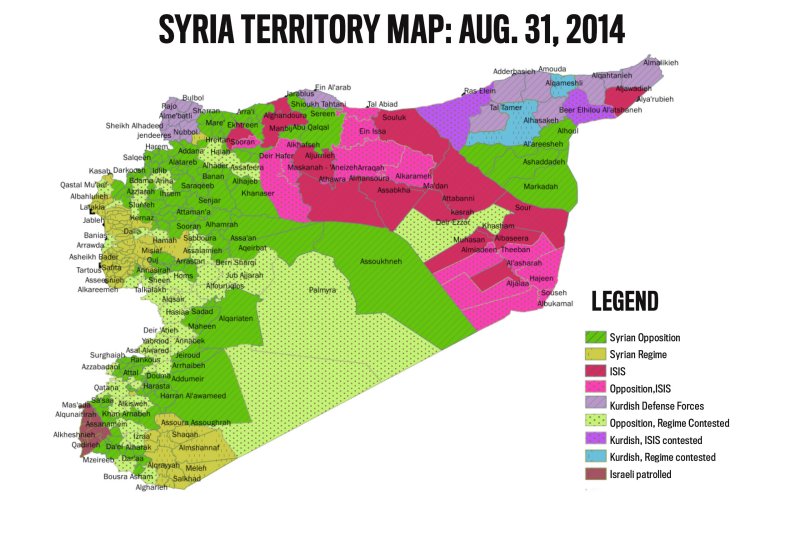
ISIS continues to gain substantial ground in Syria, despite nearly 800 airstrikes in the American-led campaign to break its grip there.At least one-third of the country’s territory is now under ISIS influence, with recent gains in rural areas that can serve as a conduit to major cities that the so-called Islamic State hopes to eventually claim as part of its caliphate. Meanwhile, the Islamic extremist group does not appear to have suffered any major ground losses since the strikes began. The result is a net ground gain for ISIS, according to information compiled by two groups with on-the-ground sources.In Syria, ISIS “has not any lost any key terrain,” Jennifer Cafarella, a fellow at the Washington, D.C.-based Institute for the Study of War who studies the Syrian conflict, explained to The Daily Beast.Even U.S. military officials privately conceded to The Daily Beast that ISIS has gained ground in some areas, even as the Pentagon claims its seized territory elsewhere, largely around the northern city of Kobani. That’s been the focus of the U.S.-led campaign, and ISIS has not been able to take the town, despite its best efforts.Other than that, they are short on specifics.

1421269431538.cachedClick to Enlarge (Coalition For a Democratic Syria)

“Yes, they have gained some ground. But we have stopped their momentum,” one Pentagon official told The Daily Beast.

A map developed by the Coalition for a Democratic Syria (CDS), a Syrian-American opposition umbrella group, shows that ISIS has nearly doubled the amount of territory it controls since airstrikes began last year.

“Assessing the map, ISIS has almost doubled its territorial control in Syria. But more importantly, the number of people who now live under ISIS control has also increased substantially,” CDS political adviser Mouaz Moustafa said.

With the fall of that much territory into ISIS hands, Syrians who once lived in ungoverned or rebel held areas are now under ISIS’s grip. Of course, in an irregular war like this one, control of people is far more important than control of territory. In that regard, too, things appear to be going in the wrong direction.

In the first two months following American airstrikes, about a million Syrians who had previously lived in areas controlled by moderates now lived in areas controlled by extremist groups al Nusra or ISIS, according to CDS, citing conversations with European diplomats who support the Syrian opposition.

The area of ISIS’s expansion includes large segments of the Homs Desert, which begins far south of the contested northern city of Aleppo. It stretches below the presumed capital of ISIS in Syria, Raqqa, and all the way to the Iraqi border. It is largely rural and not an area that ISIS has had to fight for. Rather the group took control of uncontested parts of the countryside while skirting key regime strongholds in the area, Cafarella said.

But that does not mean that land is not valuable to ISIS. That newly acquired terrain allows ISIS troops to target and threaten more valuable areas, Cafarella said.

Since the U.S. campaign began in August, “there are little buds of ISIS control in eastern Homs, al Qalamoun [which borders northern Lebanon], and southern Damascus that do appear to be growing because of that freedom of operation that can connect those western cells to key ISIS terrains in Raqqa and Deir ez Zour” in northern and eastern Syria.

Moustafa, the CDS political adviser, blamed ISIS territorial gains on a lack of “strategic coordination between coalition strikes and moderate forces inside Syria, meaning that the Free Syrian Army and aligned groups cannot use the strikes to retake territory.” Further, Moustafa told The Daily Beast, coalition strikes have given other extremist groups sympathy for ISIS.

One frustration of the Syrian opposition groups is that the bombing campaign has been focused at the heart of ISIS controlled territory, rather than at the front lines, where ISIS territorial gains could be pushed back.

“The coalition strikes seem similar to drone campaigns in Yemen or Pakistan, targeting only leadership. The front-line strength of ISIS has undoubtedly increased even as some of these targeted strikes take out mid-level individual leaders,” Moustafa said.

As of Sunday, the U.S. and its coalition partners had conducted 790 airstrikes in Syria, according to Pentagon statistics. In all, the U.S. has spent $1.2 billion on its campaign against ISIS in Iraq and Syria.

In its public comments, the U.S. military has said repeatedly the effort against ISIS is on the right track. However it often does this by conflating its war in Iraq and Syria. Ask a question about what is happening in Syria, and U.S. officials will stress that ISIS has not gained ground in Iraq. Ask if the U.S. effort is working in Syria, and the military often points to the fact that ISIS has failed to take control of Kobani.

During a Jan. 6 press briefing, for example, when a reporter asked “where ISIS’s relative strength is right now,” Navy Rear Adm. John Kirby replied by talking exclusively about the U.S. effort in Iraq, naming cities were the military believed ISIS’s momentum has been “halted.”

When the reporter pressed for an answer on what was happening in Syria, Kirby struggled, saying, “I couldn’t give you a—a specific point at which, you know, we believe, well geez, we’ve halted their momentum. It—it’s come slowly, in various stages. But I think it’s safe to say that over the last three to four weeks, we—we’ve been confident that that momentum has largely been blunted.”

On Friday, Kirby proclaimed that ISIS had lost 700 square kilometers since the campaign began—over half the size of New York City or about four times the size of the District of Columbia. But the Pentagon spokesman could not say what percentage that area marked of total ISIS-controlled land. Nor could he say if that loss was in Iraq, Syria, or combined in both nations. As Kirby asserted: “I’m frankly not sure how relevant that is. I mean, it’s—they have less ground now than they did before. They’re trying to defend what ground that they have. They’re not going on the offense much, and they’re really trying to preserve their own oxygen.”

1421269455425.cachedClick to Enlarge (Coalition For a Democratic Syria)

The American military has not been able to take full advantage of the difficulties ISIS is facing. A worldwide drop in oil prices threatens the recently declared state’s ability to raise revenue, while declining standards in public services, distribution of aid, and provision of electricity threaten to undercut the group’s support across the territories it controls. ISIS has also not been able to follow through on its military quest to challenge the Iraqi government all the way to Baghdad.

The U.S. military stressed it is waging an “Iraq first” war, that is focused on eliminating ISIS from that country first. There, the U.S. can turn to Iraqi troops on the ground to assess its efforts. But there is no equivalent resource on the ground in Syria. Perhaps because of that, the U.S. military has offered a far more detailed assessment of the air campaign in Iraq than the one in Syria.

The Combined Joint Task Force in charge of the American air campaign refused to answer a Daily Beast query about ISIS gains in Syria, even as it striking targets there. U.S. Central Command replied, “As a matter of policy we do not discuss intelligence issues.”

Information on the maps:

The maps provided by the Coalition for a Democratic Syria show the areas controlled by moderate Syrian rebels, the Syrian regime, ISIS, Syrian al Qaeda affiliate al Nusra, as well as territories contested by these groups. The maps were developed by a field team from the Coalition for a Democratic Syria (CDS), an umbrella group of Syrian American organizations. The maps were sourced through on-the-ground networks including civilian councils, humanitarian organizations, armed actors, and media monitoring of independent Syrian channels.

Erdogan’s Egyptian Nightmare

December 30, 2014

Erdogan’s Egyptian Nightmare, The Gatestone InstituteBurak Bekdil, December 30,2014

Erdogan was happy. At least until a few days ago….

Erdogan probably did not know the Emir of Qatar’s next move on the Middle Eastern chessboard.

Turkey aspires to be a regional leader with no, little or problematic dialogue with about a dozen countries in its region.

Back in 2011, everything ostensibly was coming up roses between Turkey and Egypt. In a speech that year, then-Turkish President Abdullah Gul mentioned “…an axis of democracy of the two biggest nations in our region [Turkey and Egypt], from the north to the south, from the Black Sea down to the Nile Valley…”

In September 2011, then-Prime Minister [now President] Recep Tayyip Erdogan found an emotional hero’s welcome at Cairo’s Tahrir Square. Tens of thousands of Egyptians had flocked to the Cairo airport to welcome him. Streets were decorated with posters of Erdogan.

In early 2012, a survey by TESEV, a Turkish think-tank, found that Turkey was the most popular country for the residents of seven Arab countries, including Egypt.

But against that glittering backdrop, this author wrote in June 2011: “For Ankara, Cairo can be the new Damascus until another capital becomes the new Cairo. At that time, Syrian President Bashar al-Assad, Erdogan’s one-time best regional ally, had already become his worst regional nemesis.

The Turkish-Egyptian love affair would, in fact, be quite short-lived.

In August 2013, about a month after General Abdel Fattah el-Sisi in Egypt toppled the Muslim Brotherhood rule of President Mohammed Morsi, Erdogan appeared on TV, reading — in an unusually soft voice — a letter by the Muslim Brotherhood’s Mohamed al-Beltagy. The letter was written to Beltagy’s daughter Asmaa, a 17-year-old girl, who had been killed in Cairo when security forces stormed two protest camps occupied by supporters of the deposed president. Poor Asmaa had been shot in the chest and back.

“I believe you have been loyal to your commitment to God, and He has been to you,” her father wrote in the letter. “Otherwise, He would not have called you to His presence before me.” Erdogan’s tears were visible.

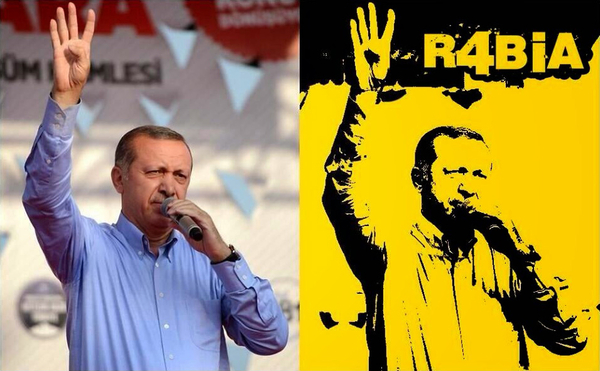
Later, Asmaa became another symbol for Turkish Islamists; Erdogan cheered party fans with the four-finger “Rabia” sign, in reference to his solidarity with the Muslim Brotherhood, and as a sign of his endearment for the unfortunate girl. Even on the playing field, a few footballers made the same sign after scoring.

859In this image, widely circulated in social media, Turkey’s then-Prime Minister [now President] Recep Tayyip Erdogan flashes the Egyptian Muslim Brotherhood’s four-fingered “Rabia” sign.

After the coup in Egypt, when el-Sisi ran for president and won the elections, Turkey’s Erdogan declared them “null and void.” And not just that. Erdogan also said that he did not view el-Sisi as “president of Egypt.” At another time, he said, “Turkey would not recognize the coup regime in Egypt.” Last July, he called el-Sisi “an illegitimate tyrant” and a “coup-maker.”

Meanwhile, neither was Erdogan a “rock star” in Cairo nor was Turkey “the most popular country.” Egyptian non-governmental organizations [NGOs] called on Egyptians and Arabs to boycott Turkish goods and soap operas. Egypt’s intellectuals, writers and businessmen were recommending a break in Egypt’s relations with Turkey because “they were disappointed.” Egypt unilaterally cancelled both visa-free travel for Turkish citizens and a transit agreement for Turkish trucks.

In the anti-el-Sisi campaign, Turkey was not alone. Its only regional ally, Qatar, fully supported Turkey against Egypt’s elected “coup leader.” Erdogan was happy. At least until a few days ago….

In Ankara, Erdogan was all smiles when he offered a red-carpet ceremony to the visiting Qatari Emir Sheikh Tamim bin Hamad al-Thani. Happy to have his best ally as a guest, Erdogan probably did not know the Emir’s next move on the Middle Eastern chessboard.

A few days after al-Thani’s merry visit to Ankara, Qatar announced its determination to thaw ties with Egypt, ending its alliance with Turkey over “Egypt’s illegitimate tyrant.”

“The security of Egypt is important for the security of Qatar … the two countries are linked by deep and fraternal ties,” ran a statement from the office of al-Thani on Dec. 21. It was a real cold shower on Ankara — and Erdogan. The statement had come one day after el-Sisi met in Cairo with a Qatari envoy, suggesting a possible thaw in relations. After the meeting, el-Sisi’s office issued a statement saying, “Egypt looks forward to a new era that ends past disagreements.” Apparently, the Egyptian-Qatari reconciliation had been brokered by Saudi Arabia and, once again, Turkey was the odd one out.

In its immediate vicinity, Turkey does not have diplomatic relations with three countries — Armenia, Cyprus and Syria — and has deeply problematic diplomatic relations with two countries: Israel and Egypt. This situation is not sustainable.

Even Deputy Prime Minister Bulent Arinc has said that Turkey should repair its relations with Egypt. But this is not an easy task. In the unlikely event of a reconciliation, Erdogan’s previous big words on el-Sisi the coup-maker will make him look like a leader shaking hands with an “illegitimate tyrant.”

On Dec. 24, Turkey’s foreign ministry spokesman said that bilateral ties with Egypt could “normalize if the country properly returns to democracy, if the Egyptian people’s free will is reflected in politics and social life.” Meaning, no normalization. The spokesman would not comment on Qatar’s policy change on Egypt.

Turkey aspires to be a regional leader with no, little or problematic dialogue with about a dozen countries in its region. Erdogan’s top advisors have found a nice euphemism for this situation: “precious loneliness.” In reality, it is rather a blend of miscalculation and over self-confidence.