Posted tagged ‘Syria’

Dispatch from Iraq: the Stealth Iranian Takeover Becomes Clear

August 1, 2015

Dispatch from Iraq: the Stealth Iranian Takeover Becomes Clear, PJ Media via Middle East Forum, Jonathan Spyer, July 31, 2015

1484A Shi’a militia billboard in Baghdad

Close observation of the militias, their activities, and their links to Tehran is invaluable in understanding what is likely to happen in the Middle East following the conclusion of the nuclear agreement between the P5 + 1 powers and Tehran.

The genius of the Iranian method is that it is not possible to locate a precise point where the Iranian influence ends and the “government” begins. Everything is entwined. This pro-Iranian military and political activity depends at ground level on the successful employment and manipulation of religious fervor. This is what makes the Hashed fighters able to stand against the rival jihadis of ISIS.

The deal itself proves that Iran can continue to push down this road while paying only a minor price, so why change? Expect further manifestations of the Tehran formula in the Middle East in the period ahead.

****************

In late June, I traveled to Iraq with the purpose of investigating the role being played by the Iranian-supported Shia militias in that country.

Close observation of the militias, their activities, and their links to Tehran is invaluable in understanding what is likely to happen in the Middle East following the conclusion of the nuclear agreement between the P5 + 1 powers and Tehran.

An Iranian stealth takeover of Iraq is currently under way. Tehran’s actions in Iraq lay bare the nature of Iranian regional strategy. They show that Iran has no peers at present in the promotion of a very 21st century way of war, which combines the recruitment and manipulation of sectarian loyalties; the establishment and patient sponsoring of political and paramilitary front groups; and the engagement of these groups in irregular and clandestine warfare, all in tune with an Iran-led agenda.

With the conclusion of the nuclear deal, and thanks to the cash about to flow into Iranian coffers, the stage is now set for an exponential increase in the scale and effect of these activities across the region.

So what is going on in Iraq, and what may be learned from it?

Power in Baghdad today is effectively held by a gathering of Shia militias known as the Hashed al-Shaabi (Popular Mobilization). This initiative brings together tens of armed groups, including some very small and newly formed ones. However, its main components ought to be familiar to Americans who remember the Iraqi Shia insurgency against the U.S. in the middle of the last decade. They are: the Badr Organization, the Asaib Ahl al-Haq, the Kataeb Hizballah, and the Sarayat al-Salam (which is the new name for the Mahdi Army of Muqtada al-Sadr).

All of these are militias of long-standing. All of them are openly pro-Iranian in nature. All of them have their own well-documented links to the Iranian government and to the Revolutionary Guards Corps.

1559Shia militiamen are becoming a fixture of daily life in the Iraqi capital.

The Hashed al-Shaabi was founded on June 15, 2014, following a fatwa by venerated Iraqi Shia cleric Ali al-Sistani a day earlier. Sistani called for a limited jihad at a time when the forces of ISIS were juggernauting toward Baghdad. The militias came together, under the auspices of Quds Force kingpin Qassem Suleimani and his Iraqi right-hand man Abu Mahdi al-Muhandis.

Because of the parlous performance of the Iraqi Army, the Shia militias have become in effect the sole force standing between ISIS and the Iraqi capital.

Therein lies the source of their strength. Political power grows, as another master strategist of irregular warfare taught, from the barrel of a gun. In the case of Iraq, no instrument exists in the hands of the elected government to oppose the will of the militias. The militias, meanwhile, in their political iteration, are also part of the government.

In the course of my visit, I travelled deep into Anbar Province with fighters of the Kataeb Hizballah, reaching just eight miles from Ramadi City. I also went to Baiji, the key front to the capital’s north, accompanying fighters from the Badr Corps.

1469Asaib Ahl al-Haq fighters operating in Baiji in June

In all areas, I observed close cooperation between the militias, the army, and the federal police. The latter are essentially under the control of the militias. Mohammed Ghabban, of Badr, is the interior minister. The Interior Ministry controls the police. Badr’s leader, Hadi al-Ameri, serves as the transport minister.

In theory, the Hashd al-Shaabi committee answers to Iraqi Prime Minister Haider al Abadi. In practice, no one views the committee as playing anything other than a liaison role. The real decision-making structure for the militias’ alliance goes through Abu Mahdi al Muhandis and Hadi al-Ameri, to Qassem Suleimani, and directly on to Supreme Leader Ali Khamenei.

No one in Iraq imagines that any of these men are taking orders from Abadi, who has no armed force of his own, whose political party (Dawa) remains dominated by former Prime Minister Nouri al-Maliki and his associates, and whose government is dependent on the military protection of the Shia militias and their political support. When I interviewed al-Muhandis in Baiji, he was quite open regarding the source of the militias’ strength: “We rely on capacity and capabilities provided by the Islamic Republic of Iran.”

1482Iraqi militia leader Abu Mahdi al-Muhandis (right) with Iranian Quds Force commander Qassem Suleimani

The genius of the Iranian method is that it is not possible to locate a precise point where the Iranian influence ends and the “government” begins. Everything is entwined. This pro-Iranian military and political activity depends at ground level on the successful employment and manipulation of religious fervor. This is what makes the Hashed fighters able to stand against the rival jihadis of ISIS. Says Major General Juma’a Enad, operational commander in Salah al-Din Province: “The Hashed strong point is the spiritual side, the jihad fatwa. Like ISIS.”

So this is Tehran’s formula. The possession of a powerful state body (the IRGC’s Quds Force) whose sole raison d’etre is the creation and sponsorship of local political-military organizations to serve the Iranian interest. The existence of a population in a given country available for indoctrination and mobilization. The creation of proxy bodies and the subsequent shepherding of them to both political and military influence, with each element complementing the other. And finally, the reaping of the benefit of all this in terms of power and influence.

This formula has at the present time brought Iran domination of Lebanon and large parts of Syria, Iraq, and Yemen. Current events in Iraq form a perfect study of the application of this method, and the results it can bring. Is Iran likely to change this winning formula as a result of the sudden provision of increased monies resulting from the nuclear deal? This is certainly the hope of the authors of the agreement. It is hard to see on what it is based.

The deal itself proves that Iran can continue to push down this road while paying only a minor price, so why change? Expect further manifestations of the Tehran formula in the Middle East in the period ahead.

Hizballah presses elite Radwan Force for conquering Galilee into saving stalled Zabadani battle

August 1, 2015

Hizballah presses elite Radwan Force for conquering Galilee into saving stalled Zabadani battle, DEBKAfile, August 1,2015

New_ninja_uniforms_of_Hezbollahs_elite_forcesNew “ninja” uniforms for Hizballah’s Radwan Force

Hizballah’s elite Radwan Force was originally designed to push in from Lebanon and conquer the Israeli Galilee. DEBKAfile’s exclusive military sources report that on Thursday, July 30 Hassan Nasralla saw he had no option but to press this high-value contingent into service, to extricate the combined Hizballah-Syrian armies from their month-long failure to recapture the key town of Zabadani – or even breach the defenses set up by the Al-Qaeda affiliated rebel Nusra Front.

This standoff with heavy casualties over the key town, which commands the main Damascus-Beirut highway, has become a symbolic make-or-break duel between the Iran-backed Shiite Hizballah and Al Qaeda’s Sunni Nusra Front. Nasrallah loses it at the cost of his organization’s credibility as a formidable fighting force.

Defeat would make western Damascus and eastern Lebanon more vulnerable to attack. And for Iran’s Lebanese proxy, it would leave an embarrassing question hanging in the air: If Hizballah under Iranian command combined with Syrian troops and backed by heavy artillery fire and air strikes can’t win a relatively small battle against no more than 1,200 rebel fighters across a nine-km square battleground, how much are its leaders’ boasts worth when they claim unbeatable prowess for winning major battles, including a war on Israel?

To save face in this landmark showdown, Hizballah decided to press into battle its most prestigious unit, named for Al-Hajj Radwan, the nom de guerre of Hizballah’s renowned military chief Imad Mughniye, whom Israel took out in February 2008.

Eight months ago, the Radwan Force lost its senior commanders. An Israeli air strike on Jan. 18 targeted a group of high Iranian and Hizballah officers on a visit to Quneitra on the Syrian Golan. They were surveying the terrain before relocating this elite unit to confront IDF positions on the Israeli Golan border. Iranian Gen. Ali Reza al-Tabatabai and the Hizballah district commander Jihad Mughniye (son of Imad) lost their lives in the Israeli raid and the plan was provisionally set aside.

If the Radwan Force manages to haul Hizballah out of its impasse in Zabadani, it may next be assigned to take up battle positions on the Golan.

But for now, its mission in the battle for Zabadani has three dimensions:

1.  To disarm the enemy by commando raids, a tactic to be borrowed from the rebels defending the town. On the night of July 24, the rebels preemptively struck Hizballah and Syrian army positions around the town and captured some of them. The decision to deploy Radwan appears to have come in response to that painful setback.

2.  To pull off a quick battlefield success at Zabadani, in view of intelligence reports that the Nusra Front and the Islamic State of Iraq and the Levant in northern Syria were preparing together to open a second front in Lebanon, in order to relieve the rebel force pinned down in Zabadani.

The two groups plan to cross into Lebanon and start attacking pro-Hizballah Shiite populations in the Beqaa Valley and the North. They propose to cut through the Bequaa Valley and head up to the important northern Lebanese city of Tripoli on the Mediterranean coast.

3.  Syrian President Bashar Asad is under extreme pressure for a battlefield success after admitting in a public speech last week to the loss of strategic territory to rebel forces and shrinking military manpower. He has earmarked a Zabadani victory – both as a turning-point for his flagging fortunes and for holding back the constant draining of his army by desertions and defections.

Our military sources reveal that, after Assad leaned hard on the Lebanese government and army to round up Syrian troops who went AWOL, Lebanese security forces went into action. They are picking up Syrian army deserters and putting them on buses driving in armored convoys into Syria. It doesn’t take much imagination to conjure up the fate of these unwilling returnees.

Reality versus Fantasy – Obama’s Proxy War In Syria

July 2, 2015

Reality versus Fantasy – Obama’s Proxy War In Syria

Author

By Eddie Pedersen — Bio and Archives July 2, 2015

via Reality versus Fantasy – Obama’s Proxy War In Syria.

Funding alleged Freedom Fighters aka Magical Fighters who historically fall prey to swapping allegiances increase the risk of genocide to astronomical proportions, unwarranted

The Kurdish people are fighting our terrorist enemies and losing their lives in the process, and it’s not just men, 30% of Kurdish fighters are now female fighters, who can never be captured alive.  Think about that the next time you can’t find a shopping cart at the local grocery store.  Think about it when you’re grilling hot dogs and burgers this Fourth of July, or when you hear the national anthem this weekend.  These men and women fight in your place.  Think about what you have done for them.

Of course Turkey is making a bundle off of this Syrian proxy war, monies from the USA and concerned European nations are pouring into Turkish President Erdogan’s hands, and Ankara’s political big wigs don’t want the cash to stop flowing.  But for now, the Kurds have warned Erdogan to stay the hell out of their Syrian affairs, because they are too busy killing the real terrorists to be bothered with Erdogan’s vendetta against Assad.  And the Kurds should get away with saying it too.  Not surprisingly, Turkey is upset because the Kurds are expanding their grip on the border, therefore they are able to secure and shut down supply routes from Turkey to the alleged freedom fighters in Syria, while strengthening Kurdish power in Syria.

Arresting the flow of enemy arms into a hot shooting war is a good idea.  If our administration was really interested in human rights and human suffering they would be compelled to stop funneling arms into the hands of Syria’s alleged freedom fighters.  Remember how the libs always love to say, ‘oh, if it just saved one life, just one single life then it would all be worth it’.  Remember that about Iraq?  Now the tables are turned and our administration is funneling in arms to alleged Freedom Fighters.  Funneling arms and monies into the hands of alleged Freedom Fighters who have pledged allegiances to the same terrorists the Kurds are fighting.  And it’s killing their Kurdish brethren not to mention Syrian civilians who are dying by the thousands.

Freedom fighters aka Magical fighters

On to the Magical Fighters!  First, to contrast things, we have two articles, just released into cyberspace: First one is titled Syria’s Kurds Warn Turkey Not to Intervene Militarily, and then there is example B, the Obama administration, U.S. Defense Secretary says, that he won’t speed up the training of Syrian Freedom Fighters thereby lowering their abilities.  Freedom fighters who have sworn allegiances to known terrorist factions in Syria we ask?  They don’t shoot at the terrorists yet sometimes they do?  But of course they always shoot at Assad, who protects the Syrian Christians plus other rare and interesting people endemic to this quaint region of the globe.  Come on, what is that?  Freedom from reality?  Are these magical fighters who operate in total submission to an administration in a far away distant capitol?  Yet we’re all supposed to believe these magical fighters will somehow make a significant difference.  A difference worth losing Kurdish fighters to bullets and arms American tax dollars paid for?  At some point we must say, this has gone on long enough, put an end to the lunacy.

To further pontificate.  The world’s population see the Kurdish people making startlingly significant gains in an anti terror war by cutting enemy supply lines; and their “reward” is they are now being threatened by a thug, Turkey’s Erdogan, because the Kurds dare cutting off highly profitable supply lines to these alleged Magical Fighters who attack Assad in conjunction with the enemies that they (the Kurds) are fighting right now, aka Islamic terror!  See the problem here?  The reality is this self destructive Kurdish self sacrifice is being demanded because of this administration’s pipe dream fantasies.  Thusly the Kurds, who are actually killing the enemies of humanity (Islamic terror), are being threatened by a Muslim brotherhood thug (Erdogan) because they (the Kurds) are cutting off supply lines for Erdogan and our administration’s outlandish fanatical obsession with killing Assad.

So somehow the Kurds are supposed to allow arms into the hands of alleged Freedom Fighters who have sworn allegiances with the terrorists because these alleged Magical Fighters say they will only shoot in Assad’s direction?  And not let their arms fall into the hands of terrorists who would definitely turn the gun barrels and rocket launchers towards Kurdish held areas?  These are all the assurances we get?  Remember, real people are fighting these terrorist monsters and dying, Kurdish men and women die daily, and to make matters worse this is a hideously ugly Islamic war being fought against Daesh monsters who do the most horrific things to the people they capture.  This isn’t a nice squeaky clean Geneva convention conflict.  Kurdish women really do carry the last bullet for themselves and in some cases have had to actually use it.  This particular war will be long remembered as an incredibly ugly and notoriously dark chapter in human history.  You can rest assured of that.

Arresting the flow of enemy arms into a hot shooting war is a good idea

Once again, in a hot shooting war it’s a good idea to starve the bad guys of weapons while funneling superior weaponry into the hands of those who are fighting in our stead.  Our Administration has let their ambition get the better of them in that weapons being funneled into a region known for factions allegiances changing overnight puts thousands of civilians at risk and could case the loss of Kurdish fighting men and women.  Let us be crystal clear about Assad.  Yes, Assad has done some really bad things, everybody knows that.  Yet he protects Syria’s Christians who are just one faction amongst many rare and unique peoples in Syria, and Assad supports a secular society, yet he has used gas in the past.  And it is here where we come down to the hard realities of this whole nightmare.  Hard realities beget hard problems that demand the harshest remedies.  And the realities in the region aren’t this Zinn and Chomsky blame-America-First alternate reality, but the one true reality,  which is that Assad, like him or not, his Syrian dilemma is incredibly similar to Muammar Gadhafi and the collapse of Libya.  It is a dramatically yet eerily similar situation, only it is happening in a completely different country.  So hear our warning now, pull the keystone out of this particular arch and an entire nation comes crashing down in genocidal ruins.  This is the reality, not some alternate reality, where the Freedom Fighters turn into Magical Fighters and defeat Assad then plant their magical flag in Damascus and the Terrorists all go away!  Just like the comic books!  Please, Washington, get a grip, come on, people. This isn’t that hard a thing to figure out, if we can do it, then our government should be able to do it too.

We are subjected to an endless Assad obsession

Time and time again we think ‘what the heck is it with the obsession to oust Assad’.  Is it that Obama once said he would (and like his promise to pull out of Iraq) topple Assad regardless of the consequences?  Is that it?  Is it petro dollars being fueled into this horrible specter shooting war to oust Assad and build the Islamic pipeline?  Is that it?  Is it oil rich checkerboard Arabic states?  Is it them?  Are they the ones fueling the west’s fantasy that they can oust Assad and then become billionaires by investing in the mega Islamic oil and natural gas pipeline that would surely be constructed?  Is it being done to further cripple Russia by breaking their grip on European fossil fuel markets?  Is it a vendetta, pure hatred or blind ambition and greed?  What compels one to funnel in vast amounts of arms and money into the hands of deserters and insurrectionists who can change allegiances overnight?  Many put it up to man’s vanity.  Some say it’s being done because it serves the egos that fuel their oppositional defiant disorder.  But the overarching reality remains, people are needlessly dying because of it.  This policy could touch off the worst genocide of the new millennium.  With America’s Magical Fighters being the catalyst, all   preventable.

Putin Proposes New Coalition to Fight Islamic State

June 30, 2015

Putin Proposes New Coalition to Fight Islamic State

Putin’s initiative comes after the failure of the U.S.-led airstrikes to dislodge Islamic State from its Syrian and Iraqi strongholds

Mike Wheatley

via Putin Proposes New Coalition to Fight Islamic State.


President Vladimir Putin has reaffirmed Russia’s support of the Syrian government following a meeting with its Foreign Minister Walid Muallem yesterday, TASS reported.

Speaking to journalists after the talks, Putin acknowledged the Islamic State terrorist group remains the biggest threat in the region, and said Syria must unite with neighboring countries in order to combat it. He added that Russia was ready to facilitate dialogue between countries in the region.

“We believe that in order to effectively combat terrorism and extremist radicalism, it is necessary for all countries in the region to unite their efforts,” Putin said.

The president said that Moscow’s contacts with the countries in the region, including with Turkey and Saudi Arabia, “showed that everyone wants to contribute to fight this evil,” referring to the Islamic State.

He exhorted all nations in the region, whatever their relations with Syria are, to “pool their efforts together” to fight the Islamic militants. “In this regard, we call on all of our friends, including Syria, to do everything they can to establish constructive dialogue with all concerned countries in the fight against terrorism,” Putin said.

The president admitted that creating a coalition to fight the Islamic State would not be an easy task, given the differences that exist between the countries on the frontline of the war. But he said, “if the Syrian leadership considers it appropriate and feasible, we will do everything to support you. That means using our good relations with all countries in the region to try and create such a coalition.”

The odds may be against that happening, but Putin’s comments show that Russia recognizes the reality that U.S.-led airstrikes against Islamic State have largely failed to make a dent in it. As such, any serious effort to defeat Islamic State clearly needs to involve the Syrian government and its military, which along with the Kurds is one of the few effective forces ranged against it on the ground.

Putin added that Russia’s “policy to support Syria, the Syrian leadership and the Syrian people remains unchanged.

For his part, Syria’s Muallem told reporters he had been given assurances that “Russia will continue to help Syria politically, economically and militarily.”

Moscow’s show of support for the embattled Syrian government comes just days after the European Union voted to extend sanctions against Russia for another six months, and once again illustrates its determination to lead an independent foreign policy no matter how much pressure its rivals apply.

Turkey Plans to Invade Syria, But to Stop the Kurds, Not ISIS

June 29, 2015

Turkey Plans to Invade Syria, But to Stop the Kurds, Not ISIS

The Turkish military is not enthusiastic and Washington may have its doubts, but President Erdogan appears determined to set up a buffer zone.

via Turkey Plans to Invade Syria, But to Stop the Kurds, Not ISIS – The Daily Beast.

The Turkish military is not enthusiastic and Washington may have its doubts, but President Erdogan appears determined to set up a buffer zone.
ISTANBUL—Turkey’s President Recep Tayyip Erdogan is planning a military intervention into northern Syria to prevent Syrian Kurds from forming their own state there, despite concerns among his own generals and possible criticism from Washington and other NATO allies, according to reports in both pro- and anti-government media.

In a speech last Friday, Erdogan vowed that Turkey would not accept a move by Syrian Kurds to set up their own state in Syria following gains by Kurdish fighters against the so-called Islamic State, or ISIS, in recent weeks. “I am saying this to the whole world: We will never allow the establishment of a state on our southern border in the north of Syria,” Erdogan said. “We will continue our fight in that respect whatever the cost may be.” He accused Syrian Kurds of ethnic cleansing in Syrian areas under their control.

Following the speech, several news outlets reported that the president and Prime Minister Ahmet Davutoglu had decided to send the Turkish army into Syria, a hugely significant move by NATO’s second biggest fighting force after the U.S. military.  Both the daily Yeni Safak, a mouthpiece of the government, and the newspaper Sozcu, which is among Erdogan’s fiercest critics, ran stories saying the Turkish Army had received orders to send soldiers over the border. Several other media had similar stories, all quoting unnamed sources in Ankara. There has been no official confirmation or denial by the government.

The government refused to comment on the reports. Foreign Minister Mevlut Cavusoglu said “the necessary statement” would be issued after a regular meeting of the National Security Council, which comprises the president, the government and military leaders, this Tuesday.

The reports said up to 18,000 soldiers would be deployed to take over and hold a strip of territory up to 30 kilometers deep and 100 kilometers long that currently is held by ISIS. It stretches from close to the Kurdish-controlled city of Kobani in the east to an area further west held by the pro-Western Free Syrian Army (FSA) and other rebel groups, beginning around the town of Mare. This “Mare Line,” as the press calls it, is to be secured with ground troops, artillery and air cover, the reports said. Yeni Safak reported preparations were due to be finalized by next Friday.

There has been speculation about a Turkish military intervention ever since the Syrian conflict began in 2011. Ankara has asked the United Nations and its Western allies to give the green light to create a buffer zone and a no-fly area inside Syria in order to prevent chaos along the Turkish border and to help refugees on Syrian soil before they cross over into Turkey. But the Turkish request has fallen on deaf ears.

The latest reports fit Erdogan’s statement on Friday and the government position regarding recent gains by Syrian Kurds against the Islamic State. The Syrian Kurdish party PYD and its armed wing YPG, affiliates of the Turkish-Kurdish rebel group PKK, have secured a long band of territory in northern Syria from the Syrian-Iraqi border in the east to Kobani.

Ankara is concerned that the Kurds will now turn their attention to the area west of Kobani and towards Mare to link up with the Kurdish area of Afrin, thereby connecting all Kurdish areas in Syria along the border with Turkey. Erdogan expects that the Syrian Kurds, whose advance against ISIS has been helped by airstrikes from the U.S.-led coalition, will go on to form their own state as Syria disintegrates after more than four years of war.

PYD leader Saleh Muslim denied that Syria’s Kurds intend to do this.

But Turkey’s leaders are not convinced that is true. The daily Hurriyet reported Erdogan and Davutoglu wanted to “kill two birds with one stone” with a military intervention along the Mare Line. One aim would be to drive ISIS away from the Turkish border, depriving the jihadists of their last foothold on the frontier and thereby cutting off supply lines. Such a move would tie in with the U.S. strategy to contain and weaken ISIS.

A second goal of the operation would be closer to Ankara’s own interests. The English-language Hurriyet Daily News quoted one source saying there was a need to  “prevent the PYD from taking full control over the Turkish-Syrian border,” and also to create a zone on Syrian territory rather than in Turkey to take in new waves of refugees.

But the military is reluctant, the reports said. Generals told the government that Turkish troops could come up against ISIS, Kurds and Syrian government troops and get drawn into the Syrian quagmire. Retaliation attacks by ISIS and Kurdish militants on Turkish territory are another concern.

Finally, the soldiers pointed to the international dimension. The military leadership told the government that the international community might get the impression that Turkey’s intervention was directed against Syria’s Kurds, the newspaper Haberturk reported.

Turkey’s NATO partners, some of whom have deployed troops operating Patriot missile defense units near the Syrian border to shield member country Turkey against possible attacks from Syria, are unlikely to be happy with a Turkish intervention.

Turkey’s pro-government press insisted there were no tensions between civilian and military leaders in Ankara. “If the government says ‘go,’ we will go in,” the pro-Erdogan daily Aksam wrote, attempting to sum up the military’s stance in a headline.

On Sunday, fighting broke out between ISIS troops and FSA units near the town of Azaz, close to the Turkish border crossing of Oncupinar. News reports said ISIS was trying to bring the Syrian side of the border crossing under its control. The area of the latest clashes lies within the “Mare Line” cited as the possible location of a Turkish incursion.

Israeli and Syrian Druze join forces – complicating Israel’s military position vis-à-vis southern Syria

June 23, 2015

Israeli and Syrian Druze join forces – complicating Israel’s military position vis-à-vis southern Syria, DEBKAfile, June 23, 2015

Druze_celebrations_21.6.15Druze celebrate ambulance attacks

Even if Druze tempers are temporarily calmed over the fate of their Syrian brethren, the fallout from the Syrian civil war has already spilled over into Israel from an unexpected quarter. For nearly five years, Israel carefully kept its hands off the conflict raging on its northern border, restricting itself to responding ad hoc to dangers and building a quiet aid mechanism for selected Syrian rebels. But in recent months, Israel has re-channeled its military intervention into areas close to its border.

The way this involvement is disavowed by Israeli officials is seriously detrimental to the government’s military credibility.

When IDF spokesman Brig. Motti Almoz reiterated past statemants that the military does not identify or assort by organization the injured Syrian rebels reaching the Israeli Golan border for treatment, he found that the Druze serving in Israel’s armed forces and those living in Golan villages knew better. Israeli Druze and Golan villagers – many loyal to Bashar Assad – were so incensed by this and past evasions that they came together for violent action – hence the attacks Monday, June 22, on two IDF ambulances ferrying injured Syrian rebel fighters to hospital.

After the first ambulance was attacked, the second should have been much better secured. It turned out that the military police escorting it were not up to fighting a raging Druze lynch mob outside Majdal Shams on the Golan. The Syrians were badly beaten up and one died later.

Israeli and Golan Druze have found a common cause, in itself a destabilizing factor, in the conviction that Israel is aiding the Syrian Al Qaeda arm, the Nusra Front, although some of the information from South Syria is disinformation slanted by hostile elements for stirring up trouble for Israel.

The thousand-year old secretive sect is treated as heretic by jihadis, including the Nusra Front. When a rebel alliance neared Jabal Druze in Syria, Nusra leaders promised not to harm the Druze provided that they “retreat from their religious mistakes.” They then forced several hundred Druze to convert to Sunni Islam and desecrated their shrines.

Nusra Front is therefore a red flag for the Druze bull

This is just one more complicating factor in considering the ill-defined, fractious rebel alliance fighting in South Syria across from the Israeli Golan.

Israeli protestations that it doesn’t support Al Qaeda-linked rebels may hold true one day, while the next day, that same group may break up and join a jihadi faction. Some of them are constantly on the move in and out of Al Qaeda.

Saudi Arabia ran up against this phenomenon in recent weeks when it bought and armed 3,000 Nusra Front fighters on condition that they leave their group and join up under an umbrella anti-Assad rebel front called the Southern Front, or the Southern Army of Conquest.

The Saudi step relieved Israel of charges of supporting jihadi movements. But it was no means let off the hook as far as the Druze were concerned, because of the notoriously volatile nature of the rebel movement.

Most of Nusra’s commanders did indeed repudiate their allegiance to Al Qaeda to win Saudi backing, but they soon switched back after Nusra in the north spearheaded major rebel victories. Clearly, victorious groups hold a fatal attraction for the hundreds of hazy rebel factions

The Druze demand for Israel to abandon the Nusra Front is tantamount to its repudiating the Syrian rebel cause at large. For the IDF this is a non-option: Ditching its under-the-radar links with certain Syrian rebel groups is the recipe for ending the relative calm on its Golan border with Syria. And withdrawing from its cooperation with the US-Saudi-Jordanian backed rebel force would endanger their effort to capture southern Syria, in the same way as comparable forces attained control of most of the north.

At the same time, the Israeli government must persuade its up-in-arms Druze citizens that IDF actions in South Syria will not bring harm to their Syrian brethren. This is an uphill task that may not prevent further Druze violence.

North Korea’s Serious New Nuclear Missile Threat

June 11, 2015

North Korea’s Serious New Nuclear Missile Threat, The Gatestone InstitutePeter Huessy, June 11, 2015

China . . . seems to want to curry favor with Iran because of its vast oil and gas supplies, as well as to use North Korea to sell and transfer nuclear technology to both North Korea and Iran, as well as other states such as Pakistan. As Reed again explains, “China has catered to the nuclear ambitions of the Iranian ayatollahs in a blatant attempt to secure an ongoing supply of oil”.

***********************

  • China continues to transfer, through its own territory, nuclear weapons technology involving both North Korea and Iran.
  • In April, North Korea launched a ballistic missile from a submerged platform. The North Korean underwater launch test was closely related to the further development of a missile-firing submarine capable of hitting the U.S. — “a first step,” according to Uzi Rubin, “in achieving a very serious and dangerous new military capability… it will take many years to build up the missile defenses, so we had better use the time wisely.”
  • Although the Chinese profess to be against nuclear proliferation, documented evidence illustrates just the opposite — as a means of asserting Chinese hegemony, complicating American security policy and undermining American influence.
  • Unfortunately, no matter how attractive a strategy of diplomatically ending North Korea’s nuclear program might look, it is painfully at odds with China’s established record of supporting nuclear proliferation with such collapsed or rogue states as Iran, Syria, Pakistan, North Korea and Libya.
  • China’s nuclear assistance to Pakistan did not stay just in Pakistan.

North Korea appears to have made significant progress in extending its capability as a nuclear-armed rogue nation, to where its missiles may become capable of hitting American cities with little or no warning.

What new evidence makes such a threat compelling?

North Korea claims to have nuclear warheads small enough to fit on their ballistic missiles andmissiles capable of being launched from a submerged platform such as a submarine.

Shortly after North Korea’s April 22, 2015 missile test, which heightened international concern about the military capabilities of North Korea, U.S. Secretary of State John Kerry urged China and our regional allies to restart the 2003 “six-party talks” aimed at eliminating nuclear weapons from the Korean peninsula and reining in North Korea’s expanding nuclear missile program.

There are some “experts,” however, who believe that North Korea’s threat is highly exaggerated and poses no immediate danger to the United States. Consequently, many believe that, given China’s oft-repeated support for a “nuclear weapons free” Korean peninsula, time is on America’s side to get an agreement that will guarantee just such a full de-nuclearization.

But, if North Korea’s technical advances are substantive, its missiles, armed with small nuclear weapons, might soon be able to reach the continental United States — not just Hawaii and Alaska. Further, if such missile threats were to come from submarines near the U.S., North Korea would be able to launch a surprise nuclear-armed missile attack on an American city. In this view, time is not on the side of the U.S. Submarine-launched missiles come without a “return address” to indicate what country or terrorist organization fired the missile.

The implications for American security do not stop there. As North Korea is Iran’s primary missile-development partner, whatever North Korea can do with its missiles and nuclear warheads, Iran will presumably be able to do as well. One can assume the arrangement is reciprocal.

Given recent warnings that North Korea may have upwards of 20 nuclear warheads, the United States seems to be facing a critical new danger. Would renewed negotiations with China, Japan, South Korea and North Korea really be able to address this threat?

Two years ago, Andrew Tarantola and Brian Barrett said there was “no reason to panic;” that North Korea was “a long way off” — in fact “years” — before its missiles and nuclear weapons could be “put together in any meaningful way.”

At the same time, in April 2013, an official U.S. assessment by the Defense Intelligence Agency stated the U.S. had “moderate” confidence that “North Korea had indeed developed a nuclear device small enough to mount on a ballistic missile.”

That was followed up two years later, on April 7, 2015, when the commander of Northcom, Admiral Bill Gortney, one of the nation’s leading homeland security defenders, said the threat was considerably more serious. He noted that, “North Korea has deployed its new road-mobile KN-08 intercontinental ballistic missile and was capable of mounting a miniaturized nuclear warhead on it.”[1]

At a Pentagon press briefing in April, Admiral Cecil Haney, Commander of the US Strategic Command and America’s senior military expert on nuclear deterrence and missile defense, said it was important to take seriously reports that North Korea can now make small nuclear warheads and put them on their ballistic missiles.[2]

And sure enough, in April, North Korea launched a ballistic missile from a submerged platform. Media reaction to the North Korean test has been confused. Reuters, citing the analysis of two German “experts,” claimed the North Korean test was fake — a not-too-clever manipulation of video images.

The Wall Street Journal, on May 21, 2015, echoed this view, noting: “[F]or evidence of North Korea’s bending of reality to drum up fears about its military prowess,” one need look no further than a consensus that North Korea “doctored” pictures of an alleged missile test from a submarine. This, they claimed, was proof that the “technology developments” by North Korea were nothing more than elaborately faked fairy tales.

However, Israeli missile defense expert Uzi Rubin — widely known as the “father” of Israel’s successful Arrow missile defense program — explained to this author that previous North Korean missile developments, which have often been dismissed as nothing more than mocked-up missiles made of plywood, actually turned out to be the real thing — findings confirmed by subsequent intelligence assessments.

Rubin, as well as the South Korean Defense Ministry, insist that on April 22, the North Korean military did, in fact, launch a missile from a submerged platform.[3]
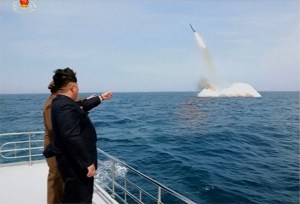
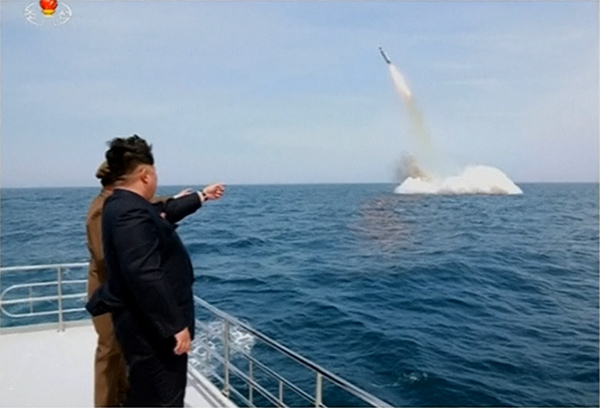
1104Kim Jong Un, the “Supreme Leader” of North Korea, supervises the April 22 test-launch of a missile from a submerged platform. (Image source: KCNA)

What gave the “faked” test story some prominence were the misunderstood remarks of the Vice Chairman of the Joint Chiefs of Staff, Admiral James Winnefeld. He had said, on May 19, that the North Korean missile launch was “not all” that North Korea said it was. He also mentioned that North Korea used clever video editors to “crop” the missile test-launch images. Apparently, that was exactly what the editors did. The Admiral, however, never claimed in his speech at the Center for Strategic and International Studies there had been no successful missile test.[4]

The same day, a high-ranking State Department official, Frank Rose — Assistant Secretary of State for Arms Control, Verification, and Compliance — told a Korean security seminar on Capitol Hill that North Korea had successfully conducted a “missile ejection” test, but from an underwater barge rather than a submarine.[5]

To confuse matters further, additional pictures were released by the South Korean media to illustrate stories about the North Korean test. Those pictures, however, were of American missiles, which use both solid and liquid propellant; as a result, one photo showed a U.S. missile with a solid propellant smoke trail and one, from a liquid propellant, without a smoke trail. These photographs apparently befuddled Reuters’ “experts,” who may have jumped to the conclusion that the photos of the North Korean test were “faked,” when they were simply of entirely different missile tests, and had been used only to “illustrate” ocean-going missile launches and not the actual North Korean test.[6]

According to Uzi Rubin, to achieve the capability to eject a missile from an underwater platform is a significant technological advancement. The accomplishment again illustrates “that rogue states such as North Korea can achieve military capabilities which pose a notable threat to the United States and its allies.”

Rubin also stated that the North Korean underwater launch test was closely related to the development of a missile-firing submarine, “a first step in achieving a very serious and dangerous new military capability.”[7]

Admiral Winnefeld and Secretary Rose, in their remarks, confirmed that the North Korean test was not the “dog and pony show” some have claimed. In other words, the U.S. government has officially confirmed that the North Koreans have made a serious step toward producing a sea-launched ballistic missile capability.

While such an operational capability may be “years away,” Rubin warns that “even many years eventually pass, and it will also take many years to build up the missile defenses, so we had better use the time wisely.”[8]

Will diplomacy succeed in stopping the North Korean threats? U.S. Secretary of State John Kerry seemed to think it worth a try; so he began the push to restart the old 2003 “six-party” talks between the United States, North Korea, Russia, China, South Korea and Japan, to bring North Korea’s nuclear weapons under some kind of international control and eventual elimination.

After all, supporters of such talks claim, similar talks with Iran appear to be leading to some kind of “deal” with Tehran, to corral its nuclear weapons program, so why not duplicate that effort and bring North Korea back into the non-nuclear fold?

What such a “deal,” if any, with Iran, will contain, is at this point unknown. Celebrations definitely seem premature. If the “deal” with North Korea is as “successful” as the P5+1’s efforts to rein in Iran’s illegal nuclear weapons program, the prognosis for the success of diplomacy could scarcely be more troubling.

Bloomberg’s defense writer, Tony Carpaccio, reflecting Washington’s conventional wisdom, recently wrote that of course China will rein in North Korea’s nuclear program: “What might be a bigger preventative will be the protestations of China, North Korea’s primary trade partner and only prominent international ally. Making China angry would put an already deeply impoverished, isolated North Korea in even more dire straits.”

Unfortunately, no matter how attractive a strategy of diplomatically ending North Korea’s nuclear program might look on the surface, it is painfully at odds with China’s established and documented track record in supporting and carrying out nuclear proliferation with such collapsed or rogue states as Iran, Syria, Pakistan, North Korea and Libya, as detailed by the 2009 book The Nuclear Express, by Tom C. Reed (former Secretary of the Air Force under President Gerald Ford and Special Assistant to the President of National Security Affairs during the Ronald Reagan administration) and Daniel Stillman (former Director of the Lawrence Livermore National Laboratory).

Far from being a potential partner in seeking a non-nuclear Korean peninsula, China, say the authors, has been and is actually actively pushing the spread of nuclear weapons to rogue states, as a means of asserting Chinese hegemony, complicating American security policy and undermining American influence.

The problem is not that China has little influence with North Korea, as China’s leadership repeatedly claims. The problem is that China has no interest in pushing North Korea away from its nuclear weapons path because the North Korean nuclear program serves China’s geostrategic purposes.

As Reed and Stillman write, “China has been using North Korea as the re-transfer point for the sale of nuclear and missile technology to Iran, Syria, Pakistan, Libya and Yemen”. They explain, “Chinese and North Korean military officers were in close communication prior to North Korea’s missile tests of 1998 and 2006”.

Thus, if China takes action to curtail North Korea’s nuclear program, China will likely be under pressure from the United States and its allies to take similar action against Iran and vice versa. China, however, seems to want to curry favor with Iran because of its vast oil and gas supplies, as well as to use North Korea to sell and transfer nuclear technology to both North Korea and Iran, as well as other states such as Pakistan. As Reed again explains, “China has catered to the nuclear ambitions of the Iranian ayatollahs in a blatant attempt to secure an ongoing supply of oil”.

North Korea is a partner with Iran in the missile and nuclear weapons development business, as Uzi Rubin has long documented. Thus, it is reasonable to believe that China may see any curtailment of North Korea’s nuclear program as also curtailing Iran’s access to the same nuclear technology being supplied by North Korea. Any curtailment would also harm the Chinese nuclear sales business to Iran and North Korea, especially if China continues to use the “North Korea to Iran route” as an indirect means of selling its own nuclear expertise and technology to Iran.

It is not as if Chinese nuclear proliferation is a recent development or a “one of a kind” activity. As far back as 1982, China gave nuclear warhead blueprints to Pakistan, according to Reed. These findings indicate that China’s nuclear weapons proliferation activities are over three decades old.[9]

Reed and Stillman also note that nearly a decade later, China tested a nuclear bomb “for Pakistan” on May 26, 1990, and that documents discovered in Libya when the George W. Bush administration shut down Libyan leader Muammar Kaddafi’s nuclear program revealed that China gave Pakistan the CHIC-4 nuclear weapon design.

Unfortunately, China’s nuclear assistance to Pakistan did not stay just in Pakistan. The nuclear technology made its way from Pakistan to North Korea. For example, high explosive craters, construction of a 50 megawatt nuclear reactor (finished in 1986) and a secret reprocessing facility begun in 1987 all were done in North Korea with major Pakistani help from the A.Q. Khan “Nukes R Us” smuggling group, as Reed and Stillman document in their book.

Reed and Stillman write that when, amid disclosures in 2003 of a major Libyan nuclear weapons program, the U.S. government sought help in shutting down the Khan nuclear smuggling ring, “Chinese authorities were totally unhelpful, to the point of stonewalling any investigation into Libya’s nuclear supply network.”

More recently, Chinese companies have now twice — in 2009 and 2011 — been indicted by the Attorney for the City of New York for trying to provide Iran with nuclear weapons technology.

The indictments document that Chinese companies were selling Iran steel for nuclear centrifuges and other banned technology. A leaked State Department cable, discussing the indictments at the time, revealed “details on China’s role as a supplier of materials for Iran’s nuclear program,” and that “China helped North Korea ship goods to Iran through Chinese airports.”

And more recently, in April 2015, the Czech government interdicted additional nuclear technology destined for Iran — the origin of which remains unknown — in violation of current sanctions against Iran.

From 1982 through at least the first part of 2015, the accumulation of documentary evidence on nuclear proliferation reveals two key facts:

First, despite literally hundreds of denials by Iran that it is seeking nuclear weapons, and amid current negotiations to end Iran’s pursuit of nuclear weapons, there is solid evidence that Iran still seeks nuclear weapons technology; and that North Korea has nuclear weapons and is advancing their capability.

Second, China continues to transfer, through its own territory, nuclear weapons technology involving both North Korea and Iran.

Although the Chinese profess to be against nuclear proliferation, their track record from the documented evidence illustrates just the opposite.

In summary, it is obvious North Korea’s nuclear weapons and ballistic missiles are a serious threat to America and its allies. And China, from its proliferation record for the past three decades, is making such a threat more widespread.

In this light, is dismissing North Korea’s advances in military technology and ignoring China’s record of advancing its neighbors’ nuclear weapons technology really best for U.S. interests?

_______________________

[1] The Washington Post, May 20, 2015, Anna Fifield, “North Korea says it has technology to make mini-nuclear weapons“; and Admiral Bill Gortney, US NORAD Commander, quoted in “NORAD commander: North Korean KN-08 Missile Operational“, by Jon Harper, in “Stars and Stripes”, of April 7, 2015; the Admiral said: “Our assessment is that they have the ability to put a nuclear weapon on a KN-08 and shoot it at the homeland.” He said “Yes sir” when asked if the U.S. thinks North Korea has succeeded in the complicated task of miniaturizing a warhead for use on such a missile. North Korea has conducted three nuclear tests since 2006.

[2] Department of Defense Press Briefing by Admiral Cecil Haney, Commander, U.S. Strategic Command, March 24, 2015.

[3] Personal communication with Uzi Rubin, President of Rubincon, May 21, 2015.

[4] Admiral James Winnefeld, Remarks at the Center for Strategic and International Studies (CSIS) Briefing on Missile Defense, May 20, 2015.

[5] U.S. Department of State, Daily Digest Bulletin, Frank Rose, Remarks on “Missile Defense and the U.S. Response to the North Korean Ballistic Missile and WMD Threat”, May 20, 2015.

[6] Explanation provided by Israel missile expert Uzi Rubin, personal communication, May 20, 2015.

[7] Ibid.

[8] Ibid.

[9] According to Reed and Stillman, in “The Nuclear Express,” none of China’s nuclear help to Pakistan and Iran could have been possible without China’s transfer of the nuclear technology through Chinese airspace.

Israel’s Druze dilemma: To arm imperiled Syrian Druze community or open door to a flood of refugees

June 11, 2015

Israel’s Druze dilemma: To arm imperiled Syrian Druze community or open door to a flood of refugees, DEBKAfile, June 11, 2015

Druze_MilitiaSyrian Druze militiaman

Israel has a unique, historic commitment to its Druze citizens and so the dangers besetting more than half a million of their Syrian brethren on Jabal Druze, 88 km from its border, and 38 km from Jordan, confronts the Netanyahu government with a grave dilemma. Israeli Druze leaders are pressing the government to provide Jabal Druze towns and villages with weapons for their defense against the enemies closing in on them: The Syrian-Hizballah army; the Syrian opposition coalition including the Nusra Front – now in control of large parts of southern Syria; and the Islamic State of Iraq and the Levant – ISIS, which has sent a small force up to the eastern approaches to the mountain.

At a reception for the visiting Chairman of the Joint US Chiefs of Staff, Gen. Martin Dempsey Wednesday, June 10, President Reuven Rivlin said: What is going on just now is intimidation and threat to the very existence of half a million Druze on the Druze Mount, which is very close to the Israeli border.”

Officials in the Pentagon denied that this issue had come up in Gen. Dempsey’s talks during his farewell visit to Israel this week, although Syria had been discussed. One official remarked: “It’s the Druze who are asking everyone to arm them. The Druze in Israel have been raising it with Israel with the US, with Jordan – everyone.”

DEBKAfile’s military sources note that this dilemma is the hardest Israel has faced since the Syrian conflict began more than four years ago. Sending arms to the Syrian Druze would mean abandoning the consistent policy of abstaining from direct involvement in that war. It would moreover entail setting up new machinery for establishing, training and arming a Druze army of 20,000 to 30,000 fighting men.

But by withholding support, Israel would make itself responsible for whatever befalls the beleaguered Syrian Druze community, including possibly mass executions by Islamic extremists for their unique faith.

Also taken into account is the proposal Tehran, Damascus and Hizballah put before the Druzes this week: to build them an army and provide it with weapons, against a pledge never to raise arms against Syrian President Bashar Assad or his troops.

No other strings were tied to the offer. The Druze army would not be given any tasks other than to defend Jabal Druze and its hundreds of small towns and villages.

Druze acceptance of Tehran’s proposition would have the effect of strengthening Iran’s hold on Damascus and weakening the Syrian opposition forces fighting in the south, with no guarantees about where this equation would end up in terms of new threats to Israeli security.

Prime Minister Binyamin Netanyahu, Defense Minister Moshe Ya’alon and IDF Chief of Staff, Lt. Gen. Gady Eisenkott, are being intensely lobbied by the leaders of Israel’s Druze community, some of them high-ranking officers in IDF and Border Police units, to come to the aid of their distressed Syrian brethren. They hold up their valuable contribution to the Jewish state’s national security as deserving of Israel’s reciprocation to step up when their community is in peril.

No one is saying this, but the awareness is there that the many Druzes serving in Israeli combat units may decide to simply cross the Golan border and take up arms in defense of Jabal Druze.

The Syria community’s plight is complicated by the sharp internal division among its leaders: One group urges taking up the Iranian offer; a second would rather join forces with the Syrian rebels; and a third, wants to stick to their long-held neutrality in the Syrian arena.

The Lebanese Druze leader Walid Jumblatt, once accepted as such by the entire community, urges Jabal Druze inhabitants to throw in their lot with the rebel groups fighting to topple Assad.

Some Druze sources claim that Israel has promised admission to any fleeing Druze reaching the Golan border fence, an assurance also offered by Jordan. This is not confirmed by any official in either government.

However, it is hard to see how Israel can bar its border if thousands of Druze refugees were to stand at the fence and demand shelter – any more than Jordan could. This may still happen – even if Jerusalem and Amman were to decide to supply the Syrian Druzes with weapons.

Syria Asks IAEA for Help Converting Nuclear Reactor

June 8, 2015

Syria Asks IAEA for Help Converting Nuclear Reactor, Jewish Press, Hana Levi JulianJune 8, 2015

The border police run an exercise, while they train for chemical , biological or atomic. warfare. Feb 14 2011.  Photo by Nati Shohat/Flash90. *** Local Caption *** îâá éøåùìéí  àéîåï àáë çìéôåú îéâåï àéîåï úéøâåì úøâéì Israeli’s Border Police training for chemical, biological, and nuclear attacks. Photo Credit: Nati Shohat / Flash 90

IAEA head Yukiya Amano told reporters Monday that Syria has told the agency it would ship the higher-grade uranium abroad.

However, it is not clear where Syria would ship the higher-grade uranium — Iran is Syria’s closest ally – and neither is it clear what grade its uranium currently is.

**********************

The regime of Syrian President Bashar al-Assad has asked the United Nations International Atomic Energy Agency for help with a nuclear reactor near Damascus, international media agencies reported Tuesday.

The UN agency is studying the Syrian request to help convert the reactor, which currently runs on highly-enriched uranium, into one that uses lower grade nuclear fuel.

IAEA head Yukiya Amano told reporters Monday that Syria has told the agency it would ship the higher-grade uranium abroad.

However, it is not clear where Syria would ship the higher-grade uranium — Iran is Syria’s closest ally – and neither is it clear what grade its uranium currently is.

Low enriched uranium is defined as that which is enriched to less than five percent of fissile purity. Weapons quality uranium is enriched above 20 percent but that which is used to fuel an atomic bomb is enriched to 90 percent.

Amano said the IAEA is studying the request and has yet to make a decision.

SHOW & TELL? Islamic State (ISIS) beheads Libyan soldier in front of school kids for ‘educational’ purposes

June 6, 2015

SHOW & TELL? Islamic State (ISIS) beheads Libyan soldier in front of school kids for ‘educational’ purposes

via SHOW & TELL? Islamic State (ISIS) beheads Libyan soldier in front of school kids for ‘educational’ purposes | BARE NAKED ISLAM.


The Islamic State (ISIS) reportedly beheaded a Libyan soldier in front of a group of six-year-olds for “educational purposes.” Supporters of ISIS posted the horrific pictures on social media.

Breitbart (h/t Mike F)  The images show a prisoner dressed in bright orange led out to the center of a floor at a mosque in Derna. Masked men with guns line up against the wall behind the captive. Men dressed in black from head to toe force the helpless man, identified as Abdulnabi al-Shargawi, to his knees before one of the barbarians takes a knife to his neck. ISIS charged the man with apostasy, which is the abandonment of Islam.

13.11

After the terrorists chop off his head, another man holds up al-Shargawi’s head as the young children gather around the body. Their faces are stone cold. Sky 105 reported that the images “surprised many” since the children “were never shocked.” But it is possible this is not the first time they witnessed a gruesome execution. ISIS is known to hold public executions and force the public to witness it. Children are often shoved to the front while fathers hold their sons on their shoulders.

0012760131-770x510

ISIS captured Derna, located on the Mediterranean Sea and 801 miles west of Tripoli, in October 2014. The terrorists retained full control of the port city by January 2015. Videos emerged of large crowds pledging “allegiance to ISIS leader Abu Bakr al Baghdadi.” The terrorists control the government and education while police cars are plastered with the ISIS insignia.

“Derna today looks identical to Raqqa, the ISIS headquarters town in Syria,” explained former jihadi Noman Benotman, who now works for the Quilliam Foundation. “ISIS pose a serious threat in Libya. They are well on the way to creating an Islamic emirate in eastern Libya.”

ISIS-beheads-Libyan-in-front-of-children-Social-Media-640x480