Posted tagged ‘Syria’

Rivlin Tells Putin Iran Must Stay Off Syrian – Israeli Border

March 17, 2016

Rivlin Tells Putin Iran Must Stay Off Syrian – Israeli Border

By: David Israel Published: March 17th, 2016

Source: The Jewish Press » » Rivlin Tells Putin Iran Must Stay Off Syrian – Israeli Border

Israeli President Reuven Rivlin (L) meets with Russian President Vladimir Putin. Photo by Mark Neyman/GPO

Israeli Presidents very rarely find themselves in a position to decide policy or negotiate with foreign powers — their role as heads of state is similar to that of the British monarchs, a symbol of government rather than the real thing. But on Wednesday President Reuven Rivlin found himself in the unexpected position of delivering a critical message to the leader of the second largest world power, President Vladimir Putin, and charting the start of a new relationship between Israel and Russia over Syria.

As the world discovered on Monday this week, President Putin announced that the war in Syria had been won and he was pulling the bulk of the Russian military contingency from the battlefield. It was a brilliant move on the part of the Russian leader, whose main achievement since the start of his involvement in Syria had been to wipe out the Western- and Saudi-funded rebels, leaving President Bashar al-Assad as the only viable alternative to the ISIS hordes. He outmaneuvered President Obama by several steps, and left Middle East leaders gasping with astonishment. This included Israel’s leadership. In fact, the original message President Rivlin was asked to deliver to Putin on his pre-scheduled state Visit Wednesday, was a call to coordinate the activities of the IDF and the Russian army in the Syrian Golan heights, along Israel’s north-eastern border.

On Monday night that message had to be scrapped and a completely new policy had to be charted on the spot, in advance of the Wednesday meeting in the Kremlin. “I felt that I was thrown into battle as the envoy of the prime minister, the defense minister and the chief of staff,” Rivlin related. His mission, outlined in a hurry on Monday night, was to draw Israel’s lines in the sand as far as the post-Russian Syrian arena was concerned.

In the end, those lines in the sand were not so hard to figure out, and Rivlin delivered the message succinctly: there will be no entry of Iranian forces into the Syrian Golan heights; there will be no transfer of advanced Russian weapons and technology into the hands of Hezbollah; there will be no Israeli retreat from the Golan heights. Those are the issues over which Israel, if pushed, would go to war.

According to reports in Israel’s media, Putin’s response was friendly and understanding — at least on the surface. He repeated his commitment to Israel’s security, if only, he joked, because so many Russians live and visit there. Putin then inquired about the steps Israel is prepared to take to advance peace with the Palestinian Arabs and President Rivlin responded with the list of efforts and gestures Israel has made since 1993 to reach peace, and promised that—short of national suicide—Israel would continue to try everything in its power to reach peace.

There will be a meeting between Putin and Prime Minister Netanyahu soon, but until then, over in Jerusalem, they appreciated Rivlin’s unscheduled relief pitching.

Russia’s ‘surprise & unexpected’ Syria withdrawal welcomed as signal of ‘true peace process’

March 15, 2016

Russia’s ‘surprise & unexpected’ Syria withdrawal welcomed as signal of ‘true peace process’

Published time: 15 Mar, 2016 04:22 Edited time: 15 Mar, 2016 13:43

Source: Russia’s ‘surprise & unexpected’ Syria withdrawal welcomed as signal of ‘true peace process’ — RT News

Global political figures have welcomed the Russian military pullout from Syria, and while many have called the Kremlin’s decision “unexpected,” it is seen as clearing the way for dialogue while a truce in the five-year-old war is negotiated in Geneva.

Acknowledging that five months of military campaigns have mostly succeeded in their primary objective of eliminating the immediate wider threat from Islamic State (IS, formerly ISIS/ISIL), President Vladimir Putin has ordered the partial withdrawal of Russian armed forces from Syria.

Read more

A Su-30 SM aircraft prepares to take off from the Hmeimim airbase in the Latakia Governorate of Syria. © Ramil Sitdikov

UN Mediator of the Syrian peace talks Staffan de Mistura said the Russian pullback would give impetus to the process. “The announcement by President Putin on the very day of the beginning of this round of Intra-Syrian Talks in Geneva is a significant development, which we hope will have a positive impact on the progress of the negotiations in Geneva aimed at achieving a political solution of the Syrian conflict and a peaceful political transition in the country,” he claimed in a statement Tuesday.

Russia has placed its strategic emphasis on establishing a diplomatic effort, with Putin instructing the Foreign Ministry to intensify Moscow’s participation in organizing the peace process to resolve the Syrian crisis, which is about to enter its sixth year.

After announcing partial Russian withdrawal, President Putin, explained to his American counterpart Barack Obama in a phone conversation that the decision will “certainly serve as a good signal to all conflicting sides and create conditions for the start of a true peace process,” the Kremlin said in a statement.

The timing of the Russian decision is crucial as vital negotiations to avert further bloodshed in Syria resumed on Monday in Geneva. The last round of negotiations collapsed in January because the opposition block refused to debate their differences as Russian air raids intensified near the northern Syrian city of Aleppo.

Obama welcomed the “much-needed reduction in violence” since the cease-fire took effect late last month, the White House said in a statement about Monday’s phone call. “The president underscored that a political transition is required to end the violence in Syria,” the White House added.

German Foreign Minister Frank-Walter Steinmeier also welcomed Moscow’s announcement saying it will put additional pressure on parties in Geneva to negotiate a peaceful transition to end the Syrian turmoil.

“This will increase the pressure on the al-Assad regime to finally and seriously negotiate a peaceful political transition in Geneva,” Steinmeier said in a statement.

The Iranian Foreign Ministry was also positive about developments.

“The fact that a semi-ceasefire has been holding in Syria is welcome news, it’s something that we’ve been asking for at least two-and-a-half, three years,” Foreign Minister Mohammad Javad Zarif said at a meeting with his Australian couterpart Julie Bishop in Canberra.

“The fact that Russia announced that it’s withdrawing part of its forces indicates that they don’t see an imminent need for resort to force in maintaining the ceasefire,” he added. “That in and of itself should be a positive sign. Now we have to wait and see.”

While Russia plans to maintain a military presence at its naval base in Tartous and the Khmeymim airbase, Moscow’s decision to reduce its military involvement in Syria has already been welcomed by the Syrian opposition currently negotiating in Geneva.

“If there is seriousness in implementing the withdrawal, it will give the talks a positive push,” said Salim al-Muslat, spokesman for the rebel High Negotiations Committee. “If this is a serious step it will form a major element of pressure on the regime, because the Russian support prolonged the regime. Matters will change significantly as a result of that.”

What is also important is that the move has been well received by all members of the UN Security Council, who have been working tirelessly on the diplomatic front to secure peace in Syria.

“We have also taken very good note of the decision by the Russians to start withdrawing part of these forces,” the Security Council’s rotating president, Angola’s Ambassador Ismael Abraao Gaspar Martins, told reporters. “When we see forces withdrawing, it means war is taking a different step. So that’s good.”

Read more

Russian President Vladimir Putin and Defense Minister Sergey Shoigu © kremlin.ru

However, despite the careful timing of Putin’s announcement that is clearly aimed at cementing the fragile ceasefire in Syria, the Kremlin’s decision has been called “a surprise move,” by the New York Times, which hypothesizes that the Russian decision was conditioned by the rift between Moscow and Damascus.

“There have been growing signs of differences between Russia and the Syrian government over the Geneva talks, which Moscow has pressed hard for along with Washington,” NYT wrote.

In reality the Russian initiative to withdraw received full support from the Syrian government before the announcement was made.

“The president of Syria noted the professionalism, courage and heroism of the Russian service personnel who took part in the military operations, and expressed his profound gratitude to Russia for providing such substantial help in fighting terrorism and providing humanitarian assistance to the civilian population,” the Kremlin said commenting on the phone call between Putin and Assad.

The Wall Street Journal has dubbed Moscow’s withdrawal an “unexpected announcement.”

“US officials said any withdrawal of Russian forces from Syria would come as a complete surprise and that the US government hadn’t expected Moscow to announce such a move,” WSJ said.

Stratfor, a global intelligence think tank, has also used the term “unexpected withdrawal,” to describe Putin’s decision. At the same time, their report acknowledged that Moscow has achieved its stated agenda.

“With their actions in Syria thus far, the Russians have showcased their improved combat capabilities and some new, previously unused weapons… Russia has also largely achieved its goal of weakening Islamic State…” the Stratfor report reads. “All in all, Islamic State may not be entirely defeated, but its forces in Syria and Iraq are much weaker than they were five months ago.”

Tanks for nothing! US-backed Syrian rebel division attacked & looted by Al-Qaeda affiliate

March 14, 2016

Tanks for nothing! US-backed Syrian rebel division attacked & looted by Al-Qaeda affiliate

Published time: 14 Mar, 2016 05:52

Source: Tanks for nothing! US-backed Syrian rebel division attacked & looted by Al-Qaeda affiliate — RT News

An Islamist Syrian rebel group Jabhat al-Nusra fighter © Hamid Khatib


In what could be one of the worst failures of the Pentagon’s program to arm Syrian rebels, several bases with American weapons, armored vehicles and US-trained fighters were captured by Al-Nusra Front. The jihadists and “moderate rebels” are blaming each other for the attack.

READ MORE: ‘Truce hasn’t changed anything, terrorists intensified attacks’ – Aleppo residents to RT

Division 13 of the Free Syrian Army (FSA), which had received both US weapons and training, on Sunday said it was attacked by Al-Nusra Front militants – radical Islamist fighters affiliated with Al-Qaeda. The jihadists looted the FSA group’s depots in the town of Maarrat Al-Nuuman in Syria’s Idlib province.

Read more

Though it has widely been reported that weapons and dozens of Division 13 fighters have been captured, there are conflicting accounts of how much the jihadists could actually carry. Some media reports claimed that the haul included US-supplied TOW anti-tank missiles, firearms and ammunition, and unspecified armored vehicles, including a tank. The rebel group’s chief has denied they have lost anti-tank missiles, telling AFP that only “light weapons” have been taken.

Moreover, up to 40 Division 13 fighters have been taken hostage and four killed, the Syrian Observatory for Human Rights has said, though the remote “sources on the ground” routinely cited by the UK-based organization are often hard to verify.

Adding to the rebel group’s dismay, Al-Nusra was also the first to release an online statement – blaming Division 13 for provoking the attack. In turn, the rebels denied attacking Al-Nusra and accused them of an unexpected armed assault on a checkpoint, set up at the request of the local population.

The reason reportedly given by the US-backed group as to why they couldn’t have attacked the Islamists? Too weak for the job.

The feud between the militant factions, once close allies in fighting Syrian President Bashar Assad’s forces, has been brewing for some time, according to AP. Al-Nusra has recently suppressed demonstrations and arrested protesters in the city of Idlib, and reportedly replaced the tricolor of the Syrian rebels with the black Al-Qaeda flag there.

On Friday, in Maaret al-Numan, motorcyclists waving the black flag of Al-Nusra threatened to fire on a protest, shouting “Allahu akbar” or “God is greatest.”

Read more

Members of Al-Qaeda-affiliated Nusra Front. © Ammar Abdullah

Interestingly, Al-Nusra has a history of looting US-backed opposition forces: last summer, jihadists kidnapped members of the US-trained Division 30, while in September a whole stock of US-supplied weapons and hardware was captured.

The Pentagon’s failed rebel-training program was canceled in October, after dozens of US-trained rebels abandoned Division 30 and handed the weapons they had been supplied to Al-Nusra upon crossing from Turkey into Syria.

However, the head of US Central Command, General Lloyd Austin, proposed to restart training for Syria’s so-called “moderate” rebels.

A month later, the US State Department admitted that some of the “moderates” had been successfully recruited by Al-Nusra in Syria.

READ MORE: ‘US created monster of al-Qaeda, yet believes Iran supported 9/11 terrorists’ (OP-ED)

Turkey bombs multiple PKK locations in northern Iraq, 67 militants killed

March 12, 2016

Turkey bombs multiple PKK locations in northern Iraq, 67 militants killed

Published time: 12 Mar, 2016 17:02

Source: Turkey bombs multiple PKK locations in northern Iraq, 67 militants killed — RT News

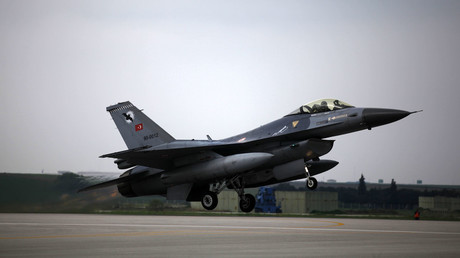
Turkish F-16 fighter jets. © Fatih Saribas / Reuters

The Turkish Air Force has delivered airstrikes in at least five locations on the territory of neighboring Iraq, targeting strongholds of the Kurdish militia, various media reported. The Turkish military claims 67 militants of the Kurdistan Workers’ Party (PKK) have been killed.
Read more

© Umit Bektas

Turkish warplanes have attacked PKK targets in northern Iraq, including the headquarters of the PKK leadership situated right on the Iraq-Iran border in the Qandil Mountains, reportedly hitting the settlements of Avasin, Basyan, Haftanin, Metina and Qandil, Reuters reports, citing the army.

The airstrikes took place on Wednesday, March 9, according to Turkey’s state-run Anadolu Agency. The agency cites an unnamed security source who claimed that 14 F-16 and F-4 fighter jets participated in the assault, bombing PKK camps, arms depots and bunkers.

READ MORE: ‘We are afraid but won’t leave our land’: Syrian Kurds who survived Turkish shelling tell RT

Beginning July 2015, after the two-year truce between Ankara and the Kurds was scrapped, Turkey has been delivering regular airstrikes against Kurdish militia in neighboring Iraq and shelling Kurdish settlements in Syria as well.

The PKK is demanding autonomy for Kurds in Turkey’s south-east, and is listed as terrorist organization #1 by the Turkish government.

READ MORE: ‘Out of question’: Erdogan rules out Turkish troop withdrawal from Iraq

In early December 2015, Turkey deployed about 150 troops and 25 tanks to a base in Iraq’s Nineveh province, without bothering to get permission from Baghdad. Ankara argued that its soldiers were sent to northern Iraq after a threat from Islamic State (IS, formerly ISIS/ISIL) to Turkish military instructors training anti-terrorist forces in the area.

Read more

© Umit Bektas

Turkey’s president Recep Tayyip Erdogan rejected a request from Baghdad to withdraw the troops, claiming that the Turkish military is present in Iraq “as instructors.”

On Friday, Turkish Interior Minister Efkan Ala said that Ankara is preparing another military operation against the Kurdish PPK in the country’s south-east. The minister announced plans to introduce curfews in three districts, saying that eight other districts have been “cleared of terrorists.”

In an interview Friday at the Foreign Ministry in Moscow, Russian Deputy Foreign Minister Gennady Gatilov criticized Turkey for shelling Kurdish positions on Syrian territory, alleging that Ankara is turning a blind eye to arms supplies to terrorists.

Gatilov stressed that such practices must stop in order “to provide a more constructive atmosphere for the intra-Syrian talks and a more durable cease-fire,” Bloomberg reported.

Syrian Kurds accuse Turkey of aiding sarin gas delivery to rebels after fresh chemical attacks

March 10, 2016

Syrian Kurds accuse Turkey of aiding sarin gas delivery to rebels after fresh chemical attacks

Published time: 10 Mar, 2016 01:09 Edited time: 10 Mar, 2016 02:18

Source: Syrian Kurds accuse Turkey of aiding sarin gas delivery to rebels after fresh chemical attacks — RT News

In an interview with RT, a spokesman for the Kurdish YPG militia accused Turkey of providing a clear transit route for the chemical weapons that were deployed against them near the city of Aleppo on Tuesday.

READ MORE: ISIS shelled Kurdish-controlled Iraq village with ‘poisonous substances’ – governor

Read more

Aleppo, Syria © Hosam Katan

Syrian anti-government militants “took advantage of the ceasefire” to launch attacks against a Kurdish-controlled area near Aleppo in northern Syria, Redur Xelil told RT. The attackers targeted a civilian district of what was once Syria’s biggest city, and has since become a key battleground. According to Xelil, the shells emitted an “unnatural smell” and “yellow smoke” upon impact, indicating that chemical weapons were involved.

“Our sources inside the rebel groups have confirmed that toxic substances were used. We also have verified information that sarin gas was delivered to them from Turkey. All signs point to the fact that these factions were using banned weapons, but we cannot access the launching area, as it is located on the front between the Turkish and rebel forces,” Xelil told RT by Skype from Rojava in Syria.

Kurdish deputies in the Turkish parliament have previously accused Ankara of supplying Islamic State (IS, formerly ISIS/ISIL) and other jihadist groups inside Syria with chemical weapons, which are used both in their fight against the Syrian government and to pin responsibility for their deployment on the regime of President Bashar Assad.

Tuesday’s attack, which also involved phosphorus, did not result in any severe casualties.

“This attack was a failure, but this doesn’t mean that there won’t be another one. We are convinced the enemy has improvised shells containing phosphorus and sarin gas,” said Xelil.

READ MORE: Who’s behind alleged Aleppo chemical weapons attack?

Last month, the Organization for the Prohibition of Chemical Weapons (OPCW) accused IS of using chemical weapons against Kurdish forces throughout 2015. Reports emerged on Wednesday revealing that the jihadist group had launched a new chemical attack on the Kurdish village of Zaza in northern Iraq, in which more than 40 civilians suffered chemical burns and lung damage.


ISIS shelled Kurdish-controlled Iraq village with ‘poisonous substances’

March 9, 2016

ISIS shelled Kurdish-controlled Iraq village with ‘poisonous substances’ – governor

Published time: 9 Mar, 2016 15:38 Edited time: 9 Mar, 2016 16:25

Source: ISIS shelled Kurdish-controlled Iraq village with ‘poisonous substances’ – governor — RT News

Islamic State (IS, formerly ISIS/ISIL) fighters used “poisonous substances” during the shelling of a village in northern Iraq on Tuesday, a local governor said, according to Reuters.

“There were poisonous substances in these shells. We don’t know what,” Kirkuk province governor Najmuddin Kareem told reporters, referring to a Tuesday attack on the village of Taza.

More than 40 people suffered from partial chocking and skin irritation after mortar shells and Katyusha rockets filled with the “poisonous substances” exploded in the mainly Shia Turkmen village, which is located south of the oil city of Kirkuk, in a region under Kurdish control.

Read more

Aleppo, Syria © Hosam Katan

None of the 40 people died as a result of the attack, though five remain in hospital, health officials told Reuters.

A total of 24 shells and rockets were fired into the village from IS positions in the nearby Bashir area, Kurdish peshmerga forces commander Wasta Rasul said.

It comes just one day after the Kurdish militia group YPG stated that Islamist opposition fighters used yellow phosphorous in a chemical attack on the Sheikh Maqsood neighborhood of Aleppo, Syria, on Tuesday.

Meanwhile, US aircraft have begun targeting IS’ chemical weapons sites near Mosul, Iraq. It comes after an initial round of airstrikes aimed at diminishing the group’s ability to use mustard agent, according to CNN.

It is unclear whether the strikes conducted over the past several days have been successful. The strikes were aided by an IS detainee who provided vital information to the US military, according to the news network.

Last month, a source from the Organization for the Prohibition of Chemical Weapons (OPCW) said that IS militants attacked Kurdish forces with mustard gas in 2015, citing lab tests that came back positive for the substance after Kurdish soldiers fell ill on the battlefield.

It represented the first known instance of chemical weapons use in Iraq since the fall of Saddam Hussein, the source said.

The revelation came just three days after Central Intelligence (CIA) Director John Brennan stated that IS had used chemical weapons on the battlefield, stressing that the militant group may have more in its possession.

In October, the OPCW also concluded that mustard gas was used in neighboring Syria in 2015. Experts believe the mustard gas used in Syria originated from an undeclared chemical stockpile, or that militants have gained the basic knowledge to develop and conduct a crude chemical attack with rockets or mortars.

Former UK Ambassador To Syria: US/UK Foreign Policy Is Doomed, Even Corrupt

March 6, 2016

Former UK Ambassador To Syria: US/UK Foreign Policy Is Doomed, Even Corrupt Tyler Durden’s picture

by Tyler Durden on 03/04/2016 22:25 -0500

Source: Former UK Ambassador To Syria: US/UK Foreign Policy Is Doomed, Even Corrupt | Zero Hedge

Authored by Eric Zuesse,

Peter Ford, who was the UK’s Ambassador in Syria during 2003-2006, was asked by the BBC in their “The Big Questions” interview on February 14th, whether the current Syrian President Bashar al-Assad would have to be a part of the solution in that country after the war is over, and Ambassador Ford said:

“I think sadly, but inevitably, he is. Realistically, Assad is not going to be overthrown. This becomes more clear with every day that passes. Western analysts have been indulging in wishful thinking for 5 years; it’s time to get real, we owe it to the Syrian people to be much more realistic and hard headed about this. The West has to stop propping up the so-called ‘moderate opposition’, which is not moderate at all.”

This was quoted by Almasdar News on February 18th, which went on to note that,

“The frustrated interviewer asked Mr. Ford about ‘what we should have done,’ and he responded that ‘we should have backed off, we should have not tried to overthrow the regime.’ Mr. Ford eloquently added that this policy has been ‘like a dog returning to vomit.’”

The video of the interview below showed him making that statement in this context:

https://youtu.be/mMZVKdWFJPk

The interviewer was clearly anti-Assad, and Ford responded with evident anger by noting (starting at 2:55 on the video) the shocking fact that:

“In Aghanistan, Iraq, Libya, like a dog returning to vomit, we go back to [and the audience already was started to clap here], we never saw a secular Arab regime that we didn’t want to overthrow.”

He was saying there that we support only non-secular regimes, sectarian regimes, in Arabia, this meaning fundamentalist Sunni governments — especially Saudi Arabia, Qatar, Kuwait, UAE, the very same regimes that even the U.S. Secretary of State acknowledged in a 2009 cable that was wikileaked, are the chief regimes that are funding Al Qaeda, ISIS and other jihadist groups. Ford was noting that the United States and UK strive to keep in power those governments, the ones that are led by royal families that supply the bulk of funding for jihadist groups — jihadists who perpetrate terrorism in the United States and Europe. “We never saw a secular  Arab regime that we didn’t want to overthrow”: Ambassdor Ford was so bold as to imply that our governments are supporting, under the table, the very same ruling families that they know to be funding (as that cable only vaguely referred to them) “Sunni terrorist groups worldwide” (which includes in Western countries, too).

The BBC’s interviewer ignored that statement; he wasn’t struck by it, such as to ask: “Why are we supporting the chief funders of Islamic jihad? Why are we overthrowing (or in Syria are trying to overthrow) a secular regime, against which we join foreign jihadist groups in order to overthrow that non-sectarian regime; why are these dogs, as you call the U.S. and UK, returning time and again to that vomit?”

This was a live interview program, and so the BBC censors weren’t able to eliminate Ambassador Ford’s responses from the interview; but, instead, the interviewer did his best to interrupt and to talk over Ford’s shocking — and shockingly truthful — assertions about the government (ours) that supposedly represent our  interests (and not the interests of Western oil companies etc.). Ford will probably not be invited again to be on live television in the West to air his views about Syria.

Ford’s evident anger at what’s going on, and at the media’s resistance to letting the public know about the reality, appeared to reach near to the edge of his blurting out that ulterior motives have to be behind this addiction to “vomit” — but he was a professional diplomat, and so he was able to restrain himself there.

The U.S. Secretary of State who had specifically requested the fundamentalist-Islamic Arab ‘allies’ to stop funding terrorism was Hillary Clinton, the leading candidate now contending for the Democratic Party’s Presidential nomination. Here she was, expressing her current view regarding Syria, in a recent debate against her Democratic Party opponent, Senator Bernie Sanders:

QUESTIONER: In respect to when you take out Syrian President Bashar al-Assad. Right now or do you wait? Do you tackle ISIS first? You have said, Secretary Clinton, that you come to the conclusion that we have to proceed on both fronts at once. We heard from the senator just this week that we must put aside the issue of how quickly we get rid of Assad and come together with countries, including Russia and Iran, to destroy ISIS first. Is he wrong?


CLINTON: I think we’re missing the point here. We are doing both at the same time.


QUESTIONER: But that’s what he’s saying, we should put that aside for now and go after ISIS.


CLINTON: Well, I don’t agree with that.

She’s still (now after five years, and even though she knows  that we’re supporting jihadist-backing Arabic royal families and their Shariah-law regimes) comes back to that “vomit”: that “we never saw a secular Arab regime that we didn’t want to overthrow.” She’s an example of this addiction, to that “vomit.”

She does this even though, in October 2014, the man who had collected the mega-donations to Al Qaeda (all of which had been in cash) had detailed, under oath, in a U.S. court proceeding, that the Saud family were the main people who paid the “salaries” of the 9/11 terrorists. The Saud family are now the chief backers of the overthrow-Assad campaign. Do politicians such as Clinton actually represent the Sauds? It’s not only the Bush family who do.

What’s exhibited here is a double-scandal: first, that a person such as that would even be a Democratic Party candidate for the U.S. Presidency (and Jeb Bush shares Hillary Clinton’s foreign policy prescriptions, though he’s virtually certain not  to win the Republican Presidential nomination); and, second, that the Western press try to avoid, as much as possible, to expose the fact that this is, indeed, “vomit,” and avoid to explain to their audience the very corrupt governmental and news-media system that enables people such as Ms. Clinton to become and remain a leading Presidential candidate in the United States. Clearly, a person like that isn’t qualified to be in government at all; she’s corrupt, or else incredibly stupid. And no one thinks she’s that stupid. But lots of people accuse her of being corrupt.

Turkey keeps shelling Kurds, backing terrorist groups in Syria

March 5, 2016

Turkey keeps shelling Kurds, backing terrorist groups in Syria – Russian MoD

Published time: 5 Mar, 2016 03:51 Edited time: 5 Mar, 2016 04:08

Source: Turkey keeps shelling Kurds, backing terrorist groups in Syria – Russian MoD — RT News

Turkish artillery in a border garrison near the Yanankey settlement targeting Kurdish positions in Syria. / RT

Turkey continues to shell Kurdish forces in Syria, hampering their operations against Al-Nusra terrorists, and at the same time funneling supplies to the militant-controlled areas at the border, Russia’s Defense Ministry reported.

Ankara bears responsibility for the ongoing ceasefire violations in the Syrian provinces of Idlib and Aleppo, the head of the Russian ceasefire monitoring center Lt. Gen. Sergey Kuralenko told journalists at a briefing on March 4.

Militants continue to freely cross the Turkish-Syrian border, Kuralenko noted, presenting the latest reconnaissance video featuring a “large terrorist unit in a forested border area.”

Another video depicted Turkish artillery in a border garrison near the Yanankey settlement targeting Kurdish positions in Syria.

“Artillery shelling of Kurdish militia units, fighting against Nusra Front, continues from the territory of a Turkish border post near Yanankey,” Kuralenko said.

Lt. Gen. also noted that in footage captured by an RT crew who traveled with the Kurdish YPG force in the area, Turkish trucks crossed the Turkish-Syrian border, according to Kuralenko. He said they are carrying supplies and arms exclusively to the territories controlled by Al-Nusra Front and Ahrar ash-Sham terrorist groups.

Read more

Turkish activities in the region are undermining the ceasefire and crippling the efforts aimed at launching the inter-Syrian dialogue and bringing peace to Syria, the defense ministry spokesman reiterated.

The ceasefire regime in Syria is being monitored and promoted via special centers set up in Moscow, Washington, Amman and Latakia and Geneva to collect and review information. The Russian center has registered 27 breaches of the ceasefire regime over the last 24 hours, with most of them – eight breaches – occurring in Aleppo, the Defense Ministry reported on Friday. The province of Idlib has seen a total of 7 violations, Damascus and Homs – 4 in each, Daraa – 3, Latakia – 1.

Besides Damascus, almost 100 various armed groups operating in Syria, alongside different regional and international interested parties, have agreed to take part in ceasefire, according to UN Syria special envoy Staffan de Mistura. The groups that don’t obey the ceasefire, including but not limited to ISIS and Al-Nusra, are considered terrorists.

Five more commanders of so-called Syria’s moderate opposition groups agreed to take part in the ceasefire along with the elders of two settlements in the province of Homs just recently, according to the ministry’s statement. Leaders of four other groups may soon join the agreement.

READ MORE: Syria ceasefire non-binding if threat to Turkey’s security – PM Davutoglu

The nationwide ceasefire was implemented on February, 27 at midnight Damascus time. Outlined by the co-chairs of the ISSG (the International Syrian Support Group) US and Russia, it was supported by the United Nations Security Council and is abiding to all parties involved in the conflict. The exceptions are Islamic State group (IS, formely ISIS/ISIL), Al-Nusra, and “other terrorist organizations” as designated by the UN Security Council.

EXCLUSIVE: Turkey ‘protects & supplies’ Al-Nusra camps at its border – Syria’s YPG to RT

March 4, 2016

EXCLUSIVE: Turkey ‘protects & supplies’ Al-Nusra camps at its border – Syria’s YPG to RT

Published time: 4 Mar, 2016 05:04 Edited time: 4 Mar, 2016 09:51

Source: EXCLUSIVE: Turkey ‘protects & supplies’ Al-Nusra camps at its border – Syria’s YPG to RT — RT News

And now a statement from the State Department ?

Read also : https://warsclerotic.wordpress.com/2016/03/04/state-department-issues-new-warning-about-terrorist-threat-to-u-s-citizens/#comment-84060

Jabhat Al-Nusra terrorists have pitched their camps right next to the border and receive regular supplies from the Turkish side, Syrian Kurdish forces told RT’s Lizzie Phelan, who traveled with YPG to investigate suspicious activity there.

An RT crew has filmed a number of vehicles coming through the Bab al-Salam crossing on the Turkish-Syrian border, on the outskirts of the northern town of Azaz, which is partially controlled by Al-Nusra, according to reports.

“We can actually see here the important border town of Azaz, that Turkey is determined to prevent YPG from taking. Just a little beyond that you can see the Bab al-Salam border crossing and a heavy flow of vehicles coming from Turkey into Azaz,” the RT correspondent said, reporting from the Turkey-Syria border, an area that TV crews rarely gain access to.

https://www.instagram.com/p/BCc9siFSq4o/

“When we zoom in we can see Turkish military vehicles, probably around a kilometer away, maybe less. And just in front here’s another small village that YPG say Al-Nusra uses for training,” Phelan said.

“Beyond that we can see the Turkish flag flying, that’s on the Turkish side of the border, and through there the YPG says they monitor a regular supply of weapons coming from Turkey to that Al-Nusra camp.”

2.&just a few km from Nusra controlled Azaz that is determined 2 prevent YPG from taking.

There were reports of dozens of Turkish military vehicles crossing into Kurdish northern Syria, with servicemen digging trenches in the area. Turkey’s “provocative” military buildup on the border and shelling of the Syrian territory could thwart the fragile truce and disrupt the peace process in the Arab Republic, the head of the Russian ceasefire monitoring center Lt. Gen. Sergey Kuralenko said this week.

Read more

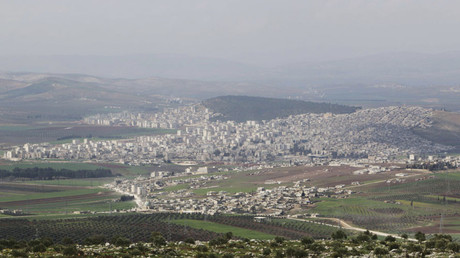
A general view shows the Kurdish city of Afrin, in Aleppo's countryside March 18, 2015. © Mahmoud Hebbo

The ceasefire in Syria, which came into force on February 27, brokered by leading world powers, including the US and Russia, is designed to pave the way to reconciliation between the Syrian government and moderate rebel forces. They would together agree on a peaceful transition in the country. Some of the forces in Syria, including IS and Al-Nusra, are not subject to the ceasefire.

Experts have been criticizing moderate rebel forces, but even they think that the situation is shifting now.

Moderate rebels used to be “a fable, a pure lie,” Syrian political analyst Taleb Ibrahim told RT.

“Everyone remembers what happened to the rebels who had been trained in Turkish camps by the CIA, and when they returned to Syria, and turned to Al-Nusra Front”.

However, the situation is starting to change slowly, as more and more Syrian rebel fighters “discover that they are destroying their country and serving external plans to divide Syria.”

Russian aircraft continue to carry out airstrikes against Al-Nusra front militants to “stabilize the situation” in the regions north of the city of Aleppo, the Russian Defense Ministry said in a statement.

READ MORE: Russia presents proof of Turkey’s role in ISIS oil trade

There have been at least 31 violations of the Syrian ceasefire over the past three days, Russian Foreign Ministry spokeswoman Maria Zakharova said on Wednesday, adding that during the same period the number of local ceasefire agreements between various factions had increased to 38.

State Department Issues New Warning About Terrorist Threat to U.S. Citizens

March 4, 2016

State Department Issues New Warning About Terrorist Threat to U.S. Citizens

BY:
March 3, 2016 5:59 pm

Source: State Department Issues New Warning About Terrorist Threat to U.S. Citizens – Washington Free Beacon

Did the state department declare now Turkey as a criminal state ?

The State Department issued a new Worldwide Caution on Thursday that warned about the ongoing terrorist threat to U.S. citizens across the world from groups like ISIS and al Qaeda.

“Current information suggests that ISIL, al-Qa’ida, Boko Haram, al-Shabaab, and other terrorist groups continue to plan terrorist attacks in multiple regions,” the State Department said in a release updating the Worldwide Caution, using another name for ISIS.

“Recent terrorist attacks, whether by those affiliated with terrorist entities, copycats, or individual perpetrators, serve as a reminder that U.S. citizens need to maintain a high level of vigilance and take appropriate steps to increase their security awareness. ”

The new alert replaced a previous alert issued in July of last year, months before ISIS launched terror attacks in Paris that killed 130 people last November. Authorities believe that ISIS continue to plot attacks against U.S. and Western interests worldwide, especially in the Middle East, North Africa, Europe, and Asia, the new alert stated.

The State Department warning cited major terrorist attacks that have been carried out in France, Belgium, Mali, Turkey, and other countries, and emphasized that U.S. citizens are at risk of kidnapping by operatives from ISIS, al Qaeda, and other groups. It noted that terrorists targeting U.S. citizens at home and abroad generally focus on places that attract crowds, including sporting events, hotels, restaurants, and public transportation systems.

“Extremists may use conventional or non-conventional weapons and target both official and private interests,” the State Department warning said. “Examples of such targets include high-profile sporting events, residential areas, business offices, hotels, clubs, restaurants, places of worship, schools, public areas, shopping malls, and other tourist destinations both in the United States and abroad where U.S. citizens gather in large numbers, including during holidays.”

The alert included information about threats in various regions, including Europe, the Middle East and North Africa, and parts of Asia. It noted that “credible information” indicated that all countries in Europe are “vulnerable” to attacks from terrorist organizations.

“Authorities believe there is a high likelihood terror attacks in Europe will continue as European members of ISIL return from Syria and Iraq. European governments are taking action to guard against terrorist attacks; however, all European countries remain potentially vulnerable,” the warning said.

The agency also reminded U.S. citizens that it is a crime to provide support to terrorist groups like ISIS.

“Private U.S. citizens are strongly discouraged from traveling to any country to join in armed conflict.  U.S. citizens are reminded that fighting on behalf of or providing other forms of support to designated terrorist organizations, including ISIL, can constitute the provision of material support for terrorism, which is a serious crime that can result in penalties including prison time and large fines,” the alert warned.

American citizens have been arrested for attempting to join or provide material support to ISIS. More than 200 Americans have tried to fight for ISIS, the head of the FBI said in 2015.