Posted tagged ‘Syria’

Palmyra mass grave: Tortured women & children among dozens of ISIS victims unearthed by Syrian Army

April 2, 2016

Palmyra mass grave: Tortured women & children among dozens of ISIS victims unearthed by Syrian Army

Published time: 2 Apr, 2016 04:58 Edited time: 2 Apr, 2016 08:11

Source: Palmyra mass grave: Tortured women & children among dozens of ISIS victims unearthed by Syrian Army — RT News

© Omar Sanadiki / Reuters

The Syrian Army is unearthing a mass grave consisting of at least 40 corpses, many of them women and children. They were butchered by Islamic State (IS, formerly ISIS/ISIL) in the recently liberated ancient city of Palmyra.

The grave was discovered by engineers and “popular defense forces” in the Masakin al-Jahizia neighborhood of the city, which lies only 500 meters from the ancient ruins, SANA reports.

So far the army has recovered 25 corpses. Among those killed by IS were three children and five females. As the excavation proceeded, 15 more corpses were unearthed – all of them women and children.

Read more

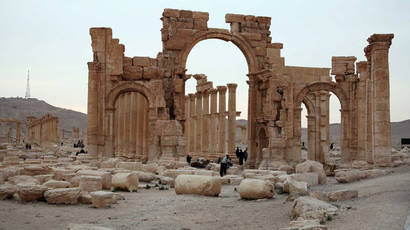
Historical city of Palmyra, Syria (Reuters / Nour Fourat)

Initial examination of the bodies revealed that some of the victims had been beheaded while other had been brutally tortured before their deaths.

The army continues to excavate the mass grave, fearing that more bodies may be found.

Engineering units continue their search for landmines and explosives as thousands were hidden by the jihadists before they were driven out of the city with the help of the Russian forces working with the Syrian Army.

Russian combat engineers arrived in Palmyra on Thursday with special robotic units to offer their expertise in detecting and dismantling mines in an area comprising over 180 hectares (445 acres), to save the UNESCO world heritage site, and help locals to return safely.

“At least 3,000 explosive devices were installed in the city,” the sapper explained to RT. He said IS created an almost invisible interconnected network, partially hidden under hard paved roads, which could blow up the entire city.

READ MORE:Palmyra booby-trap: ISIS had 3,000 bombs rigged, ready to level entire city with one click

A strategically important location, Palmyra was seized by IS jihadists in May 2015. That month, IS reportedly slaughtered 400 people, mostly women and children. At the time, Reuters reported that a video posted by IS’ supporters showed the militants entering governmental buildings in search of Syrian soldiers. They were also seen pulling down pictures of Syrian President Bashar Assad and his father, Hafez Assad.

Turkey is key supplier of weapons, military hardware to ISIS – Russian envoy to UN

April 1, 2016

Turkey is key supplier of weapons, military hardware to ISIS – Russian envoy to UN Published time: 1 Apr, 2016 14:25 Edited time: 1 Apr, 2016 14:45

Source: Turkey is key supplier of weapons, military hardware to ISIS – Russian envoy to UN — RT News

© Denis Sinyakov / Reuters

Moscow has submitted data on Turkey’s illegal arms and military hardware supply to Islamic State in Syria to the UN Security Council. Supplies are supervised by the Turkish intelligence service, Russian UN envoy Vitaly Churkin said as cited by Russian media.

The main supplier of arms and military equipment to Islamic State (IS, Daesh, formerly ISIS/ISIL) militants is Turkey, which uses non-governmental organizations (NGOs) for this purpose. The National Intelligence Organization of Turkey is in charge of the operations. Transportation is carried out mainly via automobiles, including humanitarian aid convoys, Churkin wrote in a letter to the UN Security Council (UNSC).

Terrorist groups operating in Syria received explosive materials worth $ 1.9 million via Turkey last year, according to the letter.

In total, the terrorists were delivered 2.5 thousand tons of ammonium nitrate (worth around $788,700), 456 tons of potassium nitrate ($468,700), 75 tons of aluminum powder ($496,500), sodium nitrate ($19,400), glycerin ($102,500) and nitric acid ($34,000 thousand) via Turkey in 2015, Churkin wrote.

Saudi Arabia Ambassador Explains that There Is Nothing Hypocritical In Demanding Elections For Syria Since Saudi Citizens Are Content Not To Have Full Democratic Rights

March 28, 2016

Saudi Arabia Ambassador Explains that There Is Nothing Hypocritical In Demanding Elections For Syria Since Saudi Citizens Are Content Not To Have Full Democratic Rights, Jonathan Turley’s Blog, Jonathan Turley, March 28, 2016

Saudi democracy

Saudi Arabia UN Ambassador Abdallah al-Mouallimi has finally resolved the rather glaring inconsistency of the Kingdom demanding elections in Syria while denying full elections to Saudi Arabians. The reason is simple according to Al-Mouallimi: Saudi citizens are the happiest in the world and would not want a democratic choice.

Al-Mouallimi insists that it is entirely unnecessary to given Saudi citizens democratic rights because they are happier “than almost any other country in the world.” Well, perhaps not those religious minorities who are denied a place to worship or those women who must get permission from younger brothers or husbands to travel (and cannot drive) or those girls denied basic opportunities and educational advancement. Then there are those political dissidents who are arrested for questioning the system or the royal family.

In an interview for Al Jazeera by British journalist Mehdi Hasan, Al-Mouallimi insisted that “Elections are not the panacea for everything. Just because there are elections in Syria doesn’t mean there have to be elections in Saudi.”

He added “The key question is: Is the population content and happy and satisfied with the form of government they have and I would like to claim if you went to Saudi Arabia and conducted a survey… you will find a high degree of support for the system.”

This happiness is based on a “mutual acceptance,” which of course does not apply to those political opponents arrested for criticizing the government. Putting aside all those who disagree with the government, Al-Mouallimi explained “I can tell you that mutual acceptance is much higher in Saudi Arabia than almost any other country in the world.”

Political parties remain banned in the Kingdom and questioning the monarchy is illegal.

Source: Independent

Putin congratulates Assad on liberating Palmyra, says Russia to aid in demining ancient city

March 28, 2016

Putin congratulates Assad on liberating Palmyra, says Russia to aid in demining ancient city

Published time: 27 Mar, 2016 15:15 Edited time: 27 Mar, 2016 21:14

Source: Putin congratulates Assad on liberating Palmyra, says Russia to aid in demining ancient city — RT News

Russian President Vladimir Putin has congratulated Syrian President Bashar Assad on retaking the ancient city of Palmyra from Islamic State terrorists. Putin stressed the importance of preserving the UNESCO World Heritage Site.
Read more

A view of the central part of modern Palmyra. © Mikhail Voskresenskiy

In a telephone conversation with the Syrian president, Vladimir Putin congratulated his counterpart on retaking the city of Palmyra from terrorists and noted the importance of preserving this unique historic site for world culture,” Kremlin spokesman Dmitry Peskov said Sunday.

Putin once again stressed that despite the withdrawal of the bulk of Russia’s military contingent from Syria, Russia’s forces will continue to help the Syrian authorities in their anti-terrorist efforts,” he added.

“Assad highly valued the help Russian air forces have provided and underlined that such successes as regaining Palmyra would have been impossible without Russia’s support,” Peskov said.

On Sunday, the Syrian Army retook the historic city of Palmyra from Islamic State (IS, formerly ISIS/ISIL), which had occupied it since last May. Russian warplanes were providing heavy support from the air.

The Russian Air Force has made 40 flights over the area of the Syrian city of Palmyra in the last 24 hours, hitting 117 targets and killing over 80 militants, the Russian Center for Reconciliation in Syria said Sunday.

Putin also held a phone call with UNESCO head Irina Bokova on Sunday. Peskov said Putin told Bokova that “representatives of the Russian contingent will participate in the demining of the ancient city.

READ MORE: Palmyra ‘not just an archaeological site but a symbol of Syria’ – UNESCO

The two agreed that UNESCO, Russia and Syria will soon take the necessary steps to evaluate the damage to the historic site and map out a “plan of restoring what can still be restored,” Peskov added.

According to the Kremlin spokesman, Bokova thanked Putin for Russia’s contribution and confirmed UNESCO’s readiness to cooperate.

While summarizing the results of Russia’s five-month anti-terror campaign in Syria earlier in March, Putin expressed hope that Palmyra would soon be returned to the Syrian people. On March 18, Russia’s military said that the groundwork had been laid for defeating IS in Palmyra.

Read more

© Mikhail Voskresenskiy

At that time, the Syrian Army had already taken control of all dominant heights and major roads around the city, and the terrorists’ logistical support had also been cut off, according to Sergey Rudskoy, chief of the Russian General Staff’s main operations department.

Palmyra shows Damascus strategy more effective than US-led efforts in Syria – Assad

Calling the Syrian Army’s liberation of Palmyra an “important achievement,” Assad told a delegation of French parliamentarians visiting Syria on Sunday that the victory is “new evidence” that the strategy being pursued by Damascus and its allies is effective, according SANA, Syria’s state news agency.

He also pointed out that the strategy’s success is especially apparent when compared to that of the US-led coalition, which involves more than 60 countries, but has achieved very little since its establishment one and a half years ago, for which he blamed a lack of seriousness in fighting terrorism.

The US-led coalition launched its air campaign in Syria in September of 2014 without permission from the Syrian government. Damascus has repeatedly called the intervention ineffective, saying it has failed to weaken terrorists in the region.


Before our eyes: Syria’s Battle for Palmyra in latest RT reports (VIDEOS)

March 26, 2016

Before our eyes: Syria’s Battle for Palmyra in latest RT reports (VIDEOS)

Published time: 26 Mar, 2016 06:36

Source: Before our eyes: Syria’s Battle for Palmyra in latest RT reports (VIDEOS) — RT News

© Joseph Eid / AFP

Syrian army is close to regaining full control of the ancient city of Palmyra. Check out some of RT’s exclusive footage and battleground reports on how Islamic State (IS, previously ISIS/ISIL) militants are being pushed from the UNESCO heritage site.

Fierce fighting rages on

RT’s agency Ruptly’s latest video footage shows units of the Syrian Arab Army (SAA) battling IS militants in and around Palmyra on Friday. The historical ruins of Palmyra are clearly visible from the position of Syrian mortar crews.

READ MORE: Syrian Army retakes historic citadel from ISIS continuing advance on Palmyra – state media

In the latest update, Syria state TV said that troops have regained control of the Syriatel hill near Palmyra’s castle and are a step closer to retaking the whole city, which has been under Islamic State control since last May.

Russia helping with air sorties

Russian warplanes offered crucial support to the Syrian forces on the ground this week by carrying out 41 sorties and destroying 146 terrorist targets from Tuesday to Thursday, Russia’s Defense Ministry said.

READ MORE: Russian Air Force carried out 41 sorties to support Syrian army’s Palmyra offensive

One of the stories that stood out was a report on Russian Special Operations Forces officer who called a strike onto himself when he was compromised and surrounded by IS militants near Palmyra. Thanks to the brave actions of this officer and others, Russian military planes have been able to pinpoint IS targets with precision – something absolutely crucial in the circumstances.

ISIS pillage of Palmyra

A Russian TV crew captured a striking footage of Palmyra revealing the damage endured under IS occupation. The iconic 2,000-year-old Arch of Triumph was blown up by the jihadists in October 2015.

READ MORE: Striking drone footage shows what remains of Palmyra after ISIS pillage

https://youtu.be/zFHcIm9F41w

Good win or bad win? US undecided

The US government still seems on the fence on whether or not the ancient city should be liberated from the hands of Islamic State by Syrian President Bashar Assad’s forces. Only when pressed by reporters did the State Department call IS “probably a greater evil” than President Assad.

READ MORE: US State Dept fails to say if ISIS must be pushed out of Palmyra or not

Bomb traps danger 

The Syrian army is very close to retaking control of the whole city, but it fears that IS militants have hidden bombs at ancient sites. Before more information can be gathered, the troops will not know when to expect a full-scale offensive against IS.

IS has used this tactic in the past. Also, the extremist group has carried out brutal executions at historical parts of the city by binding individuals to ancient columns and blowing them up.

RT crews remain on battlefront

The RT crew was one of the few that filmed the fighting in Palmyra, offering an exclusive look into the progress of Syrian soldiers in pushing out Islamic State fighters.

READ MORE: RT EXCLUSIVE: ISIS position in Palmyra up-close, RT 1st intl TV crew to follow Syrian Army assault

The conditions they faced while on the ground were extremely dangerous. RT’s Lizzie Phelan and her team risked their lives to report from a position with direct sight of Islamic State militants.

Just meters from where the crew was filming, a mortar landed next to their car. Shrapnel injured one of the Syrian Army soldiers.

Jordan’s king accuses Turkey of sending terrorists to Europe

March 26, 2016

Jordan’s king accuses Turkey of sending terrorists to Europe #Abdullah’sWar Abdullah tells US politicians that radicals are being ‘manufactured in Turkey… as part of Turkish policy’

Last update:
Saturday 26 March 2016 9:20 UTC

Source: Jordan’s king accuses Turkey of sending terrorists to Europe | Middle East Eye

Jordan’s king, Abdullah, and the Turkish president, Recep Tayyip Erdogan (AFP)

King Abdullah of Jordan accused Turkey of exporting terrorists to Europe at a top level meeting with senior US politicians in January, the MEE can reveal.

The king said Europe’s biggest refugee crisis was not an accident, and neither was the presence of terrorists among them: “The fact that terrorists are going to Europe is part of Turkish policy and Turkey keeps on getting a slap on the hand, but they are let off the hook.”

Asked by one of the congressmen present whether the Islamic State group was exporting oil to Turkey, Abdullah replied: ”Absolutely.”

Abdullah made his remarks during a wide-ranging debriefing to Congress on 11 January, the day a meeting with the US president, Barack Obama, was cancelled.

The White House was forced to deny that Obama snubbed one of America’s closest allies in the Middle East, attributing the cancellation to “scheduling conflicts,” although Obama and Abdullah met briefly at Andrews Air Force Base a day later.

Present at the meeting in Congress were the chairmen and members of the Senate Intelligence, Foreign Relations and Armed Services committees, including Senators John McCain and Bob Corker, and Senators Mitch McConnell and Harry Reid, the Senate Majority and Minority leaders respectively.

According to a detailed account of the meeting seen by MEE, the king went on to explain what he thought was the motivation of Turkey’s president, Recep Tayyip Erdogan.

Abdullah said that Erdogan believed in a “radical Islamic solution to the region”.

He repeated: “Turkey sought a religious solution to Syria, while we are looking at moderate elements in the south and Jordan pushed for a third option that would not allow a religious option.”

The king presented Turkey as part of a strategic challenge to the world.

“We keep being forced to tackle tactical problems against ISIL [the Islamic State group] but not the strategic issue. We forget the issue [of] the Turks who are not with us on this strategically.”

He claimed that Turkey had not only supported religious groups in Syria, and was letting foreign fighters in, but had also been helping Islamist militias in Libya and Somalia.

Abdullah claimed that “radicalisation was being manufactured in Turkey” and asked the US senators why the Turks were training the Somali army.

The king invited the US politicians present to ask the presidents of Kosovo and Albania about the Turks.

Abdullah said that both countries were begging Europe to include them, before Erdogan did.

Abdullah was supported in his remarks by his foreign minister, Nasser Judeh, who said that the Albanian president (Bujar Nishani) was a Catholic married to a Muslim, and that that was a model which should be protected in a Muslim majority country.

Judeh said that when the Russian bombing campaign prevented Turkey from establishing safe zones in northern Syria to stop refugees from coming to Turkey, “Turkey unleashed the refugees onto Europe”.

Both Judeh and Abdullah bridled at the $3bn deal offered by Europe to Turkey, noting that Turkey had only 2m Syrian refugees out of a population of 70m, whereas Jordan was facing “a bigger problem proportionally”.

Jordan and Turkey are officially allies. The Turkish prime minister, Ahmed Davutoglu, cancelled an official visit to Jordan after the latest bomb attack in Turkey, which on 13 March killed 34 people in Ankara.

The Kurdish Freedom Falcons (TAK), an offshoot of the PKK, or Kurdistan Workers’ Party, claimed responsibility for the bombing.

The postponed visit is due to take place this weekend and Davutoglu will be mindful that Abdullah told senators that Turkey was using the Kurds as an “excuse” for its policies in Syria.

Galip Dalay, research director at Al Sharq Forum and senior associate fellow on Turkey and Kurdish Affairs at Al Jazeera Center for Studies, said it was wrong to portray Turkey as having a strategic goal of establishing an Islamist government in Syria.

He said: “Turkey did its best in the first eight months of the Syrian crisis to find a political solution to the crisis, which would have included [Syrian President] Bashar Assad. Back then, Turkey was criticised in the region and the West for being too soft on the Assad regime and being too optimistic about the possibility of reform. When it became clear, after eight months of arduous attempts, that Assad had no intention of initiating a political and democratic process to meet the demands of the protestors, Turkey threw its weight behind the opposition.”

Dalay said that the claim Turkey was buying oil from the Islamic State group was a Russian fabrication concocted by Moscow after Turkey shot down the Russian fighter. “Turkey is not the only one saying there is no evidence to support this claim. The United States said it too.”

The Turkish government would not comment officially on Abdullah’s reported remarks on 11 January. But a senior Turkish source accused the king of becoming “the spokesman for Bashar al-Assad”.

He said the portrait emerging from these remarks was not one of a king speaking but of a “Western journalist with a fuzzy state of mind and little familiarity with the region”.

He said: “Turkey is definitely carrying out an intense struggle against Daesh [a reference to the Islamic State group]. Bombings take place in Turkey, not in Jordan. When this is the case, groundless accusations by King Abdullah are totally unacceptable.

“Moreover, his tackling of the Daesh issue with such unfounded information also raises the question about whether Jordan could play a meaningful role in the fight against Daesh.”

He said the king’s claims that IS was selling oil to Turkey were not only absurd but showed that Abdullah did not have the slightest idea about what was going on in Syria.

“The king’s statements and accusations against Turkey are not the first. Unfortunately, all of his allegations are the same as the slanders frequently expressed by the Assad regime.

“It would be to Jordan’s and the region’s interest if Jordan, as a friend of Turkey, were to work for a strategic cooperation with a strategic power like Turkey, instead of acting like the spokesperson of Assad.”

New Syrian constitution by August: Russia, US push for political solutions at Moscow talks

March 25, 2016

New Syrian constitution by August: Russia, US push for political solutions at Moscow talks

Published time: 25 Mar, 2016 03:16

Source: New Syrian constitution by August: Russia, US push for political solutions at Moscow talks — RT News

Russian Foreign Minister Sergei Lavrov (R) and U.S. Secretary of State John Kerry shake hands following a news conference at the Kremlin in Moscow, Russia, March 24, 2016. © Andrew Harnik / Reuters

Russia’s Sergey Lavrov and the US’ John Kerry agreed to push for a political transition in Syria by having a new draft constitution ready by August. The Kremlin-hosted talks revealed a softer, more cooperative tone on Syria, as well as Ukraine.

The discussions lasted over four hours and involved Russian President Vladimir Putin, Russian Foreign Minister Sergey Lavrov, US Secretary of State John Kerry, and US Ambassador to Russia John F. Tefft.

“We agreed on a target schedule for establishing a framework for a political transition [in Syria] and also a draft constitution, both of which we targeted by August,” Kerry told journalists at a joint news conference with Lavrov following the meeting.

Lavrov also said that both parties had agreed to use their influence to push the Syrian government to engage in “direct talks” with the opposition in order to accelerate discussions on a political transition that could help end Syria’s civil war.

“As the immediate task, we have agreed to push for the soonest start of direct talks between the government delegations and the whole spectrum of the opposition” that will help to create “a transitional governance structure” for Syria, Lavrov said.

Read more

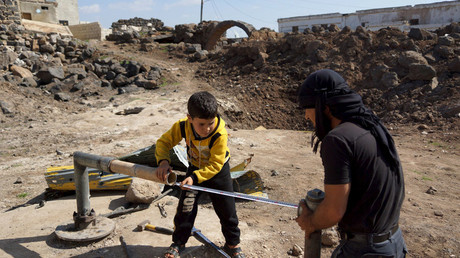
Civilians fix damaged water pipes in the rebel held al-Ghariyah al-Gharbiyah town, in Deraa province, Syria February 28, 2016. © Alaa Al-Faqir

The Russian FM pointed out that there are still a number of issues that Moscow and Washington don’t agree on, but maintained that this would not prevent them from cooperating “on an equal footing” on the problems on which they have found common ground.

“The US has plenty of partners who do not agree with them… It does not mean that the differences on one particular issue should stop them from talking at all,” Lavrov said.

At the start of the talks, Kerry told Lavrov that the partial truce in Syria was working and reducing the level of violence in the country. “It’s fair to say three weeks ago there were very, very few people who believed a cessation of hostilities was possible in Syria,” Kerry said. “The result of that work has produced some progress. There has been a fragile nevertheless beneficial reduction in violence.”

The tone of Russia-US relations appeared softer than it has been for some time on many issues, including Syria and the conflict in eastern Ukraine, as both parties demonstrated an apparent desire to improve bilateral relations.

Kerry said that the productive eleven-month collaboration of Russian cosmonaut Mikhail Kornienko and American astronaut Scott Kelly on the International Space Station (ISS) should serve as an example for cooperation between the two world powers.

“When they were telling me about how they spent their time in space, they highlighted that their close cooperation demonstrated not only what the two astronauts could do, but what two countries could achieve together as well,” Kerry said at the press conference.

Read more

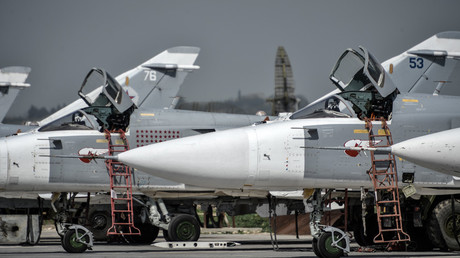
Russian Su-24 tactical bombers at the Hmeimim airbase in the Latakia Governorate of Syria. © Ramil Sitdikov

As an example, Lavrov noted that Russian and US experts could hold joint consultations to discuss the most effective ways to fight cybercrime.

When it came to Ukraine, both sides agreed that the Minsk Accords must be fully implemented.

“We have indeed pledged to ensure that Donbass, that the self-proclaimed republics of Donetsk and Lugansk [DPR and LPR], implement what they and their representatives signed under in Minsk,” Lavrov said, while calling on his US counterpart to ensure that similar pressure is put on Kiev.

Kerry reiterated that once the agreement is “fully implemented,” the US will be ready to roll back sanctions on Russia.

Meanwhile, Lavrov confirmed that Moscow is closely monitoring the health of Ukrainian national Nadezhda Savchenko. “We have confirmed that Savchenko’s health condition, that many try to speculate on, presents no concerns,” Lavrov said. “She is under constant monitoring of Russian doctors.”

Savchenko, a Ukrainian Air Force officer detained in Russia in 2014, was found guilty of murdering two Russian journalists near Lugansk in eastern Ukraine, and of illegally crossing the Russian border. The decision was made by a court in the southern Russian town of Donetsk on Monday.

Kerry, who has called for Savchenko to be sent back to Ukraine, told reporters that Putin indicated that at some point “we will be able to address the issue of Savchenko.”

Following the talks in Moscow, Aleksey Pushkov, the chairman of the Parliamentary Committee for International Relations, noted that Russia and the US are beginning to develop a closer relationship based on America’s pressing needs, which are forcing the US to forget about its previous goal to isolate Russia.

“About Kerry’s visit: there is nothing more powerful in politics than need. Under its influence, forgetting about isolating Russia, the US has begun to move,” Pushkov tweeted.

ISIS, oil & Turkey: RT films trove of jihadist docs detailing illegal trade with Ankara (EXCLUSIVE)

March 24, 2016

ISIS, oil & Turkey: RT films trove of jihadist docs detailing illegal trade with Ankara (EXCLUSIVE)

Published time: 24 Mar, 2016 03:00 Edited time: 24 Mar, 2016 05:12

Source: ISIS, oil & Turkey: RT films trove of jihadist docs detailing illegal trade with Ankara (EXCLUSIVE) — RT News

Islamic State documents, including invoices, which militants abandoned while retreating in haste. / RT

An RT Documentary crew filming in northern Syria has seen Islamic State (IS, ISIS/ISIL) documents abandoned by retreating terrorists and found by the Kurds that, along with captured IS recruits, provide a stunning insight into the alleged Turkey-IS oil trade links.

Shortly after the outbreak of the Syrian war, IS became a game-changer in Iraq and, in particular, Syria. Beheadings on camera, mass killings, and enslavement, as well as apparent connections to the Paris and Brussels attacks had become synonymous with the terror group, giving it wide publicity.

Running a viable militant organization with such remarkable capabilities would be impossible without some logistical and financial support from the outside.

Turkey, which has been actively engaged in the Syrian war since the outset, has repeatedly denied claims that it is aiding IS. However, while Ankara insists that it is the jihadist group’s sworn enemy, facts on the ground often tell a different story.

RT has spoken to several witnesses who were involved in Islamic State’s trade activities and accessed the terror group’s documents, which provide insight into how and where foreign militants enter Syria to join the terrorist “state.”

Abandoned buildings used by ISIS militants in northern Syria.

Detailed oil invoices

The RT Documentary team did most of its filming in the town of Shaddadi, located in the Syrian province Hasakah, which has been partly overrun by IS jihadists. Following the liberation of Shaddadi, which is home to some 10,000 people, RT filmed Kurdish soldiers walking around what used to be the homes of IS fighters and examining piles documents that had been left behind.

Some of the files seized at the scene turned out to be detailed invoices used by IS to calculate daily revenues from their oil fields and refineries, as well as the amount of oil extracted there. All the documents had Islamic State’s symbol at the top.

Example of an Islamic State invoice specifying the quantity of oil sold.

The files showed that “IS has kept very professional records of their oil business,” said the author of the new RT Documentary on Islamic State filmed in northern Syria, who chose to remain anonymous for security reasons.

Every invoice included the name of the driver, the vehicle type driven, and the weight of the truck, both full and empty, as well as the agreed upon price and invoice number.

One of the discovered invoices dated 11 January, 2016, says that IS had extracted some 1,925 barrels of oil from Kabibah oil field and sold it for $38,342.

IS oil goes to Turkey – IS fighters come via Turkey

RT spoke to local residents who had been forced to work in the IS oil industry about what it was like working at the terrorist-controlled oil refinery and where the extracted oil was sold.

The locals attested that “the extracted oil was delivered to an oil refinery, where it was converted into gasoline, gas and other petroleum products. Then the refined product was sold,” the RT documentary’s author said. “Then intermediaries from Raqqa and Allepo arrived to pick up the oil and often mentioned Turkey.”

Important information revealing the connection between IS and Turkey was provided by a Turkish militant previously captured by the Kurds. The IS recruit said on camera that the terrorist group does, in fact, sell oil to Turkey.

“Without even us asking the fighter directly, he admitted that the reason why it was so easy for him to cross the Turkish border and join IS was, in part, due to the fact that Turkey also benefited. When asked how, he said that Turkey gets something out of it – something such as oil.”

RT was also able to speak with a Kurdish soldier in the area, who displayed a collection of passports he had gathered from the dead bodies of IS fighters. The documentary crew’s exclusive footage shows the documents of several jihadists who had come from all over the world, including countries such as Bahrain, Libya, Kazakhstan, Russia, Tunisia, and Turkey.

Passports belonging to Islamic State fighters bearing stamps from Istanbul, Turkey.

Most of these foreign fighters seemed to have come via Turkey, as all of their passports contained entry stamps issued at Turkish border checkpoints.

A YPG member also provided some photos that were retrieved from a USB drive allegedly belonging to future IS militants. One photo showed three men standing in front of the Obelisk of Theodosius, known today as Sultanahmet Meydani, a famous landmark in Istanbul. The next photo showed the three among other fellow militants somewhere in Syria – all armed and equipped.

One of the IS fighters that RT interviewed revealed that there had been no border guards waiting for them when they crossed from Turkey into Syria.

Islamist propaganda printed in Istanbul

Turkey’s logistical support for extremist fighters trying to overthrow Syrian President Bashar Assad’s government, or at least its non-interference with their cross-border movements, has been widely reported, but little has been said about the ideological support coming from Turkish soil.

Among the documents left behind by the terrorists at an IS-run hospital, RT’s crew discovered an Islamist propaganda leaflet printed in Arabic titled “How to wage a perfect battle against the criminal Assad’s regime,” which described ways to combat the Syrian government.

Curiously, the brochure was printed in Turkey, with the cover openly displaying the postal address and phone number of an Istanbul printing house, supplemented by Facebook contacts.

Cover of an Islamist, anti-Assad propaganda leaflet printed in Istanbul, Turkey.

“Many of the people spoke about the connection with Turkey. Turkey is the direct neighbor of IS. If it was willing to close the ‘connection’ between Turkey and IS, the terrorist organization could no longer survive,” the author of the RT documentary said, recalling interviews with Kurds and captured IS recruits. “If IS would stop receiving weapons, new recruits, food, and other help from Turkey, then IS would lose a big sponsor.”

Turkey benefits from Islamic State because the terrorist group provides it with cheap oil and is fighting both Syria’s government and Kurdish population. This is an opinion shared by both Kurds and their mortal enemies from the jihadist organization. The IS documents obtained by RT may provide additional evidence revealing the dirty game being played by the government of Turkish President Recep Tayyip Erdogan in Syria.

Groundwork laid to defeat ISIS in Palmyra, Syria – Russian military

March 18, 2016

Groundwork laid to defeat ISIS in Palmyra, Syria –

Russian military

Published time: 18 Mar, 2016 15:09 Edited time: 18 Mar, 2016 16:10

Source: Groundwork laid to defeat ISIS in Palmyra, Syria – Russian military — RT News

© Mikhail Voskresenskiy / Sputnik

All conditions are in place to surround and defeat Islamic State (IS, former ISIS/ISIL) in Palmyra, Syria, Sergey Rudskoy, chief of the main operations department of the Russian General Staff, told reporters.
Read more

A general view shows the damage at the ancient al-Atroush mosque in the old city of Aleppo, Syria January 28, 2016. © Abdalrhman Ismail

“Everything necessary has been provided for the encirclement and definitive defeat of IS armed groups in Palmyra,” Rudskoy said, adding that the Syrian Army had already taken control over all dominant heights and major roads around the city. The terrorists’ logistical support has also been cut off.

The Syrian army and patriotic opposition fighters, backed by the Russian Air Force, are conducting a large-scale operation to liberate the city.

The Russian Air Force make an average of 20-25 sorties per day lending support to the operation aimed at liberating Palmyra, the spokesman said, stressing that Russia will continue to carry out airstrikes targeting IS and Al Nusra Front in Syria.

Last week, Syrian government forces and people’s militia groups backed by Russian airstrikes managed to come close to the city. On Thursday, they reportedly entered the Palmyra museum complex.

Russia is withdrawing most of its forces from Syria and ending its five-month anti-terror operation launched on September 30, 2015. The decision was taken by Russian President Vladimir Putin on March 14, who said that the operation’s objectives have been largely achieved.

Russia’s backing allowed Syrian forces to free 400 populated areas and over 10,000 square kilometers [3,860 square miles], Russian Defense Minister Sergey Shoigu said when he reported to Putin on March 14, adding that terrorists had been forced out of Latakia and Aleppo provinces while Palmyra was “blocked.”

Russia also continues to monitor observance of the ceasefire with more than 70 drones.

On Thursday, Putin said Russia could deploy its forces back to Syria in a matter of hours in necessary, although he stressed that Moscow would not want to see such a development.

The Russian Defense Ministry reiterated there had been a sustained decrease in the number of ceasefire violations adding that Russia’s ceasefire monitoring center recorded only five such cases over the last 24 hours in comparison to “dozens of violations” recorded earlier.

#JusticeForKurds: RT calls on UN to probe Turkey’s alleged killing of Kurdish civilians

March 17, 2016

JusticeForKurds: RT calls on UN to probe Turkey’s alleged killing of Kurdish civilians

Published time: 17 Mar, 2016 05:04 Edited time: 17 Mar, 2016 13:15

Source: #JusticeForKurds: RT calls on UN to probe Turkey’s alleged killing of Kurdish civilians — RTNews

RT has launched a petition calling for a UNHRC-led investigation into claims of alleged mass killing of Kurdish civilians. It is said to have been committed by the Turkish military during Ankara’s crackdown on Kurds in the country’s southeast.

RT’s petition on Change.org: We urge UNHRC to investigate alleged mass killing of Kurds in Turkey

An RT crew visited Cizre in Turkey’s Sirnak province following reports of a brutal military crackdown on the civilian population in the area. It allegedly included slaughtering of hundreds of civilians trapped in basements. The reports which surfaced in February stated that some 150 people were burned to death.

RT’s William Whiteman witnessed shocking scenes of destruction in the southeastern Turkish town, and collected horrifying accounts of an alleged massacre of Kurdish civilians there.

Witnesses who survived the offensive by the Turkish military provided Whiteman with terrifying details on what had happened in the now-devastated area, and showed the location of the alleged mass killing.

The footage shot by RT journalists in Cizre has been submitted to Human Rights Watch (HRW), the international and Middle East branches of Medics Without Borders (MSF), the International Committee of the Red Cross (ICRC), the Office of the United Nations High Commissioner for Human Rights (OHCHR), and Amnesty International.

RT asked if the international organizations were planning to investigate the claims of Turkish forces’ atrocities against civilians, and if any statements would be made. None of them have responded in detail, citing a variety of reasons.

Amnesty International emailed saying they “will not be able to comment on this at this time and must decline your offer.” HRW said their Turkish researchers “are still looking into the allegations, but are not available to comment at present.”

The ICRC said they do not have a Turkish office, thus cannot investigate the situation in its southeast. The UN Human Rights Commissioner’s office in Geneva only offered a press-release dated February 1, while MSF have not replied as of this publication.

“We want to attract widespread public attention and call for an independent international investigation led by UNHRC into the alleged mass killing of Kurds in south-eastern Turkey,” the petition launched by RT on the Change.org platform says.

Follow RT’s LIVE UPDATES on Turkey’s military crackdown on Kurds in anti-PKK op

Russian Foreign Minister Sergey Lavrov called for an investigation into reports of massive human rights abuse in south-eastern Turkey against Kurdish nationals.

“Any reports, particularly those documented ones, about rude and large scale human rights abuse and violations of international humanitarian law must be investigated. There are special international procedures for that,” Lavrov said.

Turkey has claimed it will continue its operations against Kurdish militia, saying its aim is “to ensure peace in the region.”

The US State Department said it has “certainly acknowledged Turkey’s right to defend itself against terrorists,” referring to the Kurdistan Workers’ Party (PKK), the militant group leading a guerrilla war against Turkey, but added that Ankara must “do so in accordance with international law and obligations that they have.”

On January 1, 200 academics from around the world signed a petition denouncing Turkey’s military operation against the Kurds. The document was branded “terrorist propaganda” by the Turkish government, and over 20 academics were detained by the Turkish authorities for signing it.

READ MORE: Arrested Turkish academics called for peace talks – petition signee to RT

Reports of Turkish troops slaughtering scores of civilians trapped in the basements of Cizre first surfaced in February. A member of the Turkish parliament from the pro-Kurdish Peoples’ Democratic Party accused the military of having “burned alive” around 150 people, while they were trapped in basements in different buildings.

“Some corpses were found without heads. Some were burned completely, so that autopsy is not possible,” Feleknas Uca told Sputnik news agency, adding that “most” of those killed were Kurds. In his unverified report, the MP warned that more people could face a similar fate, as more than 200 remained trapped inside buildings across the region.

READ MORE: ‘Turkish Kurds trapped in Cizre victims of brutal state terror’

Prior to the Turkish MP’s claims, the ANHA news agency reported the discovery of over a hundred bodies in the Sur and Cudi neighborhoods of Sirnak’s Cizre district. DNA samples were taken from the victims to identify the bodies, as the corpses were so badly burned that relatives were only able to identify 10 of them, according to the report.

In February, the Turkish Human Rights Foundation said that since August 16, 2015 until February 5, 2016 at least 224 civilians (42 children, 31 women, 30 people over the age 60) lost their lives in the regions and during periods when curfews were officially declared. It added: “It is estimated that, according to the 2014 population census, at least 1,377,000 residents have been affected” by those curfews and the fundamental rights of those people “have been explicitly violated.”

READ MORE: ‘This is a crackdown on civilian population, not PKK’: Kurdish politician on Ankara’s south-east op

Amnesty International reported in January that the Turkish military operation conducted under round-the-clock curfews was putting the lives of tens of thousands of people at risk and was “beginning to resemble collective punishment.”

“Cuts to water and electricity supplies combined with the dangers of accessing food and medical care while under fire are having a devastating effect on residents, and the situation is likely to get worse, fast, if this isn’t addressed,” said John Dalhuisen, Amnesty International’s director for Europe and Central Asia.