Posted tagged ‘Syria war’

Saudi Columnist Following Pulverizing Of Aleppo: Assad Is The No. 1 Terrorist; Is Putin Any Different From Al-Baghdadi? Is Khamenei More Humane Than Al-Zawahiri?

May 5, 2016

Saudi Columnist Following Pulverizing Of Aleppo: Assad Is The No. 1 Terrorist; Is Putin Any Different From Al-Baghdadi? Is Khamenei More Humane Than Al-Zawahiri? MEMRI, May 5, 2016

Following the massive attack on the city of Aleppo by the Syrian regime and its Russian ally, which included the destruction of a hospital, Saudi columnist Khalaf Al-Harbi penned an article in which he harshly attacked the Syrian regime as well as the leaders of Russia, Iran and Hizbullah. Writing in the government Saudi daily ‘Okaz, he accused these leaders of committing a “genocide” of the Syrian people, and the international community of silent complicity in this crime. He added that this crime was comparable to, if not worse than, the crimes of terrorist organizations such as ISIS and Al-Qaeda.

The following are excerpts from the article:[1]

27877Khalaf Al-Harbi (image: All4syria.info)

“In disaster-ridden Aleppo, a [Syrian air force] jet dropped barrel bombs on a hospital that was treating victims of previous airstrikes. The wounded [victims], the doctors and [other] patients were killed, and at the same time another jet bombed the rescue teams and civil defense [forces]. All this, of course, under the pretext of combatting terrorists!

“What action can terrorists carry out that is worse than the destruction of a hospital[?]

“Look at all the terrifying ISIS videos and the barbaric Al-Qaeda statements, and you will see the same [acts], possibly even less severe ones. If ISIS sends a suicide [bomber] to blow up a vegetable market, Bashar [Al-Assad] and Putin’s jets, together with Iran and Hizbullah, have already erased an entire city, and strove with all their might to exterminate its peaceful residents.

“What’s the difference between Putin and [ISIS leader] Abu Bakr Al-Baghdadi? Is it possible that [Iranian Supreme Leader] Khamenei any more humane than [Al-Qaeda Leader] Al-Zawahiri? Did [Al-Qaeda in Iraq leader] Al-Zarqawi commit any crimes that [Hizbullah leader] Hassan Nasrallah has refused to commit? And as for Bashar Al-Assad – he cannot even be compared to the most satanic among people and demons, since he is the number one terrorist butcher, who receives the blessings of the international community, and in most cases has even conspired with it.

“Moreover, one could say that the case of Al-Baghdadi, Al-Zawahiri, and other terrorist leaders is simpler than that of Putin, Khamenei, Nasrallah, and Bashar, since these terrorist leaders are wanted all over the world, whereas the leaders of the barrel bombs are presidents of UN member-states. The silence regarding the crimes [of these leaders] provides certain legitimacy to the methodical extermination [they carry out in Syria], while we thought that such matters have long ago disappeared from the world.

“If the horrible crimes taking place in Aleppo today are classified as ‘combatting terrorism,’ then we say to the supporters of the barrel bombs – you will surely lose [this] campaign. This, because the child whose good family was destroyed in front of him will not become a peace activist or a human rights activist, but will seek an organization even more barbaric than ISIS to [join, in order to] avenge his family that was wiped off the face of the earth. Shame will continue to hound all those who, for political or sectarian reasons, supported [the dropping of] barrel bombs…”


Endnotes:

[1] ‘Okaz (Saudi Arabia), May 2, 2016.

Report: Israel hunting chemical-armed ISIS terrorists in Golan

April 28, 2016

Report: Israel hunting chemical-armed ISIS terrorists in Golan, Israel National News, Ari Soffer, April 28, 2016

Isl St in SyriaISIS terrorist in Syria (file)Reuters

Israeli intelligence officials are concerned that an ISIS terrorist cell operating in the southern Golan Heights – along the border with Israel – has obtained chemical weapons.

According to a Channel 10 report, Israel is hunting the cell, located on the Syrian side of the border, amid fears the jihadists have imminent plans to use the chemical weapons in their possession.

The report added that the jihadists are not believed to be planning on using the chemical agents against Israel, but against their enemies inside Syria, of which there are no shortages. ISIS in Syria is currently fighting a multi-pronged war against the Assad regime, rival jihadists from Al Qaeda, other Syrian rebels, and, in northern Syria, against Kurdish forces.

Nevertheless, the prospect of an apocalyptic Islamist terrorist group possessing chemical weapons along Israel’s borders has naturally raised serious concerns in Jerusalem.

The Assad regime was supposed to destroy its massive chemical weapons arsenal under a Russian-brokered deal, but UN inspectors believe Damascus maintained reserves of nerve agents and other deadly chemical weapons. Fears have also been repeatedly raised of jihadists seizing chemical and even biological weapons depots from former regime positions.

A policy of hypocrisy

April 25, 2016

A policy of hypocrisy, Israel Hayom, Dr. Haim Shine, April 25, 2016

Judging by his approach to complex national and international issues, U.S. President Barack Obama is very frustrated. The frustration is natural for someone who made big promises, almost messianic ones, and is now leaving behind nothing more than a trail of shattered dreams. During his eight years in office, the United States has gone from being a leading superpower, a pillar of Western civilization, to a state that is hesitant, indecisive and alarmingly slow to respond. Its domestic economy is faltering, sowing uncertainty and insecurity among the large middle class.

Needless to say, the success enjoyed by Republican presidential candidate Donald Trump is an expression of a great number of Americans who grew up hearing about how their flag was raised on Japan’s Mount Suribachi on the island of Iwo Jima toward the end of World War II, and who are now watching with heartache as their beloved flag is being lowered to half-mast before being taken down altogether.

In an effort to gather up the pieces of his crumbling legacy, Obama set out on his final trip to the Middle East and Europe. America’s long-time allies feel betrayed. Their resentment is clear. Relationships between countries are not disposable. The Obama administration’s deference to Iran has had major implications on its ties with Saudi Arabia and the Gulf States. A divided Egypt is still paying the price for Obama’s support for the Muslim Brotherhood.

The state of Israel, which has led the struggle against a nuclear Iran for a long time, has by now come to terms with the fact that the United States was duped by the fake smiles of Iranian Foreign Minister Mohammad Javad Zarif and his friends in Tehran. Singing Passover songs in Hebrew won’t change the fact that Obama has not changed, after having sided entirely with the mendacious Palestinian narrative of victimhood.

Leaders in the Middle East cannot decide whether Obama is a naive president or one who is willing to sacrifice his fundamental values and his credibility just so he can leave behind what he sees as a positive sentence in the books of history — a sentence that will be erased with record speed.

Europe is also discouraged by the United States. Obama’s indecisiveness regarding the madness in Syria has allowed Russia to take significant steps in the Middle East and Europe. The failed efforts to confront the Syrian problem have contributed to the tsunami of migrants flooding Europe and all the resulting consequences for European society and its security. Add to this, of course, the financial crisis currently threatening to destroy the European Union, the seeds of which were sown in 1992 with the signing of the Maastricht Treaty in 1992.

It is against this backdrop that the British are expected to decide via referendum whether or not to remain a part of the European Union. During his recent visit to England, Obama spoke out strongly against Britain’s potential separation from the EU. This was a crude and disproportionate effort to meddle in another state’s affairs — an expression of his desire to evade blame for the collapse of the European Union. In his mind, British citizens are expected to forgo their opinions and best interests in favor of his legacy.

It is therefore unclear why Obama unleashed his fury at Prime Minister Benjamin Netanyahu when the latter made tireless efforts to convince Congress and the American public not be deceived by the dangerous nuclear deal. How much hypocrisy does it take to allow yourself to do things that you reprimand others for doing? Immanuel Kant saw this kind of behavior as a basic moral failure. Luckily for Britain’s citizens, Obama cannot veto their decision.

GCC leaders reject Obama’s Middle East policy

April 23, 2016

GCC leaders reject Obama’s Middle East policy, DEBKAfile, April 23, 2016

Big Bomber


DEBKAfile’s intelligence sources and its sources in the Gulf report exclusively that US President Barack Obama failed to convince the leaders of the six Gulf Cooperation Council member states, during their April 22 summit in Riyadh, to support his Middle East policy and cooperate with Washington.

Our sources also report that Saudi Arabia, with Turkey’s help, and the US carried out separate military operations several hours before the start of the summit that showed the extent of their differences.

The US on Thursday started to use its giant B-52 bombers against ISIS in an attempt to show Gulf leaders that it is determined to quash the terrorist organization’s threat to Gulf states. The bombers deployed at Qatar’s Al Udeid airbase attacked targets around Mosul in northern Iraq, but the targets were not identified.

Meanwhile, Saudi Arabia and Turkey, which recently established a bloc along with Egypt and Jordan to oppose Obama’s Middle East policy, started to infiltrate a force of 3,500 rebels back into Syria.

The force has been trained and financed by the Saudis at special camps in Turkey and Jordan. Members of the force are now fighting alongside other rebels north of Aleppo, but they are being bombed heavily by the Russian and Syrian air forces.

Riyadh sent the rebels into Syria to demonstrate to Obama that the Saudi royal family opposes the policy of diplomatic and military cooperation between the US and Russia regarding Syria that enables President Bashar Assad to remain in power in Damascus.

Since the war in Syria began in 2011, Obama has promised countless times that Washington would train and arm Syrian rebel forces outside the country, and then deploy them in Syria in order to strengthen rebel forces.

However, it has not done so except for one instance in 2015. The US infiltrated a small force consisting of no more than several dozen fighters, but it was destroyed by the Nusra Front, an affiliate of Al Qaeda, shortly after it crossed the border. The terrorist group had apparently been tipped off about the arrival of the pro-American force.

All of Washington’s efforts to recruit and train Syrian fighters, which have cost close to $1 billion, have failed.

DEBKAfile’s sources report exclusively that the leaders of the six GCC member states put their previous differences aside and presented Obama with four requests aimed at building a new joint policy regarding the region. According to our sources, these requests were:

1. Action by Washington to strengthen the Sunni majority in Iraq and facilitate representation of the Sunnis in the central government in Baghdad. The Gulf rulers told Obama that his policy of trying to win the support of Iraqi Prime MinisterHaider al-Abadi is mistaken.

They also pointed out reports by their intelligence services that al-Abadi is likely to be deposed and be replaced by a pro-Iranian prIme minister in the near future.

Obama rejected the request and said he refuses to change his Iraq policy.

2. Imposition of new US sanctions on Iran over its continuing ballistic missile tests.

On April 19, several hours before Obama’s departure for Riyadh, Iran carried out its latest act of defiance by attempting to launch a satellite into orbit using one of its “Simorgh” intercontinental ballistic missiles. The missile failed to leave the Earth’s atmosphere, fell to earth and crashed along with the satellite.

Obama turned down the Gulf leaders on new sanctions as well.

3. Provision of US-made F-35 fighter-bombers to Saudi Arabia and the UAE so they can take action against the Iranian missile threat. The US president declined the request.

4. Abandonment of Washington’s cooperation with Russia and the UN for political solution in Syria, and instead cooperate with Gulf states and Turkey to end the war and depose President Bashar Assad. Obama refused.

In other words, the summit in Riyadh, Obama’s final meeting with GCC leaders before he leaves the White House next January, ended without a single agreement.

Kurds raise an army to defend new federal region

April 21, 2016

Kurds raise an army to defend new federal region, Israel National News, Staff, April 21, 2016

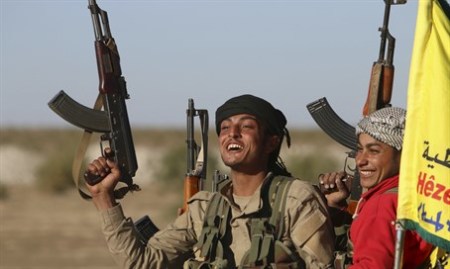
Kurds in SyriaKurdish fighters in Syria Reuters

In a leafy field in Syria, fighters in beige fatigues negotiate an obstacle course as they are trained to defend a Kurdish federal region across the country’s north.

Clutching rifles under a bright spring sun, the men are among thousands undergoing obligatory nine-month training to join the Autonomous Protection Forces.

The APF, its commander-in-chief Renas Roza says, will be responsible for defending the federal region declared last month at a Kurdish-led conference.

“This is the nucleus of a new army that will take up the defense of the federal region in northern Syria,” Roza tells AFP in his headquarters at Amuda near the border with Turkey.

The clean-shaven commander sits under a large poster bearing the APF logo – a long, curved sword crossed over a rifle below a red five-point star.

Roza says thousands of Kurdish, Arab and Syriac Christian men between the ages of 18 and 30 have completed the compulsory training.

For the first two months, conscripts are taught military structure and tactics, and then have lessons on human rights and interaction with civilians.

Three stages of training are led by the powerful People’s Protection Units (YPG), the military arm of the leading Kurdish Democratic Union Party (PYD).

Fadi Abdo Lahdo, a Syriac fighter training in the Bawr camp near Rmeilan, says his trainers are from the YPG’s commando force.

Dealing with civilians

“We’re learning how to cross over both cement barriers and natural barriers,” says the fair-haired fighter, squinting in the sunlight.

Other training sessions are administered by civic institutions.

“I served five months and I still have four months before I finish my service,” says Rinas Ahmad, an 18-year-old conscript with gelled hair.

“We were trained on military life and on how to deal with civilians so we don’t become like the Syrian (government) army,” Ahmad says.

Syria’s Kurds have both exploited and benefited from the chaos of the five-year-war to expand their control across northern parts of thecountry.

When the regime’s armed forces withdrew from Kurdish-majority areas in 2012, Kurds filled the void with a system of three “autonomous administrations.”

The three cantons, known from west to east as Afrin, Kobane and Jazire, already feature their own independent police forces, driving licenses and schools.

In March, a Kurdish-led summit in Rmeilan announced that it would establish a “federal region” uniting the cantons.

It elected a 31-member assembly tasked with laying the groundwork for the federal region by September.

The announcement was swiftly shot down by both the mainstream opposition and the regime, which categorically reject a federal system for Syria.

Rounding up recruits

In anti-government demonstrations across the country, some protesters burned the Kurdish flag to show their opposition to federalism.

Syria’s Kurds have continued their preparations nevertheless.

Training camps currently operate in the Afrin and Jazire cantons and will open soon in Kobane, Roza says.

The APF is also rounding up anyone who has yet to complete his nine-month service.

“We check people’s papers as they pass through checkpoints. If they have not done the training, we take them there,” an APF spokesman says.

An Arab APF trainee, who spoke on condition of anonymity, says he was detained at a Kurdish-run checkpoint as he drove to work.

Non-Kurdish residents living under the PYD-run cantons were already complaining about a six-month period of compulsory military service run by the YPG, but the new training period is three months longer.

As the federal region’s future army, APF units have begun deploying to areas recently captured from the Islamic State (ISIS) jihadist group.

Although they are not yet involved in front-line fighting, they are increasingly cooperating with the YPG and the Kurdish-Arab Syrian Democratic Forces.

The APF moves in to secure towns that the YPG or the SDF have seized from ISIS – such as Shadadi in Hasakeh province, which the SDF captured in February.

Kurdish forces have led the fight against ISIS since the jihadist group emerged in Syria in 2013, scoring several major victories in the recapture of key border towns, like Kobane, last year.

IDF’s drill secures Netanyahu-Putin summit

April 18, 2016

IDF’s drill secures Netanyahu-Putin summit, DEBKAfile, April 18, 2016
1 (3)

The IDF launched an unannounced military-air exercise in northen Israel Monday April 18. It will also be held in the Jordan valley, strategically located south of the Golan Heights and the Sea of Galilee. Despite the official explanation that the drills are part of the IDF’s training schedule for 2016, it is difficult not to see it as a follow-up to the Cabinet meeting on the Golan the previous day, including Prime Minister Benyamin Netanyahu’s declaration that “Israel will never withdraw from the Golan.”

Just as the Cabinet meeting was an “emergency” one, the exercise is not part of standard training, as an IDF statement claimed, but rather part of the overall picture of the war in Syria on the other side of the northeastern border.

The drill is mainly intended to prevent a possible attack by ISIS, Syrian, Iranian or Hizballah forces aimed at torpedoing Netanyahu’s discussions in Moscow with Russian President Vladimir Putin on Thursday, April 21.

DEBKAfile’s military sources report that the IDF exercise shows only half of the military picture in the area.
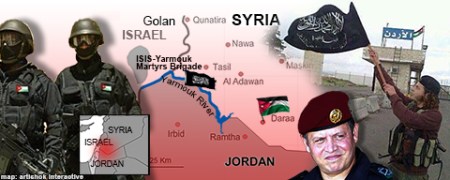
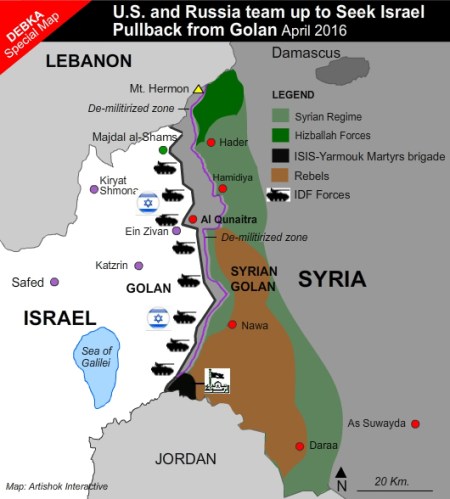
On the other side of the border, in the triangular pocket where the Israeli, Syrian and Jordanian borders meet, heavy fighting has been underway for several days between Syrian rebels and forces of the Yarmouk Martyrs Brigades and the al-Muthanna organization, which have both sworn allegiance to ISIS. The battles are taking place across from Israel’s Hamat Gader, south of the Sea of Galilee, which is the reason why the exercise is also being held in the Jordan Valley.

On the other side of the border, in the triangular pocket where the Israeli, Syrian and Jordanian borders meet, heavy fighting has been underway for several days between Syrian rebels and forces of the Yarmouk Martyrs Brigades and the al-Muthanna organization, which have both sworn allegiance to ISIS. The battles are taking place across from Israel’s Hamat Gader, south of the Sea of Galilee, which is the reason why the exercise is also being held in the Jordan Valley.

On the other side of the border, in the triangular pocket where the Israeli, Syrian and Jordanian borders meet, heavy fighting has been underway for several days between Syrian rebels and forces of the Yarmouk Martyrs Brigades and the al-Muthanna organization, which have both sworn allegiance to ISIS. The battles are taking place across from Israel’s Hamat Gader, south of the Sea of Galilee, which is the reason why the exercise is also being held in the Jordan Valley.

On Sunday, the leader and commander of Al-Muthanna was killed during the fighting. The goal of the rebel attack is to capture the Syrian villages in the territory held by ISIS, which threatens the Galilee and the Golan communities of Tel Katzir, Shaar Hagolan and Masada. Sources in Kuwait reported last week that Jordanian special forces and Israeli drones marked in the colors of the Jordanian air force are participating in the battles. The developments on the ground indicate that the goal of the attacking forces is to uproot ISIS from the Israeli and Jordanian border areas.

DEBKAfile’s sources provided the following exclusive details on April 17:   

The Israeli cabinet holds its weekly session Sunday April 17, on the Golan. Prime Minister Benyamin Netanyahu will visit Moscow on Thursday, April 21 to meet with Russian President Vladimir Putin and to launch the most important battle of his political career, and one of Israel’s most decisive contests of the last 10 years: the battle over the future of the Golan Heights.

DEBKAfile’s intelligence sources and its sources in Moscow report exclusively that Israel’s top political leaders and military commanders were stunned and shocked last weekend when they found out that US President Barack Obama and Russian President Vladimir Putin have agreed to support the return of the Golan to Syria. The two presidents gave their top diplomats, Secretary of State John Kerry and Foreign Minister Sergei Lavrov, the green light to include such a clause in a proposal being drafted at the Geneva conference on ending the Syrian civil war.

Israeli prime minister Benjamin Netanyahu seen during a security and defense tour in the Golan Heights, near the Northern Israeli border with Syria. April 11, 2016. Photo by Kobi Gideon/GPO *** Local Caption *** ??? ?????? ?????? ?????? ????? ?????? ?????. ????? ?????? ?????? ????? ?? ????? ??????? ???? ????? ?????? ?????? ?????

Israeli prime minister Benjamin Netanyahu seen during a security and defense tour in the Golan Heights, near the Northern Israeli border with Syria. April 11, 2016. Photo by Kobi Gideon/GPO

Israel captured the Golan from the Syrian army 49 years ago, during the Six-Day War in 1967 after the Syrian army invaded Israel.

In 1981, during the tenure of then Prime Minister Menachem Begin, Israel passed a law defining the Golan as a territory under Israeli sovereignty. However, it did not state that the area belongs to Israel.

While Israel was preparing for a diplomatic battle over the future of Jerusalem, Judea and Samaria, Obama and Putin decided to deal a diplomatic blow to Israel and Netanyahu’s government on an unexpected issue, the Golan.

It is part of an endeavor by the two powers to use their diplomatic and military cooperation regarding Syria to impose agreements on neighboring countries, such as Israel, Turkey, Saudi Arabia and Jordan.

For example, Washington and Moscow are trying to impose an agreement regarding the granting of independence to Syrian Kurds, despite Ankara’s adamant opposition. The two presidents are also pressuring Riyadh and Amman to accept the continuation of Syrian President Bashar Assad’s rule, at least for the immediate future.

DEBKAfile’s sources report that just like the other diplomatic or military steps initiated by Obama and Putin in Syria, such as those for Assad’s eventual removal from power, the two powers see a resolution of the Golan issue as a gradual process that may take a long time, perhaps even years. But as far as they are concerned, Israel will have to withdraw from the Golan at the end of that process.

It should be noted that Prime Minister Netanyahu is not traveling to Washington to discuss the Golan issue with Obama. The frequent trips by the prime minister, senior officials and top IDF brass to Moscow in recent months show where the winds are blowing in the Middle East.

However, Moscow is not Washington, and Israel has no lobby in the Russian capital defending its interests.

It should be made very clear that the frequent trips by senior Israeli officials to Moscow have not created an Israeli policy that can influence Putin or other senior members of the Russian leadership. Putin has made occasional concessions to Israel on matters of minimal strategic importance, but on diplomatic and military steps regarding Syria and Iran he has shown little consideration of Jerusalem’s stance.

It should also be noted that there has been no basis for the enthusiasm over the Russian intervention in Syria shown by Netanyahu, Israeli ministers and senior IDF officers.

All of the calls by a number of Russia experts, mainly those of ll of the calls by a number of Russia experts, mainly those of DEBKAfile, for extreme caution in ties with Putin have fallen on deaf ears among the political leadership in Jerusalem and the IDF command in Tel Aviv.

Amid these developments, three regional actors are very pleased by Washington and Moscow’s agreement to demand Israeli withdrawal from the Golan: Syrian President Assad, the Iranian leadership in Tehran and Hizballah leader Hassan Nasrallah.

Now, they do not need to risk a military confrontation with Israel over the Golan because Obama and Putin have essentially agreed to do the dirty work for them.

Christian Self-Defense Forces Emerge in Iraq & Syria

April 12, 2016

Christian Self-Defense Forces Emerge in Iraq & Syria, Clarion ProjectRyan Mauro, April 12, 2016

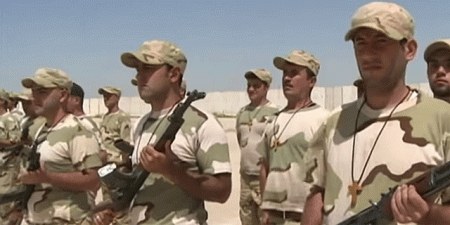
Babylon-Brigade-HPMembers of the Christian Babylon Brigade in Iraq (Video: screenshot)

The Christians of Iraq and Syria have had a breathtaking commitment to passivity since being victimized by what we all now finally agree qualifies as a genocide.

Now, the Christians are increasingly organizing to defend themselves—and the West should stand by them instead of outsourcing our moral responsibility to the Iraqis and their Iranian partners and various groups with questionable track records.

A poll in December 2014 found that only one-third of Iraqis say they are concerned about the persecution of Christians in their country. About 67 percent said they are not concerned at all or only “somewhat” concerned.

It’s easy to say that the U.S. should pressure the Iraqi government to protect the Christians, but its track record and these poll results do not inspire hope that it’ll work. The pace of the genocide is such that the Christians and those who care for them simply cannot afford to spend time hoping for the best.

A Christian force known as the Babylon Brigade has been incorporated into the Popular Mobilization Units, an assortment of militias led by the Iraqi government and their partners from the Iranian regime and Hezbollah. The Babylon Brigades and their supporters boast of their nationalism, having battled the Islamic State in non-Christian areas like Ramadi and Tikrit.

However, it numbers only 500 to 1,000 The Iraqi government should be applauded for supporting a Christian unit, but don’t mistake this for an Iraqi commitment to a Christian self-defense force that enables the community to have a say over whether it goes extinct or not.

Current U.S. policy still gambles their survival on the chance that the Iraqi government tied to Iran will protect them, particularly when the U.N. says Christian persecution in Iran has reached unprecedented levels.

The Kurds are allies of the U.S. but, when it comes to protecting Christians, they have been far from ideal. The Iraqi and Syrian Christians have plenty of stories of mistreatment at the hands of the Kurds.

The growth of a number of Christian self-defense forces in Iraq and Syria show potential for what could happen if they receive outside support.

There’s the Nineveh Plain Protection Units in northern Iraq under the helm of the Assyrian Democratic Movement of Iraq, which has a branch in northeastern Syria named the Gozarto Protection Forces. They are backed by the Middle East Christian Committee. The secretary-general of the Assyrian Democratic Movement claims that proper support would quickly grow the NPU’s numbers to 5,000.

Another small force is called Dwekh Nawsha, which is linked to the Assyrian Patriotic Party and has gotten attention because of Westerners joining their ranks. One of their advisers warned in November, “All we’re saying is we’re done. We don’t have equipment. We don’t have the weapons. We don’t have the training,” as he pleaded for U.S. backing.

In Syria, there is the Syriac Military Council, estimated to be about 2,000-strong including a Christian female unit. It belongs to a Kurdish-majority coalition known as the Syrian Democratic Forces. There is also a local Christian defense force near the Khabur River called the Khabur Guards.

Of course, any Christian force will have to be properly vetted. Hezbollah has set up a non-denominational force named Saraya al-Muqawama that includes Christians, Sunnis and non-religious Shiites.

A Christian police force that is favorable towards the Assad regime clashed with Kurdish forces in Qamishli, Syria. Sources close to the situation there emphasize that the Christians who embrace Assad are motivated by a fear of Islamist rebels, not because of any affinity for dictatorship or the regime’s brutality.

It would be a mistake to dismiss the viability of Christian self-defense forces because of their current sizes and capabilities. Unlike the Iraqi and Syrian militias and rebels, the Christians have had to rely only upon themselves for survival. They don’t have a state sponsor like Saudi Arabia, Qatar or Iran to build them up.

The U.S. has provided material support to Sunnis, Shiites and Kurds, despite records of human rights abuses, Islamism and ties to terrorists and enemy regimes. The Christians are reliable foes of Islamic extremism who, despite all they have suffered, have never formed a sectarian militia to exact bloody revenge.

It’s time for the U.S. to ask itself: Why are Sunnis, Shiites and Kurds worthy of our direct material aid but the Christians are not? Why do they deserve a chance to stop the murder, raping and torturing of their people, but the Christians do not and are left facing extinction if trends continue?

Moderate Islamist Al Qaeda Cannibal Tragically Killed in Syria

April 6, 2016

Moderate Islamist Al Qaeda Cannibal Tragically Killed in Syria, Front Page Magazine, Daniel Greenfield, April 6, 2016

lecter_palestine2b

Khaled al-Hamad (????-2016) was tragically killed in the Syrian Civil War. Al-Hamad was known as a devoted father, husband and cannibal. He fought for truth, justice and an Islamic State that would behead infidels, cover women and eat body parts. A passionate rebel, Khaled, also known as Abu Sakkar, came to the world’s attention when he passionately ate a heart or possibly a lung on camera.

Syrian rebel commander Abu Sakkar has said he has no regrets about cutting open the body of an enemy soldier and taking a bite out of his internal organs.

In the video, Sakkar, identified as a founder of the rebel Farouq Brigade, is seen taking out organs, believed to be the heart and a lung, from the soldier’s body and holding them up in front of the camera before taking a bite out of one of them.

There was some debate as to whether Sakkar/Hamad was eating a heart or a lung.

Al Hamad has now confirmed that the video is real, and that he did indeed take a bite of the soldier’s lung. (At the time of the filming, al Hamad believed that he was biting into the liver. A surgeon who has seen the video confirms that the organ in question was a lung, which somewhat resembles the liver).

Don’t worry though, Hamad isn’t one of those extremists. He was a moderate.

The Farouk Brigade has been described as “Moderately Islamist.”

Since then though Hamad became an “extremist” and joined Al Qaeda. And got himself killed.

The Observatory said that rival rebels “assassinated Khaled al-Hamad, who was known as Abu Sakkar and who was a military commander in Al-Nusra, by gunning him down” in the northwestern province of Idlib. They added, “He was likely killed in a settling of accounts.”

Apparently, Abu Sakkar joined the Al-Qaeda-affiliated Al-Nusra Front about a year ago.

It was either this or Kuru.

However, a Michigan State University report from 2014 suggests that Kuru, a neuro-degenerative disorder that is associated with cannibalism, has emerged in Syria, claiming some two dozen lives. According to the report, “Kuru resurfaced in the Muslim community recently among Syrian rebels who were rumored to be eating the hearts of victims, 2 of these rebels were then hospitalized and transferred to Germany to be treated for the disease signifying the emergence of the disease in Syria.”

The Arab Spring is now the Walking Dead.

ISIS descends on Jordan’s border, activates suicides. Jordanian command post in Daraa

April 6, 2016

ISIS descends on Jordan’s border, activates suicides. Jordanian command post in Daraa, DEBKAfile, April 6, 2016

Islamic State in Jordan

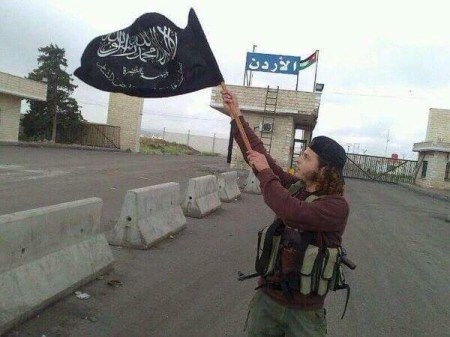
ISIS forces in southern Syria overran several Jordanian border crossings south of the Yarmouk River on Tuesday, April 5. This disastrous turn of events is illustrated by an exclusive picture obtained by DEBKAfile of an ISIS fighter unfurling the organization’s flag at one of the crossings which sports a Jordanian flag.

The picture taken the same day shocked the royal court and the Jordanian military command in Amman.

Our military sources report that an urgent conference was called at the Military Operations Command (MOC), north of Amman to devise measures for containing the Islamic State’s leap into more territory on the Syrian-Jordanian border. It was attended by Jordanian, American, Israeli, Saudi and UAE officers.

Our military sources report that an urgent conference was called at the Military Operations Command (MOC), north of Amman to devise measures for containing the Islamic State’s leap into more territory on the Syrian-Jordanian border. It was attended by Jordanian, American, Israeli, Saudi and UAE officers.

They voiced apprehension about three developments which give Daesh a substantial edge

1. A group of high ISIS officers traveled south from headquarters in Raqqa in the last few days, took command of the 3,000 fighters of the affiliated Yarmouk Brigades, and is now working to form a continuous jihadist enclave along Syria’s borders with Israel and Jordan, like the 90-kilometer ISIS strip blocking part of the Turkish border.

This enclave would directly threaten the Israeli Golan and northern Jordan.

2. When ISIS forces retreated last week from Palmyra, a group headed south, fetching up outside Jebel Druze without entering this mountain region. It is now feared that the jihadis are about to turn west toward the Israeli border and link up with the Yarmouk brigades. This would double the number of ISIS forces in southern Syria and make possible a major new assault on the Jordanian and Israeli borders.

JordanDaraa480Koteret

3. The strengthening of ISIS forces in southern Syria has attracted some of the Syrian rebel groups fighting the Syria army to the jihadist flag and the Yarmouk Brigades. The largest militia to enlist recently is the Al-Muthana movement. Although its leaders deny taking an oath of allegiance or any other ties with ISIS, Al-Muthana is currently fighting alongside ISIS. This has sent a disturbing signal to the hundreds of other anti-Assad militias in the neighborhood.

Jordan has meanwhile stepped forward to stem this flow of strength to ISIS.

DEBKAfile’s military and intelligence sources report that Jordanian military intelligence officers specializing in guerrilla warfare have been infiltrating rebel-held areas in the South, especially Daraa, the regional hub, for the purpose of whipping rebel militias together into a front against ISIS. These officers have succeeded in setting up a joint war room with the three biggest rebel groups in the south, the Southern Front, Jaish Fatah al-Junub and Jaish al-Islam, for action under the direction of the MOC outside Amman.

On Monday, April 4, the joint force saw combat, when rebel forces under Jordanian commanders launched an attack to drive the ISIS forces back into their former corner in the narrow triangle near the meeting-point of the Syrian, Israeli and Jordanian borders. ISIS hit back with suicide bombers, who blew themselves up next to the Jordanian-led rebel assault force. It was the first time ISIS had unleashed suicide bombers so close to the Israeli border.

Assad’s troops enter Palmyra after massive Russian air blitz to smash ISIS

March 27, 2016

Assad’s troops enter Palmyra after massive Russian air blitz to smash ISIS, DEBKAfile, March 27, 2016

Forces loyal to Syria's President Bashar al-Assad drive a tank during their offensive to recapture the historic city of Palmyra in this picture provided by SANA on March 24, 2016. REUTERS/SANA/Handout via Reuters ATTENTION EDITORS - THIS PICTURE WAS PROVIDED BY A THIRD PARTY. REUTERS IS UNABLE TO INDEPENDENTLY VERIFY THE AUTHENTICITY, CONTENT, LOCATION OR DATE OF THIS IMAGE. FOR EDITORIAL USE ONLY. NOT FOR SALE FOR MARKETING OR ADVERTISING CAMPAIGNS. THIS PICTURE IS DISTRIBUTED EXACTLY AS RECEIVED BY REUTERS, AS A SERVICE TO CLIENTS

Forces loyal to Syria’s President Bashar al-Assad drive a tank during their offensive to recapture the historic city of Palmyra in this picture provided by SANA on March 24, 2016. REUTERS/SANA/Handout via Reuters

Vladimir Putin after all took the momentous decision for Russian carpet bombing to level the Islamic State forces holding Palmyra since last May, and so clear the way for Bashar Assad’s troops and allied forces to enter the heritage city Saturday and Sunday, March 26-27 and take control of several districts. Television footage showed waves of explosions inside Palmyra and smoke rising from buildings, as Syrian tanks and armored vehicles fired from the outskirts.

But just as the Iraqi army, even with foreign assistance, never completely captured Ramadi or Baiji from Islamist forces, so too Assad’s forces can’t hope for complete control of the strategic town of Palmya. After pulling back to the east, ISIS forces will continue to harass the Syrian army and town with sporadic raids. And government forces will stay dependent on a Russian air umbrella to hang on.

The big question DEBKAfile’s military and intelligence sources were asking Sunday was what brought president Putin to give this groundbreaking military success to the Syrian ruler, just days after he withdrew Russian air support in southern Syria and opened the door for an Islamic State advance. He did this in an effort to break Assad’s resistance to the US-Russian deal for a political solution of the Syrian conflict by August.

Our sources offer two likely motivations:

1. Palmyra is strategically important to the Russian command because its fall to government forces opens the way to ISIS headquarters at Raqqa, 225 kilometers away.

2. Palmyra is also the gateway to Deir ez-Zour, 188 kilometers distant on Syria’s eastern border with Iraq. For the Russian military command, the importance of Deir ez-Zour outweighs that of Raqqa, because it is the key to control of the Euphrates Valley and access from Syria to Baghdad.

While these considerations bear heavily on Moscow’s strategic calculations, they have little direct impact on Assad’s overriding objective, which is to hold on to power. While the Syrian ruler may hope for acclaim for achieving a major success against ISIS, the laurel wreath belongs to Russian pilots. His forces essentially performed  a ground operation in Palmyra in Moscow’s interest and goal, which is to strengthen the Russian grip on his country.

On Saturday, DEBKAfile set forth the background for these events.

Cracks in the united US-Russian front over the Syrian ruler’s fate surfaced – even before the ink was dry on the joint announcement issued in Moscow Friday, March 25, by US Secretary of State John Kerry and Russian Foreign Minister Sergey Lavrov, setting  August as the deadline for a political solution of the five-year Syrian conflict.

Shortly after Kerry’s departure for Brussels, Russian Deputy Foreign Minister Sergey Ryabkov told reporters, “Washington now accepts Moscow’s argument that Assad’s future shouldn’t be open for negotiation right now.” However, taking exception to the phrase “right now,” State Department spokesman John Kirby immedieately snapped back, “Any suggestion that we have changed in any way our view of Assad’s future is false.”

Did this exchange spell another Washington-Moscow impasse on the future of the war and the Syrian ruler? Not exactly; Our military and intelligence analysts report that the two powers are in accord on the principle that Assad must go, but are maneuvering on the timeline for the war to end and the Syrian ruler’s handover of power.

The Americans want it to be sooner. The transition should start in August and result in adding opposition parties to the regime in positions of real influence.

President Barack Obama, when he conducts his farewell Gulf tour in April, would like to show Saudi Arabia and Gulf emirates that he has finally kept his word to them to evict Bashar Assad from power before he leaves the White House next January. The US would also be better placed for bringing the Syrian opposition into line for a negotiated deal.

But Putin prefers a delay because he has problems to solve first. The six-month long Russian military intervention in the Syrian conflict turned the tide of the war. The Syrian army and its Iranian and Hizballah allies were able to stabilize their positions and even score some important victories against rebel forces in central and northern Syria. Last year, Putin and Iran’s supreme leader Ayatollah Ali Khamenei were definitely on the same page and fully coordinated.

That cordial relationship was thrown out of kilter by the Kremlin’s decision to work with the White House for bringing the disastrous Syrian war to an end and terminating the Assad era.

From November, Iran’s Gen. Qassem Soleimani’s frequent visits to Moscow on liaison duty petered out.

Khamanei is adamantly opposed to Russia and the US commandeering the decision on Assad’s departure and its timetable. He is even more outraged by the way Putin has moved in on Syria and made it Russia’s home ground in the Middle East.

The rift with Tehran prompted Putin to announce on March 14 the partial pullback of his military forces from Syria. It was a threat to pull the rug that had turned the tide of the war in favor of Damascus and Tehran.

4 (1)

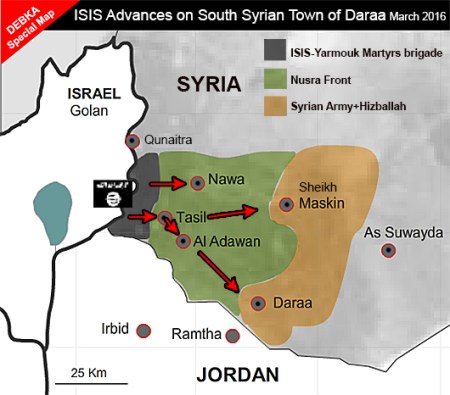
Reluctant to burn those boats, Moscow has been juggling its balls in the air, trying not to drop any. At first, he suspended Russian air cover for government-led battles. The Islamic State immediately seized on this opening in the south and advanced on the towns of Nawa, Sheikh Maskin and Daraa.

Moscow hoped that this setback would teach Bashar Assad to toe the Russian line.

Then, in the second part of last week, Putin ordered the Russian air force to renew its air strikes in the east in support of the Syrian army’s march from central Syria on the historic town of Palmyra. Friday and Saturday, the Syrian army and its allies were battling for control of the UNESCO World Heritage city, nearly a year after the Islamic State overran it and vandalized its historic remains.

DEBKAfile’s military sources stress that their capture of the reconstructed ancient Citadel perched on a hill over the city would have been beyond their strength without Russian air support. Finishing the job and recovering the entire city of Palmyra will depend heavily on Russian air strikes continuing to hammer the jihadist occupiers.

Putin faces a momentous decision. He has already taught Assad and Tehran a harsh lesson: with Russian air support, they win battles, but not without it, as their failure in the south has demonstrated.

Will he help Assad win Palmyra?

Crowning the Syrian dictator with such a striking victory would stiffen his resistance to American pressure for him to quit in short order. He would stand out as the only Syrian war leader capable of pushing ISIS back. But if the Russian leader decides to cut off air support in mid-battle for Palmyra, Assad and Iran will be forced to face the fact that without active Russian military support, they are in hot water.

The Syrian ruler would then have to accept his approaching end. That is the dilemma facing Putin.