Posted tagged ‘Syria war’

U.S. still gets it wrong on Islamic State

July 1, 2016

U.S. still gets it wrong on Islamic State, Japan Today, Peter Van Buren, July 1, 2016

(An interesting and rather perceptive analysis, quite contrary to Kerry’s position that the suicide attack at the Turkish airport was a sign of desperation. — DM

WASHINGTON — Tuesday’s attacks at Istanbul’s main airport, which appear at this time to be the work of Islamic State, are the latest reminder that the United States should not downplay the group’s rudimentary – yet effective – tactics.

Since the wave of Islamic State suicide bombings in May – killing 522 people inside Baghdad, and 148 people inside Syria – American officials have downplayed the strategy as defensive. Brett McGurk, the Special Presidential Envoy in the fight against Islamic State, said the group “returned to suicide bombing” as the area under its control shrank. The American strategy of focusing primarily on the “big picture” recapture of territory seems to push the suicide bombings to the side. “It’s their last card,” stated an Iraqi spokesperson in response to the attacks.

The reality is just the opposite.

A day after the June 26 liberation of Fallujah, car bombs exploded in eastern and southern Baghdad. Two other suicide bombers were killed outside the city. An improvised explosive device exploded in southwest Baghdad a day earlier.

Washington should know better than to underestimate the power of small weapons to shape large events. After Secretary of Defense Donald Rumsfeld labeled Iraqi insurgents as “dead enders” in 2003, they began taking a deadly toll of American forces via suicide bombs. It was the 2006 bombing of the Shi’ite al-Askari Golden Mosque that kicked the Iraqi civil war into high gear. It was improvised explosive devices and car bombs that kept American forces on the defensive through 2011.

To believe suicide bombings represent a weakening of Islamic State is a near-total misunderstanding of the hybrid nature of the group; Islamic State melds elements of a conventional army and an insurgency. To “win,” one must defeat both versions.

Islamic State differs from a traditional insurgency in that it seeks to hold territory. This separates it from al-Qaida, and most other radical groups, and falsely leads the United States to believe that retaking strategic cities like Fallujah from Islamic State is akin to “defeating” it, as if it is World War Two again and we are watching blue arrows move across the map toward Berlin. Envoy McGurk, following Fallujah, even held a press conference announcing Islamic State has now lost 47 percent of its territory.

However, simultaneously with holding and losing territory, Islamic State uses terror and violence to achieve political ends.

Islamic State has no aircraft and no significant long-range weapons, making it a very weak conventional army when facing down the combined forces of the United States, Iran and Iraq in set piece battles. It can, however, use suicide bombs to strike into the very heart of Shiite Baghdad (and Syria, Jordan, Yemen, and Turkey – as Tuesday’s bombing reminds us), acting as a strong transnational insurgency.

Why does such strength matter in the face of large-scale losses such as Fallujah?

Violence in the heart of Iraqi Shiite neighborhoods empowers hardliners to seek revenge. Core Sunni support for Islamic State grows out of the need for protection from a Shi’ite dominated military, which seeks to marginalize if not destroy the Sunnis. Reports of Shi’ite atrocities leaking out of the ruins of Sunni Fallujah are thus significant. Fallujah was largely destroyed in order to “save” it, generating some 85,000 displaced persons, mirroring what happened in Ramadi. Those actions remind many Sunnis of why they supported Islamic State (and al-Qaida before them) in the first place.

Suicide strikes reduce the confidence of the people in their government’s ability to protect them. In Iraq, that sends Shiite militias into the streets, and raises questions about the value of civil institutions like the Iraqi National Police. Victories such as the retaking of Ramadi and Fallujah, and a promised assault on Mosul, mean little to people living at risk inside the nation’s capital.

American commanders have already had to talk the Iraqi government out of pulling troops from the field to defend Baghdad, even as roughly half of all Iraqi security forces are already deployed there. This almost guarantees more American soldiers will be needed to take up the slack.

Anything that pulls more American troops into Iraq fits well with the anti-American Islamic State narrative. Few Iraqis are left who imagine the United States can be an honest broker in their country. A State Department report found that one-third of all Iraqis believe the Americans are actually supporting Islamic State, while 40 percent are convinced that the United States is trying to destabilize Iraq for its own purposes.

In a country like Turkey, suicide bombings play out in a more complex political environment. Turkey has effectively supported Islamic State with porous borders for transit in and out of Syria, and has facilitated the flow of oil out of Syria and Iraq that ultimately benefits the group. At the same time, however, Turkey opened its territory to American aircraft conducting bombing runs against Islamic State. Attacks in Turkey may be in response to pressure on the nation to shift its strategy more in line with Western demands. Russia (no friend of Islamic State) and Turkey have also recently improved relations; the attack in Istanbul may have been a warning shot reminding Turkey not to get too close.

The suicide bombings – in Turkey and elsewhere – are not desperate or defensive moves. They are not inconsequential, even if their actual numbers decline. They are careful strategy, the well-thought out application of violence by Islamic State. The United States downplays them at great risk.

U.S.-Backed Syrian Rebel Commander Boasts of Fighting With AQ Affiliate

June 29, 2016

U.S.-Backed Syrian Rebel Commander Boasts of Fighting With AQ Affiliate, Investigative Project on Terrorism, Ariel Behar and Ravi Kumar, June 28, 2016

1660Nuruddin az-Zinki fighter with a Tow missile.

A commander of a U.S.-backed Syrian opposition group says his fighters continue to ally on the battlefield with an al-Qaida-tied jihadist group.

The United States continues to arm Nuruddin az-Zinki as it fights dictator Bashar al-Assad’s forces. But in an interview posted online last week, az-Zinki founder Tawfiq Shihab Al Deen acknowledged teaming up “with Al Nusra (an al-Qaida affiliate in Syria), which is a group that proved themselves to be forceful fighters.”

“Our groups, Nuruddin az-Zinki, along with Al Nusra, are the only groups continuously fighting against the regime in the al-Malah area in Aleppo,” Shihab al-Deen told Abdullah al-Muhasayni, a radical Saudi preacher said in an interview posted on YouTube June 21.

Al-Muhasayni interviewed jihadi commanders in Syria during the month of Ramadan. He is known to be the conduit between the Jihadi rebel groups in Syria and their benefactors in the Gulf.

The United States has armed Nuruddin az-Zinki, which has posted many videosshowing their fighters using U.S. TOW missiles.

It is not clear why the United States continues to support Nuruddin az-Zinki despite its alliance with an al-Qaida affiliate.

Muhasayni’s interview with Shihab al-Deen could indicate that this alliance between Nuruddin az-Zinki and Al Nusra extends beyond the battlefield. Muhasayni is considered the spiritual father of al-Qaida in Syria.

The U.S. suspended non-lethal aid to Syrian rebels late in 2014, after jihadists seized warehouses storing supplies. But support for Nuruddin az-Zinki continued, the McClatchy news service reported.

Israel’s PM seeks role in Russian-US duo in Syria

June 6, 2016

Israel’s PM seeks role in Russian-US duo in Syria, DEBKAfile, June 6, 2016

PutinBibi2-480 (1)

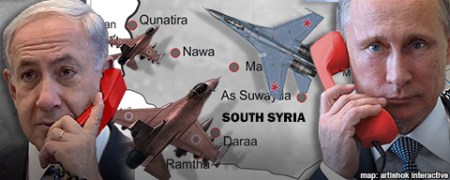
During his 48-hour trip to Moscow (Monday and Tuesday June 6-7), Prime Minister Binyamin Netanyahu will try and talk President Vladimir Putin into cutting Israel into the military teamwork evolving between Washington and Moscow for combating the Islamic State in Syria. As a quid pro quo, he will offer to elevate Moscow to senior broker in the Israeli-Palestinian dispute, with Moscow or Geneva selected as the venue for direct Israeli-Palestinian talks, if they occur – and with US participation. Netanyahu is also keen on a role for Egypt’s Presidents Abdek-Fattah al-Sisi.

DEBKAfile sources in Jerusalem and Moscow report exclusively that the floating of this deal was the reason why Russia’s Foreign Minister Sergey Lavrov abstained from attending the Mid East conference staged last weekend by France’s President Francois Hollande in Paris. The UK and German foreign ministers followed the Russian lead and stayed away.

And Friday, June 3, on the day of the Paris meeting, Russian Deputy Foreign Minister Mikihail Bogdanov, who is in charge of Kremlin Middle East policy, offered a formula for resolving the problem of Israeli settlements on the West Bank.  That formula was very similar to the land swaps plan proposed by Defense Minister Avigdor Lieberman a few years ago.

It consisted essentially of the transfer to the Palestinian state of parts of Israel with dense Arab populations, in return for Palestinian recognition of Israeli sovereignty over the Israeli communities of Judea and Samaria.

In comments to Tass news service, Bogdanov said that Moscow is willing to host an Israeli-Palestinian peace conference, and also offered to mediate between the rival Palestinian factions, including Abu Mazen’s Fatah and the radical Hamas which rules the aza Strip.

While some Israeli politicians see the French initiative as offering President Barack Obama a handle for settling accounts with PM Netanyahu before he leaves the White House at the end of the year, Moscow and Jerusalem are concocting a parallel strategy – not merely to block the Franco-American move, but also to lift Washington’s drive for an Israeli-Palestinian accord from Paris to Moscow.

DEBKAfile sources say that this maneuver is based on the early stages of military and political coordination between Washington and Moscow in the Syrian arena, including the fight against ISIS.

No such coordination exists between Washington and Paris.

Netanyahu envisages the tightening military cooperation between Russia and Israel for Syria, along with Israel’s active participation in the airstrikes against ISIS, as becoming integral to American-Russian understandings, and extending also to the Israeli-Palestinian issue.

Moscow and Jerusalem both estimate that an offer of US-Russian-Arab guarantees to the Palestinians, underwritten by Egypt and Saudi Arabia, can move the negotiations forward.

Iran’s Chess Board

June 3, 2016

Iran’s Chess Board, Front Page MagazineCaroline Glick, June 3, 2016

official_photo_of_hassan_rouhani_7th_president_of_iran_august_2013

Even if Obama’s successor disavows his actions, by the time Obama leaves office, America’s options will be more limited than ever before. Without war, his successor will likely be unable to stem Iran’s rise on the ruins of the Arab state system.

********************

Reprinted from jpost.com.

Strategic thinking has always been Israel’s Achilles’ heel. As a small state bereft of regional ambitions, so long as regional realities remained more or less static, Israel had little reason to be concerned about the great game of the Middle East.

But the ground is shifting in the lands around us. The Arab state system, which ensured the strategic status quo for decades, has collapsed.

So for the first time in four generations, strategy is again the dominant force shaping events that will impact Israel for generations to come.

To understand why, consider two events of the past week.

Early this week it was reported that after a two-year hiatus, Iran is restoring its financial support for Islamic Jihad. Iran will give the group, which is largely a creation of the Iranian Revolutionary Guard Corps, $70 million.

On Wednesday Iranian media were the first to report on the arrest of a “reporter” for Iran’s Al-Alam news service. Bassam Safadi was arrested by Israel police in his home in Majdal Shams, the Druse village closest to the border with Syria on the Golan Heights. Safadi is suspected of inciting terrorism.

That is, he is suspected of being an Iranian agent.

There is nothing new about Iranian efforts to raise and run fronts against Israel within its territory and along its borders. Iran poses a strategic threat to Israel through its Hezbollah surrogate in Lebanon, which now reportedly controls the Lebanese Armed Forces.

In Gaza, Iran controls a vast assortment of terrorist groups, including Hamas.

In Judea and Samaria, seemingly on a weekly basis we hear about another Iranian cell whose members were arrested by the Shin Bet or the IDF.

But while we are well aware of the efforts Iran is making along our borders and even within them to threaten Israel, we have not connected these efforts to Iran’s actions in Iraq and Syria. Only when we connect Iran’s actions here with its actions in those theaters do we understand what is now happening, and how it will influence Israel’s long-term strategic environment.

The big question today is what will replace the Arab state system.

Syria, Iraq, Lebanon, Yemen and Libya no longer exist. On their detritus we see the fight whose results will likely determine the fates of the surviving Arab states, as well as of much of Europe and the rest of the world.

Israel’s strategic environment will be determined in great part by the results of Iran’s actions in Iraq and Syria. While Israel can do little to affect the shape of events in these areas, it must understand what they mean for us. Only by doing so, will we be able to develop the tools to secure our future in this new strategic arena.

Until 2003, Saddam Hussein was the chief obstacle to Iran’s rise as the regional hegemon.

US forces in Iraq replaced Hussein until they left the country in 2011. In the meantime, by installing a Shi’ite government in Baghdad, the US set the conditions for the rise of Islamic State in the Sunni heartland of Anbar province on the one hand, and for Iran’s control over Iraq’s Shi’ite-controlled government and armed forces on the other.

Today, ISIS is the only thing checking Iran’s westward advance. Ironically, the monstrous group also facilitates it. ISIS is so demonic that for Americans and other Westerners, empowering Iranian-controlled forces that fight ISIS seems a small price to pay to rid the world of the fanatical scourge.

As former US naval intelligence analyst J.E. Dyer explained this week in an alarming analysis of Iran’s recent moves in Iraq published on the Liberty Unyielding website, once Iranian- controlled forces defeat ISIS in Anbar province, they will be well placed to threaten Jordan and Israel from the east. This is particularly the case given that ISIS is serving inadvertently as an advance guard for Iran.

In Syria, Iran already controls wide swaths of the country directly and through its surrogates, the Syrian army, Hezbollah and Shi’ite militias it has fielded in the country.

Since the start of the war in Syria, Israel has repeatedly taken action to block those forces from gaining and holding control over the border zone on the Golan Heights.

Prime Minister Benjamin Netanyahu’s surprising recent announcement that Israel will never relinquish control over the Golan came in response to his concern that in exchange for a cease-fire in Syria, the US would place that control on the international diplomatic chopping block.

A week and a half ago, Iran began its move on Anbar province.

On May 22, Iraqi forces trained by the US military led Iraq’s offensive to wrest control over Fallujah and Mosul from ISIS, which has controlled the Sunni cities since 2014. Despite the fact that the lead forces are US-trained, the main forces involved in the offensive are trained, equipped and directed by Iran.

As Iraqi forces surrounded Fallujah in the weeks before the offensive began, Qassem Soleimani, the commander of the Revolutionary Guards’ Quds forces, paid a public visit to the troops to demonstrate Iran’s dominant role.

The battle for Fallujah is a clear indication that Iran, rather than the US, is calling the shots in Iraq. According to media reports, the Pentagon wanted and expected for the forces to be concentrated in Mosul. But at the last minute, due to Soleimani’s intervention, the Iraqi government decided to make Fallujah the offensive’s center of gravity.

The Americans had no choice but to go along with the Iranian plan because, as Dyer noted, Iran is increasingly outflanking the US in Iraq. If things follow their current course, in the near future, Iran is liable to be in a position to force the US to choose between going to war or ceasing all air operations in Iraq.

On May 7, Asharq al-Awsat reported that the Revolutionary Guards is building a missile base in Suleimaniyah province, in Iraqi Kurdistan.

A senior IRGC general has made repeated visits to the area in recent weeks, signaling that the regime views this as an important project. The report further stated that Iran is renewing tunnel networks in the region, built during the 1980-88 Iran-Iraq War.

Dyer warned that depending on the type of missiles Iran deploys – or has deployed – to the base, it may threaten all US air operations in Iraq. And the US has no easy means to block Iran’s actions.

To date, commentators have more or less agreed that US operations in Iraq and Syria make no sense. They are significant enough to endanger US forces, but they aren’t significant enough to determine the outcome of the war in either territory.

But there may be logic to this seemingly irrational deployment that is concealed from view. A close reading of David Samuels’s profile of President Barack Obama’s Deputy National Security Adviser Ben Rhodes published last month in The New York Times, points to such a conclusion.

Samuels described Rhodes as second only to Obama in his influence over US foreign and defense policy. Rhodes boasted to Samuels that Obama’s moves toward Iran were determined by a strategic course he embraced before he entered office.

A fiction writer by training, Rhodes’s first “national security” job was as the chief note taker for the Iraq Study Group.

Then-president George W. Bush appointed the group, jointly chaired by former secretary of state James Baker and former congressman Lee Hamilton, in 2006, to advise him on how to extricate the US from the war in Iraq.

In late 2006, the ISG published its recommendations.

Among other things, the ISG recommended withdrawing US forces from Iraq as quickly as possible. The retreat was to be enacted in cooperation with Iran and Syria – the principle sponsors of the insurgency.

The ISG argued that if given the proper incentives, Syria and Iran would fight al-Qaida in Iraq in place of the US. For such action, the ISG recommended that the US end its attempts to curb Iran’s nuclear program.

Responsibility for handling the threat, the ISG recommended, should be transferred to the US Security Council.

So, too, the ISG recommended that Bush pressure Israel to withdraw from the Golan Heights, Jerusalem and Judea and Samaria in the framework of a “peace process.”

Such action too would serve to convince Iran and Syria that they could trust the US and agree to serve as its heirs in Iraq.

Bush of course, rejected the ISG’s recommendations.

He decided instead to sue for victory in Iraq. Bush announced the surge in US forces shortly after the ISG published its report.

But now we see, that through Rhodes the Iraq Study Group’s recommendation became the blueprint for a new US strategy of retreat and Iranian ascendance in Iraq and throughout the Middle East.

The chief components of that strategy have already been implemented. The US withdrawal from Iraq in 2011 left Iran as the new power broker in the country. The nuclear pact with Iran facilitated Iran’s transformation into the regional hegemon.

Against this strategic shift, the US’s minimalist campaigns in Iraq and Syria against ISIS make sense.

The US forces aren’t there to defeat ISIS, but to conceal Iran’s rise.

When ISIS is defeated in Anbar and in Raqqa in Syria, its forces are liable to turn west, to Jordan.

The US is currently helping Jordan to complete a border fence along its border with Iraq. But then ISIS is already active in Jordan.

And if events in Iraq and Syria are any guide, where ISIS leads, Iran will follow.

Iran’s strategic game, as well as America’s, requires Israel to become a strategic player.

We must recognize that what is happening in Iraq is connected to what is happening here.

We need to understand the implications of the working alliance Obama has built with Iran.

Even if Obama’s successor disavows his actions, by the time Obama leaves office, America’s options will be more limited than ever before. Without war, his successor will likely be unable to stem Iran’s rise on the ruins of the Arab state system.

In this new strategic environment, Israel must stop viewing Gaza, Judea and Samaria, the Golan Heights and Lebanon as standalone battlefields. We must not be taken in by “regional peace plans” that would curtail our maneuver room. And we must bear in mind these new conditions as we negotiate a new US military assistance package.

The name of the game today is chess. The entire Middle East is one great board. When a pawn moves in Gaza, it affects the queen in Tehran.

And when a knight moves in Fallujah, it threatens the queen in Jerusalem.

Can US, Turkey keep up appearances in Syria?

May 30, 2016

Can US, Turkey keep up appearances in Syria? Al-Monitor, May 29, 2016

A terrorist group linked to the Islamic State (IS) claimed responsibility for suicide bombings in Tartus and Jableh in Syria on May 23 that killed more than 150 civilians and wounded more than 200 others. Maxim Suchkov points out that the attack in Tartus occurred deep inside government-controlled territory. Russia maintains a naval base in Tartus and an air base and reconnaissance center in Khmeimim in the Latakia region. The suicide attacks, Suchkov suggests, could be a catalyst for a Russian “first strike” strategy against terrorist and aligned Salafi groups.

Moscow had already signaled the prospect of escalation against Jabhat al-Nusra and allied groups prior to the May 23 attacks. The Russian Ministry of Defense has announced a pause in its air campaign to allow armed groups allied with Jabhat-al Nusra to distance themselves from the al-Qaeda affiliate. On May 26, Jabhat al-Nusra, Ahrar al-Sham and allied groups seized the town of Dirkhabiyah near Damascus. Ahrar al-Sham has coordinated more closely with Jabhat al-Nusra in response to increased US and Russian targeting of the al-Qaeda affiliate over the past few months.

This column last week suggested that the United States take up a Russian offer to coordinate attacks on Jabhat al-Nusra, which is not a party to the cessation of hostilities. For the record, we have no tolerance or empathy for groups or individuals who stand with al-Qaeda. We hope that this is at least part of the message the United States is conveying to its regional partners who have backed these groups.

With the Geneva talks suspended for several weeks, the prospect of a Russian campaign to deliver heavy and potentially fatal blows to Jabhat al-Nusra and its allies, especially in and around Aleppo and Idlib, could signal yet another turning point in the Syria conflict.

Turkey’s failed proxy war

The United States and Turkey are struggling to keep up appearances in Syria, despite even further signs of division and discord.

Gen. Joseph Votel, US CENTCOM commander, met last week with Syrian Kurdish forces during a “secret” visit to northern Syria as part of a regional diplomatic tour that also included a stop in Ankara. Votel told Washington Post columnist David Ignatius that he is seeking to “balance” Turkey’s role as a “fabulous” partner in the battle against IS with that of the People’s Protection Units (YPG), the backbone of the Syrian Defense Forces (SDF), which is a “very good partner on the ground.”

In contrast to the YPG, Turkey’s proxy forces, including a worrying mix of Salafists who are willing to run operations with Jabhat al-Nusra, have been a flop. Last week, IS seized at least seven villages in the northern Aleppo region.

Fehim Tastekin reports that SDF-led military operations to liberate Jarablus, which is an essential gateway along with al-Rai to the outside world via Turkey, were postponed “because of Turkey’s red line against the Kurds.” The offensive against Raqqa has also been slowed, writes Tastekin, because “the SDF’s operational capacity still leaves much to be desired. It is not an option for the Kurdish YPG-YPJ to control Raqqa, because they will encounter local resistance. They also worry that scattering their forces in Arab regions could weaken the defensive lines of Rojava (Syrian Kurdistan). Therefore, Arab forces would have to get in shape to control the situation in the post-IS period.” Laura Rozen reports from Washington that the United States is seeking to boost the numbers of Arab Sunni forces among the SDF in anticipation of an advance on Raqqa.

Meanwhile, the Pentagon found itself in a public relations fiasco after Turkey complained that US special forces in Syria were wearing badges with the logo of the YPG, which Turkey considers the Syrian partner of the Kurdistan Workers Party (PKK) and therefore also a terrorist organization. This might be compared with what in the sports world is known as an unforced error, and made Votel’s already daunting diplomacy that much more complicated.

Air Force Col. Sean McCarthy also told Ignatius that US air operations against IS out of Incirlik Air Base were mostly “autonomous” of Turkish missions, saying that “we don’t discuss with them where we’re going.”

Adding it all up, the US-Turkish “partnership” against IS may be more fable than fabulous. The open secret is that Turkey is preoccupied first with thwarting advances by Syria’s Kurds, and second with shutting down the remaining lifelines for IS in northern Syria. These priorities are of a piece. No doubt Turkey is taking up the fight against IS, but first things first. Tastekin, who previously broke the back story on Turkey’s disastrous proxy efforts to retake al-Rai from IS in April, now concludes that “there is no room for optimism that Ankara will erase its red lines vis-a-vis the Kurds. Instead, Turkey is now trying to put together an even more formidable force with Jabhat al-Nusra, which it is trying to steer away from al-Qaeda.”

The catch might just be that many of the Syrian armed groups backed by Washington’s regional partners are proxies for a sectarian agenda that is mostly about toppling Syrian President Bashar al-Assad, however unlikely that now appears, and, by extension, keeping the heat on Iran. The when and where of taking the fight to IS or Jabhat al-Nusra is more or less negotiable, depending on trade-offs and pressure. We do not feel we are out on a limb in suggesting that efforts by Ankara or others to wean Jabhat al-Nusra from al-Qaeda will come to no good. This column has repeatedly documented the fluidity of foreign-backed Salafi groups such as Ahrar al-Sham and Jaish al-Islam shifting in and out of tactical alliances with Jabhat al-Nusra, all the while preaching an ideology almost indistinguishable from al-Qaeda and IS.

The losers, of course, are the people of Syria, including those who suffer under IS’ tyranny that much longer because of Turkey’s concerns about the Kurds, and as Washington’s policymakers and pundits begin another maddening deep dive into how to rejigger ethnic and sectarian fault lines. Syrians fleeing IS terror in Aleppo, meanwhile, told Mohammed al-Khatieb that living under IS is “like hell … unbearable.” While we acknowledge the complexities and challenges of the raw ethnic and sectarian politics of Syria, as well as the potential for vendettas and mass killings, there is, in our score, an urgency and priority to focus on the destruction of IS and al-Qaeda above all else.

Sur’s aftermath

Diyarbakir’s historic district of Sur has witnessed some of the most brutal fighting between Turkish military and PKK forces over the past year. Mahmut Bozarslan reports from Diyarbakir that “historical landmarks in Sur, which was last year added to UNESCO’s World Heritage List, also suffered their share of destruction. The walls of the Armenian Catholic church are partially destroyed, while the nearby Haci Hamit Mosque is missing its minaret, with a dome riddled with bullets. Another Armenian church, Surp Giragos, had its windows shattered and interior damaged.”

“Still, those ancient monuments were lucky compared with more ordinary structures in the area,” writes Bozarslan. “A building with an intact door was almost impossible to find. The warring parties had used some buildings as fighting bases, others as places to rest. Stairways were littered with empty tins; one was also stained with blood. At the bloodied spot, a piece of paper reading “body #1” was left behind, suggesting that the security forces had been there for a crime scene report. A couple seemed relieved that they had escaped with relatively little damage, but grumbled that their apartment had been broken into, with the bedroom and closets rummaged. They claimed it was the security forces who had entered, while their neighbor showed Al-Monitor binoculars that had been left behind.”

US military chiefs overrate damage to ISIS

May 28, 2016

US military chiefs overrate damage to ISIS, DEBKAfile, May 28, 2016

The US military chiefs fighting ISIS, have recently claiming that the US has re-organized its military resources and is determined to cut down the Islamic state after its lame efforts in the last two years.

These words of encouragement have come from genral Votel commander of US Middle East forces and the first US General to be assigned to Syria in its nearly six years of war, and Lt. Gen Charles Brown commanding the US Al Udied Air Base in Qatar where 750 aircraft operating in the Gulf and Middle East are based.

When US airstrikes against the Jihadist organization began the offensive in late 2014 was marred by inadequate intelligence and (specifically that of intelligence analysis), and sporadic aerial action.

DEBKAfiles repeatedly reported that American and coalition air strikes  against the Jihadists were too few, misfired and many of the bombers returned to base with much of their ordinance unused.

It appears that the Obama administration has finally decided to tackle ISIS in earnest.

Our military and anti-terror experts claim it is too soon to determine whether the US commitment is real.

It is true that there are signs of limited US military movement in Syria, Libya and Iraq indicating a possible change.

For example: Increasing the number of US special forces in these three countries, far beyond the framework that President Obama is talking about publicly, when he says ‘small forces’.

There are about 7,500 US soldiers deployed in Iraq and Syria, with an additional  2,000-3,000 fighters working for private security contractors. In Libya there are an additional 1,000 to 1,250  soldiers. American planes take off from Incirlilk base in South Turkey 350km by air from Raqqa, ISIS Syrian capital, and 700km from Mosul, ISIS Iraqi capital, and do not need to fly more than 1,450km (about 770 miles) when they approach from the Persian Gulf.

ISIS still shows no sign of cracking or dismantling its Islamic Caliphate, and its military and terrorist capabilities.

ISIS_State_of_war_25.5.16

There are several reasons for this:

ISIS is expanding fast. While the Obama administration treats Iraq and Syria as the main fronts against the jihadi organization, ISIS has opened three more fronts: in Egypt, Sinai Peninsula, and Libya. While the US had quietly added 4 to 5 detachments of US special forces, these forces are too small to be a military challenge to the terror organization, and all they can do is fight ISIS with the help of local forces, as the US are doing in Iraq and Syria.

In addition to Mosul and Raqqa, the ISIS has established capitals at the Lybian port of Sirte on the Mediterranean Sea and in Jabal Halal mountain range in central Sinai with a cluster of ISIS bases. They provide a fallback option for the terrorist organization in the still distant prospect of Raqqa and Mosul falling to US and local forces.

When General Brown reported that the US Air Force is now hitting ISIS held oil fields, funds and headquarters, and that its revenue has fallen “only” to $56 million per day, he omitted to mention the ISIS Lybian oil fields and their revenue. In fact, DEBKAfile’s military sources note that ISIS is making up for revenue shortfalls in Syria and Iraq by pumping oil in Libya and the surrounding desert.

While US military sources claim that 45 percent of the territory the Islamic State seized in Iraq in 2014, and 20 percent in Syria, has been reclaimed, ISIS still hangs on to its key strategic assets.

Furthermore ISIS this week launched an offensive in the northern and eastern Syrian regions of Aleppo, Azaz, and Deir-a-Zor`; and inflicted damaging assaults on May 14 and May 23 on Russian bases and Syrian Syrian government centers near Jableh and Tartous in Western Syria. It is obvious its external terrorist capacity has not been cut down as was expected.

US and Middle East intelligence agencies hold information showing that ISIS is going to expand its bomb attacks in major cities in Europe and the Middle East, in the coming weeks. This follows an estimate of the organization’s leaders that the attacks on the Russian and Egyptian passenger aircrafts, and the terror attacks in Paris, Brussels and Tunisia, to be very successful.

Lebanese ‘Al-Safir’ Daily Marks 16th Anniversary Of Israel’s Withdrawal From South Lebanon: Hizbullah Is Digging Tunnels On Israel Border

May 26, 2016

Lebanese ‘Al-Safir’ Daily Marks 16th Anniversary Of Israel’s Withdrawal From South Lebanon: Hizbullah Is Digging Tunnels On Israel Border, MEMRI, May 25, 2915

On May 25, 2016, the Lebanese daily Al-Safir, which is known for its support for Hizbullah, published a front- page article celebrating “Liberation Day,” i.e. the 16th anniversary of Israel’s withdrawal from South Lebanon. The article, which appears without a byline, analyzes the current situation of Hizbullah (which it calls “the resistance”) as well as its combative actions on the Syrian and Israeli fronts. It claims that this year’s Liberation Day celebrations are mixed with heartbreak for Hizbullah supporters, due to the large number of Hizbullah casualties in the Syria war. It adds that in its fight in Syria, Hizbullah currently faces the toughest challenge since its establishment, greater even than its conflict against Israel, because the price thus far paid by Hizbullah in this war – both in capabilities and casualties – is unprecedented, and no solution in Syria is on the horizon.

The article assesses that Hizbullah may expand its theater of operations even further in the future, in response to new challenges, and that this will turn it into a “regional power” that “formulates new equations in the region.”

Adding that alongside its fighting in Syria, Hizbullah is continuing its activity against Israel, the article also reports that resistance fighters work day and night along the Israeli border, “conducting observations, preparing, and digging tunnels that cause the settlers and enemy soldiers to lose sleep.” It also states that in fighting “tafkiri organizations,” Hizbullah has encountered an enemy that excavates tunnels, after becoming accustomed to being the only one digging them; in fact, it was Hizbullah that taught other resistance fighters, particularly Palestinians in the Gaza Strip, the tunnel doctrine.[1]

The following are excerpts from the article:[2]

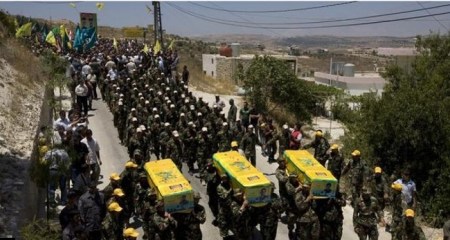
28169Funeral of Hizbullah fighters killed in Syria (image: Safa.ps)

“[Since its founding], the resistance [i.e. Hizbullah] never found itself deployed on several fronts and facing more than one challenge and more than one danger at once [as is happening today]. These four years since it became involved in the war in Syria represent the greatest trial it has [ever] faced… The movement has never paid in flesh, blood and abilities as it has paid [during the Syria war] and as it may continue to pay in the future, in the open confrontation with the takfiri [groups, i.e. the groups fighting against the Assad regime in Syria].[3] [So far] over 1,000 [fighters] have died and thousands have been wounded and disabled, and many others may meet [the same fate] in the ever-expanding confrontation that is becoming more difficult and more aggressive every day. This, especially since the horizon of a political solution seems to have been eliminated for the foreseeable future.

“Amid all this comes the 16th [anniversary] of the liberation [of South Lebanon], which underscores an element that Israel cannot ignore, namely the strengthening of the security and stability equation on both sides of the Palestine-Lebanon border. [This is] thanks to the deterrence system, or more accurately the balance of terror, which is an equation that has turned South Lebanon into the most secure region in the entire Middle East. Though we must not ignore other factors, no less important, [that contribute to this security], including [UN] Resolution 1701, UNIFIL and the Lebanese army.

“The celebrations of liberty are held amid heartbreak mixed with joy. Heartbreak [at the sight of] the processions of martyrs crossing the boundary south of the Litani every day [i.e. bodies of Hizbullah fighters killed in Syria being returned to Lebanon for burial], and joy [at the sight of] the processions [of people] rejoicing over [Hizbullah’s victory in some of] the local elections [that have been held in Lebanon in recent weeks]…

“The heartbreak over the martyrs is a necessary tax [that must be paid] in the struggle, [a struggle] which the Lebanese, of all sectors, regard as existential, even though they are divided on whether the preemptive war against the terrorists outside the borders of the homeland is justified. This heartbreak is present in every home in South [Lebanon]… When Hizbullah secretary-general Hassan Nasrallah speaks at Liberation Day ceremonies [today] in the town of Al-Nabi Shayth in the Bekaa [Valley], he will be speaking to a public that has contributed to the resistance [by supporting Hizbullah’s activity in Syria] just as residents of the South have contributed [in fighting against Israel], and perhaps even more, since [Bekaa Valley residents] face a danger today on their eastern border that is just as bad as the Israeli danger.

“It is right to say that the men of resistance on the eastern border complement the mission of the first men of resistance [who operate against Israel], who work day and night [along the border, from] the last border point in Al-Naquora to [the one in] Kfar Shouba, conducting observations, preparing, and digging tunnels that cause the settlers and enemy soldiers to lose sleep. [All this they do] without abandoning the [other] tasks of the resistance, which stands ready, openly and secretly, throughout Lebanon, and especially in the Southern Dahiya, in order to prevent any terrorist attack by the takfiris, in full coordination with the Lebanese army and Lebanon’s other security apparatuses. There might be further expansion of Hizbullah’s battle front, in accordance with future challenges, and this expansion turns this Lebanese group [Hizbullah], which was established 34 years ago in Sheikh ‘Abdallah’s base in Baalbek, into a regional force that formulates new equations in the region…

“In all of its rounds of fighting with the Israeli enemy, the resistance never faced what it has been facing for years in confronting the dark [elements] armed with the Prophet Muhammad’s Koran and Sunnah, who receive funding from tyrannical regimes and innumerable intelligence apparatuses, and are armed with military [equipment] that only armies possess.”

“The resistance also never experienced a four-year war in an area several times larger than Lebanon [itself]. It never experienced [war] against groups that imitate its methods and ways of warfare, but [who] instead of blowing themselves up against an Israeli convoy terrorize innocent people in the cities and villages, without batting an eyelash, as happened in the southern Dahiya or yesterday in Tartus and Jableh.

“The resistance never experienced war against groups fighting in caves and in the hills, mountains, wadis and even deserts, as happened at Tadmor and in the rural areas of Homs and Aleppo… Before [the war with Syria], the resistance did not storm cities and did not fight armies deep in the mountains.  Before this, no one lay in wait for it in tunnels like the ones that only it used to excavate, and [the doctrine of which] it spread to the rest of the men of the resistance, particularly to the Palestinians in the Gaza Strip.

“All these have been the unique characteristics of the resistance throughout the 16 years since May 25, 2000. All these [characteristics] and others will cause Hassan Nasrallah to declare that defending the achievement of liberation will end only with the defeat of the terrorists…”

Endnotes:

[1] Regarding the issue of the tunnels, it should be noted that Ibrahim Al-Amin, chairman of the board of the Lebanese dailyAl-Akhbar, wrote in a January 13, 2014 article that Hamas members fighting in Syria, in the Al-Quseir area and other regions, had dug tunnels there, similar to the ones excavated by Hamas in Gaza. He explained that Hizbullah had taught Hamas to dig these tunnels in the days when the two organizations were cooperating in smuggling arms into Gaza and preparing military plans against Israel.

[2] Al-Safir (Lebanon), May 25, 2016.

[3] Hizbullah, like the Syrian regime, does not draw a distinction between the rebels and the Salafi-jihadi groups.

US mull hitting ISIS for EgyptAir bombing

May 22, 2016

US mull hitting ISIS for EgyptAir bombing, DEBKAfile, May 22, 2016

Triangle480_Koteret

A special team set up by ISIS in its Syrian capital Raqqa planned the downing of EgyptAir Flight 804 from Paris to Cairo, which took the lives of 66 passengers and crew, DEBKAfile’s intelligence and counterterrorism sources say in an exclusive report.

The information that an ISIS team ploting terrorist attacks has been operating in Raqqa for several weeks was known to American intelligence and counterterrorism services even before the downing of the Egyptian airliner, and warnings containing the information were sent to several Western European capitals, including Paris.

The warnings said ISIS is prepare a series of large-scale attacks in main European cities and airports with the start of the summer travel season.

That is the main reason why both Paris and Cairo said the plane was downed by an act of terror on May 19 as soon as it became clear that the airliner had crashed into the Mediterranean 288 kilometers north of Alexandria, even before the debris was found.

Our sources report that the US has decided to maintain its original plan, prepared  before the downing of Flight 804, to impose a siege on Raqqa in an attempt to prevent terror cells from leaving the city and carrying out attacks.

On Saturday, May 21, US Army Gen. Joseph Votel, the commander of American forces in the Middle East, made a secret visit to Syria, the first of its kind by a senior US officer since the Syrian civil war began in 2011. Votel, who recently assumed command, visited Kurdish YPG militia forces and the US special forces troops at Rmelan airbase located 288 kilometers northeast of Raqqa. The American force is equipped with AH-64 Apache attack helicopters capable of attacking Raqqa within a relatively short period of time.

The purpose of Gen. Votel’s visit was to look into the viability of a US-Kurdish strike in retaliation for the downing of the Egyptian plane. It should be assumed that US President Barack Obama will need to make a decision on the operation in the coming hours.

Over the weekend, ISIS, which is aware of the American plans, enabled citizens to leave Raqqa if they wished to do so. ISIS does not want to have to worry about the civilian population if there is a US-Kurdish attack or siege.

In the meantime, Washington and Cairo are stalling for time while considering their options.

That is the reason why US and Egyptian officials, and even Egyptian President Abdel Fattah al-Sisi, continued to claim on May 22 that more time is needed to determine the cause of the crash.

It was also the reason why, soon after the air disaster, it was claimed that there was no distress call or any other message regarding a problem with the plane.

But two days after the crash, on May 21, following the recovery of debris and parts of the bodies of the passengers, there were suddenly reports that they signals from the plane of smoke in two places in the aircraft.

Investigators say it is still not clear what caused the smoke, whether a fire or fires broke out on the plane, or whether the fire eventually caused the crash, but al the signs point to an internal explosion.

DEBKAfile sources report that both Paris and Cairo believe that the crash was caused by a new type of small time bomb, or several of them, that were smuggled into the plane and planted by Charles de Gaulle airport workers loyal to ISIS.

The sources point out that ISIS explosives experts specialize in building very small devices that can be smuggled onto planes. A device within a Coca-Cola can downed a Russian Airbus A321 over the Sinai Peninsula on October 31, killing all 224 passengers and crew.

Our sources also report that investigators of the latest crash believe that just as ISIS blew up the Russian plane in retaliation for Moscow’s intervention in Syria, the downing of the Egyptian plane is linked to the entry by Egyptian special forces into Libya during the last few weeks to take action against ISIS forces.

DEBKAfile’s military sources report that an Egyptian special force is operating with a  US elite units against ISIS targets in eastern Libya near the port city of Tobruk.

FULL: Donald Trump at Morning Joe, May 20, 2016- ‘Would you consider Sanders as your running mate?’

May 20, 2016

FULL: Donald Trump at Morning Joe, May 20, 2016- ‘Would you consider Sanders as your running mate?’ May 20, 2016

(Spoiler alert: The question about Sanders as Trump’s VP choice comes at the tail end of the interview, and Trump’s answer was that Sanders should run as an independent. The interview is wide-ranging and deals with foreign policy, China, Mexico, the Islamist threat, the terrorist attack on EgyptAir and a bunch of other stuff. — DM)

https://www.youtube.com/watch?v=B36FldQmVq4

Al-Qaeda Leader Ayman Al-Zawahiri: The Mujahideen In Syria Must Unite; Syrians Must Beware Both Saudi And ‘Crusader’ Plots

May 9, 2016

Al-Qaeda Leader Ayman Al-Zawahiri: The Mujahideen In Syria Must Unite; Syrians Must Beware Both Saudi And ‘Crusader’ Plots, MEMRI, May 9, 2016

(Does Al-Zawahiri show strength or weakness? — DM)

The following report is now a complimentary offering from MEMRI’s Jihad and Terrorism Threat Monitor (JTTM). For JTTM subscription information, click here.

On May 8, 2016, Al-Qaeda issued a new audio message from its leader, Ayman Al-Zawahiri, after several month of silence. In the message, Al-Zawahiri calls on the jihad groups in Syria to unite because this is a matter of life and death for them. He urges the Muslims of Syria to reject the initiatives of Saudi Arabia and its allies in the region, and assures them that the jihadis will defeat “the Eastern and Western Crusaders war machine” – i.e., both Russia and America – as well as their allies, the Syrian regime and Iran. Addressing the relationship between Al-Qaeda and its affiliate in Syria, Jabhat Al-Nusra (JN), he hints that the ties between them are strong and that they should remain so, for the world will not accept JN as legitimate in any case, unless it completely changes its nature to suit the superpowers.

The following are excerpts from the message:

zawah90

“Syria today is the hope of the Islamic nation, for [its revolution] is the only Arab Spring revolution that is taking the correct path – the path of da’wa and jihad for the sake of strengthening the shar’ia and enacting [its laws], and for the sake of striving to establish a righteous caliphate, not the caliphate of Ibrahim Al-Badri [i.e., Abu Bakr Al-Baghdadi]…

“This is why the world’s arch-criminals [i.e., the superpowers and the international community] have come together to prevent the establishment of a jihadi state in Syria… and have hatched [various] plots and [exerted various] pressures… However, Allah willed it that there should remain one jihad-fighting group [i.e., JN and its allies], comprising the best of theansar [local fighters] and muhajiroun [foreign fighters], which cleaves to the truth and does not stray from it. The Muslims in Syria rallied around this group, seeing the difference between its correct path and the false path of the extremist Khawarij, the new takfiris [i.e., ISIS]…

“My brothers the mujahideen everywhere, our duty today is to defend the jihad in Syria against the plots being hatched against it, plots which are directed by the pampered daughter of Britain and proxy of the U.S., the state of the Sa’ud [royal] family [namely Saudi Arabia] and its lackeys in the region. The aim of all these plots is to establish a regime in Syria that will present itself as Islamic but will be based on a false Islam that coexists in harmony with secularism and with the concept of the nation-state, with extremist nationalism and with the regime of the international arch-criminals. [This regime] will sacrifice the lives of the hundreds of thousands who took to the streets to call out the natural slogan: ‘[the Prophet] Muhammad is our commander and our lord forever.’

“The greatest problem facing the world order and our apostate leaders and their governments [today] is that the mujahideen in Syria are standing on the borders of Palestine and threatening what they call ‘the state of Israel,’ [which is actually] the 51st American state and the largest military base outside America. Therefore, these criminals are compelled to cooperate in order to fight this jihad, kill it while it is still small, and divert it from its path [towards the path] of nationalism, secularism and capitulation to the world order of [these] arch-criminals. This is why they hatch one plot after another: Geneva, Riyadh, ceasefires, resolutions by the arch-criminals’ Security Council– an endless series of deceptions, lies and duplicities.

“Our duty today is to support the jihad in Syria with all our might and rally around it, all of us, [both] light and heavy.[1]Our duty today is to call for unity among the muhajideen in Syria until it is liberated from the secularist Nusairi [i.e., Alawite] regime, its partners, the rawafid Safavis [i.e., Shi’ite Persians, referring to Iran], and their allies, the Russians and the Western Crusaders – until a righteous, jihadi Islamic entity is established in this land.

“My brothers the mujahideen in Syria, who come from all over the world, today unity is a matter of life and death for you. You can unite and live a life of honor, or you can stay divided and be devoured, one by one.”

Al-Zawahiri then moves on to address the issue of the organizational ties between Al-Qaeda and JN: “There remains an open question that is dealt with extensively in an attempt to distract the Muslims in Syria from their true enemies, namely [the question of] the ties between Al-Qaeda and the dear, honorable and glorious Jabhat Al-Nusra, with whom we are proud to have relations and pray to Allah that he enhance its success and steadfastness. Let me say briefly and clearly: We have said time and again that, if and when the heroic people of Syria establish an Islamic government and choose for themselves a leader, whoever they choose will be acceptable to us. We are not power-hungry. We do not want to rule over the Muslims; we want the shari’a to rule and we want to be ruled as Muslims according to Islam. We call for unity among the mujahedeen in Syria, and urge them to agree on the establishment of a jihad-fighting and righteous Islamic government… that will wage jihad, liberate the lands, and strive to liberate Al-Aqsa and establish a caliphate in the path of prophecy. JN’s organizational affiliation will never pose an obstacle to these great objectives that we, as part of the Islamic nation, hope for. [Unlike ISIS] we do not presume to be the patrons [of the Islamic nation], nor do we pounce upon it, demanding to that it swear loyalty to unknown people and to a caliph of surprises.

“Besides, would the arch-criminals accept JN if it left Al-Qaeda? Or will they obligate it to conduct negotiations with the criminal murderers, and then compel it to obey the agreements of abasement and shame and then capitulate to the governments of corruption and subordination… We in Al-Qaeda do not accept a pledge of loyalty unless it is voluntary. We do not force anyone to swear loyalty to us. We do not threaten to blow up or behead [our opponents]. We do not brand anyone fighting against us an apostate, as do the new Khawrij [ISIS], who make baseless claims.

“Al-Zawahiri concludes with an appeal to the Muslims in Syria: “We are part of you. Though we come from different countries, religion and faith unite us. We are with you, waging one war on many fronts against the  Crusader arch-criminals and their apostate partners. Your victory is our victory, your dignity is our dignity, and your strength is our strength. Stand fast, oh servants of Allah, against the savage attack of the Crusaders from East and West [the Russians and Americans], who have forged an alliance with the secular Nusairis and the criminal rawafids. Stand fast and fight. Do not let the Crusader war machine intimidate you.” Citing former Taliban leader Mullah Muhammad Omar, Al-Zawahiri states that “Allah promised us victory,” and adds: “It was trust in Allah alone that shattered this Eastern and Western [i.e., Russian and American] Crusader war machine in Afghanistan and later in Iraq, and it is [faith in Allah] that will shatter it in Syria, Allah willing. Beware the seductions of the traitorous and subordinate apostate governments, which will not give you either freedom or dignity, because one who lacks something [himself] cannot provide it [to others]. Your deeds must justify your words when you say: ‘death and not abasement.'”

_________________________________

[1] Koran 9:41: ” Go forth, whether light or heavy, and strive with your wealth and your lives in the cause of Allah.”