Posted tagged ‘Syria war’

Hizballah units regroup on Israel’s Golan border

September 7, 2016

Hizballah units regroup on Israel’s Golan border, DEBKAfile, September 7, 2016
qunetrafront

DEBKAfile’s military sources note that the Iranian media attached photos of Israel’s security force opposite Quneitra to their reporting on the new move, thereby framing the target of the Syrian-Iranian-Backed Hizballah build-

***********************

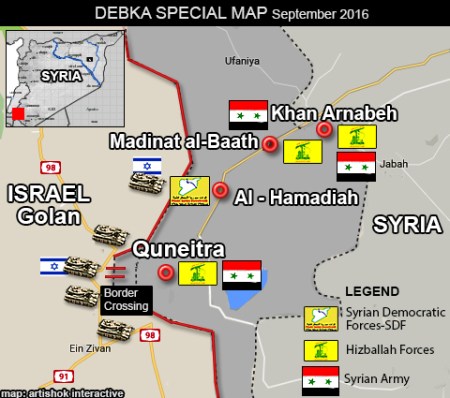
A large Hizballah force, backed by the Syrian army and pro-Iranian Shiite militias, is building up outside Quneitra, just 2km from Israel’s Golan border. The Lebanese Shiite fighters, under the command of Iranian Revolutionary Guards (IRGC) officers, are streaming into southern Syria, armed with tanks and artillery.

Monday night, Sept. 5, Iranian state-controlled media shed light on this movement, reporting that the combined force had “completed preparations necessary for an extensive operation in southern Syria,” adding, “Hizballah aims to put an end to the presence of armed men in the area close to the border.”

The nature of the “armed men” was not specified, but the goal of the new operation was clear: after evicting the assorted anti-Assad groups, including the Islamic State, holding territory “close to the border,” Hizballah and its backers planned to regroup on the Syrian-Israeli boundary.

This would position Iran and its Hizballah surrogate ready to realize their six-year old design, which is to open a second warfront against Israel.

Western and Mid East sources have toldl DEBKAfile that the triple army is in high spirits after last week’s successful operation in Aleppo. By snatching back parts of the city they lost in mid-August, the Syrian army and its allies managed to cut off the rebels’ supply lines from Turkey.

It was then that some Hizballah units were detached from the Aleppo arena and redirected to the Quneitra front in southern Syria to face the Israeli border.
israeliborder480

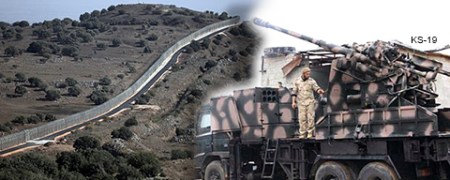
Those sources report that the incoming troops were sighted this week when they arrived at Madinat al-Baath and Khan Amabeh, the main Syrian army bases on the Syrian Golan. They came with tanks and heavy artillery. Seen for the first time in the Quentra sector were heavy, self-propelled KS-19 artillery batteries, which are Russian anti-air guns adapted to ground warfare. They have a range of 21km and a firing capacity of 15 shells per minute.

The newly-arrived Hizballah force appears to have set the capture of Syrian rebel-held al-Hamdiniyah 2km from the Israeli border, as its first objective.

DEBKAfile’s military sources note that the Iranian media attached photos of Israel’s security force opposite Quneitra to their reporting on the new move, thereby framing the target of the Syrian-Iranian-Backed Hizballah build-up.

This fast-approaching development poses two tough questions:

1. Will Israel lie down for the avowedly hostile Hizballah and Iran to occupy territory along its eastern border?Israel officials have repeatedly emphasized that these forces would not be allowed to take up positions on the Golan border, a message Russia most certainly passed on to Damascus.

If Hizballah and its allies go through with their planned offensive, Israel will have to consider serious military action to prevent them from reaching the border fence, i.e., an operation on a scale quite different from the small-shot IDF reprisals for rockets or shells straying across into the Golan from fighting on the other side.

2. Will the advancing Iranian-led force have Syrian air cover? If it does, the Israeli Air Force will also be involved in aerial combat over the Golan.
Who killed Al-Adnani? US, Russia or maybe ISIS?

September 1, 2016

Who killed Al-Adnani? US, Russia or maybe ISIS? DEBKAfile, September 1, 2016

Adnani

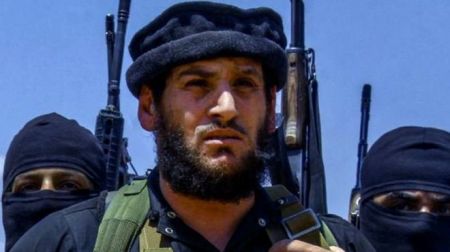
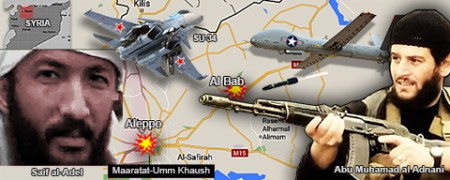
While the US has frequently claimed to have liquidated an Islamic terrorist leader, Russia put in its first claim on Aug. 31, when the defense ministry in Moscow announced for the first time that the day before, an SU-34 bomber had killed ISIS senior terrorist mastermind Mohammed Al-Adnani during a high-profile gathering at Maaratat-Umm Khaush near Aleppo.

The claim was worded so as to indicate that Russian intelligence had pulled off a major feat by a hit that took out 40 high-profile operatives.

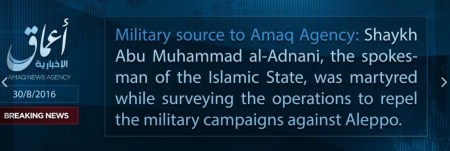
This claim came 24 hours after a US official said that a Predator drone rocket had hit a car believed to be carrying Adnani near Al-Bab, and that the results were “being assessed” – even though ISIS itself reported that the terrorist leader, tagged as senior spokesman, “was martyred while surveying the operations to repel the military campaigns against Aleppo.”

The Pentagon sources called the Russian version “lies” and “a joke.”

The distance between al-Bab and Maaratat-Umm Khaush is only 28km, but the gap between the American and Russian claims is less immeasurable.

Fighting has escalated around the city in recent weeks, with rebels breaking a siege by government forces and Syrian and Russian warplanes bombing rebel-held areas.

The competing Russian and American claims of a successful aerial-cum-intelligence action against a high-profile ISIS founder-member break new ground in the war on Islamic terror.

Al-Adnani, who was born in 1977 in the northern Syrian town of Banash, was responsible in the past two years for orchestrating terrorist atrocities in Tunisia, Paris, Brussels, Orlando, Nice, Sinai Peninsula and Istanbul, as well as suicide bombings in Baghdad.

Far from being a joke, the cold war dividing Moscow and Washington appears to have spread to the war on Islamist terror and infected the Syrian arena.

The early collaboration between the two powers in the Syrian conflict has broken down. This was admitted on Aug. 26 in Geneva, after US Secretary of State John Kerry and Russian Foreign Minister Sergei Lavrov failed to agree on further military and intelligence cooperation.

Ironically, it is noted by DEBKAfile’s intelligence and counterterrorism sources, that both powers’ clandestine services received intelligence on their target’s movements from the same source.

IsisSpokesman480

That is another first; never before has any Islamic terrorist organization fed the same piece of intelligence to the US and Russia. If that is what happened, it could mean only one thing: that someone in ISIS had decided it was time for Al-Adani to go.

This would be par for the course in the harsh world of jihadist terror organizations, such as Al Qaeda from which ISIS sprung.

When Osama bin Laden, whom US special forces killed in 2011, felt the need to cull the Al-Qaeda leadership of high-profile operatives who had outlived their usefulness or were suffering from fatigue, he would get rid of them by arranging for US intelligence to be tipped off about their whereabouts.

In one notable instance of this purge, Khalid Sheikh Mohammed, senior planner of the 9/11 attacks on New York and Washington, was turned in to the CIA in 2003.

If this is what happened to Al-Adani, DEBKAfile’s counterterrorism sources link it to the recent reappearance on the Islamist terrorist scene in Syria three weeks ago of the veteran Al-Qaeda master-terrorist Saif al-Adel with a group of followers.

Al-Adel is rated one of the world’s most dangerous terrorists, with long experience of planning and executing mass-casualty operations stretching back to the 1980s. He is “credited” with the large-scale assaults on the East African US embassies in 1998 and a string of murderous strikes in Saudi Arabia in 2003, some of which hit US targets.

It is not yet known how Al-Adel and his gang reached Syria and for what purpose. They are only known to have crossed the border from Iraq. It is presumed by intelligence watchers of terrorist insider politics that, after deciding that Al-Adnan was a spent asset, ISIS leaders found his replacement.

Does The Death of ISIS #2 Man Mean We’re Winning?

August 31, 2016

Does The Death of ISIS #2 Man Mean We’re Winning? Clarion Project, Elliot Friedland, August 31, 2016

Iraq-US-drone-MQ-1B-predator-wikimedia-commons-640-320An MQ-1B Predator Drone takes off from a US airbase in Iraq. (Photo: © Wikimedia Commons)

[A] concerted effort to delegitimize and deconstruct the underlying ideology of Islamism is the only way to secure a lasting solution to the problem of jihadist terrorism.

**********************

Islamic State (ISIS, ISIL) spokesperson Mohammed al-Adnani, who was reportedly tipped to be the successor to self-styled Caliph Abu Bakr al-Baghdadi, has been killed in Aleppo, Syria, according to an ISIS announcement.

ISIS-adnani-dead

The Islamic State has vowed to exact revenge for his death.

The Pentagon confirmed they targeted al-Adnani with a drone strike.

“We are still assessing the results of the strike, but al-Adnani’s removal from the battlefield would mark another significant blow to ISIS,” Pentagon press secretary Peter Cook said in a statement.

“Al-Adnani has served as principal architect of ISIS’ external operations and as ISIS’ chief spokesman. He has coordinated the movement of ISIS fighters, directly encouraged lone-wolf attacks on civilians and members of the military and actively recruited new ISIS members,” he said, explaining the importance of al-Adnani to the Islamic State.

Adnani was thought to be behind the Paris attacks, according to CNN.

Yet, however important al-Adnani was, he was still just one man. Killing terrorist leaders is important. But until the radical Islamist ideology that spawns terrorism is eradicated, this “War on Terror” will continue to resemble whack-a-mole.

ISIS has no shortage of eager jihadists ready to take his place and who can be trained to fulfill his role. Perhaps they will not succeed as well as he has, perhaps they will do even better.

The elimination of individual jihadists, while important, has not significantly eroded terrorism in the past.

On the contrary, more jihadists have simply stepped forward.

Islamist preacher Anwar al-Awlaki was killed in a drone strike in Yemen in 2011, yet his teachings still influenced Omar Mateen to massacre revelers at the Pulse gay nightclub in Orlando Florida.

When Osama bin Laden was killed in a drone strike in 2011, Aymen al-Zawahiri took over as leader of Al-Qaeda. Bin Laden’s son Hamza released an audio message earlier this year calling on Saudis to overthrow their government.

Since the “War on Terror” began in 2001, global terrorism has increased. According to the Global Terrorism Index fatalities caused by terrorism increased from 3,361 in 2000 to 11,133 in 2012 and 18,111 in 2013. In 2014 the figure was even higher, with 32,658 fatalities.

ISIS and Boko Haram (which pledged allegiance to the Islamic State) were jointly responsibe for 51% of those deaths.

This is despite Obama’s drone strike program killing from 2,372 to 2,581 combatants with drone strikes between January 20, 2009 and December 31, 2015 according to official White House figures, not including deaths from air strikes in Afghanistan, Iraq or Syria.

The administration claims to have killed 64 to 116 civilians in drone strikes over the same time period, a number that human rights and monitoring groups have slammed as being much lower than the real figure.

The Obama administration has killed up to 10 times as many terrorists in drone strikes as the Bush administration did, depending on which figures you use, yet terrorism increased.

Last year the number of terror attacks dropped.

“The total number of terrorist attacks in 2015 decreased by 13% and total deaths due to terrorist attacks (28,328) decreased by 14%, compared to 2014,” the US annual Country Reports on Terrorism stated.

Advances of Kurdish and Iraqi government forces and airstrikes on Islamic State oil fields probably had a lot more to do with the reduction than the killing of any one man, no matter how important.

Yet, as the Islamic State loses territory in its base of Iraq and Syria, they threaten to expand their terror attacks abroad.

Therefore a concerted effort to delegitimize and deconstruct the underlying ideology of Islamism is the only way to secure a lasting solution to the problem of jihadist terrorism. Defeating ISIS and similar groups must occur both on the battlefield, to deny them the freedom of movement and operation which enables them to plan and execute attacks, and in the realm of ideas.

Syrian Kurds clash with Turkish forces

August 26, 2016

Syrian Kurds clash with Turkish forces, DEBKAfile, August 26, 2016

(Please see also, Biden Gushes to Erdoğan That American People ‘Stand in Awe’ of Turkish ‘Courage’ — DM)

Tanks_invading_Syria_B_24.8.16

Just a few days ago, the Americans were speaking highly of Kurds as the sharpest sword in the coalition’s arsenal for vanquishing the jihadists. Since Biden’s deal with Erdogan on Wednesday, Washington can forget about the Syrian Kurdish PYG or the Iraqi Kurdish Pershmerga as spearheads of the campaigns to liberate Raqqa in Syria and Mosul in Iraq for ISIS.

*****************************

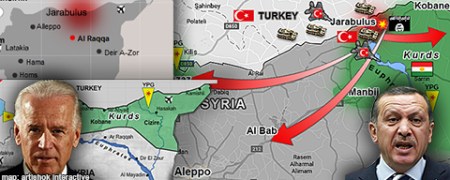
Syrian Kurdish militia commanders are flouting the ultimatum US Vice President Joe Biden handed them Wednesday, Aug. 24 to retreat to east of the Euphrates or else forfeit US support.  Instead, DEBKAfile’s military sources report, they decided to stand their ground and fight it out with the Turkish army.

The first clash occurred Thursday overnight, when Kurdish forces from Manbij attacked the positions taken by Turkish tanks in Jarablus, hours after Islamic State forces were put to flight from this border town.

The battles continued into Friday morning, Aug. 26.

The US ultimatum to the Kurds was the outcome of understandings US Vice President Joe Biden reached with Turkey’s President Tayyip Erdogan in Ankara on Wednesday, hours after the Turkish army crossed into northern Syria.

“Syrian Kurdish forces will lose US support if they don’t retreat to east bank of Euphrates,” the US vice president stated at a news conference.

Yet Thursday night, Turkish officials made an effort to counteract the impression that their military intervention in Syria was coordinated with the United States. They announce that Russian chief of staff Gen. Valery Gerasimov would be arriving in Ankara Friday for talks with his Turkish counterpart, Gen. Hulusi Akar.

The US commander of American troops in Iraq and Syria, Lt. Gen. Stephen Townsend, had meanwhile instructed all US Special Operations personnel to withdraw from Syrian-Kurdish YPG militia units, and return to the N. Syrian Rmeilan airfield near Hassaka. This is reported from DEBKAfile military and intelligence sources.

The US general also stopped artillery ammo supplies to the Kurdish militia and the transfer of field intelligence from the fighting in areas newly occupied by the Turkish army.

These measures were temporary, the US officers informed Salih Muslim, Syrian Kurdish Democratic Union Party (PYD) leader, and would be lifted after his YPG militia was instructed to pull back from northern Syria and head east of the Euphrates.

Only last week, the Syrian Kurdish militia was riding high, covered in praise for its feat in capturing Manbij with the assistance of US Special Forces.

Their comedown after the US decided to jump aboard the Turkish invasion would be complete, if they complied with the Biden ultimatum. They would forfeit all their hard-won gains from years of combat against the Islamic State, and have to forget their dream of a Kurdish state linking their enclaves along the 900km Syrian-Turkish border.

A stream of information and misinformation is meanwhile muddying the waters as the Kurds in Syria and Iraq absorb the shock of the American turn against them.

The Ministry of Foreign Affairs in Ankara said Thursday that US Secretary of State John Kerry had informed the Turkish Foreign Minister Mevlut Cavusoglu that the US-backed Syrian Kurdish militias had begun their retreat to the eastern bank of the Euphrates River.


ManbijKoteret480

US sources qualified this claim, confirming only that a ‘main element’ of the Kurds has retreated, but not the entire force. The Kurds were evidently in no hurry to take any marching orders either from Turkey or the United States.

A short Kurdish statement claimed that their forces had indeed withdrawn to the eastern bank of the Euphrates River, but DEBKAfile’s military sources military sources say that a large body of Kurdish fighters is still in place west of the river. Indeed our sources found Kurdish PYG officers adamant in their determination to stay put and take on the Turkish army.

After the Turkish invasion Wednesday, Kurdish leader Salih Muslim declared, “Turkey will be defeated in Syria along with the Islamic State.”

Kurdish units also took up positions on the roads leading to the US base at Rmeilan, ready enforce a blockade. A Kurdish food convoy due at the base Thursday did not arrive.

In Iraq, there is word of a Kurdish Peshmerga mutiny against US instructors at the bases where they are training for the offensive to recapture Mosul from the ISIS.

However, the events of this week around northern Syria have dealt a major setback to the US-led war on ISIS.

Just a few days ago, the Americans were speaking highly of Kurds as the sharpest sword in the coalition’s arsenal for vanquishing the jihadists. Since Biden’s deal with Erdogan on Wednesday, Washington can forget about the Syrian Kurdish PYG or the Iraqi Kurdish Pershmerga as spearheads of the campaigns to liberate Raqqa in Syria and Mosul in Iraq for ISIS.

Anti-Israel Double Standards Enable Assad’s Brutality

August 23, 2016

Anti-Israel Double Standards Enable Assad’s Brutality, Investigative Project on Terrorism,  Noah Beck,August 23, 2016

1789

Syria’s civil war claimed 470,000 lives since it started in March 2011, the Syrian Centre for Policy Research announced in February. That’s an average of about 262 deaths per day and 7,860 per month. The carnage has continued unabated, so, applying the same death rate nearly 200 days after the February estimate, the death toll is over 520,000.

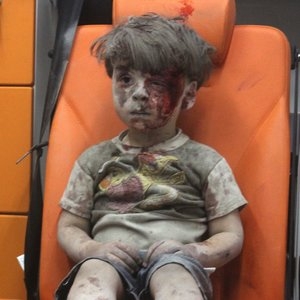
Such numbers are staggering, even by Middle East standards. However, the violence has become so routine that it only occasionally captures global attention, usually when a particularly poignant moment of human suffering is documented. The most recent example is Omran Daqneesh, a 5-year old Syrian boy who was filmed shell-shocked, bloody, and covered in dust after the airstrike bombing of his Aleppo apartment block.

The tragic image of Omran caused outrage around the world, as did the image of Aylan Kurdi, the drowned Syrian boy whose body washed up last September on a beach in Turkey. Yet Omran’s plight demonstrates that, nearly a year after the last child victim of Syrian horrors captured global sympathy, nothing has changed.

If anything, the violence in this multi-party proxy war seems to be getting worse. Since Aylan Kurdi’s drowning, Russia began blitz-bombing Syria in support of the Assad regime. The Syrian Observatory for Human Rights (SOHR) estimates that nine months of Russian airstrikes have killed 3,089 civilians – a toll that is greater, by some estimates, than the number of civilians killed by ISIS. By contrast, Syrian civilian deaths caused by U.S. airstrikes are probably in the hundreds (over roughly twice as much time, since U.S. airstrikes began in the summer of 2015).

But Syrian airstrikes are responsible for the bulk of civilian deaths in Syria. The Assad regime killed 109,347 civilians between March 2011 and July 2014 (88 percent of the total casualties at the time), according to estimates by the Syrian Network for Human Rights. That works out to about 91 civilian deaths per day. More recently, the SOHR documented 9,307 civilian deaths from 35,775 regime airstrikes over a 20-month period running from November 2014 through June 2016. Thus, roughly one innocent Syrian was killed every hour, during the 20 months that the SOHR documented civilian casualties caused by Russian and Syrian airstrikes.

Compare those figures to the number of innocent Palestinians killed by Israel from 2011 to 2014. According to Human Rights Watch (HRW), which has been accused of anti-Israel bias, 37 Palestinians were killed in 2011, 103 in 2012, 15 in 2013 and 1,500in 2014 – the year when Hamas fired rockets at Israel from highly populated Gazan areas. That’s a four-year total of 1,655. During roughly the same four-year period, the number of Syrian civilian deaths was about 76 times greater than the HRW total of Palestinian civilian casualties.

Yet the European Union singles out Israel for conflict-related consumer labels without any similar attempt to warn European consumers about goods or services whose consumption in any way helps the economies of countries responsible for the Syrian bloodshed, including Syria, Russia, and Iran. Human rights lawyer Arsen Ostrovsky has highlighted how none of those countries is targeted by those advocating a boycott of Israel out of a purported concern for human rights. Even more absurd, most of the results produced by a Google search for “academic boycott of Syria” or “academic boycott of Iran” concern academic boycotts of Israel. That asymmetry precisely captures the problem.

In addition to supporting the Assad regime in Syria and contributing to the violence there, Iran executes people for everything from drug offenses to being gay.

Indeed, the global outcry over Syrian suffering is embarrassingly weak when compared to reactions to Israel’s far less bloody conflict with the Palestinians. Imagine if Omran Daqneesh had been a Palestinian boy hurt by an Israeli airstrike on Gaza. College campus protests, the media, NGOs, and world bodies around the planet would be positively on fire. Israeli embassies would be attacked, French synagogues would be firebombed (eight were attacked in just one week during Israel’s 2014 war with Gaza), Jews around the world would be attacked, and condemnations would pour in from the EU, the United Nations, and the Obama administration. UN resolutions and emergency sessions would condemn the incident. International investigations would be demanded. Global blame would deluge Israel, regardless of whether Hamas, a terrorist organization, actually started the fighting or used human shields to maximize civilian deaths. Israel would be obsessively demonized despite any risky and unprecedented measures the Israeli military might have taken to minimize civilian casualties.

Moreover, when an occasional Syrian victim captures global attention, the protests are generally for some vague demand for “peace” in Syria, rather than blaming and demanding the punishment of Syria, Iran, and Russia, even though those regimes are clearly responsible for the slaughter. The starkly different reactions to Israel and Syria are even more shocking when it comes to the United Nations.

From its 2006 inception through August 2015, 62 United Nations Human Rights Council resolutions condemned Israel, compared to just 17 for Syria, five for Iran, and zero for Russia, according to the watchdog group UN Watch. The lopsided focus on Israel is equally appalling at the UN General Assembly, as UN Watch has highlighted. In each of the last four years, as the Syrian bloodbath claimed hundreds of thousands of lives, there were at least five times as many resolutions condemning Israel as those rebuking the rest of the world:

2012: 22 against Israel, 4 for the rest of the world

2013: 22 against Israel, 4 for the rest of the world

2014: 20 against Israel, 3 for the rest of the world

2015: 20 against Israel, 3 for the rest of the world

A corollary of the anti-Israel bias ensures that no Israeli victim will ever enjoy the kind of global sympathy expressed for Omran Daqneesh or Aylan Kurdi. When a Palestinian man enters the bedroom of a 13-year old girl and stabs her to death in her sleep,Obama says nothing even though she was a U.S. citizen and the world hardly notices. By contrast, imagine if the Israeli father of Hallel Yaffa Ariel had decided to take revenge by entering a nearby Palestinian home to stab a 13-year old Palestinian girl to death in her sleep. The global anger would be deafening.

Why do Israeli lives matter so much less? And why do student activists, the UN, the EU, the media, and the rest of the world focus so much more on alleged Palestinian civilian deaths than on Syrian civilian deaths? Doing so is woefully unjust to Syrians. It is also deeply unfair to Israel, which has endured terrorist attacks on its people throughout its existence as a state. It is the one country that, according to Col. Richard Kemp, former commander of British forces in Afghanistan, has done more to protect civilians during war than any other in the history of war.

The global obsession with condemning Israel not only defames a beleaguered democracy doing its best, it also enables the truly evil actors like the Assad regime and Hamas, by giving them a pass on some of the world’s worst crimes.

Officials In Lebanese, Gazan Terror Organizations Confirm: Iran Funds Our Activity

August 11, 2016

Officials In Lebanese, Gazan Terror Organizations Confirm: Iran Funds Our Activity, MEMRI, August 11, 2016

Arab media have recently published statements by officials in the Lebanese Hizbullah and the Gazan Hamas and Islamic Jihad organizations, and by their supporters, confirming what has long been known – namely that these Lebanese and Gazan terror organizations receive substantial financial and military assistance from Iran. These statements join many reports, especially in the anti-Iranian media, regarding Iran’s funding of various terrorist organizations across the Arab world. According to these reports, the assistance comes mainly from the office of Iranian Supreme Leader Ali Khamenei and from the Islamic Revolutionary Guards Corps (IRGC).

The following are some examples of these statements and reports from the last two months:

Hizbullah Secretary-General Nasrallah: Hizbullah’s Entire Budget Is Provided By Iran

In a speech he delivered on June 24, 2016, marking 40 days after the killing of Mustafa Badr Al-Din, who was considered to be Hizbullah’s chief operations officer, and following the imposition of U.S. sanctions on Hizbullah that threaten its financial infrastructure and income, Hizbullah Secretary-General Hassan Nasrallah clarified: “Hizbullah’s budget – its salaries and expenditures, [the money that pays for] its food and drink, weapons and missiles – [all come from] Iran. Is that clear?… As long as Iran has money we have money. Do you require greater transparency than that[?] The funds earmarked for us do not reach us through the banks. We receive them the same way we receive our missiles, with which we threaten Israel.”[1]

Hamas Official Abu Marzouq: Iran’s Assistance To Hamas Is “Not Comparable” To Any Other Assistance

The deputy head of Hamas’s political bureau, Moussa Abu Marzouq, tweeted on June 15, 2016: “The aid extended by Iran to the Palestinian resistance, in provisions, training and funds, is not comparable [to any other aid], and most other countries cannot match it.”[2]

29502Abu Marzouq’s tweet

Former Lebanese Minister Wiam Wahhab: Iran Has Funded Resistance In Palestine

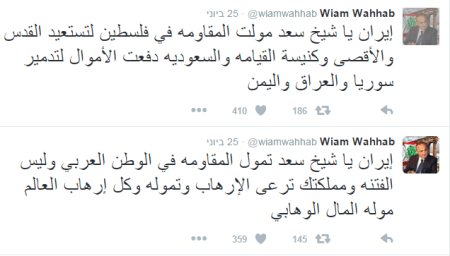
On June 25, 2016, in response to a remark by former Lebanese prime minister Sa’d Al-Hariri that Iran funds fitna(internecine strife) in the Arab world,[3] former Lebanese minister Wiam Wahhab, a known supporter of Hizbullah and the resistance axis, tweeted: “O Sheikh Sa’d [Al-Hariri], Iran has funded resistance in Palestine to restore Jerusalem, Al-Aqsa and the Church of the Sepulcher [to Palestinian hands, whereas] Saudi Arabia paid to destroy Syria, Iraq and Yemen.” In another tweet he wrote: ” O Sheikh Sa’d, Iran funded resistance in the Arab homeland rather than fitna, [whereas] your kingdom [Saudi Arabia, who supports Al-Hariri and his faction in Lebanon,] sponsors and funds terrorism. The funds of all the terrorist [organizations] in the world are Wahhabi [i.e., Saudi] funds.”[4]

29503Wiam Wahhab’s tweets

Saudi Daily Al-Sharq Al-Awsat: Hizbullah’s Weapons Come Directly From IRGC; Iran Has Renewed Regular Aid To Islamic Jihad Organization

The anti-Iranian press, such as the London-based Saudi daily Al-Sharq Al-Awsat, also reported on Iran’s funding of terrorist organizations in Lebanon and Gaza. On June 29, 2016, Al-Sharq Al-Awsat confirmed Nasrallah’s statements regarding the Iranian funding. The report stated that Hizbullah’s funds came from the office of Iranian Supreme Leader Ali Khamenei while its weapons are provided by the IRGC. It quoted the director of the Umam Research and Documentation center in Lebanon, Luqman Salim, a Shi’ite known for his opposition to Hizbullah, as saying that between 70% and 80% of Hizbullah’s funds come from Iran. According to Salim, Iran also invests about $400 million of the IRGC’s budget in the Islamic Radio and Television Union, a group of stations which includes the Iranian Al-Alam but also Hizbullah’s Al-Manar and Al-Mayadin and the Hamas-affiliated Al-Quds (all of which broadcast from Lebanon) and Hamas’s Al-Aqsa station, which broadcasts from Gaza.

The daily also cited a “knowledgeable source” as saying that until 2005 Iran transferred to Hizbullah between $200 million and $250 million annually, but since then the allocation has increased: After the 2006 Lebanon War it rose to $850 million, and since Hizbullah entered the Syria war its budget has become unlimited, because it has become part of Tehran’s war effort there.[5]

On May 25, 2016, the daily reported, citing sources close to the Islamic Jihad organization in Gaza, that Iran had renewed its regular financial aid to the organization after the two sides agreed to renew their mutual relations.[6] According to these sources, an Islamic Jihad delegation headed by the organization’s secretary-general Ramadan Shalah visited Iran in April 2016, and during this visit Tehran renewed its sponsorship of the organization after the latter accepted its terms. In meetings held by the delegation during this visit, including with IRGC commander Mohammad Ali Jafari and Qods Force commander Qassem Soleimani, Iran clarified its vision of Islamic Jihad’s course in the coming years. The sources claimed further that Soleimani decided, in coordination with the organization’s military and political bureaus, to grant $70 million a year out of the IRGC budget to Islamic Jihad’s military wing, Saraya Al-Quds, and to reorganize this body and appoint Khaled Mansour, who is close to Tehran, as its commander.[7]

Endnotes:

[1] Alahednews.com.lb, June 24, 2016.

[2] Twitter.com/mosa_abumarzook, June 15, 2016.

[3] Al-Mustaqbal (Lebanon), June 26, 2016; Al-Hariri’s remark was a response to Nasrallah’s  statement one day earlier that Hizbullah’s entire budget comes from Iran.

[4] Twitter.com/wiamwahhab, June 25, 2016.

[5] Al-Sharq Al-Awsat (Lebanon), June 29, 2016.

[6] Reports in the Arab media in the passing year indicated that Iran had suspended its assistance to Islamic Jihad following disagreements between them on the crisis in Yemen. According to these reports, the Islamic Jihad refused Iran’s demand to declare its opposition to the Arab Coalition’s activities in Yemen. See for example Aljazeera.net, May 26, 2016, Janoubia.com, April 3, 2016.

[7] Al-Sharq Al-Awsat (London), May 25, 2016.

Jihadists and other rebels claim to have broken through siege of Aleppo

August 8, 2016

Jihadists and other rebels claim to have broken through siege of Aleppo, Long War Journal, August 7, 2016

Shortly after Al Nusrah Front announced on July 28 that it was relaunching its operations under the name Jabhat Fath Al Sham (“Conquest of the Levant Front”), jihadists, Islamists and other Sunni rebel groups began an offensive to break the siege of Aleppo.

Bashar al Assad’s forces and their Iranian allies, backed by Russia, had been squeezing the rebel held part of the city since earlier this year. The Syrian regime and its partners cut off a key supply road in the north during fighting in June and July, thereby encircling their opponents.

The insurgents orchestrated an offensive to break the blockade focusing on areas in the southern part of Aleppo, including the Ramousa district, which houses key military installations. The insurgents’ offensive is one of their largest undertakings since the beginning of the Syrian war, drawing together the resources of more than 20 factions and organizations. It obviously required extensive planning to coordinate the actions of so many groups.

On Aug. 6, just over one week after the battle began, the opposition to Assad claimed to have broken through the defensive positions manned by the Syrian regime and allied paramilitary forces. According to the Syrian Observatory for Human Rights (SOHR), however, the fighting continues and Russia is bombing the area in an attempt to prevent the insurgents from consolidating their gains.

The effort to break the siege has been led by two coalitions: Jaysh al Fath (“Army of Conquest”) and Fatah Halab (“Aleppo Conquest”). Many of the constituent groups in each alliance streamed videos and released photos from the fighting on their social media pages.

Jaysh al Fath (“Army of Conquest”) and allied jihadist groups

Jaysh-al-Fath-Logo-300x300

Jaysh al Fath was formed by Al Nusrah, Ahrar al Sham, and other organizations in early 2015. The coalition quickly swept through the city of Idlib and the surrounding areas in a matter of weeks. Jaysh al Fath has led multiple other battlesthroughout Syria, with Al Nusrah (now Jabhat Fath Al Sham, or “JFS”) and Ahrar al Sham always leading the charge. Ahrar al Sham models itself after the Taliban and has its own links to al Qaeda.

Suicide bombers dispatched by JFS played a key role in the fight for southern Aleppo. Early on in the battle, JFS launched two “martyrdom” operations using vehicle borne improvised explosive devices (VBIEDs) at a location identified as Al Hikmah school. The official Twitter feed for JFS reported on July 31 that the VBIEDs targeted Assad’s loyalists. The jihadists quickly swarmed the area, claiming to have captured it.

JFS continued to launch suicide operations in the days that followed. On Aug. 5, a “martyr” identified as Abu al Baraa struck another location. JFS released a short of video of Abu al Baraa discussing his dedication to the cause, followed by footage of him driving his vehicle to the scene of the attack. On Aug. 6, JFS Twitter feeds advertised still another “martyr,” Abu Yaqub al Shami, who drove his VBIED into a Shiite-held location in Ramousa.

Jaysh al Fath’s member organizations, including JFS and Ahrar al Sham, celebrated their capture of a series of Syrian military colleges that were used as fortified bases in Ramousa. Jaysh al Fath’s battle plan was divided into several phases, with the phase focusing on the military academies known as the “Battle of Ibrahim al Youssef.” On June 16, 1979, Youssef massacred Alawite cadets at the artillery school in Ramousa. The slayings were blamed on the Syrian Muslim Brotherhood, or an offshoot of the Islamist organization.

Other groups belonging to Jaysh al Fath include Jaysh al Sunna, Ajnad al Sham and Katibat al Tawhid wal Jihad (KTJ), all of which participated in the offensive. Jaysh al Sunna and Ajnad al Sham announced the end of the strike on Aug. 6, with Ajnad al Sham thanking Allah for freeing “our brothers trapped in Aleppo.” The KTJ is a predominately Uzbek group that formally pledged allegiance to Al Nusrah last September.

Jihadists closely allied with Jaysh al Fath took part in the fighting. The Syrian arm of the Turkistan Islamic Party (TIP), which is comprised mainly of Uighurs and is part of al Qaeda’s international network, produced a video trumpeting the beginning of campaign. It is not clear if the TIP is a named member of Jaysh al Fath, but in practice it does not matter. The TIP’s men have been integrated into Jaysh al Fath’s battle plans for more than one year.

Other jihadist organizations tied to the al Qaeda network, such as Ansar al Din and Ansar al Islam, sent fighters to the battlefields in the southern part of Aleppo city as well.

Fatah Halab (“Aleppo Conquest”)

Fatah-Halab

The Fatah Halab coalition in Aleppo was formed in 2015. It was established by more than two dozen rebel organizations, including the Nur al-Din al-Zanki Movement, the Levant Front, other Islamist groups and Free Syrian Army (FSA) brigades. Faylaq al Sham (“Sham Legion”), which is an Islamist organization, fought alongside Fatah Halab, but also joined Jaysh al Fath’s operations in both Idlib and Aleppo.

At its founding, Fatah Halab explicitly excluded Al Nusrah. But some of Fatah Halab’s constituent groups, including Nur al-Din al-Zanki Movement, have long workedwith Nusrah.

Many of Fatah Halab’s constituent groups have posted propaganda from the fighting in Aleppo.

The 1st Regiment, which is a FSA unit, seemingly played a important role. On Aug. 2, the group’s fighters detonated a massive bomb in a tunnel underneath a facility controlled by Assad’s forces. The tunnel bomb paved the way for allied forces to rush into the district. Other photos show the 1st Regiment using guided missiles to destroy a vehiclebelonging to Hezbollah and attack positions held by the Syrian regime.

On its official Twitter feed, the Fastaqem Union (FKO Union) describes itself as “one of the most effective factions in Syria,” aiming “to topple Al-Assad Regime and build free and democratic state for all Syrians.” A FKO Union video tweeted on Aug. 3 purportedly shows a “whole group of Hezbollah” members being killed in a TOW missile strike. Two days later, on Aug. 5, the FKO Union claimed to repel an attack by Iranian troops and allied militias that were trying to relieve the front lines.

The FKO Union isn’t the only group to fire TOW missiles during the battle. On Aug. 2, Jaysh al Nasr (“Army of Victory”) released a video of one of its fighters launching a TOWat enemies perched atop a building in Aleppo.

Other units, such as the Central Division, the Authenticity and Development Front, theNorthern Division, Division 13, Sokoor al Jabal Brigade and the “101st Infantry” all posted images from the battle. The 101st Infantry tweeted a photo of its menmanufacturing mortars and grenades to be used in the offensive.

Still another powerful rebel group, Jaysh al Islam, sent forces into the battle for Aleppo as well.

The coming days will prove whether the offensive was as successful as the parties responsible claim.

Syrian-Russian Provocations Could Spark Golan Clash

July 28, 2016

Syrian-Russian Provocations Could Spark Golan Clash, DEBKAfile, July 28, 2016

EinZivan2

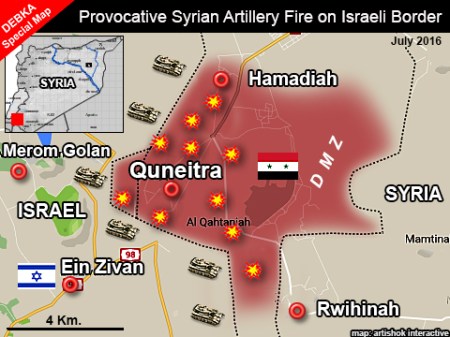
For four days since July 25, the Syrian army has been continuously firing artillery batteries – moved close to Israel’s defense lines on the Golan border – in a manner that comes dangerously close to provoking an Israeli response. This carefully orchestrated Syrian campaign goes on around the clock.

It is the first time in the six years of the Syrian war that Bashar Assad has ventured to come near to provoking Israel. But now he appears to be emboldened by his Russian ally.

The IDF is holding its fire for the moment. But Israeli military and government leaders know that the time is near for the IDF to be forced to hit back, especially since it is becoming evident that the Syrian army’s steps ae backed by Russia.

DEBKAfile’s military sources provide details of the Syrian steps:

  • The Syrian army’s 90th and 121nd battalions have been firing their artillery batteries non-stop across a 10km band along the Golan border from Hamadia, north of Quneitra, up to a point facing the Israeli village of Eyn Zivan. (See attacked map).
    This means that the Syrian army has seized the center of buffer zone between Israel and Syria and made it a firing zone.
  • This artillery fire fans out across a radius that comes a few meters short of the Israeli border and the IDF troops stationed there. It then recedes to a distance of 500 to 600 meters and sweeps across the outposts and bases of the Syrian rebel forces believed to be in touch with Israel or in receipt of Israeli medical aid.
  • The new Syrian attack appears to hold a message for Jerusalem: For six years, you supported the rebels against the Assad regime in southern Syria. That’s now over. If you continue, you will come face to face with Syrian fire.
  • Damascus is also cautioning those rebels:  For years, you fought us with Israel at your backs. But no longer. Watch us bring you under direct artillery fire, while the IDF sits on its hands.
  • On July 26, Russian media published an article revealing that Russia had delivered to the Syrian Air Force, advanced SU-24M2 front-line bombers, which is designed for attack on frontlines of battle. Israeli officials were unpleasantly taken aback by the news. Up until now, the Russians and Syrians refrained from deploying air strength in South Syria near the Israeli border. Now the Syrian air force has the means to do so.
  • DEBKAfile military sources report that the SU-24M2, following recent upgrades and modifications in Russian factories, is now capable of dropping smart bombs – ballistic bombs with a guidance system on their tails that enable them to hit targets with precision.This guidance system does not rely on US GPS satellites but rather the equivalent Russian GLONASS system which is linked to a network of 21 Russian satellites and partially encrypted for military usages.
    In addition, the SU-24M2 is equipped with a system that projects the information the pilot needs (flight details and battle details) on the plane’s windshield (head-up display) and on the pilot’s visor.
  • The Russians delivered to the Syrians two of these sophisticated airplanes this week, out of 10 that they will supply soon.

The IDF has concluded that it is only a matter of time before these planes appear in Southern Syria and so generate a new and highly combustible situation on Israel’s northern and northeastern borders.

The Russians are colluding with Damascus to inform Israel that it will no longer be allowed by either to continue backing the rebel forces in southern Syria or sustain the buffer zone which they man.

Israel may pay dear if Prime Minister Binyamin Netanyahu, Defense Minister Avigdor Lieberman, and Chief of Staff Lt. Gen. Gadi Eisenkot decide to continue to abstain from hitting back at the Syrian fire which is aimed every few hours at the vicinity of IDF posts or the impending arrival of Russian bombers. The price in store would be the weakening of the IDF’s hold on the Golan border.

IDF bulldozers with tanks enter Golan DMZ

July 13, 2016

IDF bulldozers with tanks enter Golan DMZ, DEBKAfile, July 13, 2016

GolanIsrael_Zone

Israeli military bulldozers backed by tanks have crossed into the demilitarized zone dividing the Israeli and Syrian Golan borders. They are building a line of fortifications and anti-tank trenches 300-500 meters inside the DMZ.

This is the first time in the six-year Syrian war that the IDF has openly operated on the Syrian side of the border. The force has not so far run into opposition- or indeed any word of protest – or even mention – by Assad regime officials in Damascus.

The sole reference to Israeli military movements in the DMZ has come from a small Syrian rebel group which described them.

DEBKAfile’s military sources report that the IDF operation was still going forward Wednesday, July 12, on a patch of terrain facing the Israeli Golan village of Ein Zivan, on the one hand, and the Syrian town of Quneitra, on the other.

The enclave splitting the Golan between Syria and Israel is defined in the 1974 armistice agreements as a demilitarized zone under the military control of the UN Disengagement Observer Force (UNDOF) and Syrian civilian administration. It is bounded by two strips of land around 10km deep where each side is permitted to maintain diluted military strength. No ground-to-air missiles may be deployed inside a 25km radius from the DMZ.

It was agreed that Syrian nationals forced by the October 1973 war and its aftermath to leave their homes would be able to return. Ruined Quneitra was later handed back to Syria against a commitment by its government to repopulate the town and ban terrorist activity and infiltrations of Israel from the Golan sector.

Both commitments were given orally to the US government.

However, the Syrian war as it unfolded in the last two years turned the deal on its head. The UN observers abandoned their posts, leaving behind a void that was partly filled by Syrian troops and a motley assortment of rebel groups.

But the DMZ was left mostly unoccupied as both Israel and Syria tried to preserve at least the semblance of the deal intact. However, Assad’s allies Iran and Hizballah have repeatedly attempted to plant a forward military and terrorist presence opposite Israel’s Golan defense lines – with avowed hostile intent.

The silence from Damascus on Israel’s military steps on the Golan may be no more than a respite as the Syrian ruler waits for Tehran’s endorsement of joint Syrian-Iranian-Hizballah counteraction.

Our sources add that IDF military steps on the ground were accompanied by unusual Israeli Air Force movements over Syria and Lebanon, and elevated preparedness on the 10th anniversary this week of the Lebanon war fought between Hizballah and Israel.

It was noted that Hizballah refrained from celebrating the occasion and omitted its customary boasts of a “great victory” – thereby intensifying the sense in Israeli military circles that Iran’s Lebanese proxy may be cooking up a surprise operation.

ISIS routs new US-backed Syrian force at Abu Kemal

July 1, 2016

ISIS routs new US-backed Syrian force at Abu Kemal, DEBKAfile, July 1, 2016

2

A battle on June 29 between ISIS and a pro-American Syrian rebel force near the Syria-Iraq border will go down as one of the most striking defeats ever suffered by an American-backed Syrian force trained in Jordan in the annals of the war on terror.

It was not the first, say DEBKAfile’s military and intelligence sources. In August 2015, a force from Al Qaeda’s affiliate Nusra Front destroyed a similar rebel force called Division 30. And 12 hours earlier, on June 28, ISIS suicide bombers murdered 44 people in a bloodbath at Ataturk international airport in Istanbul.

The following timeline of events is instructive:

1. In March and April of this year, military instructors from the CIA, together with Jordanian intelligence officers and special operations units, established a new militia to fight ISIS called the New Syria Army. Most of the recruits were from Syrian refugee camps. The US furnished the militia with funds and advanced weapons.

2. They were trained by US and Jordanian military instructors at Jordan’s al-Rukban base in the Berm area on the Syrian border.

3. In May, American commanders in Jordan decided that the militia would launch its first mission in eastern Syria near the border with Iraq.

4. In June, it became clear to the Americans and the Jordanians that the time had come for the new force to go into action.

There were five reasons:

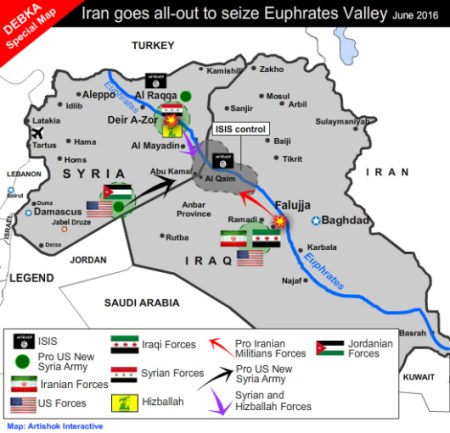
A. After the capture of the Iraqi city of Fallujah from ISIS, the pro-Iranian Shiite militias that participated in the campaign, namely the Popular Mobilization Forces and the Badar Forces, had started moving west toward the Iraq-Syria border (see map).

B. Syrian army and Hizballah forces had embarked on a parallel eastward movement from the vicinity of Deir ez-Zor toward the Iraqi border (see map). Their goal was to link up with the Iraqi Shiite militias on the Syrian-Iraqi border and create a land bridge for the use of all pro-Iranian forces in the two countries.

C. Washington and Amman regarded this development as dangerous and resolved to preempt it.

D. To that end, the New Syria Army was to be sent into action to take the town of Abu Kamal near the border.

E. The commanders assumed that the loss of Abu Kamal would deal a blow to ISIS forces in eastern Syria and plant a pro-American wedge against the linkup of the two pro-Iranian forces and so foil their projected land bridge athwart Iraq and Syria. .

5. On June 21, an ISIS suicide bomber driving a stolen Jordanian military truck blew himself up in the area of Jordan’s al-Rukban base on the Syrian border, in an attempt to avert the coming Abu Kemal attack by inflicting heavy losses on the new militia.  Most of those killed were Jordanian border guards.

6. After the attack, US and Jordanian helicopters airlifted the new militia combatants to a forward base set up at al-Tanf inside Iraq, 230 kilometers from Abu Kamal. They were attacked twice by Russian air strikes in an effort to thwart the pro-US militia’s return to Syria.

7. On June 29, the new Syrian force nonetheless launched its attack, under the direction of Jordanian special operations and military intelligence officers, and the supervision of American elite forces officers at the US-Jordanian war room north of Amman.

8. However, the new Syrian militia was speedily ambushed by ISIS, which apparently was tipped off about the impending attack and its routes of approach. Dozens of Syrian militiamen were killed or wounded, and the force fled from the battlefield. Those unable to flee were shot dead or decapitated.

9. The Jordanian officers who commanded the force were among those who fled.

10. ISIS videos of the battle showed that advanced US military equipment provided the militiamen had fallen into the terrorist organization’s hands, recalling the sights from Iraq of two years ago, when ISIS captured as booty masses of American military hardware from fleeing troops.

The US and Jordan once again failed to establish a Syrian force capable of fighting ISIS. They also lost the chance to gain control of the situation in eastern and southern Syria.

No official in Washington was ready to comment on the battle.