Posted tagged ‘Syria war’

Ignatius: Fighters in Syria Cheer Mention of Trump’s Name

July 3, 2017

Ignatius: Fighters in Syria Cheer Mention of Trump’s Name, Washington Free Beacon, July 3, 2017


Washington Post columnist David Ignatius said Monday that during his travels in Syria, rebel fighters there cheered any mention of President Donald Trump’s name.

Appearing on MSNBC’s “Morning Joe,” Ignatius prefaced his comments by warning that he would say something “sympathetic to Trump.” It was only the second airing of the show since Trump touched off a firestorm with his tweets mocking Joe Scarborough and Mika Brzezinski.

“As I traveled across Syria meeting with Syrian fighters who were trying to take down the regime of Bashar al-Assad, every time the name President Trump was mentioned, there were cheers from the audience,” he said in a clip flagged by Legal Insurrection.

One Syrian Kurdish commander, Ignatius said, colorfully remarked Trump had the equivalent of what would be called “cajones” in Spanish. Ignatius said Trump’s looser approach allowed commanders on the ground to more expeditiously carry out operations.

“More seriously, the big attacks that have taken place around Raqqa, one in particular, a surprise landing by helicopter, I was told, by the top U.S. commanders, would not have taken place if it hadn’t been for President Trump’s decision to delegate military authorities down to the level of command,” Ignatius said. “Under Obama, that would have taken a couple weeks of White House meetings, and they still wouldn’t have made up their mind.”

In March, the U.S. airlifted hundreds of fighters in an attack to help cut off Raqqa, the Islamic State’s proclaimed capital. The New York Times reported this was a result of Trump’s delegating approach.

Trump ordered a retaliatory strike against Syria in April after Assad’s regime killed more than 80 people in a chemical attack. Last week, the White House publicly threatened him with a “heavy price” if he carried out another attack.

U.S. Ambassador to the United Nations Nikki Haley said Trump’s warning to the Syrian regime to not deploy a chemical weapons attack saved “many innocent men, women and children.”

Nikki Haley’s Comments on Iran Highlight Russian-Related Complications

June 29, 2017

Nikki Haley’s Comments on Iran Highlight Russian-Related Complications, Iran News Update, Edward Carney, June 29, 2017
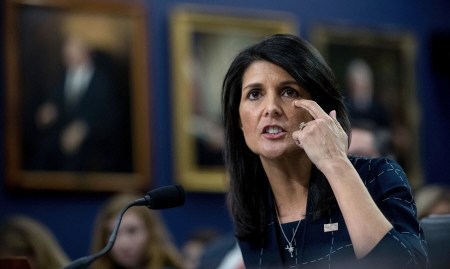
On Tuesday, Nikki Haley, the US ambassador to the United Nations delivered testimony to the House panel on foreign operations, a subcommittee of the Appropriations Committee in the US House of Representatives. In that testimony, Haley addressed multiple issues relating to the Islamic Republic of Iran, thereby reasserting the Trump administration’s assertive policies toward the Iranian regime. By most accounts those policies are still emerging, but they have already come to include purposive outreach to other adversaries of the Islamic Republic and a program of expanded sanctions on matters such as Iran’s ballistic missile program.

However, those efforts to confront and contain the Islamic Republic are arguably complicated by other aspects of the Trump administration’s policy commitments, including a focus on domestic issues and an effort to improve relations between the US and Russia, which boasts close relations with Iran in the areas of trade and military cooperation, especially as it relates to the Syrian Civil War.

While the US supports moderate rebel groups fighting against the dictatorship of Bashar al-Assad, the Iranians and Russians have been credited with turning the war in favor of Assad. Various Shiite militias are currently operating as proxies for Iran in that war, and the Iranian Revolutionary Guard Corps is increasingly playing a direct role in the conflict. Meanwhile, Russia has been providing air support for pro-Assad ground operations since 2015.

Western commentators, including officials in the Trump administration, have variously accused Russia and Iran of ignoring or actively facilitating human rights abuses by the Assad regime, including an April chemical weapons attack that killed at least 80 people in a rebel-controlled civilian area.

As the Associated Press points out, Ambassador Haley’s comments to the House panel came shortly after the White House had issued a warning to Syria regarding alleged preparations for another such chemical attack. The article specified that Pentagon officials had confirmed the intelligence underlying that warning, involving particular movements at the same Syrian air base that had been used as the staging area for the previous chemical attack on Khan Sheikhoun.

White House Press Secretary Sean Spicer said of Assad that “he and his military will pay a heavy price” if they follow through with apparent plans for another “mass murder attack using chemical weapons.” But the AP quoted Haley as saying that the administration’s remarks were not intended only for Assad, but also for Russia and Iran. Both of the Syrian allies joined in denying Assad’s responsibility for the attacks, with some officials insisting that the chemical weapons had originated in a rebel warehouse at the site of a conventional military airstrike.

The dispute over this issue and the subsequent US cruise missile strike on Shayrat air base can be seen as early examples of the escalation between Iranian allies and adversaries which is still going on to this day. In fact, Haley’s effort to fold Russia and Iran into a warning directed more explicitly against Syria is reminiscent of an incident earlier in June wherein a member of Iran’s Revolutionary Guard said that a ballistic missile strike on eastern Syria had been intended largely as a warning to the US and Saudi Arabia.

Those two traditional adversaries of the Islamic Republic have been expanding relations under the Trump administration, sometimes with explicit reference to shared anxieties over expanding Iranian influence and meddling in the broader Middle East. President Trump’s visit to Riyadh in May for an Arab-US summit coincided with the signing of trade agreements that included 110 billion dollars in arms sales to the Arab Kingdom.

But at the same time that the White House is openly siding with Saudi Arabia and its regional allies against the Iranian regime, it does not appear to be giving up on the prospect of improved relations with Russia. In fact, the Western strategy for a political solution to the Syrian Civil War seems to presently involve the expectation that Russia can be encouraged to rein in the Islamic Republic and prevent it from further sabotaging ceasefire agreements.

Recent developments have cast doubt upon the practicality of this strategy however. As the US has taken a more direct role in defending rebel groups, even resorting to the shoot-down of at least two military controlled drones and a Syrian warplane, Russia has responded by threatening to target US aircraft and to halt the use of a hotline intended to prevent mid-air collisions between the multiple powers operating in the skies over Syria.

Haley’s comments on Tuesday were indicative of a roughly matching increase in American criticism of Russia. And this criticism was not limited to the issue of chemical weapons. Haley also explained that Russia’s position on the UN Security Council allowed it to stymie US efforts to sanctions Iran and hold it to account for ongoing misbehavior in matters including the development of the Iranian nuclear program.

“[The Iranians are] going to continue their nuclear capabilities and we just gave them a lot of money to do it with,” Haley said, referring to the 2015 nuclear agreement that President Trump has described as “the worst deal ever negotiated.” She went on to highlight concerns about Iran’s sponsorship of terrorism, suggesting that nuclear weapons could find their way into the hands of terrorist groups at some point in the future, and that Russia would effectively prevent the US and its allies from doing anything to stop this.

“Yes, we would love to sanction Iran; and, yes we will continue to be loud about it; and, yes, Russia will veto it,” Haley said, according to the Washington Examiner.

But this is not to say that the Trump administration has positively brought an end to its strategy of attempting to improve relations with Russia. In fact, various reports suggest that this endeavor is even standing in the way of congressional legislation aimed at increasing national-level sanctions on both Iran and Russia. The Countering Iran’s Destabilizing Activities Act passed the Senate two weeks ago by a margin of 98 to 2, but it was subsequently stalled in the House on procedural grounds, leading Democrats to argue that the House Republican leadership was trying to protect the president’s Russian agenda.

The prospects for resolution appeared to grow dimmer on Tuesday when the Washington Post reported that energy lobbyists were urging lawmakers to reevaluate the bill on the grounds that its restrictions on doing business with Russian companies could have a punishing effect on American firms and foreign firms doing business in the US. These objections could bolster the prospects of the House leadership sending the bill to various committees for review and markup – a process that could delay a final vote by months.

As it concerns Iran, the bill would include sanctions on Iran’s ballistic missile activities and also extend all terrorism-related sanctions to the Revolutionary Guard Corps, for which Trump has urged designation as a foreign terrorist organization. This position has not changed, and it seems that neither has the Trump administration’s hardline approach to Iran policy. Some have suggested that the emerging policy is pointing in the direction of regime change, though this has not become a declared position as yet.

The Washington Examiner pointed out that one member of the House panel on foreign operations, Republican Representative Hal Rogers, had directly raised the prospect of regime change on Tuesday, asking Nikki Haley whether it is an option. The ambassador’s only response was “I don’t know.”

This coming Saturday, the National Council of Resistance of Iran will hold its annual Free Iran rally, which will include explicit calls for regime change driven by a domestic opposition movement within the Islamic Republic. The event is expected to be attended by tens of thousands of Iranian expatriates, plus hundreds of policymakers and experts from the US, Europe, and throughout the world. Notably, these dignitaries will include figures with close ties to the Trump administration, such as John Bolton, who served the second Bush administration in the position now occupied by Haley.
Northern border heating up

June 27, 2017

Northern border heating up, Israel Hayom, Ofek Ish Maas, June 27, 2017

(Please see also, After IDF retaliates for spillover, Syrian army warns Israel.– DM)

In the past few days, the Syrian civil war has been knocking on Israel’s door. On Saturday, 10 errant mortars and tank shells landed in the northern Golan Heights, and at the beginning of the week the IDF Spokesperson’s Unit reported a few more ordnance hits in open areas.

In accordance with policy, the IDF responded by firing at Syrian army targets. But although tenuous quiet has been restored, we cannot discount the possibility that errant fire from Syria will continue and increase.

The army of Syrian President Bashar Assad, which was responsible for the errant fire, is trying to block an attack by rebels, who want to break through and reach the highway that leads from Damascus to the southwestern city of Daraa, which has been the site of heavy fighting for control of southern Syria over the past month.

Since the beginning of June, Daraaa has been subjected to massive bombing by the Syrian regime and its allies. Hundreds of barrel bombs and rockets and dozens of bombs from Syrian and Russian planes have rained down on the city. According to rebel reports, some of the bombs even included phosphorus. Among other things, in an attempt to deter the rebels, the regime intentionally attacked a school in a nearby village, killing more than 20 women and children who had sought shelter there. The worsening situation led the local government to declare Daraa and its surroundings a disaster area.

Daraa, which lies about 30 kilometers (18.5 miles) east of Israel and 13 kilometers (8 miles) north of Syria’s border with Jordan, is a strategic target for the Syrian regime. First, control over border crossings in a symbol of sovereignty and the implementation of Assad’s desire to once again control all of Syria. Second, the regime and its Shiite allies want to reduce the chance of a sustainable security buffer zone under Western, Jordanian, and Israeli influence being established in southern Syria. Assad’s forces reaching the Jordanian border would stop the supply of logistic, military, and humanitarian aid Western and Persian Gulf nations are sending the rebels and would create a divide between the two rebel-controlled areas in southern Syria.

With a goal so important to the regime, and with the increasingly serious stand-off between the U.S., Russia, and Iran in eastern Syria threatening any chances of a peace deal in the south, it appears that nothing is stopping Assad from proceeding full force.

The ramifications for Israel’s security could be heavy. In the short term, if we see a repeat of the images out of Aleppo at the end of 2016 — women and children slaughtered, buildings collapsing with people inside, the use of unconventional weapons against civilians — there will be waves of displaced persons, some of whom might seek shelter along the border, in Israel’s shadow, and even ask for asylum. In the long term, Israel’s northeastern front could become a stronghold of Iran, Hezbollah, and other Shiite militias that would comprise a threat to security and safety in northern Israel.

Israel must decide how it will prepare to prevent these dangerous scenarios. It must choose between increasing support for the Sunni rebels as a buffer against Iran and its satellites, or assenting through silence to Assad returning to power. If Israel wants to stick to the idea of a buffer zone, it will have to increase support for the rebels and provide them with defense coverage, both diplomatic, against Russia, and military, in hope that the U.S. will agree. But diverting American attention to southwestern Syria will hamper its efforts to defeat the Islamic State in the east and prevent Iran from filling the ensuing vacuum. Israel, therefore, would have to roll up its sleeves and plunge its hands into the Syrian mess. On the other hand, if Israel is unwilling to do so, it will have to set clear rules of engagement for the Assad regime, which is regaining ground, by demanding that Iranian satellites not gain a foothold in the region and backing that demand up with military action.

In any case, neither option is certain and each has its risks. But the reality in Syria, especially in the south of the country, is changing fast, and the comparative security that Israel has been enjoying is in danger and requires immediate planning and responses.

Ofek Ish Maas (Riemer) is a research assistant at the Institute for National Security Studies.

Golan battles bring Hizballah near Israeli border

June 25, 2017

Golan battles bring Hizballah near Israeli border, DEBKAfile, June 25, 2017

But for now,  both these warfronts hang in the balance and are undecided. Also undecided on how and when to react are Israel and Jordan. Hizballah is already 3km from the Golan border, although Israel’s government and military leaders have pledged repeatedly that they would be allowed to come in so close.

**************************

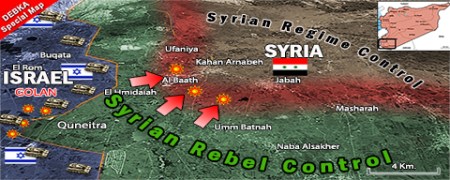
In the last 48 hours, Israel has conducted air strikes on and aimed tank fire at Syrian army positions near Quneitra’s northern suburb of Baath city, 3km from IDF Golan border defenses. (See map). Those positions were the source of the mortar shells that exploded on the Israeli Golan – 10 on Saturday, June 24 and three the next day. They came from a battle in which Syrian and Hizballah units were fighting off a Syrian rebel offensive around Quneitra.

The rebel militias set up a coalition to coordinate their offensive. It is dominated by the Hay’at Tahrir Al-Sham (HTS), which Damascus claims is an arm of Al Qaeda-Syria. In fact, it is an alignment of dozens of Islamist groups, some of which belonged and still do to Jabhat Fateh al-Sham – the former Nusra Front.

Fighting on the side of the Assad regime are the remnants of the Syrian army’s 90thBrigade, the Iranian Revolutionary Guards South Syrian command center, and the pro-Iranian Afghan Shiite militia.

They are joined by members of Hizballah’s Southern Shield Brigade.

This brigade is made up of Palestinians, Druzes, Circassians and local Syrians, whom Hizballah recruited and has posted in Hermon villages ready to launch terrorist attacks inside Israel.

The battle around Quneitra was preceded on June 17 by the assassination of Majd a-Din Khalik Khaymoud, commander of the Southern Shield Brigade and his two lieutenants, who were caught in an ambush near the village of Khan Arnabah. No party took responsibility for this attack.

Then, on Saturday, June 24, the rebel coalition launched its offensive on the Syrian-Hizballah units at Al-Baath, boasting that they would not stop until they reached Damascus. Although they caught the enemy by surprise, they were unable to follow up with a rapid advance, because they were pushed back by superior fire power. Since the Syrian mortars were aiming their fire at the rebel units concentrated around Quneitra, i.e., from east to west, some of the shells spilled over the border into the Golan.

When the rebels saw they were falling short of their objective, they drummed up a more modest goal: It was to open a second front in order to lighten the pressure on a separate rebel organization which for nearly three weeks has been fighting off fierce assaults on their positions in the southern Syrian town of Daraa, close to the Jordanian border.

Assad’s army, combined with large-scale Hizballah units and pro-Iranian forces, are therefore in full flight to seize control of Syria’s borders with Jordan and Israel. Amman and Jerusalem therefore face a twin peril on the Daraa and Al-Baath fronts.   Both are anxious to keep Hizballah as far as possible from their territory.

But for now,  both these warfronts hang in the balance and are undecided. Also undecided on how and when to react are Israel and Jordan. Hizballah is already 3km from the Golan border, although Israel’s government and military leaders have pledged repeatedly that they would be allowed to come in so close.

Assad and Putin are testing the US in Syria. Trump is answering.

June 19, 2017

Assad and Putin are testing the US in Syria. Trump is answering., Washington ExaminerTom Rogan, June 19, 2017

(Please see also, Missile strike on ISIS turning Iran into a world power. — DM)

The United States remains the world’s sole superpower. Realistic in our appraisal of national interests and prudent in their pursuit, our adversaries must never doubt our resolve.

****************************

On Sunday, an F-18 fighter jet (almost certainly from the Mediterranean-deployed USS George H.W. Bush carrier strike group), downed a Syrian Air Force Su-22 fighter jet.

It was the right decision for both tactical and strategic reasons.

For a start, the Syrian jet was bombing United States allies (the Kurdish-dominated Syrian Democratic Forces) on the ground. It was warned, but did not retreat.

Yet it’s not just relevant who the Syrians were bombing, it’s also important where they were doing so. Because the Su-22 was striking targets in north-central Syria, proximate to the Islamic State capital, Raqqa, and a town and dam, Taqba.

That locale matters for two reasons.

First, because the Syrian axis (Bashar Assad, Russia, Iran, the Lebanese Hezbollah, and other associated Shiite militias) are determined to displace U.S./allied forces from that area. The Assad axis recognizes that if it secures Taqba, it can push east of the Euphrates river and degrade anti-regime forces operating there with U.S. protection. As I’ve explained, this area of northern Syria is crucial for the future of the Syrian civil war.

Second, had the U.S. allowed axis forces to displace Kurdish forces from the area, the axis would have been able to disrupt the operation to retake Raqqa from the Islamic State. While the axis argue that they support the U.S.-led effort to defeat the Islamic State, the reality is different.

After all, the axis have vested interests in allowing the Islamic State to survive in some form. While the Islamic State is indeed their enemy, its existence allows the axis to pretend that the choice in Syria is between Assad, and the Islamic State and al Qaeda. Russia, especially, uses this narrative to delegitimate and attack more-moderate U.S.-supported Syrian rebel groups. Ever notice that the Russians always claim they are bombing “terrorists” in Syria? The Islamic State gives them that excuse.

Absent the threat of the Islamic State, the axis powers know that the world would view the Syrian regime much more harshly. Absent international jihadist groups in Syria, the regime would no longer be able to claim “we’re the best of a bad bunch.”

Still, there’s a broader issue at stake here.

This latest axis push against U.S. interests is just the tip of the iceberg. As I noted recently, the axis is also threatening a major U.S. base in south-eastern Syria. Collectively, these efforts are designed to test the Trump administration’s commitment to U.S. interests in Syria. Put simply, by escalating their threat against the U.S., and by dangling the prospect of future U.S. casualties, the Assad axis wishes for the Trump administration to back away from its resistance to Assad’s regime. They believe that, as was the case with President Barack Obama’s red lines, the U.S. can ultimately be compelled to yield.

For that reason, the U.S. response on Sunday was the right one.

A two-person U.S. aircrew in an advanced multirole fighter met a Soviet-era aircraft and outmatched it.

The United States remains the world’s sole superpower. Realistic in our appraisal of national interests and prudent in their pursuit, our adversaries must never doubt our resolve.

Syrian-Hizballah massacre in Daraa: 140 dead

June 12, 2017

Syrian-Hizballah massacre in Daraa: 140 dead, DEBKAfile, June 12, 2017

According to DEBKAfile’s military sources, any Syrian rebels surviving the initial onslaught on the town had no choice but to fall back. They could only find sanctuary in two places – Jordan, to the south, or the Al-Tanf Syrian-Iraqi border crossing to the east, which is held by US and Jordanian special forces. Those forces did not intervene in the Daraa debacle.

After capturing Daraa, the next victim of a Syrian-Hizballah massacre is most probably Quneitra, which lies less than 9km from the Israeli border. Its capture would bring every last Syrian town bordering Jordan and Israel under their domination.

***********************

Bashar Assad’s troops and his allies, the Iran-backed Lebanese Hizballah, are notorious for their barbaric cruelty to the populations they conquer. But even by their own appalling standards, the massacre they wreaked against the 100,000 citizens of the southern Syrian town of Daraa this week must stand out as a milestone from hell.

Posted in the town, just one kilometer from the Jordanian border, were 3,000 anti-Assad rebels, some of whom joined the Free Syrian Army to be trained and armed by the United States and Jordan. The offensive the Syrian government army and Hizballah launched against their positions on Sunday, June 11, left 140 dead and hundreds injured in its first hours.

DEBKAfile’s military sources report that it started with dozens of Syrian air force helicopters dropping 150 explosive barrels on those positions, while Syrian bomber-fighter planes conducted at least 25 sorties against rebel rooftop positions atop the highest buildings, and Syrian artillery fired off some 120 ground-to-ground missiles against various key points in the town of Daraa.

Syrian and Hizballah forces advanced into the town under this hellish blitz.

Our sources report that the spearhead consisted entirely of Hizballah’s Al Qaim Brigade, followed by units of the Syrian army’s elite 4th armored Division, armed with advanced Russian-made T-90 tanks. The commander of the offensive was Col. Ghayath Galla.

(On June 6, DEBKAfile disclosed in an exclusive report that the 4th Division’s commander, Bashar Assad’s younger brother, Gen. Maher Assad, and his officers were sighted inspecting the terrain around Daraa in advance of the offensive.)

According to DEBKAfile’s military sources, any Syrian rebels surviving the initial onslaught on the town had no choice but to fall back. They could only find sanctuary in two places – Jordan, to the south, or the Al-Tanf Syrian-Iraqi border crossing to the east, which is held by US and Jordanian special forces. Those forces did not intervene in the Daraa debacle.

After capturing Daraa, the next victim of a Syrian-Hizballah massacre is most probably Quneitra, which lies less than 9km from the Israeli border. Its capture would bring every last Syrian town bordering Jordan and Israel under their domination.

One missile takes out ISIS command on Golan edge

June 8, 2017

One missile takes out ISIS command on Golan edge, DEBKAfile, June 8, 2017

DEBKAfile’s military sources report concerns in the US military commend lest Iranian general Qassem Soleimani decides to drop a division of Iranian special forces by helicopter, in order to catch the garrison off guard and capture the border crossing.

This concern increased after the Islamic State conducted a surprise bombing-cum-shooting attack on prize Iranian regime targets in Tehran on June 7. The Revolutionary Guards are bent on revenge and looking for an outstanding military success to cover this humiliation.

The US commanders are also under pressure on another score: the Iranians and Syrians have sent secret messages to Moscow complaining bitterly about the US air strike. They both made it clear that they command sufficient air and artillery fire power to overwhelm and wipe the ground with the American force in Syria.  Both Damascus and Tehran appear to be spoiling for a major showdown between their armies, using Hizballah and other Shiite proxies, and the US-led contingent.

***********************

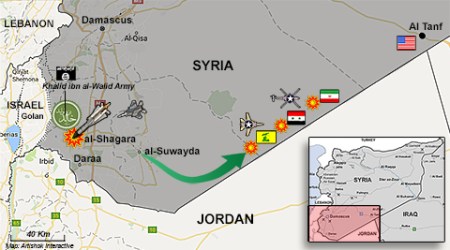
A single mystery missile, which could have been fired from the ground or the air early Wednesday morning, June 7, wiped out the entire top Islamic State command on the Syrian Golan, DEBKAfile’s military and intelligence sources report. All 16 officers of the 2,000-strong Khaled Ibn al Waleed army, the ISIS operations arm on the Syrian Golan, were present in the targeted building in the town of al-Shagara, located in the triangle where the Israeli, Syrian and Jordanian borders meet opposite the Sea of Galilee in northern Israel.

The unidentified missile blew up in the middle of a hall where the top command echelon were gathered to break their daily fast during the month of Ramadan and draw up plans. None of them survived.

Among them were the group’s chief, Gen. Abu Mohammed al-Makdessi; commander of operations, Gen. Abu Udai al-Homsi; and the group’s explosives expert who doubled as its religious leader, Abu Ali Shabat.

They operated under these aliases to conceal their real identities as former high Iraqi army officers who served in the late Saddam Hussein’s armed forces. They were also in senior command positions at the ISIS Syrian command center in Raqqa, when ISIS leader Abu Bakr al-Baghdadi decided to transfer them to the Syrian Golan to spearhead attacks that were planned to take place inside Israel and Jordan.

It took Al-Baghdad just a few hours to replace Magdessi as Khaled Ibn al-Waleed chief with a new man, Mohamed al-Refaei-Abu Hshem al-Askari.

On Tuesday, June 6, the day before the mysterious missile decapitated the Islamic State’s Golan force, US warplanes acted on another front to bomb a convoy of Iranian, Syrian and Hizballah forces that were traveling eastward from the southern town of Derra in the direction of the Al-Tanf border crossing.

Al Tanf, where US and Jordanian special forces units have established a garrison, is located in the triangle where the Syrian, Jordanian and Iraqi borders converge. The US planes destroyed several tanks, troop carriers, artillery pieces and antiaircraft systems, causing also fatalities and injuries, and so halted the convoy’s advance on the strategic crossing.

This was the second US air strike in three weeks on a similar target. The first was on May 18.

DEBKAfile’s military sources report concerns in the US military commend lest Iranian general Qassem Soleimani decides to drop a division of Iranian special forces by helicopter, in order to catch the garrison off guard and capture the border crossing.

This concern increased after the Islamic State conducted a surprise bombing-cum-shooting attack on prize Iranian regime targets in Tehran on June 7. The Revolutionary Guards are bent on revenge and looking for an outstanding military success to cover this humiliation.

The US commanders are also under pressure on another score: the Iranians and Syrians have sent secret messages to Moscow complaining bitterly about the US air strike. They both made it clear that they command sufficient air and artillery fire power to overwhelm and wipe the ground with the American force in Syria.  Both Damascus and Tehran appear to be spoiling for a major showdown between their armies, using Hizballah and other Shiite proxies, and the US-led contingent.

New US base in S. Syria for tussle over control

June 6, 2017

New US base in S. Syria for tussle over control, DEBKAfile, June 6, 2017

The ingathering of major military forces in this part of Syria is ominous: The deployment of a US forward base in the Syrian Desert, and the arrival of the most senior Iranian and Syrian commanders at the head of elite units augur the approach of a major showdown for control of southeastern Syria and its strategic multiple border assets.

***********************

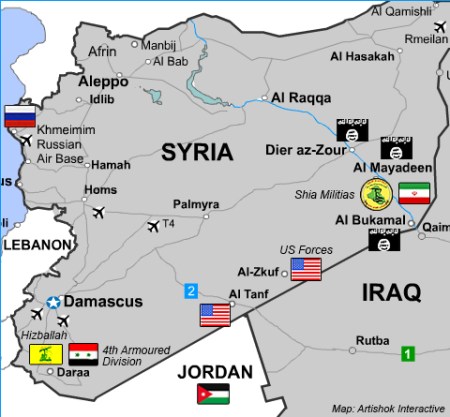
In readiness for a prospective showdown for control of southeast Syria, US Special Forces have set up a forward base at Al-Zukf in the Syrian Desert, DEBKAfile’s military and intelligence sources report. The location is 70km northwest of the Syrian-Iraqi-Jordanian border triangle and the Al Tanf crossing, which is controlled by US, Western allied and Jordanian special forces, together with a US-trained Syrian rebel unit, which calls itself the Revolutionary Commando.

(See the map at the top of this article.)

American sources say the Al Zukf base was set up for two objectives: One is to block the path of the Syrian army-Hizballah armored column, which has been advancing for the past fortnight from Al-Suweida in southeastern Syria toward the Al-Tanf crossing.

The other US objective is to capture the key town of Abu Kamal, a distance of 200km northwest of Al-Tanf, from Islamic State control.

However, the overriding goal of the US advance base is to thwart the Syrian, Hizballah and other pro-Iranian forces from gaining control of 300km of the Syrian-Iraqi border and so being able to open up Tehran’s coveted direct land bridge to the Mediterranean through Iraq.

The US force is not alone in its bid for control of this strategic area. It is getting pretty crowded.

The Syria Army’s 4th armored division rolled this week into the southern Syrian town of Daraa close to the Jordanian border and around 330km west of the new Al-Zukf base. The division moved in with high-grade Russian-made T-90 tanks complete with its high command, headed by Bashar Assad’s younger brother, Gen. Maher al-Assad. The general and staff officers were sighted carrying out inspections of Daraa’s terrain in advance of the resumption of hostilities. Parts of this potential battlefield are no more than 1,000 meters from the Jordanian border.

Our intelligence sources also reported that, this week, further north, al-Qods chief, Gen. Qassem Soleimani, commander of Iran’s Syrian and Iraqi fronts, crossed into Syria from Iraq along with his operations staff. They joined the Palmyra-based command and control of the Syrian force, which is heading out of the town in two columns for two towns – Deir ez-Zor, which is surrounded by Islamic State forces, and Abu Kamal, which is under ISIS control. Elements of Russian elite forces and Hizballah are fighting along with the Syrian troops.

The ingathering of major military forces in this part of Syria is ominous: The deployment of a US forward base in the Syrian Desert, and the arrival of the most senior Iranian and Syrian commanders at the head of elite units augur the approach of a major showdown for control of southeastern Syria and its strategic multiple border assets.

After years of empty U.S. promises, Trump arms Kurds fighting ISIS in Syria

May 31, 2017

After years of empty U.S. promises, Trump arms Kurds fighting ISIS in Syria, Hot Air, Andrew Malcolm, May 31, 2017

Now, Kurdish and Arab troops in Syria, working with U.S. Special Forces, will have their own armored cars, heavy machine guns, bulldozers, antitank weapons and mortars because as one Pentagon spokesman put it, the Kurds are the “only force on the ground that can successfully seize Raqqa in the near future.”

**********************

About time.

Finally, after years of dangerous dawdling the United States has actually begun arming Kurdish soldiers fighting ISIS in Syria.

Weapons supplies had been stockpiled nearby in anticipation of President Trump’s go-ahead, which came Monday. The armament distributions, which the commander-in-chief approved despite fierce opposition from NATO ally Turkey, will enable the tough Kurdish fighters to participate more aggressively in the imminent assault on the de facto ISIS capital of Raqqa.

The Obama administration talked of arming the Kurds, who also led the anti-ISIS fighting in northern Iraq, but wilted in the face of resistance from the Baghdad central government and Turkey. More than $200 million in armaments were earmarked for the Kurds and left behind in the Iraqi capital when Obama withdrew all U.S. troops in 2011. But somehow they never reached the Kurds, who were often left fighting ISIS forces that had better U.S. equipment captured from fleeing Iraqi troops.

Now, Kurdish and Arab troops in Syria, working with U.S. Special Forces, will have their own armored cars, heavy machine guns, bulldozers, antitank weapons and mortars because as one Pentagon spokesman put it, the Kurds are the “only force on the ground that can successfully seize Raqqa in the near future.”

The arming decision comes as Secy. of Defense James Mattis has ordered changes in strategy against ISIS. Mattis describes the change as moving from an “attrition strategy,” which allowed ISIS fighters to escape current battles, to an “annihilation strategy,” which involves encirclement and total destruction. Mattis has also given battlefield commanders increased leeway in decision-making, which under Obama often involved seeking time-consuming approval all the way back to the White House.

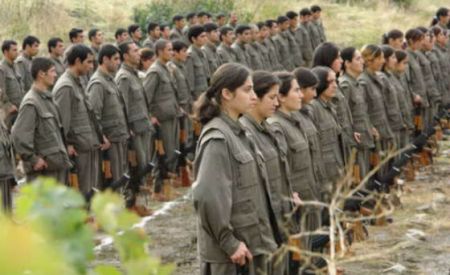
Unhappy Turkish officials were informed of Trump’s decision Monday. They regard the Kurdistan Workers Party, P.K.K., as separatist terrorists within Turkey’s borders. Indeed, the U.S. and European allies also list the PKK as a terrorist outfit. However, the U.S. recognizes the separate People’s Protection Units of the Y.P.G. as an ally with the most experienced fighters. Bottom line: The more fighting the valiant Kurds do, the less potential involvement of U.S. forces.

Turkey made its position clear last month by bombing Kurdish units fighting in Syria with the U.S., dashing hopes that President Recep Erdogan would modify his position since he’s consolidated power.

To mollify Turkish concerns, Pentagon officials said the new arms will be doled out only according to the needs of the upcoming assignments. And they said every weapon would be accounted for afterward.

Uh-huh, right.

Powerful pro-Iran Badr Brigades to enter Syria

May 31, 2017

Powerful pro-Iran Badr Brigades to enter Syria, DEBKAfile, May 31, 2017

Their entry into Syria could raise the total of pro-Iranian Shiite forces fighting in Syria to 80,000 to 100,000 troops.

For Israel, Hizballah’s hostile penetration of Syrian borders abutting its territory is child’s play compared with a major military force capable of transforming Syria into a huge staging area for Iranian aggression against the Jewish state.

****************************

Hadi al-Amiri, commander of the strongest Iraqi Shiite militia, the Badr Brigades, said Wednesday, May 31, that his forces are preparing to enter Syria. The advanced capabilities of this powerful Iranian-led militia, would tilt the Syrian war strongly in Iran’s favor, with alarming ramifications for the US, Israel and Jordan.

Al-Amri, in making this announcement, cited Iran’s new slogan: “Iraq’s security will be maintained only if Syria’s security is preserved.” In other words, the Syrian conflict would end only when pro-Iranian Shiite militias, including Hizballah, control Syria like they control Iraq.

DEBKAfile’s military and intelligence sources report that the Badr Brigades’ path into Syria was secured this week when an Iraqi Shiite conglomerate breached the Iraqi-Syrian border in the north, on the orders of Al Qods chief Gen. Qassem Soleimani. This opened Iran’s coveted overland corridor through Iraq to Syria.

The combat capabilities of the Badr Brigades, estimated at between 30,000 and 50,000 strong, are impressive. One of the most professional and well-trained military forces in Iraq, its recruits receive instruction at special camps operated by Revolutionary Guard Corps on Iranian soil. The militia consists of special forces, tank, mechanized infantry, artillery and antiaircraft units. The high quality of their munitions may be seen in the photo at the top of the story.

Their entry into Syria could raise the total of pro-Iranian Shiite forces fighting in Syria to 80,000 to 100,000 troops.

Intelligence sources expect the Badr Brigades to first head south towards the Deir ez-Zor area to link up with the Syrian Arab Army and Hizballah forces, which are threatening the US special forces and allied hold on a key crossing that commands the triangle where the Jordanian, Syrian and Iraqi borders meet.

They would need to cover 230km from Palmyra to Deir ez-Zor, the while fighting small, scattered ISIS concentrations. Wednesday, May 31, Russia came down on the side of Tehran, with a cruise missile strike on ISIS targets around Palmyra. They were fired from the missile frigate Admiral Essen and the submarine Krasnodar for the purpose of softening jihadi resistance to the Badr Brigades’ southward advance.

The consequences of this massive pro-Iranian intervention in the Syrian war are dire for the US, Israel and Jordan. For Washington, it lays the ground for Tehran’s domination of Syria – in the face of President Donald Trump’s solemn vows to prevent this happening.

For Israel, Hizballah’s hostile penetration of Syrian borders abutting its territory is child’s play compared with a major military force capable of transforming Syria into a huge staging area for Iranian aggression against the Jewish state.

Jordan’s foreboding comes from its judgment that pro-Iranian Shiite militias sitting on its borders are a greater threat even that ISIS.

Read more about this pivotal development in the coming issue of DEBKA Weekly. If you are not yet a subscriber, click here to sign on.