ISIS Wins No Matter What Happens Next, The Daily Beast, Michael Weiss, May 28, 2015
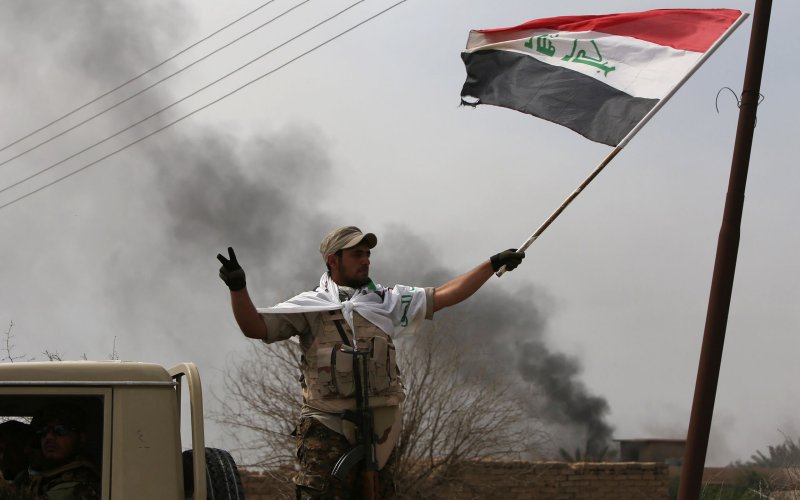 Ahmad Al-Rubaye/AFP/Getty
Usama al-Nujaifi, one of Iraq’s vice presidents and the former parliamentary speaker, pointed out that recent missteps by the militias has squandered incipient good will for Sunni reconciliation. Yesterday, during a parliamentary session, the Sunni governor of Diyala province was fired—and replaced with a Shia. “This is a real threat and a very negative message to Iraqis. This is considered a break to the rules and it contradicts what has been agreed,” Nujaifi said. “The majority in Diyala are Sunnis.”
**********************
The latest planned attack on the terror army could be playing right into their hands.
The Obama administration is being slammed from all sides for its failing strategy against ISIS—and rightly so. But amid all the scorn, one question has yet to be asked about the resiliency of the terror army, which, actually goes to the heart of its decade-old war doctrine. Namely: does ISIS actually win even when it loses?
This isn’t an academic issue. America’s allies in the ISIS war are gearing up for a major counteroffensive against the extremist group. That assault that could very well play right into ISIS’ hands.
Having superimposed its self-styled “caliphate” over a good third of Iraq’s territory, in control of two provincial capitals, ISIS is today in strongest position it has ever been for fomenting the kind of sectarian conflagration its founding father, Abu Musab al-Zarqawi, envisioned as far back as 2004.
Zarqawi’s end-game was simple: by waging merciless atrocities against Iraq’s Shia majority population (and any Sunnis seen to be conspiring with it), Zarqawi’s jihadists would have only to stand back and watch as radicalized Shia militias, many of whose members also served in various Iraqi government and security roles, conducted their own retaliatory campaigns against the country’s Sunni minority. Internecine conflict would have the knock-on effect of driving Sunnis desperately into the jihadist fold, whether or not they sympathized with the ideology of al-Qaeda in Iraq, Zarqawi’s franchise and the earliest incarnation of what we now call the Islamic State.
Indeed, in the mid-2000s, the Jordanian jihadist nearly got what he wished for by waging spectacular terror attacks against Shia civilians and holy sites, such as the Golden Mosque in Samarra, a strategy which quickened devolved Iraq’s violence from a primarily anti-American insurgency into all-out civil war. The only stopgap for a truly apocalyptic or nation-destroying result was the presence of nearly 200,000 U.S. and coalition troops. Today, however, absent such a foreign and independent military presence, the main actors left in Iraq are the same extremists —Shia militias and ISIS.
This fact was only driven home last week after thousands of U.S.-trained Iraqi Security Force personnel, including the elite counterterrorist Golden Division, fled from Ramadi, allowing the city fall to a numerically modest contingent of ISIS jihadists. Having been initially instructed by Iraq’s Prime Minister Haider al-Abadi to refrain from defending the city (no doubt at the prompting of Washington) the Hashd al-Shaabi, the umbrella organization for these Shia militias, now say they are prepping a massive counteroffensive to retake Ramadi. It promises to be a drawn-out and highly fraught counteroffensive, pitting paramilitaries—which have been accused of war crimes and atrocities by Human Rights Watch, Amnesty International and United Nations Human Rights Commission—against genocidal ISIS militants.
Many Iraqis fear, with good reason, that this counteroffensive will also extend to Sunni civilians who will now be branded “collaborators” of ISIS, as they have in previous Hashd-led operations. The result: torture, extrajudicial killing, and ethnic cleansing. Nothing would better serve the ISIS narrative or legitimate its claim to be the last custodian and safeguard of Sunni Muslims in the Middle East. Such an outcome might even precede the eventual disintegration of the modern state of Iraq into warring ethno-religious enclaves. That this was ISIS’s plan all along adds yet another grim paragraph to the obituary of American-hatched adventurism in the Middle East.
True, Hashd al-Shaabi has routed ISIS elsewhere before, namely in Amerli and Jurf al-Sakhar and Tikrit. In the aftermath, the militia was accused of committing human rights abuses, but those accusations didn’t tear the country apart.
The difference with Ramadi, however, is one of both scale and symbolism. This city of close to 200,000 is dead center in the Sunni heartland of Iraq, where ISIS has the home advantage. Ramadi was also, not coincidentally, the cynosure of the so-called “Anbar Awakening,” which saw hundreds of thousands of Sunni tribesmen rise up against ISIS’s predecessor, al-Qaeda in Iraq, in a cautious but fruitful partnership with American soldiers in the mid-2000s, a grassroots counterinsurgency whose gains were then solidified by the “surge” orchestrated by U.S. commander General David Petraeus. This time, absent any American combat forces, there are Shia Islamists who have never before tread into Ramadi. Many Iraqis dread the consequences.
“Iraq is not unified,” Iraq’s former Deputy Prime Minister Rafe Essawi, a senior Sunni political leader originally from Anbar, told The Daily Beast. “50 percent of the country belongs either to Kurds or ISIS, and 50 percent belongs to the Shia militias backed by Iran. We said too many times to our friends the Americans that we do not need to see the militias in Ramadi because this will lead to sectarian conflict.”
Yet the Americans have little on offer by way of an alternative. U.S. training efforts are still months off from fielding military units able to join the fight. With Iraq’s future resting on them, Hashd is seen as the only ready bulwark against further ISIS encroachments, though its conduct in Anbar may paradoxically purge the province of ISIS’s hard power while underwriting its soft version.
The Ramadi offensive hardly got off to a promising start. On Tuesday, Hashd spokesmen announced that the name for their Anbar offensive was, “Labeyk Ya Hussein,” a slogan roughly translated as “At your service, Hussein,” in tribute to a venerated Shia religious figure. The connotations were therefore of holy war — not exactly the multi-sectarian, pan-Iraqi message Baghdad has preferred to telegraph to international audiences.
On Wednesday, in response to criticism from U.S. officials and some Iraqi leaders—including demagogic Shiite cleric Muqtada al-Sadr (who has fallen out with Iran and has since platformed himself as a nationalist politician)—the operation’s name was changed to to more universal: “Labeyk Ya Iraq.” But the public relations rethink has not addressed underling concerns about the Hashd’s intentions, nor allayed Sunni anxieties.
“I think the careful examiner of the facts on the ground will see de facto borders are being drawn whether by design or by circumstance,” said one former Iraqi official who spoke to The Daily Beast on the condition of anonymity. “The militias have effectively cleared the Baghdad belts to the south of Sunnis, and with the Ramadi operation I expect the same will happen westward but it will entail a lot more fighting and possibly much more instability.”
This is because the war for the future Iraq isn’t being waged first and foremost by Iraqis but by their self-interested next-door neighbor, Iran, led by its elite Revolutionary Guards Corps-Quds Force, a U.S.-designated terrorist entity in its own right.
Iraq’s sectarian division, whereby Sunnis have been forced out of Shia-controlled areas under the auspices of fighting ISIS, reflects the fact that the Hashd operates more according to Tehran’s geo-strategic and ideological interests, the former official said. “I feel that Iran and some of its erstwhile allies have reached a realization that they have lost a significant ally in Syria and therefore need to buffer the ‘Shia’ zones in Iraq to protect them while paying lip service to the notion of a unified state.”
It certainly does not help matters that America’s unacknowledged ally in the anti-ISIS coalition is the IRGC-QF, whose commander, Major General Qassem Suleimani, not only blamed U.S. incompetence for the fall of Ramadi this week but labeled the United States an “accomplice” of the jihadists—a conspiratorial view of ISIS’s secret patronage widely shared amongst the Hashd rank-and-file.
The scenario described by Essawi and the ex-official is more common among the Sunni political class that either Washington or Baghdad care to acknowledge. Whether it is credible will depend on how the Hashd conducts itself on hostile terrain and whether it can break with precedence of collective punishment. If the militias act as a nationalist reserve army, under the command and control of Haider al-Abadi—something the White House has insisted as a precondition of U.S. air support—then they may be able to recruit Sunnis to their efforts, or at least earn their respect and admiration.
Essawi argues that Hashd has so far relied on coercion rather than a savvy hearts-and-minds approach for winning over Sunnis. “The Sunni tribes used to be against ISIS after [their] crimes,” he said. “Definitely there are some local supporters of ISIS, but the tribes generally speaking —almost all of them — are committed to fight. It is the government that refuses to strengthen them. So some very weak tribes have been coerced into accepting this bad choice: it’s either Hashd al-Shaabi or ISIS.”
Saleh al-Mutlaq, a Sunni deputy prime minister under Abadi, disagreed.
He emphasized that the Hashd should henceforth operate under the Iraqi flag rather than the host of competing standards their constituent militias currently brandish (including those bearing the images of Iranian ayatollahs Khomeini and Khamenei). But Mutlaq is hopeful of greater Sunni support for the Hashd. He pointed out that there are currently volunteer camps established near Ramadi to incorporate Sunnis volunteers and Iraqi policemen who fled the city into the broader counteroffensive.
“The government will give them training and weapons,” a statement issued by Mutlaq’s office read, without offering specifics. As for Shia sloganeering deemed alienating the Anbari support base, he doesn’t think this has had too dire an impact. “The Sunnis were conflicted about the intervention from the Hashd al-Shaabi because they were worried about reprisal attacks. But the Hashd is less harmful than ISIS. At least, these people are Iraqis and we can deal with them later on, but we can’t with ISIS.”
Nevertheless, Mutlaq wonders just what form a pro-government success may take and what happens the day after ISIS is routed from Ramadi. “His concern is whether Ramadi will undergo demographic changes,” his office said. “Will Sunnis be forced to relocate to others areas and will there will be any revenge attacks and conflicts between the Hashd and the tribes?”
Usama al-Nujaifi, one of Iraq’s vice presidents and the former parliamentary speaker, pointed out that recent missteps by the militias has squandered incipient good will for Sunni reconciliation. Yesterday, during a parliamentary session, the Sunni governor of Diyala province was fired—and replaced with a Shia. “This is a real threat and a very negative message to Iraqis. This is considered a break to the rules and it contradicts what has been agreed,” Nujaifi said. “The majority in Diyala are Sunnis.”
ISIS is counting on such political heavy-handedness to indemnify its own savagery. “It is that enemy, composed of Shiites joined by Sunni agents, who are the real danger with which we are confronted, for it is our fellow citizens, who know us better than anyone,” Zarqawi wrote in a 2004 letter, correctly foreseeing that the U.S. military occupation would be fleeting and incidental to the future of Iraq.
In other words, he wanted the Shia militias, principally the Badr Corps — now first among equals in the Hashd— to commit anti-Sunni atrocities as payback for Zarqawi’s own scorched-earth war against the Shia. “If we manage to draw them onto the terrain of partisan war, it will be possible to tear the Sunnis away from their heedlessness, for they will feel the weight of the imminence of danger and the devastating threat of death wielded by these Sabeans.”
If Iraq does fall apart, it will have been because Zarqawi’s apocalyptic plan got realized a decade after his death.




 anneinpt
 artaxes
 danmillerinpanama
 davidking1530
 Peter Hofman
 Joseph Wouk
 Peter
Peter Louisiana Steve
 WarSclerotic
Recent Comments