Posted tagged ‘State Department’

Exclusive: Obama Cuts Funds for the Syrian Rebels He Claims to Support

January 27, 2015

Exclusive: Obama Cuts Funds for the Syrian Rebels He Claims to Support, Daily Beast, January 27, 2015
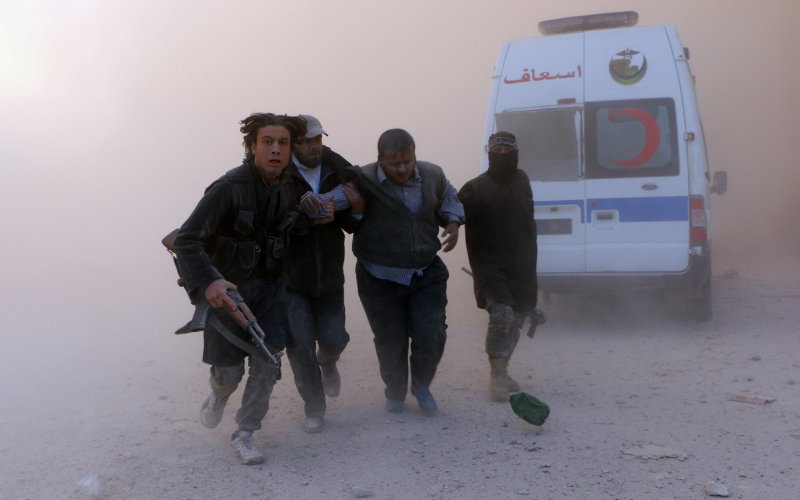
1422366030311.cachedFadi al-Halabi/AFP/Getty

LOST CAUSE?

Even the favored secular militias groomed to fight ISIS have seen their funding cut in half.

GAZIANTEP, Turkey — In the past several months many of the Syrian rebel groups previously favored by the CIA have had their money and supplies cut off or substantially reduced, even as President Obama touted the strategic importance of American support for the rebels in his State of the Union address.

The once-favored fighters are operating under a pall of confusion. In some cases, they were not even informed that money would stop flowing. In others, aid was reduced due to poor battlefield performance, compounding already miserable morale on the ground.

From afar, the U.S.-approved and partially American-armed Syrian “opposition” seems to be a single large, if rather amorphous, organization. But in fact it’s a collection of “brigades” of varying sizes and potentially shifting loyalties which have grown up around local leaders, or, if you will, local warlords. And while Washington talks about the Syrian “opposition” in general terms, the critical question for the fighters in the field and those supporting them is, “opposition to whom?” To Syrian President Assad? To the so-called Islamic State, widely known as ISIS or ISIL? To the al Qaeda affiliate, Jabhat al Nusra?

That lack of clarity is crippling the whole effort, not least because of profound suspicions among rebel groups that Washington is ready to cut some sort of deal with Assad in the short or medium term if, indeed, it has not done so already. For Washington, the concern is that the forces it supports are ineffectual, or corrupt, or will defect to ISIS or Nusra—or all of the above.

Republican lawmakers in D.C. are at their boiling point over the Obama administration’s anti-ISIS strategy, whether it is a failure to establish a no-fly zone in Syria, or unreliability with the issue of aid, or the Pentagon’s promised train and equip plan for the Syrian rebels.

“This strategy makes Pickett’s Charge appear well thought out,” said Sen. Lindsey Graham of South Carolina, referring to the poorly-planned and futile Confederate assault at Gettysburg. “We’re about to train people for certain death.”

In late October, al Qaeda’s Jabhat al Nusra routed American-backed militias in the northwest Syrian province of Idlib.

As a direct result, four of the 16 U.S.-approved brigades operating in the northern part of the country had their funding cut off and have been dropped from the list of “ratified” militias, say a State Department official and opposition sources. Since December, the remaining 12 brigades in the region have seen shortfalls or cuts in promised American assistance.

Syrian rebel sources who spoke on condition of anonymity say the 7thDivision, which is affiliated with the Syria Revolutionaries Front and aligned to the Free Syrian Army, has not received salaries from the CIA in months, although the State Department has maintained food shipments to the unit.

The secular Harakat al-Hazm, the most favored of the U.S.-backed brigades and one of the very few to be supplied with TOW anti-tank missiles, has seen a severe cutback in the monthly subsidy for its nearly 4,000 fighters. It is now receiving roughly 50 percent of the salaries it was receiving before. Weapon shipments arrived recently but commanders are nervous about whether future ones will come through. And the Farouq Brigade, a militia formed originally by moderate Islamist fighters based in the city of Homs, is getting no money for salaries at the moment.

CIA officials tell rebel commanders that unspecified “other funders” have ordered the cuts, or that Langley just doesn’t have the resources any longer. “What are the fighters meant to do?” complains one rebel commander. “They have families to feed.” Another says, “The idea that they don’t have the money is insulting. I don’t believe this—it is a political decision.”

Syrian rebel groups and their Washington, D.C. allies argue that CIA funding cuts —explained and unexplained—create relative advantages for extremist groups like al Nusra and ISIS, even as the president heralds the rebels as America’s on-the-ground-partners in the campaign to defeat the self-proclaimed Islamic State.

“It’s not just that the administration is failing to deliver on committed resources, it’s that they aren’t even communicating with formerly affiliated battalions regarding the cutoff,” says Evan Barrett, a political advisor to the Coalition for a Democratic Syria, a Syrian-American opposition umbrella group. “This puts our former allies in an incredibly vulnerable position, and ensures that groups like al Nusra will be able to take advantage of their sudden vulnerability in the field.”

The Obama administration says publicly that its support of moderate rebel brigades is not waning: the State Department continues to dispense non-lethal aid, the Pentagon supplies weapons, and the CIA pays salaries to brigades affiliated with the umbrella organization known as the Free Syrian Army. A CIA spokesman declined to comment for this story.

Privately, U.S. officials concede there have been funding changes. But American intelligence sources insist this is not a reflection of any shift in CIA strategy. They talk about “individual case-by-case shut offs” that are the consequences of brigades collapsing or failing to perform. And these sources dispute suggestions there’s an overall decrease in CIA subsidies, saying they are not giving up on the Syrian rebels—even though the Syrian rebels in the north of the country in the vicinity of the Turkish border increasingly believe this to be true. (Those in the south, near the Jordanian border and Damascus, may fare better.)

A State Department official told The Daily Beast that “the CIA has more money now than before and the State Department pie has not shrunk,” but confirms there has been some cutting off and cutting down. The official cited the “poor performance” of rebel brigades in Idlib last October as a primary reason.

When they were up against al Nusra, this official said, “they didn’t fight hard enough.” Several moderate brigades failed to come to the assistance of the Syria Revolutionaries Front, in particular, because they disapproved of its leader, who has been widely accused of corruption. The ease with which al Nusra was able to pull off its offensive angered U.S. officials—as did American-supplied equipment falling into jihadist hands.

That anger was compounded when the members of some U.S.-backed rebel groups actually defected to al Nusra during the offensive. One senior U.S. official admitted that some brigades have been “getting too close for our liking to al Nusra or other extremists.”

On Christmas Day armed groups formed an alliance for the defense of besieged rebel-held areas in Aleppo, where Assad had launched a major offensive to encircle them. Al-Jabha al-Shamiyya (Shamiyya Front), as the operational alliance is called, includes not only hardline Salafist factions from the groups known as the Islamic Front but more moderate brigades like the Muslim-Brotherhood-linked Mujahideen Army and Harakat Nour al-Din al-Zenki, which also has received TOW anti-tank missiles from Washington in the past.

Although al Nusra was not invited to join formally, it coordinates with the Shamiyya Front via the so-called Aleppo Operations Room, a joint headquarters for armed factions. It’s an arrangement that Washington does not like at all.

Aleppo-based rebels say they have no choice but to work with al Nusra and the Islamic-Front-aligned factions that are among the strongest armed groups in the war-torn city. Without them Assad’s forces would overwhelm the rebels.

“What do the Americans expect us to do?” asks a commander in the operations room. “Al Nusra is popular here. It is a perilous time for us—Assad is pushing hard.”

Syrian rebel sources who spoke on condition of anonymity say the 7th Division, which is affiliated with the Syria Revolutionaries Front and aligned to the Free Syrian Army, has not received salaries from the CIA in months, although the State Department has maintained food shipments to the unit.

The secular Harakat al-Hazm, the most favored of the U.S.-backed brigades and one of the very few to be supplied with TOW anti-tank missiles, has seen a severe cutback in the monthly subsidy for its nearly 4,000 fighters. It is now receiving roughly 50 percent of the salaries it was receiving before. Weapon shipments arrived recently but commanders are nervous about whether future ones will come through. And the Farouq Brigade, a militia formed originally by moderate Islamist fighters based in the city of Homs, is getting no money for salaries at the moment.

CIA officials tell rebel commanders that unspecified “other funders” have ordered the cuts, or that Langley just doesn’t have the resources any longer. “What are the fighters meant to do?” complains one rebel commander. “They have families to feed.” Another says, “The idea that they don’t have the money is insulting. I don’t believe this—it is a political decision.

For the Syrian rebels, uncertainties over funding changes by the CIA add doubt to already high skepticism over American policy toward the war in Syria. That skyrocketed when the Obama administration failed to enforce in 2013 its “red line” against Assad’s alleged use of chemical weapons, and the skepticism has merely grown since.

On the ground, the combatants say they suffer from the Obama administration’s inconsistency and argue that all too often they are being left out to dry, like some Syrian version of the Bay of Pigs, but much, much bloodier.

In the coffee shops of the Turkish border town Gaziantep last week, Syrians gathered on the safer side of the frontier listened incredulously as State Department spokesperson Jen Psaki insisted, “We maintain our belief that al Assad has lost all legitimacy and must go.” It was the first such inflexible anti-Assad statement for weeks from a senior U.S. official.

But that wasn’t what they’d heard from President Obama in his State of the Union address a few days before. Gone was the rhetoric of 2013 when he said he had “no doubt that the Assad regime will soon discover that the forces of change cannot be reversed, and that human dignity cannot be denied.” Instead, last Tuesday Obama spoke about the administration’s so-called train-and-equip plan to build a force that will target ISIS, and he made vague noises about helping Syria’s moderate opposition.

Those moderates are precisely the men and women on the ground who feel that bit by bit they are being abandoned.

Already, nearly four months after Secretary of State John Kerry announced the plan to train and equip Free Syrian Army units, Kurdish Peshmerga, and Iraqi Shia militiamen as anti-ISIS forces, the project appears to be facing major hurdles.

U.S. Senators emerged grim-faced last week from a classified briefing on the train-and-equip mission, with some of them predicting disaster from a Pentagon program that will train too few fighters and too slowly to make a difference.

At its best, Republican senators argue, it’s not going to work. At its worst, it will lead to the mass slaughter of the trained rebels.

“This strategy makes Pickett’s Charge appear well thought out,” said Sen. Lindsey Graham of South Carolina, referring to the brave but futile Confederate assault at Gettysburg. “We’re about to train people for certain death.”

The number of recruits required for a “strategic change in momentum is years away,” said Graham. “The concept of training an army that will be subject to slaughter by two enemies, not one, is militarily unsound,” and “if the first recruits you train get wiped out, it’s going to make it hard to recruit.”

Sen. Jeanne Shaheen, a Democrat who emerged from the same classified briefing, was tight-lipped: “I think we have a lot to do, and a lot of questions to answer.”

In Syria, few rebel fighters want to join a force focused only on ISIS. They argue that Assad is responsible for considerably more deaths among them and their extended families than ISIS, which is able to draw defectors from their ranks because it pays much higher salaries to its fighters and because it is able to exploit distrust of American intentions towards the Syrian revolution.

U.S. officials now acknowledge difficulties recruiting from insurgent ranks, conceding it is a serious challenge finding enough recruits willing to put off fighting the Assad regime.

So American officials recruiting for the train and equip mission are now hoping to fish in the pool of rebel fighters from eastern Syria who disbanded, quit the war and fled to Turkey when ISIS established control of the cities of Raqqa and Deir ez-Zor. The U.S. officials say the anti-ISIS force in Syria will have to be smaller than envisaged initially, but they are hoping early victories on the ground will convince more people to enlist.

Iran Builds Two New Nuke Plants As Obama Admin Continues Talks With Regime, Berates Congress For Attempts To Impose Sanctions

January 15, 2015

Iran Builds Two New Nuke Plants As Obama Admin Continues Talks With Regime, Berates Congress For Attempts To Impose Sanctions

via Iran Builds Two New Nuke Plants As Obama Admin Continues Talks With Regime, Berates Congress For Attempts To Impose Sanctions – Breitbart.


Reuters

Iranian President Hassan Rouhani announced on Tuesday that Iran has broken ground on two new nuclear power plants in the country’s Bushehr province, Iranian state news agencies reported.

“Construction of two new power plants will increase the capacity of Bushehr province’s power generation to 2,000 megawatts,” Rouhani said in an address in Bushehr province.

The expansion of Iran’s nuclear program has been made possible largely due to Russian cooperation. In March, Russia’s State Atomic Energy Corporation (AEOI) agreed to help build the two plants in Bushehr.

Meanwhile, U.S. Secretary of State John Kerry and his counterpart, Iranian Foreign Minister Zarif, engaged in “substantive meetings” on Wednesday, according to the State Department. Kerry was expected to leave the Geneva-based negotiations with Iran on Wednesday, but stayed in order to engage with more conversation with Zarif, the Jerusalem Post reported. “Secretary Kerry is returning to Mandarin Hotel for another meeting with Foreign Minister Zarif,” a senior State Department official said of the unexpected change of plans.

Instead of responding to Iran’s expansion of its nuclear program, the Obama administration has castigated Congress for introducing its upcoming bill to create additional sanctions against Iran. The State Department said earlier this week that any bill regarding sanctions on Iran will be immediately vetoed by President Obama.

“Even with a trigger, if there’s a bill that’s signed into law, and it is US law, in our mind it is a violation of the Joint Plan of Action, which, as we’ve said, could encourage Iran to violate,” said State Department spokesperson Marie Harf on Tuesday. Harf warned that the Iranian government was extremely sensitive to bills in Congress, and that a bill passed through both chambers could “very well lead to a breakdown in these negotiations.”

However, the Iran sanctions have overwhelming support in both chambers of Congress, with a reported veto-proof majority ready to pass the sanctions. Democratic Rep. Eliot Engel told Al-Monitor on Wednesday: “I respect and understand the White House arguing that sanctions — even triggered sanctions — could be counterproductive or even harmful. That’s their judgment. It’s not necessarily mine.”

Iran also announced on Wednesday that the regime has indicted Washington Post journalist Jason Rezaian and that he will stand trial, without speaking to what charges he will face. Rezaian’s fate remains unknown, but Iran reportedly executed 721 people in 2014, which marked a new high under President Hassan Rouhani’s tenure.

Tehran is also reportedly helping construct a nuclear plant in Syria, reported Der Spiegel earlier this week. The ruling Syrian regime under Bashar al-Assad remains a close ideological ally of Ayatollah Khamenei’s Islamic Republic of Iran.

Obama Admin Wants Hamas Ally Qatar to Remain Chief Broker in Peace Process

December 2, 2014

Obama Admin Wants Hamas Ally Qatar to Remain Chief Broker in Peace Process, Washington Free Beacon, December 1, 2014

(Please see also Hamas Declares Palestinian Unity Government Dead. According to the article republished below, “The State Department maintains that Qatar shares President Obama’s views about the Middle East peace process.” Their views have long been anti-Israel, pro-Islam. But what difference does it make nowThe “peace process” is already moribund and Qatar will administer the last rites.  — DM)

Khaled MashaalHamas chief Khaled Mashaal and Hamas Prime Minister Ismail Haniyeh / AP

Qatar promised the State Department it would not give more money to Hamas.

The State Department maintains that Qatar shares President Obama’s views about the Middle East peace process.

***********

The Obama administration is pressing for the Qatari government to remain a chief broker in the Israeli-Palestinian peace process despite the country’s longstanding financial support for the terror group Hamas, according to recent correspondence from the State Department to lawmakers on Capitol Hill.

Qatar—which has come under harsh criticism by lawmakers in recent months due to its longtime financial support for Hamas—has promised the Obama administration that it will not allow the terror group to benefit from a new $150 million cash infusion that is meant to go toward reconstruction efforts in the Gaza Strip, according to the letter.

The Obama administration will maintain its close ties with Qatar and push for it to have a key role in the tenuous peace process, despite protestations from lawmakers on Capitol Hill who say that the country cannot be trusted due to its close ties to Hamas, according to the letter sent by State Department officials late last month to Rep. Peter Roskam (R., Ill.).

Although Qatar has pledged in past years to give Hamas at least $400 million in aid, it has assured the United States that the next $150 million sent to the Palestinians will not make its way to the terror group.

“Qatar has pledged financial support that would be directed to the Palestinian people in Gaza,” Julia Frifield, an assistant secretary for legislative affairs at the State Department, informed Roskam in a Nov. 21 letter. “Qatar assured us that its assistance would not go to Hamas. We continue to interact closely with the government of Qatar and will reinforce that such assistance should not go to Hamas.”

The Obama administration in turn will continue to rely on Qatar to serve a role in the peace process and to engage with Hamas, according to the letter.

“Qatar has said it wants to help bring about a cease fire to the ongoing hostilities in Israel and Gaza,” the letter states. “The Qatari government has engaged with Hamas to this end.”

While the United States still regards Hamas as a terrorist organization, “We need countries that have leverage over the leaders of Hamas to help put a ceasefire in place,” Frifield wrote. “Qatar may be able to play that role as it has done in the past.”

Lawmakers and experts remain dubious that Qatar can be taken at its word given its robust support for Hamas in the past.

“It’s an indisputable fact that Qatar has become the chief sponsor of Hamas—an internationally recognized terrorist organization committed to the destruction of Israel,” Roskam said earlier this year after he petitioned the administration to reassess its close ties to Qatar.

“With Qatar’s financial backing, Hamas continues to indiscriminately launch thousands of rockets at our ally Israel,” Roskam said. “The Obama administration must explain its working partnership with a country that so brazenly funds terrorism right before our eyes, even going so far as turning to Qatar to help broker a ceasefire between Hamas and Israel.”

The administration cannot blindly trust Qatar to cut its close ties with Hamas, said one senior congressional aide who works on the issue.

“It appears the administration is willing to take Qatar for its word on funding some of the world’s most dangerous terrorist organizations, and the notion that Qatar can simultaneously fund Hamas and help broker and Israeli-Palestinian peace treaty is laughable,” the source said. “Congress is intent on holding the Qataris responsible for their illegal behavior and send a message that under no circumstances should the United States tolerate such brazen support for terrorism.”

The State Department maintains that Qatar shares President Obama’s views about the Middle East peace process.

“Qatar has welcomed President Obama’s commitment to a solution to the Israeli-Palestinian conflict and shares the view that such a solution would advance security, prosperity, and stability in the Middle East,” the letter states.

In addition to its role in the peace process, the administration believes that Qatar can help in the international fight against terrorism and groups such as the Islamic State (IS).

“We remain strongly committed to working with Qatar to confront ongoing terrorist financing and advance our shared regional goals,” the State Department told Roskam, noting that more than 8,500 U.S. troops are housed at the country’s Al Udeid Air Base.

“We also have a productive relationship with Qatar on key regional issues ranging from Syria to Iran,” the State Department wrote.

Top Obama Lawyer Brings Anti-Israel Bias to High Court

November 9, 2014

Top Obama Lawyer Brings Anti-Israel Bias to High Court

November 7, 2014

by Joseph Klein

via Top Obama Lawyer Brings Anti-Israel Bias to High Court | FrontPage Magazine.


zivotofsky


The Obama administration’s anti-Israel bias was on full display at the Supreme Court earlier this week. Its chief lawyer, Solicitor General Donald Verrilli, offered an incredibly insulting analogy while arguing a case involving whether a U.S. citizen born in Jerusalem has the right to require, upon request, that the State Department identify “Israel” as the place of birth on his or her passport. In defending the administration’s position that it has the inherent discretion to deny any such request if it believes that granting the request would undermine the president’s foreign policy objectives, Verrilli raised the bogeyman comparison to “issuing passports to people born in the Crimea tomorrow that identified Russia as the country of birth.” Verrilli said that to do so “would contradict the foreign policy position in a way that could be quite deleterious,” leaving the distinct impression that Israel’s relationship to Jerusalem should be analyzed the same way for the purposes of this case.

The case stemmed from an attempt by the parents of a boy born in Jerusalem, who is a U.S. citizen because both of his parents are U.S. citizens, to file an application for a consular report of birth abroad and a United States passport for their son, Menachem Binyamin, listing his place of birth as “Israel.” The parents were exercising a statutory right explicitly granted by Congress in the Foreign Relations Authorization Act, which still remains in effect and requires the State Department to record a Jerusalem-born U.S. citizen’s place of birth as “Israel” if requested to do so by the citizen or his or her legal guardian.

The State Department denied the parents’ request, despite the fact that their son was born in “West” Jerusalem, which even the Palestinian negotiators are not currently claiming belongs to them. The Palestinians insist that only “East” Jerusalem must become the capital of an independent Palestinian state, but the State Department’s rejection of the passport request thrusts the status of all parts of Jerusalem into the conflict, including the undisputed portion.

Verrilli argued to the Supreme Court that requiring the State Department to identify in a passport, an official government-issued document, Israel as the birthplace of a U.S. citizen, known by the government to have been born in Jerusalem, would impermissibly “interject an issue of recognition policy into the content of passports.” He added that “Congress cannot compel the Executive to issue diplomatic communications that contradict the official position of the United States on a matter of recognition,” in summing up the administration’s position. He also expressed concern about the impact that such implied recognition of Israel’s claims would have on the Palestinians, whom, he noted, declared, “Jerusalem the capital of the Palestinian state.”

Verrilli characterized the Obama administration’s role as “an honest broker who could stand apart from this conflict and help bring it to resolution.” He said that adhering to the Foreign Relations Authorization Act’s passport requirement would undermine this role and “the credibility of the President on this fundamental question of where the United States stands on the status of Jerusalem until the parties work it out.”

In other words, the Obama administration has come before the Supreme Court with self-righteous proclamations about the need to preserve the president’s credibility and even-handedness in his conduct of diplomacy on the Jerusalem issue in order to justify its utter disregard of a law on the books concerning the issuance of passports. True to form, the Obama administration is asserting unbridled executive power. Claiming that Congress cannot interfere with the president’s conduct of foreign diplomacy, the State Department decided to disregard an explicit provision in a congressional statute, which requires the State Department to record a Jerusalem-born U.S. citizen’s place of birth as “Israel” if requested to do so by the citizen or his or her legal guardian. The Foreign Relations Authorization Act’s Jerusalem provision granted no discretion to the executive branch in this regard.  The Act says: “For … a United States citizen born in the city of Jerusalem, the Secretary shall, upon the request of the citizen or the citizen’s legal guardian, record the place of birth as Israel.”

“Shall,” not “may,” is the operative word. Such legal technicalities do not faze the Obama administration, however. Its Solicitor General told the Supreme Court Justices that they “ought to defer to the Executive Branch’s judgment that the place of birth listing can have significant diplomatic consequences.” Justice Stephen Breyer agreed with this position because, as Justice Breyer so humbly put it, “I’m a judge. I’m not a foreign affairs expert.”

Justice Sotomayor, acting as if she were counsel for the Palestinians rather than a Supreme Court Justice, remarked that requiring the State Department to honor a Jerusalem-born U.S. citizen’s request to record his or her place of birth as “Israel” on an official government document would be tantamount to “asking the government to lie.” She reached that bizarre conclusion on the premise that the U.S. government would be identifying Jerusalem with Israel, contrary to the government’s official recognition policy.

The more conservative-leaning Justices expressed some skepticism regarding the argument that issuing the passport as requested would interfere with the president’s diplomatic powers to decide whether or not to recognize the sovereign claims of Israel to Jerusalem. Justice Scalia acknowledged that there could be a constitutional issue if the president’s recognition powers were being directly challenged by legislation, but he questioned whether that was the case here.

Justice Alito said that while he understood “the position of the United States that Israel does not exercise full sovereignty over Jerusalem,” he suspected there were certain attributes of sovereignty exercised by Israel such as Israel’s issuance of birth certificates for births within Jerusalem or Israel’s prosecution of crimes committed within Jerusalem which “the United States recognizes that Israel is lawfully exercising.”

Justice Kennedy proposed an idea he thought might alleviate the State Department’s concerns. He suggested that the State Department could simply include a statement with the passports it issues for Jewish American citizens born in Jerusalem that “This passport does not indicate that the government of the United States and the Secretary of State recognize that Israel has sovereign jurisdiction.”

Justices Kagan and Ginsburg expressed concern about the ramifications of appearing to take sides in the dispute between the Palestinians and Israel over Jerusalem’s status.

“I mean, history suggests that everything is a big deal with respect to the status of Jerusalem,” Justice Kagan said, pointing to the recent spate of violence in Jerusalem to support her point. “And right now Jerusalem is a tinderbox,” she added, “because of issues about the status of and access to a particularly holy site there. And so sort of everything matters, doesn’t it?”

With all due respect to Justice Kagan’s concerns about not setting off a “tinderbox,” what should matter is not to give the Palestinians a veto power over the implementation of a clear congressional statutory directive because of worries about a violent Palestinian reaction.

Justice Ginsburg questioned the fairness of the statute. “What about Palestinians who were born in Jerusalem and want to have Palestine as their place of birth?” she asked. “American born Palestinians cannot do that. And that suggests that Congress had a view, and the view was that Jerusalem was properly part of Israel.”

Horror of horrors that Congress should dare tilt in the direction of the one true democracy in the Middle East that has traditionally been our closest ally in the region!

In any case, President Obama has tipped the scale in precisely the opposite direction. Solicitor General Verrilli’s argument that the president’s ability to serve as an “honest broker” will be at risk if the Court rules against the State Department’s denial of the passport request rings hollow. Obama forfeited that role when he effectively endorsed the division of Jerusalem, based on Obama’s call for Israel to withdraw essentially to the pre-June 1967 lines as the basis for Palestinian-Israeli final status negotiations on the border between the two states. Obama’s map-drawing would mean that so-called “East” Jerusalem would become a part of a new Palestine state, codifying an artificial division that would reinstate the conditions prevailing during Jordan’s illegal occupation of the eastern portion of Jerusalem, including the Old City, between 1948 and 1967.

Prior to the Jordanians’ illegal occupation, Jerusalem was an undivided city. Historically, Jews have been living in Jerusalem continuously for more than three millennia. Jerusalem has never been the capital of any sovereign nation except of the Jewish people.

In more recent times, Jews have constituted the largest single group of inhabitants in Jerusalem since at least the mid-1800s. During the Jordanians’ illegal occupation between 1948 and 1967 of the eastern section, including the Old City, which Jordan annexed and ruled from its capital, Amman, Jewish homes and sacred places were destroyed or defaced. Jews were barred from worshipping at their holiest sites. The Palestinians today want to replicate this division and impose an ethnic and religious cleansing of any Jewish residents.

“In a final resolution, we would not see the presence of a single Israeli — civilian or soldier — on our lands,” Palestinian Authority President Abbas said last year.

When the Obama administration condemns Israel for planning to expand housing for Israeli Jews living in over-crowded Jewish neighborhoods within the portion of Jerusalem that Jordan had illegally occupied until Israel reunified the city, it is not neutral or acting as an “honest broker.” It is embracing the Palestinians’ bogus claims derived from Jordan’s illegal occupation.

Earlier this week, Abbas sent a letter to the family of the Palestinian jihadist killed by Israeli soldiers after he had seriously wounded Rabbi Glick, an American citizen, who was peacefully seeking more access for Jews to pray on the Temple Mount. Abbas called the would-be assassin “a martyr defending the rights of our people and the holy places.”

The Temple Mount is holy to Jews, as well as to Muslims. It includes but is not limited to the al-Aqsa Mosque. But Muslims, whom have been abusing the administrative responsibilities Israel granted to them in connection with the site,  insist on barring Jews from worshipping anywhere on the Temple Mount site. Defending “the holy places” means, according to Abbas, enforcing such discriminatory exclusion of Jews, whom he previously referred to as “cattle,” by “all means” necessary.

Palestinian violence has followed in the wake of Abbas’s incendiary rhetoric. But the Obama administration continues to side with the Palestinian position. When asked to comment last week on Glick’s shooting by a Palestinian jihadist, State Department Spokesperson Jen Psaki deplored the shooting but quickly pivoted to expressing the Obama Administration’s “support” for “the long-standing practices regarding non-Muslim visitors to the site, to Haram al-Sharif / Temple Mount.” Just by referring to the Temple Mount first by its Arabic name – even before its English designation – and omitting any reference to its Hebrew name Har haBáyit (or Har haMoria), the State Department spokesperson displayed the Obama administration’s pro-Palestinian bias.

In what should have been a prosaic explanation to the Supreme Court of the Obama administration’s position on the relevant law, its Solicitor General exposed the true animus that the Obama administration has towards the Jewish state of Israel. Solicitor General Verrilli’s reference to Russia and Crimea in an oral argument dealing with the issuance of a passport listing Israel as the place of birth for an American citizen born in Jerusalem was a contemptible distraction intended to place Israel in an unfavorable light in front of the highest court of the land.

It is always difficult to ascertain which way the Supreme Court will rule in a controversial case from the comments made by the various Justices during oral argument. However, what could emerge is a narrowly written majority opinion that sidesteps the constitutional question of separation of powers. The State Department can honor the Jerusalem-born American citizen’s request in accordance with the statute, based simply on the uncontested fact that it was Israel which issued the official birth certificate in the first place upon which the issuers of the passport relied for information. As Justice Kennedy, often a swing vote on the Court, suggested, the administrative action of issuing the passport with such birth information can be accompanied by a clear disclaimer statement that issuing the passport in no way is meant to express the U.S. government’s diplomatic recognition of Israel’s sovereign claims to Jerusalem.

Whatever the outcome, Solicitor General Verrilli’s slanderous Russia-Crimea analogy will remain a shameful episode in the annals of Supreme Court oral arguments.

Iran Nuclear Talks and North Korean Flashbacks

November 7, 2014

Iran Nuclear Talks and North Korean Flashbacks, ForbesClaudia Rosett, November 7, 2014

(During Clinton’s efforts to achieve detente with North Korea, Wendy Sherman found hope for change — for the better —  in every hostile utterance from NK leaders. Now she is Obama’s boot on the ground in the P5+1 negotiations with Iran. What can possibly go right wrong? — DM)

Now, in the Obama administration’s increasingly desperate quest for an Iran deal, comes news that President Obama is proposing to Iran’s Khamenei, ruler of the world’s leading terror-sponsoring state, that Iran and the U.S. cooperate to fight the terrorists of ISIS. This has a familiar ring. Back in 2000, the visit of North Korea’s Vice Marshal Jo to the White House was preceded, shortly beforehand, by a “Joint U.S.-D.P.R.K. Statement on International Terrorism,” in which both the U.S. and North Korea agreed that “international terrorism poses an unacceptable threat to global peace and security.” Apparently this was all part of the negotiating process of finding common ground. What could go wrong? Not that anyone should pin all this on Wendy Sherman, who is just one particularly active cog in the Washington negotiating machine. But there’s a familiar script playing out here. It does not end well.

*****************

With the Iran nuclear talks nearing a Nov. 24 deadline for a deal, U.S. chief negotiator Wendy Sherman is under pressure to bring almost a year of bargaining to fruition. While U.S. policy rests ultimately with President Obama, and the most prominent American face in these talks is now that of Secretary of State John Kerry, the hands-on haggling has been the domain of Sherman. On the ground, she has been chief choreographer of the U.S. negotiating team. The President has been pleased enough with her performance to promote her last week from Under Secretary to Acting Deputy Secretary of State.

The talks themselves have been doing far less well, marked by Iranian demands and U.S. concessions. This summer the U.S. and its negotiating partners agreed to extend the original July deadline until November. Tehran’s regime, while enjoying substantial relief from sanctions, is refusing to give up its ballistic missile program and insisting on what Tehran’s officials have called their country’s “inalienable right” to enrich uranium.

The Obama administration badly wants a deal. This week The Wall Street Journal reported that last month Obama wrote a secret letter to Iran’s Supreme Leader Ali Khamenei, which “appeared aimed both at buttressing the campaign against Islamic State and nudging Iran’s religious leader closer to a nuclear deal.” Speaking to reporters in Paris this week about the Iran nuclear negotiations, Kerry said “We believe it is imperative for a lot of different reasons to get this done.”

So, now that crunch time has arrived, what might we expect? If precedent is any guide, it’s worth revisiting Sherman’s record from her previous bout as a lead negotiator, toward the end of the second term of the Clinton administration. Back then, Sherman was trying to clinch an anti-proliferation missile deal with another rogue despotism, North Korea.

That attempt failed, but only after then-Secretary of State Madeleine Albright, together with Sherman, had dignified North Korean tyrant Kim Jong Il with a visit to Pyongyang in late October, 2000. These American top diplomats brought Kim the gift of a basketball signed by one of his favorite players, Michael Jordan. Kim entertained them with a stadium display in which tens of thousands of North Koreans used flip cards to depict the launch of a long-range missile.

Less well remembered was the encounter shortly before Albright’s trip to Pyongyang, in which the State Department hosted a visit to Washington, Oct. 9-12 of 2000, by one of the highest ranking military officials in North Korea, Vice Marshal Jo Myong Rok. The centerpiece of Jo’s trip was a 45-minute face-to-face meeting at the White House, in the Oval Office, with President Clinton. It was historic, it was the first time an American president had met with an official of North Korea’s totalitarian state.

And it was a deft piece of extortion by North Korea, which had parlayed its missile program — including its missile trafficking to the Middle East, and its 1998 test-launch of a missile over Japan — into this lofty encounter in which the U.S. superpower was pulling out all the stops in hope of cutting a deal before Clinton’s second term expired in Jan., 2001. By 2000 (or, by some accounts, earlier) the Clinton administration was also seeing signs that North Korea was cheating on a 1994 denuclearization arrangement known as the Agreed Framework. Eight months before Jo arrived in Washington, Clinton had been unable to confirm to Congress that North Korea had abandoned its pursuit of a nuclear weapons program. Nonetheless, Jo’s visit rolled ahead, with Sherman enthusing in advance to the press that “Chairman Kim Jong Il has clearly made a decision — personally — to send a special Envoy to the United States to improve relations with us.”

Officially, Jo was hosted in Washington by Albright. But it was Sherman, then the Special Advisor to the President and Secretary of State for North Korea Policy, who orchestrated the events, squired Jo around Washington and briefed the press. It was Sherman who had helped prepare the way while accompanying her predecessor, the previous North Korea policy coordinator and former defense secretary, William Perry, on a trip to North Korea in 1999.

Jo arrived in Washington on Oct. 9, staying at the venerable Mayflower Hotel, where Sherman went to greet him. The next morning Jo and his delegation began their rounds with a courtesy call on Albright at the State Department. Then, before heading to the White House, Jo engaged in a symbolically freighted act. According to an account published some years later in the Washington Post by the senior State Department Korean language interpreter, Tong Kim, who was present for the occasion: “The marshal arrived in Washington in a well-tailored suit, but before going to the White House, he asked for a room at the State Department, where he changed into his mustard-colored military uniform, with lines of heavy medals hanging on the jacket, and donned an impressive military hat with a thick gold band.” Perhaps it did not occur to anyone at the State Department that North Korea was still a hostile power, a brutal rogue state fielding one of the world’s largest standing armies, and that this donning of the uniform on State premises was not just a convenience, but an implied threat. Or perhaps the zealous hospitality of the occasion just over-rode any thought at all. In any event, it was in his uniform that Jo went from the State Department to the White House.

Following those meetings, Sherman briefed the press. She made a point of mentioning that Jo had worn a business suit to the State Department. but changed into full military uniform for his meeting with the President of the United States. Sherman chose to interpret Jo’s wardrobe change as happy evidence of North Korean diversity under Dear Leader Kim: “We think this is very important for American citizens to know that all segments of North Korea society, obviously led by Chairman Kim Chong-Il in sending this Special Envoy, are working to improve the relationship between the United States and North Korea and this is obviously an important message to the citizens of North Korea as well.”

Actually, there were substantial segments of North Korean society whose chief preoccupation was finding enough food to stay alive, toward the end of a 1990s famine in which an estimated one million or so had died — forbidden by Kim’s totalitarian state to enjoy even a hint of the freedom that had by then allowed their brethren in South Korea to join the developed world. This was known at the time, but did not figure in Sherman’s public remarks.

On the second evening of Jo’s Washington visit, Albright hosted a banquet for him and his delegation at the State Department. She welcomed the “distinguished group” to the “historic meeting,” and invited everyone to relax and get better acquainted. There was laughter and applause. Jo made a toast — a disturbing toast — in which he said there could be “friendship and cooperation and goodwill, if and when the Democratic People’s Republic of Korea and our leadership is assured, is given the strong and concrete security assurances from the United States for the state sovereignty and the territorial integrity of the Democratic People’s Republic of Korea.”

If the State Department’s chief North Korea policy coordinator, Wendy Sherman, noticed a problem with that toast, and its mention of territorial integrity, it seems she did nothing to alert the assembled American dignitaries. The crowd clapped and raised a toast to North Korea’s envoy. It was left to outside observers, such as American Enterprise Institute scholar and North Korea expert Nicholas Eberstadt, to point out, as Eberstadt stressed at an AEI forum in 2008, that North Korea lays claim to the entire Korean peninsula, including South Korea. “Take a look at the maps; take a look at the preamble to the Workers’ Party charter,” said Eberstadt; the real message is, “We can be friends with North Korea if we are willing to subsidize North Korean government behavior and throw South Korea into the bargain too, but that is a pretty high opening bid.”

Jo’s visit ended with a U.S.-D.P.R.K Joint Communique, full of talk about peace, security, transparency and access. There was no missile deal. Kim Jong Il wanted Clinton, leader of the free world, to come parley over missiles in totalitarian, nuclear-cheating Pyongyang. Clinton demurred. In late October, Albright and Sherman went instead. As the clock ticked down on the final weeks of the Clinton administration, Sherman reportedly traveled to Africa with a bag of cold-weather clothes, to be ready in the event of a last-minute summons to North Korea.

In 2001, President Bush was inaugurated. Sherman left the State Department, and soon afterward she wrote an Op-ed for The New York Times, headlined “Talking to the North Koreans.” Sherman noted that “Some are understandably concerned that a summit with President Bush would only legitimize the North Korean leader” — nonetheless, she urged Bush to try it. Bush tried confrontation in 2002 over North Korea’s nuclear cheating, followed by years of Sherman-style Six-Party Talks, including two agreements, in 2005 and 2007, which North Korea punctuated in 2006 with its first nuclear test, and has followed during Obama’s presidency with two more nuclear tests, in 2009 and 2013.

Vice-Marshal Jo died in 2010. Kim Jong Il died in 2011, and was succeeded by his son, current North Korean tyrant Kim Jong Un, whose regime carried out the 2013 nuclear test, and threatened earlier this year to conduct another. Wendy Sherman rejoined the State Department under Obama, and has moved on from wooing North Korea to the bigger and potentially far deadlier project of negotiating a nuclear deal with Iran. Considerable secrecy has surrounded many specifics of these talks, while Americans have been asked to trust that this is all for their own good. In a talk last month at Washington’s Center for Strategic and International Studies, Sherman said: “As Madeleine Albright once observed — a wonderful Secretary of State, a dear friend, and a business partner to boot at one point in my life — negotiations are like mushrooms, and often they do best in the dark.”

Now, in the Obama administration’s increasingly desperate quest for an Iran deal, comes news that President Obama is proposing to Iran’s Khamenei, ruler of the world’s leading terror-sponsoring state, that Iran and the U.S. cooperate to fight the terrorists of ISIS. This has a familiar ring. Back in 2000, the visit of North Korea’s Vice Marshal Jo to the White House was preceded, shortly beforehand, by a “Joint U.S.-D.P.R.K. Statement on International Terrorism,” in which both the U.S. and North Korea agreed that “international terrorism poses an unacceptable threat to global peace and security.” Apparently this was all part of the negotiating process of finding common ground. What could go wrong? Not that anyone should pin all this on Wendy Sherman, who is just one particularly active cog in the Washington negotiating machine. But there’s a familiar script playing out here. It does not end well.

State Dept., Iran Officials Meet at Pittsburgh Business Forum

October 31, 2014

State Dept., Iran Officials Meet at Pittsburgh Business Forum

State Dept. denies Iranian officials discussed business with companies in attendance

BY:
October 31, 2014 11:00 am

via State Dept., Iran Officials Meet at Pittsburgh Business Forum | Washington Free Beacon.


A delegation of Iranian officials paid a quiet visit to the United States this week to meet with corporate leaders and a senior State Department representative at a business forum in Pittsburgh on Tuesday.

The rare trip occurred just days after a controversial Iran-focused trade forum was held in London, to much public outcry. Iran remains under strict international economic sanctions, and some foreign policy experts say such events undermine sanctions and weaken U.S. leverage in nuclear negotiations.

Greg Sullivan, the State Department’s senior adviser for strategic communications on Iran, joined the Iranian delegation at the OASIS 7th Annual Business Conference at the Fairmont Hotel in Pittsburgh on Tuesday.

Sullivan gave a brief speech on cultural diplomacy at the conference before turning the stage over to Ali Moradkhani, Iran’s deputy minister of culture and Islamic guidance.

Other delegates in attendance were Iran’s former nuclear negotiator Hossein Mousavian, Ministry of Culture official Farzin Pirouzpey, the director of the Fajr Music Festival Ali Torabi, and Mehdi Faridzadeh of the International Society for Iranian Culture.

Ali Alfoneh, a senior fellow at the Foundation for Defense of Democracies, said the Pittsburgh visit appeared to be an attempt by Mousavian “to mobilize the U.S. business community as a pressure group calling for removal of the sanctions regime.”

“The Islamic Republic’s motive for participating at the conference is understandable: Ambassador Hossein Mousavian, who is a brilliant diplomat, desires to convey the message to the U.S. business community that Iran is open for business,” said Alfoneh.

The State Department, which said it had no role in organizing the trip other than approving the delegation’s visas and sending Sullivan to speak at the conference, said the visit was designed to promote cultural diplomacy and to its knowledge did not involve business discussions.

“We are not aware of, and would certainly not approve of, any discussions or meetings outside of the discussions about cultural collaborations,” a State Department official told the Washington Free Beacon.

The title of the conference was “Growing Business Between the U.S. and the Middle East,” and it was officially billed as “a high-level gathering of Middle East Ministries, American and Middle East decision makers from leading global companies focused on growing business opportunities between the United States and the countries of the Middle East.”

The panel topics focused on the energy, technology and medical sectors. Conference sponsors included PhRMA, Comcast, Marcellus Shale, and the Westinghouse nuclear power company.

According to the State Department, the main purpose for the visit was to arrange a musical exchange between Iran and Pittsburgh.

“Our understanding is that Mr. Moradkhani’s visit is for the purpose of discussing a possible collaboration between the Pittsburgh Symphony Orchestra and the Tehran Symphony Orchestra,” a State Department official told the Free Beacon.

But the organizer of the business conference, Simin Curtis, who was also involved in the Pittsburgh musical diplomacy talks, disputed this.

She said that the Iranian delegation did not meet with the Pittsburgh symphony, and that plans for collaboration between the orchestra and Iran were put on hold in March.

“This [trip] was not about the symphony,” said Curtis, who serves as president of the American Middle East Institute in Pittsburgh. “[State Department officials] were aware that that trip has been delayed. … Initially we worked with the State Department on the idea, but it’s been postponed.”

Curtis said she coordinated the Iranian delegation visit with the State Department. She said the trip was intended to focus on cultural diplomacy in general, adding that she invited Sullivan to speak on the issue at the conference.

According to the Curtis, the interactions between the Iranian delegation and the business community were minimal, despite the event’s industry focus.

“The deputy minister was sitting at a table watching the proceedings, he was not interacting with the businesses actually—which would have been nice—but he was just watching the proceedings,” said Curtis. “We had no special meetings set up, but we wanted them to be at the event.”

Alfoneh said he was puzzled by the State Department’s decision to issue visas to the delegation for such a trip in the first place.

“Presence of the Islamic Republic delegation in Pittsburgh is certainly not likely to strengthen the U.S. bargaining position in the nuclear negotiations,” he said.

He added that the U.S. government “sends the wrong signal by allowing the delegation from Tehran to participate at a public conference.”

Earlier this year, Moradkhani’s Ministry of Culture and Islamic Guidance hosted a book fair in Tehran featuring the Protocols of the Elders of Zion and Holocaust denial literature.

“Mr. Ali Moradkhani, Mr. Mehdi Faridzadeh, Mr. Farzin Pirouzpey, and Mr. Ali Torabi, have all been and still are involved in enforcement of censorship of literature, cinema, and music in Iran,” said Alfoneh. “Does State Department approve of censorship? If not, why issue visas to the enforcers of censorship?”

Iranian Nuclear Negotiators Attend Anti-Semitic, Anti-American Conference

October 3, 2014

Iranian Nuclear Negotiators Attend Anti-Semitic, Anti-American Conference

State Department has no idea conference is even taking place

APBY: Adam Kredo Follow @Kredo0October 3, 2014 11:35 am

via Iranian Nuclear Negotiators Attend Anti-Semitic, Anti-American Conference | Washington Free Beacon.


Hassan Rouhani / AP
At least two former Iranian nuclear negotiators joined with Holocaust deniers, 9/11 truthers, and anti-Semites from across the globe this week in Tehran for Iran’s second annual New Horizons conference, an anti-American hate fest that U.S. lawmakers say highlights the country’s dangerous duplicity.

Among those in attendance at the conference—which the U.S. State Department admitted it was not even aware of—were notorious Holocaust deniers, American anti-Israel activists, and Iranian Supreme Leader Ayatollah Ali Khamenei’s closest adviser.

They were joined by two of Iran’s former nuclear negotiators, Saeed Jalili and Ali Asghar Soltanieh, both of whom were once responsible for inking a deal with the West over Tehran’s contested nuclear program.

The presence Jalili and Soltanieh triggered concern on Capitol Hill, where lawmakers warned that this is another sign that Tehran cannot be trusted to deal honestly in ongoing nuclear talks, which have been extended through November.

As the Obama administration continues to provide billions of dollars in sanctions relief to Tehran in a bid to foster a final nuclear deal, some in Congress say that the White House is letting itself be fooled into backing a bad deal with Iran.

“The so-called ‘New Horizon’ conference in Tehran proves why the current Iranian regime under President Hassan Rouhani is, at its core, no less extremist and dangerous than the regime under Mahmoud Ahmadinejad,” Sen. Mark Kirk (R., Ill.) said in a statement.

“The conference’s participants promoted anti-Americanism, anti-Semitism, and Holocaust denial, and were even greeted on day one by high-ranking Iranian cleric Mohsen Ghomi, a close adviser to Iran’s Supreme Leader Ali Khamenei, who falsely alleged that ‘American officials are puppets of the Zionist lobby,’” Kirk said.

“It’s critical that U.S. administration officials, who are desperately offering ever more dangerous nuclear concessions to get Iran to accept a watered-down nuclear deal, open their eyes to the true nature of the current Iranian regime,” he said.

Perhaps more concerning, the U.S. State Department told reporters on Thursday that they did not know the conference was taking place, despite multiple reports in U.S. and foreign newspapers.

“Have you seen this conference that the Iranians are putting on right now which is all about how Israel and the CIA conspired to—for 9/11 and all this,” a reporter asked State Department spokeswoman Jennifer Psaki at Thursday’s daily briefing.

“I have not seen reports of this conference. Where is the conference?” Psaki asked the reporter.

Asked if she had any concerns about the conference’s explicit anti-Americanism and anti-Semitism, Pskaki responded: “We will look into that.”

“It’s alarming that the State Department’s spokesperson had no idea that this hate-filled festival in Tehran was even going on,” one former Republican House staffer said.  “It’s even more appalling that the administration has done little, if anything, to condemn either the Iranian government or American citizens who traveled to the capital city of the world’s leading state sponsor of terrorism to compare notes with the world’s worst Holocaust deniers, 9/11-conspiracy theorists, and anti-Semites.”

The conference included multiple sessions about the “myth” of the Holocaust, as well as one discussion of how American and the West cannot be trusted in nuclear talks.

Other topics included: “9/11 and the Holocaust as pro-Zionist ‘Public Myths’,” “Mossad’s Role in the 9/11 Coup d’Etat,” “9/11 Truth Movement Strategies and the Zionism Issue,” and “9/11 Truth Movement Strategies and the Zionism Issue,” according to information provided by Kirk’s office about the confab.

Those who attended the event traveled from several Western countries, including America, a fact that raises concerns about how these citizens were permitted to travel to and from the unfriendly country.

Among those American who attended the Tehran hate fest were anti-Israel Codepink activist Medea Benjamin and conspiracy theorist blogger Garth Porter.

Others in attendance included former Iranian Revolutionary Guard Corps (IRGC) members, 9/11 truthers Wayne Madsen and Kevin Barrett, anti-Semitic French entertainer Dieudonne M’bala M’bala, and a slew of other Holocaust deniers from multiple countries.

Israeli Prime Minister Benjamin Netanyahu, in a press conference with President Obama at the White House earlier this week, warned the president against giving into Iran’s demands.

“Iran seeks a deal that would lift the tough sanctions that you’ve worked so hard to put in place, and leave it as a threshold nuclear power,” Netanyahu said. “I fervently hope that under your leadership that would not happen.”

In Praise of Benjamin Netanyahu

October 1, 2014

In Praise of Benjamin Netanyahu

by Roger L Simon

September 30th, 2014 – 7:46 pm

via Roger L. Simon » In Praise of Benjamin Netanyahu.


psaki_harf_netanyahu_9-30-14-2

Not exactly a head-scratcher: spot the grownup.


In case you non-Jews haven’t noticed, we Jews bicker a lot.  Some of us even have bad things to say about Albert Einstein.  A fair number of us have bad things to say about Karl Marx.  Or about Milton Friedman — to go the other way. (Yes, I think Friedman was a lot smarter than Marx.)

So it should be no surprise that Benjamin Netanyahu is only intermittently popular in his home country.  At the height of the recent Gaza war, he was a hero on the level of King Solomon, but then, after things quieted down with a relatively indeterminate conclusion, he was, well,  just another pol.

But he’s not.

This man, whatever his failings, is better able to articulate the global situation than any political leader currently in a position of power in any country by yards.  In fact, virtually no one else is even attempting to do it. (Tony Blair did for a while before he turned, but he’s not in Bibi’s league.) Netanyahu may not be Churchill when it comes to courage, but he is Churchill, or close, when it comes to a precise mastery of the English language, ironic since he is the prime minister of a Hebrew-speaking nation.  He is able to tell the truth about the important issues, when all others, including, notably, our president and secretary of State, are prevaricating or spinning, trying desperately not to offend the reprehensible, and he did it again the other day at the United Nations. (Full text here.)  He told the truth about radical Islam to a half-empty house whose Moslem delegates had left and whose remaining attendees sat there terrified of agreeing publicly with the Israeli prime minister lest some imam or dopey liberal NGO accuse of them of Islamophobia.  He made that speech at an institution that has institutionalized anti-Semitism, not world peace or even basic common sense, as its modus operandi,  as its very raison d’être.

What would the UN do if it were unable to bash Israel?  How would it spend its time?  Over half the initiatives proposed by its ludicrous Orwellian arm  known as the UN Human Rights Council are in opposition to the behavior or existence of the Jewish state. Forget Boko Haram, ISIS or the Iranian government assassinating dissidents on a regular basis. Forget that not a single country in the UNHRC has made a contribution  to humanity in years even vaguely equal to what appears daily on Israel21C. No, it’s the Jews who are the problem.

So Netanyahu had the temerity to state the obvious about the UNHRC, calling it a “terrorist rights council.”

Not surprisingly, our “progressive” State Department demurred:

“We would not agree with that,” Jen Psaki, the State Department spokeswoman, told reporters Monday when asked about what Netanyahu said in his address that day to the U.N. General Assembly.

“We have obviously voiced concerns when we have them about actions that are taken,” she said, referring to the council, “but no, we would certainly not agree with that characterization.”

Oh, really?  Then what is it?  Here’s what Netanyahu said in context:  “By granting international legitimacy to the use of human shields, the U.N.’s Human Rights Council has thus become a terrorist rights council, and it will have repercussions.”

Of course, that’s true and Psaki knows it.  She doesn’t have the courage to be honest or her handlers won’t let her be. She and her cohort Marie Harf have become the mealy-mouthed faces of a prevaricating State Department.  They are paid to lie.  Since Benghazi, who can take them seriously?  When Psaki speaks nonsense like that, I am reminded of Joseph Welch’s famous line “Have you no shame?” Of course, Welch was talking to McCarthy.  These people are worse.  At least McCarthy was a militant, perhaps excessive (although recent history seems to exonerate him) anti-communist.  Our State Department stands for nothing, except perhaps bureaucratic self-preservation.  They would do well to learn from Netanyahu.  At least he seems to be able to talk the talk for freedom and democracy.  They seem to have given it up.

Senators want UNRWA investigated over ‘troubling’ Gaza role

August 13, 2014

Senators want UNRWA investigated over ‘troubling’ Gaza role

By MICHAEL WILNER08/13/2014 00:56

Lawmakers concerned by rockets “turned over to local authorities;” UN sending munitions experts in search of more weapons caches;

Situation “exceptionally difficult,” says State Department.

via Senators want UNRWA investigated over ‘troubling’ Gaza role | JPost | Israel News.


UNRWA school damaged by fighting in Gaza Photo: REUTERS
 

WASHINGTON — Members of the United States Senate are demanding an independent investigation into the role of the United Nations Relief and Works Agency during Israel’s most recent war in Gaza with Hamas.

Accusing UNRWA of maintaining active and extensive ties with Hamas— and of supporting its activities throughout the month-long war— Senate Foreign Relations Committee members Mark Kirk (R-Ill.), Ben Cardin (D-Md.) and Marco Rubio (R-Fla.) wrote a letter this week to US Secretary of State John Kerry accusing the UN agency of bias and its role in the conflict troubling. UNRWA, an ostensibly neutral agency tasked with administering aid to Palestinian refugees throughout the region, adopted a political role in the heat of the conflict, during which at least four of its facilities were badly damaged and many of their inhabitants killed.

During the deadliest days of the war, UNRWA officials went on record accusing the Israeli government of violating international humanitarian law. UNRWA also publicly declared the discovery of three caches of rockets stored in Gaza schools during the July battle. The organization did not identify a responsible party for the crime, however, noting that the schools used as weapons depots were “mothballed” for the summer months.

Media reports quickly surfaced suggesting UNRWA returned the recovered rockets to Hamas, but those claims were never independently unverified.

“UNRWA claimed to have turned over to the ‘local authorities’ or have gone missing,” the Senate letter reads. “We fear that this means these rockets may have found their way back into Hamas’ hands.” The senators note that the US government is the single largest donor to UNRWA, providing the agency with $294 million in 2013 and a total of $5 billion since 1950.

While the letter does not call on the State Department to cut aid, they say the American taxpayers “deserve to know if UNRWA is fulfilling its mission or taking sides in this tragic conflict.” The United States and European Union list Hamas as a terrorist organization, and the United Nations has called on the group to renounce violence, recognize Israel, and respect previous agreements between the Palestinian Authority and the Jewish state.

Responding to the letter, a State Department spokesman said that the UN is taking “proactive steps to address this problem,” including deploying munitions experts to the strip in search of more weapons caches.

“The international community cannot accept a situation where the United Nations– its facilities, staff and those it is protecting– are used as shields for militants and terrorist groups,” State Department spokesman Edgar Vasquez told The Jerusalem Post. “We remain in intensive consultations with UN leadership about the UN’s response.”

Hamas’ use of UN facilities as “shields” for its fighters and its weapons posed one of the most politically vexing challenges of the war. UN secretary-general Ban Ki-moon said that such crimes turned UN facilities into legitimate military targets, inviting Israeli strikes; but in a strongly-worded statement from the State Department, after an Israeli shelling killed UNRWA refugees in Gaza for a third time, the US said “the suspicion that militants are operating nearby does not justify strikes that put at risk the lives of so many innocent civilians.”

The Israeli army fiercely denies that it targets civilians, arguing that its use of leaflets, phone calls, text messages and “knocks on the roof” warning of impending strikes are indicative of its efforts to avoid civilian casualties.

“There are few good solutions given the exceptionally difficult situation in Gaza,” Vasquez continued, “but nonetheless we are in contact with the United Nations, other UNRWA donors and concerned parties— including Israel— on identifying better options for protecting the neutrality of UN facilities and ensuring that weapons discovered are handled appropriately and do not find their way back to Hamas or other terrorist groups.” Kirk, one of the signatories of the letter, said that UNRWA has had “ties to terrorism” in the past, and that, in September 2012, Hamas–affiliated candidates won 25 out of 27 seats on UNRWA’s workers union board.

“I am demanding a credible and independent assessment of UNRWA’s actions during this crisis,” Kirk said in a statement. “US taxpayers deserve immediate answers and full transparency regarding their intentions and actions.” Cardin was the sole Democrat among the three behind the letter.

“When leaders and organizations of the United Nations blur the clear distinction between a nation-state defending itself and a terrorist organization attempting to murder civilians, Americans take note,” Cardin said. “When an organization funded in part by the US suggests that the two are morally equivalent, US taxpayers take note.”


