Posted tagged ‘South China Sea’

Obama Threatens China with Susan Rice Visit

July 25, 2016

Obama Threatens China with Susan Rice Visit, Front Page Magazine, Daniel Greenfield, July 25, 2016

rice

Smart move.

It’s easy to threaten China with war. But threatening China with a Susan Rice visit has to be Defcon 2 at least. The only thing worse would be a John Kerry visit.

U.S. National Security Adviser Susan Rice will urge Beijing next week to avoid escalation in the South China Sea when she makes the highest-level U.S. visit to China since an international court rejected its sweeping claims to the strategic waterway.

I’m sure China will be very impressed by the incompetent lackey of a lame duck impotent administration. At least more so than until now.

With less than six months remaining of President Barack Obama’s tenure, Rice’s broader mission in her July 24-27 trip is aimed at keeping overall ties between the world’s two largest economies, which she called “the most consequential relationship we have,” on track at a time of heightened tensions. “I’ll be there to advance our cooperation,” she said.

The United States is also using quiet diplomacy to persuade claimants like the Philippines, Indonesia and Vietnam not to move aggressively to capitalize on The Hague ruling, U.S. officials have said.

China has responded to the ruling with sharp rhetoric. But a senior official said, “So far there has not been precipitous action” and Washington was hoping confrontation could be avoided.

“We are not looking to do things that are escalatory,” another senior U.S. official said. “And at the same time we don’t expect that they (the Chinese) would deem it wise to do things that are escalatory.”

So this is actually appeasement with the appearance of courage. That’s typical of Obama Inc. With the legal basis for resisting China’s occupation established, Obama has dispatched Susan Rice to warn smaller countries to bow to China, just as her boss is doing.

Tribunal rules there’s no legal basis for China’s claims in South China Sea

July 12, 2016

Tribunal rules there’s no legal basis for China’s claims in South China Sea, Associated Press via Fox News, July 12, 2016

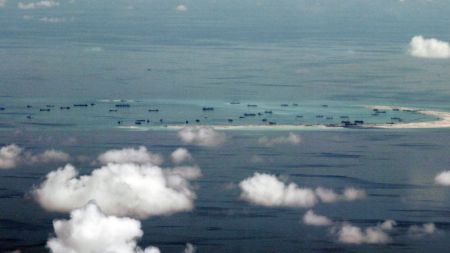
South China SeaFILE – This May 11, 2015, file photo, shows land reclamation of Mischief Reef in the Spratly Islands in the South China Sea. (AP)
 

A tribunal ruled in a sweeping decision Tuesday that China has no legal basis for claiming much of the South China Sea and had aggravated the seething regional dispute with its large-scale land reclamation and construction of artificial islands that destroyed coral reefs and the natural condition of the disputed areas.

Ruling on a variety of disputes the Philippines asked the tribunal to settle between it and China, the five-member panel unanimously concluded that China had violated its obligations to refrain from aggravating the dispute while the settlement process was ongoing.

The tribunal also found that China had interfered with Philippine petroleum exploration at Reed Bank, tried to stop fishing by Philippine vessels within the country’s exclusive economic zone and failed to prevent Chinese fishermen from fishing within the Philippines’ exclusive economic zone at Mischief Reef and Second Thomas Shoal.

The Philippines, which sought the arbitration ruling, welcomed the decision, and China rejected it outright.

“The Philippines strongly affirms its respect for this milestone decision as an important contribution to ongoing efforts in addressing disputes in the South China Sea,” Foreign Secretary Perfecto Yasay said in Manila.

He pledged to pursue a peaceful resolution of his country’s territorial disputes with China.

China’s state Xinhua news agency said China “does not accept or acknowledge” the tribunal or the ruling. China has long maintained that the tribunal did not have jurisdiction over the dispute.

The ruling is binding on both countries under a U.N. treaty that both have signed, but there is no policing agency or mechanism to enforce it.

The tribunal said that any historic rights to resources that China may have had were wiped out if they are incompatible with exclusive economic zones established under a U.N. treaty.

It also criticized China for building a large artificial island on Mischief Reef, saying it caused “permanent irreparable harm” to the coral reef ecosystem and permanently destroyed evidence of the natural conditions of the feature.

China drafted its so-called nine-dash line to demarcate its claims to virtually the entire South China Sea. Manila brought the case because China’s claims infringe upon its own 200-mile exclusive economic zone.

The dispute centers on waters through which an estimated $5 trillion in global trade passes through each year and are home to rich fishing stocks and a potential wealth of oil, gas and other resources. The ruling comes as the U.S. has ramped up its military presence in the region.

However a new Philippine leader who appears friendlier to Beijing could also influence the aftermath of the ruling.

China, which boycotted the case, summoned its demobilized sailors and officers for training drills in exercises that apparently started just days ago.

The People’s Liberation Army Daily newspaper said on social media late Monday that Chinese navy reserves have been called up to perform “functional tasks.” The post followed online rumors that reservists in central Chinese provinces were called up for an unspecified mission from July 10-22.

In the Philippines, more than 100 left-wing activists marched to the Chinese Consulate in metropolitan Manila, yelling, “Philippine territory is ours, China get out.” They called their campaign to push China out of the South China Sea, “CHexit” or “China exit now.”

Vietnam, meanwhile, accused Chinese vessels of sinking a Vietnamese fishing boat in disputed waters. Nguyen Thanh Hung, a local fisheries executive in the central province of Quang Ngai, said two Chinese vessels chased and sank the Vietnamese boat around midday Saturday as it was fishing near the Paracel islands. The five fishermen were rescued by another trawler around seven hours later.

China has argued that the tribunal has no jurisdiction and says it won’t accept the ruling. It has insisted that bilateral talks between Beijing and other claimants is the only way to address the dispute.

Findings of the tribunal are binding on the parties, including China. But the court — without police or military forces or a system of sanctions at its disposal — can’t enforce its ruling, so its potential impact remains unclear.

China Puts Advanced Missiles on Disputed Southeast Asian Island

February 17, 2016

China Puts Advanced Missiles on Disputed Southeast Asian Island Obama: U.S. military will sail, fly freely in South China Sea

BY:
February 17, 2016 5:00 am

Source: China Puts Advanced Missiles on Disputed Southeast Asian Island

President Obama defended U.S. naval and aircraft operations near disputed South China Sea islands claimed by China on Tuesday as new intelligence revealed Beijing recently placed advanced air defense missiles in the Paracels.

“Freedom of navigation must be upheld,” Obama said, adding “the United States will continue to fly, sail, and operate wherever international law allows, and we will support the right of all countries to do the same.”

The remarks followed a meeting of the Association of Southeast Asian Nations, known as ASEAN, in Sunnylands, Calif. Obama and leaders from 10 ASEAN nations agreed to defend the sea from Chinese encroachment.

“We discussed the need for tangible steps in the South China Sea to lower tensions, including a halt to further reclamation, new construction, and militarization of disputed areas,” Obama said.

The president said the United States would continue to help regional states bolster maritime capabilities and resolve disputes peacefully and legally.

Obama said “the United States will continue to stand with those across Southeast Asia who are working to advance rule of law, good governance, accountable institutions, and the universal human rights of all people.”

At the Pentagon, defense officials said recent intelligence revealed that China deployed advanced HQ-9 surface-to-air missiles on Woody Island, in the Paracel island chain in the northwestern part of the sea.

The missile deployment was detected in the past several days, said officials familiar with reports of the deployment.

The buildup of air defense missiles highlights what defense officials said is China’s continuing militarization of disputed islands in the sea.

China has demanded a halt to all U.S. warship transits through the sea, and aerial reconnaissance flights over it.

The HQ-9 is an advanced anti-aircraft system that can also shoot down short-range missiles.

The missiles are likely to heighten tensions as they could be used against U.S. reconnaissance aircraft that frequently fly over the sea.

Retired Navy Capt. Jim Fanell, a former Pacific Fleet intelligence chief, said the HQ-9 is a formidable air defense missile that can cover 125 miles.

“We should not be surprised in the least about this turn of events, as it is in keeping with the strategic trend line of China’s ‘maritime sovereignty campaign’ that has been in place since 2010,” Fanell told the Washington Free Beacon.

China’s Navy chief, Adm. Wu Shengli, announced last month that that China would determine when and how to justify the militarization of new islands. The missiles on Woody appear to be a first step, Fanell said.

“The question now remains whether or not the U.S., Japan, Australia, and the representatives of ASEAN will continue to accede to Beijing’s bullying or will they band together in a ‘unified front’ and begin conducting joint patrols within China’s unofficially asserted territorial seas,” he said. “The time to act is fleeting, each hour, each day of delay will render the situation more dangerous or untenable.”

Rick Fisher, a China military affairs analyst, said the advanced missile deployment is a major military escalation by China in the South China Sea.

“China’s deployment of up to 64 HQ-9 surface-to-air missiles to Woody Island just before the ASEAN summit in California constitutes a major slap against ASEAN and the Obama administration,” said Fisher, who is associated with the International Assessment and Strategy Center.

“It should now be clear that Obama administration diplomacy and freedom of navigation operations are useless in stopping China from militarizing its islands in the Paracel and Spratly island groups,” he said.

China’s military has said the recent passage of a warship near Triton Island in the Parcels could trigger a further military buildup.

Fisher said China could supplement the HQ-9s with long-range YJ-62 anti-ship cruise missiles or DF-21D anti-ship ballistic missiles, which have a range of 870 miles.   

“Nobody is suggesting that the U.S. attack China’s dangerous island bases, but the administration can deploy sufficient counterforce to deter China from using its bases,” Fisher said.

China deployed J-11 jet fighters to Woody Island  last October.

Two months later a U.S. B-52 bomber overflew the disputed Spratly Islands, drawing a sharp rebuke from China’s government.

The commander of the U.S. Pacific Command, Adm. Harry Harris, has rejected China’s expansive South China Sea claims. Harris said in a recent speech that the South China Sea is “no more China’s than the Gulf of Mexico is Mexico’s.”

The Pentagon has said some $5.3 trillion in international trade passes through the sea each year.

China is claiming some 90 percent of the South China Sea as its maritime domain, and has built up some 3,200 acres of new islands where military facilities, including deepwater ports and airfields, are being built.

Woody Island, called Yongxing Island by China, is located about 100 miles southeast of Triton Island, where the guided-missile destroyer USS Curtis Wilbur made a close-in passage on Jan. 30. The Pentagon said the transit was designed to demonstrate freedom of navigation to three claimants to the island, China, Vietnam, and Taiwan.

China has denied it is militarizing the sea and has criticized the United States for what it says are provocative freedom of navigation operations. In addition to the Curtis, the USS Lassen passed within 12 miles of Subi Reef in the Spratlys last October.

The HQ-9 deployment was first reported by Foxnews.com on Tuesday.

The missiles were revealed on commercial satellite imagery along a beach on Woody Island. The missiles were sent there between Feb. 3 and Feb. 14.

During a summit meeting between Obama and Chinese President Xi Jinping, the Beijing leader promised not to militarize newly-created South China Sea islands.

It is not clear if the September commitment included Woody Island, about 1 square mile in size that has had a military garrison since 2012.

The Communist Party-affiliated newspaper Global Times published a commentary Saturday criticizing U.S. military operations in the South China Sea as a serious political and military provocation.

“On the surface, Washington calls for international laws and norms, such as freedom of navigation, to be the guiding principle in the South China Sea,” wrote Zhang Tengjun, a research fellow at the China Institute of International Studies in Beijing.

“In fact, it tries to hype up China’s ‘threat’ to regional security and ASEAN’s interests so more ASEAN members will join a US-led front to counter China.”

The stories we tell ourselves – South China Sea.

November 6, 2015

The stories we tell ourselves, Foreign Policy Situation Report, November 6, 2015

It appeared to be a simple enough story, but over the last week, Pentagon and Obama administration officials have struggled to explain exactly what the USS Lassen did when it sailed near Subi Reef in the South China Sea. FP’s Dan De Luce and Keith Johnson have been following the ship’s wake, and have found conflicting accounts of what the ship was up to. When questioned by FP, “officials offered conflicting accounts as to whether the ship took steps to directly challenge China’s maritime claims in the strategic waterway — or whether it pulled its punches, tacitly conceding Beijing’s position,” they write.

Good idea, bad P.R. You’ll have to read the story to get a full sense of the linguistic knots the Pentagon is tying itself in, but the crux of the issue is that officials originally insisted the Lassen carried out a “freedom of navigation” operation, which could mean the vessel operated sonar, had its helicopters take off from the deck, or lingered in the area. But some officials weren’t ready to go that far, suggesting the ship might have just sailed through quietly without doing any of those things, making the trip an “innocent passage,” which carries with it the recognition of China’s territorial rights over the area. But doing so would undermine the whole point of the mission in the first place. Read the story.

Fair winds. While debate swirls around what to call the Lassen’s trip, the commanding officer of the ship has been telling reporters that the Chinese warships that shadowed his vessel for 10 days were full of nice, talkative people. Speaking aboard the the aircraft carrier USS Theodore Roosevelt during Defense Secretary Ash Carter’s visit this week, Cmdr. Robert Francis said the Chinese “were very cordial the entire time … even before and after the Spratly islands transit.” Finally, “when they left us they said, ‘Hey, we’re not going to be with you anymore. Wish you a pleasant voyage. Hope to see you again’.”

Chinese Jet in Second Near-Collision with U.S. Spy Plane

September 22, 2015

Chinese Jet in Second Near-Collision with U.S. Spy Plane PLA jet flies close to nose of RC-135 over East China Sea

BY:
September 22, 2015 5:00 am

Source: Chinese Jet in Second Near-Collision with U.S. Spy Plane – Washington Free Beacon

A Chinese interceptor jet conducted a second dangerous pass near a U.S. surveillance aircraft over Asian waters—weeks before a state visit to the United States by Chinese leader Xi Jinping that begins Tuesday.

The latest incident took place over the East China Sea near Japan’s Senkaku Islands when a Chinese interceptor flew in front of an RC-135 electronic intelligence-gathering jet, nearly colliding with the aircraft.

It was the second time a Chinese aircraft nearly collided with a U.S. surveillance jet. The last incident took place in August 2014 over the nearby South China Sea.

Pentagon and U.S. Pacific Command spokesmen declined to provide details of the latest encounter but did not dispute that it took place.

“I have nothing for you regarding the incident you mention,” said Cmdr. Bill Urban, a Pentagon spokesman.

The latest U.S.-China aerial confrontation was mentioned indirectly by Adm. Harry Harris, commander of the U.S. Pacific Command, during Senate Armed Services Committee testimony last week.

Harris called the 2014 incident “a very dangerous event,” referring to the barrel roll conducted by a Chinese jet over the top of a P-8 maritime surveillance aircraft as “a dangerous maneuver in acrobatic circles, let along in an intercept regime in an open ocean.”

“And we most recently have seen that again, but I’ll give the system credit for that intervening period of time, we’ve seen very few dangerous activities by the Chinese following that August 2014 incident,” Harris said.

Harris, without mentioning the RC-135 incident, said the decline in dangerous aerial encounters until the latest incident was due to military and political relationships worked out with the Chinese.

Asked about a second recent dangerous aerial encounter mentioned by the admiral, a Pacific Command spokesman at first said “there is no new P-8 incident.”

Questioned later about the RC-135 incident, the spokesman, Capt. Darryn James, refused to provide details and referred questions to the Pentagon.

Two Pentagon officials, speaking on background, described the East China Sea encounter as a dangerous and unprofessional aerial intercept that was similar to the 2014 near collision between a Chinese J-11 interceptor and Navy P-8 maritime patrol aircraft in the nearby South China Sea.

The J-11 came within 50 feet of the P-8 as it was conducting surveillance, in an attempt to coerce the surveillance aircraft to depart.

In the recent East China Sea incident, the Chinese interceptor crossed very close to the nose of the RC-135 near the Senkaku Islands—the location of a major dispute over ownership of the islands located south of Japan’s Okinawa and north of Taiwan.

Disclosure of the dangerous Chinese jet encounter comes a day before Xi begins an official state visit to the United States. The incident is likely to embarrass the Communist Party secretary who arrives in Seattle on Tuesday. He is scheduled to meet President Obama later this week.

Xi’s visit is also expected to raise two contentious issues: large-scale Chinese hacking of U.S. government and private-sector databases and the theft of data on tens of millions of Americans. China also has raised tensions as a result of disputes over maritime claims in the South China Sea and East China Sea.

Xi is also contending with a wavering Chinese economy that has caused stock markets around the world to drop sharply in recent weeks.

The Chinese leader, who recently was seen in a major military parade riding in the back of a limousine as he reviewed thousands of Chinese troops, tanks, missiles, and aircraft, will be hosted at a White House state dinner, an honor normally reserved for U.S. allies.

The dangerous aerial encounter is a setback for the Pentagon’s aggressive military diplomacy with China, which President Obama has made a centerpiece of Pentagon policy.

Critics in Congress, including Sen. John McCain (R., Ariz.), the chairman of the Senate Armed Services Committee, and Rep. Randy Forbes (R., Va.), chairman of the House Armed Services subcommittee on sea power, have called on the Obama administration to cut back on military exchanges that are not producing results.

The Pentagon recently concluded an agreement outlining what it calls rules of the road for encounters at sea that are designed to prevent further dangerous ship-to-ship incidents like the 2013 near-collision in the South China Sea.

On Dec. 5, 2013, a Chinese amphibious ship sailed directly in front of the guided missile cruiser USS Cowpens and stopped, forcing the Cowpens to sharply alter course to avoid hitting the Chinese vessel.

The Obama administration announced at the November 2014 summit between Obama and Xi that the Pentagon and Chinese military had concluded a memorandum of understanding on “rules of behavior” for the safety of air and sea encounters.

Pentagon officials have said the rules for maritime encounters are clearer than those for aerial intercepts.

Talks in Beijing on the aerial rules have been bogged down in Chinese demands that the United States halt all aerial surveillance near China’s coasts, something the Pentagon so far has refused to accept.

Harris, the Pacom commander, said last week that he has ordered his component commanders to continue to conduct operations when challenged by Chinese jets or naval forces.

“What I’ve told the component commanders of the Pacific fleet and Pacific air forces to tell their pilots and crews to do is to continue to insist on our right to operate in international airspace and maritime space,” Harris said.

“When challenged by Chinese fighter aircraft, our aircraft ought to maintain a professional flight profiles, predictable flight profiles, and we have the means to record that activity and then we’ll see what happens.”

The area where the incident occurred has been the focus of a major dispute between Beijing and Tokyo over the ownership of the Senkakus.

Senior U.S. officials, while claiming neutrality in Asian maritime disputes, have invoked the U.S.-Japan defense treaty several times in recent years, stating that U.S. forces would defend Japan if the islands are attacked.

Further heightening tensions, China in November 2013 unilaterally imposed an air defense identification zone over the East China Sea, claiming control over a security zone covering the Senkakus and several South Korean islands.

China is claiming ownership of the Senkakus, which it calls the “Diaoyu Islands,” though they have been under Japanese authority for decades. The waters around the islands are believed to contain large reserves of undersea gas and oil coveted by both countries.

The Chinese have demanded that all aircraft entering the zone seek permission and submit flight plans. China has threatened to use military forces to enforce the zone, but so far has not done so.

The United States, Japan, and South Korea have said they do not recognize the air defense zone.

Officials said the most recent aerial encounter between the United States and China was less dangerous than the 2014 encounter between the J-11 and the P-8.

The Pentagon called the 2014 intercept “aggressive” and “dangerous” and threatened to cut off military relations with the People’s Liberation Army unless the maneuvers were halted.

Defense officials have said that aerial intercepts remain an unresolved issue between the two countries. National Security Adviser Susan Rice, during a visit to Beijing last fall, was told by Chinese officials that China is demanding that the United States halt all surveillance flights along Chinese coasts.

Urban, the Pentagon spokesman, while not providing details of the East China Sea incident, defended the Pentagon’s efforts to seek to lower the risk of dangerous encounters.

“The department has made tremendous progress with respect to reducing risk between our operational forces and those of the People’s Republic of China (PRC),” Urban said.

“Over the past year, we have seen improvements in PRC behavior, specifically the safety and professionalism with which they intercept our aircraft.”

Additionally, the Pentagon has “robust, existing mechanisms to deal with incidents between our operating forces, such as the Military Maritime Consultative Agreement,” he said.

Rick Fisher, a China military analyst with the International Assessment and Strategy Center, said the latest aerial encounter should not go unchallenged.

“Threatening intercepts over the East and South China seas require a very firm U.S. response,” Fisher said.

“The first step should be increased flights. But there must also be a deliberate program of expanding air defense cooperation with Japan and the Philippines.”

Fisher urged states in the region to conduct joint aircraft deployments to Japanese air fields in the Sakishima Islands and said that the United States should offer the Philippines air defense systems and training to bolster its defenses.

Obama talks tough on Chinese Islands, then runs away

September 18, 2015

Obama talks tough on Chinese Islands, then runs away, Front Page Magazine, Daniel Greenfield, September 18, 2015

obama_bow_china_2

[W]hile Obama makes empty noises about China seizing land, and empty noises about Russia seizing land and empty noises about Iran’s nuclear program, he has conceded all three. Everything else is just empty talk about all the “options” we have, once that smart diplomacy has gotten through appeasing the enemy.

**************************

In public, Obama Inc. sounds tough and determined that China’s artificial islands don’t represent a legitimate territorial claim.

Also Wednesday, Defense Secretary Ashton Carter talked tough on China, referring to its increasingly aggressive military posture in the Pacific region.

In a reference to China’s construction of islands in the South China Sea, for which it then asserts air and sea rights, Carter continued: “There should be an immediate and lasting halt to land reclamation by all claimants. We also oppose any further militarization of disputed features.”

Like Obama, he warned China that the U.S. would not back down and would project its authority.

“There should be no mistake: The United States will fly, sail and operate wherever international law allows, as U.S. forces do all over the world,” Carter said. “America, alongside its allies and partners in the regional architecture, will not be deterred from exercising these rights.

“After all, turning an underwater rock into an airfield simply does not afford the rights of sovereignty or permit restrictions on international air or maritime transit,” he added.

In Obamaville though, all this is hot air and empty noise. Obama is a coward who bullies Americans, but cringes and bows whenever an enemy of the United States pushes him around. That was the empty rhetoric meant to fool the few Americans who still believe in Obama.

Here’s the pathetic reality.

 The Obama administration has restricted the U.S. Pacific Command from sending ships and aircraft within 12 miles of disputed Chinese-built islands in the South China Sea, bolstering Beijing’s illegal claims over the vital seaway, Pentagon leaders revealed to Congress on Thursday.

“The administration has continued to restrict our Navy ships from operating within 12 nautical miles of China’s reclaimed islands,” Senate Armed Services Committee Chairman Sen. John McCain (R., Ariz.) said in opening remarks criticizing the failure to guarantee safe passage for international commercial ships in Asia.

“This is a dangerous mistake that grants de facto recognition of China’s man-made sovereignty claims,” he said.

McCain, however, noted that the U.S. restrictions on close-in island military flights and ship visits were continuing despite the provocative dispatch of five Chinese warships in an unprecedented deployment to waters within 12 miles of Alaska’s Aleutian Islands—at the same time President Obama was concluding a recent visit to the state earlier this month.

A visibly angered McCain told Shear the best way to assert that international waters around the islands do not belong to China would be for American ships to make 12-mile passages by the disputed islands. “And we haven’t done that since 2012. I don’t find that acceptable, Mr. Secretary,” he said.

Adm. Harry Harris, commander of the U.S. Pacific Command, was asked if he is authorized to order ships to travel within 12 miles of any of the man-made islands and answered, no. Harris also said no U.S. surveillance aircraft have flown directly over any of the islands.

Brave Obama ran away. When danger reared its ugly head, he bravely turned his tail and fled and gallantly he chickened out. Bravely taking to his feet, He beat a very brave retreat.

So while Obama makes empty noises about China seizing land, and empty noises about Russia seizing land and empty noises about Iran’s nuclear program, he has conceded all three. Everything else is just empty talk about all the “options” we have, once that smart diplomacy has gotten through appeasing the enemy.

Bravest of the brave, Barack.

US Navy prepared to ramp up Pacific presence to deter China

July 18, 2015

Some content on this page was disabled on August 10, 2015 as a result of a DMCA takedown notice from Telegraph Media Group Limited. You can learn more about the DMCA here:

https://wordpress.com/support/copyright-and-the-dmca/


