Posted tagged ‘Sisi’

Netanyahu’s epic understandings with Egyptian, Saudi and UAE rulers – a potential campaign weapon

December 6, 2014

Netanyahu’s epic understandings with Egyptian, Saudi and UAE rulers – a potential campaign weapon, DEBKAfile, December 6, 2014
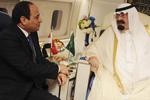
Abdullah-al_sisiEgyptian and Saudi rulers take charge of Arab affairs

Netanyahu may or may not opt to brandish Israel’s diplomatic breakthrough to the Arab world as campaign fodder to boost his run for re-election.  Whatever he decides, the rulers of Saudi Arabia, the Arab emirates and Egypt are turning out to have acquired an interest in maintaining him in office as head of the Israeli government, in direct opposition to President Obama’s ambition to unseat him.


******************

The six Gulf Cooperation Council (GCC) rulers meet in the Qatari capital of Doha next week amid high suspense across the Arab world. Its agenda is topped by moves to finally unravel the 2010 Arab Spring policy championed by US President Barack Obama, moves that also bear the imprint of extensive cooperation maintained on the quiet between Israel and key Arab rulers.

DEBKAfile reports that the Doha parley is designed to restore Egypt under the rule of President Abdel Fatteh El-Sisi to the lead role it occupied before the decline of Hosni Mubarak. Another is to root out the Muslim Brotherhood by inducing their champion, the young Qatari ruler, Emir Tamim bin Hamad Al Thani, to drop his government’s support.

At talks taking place in Riyadh ahead of the summit, Qatari officials appeared ready to discontinue the flow of weapons, funds and intelligence maintained since 2011 to the Brothers and their affiliates across the Arab world (Libya, Egypt, Syria, Jordan and Hamas-ruled Gaza), as well shutting down the El Jazeera TV network – or at least stopping the channel’s use as the Brotherhood’s main propaganda platform.

The Doha summit is designed to crown a historic effort led by Saudi King Abdullah, UAE ruler Sheikh Mohammed bin Zayed and President El-Sisi to undo the effects of the Obama administration’s support for elements dedicated to the removal of conservative Arab rulers, such as the Brotherhood.

They have found a key ally in this drive in Israel’s Prime Minister Binyamin Netanyahu, who took advantage of the chance of an epic breakthrough in relations with the leading bloc of Arab nations, with immediate and far-reaching effect on Israeli security and its standing in the region.

Yet at the same time, Netanyahu has kept this feat under his hat – even while smarting under a vicious assault by his detractors – ex-finance minister Yair Lapid and opposition leader Yakov Herzog of Labor – on his personal authority and leadership credibility (“everything is stuck,” “he’s out of touch.”) and obliged to cut short the life of his government for a general election on March 17.

He faces the voter with the secret still in his pocket of having achieved close coordination with the most important Arab leaders – not just on the Iranian nuclear issue and the Syrian conflict, but also the Palestinian question, which has throughout Israel’s history bedeviled its ties with the Arab world.

When Yair Lapid, whom Netanyahu sacked this week, boasted, “I am talking to the Americans” while accusing the prime minister of messing up ties with Washington, he meant he was talking to the Americans close to Barack Obama, whom Egypt, Saudi Arabia and Abu Dhabi, hand in hand with Netanyahu, have judged adverse to their regimes.

This Arab-Israeli collaboration encompasses too many areas to keep completely hidden. Its fruits have begun breaking surface in a string of events.

This week, Israel apparently out of the blue, quietly agreed to Egypt deploying 13 army battalions in Sinai (demilitarized under their 1979 peace treaty), including tanks, and flying fighter jets over terrorist targets.

A joint Saudi-Israeli diplomatic operation was instrumental in obstructing a US-Iran deal on Tehran’s nuclear program.

Another key arena of cooperation is Jerusalem.

Friday, Dec. 5, Jordan announced the appointment of 75 new guards for the Al Aqsa Mosque compound on Temple Mount. The director of the mosque, Sheikh Omar al-Kiswani, said they will begin work in the coming days.

This was the outcome of Jordanian King Abdullah’s talks with the Egyptian president in Cairo Sunday, Nov. 30, in which they agreed that the Muslim Waqf Authority on Temple Mount must change its mode of conduct and replace with new staff the violent elements from Hamas, the Al Tahrir movement and Israeli Arab Islamists, which had taken charge of “security.”.

The Moslem attacks from the Mount on Jewish worshippers praying at the Western Wall below and Israeli police have accordingly ceased in the two weeks since Israel lifted its age restrictions on Muslim worshippers attending Friday prayers at Al Aqsa. Israel groups advocating the right to Jewish prayer on Temple Mount were discreetly advised to cool their public campaign.

The Palestinian riots plaguing Jerusalem for months have died down, except for isolated instances, since, as DEBKAfile revealed, Saudi and Gulf funds were funneled to pacify the city’s restive Palestinian neighborhoods.

Cairo and the Gulf emirates have used their influence with Palestinian Authority Chairman Mahmoud Abbas to get him to moderate his invective against Israel and its prime minister, and slow his applications for Palestinian membership of international bodies as platforms for campaigning against the Jewish state.

Concerned by the way the mainstream Arab world was marginalizing the Palestinian question, Hamas leader Khaled Meshaal chose his moment Friday – ahead of the White House meeting between the Jordanian monarch and President Obama – to try and re-ignite the flames of violence in Jerusalem. He went unheeded.

Netanyahu may or may not opt to brandish Israel’s diplomatic breakthrough to the Arab world as campaign fodder to boost his run for re-election.  Whatever he decides, the rulers of Saudi Arabia, the Arab emirates and Egypt are turning out to have acquired an interest in maintaining him in office as head of the Israeli government, in direct opposition to President Obama’s ambition to unseat him.

Sisi is not Mubarak

December 4, 2014

Sisi is not Mubarak, Canada Free Press, Caroline Glick, December 4, 2014

Sisi1

Due to the events that propelled him to power, Sisi has adopted a strategic posture far different from Mubarak’s. As Sisi sees things, Sunni jihadist forces and their Iranian-led Shi’ite allies are existential threats to the Egyptian state even when their primary target is Israel. Sisi accepts that Israel’s fight against them directly impacts Egypt.

He recognized that when Israel is successful in defeating them, Egypt is more secure. When Israel is weak, the threat to Egypt rises.

The government must take every possible action, in economic and military spheres, to ensure that Sisi benefits from his actions. 

******************

The Egyptian court’s decision last Saturday to acquit former president Hosni Mubarak, his sons and associates of all remaining charges against them caused most commentators to proclaim that current Egyptian President Abdel Fattah Sisi has turned back the clock. Under his leadership, they say, Egypt has restored Mubarak’s authoritarian regime under a new dictator.

While this may be how things appear on the surface, the fact of the matter is that at least as far as Israel is concerned, nothing could be further from the truth.

During his 30-year rule, Mubarak always assessed that threats against Israel were unrelated to threats against Egypt. Due to this view, despite continuous complaints from Jerusalem, Mubarak enabled jihadists to take root in Sinai. He allowed Egypt to be used as the major path for terrorist personnel and armaments to enter Gaza. He took only minor, sporadic action against the smuggling tunnels connecting Gaza to Sinai.

By 2005, it became apparent that forces from Hamas, Hezbollah, Iran and al-Qaida were operating in the Sinai and cooperating with one another.

Despite warnings from Israel, Mubarak took no effective action to break up the emerging alliance and convergence of forces.

It was due to Mubarak’s refusal to act that the Palestinians in Gaza were able to begin and massively expand their projectile war of mortars, rockets and missiles against Israel. From the first such attacks, carried out 14 years ago, the Palestinian projectile campaigns could never have happened without Egypt’s effective collaboration.

On countless occasions, Palestinian terrorist commanders were able to escape to Sinai and avoid arrest by Israeli forces, only to return to Gaza from Sinai and continue their operations.

Mubarak believed that Israel was his safety valve.

Mubarak: Facilitating jihadist operations against Israel from Egyptian territory

By facilitating jihadist operations against Israel from Egyptian territory, he assumed that he was securing Egypt from them. As he saw things, the Muslim Brotherhood, Hamas, Hezbollah and Iran would be so satisfied with his cooperation in their jihad against the Jews that they would leave him alone.

It was only in 2009, when Egypt announced the unraveling of a terrorist ring in Sinai comprised of Iranian Revolutionary Guards, Hamas and Hezbollah operatives planning attacks against Israel and Egypt, and seeking the overthrow of the regime, that Mubarak began signaling he may have misjudged the situation. But even then, his actions against those forces were sporadic and half-hearted.

Hamas’s continued assaults against Israel in the years that followed, and the build-up of Muslim Brotherhood and al-Qaida forces in Sinai, were a clear sign that Mubarak was unwilling to contend with the unpleasant reality that the very forces attacking Israel were also seeking to overthrow his regime and destroy the Egyptian state.

In stark contrast, Sisi rose to power as those selfsame forces were poised to destroy the Egyptian state. The Muslim Brotherhood’s rise to power owed in part to the support it received from Hamas.

Sisi and his generals overthrew the Muslim Brotherhood with Saudi and UAE support in order to prevent Egypt from dissolving into a Sunni jihadist axis i

During the January 2011 rebellions against Mubarak, Hamas operatives played a key role in storming Egyptian prisons in Sinai and freeing Muslim Brotherhood leaders – including Muslim Brotherhood president Mohammed Morsi – from prison. In 2012 and 2013, Hamas forces reportedly served as shock troops to quell protests against the Muslim Brotherhood regime. Those protests arose in opposition to Morsi’s moves to seize dictatorial powers Mubarak never dreamed of exercising, and his constitutional machinations aimed at transforming Egypt into an Islamic state and hub of a future global caliphate.

Sisi and his generals overthrew the Muslim Brotherhood with Saudi and UAE support in order to prevent Egypt from dissolving into a Sunni jihadist axis in which Hamas, al-Qaida and other jihadist movements were key players, and Iran and Hezbollah were allied forces.

Due to the events that propelled him to power, Sisi has adopted a strategic posture far different from Mubarak’s. As Sisi sees things, Sunni jihadist forces and their Iranian-led Shi’ite allies are existential threats to the Egyptian state even when their primary target is Israel. Sisi accepts that Israel’s fight against them directly impacts Egypt.

He recognized that when Israel is successful in defeating them, Egypt is more secure. When Israel is weak, the threat to Egypt rises.

Like Israel, Sisi acknowledges that the ideology of the Muslim Brotherhood, which is shared by Hamas, al-Qaida and all other significant Sunni jihadist groups renders all of these groups threats to Egypt. And because of this acknowledgment, Sisi has abandoned Mubarak’s policy of enabling their war against Israel.

Not only has he abandoned Mubarak’s policy of enabling them, Sisi has acted in alliance with Israel in combating them. This is nowhere more evident than in his actions against Hamas in Gaza.

After seizing power in July 2013, Sisi immediately ordered the Egyptian military to take action to secure the border between Gaza and Sinai. To this end, for the first time, Egypt took effective, continuous steps to block the smuggling of arms and people between the two areas. These steps had a profound impact on Hamas’s regime. Hamas went to war against Israel this past summer in a bid to force Egypt and Israel to open their borders with Gaza in support of the Hamas regime and its jihadist allies.

Hamas was certain that footage of suffering in Gaza would force Egypt to oppose Israel, and so open its border with Gaza. It would also lead to US-led pressure on Israel that would make Israel succumb to Hamas’s demands.

Against all expectations, and previous precedents of Egyptian behavior under both Mubarak and Morsi, Sisi supported Israel against Hamas. Moreover, he brought both Saudi Arabia and the UAE into the unofficial alliance with Israel. The bloc he formed was powerful enough to surmount US pressure to end the war by bowing to Hamas’s demands and opening Gaza’s borders with Egypt and Israel.

Since the cease-fire came into force three months ago, Sisi has continued to seal the border. As a consequence, he has denied Hamas the ability to rebuild Gaza’s terror infrastructure. In its reduced state, Hamas is less able to facilitate the operations of its jihadist brethren in Sinai that are primarily involved in waging an insurgency against the Egyptian state.

To be sure, the most significant strategic development in recent years is the US’s strategic realignment under President Barack Obama. Under Obama the US has switched sides, supporting Iran and its allies, satellites and assets, including the Muslim Brotherhood and Hamas, against America’s Sunni allies and Israel.

But the alliance that emerged this summer between Israel and Egypt, with the participation of Saudi Arabia and the UAE , is also a highly significant strategic development. For the first time, a major regional power is basing its strategic posture on its understanding that the threats against itself and against Israel stem from the same sources and as a consequence, that the war against Israel is a war against it.

Israelis have argued this case for years to their Arab neighbors as well as to the Americans and other Western states. But for multiple reasons, no one has ever been willing to accept this basic, obvious reality.

As a consequence, everyone from the Americans to the Europeans to the Saudis long supported policies that empower jihadist forces against Israel.

Sisi became the first major leader to break with this consensus, as a result of actions Hamas took before and since his rise to power. He has brought Saudi Arabia and the UAE along on his intellectual journey.

And this reassessment has had a profound impact on regional realities generally and on Israel’s strategic posture specifically.

From Israel’s perspective, this is a watershed event.

The government must take every possible action, in economic and military spheres, to ensure that Sisi benefits from his actions.
