Posted tagged ‘Saudi Arabia’

Iran as Regional Hegemon: Tehran’s Success and Riyadh’s Failure

March 18, 2015

Iran as Regional Hegemon: Tehran’s Success and Riyadh’s Failure

March 16th, 2015 – 12:54 pm

by David P. Goldman

via Iran as Regional Hegemon: Tehran’s Success and Riyadh’s Failure | Spengler.


Each for its own reasons, the world’s major powers have decided to accept Iran as a regional hegemon, I wrote March 4 in Asia Times, leaving Israel and the Sunni Arabs in isolated opposition. The global consensus on behalf of Iranian hegemony is now coming clearly into focus. Although the motivations of different players are highly diverse, there is a unifying factor driving the consensus: the Obama administration’s determination to achieve a strategic rapprochement with Tehran at any cost. America’s competitors are constrained to upgrade their relations with Iran in order to compete with Washington.

The Obama administration’s assessment of Iran’s intentions is so positive that Iranian official sources quote it in their own propaganda.  As Jeryl Bier observed at the Weekly Standard, the just-released Threat Assessment report of the director of National Intelligence makes no mention of Iran’s support for terrorism, in stark contrast to the explicit citation of Iranian terrorism in the three prior annual reports. The omission of Iran’s terrorist activities is noteworthy. What the report actually says is even more disturbing. It praises Iran with faint damn:

Despite Iran’s intentions to dampen sectarianism, build responsive partners, and deescalate tensions with Saudi Arabia, Iranian leaders—particularly within the security services—are pursuing policies with negative secondary consequences for regional stability and potentially for Iran. Iran’s actions to protect and empower Shia communities are fueling growing fears and sectarian responses.

Iran supposedly is doing its best to “dampen sectarianism, build responsive partners, and deescalate tensions with Saudi Arabia” — complete and utter falsehood. Iran is infiltrating Saudi Arabia’s Shi’te-majority Eastern Province (also its most oil rich) to agitate against Saudi control, and sponsored a coup against a Saudi-allied regime in Yemen. The report attributes nothing but good intentions to the Tehran regime, and worries only that its policies will have “negative secondary consequences” due to its (understandable, of course) efforts to “protect and power Shia communities.” Iran’s primary motivation, in the administration’s view, is to be a good neighbor and a fountain of good will. Neville Chamberlain never said such nice things about Hitler.

A sign of Saudi Arabia’s waning influence was Pakistan’s decision March 15 to refuse a Saudi request for Pakistani troops to deploy on its border with Yemen, now controlled by pro-Iranian Houthi rebels. A senior Pakistani official told the local press, “Pakistan would not rush to join the anti-Iran alliance that is being forged,” in the wake of Pakistani Prime Minister Nawaz Sharif’s visit to Saudi Arabia last week. “We cannot afford to involve ourselves in the disputes among the Muslim countries,” the official said, adding that Pakistan could spare no additional troops for Saudi Arabia.

That is a serious rebuff for Riyadh, which reportedly financed Pakistan’s nuclear weapons program as a last-ditch guarantee of its own security. As Akhilesh Pillalamarri wrote March 12 in The Diplomat, “Pakistan may be Saudi Arabia’s best bet for a strong long-term security guarantee”:

Pakistan has long had a close relationship with Saudi Arabia and has been involved in protecting that country and the House of Saud. Pakistan has much friendlier relations with Iran than Saudi Arabia does, but ultimately it is more dependent on Saudi Arabia. Saudi Arabia, for example, gave oil to Pakistan in 1998 to help Pakistan weather international sanctions against it for conducting a nuclear test. The Saudis also saved Nawaz Sharif after he was overthrown in a coup in 1999, and he is thus beholden to them.

Pakistan may have been Saudi Arabia’s best bet, but it is a bet that has not paid off. Pakistan is not beholden enough, it appears: Pakistan also is beholden to both the United States and China. The right question to ask is whether Washington intervened with Pakistan to block the Saudi proposal. And China, as I reported in my March 2 analysis, has decided that Iranian regional hegemony is the least bad alternative for the time being. China’s overriding concern is the security of its energy supplies, and it wants to avoid a full-dress Sunni-Shi’ite war in the region. Until early 2014 China thought it could rely on the United States to guarantee energy security in the Persian Gulf. With America’s strategic withdrawal from the region and the rise of ISIS, China has found itself without an American guarantee and without the resources to assert its own security interests. China’s shift towards Iran reflects these considerations.

Another issue for China, Paul Nash and Reza Akhlaghi wrote in the Diplomatic Courier March 16, is that “the rise of militant Sunni Islam is aligning China’s interests with Iran’s.” Nash and Akhlaghi argue:

The rise of the Islamic State in Iraq and Syria has thus emerged as a new component of the Chinese security calculus. Beijing is worried that the rise and spread of Sunni militant Islam so close to its borders, including neighboring former Soviet “Stan” countries of Central Asia, will kindle radical elements in Xinjiang. Sunni militant Islam also threatens to become a strategic and an ideological nightmare for China’s massive and unprecedented multi-billion dollar investments from Xinjiang westward across Central Asia, the linchpin of Beijing’s future vision of energy security and economic development. Sunni radicalism could hinder, if not derail, the realization of Beijing’s Silk Road Belt initiative, presenting a major obstacle to building out a vast overland transcontinental transportation and energy infrastructure.

In an effort to maintain stability in Xinjiang, China has set about strengthening ties with Turkey. But this is no easy task. According to a Pew Research Center poll published last July, Turkey has the most unfavorable view of China amongst the Middle Eastern countries surveyed, with 69 percent of Turks expressing a negative opinion of China, and 57 percent saying that China’s growing economy is not good for Turkey.

And so China gravitates increasingly towards Iran, which it believes can act as a buffer zone against the eastward advance of Sunni radical Islam.

Reality is a bit more complex: China envisions Turkey as a terminus for the “One Belt, One Road” initiative, but it also rankles at covert Turkish support for Chinese Uyghurs. Contrary to Nash and Akhlaghi, China will continue to balance relations between Iran on the one hand and the Saudis and Turks on the other, but it does not want to confront Iran at a moment when Iran provides an important counterweight to ISIS in Iraq, a growing source of Chinese oil imports.

If militant Sunni Islam is an important (if not dominant) concern for China, it is a primary concern for both India and Russia. Russia’s problems in the Caucasus lie with Sunni rather than Shi’ite Muslims. ISIS’ success has inspired copycat terrorists in Russia such as the Caucasus Emirate. An estimated 2,500 Muslims from Chechnya and elsewhere in the Caucasus have joined ISIS, and ISIS has declared its intention to “liberate” the Caucasus from Russian control. Russia warned the West a year ago that it would align with Iran to punish the West over the Ukraine conflict.

For India, an increase in Iran’s influence represents a distraction for its main opponent Pakistan, which is 80% Sunni and shares a border with Iran in fractious Baluchistan. India may not relish the prospect of Iran as a nuclear power, but it has no more sense of urgency about this than does Israel about North Korean nuclear weapons. China does not want a nuclear arms race in the Persian Gulf, but it needs time to develop a policy response independent of the United States. Washington’s embrace of Tehran has made Iranian regional hegemony the path of least resistance. For the time being, it’s Iran’s show.

Book review: The Islamic War

March 16, 2015

The Islamic War: Book review, Dan Miller’s Blog, March 16, 2015

(The views expressed in this article are mine and do not necessarily reflect those of Warsclerotic or its other editors. — DM)

The Islamic War, Martin Archer, 2014

The novel begins with a terror attack on a residential area in Israel, resulting in multiple causalities. It may, or may not, have involved members of the Iranian Revolutionary Guard. Menachem Begin is the Israeli Prime Minister and Ariel Sharon is the Defense Minister. The story begins immediately after the (postponed?) end of the Iran – Iraq war in 1988.

A massive armor, infantry, artillery and air attack on Israeli positions in the Golan follows the terrorist attack. The Israelis are outnumbered and suffer many thousands of casualties.

Israel had anticipated a simultaneous attack via Jordan, so most Israeli tank, infantry and air resources are deployed there, rather than in the Golan, to conceal themselves and await the arrival of Iranian, Iraqi and Syrian forces. They come and are defeated, most killed or fleeing. The Israeli forces then move into Syria and have similar successes there as well.

As the story evolves, it becomes evident that Israel must have known that the Iran – Iraq war had been allowed to fester to permit Iran, Iraq and Syria to develop a well coordinated plan to dispose of Israel, in hopes that a surprise attack could be made as soon as the Iran – Iraq war ended. Other events also suggest that Israel had prior notice:

Nuclear facilities of several hostile nations explode mysteriously.

The Israeli Navy had managed to infiltrate Iranian oil ports — apparently before the attack on the Golan — without being noticed. Then, at a propitious moment near the end of the fighting elsewhere, they destroyed all oil tankers in, entering or leaving port, along with all Iranian oil storage facilities.

The Israel Navy, which had suffered no losses, then moved to Saudi Arabia to protect her oil ports and ships coming to buy her oil and leaving.

As these events unfold, Israel, Egypt, Jordan, Saudi Arabia and Turkey* are negotiating a united front against Iran, Iraq and Syria, much to the displeasure of the U.S. Secretary of State, who wants a cease fire and return to the status quo ante. Fortunately, the U.S. President favors Israel and her coalition and generally ignores his SecState.

I won’t spoil the story by relating what happens at the end, but it’s very good for Israel, Egypt, Jordan, Saudi Arabia, Turkey and the Kurds, and very bad for Iran, Iraq and Syria. The novel is well worth reading, perhaps twice.

_____________

*Historical note: Turkey in 1988 was reasonably secular and also in other ways quite different from now. Egypt under President Al-Sisi is, in some but not all respects, similar to Egypt in 1988 under President Mubarak. Beyond a good relationship with Israel, Al-Sisi is working to modernize and reform Islam by turning it away from the violent jihad which drives both the Islamic State (Sunni) and the Islamic Republic of Iran (Shiite). Egypt remains under fire from the Obama administration due to the “coup” which ousted President Morsi, who had made Egypt essentially an arm of the Muslim Brotherhood. Egypt now helps to protect Israel with her military presence in the Sinai to oppose Hamas and Muslim Brotherhood activities there. Saudi Arabia and Jordan, like most countries in the Middle East, look out for the interests of their rulers first and are quite concerned about both the Islamic State and Iran.

American Embassy in Saudi Arabia Closed Amid Rising ISIS Threat

March 15, 2015

American Embassy in Saudi Arabia Closed Amid Rising ISIS Threat, ISIS Study Group, March 14, 2015

The US State Department (DoS) announced the cancellation of all consular services for Sunday and Monday due to “heightened security concerns” that our sources in-country say has to do with an increased threat from the Islamic State (IS) to abduct western oil workers in the eastern part of the country. Specifically, an IS cell operating in the eastern part of the country has become increasingly active since last SEP 14. Much of this is the spillover we discussed in our previous article titled, “Iranian Regime Consolidates Yemeni Gains, Forming Houthi Intel Proxy.” As the IRGC-Qods Force and its proxies increase their OP-Tempo inside Saudi Arabia, so has IS. We are aware of specific threats targeting two oil workers, a French citizen and a US citizen. There’s also a separate VBIED threat targeting either the consulate in Dharhan or the embassy itself (we’re still working to identify the target location).

US shuts down Saudi embassy amid security fears
http://www.bbc.com/news/world-middle-east-31893070

US Embassy Warns Oil Workers of Saudi Arabia Kidnap Threat
http://abcnews.go.com/International/wireStory/us-embassy-warns-oil-workers-saudi-arabia-kidnap-29636051

US Embassy in Saudi Arabia halts operations amid ‘heightened security concerns
http://www.foxnews.com/politics/2015/03/14/us-embassy-in-saudi-arabia-halts-operations-amid-heightened-security-concerns/?intcmp=latestnews&utm_source=feedburner&utm_medium=twitter&utm_campaign=Feed%3A+feedburner%2FidRmZ+%28FOXNews.com%29

Saudi Arabia Travel Warning
http://travel.state.gov/content/passports/english/alertswarnings/saudi-arabia-travel-warning.html

Iranian Regime Consolidates Yemeni Gains, Forming Houthi Intel Proxy
http://isisstudygroup.com/?p=5580

Shia Proxy Threat to US ISIS Strategy in Saudi Arabia
http://isisstudygroup.com/?p=1837

riyadh-300x169Source: BBC

In our piece titled “The Islamic State’s Arabian Peninsula Campaign,” we discussed how IS was forced into conducting operations inside the Saudi kingdom due to increased targeting by Saudi security forces and the IRGC-Qods Force. We saw that in the early-JAN 15 attack on a Saudi border post along the Iraqi border that IS took responsibility for in a video put out by their Anbar, Iraq-based media outlet. The individuals responsible for the attack were part of the Abdullah bin Sayid al-Sarhan attack network. This same network was also responsible for the deaths of five Shia locals under suspicions of being proxies for the IRGC-Qods Force back in NOV 14. The network was also responsible for a separate attack on two US citizens and a Danish national. This is the same part of Eastern Saudi Arabia that the French and American national IS is planning to abduct are located.

The Islamic State’s Arabian Peninsula Campaign
http://isisstudygroup.com/?p=4558

ISIS Claims Attack On Saudi Arabia Border, Signals Strategy Change In Militant Infiltration
http://www.ibtimes.com/isis-claims-attack-saudi-arabia-border-signals-strategy-change-militant-infiltration-1773754

Masked gunmen kill five in Saudi Arabia
http://www.theguardian.com/world/2014/nov/04/masked-gunmen-kill-five-saudi-arabia

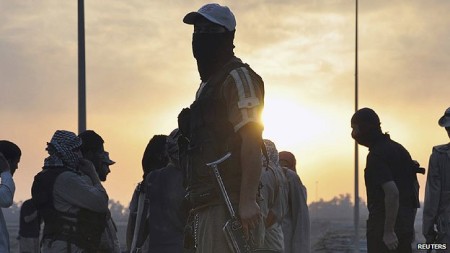
saudiborderIS fighters along the Saudi-Iraq border Source: International Business Times

The Saudis have detained over 150 IS fighters, facilitators and financiers over the past year. IS has already established a presence along the Iraq-Saudi border despite the ongoing project to erect a wall along the border. That presence enables them to send fighters and weapons across the border to and from the country at will, although Saudi military patrols have increased in recent months to interdict these smuggling operations. There are also elements of AQAP that have defected to the new IS-affiliate in Yemen, which suggests that the areas along the Southern border may be in play as well. Also keep in mind that Baghdadi specifically threatened Saudi Arabia in a NOV 14 video on “the next battlegrounds.” The current IS effort in Yemen, like their Iranian counterparts, appears to be connected to their operations in Saudi Arabia. We expect the threat to our fellow Americans and our country’s interests will continue to be threatened as the violence escalates on the Arabian Peninsula from IS, AQAP and the Iranian regime. We will continue to monitor develops in the country and update accordingly…

Saudi Arabia arrests first ISIS-related terror cell (this article has pics in it)
http://www.aawsat.net/2014/05/article55332025

Islamic State sets sights on Saudi Arabia
http://www.bbc.com/news/world-europe-30061109

ISIS gaining ground in Yemen, competing with al Qaeda
http://www.cnn.com/2015/01/21/politics/isis-gaining-ground-in-yemen/

Links to Other Related Articles:

Filipinos Among Arrested in Saudi Terror Sweep

Large-Scale Saudi Security Sweep Detains 88

Possible Cracks to The AQ Armor.

Iran’s advances create alarm in Saudi Arabia and the Gulf

March 14, 2015

Iran’s advances create alarm in Saudi Arabia and the Gulf, the Guardian,  March 13, 2015

Arabs believe Baghdad, Damascus, Beirut and Sana’a are in effect under Iranian control – and power may shift further if US sanctions are eased.

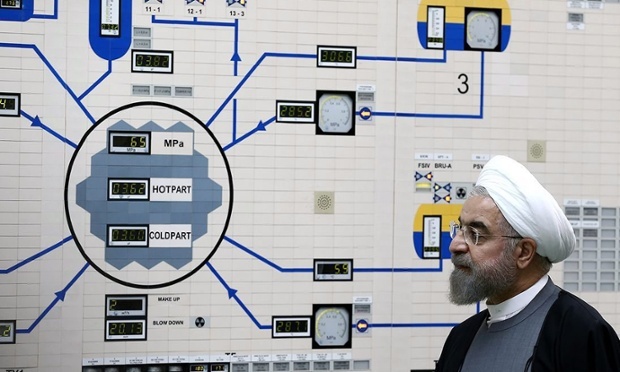
c0ac3569-93da-4ae8-8b51-29dc6991ee13-620x372 Hassan Rouhani, the Iranian president, visiting Bushehr nuclear power plant in southern Iran this year. Photograph: Presidential official handout/EPA

Iran’s great advantage, suggests Emile Hokayem, an analyst, is its commitment and competence, in Syria and beyond. “The expertise, experience and strategic patience it deployed in support of the Syrian regime to a great extent facilitated Assad’s recovery from serious setbacks in 2012. In contrast, the war in Syria has exposed not only the political and operational limitations of the Gulf states, but also the rivalries among them.”

*********************

The commanders of Iran’s Islamic Revolutionary Guard Corps (IRGC) have been working overtime recently, flaunting their achievements across the Middle East and flexing muscles as international negotiations over the country’s nuclear programme enter their critical and perhaps final phase.

On Wednesday it was the turn of Major-General Mohammad Ali Jafari, the IRGC’s most senior officer. “The Islamic revolution is advancing with good speed, its example being the ever-increasing export of the revolution,” he declared. “Not only Palestine and Lebanon acknowledge the influential role of the Islamic Republic but so do the people of Iraq and Syria. They appreciate the nation of Iran.”

Last month a similarly boastful message was delivered by General Qassem Suleimani, who leads the IRGC’s elite Quds force — and who is regularly photographed leading the fightback of Iraqi Shia miltias against the Sunni jihadis of the Islamic State (Isis) as well as against western and Arab-backed rebels fighting Bashar al-Assad in southern Syria. “Imperialists and Zionists have admitted defeat at the hands of the Islamic Republic and the resistance movement,” Suleimani said.

Iran’s advances are fuelling alarm in Saudi Arabia and the Gulf, where Tehran has been a strategic rival since the days of the Shah, and which now, it is said with dismay, in effect controls four Arab capitals – Baghdad, Damascus and Beirut and in the last month Sana’a in Yemen – which is uncomfortably close to home.

Iran’s regional position has certainly improved. Its high-profile role fighting Isis in Iraq, Assad’s retention of control in Syria with the help of its Lebanese ally Hezbollah, and the Houthi rebel takeover in Yemen have all been deeply discomfiting for the Saudis. Anti-government protests in Shia-majority Bahrain are also often blamed on Tehran — though that ignores the domestic roots of the unrest.

In Riyadh King Salman has dropped his preoccupation with the Muslim Brotherhood in favour of building a united Sunni Arab front to confront the Iranians, diplomats say, though translating that strategy into action is another matter. The message from Saudi Arabia and the United Arab Emirates is that whatever the outcome of the nuclear talks, Iran is bent on expanding its power and influence. “The Iranians have scored major victories but only where there are Shia minorities,” a senior Gulf official told the Guardian. “Our concern is that the nuclear issue will become a tool of their foreign policy.”

Arab alarm is shared by Israel. Binyamin Netanyahu used identical arguments in his recent speech to the US Congress, timed to influence next week’s nuclear endgame in Geneva. “The Saudis will be incredibly worried that we are getting close to a point where the Iranians will be players because of the nuclear issue and the way the Americans have effectively ended up on the same side as the Iranians in Iraq,” said one veteran Saudi-watcher. “But the noise they are making is in inverse proportion to their ability to do anything about it.”

Arab governments are not reassured by the promises of John Kerry, the US secretary of state, that Washington is not seeking a “grand bargain” with Tehran that will allow it to “destabilise” the Middle East, bolstered by the easing of economic sanctions. Saud Al Faisal, the Saudi foreign minister, warned of Tehran’s “hegemonic” ambitions as the IRGC supported the military operation to retake the Iraqi town of Tikrit from Isis. In Gulf capitals Hassan Rouhani, the emollient Iranian president, is seen as less important than the hardline supreme leader, Ayatollah Ali Khamenei.

It is hard to disentangle propaganda from reality. But independent analysts argue that Iran is inflating its gains for both foreign and domestic consumption. “If you listen to Suleimani there is a degree of exaggeration,” argues Ali Ansari of St Andrews University. “It’s rhetorical reassurance. He is saying to Iranians: ‘We are powerful and and everyone is worried about this’ – partly to make the point that they are not really under pressure. People outside can see what Iran’s strengths and weaknesses are. But there is this belief that you need to negotiate from a position of strength and that if you are weak you will be trampled on.”

Iran-watcher Hossein Rassam also detects a domestic calculation in the IRGC statements. “Critics of Rouhani’s policy of rapprochement with the international community inside Iran can turn to the supreme leader and say there wasn’t really much need for that softer tone because now we have more bargaining chips in our hands. Iran is the only power in the region which can actually fight Isis and the west needs us for that.”

Meir Litvak, an Israeli expert on Iran, sees both genuine belief and posturing in Tehran’s stance. “The Iranians believe they have been able to save the Assad regime from total collapse and there is at least stalemate in Syria,” he said. “That means they have been able to maintain the link with Hezbollah and maybe open a second front by proxy against Israel on the Golan Heights. The Houthi rebellion in Yemen was initially a genuinely domestic affair but the Iranian regime saw it as an opportunity. And it has become a bonus for it – even if they are not that active inYemen. But if the Saudis are scared that’s a plus for the Iranians.”

Arab diplomatic sources say they expect to see an IRGC and Hezbollah presence in Yemen, helped by a new agreement on regular flights between Tehran and Sana’a.

Iran’s role in Bahrain, where the Shia majority remains locked in confrontation with the Saudi-backed Sunni monarchy, is more about scoring propaganda points than material support – despite claims in Manama about Iran’s sinister role.

Still, in the heartlands of Iranian influence, Iraq and Syria, there have been significant costs as well as benefits, including the deaths of two senior IRGC commanders. Continuing sanctions and low oil prices – seen in Tehran as a deliberate strategy by the Saudis – have also made it harder to shell out billions of dollars to subsidise the Assad regime.

Iran’s great advantage, suggests Emile Hokayem, an analyst, is its commitment and competence, in Syria and beyond. “The expertise, experience and strategic patience it deployed in support of the Syrian regime to a great extent facilitated Assad’s recovery from serious setbacks in 2012. In contrast, the war in Syria has exposed not only the political and operational limitations of the Gulf states, but also the rivalries among them.”

Now the Saudis are developing a nuclear arsenal

March 12, 2015

Now the Saudis are developing a nuclear arsenal, Examiner, March 12, 2015

(????????????? — DM)

US nuke testThe “Baker” explosion, part of Operation Crossroads, a nuclear weapon test by the United States military at Bikini Atoll, Micronesia, on 25 July 1946.

Thus far, South Korea has been secure behind America’s nuclear arsenal. But, that country seems to have lost confidence with President Obama as well. It also might be disposed to share the technology with Japan, a country that has cast an anxious eye toward North Korea and China. In turn, the latter country will become very much alarmed.

************************

One of the terrible side effects of the impending Munich-style nuclear arms deal between President Obama and Iran is the possibility of a Middle East nuclear arms race. Hot Air reported on Thursday that the other shoe has dropped, and Saudi Arabia and South Korea has signed a nuclear agreement. The agreement suggests that the Saudis have concluded that there is no hope for President Obama preventing Iran from acquiring the Bomb. Therefore, the Kingdom is moving to acquire a native nuclear enrichment capacity in advance of building a nuclear arsenal.

By pretending that it is engaged in serious diplomacy with Iran, the Obama administration has managed to frighten the rest of the region to death. Israel is the only other country in the Middle East with a nuclear arsenal. Nearby Pakistan has the Bomb as well, but its nuclear weapons are geared toward countering its main enemy, India. The Saudis have concluded that it is time for an Arabic bomb to counter the impending Iranian bomb. Thus proliferation and the bone chilling possibility that a nuclear weapon might find its way into the hands of terrorists proceeds apace.

It gets worse. South Korea, besides an infusion of petrodollars, gets access to the nuclear technology it will build for its new desert customers. South Korea faces a country, North Korea, run by an insane man with its nuclear arsenal. Thus far, South Korea has been secure behind America’s nuclear arsenal. But, that country seems to have lost confidence with President Obama as well. It also might be disposed to share the technology with Japan, a country that has cast an anxious eye toward North Korea and China. In turn, the latter country will become very much alarmed.

So, the president, with his “smart diplomacy,” is about to create more nuclear powers across the world. Moreover, these countries will have, under the right circumstances, every incentive to use their nuclear arsenals. Who would have thought it possible?

It’s Not Just Islam, It’s the Tribal Mentality

March 12, 2015

It’s Not Just Islam, It’s the Tribal Mentality, Front Page Magazine, March 12, 2015

fft-450x253

Islam in part is the “theologizing” of the tribal mentality. Islam’s important innovation was to redefine the “tribe” as the whole umma of believers, creating in effect a “super tribe” that transcends mere blood as the bonding agent. But the tribal warrior ethos persists–– in the doctrine of jihad, tribal atrocities in contemporary terror and its gruesome videos, the privileging of men in polygamy, honor killings, and social restrictions on women, the disdain for the infidel “other” in the Koranic belief that Muslims are the “best of nations,” the betrayal of alliances in the religious sanction of lying to infidels (taqiyya), and the obsession with “honor” that today we find in violent Muslim reactions to “blasphemy” against Mohammed or the Koran.

Ignoring the tribal mentality is as dangerous for our foreign policy as downplaying Islamic doctrine.

The Obama administration’s serial appeasement of Iran––currently the “strongest tribe” spreading its influence throughout the region–– has damaged our prestige among allies like Jordan, Saudi Arabia, and Egypt, who are already shopping around for a more reliable and forceful partner. If we want to destroy the jihadists, check Iran’s nuclear ambitions, and protect our interests, we must again become the “strongest tribe.”

********************

The “nothing to do with Islam” mantra took a hit recently in one of the premier organs of liberal received wisdom, The Atlantic. Many have greeted as a revelation Graeme Wood’s article on the Islamic doctrines behind ISIS’s atrocities. Regular readers of FrontPage and Jihad Watch will not be as impressed. For years they have understood the link between jihadism and Islam. In 1994 Andy McCarthy made this connection when he prosecuted the perpetrators of the first World Trade Center bombing the previous year, a connection that the FBI ignored or discounted at the time––a failure, by the way, that has become a pernicious tradition for those charged with protecting our nation’s security and interests. For everyone else who has been paying attention to the rise of modern jihadism, Wood’s article is a dog bites man story.

One can hope that perhaps now, with the truth revealed by one of the Acela corridor’s oracles, the jihad deniers will wise up, though I wouldn’t bet on it. Unexamined opinions comprise the bulk of the progressive mind, and are notoriously resistant to empirical evidence and sound argument. But the current mess in the Middle East results from more than just Islam and its traditional belligerence, supremacist pretensions, and illiberal religious laws and doctrines. These characteristics reflect variations on the mentality of the tribe, one antithetical to modernity and the principles of liberal democracy, and still powerful in the Middle East, the region once described as “tribes with flags.”

For all the differences among tribal peoples, the components of this mentality are consistent, from the ancient Gauls and Germans Caesar conquered and the Vikings terrorizing much of Europe, to the American Indians the U.S. Cavalry fought and the jihadist gangs rampaging in the Middle East.

First, there is little notion of a common humanity that transcends ethnicity or culture. Universal principles are scarce, and personal identity is found solely in the collective customs and traditions of the tribe. Outsiders are to be distrusted, plundered, or conquered when possible. Loyalty is not to principle, but to blood. Most tribal peoples consider their tribe the acme of humanity, the only genuine humans. Hence their word for “human” is usually identical to the name of their tribe. They are literally ethnocentric.

Second, violence, particularly against outsiders, is an acceptable instrument for resolving conflict and asserting tribal superiority. Not just the violence of war, but also the cruel torture and slaughter of outsiders, including women and children, are legitimate for serving the interests of the tribe. Indeed, what we call terrorism was a tactic of tribal warfare to prevent a full-scale war by so terrorizing enemies that they would give up without a fight, a phenomenon common in the various Indian wars of American history. Hence the scary face-paint, tattoos, war cries, bizarre hairstyles, tortures like scalping, mutilation of enemies, or slaughter of their women and children, all of which are meant to frighten and demoralize the enemy. The same intent explains the blustering threats, braggadocio, and insults typical of tribal warfare and diplomacy. These practices can be documented in tribal societies from the Iroquois to the ancient Gauls.

Next, loyalty in tribal societies counts only for those within the tribe. Alliances with other tribes or peoples are ad hoc and contingent on the immediate interests of the tribe. They can be abandoned or betrayed if circumstances or perceptions change. Moreover, respect for others beyond the tribe is based solely on their capacity to inflict violence on their enemies. The “strongest tribe,” a status based on its effectiveness and success in conflict, will attract allies, who will abandon the hegemon once it loses that perception of its strength. Thus during Caesar’s wars in Gaul various Gallic and Germanic tribes would ally with the Romans when they appeared dominant, and betray them in an instant if they thought them weak. Likewise during the U.S. Cavalry’s wars against the Plains Indians, many tribes victimized by the Sioux or Apache or Cheyenne would ally with the Americans if they seemed to be winning, then switch sides the moment they seemed weak.

Finally, tribal societies are centered on the male warrior and his honor. Forget the Women’s Studies fantasies of matriarchal tribal societies. Tribal cultures privilege males, for men fight, and the survival and honor of the tribe depends on martial valor. Women bear children and work, as the skeletons of pre-contact American Indian remains demonstrate. Female bones show much more damage from hard physical labor than do male. This doesn’t mean that women had no status within the tribe, or did not enjoy somewhat more equality than women in more sophisticated civilizations. But warrior males still dominated, and culture in the main centered on men and their prowess in war, which earned honor, what we call prestige, for the whole tribe.

Sound familiar? It should, for Islam in part is the “theologizing” of the tribal mentality. Islam’s important innovation was to redefine the “tribe” as the whole umma of believers, creating in effect a “super tribe” that transcends mere blood as the bonding agent. But the tribal warrior ethos persists–– in the doctrine of jihad, tribal atrocities in contemporary terror and its gruesome videos, the privileging of men in polygamy, honor killings, and social restrictions on women, the disdain for the infidel “other” in the Koranic belief that Muslims are the “best of nations,” the betrayal of alliances in the religious sanction of lying to infidels (taqiyya), and the obsession with “honor” that today we find in violent Muslim reactions to “blasphemy” against Mohammed or the Koran.

Ignoring the tribal mentality is as dangerous for our foreign policy as downplaying Islamic doctrine. The chronic disorder in northern Iraq today is not just about the Sunni-Shi’a divide, or ISIS’s dream of a caliphate. It also reflects the bewildering number of tribes and clans in the region, whose complex alliances and enmities continually shift depending on circumstances and the perceptions of which tribe is the stronger. Our ally today can instantly become our enemy tomorrow. Factions that appear “moderate” today can become jihadist terrorists tomorrow. Our “friends” will tell us what we want to hear today, and then betray their words tomorrow. Most important, anything we do that creates the perception of weakness––especially concessions, or failure to inflict revenge, or acts of mercy––will also damage our prestige as the “strongest tribe” and invite tribes to abandon us.

These tribal practices defined most peoples, including Europeans, before the advent of modernity. They have survived among Middle Eastern Muslims because they were encoded in religious doctrines that promise global power for the tribe of the faithful in this life, and paradise in the next, especially for jihadist warriors. This amalgamation in part explains the spectacular success of Muslim warriors for a 1000 years, a record of martial achievement the memory of which today fuels the resentment and anger of those Muslims who wish to restore that lost honor. It also contributes to the difficulty of many Muslim societies to reconcile with modernity, particularly liberal democracy and its cargo of human rights, confessional tolerance, and equality for women and those of other faiths.

Of course, worldwide millions of Muslims have managed to transcend tribalism and adjust their faith to modernity. But millions more haven’t, and it is they who are fomenting most of the mayhem and murder on every continent except Antarctica. Our tactics and strategies in confronting this threat must indeed be based on a correct understanding of the spiritual imperatives that motivate the jihadists. But they also must take into account the tribal mentalities that respect force and honor the strong.

The Obama administration’s serial appeasement of Iran––currently the “strongest tribe” spreading its influence throughout the region–– has damaged our prestige among allies like Jordan, Saudi Arabia, and Egypt, who are already shopping around for a more reliable and forceful partner. If we want to destroy the jihadists, check Iran’s nuclear ambitions, and protect our interests, we must again become the “strongest tribe.”

Hero of the Middle East: Abdel Fattah el-Sisi

February 23, 2015

Hero of the Middle East: Abdel Fattah el-Sisi, The Gatestone InstituteBassam Tawil, February 23, 2015

(Please see also Obama kept reform Muslims out of summit on extremism. — DM)

The courageous, historic speech yesterday by the Grand Imam of al-Azhar University, the seat of Sunni Islam, calling for the reform of Islam, was the result of the even more courageous, historic speech delivered a few weeks ago by Egypt’s devoutly Muslim President, Abdel Fattah El-Sisi.

The Muslim Brotherhood, the current American administration’s great friend, is the poison tree whose fruit is the Islamist terrorism embodied by the ISIS, Al-Qaeda, Hamas, Palestinian Islamic Jihad, Al-Nusra Front, Boko Haram and others.

Apparently some of the Sunni Arab States have not yet realized that their own national security, and ability to withstand Iran, depend on how strong Egypt is.

It is possible, in fact, that U.S. policy is to weaken the Sunni world seeking to unite under el-Sisi’s flag of modernity. With European complicity, the U.S. Administration is trying to defraud the Arabs and turn the Israel-Palestine conflict into a center of Middle Eastern chaos, in order to hide the nuclear deal they are concocting with Iran.

The treachery of the U.S. Administration is the reason why Egypt’s faith in the United States, which is supposed to defend the Arabs against a nuclear Iran, has effectively evaporated.

And now the greatest American insanity of all time: America and Turkey are arming and training Islamist terrorist operatives in Turkey, on the ground that they are “moderates” opposed to Bashar Assad’s regime in Syria. They either ignore or are unaware that there is no such thing as a moderate Islamist terrorist. The other name of the “moderates” opposing Assad is ISIS.

The Muslim Brotherhood, in effect, runs Turkey. According to recent rumors, Turkey is also planning to build a nuclear reactor, “for research and peaceful purposes.”

Sheikh Dr. Ahmed al-Tayyeb, the Grand Imam of Cairo’s Al-Azhar University, the seat of Sunni Islam, yesterday delivered a courageous, historic speech in Mecca, Saudi Arabia, urging reform in religious education to curb extremism in Islam. Al-Tayyeb’s address was the result of an even more courageous and historic speech, delivered a few weeks ago by Egypt’s devoutly Muslim President, Abdel Fattah el-Sisi, at Al-Azhar University.

El-Sisi’s monumental statement, truly worthy of a Nobel Prize, is having a seismic result. Al-Sisi directed his remarks, about the ills of Islam to Islamic clerics in Egypt and around the world. It was enormously brave of him. He did not single out radical Islam, but he did call on all Muslims to examine themselves, carry out a religious revolution and renew their faith.

El-Sisi, a man of monumental courage, urged Muslims not to behave according to the ancient, destructive interpretations of the Qur’an and Islam that make the rest of the world hate them, destroy Islam’s reputation and put Muslim immigrants to Western countries in the position of having to fight their hosts. He claimed that it is illogical for over a billion Muslims to aspire to conquer and subdue six billion non-Muslims.

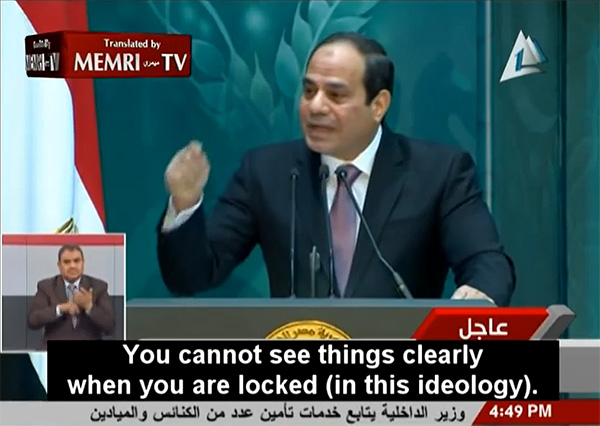
949 (1)Egypt’s President, Abdel Fattah el-Sisi, delivered a historic speech to top Islamic scholars and clergy at Al-Azhar University in Cairo, December 28, 2014. (Image source: MEMRI)

Islam deals in depth with uniting the Muslim nation (umma) and mutual responsibility among Muslims, as though they were one entity. The Prophet Muhammad (S.A.A.W.) said that every drop of Muslim blood is more precious than the entire Kaaba. Thus the liberty ISIS took upon itself to burn alive a Jordanian pilot and 45 Egyptians, to spread terrorism throughout Syria, Iraq and Egypt and to kill other Muslims in various locations around the globe, claiming they were “infidels,” is heresy in and of itself.

The calls for the deaths of “a million shaheeds” and the killing of Jews for the sake of Al-Aqsa mosque in Jerusalem, as was done by Arafat in the past, and is being done now by his heirs in the Palestinian Authority and Hamas, are a crime; they are extremist incitement that is opposed to the forgiving and compromising spirit of Islam. The murder and terrorism carried out by terrorist organizations such as ISIS, Hamas, Palestinian Islamic Jihad [PIJ] and other Islamist organizations against Jews, Christians and other non-Muslims is contrary to the modern Islam needed in the contemporary era.

El-Sisi was correct that the Muslim Brotherhood’s Sunni ideology, which drives most of the extremist Islamist organizations around the world, preaches forced conversion of “infidels” to Islam at any price, or death. Some of the “infidels” are supposed to join Islam of their own accord(targ’ib), out of self-serving interest, and some not of their own accord (tarhib), out of fear and death threats. Such conversions are also contrary to the original Islam, which states that no one is to be forced to convert to Islam and that a calm religious dialogue should be held.

However, a few days after President el-Sisi’s speech, which attempted to unify Muslims and Christian Copts, the Muslim Brotherhood and their affiliated terrorist organizations increased their attacks on Egyptian civilians and security forces throughout Egypt and the Sinai Peninsula, as well as murdering 21 Egyptian Christian Copts in Libya. The Muslim Brotherhood knows that behind the scenes, U.S. President Obama supports the movement, especially the branch in Egypt seeking to overthrow President Sisi. This approval from the U.S. encourages the Muslim Brotherhood to be even more determined to subvert and undermine Egypt’s stability, sabotage its economic rehabilitation and destroy the el-Sisi regime.

In this atmosphere of American support, the Ansar Bayt al-Maqdis terrorist group in the Sinai Peninsula operates under Muslim Brotherhood protection. It recently changed its name to the “Sinai Province” of the Islamic State and swore allegiance to the “Caliph,” Abu Bakr al-Baghdadi. It is currently working hand-in-hand with Hamas in the Gaza Strip to weaken el-Sisi’s Egyptian forces in the Sinai Peninsula.

Other Islamist terrorist organizations also kill Egyptian civilians and security forces with bombs and assault rifles. In the name of the Muslim Brotherhood’s ideology, they indiscriminately attack people on public transport, in airports and in public places, with the intent of retaking control of Egypt.

For this reason, an Egyptian court recently designated Hamas a terrorist organization, along with its military wing, the Izz al-Din al-Qassam Brigades, and outlawed both of them. In response, Qatar, a slippery agent in the service of America but also, treacherously, in the service of Iran, allowed armed Izz al-Din al-Qassam Brigades operatives to be interviewed by its Al-Jazeera TV. The operatives called the Egyptian president a traitor to the Islamic-Arab cause and to those seeking to “liberate Palestine.”

At the same time, Qatar continues to use its Al-Jazeera TV to broadcast hate propaganda targeting the el-Sisi regime, to disseminate videos and to fabricate insulting quotes intended to cause friction between el-Sisi on one side and the leaders of the Arab world and the Gulf States on the other — and to keep them from giving hungry Egyptians economic aid.

As the date for the economic conference in Sharm el-Sheikh (in the Sinai Peninsula) nears, Al-Jazeera’s propaganda machine has moved into ever-higher gear. Apparently, some of the Sunni Arabs states have not yet realized that their own national security and ability to withstand Iran depend on how strong Egypt is.

The U.S. Administration could easily halt the subversion of Egypt, but not only does it turn a blind eye, it suffers from a peculiar form of ignorance that makes it fight ISIS while at the same time supporting the Muslim Brotherhood, the hothouse of most Islamic terrorist organizations, including ISIS. The damage done to Egypt and the cracks in the weak Sunni Muslim ranks in the Middle East will eventually harm American interests and expose the Gulf States to the increasing Iranian threat.

The Muslim Brotherhood, the current American administration’s great friend, is the poison tree whose fruit is the Islamist terrorism embodied by ISIS, Al-Qaeda, Hamas, Palestinian Islamic Jihad, Al-Nusra Front, Boko Haram and others. This linkage has become obvious to all the Arab states, while the U.S. and Europe steadfastly ignore the danger to their own survival, and refuse to outlaw them.

It is possible, in fact, that U.S. policy is to weaken the Sunni world that is seeking to unite under el-Sisi’s flag of modernity. With European complicity, the U.S. Administration is trying to defraud the Arabs and turn the Israeli-Palestinian conflict into a center of Middle Eastern chaos, in order to hide the nuclear deal they are concocting with Iran. That is why the West does not really want to rehabilitate the Palestinian refugees by settling them in the Arab states, and why the West continues to nourish false Palestinian hopes that perpetuate this conflict.

The treachery of the U.S. Administration is the reason why Egyptians’ faith in America, which is supposed to defend the Arabs against a nuclear Iran, has effectively evaporated.

In the meantime, Iran’s Houthi proxies have taken over Yemen, threatening the entire Persian Gulf from the south. The el-Sisi regime is currently in the market for new allies, such as Russian President Vladimir Putin. Putin recently paid a visit to Egypt to examine the possibilities of building a nuclear reactor, sounding the first chord of a regional nuclear arms race.

The problems of the Middle East begin in the United States: that was the claim of participants in the Al-Jazeera TV show, “From Washington.” They described American policy towards Egypt as hesitant, indecisive and undemocratic. They claimed that the U.S. Administration had not yet decided whether or not to support el-Sisi, who heralded change and the willingness to fight radical Islam (a fight America used to participate in) or to remain neutral and waffle, in view of Egypt’s presumed instability. The Americans seem to be putting their all money on the extreme Islamists, who they seem to think will eventually win the bloody conflict currently being waged in Egypt.

The Americans have forgotten that under Mubarak, the regime turned a blind eye to attacks against Israel that were carried out by the Muslim Brotherhood and their carefully fostered agents. Unfortunately, since el-Sisi was elected, Egypt itself has become a victim of radical Islamic terrorism. The U.S. Administration, however, appears clearly to hate el-Sisi, and seems to be doing its utmost to undermine him and see him thrown out.

Under ousted President Mohamed Morsi, Egypt was tolerant and patient toward the U.S. Administration’s best friends, the Muslim Brotherhood, as well as Islamist and Palestinian terrorist organizations such as Hamas, Ansar Bayt al-Maqdis, Al-Qaeda, and Palestinian Islamic Jihad, all of which set up camp in the Sinai Peninsula. These terrorist groups smuggled weapons in from Iran, Sudan, Libya and Lebanon; dug smuggling and attack tunnels; developed missiles and carried out terrorist attacks “only” against Israel, the current U.S. Administration’s other apparent enemy, even though so many American Jews foolishly voted for them.

Now those same Islamist and Palestinian terrorist organizations are striking a mortal blow to the security or Egypt, and killing its civilians and security personnel.

The Muslim Brotherhood, mindful of America’s pro-Islamist policy toward it, is deliberately indulging in a wave of terrorism in Egypt and the Sinai Peninsula. Muslim Brotherhood operatives there are targeting civilians, public transport, airports and natural gas pipelines, all to undermine Egypt’s internal security and bring down el-Sisi’s regime in favor of extremist Islamists and a nuclear-threshold Iran.

In the current international situation, the U.S. Administration has apparently finally cut a deal with Turkey — which will be flimsy and ethereal — that allows Turkey to do the only thing it really cares about: to bring down the regime of Syria’s President, Bashar al-Assad.

The U.S. is also trying to cut a deal with Qatar, which along with Turkey openly supports the Muslim Brotherhood and its terrorist proxies in Egypt, Gaza, Syria and Iraq, who in general work against Western interests.

The ironic result is that Turkey plays host to both NATO and senior Hamas figures, while it deliberately ignores the slaughter by ISIS of Kurds and other ethnic minorities in Iraq and Syria. The Muslim Brotherhood, in effect, actually rules Turkey. Turkey’s President Recep Tayyip Erdogan and his AKP party make it easy for foreign fighters to cross the Turkish border into Syria and join the ranks of ISIS. Meanwhile, the Turkish government wages a diversionary propaganda war against Israel. According to recent rumors, Turkey is also planning to build a nuclear reactor, “for research and peaceful purposes.”

Another surreal result is that Qatar hosts the U.S. military bases, while it finances and encourages terrorist organizations operating against Israel and the Egypt. It also panders to Sheikh Yusuf al-Qaradawi, the spiritual mentor of the Muslim Brotherhood, an Islamist terrorist who issues fatwas permitting the murder of civilians and approves death sentences for apostasy.

And now the greatest American insanity of all time: the U.S. and Turkey are arming and training Islamist terrorist operatives in Turkey, on the grounds that they are “moderates” opposed to Bashar Assad’s regime in Syria. They either ignore or are not aware that there is no such thing as a moderate Islamist terrorist.

The other name of the “moderates” opposing Bashar Assad is ISIS; Iran’s Supreme Leader, Ali Khamenei and Hezbollah’s Hassan Nasrallah are now even saying that the U.S. is arming ISIS.

In the meantime, the Egyptian army continues its struggle against Islamist terrorist targets in the Sinai Peninsula and Libya, unaided, and even undermined, by the U.S.

In view of the U.S. Administration’s collaboration with the Muslim Brotherhood and terrorist organizations in the Gaza Strip, I am persuaded that in the near future it will be possible to find a joint Egyptian-Israeli-Palestinian formula for eradicating the Hamas-PIJ enclave of terrorism, this time by Arabs.

Most ironically of all, in the shadow of American zigzagging, a joint Arab-Israeli front is developing against Sunni and Shi’ite radicalism, and the Palestinians can only profit from it. Thus el-Sisi, who, with towering vision and courage, dares to speak openly about the poison tree of radical Islam and its fruit, when others are afraid, is a truly great Islamic hero.

Airborne Girl’s Guide to Islam & Its Abuse of Women

February 18, 2015

Airborne Girl’s Guide to Islam & Its Abuse of Women, Blackfive, February 18, 2015

Right in time for President Obama’s extremist-riddled Countering Violent Extremism Summit comes an honest report on the horrific treatment of women in Islamic states. It starts with the abuse she suffered personally at the hands, and gun barrels, of our supposed allies the Saudis during the First Gulf War. But the real issue is the infiltration of this oppressive and backwards culture into free western society. For every “strong” woman telling the press how wearing a veil empowers her, there are dozens in the shadows being beaten, forced into arranged marriages and dying in “honor” killings.


Qatar, Egypt on a collision course

February 9, 2015

Qatar, Egypt on a collision course, Israel Hayom, Dr. Reuven Berko, February 9, 2015

This anti-Egypt agenda, which seems to be shared by Turkey, is fueled by the desire to realize the dream of installing a Sunni Islamic empire, all while undermining moderate Arab regimes and giving a nod to Iran, as a way of covering all bases — just in case.

******************

Qatar and Egypt are at odds, and the attempts by the late King Abdullah of Saudi Arabia to facilitate a reconciliation between them have failed.

Qatar’s relentless efforts to overthrow Egyptian President Abdel-Fattah el-Sissi’s regime and reinstate the Muslim Brotherhood to power are evident from the programs airing on the Doha-controlled Al-Jazeera television network, and from the publication of doctored wiretaps featuring the Egyptian president and his advisers, who allegedly “stole” Egypt away from the Muslim Brotherhood and the “holy” Mohammed Morsi.

This anti-Egypt agenda, which seems to be shared by Turkey, is fueled by the desire to realize the dream of installing a Sunni Islamic empire, all while undermining moderate Arab regimes and giving a nod to Iran, as a way of covering all bases — just in case.

Egypt’s decision to outlaw the Muslim Brotherhood has resulted in increased incitement by Qatar as well as in an escalation in terrorist attacks in Egypt and Sinai. Egyptian intelligence has linked the latest series of attacks to Ansar Beit al-Maqdis, an offshoot of the Islamic State group, as well as to Hamas’ Izzedine al-Qassam Brigades. Hamas and the Izzedine al-Qassam Brigades are very much Qatar’s “babies,” and their involvement in these terrorist attacks has prompted Egypt to outlaw both.

In response, Al-Jazeera has begun portraying Izzedine al-Qassam Brigades’ operatives, who have denounced Sissi as a traitor to Islam and Arabs everywhere, as heroes fighting for the liberation of “Palestine.” The Qatari television station has also been obsessively covering the riots and unrest instigated by the Muslim Brotherhood to undermine the regime, intimidate foreign investors, and reverse the image of stability Sissi’s government is trying to convey to the world.

The airing of secret wiretaps, on which Sissi is heard mocking the wealthy Persian Gulf states, at this time seeks to pit Cairo against the Gulf states, ahead of the World Economic Forum on the Middle East, which is scheduled to convene in Sharm el-Sheikh, in Egypt, in late February, and where Egypt will lobby for aid.

Sissi’s assertion about the current situation in the Middle East is correct: Sunni Arab states are being offered as sacrifice to Iran, which is pursuing its nuclear endeavors uninterrupted. These states understand that Egypt’s stability is a prerequisite for their own national security, and therefore aiding Cairo is a favor that could only work to their advantage.

At the end of the day, in a reality where Iran poses an existential threat to other Arab countries, pointing to the emir of Qatar as a leader drowning in gold while millions of Egyptians go hungry — as heard on the wiretaps — may prove to be a double-edged sword, which may end up striking Qatar itself.

US-Saudi summit in Riyadh to deal with pivotal issues of oil prices, Iran and Yemen

January 24, 2015

US-Saudi summit in Riyadh to deal with pivotal issues of oil prices, Iran and Yemen, DEBKAfile, January 24, 2015

He will want to clear the air most urgently on three controversial items of burning interest to both leaders: Riyadh’s flat opposition to the multilateral nuclear deal with Iran and skepticism in the face of Obama’s conviction that a comprehensive accord will curtail the Islamic Republic’s drive for a nuclear weapon.

(Only if King Salman is truly demented would he agree with Obama on Iran and oil prices. Increases in Saudi oil production have hurt Iran while Obama’s Iran scam and relief from sanctions continue to help it. — DM)

Obama_King_Salman_bin_Abdulaziz__27.1.15Past meeting between President Barack Obama and King Salman, then Crown Prince

President Barack Obama, having decided to cut short the third day of his India visit, will arrive in Riyadh Tuesday, Jan. 27 with the First Lady, to offer US condolences on the death of King Abdullah and hold critical talks with his successor, King Salman Bin Abdulaziz.

He will want to clear the air most urgently on three controversial items of burning interest to both leaders: Riyadh’s flat opposition to the multilateral nuclear deal with Iran and skepticism in the face of Obama’s conviction that a comprehensive accord will curtail the Islamic Republic’s drive for a nuclear weapon.

Next, the US leader will try and persuade the new Saudi ruler to slow down oil production in order to put the brakes on plunging prices, an example which other OPEC members are sure to follow.

Finally, Obama and Salman must decide how to handle the fall of Yemen into the hands of Shiite Houthi rebels, who have seized the capital Sanaa with Iranian support and brought down the US-Saudi-sponsored president Abed Rabbo Mansour Hadi.

Two secondary issues will be the struggle against the Islamic State of Iraq and the Levant in the oil kingdom’s back yard, in which the US and Saudi Arabia are coalition partners; and the situation in the Syrian conflict.

Since this is an outsize agenda for one meeting, DEBKAfile’s sources in Washington and the Gulf expect Obama to focus in his initial encounter with Salman on the broad lines of the nuclear Iran dispute and oil prices. Detailed discussions on these and other issues will be set aside for US and Saudi officials of lower rank to hammer out in the coming weeks, as the new king begins to take hold of the reins of government.

A number of Middle East leaders will be following the outcome of this Riyadh summit with bated breath. Many are worried that Obama may persuade the new monarch to play ball with his Middle East policies, so effecting a radical reversal of the late Abdullah’s stance of flat opposition to Obama’s tactics in the region, aside from isolated cases.

A decision by Salman to accept America’s lead on the Iranian nuclear question and oil prices would be a serious blow for the anti-US Arab front, spearheaded hitherto by Saudi Arabia, Egypt and some of the Gulf emirates. It would also be a setback for Israeli Prime Minister Binyamin Netanyahu’s fight against Obama’s nuclear diplomacy for Iran. This policy was underpinned by the Saudi-Egyptian political and military partnership that aimed at stalling the deal crafted by Washington, which purported to lay to rest the nuclear controversy with Iran.