Posted tagged ‘Saudi Arabia and Iran’

Naming Bin Salman Saudi heir impacts US, Israel

June 21, 2017

Naming Bin Salman Saudi heir impacts US, Israel, DEBKAfile, June 21, 2017

US President Trump is taking the lead role along with Prince Mohammed bin Salman of Saudi Arabia, Sheikh Mohammad bin Zayed Al Nahyan of the United Arab Emirates, another crown prince, Egypt’s President Abdul-Fatteh El-Sisi, and Israel’s Prime Minister Binyamin Netanyahu.

******************************

The Saudi king’s decision to elevate his son Prince Mohammed bin Salman, 31, to crown prince and heir to the throne, in place of his cousin Mohammed bin Nayef – as part of a broad reshuffle, is not merely the internal affair of the royal hierarchy, but a game-changing international event.

DEBKAfile’s analysts see it as the outcome of a global and regional process initiated by Donald Trump soon after he settled in the White House in January. With his appointment as de facto ruler of the oil kingdom, the Saudi king’s son is ready to step into his allotted place in a new US-Arab-Israeli alliance that will seek to dominate Middle East affairs. Israel will be accepted in a regional lineup for the first time alongside the strongest Sunni Arab nations who all share similar objectives, especially the aim to stop Iran.

Trump’s trip to Riyadh and Jerusalem in early May laid the cornerstone for the new US-Sunni Arab bloc versus Iran’s Shiite grouping and also cemented Israel’s co-option.

This bloc is in its infancy and has yet to display staying power and prove the wisdom of its policies. But its contours have taken shape. US President Trump is taking the lead role along with Prince Mohammed bin Salman of Saudi Arabia, Sheikh Mohammad bin Zayed Al Nahyan of the United Arab Emirates, another crown prince, Egypt’s President Abdul-Fatteh El-Sisi, and Israel’s Prime Minister Binyamin Netanyahu.

Three of those leaders already maintain strong direct – albeit discreet – ties with Israel’s prime minister, its security establishment, military and various intelligence agencies.

In a lecture on Tuesday, June 20, Israel’s chief of staff, Lt. Gen. Gady Eisenkott, spoke of the covert relations between the IDF and certain Arab nations, which he did not name. There is clearly a lot going on under the surface in various political, economic, financial, intelligence and military fields.

Recent events in the region already point to President Trump acting on important matters, such as the confrontation with Iran, the war on terror, the Syrian conflict and US intervention in the Yemen conflict, on the advice of the two Arab crown princes rather than Defense Secretary James Mattis and Secretary of State Rex Tillerson.

This was strikingly demonstrated when Trump overrode Tillerson’s recommendation to apply diplomacy for resolving the dispute that led to four Arab nations boycotting Qatar, with the Saudis in the lead, whereas the president then demanded strong action to stop Qatar’s funding of terrorists. He therefore opted for the aggressive Saudi and UAE stance against Qatar’s ruler, Sheikh Tamim bin Hamad Al Thani.

These developments bear strongly on US-Russian relations. The two crown princes maintain active ties with President Vladimir Putin. They could, of course, act as go-betweens for smoothing relations between the White House and the Kremlin. But, on the other hand, their influence could be counter-productive and goad Trump into engaging the Russians in a limited confrontation in Syria. It is hard to see Washington and Moscow coming to terms in Syria at this point when the former is closely allied to Saudi Arabia and the UAE and Moscow maintains its loyalty to Tehran.

The evolving bonds between the US, Saudi Arabia, the UAE, Egypt and Israel are the source of President Trump’s optimism about the prospects of pulling off an Israeli-Palestinian peace accord, a vision which eluded all his predecessors in the White House, while knocking over the decades-old barriers between the moderate Arab nations and the Jewish State.

The first steps towards this goal are in the making. They will include exposing parts of their hidden interaction to the light of day, as well as such important symbolic actions, as opening Arab skies to the passage of Israeli commercial flights, or direct telephone links.

None of this is expected to transpire overnight but rather over years, especially since there is opposition to the process still to overcome in the Arab world, including Saudi Arabia, and also in the United States. Critics lay into Mohammed bin Salman, who has made his mark as a visionary social and economic reformer at home, as too young, brash and impatient to rule the kingdom. His decision to entangle Saudi Arabia in the Yemen war, which many believe it cannot win, is held up as evidence of his reckless nature.

But the process switched on by Trump in Riyadh took a large stride forward on June 21, with the formalization by King Salman of his young son’s role as the top mover and shaker in the Saudi kingdom. King Salman obtained the support of 31 out of 34 members of Saudi Arabia’s Allegiance Council for confirming Prince Muhammad Bin Salman as crown prince as well as deputy prime minister and minister of defense.
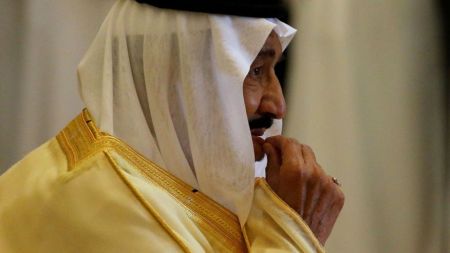
Saudi king upends royal succession, names son as 1st heir

June 21, 2017

Saudi king upends royal succession, names son as 1st heir, Fox News, Associated Press, June 21, 2017

(Please see also, IRGC Commanders: Our Main Aim Is Global Islamic Rule. Perhaps the IRGC statement of intentions was among the king’s reasons for making bin Salman the new crown prince. — DM)

Saudi Arabia’s King Salman bin Abdulaziz Al Saud waits to greet President Trump in Riyadh (REUTERS)

In remarks aired on Saudi TV in May, Mohammed bin Salman framed the tensions with Iran in sectarian terms, saying it is Iran’s goal “to control the Islamic world” and to spread its Shiite doctrine. He also vowed to take “the battle” to Iran.

***************************

Saudi Arabia’s King Salman on Wednesday appointed his 31-year-old son Mohammed bin Salman as crown prince, placing him first-in-line to the throne and removing the country’s counterterrorism czar and a figure well-known to Washington from the line of succession.

In a series of royal decrees carried on the state-run Saudi Press Agency, the monarch stripped Prince Mohammed bin Nayef from his title as crown prince and from his powerful position as the country’s interior minister overseeing security.

The all-but-certain takeover of the throne by Mohammed bin Salman awards near absolute powers to a prince who has ruled out dialogue with rival Iran, has moved to isolate neighboring Qatar for its support of Islamist groups and who has led a devastating war in Yemen that has killed thousands of civilians.

The prince already oversees a vast portfolio as defense minister. He has become popular among some of Saudi Arabia’s majority young population for pushing reforms that have opened the deeply conservative country to entertainment and greater foreign investment as part of an effort to overhaul the economy.

He had previously been second-in-line to the throne as deputy crown prince, though royal watchers had long suspected his rise to power under his father’s reign might accelerate his ascension.

The young prince was little known to Saudis and outsiders before Salman became king in January 2015. He had previously been in charge of his father’s royal court when Salman was the crown prince.

The Saudi monarch, who holds near absolute powers, quickly awarded his son expansive powers to the surprise of many within the royal family who are more senior and more experienced than Mohammed bin Salman, also known by his initials MBS.

Meanwhile, Prince Abdulaziz bin Saud, 33, was named the new interior minister tasked with counterterrorism efforts and domestic security. His father is the governor of Saudi Arabia’s vast Eastern Province, home to much of the country’s oil wealth and most of its minority Shiites. The prince is also Mohammed bin Nayef’s nephew, and previously served as an adviser to the interior and defense ministries.

The royal decree issued Wednesday stated that “a majority” of senior royal members from the so-called Allegiance Council support the recasting of the line of succession. However, that vote of support appears to have been from a past gathering of the council two years ago when Mohammed bin Salman was named second-in-line to the throne, and Mohammed bin Nayef was named the king’s successor.

The Allegiance Council is a body made up of the sons and prominent grandsons of the founder of the Saudi state, the late King Abdul-Aziz, who vote to pick the king and crown prince from among themselves. The council does not appear to have met again before Wednesday’s sudden change.

Over the weekend, the king had issued a decree restructuring Saudi Arabia’s system for prosecutions that stripped Mohammed bin Nayef of longstanding powers overseeing criminal investigations, and instead ordered that a newly-named Office of Public Prosecution and prosecutor report directly to the monarch.

The prince had appeared to be slipping from public eye and was not believed to have played a significant role in Saudi and Emirati-led efforts to isolate Qatar for its support of Islamist groups and ties with Iran.

Instead, it was his nephew, Mohammed bin Salman, who embarked on major overseas visits, including a trip to the White House to meet President Donald Trump in March. That visit to Washington helped lay the foundation for Trump’s visit to Saudi Arabia in May, which marked the president’s first overseas visit and which was promoted heavily by the kingdom as proof of its weight in the region and wider Muslim world.

Saudi-U.S. relations had cooled under the Obama administration after Washington pursued a nuclear accord with Shiite-majority Iran that the Sunni-ruled kingdom strongly opposed.

The warm ties forged between Riyadh and Washington under the Trump administration may have helped accelerate Mohammed bin Salman’s ascension as crown prince.

Despite his ambitions, which include overhauling the economy to make it less reliant on oil, the prince has faced failures and criticism for the Saudi-led war in Yemen, which he oversees as defense minister.

The war, launched more than two years ago, has failed to dislodge Iranian-allied rebels known as Houthis from the capital, Sanaa, and has had devastating effects on the impoverished country. Rights groups say Saudi forces have killed scores of civilians and have called on the U.S., as well as the U.K. and France, to halt the sale of weapons to Saudi Arabia that could be used in the Yemen war.

The U.S. already is helping the Saudis with intelligence and logistical support for the bombing campaign in Yemen, and the Trump administration has signaled it could assist with greater intelligence support to counter Iranian influence there.

The newly-minted crown prince also raised eyebrows when he ruled out any chance of dialogue with Iran. In remarks aired on Saudi TV in May, Mohammed bin Salman framed the tensions with Iran in sectarian terms, saying it is Iran’s goal “to control the Islamic world” and to spread its Shiite doctrine. He also vowed to take “the battle” to Iran.

Iran and Saudi Arabia’s rivalry has played out in proxy wars across the region. They back opposite sides in the wars in Syria and Yemen and they support political rivals in Lebanon, Bahrain and Iraq. The conflicts have deepened Sunni-Shiite enmity between hard-liners on both sides.

Lapid’s cynical Saudi blunder

May 30, 2017

Lapid’s cynical Saudi blunder, Israel Hayom, Jonathan S. Tobin, May 30, 2017

The point of the transaction is an attempt to preserve the Saudi monarchy from falling victim to radical foes. More importantly, it’s intended to bolster Riyadh against the main threat to both Sunni Arab regimes and Israel: Iran.

That the man who is seen as a serious candidate for prime minister is oblivious to the imperative for Israel to make common cause with the Saudis against an Iranian foe committed to the destruction of both countries is a shocking indictment of Lapid’s strategic vision. Lapid is trying to divide Israel and the United States at a time when former President Barack Obama’s efforts to increase the “daylight” between the countries is being reversed.

The last thing Israel needs right now is to push away Sunni Arabs who have finally realized that the Jewish state is an asset to the region rather than a threat or to pick a fight with Trump.

********************

It’s hard to beat a man by agreeing with him. That’s why Prime Minister Benjamin Netanyahu’s most credible foe is struggling to find a way to distinguish his own views from those of the man he wishes to replace. Polls show that Yesh Atid Chairman Yair Lapid is the man Netanyahu needs to watch out for in the next election. But after proclaiming earlier this year that a two-state solution must wait another 20 years for the Palestinians to show that they want peace, it’s hard to see how Lapid can possibly gain an edge over the prime minister on the most important issue facing the Jewish state.

That’s why Lapid is attempting to make an issue of Netanyahu’s apparent acceptance of a massive $110 billion arms deal concluded between Saudi Arabia and the Trump administration, without so much as a whisper of protest. In a recent interview, Lapid noted that the entire Israeli security establishment was deeply concerned about the transaction, which will place a wide array of sophisticated weaponry in Saudi hands. In doing so, Lapid is not just trying to goad Netanyahu into a suicidal spat with Trump but also demonstrating how ignorant he is of American Jewish history.

Lapid’s broadside aims to imply that the prime minister is so afraid of U.S. President Donald Trump and so dependent on his good will that he won’t speak up for Israel’s interests. But his main point of concern is that giving such weapon systems to Saudis means they are “one inch away” from falling in the hands of Sunni terrorists.

Perhaps Lapid will get some traction with the charge but for anyone who’s been following the news in the region in recent years, it’s fairly obvious that he’s woefully behind the times. The point of the transaction is an attempt to preserve the Saudi monarchy from falling victim to radical foes. More importantly, it’s intended to bolster Riyadh against the main threat to both Sunni Arab regimes and Israel: Iran.

That the man who is seen as a serious candidate for prime minister is oblivious to the imperative for Israel to make common cause with the Saudis against an Iranian foe committed to the destruction of both countries is a shocking indictment of Lapid’s strategic vision. Lapid is trying to divide Israel and the United States at a time when former President Barack Obama’s efforts to increase the “daylight” between the countries is being reversed.

Lapid is also forgetting an important precedent: In 1981, the Reagan administration wanted to sell five sophisticated AWACS (Airborne Warning and Control System) airplanes to the Saudis. Like the far larger sale just concluded, the AWACS deal was an effort to shore up the Saudi regime against an Islamist regime in Iran. But since the Saudis were then a key player in the effort to isolate and demonize Israel as well as part of a potential eastern front against it, friends of the Jewish state, led by the American Israel Public Affairs Committee, denounced the transaction as a blow to Israel’s military qualitative edge. Unfortunately, it was a bitter fight and one the pro-Israel lobby lost ignominiously.

That defeat led AIPAC to reassess its former emphasis on the executive branch and replace it with one that sought to ensure congressional support for Israel regardless of who was in the White House. But while AIPAC licked its wounds and began preparing to win future fights, friends of Israel generally forgot about what happened to the planes they had warned would be so dangerous to place in the hands of the Saudi state.

But, contrary to the predictions of those who worried that the AWACS planes would coordinate attacks on Israel rather than defending Riyadh against Iran or the Soviets, nothing of the kind every happened. The AWACS planes did nothing to harm Israel. Saudi Arabia may be the source of an ocean of anti-Western and anti-Israel propaganda but its leaders were never interested in fighting Israel. Moreover, three decades later, what was once covert security coordination between the Saudis and Israel is now an open secret and the basis upon which Trump’s hopes of an “outside-in” strategy for peace rests.

The Saudis are allies of convenience rather than conviction. It is wise to be skeptical about whether their goodwill extends beyond mutual antipathy for Iran. But the moral of the story is that nations have permanent interests not permanent allies or enemies. The last thing Israel needs right now is to push away Sunni Arabs who have finally realized that the Jewish state is an asset to the region rather than a threat or to pick a fight with Trump. Talking about the Saudis in this manner may have given Lapid a momentary edge but urging a repeat of AIPAC’s historic blunder is no way for him to prove his security chops. On the contrary, it seems to suggest that he is still not ready for power.

Jonathan S. Tobin is the opinion editor of JNS.org and a contributing writer to National Review. Twitter @jonathans_tobin.

Trump Breaks the Diplomatic Mold

May 23, 2017

Trump Breaks the Diplomatic Mold, Commentary Magazine. May 22, 2017

President Donald Trump walks with Saudi King Salman at the Arab Islamic American Summit, at the King Abdulaziz Conference Center, Sunday, May 21, 2017, in Riyadh. (AP Photo/Evan Vucci)

Upon arrival, Trump received a royal welcome. Saudi King Salman braved the 101-degree heat of the tarmac to greet the presidential plane personally. A brass band serenaded the two world leaders as cannons issued celebratory volleys and seven Saudi jets streamed trails of red, white, and blue overhead. The president and the king joined one another in the presidential limo and rode off together to an extravagant ceremony at the Saudi Court, where attention was even lavished upon the president’s aides.

The intentional contrast this reception struck with Barack Obama’s 2014 trip to the Saudi Kingdom was stark. Upon Obama’s arrival, King Salman dispatched only his distant nephew, the provincial governor of Riyadh, to meet the leader of the free world. The Obama White House did its best to save face, but the snub was a clear indication that tensions surrounding Iran nuclear deal, the ongoing bloodshed in Syria, and Obama’s explicit antipathy toward the Saudi Kingdom as a nation unworthy of an alliance with America.

As COMMENTARY’s Evelyn C. Gordon discussed, in exchange for Israeli technology and intelligence, a relaxation of the Gaza blockade, and the cessation of settlement construction in “some areas,” this Sunni alliance would “establish direct telecommunication links with Israel, let Israeli aircraft overfly their countries, lift certain trade restrictions and perhaps grant visas to Israeli athletes and businessmen.” And all of this would occur with existing Palestinian realities utterly unchanged. Even if no further progress toward peace in the region is secured, that bell cannot be un-rung.

A truly successful presidency in the Middle East may begin first with the abandonment of that burdensome, dog-eared diplomatic playbook.

************************

There is perhaps nothing a global class of calcified diplomatic professionals appreciates more than subtlety and nuance. Donald Trump’s tour of the world’s three major religious capitals is about as unsubtle and unnuanced as you can get. To many seasoned diplomats, this administration’s naïve effort to forge peace in this fashion is downright dangerous—possibly more than the administration even knows. Maybe. Or maybe the president and his team are dispensing with ossified convention in a field that could desperately use some fresh thinking. With the first leg of Trump’s world theological tour complete, it is not impossible that something new is taking shape.

In Saudi Arabia this weekend, Donald Trump danced with swords, touched an ominous glowing orb, and delivered a narrowly tailored and reasonably well-received speech on radical Islamic terrorism in the heart of the Islamic world. Among many other regional power brokers, the president also met with the leaders of Egypt, Kuwait, Qatar, and Bahrain. What Trump did in the Saudi Kingdom is, however, less interesting than how the Saudis responded to him.

Upon arrival, Trump received a royal welcome. Saudi King Salman braved the 101-degree heat of the tarmac to greet the presidential plane personally. A brass band serenaded the two world leaders as cannons issued celebratory volleys and seven Saudi jets streamed trails of red, white, and blue overhead. The president and the king joined one another in the presidential limo and rode off together to an extravagant ceremony at the Saudi Court, where attention was even lavished upon the president’s aides.

The intentional contrast this reception struck with Barack Obama’s 2014 trip to the Saudi Kingdom was stark. Upon Obama’s arrival, King Salman dispatched only his distant nephew, the provincial governor of Riyadh, to meet the leader of the free world. The Obama White House did its best to save face, but the snub was a clear indication that tensions surrounding Iran nuclear deal, the ongoing bloodshed in Syria, and Obama’s explicit antipathy toward the Saudi Kingdom as a nation unworthy of an alliance with America.

From Saudi Arabia, Trump traveled directly to Israel—itself a shift in convention—where he was also greeted warmly. Prime Minister Benjamin Netanyahu and his wife met the president and first lady at Ben Gurion International Airport in Tel Aviv. Using his remarks alongside Trump to issue a veiled rebuke of Obama, Netanyahu noted: “We appreciate the reassertion of American leadership in the Middle East.”

President Obama entered office with the objective of creating a new power balance in the region that would allow the United States to withdraw confidently. The former president’s stated belief that America’s alliance toward Israel “erodes our credibility with the Arab states” in combination with his mistrust toward Sunni Arab states like Saudi Arabia and Egypt left him with few ways of achieving that goal. There’s a cosmic irony in the fact that Obama’s navel-gazing paved the way for a radically new and promising dynamic to emerge in the Middle East. Conceptually, the strategy Trump is pursuing in the Middle East is wildly divergent from his predecessors. He is effectively abandoning the idea that there can be no resolution of the Arab World’s hostility toward Israel without first creating a Palestinian state.

As recently as February, administration sources began providing details to the press about a proposed pan-Sunni military alliance designed to both counter Islamist extremism and a resurgent Iran. That alliance would include states with unfrozen relations with Israel, like Egypt and Jordan, and nations like Saudi Arabia and the United Arab Emirates, which do not recognize the Jewish state. According to a recent bombshell report, however, the prospect of a radical relaxation in tensions between Israel and the Arab World is real.

As COMMENTARY’s Evelyn C. Gordon discussed, in exchange for Israeli technology and intelligence, a relaxation of the Gaza blockade, and the cessation of settlement construction in “some areas,” this Sunni alliance would “establish direct telecommunication links with Israel, let Israeli aircraft overfly their countries, lift certain trade restrictions and perhaps grant visas to Israeli athletes and businessmen.” And all of this would occur with existing Palestinian realities utterly unchanged. Even if no further progress toward peace in the region is secured, that bell cannot be un-rung.

Donald Trump isn’t the first American president to benefit from warm feelings solely because he isn’t the last guy to have occupied the Oval Office. When it comes to the Middle East, crises and chaos have a habit of scuttling even the best-laid plans. Iranian power projection into places like Iraq, Yemen, and Syria has, however, created new avenues of cooperation between adversarial powers with a common enemy in Tehran. If Trump can translate this new reality into tangible accomplishment (a big “if”), he will have the makings of a potent argument for his presidency and a second term.

On foreign affairs, in particular, President Donald Trump has invited the wrath of the critics. He is “the world’s most undiplomatic” diplomat who has embraced illiberal and strategically inept “lame-stream diplomacy.” Indeed, his “rejection of traditional diplomacy for his own distinctive, brusque style has incurred costs without any visible offsetting benefits.” In his article “Is This the End of the Free World,” Abe Greenwald demonstrated that Trump has an appalling and lamentably familiar habit of alienating America’s natural allies. It’s a nasty feature of a distorted worldview, and it may result in the continued loss of allied faith in American vision and authority. For now, however, not only is the Middle East obviously thrilled for the Obama era to be over but that has provided Donald Trump with the opportunity for a real diplomatic triumph. A truly successful presidency in the Middle East may begin first with the abandonment of that burdensome, dog-eared diplomatic playbook.

Syria & allies push back at US-held border post

May 20, 2017

Syria & allies push back at US-held border post, DEBKAfile, May 20, 2017

The US bombardment of that force Thursday underlined for Saudi Arabia and the dozens of Arab and Muslim rulers, gathered in Riyadh to meet the US president, his administration’s determination to prevent Iran and its Lebanese surrogate, Hizballah, from gaining control of Syria. American troops were accordingly engaged proactively in securing the border crossings between Syria and Iraq.

This clash of arms is likely to expand into an outright US showdown with the US and Syria, Iran and Hizballah in the next 24-48 hours ahead of President Trump’s visit to Israel, the second stop of his four-national trip.

*********************

The Syrian-pro-Iranian-Hizballah force in southern Syria renewed its advance on the Iraqi border on Saturday, May 20, two days after sustaining heavy casualties from a US air strike on its convoys and in spite of US Defense Secretary James’ Mattis warning, “We will defend our troops.”

Syrian military sources reported the capture Saturday of the Suweida region and another 60 square kilometers. This offensive brought the Syrian army and its allies closer to the strategic Al-Tanf crossing at the Syrian border intersection with Iraq and Jordan, which is held by US and other special operations units.

The US-led coalition force is also made up of elite units from Britain, Holland, Germany and the Czech Republic, as well as Jordan and a large contingent of the rebel Free Syria Army trained and armed by American instructors in Jordan.

The latest arrival to boost this force, DEBKAfile’s military sources report, was a unit of Norwegian special forces, which entered Syria from Iraq through the Al-Waleed border crossing in western Anbar. They arrived along with American reinforcements and linked up with the US and British forces deployed at Al Tanf.

However, the Syrian force and its allies to the US air strike moved fast enough Saturday to threaten the FSA troops fighting there with being trapped by a siege. They have pushed their offensive forward against the US-led force, despite their losses from an American air raid, as a show of defiance that was timed for President Donald Trump’s arrival in Saudi Arabia.

Another US air strike appears to be unavoidable for pushing them back. The danger is also rising of a major clash on the ground between US-led coalition special forces troops and the combined Syrian-Iranian-Hizballah force.

The US bombardment of that force Thursday underlined for Saudi Arabia and the dozens of Arab and Muslim rulers, gathered in Riyadh to meet the US president, his administration’s determination to prevent Iran and its Lebanese surrogate, Hizballah, from gaining control of Syria. American troops were accordingly engaged proactively in securing the border crossings between Syria and Iraq.

However, Tehran, Damascus and Hizballah are evidently not about to shirk a direct confrontation with Washington and the Trump administration, apparently with the support of Moscow.

This clash of arms is likely to expand into an outright US showdown with the US and Syria, Iran and Hizballah in the next 24-48 hours ahead of President Trump’s visit to Israel, the second stop of his four-national trip

A new foundation for Saudi-US relations

March 18, 2017

A new foundation for Saudi-US relations, Al ArabiyaDr. Theodore Karasik, March 18, 2017

(A Saudi perspective on Trump and his policies. Saudi Arabia is a fierce opponent of Iran. To the extent that our interests align, we should cooperate. — DM)

Saudi Arabia’s support for Trump Administration’s Executive Orders is significant. Mohammed bin Salman supports Trump’s extreme vetting program calling it a “vital and urgent precaution” that Saudi Arabia does not see as discriminatory. The Deputy Crown Prince also vouched for the president himself, remarking that Trump “expressed his deep respect for the religion of Islam.” He called Trump “a true friend of Muslims” whose commitment to achieving the Muslim world’s interests is “unprecedented.” He also described negative portrayals of Trump’s posture toward Muslims as insulting.

************************

Saudi Arabia’s Deputy Crown Prince Mohammed bin Salman’s visit to meet with US President Donald Trump and his top advisors establishes a new foundation for US-Saudi relations. The visit occurred in extraordinary settings with participants from the White House to the Pentagon. The US State Department was, however, nowhere to be seen.

The visit to Washington is occurring during a full court press for Saudi Arabia’s Vision 2030 and the drivers to bring that vision, mainly next year’s Aramco IPO and the growth of the Kingdom’s Public Investment Fund (PIF), to fruition in a logical and timely manner. While King Salman is on a momentous trip to Asia focusing on energy, investment, counter-terrorism, and religion, and with Crown Prince Mohammed bin Nayef coordinating with allies against a number of internal and external extremist and state threats, the Saudi defense minister is cementing with the Trump administration a robust binary relationship to not only counter Iran and extremism but to see both Trump’s America First and MBS’s Vision 2030 succeed.

The US and Saudi Arabia agreed that the new foundation with Riyadh could create up to one million American jobs, as well as millions more indirect American jobs, and an unspecified number of jobs in the Kingdom. The Trump administration and the Saudis voiced support for creating joint working groups on energy, industry, infrastructure, and technology, with the goal of generating $200 billion in new investments by the end of Trump’s term. 2020, of course, is the end date for the National Transformation Program (NTP) so Riyadh’s investments, in theory, will boost popularity for Trump’s economic plans.

To be sure, this new US-Saudi basis is notable. The Deputy Crown Prince said that the White House meetings were a “historical turning point in relations between both countries … which had passed through a period of divergence of views on many issues.” MBS of course was referring to the wreckage of the Obama Administration’s policies towards the Middle East. Now, the Saudi Deputy Crown Prince argues, that the US and Saudi Arabia “restored issues to their right path” and signal a “change in relations” between Riyadh and Washington D.C. when it comes to “political, military, security and economic issues.”

Clearly, the Trump Administration and Saudi Arabia see that they need each other now more than ever.

Dr. Theodore Karasik

To this point, the Saudi Deputy Crown Prince, when asked about Saudi sending troops to Syria, replied: “We are ready to do anything that will eradicate terrorism without limits.”
Mohammed bin Salman’s visit to the Pentagon for a three-hour meeting between Saudi officials and a mix of Pentagon and Strategic Initiative Group (SIG) leadership was remarkable on a number of fronts. Secretary of Defense James Mattis’ comment to Saudi Foreign Minister Adel Al-Jubeir regarding his “survivability” from an Iranian assassination plot set the tone for the Pentagon meeting.

Deputy Crown Prince Mohammed bin Salman told his opposites across the table, including Senior Presidential Advisor Stephen Bannon and Jared Kuchner, thatthe Kingdom faces hostile activities as the Iranian regime supports extremists and terrorists in the region and around the world, and challenges posed by terrorist organizations. Mohammed bin Salman asserted “That’s why we need to work and cooperate with our allies. On top of the list comes the United States, the leader of the world. Today we are very optimistic under the leadership of President Trump and we believe these challenges will be easy to tackle under the leadership of the president.” The Saudi Deputy Crown Prince made very clear to his audience the view from Riyadh: Iran and its proxies, combined with terrorism, threatens the very core of the Kingdom.

The presence of both Bannon and Kushner at the Pentagon meeting with Mohammed bin Salman deserves special attention. Both senior presidential advisors represent the Strategic Initiatives Group (SIG) within the White House. The SIG is generating Executive Orders (EOs) for President Trump to sign as well as working on grand strategic vision for “American First” but also how the United States will partner with Arab allies to push back Iran and destroy ISIS. We do not know if other issues came up in the meeting such as Syria and Yemen safe zones or actual discussion on Saudi contributions to any future US-led force in the Levant. Nevertheless, for Bannon and Kushner to listen to MBS directly helps them to better understand where Saudi Arabia fits into Trump Administration’s plans and goals not only in the Middle East but also in terms of American economic nationalism and revival.

To be sure, Saudi Arabia’s support for Trump Administration’s Executive Orders is significant. Mohammed bin Salman supports Trump’s extreme vetting program calling it a “vital and urgent precaution” that Saudi Arabia does not see as discriminatory. The Deputy Crown Prince also vouched for the president himself, remarking that Trump “expressed his deep respect for the religion of Islam.” He called Trump “a true friend of Muslims” whose commitment to achieving the Muslim world’s interests is “unprecedented.” He also described negative portrayals of Trump’s posture toward Muslims as insulting.

Consequently, there is no doubt that Justice Against Sponsors of Terrorism Act (JASTA) is likely to be dismantled as a hold-over from the Obama Administration and being too litigious. Pending US congressional action on the Muslim Brotherhood and IRGC terrorist designations may now accelerate.

Clearly, the Trump Administration and Saudi Arabia see that they need each other now more than ever. From Riyadh’s perspective, the Trump administration is the perfect strategic business partner. The two meetings illustrate that both sides succeeded in a “meeting of the minds” on strategic issues affecting both countries. There is much more binary cooperation in development between Washington and Riyadh on the way.


