Posted tagged ‘Saber Rattling’

Top Iranian general: Forces in Syria ‘awaiting orders’ to destroy Israel

July 9, 2018

Hossein Salami says Tehran also ‘creating might in Lebanon to fight our enemy from there with all our strength’ and eradicate ‘evil Zionist regime’
By Times Of Israel staff July 9, 2018

Source Link: Top Iranian general: Forces in Syria ‘awaiting orders’ to destroy Israel

{Somehow, I think Israel has already considered that possibility. – LS}

In a recent speech, the deputy commander of Iran’s Revolutionary Guards (IRGC) boasted that the “Islamic army in Syria” in the Golan Heights was awaiting orders to eradicate the “evil regime” of Israel.

He also said the Tehran-backed Hezbollah terror group had 100,000 missiles aimed at Israel.

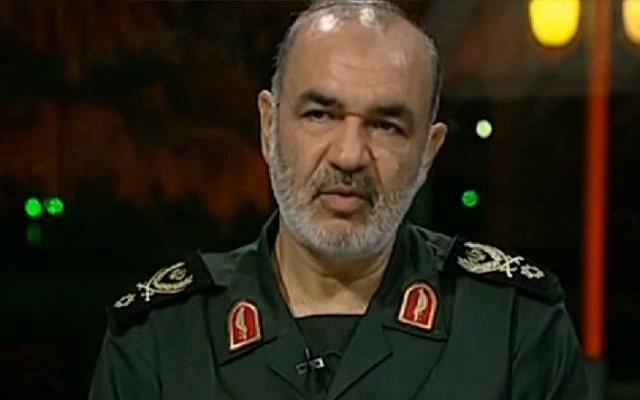
IRGC Deputy Commander Hossein Salami (YouTube screen capture)

In a recent speech, the deputy commander of Iran’s Revolutionary Guards (IRGC) boasted that the “Islamic army in Syria” in the Golan Heights was awaiting orders to eradicate the “evil regime” of Israel.

He also said the Tehran-backed Hezbollah terror group had 100,000 missiles aimed at Israel.

“We are creating might in Lebanon because we want to fight our enemy from there with all our strength,” he stated. “Hezbollah today has tremendous might on the ground that can on its own break the Zionist regime. The Zionist regime has no strategic-defensive depth.”

In the speech for the anti-Israel al-Quds Day in June, translated by the Middle East Media Research Institute (MEMRI), Hossein Salami said that the dangers Israel faces today are greater than at any time in history.

“Today an international Islamic army has been formed in Syria, and the voices of the Muslims are heard near the Golan,” he said. “Orders are awaited, so that… the eradication of the evil regime [Israel] will land and the life of this regime will be ended for good. The life of the Zionist regime was never in danger as it is now.”

Salami stressed that “the Zionist regime constitutes a threat… to the entire Islamic world. That is the philosophy of the establishment of this regime.”

He praised Ayatollah Ruhollah Khomeini, who led the 1979 Iranian revolution, for making the destruction of Israel a goal of the regime.

Khomeini “spread the rationale of eradicating Israel as a new notion in the world’s political discourse,” Salami said. “Since then, the Zionist regime is fearful, delusional, and worried.”

Israel has for years warned of Iran’s ongoing attempts to entrench itself in Syria, and has been waging a quiet campaign to prevent Tehran from establishing a new front on its border. That campaign came into the light and shifted into more open conflict in February, when an Iranian drone carrying explosives briefly entered Israeli airspace, before it was shot down. In response Israel launched a counterattack on an air base in Syria, hitting the mobile command center from which the drone had been piloted and killing at least seven members of the IRGC.

Tehran vowed revenge after the T-4 army base strike. On May 10, the IRGC’s al-Quds Force launched 32 rockets at Israel’s forward defensive line on the Golan Heights border. Four of them were shot down; the rest fell short of Israeli territory.

In response, over the next two hours, Israeli jets fired dozens of missiles at Iranian targets in Syria and destroyed a number of Syrian air defense systems. The operation was widely seen as a success in Israel.

But Salami boasted of Iran’s success in launching the rockets, claiming the barrage silenced Israel.

“When the Zionists bombed the T-4 base in Syria and killed some young men, they thought that they would get no reaction. They thought that America’s and England’s support could frighten the resistance front. They thought that no one would respond,” Salami said. “But the response came in the Golan, and dozens of missiles were fired, along with the message ‘If you respond, we will flatten the heart of Tel Aviv into dust.’ They were silent, and did nothing further.”

Iran has been accused by Israel, the Trump administration, Saudi Arabia and other Middle East countries of supporting terrorism and instability in the region.

Salami blamed Israel for all the Middle East’s troubles.

“All the problems of the Islamic world stem from the existence of the false, counterfeit, historically rootless, and identity-less regime named Israel,” he said.

On Sunday Syrian air defenses were activated near the T-4 air base, in response to an airstrike on the facility, which Syrian state media attributed to the Israeli military, although as a rule, the Israeli military does not comment on its operations abroad.

Fireworks for Iran

July 5, 2015

U.S. stockpiles powerful bunker-buster bombs in case Iran nuclear talks fail

By W.J. HENNIGAN For The L.A. Times July 3, 2015


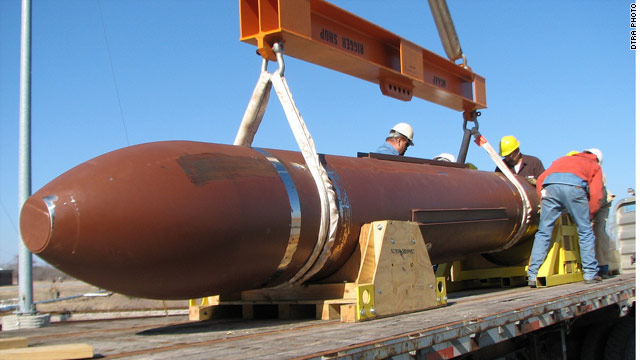
Loading the MOP during a 2007 test in New Mexico [Source: Unknown]

(Happy 4th of July everyone! – LS)

As diplomats rush to reach an agreement to curb Iran’s nuclear program, the U.S. military is stockpiling conventional bombs so powerful that strategists say they could cripple Tehran’s most heavily fortified nuclear complexes, including one deep underground.

The bunker-busting bombs are America’s most destructive munitions short of atomic weapons. At 15 tons, each is 5 tons heavier than any other bomb in the U.S. arsenal.

In development for more than a decade, the latest iteration of the MOP — massive ordnance penetrator — was successfully tested on a deeply buried target this year at the White Sands Missile Range in New Mexico. The test followed upgrades to the bomb’s guidance system and electronics to stop jammers from sending it off course.

U.S. officials say the huge bombs, which have never been used in combat, are a crucial element in the White House deterrent strategy and contingency planning should diplomacy go awry and Iran seek to develop a nuclear bomb.

Obama has made it clear that he has no desire to order an attack, warning that U.S. airstrikes on Iran’s air defense network and nuclear facilities would spark a destabilizing new war in the Middle East, and would only delay Iran by several years should it choose to build a bomb.

“A military solution will not fix it,” Obama told Israeli TV on June 1. An attack “would temporarily slow down an Iranian nuclear program, but it will not eliminate it.”

Secretary of Defense Ashton Carter, speaking to reporters Thursday at the Pentagon, sought to downplay the likelihood or the utility of an attack. He said no plan under consideration, including use of the bunker-busters, could deliver a permanent knockout blow to Iran’s nuclear infrastructure and enrichment plants.

“A military strike of that kind is a setback, but it doesn’t prevent the reconstitution over time,” he said. “And that basically has been the case as long as we’ve had those instruments and those plans, and I don’t think there’s anything substantially changed since then.”

U.S. officials have publicized the new bomb partly to rattle the Iranians. Some Pentagon officials warned not to underestimate U.S. military capabilities even if the bunker-busters can’t eliminate Iran’s nuclear program.

Gen. Martin Dempsey, chairman of the Joint Chiefs of Staff, suggested at the same Pentagon news conference Thursday that airstrikes might be ordered multiple times if Iran tries to build a bomb.

The military option “isn’t used once and set aside,” he said. “It remains in place. … We will always have military options, and a massive ordnance penetrator is one of them.”

A dynamic of escalation, action, and counteraction could produce serious unintended consequences that would … lead, potentially, to all-out regional war.

With negotiators in Vienna facing a self-imposed deadline of Tuesday, the White House views a layered military response as a potential fallback if the emerging deal — which would block Iran’s nuclear weapons capability for at least a decade in exchange for easing of economic sanctions — collapses and evidence shows that Iran is building a bomb.

Contingency plans include airstrikes by cruise missiles and stealth bombers on Iran’s major nuclear facilities, including the uranium enrichment plant at Natanz, a heavy-water reactor at Arak and a nuclear enrichment site at Fordow, which is inside a mountain and fortified with steel and concrete.

B-2 stealth bombers would be required to drop the MOP, which is designed to burrow 200 feet underground before it detonates. Multiple MOPs probably would be aimed at the same target to bore deeper and achieve maximum destruction.

The U.S. began secretly developing the MOP in 2004 after U.S. forces scoured caves in eastern Afghanistan in the hunt for Osama bin Laden. They discovered some sites so deeply buried they appeared impervious to existing bombs.

The Air Force and bomb builder Boeing Co. flight-tested the GPS-guided MOP in 2008 at the White Sands range, where the first atomic bomb was tested during World War II. The 20-foot-long bombs were dropped on multistory buildings with hardened bunkers and tunnels.

But development ramped up in 2010 after Fordow was uncovered and concern about Iran’s nuclear capabilities rose. Since then, the military has spent at least $400 million — including $40 million this year — to build and upgrade 20 bombs, according to budget documents.

Analysts offered mostly pessimistic predictions of how Iran would respond to a U.S. attack on its nuclear facilities.

“A military strike would result in the worst of all worlds,” said Dalia Dassa Kaye, director of the Center for Middle East Public Policy at the nonpartisan Rand Corp. “It may eliminate some facilities. But it would not eliminate Iranian scientists’ technical know-how and would likely further incentivize Iran to pursue a weapon at all costs.”

Iran could increase support for regional militant groups, such as Hezbollah, and perhaps back a terrorist attack on the United States, she said. U.S. forces battling Islamic State fighters in Iraq could find themselves targeted by Iranian-backed militias who are in tacit alignment in the war against the Sunni extremists.

A U.S. attack also could spark a broader war in the world’s most volatile region. Iran has hundreds of medium-range missiles capable of hitting Israel, Jordan and other American allies, according to defense intelligence estimates.

“A dynamic of escalation, action, and counteraction could produce serious unintended consequences that would … lead, potentially, to all-out regional war,” according to a recent study by the Woodrow Wilson International Center for Scholars that was endorsed by 32 high-ranking former military and government officials.

Iran’s nuclear program has already been attacked through covert digital action. In 2010, the U.S. and Israel reportedly slipped a destructive computer worm called Stuxnet into Iranian computer systems controlling the fast-spinning centrifuges that enrich uranium.

The cyberattack destroyed centrifuges and delayed enrichment, but Tehran soon recovered, according to the International Atomic Energy Agency, the United Nations nuclear watchdog agency.

Stuxnet did not lead to overt Iranian retaliation. U.S. airstrikes, and the casualties they would cause, almost certainly would spark a different response.

“It would create huge problems,” said Michael E. O’Hanlon, a military analyst at the Brookings Institution. “That said, it’s hard to rule out if talks fail.”

