Right Angle: Trumpskygate! Bill Whittle Channel via YouTube, August 2, 2016
The Real Implications of Deborah Wasserman Schultz’s Resignation, PJ Media, Roger L Simon, July 24, 2016

The most fascinating aspect of the controversy over the Democratic National Committee’s hacked emails that has resulted in Deborah Wasserman Schultz’s resignation—a quasi firing—is that everything was fine with Wasserman-Schultz until… she got caught.
While some Democrats, particularly Bernie supporters, were annoyed with Debbie before” Guccifer 2.0″ exposed the DNC emails, those same emails demonstrating favoritism to Hillary Rodham Clinton by the supposedly even-handed committee were readily available to a whole stream of people who never said word one.
It would be interesting to compile an annotated list of who they are, who was on the various rounds. Do they include those, like David Axelrod, who suddenly and eagerly called for Wasserman Schultz to bow out? I’d bet on some surprises. Whatever the case, were I a Sanders supporter, which I am not, I would obviously be furious.
It is quite possible that Bernie Sanders would currently be the Democratic Party nominee for president were it not for this conspiracy against him. We will never know. He came remarkably close even while enduring it. (I would imagine if a conspiracy surfaces on email, out of digital form in cloakroom whispers, it is even more pervasive.)
What is astonishing is that Sanders himself has turned into a eunuch, rolling over for this on the morning shows by making light of the situation. One can only wonder what his supporters think now that their hero is a sellout. (Perhaps they will learn the value of the missing Eleventh Commandment—”Never trust your leaders.”)
That the DNC server was so easily hacked is also quite astonishing since the break-in occurred after the Hillary Clinton email server story became front-page news. Don’t these people learn anything?
I am far from an expert in cybersecurity, but having run an online media company for seven years, I forced myself to learn enough to see the obvious—that those who hacked into the DNC server and other email accounts such as Sidney Blumenthal’s to Hillary Clinton, as was done by the original Guccifer, were simply clever amateurs, patient enough to guess their way in with simple-minded passwords. For the highly-trained sophisticated intelligence services of China, Russia, Germany, Israel, the UK, France, Pakistan and Iran (to name just a few) with access to super computers, such break-ins would be so routine they might be done in ten minutes. Our own NSA might have done in it three minutes. Maybe they did.
How did this outright cyber stupidity on the part of the DNC and Clinton come to pass? Two words: arrogance and corruption. They work together brilliantly.
How could you possibly trust these people to manage the war against radical Islam where cybersecurity is increasingly paramount? ISIS has certainly mastered YouTube. Who knows what else they can do? Sooner or later, they or their progeny will know plenty.
How the media plays this story will be revelatory. They treated Melania Trump’s cribbing a few lines of the most banal boilerplate from a Michelle Obama speech as a catastrophe that could upend a campaign. This is a hydrogen bomb by comparison. The governing committee of one of our two principal political parties attempted to steal an election—and was supremely incompetent in the process!
If the media does not meet its responsibility with this story and pursue it to the end, they will be exposing the bias we all know to such a degree they are endangering their own survival. The public, as Trump’s candidacy indicates, not to mention the polls, already despises the media. That same media may seem invincible, but they are vulnerable in their bottom line. Everybody is.
Still no confidence in the MSM? If you’re interested in searching the DNC email database yourself, you can do so here.
AND THIS UPDATE: People say they’re confused by the latest revelation that after having “resigned” from the DNC, Wasserman Schutlz has just been hired by Hillary’s campaign. I’m not. Washerman Schultz knows a great deal. Clinton would never want her angry and running off the reservation talking to people. As the man said, “Keep your friends close, but your enemies closer.”
MOST AMUSING BS IN THE STORY SO FAR: Clinton campaign manager Robby Mook claiming that the email leak was a Russian plot to get Donald Trump elected. WikiLeaks made fun of that one quickly enough. It’s sort of the equivalent of Hillary blaming her husband’s adulteries on “the great rightwing conspiracy.” It’s such a boldfaced lie you have to admire the person for having the guts to tell it. I rather doubt Putin is shivering in his boots over a President Hillary “Reset Button” Clinton.
President Of Pro-Kremlin Think Tank RIAC: Clinton, The Policy Professional, Preferable To Novice Trump, MEMRI, July 21, 2016
(Please see also, Russian Commentator On U.S. Elections: Clinton Is Better For Russia. — DM)
Igor Ivanov, the President of the Russian International Affairs Council (RIAC), and a former Russian Federation foreign affairs minister (1998–2004) attempted to prepare his readers for Hillary Clinton’s expected victory (the article was obviously written before the polls narrowed Clinton’s margin over Donald Trump). [1] Ivanov realizes that Russian public and elite opinion dislikes Clinton as “obsessed with human rights” and believes that Donald Trump can turn the page on US-Russia relations as he is not bound by Obama’s legacy. Moreover, the Russian elites have bitter memories of former U.S. president Bill Clinton whom they view as the architect of NATO’s eastward expansion into countries that were formerly Warsaw Pact members or Soviet republics. [2] Ivanov paints a rosier picture of Russia-US relations under Bill Clinton. Contrasting the rational and predictable behavior he expects from Hillary Clinton with the inconsistent and unpredictable behavior expected from Trump, Ivanov regards a Clinton victory as the preferable outcome.
In addition to bowing before an “inevitable” Clinton victory the Russian leadership maybe warming to the Democratic candidate due to Secretary of State John Kerry’s visit to Moscow and his lengthy talks with Russian President Vladimir Putin and Russian Foreign Minister Sergey Lavrov on greater US military cooperation with Russia in Syria.[3]
While some commentators take a cynical view of the talks and claim that ramped-up cooperation with Russia is an attempt by the Obama Administration to impress the American voters prior to the elections, or an admission that Washington’s Syria policy is bankrupt, Russia probably regards institutionalized cooperation mechanisms as a step forward. Ivanov claims that such cooperative mechanisms in all spheres and on all levels were missing in the 1990s, and their establishment would put US-Russia relations on a firmer footing.
Ivanov’s article appears below:
‘It Is…Easier To Achieve An Agreement With Experienced Professionals…A ‘Newcomer’ In International Politics Is… Harder To Work With’
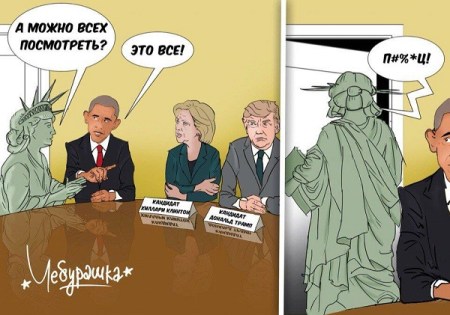 Twitter.com/sharzhipero, May 23, 2016.
On the table badges: candidate Hillary Clinton, candidate Donald Trump.
Statue of Liberty: Can I see all of them [all candidates for the U.S. presidency]?
U.S. President Barack Obama: That’s all of them
Statue of Liberty: Oh, f**k..
“Less than four months remain before America elects its President; the dramatic struggle has entered its final phase. […] As the polls show, it is widely assumed in Russia that the arrival of Donald Trump in the White House would benefit this country more than victory by Hillary Clinton. A populist and fierce opponent of the Washington establishment, Trump could, they say, turn the page in U.S.-Russia relations, which have seen better times, and open a new chapter without regard to the ‘legacy’ of Democrat Barack Obama.
“Hillary Clinton is known to arouse mixed feelings among Russians. Some know her as a relentless and at times inflexible negotiator. Others view her as a politician obsessed with human rights. And still others say that Moscow has always gotten along better with Republicans than with Democrats.
“My experience over the years – and I have talked face-to-face to the leaders of many countries – is telling me that there are hardly any substantial grounds for such fears or hopes. It is usually easier to achieve an agreement with experienced professionals, even if they are inflexible negotiators and difficult partners. They are predictable, rational, and they are well aware of their limitations. A ‘newcomer’ in international politics is usually harder to work with: the lack of experience often translates into inconsistent and unpredictable behavior; it leads to subjective, emotional and at times erroneous decisions that can be very hard to rectify later on.
“Speaking on June 17 [2016] at the Saint-Petersburg International Economic Forum, President Putin recalled his positive experience of working with the forty-second President of the United States, Bill Clinton.[4] I was Minister of Foreign Affairs at the time and remember those days very well. There was more than enough disagreement and difference between our countries back then too. But, unlike recent years, mutually respectful dialogue was never broken off and there was an understanding of how important U.S.-Russia relations were in terms of international stability. Naturally, Mrs. Clinton has her own view of American foreign policy. However, there is evidence that the ‘family experience’ will to a certain extent influence her actions if she wins the November election.
‘It Would Be Naïve To Believe That The State…Of Our Relations With The U.S Are Defined Exclusively By Who Sits In The Oval Office’
“This is not, however, the most important point. It would be naïve to believe that the state and dynamics of our relations with the United States are defined exclusively by who sits in the Oval Office, and that there is some easy and painless way to overcome the deep crisis in our bilateral relations. Miracles don’t happen in international politics. U.S. foreign policy has always been bipartisan, greatly inert, and the outcome of the presidential race alone cannot overturn the existing state of affairs.
‘It is hardly realistic to hope that the new administration will ‘come to its senses’ and be easy to deal with. No matter who wins the presidency, the strategic goal of preserving global leadership will remain unchanged, [all emphases added] though certain adjustments to the international agenda are, of course, possible.
“U.S.-Russia relations have entered a phase where the negative attitude that has accumulated over recent years has essentially grown into full-blown confrontation. This runs counter to our national interests and those of the United States as well. So it is important to take steps that would help reverse this dangerous trend. If we decide to wait and see what the new U.S. President and his or her team do, we lose time, and with it we lose the initiative.
“Frankly speaking, we failed to create a solid foundation for U.S.-Russia relations after the end of the Cold War. We did not try hard enough, engrossed in solving current international problems. This, in my view, makes the launch of a new negotiation process between Washington and Moscow the key goal, a process that would help develop common principles for our relations and jointly developed mutual commitments reflecting the interests of both sides.”
‘To Meet Just To Look Into Each Other’s Eyes Is Not Enough Anymore’
“What should we do first? This is the hardest part.
“In my mind, we first need to start working on arranging a bilateral summit. The longer it takes for such a meeting to happen, the more negative feelings will pile up. The meeting must be thoroughly worked through and it must have a strategic and future-oriented outcome. In today’s situation, to meet just to ‘look into each other’s eyes’ is not enough anymore.[5]
“Clearly, such a meeting will not solve all the numerous controversies we have at once. But this should not be the goal either. The meeting must set the course for the development of bilateral relations and form the necessary mechanisms for cooperation, which would help gradually overcome the present situation where cooperation in matters of strategic importance is held hostage by existing differences.
“Interaction at the presidential level will of course continue to remain the key element of the U.S.-Russia dialogue. But such interaction has to be complemented with a wide range of bilateral mechanisms, each devoted to a key area of cooperation. We need to breathe new life into the Strategic Stability Group,[6] where our two countries are represented by the leaders of the foreign and defense ministries. Dialogue between intelligence agencies has to be institutionalized as well. This would enhance mutual trust and create an atmosphere conducive to cooperation in fighting terrorism and in other fields. Particular attention needs to be paid to economic cooperation. Business-to-business cooperation has not become the shock-absorber that would limit or at least reduce the negative impact of differences in other areas. There is need for a mechanism that would stimulate economic cooperation at the governmental level, which would in turn promote better relations between our two countries in general.
“Another consultation mechanism should be created at the level of civil society. It should involve political and public figures, representatives of the media, science and culture – all those who influence public opinion in Russia and in the U.S. The proposed streamlining of U.S.-Russia dialogue might seem cumbersome and unrealistic at first. Unfortunately, it is the very lack of such a tight framework for dialogue on a wide range of pressing issues that has brought us to where we are today.
“In his telegram to President Obama on the occasion of Independence Day on July 4 this year, President Putin emphasized that ‘the history of US-Russia relations shows that when we act as equal partners and respect each other’s lawful interests, we are able to successfully resolve the most complex international issues for the benefit of both countries’ peoples and all of humanity.’
“Let us hope that Washington would take this invitation to dialogue seriously.”
Endnotes:
[1] Russiancouncil.ru, July 16, 2016
[2] See MEMRI Special Dispatch no. 6520, Russian Commentator On U.S. Elections: Clinton Is Better For Russia, July 19, 2016.
[3] Wall Street Journal, July 14, 2016.
[4] During the Plenary session of St Petersburg International Economic Forum, Putin said: “I worked with Bill Clinton, although for a very short time, and we had a very good relationship. I can even say that I am grateful to him for certain moments as I was entering the big stage in politics. On several occasions, he showed signs of attention, respect for me personally, as well as for Russia. I remember this and I am grateful to him. About Ms. Clinton. Perhaps she has her own view on the development of Russian-U.S. relations. You know, there is something I would like to draw [your] attention to, which has nothing to do with Russian-U.S. relations or with national politics. It is related, rather, to personnel policy. In my experience, I have often seen what happens with people before they take on a certain job and afterward. Often, you cannot recognize them, because once they reach a new level of responsibility they begin to talk and think differently, they even look different. We act on the assumption that the sense of responsibility of the U.S. head of state, the head of the country on which a great deal in the world depends today, that this sense of responsibility will encourage the newly elected president to cooperate with Russia and, I would like to repeat, build a more secure world.” Kremlin.ru, June 17, 2016.
[5] Ivanov appears to be referring to the June 2001 summit between Vladimir Putin and George W. Bush at the conclusion of which Bush told the press” “I looked the man in the eye. I found him very straight-forward and trustworthy – I was able to get a sense of his soul.” BBC.co.uk, June 16, 2001.
[6] Russia has established strategic stability groups with other countries and not only with the U.S. For example, in January 2003, the first meeting of the strategic stability group of Russia and Pakistan met to thrash out questions of proliferation of weapons of mass destruction and their delivery systems. Mid.ru, January 16, 2003.
Russian Commentator On U.S. Elections: Clinton Is Better For Russia, MEMRI, July 19, 2016
“The U.S. is now in a very difficult situation. It is far from certain that Trump’s reforms will save it. It is far from certain that Trump will be allowed to implement them. But Trump is the U.S.’s chance at revival, after which it will be able to return to an aggressive foreign policy under more favorable conditions. Whereas Hillary Clinton is Washington’s guaranteed way into the abyss. After her, no Trump will be able to save America.”
******************
Rotislav Ischenko, an analyst for ‘Russia Today’ had an interesting take on the American elections. While the Russian public prefers Trump because he is viewed as an antagonist of the American elite epitomized by Hillary Clinton, Ischenko is rooting for Clinton. Republicans, excluding George W. Bush, generally proved themselves more skillful practitioners of international politics who skillfully manipulated Russia. The Clinton Administration began the American overstretch that committed resources to meaningless and unachievable goals. Therefore those who would prefer a weakened America should hope for a Clinton victory that would translate into America’s continued decline.
A translation of Ischenko’s article appears below:[1]
‘A Democrat Means A Guaranteed And Accelerated Continuation Of The Current Decline Of The American Supremacy’
 Vitaly, Vk.com/13studiya, May 27, 2016. While Clinton and Trump are fighting in the ring, the public cheers for Russian President Vladimir Putin.
“Most Russian experts, observers and even ordinary citizens who exhibit as much interest in the American electoral campaign as in the Olympics or the Football World Cup, side with Donald Trump in this race. This comes as no surprise.
“Firstly, Hillary Clinton is a lady who is too unpleasant in all respects. Secondly, her revoltingly negative attitude to Russia is widely known. Thirdly, Trump is outrageously flamboyant and he fights the traditional American elite. Who in this world likes the traditional American elite? In short, the Russians, without any reservations, are giving the People’s Choice Award to Donald Trump.
“One must admit that Donald Trump can become a better president for America than Hillary Clinton. At least, a Republican may give it a chance, whereas a Democrat means a guaranteed and accelerated continuation of the current decline of the American supremacy.
“But the Russians who side with Trump are hoping he will be a better American president for Russia as well. This view is, however, problematic. I would even call such hopes groundless and, if we could vote in the American elections, I would deliberately give my support to the former State Secretary and the wife of the 42nd president of the U.S. [Hillary Clinton].
“Here are my considerations: Firstly, historically the policies of the Republicans have always been more flexible and less dogmatic. Even [U.S. President Ronald] Reagan who proclaimed the USSR to be ‘The Empire of Evil’ quickly realized what advantages Washington could gain from the [former President of the Soviet Union] Mikhail Gorbachev’s version of de-escalation of tension and became the best friend of the Soviet Union. His successor, George Bush senior, also a Republican, even actively campaigned against the USSR breakup. He even visited Kiev specifically in order to convince the Ukrainian elites aspiring for independence that they would be much more comfortable in the Soviet Union.
“The 40th and the 41st U.S. presidents [Reagan and George H. W. Bush] were not altruists. Their thinking was less straightforward than that of the Democrats, and they knew that the direct way to their goal is not necessarily the shortest. As part of the theory of indirect action, they tried to hug the USSR to death, and they almost succeeded. In fact, they did not need the Soviet Union to collapse. They only wanted to weaken it and reduce it to the rank of a junior partner who would pull chestnuts out of the fire for the American hegemony even more effectively than the EU.
“It was a beautiful operation that should have led to the clear victory of the U.S. with the least costs. Even the collapse of the USSR did not invalidate it – just made it more complicated: now it was Russia that had to be hugged to death.
But then the Democrats came, represented by the Clintons, and they ruined everything. They rushed to stake out a claim on seemingly important but, in reality, strategically meaningless territories (in particular, in Yugoslavia). At the same time, the policy of deterrence against Russia was applied more and more noticeably in the post-Soviet territories.
Moscow grew wary, and public opinion in Russia, initially favorable to the U.S., became diametrically opposite. The chance was wasted, and the U.S. entered an exhausting race to maintain its supremacy, which has by now stretched its battle lines and eaten practically all the free resources, at the same time allowing Russia to concentrate, consolidate and launch a counter-offensive.
‘The Foreign Policy Paradigm Determined By The Clintons… Did Not Allow The U.S. To Choke The USSR/Russia In The Least Costly And Most Effective Way’
Obama’s Democratic administration proclaimed that it was aware of the necessity for significant reforms. The Nobel Peace Prize laureate [U.S. President Barack Obama] did make an attempt to break with the past, fold military activity all over the world, avoid confrontation with Russia and China, and concentrate on the domestic problems of the U.S. He failed for a number of reasons.
“Firstly, [Obama], personally, was not ready for the presidential office. Obama pronounced stirring speeches more often than tried to implement his own ideas.
“Secondly, since he understood little in foreign policy, he tried to focus on his domestic reforms (necessary, but insufficient), and gave the run of the foreign affairs to the same people who had implemented the idea of global ‘pawn-grabbing’ [a tendency of foolish chess-players] during Clinton’s term, neglecting the U.S. strategic interests.
“Thirdly, by the time of Obama’s presidency, the U.S. had advanced so far in the implementation of the idea of violent suppression of all potential foreign opponents, it had adhered so long to the tactics of ‘conquer everything, lose nothing,’ that without a single iron directing will that would implement an alternative comprehensive concept, neither the military nor the politicians nor the diplomats were able to break out of the vicious circle of decisions the inevitability of which was dictated by previous decisions.
“As a result, Obama became trapped by Clinton’s foreign policy, ruinous for the U.S., which had been implemented before by Clinton himself and then by the Republican administration of Bush junior. During the latter’s term, the inability of Washington to suppress all its opponents by force became evident, but Bush junior had neither experience nor will sufficient to turn the state ship around. Besides, for most of Bush’s term, the U.S. was euphoric about its formal foreign victories (Iraq, Afghanistan), and this inertial motion did not arouse any significant concern in anyone except a small number of domain specialists.
“On the whole, the foreign policy paradigm determined by the Clintons that has lasted as the leading one for six presidential terms of three presidents did not allow the U.S. to choke the USSR/Russia in the least costly and most effective way. The same paradigm caused the U.S. to overstrain itself; its resource base is no longer up to the task of global domination.
‘When We Deal With Hillary, We Deal With An Unpleasant But Predictable [Politician]… Trump Is Not Burdened By Rules Of Morality, At Least Not More Than Hillary’
Today, the Washington elites are facing a choice again. They can pig-headedly continue the same policy of pressure by force, hoping that the opponent will break before the U.S. is exhausted. In fact, today it means hoping for a miracle, like the coup of 1917, which took Russia out of the First World War and delayed Germany’s downfall by 18 months. Hillary Clinton is a supporter of this policy.
We understand what she will do and how. We understand we will have to deal with hysterics, attempts to apply pressure, blatant rudeness and undisguised threat of war. But we also understand that it is not Hillary who will decide whether or not to push the button. And the people who will decide are much more level-headed. In short, when we deal with Hillary, we deal with an unpleasant but predictable and see-through politician who will continue to lead the U.S. along the way towards resource overstrain.
“Trump is no Bush junior. He is the focus of all the strong points of the Republican party. He is not burdened by rules of morality, at least no more than Hillary. But he is more flexible and sees other ways of solving the American problem, besides the pig-headed direct pressure. Above all, Donald Trump understands that without stabilizing the economy and the financial system of the U.S., all its claims to world domination are no more than wishful thinking, and the U.S. is in danger of quickly becoming ‘Upper Volta’ with missiles”.
“One must realize that Trump is not alone. Of course, he speaks against the traditional Republican establishment, but it does not mean he does not enjoy the support of influential back-stage circles, who have become aware of the ruinous character of Clinton’s policy and are trying a more creative approach. Without powerful support (taking into account how the American press is controlled by the party elites), Trump would simply never have been given the opportunity to speak. All his billions would not have sufficed for a serious campaign. One can assume that Trump will try to offer the U.S. something like the policy Putin has been implementing in Russia.
“Firstly, [Trump seeks] an acceptable compromise in foreign policy. The U.S. reduces its activity in the major conflict areas, on condition that it saves its face. Secondly, [he will shift to] focusing on domestic problems. That is, tough reforms leading to painful but decisive revitalization of the financial and economic systems, in particular, at the expense of the outside world (Trump has already acknowledged the possibility of the U.S. defaulting). Thirdly, play on the contradictions of the remaining major players, whom the U.S. will find it easier to play off against each other in the context of reduced international activity, because their necessity to defend themselves from common danger – Washington – will disappear, but the mutual contradictions will exacerbate.
“The U.S. is now in a very difficult situation. It is far from certain that Trump’s reforms will save it. It is far from certain that Trump will be allowed to implement them. But Trump is the U.S.’s chance at revival, after which it will be able to return to an aggressive foreign policy under more favorable conditions. Whereas Hillary Clinton is Washington’s guaranteed way into the abyss. After her, no Trump will be able to save America.”
Endnote:
[1] Ria.ru, May 19, 2016.
Palestinian Authority Pays Terrorists and Their Families $140 Million a Year Palestinians using foreign aid to reward terrorists for acts that kill Israelis
BY: Follow @mchalfant16
July 7, 2016 5:00 am
Source: Palestinian Authority Pays Terrorists, Families $140M a Year
The Palestinian Authority spends roughly 10 percent of its annual budget paying terrorists who attack Israelis and supporting their families, according to expert testimony to congressional lawmakers.
Yigal Carmon, the president and founder of the Middle East Media Research Institute, told the House Foreign Affairs Committee Wednesday that the Palestinian Authority is investing $137.8 million this year in salaries to terrorists jailed in Israel and payments to the families of imprisoned terrorists or suicide bombers, in violated of the Oslo peace accords with Israel.
Wednesday’s hearing took place following a months-long wave of violent attacks waged by Palestinians on Israelis in the West Bank. Last week, a Palestinian attacker broke into a home in the West Bank and stabbed to death a 13-year-old Israeli-American girl in her sleep.
There have been 250 such attacks or attempted attacks by Palestinians on Israelis since October 2015, according to the report of the Middle East Quartet—comprised of the United States, Russia, the European Union, and the United Nations—issued last week. The assaults have killed at least 30 Israelis and resulted in dozens of Palestinians being killed by Israeli police.
Official Palestinian Authority media have glorified perpetrators of these terrorist attacks. Bashar Masalha, a Palestinian who stabbed U.S. Army veteran Taylor Force to death and wounded several others in March, was hailed on official media outlets as a “martyr” at the time of his funeral.
“We welcome every drop of blood spilled in Jerusalem. This is pure blood, clean blood, blood on its way to Allah,” Palestinian President Mahmoud Abbas stated last September on Palestinian television. “With the help of Allah, every martyr will be in heaven, and every wounded will get his reward.”
The Palestinian Authority has also furnished terrorists and their families with financial support weighted by the severity of the attack, a matter over which congressional lawmakers expressed outrage on Wednesday.
“These terrorists are not, in fact, lone rangers. They are not lone wolves,” said Rep. Ed Royce (R., Calif.), who chairs the committee, in opening remarks during the hearing. “Instead, these terrorists are the product of the programming done by the PA’s perverted culture that glorifies the willingness to die or to spend time in prison in pursuit of killing or maiming Israelis.”
According to Carmon’s testimony, which was informed by an analysis of the Palestinian Authority’s budget and years of research, the Palestinian Authority transfers funds to terrorist prisoners in Israeli or their families using two Palestinian Liberation Organization funds. The financial support of these individuals is mandated by law.
Prisoners must be provided a monthly salary ranging from $364 to over $3,000 during their detention, and salaries or jobs upon their release. Those who commit the most grievous attacks receive the most substantial monthly payments and are also entitled to jobs in the Palestinian Authority institution upon their release.
Carmon said that it is difficult to determine exactly what percentage of the Palestinian Authority’s annual budget is put toward this cause because of a lack of transparency, but estimated that it amounts to about 10 percent.
“It is just outrageous that they pay cold-blooded killers who murder innocent people and call them martyrs,” Rep. Eliot Engel (D., N.Y.), the committee’s ranking member, said during the hearing. “I cannot think of anything more disgusting.”
While Abbas two years ago ordered that these salaries not be paid by the Palestinian Authority’s Ministry of Prisoners’ Affairs but instead by the Palestinian Liberation Organization, Carmon described this as a “deliberately misleading move” to assuage concerns from donor countries worried about their money being funneled to terrorists.
“The source of the money remains the PA, which receives them from donor countries, and the overseeing body remains none other than the PA,” Carmon told lawmakers. He said that countries who provide aid to Palestine, including the United States, are “complicit” in inciting terrorism because the Palestinian Authority uses foreign donations to subsidize terrorists and their families.
“By providing this support, the PA is encouraging terrorism in violation of its Oslo commitment.
Furthermore, the PA has been using money granted by donor countries for this purpose, and by doing so, has made them complicit in encouraging terrorism as well,” Carmon said.
The United States has committed over $5 billion in bilateral economic and non-lethal aid to the Palestinians since the mid-1990s in order to prevent Palestinian terrorist groups from attacking Israel and promote piece in the West Bank, according to a Congressional Research Service report issued in March.
While U.S. law allows the government to cut aid to the Palestinian Authority for paying terrorists and their families, the Palestinian Authority has avoided this by transferring the payments to the Palestinian Liberation Organization, experts said Wednesday.
“The U.S. stipulations have … been evaded by the PA by this deceitful technique of funneling money to terrorists and their families under a different name,” said David Pollock, a fellow at the Washington Institute for Near East Policy.
“I think that the United States and other countries should … reduce the amount or condition the amount of assistance that they provide to the PA without threatening to or without actually cutting it off completely,” Pollock, added, cautioning that completely ceasing aid could result in the collapse of the Palestinian Authority.
“I do think that a certain calibrated, limited amount of financial pressure applied, again, by the United States without any loopholes or escape hatches and, if possible, by European and other donors to the PA would be helpful in addressing this immediate issue,” Pollock added.
Members of Congress have pursued legislative action to address this problem. A Senate subcommittee recently approved language inserted into the fiscal year 2017 State and Foreign Operations Appropriations Bill that would cut U.S. aid to Palestine by an amount equal to that “expended by the Palestinian Authority and the Palestine Liberation Organization and any successor or affiliated organizations, as payments for acts of terrorism by individuals who are imprisoned after being fairly tried and convicted for acts of terrorism, and by individuals who died committing acts of terrorism during the previous calendar year.”
The companion bill in the House also includes similar language. The State Department would be responsible for enforcing the law.
Israel has already implemented such action. Israeli Prime Minister Benjamin Netanyahu announced on Friday that the country would withhold some tax revenues that it sends to the Palestinian Authority. The amount withheld will be equal to what is “being transferred by the Palestinian Authority to terrorists and their families,” though it is unclear how much it will be.
Some members of Congress took a hardline approach toward the issue on Wednesday. Rep. Ted Yoho (R., Fla.) said that the United States should send a clear message to Palestine that “if these policies continue, we’re done.”
“We are funding hatred. We are funding terrorism,” Yoho said, labeling it “unconscionable” to provide aid to Palestine in the name of peace while the Palestinian Authority is subsidizing terrorists.
Royce said that the United States and its European allies must do more to use leverage against Palestinian Authority to halt the practice of rewarding terrorists.
“If the PA’s irresponsible behavior continues, the whole premise for funding the PA needs to be reconsidered. The U.S. needs to do better at bringing the parties together while holding the parties responsible for their actions. This has traditionally been our role,” Royce said. “Unfortunately, in recent years, the Obama administration has been hesitant to hold the PA accountable—yet has consistently pressured Israel.”
Putin: Russia to respond if Finland joins NATO
Published time: 1 Jul, 2016 16:33 Edited time: 1 Jul, 2016 17:42
Source: Putin: Russia to respond if Finland joins NATO — RT News
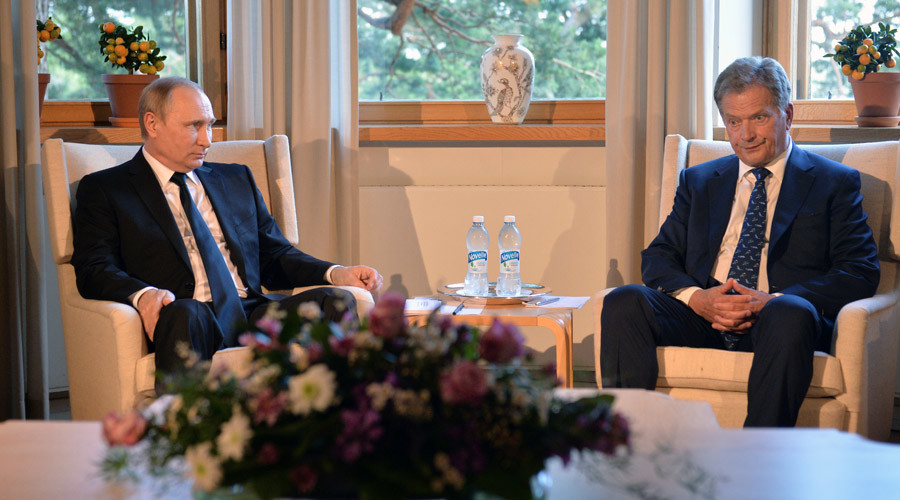
July 1, 2016. Russian President Vladimir Putin, left, and President of Finland Sauli Niinisto meet in Naantali. © Alexei Druzhinin / Sputnik
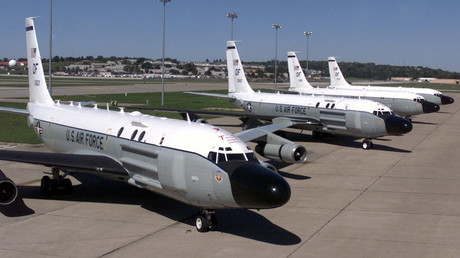
“The Finnish president came up with the proposals today on the first steps aimed at enhancing confidence and preventing conflicts [in the Baltic airspace]. I have already said that I agree with this. We will try to begin the dialogue with NATO at the summit in Brussels,” Putin said on Friday.
Putin and Finnish President Sauli Niinisto agreed to develop a set of security measures to control flights over the Baltic Sea. Finland’s president said military flights should avoid turning off their identification devices in the region, which is frequented by both Russian and NATO planes.
“We all know the risk with these flights and I have suggested that we should agree that transponders are used on all flights in the Baltic Sea region,” Niinisto said.
Putin, in turn, noted that NATO planes conduct flights over the Baltics with their transponders off twice as often as Russian planes.
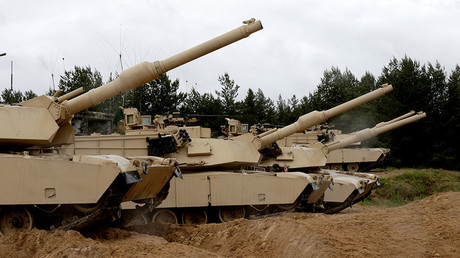
“The number of NATO planes [with transponders off] is twice as high as that of Russian planes,” Putin said citing statistics.
“We welcome the Finnish President’s proposal [to ban flights over the Baltics with transponders off]. Upon my arrival back in Moscow I will order the Foreign and Defense Ministries to raise this matter at the upcoming Russia-NATO Council meeting, which is to take place after the Russia-NATO summit in Warsaw,” he added.
Putin said Russia will respect Finland’s choice if it decides to join NATO, but will have to respond accordingly.
“Do you think we will continue to act in the same manner [if Finland joins NATO]? We have withdrawn our troops 1,500 [km from the border]. Do you think they will stay there?” he told reporters.
The remarks were made at a joint press-conference of the two heads of state following their talks at the Kultaranta summer residence of the Finnish president.
Russia intercepted several US aircraft over the Baltic Sea in close proximity to the country’s border in recent months, claiming the planes in question had their identification devices turned off.
Vladimir Putin crushes CNN’s Fareed Zakaria in St. Petersburg, Russia. Everything Fareed tried, Putin deflected and fire some shots of his own.
Huge Scandal Erupts Inside NATO: Alliance Member Germany Slams NATO “Warmongering” Against Russia
by Tyler Durden – Jun 19, 2016 3:28 AM
As we reported in just the past week, not only has NATO accelerated its encirclement of Russia, with British soldiers deployed in Estonia, US soldiers operating in Latvia and Canadians in Poland, while combat units are being increased in the Mediterranean…

… but even more troubling, was NATO’s assessment that it may now have grounds to attack Russia when it announced that if a NATO member country becomes the victim of a cyber attack by persons in a non-NATO country such as Russia or China, then NATO’s Article V “collective defense” provision requires each NATO member country to join that NATO member country if it decides to strike back against the attacking country.
Specifically, NATO is alleging that because Russian hackers had copied the emails on Hillary Clinton’s home computer, this action of someone in Russia taking advantage of her having privatized her U.S. State Department communications to her unsecured home computer and of such a Russian’s then snooping into the U.S. State Department business that was stored on it, might constitute a Russian attack against the United States of America, and would, if the U.S. President declares it to be a Russian invasion of the U.S., trigger NATO’s mutual-defense clause and so require all NATO nations to join with the U.S. government in going to war against Russia, if the U.S. government so decides.
Also recall that the attack on the DNC servers which leaked the Democrats confidential files on Trump and Hillary donors lists were also blamed on “Russian government hackers”, before it emerged that the act was the result of one solitary non-Russian hacker, but not before the US once again tried to escalate a development which may have culminated with war with Russia!
Throughout all of these escalations, the popular narrative spun by the “democratic” media was a simple one: it was Russia that was provoking NATO, not NATO’s aggressive military actions on the border with Russia that were the cause of soaring geopolitical tension. Ignored in the fictional plot line was also Russia’s clear reaction to NATO provocations that it would “respond totally asymmetrically” an outcome that could in its worst oucome lead to millions of European deaths. Still, no matter the risk of escalation, one which just two weeks ago led to assessment that the “Risk Of Nuclear Dirty Bomb Surges On Poor US-Russia Relations“, NATO had to maintain its provocative attitude .
All NATO had to do was assure that all alliance members would follow the lead, and nobody would stray from the party line.
And then everything imploded when none other than the Foreign Minister of NATO member Germany, Frank-Walter Steinmeier, criticized NATO for having a bellicose policy towards Russia, describing it as “warmongering”, the German daily Bild reported. And just like that, the entire ficitional narrative of “innocent” NATO merely reacting to evil Russian provcations has gone up in flames.
As AFP adds, Steinmeier merely highlighted all those things which rational persons have known about for a long time, namely the deployment of NATO troops near borders with Russia in the military alliance’s Baltic and east European member states. However, since it comes from a NATO member, suddenly one can’t accuse Russian propaganda. In fact, NATO has absolutely no planned response to just this contingency.
“What we should avoid today is inflaming the situation by warmongering and stomping boots,” Steinmeier told Bild in an interview to be published Sunday.

German Foreign Minister Frank-Walter Steinmeier
“Anyone who thinks you can increase security in the alliance with symbolic parades of tanks near the eastern borders, is mistaken,” Germany’s top diplomat added.
Needless to say, Russia bitterly opposes NATO’s expansion into its Soviet-era satellites and last month said it would create three new divisions in its southwest region to meet what it described as a dangerous military build-up along its borders. This is precisely what NATO wants as it would be able to then blame Russian effect to NATO cause as an irrational move by the Kremlin, one to which the kind folks at NATO HQ would have no choice but to respond in their caring defense of all those innocent people, when in reality it is NATO that is desperate to provoke and launch the conflict with Russia.
And now even its own members admit it!
In its latest ridiculous escalation, blamed on Russia no less, NATO announced on Monday that it would deploy four battalions to Estonia, Latvia, Lithuania and Poland to counter a more assertive Russia, ahead of a landmark summit in Warsaw next month. Well, as Steinmeier made it very clear, NATO’s deployment to provoke Russia was precisely that. As a result a Russian “assymmetric” response is assured, and this time it may even spill over into the combat arena, something which would bring infinite delight to Washington’s military-industrial complex neocon puppets.
In an interview with Bild on Thursday, NATO chief Jens Stoltenberg said Russia is seeking to create “a zone of influence through military means”. “We are observing massive militarisation at NATO borders — in the Arctic, in the Baltic, from the Black Sea to the Mediterranean Sea,” he told the newspaper.
How do we know Steinmeier hit it nail on the head? The neocon Council of Foreign Relations trotted out its “fellow” who promptly took to character assassinations and demanding Steinmeier’s resignation, instead of asking if perhaps a NATO-member country accusing NATO of being a warmongering provocateur, is not the real reason why Europe is back deep in the cold war, with an escalating nuclear arms race to go alongside it, courtesy of the US military industrial complex whose profits are entirely dependent on war, conflict and the death of civilians around the globe.
As for the unprecedented reality in which NATO’s biggest and most important European member is suddenly and quite vocally against NATO and as a result may be pivoting toward Russian, we for one can’t wait to see just how this shocking geopolitical debacle for western neocons and war hawks concludes.
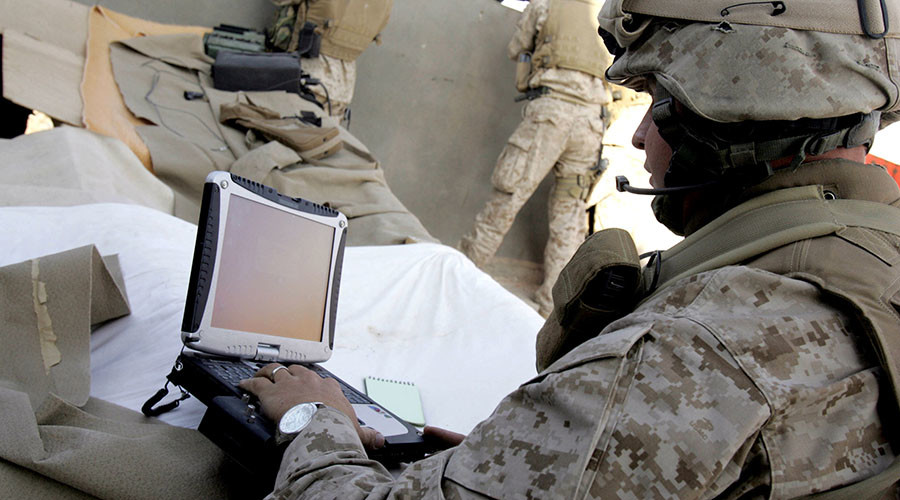
Severe cyber-attack could be a case for NATO action
Stoltenberg Published time: 16 Jun, 2016 07:45
Source: Severe cyber-attack could be a case for NATO action – Stoltenberg — RT News
© Patrick Baz / AFP
“A severe cyber-attack may be classified as a case for the alliance. Then NATO can and must react,” Jens Stoltenberg said in an interview to Germany’s Bild newspaper on Thursday. “How, that will depend on the severity of the attack,” he said.
Stoltenberg pointed out that the alliance faces a complex of threats with tendency to expand, so NATO member states have made a decision to regard cyber-attacks just like any other threat.
In early June, the German military’s top brass announced that all 28 NATO member states would likely agree to declare cyberspace an operational warzone, during the Warsaw summit, to be held in the Polish capital on July 8-9.

NATO likely to declare cyberspace a warfare domain at #Warsaw summit – German general http://on.rt.com/7e9t #NATOSummit
Individual NATO member states have also made similar statements over the past years.
The US acknowledged the notion of cyberspace being a new war dimension years ago, enacting the United States Cyber Command (USCYBERCOM) on June 23, 2009, to fulfill tasks related to cyber combat.
In 2011 Washington said it regards cyberspace as an operational domain of war, equating digital attacks to those in the real world, and preparing to respond to them as it does to other threats to national security and wellbeing.
In Moscow, officials have long been concerned about the threat of cyber-warfare against Russia. In March, Communications Minister Nikolay Nikiforov told RT that the US government and a handful of corporations working under US jurisdiction have a disproportionately strong influence on the internet.
Russia working on internet protection due to US online dominance – Com. Minister to RT http://on.rt.com/75×9

[T]he whole world… is actually totally dominated by a single country and literally by several companies, which have practically monopolized the entire IT system,” Nikiforov said.
“With this prolonged monopolization, many countries in the world are working on technical solutions that would protect national segments of the internet from a possible external destructive action. They are creating backup infrastructures, which respond to a disruption – intentional or accidental – and prevent national segments from being blocked,” Nikiforov added.




 anneinpt
 artaxes
 danmillerinpanama
 davidking1530
 Peter Hofman
 Joseph Wouk
 Peter
Peter Louisiana Steve
 WarSclerotic
Recent Comments