Posted tagged ‘Russia’

Russian Government Officials Told To Immediately Bring Back Children Studying Abroad | Zero Hedge

October 12, 2016

Russian Government Officials Told To Immediately Bring Back Children Studying Abroad Tyler

by Tyler Durden

Oct 12, 2016 2:42 AM

Source: Russian Government Officials Told To Immediately Bring Back Children Studying Abroad | Zero Hedge

In Europe, when it gets serious, you have to lie… at least if you are an unelected bureaucrat like Jean-Claude Juncker. In Russia, however, when it gets serious, attention immediately turns to the children.

Which is why we read a report in Russian website Znak published Tuesday, according to which Russian state officials and government workers were told to bring back their children studying abroad immediately, even if means cutting their education short and not waiting until the end of the school year, and re-enroll them in Russian schools, with some concern. The article adds that if the parents of these same officials also live abroad “for some reason”, and have not lost their Russian citizenship, should also be returned to the motherland. Znak cited five administration officials as the source of the report.

The “recommendation” applies to all: from the administration staff, to regional administratiors, to lawmakers of all levels. Employees of public corporations are also subject to the ordinance. One of the sources said that anyone who fails to act, will find such non-compliance to be a “complicating factor in the furtherance of their public sector career.” He added that he was aware of several such cases in recent months.

It appears that the underlying reason behind the command is that the Russian government is concerned about the optics of having children of the Russian political elite being educated abroad, while their parents appear on television talking about patriotism and being “surrounded by enemies.”

While we doubt the impacted children will be happy by this development, some of the more patriotic locals, if unimpacted, are delighted. Such as Vitaly Ivanov, a political scientist who believes that the measure to return children of officials from studying abroad, is “long overdue.” According Ivanoc, the education of children of the Russian elite abroad is subject to constant ridicule and derision against the ruling regime. “People note the hypocrisy of having a centralized state and cultivating patriotism and anti-Western sentiment, while children of government workers study abroad. You can not serve two gods, one must choose.”

On the other hand, political analyst Stanislav Belkovsky quoted by Znak, believes that such decisions should be approached with more pragmatism. Such a recommendation is more likely to lead to an outflow of officials from the state, rather than allow the return of the children studying at elite foreign universities. He also warned of attempts to recreate an echo chamber such as that experienced after the failed July coup attempt on Turkey’s President Erdogan.

But what he said next was more disturbing: “On the one hand, this is all part of a package of measures to prepare the elites for some ‘big war’ even if it is rather conditional, on the other hand – this is another blow to the unity of President Putin with his own elite” Belkovsky said. He adds that the Western sanctions launcedh in March 2014, had sought to drive a wedge between Putin and elites. In response, the Kremlin began to act precisely according to the logic of these sanctions. “But while a ban for having assets in the West is one thing, and understanable, when it comes to a ban for offshore health and education services, the blowback will be far greater, as it represents a far more important element of the establishment’s life strategy.”

Ultimately the motivation behind Putin’s decision is unclear: whether it is to show Russia’s high-ranking oligarchs who is boss, to boost a sense of patriotism among the nation by sending a symbolic message that the west is no longer a welcome destination for Russia’s rich kids, or just a preemptive move of repatriating of any individuals affiliated with Russian politics for other unknown reasons; however it underscores the severity of the ongoing diplomatic crisis and just how significant the upcoming isolation between Russia and the West is likely to become in the coming months – unless of course tensions deescalate dramatically in the very near future – resulting in even greater collapse in global commerce and a further slowdown to world economic growth, which may ultimately lead to an armed conflict, whether regional or global, as the only possible outcome.

Putin’s Puritan Piety: The Ideological War against the West

October 9, 2016

Putin’s Puritan Piety: The Ideological War against the West, Gatestone InstituteGiulio Meotti, October 9, 2016

Russia is one of the few countries in the Western world in which religion is becoming increasingly important and not less.

To establish his authority on the Russian society, President Vladimir Putin has shaped a doctrine mobilizing the entire Russian society against a perceived Western “decadence”. He has declared that Russian traditional family values are a bulwark against the West’s “so-called tolerance — genderless and infertile.”

The first Cold War was a clash between Western democracy and the Soviet dictatorship of the proletariat. The new Cold War is a one between Western liberalism and Russian conservatism.

During the Cold War, American conservatives used to label the Soviet Union “the godless nation” on the verge of collapse because it had purged religion from the Russian society. Two decades later, the Kremlin is occupied by a former officer of the KGB, secretly baptized, who launches the same accusation of atheism at the United States and the West.

Welcome to “Putin’s covert war on Western decadence“, as The Spectator defined it:

“Putin’s Russia is fast becoming a very puritan place. Ever since returning to the presidency in 2012, Putin has pursued an increasingly religious-conservative ideology both at home and abroad, defining Russia as a moral fortress against sexual licence and decadence, porn and gay rights”.

Recently, Russian officials censored porn websites. When the largest pornography site on the internet, PornHub, offered the Russia’s official communications and media watchdog a premium account in exchange for lifting the ban, Russian officials replied: “Sorry, we are not in the market and the demography is not a commodity.”

Russian President Vladimir Putin’s ideological war against the West is getting cocky and self-confident. In a televised speech from a Kremlin hall, Putin declared that Russian traditional family values are a bulwark against the West’s “so-called tolerance — genderless and infertile.”

“Many Euro-Atlantic countries have abandoned their roots, including Christian values,” said Putin. The patriarch of the Orthodox Church, Kirill, echoed Putin by charging the West of being engaged in a “spiritual disarmament” of the Russian people, and by criticizing the European laws that prevent wearing religious symbols in public. “We have experienced an era of atheism and we know what it means to live without God”, Kirill said.

1931Russian President Vladimir Putin meets with Patriarch Kirill of the Russian Orthodox Church, May 24, 2015. (Image source: The Kremlin)

The first ten years of Putin’s dominance were devoid of any religious and cultural reference. Putin and his circle never mentioned any “values”, and did not try to teach any moral lessons to the West. The second Putin decade has been marked by a “conservative revolution” based on the revival of an isolated Russian Orthodox culture, separated for centuries from European civilization. “Putin wants to make Russia into the traditional values capital of the world,” saidMasha Gessen, author of a Putin biography, entitled The Man Without a Face: The Unlikely Rise of Vladimir Putin. In the Russian media, Putin is now called “the savior of the decadent West.”

Putin is now focused on a church in the heart of Paris. The Sainte-Trinité Cathedral, often referred to as “Moscow on the Seine,” is under construction near the Eiffel Tower, in the Quai Branly, and will be the largest Orthodox cathedral in France. “This church is an outpost of the other Europe, conservative and anti-modern, in the heart of the country of libertinism and secularism”, said Michel Eltchaninoff, a French scholar and author of the book, Dans la tête de Vladimir Poutine (“Inside the Head of Vladimir Putin“), on the thoughts of the Russian president.

Are France, the United States and Ireland open to gay marriage? Putin’s Russia bans “gay propaganda“. Does Western Europe allow quick divorce? Putin’s Russia taxes divorce. Does the West legalize abortion on demand? Putin’s Russia is trying to restrict it. Russia’s leading clerics have just urged Putin to ban abortion. A new Russian law also targets “foreign religions.”

“Western values, from liberalism to the recognition of the rights of sexual minorities, from Protestantism to comfortable prisons for murderers, arouse in us suspicion, wonder and alienation”, said Yevgeny Bazhanov, one of Putin’s “intellectuals”. Putin has apparently even managed to win the support of the most renowned Russian musicians, such as the conductorValery Gergiev, superintendent at the St. Petersburg Marjinskij theater.

Even in foreign policy, Putin often justifies its decisions with references to Christianity. The New York Times explained that, in addition to strategic and economic interests, a major reason to explain Russian support for Assad’s regime in Syria is the uncompromising position of the Orthodox Church. The Russian Patriarch Kirill evoked, in fact, the Bolshevik Revolution of 1917, with its endless “carcasses of defiled churches.”

Before that, there was the historical role of Russia in defense of Armenian Christians against Turkish pro-Western Muslims, and Christian Serbs against Bosnian Muslims supported by the U.S. To try to justify the invasion of the Crimea, Putin said that is “our Temple Mount,” a reference to Judaism’s holiest site in Jerusalem.

Vladimir Putin has presided for years over the great revival of Orthodox Christianity. On the eve of the Bolshevik Revolution, the Russian church had 50,000 parishes and 60 schools. By 1941, Stalin had eliminated the church as a public institution. Every monastery and seminary had been closed. With the fall of communism in 1991, the church began to rebuild its devastated institutional life. Putin’s Russia is returning to the concept of Byzantine symphonia — an approach in which church and state work together.

The church apparently aspires to achieve the “re-Christianization of the Russian nation.” Although as much as 70% of Russians call themselves Orthodox and are baptized, only 4% take part in the liturgy. But Russia is also one of the few countries in the Western world in which religion is becoming increasingly important and not less.

To establish his authority over the Russian society, Putin has shaped a doctrine mobilizing the entire Russian society against a perceived Western “decadence.” The Kremlin has closely followed the opposition to gay marriage in France and tensions over migrants in the European Union. Putin then launched a conservative offensive aimed at both Russians and Europeans. As the Wall Street Journal wrote, “Putin Depicts Russia as a Bulwark Against European Decadence.”

Against a perceived Western amnesia about its own Christian past, moral relativism and political correctness, Putin affirmed the Christian roots of Russia, traditional family values, patriotism and obedience to hierarchy.

“According to him, in essence, Europe has entered a phase of decadence, while Russia is in an ascending phase of its history”, Michel Eltchaninoff says of Putin.

“He relies on the pseudo-scientific model of Konstantin Leontiev, one of whose most famous concepts Vladimir Putin is fond of quoting: that of ‘flourishing complexity’. According to the Russian philosopher, who took a fervently anti-European and anti-bourgeois position, any civilisation, after a period of original simplicity, reaches its apex in an era of flourishing complexity, before declining into a period of simplification and confusion. For Leontiev, ever since the Renaissance, Europe has ceased to give birth to saints and geniuses, and only engenders engineers, parliamentarians and ethics professors. It makes everything uniform, through its mode of development and its conformism. But it is also confused. Its inhabitants are lost, and no longer know how to give meaning to their lives. They show themselves to be incapable of perceiving an inspiring superior principle.”

The first Cold War was a clash between Western democracy and the Soviet dictatorship of the proletariat. Western freedom crushed the Soviet gulags. The new Cold War is a one between Western liberalism and Russian conservatism.

As happened during the first Cold War, when the Soviets depicted capitalism as a Western fault, avaricious and amoral, the burden is presumably again on the West to prove it has better way of life and that its society is not just a “decadent” stereotype. Meanwhile, against the West’s visible lack of self-confidence and the deterioration of Europe’s élite, Putin’s geopolitical and ideological hegemony is getting stronger.

‘S-300, S-400 air defenses in place’: Russian MoD warns US-led coalition not to strike Syrian army

October 6, 2016

‘S-300, S-400 air defenses in place’: Russian MoD warns US-led coalition not to strike Syrian army

Published time: 6 Oct, 2016 13:22 Edited time: 6 Oct, 2016 14:07

Source: ‘S-300, S-400 air defenses in place’: Russian MoD warns US-led coalition not to strike Syrian army — RT News

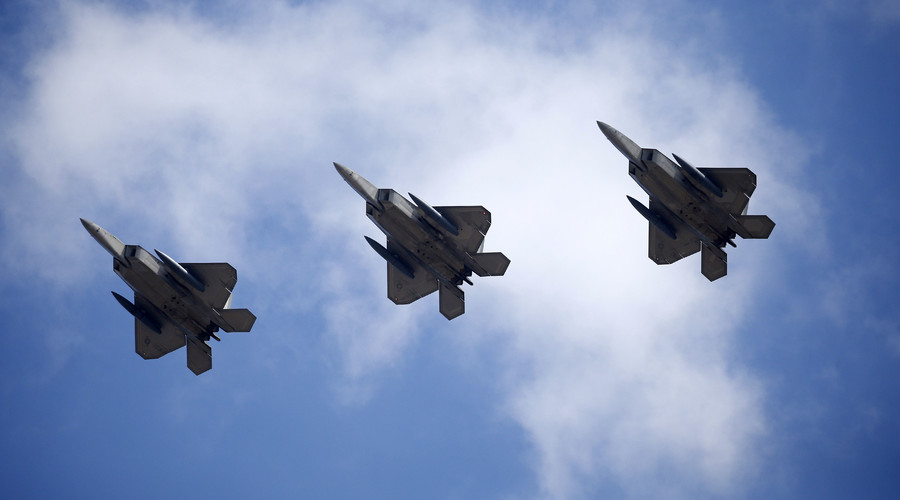
U.S. F-22 stealth fighter jets © Kim Hong-Ji / Reuters

Russia’s Defense Ministry has cautioned the US-led coalition of carrying out airstrikes on Syrian army positions, adding in Syria there are numerous S-300 and S-400 air defense systems up and running.

Russia currently has S-400 and S-300 air-defense systems deployed to protect its troops stationed at the Tartus naval supply base and the Khmeimim airbase. The radius of the weapons reach may be “a surprise” to all unidentified flying objects, Russian Defense Ministry spokesperson General Igor Konashenkov said.

Read more

© Kirill Kallinikov

According to the Russian Defense Ministry, any airstrike or missile hitting targets in territory controlled by the Syrian government would put Russian personnel in danger.

The defense official said that members of the Russian Reconciliation Center in Syria are working “on the ground” delivering aid and communicating with a large number of communities in Syria.

“Therefore, any missile or air strikes on the territory controlled by the Syrian government will create a clear threat to Russian servicemen.”

Russian air defense system crews are unlikely to have time to determine in a ‘straight line’ the exact flight paths of missiles and then who the warheads belong to. And all the illusions of amateurs about the existence of ‘invisible’ jets will face a disappointing reality,”  Konashenkov added.

Read more

© Abdalrhman Ismail

He also noted that Syria itself has S-200 as well as BUK systems, and their technical capabilities have been updated over the past year.

The Russian Defense Ministry’s statement came in response to what it called “leaks” in the Western media alleging that Washington is considering launching airstrikes against Syrian government forces.

“Of particular concern is information that the initiators of such provocations are representatives of the CIA and the Pentagon, who in September reported to the [US] President on the alleged controllability of ‘opposition’ fighters, but today are lobbying for ‘kinetic’ scenarios in Syria,” he said.

He cautioned Washington to conduct a “thorough calculation of the possible consequences of such plans.”

US-led coalition jets bombed positions of the Syrian government forces on September 17, resulting in the deaths of 83 servicemen. Washington said the airstrike was a mistake, however Damascus claimed the incident was a “blatant aggression.”

The relocation of the S-300 system in order to protect Russian ships and the naval base in Syria was confirmed by Russian defense officials on October 4. Konashenkov assured that the S-300 is a “purely defensive system and poses no threat.” Russia also has S-400 missile defense systems at Khmeimim base that were placed there after Turkey downed a Russian SU-24 jet in November of 2015.

U.S. Army Chief Threatens War With Russia

October 5, 2016

U.S. Army Chief Threatens War With Russia “We will beat you harder than you have ever been beaten before”

Paul Joseph Watson – October 5, 2016

Source: U.S. Army Chief Threatens War With Russia » Alex Jones’ Infowars: There’s a war on for your mind!


Army Chief of Staff Gen. Mark Milley warned last night that the United States was ready to “destroy” its enemies in comments that were clearly directed at Russia.

“I want to be clear to those who wish to do us harm….the United States military – despite all of our challenges, despite our [operational] tempo, despite everything we have been doing – we will stop you and we will beat you harder than you have ever been beaten before. Make no mistake about that,” said Milley.

The General went on to warn that Russia and other countries had taken advantage of the U.S. being focused on the war on terror.

“Other countries – Russia, Iran, China, North Korea – went to school on us,” he said, adding, “They studied our doctrine, our tactics, our equipment, our organization, our training, our leadership. And, in turn, they revised their own doctrines, and they are rapidly modernizing their military today to avoid our strengths in hopes of defeating us at some point in the future.”

Milley cautioned that the next major conflict would “be highly lethal, unlike anything our Army has experienced at least since World War II,” and would involve fighting in “highly populated urban areas.”

“Make no mistake about it, we can now and we will … retain the capability to rapidly deploy,” he said, “and we will destroy any enemy anywhere, any time,” he concluded.

Gen. Milley made it clear who he was talking about when he went on to quote a senior Russian official who vowed, “Russia can now fight a conventional war in Europe and win.”

The comments come amidst rising tensions between the two superpowers.

40 million Russians from all sectors of government are currently taking part in a nationwide emergency drill that will wargame “evacuation” procedures during a national crisis.

According to Oleg Manuilov, the director of the Russian Civil Defence Department, the exercise will be a test run of how the population would respond to a “disaster occurrence” under an “emergency” situation.

Last week, Russian officials revealed that huge underground nuclear bunkers had been built to provide shelter for the city’s 12 million population.

A nationwide television station run by the country’s Ministry of Defence also warned citizens last week that nuclear conflict was on the horizon.

“Schizophrenics from America are sharpening nuclear weapons for Moscow,” reported Zvezda.

Obama Warned To Defuse Tensions With Russia, “Unintended Consequences Likely To Be Catastrophic”

October 5, 2016

Obama Warned To Defuse Tensions With Russia, “Unintended Consequences Likely To Be Catastrophic”

Source: Obama Warned To Defuse Tensions With Russia, “Unintended Consequences Likely To Be Catastrophic” | Zero Hedge

A group of ex-U.S. intelligence officials is warning President Obama to defuse growing tensions with Russia over Syria by reining in the demonization of President Putin and asserting White House civilian control over the Pentagon.

ALERT MEMORANDUM FOR: The President


FROM: Veteran Intelligence Professionals for Sanity


SUBJECT: PREVENTING STILL WORSE IN SYRIA


We write to alert you, as we did President George W. Bush, six weeks before the attack on Iraq, that the consequences of limiting your circle of advisers to a small, relatively inexperienced coterie with a dubious record for wisdom can prove disastrous.* Our concern this time regards Syria.


We are hoping that your President’s Daily Brief tomorrow will give appropriate attention to Saturday’s warning by Russia’s Foreign Ministry spokesperson Maria Zakharova: “If the US launches a direct aggression against Damascus and the Syrian Army, it would cause a terrible, tectonic shift not only in the country, but in the entire region.”


Speaking on Russian TV, she warned of those whose “logic is ‘why do we need diplomacy’ … when there is power … and methods of resolving a problem by power. We already know this logic; there is nothing new about it. It usually ends with one thing – full-scale war.”


We are also hoping that this is not the first you have heard of this – no doubt officially approved – statement. If on Sundays you rely on the “mainstream” press, you may well have missed it. In the Washington Post, an abridged report of Zakharova’s remarks (nothing about “full-scale war”) was buried in the last paragraph of an 11-paragraph article titled “Hospital in Aleppo is hit again by bombs.” Sunday’s New York Times totally ignored the Foreign Ministry spokesperson’s statements.


In our view, it would be a huge mistake to allow your national security advisers to follow the example of the Post and Times in minimizing the importance of Zakharova’s remarks.


Events over the past several weeks have led Russian officials to distrust Secretary of State John Kerry. Indeed, Foreign Minister Sergey Lavrov, who parses his words carefully, has publicly expressed that distrust. Some Russian officials suspect that Kerry has been playing a double game; others believe that, however much he may strive for progress through diplomacy, he cannot deliver on his commitments because the Pentagon undercuts him every time. We believe that this lack of trust is a challenge that must be overcome and that, at this point, only you can accomplish this.


It should not be attributed to paranoia on the Russians’ part that they suspect the Sept. 17 U.S. and Australian air attacks on Syrian army troops that killed 62 and wounded 100 was no “mistake,” but rather a deliberate attempt to scuttle the partial cease-fire Kerry and Lavrov had agreed on – with your approval and that of President Putin – that took effect just five days earlier.


In public remarks bordering on the insubordinate, senior Pentagon officials showed unusually open skepticism regarding key aspects of the Kerry-Lavrov deal. We can assume that what Lavrov has told his boss in private is close to his uncharacteristically blunt words on Russian NTV on Sept. 26:


“My good friend John Kerry … is under fierce criticism from the US military machine. Despite the fact that, as always, [they] made assurances that the US Commander in Chief, President Barack Obama, supported him in his contacts with Russia (he confirmed that during his meeting with President Vladimir Putin), apparently the military does not really listen to the Commander in Chief.”


Lavrov’s words are not mere rhetoric. He also criticized JCS Chairman Joseph Dunford for telling Congress that he opposed sharing intelligence with Russia, “after the agreements concluded on direct orders of Russian President Vladimir Putin and US President Barack Obama stipulated that they would share intelligence. … It is difficult to work with such partners. …”


Policy differences between the White House and the Pentagon are rarely as openly expressed as they are now over policy on Syria. We suggest you get hold of a new book to be released this week titled The General vs. the President: MacArthur and Truman at the Brink of Nuclear War by master historian H. W. Brands. It includes testimony, earlier redacted, that sheds light on why President Truman dismissed WWII hero Gen. Douglas MacArthur from command of U.N. forces in Korea in April 1951. One early reviewer notes that “Brands’s narrative makes us wonder about challenges of military versus civilian leadership we still face today.” You may find this new book more relevant at this point in time than the Team of Rivals.


The door to further negotiations remains ajar. In recent days, officials of the Russian foreign and defense ministries, as well as President Putin’s spokesman, have carefully avoided shutting that door, and we find it a good sign that Secretary Kerry has been on the phone with Foreign Minister Lavrov. And the Russians have also emphasized Moscow’s continued willingness to honor previous agreements on Syria.


In the Kremlin’s view, Russia has far more skin in the game than the U.S. does. Thousands of Russian dissident terrorists have found their way to Syria, where they obtain weapons, funding, and practical experience in waging violent insurgency. There is understandable worry on Moscow’s part over the threat they will pose when they come back home. In addition, President Putin can be assumed to be under the same kind of pressure you face from the military to order it to try to clean out the mess in Syria “once and for all,” regardless how dim the prospects for a military solution are for either side in Syria.


We are aware that many in Congress and the “mainstream” media are now calling on you to up the ante and respond – overtly or covertly or both – with more violence in Syria. Shades of the “Washington Playbook,” about which you spoke derisively in interviews with the Atlantic’s Jeffrey Goldberg earlier this year. We take some encouragement in your acknowledgment to Goldberg that the “playbook” can be “a trap that can lead to bad decisions” – not to mention doing “stupid stuff.”


Goldberg wrote that you felt the Pentagon had “jammed” you on the troop surge for Afghanistan seven years ago and that the same thing almost happened three years ago on Syria, before President Putin persuaded Syria to surrender its chemical weapons for destruction. It seems that the kind of approach that worked then should be tried now, as well – particularly if you are starting to feel jammed once again.


Incidentally, it would be helpful toward that end if you had one of your staffers tell the “mainstream” media to tone down it puerile, nasty – and for the most part unjustified and certainly unhelpful – personal vilification of President Putin.


Renewing direct dialogue with President Putin might well offer the best chance to ensure an end, finally, to unwanted “jamming.” We believe John Kerry is correct in emphasizing how frightfully complicated the disarray in Syria is amid the various vying interests and factions. At the same time, he has already done much of the necessary spadework and has found Lavrov for the most part, a helpful partner.


Still, in view of lingering Russian – and not only Russian – skepticism regarding the strength of your support for your secretary of state, we believe that discussions at the highest level would be the best way to prevent hotheads on either side from risking the kind of armed confrontation that nobody should want.


Therefore, we strongly recommend that you invite President Putin to meet with you in a mutually convenient place, in order to try to sort things out and prevent still worse for the people of Syria.


In the wake of the carnage of World War II, Winston Churchill made an observation that is equally applicable to our 21st Century: “To jaw, jaw, jaw, is better than to war, war, war.”

For the Steering Group, Veteran Intelligence Professionals for Sanity

William Binney, former Technical Director, World Geopolitical & Military Analysis, NSA; co-founder, SIGINT Automation Research Center (ret.)

Fred Costello, Former Russian Linguist, USAF

Mike Gravel, former Adjutant, top secret control officer, Communications Intelligence Service; special agent of the Counter Intelligence Corps and former United States Senator

Matthew Hoh, former Capt., USMC, Iraq & Foreign Service Officer, Afghanistan (associate VIPS)

Larry C. Johnson, CIA & State Department (ret.)

John Kiriakou, former CIA counterterrorism officer and former senior investigator, Senate Foreign Relations Committee

Linda Lewis, WMD preparedness policy analyst, USDA (ret.) (associate VIPS)

Edward Loomis, NSA, Cryptologic Computer Scientist (ret.)

Ray McGovern, former US Army infantry/intelligence officer & CIA analyst (ret.)

Elizabeth Murray, Deputy National Intelligence Officer for Middle East, CIA (ret.)

Todd Pierce, MAJ, US Army Judge Advocate (ret.)

Coleen Rowley, Division Counsel & Special Agent, FBI (ret.)

Kirk Wiebe, former Senior Analyst, SIGINT Automation Research Center, NSA, (ret.)

Robert Wing, former Foreign Service Officer

Ann Wright, U.S. Army Reserve Colonel (ret) and former U.S. Diplomat

* In a Memorandum to President Bush criticizing Colin Powell’s address to the UN earlier on February 5, 2003, VIPS ended with these words: “After watching Secretary Powell today, we are convinced that you would be well served if you widened the discussion … beyond the circle of those advisers clearly bent on a war for which we see no compelling reason and from which we believe the unintended consequences are likely to be catastrophic.”

 

Obama Administration Again Deliberates Air Strikes on Assad

October 5, 2016

Obama Administration Again Deliberates Air Strikes on Assad Regime President unlikely to accept military action in Syria

BY:
October 4, 2016 4:46 pm

Source: Obama Administration Again Deliberates Air Strikes on Assad

The Obama administration is again considering air strikes against the regime of Syrian President Bashar al Assad following the failure of a ceasefire deal brokered by the U.S. and Russia.

Top national security officials are meeting with senior administration officials Wednesday to address the ongoing crisis in the rebel-held city of Aleppo. President Obama is expected to reject proposed airstrikes, according to the Washington Post.

Officials from the State Department, CIA, and Joint Chiefs of Staff met last week at the White House to discuss limited military strikes in Syria against the regime to punish Assad for violating the latest ceasefire and continuing to commit war crimes against his people.

Administration officials also hope to pressure Assad into diplomatic talks aimed at ending the country’s civil war, now in its sixth year.

The administration is considering a number of options that include bombing Syrian air force runways, an official participating in the discussions told the Post. The official said the White House would work around its long-standing refusal to strike the Assad regime without a U.N. Security Council resolution by covertly conducting the strikes.

“There’s an increased mood in support of kinetic actions against the regime,” one senior administration official told the Post.

Still, Obama remains unlikely to approve military action against the regime.

The U.S. on Monday suspended bilateral engagement with Russia on negotiating a diplomatic resolution in Syria. Secretary of State John Kerry had worked to restore a week-long ceasefire with Moscow, but talks ultimately fell through given Russia’s continued assault on Aleppo along with Syrian forces.

Iraq demands that Turkey pull its ‘occupying’ troops out of military base near Mosul

October 5, 2016

Iraq demands that Turkey pull its ‘occupying’ troops out of military base near Mosul Published time:

5 Oct, 2016 07:52 Edited time: 5 Oct, 2016 10:07

Source: Iraq demands that Turkey pull its ‘occupying’ troops out of military base near Mosul — RT News

© Asmaa Waguih / Reuters

Outraged by Ankara’s decision to extend the stationing of its troops in northern Iraq, 30 kilometers from Mosul, Iraqi MPs have called on the government to review its relations with Turkey and lodge a complaint against the “occupation” with the UNSC.

On Tuesday, the majority of Iraqi legislators spoke out against the Turkish parliament’s decision to prolong the stationing of about 150 Turkish soldiers and some 25 tanks at the Bashiqa military camp in Iraq’s northern Nineveh Province, which is located at the forefront of the battle with Islamic State (IS, formerly ISIS/ISIL).

Read more

U.S soldiers walk on a bridge with in the town of Gwer northern Iraq © Azad Lashkari

In a written statement, the MPs decried the decision, appealing to the country’s prime minister, Haider al-Abadi, to summon the Turkish ambassador and file a complaint with the United Nations Security Council that would designate Turkey’s military contingent as an “occupying” force, according to Rudaw news agency.

On Saturday, the Turkish parliament green lighted the extension of the Turkish military’s engagement in both Iraq and Syria.

Since 2014, Turkish servicemen have provided training and support to Kurdish Peshmerga units and Sunni militia known as Hashd al-Watani forces at the camp, subject to agreement with the Iraqi government. However, on December 4 of last year, Turkey beefed up its military presence at the camp, allegedly to protect its advisers. The move infuriated Bagdad, which insisted that Turkey had not asked for permission from the Iraqi government to deploy additional troops, thus violating its sovereignty.

Turkish President Recep Tayyip Erdogan refused to acknowledge this at that time, claiming that Turkey was acting within the scope of the previous agreement.

“Turkish soldiers are in Basheeqa camp at the request of Haider al-Abadi in 2014. Now I am asking why he has been silent since 2014,” Erdogan said in December, disputing claims that Turkey was intervening in Iraq.

Read more

© Alaa Al-Marjani

Speaking in the wake of the vote, Abadi publicly called for Turkey’s troops to immediately leave its territory, saying that “the Turkish insistence on their presence inside Iraqi territories has no justification.”

The prime-minister told journalists on Tuesday that Iraq has managed to enlist the support of the ‘international community,’ as well as the US-led international coalition, in its bid to remove the Turkish military from its territory.

While Iraq doesn’t want to be dragged into a military conflict with Turkey, it finds the actions of its government “not acceptable by any standard,” he added.

Turkish Deputy Prime Minister Numan Kurtulmus stressed on Wednesday that Turkey’s military presence in the Bashiqa camp is intended solely to provide stability and train the local forces, and that Ankara does not aim to become an occupying force.

Turkey will not allow this to become a matter of debate,” he told reporters as cited by Reuters.

Both Turkey and Iraq summoned each other’s ambassadors on Wednesday to discuss the growing rift between the two states.

Turkey’s foreign ministry also condemned the vote, the Daily Sabah reported.

READ MORE:French fighter jets take off on mission against ISIS stronghold in Mosul, Iraq

Back in December, Iraq appealed to NATO to force Turkey to withdraw its forces, but the alliance found Ankara to be in compliance with the terms of the training agreement.

Iraq’s largest city, Mosul, fell into the hands of Islamic State in 2014, and Iraqi forces are currently preparing an offensive to retake the terrorist stronghold, aided by US-led anti-terrorism coalition.

If the operation is successful, Iraq wants to “ensure Turkish troops do not exploit the power vacuum after achieving victory against Islamic State in Mosul,” Abadi has stressed.

Moscow delivers S-300 missile system to Syria for defense of Russian naval base

October 4, 2016

Moscow delivers S-300 missile system to Syria for defense of Russian naval base

Published time: 4 Oct, 2016 15:33 Edited time: 4 Oct, 2016 16:02

Source: Moscow delivers S-300 missile system to Syria for defense of Russian naval base — RT News

© Kirill Kallinikov / Sputnik

A battery of Russian S-300 air defense missile launchers has been transported to Syria, Russia’s Defense Ministry said in a statement. Its sole purpose is to defend a Russian naval base and warships, the ministry added.
Read more

The Russian Embassy in Damascus. © Mikhail Alaeddin

The information about the S-300’s deployment was confirmed by ministry spokesman Igor Konashenkov.

“Indeed, the Syrian Arab Republic received an S-300 anti-aircraft missile system. This system is designed to ensure the safety of the naval base in [Syrian city of] Tartus and ships located in the coastal area [in Syria]…” he told the media.

Konashenkov said it is unclear why the deployment of the missile system has created such a fuss in the West.

“The S-300 is a purely defensive system and poses no threat,” he said.

He recalled that before the deployment of S-300, Russia had delivered Fort air defense missile systems to Syria.

The statement comes after a report by Fox news that a Russian S-300 was deployed to Syria. The media cited three US officials who claimed that Moscow “continues to ramp up its military operations in Syria.”

In November 2015, Moscow deployed its newest S-400 air defense missile system to Khmeimim in Syria as part of a security boost following the downing of a Russian jet by Turkey near the border with that country. At the time, Russian President Vladimir Putin said that the S-400 systems are not targeting Russia’s partners, “with whom we fight terrorists in Syria together.”

The S-400 is the most advanced anti-aircraft defense system in Russia.

Russian embassy in Damascus shelled from terrorist-controlled area of Syria

October 4, 2016

Russian embassy in Damascus shelled from terrorist-controlled area of Syria

Published time: 4 Oct, 2016 10:26 Edited time: 4 Oct, 2016 12:33

Source: Russian embassy in Damascus shelled from terrorist-controlled area of Syria — RT News

The Russian embassy in Damascus came under fire on Tuesday from a neighborhood controlled by militant groups, including Al-Nusra Front, the Russian Foreign Ministry reports.
Read more

Al Qaeda-linked Nusra Front fighters © Stringer

One of the mortar shells fired at the embassy complex hit the residential area, while two others landed near the embassy building, the ministry said in a statement. Nobody was injured by the explosions.

“According to reports, the shelling came from the Jobar neighborhood of Damascus, which is under control of the terrorist groups Jabhat Fateh al-Sham and Failak ar-Rahman,” the ministry said.

Jabhat Fateh al-Sham is the new name taken by Al-Nusra Front, the Al-Qaeda offshoot universally considered a terrorist organization. Failak ar-Rahman is a lesser-known Islamist group.

Moscow said the shelling is “result of the actions of those who, like the US and some of its allies, provoke the continued bloodshed in Syria and flirt with militants and extremists of all flavors.”

The ministry said Russia would take “all necessary measures” to return peace and security to Syria.

READ MORE: 30 killed, scores injured in suicide bombing at Kurdish wedding in Syria

The Russian embassy in Damascus has come under militant fire on several occasions. The Syrian capital remains under threat despite the efforts of the army to fend off armed groups.

Putin signs decree suspending Russia-US deal on plutonium disposal over hostile US actions

October 3, 2016

Putin signs decree suspending Russia-US deal on plutonium disposal over hostile US actions

Published time: 3 Oct, 2016 08:23 Edited time: 3 Oct, 2016 16:48

Source: Putin signs decree suspending Russia-US deal on plutonium disposal over hostile US actions — RT News

And so it goes, lets trow in another Nobel peace price, priceless !

20/30 years negotiating trough the drain, and having fun already ?


Russia has suspended a post-Cold War deal with the US on disposal of plutonium from decommissioned nuclear warheads. The decision was explained by “the hostile actions of the US” against Russia and may be reversed, if such actions are stopped.

A decree signed by Russian President Vladimir Putin cites “the radical change in the environment, a threat to strategic stability posed by the hostile actions of the US against Russia, and the inability of the US to deliver on the obligation to dispose of excessive weapons plutonium under international treaties, as well as the need to take swift action to defend Russian security” as justification for suspending the deal.

While Russia suspended the plutonium reprocessing deal, it stressed that the Russian fissile material, which was subject to it, would not be used for any military purpose, be it production of new weapons or research.

The suspension decree has come into force, but it needs to be approved by the Russian parliament, which may overrule the president’s decision. Leonid Slutsky, who’s slated to be appointed head of the Foreign Relations Committee in the newly-elected parliament, said it would be given a priority.

“It’s a very important issue. It’s about taking swift action to protect Russian national security. We will deal with it as soon as the bill is submitted,” he told TASS.

A bill submitted by the president’s office to the parliament on Monday states that the uranium agreement may be resumed, provided the US takes steps to eliminate the causes of the suspension. In particular, Moscow wants Washington to curb its military presence on the territories of NATO members which have joined the alliance after September 1, 2000, to the number at which they were at the moment of signing the agreement, Russian media report.

The draft bill also mentions repeal of the so-called Magnitsky law and of sanctions against Russian regions, persons and companies introduced by the US over Ukrainian crisis, while also paying compensation for damages caused by them, including the damages caused by the counter-sanctions that Russia was forced to impose.

The Magnitsky Act is a 2012 US law intended to punish a number of Russian citizens believed to be linked to the death in custody of Russian lawyer Sergey Magnitsky.

Moscow also wants Washington to provide a clear plan how it is going to irreversibly reprocess plutonium under the agreement’s conditions.

Russian Foreign Minister Sergey Lavrov later said in a statement that Russia’s suspension of the agreement is “a forced measure.” According to the minister, Moscow has always viewed the Russia-US deal on plutonium disposal as an important step to nuclear disarmament.

“Unfortunately, in recent years the US has made a number of unfriendly steps towards Russia. In particular, under false pretexts, Washington introduced large-scale economic and other sanctions against Russia,” he said. “The US has started the build-up of its military forces and NATO infrastructure close to Russia’s borders. Washington and its allies openly talk about ‘restraining’ Russia.”

Lavrov added that Russia’s move “is a signal to Washington”:

“Trying to talk with Russia using strength, the language of sanctions and ultimatums, and still maintain selective cooperation with our country only in those areas where it is beneficial for the US, won’t work,” he added.

The development was not entirely surprising, since Russia earlier expressed its dissatisfaction with how the US wants to handle plutonium reprocessing.

Washington decided it would be cheaper to mix nuclear materials with special diluents. Russia insisted that the US was violating the terms of the deal, which required it to use a nuclear reactor to transmute plutonium. Unlike the mixing technology, the latter method makes the process irreversible.

The treaty between the US and Russia, which regulates how the two countries are to dispose of plutonium from nuclear warheads decommissioned as part of the parallel reduction of the two countries’ Cold War arsenals, was signed in 2000. Each country was required to dispose of over 34 tons of fissile material by turning it into so-called MOX fuel and burning it in nuclear reactors.

READ MORE: Why Russia can’t rely on US as partner against terrorism in Syria (OP-ED)

However, costs for building a facility at the Savannah River Site in South Carolina, where the US was supposed to fabricate MOX fuel from its plutonium, spiraled out of control. Under the Obama administration, the US decided that it would instead use the cheaper reversible process, arguing that it was in line with the spirit of the deal with Russia.

Russia expressed its concerns over the unilateral move in April, shortly after a nuclear security summit held in the US.

“We signed an agreement that the plutonium will be processed in a certain way, for which facilities would be purpose-built,” Putin said at the time. “We have met our commitments, and constructed the necessary facilities. The US has not.”

The US rejected the criticism from Russia. The “new US method would not require renegotiation of the agreement,” US State Department spokesperson Jennifer Bavisotto said.