Posted tagged ‘Russia’

Syrian Rebels Seize Russian Spy Station Near Israeli Border

October 7, 2014

Syrian Rebels Seize Russian Spy Station Near Israeli Border, Daily BeastJosh Rogin, October 7, 2014

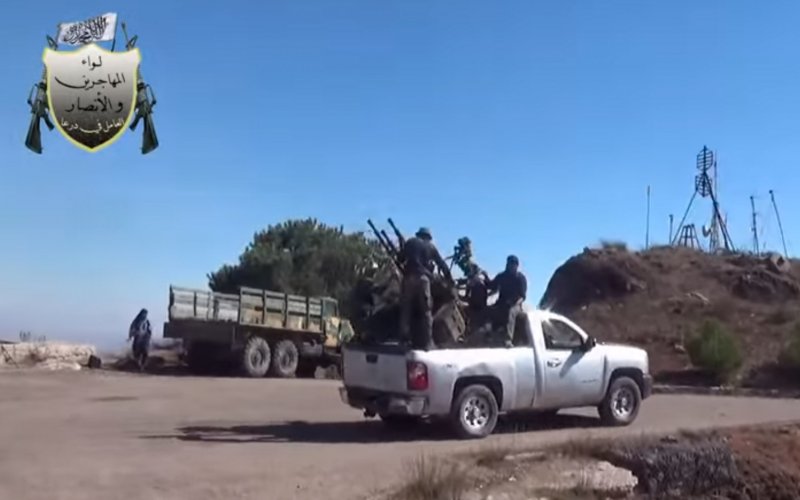
Russian spy baseYouTube

The FSA found photos and lists of senior Russian intelligence and military officials who visited the facility, pictures of Russian personnel running the base, and maps showing the location of Israeli military units. Israeli news reports earlier this year said the Russian government had upgraded an advanced surveillance and intelligence gathering station in that area which could snoop on Israel, large parts of Jordan, and western Iraq, potentially to warn Iran in advance of an Israeli strike. Initial reports said documents from the facility suggested the Russian equipment was used to spy on Israel, Saudi Arabia and Jordan

***************

When the Free Syrian Army pushed Assad’s soldiers out of a town south of Damascus, the last thing they expected to find was a Russian spy post, a few miles from the Golan Heights.

Syrian rebels have overtaken a joint Russian-Syrian secret facility that they claim was a covert intelligence collection base. Opposition fighters say the post was used to snoop in on the communications of opposition groups — and perhaps even the nearby Israelis.Free Syrian Army officials, U.S. officials, and independent experts told The Daily Beast that the evidence of Russian involvement in the facility, just a few miles from Syria’s border with Israel, if verified, would show a level of Russian involvement in the Syrian civil war that was not previously known.

Free Syrian Army officials posted several videos on YouTube showing both the outside and the inside of the facility, which the FSA captured over the weekend during a battle near Al Harah, south of Damascus, next to the Golan Heights.

The videos and accompanying photos show insignias representing a branch of Syrian intelligence and the Russian Osnaz GRU radio electronic intelligence agency. The FSA found photos and lists of senior Russian intelligence and military officials who visited the facility, pictures of Russian personnel running the base, and maps showing the location of Israeli military units. Israeli news reports earlier this year said the Russian government had upgraded an advanced surveillance and intelligence gathering station in that area which could snoop on Israel, large parts of Jordan, and western Iraq, potentially to warn Iran in advance of an Israeli strike. Initial reports said documents from the facility suggested the Russian equipment was used to spy on Israel, Saudi Arabia and Jordan.

U.S. defense officials told The Daily Beast the photos of the Russian insignia first shared on blogs were legitimate. But that evidence, at the same time, may not necessarily mean the facility captured by the opposition was controlled by Russia’s military; it could just mean that Russians were working there, as advisors or partners to Syrian troops.

Mark Galeotti, an expert on Russia’s military and intelligence services at New York University said the term “Osnaz” on the insignia just meant a special unit of any kind. “It’s the kind of unit that the Russians would have had there because Syria is not the easiest area to operate in, they are an element of the radio-technical intelligence boys who do this.”

Firas Al Hawrani, the official spokesman for the FSA in southern Syria, told The Daily Beast Monday that FSA forces had seen about 15 Russian personnel operating in the Al Harah area before the FSA took the facility, but they left before the area fell out of regime control.

“The Russians who were at the Al Harah mountain, the regime took them to Damascus by plane two weeks ago,” he said.

Galeotti said these Russian advisers would specifically be working on intercepting radio communications of opposition figures. “They would be running an operation for detailed radio technical intelligence, we are not talking about intercepting telemetry and aircraft,” he said. “This is for eavesdropping on rebel radio communications. Cell communications are easier identified through other means. And this is also for identifying the presence of these units, which leads directly into targeting.”

Russia has been one of Syria’s most important allies for years. The port of Tartus is Russia’s only naval base on the Mediterranean, for example. And since the civil war in the country broke out in 2011, Russia has provided the country with advisers and billions of dollars’ worth of heavy military equipment. Galeotti said Syria’s security services are good as “traditional secret police skills,” such as interrogation and bugging telephones. The facility taken over by the Syrian opposition, however, suggests the Russians gave the regime “a whole new capability,” Galeotti said. “A lot of the Syrians are very clumsy. Some of the more precise attacks in the last year have suggested a new sophistication.”

Sen. John McCain told The Daily Beast Monday that the apparent Russian involvement in the base, which was also reportedly tasked with collecting signals intelligence and communications of rebel groups, showed of the depth of Moscow’s collusion with Damascus in the Syrian civil war.

“If what they’ve recovered is true and I have no reason to believe it’s not, it really is very indicative of the significant involvement of Russia in this conflict,” he said. “It shows significant coordination, establishment of a facility they could use for coordination and intelligence capabilities including intercepts. It’s a pretty sophisticated operation there that they’ve uncovered.”

Meanwhile, in Northern Syria, ISIS continued a major assault on the city of Kobani near the Turkish border as Kurdish and tribal forces tried to repel them. Dr. Najmaldin Karim, the governor of Kirkuk, was in Washington last week asking U.S. officials to expand the airstrikes in both Iraq and Syria and to increase aid to the Kurdish forces in both countries.

Not only is ISIS advancing in Northern Syria, they are digging in their positions in several Iraqi cities, including Mosul and Ramadi, Karim told The Daily Beast in an interview. Gen. John Allen, whom President Obama appointed to coordinate the international coalition against ISIS, said in Baghdad that the drive to free key cities like Mosul may take as long as a year.

“A lot of the front lines are basically frozen,” said Karim. “The worst thing would be for the United States, the region, and for Iraq, would be if the situation stays like this and festers. These guys have been there since June. If it goes further, it becomes a way of life. It will become like Somalia.”

Off topic: Ex-NSA Director, US Intelligence Veterans Write Open Letter To Merkel To Avoid All-Out Ukraine War

September 2, 2014

via Ex-NSA Director, US Intelligence Veterans Write Open Letter To Merkel To Avoid All-Out Ukraine War | Zero Hedge.

Ex-NSA Director, US Intelligence Veterans Writes Open Letter To Merkel to Avoid All-Out Ukraine War

Alarmed at the anti-Russian hysteria sweeping Washington, and the specter of a new Cold War, U.S. intelligence veterans one of whom is none other than William Binney, the former senior NSA crypto-mathematician who back in March 2012 blew the whistle on the NSA’s spying programs more than a year before Edward Snowden, took the unusual step of sending the following memo dated August 30 to German Chancellor Merkel challenging the reliability of Ukrainian and U.S. media claims about a Russian “invasion.”

Via AntiWar and ConsortiumNews, highlights ours

MEMORANDUM FOR: Angela Merkel, Chancellor of Germany
FROM: Veteran Intelligence Professionals for Sanity (VIPS)
SUBJECT: Ukraine and NATO

We the undersigned are longtime veterans of U.S. intelligence. We take the unusual step of writing this open letter to you to ensure that you have an opportunity to be briefed on our views prior to the NATO summit on September 4-5.

You need to know, for example, that accusations of a major Russian “invasion” of Ukraine appear not to be supported by reliable intelligence. Rather, the “intelligence” seems to be of the same dubious, politically “fixed” kind used 12 years ago to “justify” the U.S.-led attack on Iraq. We saw no credible evidence of weapons of mass destruction in Iraq then; we see no credible evidence of a Russian invasion now. Twelve years ago, former Chancellor Gerhard Schroeder, mindful of the flimsiness of the evidence on Iraqi WMD, refused to join in the attack on Iraq. In our view, you should be appropriately suspicions of charges made by the US State Department and NATO officials alleging a Russian invasion of Ukraine.

President Barack Obama tried yesterday to cool the rhetoric of his own senior diplomats and the corporate media, when he publicly described recent activity in the Ukraine, as “a continuation of what’s been taking place for months now … it’s not really a shift.”

Obama, however, has only tenuous control over the policymakers in his administration – who, sadly, lack much sense of history, know little of war, and substitute anti-Russian invective for a policy. One year ago, hawkish State Department officials and their friends in the media very nearly got Mr. Obama to launch a major attack on Syria based, once again, on “intelligence” that was dubious, at best.

Largely because of the growing prominence of, and apparent reliance on, intelligence we believe to be spurious, we think the possibility of hostilities escalating beyond the borders of Ukraine has increased significantly over the past several days. More important, we believe that this likelihood can be avoided, depending on the degree of judicious skepticism you and other European leaders bring to the NATO summit next week.

Experience With Untruth

Hopefully, your advisers have reminded you of NATO Secretary General Anders Fogh Rasmussen’s checkered record for credibility. It appears to us that Rasmussen’s speeches continue to be drafted by Washington. This was abundantly clear on the day before the U.S.-led invasion of Iraq when, as Danish Prime Minister, he told his Parliament: “Iraq has weapons of mass destruction. This is not something we just believe. We know.”

Photos can be worth a thousand words; they can also deceive. We have considerable experience collecting, analyzing, and reporting on all kinds of satellite and other imagery, as well as other kinds of intelligence. Suffice it to say that the images released by NATO on August 28 provide a very flimsy basis on which to charge Russia with invading Ukraine. Sadly, they bear a strong resemblance to the images shown by Colin Powell at the UN on February 5, 2003 that, likewise, proved nothing.

That same day, we warned President Bush that our former colleague analysts were “increasingly distressed at the politicization of intelligence” and told him flatly, “Powell’s presentation does not come close” to justifying war. We urged Mr. Bush to “widen the discussion … beyond the circle of those advisers clearly bent on a war for which we see no compelling reason and from which we believe the unintended consequences are likely to be catastrophic.”

Consider Iraq today. Worse than catastrophic. Although President Vladimir Putin has until now showed considerable reserve on the conflict in the Ukraine, it behooves us to remember that Russia, too, can “shock and awe.” In our view, if there is the slightest chance of that kind of thing eventually happening to Europe because of Ukraine, sober-minded leaders need to think this through very carefully.

If the photos that NATO and the US have released represent the best available “proof” of an invasion from Russia, our suspicions increase that a major effort is under way to fortify arguments for the NATO summit to approve actions that Russia is sure to regard as provocative. Caveat emptor is an expression with which you are no doubt familiar. Suffice it to add that one should be very cautious regarding what Mr. Rasmussen, or even Secretary of State John Kerry, are peddling.

We trust that your advisers have kept you informed regarding the crisis in Ukraine from the beginning of 2014, and how the possibility that Ukraine would become a member of NATO is anathema to the Kremlin. According to a February 1, 2008 cable (published by WikiLeaks) from the US embassy in Moscow to Secretary of State Condoleezza Rice, US Ambassador William Burns was called in by Foreign Minister Sergey Lavrov, who explained Russia’s strong opposition to NATO membership for Ukraine.

Lavrov warned pointedly of “fears that the issue could potentially split the country in two, leading to violence or even, some claim, civil war, which would force Russia to decide whether to intervene.” Burns gave his cable the unusual title, “NYET MEANS NYET: RUSSIA’S NATO ENLARGEMENT REDLINES,” and sent it off to Washington with IMMEDIATE precedence. Two months later, at their summit in Bucharest NATO leaders issued a formal declaration that “Georgia and Ukraine will be in NATO.”

Just yesterday, Ukrainian Prime Minister Arseny Yatsenyuk used his Facebook page to claim that, with the approval of Parliament that he has requested, the path to NATO membership is open. Yatsenyuk, of course, was Washington’s favorite pick to become prime minister after the February 22 coup d’etat in Kiev. “Yats is the guy,” said Assistant Secretary of State Victoria Nuland a few weeks before the coup, in an intercepted telephone conversation with US Ambassador to Ukraine Geoffrey Pyatt. You may recall that this is the same conversation in which Nuland said, “Fuck the EU.”

Timing of the Russian “Invasion”

The conventional wisdom promoted by Kiev just a few weeks ago was that Ukrainian forces had the upper hand in fighting the anti-coup federalists in southeastern Ukraine, in what was largely portrayed as a mop-up operation. But that picture of the offensive originated almost solely from official government sources in Kiev. There were very few reports coming from the ground in southeastern Ukraine. There was one, however, quoting Ukrainian President Petro Poroshenko, that raised doubt about the reliability of the government’s portrayal.

According to the “press service of the President of Ukraine” on August 18, Poroshenko called for a “regrouping of Ukrainian military units involved in the operation of power in the East of the country. … Today we need to do the rearrangement of forces that will defend our territory and continued army offensives,” said Poroshenko, adding, “we need to consider a new military operation in the new circumstances.”

If the “new circumstances” meant successful advances by Ukrainian government forces, why would it be necessary to “regroup,” to “rearrange” the forces? At about this time, sources on the ground began to report a string of successful attacks by the anti-coup federalists against government forces. According to these sources, it was the government army that was starting to take heavy casualties and lose ground, largely because of ineptitude and poor leadership.

Ten days later, as they became encircled and/or retreated, a ready-made excuse for this was to be found in the “Russian invasion.” That is precisely when the fuzzy photos were released by NATO and reporters like the New York Times’ Michael Gordon were set loose to spread the word that “the Russians are coming.” (Michael Gordon was one of the most egregious propagandists promoting the war on Iraq.)

No Invasion – But Plenty Other Russian Support

The anti-coup federalists in southeastern Ukraine enjoy considerable local support, partly as a result of government artillery strikes on major population centers. And we believe that Russian support probably has been pouring across the border and includes, significantly, excellent battlefield intelligence. But it is far from clear that this support includes tanks and artillery at this point – mostly because the federalists have been better led and surprisingly successful in pinning down government forces.

At the same time, we have little doubt that, if and when the federalists need them, the Russian tanks will come.

This is precisely why the situation demands a concerted effort for a ceasefire, which you know Kiev has so far been delaying. What is to be done at this point? In our view, Poroshenko and Yatsenyuk need to be told flat-out that membership in NATO is not in the cards – and that NATO has no intention of waging a proxy war with Russia – and especially not in support of the ragtag army of Ukraine. Other members of NATO need to be told the same thing.

For the Steering Group, Veteran Intelligence Professionals for Sanity

  •     William Binney, former Technical Director, World Geopolitical & Military Analysis, NSA; co-founder, SIGINT Automation Research Center (ret.)
  •     David MacMichael, National Intelligence Council (ret.)
  •     Ray McGovern, former US Army infantry/intelligence officer & CIA analyst (ret.)
  •     Elizabeth Murray, Deputy National Intelligence Officer for Middle East (ret.)
  •     Todd E. Pierce, MAJ, US Army Judge Advocate (Ret.)
  •     Coleen Rowley, Division Counsel & Special Agent, FBI (ret.)
  •     Ann Wright, Col., US Army (ret.); Foreign Service Officer (resigned)

Ukraine president warns Europe nearing ‘point of no return’

August 31, 2014

Ukraine president warns Europe nearing ‘point of no return’

Poroshenko calls for strong response to ‘military aggression’ in his country, while Barroso laments ‘serious’ situation,

Sunday 31 August 2014 00.12 BST

via Ukraine president warns Europe nearing ‘point of no return’ | World news | theguardian.com.


Petro Poroshenko and José Manuel Barroso meet in Brussels to discuss crisis in Ukraine Photograph: Itar-Tass/Barcroft


The European Union has warned that the apparent incursion of Russian troops on Ukrainian soil pushes the conflict closer to a point of no return, with new economic sanctions being drawn up to make Moscow reconsider its position.

The Ukrainian president, Petro Poroshenko, who briefed a summit of the 28-nation EU’s leaders in Brussels, said a strong response was needed to the “military aggression and terror” facing his country.

“Thousands of foreign troops and hundreds of foreign tanks are now on the territory of Ukraine,” Poroshenko told reporters in English. “There is a very high risk not only for peace and stability for Ukraine, but for the whole peace and stability of Europe.”

However, because several EU nations fear the fallout of sanctions on their own economies, it wasn’t immediately clear whether the required unanimity would be reached for immediate punitive measures, or whether the leaders would set Russia another ultimatum.

Lithuanian leader Dalia Grybauskaite insisted Russia’s meddling in Ukraine, which seeks closer ties with the EU, amounts to a direct confrontation that requires stronger sanctions. “Russia is practically at war against Europe,” she said, also in English. Calling on EU countries to supply Kiev with military equipment, she went on: “That means we need to help Ukraine to … defend its territory and its people and to help militarily, especially with the military materials to help Ukraine defend itself because today Ukraine is fighting a war on behalf of all Europe.”

Nato estimates that at least 1,000 Russian soldiers are in Ukraine even though Russia denies any military involvement in the fighting that has according to the UN claimed 2,600 lives.

David Cameron also warned that Europe cannot be complacent about Russian troops on Ukrainian soil. “Countries in Europe shouldn’t have to think long before realising just how unacceptable that is,” he said. “We know that from our history. So consequences must follow.”

Poroshenko told reporters that he believed efforts to halt the violence were “very close to a point of no return,” warning that failure could lead to a “full-scale war.”

Conceding ground in the face of a reinvigorated rebel offensive, Ukraine said Saturday that it was abandoning a city where its forces have been surrounded by rebels for days. Government forces were also pulling back from another it had claimed to have taken control of two weeks earlier. The Ukrainian military also reported that one of its fighter jets had been shot down by Russian anti-aircraft fire, although the pilot managed to eject to safety.

The statements by Col Andriy Lysenko, a spokesman for the national security council, indicate that Ukrainian forces face increasingly strong resistance from Russian-backed separatist rebels just weeks after racking up significant gains and forcing rebels out of much of the territory they had held.

The office of the Donetsk mayor reported in a statement that at least two people died in an artillery attack on one of Donetsk’s neighborhoods. Shelling was also reported elsewhere in the city.

Poroshenko said Ukraine would welcome an EU decision to help with military equipment and further intelligence-sharing.

In Brussels, European Commission President Jose Manuel Barroso said “sanctions are not an end in themselves,” but a means to dissuade Russia from further destabilising Ukraine.

“If the escalation of the conflict continues, this point of no return can come.”

He provided no specifics about which sanctions the heads of state and government might adopt to inflict more economic pain to nudge Russia toward a political solution.

Grybauskaite added that an arms embargo on Russia should be tightened by including a halt on sales under existing contracts – a thinly-veiled swipe at France, which has resisted calls to cancel a deal to sell Moscow a strategic new warship. This came after the German vice-chancellor, Sigmar Gabriel, told journalists: “It is clear that after this intervention by Russia in Ukraine … EU leaders will certainly task the European commission with preparing the next level of sanctions.”

“We see regular Russian army units operating offensively on the Ukrainian territory against the Ukrainian army. We must call a spade a spade,” said the Swedish foreign minister, Carl Bildt.

All options except military action will be considered to punish Russia for pursuing “the wrong path”, said Jean Asselborn, Luxembourg’s foreign minister.

According to Agence France-Presse (AFP), Putin held late-night discussions about Ukraine with the French president, François Hollande, and Barroso.

Kiev and Moscow had agreed to hold high-level discussions between army leadership and border control agencies, and an official told AFP that heads of border control will meet on Saturday. “They will discuss measures to protect Ukrainian territory from breaches by militants and equipment,” Sergiy Astakhov, an aide to the head of Kiev’s border service, said.

UN figures suggest that fighting between Ukrainian military forces and Russian-backed separatists in eastern Ukraine has already claimed at least 2,200 lives.

Nato estimates that there are at least 1,000 Russian soldiers in Ukraine, while Kiev claimed this week that Russian tanks and armoured vehicles entered the country as rebels opened a new front along the Azov Sea coast. Russia consistently denies that its forces are in Ukraine and allegations that it is supplying the rebels.

Until this week, the fighting had been concentrated inland. But rebels have taken control of the town of Novoazovsk, with the apparent aim of pushing further west along the coast connecting Russia to the Crimean peninsula.

Allying With Iran Is Putin’s Ace in the Hole

August 19, 2014

Allying With Iran Is Putin’s Ace in the Hole, The Moscow TimesJosh Cohen, August 19, 2014

5437-Web-cohen

[P]erhaps the most damaging step Putin could take against Western interests would be to undermine the P5+1 [the five permanent members of the United Nations Security Council plus Germany] negotiations aimed at limiting Iran’s nuclear program.

**********

As Moscow considers new ways of responding to Western sanctions, both existing and potential, the Kremlin has a range of economic and political options at its fingertips.

In addition to its current ban on importing U.S. and EU foodstuffs, a ban on the import of foreign cars may also be in the works. President Vladimir Putin could also retaliate by prolonging Ukraine’s gas cutoff and ratcheting up tensions in other states with substantial ethnic Russian populations such as Estonia and Latvia.

But perhaps the most damaging step Putin could take against Western interests would be to undermine the P5+1 [the five permanent members of the United Nations Security Council plus Germany] negotiations aimed at limiting Iran’s nuclear program.

Six months of dialogue between Iran and the West recently failed to yield any agreement, and despite the fact that negotiations with Iran were extended until November, the two sides remain distant.

The West’s major leverage against Tehran stems from its sanctions, which have cut Iran off from the global financial system and inflicted severe hardship on the Iranian economy and its people. Sanctions were instrumental in bringing the ayatollahs to the negotiating table, and these sanctions have remained largely in place during the ongoing P5+1 Iranian nuclear negotiations.

But Russia has never been fully on board with the move to isolate Iran, and Moscow has already warned the West that it could play the “Iran card.”

Speaking in March about Western sanctions after a P5+1 meeting in Geneva, Deputy Foreign Minister Sergei Ryabkov said: “We wouldn’t like to use these talks as an element of the game of raising the stakes … but if they force us into that, we will take retaliatory measures here as well.”

Ryabkov’s subsequent statement that the “reunification of Crimea with Russia is incomparable to what we are dealing with in the Iranian issue” only emphasizes how differently the West and Russia evaluate the danger of a nuclear-armed Iran.

The Iranians are well aware that the Ukraine crisis could strengthen Iran’s negotiating position. Hossein Mousavian, a former spokesman for Iran’s nuclear negotiators, recently wrote: “Logic follows that Russia will play Iran’s nuclear card [against the West]. Great economic rewards may also result from Russia cultivating closer relations with Iran.”

Moscow has now taken concrete steps to play Mousavian’s “nuclear card,” signing a memorandum of understanding with Tehran to implement a $20 billion “oil for goods” accord.

While the details of the memorandum are still vague, previous reports noted that Iran would supply Russia up to 500,000 barrels a day of Iranian oil, and in exchange Iran would import Russian power and pump equipment, steel products such as pipes, machinery for its leather and textile industries, wood, wheat, pulses, oilseeds and meat.

Cliff Kupchan, a Russia specialist at the Eurasia Group, noted in Time magazine that the oil-for-goods accord “gives Iran momentum and confidence to adopt a harder position at the talks. Hard-liners now have a more plausible argument that Iran can survive economically if talks fail.”

The U.S. has already responded to Moscow’s oil-for goods deal with alarm. David Cohen, the Treasury Department’s undersecretary for terrorism and financial intelligence, has threatened additional sanctions against Russia should Moscow move forward in implementing the deal, saying: “It is almost certain that any entity involved in the deal would open themselves up to certainly U.S. sanctions and possibly others.”

The oil-for-goods deal is not the only way Russia could undermine Western interests in Iran. Russia and Iran have had ongoing discussions about the construction of additional nuclear reactors for Iran by Rosatom, the Russian state energy company. This pact strengthens Iran’s case against the West that it should be permitted to enrich more uranium on its own soil, as the construction of additional reactors would increase the amount of fuel Iran needs.

And while the oil-for-goods deal and the construction of additional reactors certainly has the potential to strengthen Iranian hard-liners opposed to a deal with the West, Russia holds one card in reserve that trumps even these.

In 2007, Russia signed a contract with Iran to supply it with its sophisticated S-300 anti-aircraft missiles. Described by the International Assessment and Strategy Center as “one of the most lethal, if not the most lethal, all altitude area defense SAM systems in service,” it can be deployed within minutes, track 100 aircraft approaching from 300 kilometers away, fire two missiles every three seconds and engage up to 36 planes simultaneously.

Although Russia suspended the delivery of the S-300 systems to Iran in 2010 in response to U.S. pressure, Putin could retaliate against the West by allowing the sale to go through — a decision that could change the balance of power in the Middle East.

In a speech before the UN General Assembly last year, Israeli Prime Minister Benjamin Netanyahu said Israel could never accept a nuclear-armed Iran, and the Jewish state has made clear that it will act on its own against Iran’s nuclear program if necessary. Israel’s vaunted air force — the IAF — would be the lead actor in an Israeli strike on Iran’s nuclear facilities.

But according to Kupchan, the S-300 “is the one card that they [the Russians] have. … The S-300 can be a game changer; it would reduce Israel’s ability to attack Iran.”

If Russia were on the cusp of delivering S-300s to Iran, it is very possible that Israel would choose to strike Iran before the missile system were installed. Tehran could retaliate by taking any number of steps, from mining the Straits of Hormuz to launching missiles at the oil fields of U.S. allies such as Saudi Arabia and Kuwait. The Middle East — if not the world — would be thrown into economic turmoil.

The S-300s thus represent Putin’s ultimate ace in the hole, should he wish to retaliate asymmetrically against Western sanctions. Would Putin actually risk such an outcome?

The Russian president has proven to be nothing if not unpredictable, and if the pressure from the West against Russia continues to mount, the West may find that Putin has his own trump card to play.

After shunning Europe, Russia turning to Israel for fruit imports

August 16, 2014

After shunning Europe, Russia turning to Israel for fruit importsIsrael, in danger of losing business over Gaza war, gains a client interested in shunning Europe.

By Ora Coren | Aug. 13, 2014 | 9:10 PM

via After shunning Europe, Russia turning to Israel for fruit imports – Business Israel News | Haaretz.


An Israeli Clementine orange. Photo by Tomer Appelbaum
 

Russia is interested in increasing its fruit imports from Israel, after deciding to boycott imports from Europe as part of the ongoing diplomatic spat between Russia and the West.

This development comes as buyers in Gaza, Jordan and some European nations have started refusing to buy Israeli mangoes due to Operation Protective Edge. Most recently, a buyer for a supermarket chain in Montreal announced that it would not be buying Israeli fruit.

Amir Porat, marketing manager for Adom Fruits, which exports primarily pomegranate and mango, said that as opposed to the Montreal buyer, his buyers in Canada are still interested in Israeli produce.

“My customer is happy to receive Israeli products, he’s clearly pro-Israel and very satisfied with the produce,” said Porat. He acknowledged that not all Canadians may feel that way, however.

Due to the tension between Russia and Europe, and Russia’s decision to halt imports from Europe, Israel has been asked to increase exports of fruits, specifically apples and plums, said Porat.

“Unfortunately, the Russian market isn’t a big consumer of mangoes, so it can’t replace the declining demand from Europe,” said Porat.

Porat noted that lower European demand could be tied to an excess of produce there created by the Russian boycott, and not necessarily due to anti-Israel sentiments in Europe.

Meanwhile, Israeli importers and exporters are reconsidering ties with Turkey as relations with that nation sour.

The Foreign Ministry has recommended against flights to Turkey, and businesses are reconsidering their ties there. While Turkish businesses have said they are interested in continuing to work with Israelis, some Israelis are considering leaving the Turkish market, particularly importers and exporters of medical equipment.

“You can’t keep up a relationship by e-mail and phone,” said Eli Cohen, CEO of Termokir Industries, which imports gypsum, a construction material, from Turkey.

Cohen said he recently canceled two work trips to Turkey.

1st Cavalry soldiers headed to Poland, Baltics

August 15, 2014

1st Cavalry soldiers headed to Poland, Baltics

By Jon Harper

Stars and Stripes Published: August 13, 2014

via 1st Cavalry soldiers headed to Poland, Baltics – News – Stripes.


WASHINGTON — Approximately 600 soldiers from the Army’s 1st Brigade, 1st Cavalry Division will deploy to Poland and the Baltic states to help reassure European allies who feel threatened by Russian military moves, the Pentagon announced Wednesday.

The troops and their equipment — which include M-1 Abrams tanks, infantry fighting vehicles, and armored personnel carriers — will go to Europe in October for a three-month series of training exercises.

The soldiers, based at Fort Hood, Texas, are replacing about 600 paratroopers from the Army’s 173rd Airborne Brigade, which is based in Vicenza, Italy. The “Sky Soldiers” have been conducting exercises with Poland, Latvia, Lithuania and Estonia since April as part of ongoing Operation Atlantic Resolve.

“These land training exercises … help foster interoperability through small unit and leader training,” Pentagon spokesman Col. Steve Warren said.

In addition to ground forces, the U.S. has also sent F-16 combat aircraft to Poland and participated in NATO air policing missions over the Baltics.

The exercises came at the request of host nations that fear a resurgent Russia, which annexed the Crimea region of Ukraine earlier this year and continues to support a pro-Russia separatist movement in eastern Ukraine.

For months, the Russian military has massed forces along the border with Ukraine and provided advanced weaponry and other assistance to the rebels. In recent days, Moscow has announced its intention to send a convoy of trucks into Ukraine to deliver what it says is humanitarian aid to separatist-held areas under pressure from Ukrainian government forces.

Kiev has said it will allow Russian humanitarian aid into the affected region, but only if it is delivered by the International Red Cross. Russia wants to deliver the supplies directly.

Ukrainian and Western officials are concerned that the alleged humanitarian mission might be a ruse to enable Russia to provide more military help to the separatists.

On Tuesday, Warren warned that Russian aid convoys could be a “Trojan horse.”

harper.jon@stripes.com
Twitter: @JHarperStripes

EU signs pacts with Ukraine, Georgia and Moldova

June 27, 2014

GMTEU signs pacts with Ukraine, Georgia and Moldova

27 June 2014  Last updated at 10:23

via BBC News – EU signs pacts with Ukraine, Georgia and Moldova.


Mr Poroshenko (C) said the pact was a “symbol of faith and unbreakable will”
 

Ukraine, Georgia and Moldova have signed partnership agreements with the European Union, in a move strongly opposed by Russia.

The pact – which would bind the three countries more closely to the West both economically and politically – is at the heart of the crisis in Ukraine.

Russian President Vladimir Putin said making Ukraine choose between Russia and the EU would split it in two.

A ceasefire with pro-Russian rebels in east Ukraine is due to end on Friday.

Mr Putin called for a long-term ceasefire to allow talks between the government and separatists.

Meanwhile the United Nations refugee agency said there had been a sharp rise in the numbers of displaced people in eastern Ukraine in the past week, with 16,400 people fleeing the area.

The total number internally displaced has reached 54,400, while a further 110,000 people left Ukraine for Russia this year.
line
Analysis: Steve Rosenberg, BBC News Moscow

There is a general sense of irritation or perhaps even anger here that Moscow has failed to convince countries like Ukraine, Moldova and Georgia not to sign this historic free trade deal today with the EU.

Moscow has economic concerns about these deals – it is worried that the Russian market could be flooded by cheap goods from the EU that would hit Russian producers.

More pressing for Moscow are the geopolitical concerns here – the whole idea of former Soviet states, countries that Moscow still views as being within its sphere of influence, drifting towards Europe and one day possibly becoming part of the EU – that really grates with Moscow, particularly in the case of Ukraine.

There’s a lot of concern about what could happen in eastern Ukraine – the ceasefire announced a few days ago by Mr Poroshenko, and the ceasefire announced by armed separatist rebels, is due to expire today. It’s unclear how things are going to develop later.