Posted tagged ‘Russia’

Syrian civilians helping Russian airstrikes target ISIS

October 18, 2015

Syrian civilians helping Russian airstrikes target ISIS – Defense Ministry

Published time: 17 Oct, 2015 11:50 Edited time: 17 Oct, 2015 12:33

Source: Syrian civilians helping Russian airstrikes target ISIS – Defense Ministry — RT News

Russian Su-25 attack aircraft take off from the Khmeimim airbase in Syria. © Dmitriy Vinogradov

Russian Su-25 attack aircraft take off from the Khmeimim airbase in Syria. © Dmitriy Vinogradov / RIA Novosti

Russian warplanes have bombed a training camp in Syria where foreign instructors trained potential suicide bombers, the Russian defense ministry said. It was one of 49 terrorist targets hit by the Russian Air Forces over the day.

“Not far from Salma in Latakia province, a Su-24M bomber delivered a strike at a building, which was used as a terrorist training ground. According to intelligence, there were ISIL foreign instructors, who were training people, including suicide bombers, for guerrilla warfare in areas liberated by the Syrian army,” ministry spokesman Maj. Gen. Igor Konashenkov said.

He added that the facility had its own explosives workshop, which was also destroyed by an airstrike.

Russian warplanes conducted 36 combat sorties on Saturday and attacked 49 militant targets in Syria, including command points, weapons workshops, firing positions, depots and fortified bunkers, Konashenkov added.

The general said that the terrorist group Islamic State (IS, formerly known as ISIS/ISIL), which suffered serious damage from Russian bombings, is working to rebuild its infrastructure.

“The militants’ new tactics is to spread their supply and command facilities, but it does not work. All their new infrastructure objects are being identified and destroyed,” he said.

READ MORE: Russia offers US ‘broader cooperation’ in Syria, but Washington not ready – Defense Ministry

Konashenkov said the civilian population in the areas under terrorist group’s control are aiding the Russian airstrikes by providing intelligence about IS to the Syrian government.

“This information is double-checked by our aviation group with various technical means of reconnaissance. Following this, a decision is made on which objects we should target,” he said.

Russia is providing air support to Syrian government troops, which are currently undertaking an offensive to retake villages and cities captured by terrorist groups. Moscow says its goal is to stabilize the situation in the country enough to allow political dialogue between Damascus and moderate opposition to start.

Senior Al-Qaeda leader killed in Syria airstrike

October 18, 2015

Senior Al-Qaeda leader killed in Syria airstrike

Published time: 17 Oct, 2015 16:17

Source: Senior Al-Qaeda leader killed in Syria airstrike — RT News

© Abdalrhman Ismail
A senior leader from Al-Nusra Front, Al-Qaeda’s branch in Syria, has been reportedly killed alongside two other members of the terrorist group in the province of Aleppo.

Sanafi Al-Nasr, who was allegedly killed in an airstrike near the town of Dana, was Al-Qaeda’s senior strategist and an important power broker, the Iranian Fars news agency reports, citing jihadist sources close to the killed militant leader.

Al-Nusra released several photos showing a car hit by an air strike along with several bodies of the dead militants, although their identities were not verified. However, jihadists claimed on social media that Al-Nasr had been killed.

Other photos published by the terrorist organization show the alleged graves of Al-Nasr and two other militants who were killed in an airstrike.

The death of Sanafi Al-Nasr, whose real name was Abdul Mohsen Abdallah Ibrahim Al-Charekh, was also confirmed by the Britain-based Syrian Observatory for Human Rights, who claimed the jihadist leader was killed on Thursday.

Al-Nasr, who was born in Saudi Arabia, was a member of Al-Qaeda’s so-called “Victory Committee” that was responsible for developing and implementing the group’s strategy and policies.

The jihadists did not specify if he was killed in a Russian airstrike or in an attack carried out by the US-led coalition. Some militants claimed on social media, it was a ‘Crusader coalition’ that delivered the strike.

Russian warplanes have been hitting militants’ positions near Aleppo for several days. On Thursday, they targeted a total of 32 militant positions in several provinces including Aleppo, the Russian defense Ministry spokesman, Igor Konashenkov said.

On Saturday, Russian planes struck 49 jihadists’ targets in the provinces of Idlib, Hama, Latakia, Damascus, and Aleppo. “As a result of airstrikes, 11 command centers and control posts of the militants have been destroyed,” Konashenkov said.

An explosives workshop, three artillery positions, nine ammunition depots, two military equipment bases and 15 terrorist camps were also hit during the latest strikes, the ministry said.

The US-led coalition also conducted three airstrikes in Syria near Aleppo on Thursday targeting tactical units and an explosive device cluster, Reuters reports citing the coalition’s statement.

The Syrian army and Hezbollah fighters have started a major operation in the Aleppo province with Russia’s air support. They have already recaptured several villages and towns in the province.

Whoever Controls Eurasia Controls the World

October 16, 2015

Whoever Controls Eurasia Controls the World The battle over Syria is part of a much larger – and longer-term – struggle for global hegemony.

Hans-Christof Kraus

Source: Whoever Controls Eurasia Controls the World

There’s far more at stake than just Syria

This article originally appeared in Frankfurter Allgemeine Zeitung. Translated from German by Nils Hansen


One can only be astounded at the scope of almost criminal naïveté, or even just plain ignorance, shown by many who are judging the Syrian crisis – in particular when it comes to revealing the background motives behind the tough game of tug-of-war in the UN Security Council, between America and the western powers on the one side and China and Russia on the other.

If one were to follow the narrative of the conflict in large parts of the western world, then the heart of the matter would seem to be only the question of whether or not the Syrian people could eventually be freed from a cruel dictator. Particularly in Germany, the lack of awareness seems to be limitless in the current discussion of this contest – up to the point of an alleged (although not confirmed) enquiry to the Russian government as to whether Russia would be ready to grant asylum to Assad should he be overthrown.

However, very different issues are at the core of this matter. The lines of conflict run where most German observers fail to notice them – chiefly because they have forgotten how to think in global-political and geostrategic terms. Viewed from a global-political angle, it is in the first instance irrelevant from the perspective of geostrategic considerations, whether the Syrians will be now, or in the future, ruled either by a dictator of the house of Assad, by a democratic government or at least one pretending to be democratic, or a radical Muslim regime.

A division into ‘World Island’ and ‘Heartland’

Around and after the year 1900, the world, the entire global land surface, was divided and mostly under the political reign of the Europeans and the Americans, the geostrategic thinkers of that time developed a completely new idea for global politics going forward.

The Anglo-Saxons, even though they in particular seemed invulnerable, for the first time had a reason to fear for their position in the world. British geographer and politician Halford Mackinder, shortly before the onset of the First World War, developed his extraordinarily momentous doctrine of the inferiority of the maritime global powers.

Whereas previously the maxim posed by American military historian Alfred T. Mahan had applied, stating the unassailability of globally acting maritime powers, Mackinder asserted the contrary.
In his new analysis of the world’s land surface, he assigned the sea powers to the ‘Outer Insular Crescent’, while conceiving of Europe, Asia and Africa collectively as a gigantic supercontinent which he dubbed the ‘World Island’.

The core of this World Island was supposed to be the ‘Pivot Area’, which he found to be in northern and central Asia. According to Mackinder, seven out of eight of the world’s population were situated in the ‘Pivot Area’ and its surroundings, , as well as by far the largest share of globally available raw materials. Thus, the future rulers of the world were bound to be not the Anglo-Saxon maritime powers, so Mackinder argued, but possibly the very power (or group of powers) that would succeed in bringing the ‘Pivot Area’ completely under their control.

The debate about the worlds-politically decisive region on the earth

Not only the strong Anglo-Saxon distrust in the communist Soviet Union in the interwar period, but also the inexorably led war by America and Great Britain, fought to unconditional surrender against the two axis powers Germany and Japan, who were threatening the ‘Pivot Area’ from West and East, can only be understood against the backdrop of this geopolitical conception:

The nightmare of a pivot area jointly controlled by Germany and Japan, or by Germany alone in the worst case, in the heart of Eurasia. This situation had to be averted using all possible means. This was the primary and most important war aim of Roosevelt and Churchill, to which everything else was subordinated.

Still, before the end of the war, Mackinder’s teachings about the meaning of the pivot area were improved upon and slightly altered. Nicholas Spykman, the most significant American geo-politician of his time, had developed during the war the theory that it was not actually the ‘Pivot Area’, but rather its bordering area, the ‘Rim Land’, which was the geopolitically decisive region of the world. This ‘Rim Land’ reaches from Scandinavia across Central Eastern Europe, Turkey, the Arab and Near Eastern countries and India, to Indochina, Korea as well as Eastern and Northern China.

This was to be the truly decisive region of the World Island, of the whole Eurasian continent, and he who would succeed in subjugating the ‘Rim Land’ with its enormous population and undeletable stock of raw materials, would be the ruler of the earth or at least have the ability to force it’s will upon other powers, in particular upon the traditional maritime powers.

A ban on interventions by powers from outside the region?

Based not least of all on the premises of these fundamental analyses by Spykman, who died in 1943, it became the post-war foreign policy of the United States to ultimately abandon its traditional isolationism and henceforth develop into an active driver of world politics.

For the era of the Cold War in any case it can be said that almost all of the main conflict lines between East and West have been located in the regions of this wide ‘Rim Land’ between Finland in the West and Korea in the East. Most wars of the post-WWII period, from the Korean War to the Middle-Eastern and Gulf wars to the Vietnam conflict, have taken place in this very zone.

The counter theory to Mackinder and Spykman in terms of geopolitics and international law dates back perhaps even longer; its core it can be found in the American Monroe Doctrine of 1823; borrowing the title from a well-known oeuvre of the 20th century, it could be called an “International Legal Order for Large Regions with a Ban on Interventions by Powers from Outside” (the title of a book written by Carl Schmitt).

Admittedly, this model did not work out at the time of its creation; and especially with a view to the importance of the ‘Rim Land’ and the heart land, the Americans have neither recognised, nor accepted, a ban on interventions outside of their own American hemisphere (in any case if it was directed against their own interests).

The primary goal is not to protect the Syrian people

Quite the opposite: after 1945, the Americans have repeatedly intervened in those places where they deemed it necessary to strengthen their own position of power. The oil affluent and strategically crucial region between the eastern Mediterranean and the Arab Sea has made this area in particular, a main field of action for American foreign policy. The recent Iraq war, the occupation of Afghanistan and the opaque actions in north-eastern Pakistan, which are by no means legitimate by International Law, are the result of this policy.

The current conflict about an intervention, or non-intervention into the Syrian civil war is so explosive because this question is the manifestation of the antagonism between two radically different geostrategic and world political concepts.

The Americans and the Western side are not particularly concerned with helping the pitiable Syrian people, but rather with influencing the reshaping of the country after an anticipated overthrow of the current regime. Even though the US and its Western partners have been able to work well with the Syrian government in the past, several long-planned oil and gas pipelines of paramount importance for the West are at stake. These pipelines are designed to connect Saudi Arabia and Qatar to the eastern Mediterranean area and Turkey and therefore are, at least partially, to cross Syrian territory.

The tables have turned

The Russians and Chinese have a different perspective. The Russian Mediterranean military base, situated in the Syrian port of Tartus, is also at stake – just like the general power/political position of Moscow and Beijing in the Middle and Near East. The prospect of a possible military conflict between Israel and Iran makes it inevitable that the two largest Asian powers will be present there.

It cannot yet be foreseen which of the two sides will prevail, as the Americans have oftentimes in the past ignored UN resolutions when they deemed it necessary for the advancement of their own interests. The undeclared war against Iraq, which led to the fall of Saddam Hussein’s regime, was only grudgingly accepted by Moscow and Beijing – in the end only because they did not dare to stand more decisively against the only highly armed world power at the time.

Today, the tables have turned: Due to severe home-made economic problems, themselves connected to a strongly over-expansionist foreign policy and military engagement, the United States finds itself in a considerably weakened position. A military intervention in Syria on their part, for this reason alone, seems hardly probable.

The die is not yet cast

Therefore the government in Washington must interpret the veto by Beijing and Moscow, now voiced three consecutive times, with which a UN resolution against the Syrian regime has been averted, as a serious warning. It appears that China and Russia perceive themselves in a common position of co-dominance over the South Asian realm, and their fierce ‘no’ against an intervention by western powers in Syria can well be seen in the sense of a political-international-legal doctrine of an, at least hinted at, ban on interventions by powers from outside the region, directed chiefly at America.

The government in Washington would hardly be able to accept such a ban if it is meant seriously. Because, as a consequence, it would mean the ultimate surrender of its political-economic influence, possibly even of military intervention, in the regions of the ‘Rim Land’. Washington cannot, simply in their very own interest, afford to leave these Eurasian Rim Land regions to their fate, let alone to the two Asian world powers.

Therefore, one can derive from the scope, the course, and, as can be foreseen, the soon materialising consequences of the Syrian conflict, the current distribution of geopolitical power potentials is like using a concave mirror. The die is not yet cast. Yet the geostrategic global players hold these things in their hands.

Hans-Christof Kraus teaches recent and modern history at the University of Passau.

U.S. Official Bemoans Russian Destruction Of “Our” Terrorists

October 16, 2015

U.S. Official Bemoans Russian Destruction Of “Our” Terrorists

October 15, 2015

Source: M of A – U.S. Official Bemoans Russian Destruction Of “Our” Terrorists

U.S. Official Bemoans Russian Destruction Of “Our” Terrorists

Some U.S. official is whining because his flock of bastards gets hurt:

“Putin is deliberately targeting our forces,” a U.S. official, who is disappointed in the U.S. response to Russia, told Fox News.”Our guys are fighting for their lives,” said the official, estimating up to 150 CIA-trained moderate rebels have been killed by the Russians.

“Our forces”, “our guys” – hmm. The official is referring to the CIA-mercenaries who are fighting under al-Qaeda’s command:

Advancing alongside the Islamist groups, and sometimes aiding them, have been several of the relatively secular groups, like the Free Syrian Army, which have gained new prominence and status because of their access to the TOWs.Even in smaller quantities, the missiles played a major role in the insurgent advances that eventually endangered Mr. Assad’s rule. While that would seem like a welcome development for United States policy makers, in practice it presented another quandary, given that the Nusra Front was among the groups benefiting from the enhanced firepower.

It is a tactical alliance that Free Syrian Army commanders describe as an uncomfortable marriage of necessity, because they cannot operate without the consent of the larger and stronger Nusra Front.

The “official” should go to jail for, at least, indirectly arming and supporting the terrorists of Jabhat al-Nusra aka al-Qaeda in Syria.

Under U.S. domestic law Obama justifies his attacks on the Islamic State in Syria (which is illegal under international law) with reference to the Authorization for Use of Military Force Against Terrorists as passed by the United States Congress on September 14, 2001. According to that AUMF:

That the President is authorized to use all necessary and appropriate force against those nations, organizations, or persons he determines planned, authorized, committed, or aided the terrorist

If that is the relevant legal code to fight the Islamic State then this even more so applies to Jabhat al-Nusra as it is loyal to the original al-Qaeda organization.

What Russia does, fighting on behalf of the legal government of Syria after having been asked to do so, is not only legal under international law but it is also easily justifiable by the same U.S. domestic law which the U.S. president applies to fight the Islamic State.

That whining official should recognize that a. what “his forces” do is illegal under U.S. law b. what Russia does with “his guys” is legal even under U.S. law and c. that there is always a moral hazard when using such proxy forces.

When the CIA send some idiots to invade Cuba where they were killed or capture it could do nothing and did nothing to protect them because that would have started a much bigger war. This is the same case here. These forces will be destroyed and there is nothing the U.S. can or will do about that. If you are sentimental about the fate of mercenaries and if you do not want this to happen do not use proxy forces but be man enough to go yourself.

Posted by b on October 15, 2015 at 01:51 PM | Permalink

Russian Warplanes Have Destroyed 456 ISIL Targets in Syria Since Sept. 30

October 16, 2015

Russian Warplanes Have Destroyed 456 ISIL Targets in Syria Since Sept. 30

16:06 16.10.2015 (updated 17:12 16.10.2015)

Source: Russian Warplanes Have Destroyed 456 ISIL Targets in Syria Since Sept. 30

Russian warplanes in Syria have destroyed a total of 456 ISIL targets since the operation began on September 30, the Russian General Staff said Friday.

Russian warplanes in Syria have destroyed a total of 456 ISIL targets since the operation began on September 30, the Russian General Staff said Friday.Over the past week, they have carried out 394 sorties, destroying 46 command and communication posts, 6 explosives manufacturing facilities, 22 warehouses and fuel depots, along with 272 militant positions, strongpoints and field camps, Colonel-General Andrei Kartapolov, head of the Main Operations Directorate of the Russian General Staff, told journalists during a briefing.

“Most armed formations are demoralized. There is growing discontent with field commanders, and there is evidence of disobedience. Desertion is becoming widespread,” Kartapolov told reporters.

Around 100 extremists cross the Syria-Turkey border each day, Kartapolov said citing intelligence data, adding that evidence suggests the militants are leaving combat zones through refugee routes.

“I would like to point out once again, our aircraft carry out strikes against the militants infrastructure based on data provided through several intelligence channels as well as intel supplied by the information center in Baghdad,” Kartapolov said, referring to accusations that Russian warplanes had hit targets other than ISIL.

“We only attack targets held by internationally-recognized terrorist groups. Our warplanes do not operate in the southern regions of Syria where, according to our intel, units of the Free Syrian Army operate,” Kartapolov said.

Kartapolov said some of the airstrikes carried out by the US-coalition target civil facilities.

“It is against our principles to advise our colleagues which targets to strike. However, on October 11 a power plant and an electrical substation were destroyed by coalition warplanes in the vicinity of Tell-Alam,” he told foreign military attaches and journalists attending the briefing.

“It looks like someone is deliberately destroying the civilian infrastructure in population centers making them unfit for habitation. Because of that civilians are fleeing these towns and contribute to the flow of refugees to Europe,” Kartapolov noted.

At the same time, he stressed that Russia had repeatedly asked coalition members to share intelligence on ISIL positions, but none of these requests were met.

“When we didn’t receive the ISIL forces coordinates, we requested our partners to provide us data about regions held by moderate opposition. Unfortunately, our partners didn’t provide a coherent answer to any of our questions,” Kartapolov said.

“So we went ahead and created a comprehensive map of areas controlled by ISIL, based on our intel and on data provided by the information center in Baghdad,” he went on to say.

He added that Russia and US are about to sign an agreement to provide for the safety of their aircraft over Syria. “All the technicalities have been agreed on. Russian and US lawyers are checking the text which we hope will be signed soon,” Kartapolov said.

Russia started precision airstrikes against ISIL targets in Syria on September 30, following a request from Syria’s internationally recognized government. The Russian airstrikes hit targets that are chosen based on intelligence collected by Russia, Syria, Iraq and Iran.

Top China paper says U.S., Russia playing Cold War game in Syria

October 16, 2015

Top China paper says U.S., Russia playing Cold War game in Syria

Tue Oct 13, 2015 12:39am EDT

Source: Top China paper says U.S., Russia playing Cold War game in Syria | Reuters

China’s top newspaper on Tuesday accused both the United States and Russia of replaying their Cold War rivalry by engaging in military action in Syria, saying they needed to realize that era is over and should instead push for peace talks.

The People’s Daily, the official paper of China’s ruling Communist Party, said in a commentary that the United States and Russia seemed to be using Syria as a proxy for diplomatic and military competition, as during the Cold War.

“The United States and the Soviet Union used all sorts of diplomatic, economic and military actions on the soil of third countries, playing tit-for-tat games to increase their influence – it’s an old scene from the Cold War,” the newspaper wrote in a commentary.

“But we’re in the 21st century now, and people need to get their heads around this!,” it added.

While China generally votes with fellow permanent United Nations Security Council member Russia on the Syria issue, it has expressed concern about interference in Syria’s internal affairs and repeatedly called for a political solution.

Russia last month began striking targets in Syria in a dramatic escalation of foreign involvement in the civil war. This has been criticized by the West as an attempt to prop up Syrian President Bashar al-Assad, rather than its purported aim of attacking Islamic State.

The United States and its allies have also been carrying out air strikes in Syria against Islamic State, and have supported opposition groups fighting Assad.

The People’s Daily said nobody should stand by while Syria becomes a proxy war, and efforts to reach a peaceful settlement to the crisis should not slacken.

“The international community, especially large countries with much influence, must fully recognize the critical, urgent necessity to reach a political solution to the Syria issue,” it said.

The commentary was published under the pen name “Zhong Sheng”, meaning “Voice of China”, often used to give views on foreign policy.

China, a low-key diplomatic player in the Middle East despite its dependence on the region for its oil, has repeatedly warned that military action cannot end the crisis.

(Reporting by Ben Blanchard; Editing by Richard Borsuk)


John McCain ‘Guaranteed’ Two Years Ago Russia Wouldn’t Act in Syria

October 16, 2015

WATCH: John McCain ‘Guaranteed’ Two Years Ago Russia Wouldn’t Act in Syria

00:38 16.10.2015(updated 01:26 16.10.2015)

Source: WATCH: John McCain ‘Guaranteed’ Two Years Ago Russia Wouldn’t Act in Syria

Not exactly known for his accurate military predictions, US Senator John McCain was once firmly convinced that Russia would never act in Syria. Oops.

 Back in 2013, Russia, China, and Iran all warned the United States of the devastating consequences that would occur if it began airstrikes in Syria. Destabilizing the legitimate government of President Bashar al-Assad would lead to the inevitable rise of terrorist groups like the self-proclaimed Islamic State.

Arizona Senator John McCain, however, could not foresee this. And he was dead wrong about the future in other ways, as well.

It doesn’t concern me in the slightest,” McCain said in 2013, when asked if he was worried about a Russian and Chinese intervention in Syria. “Because they will not act.”

“The United States is the most powerful nation in the world, and we’re not going to be intimidated by Russia and China,” he added. “We are not, so I guarantee you that they will not act.”

Flash forward two years and the United States is, indeed, being intimidated. Beijing’s construction of artificial islands in the Spratly archipelago is forcing Washington to scramble together alliances in the Pacific.

But, more importantly, Russia’s anti-terror campaign in Syria has forced the United States to completely rethink its regional strategy. Airstrikes have devastated IS militants, and since the bombing began on September 30, Russian support is already helping to stabilize a nation thoroughly wrecked by the United States and its allies.

On Thursday, reports surfaced that a Russian airstrike killed Abu Bakr al-Shishani, a prominent leader of the Ahrar ash-Sham terrorist group.

“A group of militants, including the leader of Jaish al-Sham terrorist group, Chechen native Abu Bakr al-Shishani, was eliminated on October 14 as a result of a Russian airstrike in the Homs province,” a Syrian military source told Sputnik.

McCain, at least, is not in denial. Recognizing Russia’s success, the senator wrote an op-ed for CNN on Wednesday.

“Vladimir Putin must be stopped,” he wrote.

At least he didn’t risk his reputation by writing “Putin will be stopped,” because that would be…another false prediction.

Russia, Israel, Hamas & ISIL: Putting Together the Pieces of the Puzzle

October 15, 2015

Russia, Israel, Hamas & ISIL: Putting Together the Pieces of the Puzzle

21:40 15.10.2015(updated 21:47 15.10.2015)

Source: Russia, Israel, Hamas & ISIL: Putting Together the Pieces of the Puzzle

Speaking to Radio Sputnik on Thursday, Israeli political analyst Avigdor Eskin attempted to explain Israel’s motivations in the war against ISIL.

Commenting on Hamas’s role in the war, Eskin recalled that Hamas is an offshoot of the Muslim Brotherhood, adding that “the Muslim Brotherhood is, in a sense, partially ISIS,” with some of their members “turning to ISIS: It happened in Iraq, it happened in Syria, when certain significant numbers of their people decided to become more radical.”

In the case of Hamas, as you know, this organization was aided largely by Syria and Iran up until a couple of years ago, and their military headquarters were sustained in Damascus…And what they did when the civil war started was to turn their weapons against the government of Syria. Therefore the government of Syria –Assad and Iran today are very unhappy with Hamas –they fight Hamas. And Hamas people in Syria joined ISIS. Therefore, today we cannot separate Hamas from ISIS.”

As far as Israel’s position toward ISIL is concerned, Eskin noted that “Israel is definitely threatened by ISIS, and has helped Yazidis and the Kurds in Iraq since the beginning of the fighting there. Israel was the first to assist them in their fight against ISIS. Thus, Israel has been fighting ISIS in indirect ways since shortly after ISIS came into existence.”

Citing the recent arrests of ISIL-affiliated would-be terrorists in Moscow, Eskin emphasized that today, “everybody is threatened by ISIS. As far as Israel is concerned, the one thing I can say is that the country is trying not to interfere in Syrian affairs, since there are still anti-Israeli sentiments in the Arab world…the involvement of Israel could undermine Russian efforts, so Israel just needs to keep quiet about the situation in Syria. Let Russia and President Assad do the job. But on the other hand, Israel is assisting indirectly by helping the Yazidis and the Kurds to destroy ISIS in Iraq.”

The analyst noted that “one thing is clear: terrorism is terrorism. And it’s important that the West will help Russia, President Assad and Israel instead of criticizing, instead of undermining their efforts and spreading information which is not correct.”

Commenting on the assessment that Israel may actually benefit from the existence of ISIL, Eskin suggested that this was a “disturbed way of thinking,” adding that “ISIS is a group which wants to destroy Israel, and acts against Israel, and from the very beginning supports the idea that Israel should not exist in the Middle East, so how can anyone be benefiting?”

US defense chief: we will deter Russia’s ‘malign and destabilizing influence’

October 15, 2015

US defense chief: we will deter Russia’s ‘malign and destabilizing influence’ Ash Carter says US will not cooperate as long as Russia pursues a ‘misguided strategy’ in Syria but Moscow says it has been rebuffed in calls for consultation

Source: US defense chief: we will deter Russia’s ‘malign and destabilizing influence’ | World news | The Guardian

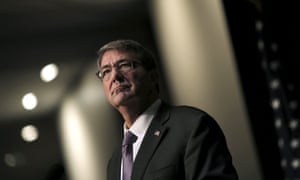
Ash Carter
Carter said the US ‘will take all necessary steps’ to counter Russian ‘influence, coercion and aggression’. Photograph: Carlos Barria/Reuters

The US defense chief has vowed to take “all necessary steps” against a resurgent Russia which is challenging a frustrated Washington in eastern Europe and the Middle East.

Ash Carter, the US defense secretary, said the Russian president, Vladimir Putin, had wrapped his country in a “shroud of isolation” which only a drastic change in policy could reverse.

“We will take all necessary steps to deter Russia’s malign and destabilising influence, coercion and aggression,” Carter said, attacking Russian military intervention in Ukraine and Syria.

The speech at a US army convention on Wednesday included some of the strongest language yet by the Obama administration, which came into office determined to “reset” relations with Russia and move them in a more cooperative direction.

Carter said that as long as Russia pursued a “misguided strategy” in Syria to bolster its client Bashar al-Assad, “we have not, and will not, agree to cooperate with Russia”.

Meanwhile, Russia claimed that the United States snubbed its overtures for high-level consultations on Syria, refusing to send a delegation to Moscow or receive a high-ranking Russian delegation.

On Tuesday, Putin said he wanted to send a delegation led by the Russian prime minister, Dmitry Medvedev, to the US. Moscow said the suggestion was first raised during a meeting between Putin and Barack Obama on the sidelines of the UN general assembly last month.

“Literally today, we got an official reply,” the foreign minister, Sergei Lavrov, said on Wednesday. “We have been told that they can’t send a delegation to Moscow and they can’t host a delegation in Washington either.”

Putin’s spokesman, Dmitry Peskov, said on Wednesday evening: “Given the current situation in Syria, refusing dialogue does not help to save the country and region from the Islamic State.”

There was no immediate response to the claim from US officials, though the accusation stands in contrast to two weeks of unresolved requests from the Pentagon to the Russian defence ministry for a clear procedure to avoid midair conflict.

While the US Defense Department last week held out hope for “deconfliction”, three rounds of talks have yet to result in clear rules for US and Russian pilots and their commanders, despite a series of undisclosed proposals and counterproposals. A third video conference made “progress” on Wednesday, and was described as “focused narrowly on the implementation of specific safety procedures” by a Pentagon spokesman, Captain Jeff Davis.

Lavrov said on Wednesday that agreement was close and procedures “should become operational any day now”.

The diplomatic disagreement over the international community’s response to the Syrian war reflects the positions of two distinct coalitions with divergent goals. Russia, Iran and the Syrian regime of the dictator Assad have accelerated a military offensive against Assad’s Syrian enemies.

The pro-Assad coalition is reportedly aiming to retake Aleppo in the coming days, with Russian warplanes supporting Iranian ground forces.

The US and much of the west are focused instead on a relatively slower campaign against the Islamic State, which formally opposes Assad but has turned its attention to consolidating its hold on eastern Syria and north-western Iraq.

On the one hand, Russia has been using its entrance into the Syria theatre to regain diplomatic clout after isolation following its actions in Ukraine, with Putin meeting with Obama in New York on the sidelines of the UN general assembly meeting, and the latest attempt to send a negotiating group to Washington.

On the other hand, when the strategy has failed, Putin has not shied from going it alone, launching the air campaign in Syria just two days after his speech at the UN calling for a coalition, and giving the US just an hour’s notice, via diplomats in Baghdad.

“I believe some of our partners simply have mush for brains,” Putin said, complaining that the US did not appear to have a firm set of goals in Syria.

In the balance for the US is the Iraqi government, which pivots between US and Iranian sponsorship. The Iraqi government of Haider Abadi, installed with the aid of the US last year, has begun flirting with the Russian-Iranian-Assad coalition in frustration with what it considers insufficient US support against Isis.

Iraq now hosts an intelligence fusion centre with Russian, Syrian and Iranian liaisons and reportedly has begun using situational awareness generated from the centre to bomb Isis positions.

Russia has said it would be willing to consider expanding its airstrikes to Iraq but only if it was asked to do so by Iraqi authorities.

The US has made clear it will not participate in the intelligence centre, out of concern that its Russian and Iranian adversaries would gain access to US information; the US maintains its own independent intelligence cell with the Iraqis. The Iraqi defence ministry has provided “assurances that our information will be appropriately protected”, Warren said on 1 October.

Meanwhile Carter said that he did not know if Putin would take “the opportunity to change course”.

“From the Kamchatka peninsula through south Asia, into the Caucasus and around to the Baltics, Russia has continued to wrap itself in a shroud of isolation. And only the Kremlin can decide to change that.”

Russia and US Close to Agreement on Flights Over Syria

October 15, 2015

Russia and US Close to Agreement on Flights Over Syria

14:27 15.10.2015(updated 18:36

Source: Russia and US Close to Agreement on Flights Over Syria

Over the past 24 hours, Russian warplanes completed 33 sorties in Syria, striking ISIL facilities in the provinces of Idlib, Hama, Damascus, Aleppo, and Deir az-Zor, the Russian Defense Ministry said Thursday.

 Russia and the United States are moving closer to a possible agreement to provide for the safety of their aircraft over Syria, the Russian Defense Ministry said Thursday.

“Yesterday, another round of negotiations was held on a possible agreement on ensuring the safety of Russian and US-led coalition flights over Syria. We note that our positions are moving closer on key provisions of the future document,” ministry spokesman Maj. Gen. Igor Konashenkov told reporters.

In addition, Russian and Israeli aircraft have begun training on safe flights in Syrian airspace.“Yesterday, the first stage of exercises on preventing dangerous incidents in the sky above the Syrian Arab Republic began between Russia’s Aerospace Forces and the Israeli Air Force,” Konashenkov said, adding that the second phase of joint exercises will take place later on Thursday.

The spokesman noted that a mutual information mechanism on flights over Syria has been organized between the Russian control center at Syria’s Hmaimim airbase and the Israeli Air Force’s command post.

Over the past 24 hours, Russian aviation completed 33 sorties in Syria, striking ISIL facilities in the provinces of Idlib, Hama, Damascus, Aleppo, and Deir az-Zor, he added.

“Near the region of East Ghouta in the Damascus Province, an Su-34 destroyed a camouflaged firing position with an Osa missile complex that was earlier captured by militants from the Syrian Armed Forces,” Konashenkov said.

He said a KAB-500 bomb destroyed the complex that was under a concrete enclosure.

In addition, Su-24M bombers smashed an ISIL command post in Qusair al-Ward in the Aleppo province. The facility was destroyed by a direct hit, he said.

In the province of Hama Russian warplanes destroyed a professionally camouflaged artillery battery, the Defense Ministry spokesman went on to say. According to him, it was detected by Russian military drones.

The methods the enemy used to deploy its artillery shows that Islamic State has professionals with good military training in its ranks,” Konashenkov said.

According to him, after additional reconnaissance and target localization Su-34 bombers and Su-25 attack aircraft carried out a massive airstrike.

The precision airstrikes took out six pieces of artillery, armament, and four high terrain vehicles equipped with mortars, he added.

According to Konashenkov, Islamic State militants have begun to retreat in Syria, as Russian aviation increases reconnaissance to pinpoint new positions.

“The militants are retreating, trying to establish new positions, and changing underway the course of their existing logistics system for the supply of ammunition, weaponry and equipment,” ministry spokesman Maj. Gen Igor Konashenkov told reporters.

Of course, in order to verify and confirm this information we have increased the intensity of reconnaissance flights by the air force and by unmanned aerial vehicles,” he said.

At the same time, Russian forces have eased the intensity of sorties in Syria over the last day, the spokesman stated. “This is due to the fact that the Syrian army’s offensive is transforming the contact line with Islamic State terrorist formations.”