Posted tagged ‘Russia’

Russia’s ‘surprise & unexpected’ Syria withdrawal welcomed as signal of ‘true peace process’

March 15, 2016

Russia’s ‘surprise & unexpected’ Syria withdrawal welcomed as signal of ‘true peace process’

Published time: 15 Mar, 2016 04:22 Edited time: 15 Mar, 2016 13:43

Source: Russia’s ‘surprise & unexpected’ Syria withdrawal welcomed as signal of ‘true peace process’ — RT News

Global political figures have welcomed the Russian military pullout from Syria, and while many have called the Kremlin’s decision “unexpected,” it is seen as clearing the way for dialogue while a truce in the five-year-old war is negotiated in Geneva.

Acknowledging that five months of military campaigns have mostly succeeded in their primary objective of eliminating the immediate wider threat from Islamic State (IS, formerly ISIS/ISIL), President Vladimir Putin has ordered the partial withdrawal of Russian armed forces from Syria.

Read more

A Su-30 SM aircraft prepares to take off from the Hmeimim airbase in the Latakia Governorate of Syria. © Ramil Sitdikov

UN Mediator of the Syrian peace talks Staffan de Mistura said the Russian pullback would give impetus to the process. “The announcement by President Putin on the very day of the beginning of this round of Intra-Syrian Talks in Geneva is a significant development, which we hope will have a positive impact on the progress of the negotiations in Geneva aimed at achieving a political solution of the Syrian conflict and a peaceful political transition in the country,” he claimed in a statement Tuesday.

Russia has placed its strategic emphasis on establishing a diplomatic effort, with Putin instructing the Foreign Ministry to intensify Moscow’s participation in organizing the peace process to resolve the Syrian crisis, which is about to enter its sixth year.

After announcing partial Russian withdrawal, President Putin, explained to his American counterpart Barack Obama in a phone conversation that the decision will “certainly serve as a good signal to all conflicting sides and create conditions for the start of a true peace process,” the Kremlin said in a statement.

The timing of the Russian decision is crucial as vital negotiations to avert further bloodshed in Syria resumed on Monday in Geneva. The last round of negotiations collapsed in January because the opposition block refused to debate their differences as Russian air raids intensified near the northern Syrian city of Aleppo.

Obama welcomed the “much-needed reduction in violence” since the cease-fire took effect late last month, the White House said in a statement about Monday’s phone call. “The president underscored that a political transition is required to end the violence in Syria,” the White House added.

German Foreign Minister Frank-Walter Steinmeier also welcomed Moscow’s announcement saying it will put additional pressure on parties in Geneva to negotiate a peaceful transition to end the Syrian turmoil.

“This will increase the pressure on the al-Assad regime to finally and seriously negotiate a peaceful political transition in Geneva,” Steinmeier said in a statement.

The Iranian Foreign Ministry was also positive about developments.

“The fact that a semi-ceasefire has been holding in Syria is welcome news, it’s something that we’ve been asking for at least two-and-a-half, three years,” Foreign Minister Mohammad Javad Zarif said at a meeting with his Australian couterpart Julie Bishop in Canberra.

“The fact that Russia announced that it’s withdrawing part of its forces indicates that they don’t see an imminent need for resort to force in maintaining the ceasefire,” he added. “That in and of itself should be a positive sign. Now we have to wait and see.”

While Russia plans to maintain a military presence at its naval base in Tartous and the Khmeymim airbase, Moscow’s decision to reduce its military involvement in Syria has already been welcomed by the Syrian opposition currently negotiating in Geneva.

“If there is seriousness in implementing the withdrawal, it will give the talks a positive push,” said Salim al-Muslat, spokesman for the rebel High Negotiations Committee. “If this is a serious step it will form a major element of pressure on the regime, because the Russian support prolonged the regime. Matters will change significantly as a result of that.”

What is also important is that the move has been well received by all members of the UN Security Council, who have been working tirelessly on the diplomatic front to secure peace in Syria.

“We have also taken very good note of the decision by the Russians to start withdrawing part of these forces,” the Security Council’s rotating president, Angola’s Ambassador Ismael Abraao Gaspar Martins, told reporters. “When we see forces withdrawing, it means war is taking a different step. So that’s good.”

Read more

Russian President Vladimir Putin and Defense Minister Sergey Shoigu © kremlin.ru

However, despite the careful timing of Putin’s announcement that is clearly aimed at cementing the fragile ceasefire in Syria, the Kremlin’s decision has been called “a surprise move,” by the New York Times, which hypothesizes that the Russian decision was conditioned by the rift between Moscow and Damascus.

“There have been growing signs of differences between Russia and the Syrian government over the Geneva talks, which Moscow has pressed hard for along with Washington,” NYT wrote.

In reality the Russian initiative to withdraw received full support from the Syrian government before the announcement was made.

“The president of Syria noted the professionalism, courage and heroism of the Russian service personnel who took part in the military operations, and expressed his profound gratitude to Russia for providing such substantial help in fighting terrorism and providing humanitarian assistance to the civilian population,” the Kremlin said commenting on the phone call between Putin and Assad.

The Wall Street Journal has dubbed Moscow’s withdrawal an “unexpected announcement.”

“US officials said any withdrawal of Russian forces from Syria would come as a complete surprise and that the US government hadn’t expected Moscow to announce such a move,” WSJ said.

Stratfor, a global intelligence think tank, has also used the term “unexpected withdrawal,” to describe Putin’s decision. At the same time, their report acknowledged that Moscow has achieved its stated agenda.

“With their actions in Syria thus far, the Russians have showcased their improved combat capabilities and some new, previously unused weapons… Russia has also largely achieved its goal of weakening Islamic State…” the Stratfor report reads. “All in all, Islamic State may not be entirely defeated, but its forces in Syria and Iraq are much weaker than they were five months ago.”

Tanks for nothing! US-backed Syrian rebel division attacked & looted by Al-Qaeda affiliate

March 14, 2016

Tanks for nothing! US-backed Syrian rebel division attacked & looted by Al-Qaeda affiliate

Published time: 14 Mar, 2016 05:52

Source: Tanks for nothing! US-backed Syrian rebel division attacked & looted by Al-Qaeda affiliate — RT News

An Islamist Syrian rebel group Jabhat al-Nusra fighter © Hamid Khatib


In what could be one of the worst failures of the Pentagon’s program to arm Syrian rebels, several bases with American weapons, armored vehicles and US-trained fighters were captured by Al-Nusra Front. The jihadists and “moderate rebels” are blaming each other for the attack.

READ MORE: ‘Truce hasn’t changed anything, terrorists intensified attacks’ – Aleppo residents to RT

Division 13 of the Free Syrian Army (FSA), which had received both US weapons and training, on Sunday said it was attacked by Al-Nusra Front militants – radical Islamist fighters affiliated with Al-Qaeda. The jihadists looted the FSA group’s depots in the town of Maarrat Al-Nuuman in Syria’s Idlib province.

Read more

Though it has widely been reported that weapons and dozens of Division 13 fighters have been captured, there are conflicting accounts of how much the jihadists could actually carry. Some media reports claimed that the haul included US-supplied TOW anti-tank missiles, firearms and ammunition, and unspecified armored vehicles, including a tank. The rebel group’s chief has denied they have lost anti-tank missiles, telling AFP that only “light weapons” have been taken.

Moreover, up to 40 Division 13 fighters have been taken hostage and four killed, the Syrian Observatory for Human Rights has said, though the remote “sources on the ground” routinely cited by the UK-based organization are often hard to verify.

Adding to the rebel group’s dismay, Al-Nusra was also the first to release an online statement – blaming Division 13 for provoking the attack. In turn, the rebels denied attacking Al-Nusra and accused them of an unexpected armed assault on a checkpoint, set up at the request of the local population.

The reason reportedly given by the US-backed group as to why they couldn’t have attacked the Islamists? Too weak for the job.

The feud between the militant factions, once close allies in fighting Syrian President Bashar Assad’s forces, has been brewing for some time, according to AP. Al-Nusra has recently suppressed demonstrations and arrested protesters in the city of Idlib, and reportedly replaced the tricolor of the Syrian rebels with the black Al-Qaeda flag there.

On Friday, in Maaret al-Numan, motorcyclists waving the black flag of Al-Nusra threatened to fire on a protest, shouting “Allahu akbar” or “God is greatest.”

Read more

Members of Al-Qaeda-affiliated Nusra Front. © Ammar Abdullah

Interestingly, Al-Nusra has a history of looting US-backed opposition forces: last summer, jihadists kidnapped members of the US-trained Division 30, while in September a whole stock of US-supplied weapons and hardware was captured.

The Pentagon’s failed rebel-training program was canceled in October, after dozens of US-trained rebels abandoned Division 30 and handed the weapons they had been supplied to Al-Nusra upon crossing from Turkey into Syria.

However, the head of US Central Command, General Lloyd Austin, proposed to restart training for Syria’s so-called “moderate” rebels.

A month later, the US State Department admitted that some of the “moderates” had been successfully recruited by Al-Nusra in Syria.

READ MORE: ‘US created monster of al-Qaeda, yet believes Iran supported 9/11 terrorists’ (OP-ED)

Turkey bombs multiple PKK locations in northern Iraq, 67 militants killed

March 12, 2016

Turkey bombs multiple PKK locations in northern Iraq, 67 militants killed

Published time: 12 Mar, 2016 17:02

Source: Turkey bombs multiple PKK locations in northern Iraq, 67 militants killed — RT News

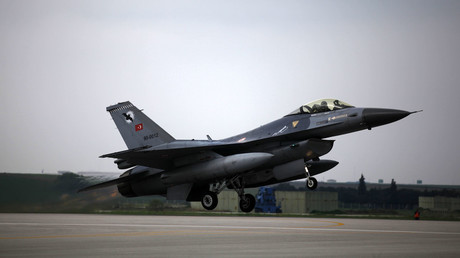
Turkish F-16 fighter jets. © Fatih Saribas / Reuters

The Turkish Air Force has delivered airstrikes in at least five locations on the territory of neighboring Iraq, targeting strongholds of the Kurdish militia, various media reported. The Turkish military claims 67 militants of the Kurdistan Workers’ Party (PKK) have been killed.
Read more

© Umit Bektas

Turkish warplanes have attacked PKK targets in northern Iraq, including the headquarters of the PKK leadership situated right on the Iraq-Iran border in the Qandil Mountains, reportedly hitting the settlements of Avasin, Basyan, Haftanin, Metina and Qandil, Reuters reports, citing the army.

The airstrikes took place on Wednesday, March 9, according to Turkey’s state-run Anadolu Agency. The agency cites an unnamed security source who claimed that 14 F-16 and F-4 fighter jets participated in the assault, bombing PKK camps, arms depots and bunkers.

READ MORE: ‘We are afraid but won’t leave our land’: Syrian Kurds who survived Turkish shelling tell RT

Beginning July 2015, after the two-year truce between Ankara and the Kurds was scrapped, Turkey has been delivering regular airstrikes against Kurdish militia in neighboring Iraq and shelling Kurdish settlements in Syria as well.

The PKK is demanding autonomy for Kurds in Turkey’s south-east, and is listed as terrorist organization #1 by the Turkish government.

READ MORE: ‘Out of question’: Erdogan rules out Turkish troop withdrawal from Iraq

In early December 2015, Turkey deployed about 150 troops and 25 tanks to a base in Iraq’s Nineveh province, without bothering to get permission from Baghdad. Ankara argued that its soldiers were sent to northern Iraq after a threat from Islamic State (IS, formerly ISIS/ISIL) to Turkish military instructors training anti-terrorist forces in the area.

Read more

© Umit Bektas

Turkey’s president Recep Tayyip Erdogan rejected a request from Baghdad to withdraw the troops, claiming that the Turkish military is present in Iraq “as instructors.”

On Friday, Turkish Interior Minister Efkan Ala said that Ankara is preparing another military operation against the Kurdish PPK in the country’s south-east. The minister announced plans to introduce curfews in three districts, saying that eight other districts have been “cleared of terrorists.”

In an interview Friday at the Foreign Ministry in Moscow, Russian Deputy Foreign Minister Gennady Gatilov criticized Turkey for shelling Kurdish positions on Syrian territory, alleging that Ankara is turning a blind eye to arms supplies to terrorists.

Gatilov stressed that such practices must stop in order “to provide a more constructive atmosphere for the intra-Syrian talks and a more durable cease-fire,” Bloomberg reported.

Iranian official: “Iran’s missile program will not stop under any circumstances”

March 10, 2016

Iranian official says Iran never accepted UN Security Council resolutions regarding missile program The Iranian Revolutionary Guards Corps (IRGC) claim that in light of the missile trials and the wave of international criticism of them, the Islamic Republic of Iran does not recognize the UN Security Council’s decisions regarding the country’s missile program.

Mar 10, 2016, 2:00PM Becca Noy

Source: Iranian official: “Iran’s missile program will not stop under any circumstances” | JerusalemOnline.com

For a few days, Iran has been testing ballistic missiles and today (Thursday), a senior level IRGC official said that “we never accepted the UN Security Council resolutions on Iran’s missile work.”

Yesterday (Wednesday), Israeli officials strongly condemned the trials that were conducted in Iran recently, in which long range missiles that can reach any destination in Israel were tested. In addition, threats against Israel were inscribed on some of the missiles.

Former UK Ambassador To Syria: US/UK Foreign Policy Is Doomed, Even Corrupt

March 6, 2016

Former UK Ambassador To Syria: US/UK Foreign Policy Is Doomed, Even Corrupt Tyler Durden’s picture

by Tyler Durden on 03/04/2016 22:25 -0500

Source: Former UK Ambassador To Syria: US/UK Foreign Policy Is Doomed, Even Corrupt | Zero Hedge

Authored by Eric Zuesse,

Peter Ford, who was the UK’s Ambassador in Syria during 2003-2006, was asked by the BBC in their “The Big Questions” interview on February 14th, whether the current Syrian President Bashar al-Assad would have to be a part of the solution in that country after the war is over, and Ambassador Ford said:

“I think sadly, but inevitably, he is. Realistically, Assad is not going to be overthrown. This becomes more clear with every day that passes. Western analysts have been indulging in wishful thinking for 5 years; it’s time to get real, we owe it to the Syrian people to be much more realistic and hard headed about this. The West has to stop propping up the so-called ‘moderate opposition’, which is not moderate at all.”

This was quoted by Almasdar News on February 18th, which went on to note that,

“The frustrated interviewer asked Mr. Ford about ‘what we should have done,’ and he responded that ‘we should have backed off, we should have not tried to overthrow the regime.’ Mr. Ford eloquently added that this policy has been ‘like a dog returning to vomit.’”

The video of the interview below showed him making that statement in this context:

The interviewer was clearly anti-Assad, and Ford responded with evident anger by noting (starting at 2:55 on the video) the shocking fact that:

“In Aghanistan, Iraq, Libya, like a dog returning to vomit, we go back to [and the audience already was started to clap here], we never saw a secular Arab regime that we didn’t want to overthrow.”

He was saying there that we support only non-secular regimes, sectarian regimes, in Arabia, this meaning fundamentalist Sunni governments — especially Saudi Arabia, Qatar, Kuwait, UAE, the very same regimes that even the U.S. Secretary of State acknowledged in a 2009 cable that was wikileaked, are the chief regimes that are funding Al Qaeda, ISIS and other jihadist groups. Ford was noting that the United States and UK strive to keep in power those governments, the ones that are led by royal families that supply the bulk of funding for jihadist groups — jihadists who perpetrate terrorism in the United States and Europe. “We never saw a secular  Arab regime that we didn’t want to overthrow”: Ambassdor Ford was so bold as to imply that our governments are supporting, under the table, the very same ruling families that they know to be funding (as that cable only vaguely referred to them) “Sunni terrorist groups worldwide” (which includes in Western countries, too).

The BBC’s interviewer ignored that statement; he wasn’t struck by it, such as to ask: “Why are we supporting the chief funders of Islamic jihad? Why are we overthrowing (or in Syria are trying to overthrow) a secular regime, against which we join foreign jihadist groups in order to overthrow that non-sectarian regime; why are these dogs, as you call the U.S. and UK, returning time and again to that vomit?”

This was a live interview program, and so the BBC censors weren’t able to eliminate Ambassador Ford’s responses from the interview; but, instead, the interviewer did his best to interrupt and to talk over Ford’s shocking — and shockingly truthful — assertions about the government (ours) that supposedly represent our  interests (and not the interests of Western oil companies etc.). Ford will probably not be invited again to be on live television in the West to air his views about Syria.

Ford’s evident anger at what’s going on, and at the media’s resistance to letting the public know about the reality, appeared to reach near to the edge of his blurting out that ulterior motives have to be behind this addiction to “vomit” — but he was a professional diplomat, and so he was able to restrain himself there.

The U.S. Secretary of State who had specifically requested the fundamentalist-Islamic Arab ‘allies’ to stop funding terrorism was Hillary Clinton, the leading candidate now contending for the Democratic Party’s Presidential nomination. Here she was, expressing her current view regarding Syria, in a recent debate against her Democratic Party opponent, Senator Bernie Sanders:

QUESTIONER: In respect to when you take out Syrian President Bashar al-Assad. Right now or do you wait? Do you tackle ISIS first? You have said, Secretary Clinton, that you come to the conclusion that we have to proceed on both fronts at once. We heard from the senator just this week that we must put aside the issue of how quickly we get rid of Assad and come together with countries, including Russia and Iran, to destroy ISIS first. Is he wrong?


CLINTON: I think we’re missing the point here. We are doing both at the same time.


QUESTIONER: But that’s what he’s saying, we should put that aside for now and go after ISIS.


CLINTON: Well, I don’t agree with that.

She’s still (now after five years, and even though she knows  that we’re supporting jihadist-backing Arabic royal families and their Shariah-law regimes) comes back to that “vomit”: that “we never saw a secular Arab regime that we didn’t want to overthrow.” She’s an example of this addiction, to that “vomit.”

She does this even though, in October 2014, the man who had collected the mega-donations to Al Qaeda (all of which had been in cash) had detailed, under oath, in a U.S. court proceeding, that the Saud family were the main people who paid the “salaries” of the 9/11 terrorists. The Saud family are now the chief backers of the overthrow-Assad campaign. Do politicians such as Clinton actually represent the Sauds? It’s not only the Bush family who do.

What’s exhibited here is a double-scandal: first, that a person such as that would even be a Democratic Party candidate for the U.S. Presidency (and Jeb Bush shares Hillary Clinton’s foreign policy prescriptions, though he’s virtually certain not  to win the Republican Presidential nomination); and, second, that the Western press try to avoid, as much as possible, to expose the fact that this is, indeed, “vomit,” and avoid to explain to their audience the very corrupt governmental and news-media system that enables people such as Ms. Clinton to become and remain a leading Presidential candidate in the United States. Clearly, a person like that isn’t qualified to be in government at all; she’s corrupt, or else incredibly stupid. And no one thinks she’s that stupid. But lots of people accuse her of being corrupt.

Turkey keeps shelling Kurds, backing terrorist groups in Syria

March 5, 2016

Turkey keeps shelling Kurds, backing terrorist groups in Syria – Russian MoD

Published time: 5 Mar, 2016 03:51 Edited time: 5 Mar, 2016 04:08

Source: Turkey keeps shelling Kurds, backing terrorist groups in Syria – Russian MoD — RT News

Turkish artillery in a border garrison near the Yanankey settlement targeting Kurdish positions in Syria. / RT

Turkey continues to shell Kurdish forces in Syria, hampering their operations against Al-Nusra terrorists, and at the same time funneling supplies to the militant-controlled areas at the border, Russia’s Defense Ministry reported.

Ankara bears responsibility for the ongoing ceasefire violations in the Syrian provinces of Idlib and Aleppo, the head of the Russian ceasefire monitoring center Lt. Gen. Sergey Kuralenko told journalists at a briefing on March 4.

Militants continue to freely cross the Turkish-Syrian border, Kuralenko noted, presenting the latest reconnaissance video featuring a “large terrorist unit in a forested border area.”

Another video depicted Turkish artillery in a border garrison near the Yanankey settlement targeting Kurdish positions in Syria.

“Artillery shelling of Kurdish militia units, fighting against Nusra Front, continues from the territory of a Turkish border post near Yanankey,” Kuralenko said.

Lt. Gen. also noted that in footage captured by an RT crew who traveled with the Kurdish YPG force in the area, Turkish trucks crossed the Turkish-Syrian border, according to Kuralenko. He said they are carrying supplies and arms exclusively to the territories controlled by Al-Nusra Front and Ahrar ash-Sham terrorist groups.

Read more

Turkish activities in the region are undermining the ceasefire and crippling the efforts aimed at launching the inter-Syrian dialogue and bringing peace to Syria, the defense ministry spokesman reiterated.

The ceasefire regime in Syria is being monitored and promoted via special centers set up in Moscow, Washington, Amman and Latakia and Geneva to collect and review information. The Russian center has registered 27 breaches of the ceasefire regime over the last 24 hours, with most of them – eight breaches – occurring in Aleppo, the Defense Ministry reported on Friday. The province of Idlib has seen a total of 7 violations, Damascus and Homs – 4 in each, Daraa – 3, Latakia – 1.

Besides Damascus, almost 100 various armed groups operating in Syria, alongside different regional and international interested parties, have agreed to take part in ceasefire, according to UN Syria special envoy Staffan de Mistura. The groups that don’t obey the ceasefire, including but not limited to ISIS and Al-Nusra, are considered terrorists.

Five more commanders of so-called Syria’s moderate opposition groups agreed to take part in the ceasefire along with the elders of two settlements in the province of Homs just recently, according to the ministry’s statement. Leaders of four other groups may soon join the agreement.

READ MORE: Syria ceasefire non-binding if threat to Turkey’s security – PM Davutoglu

The nationwide ceasefire was implemented on February, 27 at midnight Damascus time. Outlined by the co-chairs of the ISSG (the International Syrian Support Group) US and Russia, it was supported by the United Nations Security Council and is abiding to all parties involved in the conflict. The exceptions are Islamic State group (IS, formely ISIS/ISIL), Al-Nusra, and “other terrorist organizations” as designated by the UN Security Council.

EXCLUSIVE: Turkey ‘protects & supplies’ Al-Nusra camps at its border – Syria’s YPG to RT

March 4, 2016

EXCLUSIVE: Turkey ‘protects & supplies’ Al-Nusra camps at its border – Syria’s YPG to RT

Published time: 4 Mar, 2016 05:04 Edited time: 4 Mar, 2016 09:51

Source: EXCLUSIVE: Turkey ‘protects & supplies’ Al-Nusra camps at its border – Syria’s YPG to RT — RT News

And now a statement from the State Department ?

Read also : https://warsclerotic.wordpress.com/2016/03/04/state-department-issues-new-warning-about-terrorist-threat-to-u-s-citizens/#comment-84060

Jabhat Al-Nusra terrorists have pitched their camps right next to the border and receive regular supplies from the Turkish side, Syrian Kurdish forces told RT’s Lizzie Phelan, who traveled with YPG to investigate suspicious activity there.

An RT crew has filmed a number of vehicles coming through the Bab al-Salam crossing on the Turkish-Syrian border, on the outskirts of the northern town of Azaz, which is partially controlled by Al-Nusra, according to reports.

“We can actually see here the important border town of Azaz, that Turkey is determined to prevent YPG from taking. Just a little beyond that you can see the Bab al-Salam border crossing and a heavy flow of vehicles coming from Turkey into Azaz,” the RT correspondent said, reporting from the Turkey-Syria border, an area that TV crews rarely gain access to.

https://www.instagram.com/p/BCc9siFSq4o/

“When we zoom in we can see Turkish military vehicles, probably around a kilometer away, maybe less. And just in front here’s another small village that YPG say Al-Nusra uses for training,” Phelan said.

“Beyond that we can see the Turkish flag flying, that’s on the Turkish side of the border, and through there the YPG says they monitor a regular supply of weapons coming from Turkey to that Al-Nusra camp.”

2.&just a few km from Nusra controlled Azaz that is determined 2 prevent YPG from taking.

There were reports of dozens of Turkish military vehicles crossing into Kurdish northern Syria, with servicemen digging trenches in the area. Turkey’s “provocative” military buildup on the border and shelling of the Syrian territory could thwart the fragile truce and disrupt the peace process in the Arab Republic, the head of the Russian ceasefire monitoring center Lt. Gen. Sergey Kuralenko said this week.

Read more

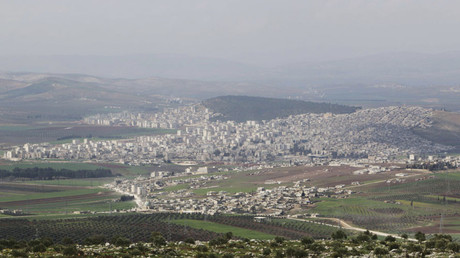
A general view shows the Kurdish city of Afrin, in Aleppo's countryside March 18, 2015. © Mahmoud Hebbo

The ceasefire in Syria, which came into force on February 27, brokered by leading world powers, including the US and Russia, is designed to pave the way to reconciliation between the Syrian government and moderate rebel forces. They would together agree on a peaceful transition in the country. Some of the forces in Syria, including IS and Al-Nusra, are not subject to the ceasefire.

Experts have been criticizing moderate rebel forces, but even they think that the situation is shifting now.

Moderate rebels used to be “a fable, a pure lie,” Syrian political analyst Taleb Ibrahim told RT.

“Everyone remembers what happened to the rebels who had been trained in Turkish camps by the CIA, and when they returned to Syria, and turned to Al-Nusra Front”.

However, the situation is starting to change slowly, as more and more Syrian rebel fighters “discover that they are destroying their country and serving external plans to divide Syria.”

Russian aircraft continue to carry out airstrikes against Al-Nusra front militants to “stabilize the situation” in the regions north of the city of Aleppo, the Russian Defense Ministry said in a statement.

READ MORE: Russia presents proof of Turkey’s role in ISIS oil trade

There have been at least 31 violations of the Syrian ceasefire over the past three days, Russian Foreign Ministry spokeswoman Maria Zakharova said on Wednesday, adding that during the same period the number of local ceasefire agreements between various factions had increased to 38.

Lavrov: Russia open to widest possible cooperation with West

March 3, 2016

Lavrov: Russia open to widest possible cooperation with West

Published time: 3 Mar, 2016 13:50

Source: Lavrov: Russia open to widest possible cooperation with West — RT Official word

Russian Foreign Minister Sergey Lavrov. © Grigoriy Sisoev
Russian Foreign Minister Sergey Lavrov has discussed the role of Russia in international relations, stressing the need for cooperation between Moscow and the West, in an article published in the Russia in Global Affairs magazine.

International relations have entered a very difficult period, and Russia once again finds itself at the crossroads of key trends that determine the vector of future global development.

Many different opinions have been expressed in this connection including the fear that we have a distorted view of the international situation and Russia’s international standing. I perceive this as an echo of the eternal dispute between pro-Western liberals and the advocates of Russia’s unique path. There are also those, both in Russia and outside of it, who believe that Russia is doomed to drag behind, trying to catch up with the West and forced to bend to other players’ rules, and hence will be unable to claim its rightful place in international affairs. I’d like to use this opportunity to express some of my views and to back them with examples from history and historical parallels.

It is an established fact that a substantiated policy is impossible without reliance on history. This reference to history is absolutely justified, especially considering recent celebrations. In 2015, we celebrated the 70th anniversary of Victory in WWII, and in 2014, we marked a century since the start of WWI. In 2012, we marked 200 years of the Battle of Borodino and 400 years of Moscow’s liberation from the Polish invaders. If we look at these events carefully, we’ll see that they clearly point to Russia’s special role in European and global history.

History doesn’t confirm the widespread belief that Russia has always camped in Europe’s backyard and has been Europe’s political outsider. I’d like to remind you that the adoption of Christianity in Russia in 988 – we marked 1025 years of that event quite recently – boosted the development of state institutions, social relations and culture and eventually made Kievan Rus a full member of the European community. At that time, dynastic marriages were the best gauge of a country’s role in the system of international relations. In the 11th century, three daughters of Grand Prince Yaroslav the Wise became the queens of Norway and Denmark, Hungary and France. Yaroslav’s sister married the Polish king and granddaughter the German emperor.

Numerous scientific investigations bear witness to the high cultural and spiritual level of Rus of those days, a level that was frequently higher than in western European states. Many prominent Western thinkers recognized that Rus was part of the European context. At the same time, Russian people possessed a cultural matrix of their own and an original type of spirituality and never merged with the West. It is instructive to recall in this connection what was for my people a tragic and in many respects critical epoch of the Mongolian invasion. The great Russian poet and writer Alexander Pushkin wrote: “The barbarians did not dare to leave an enslaved Rus in their rear and returned to their Eastern steppes. Christian enlightenment was saved by a ravaged and dying Russia.” We also know an alternative view offered by prominent historian and ethnologist Lev Gumilyov, who believed that the Mongolian invasion had prompted the emergence of a new Russian ethnos and that the Great Steppe had given us an additional impetus for development.

However that may be, it is clear that the said period was extremely important for the assertion of the Russian State’s independent role in Eurasia. Let us recall in this connection the policy pursued by Grand Prince Alexander Nevsky, who opted to temporarily submit to Golden Horde rulers, who were tolerant of Christianity, in order to uphold the Russians’ right to have a faith of their own and to decide their fate, despite the European West’s attempts to put Russian lands under full control and to deprive Russians of their identity. I am confident that this wise and forward-looking policy is in our genes.

Rus bent under but was not broken by the heavy Mongolian yoke, and managed to emerge from this dire trial as a single state, which was later regarded by both the West and the East as the successor to the Byzantine Empire that ceased to exist in 1453. An imposing country stretching along what was practically the entire eastern perimeter of Europe, Russia began a natural expansion towards the Urals and Siberia, absorbing their huge territories. Already then it was a powerful balancing factor in European political combinations, including the well-known Thirty Years’ War that gave birth to the Westphalian system of international relations, whose principles, primarily respect for state sovereignty, are of importance even today.

At this point we are approaching a dilemma that has been evident for several centuries. While the rapidly developing Moscow state naturally played an increasing role in European affairs, the European countries had apprehensions about the nascent giant in the East and tried to isolate it whenever possible and prevent it from taking part in Europe’s most important affairs.

The seeming contradiction between the traditional social order and a striving for modernisation based on the most advanced experience also dates back centuries. In reality, a rapidly developing state is bound to try and make a leap forward, relying on modern technology, which does not necessarily imply the renunciation of its “cultural code.” There are many examples of Eastern societies modernising without the radical breakdown of their traditions. This is all the more typical of Russia that is essentially a branch of European civilisation.

Incidentally, the need for modernisation based on European achievements was clearly manifest in Russian society under Tsar Alexis, while talented and ambitious Peter the Great gave it a strong boost. Relying on tough domestic measures and resolute, and successful, foreign policy, Peter the Great managed to put Russia into the category of Europe’s leading countries in a little over two decades. Since that time Russia’s position could no longer be ignored. Not a single European issue can be resolved without Russia’s opinion.

It wouldn’t be accurate to assume that everyone was happy about this state of affairs. Repeated attempts to return this country into the pre-Peter times were made over subsequent centuries but failed. In the middle 18th century Russia played a key role in a pan-European conflict – the Seven Years’ War. At that time, Russian troops made a triumphal entry into Berlin, the capital of Prussia under Frederick II who had a reputation for invincibility. Prussia was saved from an inevitable rout only because Empress Elizabeth died a sudden death and was succeeded by Peter III who sympathised with Frederick II. This turn in German history is still referred to as the Miracle of the House of Brandenburg. Russia’s size, power and influence grew substantially under Catherine the Great when, as then Chancellor Alexander Bezborodko put it, “Not a single cannon in Europe could be fired without our consent.”

I’d like to quote the opinion of a reputable researcher of Russian history, Hélène Carrère d’Encausse, the permanent secretary of the French Academy. She said the Russian Empire was the greatest empire of all times in the totality of all parameters – its size, an ability to administer its territories and the longevity of its existence. Following Russian philosopher Nikolai Berdyayev, she insists that history has imbued Russia with the mission of being a link between the East and the West.

During at least the past two centuries any attempts to unite Europe without Russia and against it have inevitably led to grim tragedies, the consequences of which were always overcome with the decisive participation of our country. I’m referring, in part, to the Napoleonic wars upon the completion of which Russia rescued the system of international relations that was based on the balance of forces and mutual consideration for national interests and ruled out the total dominance of one state in Europe. We remember that Emperor Alexander I took an active role in the drafting of decisions of the 1815 Vienna Congress that ensured the development of Europe without serious armed clashes during the subsequent 40 years.

Incidentally, to a certain extent the ideas of Alexander I could be described as a prototype of the concept on subordinating national interests to common goals, primarily, the maintenance of peace and order in Europe. As the Russian emperor said, “there can be no more English, French, Russian or Austrian policy. There can be only one policy – a common policy that must be accepted by both peoples and sovereigns for common happiness.”

By the same token, the Vienna system was destroyed in the wake of the desire to marginalise Russia in European affairs. Paris was obsessed with this idea during the reign of Emperor Napoleon III. In his attempt to forge an anti-Russian alliance, the French monarch was willing, as a hapless chess grandmaster, to sacrifice all the other figures. How did it play out? Indeed, Russia was defeated in the Crimean War of 1853-1856, the consequences of which it managed to overcome soon due to a consistent and far-sighted policy pursued by Chancellor Alexander Gorchakov. As for Napoleon III, he ended his rule in German captivity, and the nightmare of the Franco-German confrontation loomed over Western Europe for decades.

Here is another Crimean War-related episode. As we know, the Austrian Emperor refused to help Russia, which, a few years earlier, in 1849, had come to his help during the Hungarian revolt. Then Austrian Foreign Minister Felix Schwarzenberg famously said: “Europe would be astonished by the extent of Austria’s ingratitude.” In general, the imbalance of pan-European mechanisms triggered a chain of events that led to the First World War.

Notably, back then Russian diplomacy also advanced ideas that were ahead of their time. The Hague Peace conferences of 1899 and 1907, convened at the initiative of Emperor Nicholas II, were the first attempts to agree on curbing the arms race and stopping preparations for a devastating war. But not many people know about it.

The First World War claimed lives and caused the suffering of countless millions of people and led to the collapse of four empires. In this connection, it is appropriate to recall yet another anniversary, which will be marked next year – the 100th anniversary of the Russian Revolution. Today we are faced with the need to develop a balanced and objective assessment of those events, especially in an environment where, particularly in the West, many are willing to use this date to mount even more information attacks on Russia, and to portray the 1917 Revolution as a barbaric coup that dragged down all of European history. Even worse, they want to equate the Soviet regime to Nazism, and partially blame it for starting WWII.

Without a doubt, the Revolution of 1917 and the ensuing Civil War were a terrible tragedy for our nation. However, all other revolutions were tragic as well. This does not prevent our French colleagues from extolling their upheaval, which, in addition to the slogans of liberty, equality and fraternity, also involved the use of the guillotine, and rivers of blood.

Undoubtedly, the Russian Revolution was a major event which impacted world history in many controversial ways. It has become regarded as a kind of experiment in implementing socialist ideas, which were then widely spread across Europe. The people supported them, because wide masses gravitated towards social organisation with reliance on the collective and community principles.

Serious researchers clearly see the impact of reforms in the Soviet Union on the formation of the so-called welfare state in Western Europe in the post-WWII period. European governments decided to introduce unprecedented measures of social protection under the influence of the example of the Soviet Union in an effort to cut the ground from under the feet of the left-wing political forces.

One can say that the 40 years following World War II were a surprisingly good time for Western Europe, which was spared the need to make its own major decisions under the umbrella of the US-Soviet confrontation and enjoyed unique opportunities for steady development.

In these circumstances, Western European countries have implemented several ideas regarding ​​conversion of the capitalist and socialist models, which, as a preferred form of socioeconomic progress, were promoted by Pitirim Sorokin and other outstanding thinkers of the 20th century. Over the past 20 years, we have been witnessing the reverse process in Europe and the United States: the reduction of the middle class, increased social inequality, and the dismantling of controls over big business.

The role which the Soviet Union played in decolonisation, and promoting international relations principles, such as the independent development of nations and their right to self-determination, is undeniable.

I will not dwell on the points related to Europe slipping into WWII. Clearly, the anti-Russian aspirations of the European elites, and their desire to unleash Hitler’s war machine on the Soviet Union played their fatal part here. Redressing the situation after this terrible disaster involved the participation of our country as a key partner in determining the parameters of the European and the world order.

In this context, the notion of the “clash of two totalitarianisms,” which is now actively inculcated in European minds, including at schools, is groundless and immoral. The Soviet Union, for all its evils, never aimed to destroy entire nations. Winston Churchill, who all his life was a principled opponent of the Soviet Union and played a major role in going from the WWII alliance to a new confrontation with the Soviet Union, said that graciousness, i.e. life in accordance with conscience, is the Russian way of doing things.

If you take an unbiased look at the smaller European countries, which previously were part of the Warsaw Treaty, and are now members of the EU or NATO, it is clear that the issue was not about going from subjugation to freedom, which Western masterminds like to talk about, but rather a change of leadership.Russian President Vladimir Putin spoke about it not long ago. The representatives of these countries concede behind closed doors that they can’t take any significant decision without the green light from Washington or Brussels.

It seems that in the context of the 100th anniversary of the Russian Revolution, it is important for us to understand the continuity of Russian history, which should include all of its periods without exception, and the importance of the synthesis of all the positive traditions and historical experience as the basis for making dynamic advances and upholding the rightful role of our country as a leading centre of the modern world, and a provider of the values of sustainable development, security and stability.

The post-war world order relied on confrontation between two world systems and was far from ideal, yet it was sufficient to preserve international peace and to avoid the worst possible temptation – the use of weapons of mass destruction, primarily nuclear weapons. There is no substance behind the popular belief that the Soviet Union’s dissolution signified Western victory in the Cold War. It was the result of our people’s will for change plus an unlucky chain of events.

These developments resulted in a truly tectonic shift in the international landscape. In fact, they changed global politics altogether, considering that the end of the Cold War and related ideological confrontation offered a unique opportunity to change the European architecture on the principles of indivisible and equal security and broad cooperation without dividing lines.

We had a practical chance to mend Europe’s divide and implement the dream of a common European home, which many European thinkers and politicians, including President Charles de Gaulle of France, wholeheartedly embraced. Russia was fully open to this option and advanced many proposals and initiatives in this connection. Logically, we should have created a new foundation for European security by strengthening the military and political components of the Organisation for Security and Cooperation in Europe (OSCE). Vladimir Putin said in a recent interview with the German newspaper Bild that German politician Egon Bahr proposed similar approaches.

Unfortunately, our Western partners chose differently. They opted to expand NATO eastward and to advance the geopolitical space they controlled closer to the Russian border. This is the essence of the systemic problems that have soured Russia’s relations with the United States and the European Union. It is notable that George Kennan, the architect of the US policy of containment of the Soviet Union, said in his winter years that the ratification of NATO expansion was “a tragic mistake.”

The underlying problem of this Western policy is that it disregarded the global context. The current globalised world is based on an unprecedented interconnection between countries, and so it’s impossible to develop relations between Russia and the EU as if they remained at the core of global politics as during the Cold War. We must take note of the powerful processes that are underway in Asia Pacific, the Middle East, Africa and Latin America.

Rapid changes in all areas of international life is the primary sign of the current stage. Indicatively, they often take an unexpected turn. Thus, the concept of “the end of history” developed by well-known US sociologist and political researcher Francis Fukuyama, that was popular in the 1990s, has become clearly inconsistent today. According to this concept, rapid globalisation signals the ultimate victory of the liberal capitalist model, whereas all other models should adapt to it under the guidance of the wise Western teachers.

In reality, the second wave of globalisation (the first occurred before World War I) led to the dispersal of global economic might and, hence, of political influence, and to the emergence of new and large centres of power, primarily in the Asia-Pacific Region. China’s rapid upsurge is the clearest example. Owing to unprecedented economic growth rates, in just three decades it became the second and, calculated as per purchasing power parity, the first economy in the world. This example illustrates an axiomatic fact – there are many development models– which rules out the monotony of existence within the uniform, Western frame of reference.

Consequently, there has been a relative reduction in the influence of the so-called “historical West” that was used to seeing itself as the master of the human race’s destinies for almost five centuries. The competition on the shaping of the world order in the 21st century has toughened. The transition from the Cold War to a new international system proved to be much longer and more painful than it seemed 20-25 years ago.

Against this backdrop, one of the basic issues in international affairs is the form that is being acquired by this generally natural competition between the world’s leading powers. We see how the United States and the US-led Western alliance are trying to preserve their dominant positions by any available method or, to use the American lexicon, ensure their “global leadership”. Many diverse ways of exerting pressure, economic sanctions and even direct armed intervention are being used. Large-scale information wars are being waged. Technology of unconstitutional change of governments by launching “colour” revolutions has been tried and tested. Importantly, democratic revolutions appear to be destructive for the nations targeted by such actions. Our country that went through a historical period of encouraging artificial transformations abroad, firmly proceeds from the preference of evolutionary changes that should be carried out in the forms and at a speed that conform to the traditions of a society and its level of development.

Western propaganda habitually accuses Russia of “revisionism,” and the alleged desire to destroy the established international system, as if it was us who bombed Yugoslavia in 1999 in violation of the UN Charter and the Helsinki Final Act, as if it was Russia that ignored international law by invading Iraq in 2003 and distorted UN Security Council resolutions by overthrowing Muammar Gaddafi’s regime by force in Libya in 2011. There are many examples.

This discourse about “revisionism” does not hold water. It is based on the simple and even primitive logic that only Washington can set the tune in world affairs. In line with this logic, the principle once formulated by George Orwell and moved to the international level, sounds like the following: all states are equal but some states are more equal than others. However, today international relations are too sophisticated a mechanism to be controlled from one centre. This is obvious given the results of US interference: There is virtually no state in Libya; Iraq is balancing on the brink of disintegration, and so on and so forth.

A reliable solution to the problems of the modern world can only be achieved through serious and honest cooperation between the leading states and their associations in order to address common challenges. Such an interaction should include all the colours of the modern world, and be based on its cultural and civilisational diversity, as well as reflect the interests of the international community’s key components.

We know from experience that when these principles are applied in practice, it is possible to achieve specific and tangible results, such as the agreement on the Iranian nuclear programme, the elimination of Syrian chemical weapons, the agreement on stopping hostilities in Syria, and the development of the basic parameters of the global climate agreement. This shows the need to restore the culture of compromise, the reliance on the diplomatic work, which can be difficult, even exhausting, but which remains, in essence, the only way to ensure a mutually acceptable solution to problems by peaceful means.

Our approaches are shared by most countries of the world, including our Chinese partners, other BRICSand SCO nations, and our friends in the EAEU, the CSTO, and the CIS. In other words, we can say that Russia is fighting not against someone, but for the resolution of all the issues on an equal and mutually respectful basis, which alone can serve as a reliable foundation for a long-term improvement of international relations.

Our most important task is to join our efforts against not some far-fetched, but very real challenges, among which the terrorist aggression is the most pressing one. The extremists from ISIS, Jabhat an-Nusra and the like managed for the first time to establish control over large territories in Syria and Iraq. They are trying to extend their influence to other countries and regions, and are committing acts of terrorism around the world. Underestimating this risk is nothing short of criminal shortsightedness.

The Russian President called for forming a broad-based front in order to defeat the terrorists militarily. The Russian Aerospace Forces make an important contribution to this effort. At the same time, we are working hard to establish collective actions regarding the political settlement of the conflicts in this crisis-ridden region.

Importantly, the long-term success can only be achieved on the basis of movement to the partnership of civilisations based on respectful interaction of diverse cultures and religions. We believe that human solidarity must have a moral basis formed by traditional values ​​that are largely shared by the world’s leading religions. In this connection, I would like to draw your attention to the joint statement by Patriarch Kirill and Pope Francis, in which, among other things, they have expressed support for the family as a natural centre of life of individuals and society.

I repeat, we are not seeking confrontation with the United States, or the European Union, or NATO. On the contrary, Russia is open to the widest possible cooperation with its Western partners. We continue to believe that the best way to ensure the interests of the peoples living in Europe is to form a common economic and humanitarian space from the Atlantic to the Pacific, so that the newly formed Eurasian Economic Union could be an integrating link between Europe and Asia Pacific. We strive to do our best to overcome obstacles on that way, including the settlement of the Ukraine crisis caused by the coup in Kiev in February 2014, on the basis of the Minsk Agreements.

I’d like to quote wise and politically experienced Henry Kissinger, who, speaking recently in Moscow, said that “Russia should be perceived as an essential element of any new global equilibrium, not primarily as a threat to the United States… I am here to argue for the possibility of a dialogue that seeks to merge our futures rather than elaborate our conflicts. This requires respect by both sides of the vital values and interest of the other.”  We share such an approach. And we will continue to defend the principles of law and justice in international affairs.

Speaking about Russia’s role in the world as a great power, Russian philosopher Ivan Ilyin said that the greatness of a country is not determined by the size of its territory or the number of its inhabitants, but by the capacity of its people and its government to take on the burden of great world problems and to deal with these problems in a creative manner. A great power is the one which, asserting its existence and its interest … introduces a creative and meaningful legal idea to ​​the entire assembly of the nations, the entire “concert” of the peoples and states. It is difficult to disagree with these words.

‘Sunshine of the spotless mind’: Russia rebuts NATO accusation of it ‘weaponizing’ migrant crisis

March 3, 2016

Sunshine of the spotless mind’: Russia rebuts NATO accusation of it ‘weaponizing’ migrant crisis

Published time: 3 Mar, 2016 03:57

Source: ‘Sunshine of the spotless mind’: Russia rebuts NATO accusation of it ‘weaponizing’ migrant crisis — RT News

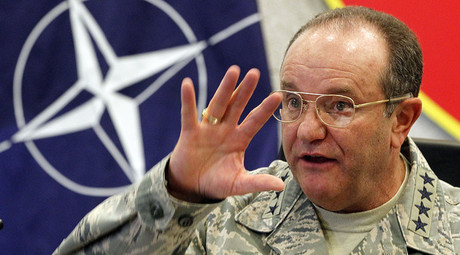
U.S. Air Force Gen. Philip Breedlove, commander of the U.S. European Command and Supreme Allied Commander for Europe © Jonathan Ernst
Moscow was amused by the top NATO General’s claims that it is using the refugee crisis as a “weapon” against the West, with the Defense Ministry’s spokesman saying such rhetoric reaffirms concerns of Breedlove’s apparent dislocation of memory.

In front of the Senate Armed Services Committee this week, top NATO General Philip Breedlove accused Moscow of siding with the Syrian President and deliberately fueling the displacement of Syrians.

“Together, Russia and the Assad regime are deliberately weaponizing migration in an attempt to overwhelm European structures and break European resolve,” Breedlove told the committee.

Read more

U.S. General Philip Breedlove. © Ciro De Luca

Insisting that the influx of migrants to Europe benefited Moscow, Breedlove noted that foreign militants who have been fighting in Syria are now returning back home, where they might use their battlefield skills.

Breedlove added that the alleged strategy was used by both Russian and Syrian presidents to create a distraction for the western countries that have been busy tackling the crisis and did not notice its root cause: “Indiscriminate weapons used by both Bashar al-Assad, and the non-precision use of weapons by the Russian forces.”

Russian Ministry of Defense spokesman Igor Konashenkov called the latest allegations a “recurrence” of the NATO general’s traditional rhetoric which only reaffirms concerns about Breedlove’s “memory dislocation.”

“Taking into account that such recurrence of the ‘sunshine of the spotless mind’ appeared right before the scheduled meeting of the Armed Services Committee, there is no wonder that a decision has been made by the US congressmen to replace him on his post of the Commander-in-Chief of the NATO Joint Force in Europe,” Konashenkov said.

Konashenkov once again pointed out that Moscow could not have possibly been the reason for the refugee crisis, which began long before Russia launched its anti-terror operations in Syria. And unlike the anti-ISIS coalition, Russia’s operations in Syria have alleviated the refugee crisis in the country and led to the first step of the establishment of a peace-making process, Konashenkov added.

“Essential is the fact that as a results of the Russian operation, the UN is registering the reduction of refugee flows from Syria and a process of reconciliation has been initiated, which is something the Western so-called “anti-ISIS coalition” has been unable to achieve over the previous three years of their “fight” against terrorism,” Konashenkov stated.

Responding to the “indiscriminate” and “non-precision” bombing claims, Konashenkov reminded the NATO general that precision of airstrike depends not only on smart weapons, but also on proper intelligence, pilot’s skills and aiming systems of the aircraft.

“Sole reliance on ‘supersmart’ or ‘superprecision’ weapons leads American hawks to tragic mistakes with fatal consequences, as it was repeatedly observed in Afghanistan, Iraq, and since recently – in Syria,” Konashenkov said.

Turkey’s ‘provocative’ military actions could jeopardize Syria ceasefire

March 1, 2016

Turkey’s ‘provocative’ military actions could jeopardize Syria ceasefire – Russian military

Published time: 29 Feb, 2016 23:27 Edited time: 1 Mar, 2016 01:37

Source: Turkey’s ‘provocative’ military actions could jeopardize Syria ceasefire – Russian military — RT News


Turkey’s “provocative” military buildup on the border and shelling of the Syrian territory could thwart the truce and disrupt the peace process in the Arab Republic, said the head of the Russian ceasefire monitoring center Lt. Gen. Sergey Kuralenko.

Turkey is strengthening its military positions on the border with Syria and is concentrating armored vehicles in the area, Lieutenant General Kuralenko said, denouncing these moves as “obviously provocative steps that could lead to a breakdown of the ceasefire and the peace process in the Syrian Arab Republic.”

The Russian military has examined footage taken by a Russian TV crew near the Syrian city of Tel Abyad located not far from the Turkish border, which demonstrated Ankara’s military “organizing firing positions and concentrating armored vehicles near the border,” Kuralenko said.

Meanwhile Turkish artillery fired at least 50 rounds at alleged Islamic State (IS, formerly ISIS/ISIL) targets north of Aleppo as part of the US-led coalition’s offensive, according to local media reports.

Read more

© Ammar Abdullah

The truce in Syria is generally being observed, the Lt. Gen. added, noting however that terrorist groups shelled populated areas at least seven times on Monday.

“In general, the truce between the governmental troops and the opposition forces on the territory of the Syrian Arab republic holds,” he said adding that a Russian center in Latakia monitors the situation in the six Syrian provinces of Hama, Homs, Latakia, Damascus, Aleppo and Deraa on a 24-hour basis.

“Within the last 24 hours, officers from the Russian [ceasefire monitoring] center as well as Syrian government forces and self-defense forces recorded seven cases of terrorist groups shelling Syrian residential areas,” he told journalists.

Kuralenko said that Al-Nusra militants attacked Syrian Kurdish positions in Aleppo province using artillery, while IS terrorists continued shelling the road between the cities of Hama and Aleppo, making the “delivery of humanitarian aid to Aleppo and nearby provinces impossible.”

The Lieutenant General stressed that governmental forces and the opposition achieved “significant progress” in the reconciliation process in four Syrian provinces, although he did not mention them by name.

The head of the Russian ceasefire monitoring center also discussed the first results of the truce with his US counterpart and they both expressed satisfaction with the joint efforts. “We discussed the first results of the ceasefire and signified satisfaction with the concerted efforts,” Kuralenko told journalists referring to a telephone conversation with representatives of the US ceasefire monitoring center in Amman.

In the meantime, Russian aircraft carried out several air strikes against Al-Nusra front militants to “stabilize the situation” in the regions north of the city of Aleppo, according to the Russian Defense Ministry.

Al-Nusra extremists were shelling the Syrian army positions from the Narb-Nafsa village located north of Aleppo. In response, Russian Air Space Forces “carried out missile and bomb attacks against… Al Nusra units in the region and hit positions of terrorists near Narb-Nafsa…” the statement said.

At the same time, the Russian ceasefire monitoring center once again stressed that Russian aircraft conducted no strikes against the groups which joined the truce.

Secretary of State John Kerry said that Moscow and Washington have worked out a mechanism to track down all reported violations of the ceasefire in Syria through specially set up teams in Geneva and Amman. Kerry specified that he and Lavrov agreed that the mechanism should ensure that any strikes in Syria target only Islamic State and Al Nusra Front.

“We are going to track down each alleged violation and work even more now to put in place a construct which will help us to guarantee that missions are indeed missions against Nusra or missions against Daesh [the Arabic name for IS],” Kerry said at a news conference with German Foreign Minister Frank-Walter Steinmeier.