Posted tagged ‘Russia’

Syrian official answers Netanyahu: We will use all available means to recapture the Golan

April 17, 2016

Syrian official answers Netanyahu: We will use all available means to recapture the Golan, Jerusalem PostMaayan Groisman, April 17, 2016

(Please see also, Netanyahu to battle Obama, Putin over the Golan. — DM)

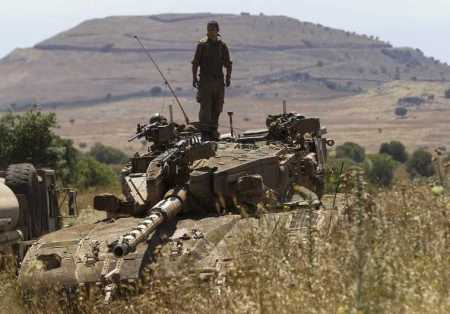
ShowImage (24)An IDF soldier stands atop a tank near Alonei Habashan on the Golan Heights, close to the ceasefire line between Israel and Syria. (photo credit:REUTERS)

In a first reaction to Prime Minister Benjamin Netanyahu’s declaration that “Israel will never leave the Golan Heights,” Syrian Foreign Minister Faisal al-Miqdad said Sunday that Syria is prepared to use every possible means to recapture the area, including military means.

“The Syrian Golan is an occupied Arab land according to the UN Security Council’s resolutions, and the presence of the United Nations Disengagement Observer Forces proves this,” Miqad said in an interview with the Lebanon-based TV channel al-Mayadeen.

“We have never renounced the resistance and we are ready to recapture the Golan in all possible ways, including military ways. Israel wants to provoke us, but we will never surrender,” Miqdad added.

Regarding Syria’s cooperation with Russia, he stated that “the daily communication between the Syrian leadership and the Russian leadership continues. We believe that the Russian policy leans on the international law and on UN Security Council resolutions.

“Neither Russian President Vladimir Putin nor any other president in the world would have accepted the indecent Israeli logic regarding the Golan,” Miqdad argued.

At the opening of a special cabinet meeting held for the first time ever on the Golan Heights on Sunday, PM Netanyahu declared: “The time has come after 40 years for the international community to finally recognize that the Golan Heights will remain forever under Israeli sovereignty.”

Netanyahu’s dilemma: Détente with Turkey or recognition of Syrian Kurds

April 4, 2016

Netanyahu’s dilemma: Détente with Turkey or recognition of Syrian Kurds, DEBKAfile, April 4, 2016

obama_erdogan_best_friends_2012They were once good friends

Last Friday, April 1, President Reccep Tayyip Erdogan had his first encounter with a group of American Jewish leaders, at his request. The full details of its contents were hard to sort out because the Turkish translator censored his master’s words with a heavy hand to make them more acceptable to his audience. But Erdogan’s bottom line, DEBKAfile’s New York sources report, was a request for help in explaining to the Obama administration in Washington and the Netanyahu government in Jerusalem why they must on no account extend support to the Syrian Kurdish PYD and its YPG militia or recognize their bid for a separate state in northern Syria.

The Turkish president did not spell out his response to this step, but indicated that a Turkish invasion to confront the Kurdish separatists was under serious consideration in Ankara. His meaning was clear: He would go to war against the Kurds, even if this meant flying in the face of President Barack Obama’s expectation that Turkey would fight the Islamic State.

Relations between the Turkish and US presidents have slipped back another notch in the last two weeks. When he visited Washington for the nuclear summit, Erdogan was pointedly not invited to the White House and his request for a tete a tete with Obama was ruled out. The US president even refused to join Erdogan in ceremonially honoring a new mosque built outside Washington with Turkish government funding.

At odds between them is not just the Kurdish question, but Erdogan’s furious opposition to Obama’s collaboration with Russian President Vladimir Putin on the Syrian conflict, and the two presidents’ tacit accord to leave Bashar Assad in power indefinitely until a handover becomes manageable.

On Feb. 7, on his return for a Latin American tour, the Turkish president warned Obama that he must choose between Ankara and the Kurds, whom he called “terrorists.” By last week, the US president’s choice was clear. It was the Kurds.

ObamaErdogan480_Koteret

When Erdogan arrived home from Washington last week, he discovered that the roughly four million Syrian Kurds dwelling in three enclaves touching on the Turkish border had taken important steps to advance their goal for self-rule: They were drafting a plan for establishing a “Federal Democratic System” in their three enclaves – Hassakeh-Jazeera, Kobani and Afrin – and had announced the amalgamation of their respective militias under the heading the “Syrian Democratic Forces”.

Cold-shouldered in Washington as well as Moscow (since Turkish jets shot down a Russian fighter last November), Erdogan found himself let down by the Jewish leaders whom he tried to woo. They refused to support him or his policy on the Kurdish question for three reasons:

1. Ankara had for years consistently promoted the radical Palestinian Hamas organization. To this, Erdogan replied by denying he had backed Hamas  only acted to improve the lives of the Gaza population. And, anyway, he said he had reacyed understandings with Israel on this issue..

2. His hostility towards Egyptian President Abdel-Fatteh El-Sisi. Erdogan’s response to this was a diatribe slamming the Egyptian ruler.

3. No clear reply had been forthcoming from Jerusalem by that time on Israel’s relations with Turkey or its policy towards the Kurds, despite the Turkish leader’s positive presentation of  mended fences.

The current state of the relationship is laid out by DEBKAfile’s sources:

Prime Minister Binyamin Netanyahu is caught on the horns of multiple dilemmas: While reluctant to respond to Ankara’s suit for warm relations with a leader who is shunned by Obama and Putin alike, Turkey is nonetheless offering to be Israel’s best client for its offshore gas.

Israel’s friendship with the Kurdish people goes back many years. The rise of an independent or autonomous state in Syria and its potential link-up with the semiautonomous Kurdish region of Iraq would create an important new state of 40 million people in the heart of the Middle East.

Israel has no wish to make enemies of its longstanding friends by disowning them in favor of Turkey.

Already, Israel’s evolving ties with the Syrian Kurds have given Israel’s strategic position in Syria a new positive spin, upgrading it versus the Assad regime in Damascus and its Hizballah and Iranian allies, who are avowed enemies of the Jewish state. Those ties offer Israel its first foothold in northern Syria.

And finally, Erdogan is not the only opponent of Kurdish separatism; so too are important Sunni Muslim nations like Saudi Arabia and Egypt. By promoting the Kurds, Israel risks jeopardizing its rapidly developing ties with those governments.

US deploys F-15s to Iceland, Netherlands

April 3, 2016

US deploys F-15s to Iceland, Netherlands

Published time: 3 Apr, 2016 14:45

Source: US deploys F-15s to Iceland, Netherlands — RT News

A U.S. Air Force F-15 fighter © Ints Kalnins / Reuters

The US has deployed 12 F-15C Eagles and around 350 airmen in Europe as part of Operation Atlantic Resolve (OAR), the Pentagon’s demonstration of force designed to deter what the US calls Russian aggression against Europe.

The aircraft and troops were sent from the Barnes Air National Guard Base in Massachusetts and the Fresno Air National Guard Base in California for a six-month tour to Iceland’s Keflavik and the Dutch Leeuwarden Air Base.

Read more

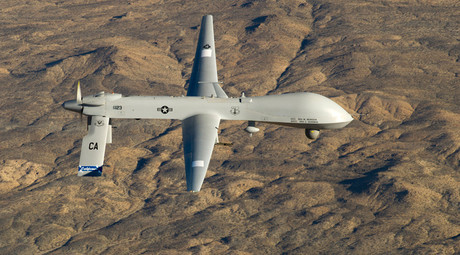
A U.S. Air Force MQ-1 Predator © U.S. Air Force / Tech. Sgt. Effrain Lopez / Handout

The American fighters “will conduct training alongside NATO allies and partners as part of OAR to strengthen interoperability, demonstrate US commitment to a Europe that is whole, free, at peace, secure, and prosperous and to deter further Russian aggression,” the USAF said in a statement.

During the tour the aircraft will forward-deploy to the Eastern European nations of Bulgaria, Romania and Estonia.

The deployment is one of several planned by the Pentagon. Next month it is planning to send six F-15s to Finland, which is not a NATO member, but an active participant in many of the bloc’s activities.

Iceland is the only NATO member that has no military of its own, although it has a small coast guard force. The country used to host a US airbase during the Cold War, but it was shut down in 2006. Two years later US warplanes started paroling Iceland’s airspace.

The US and NATO are pushing for a stronger military presence in Europe, and particularly in Eastern Europe and the Baltic, close to Russia’s border. They argue that such deployment is necessary to deter Russia from military aggression.

Moscow says Western hawks are simply using the perceived Russian threat to justify greater military spending.

Turkey is key supplier of weapons, military hardware to ISIS – Russian envoy to UN

April 1, 2016

Turkey is key supplier of weapons, military hardware to ISIS – Russian envoy to UN Published time: 1 Apr, 2016 14:25 Edited time: 1 Apr, 2016 14:45

Source: Turkey is key supplier of weapons, military hardware to ISIS – Russian envoy to UN — RT News

© Denis Sinyakov / Reuters

Moscow has submitted data on Turkey’s illegal arms and military hardware supply to Islamic State in Syria to the UN Security Council. Supplies are supervised by the Turkish intelligence service, Russian UN envoy Vitaly Churkin said as cited by Russian media.

The main supplier of arms and military equipment to Islamic State (IS, Daesh, formerly ISIS/ISIL) militants is Turkey, which uses non-governmental organizations (NGOs) for this purpose. The National Intelligence Organization of Turkey is in charge of the operations. Transportation is carried out mainly via automobiles, including humanitarian aid convoys, Churkin wrote in a letter to the UN Security Council (UNSC).

Terrorist groups operating in Syria received explosive materials worth $ 1.9 million via Turkey last year, according to the letter.

In total, the terrorists were delivered 2.5 thousand tons of ammonium nitrate (worth around $788,700), 456 tons of potassium nitrate ($468,700), 75 tons of aluminum powder ($496,500), sodium nitrate ($19,400), glycerin ($102,500) and nitric acid ($34,000 thousand) via Turkey in 2015, Churkin wrote.

Sisi asks Obama for military intervention to save Egypt from ISIS

March 28, 2016

Sisi asks Obama for military intervention to save Egypt from ISIS, DEBKAfile, March 28, 2016

Egyptian President Abdel Fatteh El-Sisi has sent a secret missive to President Barack Obama asking for urgent US military intervention in support of Egypt’s war on the Islamist State in Sinai, before the jihadis pose a real threat to Cairo. DEBKAfile’s exclusive intelligence and counterterrorism sources report that El-Sisi has come to the conclusion that Egyptian army lacks the ability to eradicate the terrorist peril without direct US military support.

In his note, he asks Washington to replicate in Sinai the format of US intervention in the war on ISIS in Iraq and Syria, namely, to send in special operations forces to establish bases and operate drones against jihadist targets. Unless stopped, he warns, the Islamic State is on the point of transforming the Sinai Peninsula into its primary forward base in the Middle East, bolstered by its branches of terror across North Africa, especially in Libya. US intervention is necessary to avert this.

So far, Sisi has received no answer from the White House and no sign of one in the pipeline.

Our military sources note that, given his record as former defense minister and a much-decorated general in the Egyptian army, an appeal to a foreign power for military assistance is out of character and would normally be found unacceptable in his own milieu. It must therefore be seen as a sign of extreme distress over Cairo’s failure to vanquish – or even contain ISIS, which now poses a strategic threat to Egypt proper.

In this situation, the generals in Cairo were dismayed to read a New York Timesleader on March 25, captioned “Time to Rethink US relationship with Egypt,” which faults the Egyptian regime’s human rights record and suggests that the relationship does Washington more harm than good.

The NYT concludes by saying, “Over the next few months, the president should start planning the possibility of a break in the alliance with Egypt. That scenario appears increasingly necessary.”

Since this article appeared out of the blue, it is feared in Cairo that it is President Obama’s way of spurring the Egyptian president’s SOS.

Some high-ranking military figures in Cairo have started talking about alternatives: If Washington refuses to come up with military assistance for fighting the Islamic State, perhaps the time has time to go elsewhere.
An Egyptian appeal to Moscow cannot be ruled out.


Putin congratulates Assad on liberating Palmyra, says Russia to aid in demining ancient city

March 28, 2016

Putin congratulates Assad on liberating Palmyra, says Russia to aid in demining ancient city

Published time: 27 Mar, 2016 15:15 Edited time: 27 Mar, 2016 21:14

Source: Putin congratulates Assad on liberating Palmyra, says Russia to aid in demining ancient city — RT News

Russian President Vladimir Putin has congratulated Syrian President Bashar Assad on retaking the ancient city of Palmyra from Islamic State terrorists. Putin stressed the importance of preserving the UNESCO World Heritage Site.
Read more

A view of the central part of modern Palmyra. © Mikhail Voskresenskiy

In a telephone conversation with the Syrian president, Vladimir Putin congratulated his counterpart on retaking the city of Palmyra from terrorists and noted the importance of preserving this unique historic site for world culture,” Kremlin spokesman Dmitry Peskov said Sunday.

Putin once again stressed that despite the withdrawal of the bulk of Russia’s military contingent from Syria, Russia’s forces will continue to help the Syrian authorities in their anti-terrorist efforts,” he added.

“Assad highly valued the help Russian air forces have provided and underlined that such successes as regaining Palmyra would have been impossible without Russia’s support,” Peskov said.

On Sunday, the Syrian Army retook the historic city of Palmyra from Islamic State (IS, formerly ISIS/ISIL), which had occupied it since last May. Russian warplanes were providing heavy support from the air.

The Russian Air Force has made 40 flights over the area of the Syrian city of Palmyra in the last 24 hours, hitting 117 targets and killing over 80 militants, the Russian Center for Reconciliation in Syria said Sunday.

Putin also held a phone call with UNESCO head Irina Bokova on Sunday. Peskov said Putin told Bokova that “representatives of the Russian contingent will participate in the demining of the ancient city.

READ MORE: Palmyra ‘not just an archaeological site but a symbol of Syria’ – UNESCO

The two agreed that UNESCO, Russia and Syria will soon take the necessary steps to evaluate the damage to the historic site and map out a “plan of restoring what can still be restored,” Peskov added.

According to the Kremlin spokesman, Bokova thanked Putin for Russia’s contribution and confirmed UNESCO’s readiness to cooperate.

While summarizing the results of Russia’s five-month anti-terror campaign in Syria earlier in March, Putin expressed hope that Palmyra would soon be returned to the Syrian people. On March 18, Russia’s military said that the groundwork had been laid for defeating IS in Palmyra.

Read more

© Mikhail Voskresenskiy

At that time, the Syrian Army had already taken control of all dominant heights and major roads around the city, and the terrorists’ logistical support had also been cut off, according to Sergey Rudskoy, chief of the Russian General Staff’s main operations department.

Palmyra shows Damascus strategy more effective than US-led efforts in Syria – Assad

Calling the Syrian Army’s liberation of Palmyra an “important achievement,” Assad told a delegation of French parliamentarians visiting Syria on Sunday that the victory is “new evidence” that the strategy being pursued by Damascus and its allies is effective, according SANA, Syria’s state news agency.

He also pointed out that the strategy’s success is especially apparent when compared to that of the US-led coalition, which involves more than 60 countries, but has achieved very little since its establishment one and a half years ago, for which he blamed a lack of seriousness in fighting terrorism.

The US-led coalition launched its air campaign in Syria in September of 2014 without permission from the Syrian government. Damascus has repeatedly called the intervention ineffective, saying it has failed to weaken terrorists in the region.


Before our eyes: Syria’s Battle for Palmyra in latest RT reports (VIDEOS)

March 26, 2016

Before our eyes: Syria’s Battle for Palmyra in latest RT reports (VIDEOS)

Published time: 26 Mar, 2016 06:36

Source: Before our eyes: Syria’s Battle for Palmyra in latest RT reports (VIDEOS) — RT News

© Joseph Eid / AFP

Syrian army is close to regaining full control of the ancient city of Palmyra. Check out some of RT’s exclusive footage and battleground reports on how Islamic State (IS, previously ISIS/ISIL) militants are being pushed from the UNESCO heritage site.

Fierce fighting rages on

RT’s agency Ruptly’s latest video footage shows units of the Syrian Arab Army (SAA) battling IS militants in and around Palmyra on Friday. The historical ruins of Palmyra are clearly visible from the position of Syrian mortar crews.

READ MORE: Syrian Army retakes historic citadel from ISIS continuing advance on Palmyra – state media

In the latest update, Syria state TV said that troops have regained control of the Syriatel hill near Palmyra’s castle and are a step closer to retaking the whole city, which has been under Islamic State control since last May.

Russia helping with air sorties

Russian warplanes offered crucial support to the Syrian forces on the ground this week by carrying out 41 sorties and destroying 146 terrorist targets from Tuesday to Thursday, Russia’s Defense Ministry said.

READ MORE: Russian Air Force carried out 41 sorties to support Syrian army’s Palmyra offensive

One of the stories that stood out was a report on Russian Special Operations Forces officer who called a strike onto himself when he was compromised and surrounded by IS militants near Palmyra. Thanks to the brave actions of this officer and others, Russian military planes have been able to pinpoint IS targets with precision – something absolutely crucial in the circumstances.

ISIS pillage of Palmyra

A Russian TV crew captured a striking footage of Palmyra revealing the damage endured under IS occupation. The iconic 2,000-year-old Arch of Triumph was blown up by the jihadists in October 2015.

READ MORE: Striking drone footage shows what remains of Palmyra after ISIS pillage

Good win or bad win? US undecided

The US government still seems on the fence on whether or not the ancient city should be liberated from the hands of Islamic State by Syrian President Bashar Assad’s forces. Only when pressed by reporters did the State Department call IS “probably a greater evil” than President Assad.

READ MORE: US State Dept fails to say if ISIS must be pushed out of Palmyra or not

Bomb traps danger 

The Syrian army is very close to retaking control of the whole city, but it fears that IS militants have hidden bombs at ancient sites. Before more information can be gathered, the troops will not know when to expect a full-scale offensive against IS.

IS has used this tactic in the past. Also, the extremist group has carried out brutal executions at historical parts of the city by binding individuals to ancient columns and blowing them up.

RT crews remain on battlefront

The RT crew was one of the few that filmed the fighting in Palmyra, offering an exclusive look into the progress of Syrian soldiers in pushing out Islamic State fighters.

READ MORE: RT EXCLUSIVE: ISIS position in Palmyra up-close, RT 1st intl TV crew to follow Syrian Army assault

The conditions they faced while on the ground were extremely dangerous. RT’s Lizzie Phelan and her team risked their lives to report from a position with direct sight of Islamic State militants.

Just meters from where the crew was filming, a mortar landed next to their car. Shrapnel injured one of the Syrian Army soldiers.

New Syrian constitution by August: Russia, US push for political solutions at Moscow talks

March 25, 2016

New Syrian constitution by August: Russia, US push for political solutions at Moscow talks

Published time: 25 Mar, 2016 03:16

Source: New Syrian constitution by August: Russia, US push for political solutions at Moscow talks — RT News

Russian Foreign Minister Sergei Lavrov (R) and U.S. Secretary of State John Kerry shake hands following a news conference at the Kremlin in Moscow, Russia, March 24, 2016. © Andrew Harnik / Reuters

Russia’s Sergey Lavrov and the US’ John Kerry agreed to push for a political transition in Syria by having a new draft constitution ready by August. The Kremlin-hosted talks revealed a softer, more cooperative tone on Syria, as well as Ukraine.

The discussions lasted over four hours and involved Russian President Vladimir Putin, Russian Foreign Minister Sergey Lavrov, US Secretary of State John Kerry, and US Ambassador to Russia John F. Tefft.

“We agreed on a target schedule for establishing a framework for a political transition [in Syria] and also a draft constitution, both of which we targeted by August,” Kerry told journalists at a joint news conference with Lavrov following the meeting.

Lavrov also said that both parties had agreed to use their influence to push the Syrian government to engage in “direct talks” with the opposition in order to accelerate discussions on a political transition that could help end Syria’s civil war.

“As the immediate task, we have agreed to push for the soonest start of direct talks between the government delegations and the whole spectrum of the opposition” that will help to create “a transitional governance structure” for Syria, Lavrov said.

Read more
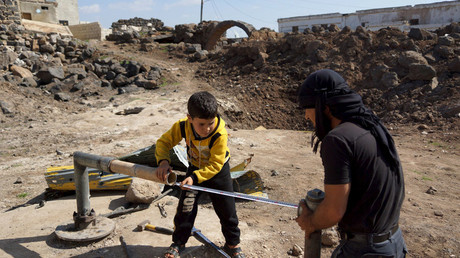
Civilians fix damaged water pipes in the rebel held al-Ghariyah al-Gharbiyah town, in Deraa province, Syria February 28, 2016. © Alaa Al-Faqir

The Russian FM pointed out that there are still a number of issues that Moscow and Washington don’t agree on, but maintained that this would not prevent them from cooperating “on an equal footing” on the problems on which they have found common ground.

“The US has plenty of partners who do not agree with them… It does not mean that the differences on one particular issue should stop them from talking at all,” Lavrov said.

At the start of the talks, Kerry told Lavrov that the partial truce in Syria was working and reducing the level of violence in the country. “It’s fair to say three weeks ago there were very, very few people who believed a cessation of hostilities was possible in Syria,” Kerry said. “The result of that work has produced some progress. There has been a fragile nevertheless beneficial reduction in violence.”

The tone of Russia-US relations appeared softer than it has been for some time on many issues, including Syria and the conflict in eastern Ukraine, as both parties demonstrated an apparent desire to improve bilateral relations.

Kerry said that the productive eleven-month collaboration of Russian cosmonaut Mikhail Kornienko and American astronaut Scott Kelly on the International Space Station (ISS) should serve as an example for cooperation between the two world powers.

“When they were telling me about how they spent their time in space, they highlighted that their close cooperation demonstrated not only what the two astronauts could do, but what two countries could achieve together as well,” Kerry said at the press conference.

Read more
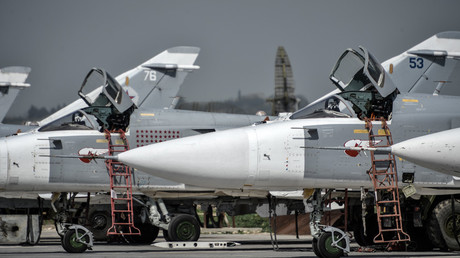
Russian Su-24 tactical bombers at the Hmeimim airbase in the Latakia Governorate of Syria. © Ramil Sitdikov

As an example, Lavrov noted that Russian and US experts could hold joint consultations to discuss the most effective ways to fight cybercrime.

When it came to Ukraine, both sides agreed that the Minsk Accords must be fully implemented.

“We have indeed pledged to ensure that Donbass, that the self-proclaimed republics of Donetsk and Lugansk [DPR and LPR], implement what they and their representatives signed under in Minsk,” Lavrov said, while calling on his US counterpart to ensure that similar pressure is put on Kiev.

Kerry reiterated that once the agreement is “fully implemented,” the US will be ready to roll back sanctions on Russia.

Meanwhile, Lavrov confirmed that Moscow is closely monitoring the health of Ukrainian national Nadezhda Savchenko. “We have confirmed that Savchenko’s health condition, that many try to speculate on, presents no concerns,” Lavrov said. “She is under constant monitoring of Russian doctors.”

Savchenko, a Ukrainian Air Force officer detained in Russia in 2014, was found guilty of murdering two Russian journalists near Lugansk in eastern Ukraine, and of illegally crossing the Russian border. The decision was made by a court in the southern Russian town of Donetsk on Monday.

Kerry, who has called for Savchenko to be sent back to Ukraine, told reporters that Putin indicated that at some point “we will be able to address the issue of Savchenko.”

Following the talks in Moscow, Aleksey Pushkov, the chairman of the Parliamentary Committee for International Relations, noted that Russia and the US are beginning to develop a closer relationship based on America’s pressing needs, which are forcing the US to forget about its previous goal to isolate Russia.

“About Kerry’s visit: there is nothing more powerful in politics than need. Under its influence, forgetting about isolating Russia, the US has begun to move,” Pushkov tweeted.
Groundwork laid to defeat ISIS in Palmyra, Syria – Russian military

March 18, 2016

Groundwork laid to defeat ISIS in Palmyra, Syria –

Russian military

Published time: 18 Mar, 2016 15:09 Edited time: 18 Mar, 2016 16:10

Source: Groundwork laid to defeat ISIS in Palmyra, Syria – Russian military — RT News

© Mikhail Voskresenskiy / Sputnik

All conditions are in place to surround and defeat Islamic State (IS, former ISIS/ISIL) in Palmyra, Syria, Sergey Rudskoy, chief of the main operations department of the Russian General Staff, told reporters.
Read more

A general view shows the damage at the ancient al-Atroush mosque in the old city of Aleppo, Syria January 28, 2016. © Abdalrhman Ismail

“Everything necessary has been provided for the encirclement and definitive defeat of IS armed groups in Palmyra,” Rudskoy said, adding that the Syrian Army had already taken control over all dominant heights and major roads around the city. The terrorists’ logistical support has also been cut off.

The Syrian army and patriotic opposition fighters, backed by the Russian Air Force, are conducting a large-scale operation to liberate the city.

The Russian Air Force make an average of 20-25 sorties per day lending support to the operation aimed at liberating Palmyra, the spokesman said, stressing that Russia will continue to carry out airstrikes targeting IS and Al Nusra Front in Syria.

Last week, Syrian government forces and people’s militia groups backed by Russian airstrikes managed to come close to the city. On Thursday, they reportedly entered the Palmyra museum complex.

Russia is withdrawing most of its forces from Syria and ending its five-month anti-terror operation launched on September 30, 2015. The decision was taken by Russian President Vladimir Putin on March 14, who said that the operation’s objectives have been largely achieved.

Russia’s backing allowed Syrian forces to free 400 populated areas and over 10,000 square kilometers [3,860 square miles], Russian Defense Minister Sergey Shoigu said when he reported to Putin on March 14, adding that terrorists had been forced out of Latakia and Aleppo provinces while Palmyra was “blocked.”

Russia also continues to monitor observance of the ceasefire with more than 70 drones.

On Thursday, Putin said Russia could deploy its forces back to Syria in a matter of hours in necessary, although he stressed that Moscow would not want to see such a development.

The Russian Defense Ministry reiterated there had been a sustained decrease in the number of ceasefire violations adding that Russia’s ceasefire monitoring center recorded only five such cases over the last 24 hours in comparison to “dozens of violations” recorded earlier.

Rivlin Tells Putin Iran Must Stay Off Syrian – Israeli Border

March 17, 2016

Rivlin Tells Putin Iran Must Stay Off Syrian – Israeli Border

By: David Israel Published: March 17th, 2016

Source: The Jewish Press » » Rivlin Tells Putin Iran Must Stay Off Syrian – Israeli Border

Israeli President Reuven Rivlin (L) meets with Russian President Vladimir Putin. Photo by Mark Neyman/GPO

Israeli Presidents very rarely find themselves in a position to decide policy or negotiate with foreign powers — their role as heads of state is similar to that of the British monarchs, a symbol of government rather than the real thing. But on Wednesday President Reuven Rivlin found himself in the unexpected position of delivering a critical message to the leader of the second largest world power, President Vladimir Putin, and charting the start of a new relationship between Israel and Russia over Syria.

As the world discovered on Monday this week, President Putin announced that the war in Syria had been won and he was pulling the bulk of the Russian military contingency from the battlefield. It was a brilliant move on the part of the Russian leader, whose main achievement since the start of his involvement in Syria had been to wipe out the Western- and Saudi-funded rebels, leaving President Bashar al-Assad as the only viable alternative to the ISIS hordes. He outmaneuvered President Obama by several steps, and left Middle East leaders gasping with astonishment. This included Israel’s leadership. In fact, the original message President Rivlin was asked to deliver to Putin on his pre-scheduled state Visit Wednesday, was a call to coordinate the activities of the IDF and the Russian army in the Syrian Golan heights, along Israel’s north-eastern border.

On Monday night that message had to be scrapped and a completely new policy had to be charted on the spot, in advance of the Wednesday meeting in the Kremlin. “I felt that I was thrown into battle as the envoy of the prime minister, the defense minister and the chief of staff,” Rivlin related. His mission, outlined in a hurry on Monday night, was to draw Israel’s lines in the sand as far as the post-Russian Syrian arena was concerned.

In the end, those lines in the sand were not so hard to figure out, and Rivlin delivered the message succinctly: there will be no entry of Iranian forces into the Syrian Golan heights; there will be no transfer of advanced Russian weapons and technology into the hands of Hezbollah; there will be no Israeli retreat from the Golan heights. Those are the issues over which Israel, if pushed, would go to war.

According to reports in Israel’s media, Putin’s response was friendly and understanding — at least on the surface. He repeated his commitment to Israel’s security, if only, he joked, because so many Russians live and visit there. Putin then inquired about the steps Israel is prepared to take to advance peace with the Palestinian Arabs and President Rivlin responded with the list of efforts and gestures Israel has made since 1993 to reach peace, and promised that—short of national suicide—Israel would continue to try everything in its power to reach peace.

There will be a meeting between Putin and Prime Minister Netanyahu soon, but until then, over in Jerusalem, they appreciated Rivlin’s unscheduled relief pitching.