Posted tagged ‘Russia – Turkey’

Can US, Turkey keep up appearances in Syria?

May 30, 2016

Can US, Turkey keep up appearances in Syria? Al-Monitor, May 29, 2016

A terrorist group linked to the Islamic State (IS) claimed responsibility for suicide bombings in Tartus and Jableh in Syria on May 23 that killed more than 150 civilians and wounded more than 200 others. Maxim Suchkov points out that the attack in Tartus occurred deep inside government-controlled territory. Russia maintains a naval base in Tartus and an air base and reconnaissance center in Khmeimim in the Latakia region. The suicide attacks, Suchkov suggests, could be a catalyst for a Russian “first strike” strategy against terrorist and aligned Salafi groups.

Moscow had already signaled the prospect of escalation against Jabhat al-Nusra and allied groups prior to the May 23 attacks. The Russian Ministry of Defense has announced a pause in its air campaign to allow armed groups allied with Jabhat-al Nusra to distance themselves from the al-Qaeda affiliate. On May 26, Jabhat al-Nusra, Ahrar al-Sham and allied groups seized the town of Dirkhabiyah near Damascus. Ahrar al-Sham has coordinated more closely with Jabhat al-Nusra in response to increased US and Russian targeting of the al-Qaeda affiliate over the past few months.

This column last week suggested that the United States take up a Russian offer to coordinate attacks on Jabhat al-Nusra, which is not a party to the cessation of hostilities. For the record, we have no tolerance or empathy for groups or individuals who stand with al-Qaeda. We hope that this is at least part of the message the United States is conveying to its regional partners who have backed these groups.

With the Geneva talks suspended for several weeks, the prospect of a Russian campaign to deliver heavy and potentially fatal blows to Jabhat al-Nusra and its allies, especially in and around Aleppo and Idlib, could signal yet another turning point in the Syria conflict.

Turkey’s failed proxy war

The United States and Turkey are struggling to keep up appearances in Syria, despite even further signs of division and discord.

Gen. Joseph Votel, US CENTCOM commander, met last week with Syrian Kurdish forces during a “secret” visit to northern Syria as part of a regional diplomatic tour that also included a stop in Ankara. Votel told Washington Post columnist David Ignatius that he is seeking to “balance” Turkey’s role as a “fabulous” partner in the battle against IS with that of the People’s Protection Units (YPG), the backbone of the Syrian Defense Forces (SDF), which is a “very good partner on the ground.”

In contrast to the YPG, Turkey’s proxy forces, including a worrying mix of Salafists who are willing to run operations with Jabhat al-Nusra, have been a flop. Last week, IS seized at least seven villages in the northern Aleppo region.

Fehim Tastekin reports that SDF-led military operations to liberate Jarablus, which is an essential gateway along with al-Rai to the outside world via Turkey, were postponed “because of Turkey’s red line against the Kurds.” The offensive against Raqqa has also been slowed, writes Tastekin, because “the SDF’s operational capacity still leaves much to be desired. It is not an option for the Kurdish YPG-YPJ to control Raqqa, because they will encounter local resistance. They also worry that scattering their forces in Arab regions could weaken the defensive lines of Rojava (Syrian Kurdistan). Therefore, Arab forces would have to get in shape to control the situation in the post-IS period.” Laura Rozen reports from Washington that the United States is seeking to boost the numbers of Arab Sunni forces among the SDF in anticipation of an advance on Raqqa.

Meanwhile, the Pentagon found itself in a public relations fiasco after Turkey complained that US special forces in Syria were wearing badges with the logo of the YPG, which Turkey considers the Syrian partner of the Kurdistan Workers Party (PKK) and therefore also a terrorist organization. This might be compared with what in the sports world is known as an unforced error, and made Votel’s already daunting diplomacy that much more complicated.

Air Force Col. Sean McCarthy also told Ignatius that US air operations against IS out of Incirlik Air Base were mostly “autonomous” of Turkish missions, saying that “we don’t discuss with them where we’re going.”

Adding it all up, the US-Turkish “partnership” against IS may be more fable than fabulous. The open secret is that Turkey is preoccupied first with thwarting advances by Syria’s Kurds, and second with shutting down the remaining lifelines for IS in northern Syria. These priorities are of a piece. No doubt Turkey is taking up the fight against IS, but first things first. Tastekin, who previously broke the back story on Turkey’s disastrous proxy efforts to retake al-Rai from IS in April, now concludes that “there is no room for optimism that Ankara will erase its red lines vis-a-vis the Kurds. Instead, Turkey is now trying to put together an even more formidable force with Jabhat al-Nusra, which it is trying to steer away from al-Qaeda.”

The catch might just be that many of the Syrian armed groups backed by Washington’s regional partners are proxies for a sectarian agenda that is mostly about toppling Syrian President Bashar al-Assad, however unlikely that now appears, and, by extension, keeping the heat on Iran. The when and where of taking the fight to IS or Jabhat al-Nusra is more or less negotiable, depending on trade-offs and pressure. We do not feel we are out on a limb in suggesting that efforts by Ankara or others to wean Jabhat al-Nusra from al-Qaeda will come to no good. This column has repeatedly documented the fluidity of foreign-backed Salafi groups such as Ahrar al-Sham and Jaish al-Islam shifting in and out of tactical alliances with Jabhat al-Nusra, all the while preaching an ideology almost indistinguishable from al-Qaeda and IS.

The losers, of course, are the people of Syria, including those who suffer under IS’ tyranny that much longer because of Turkey’s concerns about the Kurds, and as Washington’s policymakers and pundits begin another maddening deep dive into how to rejigger ethnic and sectarian fault lines. Syrians fleeing IS terror in Aleppo, meanwhile, told Mohammed al-Khatieb that living under IS is “like hell … unbearable.” While we acknowledge the complexities and challenges of the raw ethnic and sectarian politics of Syria, as well as the potential for vendettas and mass killings, there is, in our score, an urgency and priority to focus on the destruction of IS and al-Qaeda above all else.

Sur’s aftermath

Diyarbakir’s historic district of Sur has witnessed some of the most brutal fighting between Turkish military and PKK forces over the past year. Mahmut Bozarslan reports from Diyarbakir that “historical landmarks in Sur, which was last year added to UNESCO’s World Heritage List, also suffered their share of destruction. The walls of the Armenian Catholic church are partially destroyed, while the nearby Haci Hamit Mosque is missing its minaret, with a dome riddled with bullets. Another Armenian church, Surp Giragos, had its windows shattered and interior damaged.”

“Still, those ancient monuments were lucky compared with more ordinary structures in the area,” writes Bozarslan. “A building with an intact door was almost impossible to find. The warring parties had used some buildings as fighting bases, others as places to rest. Stairways were littered with empty tins; one was also stained with blood. At the bloodied spot, a piece of paper reading “body #1” was left behind, suggesting that the security forces had been there for a crime scene report. A couple seemed relieved that they had escaped with relatively little damage, but grumbled that their apartment had been broken into, with the bedroom and closets rummaged. They claimed it was the security forces who had entered, while their neighbor showed Al-Monitor binoculars that had been left behind.”

GCC leaders reject Obama’s Middle East policy

April 23, 2016

GCC leaders reject Obama’s Middle East policy, DEBKAfile, April 23, 2016

Big Bomber


DEBKAfile’s intelligence sources and its sources in the Gulf report exclusively that US President Barack Obama failed to convince the leaders of the six Gulf Cooperation Council member states, during their April 22 summit in Riyadh, to support his Middle East policy and cooperate with Washington.

Our sources also report that Saudi Arabia, with Turkey’s help, and the US carried out separate military operations several hours before the start of the summit that showed the extent of their differences.

The US on Thursday started to use its giant B-52 bombers against ISIS in an attempt to show Gulf leaders that it is determined to quash the terrorist organization’s threat to Gulf states. The bombers deployed at Qatar’s Al Udeid airbase attacked targets around Mosul in northern Iraq, but the targets were not identified.

Meanwhile, Saudi Arabia and Turkey, which recently established a bloc along with Egypt and Jordan to oppose Obama’s Middle East policy, started to infiltrate a force of 3,500 rebels back into Syria.

The force has been trained and financed by the Saudis at special camps in Turkey and Jordan. Members of the force are now fighting alongside other rebels north of Aleppo, but they are being bombed heavily by the Russian and Syrian air forces.

Riyadh sent the rebels into Syria to demonstrate to Obama that the Saudi royal family opposes the policy of diplomatic and military cooperation between the US and Russia regarding Syria that enables President Bashar Assad to remain in power in Damascus.

Since the war in Syria began in 2011, Obama has promised countless times that Washington would train and arm Syrian rebel forces outside the country, and then deploy them in Syria in order to strengthen rebel forces.

However, it has not done so except for one instance in 2015. The US infiltrated a small force consisting of no more than several dozen fighters, but it was destroyed by the Nusra Front, an affiliate of Al Qaeda, shortly after it crossed the border. The terrorist group had apparently been tipped off about the arrival of the pro-American force.

All of Washington’s efforts to recruit and train Syrian fighters, which have cost close to $1 billion, have failed.

DEBKAfile’s sources report exclusively that the leaders of the six GCC member states put their previous differences aside and presented Obama with four requests aimed at building a new joint policy regarding the region. According to our sources, these requests were:

1. Action by Washington to strengthen the Sunni majority in Iraq and facilitate representation of the Sunnis in the central government in Baghdad. The Gulf rulers told Obama that his policy of trying to win the support of Iraqi Prime MinisterHaider al-Abadi is mistaken.

They also pointed out reports by their intelligence services that al-Abadi is likely to be deposed and be replaced by a pro-Iranian prIme minister in the near future.

Obama rejected the request and said he refuses to change his Iraq policy.

2. Imposition of new US sanctions on Iran over its continuing ballistic missile tests.

On April 19, several hours before Obama’s departure for Riyadh, Iran carried out its latest act of defiance by attempting to launch a satellite into orbit using one of its “Simorgh” intercontinental ballistic missiles. The missile failed to leave the Earth’s atmosphere, fell to earth and crashed along with the satellite.

Obama turned down the Gulf leaders on new sanctions as well.

3. Provision of US-made F-35 fighter-bombers to Saudi Arabia and the UAE so they can take action against the Iranian missile threat. The US president declined the request.

4. Abandonment of Washington’s cooperation with Russia and the UN for political solution in Syria, and instead cooperate with Gulf states and Turkey to end the war and depose President Bashar Assad. Obama refused.

In other words, the summit in Riyadh, Obama’s final meeting with GCC leaders before he leaves the White House next January, ended without a single agreement.

Russia to keep S-400 in Syria until Saudi warplanes leave Turkey

March 16, 2016

Russia to keep S-400 in Syria until Saudi warplanes leave Turkey, DEBKAfile, March 16, 2016

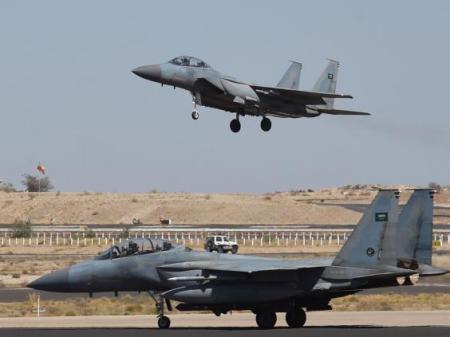
F15-fighter-jetsSaudi F-15 bombers

The highly-advanced S-400 air defense missiles will also eventually be evacuated from Syria, said high-ranking officials in Moscow on Wednesday, March 17, according to an exclusive DEBKAfile report. But their presence for now is crucial in view of the continuing Saudi buildup of warplanes in Turkey, close to the Syrian border.

Our military sources disclose that the initial Saudi deployment of four warplanes to the Turkish air base of Incirlik earlier this month, has been expanded to sixteen, while Saudi officials declare that Riyadh and Ankara are preparing to intervene jointly in the Syrian conflict.

According to our sources, Turkish armored and infantry troops have already crossed the border and set up positions in the northern Syrian province of Idlib, just a few hundred meters inside the border.

Russian Foreign Minister Sergei Lavrov referred Sunday, March 14, to evidence of “a creeping expansion by Turkey in the sovereign nation of Syria.”

This was taken as a warning that Moscow would not tolerate any further Turkish encroachments in Syria, any more than it would accept Saudi air force intrusions of Syrian air space.

The Russians infer from Turkish military movements that Ankara aims to establish enclaves inside Syria as no-fly or security zones, which Moscow has consistently opposed. The presence of the top-grade S-400 anti-air missiles in Syria is meant to obstruct this plan and discourage Turkish and Saudi aerial flights over Syria.

At the same time, the presence of the S-400 missiles close by is a worry for the Israeli Air force.  The batteries, currently positioned at the Latakia base, would cover a broad stretch of air space over northern and central Israel if they were moved further south.

A word of reassurance on this score was understood to have come from Russian military sources Wednesday. They said that the S-400 would be removed eventually, leaving behind only the Pantsir-S1 anti-air missile systems, which have never posed a challenge to the Israeli air force in the last decade.

DEBKAfile’s military sources also confirm that Putin has so far kept his promise to Prime Minister Binyamin Netanyahu to withhold advanced S-400 and S-300 air defense missiles from Iran, by executing a series of delays.

On Feb. 17, Iranian military officials announced a ceremony the next day at the Caspian port of Astrakhan for the handover of the first batch of S-300s. The ceremony never took place.

This week, Russian arms industry sources announced that the missiles would be not be delivered to Iran before August or September – another delay, which is unlikely to  be the last.

Turkey and Saudi Arabia hit back for the Obama-Putin Syrian pact

March 5, 2016

Turkey and Saudi Arabia hit back for the Obama-Putin Syrian pact, DEBKAfile, March 5, 2016

Zaman_4.3.16Headline of last issue of Turkey’s Zaman before government takeover

Turkey and Saudi Arabia have taken separate steps to break free from Washington’s dictates on the Syrian issue and show their resistance to Russia’s highhanded intervention in Syria. They are moving on separate tracks to signal their defiance and frustration with the exclusive pact between Presidents Barack Obama and Vladimir Putin which ostracizes Riyadh and Ankara on the Syrian question.

Turkey in particular, saddled with three million Syrian refugees (Jordan hosts another 1.4 million), resents Washington’s deaf ear to its demand for no-fly zones in northern and southern Syria as shelters against Russian and Syrian air raids.

Last year, President Reccep Erdogan tried in desperation to partially open the door for a mass exit of Syrian refugees to Europe. He was aghast when he found that most of the million asylum-seekers reaching Europe were not Syrians, but Muslims from Africa, Afghanistan and Pakistan, in search of a better life in the West. Most of the Syrians stayed put in the camps housing them in southern Turkey.

Even the Turkish intelligence agency MIT was hard put to explain this setback.  According to one partial explanation, organized crime gangs of Middle East dope and arms smugglers, in which ISIS is heavily represented, seized control of the refugee traffic heading to Europe from Libya, Iraq and Syria.
This human traffic netted the gangs an estimated $1 billion.

Turkey was left high and dry with millions of Syrian refugees on its hands and insufficient international aid to supply their needs. No less painful, Bashar Assad was still sitting pretty in Damascus.

Finding Assad firmly entrenched in Damascus is no less an affront for Saudi Arabia. Added to this, the Syrian rebel groups supported by Riyadh are melting away under continuing Russian-backed government assaults enabled by the Obama-Putin “ceasefire” deal’

The oil kingdom’s rulers find it particularly hard to stomach the sight of Iran and Hizballah going from strength to strength both in Syria and Lebanon.

The Turks threatened to strike back, but confined themselves to artillery shelling of Syrian areas close to the border. While appearing to be targeting the Kurdish YPD-YPG militia moving into these areas, the Turkish guns were in fact pounding open spaces with no Kurdish presence. Their purpose was to draw a line around the territory which they have marked out for a northern no-fly or security zone.

Saturday, March 5, President Erdogan proposed building a “new city” of 4,500 square kilometers on northern Syrian soil, to shelter the millions of war refugees. He again tried putting the idea to President Obama.

The Saudi Defense Minister, Deputy Crown Prince Mohammed bin Salman put together a more high-risk and comprehensive scheme. Its dual purpose is to hit pro-Iranian Hizballah from the rear and forcied [Sic] the two big powers to treat Riyadh seriously as a player for resolving the Syrian imbroglio.

The scheme hinged in the cancellation of a $4 billion Saudi pledge of military aid to the Lebanese army, thereby denying Hizballah, which is a state within the state and also dominates the government, access to Saudi funding. But it also pulled the rug from under Lebanon’s hopes for combating ISIS and Al Qaeda’s Nusra Front, which have grabbed a strip of Lebanese territory in the northern Beqaa Valley.

The Saudi action, by weakening the Lebanese military and its ability to shore up central government in Beirut, risks tipping Lebanon over into another civil war.

The London Economist commented that this Saudi step against Lebanon seems “amateurish.” Under the young prince (30), “Saudi Arabia sometimes acts with bombast and violence that makes it look like the Donald Trump of the Arab World,” in the view of the magazine.

But the Saudi step had a third less obvious motive, a poke in the eye for President Obama for espousing Iran’s claim to Middle East hegemony. Resentment on this score is common to the Saudi royal house and the Erdogan government.

As a crude provocation for Washington, the Turkish president ordered police Friday, March 4, to raid Turkey’s largest newspaper Zaman, after an Istanbul court ruling placed it under government control.

The newspaper released its final edition ahead of the raid declaring the takeover a “shameful day for free press” in the country. A group of protesters outside the building was dispersed with tear gas, rubber bullets and water cannons.

Zaman is owned by the exiled Muslim cleric Felhullah Gulen, who heads the powerful Hizmet movement, which strongly contests Erdogan government policies. A former ally of the president, the two fell out years ago. In 1999, after he was accused of conspiring to overthrow the government in Ankara, Gulen fled to the United States.

Today, the exiled cleric runs the Hizmet campaign against the Turkish president from his home in Pennsylvania, for which he has been declared a terrorist and many of his supporters arrested.

The takeover of Zaman was intended both as a blow by Ankara against Muslim circles opposed to the Erdogan regime and as an act of retaliation against the United States, for harboring its opponents and sidelining Turkey from Obama administration plans for Syria.

Oddly enough, the Turkish president finds himself in a position analogous to Egyptian President Abdel-Fatteh El-Sisi, who is at war with the Muslim Brotherhood, a movement which enjoys Obama’s support.

Israeli Prime Minister Binyamin Netanyahu has his own dilemmas. Struggling to keep his balance while walking a tight rope on the Syrian situation between Israel’s longstanding ties with Washington and handling the Russian tiger lurking next door, he is in no hurry to welcome Erdogan’s determined overtures for the resumption of normal relations.

Turkey is in trouble with both major world powers and, after living for five years under hostile abuse from Ankara, Israel does not owe Erdogan a helping had for pulling  him out of the mess.

Russian Magazine: Russia’s Air Force In Syria Is Winning The Battle For Assad

February 17, 2016

Russian Magazine: Russia’s Air Force In Syria Is Winning The Battle For Assad, MEMRI, February 17, 2016

(Please see also, Moscow on the Tigris: Russia Joins the Terror Nexus:

While an exhausted and burned out United States wishes international migraines like the Syrian civil war would just go away, Russia is energized by the prospect of filling the vacuum and thus once again playing a major role on the world stage. Aggressively intervening on behalf of his ally in Damascus, President Bashar al-Assad, and projecting force well beyond even the frontier states in his“near abroad,” Vladimir Putin audaciously aims to change political outcomes in a region that has been out of his country’s sphere of influence for a generation.

— DM)

Recently, the Russian campaign in Syria reached its 100th day. An article in Expert Online, the website of the influential Russian analytical magazine Expert, reviews the state of the Syria war, analyzing the activities on various fronts as well as the Russian involvement. The article, by journalist Pyetr Skorobogatyj, states that, with Russia’s help, the Syrian army is advancing slowly but surely. It stresses that the operation in Syria is not a substantial financial burden for Russia, and that it benefits Russia in many ways – including by allowing it to train pilots, test the performance of various weapons, and target Russian-speaking militants who are fighting in Syria. Most significantly, it allows Russia to establish a permanent presence in the Middle East that has an impact on all the region’s countries.

The article then reviews the military situation in Syria region by region. Focusing first on the north, it stresses that the Kurdish forces there are making headway against ISIS and are laying down the foundations for what may eventually become a Kurdish autonomy or even an independent Kurdish state. The main loser, says the article, is Turkey, who is powerless to stop these developments from unfolding.

The article states further that Russia, using its S-400 missiles, has effectively set up a no-fly-zone in the north of Syria, thus enabling the regime forces to make substantial achievements against the rebels, especially in the Latakia area. It adds that the U.S., too, is planning to establish a military base in northeast Syria, in the Malikia area.

Moving to the southern region, the article states that the stalemate between the sides there – namely the regime forces and rebel groups backed by Jordan – has ended, since Jordan has ordered these forces to stop attacking Assad’s troops. In Damascus, too, the regime is slowly flushing out the rebels, street by street and building by building. As for eastern Syria, the article concedes that ISIS still maintains a strong presence there and will be difficult to defeat.

The following are excerpts from the article.[1]

 “The Air Campaign Is Not Expensive For Moscow, And It Allows Russia To Train Pilots And Test Different Types Of Weapons”

“As the Russian campaign recently reached its 100th day,[2] [Russia’s] main goal appears to be the use of military power to force peace on the ‘rational’ [i.e., non-jihadist] rebel groups. There are a number of small [rebel] groups which have either joined Assad’s military or have stayed independent but coordinate their activities with the Syrian army. [Russia’s] largest partner [apart from the Syrian army] is the Syrian Democratic Army [SDA], a Sunni popular militia which is fighting in the north [of the country] alongside the Kurds and government troops. The Russian Ministry of Defense has confirmed that Russia supports the SDA with weapons, ammunition and airstrikes. ‘For its part, the patriotic opposition [i.e. the SDA] coordinates its military objectives with the Russian aviation group,’ noted Lt. General Sergei Rudskoy, Chief of Main Operations Management in the Russian Army General Staff…

“The joint military campaign of the Russian Air Force and Syrian troops seems to be [progressing] slowly but surely. [The slow pace] is due to the broad spectrum of military goals which must be met, including pressure on all ‘factions’ in order to separate [potential] ‘partners’ from ‘enemies,’ as well as the necessity to return as much territory as possible to the Syrian government’s control, in order to enable it to negotiate from a position of strength about the country’s future. In addition, all the battle fronts seem chaotic, with many parallel ‘seething cauldrons’… and with weather conditions are getting worse… All of these factors together make Russian air operations difficult, especially during the winter period. This week the ‘bad guys’ [i.e. ISIS] used the cover of a sandstorm [which hampered Russian air activity] to mount a major offensive on Deir Al-Zor, a Syrian enclave in the desert. This action resulted in a major defeat for the Syrian side. As prevailing weather conditions worsen, the… intensity of the military campaign will decrease…

“Notwithstanding, during the first 100 days of Russian Air Force and Navy operations, 217 villages and towns were retaken, and 1000 sq. km. of territory. The Russian-Syrian coalition has no need to hurry. The air campaign is not expensive for Moscow, and it allows Russia to train pilots and to test the battle performance of different types of weapons. These benefits are in addition to the political gains and to the main goal, which is to eliminate Russian-speaking fighters in theaters far away from Russia’s borders.

“In addition, thanks to the new Russian air force base in the [the Syrian city of] Latakia, Moscow has established a permanent presence in the region, controlling a very important logistic hub. This modern military base (equipped with Iskander[3] and S-400[4] missiles)… changes the military and political situation in Iraq, Iran, Israel, the U.S… and, of course, Turkey”…”

“Russia Has Set Up A No-Fly Zone Using Its S-400 Surface-To-Air Missile System”

“[Meanwhile] the goals of the main participants in the Syrian battle have become clear. In the north of Syria… the Kurds are winning. They are finally receiving extensive military support from the U.S. and covert support from Russia. They are carrying out offensive operations against ISIS and expanding their territory, which might become a future Kurdish state or an autonomous region within Syria, depending on the final agreement… The main loser is Turkey, who is unpredictable, irresponsible and unable to keep agreements. Currently, [Turkish President Recep Tayyip] Erdogan can only look on as the Kurdish enclave continually grows stronger. [The Turkish President] can initiate military operations only on his own territory…

“The geopolitical value of northern Syria is understood by all parties. Russia has set up a no-fly zone [there] using its S-400 surface-to-air missile system… [while] Syria is strengthening its Al-Bab air base with Russian military advisors and the S-300[5] missile system. The Americans are not napping either, and plan to set up a military base in Malikia in north-east Syria… This will allow the U.S to carry out an independent policy without having to depend on the Kurdish state which is being established…

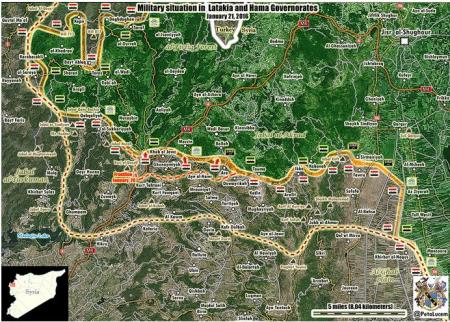
“The Syrian army, aided by Hizbullah’s brigades, is doing very well in the Latakia governorate. The map [below] clearly shows the movement of the fighting forces over the last few months. The dotted red line represents the front on October 7, 2015. In the first half of January 2016, government troops finally showed fighting ability against the Islamist stronghold of Salma… It was the first time that Russian military experts actively took part in the campaign, probably coordinating the attack on Salma. Support from Russian planes in the northern Latakia province allows the Syrian army to continue its advance at full speed…”

26798Military situation in Latakia and Hama areas, January 21, 2016

In The South, Jordan-Backed Rebels Have Been Ordered To Stop Attacking; In Damascus, The Government Is Flushing Out Islamists; In The East, ISIS Still Holds A Significant Area

“In the Dera province in the south, the opposing sides had [previously] agreed to maintain the status quo. Damascus was avoiding a conflict with Israel as well as with Jordan, which openly sponsored tribal forces and Islamist brigades… [Today, however,] the tactic of constant pressure [by Syrian regime troops on these forces and brigades] is producing results. The Military Operations Command [MOC] in Amman… which is coordinating rebel activities in southern Syria, has ordered [the forces it sponsors] to stop attacking [Syrian] government forces… Jordan’s logic is very simple… Syrian refugees in Jordan now total about 30% of the population, the same number as the Palestinians living in Jordan… so Jordan prefers to try to stabilize the situation in Syria rather than dream about cutting off Syria’s southern territories from the rest of the country. On the other hand, Damascus has begun to raise the issue of Israeli[-sponsored] rebels occupying the [Syrian] Golan Heights.

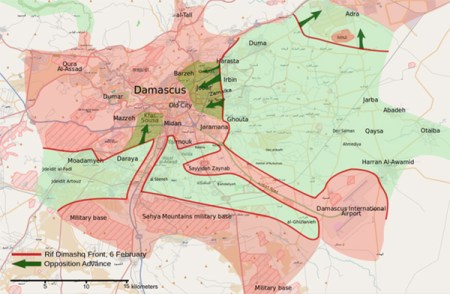
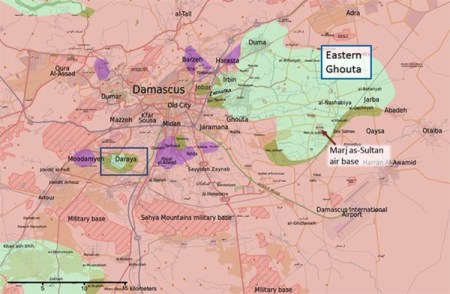
“In the Syrian capital, government troops are continuing to flush out Islamists and ‘bad guys’ from the city. The score is being kept not by counting streets retaken, but by counting buildings… The progress in the Damascus area is noticeable only when viewed over a long period of time. Below is a map showing the balance of forces in 2013, and beneath it a map showing the balance of forces in 2015.

26799Damascus area in 2013
26800Damascus’ area in 2015

“In addition, peace talks between the government and some rebel groups are now underway. Just recently, an agreement was made with a rebel brigade in the Al-Qadam suburb [in Damascus]. Some militants who were disarmed were moved to Raqqa and Idlib, while almost 1,500 others agreed to switch to Assad’s side…

“In spite of the relative success of government troops, ISIS still holds a significant area in the eastern part of Syria… The [ISIS] Caliphate is well-entrenched in the area it controls, with a strong force and command structure, and is not going to withdraw easily.”


Endnotes:

[1] Expert.ru, January, 22, 2016.

[2] The Russian campaign in Syria started on September 30, 2015.

[3] A Russia-manufactured portable short-range ballistic missile system; NATO designation name: SS-26 Stone.

[4] A Russia-manufactured anti-aircraft weapons system; NATO designation name: SA-21 Growler.

[5] A Russia-manufactured long range surface-to-air missile system;  NATO designation name: SA-10 Grumble.

Russian-Turkish clash building up over Syria

February 14, 2016

Russian-Turkish clash building up over Syria, DEBKAfile, February 14, 2016

Turkish-self-propelled_howitzers_13.2.16

Turkish President Tayyip Erdogan clearly took a calculated risk when he ordered a two-our cross-border artillery bombardment Saturday, Feb. 13 of Syrian army forces positioned around the northern Syrian town of Azaz and the Kurdish YPG militia units which two days earlier took control of the former Syrian military air base of Minagh some six kilometers from the Turkish border.

Kurdish troops backed by the Russian air force seized that base last week from rebel militias as part of the operation for cutting the rebel groups under siege in Aleppo from their supply routes. The Turkish bombardment was therefore an indirect attack on the Russian forces backing pro-Assad forces against the rebels in the Syria war.

Erdogan knows that Moscow hasn’t finished settling accounts with Turkey for the shooting down of a Russian Su-24 on Nov. 24 and is spoiling for more punishment. After that incident, the Russians deployed top-of-line S-400 ground-to-air missile batteries and advanced Sukhoi Su-35 warplanes to their base in Latakia near the Turkish border. Ankara therefore limited its strike to a two-hour artillery bombardment from Turkish soil, reasoning that a Turkish warplane anywhere near the Syrian border would be shot down instantly.

Emboldened by the delay in the Russian response, the Turks took another step: Prime Minister Ahmet Davutoglu threatened the Kurdish YPG militia with more attacks if they failed to withdraw from the Menagh air base.

Although the Turkish prime minister had called on “allies and supporters” to back the operation against the Russian-backed  Syrian Kurds, Washington took the opposite line by urging Turkey, a fellow member of NATO, to desist from any further attacks.

Washington’s concern is obvious. An outright clash between Turkey and Russia would entitle Ankara to invoke the NATO charter and demand allied protection for a member state under attack.

The Obama administration would have had to spurn this appeal for three reasons:

1. To avoid getting mixed up in a military clash between two countries, just as the US kept its powder dry in the Russian-Ukraine confrontation after Moscow’s annexation of the Crimean Peninsula in February 2014.

2. To avoid upsetting the secret Obama-Putin deal on the allocation of spheres of influence in Syria: the Americans have taken the regions east of the Euphrates River, and the Russians, the west.

The Kurdish YPG militia forces near Aleppo and the city itself come under the Russian area of influence.

3. Regional tensions were tightened another notch Saturday by Russian comments: Russian Prime Minister Dmitry Medvedev said that his country and the West have “slid into a new Cold War period,” and Foreign Minister Sergei Lavrov said a third World War is actually underway -“I call this struggle a third World War by other means.,” he said.

Washington will avoid any action that risks further stoking this high state of international tension, but will act instead to de-escalate the cross-border Turkish-Russian confrontation over Syria.

All eyes are now on Moscow, Much depends on Russia’s response to the artillery bombardment of its Syrian and Kurdish allies. It is up to Putin to decide when and how to strike back – if at all.

Russian Media Outlets Slam Turkey: Discuss Option Of Nuclear Attack On It, Accuse President Erdogan Of Supporting ISIS

January 19, 2016

Russian Media Outlets Slam Turkey: Discuss Option Of Nuclear Attack On It, Accuse President Erdogan Of Supporting ISIS, MEMRI, January 19, 2016

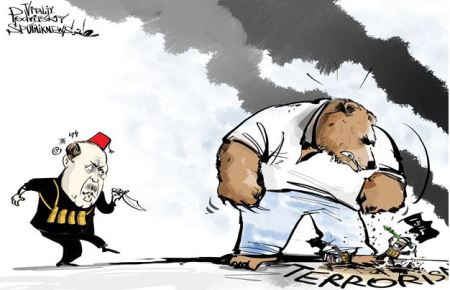
The Russian-Turkish conflict is reflected not only in the military, political and economic tension between the two countries but also in the Russian media, which expresses extreme hostility towards Turkey and its president.

This is evident, for example, in articles in English published recently on the Russian websites NEO[1] and Pravda.[2] One of these articles cites “a leading military expert” as saying that, in the event of a war between the two countries, “Russia will have to use nuclear weapons immediately, because the existence of the nation will be at stake.” The others focus on Turkish president Recep Tayyip Erdogan, presenting him as an enabler and supporter of the Islamic State (ISIS) and calling him a “madman” and a “murderer.” One even suggests that Turkey was “a prime mover in the [November 13] Paris attack.”

The following are excerpts from the articles.

26473The Russian bear stamps out terror, but Erdogan prepares to stab it in the back (Sputniknews.com, November 24, 2015)

‘It Would Be A Mistake For Russia Not To Use Nuclear Weapons’ In A War With Turkey

A Pravda.ru article titled “‘Scenarios For Real War Between Russia And Turkey” states:

“The possibility of a full-fledged war between Russia and Turkey has been a talk of the day for conspiracy theorists, analysts, couch warriors and experts on international politics for several weeks already… Let’s assume that a real war sparks between Russia and Turkey (NATO) – what kind of war would it be? What results would it bring?

“Politonline.ru[3] discussed the topic with leading military experts that follow various approaches to international armed conflicts.

“A leading expert of the Center for Military and Political Studies,[4] Mikhail Alexandrov, is convinced that in case of a real war, Russia will have to use nuclear weapons immediately, because the existence of the nation will be at stake.

“‘It would be a mistake for Russia not to use nuclear weapons in this case,’ [he said]. ‘The West and Turkey will try to drag us into a war such as the Crimean war, where escalation will be slow, combat actions in the Caucasus will erupt, and the Russian group in Syria will be destroyed. The West will be helping Turkey – there will be military units and state-of-the-art aviation deployed there. It will be a war of the wearing-out strategy’, he said.

“‘From my point of view, should the war with Turkey start, it must be a determined, ambitious and quick war. Russia will have to strike a nuclear blow on main infrastructure and military targets in Turkey immediately’…

“‘During the first few hours of this war, Russia must destroy the entire military infrastructure of Turkey’, Mikhail Alexandrov said. ‘One does not even have to use ballistic missiles in this strike – Iskander-M with nuclear warheads would be enough. As soon as the military infrastructure is destroyed, the Russian troops will go and take the area of the straits’, he added.

“‘The West will not even have time to do anything. European countries will be so horrified that they will not even dare to intervene. The Americans will face a choice – either they begin a strategic nuclear war against Russia or not. As a result, Russia will take the area of the straits, and the rest will be left to Turkey’, said the expert.

“In turn, non-nuclear scenario of a hypothetical possibility, but deputy head of the Tauric information-analytical center at Russian Institute for Strategic Studies,[5] Sergey Ermakov, suggested a non-nuclear scenario.

“‘Hopefully, the real conflict will not happen. Using nuclear weapons is an extreme option. As for a  regional war, there are non-military tools in the region. There are many anti-Turkish players in the region. In the case of a military conflict, the Kurds will rip the region to pieces, so for Turkey, a war is a game not even with the zero, but with a negative sum’, he said.

“‘If Turkey provokes the conflict, NATO may not resort to the fifth article. Aggression is one thing, but a country asking for a conflict and pulling NATO into it is another thing. In such cases, NATO tries not to get involved’, Sergei Ermakov said.

“‘No one wants to get involved in a direct military conflict with Russia. This conflict is fraught with a nuclear war and a global tragedy’, he added.”[6]

‘The Leader Of The Turkish Nation Is Not Just An Islamist, He’s A Supporter Of International Terrorism”

An article on NEO titled “What Fate Awaits Turkey?” states:

“It is now clear that Tayyip Erdogan’s political career is heading to a closure, slowly but surely. He had a chance of saving it if he had the courage to immediately offer his apologies to Moscow after the downing of the Russian Su-24 bomber over Syria, that was in fact heading away from Turkey, not toward it.

“Instead, he got tangled in a web of ridiculous lies and explanations, all while being rude to Russia. On top of it all, he framed Washington, by trying to excuse the actions of the Turkish Air Force with alleged orders he personally received from Barack Obama at the G20 summit held in Antalya.

“But even with his back against the wall, Turkey’s President proved to be stubbornly shortsighted, which forced Russia to go even further by uncovering the role Turkey and Erdogan’s family played in the smuggling of stolen Syrian oil, which is a direct violation of the UN Security Council Resolution that was adopted on February 12, 2015. This means that the Turkish state is directly responsible for the sponsorship of international terrorism, which, according to the UN, should be punished in a particularly harsh manner.

“But what’s even more grave – the president has publicly disgraced himself before the country. His had already been steadily losing his position, but once he dropped his mask, his ratings started falling abruptly. It turns out that the leader of the Turkish nation is not just an Islamist, he’s a supporter of international terrorism.

“Now we are presented with a situation in which the AKP leader and the sitting Prime Minister Ahmet Davutoglu who are largely secured by the victory for the ruling party, has obtained as much influence as the president. And after the downing of Russia’s bomber he strengthened his positions even more, even though he decided not to distance himself publicly from the president. It’s safe to assume that he’s just quietly waiting for a perfect opportunity to strike a mortal blow. He’s nothing short of a dangerous contender that is prepared to replace Erdogan at any given moment.

“But the deposing of Erdogan is a relatively positive scenario. Those who remember Turkish history should know that Erdogan is hated by the military command of the Turkish Armed Forces, which has traditionally played a crucial role in the maintaining of country’s stability… The army is not getting any revenues from the illegal oil smuggling, so, should the ties between ISIL and Ankara be maintained, the military command, while enjoying the support of NATO allies, can launch a coup d’etat and return to the power they had three decades ago. But this scenario won’t satisfy local Kurds and other ethnic and religious minorities, who have experienced the cruelty of the army in the suppression of their rights first hand.

“Turkey is going to be plunged into political chaos, when the ruling AKP will find itself opposed by both the army and the legal opposition, along with 22 million Kurds led by the banned Kurdistan Workers Party (PKK). In this case, the civil conflict could result in the collapse of the Turkish state with the Kurdish areas (the entire South-East Anatolia) breaking away, seeking ways to create an independent Kurdistan that will absorb certain areas in Syria in Iraq, changing the whole balance of power in the Middle East.

“Whatever happens, one thing is clear: Tayyip Erdogan will be forced to answer for his stubbornness, inability to respect others, dictatorship, corruption, and connections with ISIL. And above all, he must answer to the people of Turkey. And also to Russia for the cowardly attacks that claimed the lives of two Russian soldiers who fought valiantly against terrorism.”[7]

‘Turkey May Well Have Been A ‘Prime Actor’ In The Paris Attack’

Another NOE article, titled “Mad King Erdogan’s Oil Lies,” stated: “Erdogan is claiming he stole no oil. He has threatened to resign if he receives proof. There is little doubt that Erdogan is insane, those who have been watching his dance of death with ISIS have known this all along.

“However, while Erdogan talks only of oil, there are other issues to note as well. First of all, let’s talk about arms shipments that cross Turkey and move into Syria and Iraq. By Erdogan’s claim of total innocence, we must assume that ISIS, al Qaeda and the other openly terrorist groups that make up 95% of those fighting against Iraq and Syria are operating without any outside supplies.

“Where Erdogan’s wild claims fail is simple as looking at a map. When Russia publishes surveillance photos of not just hundreds but thousands of oil trucks, how can there be denial? The roads that these trucks use only go to Turkey.

“They don’t go anyplace else, there is no place else. There is absolutely no vehicle traffic between the Turkish occupied areas of Iraq and Syria, and we might as well call them that, and the areas under control of the legitimate governments in Baghdad and Damascus.

“What is support of terrorism if it isn’t trading oil for arms or, moreover, trading oil and the other loot of Iraq and Syria, for the cooperation of Turkish politicians and, just perhaps, their European and American friends as well.

“Yet no one considers that Turkey may well have been a ‘prime actor’ in the Paris attack. Would Erdogan have downed a Russian plane if it weren’t for the Paris attack? What about the Russian airliner downed over Syria? When you add MH17 and examine what is now known, that Ukraine and Turkey have been working closely together all along, with ISIS troops joining Kiev forces against NovoRussians, do we see a pattern?”[8]

‘Turkey’s “Leader” Should Be Charged With Murder’

A Pravda.ru article titled “Turkey: Treacherous Turncoat,” stated:

“Turkey’s ‘leader’ should be charged with murder. The sanctimonious West is in denial. NATO, partly complicit if not the instigator, vows to defend the murderer. Washington, which knows every detail, feigns ignorance. Why is there no Western condemnation in absence of Turkey’s compunction?

“Turkey, though paying lip service to Obama’s ‘coalition of the coerced’ to at long last fight ISIS in Syria with military force, is loath to do so. More important Turkey has its political/economic motives to do just the opposite: not lift a finger (against ISIS). That is because, as President Putin already disclosed to Russia’s Western ‘partners’ at the G20 Summit, Turkey is in reality a turncoat. Russian military intelligence provided the evidence: Turkey, including its President, are really aiding and abetting the ISIS terrorists. Detailed satellite images show that Turkey provided the egress for the stolen oil that ISIS has been trucking in and through Turkey.

“From there the contraband, once brokered by the Turks, is sold elsewhere. The ‘buyers’ list includes Israel, the European Union and as some have suggested, even America. The scale and the scope of the covert theft equates to over 50 million barrels. Moreover, Turkey has profited from this nefarious heist for almost four years. Russia has more proof. The laundered money trail flows straight to the Turkish President’s palace. Using a labyrinth of the Erdogan’s financial network including his own son, the ill-gotten gains are then spirited outside the country.

“While the Kurds fight ISIS, Erdogan courts the terrorists by providing them military cover. Russia, now wiser as to Erdogan’s true colors, should endeavor to be ever more vigilant in its Syria campaign as to joining the West’s coalition of ‘partners’.

“That same portent applies to the newest ‘partners’: Hollande and Cameron. The two turkeys are even bigger U.S. vassals. Neither one is trustworthy. Syria’s war is about oil; both Putin and Assad know that well.”[9]


Endnotes:


[1] NEO (New Eastern Outlook) is the journal of the Russian Academy of Science’s Institute of Oriental Studies, a leading research institution dealing with Asian and African countries and cultures. NEO presents itself as follows: “We cover political and religious issues, economic and ideological trends, regional security topics and social problems. We are committed to develop NEO into a notable international networking platform offering unbiased expert opinions and open dialogue among all thinking people worldwide regardless of their nationality, race or religion… We are focused on creating a new culture of partnership where opinions influence decisions.” (Journal-neo.org, “About” section, accessed January 12, 2016).

[2] Pravda.ru is a pro-government news and opinion website. According to its former Director General, Vadim Gorshenin, it is the successor of Pravda, the official mouthpiece of the Soviet Union’s Communist Party. It was founded by prominent members of Pravda’s editorial staff who left it in 1999, and today it is privately owned by Pravda.ru Holding, of which Gorshenin is the head.  Its current Director General, Inna Novikova, is Gorshenin’s wife.

The Pravda website publishes in four languages: Russian, English, Italian, Portuguese, and has more than 200,000 visitors daily. According Gorshenin, the English version is the second most popular English-language Russian website, after Russia Today (Pravda.ru, September 16, 2013).

[3] Politonline.ru is a political website, part of the Pravda media network.

[4] The Center for Military-Political Studies is a division of the Russian foreign ministry’s Moscow State Institute of International Relations. The center studies trends and affairs in the domains of defense policy, weaponry, military industry, military cooperation and state security (Eurasian-defence.ru).

[5] The Russian Institute for Strategic Studies (RISS) is a research center established by the President of the Russian Federation. Its main task is to inform various Russian state institutions on the political, economic and socio-political situation in the Black Sea countries and  Mediterranean region (En.riss.ru).

[6] Pravdareport.com, December 8, 2015. The Russian version of the article was published on Politonline.ru on November 27, 2015.

[7] Journal-neo.org, December 7, 2015. The author, Peter Lvov, is described by NEO as a Ph.D in political science.

[8] Journal-neo.org, December 7, 2015. The author, Gordon Duff, is described by NEO as a U.S. Marine combat veteran of the Vietnam War and a senior editor and board chairman of the Veterans Today website.

[9] Pravdareport.com, December 16, 2016. The author’s name is given as “Montresor.”