Posted tagged ‘Russia – Syrian war’

Russia’s 4 Syrian ceasefire zones – Kremlin spin

May 6, 2017

Russia’s 4 Syrian ceasefire zones – Kremlin spin, DEBKAfile, May 6, 2017

The only real change in Syria’s military situation is a surreptitious one, which may present a fresh, wide-ranging peril: The Lebanese Shiite Hizballah has agreed to place the 8,000 members fighting in Syria for Bashar Assad under direct Iranian command. This is part of a radical reorganization of all the military outfits Iran has deployed in Syria, whereby all the Shiite militias including Hizballah fall henceforth directly under a single centralized Iranian command.

************************

The widely reported Kremlin plan to set up four safe or “de-escalation” zones, that were supposed to have gone into effect in Syria Friday night, May 5, turns out to be nothing but a propaganda ploy. The spin factor leaps to the eye from the small print of the plan that was released by Gen. Sergey Rudskoy, head of Russian General Staffs Operations Division, Friday night.  He outlined four steps that may never take off.

1. Observation points will be set up to monitor the ceasefire (in the four designated de-escalation zones).

So when the putative safe zones were to have started operating Friday night, there were no observation points to monitor them.

2. The boundaries of the zones will be determined in accordance with the observation points.

This means that the zones don’t exist.

3. By June 4, a working team made up of officers of the three guarantors, Russia, Turkey and Iran, will be created to administer the observation points.

Who can tell what will happen in Syrian in a month’s time.

4. Only after the observation groups of the three sponsor-nations’ armies finish mapping the ceasefire zones can it be determined whether the plan is doable or not.

Still no zones.

The Russian propaganda machine worked overtime this weekend to convince the Western media that the ceasefire zones plan had won the support of the United States and Saudi Arabia.

The truth is that US President Donald Trump did not commit himself one way or another when he talked on the phone with President Vladimir Putin on Tuesday, May 2, although most of their conversation was devoted to Syria, rather than the North Korean crisis. There was no agreement between them on any Syrian issue, except for a decision that American and Russian forces in the war-torn country would stay out of each other’s way.

In sum, Moscow’s ceasefire zones plan, though effectively propagandized, has changed nothing in Syria’s bloody predicament.

With so much still up in the air, Secretary of State Rex Tillerson talked by phone Friday to Russian Foreign Minister Sergey Lavrov, after which he gave the following statement: “The secretary looks forward to further meetings with the foreign minister to discuss the respective roles of the United States and Russia in de-escalating the conflict and supporting the talks in Geneva to move the political solution forward.”

Tillerson made no mention of any safe zones which Moscow claims to be setting up with Ankara and Tehran, or of the Russian-sponsored Syrian peace conference in Astana, Kazakhstan.

Rebel groups, supposed to be holding a dialogue with Assad regime representatives, walked out of its fourth round last week. And the Trump administration appears unwilling to throw its support behind the Russian-sponsored peace initiative, preferring to stand solidly behind the UN-sponsored Geneva process.

Turkey and Iran, the other two “sponsors” of the Astana framework, and putative “guarantors” of the safe zones, are strangely silent about the roles assigned them by the Kremlin. And no wonder. As rivals in the Syrian arena, their forces are ranged against each other in both Syria and Iraq. It is hard to see them working shoulder to shoulder alongside Russian officers to monitor safety zones which are still pie in the sky.

The situation at the moment is this: In Iraq, Turkish and Iranian troops – essentially pro-Iranian militias under the command of Revolutionary Guards officers – glare at each other across two warfronts, Tel Afar and Sinjar. In Syria, each of their armies is poised to grab Al-Bab in the Aleppo province.

The only real change in Syria’s military situation is a surreptitious one, which may present a fresh, wide-ranging peril: The Lebanese Shiite Hizballah has agreed to place the 8,000 members fighting in Syria for Bashar Assad under direct Iranian command. This is part of a radical reorganization of all the military outfits Iran has deployed in Syria, whereby all the Shiite militias including Hizballah fall henceforth directly under a single centralized Iranian command.

This fundamental shift in the military balance in Syria was initiated by Al Qods chief Gen. Qassem Suleiman, commander of Iranian forces in Syria and Iraq. He convinced supreme leader Ayatollah Ali Khamenei that there was no other way to safeguard Iran’s military supremacy in the Syrian war arena, guarantee a land bridge to Lebanon, or mobilize tactically for future confrontations with Israel.

The Syrian ruler also submitted to this step. Therefore, Hizballah and the Shiite militias will henceforth operate under the orders of the Iranian military mission which has its seat at Syrian High Command Headquarters in Damascus.

This “reorganization” opens the door for Hizballah officers to assume Iranian army uniforms and act as “ceasefire monitors” if Russia’s fictitious safe zones ever get off the ground.

Iran, Russia Boost Military Ties Amid U.S. Action In Syria

April 24, 2017

Iran, Russia Boost Military Ties Amid U.S. Action In Syria, Washington Free Beacon, , April 24, 2017

(Please see also, Obama’s hidden Iran deal giveaway. — DM)

Russian Foreign Minister Sergei Lavrov (C) shakes hands with his Iranian counterpart Mohammad Javad Zarif (R) as Syrian Foreign Minister Walid Muallem (L) looks on after a joint press conference after their talks in Moscow on April 14, 2017./ AFP PHOTO  ALEXANDER NEMENOV/AFP/Getty Images)

Russia can serve as a major military ally for Iran and help provide it with not just military capabilities, but nuclear technology. Iran and Russia inked several deals in the past years to build a series of new light water nuclear reactors across the Islamic Republic.

***********************

Iran and Russia are moving closer together in their military alliance, working to boost ties and coordination in Syria and elsewhere in the region following the U.S. decision to launch a military strike in Syria, according to regional reports and experts.

Iran’s defense minister is slated to visit Moscow at the end of the month to discuss increased military ties, a move that is meant to deter U.S. action in the region and show a sign of increased force, according to regional experts who spoke to the Washington Free Beacon.

The Tehran-Moscow axis has been growing since the landmark Iran nuclear deal, with Russia making good on a series of weapons deliveries, including the Russian-made S-300 missile defense system. The two countries have been signing an additional number of military deals in recent months and that cooperation is likely to increase in light of the Trump administration’s decision to launch strikes against embattled Syrian President Bashar al-Assad, who is being backed by both Russia and Iran.

Iranian leaders have signaled in recent days that the alliance with Russia is a top priority going forward and that a number of new military deals are in the works.

“The visit by Iranian [President Hassan] Rouhani that took place on March 28 was another step toward developing extensive cooperation between Moscow and Tehran,” Iranian Ambassador to Russia Mehdi Sanaei was quoted in the country’s state-controlled press.

“We hope that we will witness even broader bilateral ties across all areas in the future,” Sanaei said during an event last week marking the Iranian Army Day.

Sanaei also celebrated the recent delivery by Russia of the S-300 missile system, which Tehran had been coveting for some time. The system is viewed by Iran as a major deterrence factor aimed at intimidating U.S. forces in the region.

The delivery of the S-300 system to Iran is a sign that Russia has an interest in bolstering Tehran’s military might, Sanaei said.

Since signing a massive military deal in 2015 with Russia, “important steps have been taken to strengthen bilateral relations in the area of defense,” Sanaei said. “One such step was the delivery of S-300 missile systems to Iran. This is an indicator of mutual trust in defense cooperation.”

As Iran’s defense minister gears up to visit Moscow, regional experts predict that the military ties between the countries will only increase as Assad comes under greater international pressure.

However, the alliance between the countries remains fragile and largely one of convenience.

“Russia and Iran have a similar goal in keeping Assad in power at all costs,” Boris Zilberman, a Russia expert at the Foundation for Defense of Democracies’ (FDD) Center on Sanctions and Illicit Finance, told the Free Beacon. “However, how each perceives the end state in Syria and the other’s role in that future is one of the big questions in the relationship.”

In the short term, both Iran and Russia will aggressively work to “show a united front after America’s first strike on the Assad regime,” Zilberman said. “This is what we are seeing in the flurry of activity, but it is yet to be seen if anything of substance comes out of these talks.”

Behnam Ben Taleblu, a senior Iran analyst at FDD, said that Russia views Iran as a chief counter to U.S. power in the region. The alliance between the countries is likely to strengthen as long as Moscow can use Tehran to offset American influence in the region.

“Russia can and will likely continue to use Iran instrumentally in its larger strategic competition with the United States,” Ben Taleblu said. “One wonders however, how the leadership of the Islamic Republic, which derided the late Shah of Iran for his closeness to the U.S. are able to justify—legally, politically, and even spiritually, the concessions they have made to befriend Russia. As a reminder, no country has taken more territory away from Iran and threatened its sovereignty in the past half millennia than Russia.”

Russia can serve as a major military ally for Iran and help provide it with not just military capabilities, but nuclear technology. Iran and Russia inked several deals in the past years to build a series of new light water nuclear reactors across the Islamic Republic.

“For the past two years Tehran has been drawing closer to Moscow,” Ben Taleblu explained. “Iran will look to Russia to help it drive the U.S. from the region, as well as support its nuclear development under the auspices of the [Iran deal], and engage in a highly selective modernization process for its military. Russia and China will likely become the two largest sources for arms as a UN-mandated arms ban is set to expire in 2020.”

[UPDATED] Syria moves all its fighter jets to Russian base

April 19, 2017

Syria moves all its fighter jets to Russian base, DEBKAfile, April 19, 2017

The Pentagon disclosure came ironically just hours after a senior Israeli military officer confidently informed military correspondents in Tel Aviv that the mechanism introduced for Russian-Israeli air force coordination in Syria had been successfully adopted by other nations operating in Syria, such as Turkey and the United States. He reported that the arrangement included reciprocal visits once every two months by heads of the operations divisions of the two armies.

These visits will probably go the same way now as the entire arrangement.

**********************************

Syria has moved all its fighter aircraft to the Russian Hmeimim air base in Latakia three weeks after 59 US Tomahawk cruise missiles knocked out one-fifth of its air force at the Shayrat base, in retaliation for a chemical attack on civilians in Idlib. This was reported Wednesday night, April 19, by the Pentagon. The Russian high command in Syria has its seat at that base.

DEBKAfile’s military sources report that the Syrian air force will operate henceforth under Russian protection and behind the advanced Russian S-300 and S-400 air defense shield without fear of US reprisals.

President Vladimir Putin’s response to the Trump administration’s call to distance Moscow from the Assad regime is therefore a flat rejection. He is instead fortifying Russian support for that regime.

The upsurge of Russian-US military tension places at risk the operational coordination accords prevailing between the air forces of Russia, the US and Israel in Syrian skies.

Syrian operational staff officers working in Hmeimim will now have access to the advanced Russian surveillance instruments tracking the movements of all foreign aircraft moving through Syrian air space. Syrian intelligence officers will also be close to Russian SIGINT facilities which the Russian spy agency GRU has installed there. In other words, by a single move, the Russians have substantially upgraded the Syrian air force’s operational and intelligence capabilities.

How does this affect the Syrian and Iranian air freight traffic ferrying military supplies from Iran? Where will they deliver their cargoes? Will they too be allowed to land at the Russian base in Latakia? If they are, the Israeli air force will be prevented from cutting down the flow of Iranian weapons for Hizballah. The new move more or less buries the Russian-Israeli agreements covering Syrian skies.

The Pentagon disclosure came ironically just hours after a senior Israeli military officer confidently informed military correspondents in Tel Aviv that the mechanism introduced for Russian-Israeli air force coordination in Syria had been successfully adopted by other nations operating in Syria, such as Turkey and the United States. He reported that the arrangement included reciprocal visits once every two months by heads of the operations divisions of the two armies.

These visits will probably go the same way now as the entire arrangement.

Official: U.S. Concludes Russia Had Advanced Knowledge of Syrian Chemical Weapons Attack

April 11, 2017

Official: U.S. Concludes Russia Had Advanced Knowledge of Syrian Chemical Weapons Attack, Washington Free Beacon, April 10, 2017

(Russia took all of the Syrian chemical stuff away, just as Saint Barack told us. Saint Bashar wouldn’t use chemical weapons on Syrians even if he had some, and Saint Vlad wouldn’t condone it for a minute if he did. It just a strange coincidence and it must have been a false flag attack, probably by wicked Christians, Jews or Hindus. Evil Trump must have glommed onto it to appear strong and good. Right? — DM.) 

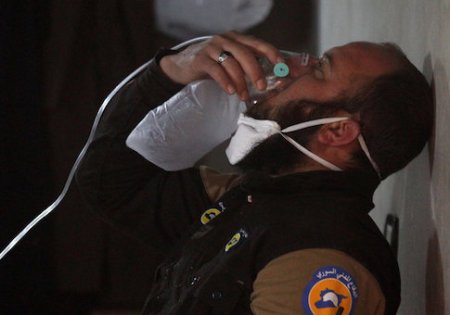
A civil defence member breathes through an oxygen mask, after what rescue workers described as a suspected gas attack in the town of Khan Sheikhoun in rebel-held Idlib, Syria April 4, 2017. REUTERS/Ammar Abdullah

The United States has concluded Russia knew in advance that the Syrian regime would employ chemical weapons in a large-scale attack last week, according to the Associated Press.

Syrian President Bashar al-Assad’s regime reportedly ordered the chemical bombings that hit a rebel-held town in the Idlib Province on April 4. At least 80 people were killed, and video footage of women and children fighting to draw breath because of lethal chemical gas spread around the world.

BREAKING: Senior U.S. official says U.S. has concluded that Russia knew in advance of Syria’s chemical weapons attack last week.

According to a senior official, a Russian-operated drone flew over a Syrian hospital while victims sought treatment, and later a Russian-made fighter jet bombed the hospital. The official said the drone’s presence revealed that Russia knew the attack was coming:

Hours after the drone left, a Russian-made fighter jet bombed the hospital in what American officials believe was an attempt to cover up the usage of chemical weapons.

Until Monday, U.S. officials had said they weren’t sure if the drone was operated by Russia or Syria. The senior official said it still wasn’t clear who was flying the jet that bombed the hospital.

The official said the presence of the drone couldn’t have been a coincidence, and that Russia must have known the chemical weapons attack was coming and that victims were seeking treatment.

President Donald Trump responded to the chemical attack on Thursday, when he ordered the firing of 59 Tomahawk cruise missiles at the Al Shayrat airfield in western Syria, where the chemical attack originated.

The Trump administration has stepped up its rhetoric against Russia in the wake of the Syria attack.

Secretary of State Rex Tillerson spoke Monday at a World War II memorial in Italy to issue a warning against countries that “commit crimes against the innocents.”

“We rededicate ourselves to holding to account any and all who commit crimes against the innocents anywhere in the world,” he said.

United Nations Ambassador Nikki Haley said on Sunday that the administration would not let Russia “cover for this regime anymore.”

“This is something to let Russia know, ‘You know what? We’re not going to have you cover for this regime anymore. And we’re not going to allow things like this to happen to innocent people,'” Haley said on “Meet The Press.”

US Air Force to quit Incirlik, move to Syria base

April 8, 2017

US Air Force to quit Incirlik, move to Syria base, DEBKAfile, April 8, 2017

When the work is finished, the rising complex of air bases will enable America to deploy twice as many warplanes and helicopters in Syria as the Russians currently maintain.

The five US bases in Syria are part of Trump’s three-pronged strategy which aims at a) fighting Islamist terror; b) blocking Iran’s land and air access to Syria; and c) providing the enclaves of the Syrian Kurdish-PYD-YPG with a military shield against the Turkish army.

********************

Several US engineering teams are working round the clock to build a big new air base in northern Syria after completing the expansion of another four. They are all situated in the Syrian borderland with Iraq, DEBKAfile’s military forces report.

This was going on over the weekend as senators, news correspondents and commentators were outguessing each other over whether the US missile attack on the Syrian Shayrat air base Friday, in retaliation for the Assad regime’s chemical attack on Khan Sheikhoun, was a one-off or the start of a new series.

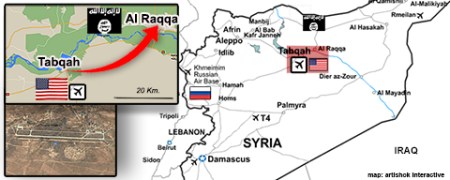
As the White House parried those questions, the Trump administration was going full steam ahead on the massive project of preparing to pull US air force units out of the Incirlik air base in southern Turkey, in active American use since 2002. Those units were in the middle of a big moving job to the five new and expanded air bases in Syria. Their hub is to be Tabqa, which is just 110km west of the Islamic State’s Syrian capital, Raqqa. The other five are Hajar airport in the Rmelan region, two small air fields serving farm transport in Qamishli, which have been converted to military us; and a fifth in the Kurdish Kobani enclave north of Aleppo near the Syrian-Turkish border.

Tabqa is also becoming the main assembly-point for the joint US, Kurdish, tribal Arab force that is coming together in readiness for a major charge on Raqqa.

When the work is finished, the rising complex of air bases will enable America to deploy twice as many warplanes and helicopters in Syria as the Russians currently maintain.

The site of the Tabqa air field was captured as recently as late March by the Syrian Democratic Force (Kurdish-Arab fighters) which were flown in and dropped there by the US Air Force’s Air Mobility Command. It was quickly dubbed “Incirlik 2” or “Qayyarah-2” after the US command center running the Iraqi military offensive against ISIS in Mosul.

Tabqa is designed to accommodate the 2,500 US military personnel housed at Incirlik. Like the Americans, the German Bundeswehr is also on the point of quitting Incirlik and eying a number of new locations in Cyprus and Jordan. The Germans are pulling out over the crisis in their relations with Ankara. The Americans are quitting because President Donald Trump wants to chill US ties with Turkish President Reccep Tayyip Erdogan and cooperation with the Turkish army.

The five US bases in Syria are part of Trump’s three-pronged strategy which aims at a) fighting Islamist terror; b) blocking Iran’s land and air access to Syria; and c) providing the enclaves of the Syrian Kurdish-PYD-YPG with a military shield against the Turkish army.

US strikes Syrian military airfield

April 7, 2017

US strikes Syrian military airfield, DEBKAfile, April 7, 2017

(Please see also, Condemnation will not stop Assad’s chemical war. — DM)

The US military launched 59 Tomahawk cruise missiles at a Syrian military airfield late on Thursday, April 6, in the first direct American assault on the government of President Bashar al-Assad since that country’s civil war began six years ago. The operation, which the Trump administration authorized in retaliation for a chemical attack killing scores of civilians this week, significantly expanded US military involvement in Syria.

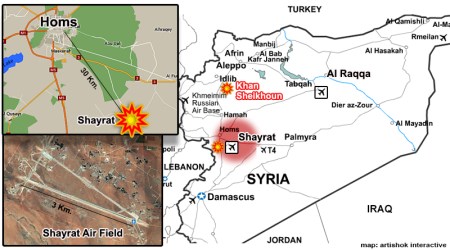
The missiles were launched from two Navy destroyers — the USS Ross and USS Porter — in the eastern Mediterranean. They struck an airbase called Shayrat in Homs province, the site from which the planes that conducted the chemical attack in Idlib are believed to have originated. Syrian military aircraft, infrastructure and runways were hit

“Tonight, I call on all civilized nations to join us in seeking to end the slaughter and bloodshed in Syria and also to end terrorism of all kinds and all types,” president Donald Trump said to reporters from Mar-a-Lago, Florida, where he is hosting China President Xi Jinping and his wife…

“Assad choked out the lives of helpless men, women and children,” he said. He acted because of a “vital national security interest of the United States to prevent and deter the spread and use of deadly chemical weapons.”

DEBKAfile: Washington has no doubt that the Syrian SU-22 bomber which Tuesday dropped a sarin gas bomb on Khan Sheikhoun in Idlib province, killing up to 100 people, was a joint Russian-Iranian-Syrian gambit to divert the Trump administration from a comprehensive plan for Syria. As US President and commander-in-chief he could not ignore this provocation.

Our sources report that the new US administration’s plans for Syria center on an offensive to evict the Islamic State from its Syrian capital, Raqqa, a mission for which US military preparations have been going forward for the past two weeks at five centers. To this operation Moscow, Tehran and Damascus were not averse. But that operation was also designed to rid Syria of Iranian and Hizballah forces – to which they were.

Secretary of State Rex Tillerson said that despite previous agreements, Syria had not surrendered its chemical weapons stockpile, and accused Russia of “failing in its responsibility to deliver on its commitment” to supervise the surrender of those chemical weapons. “Either Russia has been complicit or simply incompetent in its ability to deliver,” Tillerson continued.

The question now is whether Vladimir Putin will decide to hit back at the US operation. Russia did not retaliate for the Israel air strike on March 17 over the northern Syrian T4 air base. If Putin chooses to sit on his hands once again, the same question may be addressed to Iran and Hizballah.

Very possibly, Trump and Putin reached accord on the limits of the US punitive attack in Syrian in long hours of debate during the day between the US State and Defense Departments and the Russian Foreign and Defense Ministries, which were first reported by DEBKAfile 24 hours ago. Pentagon sources report that Washington gave Moscow advance warning of the coming US attack on the Syrian Shayrat base where Russian air force units are also deployed.

Follow-up US military action may yet come after the US president asserted that for him, “many, many lines were crossed” by Assad’s chemical attack and his attitude towards Syria had changed..

Trump’s comprehensive plans for Syria our outlined in the latest DEBKA Weekly. If you are not yet a subscriber, click here for this and other exclusive revelations.

The Real War in ‘Syria’ and the Strategy for Long-Term Victory

April 7, 2017

The Real War in ‘Syria’ and the Strategy for Long-Term Victory, PJ MediaMichael Ledeen, April 6, 2017

(Iran is ripe for regime change and the sooner the better. Please see also, Iran’s Elections: A Breaking Crisis? and All 15 Arab Summit resolutions blast Iran.– DM)

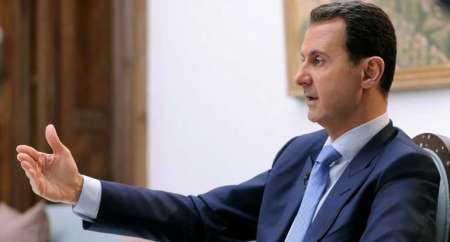
Syria’s President Bashar al-Assad (Reuters, RTX34BQA)

Punishing Assad would be satisfying, but we’ve got a big war to win. It’s smarter and more effective to go after the regime in Tehran. Not militarily, but rather supporting the tens of millions of Iranians who detest the Khamenei regime. Call it political warfare, or subversion, or democratic revolution. It worked against the Soviet Empire, and there are good reasons to believe it would work in Iran as well. Most Iranians, suffering under the failed regime, want a freely chosen government that will address their problems instead of dispatching their husbands and sons sent to the battlefield.

Regime change in Iran would be devastating to Assad and Putin, and its positive effects would be felt in North Africa and our own hemisphere, striking at the Revolutionary Guards and Hezbollah in Latin America. And it would remind the tyrants that America’s greatest weapon is political. We are the most revolutionary country in the world, and we should act like it.

****************************

Of course I loathe Assad. And of course I despise the Obamans for that phony red line and the subsequent retreat-and-bogus-Russian-deal. But just carrying out vengeance against Assad isn’t good enough. It fails to address the central problem of our time: the global anti-American alliance.

There is no Syria any more, and the enemy forces on the Middle Eastern battlefield come from various jihadi groups, and three regimes: Moscow, Tehran, and Damascus. We have to defeat them all, and other members of the enemy alliance, including Cuba and North Korea. Nikki Haley has it right: “The truth is that Assad, Russia and Iran have no interest in peace.”

Indeed, they are waging war, and the principal force driving that war is not Assad, but Iranian Supreme Leader Ali Khamenei. Khamenei’s killers have been alongside Assad’s from the very beginning, as the survival of the Syrian dictator is crucial to Iranian ambitions and quite likely also the survival of the Islamic Republic itself. Listen to Defense Secretary James Mattis a few days ago (from Reuters):

Asked about comments Mattis made in 2012 that the three primary threats the United States faced were “Iran, Iran, Iran,” Mattis told reporters that Iran’s behavior had not changed in the years since.

“At the time when I spoke about Iran I was a commander of US central command and that (Iran) was the primary exporter of terrorism, frankly, it was the primary state sponsor of terrorism and it continues that kind of behavior today,” Mattis said.

True, and Mattis’ characteristically strong language points the way to the best American action in the region, namely bringing down the Tehran regime. Lashing out at Assad isn’t nearly good enough. After all, what strategic objective would we accomplish by smashing, even removing, Assad? The Iranian and Russian fighters would still be there, as would the Islamist forces. The demands on our military would dramatically expand. We do not want to occupy a significant land mass in what used to be called Syria, nor do we seem to have sorted out what we want to do with the Turks and the Kurds.

Punishing Assad would be satisfying, but we’ve got a big war to win. It’s smarter and more effective to go after the regime in Tehran. Not militarily, but rather supporting the tens of millions of Iranians who detest the Khamenei regime. Call it political warfare, or subversion, or democratic revolution. It worked against the Soviet Empire, and there are good reasons to believe it would work in Iran as well. Most Iranians, suffering under the failed regime, want a freely chosen government that will address their problems instead of dispatching their husbands and sons sent to the battlefield.

Regime change in Iran would be devastating to Assad and Putin, and its positive effects would be felt in North Africa and our own hemisphere, striking at the Revolutionary Guards and Hezbollah in Latin America. And it would remind the tyrants that America’s greatest weapon is political. We are the most revolutionary country in the world, and we should act like it.

Condemnation will not stop Assad’s chemical war

April 5, 2017

Condemnation will not stop Assad’s chemical war, DEBKAfile, April 5, 2017

The task of locating destroying Assad’s stocks of pernicious weapon of war can only be performed by troops on the ground. And that is unlikely to happen.

****************************

Seven nations maintain elite military units in Syria – the US, Russia, Britain, Germany, France, Jordan and Israel. American, Russian and Turkish troops are backed by air support. Had those powers decided to destroy the Syrian dictator Bashar Assad’s poison chemical arsenal, they could have combined to do so and finished the job in a few days – and this week’s horrific tragedy possibly been averted.

The death toll from the Syrian chemical warfare bombardment of the rebel-held town of Kkhan Sheikhoun Monday, April 3, is now estimated at 150 with several hundred injured, cared for in totally inadequate medical facilities. The number of child victims has raised the pitch of world condemnation  The total figure fluctuates according to source.

But the most tragic truth of all is that no one in Moscow, Washington or Ankara is ready go ahead with this operation, any more than they are focused on ending the six-year old Syrian war, which has claimed a death toll of more than 600,000 – most civilians – and the displacement of 12 million refugees. Instead, they are calling the UN Security Council into another emergency (useless) session.

The most cynical aspect of this international wringing of hands is the sorry record of the way Assad’s toxic warfare record has been handled.

On May 3, 2014, the US military reported that efforts to bring about the dismantling of the Syrian army’s chemical weapons had come to naught after Bashar Assad refused to hand over the 27 tons of sarin precursor chemicals, so long as the UN disarmament agency (OPCW) insisted on his destroying their underground storage sites..

According to DEBKAfile’s sources, 12 of those bunker facilities are still operational and barred to access by UN inspectors.

Five months later, OPCW reported that Assad’s chemical weapons stocks had been liquidated. US Secretary of State John Kerry and Russian Foreign Minister Sergey Lavrov shook hands in Geneva to flashing cameras to celebrate the successful outcome of their negotiations on the subject.

This turned out to a charade, staged to cover up President Barack Obama’s decision to dodge his own red lines and abstain from action against the Assad regime if he resorted to chemical warfare.

Careful reading of the final OPCW report gives the game away: “To date, nearly 95 percent of all chemical weapon stockpiles declared by the possessor states have been destroyed under OPCW verification.” For its extensive efforts in eliminating chemical weapons, the OPCW received the 2013 Nobel Prize for Peace.

So 5 percent of the poisonous substances remained intact. In the interim four years, the Syrian ruler was able to substantially build up his depleted stocks of poison gas, the use of which also spread to the war in Iraq. The Syrian air force meanwhile began unbridled air strikes with chlorine bombs. They were replenished by Iranian freight planes landing at the Damascus military airfield and the T4 military air base near Palmyra with fresh consignments of chlorine bombs custom-made at Iran’s military industry factories.

Neither the Obama administration in Washington nor the Kremlin in Moscow lifted a finger to stop these deliveries. In the opposition camp, certain Syrian rebel groups, ISIS and Al Qaeda’s Nusra Front branch started tests on homemade chemical weapons, some of them successfully building up stocks of primitive poison weapons. Other rebel groups simply purchased Syrian chemical weapons from Syrian army officers.

Today, no international inquiry commissions would be able to establish beyond doubt the source of the chemical substances that poisoned hundreds of people in Idlib this week or determine who was ultimately responsible for this atrocity. It must be said that only the Syrian military had the ability to carry out an aerial attack like the one that struck the rebel-held town of Khan Sheikhoun. The Russians will certainly try to use as a pretext for vetoing a condemnatory UN Security Council resolution the claim that Syrian warplanes had only struck an insurgent storehouse containing toxic substances.

The task of locating destroying Assad’s stocks of pernicious weapon of war can only be performed by troops on the ground. And that is unlikely to happen.

Hizballah’s trust in Russia – strategic dilemma for Israel

March 19, 2017

Hizballah’s trust in Russia – strategic dilemma for Israel, DEBKAfile, March 18, 2017

Israel is not planning action against Russian forces in Syria, but if the Russian army, whether deliberately or unintentionally, grants Iran and Hizballaha military protection, as they counted on having at T4, Israel would not hesitate to disabuse them.

************************

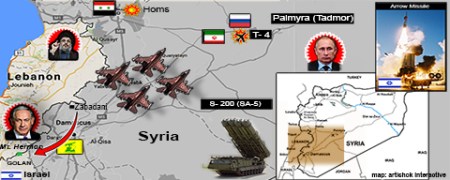
Israel finally took a hand in the swiftly moving events looming from Syria over its northern borders by launching multiple air raids against the key northern Syrian air base known as T4 near Palmyra early Friday night March 17.

Those events are spearheaded by the pro-Iranian Hizballlah’s drive to capture the Golan in line with its war of “resistance” on the Jewish state.  This fixation came into sharp focus the day after the air strike in a rare admission by Hizballah of the loss of a commander. He was named Badee Hamiyeh and was described as having been killed “in the southern Syrian region of Quneitra near the Israeli-held Golan Heights.”  This was the first anyone had heard of any recent battle on the Golan.

A week earlier, Prime Minister Binyamin Netanyahu and IDF Intelligence Director Maj. Gen. Hertzl Halevi showed President Vladimir Putin in the Kremlin maps depicting the various military movements ongoing in Syria, with the accent on an armored convoy of several hundred Hizballah troops driving out of their Syrian stronghold of Zabadani towards Mt. Hermon. The convoy was clearing a path by overrunning some 30 Syrian rebel villages on the Hermon slopes, which command the Syrian Golan town of Quneitra and the Israeli border.

This evidence demonstrated that Hizballah had developed a single military stratagem for threatening Israel-held Hermon, ruling central Golan and gearing up for battle to restore the entire Golan area to Syrian sovereignty under Hizballah control.

Netanyahu had hoped that Putin would agree to stop the Hizballah convoy and keep his promise not to let Iran and Hizballah deploy on the Israeli border. However, the Russian leader was unresponsive. Not only were Russian commanders in Syria not instructed to restrain Hizballah, they acted to persuade Syrian rebels on the Hermon and the Golan to surrender to he Lebanese Shiite invaders.

And indeed, as the Hizballah advance continued. Its leader Hassan Nasrallah contrived an equation to justify his assault on the Golan. “They brought ISIS to the Beqaa [Hizballah’s Lebanese stronghold] and so the ‘resistance’ [Hizballah] went to Syria. They wanted this group to reach Beirut, and so, today, we are in Golan.”

Seeing Hizballah on the move unchecked and gearing up for an expeced showdown with Israel, Netanyahu and the IDF decided to take matters in their own hands. They ordered several air force strikes Friday on the relatively remote strategic T4 air base near Palmyra in northeastern Syria and hit several birds with one stone.

DEBKAfile’s military sources describe T4 as the main terminal for Iranian planes to land day by day and unload  war materials for their own forces as well as the Syrian army and Hizballah.This air base also houses Russian attack helicopters and special operations troops, whose presence there was trusted by Tehran and Nasrallah to be an effective shield against Israeli attack.

The IAF air strike Friday proved them wrong.

These developments were the subtext of the video statement by Netanyahu that was broadcast Friday night by Israeli media: “I can assure you that our resolve is firm, as attested to by our actions,” he said. “This is something that everyone should take into account, everyone!.” When he said, “everyone,” he was not just addressing Tehran and Beirut, but Moscow as well.

Israel is not planning action against Russian forces in Syria, but if the Russian army, whether deliberately or unintentionally, grants Iran and Hizballaha military protection, as they counted on having at T4, Israel would not hesitate to disabuse them.

The Kremlin got the message and, a few hours after the Israeli air strikes, Israeli Ambassador Cary Koren was summoned to the Russian Foreign Ministry. There was no official protest, but Deputy Foreign Minister Mikhail Bogdanov firmly informed the ambassador that Moscow would not tolerate any further Israeli attacks on Syrian bases where Russian forces were present.

In the course of the raid, Israel’s advanced anti-missile Arrow system made its first operational appearance. IDF chiefs feared that the Syrian anti-air missiles fired against the Israeli jets might fall on a populated location inside Israel and so decided it was necessary to intercept any incoming projectiles.

Israel’s military experts got into an argument, which will no doubt go on for years, over whether Arrow’s first appearance in this situation was a good or a bad move. However, the deafening bang that the IDF wonder weapon inflicted on millions of Israeli ears, within a radius of more than a 150 kilometers from the Jordan Valley to the Mediterranean, offered an inkling of how much worse it will be in a full-scale conflict.

US armored column at Manbij to block Russians

March 6, 2017

US armored column at Manbij to block Russians, DEBKAfile, March 6, 2017

But now, as Russian units geared up to enter Manjib, the Trump administration warned Russian President Vladimir Putin that if they did move in, they would face American forces.

The Trump administration has thus taken its first direct military action in Syria to cut off the expansion of Russian forces in the North.

********************

The Pentagon announced Tuesday, March 6, that a US armored convoy was deployed around the disputed northern Syrian town of Manbij, and in an unusual move, released a video depicting the convoy and its men.

A US military spokesman tweeted that the US deployment was a deliberate action taken to assure that forces within the US-led coalition deterred aggression and kept the focus on defeating ISIS.

Affirming that the US-led coalition was aware of the location of Russian-backed Syrian forces, Pentagon spokesman Captain Jeff Davis told reporters Monday.

“They are certainly aware of where we are, and we are aware of where they are. There is no intention between the two of there being any conflict against any party other than ISIS.”

DEBKAfile’s military sources report that the US armored force landed in the middle of a complicated crisis around the important town of Manjib, ever since a mixed Kurdish-Syrian Arab force captured it from ISIS last year with US air and military support.

A few days ago, the Kurdish YPG militia handed over some of the villages and military positions around the town to Russian and Syrian army units, as we revealed in an article (Monday, March 5) on ramped-up Russian-Iranian military cooperation in Syria, in the absence of American moves.

But now, as Russian units geared up to enter Manjib, the Trump administration warned Russian President Vladimir Putin that if they did move in, they would face American forces.

The Trump administration has thus taken its first direct military action in Syria to cut off the expansion of Russian forces in the North.

Our military sources reveal that the Russian units assigned to Manjib consist mainly of a Chechen commando brigade brought over by Moscow three months ago.

Our sources added:  Tuesday afternoon, President Donald Trump phoned Prime Minister Binyamin Netanyahu while he was being questioned by the police at his residence. That call almost certainly dealt with the possibility of a US-Russian military clash in Manjib, two days before Netanyahu sets out of Moscow for talks with the Russian president.