Posted tagged ‘Russia – Syrian war’

Russia vies with Israel over aid for Quneitra

July 19, 2017

Russia vies with Israel over aid for Quneitra, DEBKAfile, July 19, 2017

(Please see also, Operation Good Neighbor: Israel’s part in Syria.– DM)

On their arrival in Quneitra, the Russians found a population that was better fed and cared for than Syrian civilians on any other of the country’s warfronts. They are nonetheless challenging Israel for the locals’ hearts and minds.
******************************

As Russian troops began moving into the Quneitra ceasefire sector opposite Israel’s Golan border on Wednesday, July 19, they found they were in hot competition with Israel over … humanitarian aid for the sector’s rebel-held villages.

Since Israel is adamantly opposed to the Russian presence in the Quneitra demilitarized zone – although it was endorsed by the Trump administration, as DEBKAfile reported exclusively on Tuesday, July 18 – Moscow decided to take it slowly and meanwhile try and win over the Syrian rebel groups whom Israel has succored for years. The Kremlin figured that if these anti-Assad groups could be weaned away from Israel, they might be persuaded to cooperate with the Russian troops in setting up the Quneitra ceasefire zone, and the Russians would not need Israel’s compliance.

On Tuesday, therefore, a Russian military convoy drove into Jabah, a village northeast of Qunetra town and 4km from Israel’s Golan border. Officers described as belonging to the “Russian Defense Ministry’s reconciliation center” alit from the trucks and began handing out food packages to the villagers.

The civilians received necessities and were treated by Russian doctors, a Syrian officer announced. Russian and Syrian officers promised that more humanitarian aid would be delivered to “settlements across the Quneitra province” and Russian doctors would visit all the villages in the ceasefire zone.

Israel, who has been sending aid across these Syrian villages which were cut off by the civil war from basic necessities, has mostly kept its humanitarian program under wraps, except when witnesses reported what they saw to the media. On Wednesday, the IDF officers running the program asked sardonically: “Where were the Russians all these years when Israel alone helped the beleaguered villages across its border?”

After watching the Russian troops hand out packages to the people of Quneitra, the Israeli government and military chiefs decided to challenge the Russian belated propaganda move.

Up until now, Israel has supplied regular humanitarian aid to some 200,000 Syrian villagers living in 80 non-ISIS rebel-controlled villages 15km deep inside the Syrian Golan. Last year alone, Israel sent over half a million liters of heavy fuel, 360 tonnes of foodstuffs, 77 tonnes of clothing and shoes, tens of generators and water system, as well as providing them with medical treatment, including hospital care for sick and injured Syrians and a field hospital on the border.

Wednesday, Israel formalized its assistance program under the title “The Good Neighbor” and disclosed it had been administered since 2016 by a special unit of the Bashan Division which is in charge of the Golan sector.

The IDF released footage of trucks ferrying across the border supplies of medical equipment, medicines, foodstuffs and fuel, as well as pictures documenting IDF medics lifting Injured Syrians off the battlefield for treatment in Israeli hospitals.

According to IDF statistics, at least 3,000 Syrians crossed the border in the past four years for medical treatment. And Israel sent over as needed incubators, respirators and ambulances. In the same period, the IDF conducted 150 assistance operations on Syrian soil.

On their arrival in Quneitra, the Russians found a population that was better fed and cared for than Syrian civilians on any other of the country’s warfronts. They are nonetheless challenging Israel for the locals’ hearts and minds.
Russians enter Daraa, Syrians/Hizballah move out

July 12, 2017

Russians enter Daraa, Syrians/Hizballah move out, DEBKAfile, July 12, 2017

Israel has so far objected to any Russian military presence along its borders with Syria, even in the capacity of ceasefire monitors, preferring Americans to police the truce in the Qunetra region. If that proved unfeasible, then Israel would leave the Syrian rebels controlling this area in place.

**********************************

Russian troops stepped into southern Syria for the first time Wednesday, July 13, when they entered the embattled town of Daraa to start enforcing the partial ceasefire agreed by Presidents Donald Trump and Vladimir Putin in Hamburg on July 7.  DEBKAfile’s military sources report this exclusively.

The Russians, including military police and Chechen paratroopers, were sighted getting out of the vehicles of their convoy and taking up positions in the center of Daraa. As they moved into the town, our sources report that tank units of the pro-regime Syrian army’s 5th Armored Division were seen driving out, along with Hizballah.

Their withdrawal cut short the Syrian military’s Operation Big Dawn against the Syrian rebels in Daraa, which breached the ceasefire Monday, July 11 – less then 24 hours after it went into force.

The Russian deployment in a southern Syrian border town Wednesday was the first step in their posting along Syria’s Israeli and Jordanian borders, as agreed between Washington and Moscow. President Trump had assented to this arrangement to bolster the first stage of the Syrian ceasefire going into effect in the de-confliction zone of the southwest.

Jordan also assented, in the interests of de-escalating tensions on its border with Syria.

The Russian troops and Chechens in Russian military police uniforms were armed only with light weapons. On July 5, Putin’s special envoy for Syrian affairs, Alexander Levrentiev, said that the Russian troops deployed in Syrian ceasefire zones would be lightly armed for self-defense. Most would consist of Russian military police. This description was intended to cover the presence of Chechen paratroops, who were seconded to the Russian police force for this mission.

Israel has so far objected to any Russian military presence along its borders with Syria, even in the capacity of ceasefire monitors, preferring Americans to police the truce in the Qunetra region. If that proved unfeasible, then Israel would leave the Syrian rebels controlling this area in place.

But our sources predict that, after the arrival of Russian troops in Daraa to preserve the ceasefire, both Washington and Moscow will lean hard on Jerusalem to accept Russian troops at Quneitra too, that is, opposite the Golan.

Astana Peace Talks Fail over Syrian Safe Zones

July 5, 2017

Astana Peace Talks Fail over Syrian Safe Zones, DEBKAfile, July 5, 2017

DEBKAfile’s sources report that the Russians suggested that the discussion be held over for the next session. They then took the Americans by surprise by relocating the sixth session of the Astana conference to Tehran. This too was a measure of the conference’s breakdown as a peace forum. US, Jordanian and Syrian rebel opposition groups will never travel to the Iranian capital to negotiate an end to the Syrian war.

The ceasefire was supposed to be in effect until midnight on Thursday, June 6, but there is now a possibility that the fighting will resume earlier, perhaps even in the coming hours.

*****************************

The fifth round of Russian-initiated Syrian peace talks taking place Tuesday, July 4, in the Kazakh capital of Astana was designed to prepare the ground for the Trump-Putin summit Friday on the sidelines of the Hamburg G20 summit, by laying out proposals for deconfliction zones in Syria.

To support this move, Moscow twisted the Syrian ruler Bashar Assad’s arm to declare a unilateral ceasefire in southern Syria.

However, the ploy was soon aborted. The Astana conference quickly broke down when Iran and Turkey, two of the three sponsors along with Russia, rejected the formula for deconfliction zones on Syria’s borders with Iraq, Jordan and Israel, DEBKAfile’s sources report.

Present at Astana along with the three sponsors were leading Syrian opposition and rebel groups, as well as UN envoy for Syrian affairs Staffan de Minstura, US Acting Assistant Secretary of State for Near Eastern Affairs Stuart Jones, and Jordanian Foreign Ministry adviser Nawaf Uasfi Tal.

The Iranina and Turkish delegates had no objections to the two demilitarized zones proposed for the Damascus and Homs areas, but withheld their consent for the zones in eastern and southern Syria, and refused to accept the formula for forces policing the latter deconfliction zones, their identity, powers as truce monitors and the types of arms they were allowed to carry.

Iran and Turkey demanded the deployment of their own troops along with Russians in the two safe zones, which border on Israel, Jordan and Iraq, and wanted them armed for “self-defense.” The representatives of the US and Jordan refused, proposing instead that an international force be established to supervise the zones. Turkey and Iran rejected this out of hand.

DEBKAfile’s sources report that the Russians suggested that the discussion be held over for the next session. They then took the Americans by surprise by relocating the sixth session of the Astana conference to Tehran. This too was a measure of the conference’s breakdown as a peace forum. US, Jordanian and Syrian rebel opposition groups will never travel to the Iranian capital to negotiate an end to the Syrian war.

By knuckling under to Tehran on this venue, the Russians have shown their hand as supporters of Iran’s military objectives in Syria, which they have hitherto tried to disguise.

The failure of the Astana peace track calls into question the ceasefire declared on Sunday by Damascus on all the warfronts of southeastern Syria, including the battle for Daraa, 1 km from the Jordanian border, and the fighting for the Quneitra region, just 3 km from Israel’s Golan.  That front was the source of the mortar shells that strayed across the border into the Golan last week.

The ceasefire was supposed to be in effect until midnight on Thursday, June 6, but there is now a possibility that the fighting will resume earlier, perhaps even in the coming hours.

In Syria, Trump’s Red Line May be Holding

June 29, 2017

In Syria, Trump’s Red Line May be Holding, Front Page MagazineJoseph Klein, June 29, 2017

It is not only what Assad has been doing in unleashing his ghastly chemical weapons on his own people, causing horrible suffering in their wake, which demands our attention. After all, Assad has been causing such suffering with conventional weapons as well, including his use of barrel bombs, which we have repeatedly condemned but have not taken specific military action to stop. To do so would almost inevitably draw us into a wider war. What makes chemical and other weapons of mass destruction different is their potential proliferation to the very Islamic terrorists we are trying to defeat.

**************************

Secretary of Defense Jim Mattis claimed Wednesday that the Syrian regime has drawn back from plans to conduct another chemical attack, following a warning by the Trump administration of serious consequences if Syrian President Bashar al-Assad’s forces followed through with their plans. 

U.S. intelligence detected “active preparations for chemical weapons use” at the same air base from which the regime allegedly had launched its prior chemical attack last April that caused mass casualties. President Trump had responded to the April chemical attack with a barrage of cruise missiles targeting that air base. The White House issued its public warning to the Assad regime on Monday in unambiguous terms, declaring that Assad and his military would pay a “heavy price” if his regime conducted another chemical attack.

“It appears that they took the warning seriously. They didn’t do it,” Mattis told reporters.

Nikki Haley, the U.S. ambassador to the United Nations, went even further in crediting the Trump administration for stopping Assad at least for now. “I can tell you that due to the President’s actions, we did not see an incident,” Ambassador Haley claimed at a House of Representatives foreign affairs committee hearing. “I would like to think that the President saved many innocent men, women and children.”

It is difficult to prove what may have actually motivated Assad. In any case, whether Assad holds back for good remains to be seen. But we do know the Trump administration is watching constantly for any moves by the Assad regime that could signal an imminent chemical attack and has military assets in place to swiftly respond to such an attack, if not prevent one in the first place.

President Trump not only demonstrated last April that he would follow through on his threats if certain red lines of his were crossed, unlike our previous president. In addition to its warning, the Trump administration may have sent some concrete signals to the Assad regime that it means business this time as well. According to Debkafile, “Signs were gathering in Washington and the Middle East Tuesday, June 26 that the Trump administration was preparing a substantial military operation against the Syrian army and Bashar Assad’s allies, such as the foreign pro-Iranian Shiite militias and Hizballah. Some US military sources suggested that an American preemptive strike was in store in the coming hours to prevent Assad’s army from again resorting to chemical warfare against his people.”

Assad may still decide to launch another chemical attack, figuring that his key allies, particularly Russia, will continue to back him. No doubt, he took note of Russia’s stern response to the U.S.’s downing of a Syrian warplane earlier this month, including a warning from the Russian Defense Ministry that “All kinds of airborne vehicles, including aircraft and UAVs of the international coalition detected to the west of the Euphrates River will be tracked by the Russian SAM systems as air targets.” The Syrian regime had also already taken some precautions by moving most of its operational aircraft to a Russian airbase in Syria after the April missile strike. The Russian airbase is protected by fairly advanced air defense systems. An American missile strike on Syrian aircraft located at a Russian air base would in all likelihood be seen as a major escalation of the war by the Russian government, risking a direct military confrontation between U.S. and Russia that the Trump administration may be loath to risk. As if to thumb his nose at the Trump administration’s latest threats by demonstrating the strength of his military alliance with Russia, Assad was seen strutting around a Russian air baseinspecting its aircraft and defense systems. He was even photographed sitting in the cockpit of a Russian fighter jet.

Indeed, Russia appears ready to raise the stakes to bolster the Syrian dictator’s regime. Debkafile reports that Russia is “building a new base in southeastern Syria,” which would “provide Russia with a lever of control over the volatile Syrian southeast and its borders, where US-backed and Iranian-backed forces are fighting for dominance.”

As Russia raises the stakes, the U.S. must be clearer than ever as to its strategic objectives in Syria, which it is willing to back up with military force even in the face of Russian threats.  We must do all we can to prevent getting sucked into Syria’s civil war, including by undertaking any military efforts at regime change. That said, we must repel any military action by the Syrian regime or its allies that would prevent us from prosecuting the war against ISIS, which remains our number one objective until the ISIS sanctuaries, infrastructure and leadership are for all intents and purposes destroyed.

However, we also cannot ignore the threat that Assad’s chemical weapons program continues to pose. The Obama administration had thought that it had largely eliminated the threat “diplomatically,” when it reached a phony deal with Russia to oversee the removal and destruction of the Syrian regime’s declared chemical weapons. The opportunity for cheating was all too plain to see, except by Obama and his clueless Secretary of State John Kerry. We are now seeing the consequences. According to Secretary of Defense Mattis, Syria’s chemical program remains intact.

It is not only what Assad has been doing in unleashing his ghastly chemical weapons on his own people, causing horrible suffering in their wake, which demands our attention. After all, Assad has been causing such suffering with conventional weapons as well, including his use of barrel bombs, which we have repeatedly condemned but have not taken specific military action to stop. To do so would almost inevitably draw us into a wider war. What makes chemical and other weapons of mass destruction different is their potential proliferation to the very Islamic terrorists we are trying to defeat. The transfer of chemical or biological weapons to terrorist hands would represent the most dangerous outcome of the Syrian conflict to the rest of the world, including to the United States. That is why we must monitor where we believe Assad’s remaining chemical weapons and production facilities are located, prevent them from being used or even moved from known locations, do all that we can to keep them out of the hands of the terrorists and destroy the chemical weapons and production facilities when the opportunity presents itself.

US pilots will defend themselves as Russia threatens aircraft over Syria, Pentagon says

June 19, 2017

US pilots will defend themselves as Russia threatens aircraft over Syria, Pentagon says, Washington ExaminerJamie McIntyre, June 19, 2017

U.S. pilots over Syria will defend themselves if attacked by Russians, a Pentagon spokesman said Monday, following a report that Russia will treat U.S. or coalition aircraft as targets if they fly over areas in western Syria controlled by Russia.

The Russian Defense Ministry made the threat Monday after a U.S. F/A-18E Super Hornet shot down a Syrian Su-22 after that plane bombed U.S.-backed Syrian Democratic Forces that are working with the U.S. to defeat the Islamic State on Sunday.

“Any aircraft, including planes and drones of the international coalition, detected in the operation areas west of the Euphrates River by the Russian air forces will be followed by Russian ground-based air defense and air defense aircraft as air targets,” the Defense Ministry said.

“We are aware of the Russian statements,” Navy Capt. Jeff Davis, a Pentagon spokesman, said Monday morning. “We do not seek conflict with any party in Syria other than ISIS, but we will not hesitate to defend ourselves or our partners if threatened,” Davis said.

A spokesman for the U.S.-led coalition said the Russian statement has had no effect on the operations in support of U.S.-backed Syrian fighters moving against ISIS in Raqqa in western Syria.

“Coalition aircraft continue to conduct operations throughout Syria, targeting ISIS forces and providing air support for coalition partner forces on the ground,” said Col. Ryan Dillon, chief U.S. military spokesman in Baghdad.

He also appeared to indicate the U.S. is avoiding the parts of Syria where Russia said U.S. planes would be tracked as potential targets or providing additional airpower to counter threats.

“As a result of recent encounters involving pro-Syrian regime and Russian forces, we have taken prudent measures to reposition aircraft over Syria so as to continue targeting ISIS forces while ensuring the safety of our aircrews given known threats in the battlespace,” Dillon said.

The statement was meant as a warning, said Viktor Ozerov, a member of the Russian parliament, described the Defense Ministry’s statement as a warning.

“I’m sure that because of this neither the U.S. nor anyone else will take any actions to threaten our aircraft,” he said, according to state-owned RIA Novosti news agency. “That’s why there’s no threat of direct confrontation between Russia and American aircraft.”

Russia, beyond making the threat to treat U.S. or coalition aircraft as targets, also said its “deconfliction” line with the U.S. has been shut down. The line was established so U.S. and Russian forces could avoid bombing each other as they fight ISIS.

Both Davis and Dillon insisted the hotline remains the best way to avoid future shoot-downs.

“The coalition is always available to de-conflict with the Russians to ensure the safety of coalition aircrews and operations,” Davis said. “The de-confliction line has proven effective at mitigating strategic miscalculations and de-escalating tense situations.”

Said Dillon: “We used the de-confliction line yesterday and remain open to using it. It has proven its worth in the past to tap down tensions.”

One missile takes out ISIS command on Golan edge

June 8, 2017

One missile takes out ISIS command on Golan edge, DEBKAfile, June 8, 2017

DEBKAfile’s military sources report concerns in the US military commend lest Iranian general Qassem Soleimani decides to drop a division of Iranian special forces by helicopter, in order to catch the garrison off guard and capture the border crossing.

This concern increased after the Islamic State conducted a surprise bombing-cum-shooting attack on prize Iranian regime targets in Tehran on June 7. The Revolutionary Guards are bent on revenge and looking for an outstanding military success to cover this humiliation.

The US commanders are also under pressure on another score: the Iranians and Syrians have sent secret messages to Moscow complaining bitterly about the US air strike. They both made it clear that they command sufficient air and artillery fire power to overwhelm and wipe the ground with the American force in Syria.  Both Damascus and Tehran appear to be spoiling for a major showdown between their armies, using Hizballah and other Shiite proxies, and the US-led contingent.

***********************

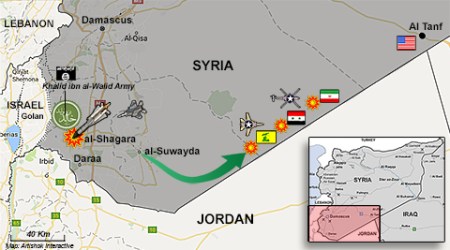
A single mystery missile, which could have been fired from the ground or the air early Wednesday morning, June 7, wiped out the entire top Islamic State command on the Syrian Golan, DEBKAfile’s military and intelligence sources report. All 16 officers of the 2,000-strong Khaled Ibn al Waleed army, the ISIS operations arm on the Syrian Golan, were present in the targeted building in the town of al-Shagara, located in the triangle where the Israeli, Syrian and Jordanian borders meet opposite the Sea of Galilee in northern Israel.

The unidentified missile blew up in the middle of a hall where the top command echelon were gathered to break their daily fast during the month of Ramadan and draw up plans. None of them survived.

Among them were the group’s chief, Gen. Abu Mohammed al-Makdessi; commander of operations, Gen. Abu Udai al-Homsi; and the group’s explosives expert who doubled as its religious leader, Abu Ali Shabat.

They operated under these aliases to conceal their real identities as former high Iraqi army officers who served in the late Saddam Hussein’s armed forces. They were also in senior command positions at the ISIS Syrian command center in Raqqa, when ISIS leader Abu Bakr al-Baghdadi decided to transfer them to the Syrian Golan to spearhead attacks that were planned to take place inside Israel and Jordan.

It took Al-Baghdad just a few hours to replace Magdessi as Khaled Ibn al-Waleed chief with a new man, Mohamed al-Refaei-Abu Hshem al-Askari.

On Tuesday, June 6, the day before the mysterious missile decapitated the Islamic State’s Golan force, US warplanes acted on another front to bomb a convoy of Iranian, Syrian and Hizballah forces that were traveling eastward from the southern town of Derra in the direction of the Al-Tanf border crossing.

Al Tanf, where US and Jordanian special forces units have established a garrison, is located in the triangle where the Syrian, Jordanian and Iraqi borders converge. The US planes destroyed several tanks, troop carriers, artillery pieces and antiaircraft systems, causing also fatalities and injuries, and so halted the convoy’s advance on the strategic crossing.

This was the second US air strike in three weeks on a similar target. The first was on May 18.

DEBKAfile’s military sources report concerns in the US military commend lest Iranian general Qassem Soleimani decides to drop a division of Iranian special forces by helicopter, in order to catch the garrison off guard and capture the border crossing.

This concern increased after the Islamic State conducted a surprise bombing-cum-shooting attack on prize Iranian regime targets in Tehran on June 7. The Revolutionary Guards are bent on revenge and looking for an outstanding military success to cover this humiliation.

The US commanders are also under pressure on another score: the Iranians and Syrians have sent secret messages to Moscow complaining bitterly about the US air strike. They both made it clear that they command sufficient air and artillery fire power to overwhelm and wipe the ground with the American force in Syria.  Both Damascus and Tehran appear to be spoiling for a major showdown between their armies, using Hizballah and other Shiite proxies, and the US-led contingent.

Powerful pro-Iran Badr Brigades to enter Syria

May 31, 2017

Powerful pro-Iran Badr Brigades to enter Syria, DEBKAfile, May 31, 2017

Their entry into Syria could raise the total of pro-Iranian Shiite forces fighting in Syria to 80,000 to 100,000 troops.

For Israel, Hizballah’s hostile penetration of Syrian borders abutting its territory is child’s play compared with a major military force capable of transforming Syria into a huge staging area for Iranian aggression against the Jewish state.

****************************

Hadi al-Amiri, commander of the strongest Iraqi Shiite militia, the Badr Brigades, said Wednesday, May 31, that his forces are preparing to enter Syria. The advanced capabilities of this powerful Iranian-led militia, would tilt the Syrian war strongly in Iran’s favor, with alarming ramifications for the US, Israel and Jordan.

Al-Amri, in making this announcement, cited Iran’s new slogan: “Iraq’s security will be maintained only if Syria’s security is preserved.” In other words, the Syrian conflict would end only when pro-Iranian Shiite militias, including Hizballah, control Syria like they control Iraq.

DEBKAfile’s military and intelligence sources report that the Badr Brigades’ path into Syria was secured this week when an Iraqi Shiite conglomerate breached the Iraqi-Syrian border in the north, on the orders of Al Qods chief Gen. Qassem Soleimani. This opened Iran’s coveted overland corridor through Iraq to Syria.

The combat capabilities of the Badr Brigades, estimated at between 30,000 and 50,000 strong, are impressive. One of the most professional and well-trained military forces in Iraq, its recruits receive instruction at special camps operated by Revolutionary Guard Corps on Iranian soil. The militia consists of special forces, tank, mechanized infantry, artillery and antiaircraft units. The high quality of their munitions may be seen in the photo at the top of the story.

Their entry into Syria could raise the total of pro-Iranian Shiite forces fighting in Syria to 80,000 to 100,000 troops.

Intelligence sources expect the Badr Brigades to first head south towards the Deir ez-Zor area to link up with the Syrian Arab Army and Hizballah forces, which are threatening the US special forces and allied hold on a key crossing that commands the triangle where the Jordanian, Syrian and Iraqi borders meet.

They would need to cover 230km from Palmyra to Deir ez-Zor, the while fighting small, scattered ISIS concentrations. Wednesday, May 31, Russia came down on the side of Tehran, with a cruise missile strike on ISIS targets around Palmyra. They were fired from the missile frigate Admiral Essen and the submarine Krasnodar for the purpose of softening jihadi resistance to the Badr Brigades’ southward advance.

The consequences of this massive pro-Iranian intervention in the Syrian war are dire for the US, Israel and Jordan. For Washington, it lays the ground for Tehran’s domination of Syria – in the face of President Donald Trump’s solemn vows to prevent this happening.

For Israel, Hizballah’s hostile penetration of Syrian borders abutting its territory is child’s play compared with a major military force capable of transforming Syria into a huge staging area for Iranian aggression against the Jewish state.

Jordan’s foreboding comes from its judgment that pro-Iranian Shiite militias sitting on its borders are a greater threat even that ISIS.

Read more about this pivotal development in the coming issue of DEBKA Weekly. If you are not yet a subscriber, click here to sign on.

Russian siege on Raqqa, distant from US troops

May 27, 2017

Russian siege on Raqqa, distant from US troops, DEBKAfile, May 27, 2017

DEBKAfile’s military sources can disclose that Putin has ordered the Russian commanders in Syria to impose an aerial and special forces ground siege on the northern town of Raqqa, the Islamic State’s de facto Syrian capital. This move was designed to match the American initiative on the strategic Syrian-Iraqi border, without a military clash.

Why Raqqa? Firstly, it is in the north, far from the American positions. Second, Russian intelligence had apparently discovered a deal between the Kurdish-dominated Syrian Democratic Forces – SDF – and ISIS which allowed the jihadists safe passage out of their stronghold towards the south.

************************

Russian President Vladimir Putin acted to strengthen the military alliance he had set up with Iran and Turkey for working together in Syria – as a counterweight to President Donald Trump’s spectacular success in forging a Sunni Arab bloc during his four days in the Middle East.

It was a tough call. Putin’s allies demanded action to prevent a Syrian rebel force, backed by US, Western and Jordanian special forces, from taking control of the Syrian-Iraqi border. The Russian leader had to find a way to satisfy them without getting into a clash of arms with American troops.

On Saturday, May 27, as Trump flew home from his nine-day trip, Putin turned the dilemma over with his two allies, President Tayyip Erdogan of Turkey and the newly-elected Iranian president, Hassan Rouhani.

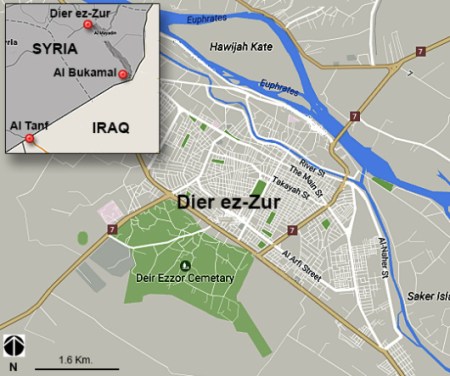
Three days earlier, the Russian president was put on the spot by Iran’s National Security Adviser Ali Shamkhani, who arrived in Moscow Wednesday, May 24. He slapped down a demand from supreme leader Ayatollah Ali Khamenei for an answer as to how the Russian leader proposed to put a stop to the takeover by American special forces and their allies of the eastern province of Deir ez-Zour and the Al-Tanf crossing at the Syrian-Iraqi-Jordanian border triangle. (See attached map)

Shamkhani warned Putin that without fast action, the Americans would block the routes from Baghdad to Damascus against the passage of Iranian and Russian forces.

The Russian leader took a couple of days to come up with a stratagem, which he revealed to Erdogan during their conversation on Saturday.

DEBKAfile’s military sources can disclose that Putin has ordered the Russian commanders in Syria to impose an aerial and special forces ground siege on the northern town of Raqqa, the Islamic State’s de facto Syrian capital. This move was designed to match the American initiative on the strategic Syrian-Iraqi border, without a military clash.

Why Raqqa? Firstly, it is in the north, far from the American positions. Second, Russian intelligence had apparently discovered a deal between the Kurdish-dominated Syrian Democratic Forces – SDF – and ISIS which allowed the jihadists safe passage out of their stronghold towards the south.

The Russian siege on Raqqa was therefore a move against the US-backed SDF and the Kurds, without getting entangled in a direct showdown with the US forces in the South: Putin had installed a Russian-backed foothold in northern Syria to counter the US-led front in the south.

Immediately after the Putin-Erdogan phone call, a Russian military source in Moscow released this story: “Russian intelligence drones have set up a perimeter around the city ([Raqqa] to monitor possible terrorist escape routes, with combat aircraft and special forces units engaged in preventing militants’ escape.” The report went on to warn that any attempts by ISIS fighters to leave the town “will be squashed.”

Putin’s maneuver in Syria was designed to achieve three goals:

1. To counterbalance the America-led takeover of the Syrian-Iraqi border in the south, the Russians would assert control of the northern section of that same border.

2.  To showcase the Russian army as the great champions fighting the Islamic State terrorists, compared with the American troops and their allies who had turned aside from this mission, although President Trump had made it the centerpiece of his nine-day trip.

Putin was careful not to name his objective as the conquest of Raqqa, but only a siege operation.

3. To hit US allies, such as the Syrian Kurds in the north, without tangling with the Americans in combat.

Iraqi officers land in Syria, stir Israeli concern

May 17, 2017

Iraqi officers land in Syria, stir Israeli concern, DEBKAfile, May 17, 2017

Israel was deeply disquieted to discover that Iraq’s Prime Minister Haidar al-Abadi had secretly pivoted his support away from the US-Jordanian campaign for control over the borders of Iraq and Syria, and switched instead to alignment with Moscow and Tehran.

Israeli policy-makers are worried that President Donald Trump will be constrained by the daily barrage of personal attacks descending on from fully focusing on the forces building up dangerously against US military plans in Syria.

****************************

Israeli security chiefs were gravely concerned Wednesday, May 17, when they learned that a high-ranking Iraqi military delegation had arrived in Damascus, the first in decades during which the Iraqi and Syrian ruling regimes were at odds, for a discussion on the situation unfolding on the Syrian-Iraqi border – in particular the Al-Tanf crossing.

DEBKAfile’s military sources reported on May 15 and May 16 on the potential for a clash of arms over this strategic crossing, which is situated at the intersection of the Jordanian, Iraq, and Syrian borders and commands the No.1 Route linking Baghdad with Damascus and the Jordanian capital of Amman.

Wednesday saw a flurry of military activity in the area by US, British and Jordanian special forces, on the one hand, and Syrian, Hizballah and other pro-Iranian forces, on the other. A race appeared to be quietly developing over who would reach the border first and seize control of the Al-Tanf crossing.

On this very subject, the Iraqi military delegation held separate talks in Damascus with senior officers of the Russian command in Syria and senior Iranian officers posted at Syrian General Staff headquarters. Concurrently, the Russian military command announced that Russia, Iran and Iraq were holding consultations on how to secure the border regions between Syria and Iraq.

Our forces add that the three groups of officers got down to brass talks, in fact, on ways to fit Iraqi army units into the Syrian-Iranian effort for guaranteeing full control by Damascus and Tehran of the sensitive border regions.

Israel was deeply disquieted to discover that Iraq’s Prime Minister Haidar al-Abadi had secretly pivoted his support away from the US-Jordanian campaign for control over the borders of Iraq and Syria, and switched instead to alignment with Moscow and Tehran.

Israeli policy-makers are worried that President Donald Trump will be constrained by the daily barrage of personal attacks descending on from fully focusing on the forces building up dangerously against US military plans in Syria.

US, UK, Jordanian forces enter S. Syria

May 15, 2017

US, UK, Jordanian forces enter S. Syria, DEBKAfile, May 15, 2017

DEBKAfile’s military sources explain that Damascus and Tehran acted to pre-empt the US-Jordanian-Israeli military operations along the Israeli and Jordanian borders with Syria, lest they lead to the carving out of US-controlled security zones in southern Syria.

Iran continued to pour additional troops into Damascus through the Baghdad-Damascus highway, on the one hand, while, on the other, Iraqi Prime Minister Haidar al-Abadi offered Washington two of his army’s divisions, which would be sent into Syria to support US military operations in the southeast.

*****************************

US special forces, together with British and Jordanian elite troops, moved into southern Syria late Sunday, May 14. They were acting to counter the Syrian-Iranian scheme to nullify the American plan for posting Jordanian forces in southeastern Syria, which timed for the days before US President Donald Trump’s trip to the Middle East.

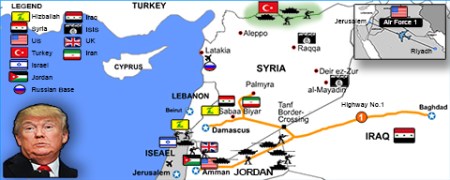
The US-led armored force with British and Jordanian units crossed from northern Jordan through the Tanf Border-Crossing between the Hashemite Kingdom, Iraq and Syria, and took up positions capable of consolidating their control of the main road between Palmyra and Baghdad. Some of their moves were coordinated with Israel.
(See map).

This push aimed at countering the drive in the last few days by hundreds of Syrian troops, Iranian-backed Shiite militias and Hizballah’s Radwan special forces, with tanks and heavy equipment, to take over the town of Sabaa Biyar. Located in sparsely desert territory, this town lies 110km west of the Syrian-Iraqi border, 95km north of the Syrian-Jordanian border and 128km east of Damascus.

Its high strategic importance for Tehran, Damascus and Hizballah lies in its command of the border between Syria, Iraq and Jordan and of Highway No. 1 which links the Jordanian capital of Amman with Baghdad.

DEBKAfile’s military sources explain that Damascus and Tehran acted to pre-empt the US-Jordanian-Israeli military operations along the Israeli and Jordanian borders with Syria, lest they lead to the carving out of US-controlled security zones in southern Syria.

Our military sources add that Moscow too eyes the new US-led military movements with mistrust, in view of its potential impact on the Russian plan for four ceasefire zones in Syria, in cooperation with Iranian and Turkish forces. The Russians are accordingly feeding Tehran and Damascus intelligence on the US-led movements.

On Sunday, too, the Israeli Defense Forces launched a large-scale military exercise in the Galilee and Golan regions close to its borders with Syria and Lebanon. The war game may well run over its final date in order to keep a substantial military force poised on along Israel’s northern borders, in case of attempts to disrupt the Trump visits to Saudi Arabia and Israel from May 22 to May 24.

Other military movements in the region this week were taken by the Iraqi army and Iraqi Shiite militias under the command of Iranian Revolutionary Guards officers. Iran continued to pour additional troops into Damascus through the Baghdad-Damascus highway, on the one hand, while, on the other, Iraqi Prime Minister Haidar al-Abadi offered Washington two of his army’s divisions, which would be sent into Syria to support US military operations in the southeast.

For the time being, the Trump administration’s plans for an offensive against the Islamic State appear to have been put on a back burner.