Posted tagged ‘Rouhani’

Implications of Iranian Cheating at Arak

December 10, 2014

Implications of Iranian Cheating at Arak, Commentary Magazine, December 10, 2014

[T]he State Department never conducts lessons-learned exercises to determine why previous episodes of diplomacy have failed.

Kerry is like a gambler who has lost everything, but figures if only he is given one more round at the craps table, he can win big. American national security, however, is nothing with which to gamble. Especially when a gambler is desperate, the house will always win. In this case, however, the house is not Washington, but rather Tehran.

**********

As Jonathan Tobin notes, Colum Lynch’s Foreign Policy bombshell report about Iran’s covert efforts to buy equipment for its Arak plant, a facility which could produce plutonium for a nuclear bomb, raises questions about the logic of the Obama administration, and the recent comments by both Vice President Joe Biden and Secretary of State John Kerry with regard to the wisdom of extending nuclear talks with Iran.

If Lynch’s report is true—and it appears very much to be so—then there are two possibilities as to what happened vis-à-vis American diplomacy. The first is that Iranian diplomats were always insincere in pursuit of a nuclear resolution, and lied outright to Kerry, Undersecretary Wendy Sherman, Clinton, Biden-aide Jake Sullivan, and other officials who have championed the drive for nuclear talks with the current Iranian administration. That possibility is troubling enough, but the second scenario is as troubling, and that is that Iranian diplomats were perfectly sincere, but that the regime simply couldn’t care less what its diplomats said and pursued its own goals irrespective of any commitments they made.

A key theme of my recent book exploring the history of U.S. diplomacy with rogue regimes (of which Iran is the marquee example) is that the State Department never conducts lessons-learned exercises to determine why previous episodes of diplomacy have failed. One example they might consider is the pre-Iraq War negotiations with Iran: Immediately prior to the U.S.-led invasion of Iraq, National Security Council official Zalmay Khalilzad along with Ambassador Ryan Crocker met with Mohammad Javad Zarif, Iran’s UN ambassador (and its current foreign minister) in secret talks in Geneva. Almost simultaneously, British Foreign Secretary Jack Straw met with Iranian Foreign Minister Kamal Kharrazi. Both talks solicited the same Iranian pledge: Iranian officials would not interfere with coalition forces in Iraq, and Iran would not insert its own personnel or militias into Iraq.

In hindsight, the Iranians there, too, lied. Soon after Saddam’s fall, the Islamic Revolutionary Guard Corps (IRGC) infiltrated 2,000 fighters, militiamen, and Qods Force personnel into Iraq replete with radio transmitters, money, pamphlets, and supplies. The source for that statement? Iranian journalists. Those most enthusiastic for rapprochement, however, are now placing their hopes in the same Mr. Zarif, the man who a decade ago either lied shamelessly or bluffed about the power he did have to control the behavior of the IRGC and influence the supreme leader. Then again, there is a reason why, before he became vice president, Joe Biden was Tehran’s favorite senator.

Kerry is like a gambler who has lost everything, but figures if only he is given one more round at the craps table, he can win big. American national security, however, is nothing with which to gamble. Especially when a gambler is desperate, the house will always win. In this case, however, the house is not Washington, but rather Tehran.

Top Iranian Official: Obama Begs to Meet Rouhani

December 8, 2014

Top Iranian Official: Obama Begs to Meet Rouhani, Israel National News, Tova Dvorin, December 8, 2014

Khamenei office official boasts that Obama is ‘knocking on every door’ just to meet Hassan Rouhani, and that it ‘demonstrates strength.’

The head of the office of Iran’s Supreme Leader Ayatollah Khamenei insists that US President Barack Obama is chasing after Iranian President Hassan Rouhani, according to footage provided by the Middle East MediaResearch Institute (MEMRI).

“When you see the American president knocking on every door just to meet our president for a few minutes, this is no trivial matter,” Mohammad Golpayegani stated in an IRINN (Iranian news channel) broadcast. “Some people lurk in the UN corridor just to get the chance to shake (Obama’s) hand, and he does not deign to even do that.”

“Yet he sends mediators and goes to such efforts (in order to meet Iranian President Hassan Rouhani),” he continued. “This demonstrates our strength.”

The statement follows news that Obama had sent a secret letter to Khamenei in October without informing its regional partners (Israel, Saudi Arabia, and the United Arab Emirates) in which he called for cooperation against Islamic State (ISIS) and a nuclear agreement.

Earlier that month, American and Arab officials revealed to the Wall Street Journal that Obama has moved closer to Iran and its terror proxies Hamas and Hezbollah, citing “secret channels of communications” to Iran via senior Shi’ite sources in Iraq.

Obama’s Parallel Universe

November 26, 2014

Obama’s Parallel Universe, Front Page Magazine, November 26, 2014

obama_iran_0117-383x350

[T]here is not a single aspect of Iran’s nuclear program that has stopped advancing. On the contrary, they are making progress by leaps and bounds.

******************

You’ve got to hand it to Obama. He is no slouch when it comes to redefining reality.

He can look at an elephant and proclaim it a donkey without a bat of the eye. Or in the case of Iran, look at spinning centrifuges and see no threat.

Over the weekend he told George Stephanapolous that the nuclear deal with Iran, which his negotiators extended for another eight months on Monday without a single concession from Iran, has “definitely stopped Iran’s nuclear program from advancing.”

Welcome to Obama’s Parallel Universe.

Iran continues to spin centrifuges and expand its stockpiles of enriched uranium. It continues to develop new generations of centrifuges that will allow Iran to race to the bomb five times faster than it can today. As we learned earlier this month, the International Atomic Energy Agency even found that Iran was feeding uranium gas into some of these new generation centrifuges in violation of the interim nuclear deal. The U.S. declined to call out the Iranians for cheating.

Iran also continues work on the plutonium bomb plant at Arak, rather than dismantling it as the U.S. initially demanded. It continues to deny full scope inspections and to refuse inquiries from the IAEA to explain its past nuclear weapons-related activities, without which the United States and its allies cannot map the full scope of the Iranian program or verify it.

In fact, there is not a single aspect of Iran’s nuclear program that has stopped advancing. On the contrary, they are making progress by leaps and bounds.

When Stephanapolous played the sceptic and asked Obama whether he could get the deal through Congress, Obama said he was “confidant that if we reach a deal that is verifiable and assures that Iran does not have breakout capacity, not only can I persuade Congress but I can persuade the American people that it’s the right thing to do.”

The problem is, no one believes that is what this deal will accomplish, including the French and German foreign ministers who took part in the months-long farce in Vienna, Austria that gave birth to yet another extension of talks.

Former CIA Director General Michael Hayden told Congress last week that without an “invasive inspections regime” attached to any deal, “I am unwilling to guarantee American intelligence can sufficiently verify the agreement on its own.”

That’s a pretty damning admission. Given the track record so far – massive U.S. and Western concessions on sanctions relief and enrichment, and no meaningful concessions on Iran’s side – it’s unlikely such an inspection regime will ever exist.

Former U.S. Ambassador Eric Edelman told a Washington, DC conference last week that the Western powers have been in “serial retreat” on their negotiating demands toward Iran since the EU-3 first started unsuccessful talks in 2003.

At the start of the current process, one year ago, Secretary of State John Kerry was still talking about “dismantling” Iran’s centrifuge enrichment program.

But in the first stage of talks, the P5+1 (US., UK, France, Russia, China + Germany) swept that demand off the table, caving into Iran’s demand that the great powers recognize a supposed “right to enrich,” which I and others argue Iran forfeited in the mid-2000s when the United Nations Security Council passed resolutions condemning Iran for violating its commitments under the Nonproliferation treaty.

Why would Iran agree to make meaningful concessions when the United States continues to back off its demands and to throw away its trump card: the complex tissue of U.S. and multilateral sanctions that had crippled Iran’s economy and brought it to the negotiating table in the first place?

The Economist published a series of revealing economic charts on the impact of the Iran sanctions in its November 1st edition, drawing on sources from the Economist Intelligence Unit, the Energy Information Administration, the Statistical Centre of Iran, and the Central Bank of Iran.

Once crippling oil and financial sanctions imposed in 2010-2011 began to kick in, Iran’s economy went into a freefall. Iran’s GDP has been gradually expanding for several years. In 2012, the economy went into full recession, retracting by 6%. Consumer prices skyrocketed by 40%, as did the youth unemployment rate. Vehicle production plunged, the currency collapsed, while both imports and exports declined dramatically.

By all accounts, the halving of Iran’s oil exports – a much greater impact than most analysts had expected – resulted in bringing Iran to the table.

But now, all of that is changing.

Mark Dubowitz, of the Foundation for Defense of Democracies, estimates that real sanctions relief over the first year of negotiations was close to $20 billion – far more than the administration has claimed.

“The Geneva process has turned around Iran’s economy,” he told a Washington, DC conference last week. As a result, “their nuclear intransigence has increased, not decreased.”

Former IAEA nuclear safeguards chief Olli Heinonen told the same conference that the negotiations were “rewarding Iran for its past bad behavior,” and set a “bad example for future proliferators.”

The Iranians “will just lie their faces off to get a bomb,” Senator Mark Kirk (R,IL) added.

On Monday, Secretary of State John Kerry declared in Vienna that a final agreement, to be negotiated in the coming months, would “close off all the pathways for Iran to get fissile material for a nuclear weapon.”

The formula was designed to meet a key criterion set down by Democrats in the House and Senate, such as Florida Rep. Ted Deutch, who agree with their Republican colleagues that Congress must set a high threshhold for what an acceptable deal must look like.

For these security-minded Democrats, an acceptable nuclear deal “must dismantle Iran’s centrifuge program to prevent Iran from becoming a threshold nuclear state, create robust verification and monitoring mechanisms to prevent undetectable breakout, force Iran to come clean on its past nuclear activities including possible military dimensions and cover a long enough duration that the regime won’t simply ‘wait it out.’”

If a deal along these lines cannot be reached, “Congress must make clear to Iran that sanctions will be ratcheted up dramatically at the end of the extension period,” he added.

The problem is, Obama has no intention of letting that happen, and has made it clear he will remove additional sanctions by the stroke of his Executive Order pen or by issuing waivers to legislative sanctions. (On pages 5-7 of his excellent testimony before Congress last week, FDD’s Dubowitz outlines “the administration’s plan to circumvent Congress” through executive branch sanctions relief).

Die-hard Obama loyalists in Congress, such as Virginia Democrat Gerry Connolly, argue that a bad nuclear agreement is better than no agreement. “Beware making the perfect the enemy of the good,” he said last week. “Without an agreement, we are condemning the world to a conflict with Iran.”

That in the end is Obama’s hammer. He will accuse anyone who opposes his massive concessions to Iran as a war-mongerer – a charge that Rep. Ted Deutch has tried to tackle head on. “Those who oppose a bad deal do not support a ‘march to war,’ but refuse an agreement that allows Iran to acquire a nuclear weapon,” he said.

Want to bet what Obama will be saying about him when he and Kerry finally reveal the terms of the bad deal they want Congress to approve? “They’ve red-teamed this. They will paint their opponents as war-mongers,” Dubowitz says.

Get ready to enter Obama’s parallel universe.

Like Hassan ibn Saba, leader of the 11th century hashish cult fictionalized by novelist Vladimir Bartol, Obama believes himself to be a master of illusion. If you can make people believe the illusion, then the illusion becomes reality. Perception is everything.

So here we go. Obama wants us to watch his hands and repeat after him: Iran is not a threat. We have stopped Iran’s nuclear weapons development. Iran is our ally against ISIS. Iran is a rational regime.

It’s up to us and to Congress to break the spell. Don’t look at his hands but at the fire burning just behind him.

Iran’s Ideological Camp Fears The Possibility Of A Nuclear Agreement Between Iran And The P5+1, Warns Rohani Government

November 7, 2014

Iran’s Ideological Camp Fears The Possibility Of A Nuclear Agreement Between Iran And The P5+1, Warns Rohani Government, MEMRI, A. Savyon, Y. Mansharof, and E. Kharrazi, November 6, 2014

(What might Obama and Kerry give the “ideologues” to encourage them to board their ship of State, the BHO Titanic? — DM)

Kayhan: “In Negotiations That Could Take Place In 2024, Iran Will Undoubtedly Come To The Negotiating Table With Tens Of Thousands Of Centrifuges That Are More Advanced Than Those It Has Today”; The Nuclear Mushroom Yields Results Once In A Decade

“Under Section 125 of our constitution, international commitments must be approved by the Majlis. But unfortunately, the Majlis members are not being updated at all in the nuclear negotiations issue… Government actions that disregard Majlis opinion will cause future problems, and will cause [the Majlis] to reject agreements that are against the interest of the people – which will have direct repercussions for the negotiating team.”

Democrats in the White House will try to turn their defeat in the elections to their diplomatic advantage. Obama is like a gambler who has lost everything, and he is sending his representatives to the [negotiating] table with empty pockets…

****************

Introduction

Both the U.S. administration and Iran’s pragmatic camp were last week preparing public opinion in their respective countries for the possibility that a nuclear agreement will be reached between Iran and the P5+1 by the November 24, 2014 deadline.[1] According to the emerging contours of the agreement, Tehran will apparently be allowed to operate 4,000 to 6,000 first-generation centrifuges,[2] and in return, in a move that will not require Congressional approval, the U.S. administration will suspend American sanctions.

The pragmatic camp in Iran, headed by Hashemi Rafsanjani and his proxy President Hassan Rohani, is pressuring the White House to reach an agreement with Iran right now, and identifying President Obama as “the weakest American president.”[3] At the same time, this camp’s leaders are laying the groundwork for obtaining Iranian approval for an agreement.

On October 22, 2014, President Rohani emphasized the need for engaging and negotiating with the enemy, framing doing so as the lesson that should be taken from the Shi’ite legend of Karbala – in contrast to the interpretation of these events commonly accepted in Iran.[4] On October 27, the pragmatic camp’s main organ, the Jomhouri-ye Eslami daily, called on the ideological camp not to sabotage the emerging agreement, stressed that the agreement was within the red lines set out by Iranian Supreme Leader Ali Khamenei, and warned the Khamenei camp that it must not cause Iran to miss this golden opportunity.

Furthermore, on November 2, 2014, two days before the nation marked the anniversary of the 1979 seizure of the U.S. Embassy and capture of its staff in Tehran, which this year coincides with Iran’s Ashura rituals, Ali Khorram, senior advisor to Iranian Foreign Minister Javad Zarif, told the reformist pro-Rohani newspaper Shargh that U.S.-Iran relations are now no longer hostile, and are even “friendly.” He claimed there had been a change for the better in U.S. policy, that the two countries need not wait for Judgment Day to trust each other, and that the time had come for them to end the hostility between them. He also said that they had common interests in Iraq and Syria, and that the Americans considered the U.S. Embassy takeover an “old wound.”[5]

In contrast, the ideological camp is alarmed at the prospect of an imminent nuclear deal, voicing its apprehensions that the national interests of the regime would be damaged and that there would be a U.S.-Iran rapprochement. On October 28, 2014, the day after Jomhouri-ye Eslami called on the ideological camp to refrain from sabotaging the agreement, Majlis member Ali Reza Zakani urged the Iranian security apparatuses to intervene, and warned the negotiating team that it would bear responsibility for a “bad agreement” that both crossed the regime’s red lines and failed to completely lift the sanctions.

At the same time, the daily Kayhan, which is close to Khamenei, attacked the emerging agreement from two angles: First, the agreement crosses Khamenei’s red lines and fails to immediately lift all anti-Iran sanctions, and second, following the defeat for U.S. President Barack Obama in the November 4 midterm elections, Iran could, in another decade, according to the newspaper, come to a possible negotiating table as a nuclear power with tens of thousands of advanced-generation centrifuges. It urged the negotiating team not only to not be deterred by White House threats that once the newly elected Republicans take office the sanctions will be increased and thus Iran should sign an agreement now, but also that Iran must give the U.S. an ultimatum. The newspaper also warned of plots and of an organized scheme led by “the men of fitna” past and present – hinting at collaboration among pragmatic camp leaders Rafsanjani and Rohani and Green Movement leaders and former presidential candidates Mir Hossein Mousavi and Mehdi Karroubi, both of whom have been under house arrest for several years for what the regime alleges was their role in the unrest of the 2009 presidential election. He was also hinting at coordination between them and the West, in order to anesthetize the public and Iran’s elites into inaction so that a nuclear agreement could be attained “no matter what the cost.” The paper also warned President Rohani to follow the orders issued by Khamenei on the nuclear negotiations, and even to refrain from talking with the U.S.

The website Afsaran, which is close to security circles, also expressed fears that Iranian negotiating team chief and Foreign Minister Mohammad Javad Zarif – and by allusion his entire camp – is seeking to depose Khamenei by securing a nuclear deal with the U.S.

This paper will review the reaction of Iran’s ideological camp to the possibility of an Iran-P5+1 nuclear agreement:

The Pragmatic Camp: Laying The Groundwork For An Agreement, Urging Ideologues To Accept It

Rohani: From Imam Hussein And The Legend Of Karbala, We Learn We Must Engage And Negotiate

In his October 22, 2014 speech in Zanjan, in northwest Iran, Rohani called on the ideological camp to accept his camp’s policy of engaging the U.S., depicting the legend of Imam Hussein’s martyrdom at Karbala as a paradigm justifying negotiating with the enemy, rather than its customary interpretation of promoting martydom. He said: “The lesson and message of Imam Hussein is brotherhood, unity, forgiveness, [and] accepting the other’s side’s repentance. The lesson of Karbala is one of constructive engagement and negotiation, as part of the logic and the instructions [of the religion or the leader].”[6]

This statement provoked considerable criticism from the ideological camp, especially from Khamenei’s close associate and the editor of Kayhan, Hossein Shariatmadari. Shariatmadari accused Rohani of distorting the Karbala legend, stressing that that the only way to follow its example was to hold fast and to resist the oppressive enemies, even at the price of martyrdom in following God’s path.[7]

Jomhouri-ye Eslami: The Agreement’s Opponents Must Not Make Iran Miss This Chance To Resolve The Nuclear Issue

On October 27, 2014, Jomhouri-ye Eslami wrote: “For over a week, there have been positive reports from both within and without [Iran] about the progress in the Iran-P5+1 nuclear negotiations – within Iran, from statements [by officials from] President Rohani himself to the foreign minister and members of the negotiating team, and outside Iran from senior Russian, Chinese, German, French and American officials. All have emphasized the imminence of a comprehensive nuclear agreement signed by November 25…

“While it is true that there may be some changes in the decision before all members of the P5+1 sign the agreement, it is clear – and this must be noted – that there is practically zero disagreement [among the parties]. Thus, in contrast to what is depicted in the Iranian media, all the parties are more optimistic than ever that the agreement will be signed by November 25. Under the agreement, Iran is satisfied with regard to [what is agreed about] the sanctions, the centrifuges, the [uranium] enrichment, and the nuclear facilities; according to some conservative leaders, the agreement is a victory for Iran…

“Those within [Iran] who oppose the nuclear agreement must be aware of reality – this opportunity to resolve the issue must not be missed. This is because the agreement was drafted within the framework of [Iran’s] national interests and is within the red lines that were set out; also, as senior members of the negotiating team and President Rohani himself have emphasized several times, Iran will not back down one single inch from its [nuclear] right. Additionally, the entire Iranian nation desires to reach an agreement that [both] includes the nation’s right and conclusively resolves the nuclear issue. Therefore, everyone must work for the success of the negotiating team and must refrain from taking measures and from [disseminating] propaganda that will cause problems on this path.[8]

In Ideological Camp, Great Fear Of The Emerging Agreement

Majlis Member Zakani: The Agreement Crosses The Regime’s Red Lines; I Am Asking The Security Apparatuses To Act; The Negotiating Team Will Be Held Responsible

In an October 28, 2014 Majlis speech, Majlis member Ali Reza Zakani warned: “News is coming in that an agreement has been reached between Iran and America. According to this information, red lines set out by the Islamic regime are crossed in it. I hereby warn the foreign minister on the issue of the nuclear boundaries [i.e. red lines]…

“The silence of the country’s diplomatic apparatus in the face of the babbling of the American negotiation representative [Wendy Sherman] – [babbling that] constitutes a reiteration of their exaggerated declarations – is leading to impudence, greed, and nonsensical statements on the part of ‘the Great Satan,’ America.

“I see the campaign promoted by those connected to the nuclear dossier [i.e. Foreign Minister Zarif] that is called ‘any bad agreement is preferable to none at all’ as a humiliation, and I vigorously condemn it. I am asking the security apparatuses to clarify to the Iranian nation what is behind this.

“The news coming in attests that the red lines set out by the Islamic regime have been crossed in the agreement; this will undoubtedly lead to the loss of the Iranian nation’s rights and to the trampling of its nuclear achievements. Accepting the oppressive demands of the American side regarding cutbacks in our [uranium] enrichment, transforming the very essence of parts of our nuclear industry, in return for the lifting of a small part of the sanctions, is unacceptable to the Iranian nation, and will harm the national interests and the interests of the Islamic Revolution.

“Under Section 125 of our constitution, international commitments must be approved by the Majlis. But unfortunately, the Majlis members are not being updated at all in the nuclear negotiations issue… Government actions that disregard Majlis opinion will cause future problems, and will cause [the Majlis] to reject agreements that are against the interest of the people – which will have direct repercussions for the negotiating team.”[9]
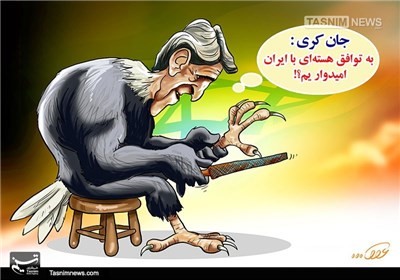
21114November 2, 2014 on Tasnimnews.com, which is close to Iran’s Islamic Revolutionary Guards Corps (IRGC): “Kerry’s Greedy Declarations.” U.S. Secretary of State Kerry the eagle, who is sharpening his talons against the backdrop of an Israeli flag, says: “I am optimistic with regard to the nuclear agreement with Iran.”

Kayhan: “In Negotiations That Could Take Place In 2024, Iran Will Undoubtedly Come To The Negotiating Table With Tens Of Thousands Of Centrifuges That Are More Advanced Than Those It Has Today”; The Nuclear Mushroom Yields Results Once In A Decade

On November 6, 2014, two days after the Republicans swept the U.S. midterm elections, Kayhan wrote: “Obama is now at his lowest point of popularity since he was elected… At the last nuclear negotiating venue [in Oman, at the level of Foreign Minister Zarif, U.S. Secretary of State Kerry, and EU High Representative on Foreign Policy Catherine Ashton, November 9-10, 2014], the Democrats in the White House will try to turn their defeat in the elections to their diplomatic advantage. Obama is like a gambler who has lost everything, and he is sending his representatives to the [negotiating] table with empty pockets… Apparently, the White House emissaries will recommend to the Iranian team to sign the nuclear agreement as soon as possible, since if they do not, Congress will enter the arena with a stick, threats, and sanctions…

“The [negotiating] venue in Oman must be the place where the [Iranian team] gives the Americans a final ultimatum, instead of listening to their boasts… Recently, American negotiating team leader Wendy Sherman quoted former U.S. secretary of state Madeleine Albright as saying that negotiations are ‘like a mushroom that grows best in the dark.’ Soon the result of the[se] negotiations, which have been conducted in the dark for over a year, will become clear.

“The last time that Western [officials] tried to feed Iran this poison mushroom and to force it to submit to the American greed was a decade ago. Undoubtedly, the 2014 mushroom will contain poison that was concocted in 2003. This is because at that point in the negotiations [i.e. in 2003], Iran was operating very few centrifuges, while today it has some 20,000 centrifuges. The Americans need to know that in the most optimal situation [for them], the nuclear mushroom yields results once in a decade… In negotiations that could take place in 2024, Iran will undoubtedly come to the negotiating table with tens of thousands of centrifuges that are more advanced than those it has today.”[10]

Kayhan: Rafsanjani And Rohani Are Bringing Up Various Issues To Distract The Elites From The Upcoming Agreement

On October 28, 2014, Kayhan wrote: “In the Geneva agreements, we put on the table [i.e. we were forced to give up] the product of three years of [uranium] enrichment to 20%, and [agreed to accept] a freeze on activity at the Fordow [enrichment facility] and a halt to the operations to complete the Arak [heavy water] facility, in return for the release of some $7 billion in Iranian funds…

“During the four-month extension [of the Geneva document] we expanded this give-and-take – and now America covets another part of Iran’s assets, saying ‘close Fordow or turn it into a research center; cut back your reserves of enriched [material] to 3.5%, to a quantity that we will tell [you], and remove [it] from Iran; [and] shut down 5,400 of your9,400 operating centrifuges, etc., etc. In return, we will examine your intentions for a period of seven to 20 years, [so that we can ascertain] whether or not we can trust you, or for example, [in return for] our promise not to impose new sanctions.’ This is truly a win-win game and constructive engagement [a jibe at President Rohani].

“The question is, to what point and from what assets does the government intend to pay for this extension of the negotiations and the incremental freeze [on Iran’s nuclear activity]?… When [Iran’s] nuclear technology peaked, Rafsanjani, Rohani, and even [Mir Hossein] Mousavi, and others, saw themselves as major shareholders in this progress. However when the [P5+1] began to impose its impediments, a green light was given for [Iranian] concessions based on a freeze on a small or large part of the [nuclear] program. Rafsanjani even announced his satisfaction with the Geneva negotiations, [saying], ‘Thanks to the negotiations, the taboo [on engagement] with America has been broken.’

“The negotiations apparently had two objectives: The first was to preserve the nuclear program, from the standpoint of [Iran’s right to] enrich [uranium]; the second was to get the sanctions lifted. If some political figures do not attach the requisite importance to the first, they undoubtedly need to explain the second. Therefore, [they must be asked] why not a single sanction was lifted after [Iran] made all these concessions [in the negotiations] – but the sanctions were only made harsher?…

“The acceptance of the West’s demands is the same mistake in judgment that has repeatedly led to an impasse, to the squandering [of Iran’s] strategic assets, [and] to defaming and labelling the critics [of the government] who support [the regime] in an effort to render them passive. The storm surrounding the law to preserve the hijab and modesty, the support for the modesty police, the accusations that the Majlis removed the science minister due to the scholarships scandal[11]… the exploitation of the crime of the acid attacks [against women in Isfahan by claiming that the ideological camp was behind them] – all these are taken from the script and from the organized attempt by the men of fitna and their supporters outside [Iran], with the aim of stirring up marginal scandals within Iran so that [the main issues] are ignored.

“The West sees that Iran’s irreplaceable role has redrawn the map of western Asia and the Middle East, [adding] the qualities of resistance and Islamic awakening in Iraq, Syria, Lebanon, Yemen,l and Bahrain, [and says] ‘Iran must be stopped from playing this role.’

“The men of fitna and the bankrupt extremists… believe that the only way to rebuild their organizations is by dealing with marginal issues and [news-grabbing] explosions that make a huge splash. A group of them… is operating based on a plan given to them, and their media and statesmen are moving ahead in coordination with the Western scheme.

“This hypocritical combination stands out clearly in the government [of Rohani] – revolutionary national enthusiasm [combined with] whispers aimed at trapping critics of the government into dealing with marginal issues to render them passive… to the point where neither the elites nor the people will ask why the negotiations are at an impasse, so that in the atmosphere of passivity and obliviousness it will be possible to reach an agreement, no matter what the cost. [Therefore], by the time the elites and the people wake up and ask what happened, what we gave, and what we got, it will be all over [that is, the deal will be signed]. Most statesmen oppose this harmful approach.

“The government and the president have already learned from the experience acquired in their 14 months in office. They are now at a point of evaluation and course correction. It is always beneficial to prevent damage and dangerous conduct. The leader [Khamenei]… said that the American regime, which stands with Israel, is the exception to Iran’s foreign policy of engagement. The accuracy of his declaration [that we cannot talk to either the U.S. or Israel] was revealed to all over time. Obeying this instruction is the path that will benefit the government and bring it honor. Otherwise, [the Rohani government] will owe a debt to the arrogant ones outside [Iran] and to the seekers of fitna within [Iran], who are skilled in this matter; in this way [i.e. if it talks to the U.S., Iran] will gain  no victory and no prestige…”[12]

Website Affiliated With Ideological Camp: The Pragmatists Are Trying To Remove Khamenei

On October 29, 2014, Afsaran.ir, which is close to Iranian security circles, published an article titled “What Is The Real Objective Of The Line Of Obliviousness [i.e. the pragmatic camp] – Taking The Majlis Or Replacing The Supreme Leader?” The article hinted that Foreign Minister Zarif is party to a Western plot to depose Khamenei, using the pragmatic camp’s strategy for dealing with the Americans, saying that if no agreement is reached, then the ideological stream that opposes rapprochement with the West will seize key political positions in Iran.[13]

The article stated: “Although America’s hostility towards the leader of the revolution [Khamenei] is nothing new, and they have acknowledged this a number of times… the [Americans’] attacks [against Iran] since the New York negotiations… [including] Under Secretary of State Wendy Sherman’s interview on the Voice of America in Persian and [Foreign Minister Javad Zarif’s] entreaties before America’s Council of Foreign Relations have colored it a different hue. Besides the abovementioned incidents, [the Iranian-American academic] Vali Nasr and other American senior officials and influential figures have mentioned Iranian leader Khamenei as the main reason why no agreement has been reached, going so far as to consider replacing him.

“Nasr said: In December 2015, elections will be held in Iran for the Iranian Assembly of Experts, which will appoint Iran’s next leader. He also said: The next [Assembly of Experts] election can change the political direction in Iran.’

“Therefore, it must be asked: Who are the people [in Iran] who directed the policymakers of the enemy [i.e. the U.S.] towards supporting this strategy of deposing the leader Khamenei during direct negotiations with America?

“After consulting with which Iranians does America now consider the nuclear negotiations as an obstacle to its realization of its objectives, and as fertile ground for changing the course of the [Islamic] Revolution [i.e. the regime]?

“In all honesty, is the foreign minister really aiming, in his request to the American Congress to cooperate with the line of obliviousness [i.e. the pragmatic camp], to [obtain American] help so that they [i.e. the pragmatic camp] can win the Majlis elections? Or is he, like Nasr, really referring to a change in the makeup of the Iranian Assembly of Experts [so that it will remove or replace Khamenei]?

“Maybe some within Iran are not yet speaking as frankly as Nasr.”[14]

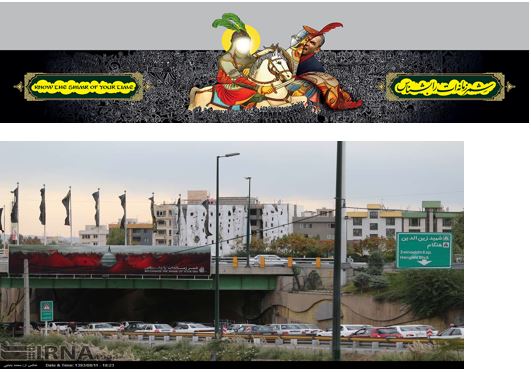
Basij Posts Signs In Iranian Cities Saying ‘Know The Shimr Of Our Time’

Also, the Basij has recently posted signs in Tehran and Shiraz stating, “Know The Shimr [who in Shi’ite legend murdered Imam Hussein] Of Our Time”; the signs clearly depict President Obama and the dome of the U.S. Capitol.[15]
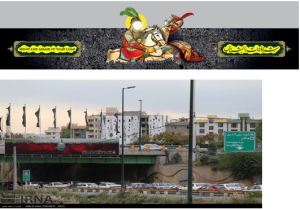
21115

Endnotes:

[1] See October 23, 2014 statement by U.S. Under Secretary for Political Affairs Wendy Sherman, State.gov/p/us/rm/2014/233306.htm.

[2] Most reports refer to 4,000; however, two Iranian sources have referred to at least 6,000. Majlis Nuclear Committee head Ebrahim Karkhanehi reported that P5+1 had agreed to approve the operation of 6,000 to 9,000 centrifuges. Tasnim, Iran, November 2, 2014.

[3] See MEMRI Inquiry & Analysis No. 1127, Iran’s Pragmatic Camp Calls For Exploiting Obama’s Weakness To Attain Comprehensive Nuclear Agreement On Tehran’s Terms, October 26, 2014.

[4]  The Shi’ite legend of Karbala underpins Iranian culture, particularly political culture, in post-Islamic Revolution Iran; it tells of the first Shi’ite martyr, Imam Hussein Ibn Ali, the grandson of the Prophet, at Karbala in 680 CE, after he demanded power and refused to accept the authority of Umayyad caliph Yazid ibn Mu’awiyah.

[5] Shargh (Iran), November 2, 2014. An anonymous party familiar with dealings in the Foreign Ministry told Tabnak in an interview that Khorram is not an advisor to Foreign Minister Zarif, and that his views do not represent the negotiating team or the foreign ministry. Tabnak, Iran, November 4, 2014.

[6] President.ir, October 22, 2014.

[7] Kayhan (Iran), October 23, 2014.

[8] Jomhouri-ye Eslami, (Iran), October 27, 2014.

[9] Tasnim (Iran), October 28, 2014.

[10] Kayhan (Iran), November 6, 2014.

[11] Recently, the ideological camp succeeded in removing Rohani’s science minister for having a record as a reformist.

[12] Kayhan (Iran), October 28, 2014.

[13] See MEMRI Inquiry & Analysis No. 1127, Iran’s Pragmatic Camp Calls For Exploiting Obama’s Weakness To Attain Comprehensive Nuclear Agreement On Tehran’s Terms, October 26, 2014.

[14] Afsaran.ir, October 29, 2014.

[15] IRNA (Iran) November 2, 2014; Tasnim, October 30, 2014.
Is Ahmadinejad making a comeback?

November 7, 2014

Is Ahmadinejad making a comeback? Al-MonitorArash Azizi, November 5, 2014

(Since it now appears that a nuke deal may well be signed by the November 24th deadline — well before the new U.S. Republican Congress takes over in January — what difference does it make now? In any event, with the Supreme Leader in charge regardless of whether Iran’s President is a “moderate” or an “extremist,” what difference does it make, ever? Even a “good” deal can and will be violated with impunity. — DM)

Iran's President Mahmoud Ahmadinejad meets with Iraq's Vice President Khudair al-Khuzaie during his visit in BaghdadMahmoud Ahmadinejad (C) meets with Iraqi Vice President Khudair al-Khuzaie (not seen) during a visit in Baghdad when Ahmadinejad was still president of Iran, July 18, 2013. (photo by REUTERS/Hadi Mizban)

The media activities and meetings of former Iranian President Mahmoud Ahmadinejad signal that he is keeping his name before the public and trying to forge new alliances for his political comeback.

A three-story building in a quiet one-way alley in northern Tehran is the headquarters of an unlikely campaign that opposes both the administration of President Hassan Rouhani and many of the Islamic Republic’s establishment figures.

The Velenjak building is the base of activities for former President Mahmoud Ahmadinejad, who has his offices on its third floor.

Ahmadinejad has been relatively quiet since the ascendance of the moderate Rouhani, but the Iranian Labor News Agency (ILNA) is only one of many outlets that have reported on his desire to make a comeback.

According to Amir Mohebbian, a leading political analyst, Ahmadinejad’s attempt to return to power is obvious as he “quietly awaits favorable conditions and occasionally tests the waters.”

The provincial trips that the former hard-line president makes are one indication.

In addition to making many trips to southern and northern Iran, Ahmadinejad celebrated the end of Ramadan by visiting Taleqan with the family members of four celebrated Iran-Iraq war “martyrs” in a trip that, according to ILNA, was coordinated by the Quds Force, the formidable international arm of Iran’s Islamic Revolutionary Guards Corps.

In April, Ahmadinejad ruled out a return to politics but many of his supporters beg to differ.

They are tirelessly organizing and insist on his return. These are an unlikely bunch. Their young cadre runs many blogs and social media accounts. They draw controversy by their occasionally unconventional mixing of Islamism with an anti-wealthy and anti-establishment discourse, and many have spent time in jail for their activities. Their targets are not only the Reformists but many of the traditional conservatives.

Take Ahmad Shariat, who heads the Internet committee of an Ahmadinejad organization. In his blog, he attacked the policy of backing Syrian President Bashar al-Assad, called for a boycott of the last Majles elections in 2012 (because many Ahmadinejad forces were barred), attacked establishment religious figures such as Ayatollah Mesbah Yazdi and, finally, dared to criticize Supreme Leader Ayatollah Ali Khamenei himself (the latter, in early 2013, led to the closing of Shariat’s blog and his arrest).

These supporters leave no doubt as to their allegiance to the ex-president. One name they go by is “Homa,” a Persian acronym for “Supporters of Mahmoud Ahmadinejad.” An online newspaper with the same name (Homa Daily) opened last week on the occasion of Ahmadinejad’s 58th birthday. (“Square 72” is another outlet, named after Ahmadinejad’s neighborhood in northeastern Tehran).

Abdolreza Davari — who was a vice-president of IRNA, the national news agency for the administration under Ahmadinejad — is a leading organizer of Homa. A controversial figure who was fired from a teaching post for “political activities,” Davari was reported by ILNA as one of the top three media campaigners attempting an Ahmadinejad comeback.

“As an Iranian, I hope for the return of Mr. Ahmadinejad to politics,” Davari told Al-Monitor, before adding that he thinks the ex-president is currently focused on “scientific” activities.

To my question about the regular meetings of Homa in the Velenjak building, Davari says that such meetings are not organized but that “all kinds of people, commentators, students or ordinary people come to meet and talk to Dr. Ahmadinejad.”

Davari also denies that Homa is attempting to organize for next year’s Majles elections. Ahmadinejad’s return to power needs no less than “changes in the current relation of forces,” Davari says, seeming to imply that many of the establishment figures wouldn’t want the ex-president back. Many such figures are especially opposed to Ahmadinejad’s entourage.

Enter Esfandiar Rahim Mashaei, Ahmadinejad’s chief of staff, who was openly rebuked by Khamenei for his maverick mixing of Shiite millennialism, Persian nationalism and leftist language. Despite Khamenei’s personal rejection and the sustained attacks of many who accused Mashaei of leading a “deviationist current,” the ex-president has continued backing his close friend (whose daughter married Ahmadinejad’s eldest son) even after the Guardian Council rejected Mashaei’s candidacy in last year’s presidential elections.

Mashaei’s offices are on the second level of the Velenjak building, and he is known to take part in Homa meetings.

Homa Daily ran Mashaei’s picture in the first page of its first issue, while reprinting his most controversial interview, where he had defended the necessity of “friendship with the Israeli people” — an interview personally criticized and attacked by Khamenei.

Davari says Mashaei doesn’t want to return to politics due to his “cultural and spiritual sentiment.” Taking a note from Mashaei’s book, he says Ahmadinejad’s concept of the Islamic Revolution and his belief in the coming of the hidden Imam is not “meant for a specific geography or religion as the hidden Imam’s global message is aimed at all nations and groups.”

“Freedom-loving and justice-seeking fighters” like Fidel Castro, Che Guevara, Djamila Boupacha, Bobby Sands, Hassan Nasrallah and Hugo Chavez belong to the same global front as Ahmadinejad, Davari insists.

Acolytes of Mashaei seem to have especially targeted Iran’s nuclear negotiations. A group called the “the National Movement for Iran’s Independence” (NAMA, for its Persian acronym) was formed with the declared goal of fighting any compromise with the West. Its unusual name (not mentioning Islam) has the Mashaie imprint.

Mashaei’s presence has always driven away many of Ahmadinejad’s backers. One of them is Mohammadreza Etemadian, a trade adviser to the ex-president. Etemadian told Al-Monitor that he would like to see Ahmadinejad back, but he has always told him to keep Mashaei away since “he is not on good terms with the supreme leader and is a deviant.”

Etemadian is a leading member of the Islamic Coalition Party, the traditional organization of Bazari Islamists and an important part of the establishment. Its leaders seem to detest the populist excesses of Ahmadinejad.

Sensing this, the ever-adventurous Ahmadinejad has been trying to find new allies, even if among the Reformists. He met with Hassan Khomeini, the 40-year-old grandson of the founder of the Islamic Republic, known for his proximity to the Reformists. The ex-president boldly asked Khomeini to lead a group of young clerics to contest the next year’s election of the Assembly of Experts, the body that chooses the supreme leader.

He has also reportedly tried to meet the Reformist ex-President Mohammad Khatami and Ambassador Sadeq Kharazi, an influential diplomat from a key political family.

Meanwhile, it was reported that Gholam-Hossein Elham, the spokesman of Ahmadinejad’s government, has started campaigning for the ex-president and last week met with the governors-generals of the previous government to organize. Elham, however, spoke with the pro-Ahmadinejad “Square 72” website to deny this news.

Unceremoniously bowing out after the disqualification of the candidate he supported in the 2013 presidential elections, Ahmadinejad seems to be busy plotting a comeback.


Rouhani ties Iran cooperation on Mideast violence to nuke deal

September 25, 2014

Rouhani ties Iran cooperation on Mideast violence to nuke deal, Fox News, September 25, 2014

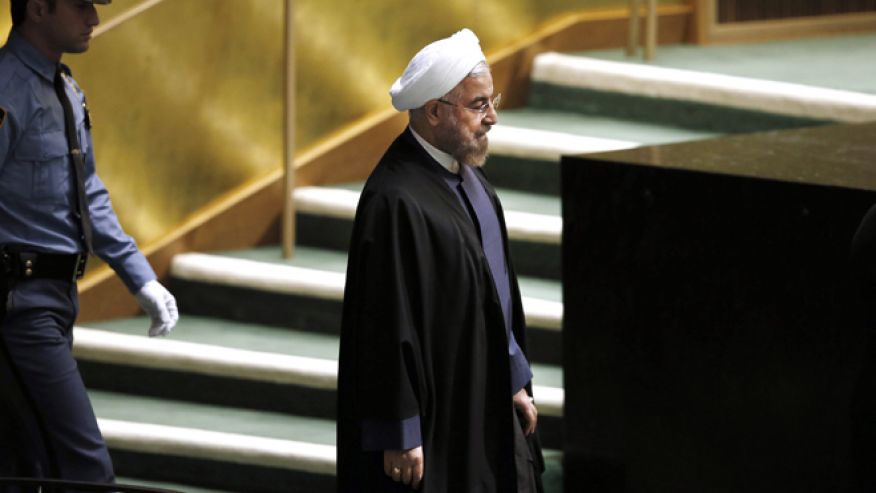
UN General Assembly_Rouhani_AP_660In this Thursday, Sept. 25, 2014 photo, President Hassan Rouhani of Iran walks in before addressing the 69th session of the United Nations General Assembly at U.N. headquarters. (AP)

Iranian President Hassan Rouhani on Thursday sought to leverage the crisis in the Middle East to ease sanctions on his country as part of nuclear talks, suggesting during a United Nations address that security cooperation between Iran and other nations could only occur if they struck a favorable nuclear deal.

The Iranian president, meanwhile, sought to lay the blame for raging violence in the Middle East at the feet of western nations. He strongly condemned terrorism and described it as a serious threat, but also said the West’s “blunders” in the region have created a “haven for terrorists and extremists.” He alleged that attempts to “export” democracy have created “weak and vulnerable governments.”

While focusing in large part on violent extremists in the region, Rouhani made clear Iran’s cooperation in addressing these threats hinges on the outcome of ongoing nuclear talks – as he once again urged other nations to drop what he described as “excessive demands.”

Rouhani said a deal could mark the “beginning of multilateral cooperation” and allow for “greater focus on some very important regional issues such as combating violence and extremism.”

But, he said: “The people of Iran who have been subjected to pressures … as a result of continued sanctions cannot place trust in any security cooperation between their governments with those who have imposed sanctions.”

Whether Iran’s cooperation in addressing Middle East unrest will serve as an effective bargaining chip remains to be seen.

The U.S. publicly has said it will not cooperate militarily or share intelligence with Iran to address the Islamic State threat.

Yet Secretary of State John Kerry said this week he was “open to have a conversation at some point in time if there’s a way to find something constructive.” And the U.S. reportedly notified Iran in advance of plans to strike inside Syria.

In his address to world leaders late Wednesday, British Prime Minister David Cameron also said Iran could help in defeating the terror group’s threat. Cameron spoke hours after meeting in person with Rouhani, the first meeting between the British and Iranian leaders since the Iranian revolution in 1979.

The world leaders spoke as the U.S., Iran and other nations resume nuclear talks after a two-month hiatus.

They are running up against a Nov. 24 deadline to reach a comprehensive agreement to curb Iran’s nuclear activities in exchange for easing sanctions.

Tehran, though, is resisting U.S. calls that it gut a nuclear program that enriches uranium, a process that can make both reactor fuel and the fissile core of a nuclear warhead. GOP lawmakers have also warned that the Obama administration may be willing to give too much ground to Iran in pursuit of an agreement.

Failure to seal a deal could see a return to confrontation, including U.S. and Israeli threats of military means as a last resort to slow Iran’s nuclear program.

“My message to Iran’s leaders and people is simple: Do not let this opportunity pass,” President Obama said Wednesday in his own address to world leaders.

The disagreement has complicated efforts to regarding the Islamic State menace.

In comments on the eve of his own General Assembly speech, Rouhani suggested his country was ready to join Washington and others in opposing the Islamic State. But he said the U.S. needed to move beyond “insignificant” fears that his country seeks nuclear arms.

At the same time, he was critical of the U.S. bombing campaign of Islamic State group strongholds and the growing coalition of countries seeking to stop the extremists by military means. “Bombing and airstrikes are not the appropriate way,” Rouhani said, warning that “extraterritorial interference … in fact only feeds and strengthens terrorism.”

There are other issues. American officials are furious with Iran for detaining Jason Rezarian, a Washington Post journalist who has both American and Iranian citizenship, as well as his wife.

Iranian officials have not specifically said why the couple is being held, and Rouhani has dodged questions about their fate. Asked again Wednesday about Rezarian, he said he would be freed if he is innocent of any crime.