Why Islam Needs a Reformation, Wall Street Journal, Ayaan Hirsi Ali, March 20, 2015
(What are the chances of such a reformation over the next hundred years or so? — DM)
 A man prays during the Muslim festival of Eid al-Adha, or the Festival of Sacrifice, at Jama Masjid in New Delhi on Oct. 6, 2014. Eid al-Adha marks the end of the Hajj, the annual pilgrimage to Mecca. PHOTO: AGENCE FRANCE-PRESSE/GETTY IMAGES
“Islam’s borders are bloody,” wrote the late political scientist Samuel Huntington in 1996, “and so are its innards.” Nearly 20 years later, Huntington looks more right than ever before. According to the International Institute for Strategic Studies, at least 70% of all the fatalities in armed conflicts around the world last year were in wars involving Muslims. In 2013, there were nearly 12,000 terrorist attacks world-wide. The lion’s share were in Muslim-majority countries, and many of the others were carried out by Muslims. By far the most numerous victims of Muslim violence—including executions and lynchings not captured in these statistics—are Muslims themselves.
Not all of this violence is explicitly motivated by religion, but a great deal of it is. I believe that it is foolish to insist, as Western leaders habitually do, that the violent acts committed in the name of Islam can somehow be divorced from the religion itself. For more than a decade, my message has been simple: Islam is not a religion of peace.
When I assert this, I do not mean that Islamic belief makes all Muslims violent. This is manifestly not the case: There are many millions of peaceful Muslims in the world. What I do say is that the call to violence and the justification for it are explicitly stated in the sacred texts of Islam. Moreover, this theologically sanctioned violence is there to be activated by any number of offenses, including but not limited to apostasy, adultery, blasphemy and even something as vague as threats to family honor or to the honor of Islam itself.
It is not just al Qaeda and Islamic State that show the violent face of Islamic faith and practice. It is Pakistan, where any statement critical of the Prophet or Islam is labeled as blasphemy and punishable by death. It is Saudi Arabia, where churches and synagogues are outlawed and where beheadings are a legitimate form of punishment. It is Iran, where stoning is an acceptable punishment and homosexuals are hanged for their “crime.”
As I see it, the fundamental problem is that the majority of otherwise peaceful and law-abiding Muslims are unwilling to acknowledge, much less to repudiate, the theological warrant for intolerance and violence embedded in their own religious texts. It simply will not do for Muslims to claim that their religion has been “hijacked” by extremists. The killers of Islamic State and Nigeria’s Boko Haram cite the same religious texts that every other Muslim in the world considers sacrosanct.
Instead of letting Islam off the hook with bland clichés about the religion of peace, we in the West need to challenge and debate the very substance of Islamic thought and practice. We need to hold Islam accountable for the acts of its most violent adherents and to demand that it reform or disavow the key beliefs that are used to justify those acts.
As it turns out, the West has some experience with this sort of reformist project. It is precisely what took place in Judaism and Christianity over the centuries, as both traditions gradually consigned the violent passages of their own sacred texts to the past. Many parts of the Bible and the Talmud reflect patriarchal norms, and both also contain many stories of harsh human and divine retribution. As President Barack Obama said in remarks at the National Prayer Breakfast last month, “Remember that during the Crusades and the Inquisition, people committed terrible deeds in the name of Christ.”
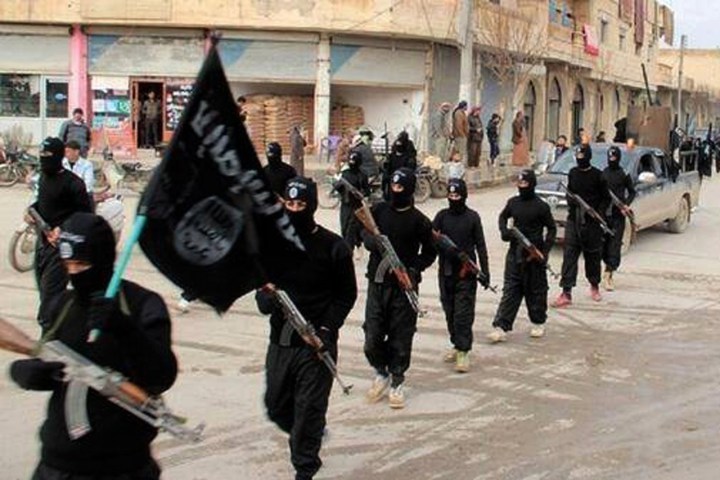 Islamic State militants marching through Raqqa, Syria, a stronghold of the Sunni extremist group, in an undated file image posted on a militant website on Jan. 14, 2014. PHOTO: ASSOCIATED PRESS
Yet today, because their faiths went through a long, meaningful process of Reformation and Enlightenment, the vast majority of Jews and Christians have come to dismiss religious scripture that urges intolerance or violence. There are literalist fringes in both religions, but they are true fringes. Regrettably, in Islam, it is the other way around: It is those seeking religious reform who are the fringe element.
Any serious discussion of Islam must begin with its core creed, which is based on the Quran (the words said to have been revealed by the Angel Gabriel to the Prophet Muhammad) and the hadith (the accompanying works that detail Muhammad’s life and words). Despite some sectarian differences, this creed unites all Muslims. All, without exception, know by heart these words: “I bear witness that there is no God but Allah; and Muhammad is His messenger.” This is the Shahada, the Muslim profession of faith.
The Shahada might seem to be a declaration of belief no different from any other. But the reality is that the Shahada is both a religious and a political symbol.
In the early days of Islam, when Muhammad was going from door to door in Mecca trying to persuade the polytheists to abandon their idols of worship, he was inviting them to accept that there was no god but Allah and that he was Allah’s messenger.
After 10 years of trying this kind of persuasion, however, he and his small band of believers went to Medina, and from that moment, Muhammad’s mission took on a political dimension. Unbelievers were still invited to submit to Allah, but after Medina, they were attacked if they refused. If defeated, they were given the option to convert or to die. (Jews and Christians could retain their faith if they submitted to paying a special tax.)
No symbol represents the soul of Islam more than the Shahada. But today there is a contest within Islam for the ownership of that symbol. Who owns the Shahada? Is it those Muslims who want to emphasize Muhammad’s years in Mecca or those who are inspired by his conquests after Medina? On this basis, I believe that we can distinguish three different groups of Muslims.
The first group is the most problematic. These are the fundamentalists who, when they say the Shahada, mean: “We must live by the strict letter of our creed.” They envision a regime based on Shariah, Islamic religious law. They argue for an Islam largely or completely unchanged from its original seventh-century version. What is more, they take it as a requirement of their faith that they impose it on everyone else.
I shall call them Medina Muslims, in that they see the forcible imposition of Shariah as their religious duty. They aim not just to obey Muhammad’s teaching but also to emulate his warlike conduct after his move to Medina. Even if they do not themselves engage in violence, they do not hesitate to condone it.
It is Medina Muslims who call Jews and Christians “pigs and monkeys.” It is Medina Muslims who prescribe death for the crime of apostasy, death by stoning for adultery and hanging for homosexuality. It is Medina Muslims who put women in burqas and beat them if they leave their homes alone or if they are improperly veiled.
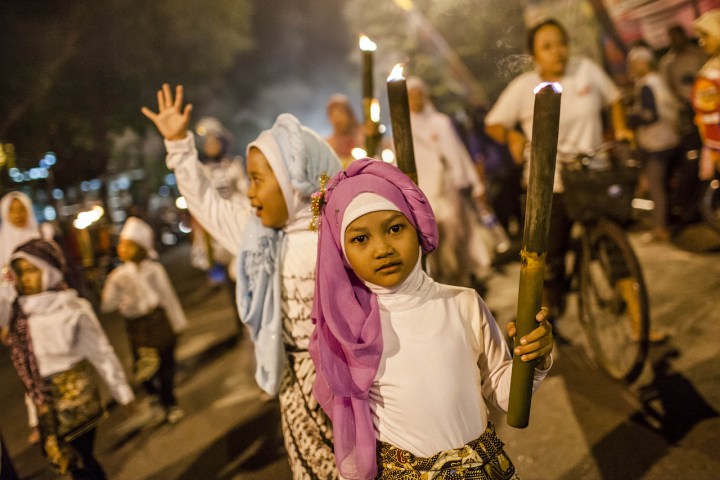 Muslim children carry torches during a parade before Eid al-Fitr, at the end of the holy month of Ramadan, on July 27, 2014, in Yogyakarta, Indonesia. PHOTO: GETTY IMAGES
The second group—and the clear majority throughout the Muslim world—consists of Muslims who are loyal to the core creed and worship devoutly but are not inclined to practice violence. I call them Mecca Muslims. Like devout Christians or Jews who attend religious services every day and abide by religious rules in what they eat and wear, Mecca Muslims focus on religious observance. I was born in Somalia and raised as a Mecca Muslim. So were the majority of Muslims from Casablanca to Jakarta.
Yet the Mecca Muslims have a problem: Their religious beliefs exist in an uneasy tension with modernity—the complex of economic, cultural and political innovations that not only reshaped the Western world but also dramatically transformed the developing world as the West exported it. The rational, secular and individualistic values of modernity are fundamentally corrosive of traditional societies, especially hierarchies based on gender, age and inherited status.
Trapped between two worlds of belief and experience, these Muslims are engaged in a daily struggle to adhere to Islam in the context of a society that challenges their values and beliefs at every turn. Many are able to resolve this tension only by withdrawing into self-enclosed (and increasingly self-governing) enclaves. This is called cocooning, a practice whereby Muslim immigrants attempt to wall off outside influences, permitting only an Islamic education for their children and disengaging from the wider non-Muslim community.
It is my hope to engage this second group of Muslims—those closer to Mecca than to Medina—in a dialogue about the meaning and practice of their faith. I recognize that these Muslims are not likely to heed a call for doctrinal reformation from someone they regard as an apostate and infidel. But they may reconsider if I can persuade them to think of me not as an apostate but as a heretic: one of a growing number of people born into Islam who have sought to think critically about the faith we were raised in. It is with this third group—only a few of whom have left Islam altogether—that I would now identify myself.
These are the Muslim dissidents. A few of us have been forced by experience to conclude that we could not continue to be believers; yet we remain deeply engaged in the debate about Islam’s future. The majority of dissidents are reforming believers—among them clerics who have come to realize that their religion must change if its followers are not to be condemned to an interminable cycle of political violence.
How many Muslims belong to each group? Ed Husain of the Council on Foreign Relations estimates that only 3% of the world’s Muslims understand Islam in the militant terms I associate with Muhammad’s time in Medina. But out of well over 1.6 billion believers, or 23% of the globe’s population, that 48 million seems to be more than enough. (I would put the number significantly higher, based on survey data on attitudes toward Shariah in Muslim countries.)
In any case, regardless of the numbers, it is the Medina Muslims who have captured the world’s attention on the airwaves, over social media, in far too many mosques and, of course, on the battlefield.
The Medina Muslims pose a threat not just to non-Muslims. They also undermine the position of those Mecca Muslims attempting to lead a quiet life in their cultural cocoons throughout the Western world. But those under the greatest threat are the dissidents and reformers within Islam, who face ostracism and rejection, who must brave all manner of insults, who must deal with the death threats—or face death itself.
For the world at large, the only viable strategy for containing the threat posed by the Medina Muslims is to side with the dissidents and reformers and to help them to do two things: first, identify and repudiate those parts of Muhammad’s legacy that summon Muslims to intolerance and war, and second, persuade the great majority of believers—the Mecca Muslims—to accept this change.
Islam is at a crossroads. Muslims need to make a conscious decision to confront, debate and ultimately reject the violent elements within their religion. To some extent—not least because of widespread revulsion at the atrocities of Islamic State, al Qaeda and the rest—this process has already begun. But it needs leadership from the dissidents, and they in turn stand no chance without support from the West.
What needs to happen for us to defeat the extremists for good? Economic, political, judicial and military tools have been proposed and some of them deployed. But I believe that these will have little effect unless Islam itself is reformed.
Such a reformation has been called for repeatedly at least since the fall of the Ottoman Empire and the subsequent abolition of the caliphate. But I would like to specify precisely what needs to be reformed.
I have identified five precepts central to Islam that have made it resistant to historical change and adaptation. Only when the harmfulness of these ideas are recognized and they are repudiated will a true Muslim Reformation have been achieved.
Here are the five areas that require amendment:
1. Muhammad’s semi-divine status, along with the literalist reading of the Quran.
Muhammad should not be seen as infallible, let alone as a source of divine writ. He should be seen as a historical figure who united the Arab tribes in a premodern context that cannot be replicated in the 21st century. And although Islam maintains that the Quran is the literal word of Allah, it is, in historical reality, a book that was shaped by human hands. Large parts of the Quran simply reflect the tribal values of the 7th-century Arabian context from which it emerged. The Quran’s eternal spiritual values must be separated from the cultural accidents of the place and time of its birth.
2. The supremacy of life after death.
The appeal of martyrdom will fade only when Muslims assign a greater value to the rewards of this life than to those promised in the hereafter.
3. Shariah, the vast body of religious legislation.
Muslims should learn to put the dynamic, evolving laws made by human beings above those aspects of Shariah that are violent, intolerant or anachronistic.
4. The right of individual Muslims to enforce Islamic law.
There is no room in the modern world for religious police, vigilantes and politically empowered clerics.
5. The imperative to wage jihad, or holy war.
Islam must become a true religion of peace, which means rejecting the imposition of religion by the sword.
I know that this argument will make many Muslims uncomfortable. Some are bound to be offended by my proposed amendments. Others will contend that I am not qualified to discuss these complex issues of theology and law. I am also afraid—genuinely afraid—that it will make a few Muslims even more eager to silence me.
But this is not a work of theology. It is more in the nature of a public intervention in the debate about the future of Islam. The biggest obstacle to change within the Muslim world is precisely its suppression of the sort of critical thinking I am attempting here. If my proposal for reform helps to spark a serious discussion of these issues among Muslims themselves, I will consider it a success.
Let me make two things clear. I do not seek to inspire another war on terror or extremism—violence in the name of Islam cannot be ended by military means alone. Nor am I any sort of “Islamophobe.” At various times, I myself have been all three kinds of Muslim: a fundamentalist, a cocooned believer and a dissident. My journey has gone from Mecca to Medina to Manhattan.
For me, there seemed no way to reconcile my faith with the freedoms I came to the West to embrace. I left the faith, despite the threat of the death penalty prescribed by Shariah for apostates. Future generations of Muslims deserve better, safer options. Muslims should be able to welcome modernity, not be forced to wall themselves off, or live in a state of cognitive dissonance, or lash out in violent rejection.
But it is not only Muslims who would benefit from a reformation of Islam. We in the West have an enormous stake in how the struggle over Islam plays out. We cannot remain on the sidelines, as though the outcome has nothing to do with us. For if the Medina Muslims win and the hope for a Muslim Reformation dies, the rest of the world too will pay an enormous price—not only in blood spilled but also in freedom lost.





 anneinpt
 artaxes
 danmillerinpanama
 davidking1530
 Peter Hofman
 Joseph Wouk
 Peter
Peter Louisiana Steve
 WarSclerotic
Recent Comments