Posted tagged ‘Refugees’

Trump vs. Globalists

February 7, 2017

Trump vs. Globalists, Front Page MagazineMichael Cutler, February 7, 2017

bjn

President Donald Trump has been confronted by unprecedented demonstrations not only in the United States but even in foreign countries.

President Trump’s support of Brexit and his promises to secure our border with Mexico and subject aliens seeking entry into the United States to “extreme vetting” runs contrary to the Globalists goals. Consequently they fired up the mobs even before Trump’s inauguration.

Globalists are behind the vilification of President Trump and anyone who supports effective immigration law enforcement. 

Globalists abhor the notion of national sovereignty and see secure borders as impediments to their wealth and consequently are doing everything possible to create Immigration Failure — By Design.

Globalists have support “Sanctuary Cities” ignoring the nexus between terrorism, enclaves and sanctuary cities.

For decades globalists and their “front groups” such as the U.S. Chamber of Commerce have foisted their lies on Americans, through what I have come to refer to as the immigration con game.

News organizations have, all too often, become venues for the disbursement of propaganda.

Consider how the seven countries whose citizens are being temporary barred from entering the United States have been described in the media as “Muslim majority countries.”  Yet there is nothing in Trump’s executive orders that mention Islam but rather focus on how the list of  countries was compiled by the Obama administration because of their links to terrorism and the inability to vet citizens of those countries.

Obviously the Democrats have been publicly leading the charge to vilify President Trump.  Trump upset their plans to coronate Hillary and were stunned by her defeat.  In response Democrats tried every possible strategy to delegitimize the outcome of the election and, by extension, the Trump presidency.

However, it is impossible to ignore that many journalists and politicians have, marching lockstep with the globalists, accused Trump of not really being a Republican but of being a “Populist”

Populism has been defined as:

 support for the concerns of ordinary people: it is clear that your populism identifies with the folks on the bottom of the ladder | the Finance Minister performed a commendable balancing act, combining populism with prudence.

the quality of appealing to or being aimed at ordinary people: art museums did not gain bigger audiences through a new populism.

Those journalists and politicians, upset over the notion of a President of the United States being a “Populist,” must not have read the Declaration of Independence that begins with the phrase, “We the people…”

You have to wonder what the Founding Fathers and especially what Thomas Jefferson would say about all of this.

In order to block the implementation of Trump’s immigration policies crafted to protect national security and the lives of Americans, the Democratic Party went “Judge shopping” and came up with James Robart, a jurist who, the media has been quick to report, had been, in fact, appointed by President George W. Bush.

CNN provided a thumbnail sketch about James Robart: 5 things to know about judge who blocked travel ban that noted that Judge Robart sided with “Black Lives Matter” over the police in Seattle, Washington in a case last year, involving an allegation of excessive force by police.

The CNN report also noted that Judge Robert had also provided pro bono assistance to refugees.

My recent article on President Trump’s Immigration Challenge  noted that the President not only has to undo the catastrophic damage done to immigration law enforcement by the Obama administration but also deal with the very structure of the Department of Homeland Security, the agency created by the Bush administration in the wake of the terror attacks of September 11, 2001 to address vulnerabilities in the immigration system identified by the 9/11 Commission.

My article noted that I testified at a hearing on May 5, 2005 conducted by the House Subcommittee on Immigration, Border Security and Claims conducted a hearing on the topic, “New ‘Dual Mission’ Of The Immigration Enforcement Agencies.”

Of particular interest is the statement made by the then-chairman of that subcommittee, Rep. John Hostettler who, in part said in his prepared statement:

The Homeland Security Act, enacted in November 2002, split the former Immigration and Naturalization Service, or INS, into separate immigration service and enforcement agencies, both within the Department of Homeland Security. This split had been pursued by Chairman Sensenbrenner based on testimony and evidence that the dual missions of INS had resulted in poor performance.

Separating the former INS into two separate agencies to separate the immigration benefits program from the law enforcement elements of the former INS was a strategy I had strongly advocated in my testimony for the 9/11 Commission and during my discussions with members of the Congress as well as in my testimony at several hearings.  However, when the DHS was created, the immigration enforcement components of the DHS were split up and combined with other, non-immigration law enforcement agencies, thereby severely hobbling efforts at immigration law enforcement.

Consider this additional excerpt from Chairman Hostettler’s testimony:

At no time during the reorganization planning was it anticipated by the Committee that an immigration enforcement agency would share its role with other enforcement functions, such as enforcement of our customs laws. This simply results in the creation of dual or multiple missions that the act sought to avoid in the first place.

Failure to adhere to the statutory framework established by HSA has produced immigration enforcement incoherence that undermines the immigration enforcement mission central to DHS, and undermines the security of our Nation’s borders and citizens.

It is impossible to believe that this was done by accident.  Clearly the Bush administration opposed securing our borders and effectively enforcing our immigration laws.

Today Democrats such as Chuck Schumer have seized every opportunity to bash Donald Trump over his immigration policies.  Of course, during the Obama administration it was Schumer who called for a suspension of the admission of Syrian refugees because of concerns that it was impossible to vet these aliens, a concern raised by no less an authority than John Brennan, the Director of the CIA who had been appointed by Obama.

As the Washington website, The Hill, reported on November 17, 2015, Schumer: Refugee pause may be necessary.

What a difference a year (and and administration) can make!  You have to wonder if Schumer’s own words back then, bring tears to his eyes today.

However, now that President Trump is giving Schumer what he asked for in 2015, pausing the admission of refugees who cannot be vetted, to protect Americans lives and national security, Schumer has taken to shamelessly bashing the President.

On January 27, 2017 CBS reported, Sen. Menendez Slams Border Wall, Trump’s Other Immigration Plans that included this excerpt:

Menendez called the Mexican border wall a “wall of hate.” He said further that Trump’s plan to fund it violates national agreements, and will ultimately cost American jobs.

“So this is one of the worst ideas I’ve heard in the incipiency of a new administration that only creates a major diplomatic and trade challenge with one of the most significant front door neighbors that we have in the western hemisphere,” Menendez said.

Menendez’s statements are nonsensical.  The purpose of the wall is to prevent the entry of criminals, terrorists and illegal aliens who displace American and lawful immigrant workers by evading the inspections process at ports of entry.

The purpose of the wall is to prevent the flood of narcotics into the United States.  Indeed, as Menendez made that statement, El Chapo” was being held in a jail in lower Manhattan.  Perhaps Menendez should read the January 20, 2017 press release“Joaquin “El Chapo” Guzman Loera Faces Charges in New York for Leading a Continuing Criminal Enterprise and other Drug-Related Charges” and check out the links it contains to the Detention Memo and the Indictment

Furthermore, the wall that President Trump is determined to build would not block access to our ports of entry along the U.S./Mexican border, just make certain that all movements across that violent border take place at those ports of entry and not between those ports of entry.

The only commerce that would be blocked by that wall would involve the influx of massive quantities of drugs and illegal aliens including criminals and terrorists.

However, Menendez is a Democrat.  It is clear where the Democrats stand on all of these issues.

The question that has to be raised, however, is why Republicans such as Lindsay Graham and John McCain would stand should to shoulder with Menendez and Schumer on virtually every single issue where immigration and border security are concerned.

The answer is not difficult to find- they were all members of the “Gang of Eight” or, as I prefer to refer to them, “The Eight Gangsters.”

If the Republican Party is to continue to meet the rational and reasonable demands of the citizens of the United States and maintain its majority in both the Senate and House of Representatives, it will need to purge the globalists from their ranks, who have far more in common with today’s Democrats than with the goals of the Trump administration and “We the people.”

The Globalists are betraying America and Americans.

This is not about “Left” or “Right” but about right or wrong.
A Strange Ruling From a Strange Judge

February 5, 2017

A Strange Ruling From a Strange Judge, Power LinePaul Mirengoff, February 4, 2017

Jerome Woehrle at Liberty Unyielding provides a revealing look at James Robart, the federal judge who enjoined President Trump’s executive order temporarily restricting entry to the U.S. from seven highly problematic nations. Scott has observed that Judge Robart’s opinion is nearly devoid of legal analysis. Woehrle expands on this criticism:

Judge James Robart’s order has no legal basis, and barely pretends to. [The] order against Trump sheds little light on his thinking.

But at an earlier hearing on Washington State’s motion for a temporary restraining order, he asked what rational basis the government had for restricting entry from the seven violence-wracked countries covered by Trump’s order: Iraq, Iran, Syria, Sudan, Somalia, Libya and Yemen.

As NPR notes, these seven countries were previously singled out by Congress for milder restrictions on visas. Congress did so after terrorist attacks in Paris and San Bernardino, in a 2015 law tightening up the Visa Waiver Program that was signed by President Obama.

Critics argue that there was no rational basis for restricting travel from these countries but not other countries in the Middle East, such as Saudi Arabia. This argument is silly, since America has deep economic links and security ties with Saudi Arabia that it lacks with the seven countries subject to the 2015 law and Trump’s executive order. America need not antagonize a key ally when it takes steps to increase border security.

Perhaps for this reason, Judge Robart’s order in State of Washington v. Trump does not even make this argument, simply suggesting that for some unexplained reason the executive order may violate the “Constitution.”

The seven countries at issue are: Iraq, Syria, Libya, Somalia, Sudan, Yemen, and Iran. The first six are all failed, chaotic states that have produced terrorists. The problems with effectively vetting people from these countries are obvious.

The seventh country is Iran. It exports terrorism. Though not a failed state, our relations with the mullahs are such that effective vetting may be well nigh impossible.

Saudi Arabia is neither a failed state nor a nation with which we have essentially no relations. Same with Pakistan. We can expect, or at least plausibly hope for, meaningful assistance from the government in vetting potential entrants to the U.S.

I’m not saying that this provides the assurance we need, but it does provide a higher level of assurance than we have with the seven nations on the list. Or so it rationally can be argued.

Thus, even apart from what Congress did in the 2015 law tightening up the Visa Waiver Program, there is a rational basis for picking the seven countries and not states like Saudi Arabia and Pakistan.

Woehrle continues:

To cover up the embarrassing weakness of Judge Robart’s temporary restraining order, reporters at the Washington Post and elsewhere have trumpeted the fact that Robart was nominally appointed by President George W. Bush. They have done this to suggest that his ruling must have merit, because otherwise he would not have ruled against a President of the same party as the man who appointed him.

But this is misleading, since Robart is a staunchly liberal judge whose appointment was effectively forced on Bush by liberal Senator Patty Murray in 2004, when Washington State had two liberal Senators.

How did this happen? Woehrle explains:

Robart’s appointment as a federal judge was championed by liberal Senators like Patty Murray, who used Senatorial custom allowing senators to veto Presidential appointments of trial judges to obtain the appointment of liberal trial judges like Robart in Washington State. An April 13, 2005 press release by Murray touts Robart’s appointment as the “bipartisan” result of using a state commission to select federal trial judges in Washington, whose appointment Bush then rubberstamped.

This Senatorial veto power, known as the “blue slip,” is an old tradition, dating back to at least 1917, that lets senators have a say on which trial judges are appointed to courts in their home state.

On the bench, Robart has lived up to Patty Murray’s expectations. He has a history of not just liberal rulings, but oddball ones. Woehrle quotes one observer who said this about the judge:

Judge Robart. . .is the same guy who issued [a] bizarre college sexual assault ruling. . .He ruled a falsely-accused male student could not depose or obtain relevant documents from the female student who got him expelled because that would traumatize her (never mind that it was SHE who performed a sex act on him when he was blacked out, meaning that if anyone was guilty of sexual assault it was HER). Reason’s article about it can be found here.

Robart also bellowed “Black Lives Matter” in open court, as the Daily Caller noted (in a context in which it made little sense).

Robart’s ruling on Trump’s executive order doesn’t even attempt to make sense. It is basically ipse dixit.

Unfortunately, the left-wing Ninth Circuit is unlikely to disturb anything Robart does on this matter. And in the Supreme Court, there are probably four votes (minimum) in favor of stopping the Trump order.

Four votes would be enough to affirm the Ninth Circuit right now. That’s why Scott’s immigration lawyer friend was wise to say “Get on with the Gorsuch confirmation. Fast.”

Spare Us Iran’s Pieties on U.S. Immigration Policy

February 1, 2017

Spare Us Iran’s Pieties on U.S. Immigration Policy, PJ MediaClaudia Rosett, January 31, 2017

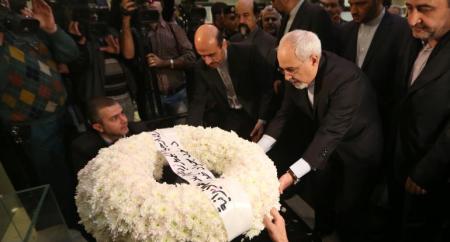
zarifwreathIranian Foreign Minister Mohammad Javad Zarif lays a wreath on the grave of Imad Mughniyeh, a top Hezbollah commander, in the southern suburb of Beirut, Lebanon, Monday, Jan. 13, 2014. (AP Photo/Bilal Hussein)

After eight years of President Obama’s incendiary efforts to couple an expanding American welfare state with a laissez-faire approach to U.S. borders, America is finally launching a real debate over immigration policy. In our democracy, there’s room for everything from the weepy Sen. Chuck Schumer to the defiant President Trump. My hope is that America ends up willing to take as many refugees — and immigrants generally — as possible, subject to genuine regard for American security and preservation of our rambunctious democracy and its Constitution.

What America emphatically does not need, however, is the voice of Tehran’s terror-sponsoring regime insinuating itself anywhere in this immigration debate. Which is exactly what Iran’s foreign minister, Javad Zarif, has been trying to do with his recent comments that Trump’s Jan. 27 executive order on immigration is “a great gift to extremists.” Calling Trump’s order a “Muslim ban” (which it is not), Zarif has accused the Trump administration of intruding into the friendship between the American and Iranian people, and aiding “terrorist recruitment” by “deepening fault lines exploited by extremist demagogues to swell their ranks.”

Zarif’s statements (in which Zarif himself was de facto doing plenty to encourage terrorists and deepen fault lines) were put out on Twitter, replayed via Iran’s Islamic Republic News Agency (IRNA), and amplified by Al Jazeera, under the headline “Zarif: Trump’s Muslim ban ‘great gift to extremists'” — along with Al Jazeera’s report that some 45% of the would-be travelers to America affected by Trump’s order are from Iran, and that “more than a million Iranians live in the United States.”

In case it sounds touching that Zarif should be so concerned about the well-being of America, let’s be clear on what’s really going on here. Zarif, while presenting himself as an enemy of “extremists,” is a prominent official voice of an Iranian regime that has ranked for years as the Middle East’s biggest Old Boys’ Club of “extremism.” The Tehran government Zarif represents is the world’s leading state sponsor of terrorism. He speaks for a regime which since Iran’s 1979 Islamic revolution has as a matter of messianic government policy recruited, trained and funded legions of terrorists — a poisonous influence emanating from the Middle East, a self-declared existential threat to Israel, and home to officially blessed chants of “Death to America.”

According to the State Department’s most recent report on State Sponsors of Terrorism, covering 2015, “Iran continued its terrorist related activity… including support for Hizballah, Palestinian terrorist groups in Gaza, and various groups in Iraq and throughout the Middle East.” State noted that Iran views the terror-sponsoring Assad regime in Syria as “a crucial ally”; that Tehran-backed Shia terrorist groups have “exacerbated sectarian tensions in Iraq and have committed serious human rights abuses”; and that “Iran has also provided weapons, funding and training to Shia militants in Bahrain,” including such gee-gaws as “a bomb-making facility” which, when discovered by the Bahraini government, was housing 1.5 tons of high-grade explosives.

As for Zarif’s charges that the Trump administration is imperiling the friendship between the people of Iran and the people of America, let’s recall that Iran’s Islamic Republic, from the year of its inception right up to the present, has made a practice of seizing and holding Americans as de facto hostages — including the prisoners whose release in Jan. 2016 came coincident with (or, as it now appears, no coincidence?) President Obama’s secret hustling of $1.7 billion in cash to Iran’s terror-sponsoring government. Nor does it help the cause of friendship that Iran — despite its official promise to abjure a nuclear weapons program — continues, as it did just last week, to test ballistic missiles (for which the only realistic use is delivering nuclear weapons).

It is the Tehran regime itself that is the prime cause of misery for people who would like to travel from Iran to America, or vice versa. If Zarif’s real concern is to fight terrorism and encourage the free flow of people between Iran and America, what he really ought to do is resign his post and call for an end to the repressive and terror-sponsoring Tehran government that he himself, under Supreme Leader Ali Khamenei, has for decades so zealously served. That would be the right and decent move; an honest and genuinely useful contribution to world affairs.

Not that Zarif is even remotely likely to do any such thing. But unless he takes the highly improbable course of placing blame where it belongs — on his own government — his indignant opinions about U.S. immigration policy are of less than zero value. They are of a piece with those Iran visas extended to the series of American citizens who took the bait and ended up in Iran’s prisons, held as chits for Tehran’s political extortion rackets. Such are the contributions of Iran’s regime to the cause of international friendships and open exchange of people. Please spare us.

The Lessons of Roosevelt’s Failures

February 1, 2017

The Lessons of Roosevelt’s Failures, Front Page MagazineCaroline Glick, February 1, 2017

djt1

Is US President Donald Trump the new Franklin Delano Roosevelt? Does his immigration policy mimic Roosevelt’s by adopting a callous, bigoted position on would-be asylum seekers from the Muslim world? At a press conference on June 5, 1940, Roosevelt gave an unspeakably cynical justification for his administration’s refusal to permit the desperate Jews of Nazi Germany to enter the US.

In Roosevelt’s words, “Among the refugees [from Germany], there are some spies… And not all of them are voluntary spies – it is rather a horrible story but in some of the other countries that refugees out of Germany have gone to, especially Jewish refugees, they found a number of definitely proven spies.”

The current media and left-wing uproar over the executive order US President Donald Trump signed on Saturday which enacts a temporary ban on entry to the US of nationals from seven Muslim majority countries is extraordinary on many levels. But one that stands out is the fact that opponents of Trump’s move insist that Trump is reenacting the bigoted immigration policies the US maintained throughout the Holocaust.

The first thing that is important to understand about Trump’s order is that it did not come out of nowhere. It is based on the policies of his predecessor Barack Obama. Trump’s move is an attempt to correct the strategic and moral deficiencies of Obama’s policies – deficiencies that empower bigots and fascists while disenfranchising and imperiling their victims.

Trump’s order is based on the 2015 Terrorist Travel Prevention Act. As White House spokesman Sean Spicer noted in an interview with ABC News’ Martha Raddatz Sunday, the seven states targeted by Trump’s temporary ban – Syria, Iraq, Sudan, Iran, Libya, Yemen and Somalia – were not chosen by Trump.

They were identified as uniquely problematic and in need of specific, harsher vetting policies for refugee applications by former US president Barack Obama.

In Iraq, Syria, Libya and Yemen, the recognized governments lack control over large swaths of territory.

As a consequence, they are unable to conclude immigration vetting protocols with the US. As others have noted, unlike these governments, Turkish, Saudi Arabian and Egyptian officials have concluded and implement severe and detailed visa vetting protocols with US immigration officials.

Immigrants from Somalia have carried out terrorist attacks in the US. Clearly there is a problem with vetting procedures in relation to that jihad-plagued failed state.

Finally, the regimes in Sudan and Iran are state sponsors of terrorism. As such, the regimes clearly cannot be trusted to properly report the status of visa applicants.

In other words, the one thing that the seven states have in common is that the US has no official counterpart in any of them as it seeks to vet nationals from those states seeking to enter its territory. So the US must adopt specific, unilateral vetting policies for each of them.

Now that we know the reason the Obama administration concluded that visa applicants from these seven states require specific vetting, we arrive at the question of whether Trump’s order will improve the outcome of that vetting from both a strategic and moral perspective.

The new executive order requires the relevant federal agencies and departments to review the current immigration practices in order to ensure two things.

First, that immigrants from these and other states are not enemies of the US. And second, to ensure that those that do enter the US are people who need protection.

Trump’s order requires the secretary of state and the secretary of homeland security to ensure that the new vetting processes “prioritize refugee claims made by individuals on the basis of religious-based persecution, provided that the religion of the individual is a minority in the individual’s country of nationality.”

Under the Obama administration, the opposite occurred. Christians and Yazidis in Syria for instance, have been targeted specifically for annihilation by Islamic State and related groups. And yet, they have made up a tiny minority of visa recipients. According to Christian News Service, during 2016, the number of refugees from Syria to the US increased by 675%. But among the 13,210 Syrian refugees admitted to the US, only 77, or 0.5% were Christians and only 24, or 0.18%, were Yazidis.

Similar percentages held in previous years.

On the second issue, of blocking potential terrorists from entering the US, Trump’s order calls for measures to be taken to ensure that those who ascribe to creeds that would endanger the lives of US citizens are barred from entering.

Specifically, the order states, “The United States cannot, and should not, admit those who do not support the Constitution, or those who would place violent ideologies over American law. In addition, the United States should not admit those who engage in acts of bigotry or hatred (including ‘honor’ killings, other forms of violence against women, or the persecution of those who practice religions different from their own) or those who would oppress Americans of any race, gender, or sexual orientation.”

Whether or not the Obama administration’s failure to give top priority to Christian and Yazidi refugees being targeted for genocide, enslavement and rape was driven by political considerations, the fact is that the current US refugee system makes it all but impossible for US officials to give priority to vulnerable minorities.

As Nina Shea, director of the Hudson Institute’s Center for Religious Freedom pointed out in an article in National Review in November 2015, the US has relied on the UN High Commissioner on Refugees to vet potential immigrants from these countries. The UNHCR accepts applications for resettlement primarily from people who reside in its refugee camps. Members of the Christian and Yazidi avoid UN camps because UN officials do not protect them.

As Shea noted, human rights groups and media reports have shown that at UN camps, “ISIS, militias and gangs traffic in women and threaten men who refuse to swear allegiance to the caliphate.”

The situation repeats itself in European refugee centers. Shea noted that in Germany, for instance, due to Muslim persecution of non-Muslim refugees at refugee centers, “the German police union recommended separate shelters for Christian and Muslim groups.”

The UNHCR itself has not been an innocent bystander in all of this. To the contrary. It appears that the institution colludes with jihadists to keep persecuted Christians and other minorities out of the UN refugee system, thus dooming them to remain in areas were they are subjected to forms of persecution unseen since the Holocaust.

Questioned by Shea, the UN High Commissioner for Refugees António Guterres said that he opposes the resettlement of persecuted Christians from Syria. Despite the fact that in 2011 Pope Francis acknowledged that Syrian Christians were being targeted for genocide, Guterres told Shea that he doesn’t want Christians to leave Syria, because they are part of the “DNA of the Middle East.” He added that Lebanon’s former president asked him not to resettle the Christians.

Invoking the Holocaust, in recent days US Jews have been among the most outspoken critics of Trump’s executive order. Speaking to Britain’s Independent, for instance, Mark Hetfield, the executive director of HIAS, the Hebrew Immigrant Aid Society, slammed Trump’s executive order as the “lowest point we’ve seen since the 1920s.”

Forward editor Jane Eisner wrote that Trump’s move is immoral and un-American and that all Jewish organizations are morally required to stand up to his “anti-Muslim” policies.

Writing at Vox.com, Dara Lind drew a direct connection between Trump’s executive order and the Roosevelt administration’s refusal to permit the Jews of Europe to flee to the US to escape annihilation in the Holocaust.

This then brings us back to Roosevelt’s immoral policies toward the Jews of Europe and to the question of who has learned the lessons of his bigotry.

The American Jewish uproar at Trump’s actions shows first and foremost the cynicism of the leftist Jewish leadership.

It isn’t simply that left-wing activists like Hetfield and Eisner cynically ignore that Trump’s order is based on Obama’s policies, which they didn’t oppose.

It is that in their expressed concerned for would-be Muslim refugees to the US they refuse to recognize that the plight of Muslims as Muslims in places like Syria and Iraq is not the same as the plight of Christians and Yazidis as Christians and Yazidis in these lands.

The “Jews” in the present circumstances are not the Muslims, who are nowhere targeted for genocide.

The “Jews” in the present circumstances are the Christians and Yazidis and other religious minorities, whom Trump’s impassioned Jewish opponents and Obama’s impassioned Jewish champions fail to defend.

Trump’s executive order is far from perfect. But in making the distinction between the hunters and the hunted and siding with the latter against the former, Trump is showing that he is not a bigot.

Unlike his critics, he has learned the lessons of Roosevelt’s moral failure and is working to ensure that the US acts differently today.

On Boycotting Radical Islamic Nations

January 31, 2017

On Boycotting Radical Islamic Nations, Gatestone InstitueNonie Darwish, January 31, 2017

The interviewer seemed shocked to hear that I do not have any Arab or Muslim friends who are protesting President Trump’s ban, and that many immigrants of Islamic origin support the ban and are fed up and embarrassed by what jihadists are doing.

The lesson America needs to know is that the West is not doing Muslims a favor by constantly treating them as children who should be shielded from reality. They hungry for the truth: that their educational system and mosque preaching are full of incitement, are abhorrent, hate-filled and the foundation upon which violent jihad is built.

Muslims need to know that the world does indeed have a justifiable and legitimate concern about Islam and actions done in the name of Islam by Muslims.

Muslims need to look at themselves in the mirror and see the world from the point of view of their victims. Instead, the West is sacrificing its culture, values, laws, pride and even self-respect.

It might compassion that leads the West to take in millions of Muslim refugees but it is reckless compassion. Do Westerners question the motivation of Islamic theocracies as to why ultra-rich Arab nations are sending us their refugees but taking in none?

Some “tough love” is urgently needed if Muslims are to be motivated to change and reform.

Early this morning an Arabic radio station in the Middle East called asking my opinion about President Trump’s ban on refugees and citizens of seven Muslim nations. The radio host, who sounded angry over the ban, was a Christian Arab. She was surprised to hear that I supported the ban and think that it should have taken place the day after 9/11.

She then asked me if I knew any Arab American activist who was against the ban because she wanted to interview someone against the ban. She seemed shocked to hear that I do not have any Arab or Muslim friends who are protesting the ban, and that many immigrants of Islamic and Middle East origin support the ban and are fed up and embarrassed by what jihadists are doing.

She said that all she sees on CNN and other channels are riots that portray almost all Americans supporting Muslims and against Trump. I am upset over the success of the leftist propaganda all over the Middle East. It brings back memories of the life of the hate indoctrination and misinformation I lived under for most of my life.

What would Muslim countries do to the West, I asked, if 19 American terrorists flew airplanes into Arab capitals and their government and military headquarters? What did she think Arabs would do if every week or so American terrorists would conduct synchronized killing sprees all over the Muslim world, gunning Muslims down, blowing them up with homemade pressure cookers, ramming into crowds with trucks? There was silence.

She then started calming down and said that of course she is against terrorism, “but”. I asked: “Do you see what jihad did to your Christian community in the Middle East?” She was silent for a minute, then it occurred to me that she might be afraid to continue the conversation because her bosses were probably Muslims.

I was sure she was going to hang up on me, but to my surprise she asked me to please hold. Then she was back, live from the studio, and started interviewing me and asked the same questions on air. I poured my heart out in Arabic to the Arab listeners.

The lesson here is that Arabs are hungry to hear the truth; this Arab station, instead of rejecting these ideas, ended up putting them on air. The lesson America needs to learn is that the West is not doing Muslims (especially the reformists) a favor by constantly treating them as children who should be shielded from reality.

Muslims need to know that the world does indeed have a justifiable and legitimate concern about Islam and actions done in the name of Islam by Muslims. Muslims need to look at themselves in the mirror and see the world from the point of view of their victims. Instead, the West is sacrificing its culture, values, laws, pride and even self-respect. Muslim culture needs a wake-up call telling them that, sooner or later, non-Muslim nations will close their doors to any kind of Muslim immigration if the jihad culture continues. That will also be a strong message to Muslims already in the West who still believe in jihad.

2256President Donald Trump signs an executive order restricting immigration, January 27, 2017. (Image source: Reuters video screenshot)

The Muslim people are hungry for the truth: that their educational system and mosque preaching are full of incitement, abhorrent, hate-filled and the foundation upon which violent jihad is built. The Islamic commandment to do jihad sacrifices Muslim men, women and children to kill and get killed.

As long as the West continues its appeasement of Islamic jihad, Islam will never reform and the West will lose. So far, the West has continued to extend a lifeline to the religion of Islam; a religion for which the number one enemy is the truth, and which struggles to suppress the truth.

It might be compassion that leads the West to take in millions of Muslim refugees, but it is reckless compassion. Why isn’t Saudi Arabia taking refugees temporarily until things settle down in Syria and Iraq? Do Westerners question the motivation of Islamic theocracies, as to why ultra-rich Arab nations are sending us their refugees but taking in none?

Who is really benefiting from the policy of appeasement, the acceptance of Sharia-stricken theocracies and their jihadist, hate-filled education? Some “tough love” is urgently needed if Muslims are to be motivated to change and reform.

Is The Trump Executive Order on Refugees Unlawful?

January 31, 2017

Is The Trump Executive Order on Refugees Unlawful?, Jonathan Turley’s Blog, Jonathan Turley, January 31, 2017

djt

If the 1965 law means what the ACLU has suggested, actions by presidents from Carter to Obama would be facially unconstitutional.  Presidents have routinely identified countries as raising threats requiring special procedures.  President Obama was among them.  There is no requirement that this can only be done in response to an attack or specific threat if the president finds a national security danger.  Courts are loathe to substitute their judgment on such questions for a president.

*********************************

I previously discussed how President Donald Trump has the advantage in a constitutional challenge of this executive order suspending entry for refugees and imposing special limitations on seven stated countries.  As I have noted, this does not mean that there are not legitimate questions raised, particularly over the express preference to be given “religious minorities” under the order. However, the case laws heavily supports a president’s plenary power over such border controls.  There remains however a question over whether the law could be constitutional under a president’s inherent authority but still unlawful under statutory authority.  Most of that argument centers on the Immigration and Nationality Act of 1965, which bars discrimination based on nationality or place of origin.  There are clearly compelling arguments on both sides of this question, but once again I believe that critics may be overstating the 1965 law as making the executive order facially invalid.  As I have repeatedly stated since this executive order was signed, I believe it was a terrible mistake, poorly executed, and inimical to our values as a nation.  However, legal analysis by a court should not be influenced by such personal viewpoints.  The question is solely whether the president is barred statutorily from taking this action.

The federal law relevant to this question stands in oppose tension between provisions that grant sweeping authority to a president while at the same time limiting that authority with regard to certain types of discrimination.  As we previously discussed, the 1952 immigration laws states in Section 1182(f): “Whenever the President finds that the entry of any aliens or of any class of aliens into the United States would be detrimental to the interests of the United States, he may by proclamation, and for such period as he shall deem necessary, suspend the entry of all aliens or any class of aliens as immigrants or nonimmigrants, or impose on the entry of aliens any restrictions he may deem to be appropriate”   That is obviously quite sweeping and supporting of the actions taken under this executive order.

However, in 1965 the Congress enacted the Immigration and Nationality Act of 1965. That laws was designed to end the quota system given numerical preference to certain European countries.  The  operative provision states “no person could be “discriminated against in the issuance of an immigrant visa because of the person’s race, sex, nationality, place of birth or place of residence.”  Congress exempted Cuban refugees but otherwise stated that no discrimination based on national or place of residence would be tolerated.

It is important to recognize what the 1965 law does not do. First, it does not apply to refugees and thus would not impact much of this order.  This deals with immigrants securing visas.  Second, the law does not ban discrimination based on religion.  Third, the law governs visas not later requirements of reporting or other conditions once immigrants are granted entry. Thus, President Carter signed out Iranian for special procedures and deported thousands of them.  Finally, and most importantly, the law was itself amended in 1996.  Congress expressly stated that “procedures” and “locations” for processing immigration applications cannot count as discrimination.  Thus, the Administration could argue that “vetting procedures” are exempted even for non-refugees.

With the exemption of green card holders, the foot print for analysis under the 1965 language has been reduced further by the Administration.  Notably, the Office of Legal Counsel reviewed these laws and signed off on the legality of the executive order.  I expect it was due to these exemptions and the amendment.

That does not mean that there is not a compelling argument to make but it is not as facially clear as has been suggested.  Like the OLC, I would still give the advantage to the Administration.  However, this is clearly the best foundation for challenge.

Of course, that leaves a potential conflict between the statute and inherent president authority in a rehash of past cases like U.S. v. Curtiss-Wright.  In that opinion, the Court held:

It is important to bear in mind that we are here dealing not alone with an authority vested in the President by an exertion of legislative power, but with such an authority plus the very delicate, plenary and exclusive power of the President as the sole organ of the federal government in the field of international relations–a power which does not require as a basis for its exercise an act of Congress, but which, of course, like every other governmental power, must be exercised in subordination to the applicable provisions of the Constitution.

Presented with such a conflict, the provision could be narrowly construed.  Courts have long adopted interpretations that would avoid such conflicts.  If there is a narrow interpretation of the 1965 law that would avoid the conflict, it traditionally has been favored by federal courts.

The challenge to the order is also burdened by history.  If the 1965 law means what the ACLU has suggested, actions by presidents from Carter to Obama would be facially unconstitutional.  Presidents have routinely identified countries as raising threats requiring special procedures.  President Obama was among them.  There is no requirement that this can only be done in response to an attack or specific threat if the president finds a national security danger.  Courts are loathe to substitute their judgment on such questions for a president.

So where does all of that leave us?  It leaves us with a good-faith challenge to an executive order, but a challenge that will have to clear away a host of existing cases to prevail.  Could it happen?  Sure, but it is important not to overstate the authority in the area or allow passions to overcome analysis.  At most the 1965 law would be relevant to part of the order and even for that portion (on the seven identified countries) the Administration has strong arguments on the basis of inherent plenary authority and statutory exemptions.


Separating fact from sickening media fiction on Trump’s immigration executive order

January 29, 2017

Separating fact from sickening media fiction on Trump’s immigration executive order, Conservative Review,  Daniel Horowitz, Chris Pandolfo, January 29, 2017

myths-vs-facts-chalkboard

“Any alien coming to this country must or ought to know, that this being an independent nation, it has all the rights concerning the removal of aliens which belong by the law of nations to any other; that while he remains in the country in the character of an alien, he can claim no other privilege than such as an alien is entitled to, and consequently, whatever risque he may incur in that capacity is incurred voluntarily, with the hope that in due time by his unexceptionable conduct, he may become a citizen of the United States.” ~Justice James Iredell, 1799

There is a lot of confusion swirling around the events that transpired this weekend as a result of Trump’s executive order on immigration. Make no mistake: every word of Trump’s executive order is in accordance with statute.

It’s important not to conflate political arguments with legal arguments, as many liberals and far too many “conservatives” on social media are doing.  While the timing and coordination of implementing this order might have been poorly planned, we shouldn’t allow that to undermine the broader need to defend our sovereignty.  For courts to violate years’ worth of precedent and steal our sovereignty should concern everyone.

What the order actually does

Among other things, the key provisions at the center of the existing controversy are as follows:

It shuts off the issuance of all new immigrant and non-immigrant visas for 30 days from the following seven volatile countries: Syria, Iraq, Iran, Libya, Somalia, Sudan, and Yemen. Any non-citizen from those seven countries (not “all” Muslim countries) is excluded from entering the country during this time-period (which usually means they won’t be able to board a direct flight to America).  After 90 days, the secretary of state and secretary of homeland security must submit a report to completely revamp the vetting process going forward.

Within 60 days, countries will have to submit any information that the administration determines necessary, pursuant to the findings of this report, in order to adjudicate a visa application and ensure they are properly vetted. Any country that fails to submit this information will not be able to send foreign nationals to our country. All the while, the ban can be extended and expanded at any time.

In addition, the entire refugee resettlement program is suspended for four months pending a complete investigation of the program and a plan to restructure it and prioritize those who are truly in danger of religious persecution. After 120 days, the program may resume, but only for those countries Secretaries Kelly and Tillerson determine do not pose a threat. The program from Syria is completely suspended until the president personally gives the green light.

[T]his was actually a judicious and cautious approach from Trump.

With regards to refugees and those who seek to enter from the seven countries temporarily excluded, the order gave discretion to the State Department and DHS to admit individuals on a case-by-case basis for important reasons, even during the temporary moratorium.

Statement of principles on the right of a country to exclude non-citizens

Those who want to immigrate: There is no affirmative right, constitutional or otherwise, to visit or settle in the United States. Period.

Based on the social contract, social compact, sovereignty, long-standing law of nation-states, governance by the consent of the governed, the plenary power of Congress over immigration, and 200 years of case law, our political branches of government have the power to exclude or invite any individual or classes people for any reason on a temporary or even permanent basis – without any involvement from the courts.[1] Congress has already delegated its authority to the president to shut off any form of immigration at will at any time.

Immigrants already here: Those already admitted to this country with the consent of the citizenry have unalienable rights. They cannot be indefinitely detained. However, they can be deported for any reason if they are not citizens. In Fong Yue Ting v. United States (1893), which is still settled law, the court ruled that Congress has the same plenary power to deport aliens for any reason as it does to exclude them and that the statutory procedures and conditions for doing so are due process.[2] Congress has established the process for deportation of those already here.  However, as long as a legal permanent resident leaves the country he has no affirmative right to re-enter.[3] Either way, they have absolutely no right to judicial review other than to ensure that statutes are properly followed.

But can Trump prevent those with green cards from re-entering the country?

The statute is clear as day. The Immigration and Nationality Act (§ 212(f)) gives the president plenary power to “by proclamation, and for such period as he shall deem necessary, suspend the entry of all aliens or any class of aliens as immigrants or nonimmigrants.” Clearly, the president has the authority to block any non-citizen – including refugees, green card holders, and foreign students – from entering the country.  Also, for purposes of deportation, there is no difference between a green card holder or a holder of a non-immigrant visa.  No foreign national who has not yet obtained citizenship has an affirmative right to re-enter the country.

Is this a ban on Muslim immigration?

No, it’s a moratorium on immigration or re-entries from seven individual countries and a temporary moratorium on refugees from all countries, subject to case-by-case exceptions.

Why didn’t Trump place restrictions on immigration/visas from Saudi Arabia and other Muslim countries?

That’s probably a good idea.  But this was actually a judicious and cautious approach from Trump to start with low-hanging fruit.  These seven countries are failed states or enemies of the U.S. (in the case of Iran).  As such, there is absolutely no way to share data with the host countries and properly vet them.  Somalia has been one of the biggest trouble spots.  The other countries are marred in Islamic civil wars.  Moreover, these are the countries that existing law targets for travel restrictions, and that Obama’s own DHS listed last year.

Why would Trump include green card holders in the ban on re-entry?

Both liberals and conservatives expressed concern over hundreds of individuals going over to fight for ISIS.  We are already limited in how we can combat this growing threat among U.S. citizens.  Given that it is completely legal to exclude non-citizens upon re-entry, Trump extended the ban to legal permanent residents as well.

If a Somali refugee is travelling back to Somalia (so much for credible fear of persecution!), government officials should have the ability to prevent that person from coming back when necessary. Obviously, there are some individuals from these seven countries who already have green cards and we might not want to exclude. That is why the order grants discretion to the State Department to issue case-by-case exemptions for “religious persecution, “or when the person is already in transit and denying admission would cause undue hardship.”  A CBP agent is always stationed at any international airport from which these individuals would board a direct flight to the United States (Paris and Dubai, for example). That individual would not allow anyone covered by this ban onto a U.S.-bound flight unless he grants them a hardship exemption.

Indeed, it appears that green card holders returning yesterday from those seven countries were all granted entry.

What’s with the chaos at the airports and the courts?

Henceforth, CBP agents will not allow individual aliens from those seven countries to board a flight to the U.S. So the chaos will end.

The problem arose from the 100 or so individuals that were already in transit when the order took effect. When they arrived at American airports, they were detained at customs. Standing at this point is not tantamount to being on American soil.[4]  However, a federal judge in New York issued a stay and prevented the feds from sending two individuals back on a flight. Other judges have prevented officials from even detaining such persons. It’s unclear if federal agents might have made a mistake and released some of these individuals before ordering them to leave the country. Once they are released onto American soil, any effort to remove them is treated as a deportation, not an exclusion, and is subject to the due process afforded them by congressional statutes (not the Constitution).

Thus, it’s unclear if the stay even applied to any element of the order or whether it applied to anomalous circumstances or particular actions taken by federal officials that overstepped the order.

It’s also confusing because many contemporary judges have no respect for our sovereignty and have been gradually chipping away at the plenary power of Congress (or the president, pursuant to statute) to exclude aliens re-entering the country, despite years of settled law. If courts are indeed violating our sovereignty, this is the very grave danger I warned about in Stolen Sovereignty.  Either way, it should not affect the ability of the administration to enforce the order against those who want to prospectively board flights to return.

President Trump’s Immigration Ban is Magnificently Right

January 29, 2017

President Trump’s Immigration Ban is Magnificently Right, PJ MediaDavid P. Goldman, January 28, 2017

terroristpic

The first duty of the U.S. government is to show kindness to prospective American victims of terrorism. And it’s great to have a president with the guts to do something about it.

************************

President Trump kicked over a hornet’s nest by imposing a 90-day ban on immigration from selected Muslim countries in keeping with his campaign pledges. Andrew McCarthy, the federal prosecutor who convicted the blind sheikh and his accomplices of the first World Trade Center bombing, explains why the ban is legal–despite a federal judge’s restraining order against implementation of the order. I’ll leave it to the legal experts to explain why this is yet another outrageous abuse of power by the judiciary.

The legal issues will be sorted out soon enough. It’s the right policy, despite liberal whining and some conservative complaints.

The liberals claim that the immigration halt will convince Muslims that the U.S. administration isn’t fighting ISIS and other terrorists, but Muslims as a religious group. Some conservatives, e.g. Walter Russell Mead, call it “callous.” The latter characterization is misleading. It is callous towards individual Muslims but merciful to American citizens, who have the right to go about their business without fear of mass terrorist attacks. In Europe, the elites accept a certain level of terrorism as the cost of doing business, and the people grudgingly accept it. Americans don’t see why they should sacrifice their safety or sense of security to accommodate the hurt feelings of other people. Prof. Mead compares this to America’s refusal to accept Jewish immigrants during the Holocaust. I respect Mead, but I find the comparison offensive: How many Jewish refugees from Hitler murdered civilians at random (the answer is, not one)?

As for the argument that the measure will alienate Muslims, precisely the opposite is true. Many Muslim governments, institutions, and individuals do not actively support terrorism, but tolerate it. Active terrorists are a small minority, but they swim in a sea of broader Muslim opinion that sympathizes with terrorists like Hamas in Gaza or Hezbollah in Lebanon.

hamas

The last time the Pew Institute surveyed Muslim opinion about Hezbollah and Hamas (in 2010), it found majorities or very large minorities in support of these terrorists in most of the largest Muslim countries. In the United States, the Council on American-Islamic Relations (CAIR)–founded by the pro-Hamas Islamic Association for Palestine–routinely denounces acts of terror on American soil, but has never once criticized Hamas terrorism in the Middle East.

The Obama administration and the Bush administration hoped to persuade Islamist extremists like the Muslim Brotherhood (of which Hamas is the Palestinian branch) to change their spots and turn peaceful. That didn’t work.

The alternative is to serve notice on Muslim governments: If they don’t crack down on terrorists and their supporters, we won’t let their citizens into the United States until we find ways to vet entrants ourselves.

The terrorists have been winning the intelligence war because a very large number of Muslims fear the terrorists more than they do the counterterrorism efforts of the United States and other Western governments. The terrorists infest Muslim communities and operate like a gangland protection racket. It is dangerous to stand up to them. This will change when Muslims fear the U.S. government more than they fear the terrorists.

Is that cruel? Of course. The world is cruel, but its cruelty is not of our making. The first duty of the U.S. government is to show kindness to prospective American victims of terrorism. And it’s great to have a president with the guts to do something about it.

DHS “will continue to enforce all of President Trump’s Executive Orders” on immigration

January 29, 2017

DHS “will continue to enforce all of President Trump’s Executive Orders” on immigration, Jihad Watch

The Department of Homeland Security will comply with judicial orders; faithfully enforce our immigration laws, and implement President Trump’s Executive Orders to ensure that those entering the United States do not pose a threat to our country or the American people.

**********************************

“President Trump’s Executive Order affects a minor portion of international travelers, and is a first step towards reestablishing control over America’s borders and national security.”

Steps to ensure border control and national security shouldn’t be controversial. That the Left is behaving as if they’re the second coming of the Nazi gas chambers shows how hysterical and silly Leftists have become, while their increasingly violent demonstrations show how eager they are to unleash rioting and bloodshed in the streets. I’ve long noted how thuggish the Left was becoming, and that tendency has sharply accelerated since January 20.

trump2-1

“Department Of Homeland Security Response To Recent Litigation,” DHS.gov, January 29, 2017:

WASHINGTON – The Department of Homeland Security will continue to enforce all of President Trump’s Executive Orders in a manner that ensures the safety and security of the American people. President Trump’s Executive Orders remain in place—prohibited travel will remain prohibited, and the U.S. government retains its right to revoke visas at any time if required for national security or public safety. President Trump’s Executive Order affects a minor portion of international travelers, and is a first step towards reestablishing control over America’s borders and national security.

Approximately 80 million international travelers enter the United States every year. Yesterday, less than one percent of the more than 325,000 international air travelers who arrive every day were inconvenienced while enhanced security measures were implemented. These individuals went through enhanced security screenings and are being processed for entry to the United States, consistent with our immigration laws and judicial orders.

The Department of Homeland Security will faithfully execute the immigration laws, and we will treat all of those we encounter humanely and with professionalism. No foreign national in a foreign land, without ties to the United States, has any unfettered right to demand entry into the United States or to demand immigration benefits in the United States.

The Department of Homeland Security will comply with judicial orders; faithfully enforce our immigration laws, and implement President Trump’s Executive Orders to ensure that those entering the United States do not pose a threat to our country or the American people.

Immigration Priorities: Translators, and Victims of Genocide

January 27, 2017

Immigration Priorities: Translators, and Victims of Genocide, Gatestone Institute, Shoshana Bryen, January 27, 2017

Secretary Kerry described his understanding that Christian women were sold as sex slaves, and both women and men were massacred in areas of Syria and Iraq controlled by ISIS. But of the 10,801 refugees accepted in fiscal 2016 from Syria, only 56 (0.5 percent) were Christian.

********************

Prioritize two groups from the Middle East: those who have worked for the U.S. military as translators (and their families); and Middle East Christians who, according to then-Secretary of State Kerry, were being subjected to genocide in Syria and Iraq.

In 2008, Congress authorized 20,000 special visas for Iraqis who served the U.S. for a year or more; and in 2009, authorized 7,500 visas over seven years for Afghan translators. The idea was to get allies who had risked their lives for American troops out as quickly as possible, but thousands have waited for years.

Iraq and Afghanistan are countries in which being tagged as helpful to the U.S. military can be, and has been, a death sentence. And worse, in July 2016, an extension of the visa program failed to make it out of the Senate.

Of the 10,801 refugees accepted in fiscal 2016 from Syria, only 56 (0.5 percent) were Christian.

Making a concerted effort to bring those two desperately threatened groups to the United States would meet our commitment to the translators, give concrete expression to our revulsion at genocide, protect the interests of the American people, and ensure that America remains hospitable to immigrants and refugees.

If you want security clearances in the United States, the government “vets” you quite thoroughly. They begin by asking you questions and then ask for a list of people to interview — family, friends, employers, etc. They take your list and ask those people for more people who will talk about you, then take that list and ask those people for more people who will talk about you — and so on until the lists have the right number and combination of names that overlap. If you have a vindictive ex-wife, watch out. They do a credit check, a criminal background check, a motor vehicle records check, and a medical records check. Psychiatrist? That too.

When discussing visas for people coming to the U.S. from countries with terrorism issues, it is useful to know what it means to “vet” and why there is no possibility of vetting (or “extreme vetting,” whatever that means) refugees and potential immigrants who have no links to their former lives. Vetting — whether for security clearances or visas — is all about your life to this point.

President Trump’s executive order halting immigration from seven countries for 30 days — for a start — is a reasonable response to the increasing understanding that people from certain countries can pose more of a security risk than people from other countries, even when all the countries are Muslim-majority. The seven are Iraq, Iran, Syria, Yemen, Sudan, Libya and Somalia; the U.S. government, under previous presidents, had cited all for terror links. Countries such as Kuwait, Egypt, Jordan, Indonesia, Oman and Tunisia and other Muslim-majority countries are not affected.

A “Muslim ban” would be racist, wrong, and a violation of deeply held American principles; but the claim by the Council on American-Islamic Relations (CAIR) that visa restrictions are tantamount to slavery and denying women the right to vote is slanderous, exaggerated, inaccurate and anti-American. Restrictions — and post-fact checks — on people who enter the United States from countries with clear links to terrorism, and to which we cannot turn for record-checks and interviews, are simply something the United States does.

In 1979, the U.S. Embassy in Tehran was occupied by radical Islamists bent on war with the United States. The Carter Administration ordered all Iranians with student visas to report physically to U.S. immigration officials or face possible deportation. Ten months later (Carter’s order had to go through the courts), the New York Times, citing an Immigration and Naturalization Service spokesman, reported that nearly 60,000 students had registered as required, about 430 had been deported, and 5,000 had left voluntarily. In the interim, Carter ordered federal officials to:

“invalidate all visas issued to Iranian citizens for future entry into the United States, effective today. We will not reissue visas, nor will we issue new visas, except for compelling and proven humanitarian reasons or where the national interest of our own country requires. This directive will be interpreted very strictly.”

Iran remains at war with the United States and al Qaeda and ISIS are no less at war simply because they lack a central government.

In 2015, the assistant secretary of state for the Bureau of Consular Affairs told a House hearing that the U.S. government had revoked more than 9,500 visas over terrorism concerns since 2001 (the number is now more than 13,000). The attacks of 9/11 were followed by more attacks and plots against symbols of American military, law, justice, and governance as well as trains, bars, and shopping centers that are symbols of everyday life. Mass-casualty attacks in San Bernardino and Orlando were only the latest catalysts for Americans’ underlying concern that have been growing for years about terrorism and the government’s ability to protect us.

If “vetting” is not possible and American security requirements are real, is there a way to bring together our historic sympathy for refugees and historic welcome of immigrants with our reasonable concerns?

Yes.

Prioritize two groups from the Middle East: those who have worked for the U.S. military as translators (and their families); and Middle East Christians who, according to then-Secretary of State Kerry, were being subjected to genocide in Syria and Iraq.

In 2008, Congress authorized 20,000 special visas for Iraqis who served the U.S. for a year or more; and in 2009, authorized 7,500 visas over seven years for Afghan translators. The idea was to get allies who had risked their lives for American troops out as quickly as possible, but thousands have waited for years. Iraq and Afghanistan veteran Spencer Case wrote early in 2016:

“State Department numbers show that an Iraqi applying for a special visa could expect to wait for 292 business days before hearing back — and hearing back may just be another delay or a denial. In Afghanistan, the average wait time is 417 business days.”

Iraq and Afghanistan are countries in which being tagged as helpful to the United States military can be, and has been, a death sentence. And worse, in July 2016, an extension of the visa program failed to make it out of the Senate.

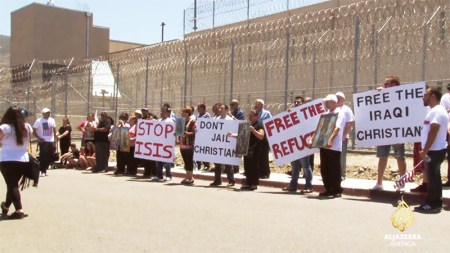
Secretary Kerry described his understanding that Christian women were sold as sex slaves, and both women and men were massacred in areas of Syria and Iraq controlled by ISIS. But of the 10,801 refugees accepted in fiscal 2016 from Syria, only 56 (0.5 percent) were Christian.

1261-1When a few persecuted Iraqi Christians crossed the border into the U.S., they were thrown in prison for several months and then sent back to the countries persecuting them, possibly to be enslaved, raped, or murdered. Pictured above: Members of California’s Iraqi Christian community and their supporters protest the months-long detention of Iraqi Christian asylum-seekers at the Otay Mesa detention center. (Image source Al Jazeera video screenshot)

Making a concerted effort to bring those two desperately threatened groups to the United States would meet our commitment to the translators, give concrete expression to our revulsion at genocide, protect the interests of the American people, and ensure that America remains hospitable to immigrants and refugees.