Posted tagged ‘Recep Tayyip Erdogan’

Geert Wilders: Let’s Dump Turkey

May 11, 2016

Geert Wilders: Let’s Dump Turkey

by Geert Wilders

11 May 2016

Source: Geert Wilders: Let’s Dump Turkey

The greatest threat to the West is Islam.

Look at every country where Islam is dominant and you will see a total lack of freedom and democracy. Islam and freedom are absolutely incompatible. And yet, we are importing it into our western societies, thereby endangering our own freedoms. It is time to stop this foolishness.

Take Turkey, for example. Turkey’s President, Recep Tayyip Erdogan, has never made a secret of his aim to strengthen the powers of Islam. Contrary to what some want us to believe, Turkey does not prove that Islam and democracy are compatible.

For Erdogan, democracy is merely a tool. He once compared it to a tram: “You ride it until you arrive at your destination, then you step off.”

Today, Mr Erdogan is stepping off.

The repercussions are felt not only in Turkey, but also in European countries, such as Germany and the Netherlands, where large Turkish immigrant communities act as the fifth column of intolerance.

Indeed, the Turkish President not only oppresses free speech at home. He has embarked on a crusade to oppress it in Europe as well. And the large groups of Turkish immigrants in Western European countries are his henchmen.

Last month, the Turkish President demanded criminal prosecution of German comedian Jan Böhmermann. The latter had ridiculed Erdogan with a critical poem on German television.

German Turks began to threaten Böhmermann to such degree that he had to request police protection and go into hiding. At the same time, the German authorities started criminal proceedings against the comedian, based on a 19th century German penal law which forbids insulting the representatives of foreign states.

The criminal proceedings were started with the explicit consent of German Chancellor Angela Merkel, who, according to Böhmermann, has “served me for tea to a despot.”

Meanwhile, Erdogan’s appetite is far from over. This week, he demanded a German court to stop Mathias Döpfner, the CEO of the Springer publishing company, from defending the comedian.

Fear of violent Turkish immigrants also forced a hamburger restaurant in Cologne to shut down. Its owner, Jörg Tiemann, had put a burger with goat cheese on the menu, calling it “the Erdogan burger.” Erdogan supporters immediately responded with threats against owner and staff, forcing the restaurant to close its doors.

Then, there is the case of Ebru Umar, a Dutch journalist of Turkish descent. Four weeks ago, she wrote a column criticizing the Turkish Consulate in Rotterdam. Following the Böhmermann incident, the Consulate had called on Dutch Turks to report incidents of “insults” against Erdogan in The Netherlands.

One week later, while on holiday in the Turkish seaside resort Kusadasi, Umar was arrested and only released on condition that she not leave Turkey. On Facebook and Twitter, hundreds of Dutch Turks openly rejoiced in her arrest.

Her home in Amsterdam was broken into and vandalized.When walking the streets of Kusadasi, Umar was threatened on several occasions by Dutch Turks who had gone looking for her. “We will know where to find you when you return to the Netherlands,” they said. “You will get what you deserve.”

Last Tuesday, after three weeks, the Erdogan regime finally allowed Umar to return to the Netherlands.

Many of those threatening people in the West are third or even fourth generation immigrants to our countries. This proves that – barring a few exceptions – the integration and assimilation of Islamic immigrants into our Western society has failed.

Many of the Islamic newcomers are simply incapable of adopting our values. Indeed, they are a danger to these values.

We must protect these values. And one of the first things to do is to sever our links with regimes promoting Islam. These regimes cannot be our friends; they are dangerous.

It is an outrage that Turkey is still a member of NATO. The sooner we get rid of this Trojan Horse within our Western alliance, the better. We should dump Turkey.

Instead of doing this, however, our current Western leaders are welcoming Turkey.

Next June, the European Union wants to allow visa free travel for Turks. For decades, the EU elites have been promoting Turkish EU membership, eagerly backed by President Barack Obama and by Hillary Clinton, who has even said that she is “strongly in favor of it.”

There is little doubt that if Hillary Rodham Clinton becomes the next President of the United States, she will be a cheerleader for Turkey.

Geert Wilders is a member of the Dutch Parliament and leader of the Party for Freedom (PVV), which is currently by far the biggest party in the Dutch polls. He is the author of “Marked for Death: Islam’s War Against the West and Me” (Regnery)

Erdoğan says he does not obey or respect top court ruling on jailed journalists

February 29, 2016

Erdoğan says he does not obey or respect top court ruling on jailed journalists

February 28, 2016, Sunday/ 12:32:10/ İPEK ÜZÜM | ISTANBUL

Source: Erdoğan says he does not obey or respect top court ruling on jailed journalists


Erdoğan says he does not obey or respect top court ruling on jailed journalists

President Recep Tayyip Erdoğan speaks to reporters before departing for an African tour on Feb. 28. (Photo: DHA)

President Recep Tayyip Erdoğan said on Sunday he does not obey or respect the decision by the Constitutional Court declaring that the imprisonment of two prominent journalists for a report on alleged illegal arms transfers to Syria amounted to a violation of their rights.

Cumhuriyet Editor-in-Chief Can Dündar and its Ankara representative Erdem Gül were freed in the early hours of Friday after 92 days in jail following the top court’s ruling. The court said the journalists’ right to freedom and security, the right to express their thoughts and freedom of the press under articles 19, 26 and 28 of the Constitution, respectively, were violated.

“The Constitutional Court may have reached such a verdict. I would only remain silent. I am not in a position to accept it,” Erdoğan told reporters before departing for a visit to African countries. “I do not obey it nor do I respect it.”

Dündar and Gül were arrested on charges of espionage and aiding a terrorist organization in November after the publication of video footage purporting to show the National Intelligence Organization (MİT) helping to send weapons to Syria when they were intercepted in 2014 by gendarmerie forces. The arrest drew international condemnation and revived concern about media freedom in Turkey.

Erdoğan, who had described the interception of the MİT trucks as an act of espionage aimed at undermining Turkey internationally, vowed that Dündar would pay a “heavy price” for reporting on the incident. “I will not let him go [unpunished],” he said back in November.

“The media cannot have unlimited freedom. These reports are an attack on the current president of this country,” Erdoğan said on Sunday. “This has nothing to do with freedom of expression at all. This is an espionage case.”

He also said the İstanbul 14th High Criminal Court, which is overseeing the two journalists’ trial and ruled for their release in line with the decision of the Constitutional Court, could have resisted the top court’s ruling and refused to free them.

“That would have invalidated the Constitutional Court ruling or those who were freed would have appealed to the European Court of Human Rights,” he said.

Despite their release from prison, Dündar and Gül are still facing possible life sentences in a trial, which is due to start on March 25. The indictment against the two journalists seeks an aggravated life sentence, a life sentence and 30 years of imprisonment on separate charges including “obtaining and revealing secret information pertaining to the security of the state for espionage purposes,” “seeking to overthrow the Turkish government” and “aiding an armed terrorist organization.”

Erdoğan’s remarks lead to strong criticisms

Erdoğan’s remarks on the Constitutional Court’s decision about Gül and Dündar attracted strong criticisms from intellectuals, jurists and politicians.

Main opposition Republican People’s Party (CHP) Deputy Chairman Sezgin Tanrıkulu said Erdoğan has to respect and implement both the Constitution and the decisions of constitutional institutions as befitting his current position.

Tanrıkulu said: “A president cannot disregard the Constitution. If he says such a thing, this clearly implies he also does not respect the current constitutional order in the country. He is also encouraging people not to respect the Constitution and the court rulings.”

Bülent Tezcan, the deputy parliamentary group chairman of the CHP, also reacted against Erdoğan’s statement on Twitter on Sunday. He said Erdoğan does not recognize the Constitution, adding, “Now, he [Erdoğan] is calling on the courts to not recognize the laws and the Constitution.”

Constitutional law professor and Peoples’ Democratic Party (HDP) deputy Mithat Sancar said he was not surprised by Erdoğan’s recent statement, underlining Erdoğan has not been respecting constitutional laws since he was elected president in August 2014. “Not only with his statements, he has also violated the Constitution with his acts. One of the most typical violation is engaging in an electoral campaign as though he was the chairman of a political party [ruling Justice and Development Party (AK Party)] before the June 7 election,” Sancar said.

Saying Erdoğan engaged in similar acts that do not comply with the Constitution while he was serving as prime minister before he was elected president, Sancar stated: “Actually, the AK Party has never been at peace with the rule of law. When it feels it is necessary, it puts the laws aside. When it also feels the need, it uses these laws against its opponents in the harshest manner.”

Responding to critics who accuse him of violating his constitutional limits, Erdoğan had said he was elected by the nation and is determined to use his authorities “to the end.”

“You can either accept it or not. Turkey’s government system has been de facto changed in this regard. What should be done now is to finalize the legal framework of this de facto situation with a new Constitution,” Erdoğan said during a speech on Aug. 16, 2015.

‘Erdoğan staged a coup on anniversary of Feb. 28’

CHP deputy Özgür Özel held a press conference in Parliament on Sunday. Reminding that Sunday marks the anniversary of the Feb. 28, 1997 post-modern coup, Özel accused Erdoğan of staging a coup on the anniversary of Feb. 28 coup.

“Erdoğan made a coup against the judiciary on the anniversary of Feb. 28. He attempted to adjust the higher judiciary,” Özel stated.

Nationalist Movement Party (MHP) parliamentary group chairman Oktay Vural said Erdoğan has admitted that Turkey is no longer a state being ruled by law. Speaking at a press conference in Parliament on Sunday, Vural said that Erdoğan also gave an order to the local court during his speech, but Erdoğan had promised to respect the supremacy of law during his presidential oath.

“If you say you don’t respect the court ruling, this means you don’t think of a state as being ruled by law. There is no supremacy of law, but you have the law of superiors in your mind. This one-man, pro-coup mindset is against the rule of law and the supremacy of law. This is a typical example of the Feb. 28 [coup],” Vural maintained.

Contemporary Journalists Association (ÇGD) President Ahmet Abakay said the president is obligated to respect the Constitutional Court. “However, we know that the president does not respect even the Constitution via his practices and statements. This situation does not comply with a democratic country. The state administrators have to respect the laws, Constitution and the judicial bodies and they are binding for them. But now in Turkey, the administrators do not respect the law,” Abakay said.

Pointing to Erdoğan’s remarks that the trial of Dündar and Gül was not a case of freedom of expression but an espionage case, Abakay said this is not true. He added: “This is not an espionage case. For a journalist, whether a report is factual or not is important. Erdoğan has never said the report [of Cumhuriyet daily] was a lie. He even confirmed it by saying, ‘So what if the trucks were filled with weapons?’ Reporting is the duty of those friends [Gül and Dündar] and they just did their job.”

Commenting on Erdoğan’s remarks that the local court should have resisted the ruling of the top court, Abakay also said his statement was actually a clear threat against those judges who gave the decision. “He tells the judges in what way they should give their rulings,” Abakaya added.

Veteran journalist Hasan Cemal also posted a tweet on the issue on Sunday, stating: “I don’t know what to say; you become tongue-tied, when you look at Erdoğan’s reactions against the Constitutional Court’s ruling. I repeat this: Stability is nothing more than a dream in a country with Erdoğan, who is disregarding the law in such level.”

Journalist Özgür Mumcu addressed Erdoğan in a tweet on Sunday, saying: “You are now in your palace because the Constitutional Court, which you say don’t respect, did not decide to shut down your party previously. If people also had not respected that ruling of the court, where would you be now?”

Emin Çapa, CNN Türk’s senior economy editor, also commented on the issue, saying that Erdoğan can say that he does not agree with the ruling, but he holds a position in which he is obligated to respect court rulings and implement those rulings.

The Constitutional Court’s ruling, which Erdoğan is highly critical of, was praised by members of the European Parliament, Council of Europe and diplomats on Friday.

Pointing out that the top court’s ruling reveals its implicit acknowledgment that pre-trial imprisonment is an act of illegal confinement, Rebecca Harms, president of the Greens in the European Parliament, noted that freedom of expression and opinion must not be labeled a criminal offense since pluralism and freedom of speech are basic prerequisites of a viable democracy.

Daniel Höltgen, Council of Europe spokesman, said in a statement on Thursday evening that he was glad to hear of the Constitutional Court’s decision to release the two journalists. “I trust that the Constitutional Court will continue to assert itself for the sake of freedom of expression in Turkey, relying on the European Convention on Human Rights,” Höltgen said.

Commenting on the Constitutional Court’s decision on her Twitter account on Thursday evening, European Parliament’s Turkey rapporteur Kati Piri also welcomed the ruling and said both Dündar and Gül should be freed soon.

Turkey’s Erdoğan threatened to flood Europe with migrants, leak reveals

February 9, 2016

Turkey’s Erdoğan threatened to flood Europe with migrants, leak reveals

February 08, 2016, Monday/ 17:03:09/ TODAY’S ZAMAN

Source: Turkey’s Erdoğan threatened to flood Europe with migrants, leak reveals

Turkey’s Erdoğan threatened to flood Europe with migrants, leak reveals

European Commission President Jean-Claude Juncker welcomes Turkish President Recep Tayyip Erdoğan (L) at the EU Commission headquarters in Brussels on Oct. 5, 2015. (Photo: Cihan)

President Recep Tayyip Erdoğan threatened to send buses full of refugees to Greece if the EU did not finalize an agreement with Turkey over the action plan to stem the flow of refugees to Europe, according to the leaked transcript of a meeting between Erdoğan and leaders of the EU.

The transcript, published by the Greek-based euro2day.gr online news portal, claims to be the minutes of a meeting of Erdoğan, President of the European Council Donald Tusk and President of the European Commission (EC) Jean-Claude Juncker.

According to the transcript Erdoğan pushes the EU leaders for 3 billion euros per year, for two years, instead of 3 billion euros over two years, which the EU proposed. According to the leak, Turkish Foreign Minister Mevlüt Çavuşoğlu, who was present at the meeting, showed Juncker an internal document belonging to the EC, which stated 3 billion euros per year.

Erdoğan also asks whether the proposal would be for 3 billion or 6 billion euros. When Juncker confirmed 3 billion, Erdoğan said Turkey did not need the EU’s money.

“We [Turkey] can open the doors to Greece and Bulgaria any time, and we can put the refugees on buses,” Erdoğan was quoted as saying.

The meeting was held in Antalya in the run-up to the EU-Turkey summit on Nov. 29, 2015, in which the action plan that envisages Turkey stemming the flow of Syrian refugees to Europe was signed.

In return for keeping the refugees, the EU promised Turkey 3 billion euros, visa-free travel to Europe, the inclusion of Turkish officials in EU summits and a re-invigoration of Turkey’s EU accession process — starting with the opening of the 15th chapter of the negotiation acquis.

All 28 EU countries recently signed off on the proposal to allocate the funds to Turkey at a meeting in Brussels. The funds will be given to Ankara in return for Turkey culling the flow of immigrants to Europe.

In response to Today’s Zaman, the EU Commission declined to comment on the leak.

The transcript states that Erdoğan said the agreement on the action plan is to keep alive the Schengen project, which allows free travel among most EU member states. Many officials, including Tusk, have warned about the impending collapse of the Schengen project if the refugee crisis is not tended to urgently.

In the transcript Juncker replies to Erdoğan stating that if Schengen collapses Turkey can have no visa liberalization deal with the EU and will have to apply for visa exemptions on a bilateral basis.

According to the minutes of the meeting, Tusk told Erdoğan that the EU “really wants a deal” with Turkey, to which Erdoğan replied: “So how will you deal with the refugees if there is no deal? Kill the refugees?”

Also Erdoğan tells the EU leaders that the delaying of the European Commission’s Progress Report did not help the Justice and Development Party (AK Party) to win the Nov. 1 election last year.

“Anyway, the report was an insult. Who prepared it, anyway? How can you come up with this? It’s not the real Turkey. You [EU leaders] never came to me to learn the truth,” Erdoğan said, according to the transcript.

“Again, no chapters have been opened yet, despite our [Turkey] good progress. We [Turkey] used to be at EU summits, but for 11 years you [EU officials] don’t want to be seen with us. And for five years there has been no opening of chapters,” Erdoğan said.

The EC’s report on Turkey, originally set to be published on Oct. 14, 2015, was held back until after the Nov. 1 election. It criticized the AK Party over backtracking on the rule of law, media freedom and judicial independence.

Juncker, however, is quoted as saying that the report was delayed upon Erdoğan’s request. “Why else would we be willing to get criticized for it [delaying the report]?” he was reported to have said.

Erdoğan also says Luxembourg, Juncker’s native country, is the size of a town in Turkey and that Turkey should not be compared with other EU member states due to its size.

The report prompted a member of the European Parliament from the Greek centrist party To Potami to ask the European Commission to confirm the purported talks.

“If the relevant dialogues between the EU officials and the Turkish President are true, it seems that there are aspects of the deal between Ankara and the EU which were concealed on purpose,” Miltos Kyrkos said in the question he submitted to the Commission.

“We want immediately an answer on whether these revelations are true and where the Commission’s legitimacy to negotiate, using Turkey’s accession course as a trump card, is coming from,” Kyrkos said.

Erdoğan to US: Choose either Turkey or the PYD as your partner

February 7, 2016

Erdoğan to US: Choose either Turkey or the PYD as your partner

February 07, 2016, Sunday/ 10:51:35/

Source: Erdoğan to US: Choose either Turkey or the PYD as your partner

Erdoğan to US: Choose either Turkey or the PYD as your partner

President Recep Tayyip Erdoğan. (Photo: Reuters)

In one of his strongest remarks to date, Turkish President Recep Tayyip Erdoğan has lambasted the US after a senior official’s visit last week to the northern Syrian town of Kobani, which is under the control of the Kurdish Democratic Union Party (PYD), and called on Washington to choose either Turkey or “terrorists in Kobani” as a partner.

Erdoğan directed severe criticism at the visit to the town by Brett McGurk, US President Barack Obama’s special envoy for the anti-Islamic State in Iraq and the Levant (ISIL) coalition. The visit came at a time where Geneva peace talks were taking place, and the Turkish president declared that the US should make a choice between the PYD and Turkey.

Erdoğan has called on the US and the European Union to list the major Syrian Kurdish political party and its armed wing as terrorist organizations over their affiliation with the Kurdistan Workers’ Party (PKK), which is fighting against the Turkish state and which is regarded as a terrorist group by Washington and Brussels.

“Do you accept the PKK as a terrorist organization? Then why don’t you list the PYD and [People’s Protection Units] YPG as terrorist organizations, too?” Erdoğan asked while speaking to reporters on Friday on board a plane en route to Turkey from a week-long Latin America tour

This is not the first time Erdoğan has made such a call. His and other senior Turkish leaders’ calls reflect a split between Ankara and its allies over how to treat the Syrian Kurdish party and its armed faction.

The Kurdish militia the YPG has been a reliable ally in the fight against ISIL on the ground and has benefited from the US arms supply on several occasions.

While the US and EU share Turkey’s view toward the PKK and sees it as a terrorist organization, they differ in their views regarding the PYD and YPG.

During his visit, McGurk met with senior PYD and YPG officials and pledged further support for Syrian Kurds. He also visited a cemetery and paid his respects to YPG fighters killed during a months-long battle with ISIL in Kobani.

It was the first time a top US official has visited the YPG-controlled town, reflecting the type of relationship the US and the PYD enjoy. The US airdropped weapons and munitions during the siege of Kobani.

“We discovered advanced Russian, US and European weapons in PKK cells during military operations in southeastern Turkey. Where do these weapons come from?” the Turkish president asked, revealing Turkey’s growing anxiety that some of the weapons provided by the US and EU to the YPG end up in PKK hands.

“The PKK is a terrorist organization and the YPG is too. The PYD is what the PKK is. [US Vice President] Joe Biden came with an official. A national security official [Obama’s envoy]. He visits Kobani at the time of the Geneva talks and is awarded a plaque by a so-called YPG general. How can we trust [you]?” Erdoğan said, expressing his dismay over McGurk’s visit.

McGurk was given a plaque by YPG official Polat Can, a former PKK member. It sparked a harsh reaction from Ankara as Erdoğan called on the US to choose, saying, “Am I your ally or are the ‘terrorists’ in Kobani?”

Erdoğan also repeated his criticism of Russian air strikes in Syria. The Turkish president said on Friday that Russia must be held accountable for the people it has killed in Syria, arguing that Moscow and Damascus were together responsible for 400,000 deaths there.

While speaking at a joint press conference with his Senegalese counterpart during a brief stopover in the West African country on Friday, Erdoğan also dismissed a Russian statement that Turkey was preparing for an incursion in Syria, saying he is “laughing” at the claim.

Ankara has dismissed this as propaganda intended to conceal Russia’s own “crimes.”

Erdoğan said Russia was engaged in an invasion of Syria and accused it of trying to set up a “boutique state” for its longtime ally President Bashar al-Assad.

“Russia must be held accountable for the people it has killed within Syria’s borders,” the Doğan news agency quoted him as saying. “By cooperating with the regime, the number of people they have killed has reached 400,000.”

His comments are likely to further anger Moscow. Relations between Turkey, a NATO member, and Russia hit their worst low in recent memory last November after Turkey shot down a Russian warplane Ankara said had violated Turkish airspace from Syria.

Report: Turkey suspects Russia building air base near border with Syria

January 22, 2016

Report: Turkey suspects Russia building air base near border with Syria

January 22, 2016, Friday/ 14:41:44/ TODAY’S ZAMAN

Source: Report: Turkey suspects Russia building air base near border with Syria

 Report: Turkey suspects Russia building air base near border with Syria

Turkish troops and military vehicles are seen on the Turkish-Syrian border near the Syrian town of Qamishli in this May 2015 file photo. (Photo: DHA)

Turkish authorities reportedly have intelligence suggesting that Russia might be preparing to establish an air base close to Turkey’s border with Syria, a step likely to deepen tensions that flared between the two countries after Turkish warplanes downed a Russian fighter jet in November last year, according to a report.

A Russian delegation led by a lieutenant general flew to the northern Syrian town of Qamishli, right across the border from Nusaybin in southeastern Turkey, on Jan. 16, a news report published in the Hürriyet daily said, quoting unnamed security sources.

Qamishli is being controlled by the Democratic Union Party (PYD), a Syrian Kurdish group that is linked to the Kurdistan Workers’ Party (PKK) terrorist group. Ankara opposes PYD efforts to expand its influence in northern Syria, saying it is a terrorist organization that is no different from the Islamic State in Iraq and the Levant (ISIL).

The Russian delegation conducted extensive inspections in and around the airport in Qamishli, according to the sources. The delegation, which included officials from Russian military intelligence, was accompanied by representatives from the PYD.

Turkish sources suspect that the delegation’s visit is a part of Russian plans to renovate the airport in the town so that it can be turned into a base for warplanes and military cargo planes. This would also entail the installation of radars that would be able to closely monitor Turkish military activities in the area.

After reports that Russia deployed troops to YPG-controlled Qamishli, the Turkish military reinforced the Syrian border with additional tanks and armored vehicles and has started to dig trenches on the border as a security measure.

The Turkish armed forces are now digging trenches on the Turkish side of the border opposite an airport in Qamishli. A large minefield lies between Nusaybin, a Turkish border town in the southeastern province of Mardin, and Qamishli in Syria.

The deployment of Russian troops and military experts to conduct examinations in Kurdish-controlled Qamishli has brought tension between the two countries to a dangerous new level, increasing the prospect of an inadvertent encounter in the area.

These events come after media reports yesterday of an agreement between the US and the YPG for the US to use an airfield in the YPG-controlled part of Hasakah province in northeastern Syria. US military experts are now working to expand the airfield so as to deploy American aerial vehicles, including UAVS, for strikes against ISIL.

The recent developments reveal the complicated nature of geopolitics and the rapidly shifting alignments in Syria’s combustible battlefield, with countless numbers of actors seeking to carve out zones of influence for themselves. Syrian Kurds, who have adopted a non-aligned stance in the Syrian civil war, have cultivated close ties with both the US and Russia to further their own interests, which involve establishing a separate political zone for the Kurdish people.

Speaking in a parliamentary session on Thursday, Deputy Prime Minister Tuğrul Türkeş confirmed Russia’s deployment of a small contingent force in Qamishli. But he played down the nature of the development, saying that a small-scale Russian military presence near the Turkish border is not a significant threat to NATO-member Turkey.

Russia’s foray into Syria’s prolonged war created a new conundrum both for Turkey and the US-led international coalition against the Islamic State in Iraq and the Levant (ISIL).

When a Russian bomber jet violated Turkish airspace after two previous incursions, it prompted Turkish air forces to shoot it down. Subsequently a major dispute broke out between the two nations, triggering a series of sanctions imposed by Moscow on Turkish trade goods.

Following the jet crisis Russia deployed cutting-edge S-400 air defense systems to Syria. This was a move meant to keep Turkish air forces out of Syrian airspace, and one which practically ruled out any Turkish contribution to Western coalition air strikes against ISIL targets in Syria. To avoid another incident, the US urged Turkey to suspend all its flights over Syria.

On Thursday, the US-led coalition carried out new air strikes against ISIL targets in Syria. On the same day, according to Turkish military sources, Russian jets pounded Turkmen positions in western Syria and rural Aleppo, in an intensifying campaign to uproot Western-backed moderate Syrian rebel groups, including Turkmen forces, to the dismay and fury of Turkey and the West.

Russia’s selective targeting of moderate groups has complicated the fight against ISIL, leading to renewed accusations from the West and Turkey, who say Moscow intends to destroy non-ISIL opposition groups rather than fighting the extremist ISIL militants.

Moscow denies charges of watering down its fight against ISIL.

Russian Foreign Ministry Spokesperson Maria Zakharova accused Turkey of sending militants to Syria to join terrorist groups such as the “al-Nusra Front.” She went on to claim that the recent Turkish efforts to build a wall are not intended to boost border security, but rather serve as shelter for terrorists and position from which terrorists can cross the border.

Turkey and Russia frequently engage in tit-for-tat accusations and recriminations over each other’s stance in the Syrian conflict, exacerbating the state of discord among them.


Erdoğan: What would happen if 2.2 mln Syrian refugees walk to Europe

November 16, 2015

Erdoğan: What would happen if 2.2 mln Syrian refugees walk to Europe

November 13, 2015, Friday/ 15:56:45/

TODAY’S ZAMAN WITH REUTERS / ISTANBUL

Source: Erdoğan: What would happen if 2.2 mln Syrian refugees walk to Europe

Erdoğan: What would happen if 2.2 mln Syrian refugees walk to Europe

President Erdoğan speaks during an interview with CNN International on Thursday.

In an interview with CNN International on Thursday, President Recep Tayyip Erdoğan implicitly threatened to increase the migrant flow to the EU while complaining about inadequate cooperation from the bloc as it plans to hold a summit with Turkey to discuss ways to stem the migrant flow.

“What would happen if the 2.2 million Syrian refugees currently in Turkey all march to Europe?” Erdoğan said, criticizing the EU for closing its borders while his country is struggling to cope with the presence of a large number of migrants.

The EU is continuing to struggle with the arrival of migrants and recently held a summit with the leaders of a number of African countries to find a lasting solution to the problem of migrants crossing to Europe from North Africa in often deadly journeys over the Mediterranean. Thousands of people have died in fatal incidents, mostly in boats that sink due to overcrowding, prompting the EU to develop counter measures to deal with human smugglers who exploit the internal turmoil and political instability in Libya for a thriving business of bringing migrants to Europe, often through Italy.

European Union leaders agreed on Thursday to invite Erdoğan to a summit very soon as they seek his help to stem a chaotic flow of migrants that threatens Europe’s unity and open borders. European Council President Donald Tusk, who chaired the emergency meeting of EU leaders in Malta, warned that the EU must win a “race against time” to slow arrivals via Greece if it is to save the Schengen zone of passport-free travel inside the bloc from being sidelined by new national barriers and controls.

At the meeting, which followed a summit on the same topic with African government officials, leaders were briefed on negotiations with Ankara the EU executive launched a month ago and gave the green light to wrapping them up. That could be completed at a summit in Brussels involving Erdoğan and the 28 EU leaders, most likely late this month. Tusk said he was “99 percent sure” it would be at the end of November.

Though many Europeans have qualms about giving too much to Erdoğan when the EU is complaining of increasing human rights abuse in Turkey, his party’s sweeping victory in a recent election has strengthened his hand to make demands on Western neighbors whose fate he largely holds in his hands.

On offer are 3 billion euros ($3.2 billion) to help Syrians in Turkey, a broadening of Turkey’s long-stalled EU membership talks to include economic policy and, critically for many Turks, more visa-free travel to Europe. In return, the EU wants Turkey to improve conditions for Syrian refugees and curb transit by Asians seeking to reach Europe in the hope of better paid work.

EU-Turkey summit

Though Turkish officials play down its importance, European diplomats say organizing a summit-level platform for Erdoğan to meet his EU counterparts has been an important element in talks. They see the president intent on international recognition and respect at a time when his rule faces heavy foreign criticism.

Greek Prime Minister Alexis Tsipras, whose country has been overwhelmed by over 600,000 migrants reaching its islands from Turkey on their way to Germany and northern Europe, said it was clear the EU’s salvation lay with Turkey, a NATO ally and would-be first Muslim member of the European Union.

“It is obvious that the only real chance of stopping these flows,” he said, “is reaching an understanding with Turkey.”

Though details have yet to be finalized, German Chancellor Angela Merkel said there was consensus on the 3 billion euro offer for the next two years to improve conditions for the more than 2 million Syrian refugees in Turkey.

The executive Commission proposed paying 500 million euros from the EU budget and asking member states for the rest. Merkel said that precise budgeting was yet to be done and diplomats said several governments had reservations about contributing. The EU-Turkey summit would, Merkel said, “Demonstrate that we will work very closely with each other and that we sensibly share out the challenges arising from the civil war in Syria”.

Lebanon and Jordan, also hosting large numbers of refugees, would also be considered for more EU assistance, officials said.

Tusk and Commission President Jean-Claude Juncker will meet Erdoğan and Prime Minister Ahmet Davutoğlu on Monday to pursue the negotiations during the G-20 summit in Turkey.

‘Race against time’

EU leaders also urged each other to speed up implementation of measures agreed, some only after bitter disputes, over the past few months as close to a million migrants have arrived.

Tusk, a former Polish premier who has sounded increasingly vocal alarms about the cohesion of the bloc, said tighter control of the external borders was essential. Citing Sweden’s move to re-impose checks on arrivals from other EU countries and new measures in Germany and Slovenia, he said of the bloc’s passport-free travel zone: “Saving Schengen is a race against time. And we are determined to win that race.”

“Without effective border control, the Schengen rules will not survive,” he added. “We must hurry, but without panic.”

Ex-communist eastern states that have been among critics of Merkel’s insistence on welcoming refugees in Germany announced they would provide a large contingent of border guards to meet demands of the EU border agency Frontex.

A lack of response to a call for personnel has been among factors slowing plans to tighten checks on those arriving and to relocate asylum-seekers from Italy and Greece. However, Victor Orban, the outspoken right-wing prime minister of Hungary who was one of those contributing immigration staff, was unrepentant in his view that Europe must crack down on all migration flows.

“Migration is not a win-win situation … but a lose-lose situation,” said Orban, who fenced his borders after tens of thousands of refugees arrived from Greece via the Balkans.

“We should change the language of discussions and not consider migration a positive thing because it is totally against the impression of European citizens,” he said.

Turkish journalist: “Turkey prefers ISIS to the Kurds”

July 27, 2015

Turkish journalist: “Turkey prefers ISIS to the Kurds”

In an exclusive interview with JerusalemOnline, Turkish journalist Uzay Bulut described how the Turkish state systematically persecutes the Kurds while at the same time assisting ISIS and other jihadist terror groups.

Jul 27, 2015, 02:03PM | Rachel Avraham

via Israel News – Turkish journalist: “Turkey prefers ISIS to the Kurds” – JerusalemOnline.

Photo Credit: Faridan Abbas

In an exclusive interview with JerusalemOnline, Turkish journalist Uzay Bulut, who writes for the Gatestone Institute, proclaimed that Turkey prefers the ISIS terror organization to the Kurds: “In a television interview on 28 December, 2012, Recep Tayyip Erdogan said that the government was in negotiations with Abdullah Ocalan, the jailed leader of the PKK, in order to resolve the Kurdish issue.  But at the same time, there are also several reports and witness accounts that Turkey has aided the rise of ISIS, enabling the flow of funds and fighters to support it.”

According to Bulut, the establishment of Turkey as a state was based upon the denial of the Kurds identity: “After the state was founded in 1923, the name of the Kurdish land, Kurdistan, the Kurdish language and everything else related to the Kurdish existence was denied. According to the founding ideology of the state, there were no Kurds or Kurdish language. So Kurdistan within Turkey’s borders became a sub-colony without even borders or a name. Kurds have been exposed to numerous massacres and extrajudicial murders for more than 90 years. As a result of these repressive and assimilationist policies, many Kurds have been assimilated into Turkishness but many others have resisted and still demand their national rights.”

Bulut noted that it has been more than 90 years since the establishment of the Turkish Republic but the Kurds within the country are still struggling for political recognition and the Turkish government wants to stop the spread of this desire for national rights at all costs. “The establishment of the Kurdistan Regional Government of Iraq was a huge step in the liberation of Kurdistan,” Bulut noted. “Now Syrian Kurdistan is on the rise; Kurdish male and female defenders there are struggling for their freedom. So Turkey wants to stop this new development. And ISIS is the name of their new plan that they apply to stop the liberation of Kurdistan and to exterminate the Kurds – as much as possible.”

In order to highlight this, Bulut stressed that on July 20th, there was a bomb attack in the Kurdish town of Suruc that killed 32 people during a meeting to discuss reconstruction efforts in Kobane and Turkish fighter jets recently bombed Qandil where the PKK was operating. She also noted that scores of Kurds have been arrested within Turkey this week: “These developments do not signal a positive change in Turkish state policy towards the Kurds.”

In an another instance, Kurds were persecuted by the Turkish state for taking a stand against ISIS: “Esra Yakar, a 5th-year Kurdish student at the Medical School of Dicle University in Diyarbakir, went to the Kurdish province of Kobani a few months ago as a volunteer doctor to help treat Kurds wounded in the fighting with ISIS terrorists. In December 2014, she suffered heavy wounds to her head and right eye during an attack by ISIS. Her referral to a hospital for advanced examination and treatment in Turkey was delayed. In the meantime, she lost her right eye. And while still under medical treatment, she was arrested and jailed in the Sincan prison in Ankara for being a terrorist.”

However, Bulut noted that ISIS terrorists face no such obstacles for receiving medical treatment in Turkey: “Emrah Cakan, a Turkish-born ISIS commander wounded in Syria, got medical treatment at the university hospital in Turkey’s Denizli province in March. As it is evident from this instance and many others, aiding ISIS terrorists while attacking or not helping Kurds has paved the way for the crimes committed by ISIS and other jihadist armies there.”

While the Kurds are being systematically oppressed within Turkey, Bulut noted that Turkey has not only economic relations with jihadist groups but also political relations with them as well: “For Islamic armies to advance and invade places today, they do need fighters as well as logistics and military support. People who believe in Islamic jihad become the fighters – or murderers and rapists – of ISIS and other Islamist armies. But the logistics and military support is mostly provided by the regional states – including Turkey.”

This support is used in order to oppress the Kurds: “ISIS mostly operates in all parts of Kurdistan, threatening the security of all Kurds in the region and even slaughtering or kidnapping and selling them as they did to the Yazidi Kurds in the Shengal region in August 2014. And this seems to be the only concrete outcome of the so-called resolution process in Turkey. No Kurdish rights have been recognized officially and Kurdish massacres are still happening.”

“Subjugating Kurds has been one of the primary policies of Turkey since 1920s,” Bulut emphasized. “A democratic state would choose to grant political and cultural rights to indigenous Kurds but Turkish supremacism, Kurdish-hatred and anti-Kurdish bigotry is so intense in Turkey that Turkey does not seem to aim to achieve real and sustainable peace with the Kurds. And because of that, the Turkish state seems to prefer even a genocidal group like ISIS to the Kurds.”


Turkey Plans to Invade Syria, But to Stop the Kurds, Not ISIS

June 29, 2015

Turkey Plans to Invade Syria, But to Stop the Kurds, Not ISIS

The Turkish military is not enthusiastic and Washington may have its doubts, but President Erdogan appears determined to set up a buffer zone.

via Turkey Plans to Invade Syria, But to Stop the Kurds, Not ISIS – The Daily Beast.

The Turkish military is not enthusiastic and Washington may have its doubts, but President Erdogan appears determined to set up a buffer zone.
ISTANBUL—Turkey’s President Recep Tayyip Erdogan is planning a military intervention into northern Syria to prevent Syrian Kurds from forming their own state there, despite concerns among his own generals and possible criticism from Washington and other NATO allies, according to reports in both pro- and anti-government media.

In a speech last Friday, Erdogan vowed that Turkey would not accept a move by Syrian Kurds to set up their own state in Syria following gains by Kurdish fighters against the so-called Islamic State, or ISIS, in recent weeks. “I am saying this to the whole world: We will never allow the establishment of a state on our southern border in the north of Syria,” Erdogan said. “We will continue our fight in that respect whatever the cost may be.” He accused Syrian Kurds of ethnic cleansing in Syrian areas under their control.

Following the speech, several news outlets reported that the president and Prime Minister Ahmet Davutoglu had decided to send the Turkish army into Syria, a hugely significant move by NATO’s second biggest fighting force after the U.S. military.  Both the daily Yeni Safak, a mouthpiece of the government, and the newspaper Sozcu, which is among Erdogan’s fiercest critics, ran stories saying the Turkish Army had received orders to send soldiers over the border. Several other media had similar stories, all quoting unnamed sources in Ankara. There has been no official confirmation or denial by the government.

The government refused to comment on the reports. Foreign Minister Mevlut Cavusoglu said “the necessary statement” would be issued after a regular meeting of the National Security Council, which comprises the president, the government and military leaders, this Tuesday.

The reports said up to 18,000 soldiers would be deployed to take over and hold a strip of territory up to 30 kilometers deep and 100 kilometers long that currently is held by ISIS. It stretches from close to the Kurdish-controlled city of Kobani in the east to an area further west held by the pro-Western Free Syrian Army (FSA) and other rebel groups, beginning around the town of Mare. This “Mare Line,” as the press calls it, is to be secured with ground troops, artillery and air cover, the reports said. Yeni Safak reported preparations were due to be finalized by next Friday.

There has been speculation about a Turkish military intervention ever since the Syrian conflict began in 2011. Ankara has asked the United Nations and its Western allies to give the green light to create a buffer zone and a no-fly area inside Syria in order to prevent chaos along the Turkish border and to help refugees on Syrian soil before they cross over into Turkey. But the Turkish request has fallen on deaf ears.

The latest reports fit Erdogan’s statement on Friday and the government position regarding recent gains by Syrian Kurds against the Islamic State. The Syrian Kurdish party PYD and its armed wing YPG, affiliates of the Turkish-Kurdish rebel group PKK, have secured a long band of territory in northern Syria from the Syrian-Iraqi border in the east to Kobani.

Ankara is concerned that the Kurds will now turn their attention to the area west of Kobani and towards Mare to link up with the Kurdish area of Afrin, thereby connecting all Kurdish areas in Syria along the border with Turkey. Erdogan expects that the Syrian Kurds, whose advance against ISIS has been helped by airstrikes from the U.S.-led coalition, will go on to form their own state as Syria disintegrates after more than four years of war.

PYD leader Saleh Muslim denied that Syria’s Kurds intend to do this.

But Turkey’s leaders are not convinced that is true. The daily Hurriyet reported Erdogan and Davutoglu wanted to “kill two birds with one stone” with a military intervention along the Mare Line. One aim would be to drive ISIS away from the Turkish border, depriving the jihadists of their last foothold on the frontier and thereby cutting off supply lines. Such a move would tie in with the U.S. strategy to contain and weaken ISIS.

A second goal of the operation would be closer to Ankara’s own interests. The English-language Hurriyet Daily News quoted one source saying there was a need to  “prevent the PYD from taking full control over the Turkish-Syrian border,” and also to create a zone on Syrian territory rather than in Turkey to take in new waves of refugees.

But the military is reluctant, the reports said. Generals told the government that Turkish troops could come up against ISIS, Kurds and Syrian government troops and get drawn into the Syrian quagmire. Retaliation attacks by ISIS and Kurdish militants on Turkish territory are another concern.

Finally, the soldiers pointed to the international dimension. The military leadership told the government that the international community might get the impression that Turkey’s intervention was directed against Syria’s Kurds, the newspaper Haberturk reported.

Turkey’s NATO partners, some of whom have deployed troops operating Patriot missile defense units near the Syrian border to shield member country Turkey against possible attacks from Syria, are unlikely to be happy with a Turkish intervention.

Turkey’s pro-government press insisted there were no tensions between civilian and military leaders in Ankara. “If the government says ‘go,’ we will go in,” the pro-Erdogan daily Aksam wrote, attempting to sum up the military’s stance in a headline.

On Sunday, fighting broke out between ISIS troops and FSA units near the town of Azaz, close to the Turkish border crossing of Oncupinar. News reports said ISIS was trying to bring the Syrian side of the border crossing under its control. The area of the latest clashes lies within the “Mare Line” cited as the possible location of a Turkish incursion.

The new Ottoman emperor

December 3, 2014

The new Ottoman emperor, Israel Hayom, Clifford D. May, December 3, 2014

[T]here is mounting evidence that weapons and fighters are crossing from Turkey into Syria, where they are delivered to Islamic State fighters. Turkish officials are turning a blind eye, or maybe even facilitating the traffic. Stolen oil is moving in the other direction, sold to raise cash for Islamic State. Inside Turkey, as well, Schanzer and Tahiroglu write, Islamic State has “established cells for recruiting militants and other logistical operations.” Last weekend, Turkey’s main Kurdish party accused the Erdogan government of allowing Islamic State fighters to attack the Syrian Kurdish town of Kobani from within Turkey.

******************

Turkey should have been part of the solution. Instead it has become part of the problem. The problem, of course, is the spread of jihadism throughout the Middle East, North Africa and beyond.

Turkish policies have been aiding and abetting the Nusra Front, an al-Qaida affiliate; the Islamic State group, which has turned large swaths of Syria and Iraq into killing fields; the Islamic Republic of Iran, still ranked by the U.S. government as the world’s leading sponsor of terrorism and well on its way to becoming nuclear-armed; and the Muslim Brotherhood, including Hamas, the group’s Palestinian branch.

Troubling, too, is the rhetoric we’ve been hearing from Turkish leaders. Turkish Science, Industry and Technology Minister Fikri Isık claimed last week that it was Muslim scientists who first discovered that the earth is round. Two weeks earlier, Turkish President Recep Tayyip Erdogan insisted that Muslim sailors reached the Americas 300 years before Columbus — only to find that well-established Muslims in Cuba had built a beautiful mosque.

Such myth-making might be dismissed as nothing more than attempts to play to Islamic pride. Less easy to excuse is Erdogan’s increasing xenophobia. “Foreigners,” he recently observed, “love oil, gold, diamonds, and the cheap labor force of the Islamic world. They like the conflicts, fights and quarrels of the Middle East.” He added that Westerners “look like friends, but they want us dead, they like seeing our children die. How long will we stand that fact?”

If Turkey were just another tin-pot dictatorship, none of this would much matter. But Turkey is a Muslim-majority (98 percent) republic with a dynamic economy (not dependent on the extraction of petroleum), a member of NATO (making it, officially, an American ally), and a candidate for membership in the European Union (though that possibility now appears remote).

Just three years ago, U.S. President Barack Obama listed Erdogan as one of five world leaders with whom he had especially close personal ties. He regarded the Turkish leader as a moderate, his interpreter of — and bridge to — the tumultuous and confusing Islamic world.

Today, as detailed in a new report by Jonathan Schanzer and Merve Tahiroglu, my colleagues at the Foundation for Defense of Democracies, Erdogan is refusing to allow the American-led coalition formed in August to launch strikes against Islamic State from Turkish soil.

Worse, there is mounting evidence that weapons and fighters are crossing from Turkey into Syria, where they are delivered to Islamic State fighters. Turkish officials are turning a blind eye, or maybe even facilitating the traffic. Stolen oil is moving in the other direction, sold to raise cash for Islamic State. Inside Turkey, as well, Schanzer and Tahiroglu write, Islamic State has “established cells for recruiting militants and other logistical operations.” Last weekend, Turkey’s main Kurdish party accused the Erdogan government of allowing Islamic State fighters to attack the Syrian Kurdish town of Kobani from within Turkey.

The FDD report cites numerous sources alleging that Turkey also has given assistance to the Nusra Front. To be fair: The Turkish government, like the Obama administration, seeks the fall of Syrian dictator Bashar Assad, satrap of the Islamic Republic of Iran. A Turkish official is quoted as saying that Nusra fighters are essential to that effort, adding: “After Assad is gone, we know how to deal with these extremist groups.”

Do they? Hamas is an extremist group and one of its top leaders, Saleh al-Arouri, has been permitted to set up his headquarters in Turkey. In August, Israel’s Shin Bet security agency said it had thwarted a Hamas-led plot to topple Palestinian Authority President Mahmoud Abbas — and that Arouri was behind it. Arouri also claimed responsibility — in the presence of Turkey’s deputy prime minister — for the kidnapping and murder of three Israeli boys in the West Bank early last summer, an act of terrorism that led to the 50-day war between Israel and Hamas in Gaza.

There’s more: credible allegations that Turkey has helped Iran’s rulers evade sanctions; the fact that Turkey imprisons more journalists than any other country; Erdogan’s comparison of Israelis to Nazis (guess which he regards as more “barbaric”); and his pledge to “wipe out Twitter. I don’t care what the international community says. They will see the Turkish republic’s strength.”

To understand what Turkey has become, it helps to know a little about what Turkey used to be. Istanbul was once Constantinople, a Christian capital of the ancient world. In 1453, it fell to the fierce armies of the Ottoman Empire and the Islamic caliphate. Islam’s political and religious leaders soon established the Sublime Porte, the central government of their growing imperial realm.

Almost 500 years later, in the aftermath of World War I, the empire collapsed and the caliphate was dissolved. Modern Turkey arose from the ashes thanks to the leadership of Mustafa Kamal Ataturk, a visionary general who believed that progress and prosperity could be achieved only by separating mosque and state. His goal was to make Turkey a nation, one as modern and powerful as any in Europe.

A century later, the world looks rather different. There are good reasons to believe Europe is in decline and America in retreat (these are disparate phenomena). While it may be delusional to believe that Columbus encountered Muslims in the Caribbean, it is not crazy to believe that, over the decades ahead, fierce Muslim warriors will profoundly alter the world order once more.

Viewed in this light, Erdogan looks like a neo-Ottoman, one who dreams of commanding Muslims — and those who have submitted to them — in many lands. If that’s accurate, the rift between Turkey and the West can only widen.

A Turkish Quest to “Liberate” Jerusalem

November 13, 2014

A Turkish Quest to “Liberate” Jerusalem, Gatestone InstituteBurak Bekdil, November 13, 2014

Both Turkey’s President Erdogan and its Prime Minister Davutoglu have declared countess times that Gaza and Jerusalem (in addition to Syria, Iraq, Egypt, Somalia, and the Maghreb) are Turkey’s “domestic affairs.”

In truth, there is no mention of any city’s name in the Qur’an.

Turks have a different understanding of what constitutes an occupation and a conquest of a city. The Turkish rule is very simple: The capture of a foreign city by force is an occupation if that city is Turkish (or Muslim) and the capture of a city by force is conquest if the city belongs to a foreign nation (or non-Muslims).

For instance, Turks still think the capture of Istanbul in 1453 was not occupation; it was conquest.

In a 2012 speech, President Recep Tayyip Erdogan (then Prime Minister) said: “Just like Mecca, Cairo and Istanbul are cities of the Qur’an.” In truth, there is no mention of any city’s name in the Qur’an. Never mind.

“Conquest,” Turkey’s top Muslim cleric, Professor Mehmet Gormez, declared in 2012, “is not to occupy lands or destroy cities and castles. Conquest is the conquest of hearts!” That is why, the top Turkish cleric said, “In our history there has never been occupation.” Instead, Professor Gormez said, “in our history, there has always been conquest.” He further explained that one pillar of conquest is to “open up minds to Islam, and hearts to the Qur’an.”

It is in this religious justification that most Turkish Islamists think they have an Allah-given right to take infidel lands by the force of sword — ironically, not much different from what the tougher Islamists have been doing in large parts of Syria and Iraq. Ask any commander in the Islamic State and he would tell you what the jihadists are doing there is “opening up minds to Islam, and hearts to the Qur’an.”

Both President Erdogan and Prime Minister Ahmet Davutoglu have declared countless times that Gaza and Jerusalem (in addition to Syria, Iraq, Egypt, Somalia and the Maghreb) are Turkey’s “domestic affairs.”

This author wrote in this journal on Oct. 30:

In reality, with or without the normalization of diplomatic relations between Ankara and Jerusalem, the Turks have never hidden their broader goals in the Arab-Israeli dispute: that Jerusalem should be the capital of a Palestinian state; and that Israel should be pushed back to its pre-1967 borders. Until then, it will be ‘halal’ [permitted in Islam] for Erdogan to blame Israel for global warming, the Ebola virus, starvation in Africa and every other misfortune the world faces.

As if to confirm this whimsical view, Deputy Prime Minister Yalcin Akdogan has blamed Israel for democratic failings in the Arab world. “Israel works with [undemocratic] regimes and keeps its ship afloat.” So, it is because of Israel that Arab nations have never established democratic culture — before or after 1948; or before or after the Arab Spring revolts. But fortunately, Palestinians have a new “protector.”

From Prime Minister Davutoglu’s public speech on November 7:

Al-Aqsa [mosque in Jerusalem] will one day be liberated. The Israelis should know that the oppressed Syrians have a protector. The oppressed Palestinians too have a protector. That protector is Turkey. Just as Bursa [the Turkish city where he spoke] ended its occupation, the honorable Palestinians, honorable Muslims will end the [Israeli] occupation. Just as Osman Gazi [a sepulchre in Bursa] was liberated, al-Aqsa too will be liberated. Al-Quds [Jerusalem] is both our first prayer direction and has been entrusted with us by history. It has been entrusted with us by Hazrat Omar. The last freedom seen in Jerusalem was under our [Ottoman] rule. Al-Quds is our cause. It is the occupying, oppressive Israeli government that has turned the Middle East into a quagmire.

Echoing that view, President Erdogan said that protecting Islamic sites in the Holy Land is a sacred mission (for his government), and bluntly warned that any attack against the al-Aqsa mosque is no different than an attack on the Kaaba in the holy city of Mecca.

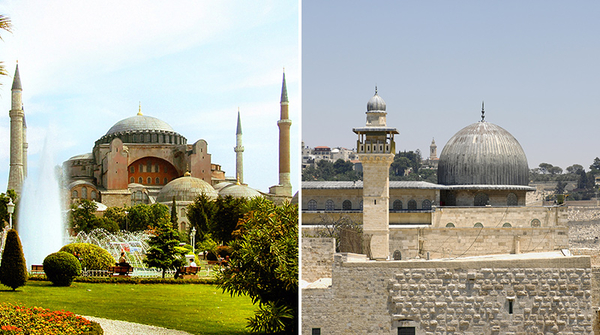
792Spot the difference: In the eyes of Turkey’s political and religious leadership, Istanbul and its Hagia Sophia (once a Greek Orthodox Basilica) were legitimately “conquered” by the Muslim Ottomans, while Jerusalem and its al-Aqsa mosque (built atop the ruins of the Jewish Temples) are illegally “occupied” by Israel. (Images source: Wikimedia Commons)

No doubt, after Gaza, al-Aqsa (and Jerusalem) has become a powerful Turkish obsession, and a treasure-trove of votes, especially in view of Turkey’s parliamentary elections next June. And do not expect the Turkish leadership only to corrupt facts. Plain fabrication is a more favored method. All the same, someone, sometimes, would unwillingly reveal the truth often when trying to corrupt other facts.

Since Davutoglu claimed that “Jerusalem has been entrusted with the Turks by Hazrat Omar,” it may be useful to refresh memories. Hazrat Omar is Omar bin Al-Khattab (579-644), one of the most powerful and influential Muslim caliphs in history. Within the context of “conquest vs. occupation,” he was referenced by the top cleric, Professor Gormez in a 2012 speech:

After Hazrat Omar conquered al-Quds [Jerusalem], he was invited to pray at a church [as there were no mosques yet in Jerusalem]. But he politely refused because he was worried that the [conquering] Muslims could turn the church into a mosque after he prayed there.

Since medieval historical facts cannot have changed over the past two years, the top Turkish ulama [religious scholar], referencing a most powerful Muslim caliph, is best witness that when the Muslims had first arrived in Jerusalem there was not a single mosque in the city. Why? Because Jerusalem was not a Muslim city. Why, then, do Turkish Islamists claim that it is Muslim? Because it once had been “conquered.” Would the same Turks surrender Istanbul to the occupying forces that took the city after World War I because its capture in 1920 made it a non-Turkish city? No, that was not conquest, that was occupation!

Had Messrs Erdogan and Davutoglu been schoolchildren, such reasoning might have been called bullying and cheating.