Posted tagged ‘Qatar’

The Imaginary Islamic Radical

January 28, 2015

The Imaginary Islamic Radical, Front Page Magazine, Daniel Greenfield, January 28,2015

(Ask Secretary Kerry.

Please see also Muslim Brotherhood-Aligned Leaders Hosted at State Department. — DM)

iraqstill-450x281

Our problem is not the Islamic radical, but the inherent radicalism of Islam. Islam is a radical religion. It radicalizes those who follow it. Every atrocity we associate with Islamic radicals is already in Islam. The Koran is not the solution to Islamic radicalism, it is the cause.

******************

The debate over Islamic terrorism has shifted so far from reality that it has now become an argument between the administration, which insists that there is nothing Islamic about ISIS, and critics who contend that a minority of Islamic extremists are the ones causing all the problems.

But what makes an Islamic radical, extremist? Where is the line between ordinary Muslim practice and its extremist dark side?

It can’t be beheading people in public.

Saudi Arabia just did that and was praised for its progressiveness by the UN Secretary General, had flags flown at half-staff in the honor of its deceased tyrant in the UK and that same tyrant was honored by Obama, in preference to such minor events as the Paris Unity March and the Auschwitz commemoration.

It can’t be terrorism either. Not when the US funds the PLO and three successive administrations invested massive amounts of political capital into turning the terrorist group into a state. While the US and the EU fund the Palestinian Authority’s homicidal kleptocracy; its media urges stabbing Jews.

Clearly that’s not Islamic extremism either. At least it’s not too extreme for Obama.

If blowing up civilians in Allah’s name isn’t extreme, what do our radicals have to do to get really radical?

Sex slavery? The Saudis only abolished it in 1962; officially. Unofficially it continues. Every few years a Saudi bigwig gets busted for it abroad. The third in line for the Saudi throne was the son of a “slave girl”.

Ethnic cleansing? Genocide? The “moderate” Islamists we backed in Syria, Libya and Egypt have been busy doing it with the weapons and support that we gave them. So that can’t be extreme either.

If terrorism, ethnic cleansing, sex slavery and beheading are just the behavior of moderate Muslims, what does a Jihadist have to do to be officially extreme? What is it that makes ISIS extreme?

Our government’s definition of moderate often hinges on a willingness to negotiate regardless of the results. The moderate Taliban were the ones willing to talk us. They just weren’t willing to make a deal. Iran’s new government is moderate because it engages in aimless negotiations while pushing its nuclear program forward and issuing violent threats, instead of just pushing and threatening without the negotiations. Nothing has come of the negotiations, but the very willingness to negotiate is moderate.

The Saudis would talk to us all day long while they continued sponsoring terrorists and setting up terror mosques in the West. That made them moderates. Qatar keeps talking to us while arming terrorists and propping up the Muslim Brotherhood. So they too are moderate. The Muslim Brotherhood talked to us even while its thugs burned churches, tortured protesters and worked with terrorist groups in the Sinai.

A radical terrorist will kill you. A moderate terrorist will talk to you and then kill someone else. And you’ll ignore it because the conversation is a sign that they’re willing to pretend to be reasonable.

From a Muslim perspective, ISIS is radical because it declared a Caliphate and is casual about declaring other Muslims infidels. That’s a serious issue for Muslims and when we distinguish between radicals and moderates based not on their treatment of people, but their treatment of Muslims, we define radicalism from the perspective of Islamic supremacism, rather than our own American values.

The position that the Muslim Brotherhood is moderate and Al Qaeda is extreme because the Brotherhood kills Christians and Jews while Al Qaeda kills Muslims is Islamic Supremacism. The idea of the moderate Muslim places the lives of Muslims over those of every other human being on earth.

Our Countering Violent Extremism program emphasizes the centrality of Islamic legal authority as the best means of fighting Islamic terrorists. Our ideological warfare slams terrorists for not accepting the proper Islamic chain of command. Our solution to Islamic terrorism is a call for Sharia submission.

That’s not an American position. It’s an Islamic position and it puts us in the strange position of arguing Islamic legalism with Islamic terrorists. Our politicians, generals and cops insist that the Islamic terrorists we’re dealing with know nothing about Islam because that is what their Saudi liaisons told them to say.

It’s as if we were fighting Marxist terrorist groups by reproving them for not accepting the authority of the USSR or the Fourth International. It’s not only stupid of us to nitpick another ideology’s fine points, especially when our leaders don’t know what they’re talking about, but our path to victory involves uniting our enemies behind one central theocracy. That’s even worse than arming and training them, which we’re also doing (but only for the moderate genocidal terrorists, not the extremists).

Secretary of State Kerry insists that ISIS are nihilists and anarchists. Nihilism is the exact opposite of the highly structured Islamic system of the Caliphate. It might be a more accurate description of Kerry. But the Saudis and the Muslim Brotherhood successfully sold the Western security establishment on the idea that the only way to defeat Islamic terrorism was by denying any Islamic links to its actions.

This was like an arsonist convincing the fire department that the best way to fight fires was to pretend that they happened randomly on their own through spontaneous combustion.

Victory through denial demands that we pretend that Islamic terrorism has nothing to do with Islam. It’s a wholly irrational position, but the alternative of a tiny minority of extremists is nearly as irrational.

If ISIS is extreme and Islam is moderate, what did ISIS do that Mohammed did not?

The answers usually have a whole lot to do with the internal structures of Islam and very little to do with such pragmatic things as not raping women or not killing non-Muslims.

Early on we decided to take sides between Islamic tyrants and Islamic terrorists, deeming the former moderate and the latter extremists. But the tyrants were backing their own terrorists. And when it came to human rights and their view of us, there wasn’t all that much of a difference between the two.

It made sense for us to put down Islamic terrorists because they often represented a more direct threat, but allowing the Islamic tyrants to convince us that they and the terrorists followed two different brands of Islam and that the only solution to Islamic terrorism lay in their theocracy was foolish of us.

We can’t win the War on Terror through their theocracy. That way lies a real Caliphate.

Our problem is not the Islamic radical, but the inherent radicalism of Islam. Islam is a radical religion. It radicalizes those who follow it. Every atrocity we associate with Islamic radicals is already in Islam. The Koran is not the solution to Islamic radicalism, it is the cause.

Our enemy is not radicalism, but a hostile civilization bearing grudges and ambitions.

We aren’t fighting nihilists or radicals. We are at war with the inheritors of an old empire seeking to reestablish its supremacy not only in the hinterlands of the east, but in the megalopolises of the west.

Exclusive: Freed Al Qaeda Agent Was Part of Proposed Swap for Jailed Americans

January 26, 2015

Exclusive: Freed Al Qaeda Agent Was Part of Proposed Swap for Jailed Americans, Daily Beast, January 25, 2015

(Please see also Analysis: Former al Qaeda operative freed, sent home to Qatar, a January 20th article from Long War Journal which also raises questions about the release of Al-Marri and notes the grand reception given him as a hero upon arrival in Qatar. Among other points, it states:

According to The Guardian (UK), al Marri’s nephew revealed that upon arrival in Doha, his uncle “was greeted by representatives from the Qatari interior and foreign ministries” and is now in “high spirits.” He thanked Qatari officials for exerting “tremendous efforts” for his uncle’s release.

— DM)

1422235859979.cachedThe Daily Beast

An American couple’s freedom may have come at a steep price: the release of a convicted terrorist from Supermax prison.

Before he was released from a U.S. maximum-security prison last week, a confessed al Qaeda sleeper agent was offered up in a potential prisoner swap that would have freed two Americans held abroad.

The Daily Beast has learned that the proposal was floated in July 2014 to the then-U.S. ambassador in Qatar by an individual acting on behalf of that country’s attorney general. According to two individuals with direct knowledge of the case, the proposition was made shortly after the Obama administration traded five Taliban fighters for Army Sgt. Bowe Bergdahl. Those fighters were also sent to Qatar, where they’re to remain under government watch until later this year. U.S. officials have said they’re at risk of plotting further attacks against the United States.

The proposed swap involving the al Qaeda agent, Ali Saleh Al-Marri, raises troubling questions about whether the Bergdahl trade opened a kind of Pandora’s box, signaling to foreign governments that they can pressure the United States to make concessions on terrorism by trading American prisoners abroad for dangerous extremists held in the United States.

“I believe we must examine the administration’s decision in the case of Al-Marri and determine if his release is connected to negotiations of any kind,” Rep. Duncan Hunter, a frequent critic of the Obama administration’s hostage negotiations, wrote Thursday in a letter to Rep. Mac Thornberry (R-TX), the House Armed Services Committee chairman, obtained by The Daily Beast.

Governments’ hostage negotiations policies are once again taking center stage after ISIS released a photograph Saturday showing the apparent beheading of Haruna Yukawa, one of two Japanese men the group is holding. Unexpectedly, ISIS has now dropped an earlier demand of $200 million ransom and says it will free the remaining hostage, journalist Kenji Goto, in exchange for the release of Sajida Mubarak al-Rishawi, a failed suicide bomber who’s imprisoned in Jordan for her role in an attack on three hotels in Amman in 2005, which killed 60 people.

ISIS has made other demands for freeing prisoners, including a Pakistani woman held in the United Sates, Aafia Siddiqui, known in counterterrorism circles as “Lady Al Qaeda,” who was convicted in 2010 of attempting to kill Americans in Afghanistan. Siddiqui has been used as a bargaining chip in other negotiations, as well. In 2012, Pakistani officials offered to try and win the release of Bergdahl if the United States would free Siddiqui. The Obama administration quickly rejected the idea because releasing her would be seen as offering concessions to terrorist groups and put a potentially dangerous woman back on the streets, according to current and former administration officials.In his letter, Hunter accused the administration of failing to pursue other avenues for freeing Americans abroad and relying on prisoner releases or exchanges, “which are often counter to U.S. security interests, for leverage in negotiations.” The congressman also alluded to other potential swaps, saying it’s his understanding that “other foreign nationals” who are still in U.S. custody “have also been named as potential figures of interest in other cases, with Qatar at the forefront.”

1422235139852.cachedTara Todras-Whitehill/The New York Times, via Redux

Qatar has emerged as a go-between in various hostage negotiations. It agreed to take custody of the five Taliban fighters for a period of one year after Bergdahl’s release. And sources close to efforts to free other Americans held abroad said that Qatar facilitated a ransom payment to help free journalist Peter Theo Curtis, who was held for two years by al Qaeda’s branch in Syria.

Hunter helped spur the administration to review its hostage negotiation policy, which is widely seen by experts and family members of Americans held abroad as dysfunctional.

The proposal to trade Al-Marri came from an individual described by one source as a “government contractor” and close friend of Qatar’s attorney general, Ali Bin Mohsen Bin Fetais Al Marri, who is said to be a relative of the confessed terrorist. The emissary met with the then-U.S. ambassador to Qatar, Susan Ziadeh, and raised the idea of trading Al-Marri for Matthew and Grace Huang, an American couple who’d been living in Qatar and were convicted in the still-unexplained death of their adopted daughter, in what was widely criticized by human-rights groups and legal experts as an unfair show trial.

“Qatari government officials told the Huang team that they floated the idea of a prisoner swap to the U.S. ambassador,” Richard Grenell, a former U.S. diplomat who worked on the Huang case, told The Daily Beast. That account was corroborated by a second source.

A State Department spokesman said that “no such proposal was ever on the table,” and noted that Al-Marri was eventually released from prison and sent home to Qatar as scheduled “and not as the result of any U.S.-Qatari agreement.” Asked for further clarification on whether the swap was raised as described and what the U.S. reaction was, the spokesman declined to comment further. The Qatari embassy in Washington didn’t respond to inquiries from The Daily Beast.

A second administration official pushed back on the idea that Al-Marri’s release was a quid pro quo for freeing the Huangs, who were eventually allowed to leave Qatar in December after their conviction was overturned.

“Al-Marri’s release happened as a matter of course, as a result of his court-imposed sentence being completed,” the administration official said. Al-Marri was given a “good conduct release” from the “supermax” facility in Florence, Colorado, on Jan. 16, after serving 87 percent of his 100-month sentence, said a spokesperson for the Bureau of Prisons. He’d accumulated credit for good behavior while in prison and time already served in jail while awaiting trial, which is why he didn’t serve the remainder of his time.

Administration officials characterized Al-Marri’s release as routine. But Al-Marri was no ordinary prisoner. At one time, he was the only so-called enemy combatant being held on U.S. soil, a status that treated him more like solider in a war than an ordinary criminal. Al-Marri’s release—timely or otherwise—has led to criticism that the Obama administration is repatriating a dangerous man who could help plan more attacks. An individual with knowledge of Al-Marri’s release said President Obama played no role in the process.

Al-Marri was first detained by U.S. authorities in December 2001 at his home in Peoria, Illinois, having arrived in the U.S. on a student visa. Authorities suspected that Al-Marri, who has dual citizenship in Qatar and Saudi Arabia, had ties to al Qaeda. But his future dramatically changed when was declared an enemy combatant in June 2003 and then transferred into military custody.

It turns out that Al-Marri may have been more valuable as a source of intelligence about other terrorist plots than for anything he knew about the 9/11 attacks. Much of the information that U.S. officials have on his plans came from the brutal interrogation of Khalid Sheikh Mohammed, the 9/11 mastermind, which included waterboarding. “Over three quarters of the intelligence reports that the FBI cited in a paper assessing the activities of [Al-Marri] and explaining the reach of al Qaeda’s network in the U.S. were sourced to” Mohammed, the CIA stated in its written response to a blistering report by the Senate Intelligence Committee on the so-called torture program. “Prior to [Mohammed’s] information, CIA and the FBI were aware of Al-Marri’s links to al Qaeda but lacked the detail to more fully understand al Qaeda’s plans for him.”

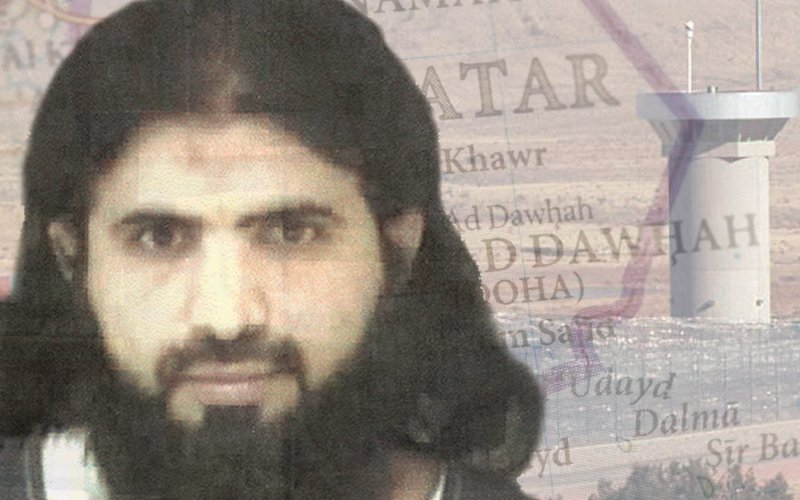
1422235139631.cachedAli Saleh Kahlah al-Marri, former graduate student at Bradley University, Peoria, Illinois, is photographed in this booking photo at Peoria County Sheriff’s Office in Illinois on May 20, 2003. (Peoria County Sheriff’s Office/Reuters)

That may explain why U.S. officials were reluctant to give Al-Marri a criminal trial, where he could have questioned the credibility of the evidence Mohammed provided while being tortured and exposed the details of the CIA’s interrogation program.

Al-Marri was held in a naval brig for more than five years, and his lawyers have claimed he was subjected to harsh and intimidating treatment. Al-Marri’s case took yet another odd turn when, early in the Obama administration, he was transferred back into federal court and pleaded guilty to conspiracy to aid al Qaeda.

Back in Qatar, where Al-Marri has been reunited with his family, he’s being given a hero’s welcome. Members of the public have been invited to a celebration in Al-Marri’s honor held just down the street from a football stadium that will host the 2022 World Cup, said David Weinberg, a senior fellow at the Foundation for Defense of Democracies.

“Several prominent Qatari personalities welcomed Al-Marri home with open arms. That trend has continued, with a longtime board member of Al Jazeeradeclaring on her personal Twitter page that ‘We congratulate the family of Ali bin Kahlah Al-Marri on his return,’” Weinberg told The Daily Beast.

Al-Marri may have other powerful friends in Qatar, in addition to the attorney general. Weinberg noted that in U.S. court documents, Al-Marri is said to have spent nearly a decade working as a “key person” in the audit department of Qatar Islamic Bank, and then as a senior auditor for the government of Qatar. Sending a known moneyman to a country widely seen as a major financial hub for terrorist groups, instead of to Saudi Arabia, where he also has citizenship, “was a big missed opportunity for U.S. policy,” Weinberg said.

Analysis: Former al Qaeda operative freed, sent home to Qatar

January 20, 2015

Analysis: Former al Qaeda operative freed, sent home to Qatar, Long War Journal, David Weinberg, January 20, 2015

Ali-Marri-thumb-400x253-5476Ali Saleh Kahlah al Marri, back in Qatar with his youngest son. Photo provided to the Peoria Journal Star by al Marri’s family.

Editor’s Note: For more on Qatar’s track record in fighting terrorism, see Dr. Weinberg’s report for the Foundation for Defense of Democracies’ Center on Sanctions & Illicit Finance, Qatar and Terror Finance, Part 1: Negligence.

The US government’s decision to repatriate al Marri to Qatar is a curious one, to say the least.

According to The Guardian (UK), al Marri’s nephew revealed that upon arrival in Doha, his uncle “was greeted by representatives from the Qatari interior and foreign ministries” and is now in “high spirits.” He thanked Qatari officials for exerting “tremendous efforts” for his uncle’s release.

********************

Editor’s Note: For more on Qatar’s track record in fighting terrorism, see Dr. Weinberg’s report for the Foundation for Defense of Democracies’ Center on Sanctions & Illicit Finance, Qatar and Terror Finance, Part 1: Negligence.

Ali Saleh Kahlah al Marri, an admitted former al Qaeda operative, has been released from a American jail and permitted to return home to Qatar.

No formal statement has been released yet by either government, but it is being reported that al Marri’s release was the result of a bilateral agreement between the Qatari and American governments. According to the US Bureau of Prisons, a prisoner with the same name and estimated age (ID number 12194-026) was freed on Friday.

Additionally, a source from al Marri’s family told the Qatari press he was recently released and arrived in Doha Saturday. Soon afterwards, the story was confirmed by Agence France Presse (AFP), which spoke to al Marri’s nephew.

This followed statements by two of his former attorneys that he was expected to be released within days. And photographs have been posted on social media that reportedly show al Marri coming home to his children for the first time in over a decade. A Kuwaiti newspaper posted video of a man identified as al Marri at the airport in Doha bumping noses with male relatives and kissing his mother’s feet.

An al Qaeda sleeper agent

Ali Saleh Kahlah al Marri was at one point the only enemy combatant detained on US soil. According to the terms of a plea deal he accepted in 2009, al Marri “was instructed by Khalid Sheikh Mohammed to enter the United States no later than September 10, 2001” and to await further instructions. Mohammed, also known as KSM, was serving at the time as the chief of al Qaeda’s external operations and is considered the mastermind of 9/11 attacks. According to the FBI in 2009, “Ali al-Marri was an al-Qaeda ‘sleeper’ operative working on U.S. soil.”

President George W. Bush indicated that the US intelligence community believes al Marri discussed various targets with KSM, including “water reservoirs, the New York Stock Exchange, and United States military academies.” Bush also described him as “a present and grave danger to US national security.”

The plea bargain accepted by al Marri acknowledged that his computer’s search history included research on “various cyanide substances” according to “the method taught by al Qaeda for manufacturing cyanide gas,” as well as research on “dams, waterways and tunnels in the United States, which is also consistent with al Qaeda attack planning regarding the use of cyanide gases”. The plea deal also noted that “between 1998 and 2001” he “attended various training camps because he wished to engage in jihad”.

In other court documents, US officials alleged that KSM chose al Marri to be an al Qaeda sleeper agent because he had a family and would therefore be less likely to attract suspicion. He was pulled over in a routine traffic stop two days after 9/11 when a police officer saw al Marri’s son standing up in the moving car’s back seat.

Al Marri was then briefly arrested on an old warrant for driving under the influence and raised authorities’ suspicions when he paid his $300 bail out of a briefcase full of bundles of hundred dollar bills. Al Marri would later acknowledge receiving these funds from an al Qaeda financial facilitator in the United Arab Emirates, Mustafa Hawsawi, whom KSM had instructed him to visit. Soon afterwards, al Marri was detained again when law enforcement officials confirmed a telephone at his home had been used to contact Hawsawi, whom they had already connected to one of the 9/11 hijackers.

Hawsawi was captured alongside KSM in early March 2003 and then held in the CIA’s controversial detention and interrogation program before being transferred to Guantanamo, where he remains in detention.

Reason for release unclear

Al Marri’s release seems to be the end result of a process set in motion by President Obama during his first month in office.

Al Marri had been held for years under solitary confinement at the Navy Brig in Charleston, South Carolina. But President Obama directed the government to reconsider his case in parallel to reviewing all the cases of detainees held at Guantanamo. The president ordered the Defense Department to transfer al Marri to the custody of the Justice Department, which would try him in a civilian court.

However, it is unclear as to why the United States released al Marri now. Taking into consideration what the judge called al Marri’s “unacceptable” treatment by the military, al Marri was sentenced to only an additional eight years and four months in prison in late October 2009. His sentence had already been reduced from fifteen years to account for his time in custody of the military. That would have meant a release in early 2018. The reasons for Al Marri’s early departure from prison have not been made public. He may have received credit for prior time served in civilian jails and possibly also for good behavior.

The Journal Star newspaper in Peoria, Illinois, where al Marri was living in 2001, reports that he was “was spirited out of the United States on Friday [Jan. 16], two days before he was scheduled to be released from a maximum security prison” in Florence, Colorado. The paper elaborated that “the move was unknown to his attorney Andrew Savage of Charleston, S.C., who had met with his client just one day before.”

Initially, it was unclear whether or not the US government had negotiated ground rules with the Qatari government to justify his repatriation there. However, a Qatari-owned Arabic news outlet based in London, al-Araby al-Jadeed, quotes sources close to al Marri’s family claiming that his release was the result of a bilateral agreement between the two governments.

Even if the United States did reach some sort of prior understanding about the terms of his release, Doha has violated these sorts of commitments in the past.

Qatar’s negligent record

The US government’s decision to repatriate al Marri to Qatar is a curious one, to say the least.

Ali al Marri’s brother, Jarallah Saleh Kahlah al Marri, was detained at the Afghanistan-Pakistan border shortly after 9/11 and subsequently held at Guantanamo. According to a leaked threat assessment prepared by Joint Task Force – Guantanamo (JTF-GTMO), Jarallah al Marri also spent time at al Qaeda training camps and was suspected of seeking to transfer $10,000 in operational funds to his brother at KSM’s direction. He was released back to Doha’s supervision in 2008.

The Qatari government violated a pledge to Washington on how it would handle Jarallah al Marri. He was repatriated based on an explicit, written commitment from Qatar that he would not be allowed to leave the country. Qatar even promised to notify Washington immediately if he merely tried to do so.

And yet Washington found out from British authorities that they had arrested Jarallah al Marri on charges of visa fraud, after he had been permitted to leave Qatar not once but twice without mention from the Qatari government. The US ambassador in Doha at the time concluded that the decision to let Jarallah travel was “almost certainly” a decision that involved Qatar’s attorney general, who outrageously contended he “was bound only by signed judicial assistance agreements and not diplomatic notes”.

At least once Qatar also withheld cooperation from the United States on the case of Ali al Marri himself. A leaked US cable from October 2008 stated that Qatar’s attorney general “decline[d] our judicial request on Ali al-Marri,” specifically refusing to honor “a long-standing request for banking records” involving him.

More broadly, Qatar has been labeled a permissive jurisdiction for terror finance by the US Treasury Department. It is home to several individuals on US or UN blacklists who allegedly provided high-level funding to al Qaeda. Local authorities have refused to charge the suspected al Qaeda financiers with a crime.

And the last time Qatar promised to keep an alleged senior terrorist operative “under control,” that individual showed up several years later on Treasury sanctions announcements as having again transferred hundreds of thousands of dollars to al Qaeda’s senior leadership abroad.

Received as a hero

Ali al Marri’s reception in Qatar so far should raise additional concerns in the counterterrorism community. The Qatari government has given no public sign it plans to supervise his activities, nor has it indicated disapproval of his prior al Qaeda role. It is unlikely he will face further charges in Qatari court, and he is not currently being detained.

Worse, al Marri is being received as a returning hero.

Abdulrahman al Nuaymi has been blacklisted by the US and UN on charges of terror finance yet enjoys legal impunity in Qatar. Al Nuaymi welcomed the news of Al Marri’s release on his Twitter account, while also minimizing any suggestion of wrongdoing on al Marri’s part.

“Praise Allah, Brother Ali Saleh Kahlah al-Marri has been released and returned to his country and his people after thirteen years in the prisons of global injustice (America),” a post on al Nuaymi’s Twitter feed reads.

Al Nuaymi is not the only one celebrating al Marri’s return. According to The Guardian (UK), al Marri’s nephew revealed that upon arrival in Doha, his uncle “was greeted by representatives from the Qatari interior and foreign ministries” and is now in “high spirits.” He thanked Qatari officials for exerting “tremendous efforts” for his uncle’s release.

Similarly, the editor-in-chief of one of Qatar’s main newspapers, al-Arab, proclaimed in Arabic on Twitter: “We thank Allah for his favor in returning Brother Ali Saleh Kahlah al-Marri, who was detained by America. Our congratulations to him and to his family, and many thanks to all those who followed his case and worked for his return.”

Another major Qatari paper, al-Sharq, covered his release without polemics, but it also elided any mention of al Marri’s plea bargain or its contents, including his admitted connection to al Qaeda and plotting against civilian targets. In fact, the story did not even note that he was accused of involvement with al Qaeda, instead simply stating that he was detained in the US in the aftermath of 9/11.

Only one of two articles by the Qatari-owned UK outlet al-Araby al-Jadeed included some limited details from al Marri’s plea bargain, but the article quoted Qatar’s former minister of justice basically dismissing those admissions as a means to an end for al Marri to get released. The paper also quoted the head of Qatar’s state-controlled National Human Rights Commission, who revealed that his group had been pushing US officials for years for Ali al Marri’s immediate release.

If this collective amnesia is reflective of how the Qatari authorities feel, Doha will likely give al Marri free rein, viewing him more as a victim than an admitted terrorist agent who plotted mass attacks against civilians for the sake of jihad. This risk seems especially acute given that a Twitter account appearing to belong to his brother, Jarallah, recently lavished praise upon Osama bin Laden and repeatedly publicized a fundraising campaign for Syria that was shut down after allegedly serving as a financial conduit for the Al Nusra Front, al Qaeda’s official branch in Syria.

During her confirmation hearings before the Senate Foreign Relations Committee, the current US envoy to Doha, Ambassador Dana Shell Smith, pledged that if confirmed she would monitor the so-called Taliban Five “continuously” at “the very top of my list of priorities.” The Taliban Five is a group of senior Taliban leaders who were exchanged for Sgt. Bowe Bergdahl last year. Qatar helped broker the swap.

Smith testified she would work “every morning when I wake up, every night when I go to sleep, to reassess whether these people [the Taliban Five] pose any threat whatsoever, to our national security.”

Smith may wish to add the al Marri brothers to the list of jihadists she monitors.


A Sad State of Affairs: The Kerry Record

January 2, 2015

A Sad State of Affairs: The Kerry Record, World Affairs JournalJoshua Muravchik, November/December, 2014

(Kerry likely agrees with Obama as to his quite foreign foreign policies and, equally likely, we are stuck with both at least until Obama leaves the White House.

Kerry I'm an idiot

The most bothersome current aspects of Obama-Kerry foreign policies are the extent to which they trust Iran and how they deal with it and the P5+1 negotiating group. — DM)

John_Kerry_and_Benjamin_Netanyahu_July_2014 (1)

Although Kerry’s anti-American ideology has moderated to some degree from his fiery days as an antiwar leader, he has misrepresented but never repudiated his past. Especially consistent has been his inclination to see the best in America’s enemies, from Madame Binh to Comandante Ortega to Bashar Assad. Israelis were shocked this summer that Kerry came up with a plan molded by Turkey and Qatar to fit the interests of Hamas at their own expense. Had they known him and his record better, they might not have been.
***************

The Gaza war of July and August 2014 occasioned the sharpest frictions in memory between the United States and Israel, highlighted by a cease-fire proposal offered by Secretary of State John Kerry that Israel’s security cabinet rejected unanimously. Kerry’s plan envisioned a seven-day cease-fire, during which the parties would negotiate “arrangements” to meet each of Hamas’s demands about the free flow of people and goods into Gaza and the payment of salaries of Hamas’s tens of thousands of employees. As for Israel’s demands about destruction of tunnels and rockets and the demilitarization of Gaza, these were not mentioned at all, except in the add-on phrase that the talks would also “address all security issues.”

The document cited the important role to be played by “the United Nations, the Arab League, the European Union, the United States, Turkey, [and] Qatar.” Conspicuous by their absence from this list were Israel, Egypt, and the Palestinian Authority. These three had also not been invited to the Paris meetings where Kerry worked on his ideas with leaders of the countries and bodies mentioned.

Barak Ravid, diplomatic correspondent for the liberal Israeli newspaper Haaretz, wrote that the proposal “might as well have been penned by Khaled Meshal [head of Hamas]. It was everything Hamas could have hoped for.” The centrist Times of Israel’s characteristically circumspect editor, David Horovitz, branded Kerry’s initiative “a betrayal.” And left-leaning author Ari Shavit commented that “Kerry ruined everything. [He] put wind in the sails of Hamas’ political leader Khaled Meshal, allowed the Hamas extremists to overcome the Hamas moderates, and gave renewed life to the weakened regional alliance of the Muslim Brotherhood.”

Turkey and Qatar are the mainstays of that alliance and were chosen by Kerry as his principal interlocutors because they are Hamas’s main backers. This brought protests from the Palestinian Authority, led by President Mahmoud Abbas’s movement, Fatah, the secularist rival to Hamas. That group declared that “whoever wants Qatar and Turkey to represent them can emigrate and go live there. Our only legitimate representative is the PLO.”

The shock of Palestinian and Israeli leaders would have been less, however, if they had been more familiar with the record of John Kerry. Spurning America’s friends in pursuit of deals with their nemeses was perfectly in character for the secretary of state. The hallmark of his career has been to denigrate America itself, while supporting the claims of its enemies.

That career began in 1969, when, months after returning from a tour of duty in Vietnam, Kerry sought and received a military discharge so that he might run for Congress. His campaign as a peace candidate sputtered, but his authenticity as a Vietnam vet established him as a presence in the burgeoning antiwar movement. In May 1970, he traveled to Paris for an unpublicized meeting with Viet Cong representatives, and, perhaps at their suggestion, he joined up upon his return with Vietnam Veterans Against the War. VVAW was headed by Al Hubbard, a former Black Panther. Kerry was instantly given a top role, twinning with Hubbard as the public face of the organization.

At a VVAW protest in Washington, DC, in April 1971, Kerry joined other veterans in throwing away their military medals in front of news cameras. The entire demonstration was punctuated by Kerry’s appearance before the Senate Foreign Relations Committee, where he offered dramatic testimony about American atrocities in Vietnam based on accounts heard at a VVAW inquest a few months earlier. He spoke of veterans who said:

They had personally raped, cut off ears, cut off heads, taped wires from portable telephones to human genitals and turned up the power, cut off limbs, blown up bodies, randomly shot at civilians, razed villages . . . poisoned food stocks, and generally ravaged the countryside.

These acts, Kerry emphasized, “were not isolated incidents but crimes committed on a day-to-day basis with the full awareness of officers at all levels of command.”

When, at the behest of aghast senators, the Naval Criminal Investigative Service conducted a formal inquiry into the stories presented at the VVAW inquest, it reported that many of the VVAW witnesses cited by Kerry refused to cooperate, although promised immunity. Others were clearly crackpots, and several swore, and provided witness corroboration, that they had not participated at the inquest at all and had no idea who had appeared in their names. The entire exercise had been inspired and largely engineered by Mark Lane, whose book on the same subject earlier that year had been panned by New York Times columnist James Reston Jr. as “a hodgepodge of hearsay,” while that paper’s book reviewer, Neil Sheehan, who had reported from Vietnam and would soon break the Pentagon Papers, revealed that some of Lane’s “witnesses” had not served in Vietnam. (The political scientist Guenter Lewy documents these events in his 1978 book America in Vietnam.)

In August 1971, four months after his Senate appearance, Kerry made another trip to Paris, to meet with Madame Nguyen Thi Binh, foreign minister of the Viet Cong, this time in full view, for his first exercise in international diplomacy. He returned touting the “peace plan” of the Viet Cong, explaining: “If the United States were to set a date for withdrawal, the prisoners of war would be returned.” Although he frequently accused American leaders of lying, he took the Communist leaders’ statements at face value, asserting that their peace plan “negates very clearly the argument of the president [Nixon] that we have to maintain a presence in Vietnam to use as a negotiating [chip] for the return of those prisoners.”

Kerry’s dismissal of the statements of US leaders as lies and his credulity toward those of the Vietnamese Communists reflected a broader difference in attitude toward the two sides to the conflict. Ho Chi Minh, who had spent long years as a henchman of Stalin’s, serving the Comintern in several countries, was in Kerry’s admiring eyes “the George Washington of Vietnam” who aimed only “to install the same provisions into the government of Vietnam” that appeared in the American Constitution. America, in contrast, had itself strayed so far from those principles that it needed a “revolution” to restore them.

Kerry’s colleagues in VVAW undoubtedly shared this sentiment, and in November 1971, at a conference of its leadership in Kansas, the group considered just how far down the path of revolution it was willing to go. It debated, although ultimately rejected, a proposal to commence a campaign of terrorist violence and assassination of pro-war US senators. When he ran for president in 2004, Kerry denied he had been present at this conclave, but when FBI files secured by the Los Angeles Times under the Freedom of Information Act placed him there, he retracted that denial in favor of the statement that he had “no personal recollection” of it.

Is this plausible? Gerald Nicosia, author of a highly sympathetic history of the antiwar movement, reported, in May 2004, that “several people at the Kansas City meeting recently said to me or to mutual friends that they had been told by the Kerry campaign not to speak about those events without permission.” Why the urgency to cover up? And how would the campaign know who was there, that is, whose silence to seek, if Kerry had no recollection of the meeting? One of Nicosia’s interviewees, John Musgrave, said “he was asked by Kerry’s veterans coordinator to ‘refresh his memory’ after he told the press Kerry was in Kansas City. Not only is Musgrave outraged that ‘they were trying to make me look like a liar,’ but he also says ‘there’s no way Kerry could have forgotten that meeting—there was too much going on.’”

This puts it mildly: the event was memorably raucous, with debates over the proposals for violence and for napalming the national Christmas tree, furious factional fighting, the discovery of eavesdropping bugs in the building leading to a quick move to another location, and above all an angry showdown between Kerry and Hubbard over revelations that the latter had never been in Vietnam. This particular contretemps was punctuated by Hubbard’s dramatically pulling down his pants to show scars he claimed he sustained in Vietnam. The mayhem culminated in Kerry’s announcing his resignation from the group’s executive. And Kerry had “no personal recollection” of being there?

Although Kerry appeared as a speaker for VVAW for about a year following this resignation, he then faded from national view for a decade, climbing the ladder of local and state politics in Massachusetts before winning election to the US Senate in 1984. The Senate, he later said, “was the right place for me in terms of . . . my passions. The issue of war and peace was on the table again.” What put it on the table were the anti-communist policies of President Ronald Reagan, which Kerry deeply opposed. A year earlier, Reagan had ordered the invasion of Grenada, which Kerry scorned as “a bully’s show of force [that] only served to heighten world tensions and further strain brittle US-Soviet and North-South relations.”

In contrast, Kerry ran on a platform of the Nuclear Freeze, a popular movement opposing US plans to counterbalance a large Soviet nuclear buildup over the previous decade. Kerry made sure to score one hundred percent on a test of candidates’ positions presented by a group called Freeze Voter ’84, and he proposed to cut the defense budget by nearly twenty percent, including “cancellation of twenty-seven weapons systems” and “reductions in eighteen other[s],” according to the Boston Globe. He cited his own work with VVAW as a counterpoint: “We were criticized when we stood up on Vietnam. . . . But we’ve been borne out. We were correct. Sometimes you just have to stand and hold your ground.”

In the Senate, he secured a coveted seat on the Foreign Affairs Committee and turned his attention to the fraught issue of policy toward Central America, a small region that had assumed inordinate geopolitical importance by becoming one of the front lines in the Cold War. A Marxist-Leninist party, the Sandinista National Liberation Front, had seized power in Nicaragua and was aiding likeminded movements in El Salvador and other nearby states while the Reagan administration supported anti-Communist guerrillas inside Nicaragua, the so-called “Contras.”

Kerry lent his name to Medical Aid for El Salvador, which gave non-lethal aid to the Communist side in that civil war. On February 16, 1982, an Associated Press story quoted actor Ed Asner, leader of a Hollywood group that raised much of the funding for this project, as explaining that “medical supplies are to be purchased in Mexico and shipped clandestinely to the Democratic Revolutionary Front in El Salvador.” However, the issue of US aid to El Salvador’s anti-Communist government became overshadowed by debate about aid to the Nicaraguan “Contras.”

As the Senate neared a decisive vote, Kerry and Senator Tom Harkin undertook a dramatic maneuver to try to head off approval of the Reagan administration’s request for Contra funding. They flew to Managua, the Nicaraguan capital, for their own summit meeting with the country’s strongman, “Comandante” Daniel Ortega. The results resembled those of his 1971 meeting with Madame Binh. Ortega handed Kerry a “peace plan” according to which the US would first end all aid to the Contras, and the Sandinistas would then initiate a cease-fire and restore civil liberties. Kerry justified undercutting the US government in this way by faulting Reagan’s failure “to create a climate of trust” with the Sandinistas. He, in contrast, offered them trust in abundance, calling Ortega’s plan “a wonderful opening.” He took to the Senate floor to say, “Here, in writing, is a guarantee of the security interest of the United States.”

A year later, in 1986, in another Senate debate on Contra aid, Kerry voiced one of the odder claims about his Vietnam experience. Warning against the slippery slope of military involvement and against the duplicity of our own government, Kerry delivered a floor speech containing this assertion:

I remember Christmas of 1968, sitting on a gunboat in Cambodia. I remember what it was like to be shot at by Vietnamese and Khmer Rouge and Cambodians, and have the president of the United States telling the American people that I was not there; the troops were not in Cambodia. I have that memory which is seared—seared—in me.

The “seared” part was a nice touch, especially in view of the fact that the whole thing had not happened (although Kerry had been repeating the story since as early as 1979). In the course of Kerry’s 2004 presidential campaign, the Swift Boat Veterans for Truth, former crewmen on the type of vessel on which Kerry served who were angered by his antiwar activities, attacked this claim among other aspects of Kerry’s military history. In this case, however, unlike in response to some points raised by Kerry’s detractors, no shipmate of Kerry’s could be found to corroborate his version. Soon, his spokesmen began to hedge. One aide explained that Kerry’s boat had been “between” Vietnam and Cambodia. But the two countries are contiguous: there is no “between,” so another spokesman backed down further, explaining that Kerry had merely been “near” Cambodia.

Then, Douglas Brinkley, who authored a laudatory history of Kerry’s military service, issued another explanation, apparently at the behest of the campaign. On Christmas 1968, the moment of Kerry’s “seared” memory, he was fifty miles from Cambodia, said Brinkley, but his boat “went into Cambodia waters three or four times in January and February 1969.” Oddly, however, Brinkley’s book, which covered those two months in painstaking detail at a length of nearly one hundred pages, even to the extent of locating the sites of battles, made no mention of Kerry’s having crossed into Cambodia. And the campaign soon pulled the rug from under Brinkley by issuing a new claim, namely, that Kerry’s boat had “on one occasion crossed into Cambodia.” Three of Kerry’s shipmates, two of whom were supporting his campaign, categorically denied even this minimized claim.

In that, they are supported by no less a source than Kerry himself, in the form of a journal he kept while on duty. Substantial passages of it are reproduced in Brinkley’s book, and one of them reads:

The banks of the [Rach Giang Thanh River] whistled by as we churned out mile after mile at full speed. On my left were occasional open fields that allowed us a clear view into Cambodia. At some points, the border was only fifty yards away and it then would meander out to several hundred or even as much as a thousand yards away, always making one wonder what lay on the other side.

He was never to learn the answer because this diary entry was from his final mission.

Kerry was of course right to link Central America to Southeast Asia. They were both nodes in the Cold War, the epic struggle that defined international politics for forty years, including the first two decades of Kerry’s political engagement, from the time he returned from Vietnam in 1969 until the Berlin Wall came down in 1989. Whatever the rights and wrongs of America’s entry into Vietnam, or its actions in Central America or elsewhere, Kerry perverted the basic issue of the Cold War, always viewing America’s actions as bellicose and malign, while casting those of the Communists, like “George Washington” Ho Chi Minh, in the most favorable light.

To many, the Cold War’s benign denouement—the fall of the Wall and the USSR’s disappearance into the ash bin of history—vindicated Reagan’s approach, but Kerry appears to have entertained no second thoughts despite these outcomes. When it came to addressing post–Cold War issues, he remained reflexively averse to the exercise of American power. Kerry had lamented as “not proportional” Reagan’s 1986 bombing of Libyan dictator Muammar el-Qaddafi’s residence in response to a Libyan terror attack on US servicemen in Germany. The Middle East was also the scene of the first military showdown after the Cold War, when Saddam Hussein’s Iraq swallowed whole the neighboring state of Kuwait, in 1990. At the time, Kerry opposed the Bush administration’s request for authorization of military action, saying that those “of the Vietnam generation . . . come to this debate with a measure of distrust [and] a resolve . . . not [to be] misled again.” He concluded his Senate speech by reading a passage from an antiwar novel by the American Communist Dalton Trumbo.

With the Cold War’s end, and America’s demonstration of will and strength in driving Hussein’s forces from Kuwait, the defining issue of the 1990s became the wars of Yugoslavia’s dissolution. Here, the prime issue was whether or not to lift an international arms embargo that rendered Bosnia’s Muslims naked before their predators, the well-armed Serbs. As public opinion reacted to news accounts of the grisly results of this imbalance, the Senate voted to lift the embargo, over the objections of Kerry, who helped to lead the opposition.

With the terrorist attacks of September 11, 2001, the American public was awakened from its post–Cold War indifference toward foreign affairs. A fierce patriotism burst forth, and with it a determination to take down those who had attacked us. Thus, preparing for a 2004 presidential bid, Kerry moved to reconfigure his image. The antiwar veteran was suddenly replaced by the military hero, and the Democratic nominating convention was replete with uniforms and military gestures, highlighted by Kerry’s sharp salute to the assemblage while uttering the words, “reporting for duty.” Already, his rejected service medals had miraculously reappeared mounted and framed on his Senate office wall. Asked how that was possible, as he had been photographed throwing them away, Kerry explained that the medals he tossed were not his own but actually belonged to another veteran.

The dramatic reincarnation did not quite come off, as Kerry was dogged by Vietnam veterans, led by fellow Swift Boat crewmen, still furious at how he had blackened their names. And the awkwardness of his transformation was symbolized by his much-ridiculed explanation of his stance on funding the 2003 US invasion of Iraq: “I actually did vote for the $87 billion before I voted against it.”

In his later years in the Senate, Kerry made the issue of Syria his own. He took several trips to Damascus where, according to a June 2011 account in the Wall Street Journal, he “established something approaching a friendship with [Syrian dictator Bashar] Assad.” When Barack Obama came to office, he made Kerry his point man in efforts to improve US-Syrian relations. Kerry put his endorsement on diplomatic proposals he received in Damascus, including an offer by Assad to engineer a Palestinian unity government embracing Fatah and Hamas. The benefits to the US, not to mention Israel, of such unity were not self-evident, but in any event, talks between the two Palestinian factions were already under way, mediated by Egypt, which was closer to Fatah. Why it would be advantageous to switch the sponsorship to Syria, the ally of Hamas, was hard to grasp. Nonetheless, Kerry saw in Assad’s proposal the prospect of “a major step forward in terms of how you reignite discussions for the two-state solution . . . . Syria indicated to me a willingness to be helpful in that respect.” In all, as the Journal put it, “Kerry . . . became . . . Assad’s champion in the US, urging lawmakers and policymakers to embrace the Syrian leader as a partner in stabilizing the Mideast.”

In sum, although Kerry’s anti-American ideology has moderated to some degree from his fiery days as an antiwar leader, he has misrepresented but never repudiated his past. Especially consistent has been his inclination to see the best in America’s enemies, from Madame Binh to Comandante Ortega to Bashar Assad. Israelis were shocked this summer that Kerry came up with a plan molded by Turkey and Qatar to fit the interests of Hamas at their own expense. Had they known him and his record better, they might not have been.

Egypt-Qatar rapprochement rattles Hamas

December 31, 2014

Egypt-Qatar rapprochement rattles Hamas, Al-MonitorAdnan Abu Amer, December 30, 2014

(These guys could form several pretty adequate stand-up comedy teams.

— DM)

Egyptian woman gestures during a protest against what they say is Qatar's backing of ousted Egyptian president Mohamed Mursi's government, outside the Qatari Embassy in CairoAn Egyptian woman gestures during a demonstration against what protesters call Qatar’s backing of ousted Egyptian President Mohammed Morsi’s government, outside the Qatari Embassy in Cairo, Nov. 30, 2013. (photo by REUTERS)

At a time when Hamas is mending its relationship with Iran, Egypt and Qatar are also in the process of rapprochement after more than a year of tension. Resumed ties between them will likely have an impact on Hamas, but questions remain as to whether the Palestinian Islamist movement stands to gain or lose from this important regional development.

Hamas waited several days to announce its final position on the return of positive relations between Doha and Cairo on Dec. 20, when President Abdel Fattah al-Sisi met the envoy of Qatar’s emir in Cairo, Sheikh Mohammed bin Abdulrahman bin Jassim Al-Thani, the minister’s assistant for International Cooperation Affairs.

On Dec. 28, senior Hamas leader Mahmoud al-Zahar welcomed the Egyptian-Qatari convergence and denied Qatar was pressuring the Hamas leadership to leave Doha. He also denied reports that Qatar was planning to suspend its support for Hamas over the warming of ties with Egypt, reiterating that Hamas supports the unity of Arab countries to serve the Palestinian cause.

Yousef Rizqa, the former minister of information and political adviser to former Gaza Prime Minister Ismail Haniyeh, said in an interview with Al-Monitor, “The Egyptian-Qatari rapprochement serves the interest of the Palestinian national project, and Hamas has no concerns about its relations with Doha being harmed after the Doha-Cairo rapprochement because the movement is not a party to the internal Arab conflict, and it is accepted by the Arab capitals.”

However, an anonymous Egyptian official said in Dec. 26 press statement that Doha informed Hamas leaders that it would temporarily suspend its support for the movement in a bid to pressure Hamas to change its policies against Cairo.

Husam Badran, spokesman for Hamas and a resident of Doha, told Al-Monitor, “There is no suspension of the Qatari financial support for the movement, since their relationship is ongoing.” But Palestinian Minister of Labor Maamoun Abu Shahla revealed Dec. 28 that Qatar had postponed the financial grant supposed to be sent to Gaza’s state workers.

Rizqa neither confirmed nor denied this report, but he told Al-Monitor that Qatar has not cut its support and relationship with Hamas over the rapprochement with Egypt, saying, “The Hamas-Doha relationship is stable and Qatar’s support for the movement is sustained and has never ceased. Moreover, Qatar’s position on Hamas is strategic.”

It is worth noting that Hamas’ fear of Qatar halting its financial support for the movement at Egypt’s request coincides with its renewed attempt to improve ties with Iran, as well as political head Khaled Meshaal’s recent visit to Turkey. Hamas may be reaching out to possible alternatives for regional support should Doha downgrade its ties with the movement in a “secret” deal with Cairo.

The Palestinian Authority did not express a position on the Egyptian-Qatari rapprochement, but on Dec. 25 Ambassador Hazem Abu Shanab, a member of the Revolutionary Council of Fatah, ruled out the consideration that the Egyptian-Qatari convergence would contribute to the improvement of relations between Hamas and Cairo, because this depends on how Cairo decides to deal with the Muslim Brotherhood and its affiliates, such as Hamas.

This prompted the Egyptian official to reveal Dec. 26, also on condition of anonymity, that Hamas demanded Doha mediate with Cairo to calm the atmosphere with Hamas, as the movement expressed its goodwill toward overcoming the tension with Cairo.

A senior Hamas official told Al-Monitor on condition of anonymity that Hamas is analyzing the extent of Doha’s ability to influence Cairo on reconciling with the movement. Should the rupture between Hamas and Egypt continue irrespective of the Doha-Cairo rapprochement, this would be interpreted by Hamas as being made a scapegoat.

A former member of the Qatari Shura Council, asking not to be named, revealed to Al-Monitor, “There have been contacts made between the Hamas leadership, represented by Meshaal, and Emir Tamim bin Hamad al-Thani, among other Qatari officials. They discussed the rapprochement with Egypt. Meshaal told the emir that he fully supports any Qatari effort to unify Arab positions.”

The Qatari official told Al-Monitor by phone from Doha, “Meshaal received a formal Qatari pledge not to attack the Hamas leadership or tighten the noose around its neck in Doha in exchange for rapprochement with Cairo. This is because Qatar never establishes relations based on bargaining between one party or another, and our relationship with Hamas will continue to exist.”

Interestingly, coinciding with the rapprochement, Egyptian media outlets reported that Cairo threatened to cut ties with Hamas on Dec. 26 unless 13 accused members of the movement were extradited to Egypt. The 13 were accused of involvement in armed operations in Egypt, and allegedly, Egyptian authorities have insisted that extradition proceedings must conclude before they consider improving relations with Hamas.

On Dec. 28, Zahar denied Egyptian media reports that Hamas interfered in Egypt’s domestic affairs.

A senior Hamas official in Gaza who spoke to Al-Monitor on condition of anonymity also denied the reports, saying, “Egypt made no formal request to extradite any Hamas member, and these accusations were featured across all media outlets, which only creates more tensions,” he said.

Ahmed Yousef, a senior Hamas official, told Al-Monitor that he hopes “the breakthrough in the Doha-Cairo relations will positively affect Hamas’ relations with Egypt and that Qatar would do its best to alleviate the tension between Gaza and Cairo,” adding, “The Hamas and Cairo dossier is likely to be opened after the meeting of Emir Tamim with Sisi.” He denied the existence of contacts between the movement and Egypt following the Doha-Cairo rapprochement.

The timing of the Egyptian-Qatari warming may have come as a surprise to Hamas, which took nearly a week to announce that it welcomes the move, making sure that it would not come at its expense. The atmosphere prevailing within Hamas is still ambiguous over whether the Qatari position toward the movement will be affected, despite promises made by Doha to the contrary. Hamas knows that the pressure exerted on Qatar may be stronger than its ability to resist.


Erdogan’s Egyptian Nightmare

December 30, 2014

Erdogan’s Egyptian Nightmare, The Gatestone InstituteBurak Bekdil, December 30,2014

Erdogan was happy. At least until a few days ago….

Erdogan probably did not know the Emir of Qatar’s next move on the Middle Eastern chessboard.

Turkey aspires to be a regional leader with no, little or problematic dialogue with about a dozen countries in its region.

Back in 2011, everything ostensibly was coming up roses between Turkey and Egypt. In a speech that year, then-Turkish President Abdullah Gul mentioned “…an axis of democracy of the two biggest nations in our region [Turkey and Egypt], from the north to the south, from the Black Sea down to the Nile Valley…”

In September 2011, then-Prime Minister [now President] Recep Tayyip Erdogan found an emotional hero’s welcome at Cairo’s Tahrir Square. Tens of thousands of Egyptians had flocked to the Cairo airport to welcome him. Streets were decorated with posters of Erdogan.

In early 2012, a survey by TESEV, a Turkish think-tank, found that Turkey was the most popular country for the residents of seven Arab countries, including Egypt.

But against that glittering backdrop, this author wrote in June 2011: “For Ankara, Cairo can be the new Damascus until another capital becomes the new Cairo. At that time, Syrian President Bashar al-Assad, Erdogan’s one-time best regional ally, had already become his worst regional nemesis.

The Turkish-Egyptian love affair would, in fact, be quite short-lived.

In August 2013, about a month after General Abdel Fattah el-Sisi in Egypt toppled the Muslim Brotherhood rule of President Mohammed Morsi, Erdogan appeared on TV, reading — in an unusually soft voice — a letter by the Muslim Brotherhood’s Mohamed al-Beltagy. The letter was written to Beltagy’s daughter Asmaa, a 17-year-old girl, who had been killed in Cairo when security forces stormed two protest camps occupied by supporters of the deposed president. Poor Asmaa had been shot in the chest and back.

“I believe you have been loyal to your commitment to God, and He has been to you,” her father wrote in the letter. “Otherwise, He would not have called you to His presence before me.” Erdogan’s tears were visible.

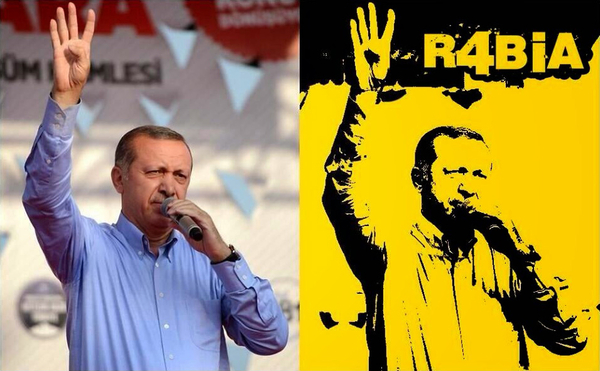
Later, Asmaa became another symbol for Turkish Islamists; Erdogan cheered party fans with the four-finger “Rabia” sign, in reference to his solidarity with the Muslim Brotherhood, and as a sign of his endearment for the unfortunate girl. Even on the playing field, a few footballers made the same sign after scoring.

859In this image, widely circulated in social media, Turkey’s then-Prime Minister [now President] Recep Tayyip Erdogan flashes the Egyptian Muslim Brotherhood’s four-fingered “Rabia” sign.

After the coup in Egypt, when el-Sisi ran for president and won the elections, Turkey’s Erdogan declared them “null and void.” And not just that. Erdogan also said that he did not view el-Sisi as “president of Egypt.” At another time, he said, “Turkey would not recognize the coup regime in Egypt.” Last July, he called el-Sisi “an illegitimate tyrant” and a “coup-maker.”

Meanwhile, neither was Erdogan a “rock star” in Cairo nor was Turkey “the most popular country.” Egyptian non-governmental organizations [NGOs] called on Egyptians and Arabs to boycott Turkish goods and soap operas. Egypt’s intellectuals, writers and businessmen were recommending a break in Egypt’s relations with Turkey because “they were disappointed.” Egypt unilaterally cancelled both visa-free travel for Turkish citizens and a transit agreement for Turkish trucks.

In the anti-el-Sisi campaign, Turkey was not alone. Its only regional ally, Qatar, fully supported Turkey against Egypt’s elected “coup leader.” Erdogan was happy. At least until a few days ago….

In Ankara, Erdogan was all smiles when he offered a red-carpet ceremony to the visiting Qatari Emir Sheikh Tamim bin Hamad al-Thani. Happy to have his best ally as a guest, Erdogan probably did not know the Emir’s next move on the Middle Eastern chessboard.

A few days after al-Thani’s merry visit to Ankara, Qatar announced its determination to thaw ties with Egypt, ending its alliance with Turkey over “Egypt’s illegitimate tyrant.”

“The security of Egypt is important for the security of Qatar … the two countries are linked by deep and fraternal ties,” ran a statement from the office of al-Thani on Dec. 21. It was a real cold shower on Ankara — and Erdogan. The statement had come one day after el-Sisi met in Cairo with a Qatari envoy, suggesting a possible thaw in relations. After the meeting, el-Sisi’s office issued a statement saying, “Egypt looks forward to a new era that ends past disagreements.” Apparently, the Egyptian-Qatari reconciliation had been brokered by Saudi Arabia and, once again, Turkey was the odd one out.

In its immediate vicinity, Turkey does not have diplomatic relations with three countries — Armenia, Cyprus and Syria — and has deeply problematic diplomatic relations with two countries: Israel and Egypt. This situation is not sustainable.

Even Deputy Prime Minister Bulent Arinc has said that Turkey should repair its relations with Egypt. But this is not an easy task. In the unlikely event of a reconciliation, Erdogan’s previous big words on el-Sisi the coup-maker will make him look like a leader shaking hands with an “illegitimate tyrant.”

On Dec. 24, Turkey’s foreign ministry spokesman said that bilateral ties with Egypt could “normalize if the country properly returns to democracy, if the Egyptian people’s free will is reflected in politics and social life.” Meaning, no normalization. The spokesman would not comment on Qatar’s policy change on Egypt.

Turkey aspires to be a regional leader with no, little or problematic dialogue with about a dozen countries in its region. Erdogan’s top advisors have found a nice euphemism for this situation: “precious loneliness.” In reality, it is rather a blend of miscalculation and over self-confidence.

Meshaal on point of relocating Hamas’ political headquarters from Doha to Tehran

December 27, 2014

Original posted by Dan Miller

Meshaal on point of relocating Hamas’ political headquarters from Doha to Tehran, DEBKAfile, December 27, 2014

Khaled_Mashaal_12.14Hamas’ Khaled Meshaal heads for new exile

Hamas’ political leader Khaled Meshaak, forced to quit his old headquarters in Damascus after abandoning his longtime host Bashar Assad and finding sanctuary in Doha – is again being hounded from pillar to post.

A deal struck this week between Egypt and Qatar could result in the Hamas leader settling in the Iranian capital. This would afford Tehran a foothold in the Gaza Strip, its second Mediterranean outpost after Lebanon on the Israeli border.

The Egyptian-Qatar deal, revealed here by DEBKAfile’s Middle East sources, covers the future of the Muslim Brotherhood, the nemesis of Egyptian President Abdel-Fatteh El-Sisis, and its offspring, the Palestinian Hamas, which rules the Gaza Strip. Their memorandum of understanding was concluded Wednesday, Dec. 24, in Cairo by a delegation of Qatari intelligence chiefs and the new Egyptian director of intelligence Gen. Khaled Fawzi. They spent most of the day hammering out its six points, which are listed here:

1.  Qatar withdraws its support from all Brotherhood operations against Egypt and Saudi Arabia;

2.  This point applies equally to any Hamas activity that may be interpreted as inimical to Egypt;

3.  Qatar’s assistance to Hamas will be limited to “civilian” projects (such as repairing war damage in Gaza), which too will be subject to President El-Sisi’s approval;

4. Given the close cooperation maintained at present between the Egyptian president and Israeli Prime Minister Binyamin Netanyahu on affairs relating to Gaza, Israel will implicitly have the right to disqualify certain Palestinian projects in the enclave;

5.  Qatar is to shut down the anti-Egyptian propaganda channel run by its Al Jazeera television station;

6.  The emirate is not required to sever all its ties with the Muslim Brotherhood and Hamas, just to keep them under control as its “strategic reserve.”

It is extremely hard to conceive of these two radical Islamist organizations bowing to the restrictions placed on their operations under the Egyptian-Qatari deal.

Brotherhood leaders have exited Doha and made arrangements to establish residence and a new center of operations in London, U.K.  Khaled Meshaal, after he was denied permission by Turkish President Tayyip Erdogan to set up shop in Istanbul, is on the point of a decision to relocate his offices in Tehran. Iran would thus gain a proxy foothold in the Gaza Strip, its second outpost on the Mediterranean after the first was provided by Hizballah in Lebanon. If Meshaal decided to settle in Tehran, Iran would acquire a handy springboard for action against Egypt and southern Israel.

EU Gives Hamas Green Light to Attack Israel

December 22, 2014

EU Gives Hamas Green Light to Attack Israel, Gatestone InstituteKhaled Abu Toameh, December 22, 2014

Although the EU court has said that its controversial decision was “technical” and was not a reassessment of Hamas’s classification as a terrorist group, leaders of the Islamist movement believe that the move will eventually earn them legitimacy in the international arena.

The EU court’s decision represents a “severe blow to the Palestinian Authority and Egypt,” according to Palestinian political analyst Raed Abu Dayer.

Any victory for Hamas, albeit a small and symbolic one, is a victory for the Islamic State, Al-Qaeda, Islamic Jihad, the Muslim Brotherhood and other fundamentalist groups, and causes tremendous damage to those Muslims who are opposed to radical Islam.

Hours before the EU court’s decision was made public, Hamas leader Mahmoud Zahar announced that his movement would never recognize Israel, and that Hamas seeks to overthrow the Palestinian Authority and seize control of the West Bank.

The EU court’s decision also coincided with a rapprochement between Hamas and Iran. Now, the Iranians and other countries, such as Turkey and Qatar, are likely to interpret the EU court’s decision as a green light to resume financial and military aid, including rockets and missiles, to Hamas — not only to Gaza but to the West Bank as well — to support those Palestinians whose aim it is to eliminate Israel.

Less than 48 hours after a top European Union court ruled that Hamas should be removed from the bloc’s list of terrorist groups, supporters of the Palestinian Islamist movement responded by firing a rocket at Israel. The attack, which did not cause any casualties or damage, did not come as a surprise.

Buoyed by the EU court’s ruling, Hamas leaders and spokesmen see it as a “political and legal achievement” and a “big victory” for the “armed struggle” against Israel.

Musa Abu Marzouk, a top Hamas leader, issued a statement thanking the EU court for its decision. He hailed the decision to remove his movement from the terrorist list as a “victory for all those who support the Palestinian right to resistance.”

When Hamas leaders talk about “resistance,” they are referring to terrorist attacks, such as the launching of rockets and suicide bombings against Israel. In other words, Hamas has interpreted the court’s decision as a green light to carry out fresh attacks as part of its ambition to destroy Israel.

The rocket that was fired from the Gaza Strip at Israel only days after the court decision is not likely to be the last.

Although the EU court has said that its controversial decision was “technical” and was not a reassessment of Hamas’s classification as a terrorist group, leaders of the Islamist movement believe that the move will eventually earn them legitimacy in the international arena.

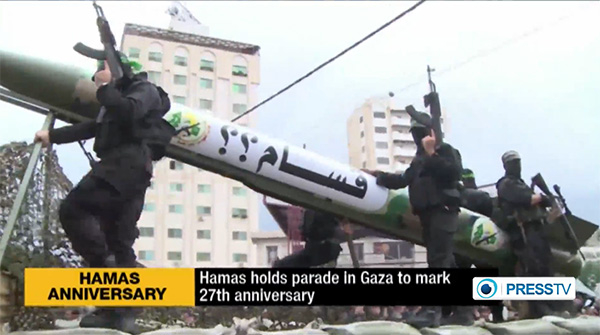
Ironically, the EU court’s decision coincided with Hamas celebrations marking the 27thanniversary of its founding. Once again, Hamas used the celebrations to remind everyone that its real goal is to destroy Israel. And, of course, Hamas used the event to display its arsenal of weapons that include various types of rockets and missiles, as well as drones.

845 (1)Thousands of armed Hamas troops showed off their military hardware at a Dec. 14, 2014 parade in Gaza, marking the organization’s 27th anniversary. (Image source: PressTV video screenshot)

Hours before the EU court decision was made public, Hamas leader Mahmoud Zahar announced that his movement would never recognize Israel. Zahar also made it clear that Hamas seeks to overthrow the Palestinian Authority [PA] regime and seize control over the West Bank.

The EU court’s decision also coincided with increased efforts to achieve rapprochement between Hamas and Iran. Recently, a senior Hamas leadership delegation visited Tehran as part of efforts to mend fences between the two sides. The main purpose of the visit was to persuade the Iranians to resume military and financial aid to Hamas. The visit, according to senior Hamas officials, appears to have been “successful.”

“There are many signs that our relations are back on the right track,” explained Hamas’s Musa Abu Marzouk. “Hamas and Iran have repaired their relations, which were strong before the Syrian crisis.” Relations between Hamas and Iran deteriorated due to the Islamist movement’s refusal to support the regime of Syrian President Bashar Assad.

Now the Iranians are likely to interpret the EU court decision to remove Hamas from the list of terrorist groups as a green light to resume financial and military aid to the movement.

Iran’s leaders recently announced that they intend to dispatch weapons not only to the Gaza Strip, but to the West Bank as well, as part of Tehran’s effort to support those Palestinians who are fighting to eliminate Israel.

Moreover, the EU court’s move will also embolden other countries that provide Hamas with political and financial aid, first and foremost Qatar and Turkey. Oil-rich Gulf countries such as Kuwait, Bahrain, Oman and Saudi Arabia will now face pressure from many Arabs and Muslims to join Qatar, Turkey and Iran in extending their support to Hamas.

The biggest losers, meanwhile, are Palestinian Authority President Mahmoud Abbas and Egypt’s President Abdel Fattah el-Sisi. Over the past few months, the two men have been doing their utmost to undermine Hamas and end its rule over the Gaza Strip.

Abbas has been fighting Hamas by blocking financial and humanitarian aid and arresting its supporters in the West Bank, while Sisi continues to tighten the blockade on the Gaza Strip and destroy dozens of smuggling tunnels along the border with Egypt.

The EU court’s decision represents a “severe blow to the Palestinian Authority and Egypt,” noted Palestinian political analyst Raed Abu Dayer. “As far is Abbas is concerned, the decision grants Hamas political legitimacy and challenges his claim to be the sole legitimate leader [of the Palestinians]. With regards to Egypt, the European court decision calls into question rulings by Egyptian courts that Hamas is a terrorist organization.”

Even if the EU court decision is reversed in the future, there’s no doubt that it has already caused tremendous damage, especially to those Muslims who are opposed to radical Islam.

Any victory for Hamas, albeit a small and symbolic one, is a victory for the Islamic State, Al-Qaeda, Islamic Jihad, the Muslim Brotherhood and other fundamentalist groups around the world.

The decision has left many Arabs and Muslims with the impression that Hamas, after all, is not a terrorist organization, especially if non-Muslims in Europe say so through one of their top courts. Even worse, the decision poses a real and immediate threat to Israel, as evident from the latest rocket attack.

If the Europeans have reached the conclusion that Hamas is not a terrorist organization, then why don’t their governments openly invite tens of thousands of Hamas members and supporters to move to London, Paris and Rome? And they should not forget to ask the Hamas members to bring along with them their arsenal of weapons.

Obama Admin Wants Hamas Ally Qatar to Remain Chief Broker in Peace Process

December 2, 2014

Obama Admin Wants Hamas Ally Qatar to Remain Chief Broker in Peace Process, Washington Free Beacon, December 1, 2014

(Please see also Hamas Declares Palestinian Unity Government Dead. According to the article republished below, “The State Department maintains that Qatar shares President Obama’s views about the Middle East peace process.” Their views have long been anti-Israel, pro-Islam. But what difference does it make nowThe “peace process” is already moribund and Qatar will administer the last rites.  — DM)

Khaled MashaalHamas chief Khaled Mashaal and Hamas Prime Minister Ismail Haniyeh / AP

Qatar promised the State Department it would not give more money to Hamas.

The State Department maintains that Qatar shares President Obama’s views about the Middle East peace process.

***********

The Obama administration is pressing for the Qatari government to remain a chief broker in the Israeli-Palestinian peace process despite the country’s longstanding financial support for the terror group Hamas, according to recent correspondence from the State Department to lawmakers on Capitol Hill.

Qatar—which has come under harsh criticism by lawmakers in recent months due to its longtime financial support for Hamas—has promised the Obama administration that it will not allow the terror group to benefit from a new $150 million cash infusion that is meant to go toward reconstruction efforts in the Gaza Strip, according to the letter.

The Obama administration will maintain its close ties with Qatar and push for it to have a key role in the tenuous peace process, despite protestations from lawmakers on Capitol Hill who say that the country cannot be trusted due to its close ties to Hamas, according to the letter sent by State Department officials late last month to Rep. Peter Roskam (R., Ill.).

Although Qatar has pledged in past years to give Hamas at least $400 million in aid, it has assured the United States that the next $150 million sent to the Palestinians will not make its way to the terror group.

“Qatar has pledged financial support that would be directed to the Palestinian people in Gaza,” Julia Frifield, an assistant secretary for legislative affairs at the State Department, informed Roskam in a Nov. 21 letter. “Qatar assured us that its assistance would not go to Hamas. We continue to interact closely with the government of Qatar and will reinforce that such assistance should not go to Hamas.”

The Obama administration in turn will continue to rely on Qatar to serve a role in the peace process and to engage with Hamas, according to the letter.

“Qatar has said it wants to help bring about a cease fire to the ongoing hostilities in Israel and Gaza,” the letter states. “The Qatari government has engaged with Hamas to this end.”

While the United States still regards Hamas as a terrorist organization, “We need countries that have leverage over the leaders of Hamas to help put a ceasefire in place,” Frifield wrote. “Qatar may be able to play that role as it has done in the past.”

Lawmakers and experts remain dubious that Qatar can be taken at its word given its robust support for Hamas in the past.

“It’s an indisputable fact that Qatar has become the chief sponsor of Hamas—an internationally recognized terrorist organization committed to the destruction of Israel,” Roskam said earlier this year after he petitioned the administration to reassess its close ties to Qatar.

“With Qatar’s financial backing, Hamas continues to indiscriminately launch thousands of rockets at our ally Israel,” Roskam said. “The Obama administration must explain its working partnership with a country that so brazenly funds terrorism right before our eyes, even going so far as turning to Qatar to help broker a ceasefire between Hamas and Israel.”

The administration cannot blindly trust Qatar to cut its close ties with Hamas, said one senior congressional aide who works on the issue.

“It appears the administration is willing to take Qatar for its word on funding some of the world’s most dangerous terrorist organizations, and the notion that Qatar can simultaneously fund Hamas and help broker and Israeli-Palestinian peace treaty is laughable,” the source said. “Congress is intent on holding the Qataris responsible for their illegal behavior and send a message that under no circumstances should the United States tolerate such brazen support for terrorism.”

The State Department maintains that Qatar shares President Obama’s views about the Middle East peace process.

“Qatar has welcomed President Obama’s commitment to a solution to the Israeli-Palestinian conflict and shares the view that such a solution would advance security, prosperity, and stability in the Middle East,” the letter states.

In addition to its role in the peace process, the administration believes that Qatar can help in the international fight against terrorism and groups such as the Islamic State (IS).

“We remain strongly committed to working with Qatar to confront ongoing terrorist financing and advance our shared regional goals,” the State Department told Roskam, noting that more than 8,500 U.S. troops are housed at the country’s Al Udeid Air Base.

“We also have a productive relationship with Qatar on key regional issues ranging from Syria to Iran,” the State Department wrote.

Who is the Real Chickenshit?

November 4, 2014

Who is the Real Chickenshit? Gatestone InstituteBassam Tawil, November 4, 2014

(Are attempts to spawn a new Islamic Caliphate more grounded in fantasy than Obama-Kerry perceptions of the Islamic State, grounded in their ill-formed perceptions of fact and ideology? Or less? — DM)

Judging by their actions, most Arab leaders do not want to create yet another terrorist Islamist state, dedicated to the Muslim Brotherhood’s ideology and to toppling their regimes. We do want a Palestinian state, but please, only one that will provide responsible governance.

According to the “Arab street,” it is the Americans and Europeans who are cowards, afraid to take significant steps against Iran, and terrified of the Islamic ghettoes in their cities, which have been exporting terrorists to fight for the Islamic State, and providing housing to the seasoned fighters who return.

To Arabs, the ultimate irony is that America is paying Qatar to have its airbase there, while Qatar is paying terrorists to kill Americans.

When John Kerry claimed it was the unresolved Palestinian issue that caused a ripple effect that crated ISIS, he simply inspired the Palestinians to use Al-Aqsa mosque as a religious trigger for future bloodshed.

There is a civil war currently under way between radical Islam — motivated by imperialist fantasies of restoring the Islamic Caliphate — and the more moderate secular Muslim regimes that are seeking the path to modernization and progress.

At the same time, Sunni Islam is in the midst of an increasingly violent crisis in its dealings with Shi’ite Iran, which looks as if it is about to be granted nuclear weapons capability, and which for decades quietly has been eyeing neighboring Arab oil fields.

Into the middle of this explosive disarray, U.S. Secretary of State John Kerry and his supporters have thrown the accusation that it was actually Israel’s so-called refusal to reach a peace agreement that was responsible for the ripple effect that led to the creation of ISIS. This incorrect diagnosis of the situation merely postpones the West’s efforts to find a real, workable solution for the Palestinian issue.

774Does Kerry really blame Israel for ISIS? Above, U.S. Secretary of State John Kerry meets with Israeli Prime Minister Benjamin Netanyahu in Tel Aviv, Israel, on July 23, 2014. (Image source: U.S. State Department)

It is easy for the leaders of the Arab world to latch onto Kerry’s accusation and use it justify their weakness and unwillingness to enter into a direct battle against terrorism; to let America do the dirty work, and conveniently to relieve the Arab world of having to recognize Israel and establish a Palestinian state.

They would also be able to avoid dealing with Israel’s demand for the Palestinian territories to be disarmed and the Palestinians’ demands for concessions from Israel.

Judging by their actions, most Arab leaders have no desire to see the Palestinian issue resolved. They seem to prefer preserving the status quo. They blame Israel for refusing to make concessions to the Palestinians and hope that this refusal will weaken Israel, even though Israel is their strategic defense against Iran.

Most Arab leaders do not want to create what is bound soon to become yet another terrorist Islamist state, dedicated to the Muslim Brotherhood’s ideology and to toppling their regimes. The Arab leaders already have to contend with ISIS, Al-Qaeda and the Al-Nusra Front in Syria, Iraq, Libya and Yemen, which are enough for them, to say nothing of Africa from Nigeria to Somalia and everything in between.

But if Israel can be blamed for another of world’s ills, with Kerry’s blessing, why waste the opportunity?

When Jordan’s King Abdullah called the current Islamic civil war a cry of distress, he was not speaking randomly. There is a genuine problem.

No examples are better than Turkey, Qatar and Iran. Turkey, led by its president, Recep Tayyip Erdogan, hosts Hamas’s overseas command center; is supported by Qatar and would apparently like to take control of more Sunni territory by subverting the Sunni Arab monarchies. Such a move would enable Erdogan to realize his outspoken dream of recreating an Ottoman Empire and Caliphate.

Turkey and Qatar, its partner in plotting the return of the Caliphate, have left their fingerprints on most of the terrorist attacks and catastrophes currently visited upon the Middle East, especially in the fields of subversion, incitement to terrorism, and the arming and training of terrorists.

The Middle Eastern Sunni Islamist terrorist organizations, meanwhile, are being incited and indoctrinated by Al-Jazeera TV, a Muslim Brotherhood megaphone that belongs to Qatar’s ruling al-Thani family. It was Al Jazeera’s Arabic channel that created the “Arab Spring” by taking the story of a fruit-seller who merely wanted a permit, and whipping it up, non-stop, until it grew into a revolution that brought down Tunisia’s government.

The Middle East’s terrorist gangs are now armed and trained with funding from Qatar. Recently, in yet another savored irony, Turkey agreed to help train Syrian rebels and allow the U.S. to use its military bases — but for Turkey, the plan is probably to bring down Syria’s non-Sunni President, Bashar Al-Assad, and not, as the U.S. might imagine, to bring down ISIS.

In the past, Persian Gulf states such as Saudi Arabia joined in training Islamic terrorist cadres, but currently, as the Arab proverb goes, “The magic spell boomeranged,” and Saudi Arabia and its Gulf allies have to defend themselves from the very groups they helped create.

Terrorist organizations are now generously funded by Qatar and NATO-member Turkey, which inspire them to attack the regimes of Egypt, Syria, Iraq and Jordan, and various regimes in the Persian Gulf and Africa. Of course, they are all also inspired to attack Israel, as Hamas has done.

Turkey and Qatar are also exploiting the naiveté of the Western world, encouraging ISIS operatives to make preparations to attack Europe and the United States. Preachers of “political Islam” incite susceptible Islamic youths in the West and prepare them for a terrorist campaign. They use the West’s political correctness, free speech and support for “pluralism,” all the while insisting they are not preaching terrorism.

Turkey and Qatar, along with Iran — which does its utmost to export the Ayatollah Khomeini’s Islamic Revolution throughout both North and South America, as well as Syria, Lebanon, Iraq and Yemen — are aided by a mechanism known as the da’wah, or “outreach,” Da’wah, technically the preaching of Islam, is used by political Islam for indoctrinating, enlisting and handling Islamist terrorists worldwide. Perfected for terrorist purposes by the Muslim Brotherhood, its mouthpiece is Sheikh Yusuf al-Qaradawi, who, like Hamas’s leader, Khaled Mashaal, is based in Qatar.

While Iran’s rivals, the Sunni states, conduct their civil wars, Iran only becomes stronger. Not only is it turning itself into a nuclear power, it is also strengthening all its outposts in the Middle East and around the world. It supports the Shi’ite regime in Iraq against ISIS; it arms and funds the Houthis in Yemen and the Hezbollah in Lebanon; and it supports the Syrian Alawite regime against its Sunni opponents.

When it comes to terrorism, Iran does not draw partisan lines. It also supports the Sunni groups Hamas and Palestinian Islamic Jihad, both of which seek to destroy Israel and attack the Egyptians in the Sinai Peninsula.

In response to the colossal threat of radical Islam, the whimpering voice of the West can barely be heard. The U.S. administration targeted Israel for condemnation. A “senior official,” most likely the current White House Chief of Staff Denis McDonough, called Israel’s Prime Minister Benjamin Netanyahu a “chickenshit,” for being afraid to make peace with the Palestinians.

According to the “Arab street,” including the Palestinian street, it is the Americans and Europeans who are cowards, afraid to take significant steps against Iran, and terrified of the Islamic ghettoes in their cities, which have been exporting terrorists to fight for the Islamic State, and providing housing to the seasoned fighters who return.

The Sunni states under Shi’ite threat cannot even reach an agreement among themselves about what is to be done; and the Palestinians, in their folly, have chosen the worst possible moment to ignite violence in Jerusalem and the Al-Aqsa mosque. The Palestinians seem not to understand that the Arab regimes that might support them are currently busy fighting for their own survival, and have no desire to fall prey to Palestinian provocations about what they realize all too well are fictional threats to Jerusalem.

Given the current situation, Turkey’s regional political actions are dangerous, underhanded and hypocritical. To achieve their ends, Turkey’s leaders seem to have no qualms about sacrificing their minorities, such as Christians and the Kurds (most of whom are Sunni). Turkey’s leaders were the first to cry “humanitarian crisis” when Israel imposed a closure on the Gaza Strip to prevent Iran from sending Hamas arms. Turkey sent the Mavi Marmara flotilla to protect the Gazans, who were never in any danger in the first place. Turkey’s leaders then weakened Palestinian Authority President Mahmoud Abbas, who, at least at that time, showed himself willing to reach a peace agreement with the Israelis. But when Syria’s Kurds are being killed in Kobani on a daily basis, the Turks are silent, perhaps secretly comfortable seeing a group that wants a state of its own apart from Turkey, being attacked.

Thus, when John Kerry claimed that it was the unresolved Palestinian issue that caused a ripple effect that created ISIS, he simply inspired the Palestinians to use Al-Aqsa mosque as a religious trigger for future bloodshed. The idea is not new; it was used in 1929 by the Grand Mufti of Jerusalem and led to anti-Jewish riots and the massacre of the Jews in Hebron. It was used again by PLO Chairman Yasser Arafat in 2000, to incite the Palestinians to the second intifada, which killed untold numbers of Jews and Arabs. Today, Mahmoud Abbas and Hamas’s Khaled Mashaal are doing the same thing to incite a jihad that this time will truly be religious and not based on real estate.

The more Kerry accuses Israel of having had a hand in creating ISIS, the more the Palestinians will use Al-Aqsa mosque to stir the fire burning under the bubbling cauldron of the Middle East.

The Palestinians’ religious incitement campaign is currently being waged primarily by Mahmoud Abbas, the man who stood in front of the UN and accused Israel of fomenting a religious war. This is the same Mahmoud Abbas who calls on Palestinians to use every means available to fight Israel, while at the same time denying that he is doing so.

Meanwhile, Qatar lurks in the background, instructing Al-Jazeera TV to incite the Palestinians against Israel, Egypt and Jordan, and encouraging terrorist attacks that lead only to justified Israeli reprisals.

Qatar’s royal family hides behind the security of having a major U.S. airbase on its soil, while supporting Hamas, the Islamic Movement in Israel and the terrorist organizations in the Sinai Peninsula. To Arabs, the ultimate irony is that Americans are paying Qatar to have an airbase there, while Qatar is paying terrorists to kill Americans.

Qatar also still finds time nonsensically to accuse the wakf in Jordan, responsible for Al-Aqsa mosque, of collaborating with Israel to eradicate all signs of Muslim presence on the Temple Mount. Qatar’s only plan with that at the moment, however, is to cause riots in Jordan to oust Jordan’s king.

Inspired by Western accusations against Israel and the West’s enthusiastic recognition of a Palestinian state — without requiring the direct negotiations with Israel, as obligated by international treaties — the Palestinian leadership has become more radicalized.

Mahmoud Abbas has gone so far as to abandon his pretense of moderation: if the Israelis can be accused of creating the ISIS with no mention made of the culpability of Hamas, whose ideology is the same as ISIS’s, Mahmoud Abbas has been freed of any commitment to peace and can actively pursue the unilateral declaration of a Palestinian state.

In addition, witnessing Russia’s abrogation of its 1994 Budapest Memorandum with the Ukraine, with virtually no adverse consequences, must have seemed a precedent too tempting to ignore. Thus, the Palestinian Authority and Hamas do truly speak with one voice, but it is the voice of Hamas.

Khaled Mashaal, head of Hamas’s political bureau, called on all the Palestinians to take up arms to defend Al-Aqsa mosque in Jerusalem. The mosque, he said, justifies jihad and the sacrificing of shaheeds [martyrs] to liberate it, and, as in the Hamas charter, that “resistance” is the only solution for the problems of the Palestinian people.

Mashaal was echoed by Mahmoud Abbas at the 14th Fatah conference. Abbas said that under no condition were Jews to be allowed into Al-Aqsa mosque or the Church of the Holy Sepulcher, because any Jewish presence would defile them. On whose authority did he take possession of the Christian holy sites? A short time earlier, Abbas had even claimed that he had no intention of inciting a third intifada against Israel.

Somehow, John Kerry has managed to link to Israel the Shi’ite-Sunni civil wars, radical Islam’s Muslim Brotherhood-inspired global plot and the creation of ISIS. Then he linked the failure of the Palestinian issue to have been resolved to Israel’s Prime Minister Benjamin Netanyahu.

The unpopular and inconvenient truth is: if there is to be peace, Hamas has to be disarmed, the Palestinian Authority and the Gaza Strip have to be demilitarized, Mahmoud Abbas has to recognize the State of Israel as the homeland of the Jews, and Netanyahu has to recognize the Palestinians state. Israel will then compensate the Palestinians with land in return for the land on which the three large blocks of settlements stand, as has already been agreed.

It is not Israel but the Palestinians who are trying to avoid negotiating a final agreement. They see themselves, with the backing of the UN and Secretary Kerry — and in a final breakdown of any trust in future international agreements — as able to achieve their desired result without having to make any concessions.

People who repeat infamies, as Kerry has done, not only encourage radicalism, they are just delaying the establishment of a Palestinian state. We do want a Palestinian state, but please only one that will provide responsible governance.