Posted tagged ‘Putin’

Putin: Russia to respond if Finland joins NATO

July 1, 2016

Putin: Russia to respond if Finland joins NATO

Published time: 1 Jul, 2016 16:33 Edited time: 1 Jul, 2016 17:42

Source: Putin: Russia to respond if Finland joins NATO — RT News

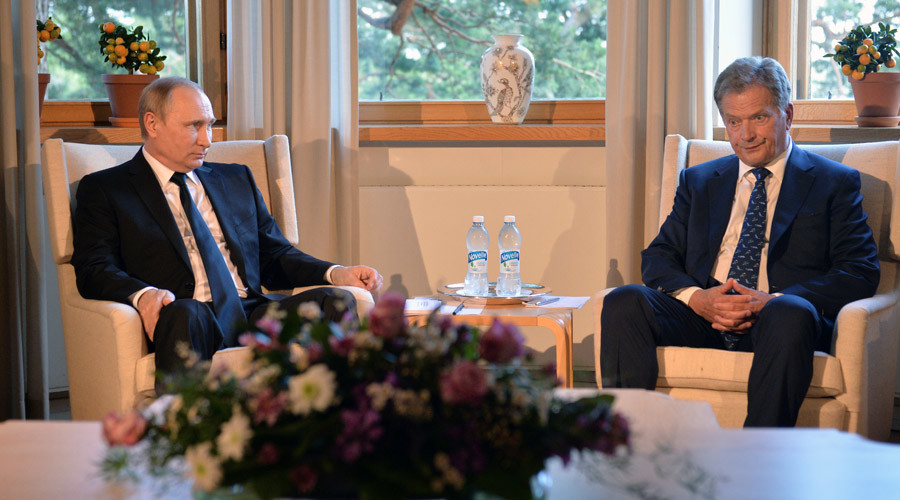
July 1, 2016. Russian President Vladimir Putin, left, and President of Finland Sauli Niinisto meet in Naantali. © Alexei Druzhinin / Sputnik

Russia will respond accordingly if neighboring Finland joins NATO, Russian President Vladimir Putin has said. However, he added that Moscow will try to begin a dialogue with NATO despite its expansion towards Russia’s borders.
Read more

©

“The Finnish president came up with the proposals today on the first steps aimed at enhancing confidence and preventing conflicts [in the Baltic airspace]. I have already said that I agree with this. We will try to begin the dialogue with NATO at the summit in Brussels,” Putin said on Friday.

Putin and Finnish President Sauli Niinisto agreed to develop a set of security measures to control flights over the Baltic Sea. Finland’s president said military flights should avoid turning off their identification devices in the region, which is frequented by both Russian and NATO planes.

We all know the risk with these flights and I have suggested that we should agree that transponders are used on all flights in the Baltic Sea region,” Niinisto said.

Putin, in turn, noted that NATO planes conduct flights over the Baltics with their transponders off twice as often as Russian planes.

Read more

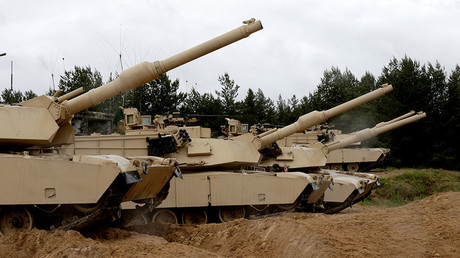
U.S. M1 Abrams tanks take part in the NATO military exercise

“The number of NATO planes [with transponders off] is twice as high as that of Russian planes,” Putin said citing statistics.

“We welcome the Finnish President’s proposal [to ban flights over the Baltics with transponders off]. Upon my arrival back in Moscow I will order the Foreign and Defense Ministries to raise this matter at the upcoming Russia-NATO Council meeting, which is to take place after the Russia-NATO summit in Warsaw,” he added.

Putin said Russia will respect Finland’s choice if it decides to join NATO, but will have to respond accordingly.

Do you think we will continue to act in the same manner [if Finland joins NATO]? We have withdrawn our troops 1,500 [km from the border]. Do you think they will stay there?” he told reporters.

The remarks were made at a joint press-conference of the two heads of state following their talks at the Kultaranta summer residence of the Finnish president.

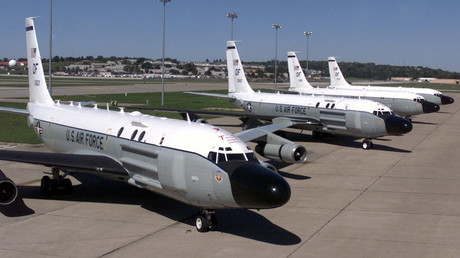
Russia intercepted several US aircraft over the Baltic Sea in close proximity to the country’s border in recent months, claiming the planes in question had their identification devices turned off.

First ever Israeli-Russian war game is coming

June 10, 2016

First ever Israeli-Russian war game is coming, DEBKAfile, June 10, 2016

Levyatan480

Russian President Vladimir Putin and Israeli Prime Minister Benyamin Netanyahu decided at their June 7 meeting in Moscow to deepen the military ties between the Russian and Israeli armed forces, DEBKAfile reports exclusively from is military and intelligence sources. It was a historic decision that spells the end of the IDF’s unique relationship with the US military.

The head of the IDF’s military intelligence branch, Maj. Gen. Hertzi Halevi, and Mossad chief Yossi Cohen also participated in the meeting.

Our sources report that Putin and Netanyahu decided that a joint exercise by the Israeli and Russian naval and air forces will be held this summer as part of the first stage of expanded ties.

It will mark the first time in modern Middle East military history that Russian military planes take off from an Arab country, Syria’s Hmeymim airbase, and Russian warships sail out of their bases in Tartus and Latakia, for joint maneuvers with the Israeli air force and navy.

DEBKAfile’s military sources add that, ahead of the exercise, the joint mechanism that coordinates Russian and Israeli air flights in Syrian airspace will be expanded.

According to those sources, the bilateral decision for the joint war game was tied to an agreement to allow Russian gas companies to compete for contracts to develop Israel’s Leviathan and Tamar offshore gas fields.

Netanyahu said June 7 in Moscow, “Our doors are open now to all companies from all countries that have substantial experience in developing gas fields, including Russia of course.”

Putin had tried repeatedly to win a foothold for Russian companies, especially energy giant Gazprom, in the development of Israel’s offshore gas fields and export industry. The Russian leader tried to convince Netanyahu by saying that the presence of the Russian navy and air force in the area would guarantee that no Arab or Muslim military force, such as those of Iran, Syria and Hizballah, would attack the gas fields.

DEBKAfile’s military sources point out that increased cooperation between the navies of the two countries could serve as a basis for regional and economic cooperation and for the defense of any future Gazprom energy infrastructure in the Mediterranean.

In the long term, the combination of Russia’s massive warships and Israel’s smaller and faster vessels built for rapid response to any attack along its coast, may provide an effective defense of energy assets in the Mediterranean basin, especially in the region of Cyprus, Greece, Turkey and Israel.

These assets would include shipping routes, drilling platforms, gas pipelines and undersea optic cables, among others.

Alongside the advantages, cooperation with a world military power like Russia holds operational, intelligence, tactical and strategic risks.

Although the joint exercise will be of limited scope, it needs advance preparation, a careful division of tasks, missions and resources, assignment of flight paths and sea routes, and goals preset as benchmarks for measuring the joint drill success. Radio and other communication networks must be set up and the degree of intelligence sharing determined. Both the Russian military and the IDF appreciate that this shared maneuver may result in mutual exposure of some of their military secrets.

To play it as safe as possible, Putin and Netanyahu decided to hold their joint exercise high in the sky and far out at sea, in an effort by both to guard their military secrets as far as possible.

Suddenly Russia consents to consider Assad’s ouster

May 4, 2016

Suddenly Russia consents to consider Assad’s ouster, DEBKAfile, May 4, 2016

Washington and Moscow have made dramatic progress over the last few days in marathon telephone talks between Secretary of State John Kerry and Foreign Minister Sergei Lavrov on ending the war in Syria. Russia agreed for the first time to discuss the possibility that Syrian President Bashar Assad will step down, and the conditions under which such a process will take place, according to DEBKAfile’s intelligence sources.

The sources add that the Russians also agreed to begin to negotiate the future of senior Syrian military commanders who are carrying out the war against the rebels. The contacts that include the Saudis and the Jordanians have reached such an advanced stage that participants have started to prepare lists of Syrian commanders who will be removed or remain in their posts.

One of the clearest signs of the progress was the arrival of nearly all of the heads and commanders of the Syrian rebel organizations on Monday and Tuesday (May 2-3) for intensive talks at the US Central Command Forward-Jordan, a war room outside Amman staffed by officers from the US, Jordan, Saudi Arabia and the UAE. The gathering was arranged via a series of meetings held in Geneva over the last few days between the top diplomats of the US, Saudi Arabia and Jordan.

Our sources report that US officials and senior officers in charge of the Obama administration’s strategy for the war in Syria presented the rebel leaders and commanders with a series of agreements already reached by Washington and Moscow on ways of ending the war. The main part of the agreement focused on the resignation of Assad and the departure of him and his family from the country-the Syrian opposition’s key demand for continuing the talks.

The rebel leaders were asked by the US officials and officers, who were accompanied by Saudi and Jordanian officials, to help facilitate implementation of the agreed measures and not to try to interfere with them, or in other words, to stop the fighting.

According to the information from our sources, the discussions in Jordan are continuing.

Washington’s current goal is achieve a ceasefire in all of Syria that will prevent an imminent attack by Russian, Iranian, Syrian and Hizballah forces on Aleppo, the country’s second-largest city.

Our military sources report that on Monday and Tuesday, by order of President Vladimir Putin, the Russian air force suddenly halted its airstrikes in the Aleppo area.

Thus, the Iranian, Syrian and Hizballah armies are preparing to launch their assault without the air support needed to capture the city. Even though the Syrian air force can operate in an uninhibited manner in the Aleppo area, it is not up to a large-scale and decisive attack.

No specific information is forthcoming for the Russian U-turn on Assad ousters in mid offensive for the recovery of Aleppo.

However Putin is prone to sudden zigzag in policies.

Iran’s army chief takes command in Syria

May 2, 2016

Iran’s army chief takes command in Syria, DEBKAfile, May 2, 2016

Iranian ground forces commander

Israel must be prepared for the possibility that the Iranian chief of staff will personally take charge of the deployment of Iranian, Syrian and Hizballah forces along Syria’s border with the Golan Heights.

*********************

The chief of staff of the Iranian military, Maj. Gen. Hassan Firouzabadi, arrived in Damascus on April 30 to assume direct command of the Iranian, Syrian and Hizballah forces fighting in Syria, DEBKAfile’s military and intelligence sources report. His arrival showed Iran has significantly stepped up its military involvement in Syria.

Sources close to Iranian supreme leader Ayatollah Ali Khamenei said May 1 in Tehran that the general arrived in Damascus “to personally supervise the battles and the borders that were determined.” The sources did not specify which battles he would command or who had set the borders. They also did not say whether the borders referred to those of the war raging in Syria, or the country’s sovereign borders.

According to DEBKAfile’s sources in Moscow and Tehran, just as Russian President Vladimir Putin and his country’s military command see the current offensive by Russian, Iranian, Syrian and Hizballah forces around Aleppo as the climax of the Russian military intervention, the Iranians see the battle  for Aleppo as pivotal for the future of Syrian President Bashar Assad’s regime, as well as Tehran’s standing in Damascus.

Tehran also believes that the battle around Syria’s largest city will play a major role in determining all of the country’s borders, not just its northern one.

Our sources report that there are sharp differences between Moscow and Tehran on this point. It seems that the main role of Maj. Gen. Firouzabadi will be to ensure that immediately after the capture of Aleppo, his country’s forces will focus their operations on other areas of Syria where Iran, not Russia, has strategic interests.

One example of such an area is southern Syria, which borders both Israel and Jordan.

In other words, Israel must be prepared for the possibility that the Iranian chief of staff will personally take charge of the deployment of Iranian, Syrian and Hizballah forces along Syria’s border with the Golan Heights.

Until now, Israel’s government and military command had believed that it was possible to secure the northern border though understandings with Putin. But now, that assessment has been proven to be mistaken with the arrival of the Iranian general in Damascus, and Tehran’s announcement that Firouzabadi will deal with the issue of borders, among others.

DEBKAfile’s military sources point out that another main reason for the dispatch of the chief of staff is the fact that Iran has sent large forces from elite units of its standing army to Syria during the last month. It is the first time in Iran’s modern history that its standing army forces have been sent to fight beyond the country’s borders.

Over the past few weeks, the arrival of Iran’s 65th Airborne Brigade of the Special Forces-NOHED brigade drew particular attention.

Our sources report that this brigade will serve as the spearhead of the Iranian, Syrian and Hizballah assault on rebel positions in Aleppo.

According to the understandings reached by the Russian and Iranian general staffs, there is a clear division of responsibility between the forces of the two sides in the campaign. The Russian air force and heavy artillery will strike the rebel bases and positions in and around the city, while the Iranians, Syrians and Hizballah advance on the ground. After those forces surround the rebels in Aleppo, they will launch an all-out attack.

Is Obama plotting yet again to harm embattled Israel?

April 19, 2016

Is Obama plotting yet again to harm embattled Israel? American ThinkerVictor Sharpe, April 19, 2016

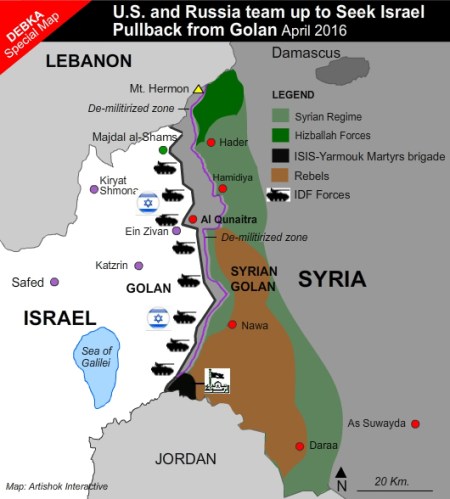
According to a report dated April 16, 2016 in the sometimes reliable Debka Special Report,Israel’s top political leaders and military commanders were stunned and shocked last weekend when they found out that US President Barack Obama and Russian President Vladimir Putin have agreed to support the return of the Golan to Syria.”

If this is true, Barack Hussein Obama is plotting yet again a way to torment the Jewish state with yet another vile edict, one which clearly has nothing to do with enlightened statecraft but much more to do with evil witchcraft.

The occupant in the Oval Office cannot salivate enough at the prospect of harming Israel’s security and survivability. No doubt he is fulfilling a malevolent pact he has made with a cabal of Islamists and extreme leftists; both of which ideologies have satanic hatred for Israel.

With this threat hanging over the strategic territory known as the Golan Heights, it is time once again to learn its history and Biblical significance.  Even as modern day Syria is convulsed in a murderous and bloody civil war with untold thousands dead and maimed; even as its tyrant, Bashir al-Assad, fights for his political and physical life; even with all this, he nevertheless spews forth his hatred of Israel and his call to take away the Golan Heights from the Jewish state.

But so do those “rebels” who are fighting him and thus remind us of the famous aphorism: “better the devil you know,” or better still, “a plague on all your houses.”

Those of us who have stood on the Golan’s 1,700 foot steep escarpment, are struck by its immense strategic value overlooking Israel’s fertile Hula Valley and the beautiful harp-shaped lake below, called in Hebrew, Kinneret (better known as the Sea of Galilee.)

But during Syria’s occupation of the territory, no agriculture of any significance took place and no restoration of its terrain was ever undertaken. Instead, the Golan was a giant Syrian army artillery encampment whose sole purpose was to deliberately rain down upon Israeli farmers, fishermen and villagers an endless barrage of shells.

So what is the history of the Golan Heights and what is its overwhelming biblical significance to the reconstituted Jewish state? Perhaps we should return primarily to the biblical books of Joshua and Numbers.

Before the Tribes of Israel would cross the River Jordan and enter the Promised Land, the first among them had already taken possession of territory east of the River Jordan. These were the half tribes of Manasseh, Gad, and Reuben who liberated the Bashan and Gilead from the Amorites.

Biblical Bashan incorporates today’s Golan Heights. Gilead is the fertile land, which lies in what is the north eastern area of today’s Kingdom of Jordan:

“ … a little balm, and a little honey, spices and myrrh, nuts and almonds” (Gen 43:11.)

 It was Canaan, west of the Jordan, (including today’s so-called West Bank) which would pose the formidable challenge to Joshua bin Nun, the general leading the Israelite tribes.

So it was that Moses, the Lawgiver, spoke to the children of Gad and Reuben thus:
“Shall your brethren go to war, and shall you sit here?” (Numbers 32:6) The leaders of the two tribes replied that they would indeed send their warriors west into Canaan and fight alongside their brethren while their families would remain behind.

“We will build sheepfolds here for our cattle and cities for our little ones. But we ourselves will go ready armed before the children of Israel until we have brought them unto their place: and our little ones shall dwell in fenced cities because of the inhabitants of the land. We will not return unto our houses until the children of Israel have inherited every man his inheritance.” (Numbers 32: 16-18)

The story of reconstituted Israel and its people is mirrored in the biblical story of those ancient ancestors. The young men and women of modern Israel have gone again and again from their homes; be they villages, towns or cities, to the borders and established communities there in times of danger and peril, just like those young men did from the biblical tribes of Gad and Reuben.

The Jewish pioneers of today in Judea and Samaria — the biblical and ancestral heartland known today as the “West Bank” — are no different.

But the world has chosen to demonize them as ‘‘obstacles to peace” and an impediment to the creation of a fraudulent Arab state to be called Palestine; a state that has never existed in all of recorded history; and certainly not as a sovereign independent Arab state.

The pioneers are now called “settlers” and their homes and farms derisively called “settlements.” It matters not to the infernal chorus that sings the international siren song of hate and ignorance that these pioneers are returned to their ancestral homesteads and seek to take up their ploughshares to sow, to plant and re-possess their homeland.

But the purpose of this article is also to learn about the biblical and post biblical history of the Jewish descendants of Gad, Reuben and Manasseh. Such facts, of course, will not persuade the likes of Barack Hussein Obama as he plots and schemes.
 The Bashan region, now known as the Golan Heights, is a part of the biblical territory promised to the Patriarch Abraham and the people of Israel for an everlasting covenant — the Covenant of the Parts — recounted in Genesis 15. The city of Bashan was a refuge city (Deut, 4:43).

During the biblical period of the Jewish Kings, a battle high on the Golan took place between King Ahab and the army of Aram. A Jewish victory occurred at the present site of Kibbutz Afik, which lies a few miles east of Lake Kinneret, the Sea of Galilee.

After the end of the Babylonian Exile, and during the Second Temple Period, Jews returned to their homes on the Golan. Subsequently the returnees were attacked by gentiles and Judah Maccabee brought his forces up to the Heights to defend them.

At the conclusion of the Hasmonean Period, King Alexander Yannai finally re-conquered the Golan and Jews returned yet again. They rebuilt communities in central Golan, including the major cities of Banias and Susita, which formed part of the defense of the Golan.

Their residents fought heroically against the Roman legions during the Great Revolt of 135 AD, known also as the Second Uprising. It was led by the charismatic Shimon Bar Kokhba, known as the “Son of a Star” and a Jewish folk hero. Some 10,000 residents of Gamla alone perished fighting against Rome.

Second century Jewish coins were found on the Golan after its liberation during the last days of the June, 1967 Six Day War. These ancient coins were inscribed with the words, “For the Redemption of Holy Jerusalem.”

In the succeeding period of the Talmudic Period, Jewish communities flourished and expanded. Archaeologists have found the remains of 34 synagogues on the Golan. Jewish life on the Golan largely ended after the defeat of the Byzantine army by Arabs from Arabia carrying the new banner of Islam and the region descended into a long period of neglect.

But Jewish life returned yet again in the latter years of the 19th century when members of the Bnei Yehuda society from Safed purchased land on the Golan. In 1891, Baron Rothschild purchased around 18,000 acres in what is present day Ramat Magshimim.

The Jewish pioneers of the First Aliyah (immigration) began to farm land they had purchased in the Horan region until the Turkish Ottoman occupiers evicted them in 1898. Their land was then seized, and in 1923 the entire Golan was given away by Britain to the French Mandate over Syria and Lebanon.

Zionist leaders had earlier demanded the Golan be included within the new Jewish National Home because of its immense historical roots in biblical and post-biblical Jewish history. But Jewish liberation of the ancestral land was not possible until Israel was forced to fight for its very survival during the Six Day War.

The Golan is only 60 miles from Haifa; and the slopes of Mount Hermon, the highest point in the region, are the present eyes and ears of Israel. The Golan Heights were officially annexed to Israel in 1980. But it was the left wing Israeli Prime Minister, Yitzhak Rabin, who first offered to give the Heights away in 1994.

Since then, Israelis have winced at the wrenching offers made by subsequent left leaning Israeli governments and politicians who declared publicly their desire to give the entire Heights to the Syrians in return for a delusional peace. The overwhelming majority of Israelis are adamantly opposed to any such suggestion.

The Baker-Hamilton Iraq Study Group suggested that a way out for the United States from its Iraqi imbroglio would be for Israel to give the Golan Heights away to Syria. This, it was believed by the ISG, would bring Syria into responsible nationhood and wean her away from support of the “insurgents” attacking Iraqi and U.S assets. Of course this was before the successes of the “Surge” instituted by General Petraus made such a suggestion moot.

President Obama mistakenly renewed diplomatic relations with Syria as a way, he believed, of distancing the Arab dictatorship from its alliance with Iran. This was yet another delusional act by the current U.S. President whose foreign policy is in tatters.

But Obama’s carrot to the Syrian dictator, should it ever be resurrected, inevitably will be the Golan Heights. Again and again, he chooses to appease Arab and Muslim tyrants and it is becoming more and more apparent that indeed he is preparing to apply brutal pressure against Israel to force it to give away yet more of its biblical patrimony.

 But what would such pressure on Israel to withdraw from the Golan Heights mean? Bringing down the Israeli radar stations on the Hermon Massif to the valley floor below would seriously degrade any warning of future hostile Syrian attacks.

It would further hamper Israel’s ability to prevent attacks upon it by Syrian forces and by Hezb’allah, now armed to the teeth by the Iranian mullahs and with an estimated 150,000 missiles aimed at Israel and hidden among Lebanese civilians.

To put any trust in an Arab nation, especially the Iranian-backed Syrian regime, is truly mind boggling. Besides which, the so-called rebels fighting the Syrian regime have already stated that their ambition is also to take the Golan from Israel at the same time that they plan on making Syria yet another Islamic Republic and a future part of an Islamic Caliphate.

And consider this. The British colonial power gave away the Golan to France’s Syrian colony in 1923. Syria attacked Israel in 1967 and lost the Golan. Syria had occupied it for 44 years. Israel’s liberation of the Golan has lasted nearly 50 years. Ask yourself then, who has possessed the Golan the longest?

Any thought of being brutally forced by Obama and Putin to abandon biblical Bashan (the Golan) with its immense strategic value to such Islamist foes as exist in Syria would be a betrayal of a loyal ally of the United States and of those first Jewish ancestors on the Golan who long ago “built sheepfolds for their cattle and cities for their little ones.”
 

IDF’s drill secures Netanyahu-Putin summit

April 18, 2016

IDF’s drill secures Netanyahu-Putin summit, DEBKAfile, April 18, 2016

1 (3)

The IDF launched an unannounced military-air exercise in northen Israel Monday April 18. It will also be held in the Jordan valley, strategically located south of the Golan Heights and the Sea of Galilee. Despite the official explanation that the drills are part of the IDF’s training schedule for 2016, it is difficult not to see it as a follow-up to the Cabinet meeting on the Golan the previous day, including Prime Minister Benyamin Netanyahu’s declaration that “Israel will never withdraw from the Golan.”

Just as the Cabinet meeting was an “emergency” one, the exercise is not part of standard training, as an IDF statement claimed, but rather part of the overall picture of the war in Syria on the other side of the northeastern border.

The drill is mainly intended to prevent a possible attack by ISIS, Syrian, Iranian or Hizballah forces aimed at torpedoing Netanyahu’s discussions in Moscow with Russian President Vladimir Putin on Thursday, April 21.

DEBKAfile’s military sources report that the IDF exercise shows only half of the military picture in the area.
On the other side of the border, in the triangular pocket where the Israeli, Syrian and Jordanian borders meet, heavy fighting has been underway for several days between Syrian rebels and forces of the Yarmouk Martyrs Brigades and the al-Muthanna organization, which have both sworn allegiance to ISIS. The battles are taking place across from Israel’s Hamat Gader, south of the Sea of Galilee, which is the reason why the exercise is also being held in the Jordan Valley.

On the other side of the border, in the triangular pocket where the Israeli, Syrian and Jordanian borders meet, heavy fighting has been underway for several days between Syrian rebels and forces of the Yarmouk Martyrs Brigades and the al-Muthanna organization, which have both sworn allegiance to ISIS. The battles are taking place across from Israel’s Hamat Gader, south of the Sea of Galilee, which is the reason why the exercise is also being held in the Jordan Valley.

On the other side of the border, in the triangular pocket where the Israeli, Syrian and Jordanian borders meet, heavy fighting has been underway for several days between Syrian rebels and forces of the Yarmouk Martyrs Brigades and the al-Muthanna organization, which have both sworn allegiance to ISIS. The battles are taking place across from Israel’s Hamat Gader, south of the Sea of Galilee, which is the reason why the exercise is also being held in the Jordan Valley.

On Sunday, the leader and commander of Al-Muthanna was killed during the fighting. The goal of the rebel attack is to capture the Syrian villages in the territory held by ISIS, which threatens the Galilee and the Golan communities of Tel Katzir, Shaar Hagolan and Masada. Sources in Kuwait reported last week that Jordanian special forces and Israeli drones marked in the colors of the Jordanian air force are participating in the battles. The developments on the ground indicate that the goal of the attacking forces is to uproot ISIS from the Israeli and Jordanian border areas.

DEBKAfile’s sources provided the following exclusive details on April 17:   

The Israeli cabinet holds its weekly session Sunday April 17, on the Golan. Prime Minister Benyamin Netanyahu will visit Moscow on Thursday, April 21 to meet with Russian President Vladimir Putin and to launch the most important battle of his political career, and one of Israel’s most decisive contests of the last 10 years: the battle over the future of the Golan Heights.

DEBKAfile’s intelligence sources and its sources in Moscow report exclusively that Israel’s top political leaders and military commanders were stunned and shocked last weekend when they found out that US President Barack Obama and Russian President Vladimir Putin have agreed to support the return of the Golan to Syria. The two presidents gave their top diplomats, Secretary of State John Kerry and Foreign Minister Sergei Lavrov, the green light to include such a clause in a proposal being drafted at the Geneva conference on ending the Syrian civil war.

Israeli prime minister Benjamin Netanyahu seen during a security and defense tour in the Golan Heights, near the Northern Israeli border with Syria. April 11, 2016. Photo by Kobi Gideon/GPO *** Local Caption *** ??? ?????? ?????? ?????? ????? ?????? ?????. ????? ?????? ?????? ????? ?? ????? ??????? ???? ????? ?????? ?????? ?????

Israeli prime minister Benjamin Netanyahu seen during a security and defense tour in the Golan Heights, near the Northern Israeli border with Syria. April 11, 2016. Photo by Kobi Gideon/GPO

Israel captured the Golan from the Syrian army 49 years ago, during the Six-Day War in 1967 after the Syrian army invaded Israel.

In 1981, during the tenure of then Prime Minister Menachem Begin, Israel passed a law defining the Golan as a territory under Israeli sovereignty. However, it did not state that the area belongs to Israel.

While Israel was preparing for a diplomatic battle over the future of Jerusalem, Judea and Samaria, Obama and Putin decided to deal a diplomatic blow to Israel and Netanyahu’s government on an unexpected issue, the Golan.

It is part of an endeavor by the two powers to use their diplomatic and military cooperation regarding Syria to impose agreements on neighboring countries, such as Israel, Turkey, Saudi Arabia and Jordan.

For example, Washington and Moscow are trying to impose an agreement regarding the granting of independence to Syrian Kurds, despite Ankara’s adamant opposition. The two presidents are also pressuring Riyadh and Amman to accept the continuation of Syrian President Bashar Assad’s rule, at least for the immediate future.

DEBKAfile’s sources report that just like the other diplomatic or military steps initiated by Obama and Putin in Syria, such as those for Assad’s eventual removal from power, the two powers see a resolution of the Golan issue as a gradual process that may take a long time, perhaps even years. But as far as they are concerned, Israel will have to withdraw from the Golan at the end of that process.

It should be noted that Prime Minister Netanyahu is not traveling to Washington to discuss the Golan issue with Obama. The frequent trips by the prime minister, senior officials and top IDF brass to Moscow in recent months show where the winds are blowing in the Middle East.

However, Moscow is not Washington, and Israel has no lobby in the Russian capital defending its interests.

It should be made very clear that the frequent trips by senior Israeli officials to Moscow have not created an Israeli policy that can influence Putin or other senior members of the Russian leadership. Putin has made occasional concessions to Israel on matters of minimal strategic importance, but on diplomatic and military steps regarding Syria and Iran he has shown little consideration of Jerusalem’s stance.

It should also be noted that there has been no basis for the enthusiasm over the Russian intervention in Syria shown by Netanyahu, Israeli ministers and senior IDF officers.

All of the calls by a number of Russia experts, mainly those of ll of the calls by a number of Russia experts, mainly those of DEBKAfile, for extreme caution in ties with Putin have fallen on deaf ears among the political leadership in Jerusalem and the IDF command in Tel Aviv.

Amid these developments, three regional actors are very pleased by Washington and Moscow’s agreement to demand Israeli withdrawal from the Golan: Syrian President Assad, the Iranian leadership in Tehran and Hizballah leader Hassan Nasrallah.

Now, they do not need to risk a military confrontation with Israel over the Golan because Obama and Putin have essentially agreed to do the dirty work for them.

Putin Praises Obama’s “Strength”

April 15, 2016

Putin Praises Obama’s “Strength” Front Page Magazine, Daniel Greenfield, April 14, 2016

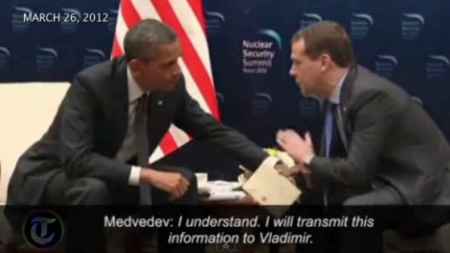
obama-medvedev-mar-2012-2

This is A+ trolling. Count on a KGB guy to take Obama’s “weakness is strength” meme and turn it around on him.

“That’s very good that my colleague possesses the courage to make such statements.”

“Barack, as a senator, criticized the administration for its actions in Iraq. But, as president, he allowed a mistake to happen, he has said it himself, in Libya. Not everyone can do that. They snap at him from different sides over that but only a strong man could have done that.”

A very strong man. Let’s get some context on that.

Obama dismissed the notion that Putin was acting “out of strength,” telling the San Diego station the annexation of Crimea was an action taken “out of weakness.”

So Putin turned Obama’s contention that weakness is strength and strength is weakness by praising his weakness as strength. Does Putin mean this? This is a regime whose propagandists depict Obama on toilet paper. But this throws in a dose of mockery and some trolling that Obama is unlikely to get as he’s eating up the flattery.

Now if Putin does encounter a strong US president, he’ll call him weak.

When asked whether he regretted Obama’s leaving office, Putin said, “We all go sooner or later, probably. It’s pointless to regret.”

I bet.

Putin’s Message

April 15, 2016

Putin’s Message, Power LineScott Johnson, April 14, 2016

Vladimir Putin has a message for Barack Obama and the United States, a message he sent via Russian warplanes buzzing the Navy destroyer Donald Cook in the Baltic Sea. Yesterday the Pentagon released video of the jets flying extremely close to the ship more than 30 times over the past two days. Military Times originally reported the story yesterday here. CBS News quotes the Obama administration calling the “simulated attack” passes unsafe. The video below shows two Russian jets coming incredibly close on one of their passes.

https://www.youtube.com/watch?v=j6g_Wli7WJY

Putin’s message is that he holds Obama in the utmost contempt and that it is safe for him to show it. He knows Obama thinks him retrograde. Obama transcends concerns about national pride as a relic of the past. Putin wants to spread his message and publicize Obama’s attitude to those who take matters of national pride and humiliation seriously, even if it is redundant in both cases.

Assad’s troops enter Palmyra after massive Russian air blitz to smash ISIS

March 27, 2016

Assad’s troops enter Palmyra after massive Russian air blitz to smash ISIS, DEBKAfile, March 27, 2016

Forces loyal to Syria's President Bashar al-Assad drive a tank during their offensive to recapture the historic city of Palmyra in this picture provided by SANA on March 24, 2016. REUTERS/SANA/Handout via Reuters ATTENTION EDITORS - THIS PICTURE WAS PROVIDED BY A THIRD PARTY. REUTERS IS UNABLE TO INDEPENDENTLY VERIFY THE AUTHENTICITY, CONTENT, LOCATION OR DATE OF THIS IMAGE. FOR EDITORIAL USE ONLY. NOT FOR SALE FOR MARKETING OR ADVERTISING CAMPAIGNS. THIS PICTURE IS DISTRIBUTED EXACTLY AS RECEIVED BY REUTERS, AS A SERVICE TO CLIENTS

Forces loyal to Syria’s President Bashar al-Assad drive a tank during their offensive to recapture the historic city of Palmyra in this picture provided by SANA on March 24, 2016. REUTERS/SANA/Handout via Reuters

Vladimir Putin after all took the momentous decision for Russian carpet bombing to level the Islamic State forces holding Palmyra since last May, and so clear the way for Bashar Assad’s troops and allied forces to enter the heritage city Saturday and Sunday, March 26-27 and take control of several districts. Television footage showed waves of explosions inside Palmyra and smoke rising from buildings, as Syrian tanks and armored vehicles fired from the outskirts.

But just as the Iraqi army, even with foreign assistance, never completely captured Ramadi or Baiji from Islamist forces, so too Assad’s forces can’t hope for complete control of the strategic town of Palmya. After pulling back to the east, ISIS forces will continue to harass the Syrian army and town with sporadic raids. And government forces will stay dependent on a Russian air umbrella to hang on.

The big question DEBKAfile’s military and intelligence sources were asking Sunday was what brought president Putin to give this groundbreaking military success to the Syrian ruler, just days after he withdrew Russian air support in southern Syria and opened the door for an Islamic State advance. He did this in an effort to break Assad’s resistance to the US-Russian deal for a political solution of the Syrian conflict by August.

Our sources offer two likely motivations:

1. Palmyra is strategically important to the Russian command because its fall to government forces opens the way to ISIS headquarters at Raqqa, 225 kilometers away.

2. Palmyra is also the gateway to Deir ez-Zour, 188 kilometers distant on Syria’s eastern border with Iraq. For the Russian military command, the importance of Deir ez-Zour outweighs that of Raqqa, because it is the key to control of the Euphrates Valley and access from Syria to Baghdad.

While these considerations bear heavily on Moscow’s strategic calculations, they have little direct impact on Assad’s overriding objective, which is to hold on to power. While the Syrian ruler may hope for acclaim for achieving a major success against ISIS, the laurel wreath belongs to Russian pilots. His forces essentially performed  a ground operation in Palmyra in Moscow’s interest and goal, which is to strengthen the Russian grip on his country.

On Saturday, DEBKAfile set forth the background for these events.

Cracks in the united US-Russian front over the Syrian ruler’s fate surfaced – even before the ink was dry on the joint announcement issued in Moscow Friday, March 25, by US Secretary of State John Kerry and Russian Foreign Minister Sergey Lavrov, setting  August as the deadline for a political solution of the five-year Syrian conflict.

Shortly after Kerry’s departure for Brussels, Russian Deputy Foreign Minister Sergey Ryabkov told reporters, “Washington now accepts Moscow’s argument that Assad’s future shouldn’t be open for negotiation right now.” However, taking exception to the phrase “right now,” State Department spokesman John Kirby immedieately snapped back, “Any suggestion that we have changed in any way our view of Assad’s future is false.”

Did this exchange spell another Washington-Moscow impasse on the future of the war and the Syrian ruler? Not exactly; Our military and intelligence analysts report that the two powers are in accord on the principle that Assad must go, but are maneuvering on the timeline for the war to end and the Syrian ruler’s handover of power.

The Americans want it to be sooner. The transition should start in August and result in adding opposition parties to the regime in positions of real influence.

President Barack Obama, when he conducts his farewell Gulf tour in April, would like to show Saudi Arabia and Gulf emirates that he has finally kept his word to them to evict Bashar Assad from power before he leaves the White House next January. The US would also be better placed for bringing the Syrian opposition into line for a negotiated deal.

But Putin prefers a delay because he has problems to solve first. The six-month long Russian military intervention in the Syrian conflict turned the tide of the war. The Syrian army and its Iranian and Hizballah allies were able to stabilize their positions and even score some important victories against rebel forces in central and northern Syria. Last year, Putin and Iran’s supreme leader Ayatollah Ali Khamenei were definitely on the same page and fully coordinated.

That cordial relationship was thrown out of kilter by the Kremlin’s decision to work with the White House for bringing the disastrous Syrian war to an end and terminating the Assad era.

From November, Iran’s Gen. Qassem Soleimani’s frequent visits to Moscow on liaison duty petered out.

Khamanei is adamantly opposed to Russia and the US commandeering the decision on Assad’s departure and its timetable. He is even more outraged by the way Putin has moved in on Syria and made it Russia’s home ground in the Middle East.

The rift with Tehran prompted Putin to announce on March 14 the partial pullback of his military forces from Syria. It was a threat to pull the rug that had turned the tide of the war in favor of Damascus and Tehran.

4 (1)

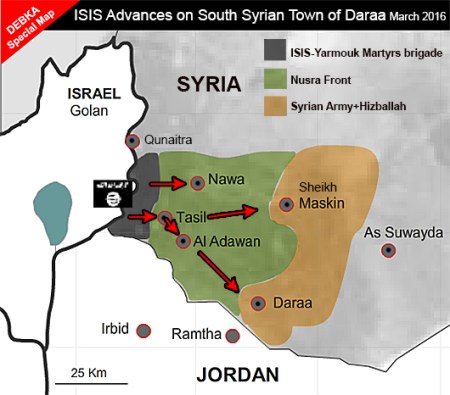
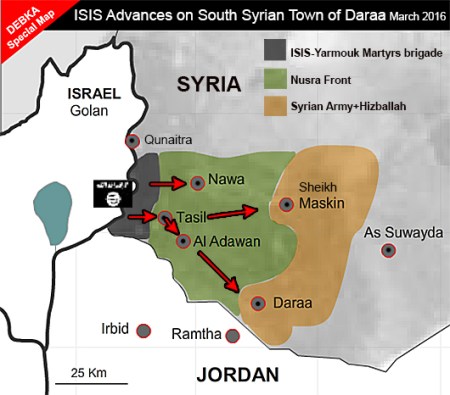
Reluctant to burn those boats, Moscow has been juggling its balls in the air, trying not to drop any. At first, he suspended Russian air cover for government-led battles. The Islamic State immediately seized on this opening in the south and advanced on the towns of Nawa, Sheikh Maskin and Daraa.

Moscow hoped that this setback would teach Bashar Assad to toe the Russian line.

Then, in the second part of last week, Putin ordered the Russian air force to renew its air strikes in the east in support of the Syrian army’s march from central Syria on the historic town of Palmyra. Friday and Saturday, the Syrian army and its allies were battling for control of the UNESCO World Heritage city, nearly a year after the Islamic State overran it and vandalized its historic remains.

DEBKAfile’s military sources stress that their capture of the reconstructed ancient Citadel perched on a hill over the city would have been beyond their strength without Russian air support. Finishing the job and recovering the entire city of Palmyra will depend heavily on Russian air strikes continuing to hammer the jihadist occupiers.

Putin faces a momentous decision. He has already taught Assad and Tehran a harsh lesson: with Russian air support, they win battles, but not without it, as their failure in the south has demonstrated.

Will he help Assad win Palmyra?

Crowning the Syrian dictator with such a striking victory would stiffen his resistance to American pressure for him to quit in short order. He would stand out as the only Syrian war leader capable of pushing ISIS back. But if the Russian leader decides to cut off air support in mid-battle for Palmyra, Assad and Iran will be forced to face the fact that without active Russian military support, they are in hot water.

The Syrian ruler would then have to accept his approaching end. That is the dilemma facing Putin.

Assad’s fate hangs on the Palmyra battle – and on Russian air support

March 26, 2016

Assad’s fate hangs on the Palmyra battle – and on Russian air support, DEBKAfile, March 26, 2016

Forces loyal to Syria's President Bashar al-Assad drive a tank during their offensive to recapture the historic city of Palmyra in this picture provided by SANA on March 24, 2016. REUTERS/SANA/Handout via Reuters ATTENTION EDITORS - THIS PICTURE WAS PROVIDED BY A THIRD PARTY. REUTERS IS UNABLE TO INDEPENDENTLY VERIFY THE AUTHENTICITY, CONTENT, LOCATION OR DATE OF THIS IMAGE. FOR EDITORIAL USE ONLY. NOT FOR SALE FOR MARKETING OR ADVERTISING CAMPAIGNS. THIS PICTURE IS DISTRIBUTED EXACTLY AS RECEIVED BY REUTERS, AS A SERVICE TO CLIENTS

Forces loyal to Syria’s President Bashar al-Assad drive a tank during their offensive to recapture the historic city of Palmyra in this picture provided by SANA on March 24, 2016. REUTERS/SANA/Handout via Reuters ATTENTION EDITORS – THIS PICTURE WAS PROVIDED BY A THIRD PARTY. REUTERS IS UNABLE TO INDEPENDENTLY VERIFY THE AUTHENTICITY, CONTENT, LOCATION OR DATE OF THIS IMAGE.

Cracks in the united US-Russian front over the Syrian ruler’s fate surfaced – even before the ink was dry on the joint announcement issued in Moscow Friday, March 25, by US Secretary of State John Kerry and Russian Foreign Minister Sergey Lavrov, setting  August as the deadline for a political solution of the five-year Syrian conflict.

Shortly after Kerry’s departure for Brussels, Russian Deputy Foreign Minister Sergey Ryabkov told reporters, “Washington now accepts Moscow’s argument that Assad’s future shouldn’t be open for negotiation right now.” However, taking exception to the phrase “right now,” State Department spokesman John Kirby immedieately snapped back, “Any suggestion that we have changed in any way our view of Assad’s future is false.”

Did this exchange spell another Washington-Moscow impasse on the future of the war and the Syrian ruler? Not exactly; Our military and intelligence analysts report that the two powers are in accord on the principle that Assad must go, but are maneuvering on the timeline for the war to end and the Syrian ruler’s handover of power.

The Americans want it to be sooner. The transition should start in August and result in adding opposition parties to the regime in positions of real influence.

President Barack Obama, when he conducts his farewell Gulf tour in April, would like to show Saudi Arabia and Gulf emirates that he has finally kept his word to them to evict Bashar Assad from power before he leaves the White House next January. The US would also be better placed for bringing the Syrian opposition into line for a negotiated deal.

But Putin prefers a delay because he has problems to solve first. The six-month long Russian military intervention in the Syrian conflict turned the tide of the war. The Syrian army and its Iranian and Hizballah allies were able to stabilize their positions and even score some important victories against rebel forces in central and northern Syria. Last year, Putin and Iran’s supreme leader Ayatollah Ali Khamenei were definitely on the same page and fully coordinated.

That cordial relationship was thrown out of kilter by the Kremlin’s decision to work with the White House for bringing the disastrous Syrian war to an end and terminating the Assad era.

From November, Iran’s Gen. Qassem Soleimani’s frequent visits to Moscow on liaison duty petered out.

Khamanei is adamantly opposed to Russia and the US commandeering the decision on Assad’s departure and its timetable. He is even more outraged by the way Putin has moved in on Syria and made it Russia’s home ground in the Middle East.

The rift with Tehran prompted Putin to announce on March 14 the partial pullback of his military forces from Syria. It was a threat to pull the rug that had turned the tide of the war in favor of Damascus and Tehran.

4

Reluctant to burn those boats, Moscow has been juggling its balls in the air, trying not to drop any. At first, he suspended Russian air cover for government-led battles. The Islamic State immediately seized on this opening in the south and advanced on the towns of Nawa, Sheikh Maskin and Daraa.

Moscow hoped that this setback would teach Bashar Assad to toe the Russian line.

Then, in the second part of last week, Putin ordered the Russian air force to renew its air strikes in the east in support of the Syrian army’s march from central Syria on the historic town of Palmyra. Friday and Saturday, the Syrian army and its allies were battling for control of the UNESCO World Heritage city, nearly a year after the Islamic State overran it and vandalized its historic remains.

DEBKAfile’s military sources stress that their capture of the reconstructed ancient Citadel perched on a hill over the city would have been beyond their strength without Russian air support. Finishing the job and recovering the entire city of Palmyra will depend heavily on Russian air strikes continuing to hammer the jihadist occupiers.

Putin faces a momentous decision. He has already taught Assad and Tehran a harsh lesson: with Russian air support, they win battles, but not without it, as their failure in the south has demonstrated.

Will he help Assad win Palmyra?

Crowning the Syrian dictator with such a striking victory would stiffen his resistance to American pressure for him to quit in short order. He would stand out as the only Syrian war leader capable of pushing ISIS back. But if the Russian leader decides to cut off air support in mid-battle for Palmyra, Assad and Iran will be forced to face the fact that without active Russian military support, they are in hot water.

The Syrian ruler would then have to accept his approaching end. That is the dilemma facing Putin.