Posted tagged ‘Press freedom’

Turkey’s female journalists now risk parental rights for critical reporting

May 24, 2016

Turkey’s female journalists now risk parental rights for critical reporting, Al Monitor

arzuThe Turkish court has sentenced journalist Arzu Yildiz to prison and denied her “parental rights” over a story on MIT trucks and arms transfers to Syria, May 18, 2016. (photo by FACEBOOK/Save Kobane)

Turkish female journalist Arzu Yildiz was this week sentenced to 20 months in prison for her reporting on alleged Turkish arms shipments to Syria, a highly controversial issue that has riled Ankara and landed both journalists and judicial officials in jail. The court, however, did not stop there, and stripped Yildiz also of her parental rights. While the imprisonment of journalists may have become commonplace in Turkey, now ranking 151st on the World Press Freedom Index, the restriction of Yildiz’s parental rights marks a new milestone in the extent the pressure on journalists has reached, affecting even their familial ties and social standing.

Yildiz is an experienced journalist who, after working for various media outlets, was left jobless a couple of years ago. Together with other jobless colleagues, she co-founded the nonprofit Grihat news site, where her reporting on the trucks controversy led to her conviction.

The story in question was related to the interception of Syria-bound trucks in the southern provinces of Hatay and Adana in January 2014. Acting on tip-offs, prosecutors had issued search warrants for the trucks. But when stopped by police and gendarmerie officers, the men in the vehicles identified themselves as members of the National Intelligence Organization (MIT) and resisted the searches. President Recep Tayyip Erdogan claimed at the time the trucks carried humanitarian supplies, but few were convinced. All judicial officials and security forces involved in the attempted search are behind bars today. The Cumhuriyet daily’s Editor-in-Chief Can Dundar and Ankara representative Erdem Gul also found themselves behind bars for their reports on the story. Though they were released three months later, they received jail terms for revealing state secrets earlier this month. Another journalist who covered the issue, Fatih Yagmur, remains on trial.

Yildiz, for her part, faced several investigations for her coverage of the incident and ensuing developments. The report that earned her the 20-month sentence pertained to the testimonies of the prosecutors who were arrested for attempting the search. On top of the prison term, the court in the southern city of Tarsus banned Yildiz from using “certain rights.”

In an interview with Al-Monitor, her lawyer, Alp Deger Tanriverdi, explained what the ruling means. “Let me tell you the most significant part: The ruling strips Arzu Yildiz of her motherhood rights,” he said. “She can no longer register her kids to school, open bank accounts for them or do other similar things on their behalf. She can’t even go abroad with them.”

Asked about the grounds on which the court made the decision, the lawyer said, “The court was [actually] supposed to suspend the sentence because Yildiz had no other conviction before. That was her legal right. Yet the court arbitrarily went ahead on grounds she committed the crime willfully, which automatically brought the decision to strip her from her rights. The court could have withheld this decision as well. Such restrictions are based on the following logic: ‘You’ve committed a crime willfully, so you are guilty before society as well. Thus, you must not be allowed to have a [bad] influence on your children.’ Such is the intention of the clause, yet the court applied it to Yildiz — to humiliate her.”

In remarks to Al-Monitor, Yildiz also lamented the court had acted arbitrarily. “I have two kids — one 6½ years old, the other only four months. I think the court made this decision deliberately, knowing that I’m a mother of two — simply to hurt me more,” she said. “My kids are my whole world. What else do I have? The court now says I can’t claim any right on them, can’t register them to school and can’t travel abroad with them. What hurts even more is that a ban that the courts withhold [even] from child molesters and rapists is being imposed on a journalist.”

Yildiz believes the ruling essentially aims to denigrate and humiliate journalists before the public. Yet, she remains adamant on soldiering on. “I covered the MIT trucks investigation from beginning to end. In the meantime, I gave birth [to my second child] and left my baby home when she was only 20 days old to go watch the hearings in this case,” she said. “I did this without having any financial support. The story in question was published on Grihat, which we had launched without any financial considerations. With this ruling, the court is trying to prevent me from doing journalism but it won’t succeed.”

The restriction on Yildiz’s parental rights sparked indignation from civic society groups and social media users. The issue became a trending topic on Twitter, generating about 50,000 tweets. “Some court rulings are destroying the society’s trust in the judiciary,” the Turkish Journalists’ Trade Union (TGS) said, while Yildiz’s colleagues circulated pictures of her four-month-old daughter with the slogan “Baby Zehra is not alone.”

The onslaught on critical media in Turkey has proceeded through wide-ranging means, including dismissal, judicial probes and imprisonment. According to a recent report by Press for Freedom, an advocacy project carried out by the Ankara-based Journalists Association, 894 journalists lost their jobs in Turkey in the first four months of the year and 74 journalists faced some kind of judicial action. Thirty-six journalists remain behind bars, according to the TGS.

With the Yildiz case, the boundary of intimidation has moved even further, threatening the parental rights of journalists and undermining their standing in society and vis-a-vis the state.
 

Turkey’s Circus in Washington

April 12, 2016

Turkey’s Circus in Washington, Gatestone InstituteBurak Bekdil, April 12, 2016

(Please see also, Germany Moves To Remove Anti-Erdogan Poem And Merkel Calls Turkey To Apologize. — DM)

♦ During his visit to Washington, Turkish President Recep Tayyip Erdogan’s security guards harassed and physically assaulted journalists trying to cover the event; they also forcibly attempted to remove several journalists, although they were on the guest list.

♦ An American reporter attempting to film the harassment received a kick in the chest.

♦ Against this backdrop, Erdogan kept on adding to his own ridicule. “I am not at war with the press,” he said in an interview with CNN International. Then he went on: “We have never done anything to stop freedom of expression or freedom of press.

Turkish President Recep Tayyip Erdogan’s increasing Third-Worldish authoritarianism is taking new turns: it is now visible outside Turkey.

At the same time as Erdogan was heading for Washington for a nuclear security summit, the two journalists who he asserted last year “will pay a heavy price” had to stand trial at a second hearing on charges of espionage and terrorism, and with life sentences hanging over their heads. Their “espionage and terrorism” activity concerned a story they ran in May 2015 detailing how Turkish intelligence was transporting weapons to Islamist fighters in Syria.

“This is a tug of war between Turkish democrats and autocrats,” Can Dundar, one of the “spy/terrorists” told The Wall Street Journal. “The Western world has been supporting Erdogan for years and we were telling them that this was the wrong decision, not only for Turkey, but also for the Western world.”

The case had already turned into a diplomatic row between Turkey and a number of European Union nations, after Erdogan lashed out at the foreign consuls-general who attended the first court hearing in a show of solidarity with the journalists.

Meanwhile, Turkish paranoia around insane claims that the entire world has joined hands to conspire against Turkey’s supreme leader appeared once again. Senior government officials have been slamming Twitter, and claiming it “censored” a hashtag created for Erdogan by removing #WeLoveErdogan from its top trending tweets.

“I’m asking Twitter officials: Who instructed you to remove the #WeLoveErdogan hashtag? Was it a country, a person, a terrorist organization, or someone else?” Justice Minister Bekir Bozdag told reporters just a day before Erdogan arrived in Washington. “I am of the opinion that this is one part of a global operation conducted against our president.”

Apparently, Twitter is not the only conspirator against the Turkish leader. Turkey’s foreign ministry summoned the German ambassador and asked him to remove from the internet a German satire program poking fun at Erdogan, thus causing a diplomatic dust-up with Germany.

The Germans, as every free country would, refused to censor the satire. Ironically, of course, Erdogan’s attempt at censorship spurred a huge surge of online interest in the video, which by March 31 had attracted more than four million views — ten times the program’s usual audience. Once again, Erdogan’s repressive manners turned into self-ridicule.

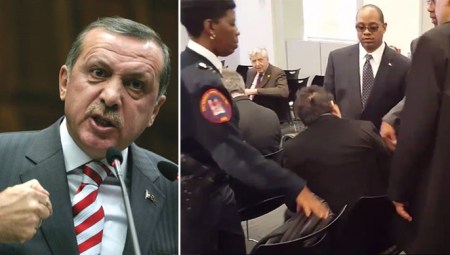
Then came the Turkish circus in Washington. On March 31, Erdogan was scheduled to speak at the Brookings Institution. His security guards harassed and physically assaulted journalists trying to cover the event; they also forcibly attempted to remove several journalists, although they were on the guest list. According to Reporters Without Borders (RSF), the Brookings staff prevented them from ejecting the reporters.

One Turkish journalist, Adem Yavuz Arslan, was kicked out of the building while checking in. A senior Brookings official eventually escorted Arslan back in, but, as Erdogan’s security guards continued to “verbally harass, insult and threaten” him, Brookings had to assign its own security guard to the seat next to him. “Erdogan’s guards are not committing these barbaric acts against independent media on their own,” Arslan told Reporters Without Borders. “I’m pretty confident they have their orders.” But that was not the entire show.

1548When Turkish President Recep Tayyip Erdogan (left) gave a speech at the Brookings Institution in Washington last month, his security guards harassed, threatened and assaulted numerous journalists trying to cover the event. Pictured at right, a police officer steps in to protect a Turkish journalist from Erdogan’s guards

According to press reports, several other journalists were involved in the tussle with Erdogan’s security guards. Another Turkish journalist, Emre Uslu, said that outside the event he was kicked in the leg by Erdogan’s bodyguards and was prevented from attending the speech.

An American reporter attempting to film the harassment received a kick in the chest. The National Press Club was outraged. “We have increasingly seen disrespect for basic human rights and press freedom in Turkey,” the president of the Club, Thomas Burr, said. “Erdogan doesn’t get to export such abuse.”

Against this backdrop, Erdogan kept on adding to his own ridicule. “I am not at war with the press,” he said in an interview with CNN International. Then he went on: “We have never done anything to stop freedom of expression or freedom of press. On the contrary, the press in Turkey had been very critical of me and my government, attacking me very seriously. And regardless of those attacks, we have been very patient in the way we have responded to those attacks.”

As Aykan Erdemir, a former opposition member of the Turkish parliament [now a fellow at the Foundation for Defense of Democracies in Washington], said, Erdogan can be a “toxic asset”: “Heads of state don’t want to be in the same photo with him …”

Journalism in Turkey: Newsroom vs. Courtroom

March 31, 2016

Journalism in Turkey: Newsroom vs. Courtroom, Gatestone InstituteBurak Bekdil, March 31, 2016

(Please see also, Turkey to Host UN’S First Global Humanitarian Summit. — DM)

♦ According to a report by the Turkish Journalists Association, 500 journalists were fired in Turkey in 2015; 70 others were subjected to physical violence. Thirty journalists remain in prison, mostly on charges of “terrorism.” There are also many journalists among the 1,845 Turks who have been investigated or prosecuted for insulting President Recep Tayyip Erdogan since he was elected in August 2014.

♦ After the secular daily newspaper Cumhuriyet published evidence of arms deliveries by the Turkish intelligence services to Islamist groups in Syria, President Erdogan himself filed a criminal complaint against Cumhuriyet’seditor-in-chief, Can Dundar, and the Ankara bureau chief, Erdem Gul.

♦ At a March 25 hearing, the Istanbul court ruled for the whole trial to be held in secret.

♦ “We came here today to defend journalism…We said we would defend the people’s right to access information. We defended that and we were arrested.” — Can Dundar, editor-in-chief of Cumhuriyet.

♦ The trial clearly exhibits how Erdogan’s authoritarian rule diverges from Western democratic culture.

“Turkey is where many journalists may have to spend more time at their attorneys’ offices or in courtrooms than in the newsrooms, where they should be,” a Western diplomat joked bitterly. “Don’t quote me on that. I don’t want to be declared persona non grata,” he added with a smile.

He was right. According to a report by the Turkish Journalists Association, 500 journalists were fired in Turkey in 2015; 70 others were subjected to physical violence. Thirty journalists remain in prison, mostly on charges of “terrorism.”

Needless to say, the unfortunate journalists are invariably known to be critical of Erdogan. There are also many journalists among the 1,845 Turks who have been investigated or prosecuted for insulting President Recep Tayyip Erdogan since he was elected in August 2014.

One of them is Sedat Ergin, editor-in-chief of Turkey’s most influential newspaper, Hurriyet. On March 25 Ergin had to appear before a penal court on charges of insulting Erdogan, with the prosecution demanding up to four years in jail for him. The veteran journalist says he is devastated to have been taken to court for the first time in his 41 years as a journalist on such an accusation. After his trial Ergin told reporters: “… in the year 2016 courthouse corridors and the hearing rooms have become the habitats of journalists in Turkey. Freedom of the press in Turkey in 2016 is now confined to court corridors.”

On that same day, two more journalists were in a courtroom, but they are not as lucky as Ergin in terms of the prison sentences demanded by the prosecution.

In May 2015, the secular daily newspaper Cumhuriyet published on its front page video and photographic evidence of arms deliveries by the Turkish intelligence services to Islamist groups in Syria. A month later, President Erdogan himself filed a criminal complaint against Cumhuriyet’seditor-in-chief, the prominent journalist, Can Dundar, and the newspaper’s Ankara bureau chief, Erdem Gul. In a public speech, Erdogan said: “He who ran this story will pay heavily for it.”

Dundar and Gul were arrested and remained behind bars for over 90 days, until Turkey’s Constitutional Court ruled that their detention violated their rights. They were released, but must now stand trial on charges of espionage, as well as aiding a terrorist organization that aims to topple Erdogan’s government. The case is a serious threat to the two journalists’ liberty, especially when Erdogan’s “weight” in the courtroom remains easily felt, if not seen.

1535Can Dundar (right), editor-in-chief of Turkey’s Cumhuriyet newspaper, and Erdem Gul (left), Cumhuriyet’s Ankara bureau chief, were arrested after the paper published evidence of arms deliveries by the Turkish intelligence services to Islamist groups in Syria. They remained behind bars for over 90 days, until Turkey’s Constitutional Court ruled that their detention violated their rights.

At the March 25 hearing, the Istanbul court ruled for the whole trial to be held in secret. A group of opposition MPs protested the decision and refused to leave the courtroom. The court decided to file a criminal complaint against them for “obstructing justice.”

“We came here today to defend journalism. We gathered here before and said the same thing. We said we would defend the people’s right to access information. We defended that and we were arrested,” Dundar said.

It seems that Erdogan has no intention of leaving the journalists alone. The trial also clearly exhibits how his authoritarian rule diverges from Western democratic culture. On March 25, a group of Western consuls-general in Istanbul attended the journalists’ trial in a show of solidarity. The diplomats included Leigh Turner, the British Consul-General, who shared images from outside the court and messages of support for the journalists on Twitter. Now Erdogan thinks he has new enemies.

The day after the court hearing, Erdogan spoke:

“The situation of those who attended this hearing is very important. The consuls-general in Istanbul come to the courthouse. Who are you, what are you doing there? This is not your country, this is Turkey … Diplomats can operate within the boundaries of missions. Elsewhere is subject to permission.”

Now is that a new jurisprudence in diplomacy — that foreign diplomats in Turkey should be confined to their mission buildings and not observe most important political trials without permission from the Turkish government? In addition to the court’s blackout on the Dundar-Gul case, Erdogan now wants political confinement for the journalists.

By pursuing life sentences so aggressively for the journalists, Erdogan is in fact trying to achieve another political goal: He is giving messages at many wavelengths to any other investigative journalist who may in the future publish another embarrassing report on his administration.

Not really peaceful and free times for Turkish journalism.


