Posted tagged ‘President Trump’

President Trump’s Immigration Challenge

January 4, 2017

President Trump’s Immigration Challenge, Front Page MagazineMichael Cutler, January 4, 2017

nj

On January 20, 2017 President Trump can and likely will end all of Obama’s illegal immigration executive orders, but he needs to do more.

For decades the effective enforcement of our nation’s immigration laws was hobbled by lack of resources in general and a particularly devastating failure to enforce the immigration laws from within the interior of the United States.

For decades the Border Patrol was perceived as the primary enforcement arm of America’s immigration laws and for the Border Patrol this worked out fine.  They got the lion’s share of publicity and, far more importantly, the funding while INS special agents and the interior enforcement mission were all but ignored

When the DHS (Department of Homeland Security) was created in the wake of the terror attacks of 9/11, the former INS was dismantled and broken into several components of the DHS and mixed in with other agencies, principally the U.S. Customs Service.

Bad as it was for INS agents to operate in the shadow of the Border Patrol, the creation of the DHS was disastrous and caused many of the INS agents nostalgic for “the good old days.”

On May 5, 2005 the House Subcommittee on Immigration, Border Security and Claims conducted a hearing on the topic, “New ‘Dual Mission’ Of The Immigration Enforcement Agencies.”

I was one of four witnesses who testified at that hearing.  In point of fact, I testified at several hearings that sought to understand the challenges that the creation of the DHS created for the effective enforcement of our nation’s immigration laws.

In my testimony I clearly articulated my concerns about the myriad issues created when the DHS was established and the former INS was dismantled.

Consider this excerpt from the testimony of then-Subcommittee Chairman John Hostettler in which he articulated the importance of immigration law enforcement and that was, however, hobbled by the creation of the DHS:

The first two Subcommittee hearings of the year examined in detail how the immigration enforcement agencies have inadequate resources and too few personnel to carry out their mission. The witnesses mentioned the lack of uniforms, badges, detention space, and the inevitable low morale of frontline agents who are overwhelmed by the sheer volume of incoming illegal aliens. If this were not enough, these ”immigration enforcement” agencies also face internal confusion resulting from dual or multiple missions in which immigration has all too often taken a back seat. Sadly, contrary to Congress’ expectations, immigration enforcement has not been the primary focus of either of these agencies, and that is the subject of today’s hearing.

The Homeland Security Act, enacted in November 2002, split the former Immigration and Naturalization Service, or INS, into separate immigration service and enforcement agencies, both within the Department of Homeland Security. This split had been pursued by Chairman Sensenbrenner based on testimony and evidence that the dual missions of INS had resulted in poor performance.

There was a constant tug-of-war between providing good service to law-abiding aliens and enforcing the law against law-breakers. The plain language of the Homeland Security Act, Title D, creates a ”Bureau of Border Security,” and specifically transfers all immigration enforcement functions of INS into it. Yet when it came down to actually creating the two: new agencies, the Administration veered off course. Although the service functions of INS were transferred to USCIS, the enforcement side of INS was split in two, what is now Immigration and Customs Enforcement, or ICE, to handle interior enforcement, and Customs and Border Protection (CBP) to guard our borders.

ICE was given all Customs agents, investigators, intelligence and analysis-from the Treasury Department, as well as the Federal Protective Service to guard Federal buildings, and the Federal Air Marshals to protect our airplanes, and finally the INS investigators.

CBP was given all Treasury Customs inspectors at the ports-of-entry, Agriculture Inspector from the Department Of Agriculture, and INS inspectors.

At no time during the reorganization planning was it anticipated by the Committee that an immigration enforcement agency would share its role with other enforcement functions, such as enforcement of our customs laws. This simply results in the creation of dual or multiple missions that the act sought to avoid in the first place.

Failure to adhere to the statutory framework established by HSA has produced immigration enforcement incoherence that undermines the immigration enforcement mission central to DHS, and undermines the security of our Nation’s borders and citizens.

It is not certain on what basis it was determined that customs and agriculture enforcement should become part of the immigration enforcement agency, except to require Federal agents at the border to have more expertise and more functions.

It is also unknown on what basis the Federal Air Marshals should become part of this agency, especially since it has been revealed that the policy is not to apprehend out-of-immigration status aliens when discovered on flights. If the mission of the Department of Homeland Security is to protect the homeland, it cannot effect its mission by compromising or neglecting immigration enforcement for customs enforcement.

The 9/11 terrorists all came to the United States without weapons or contraband—Added customs enforcement would not have stopped 9/11 from happening. What might have foiled al Qaeda’s plan was additional immigration focus, vetting and enforcement. And so what is needed is recognition that, one, immigration is a very important national security issue that cannot take a back seat to customs or agriculture. Two, immigration is a very complex issue, and immigration enforcement agencies need experts in immigration enforcement. And three, the leadership of our immigration agencies should be shielded from political pressures to act in a way which could compromise the Nation’s security.

It was clear that the Bush administration was eager to de-emphasize immigration law enforcement.  What was not noted in the testimony is that most of the management at ICE came from Legacy Customs and not from Legacy INS.

Facing North Korea and Iran, Trump Must Strengthen Nuclear Deterrence

January 3, 2017

Facing North Korea and Iran, Trump Must Strengthen Nuclear Deterrence, National Review, Tom Rogan, January 3, 2017

Ultimately, the nuclear issue is just one challenge the incoming Trump administration faces in foreign policy. The U.S. needs a new strategy of realist resolution. After years of Obama’s fraying credibility with allies and foes alike, the United States must resume leading. Kim Jong-un and Iranian supreme leader Khamenei are arrogant. If given an inch, they will walk the nuclear mile. And history tells us that great power and totalitarian zealots rarely blend positively.

***********************************

How President Trump should strengthen America’s ICBM-deterrence posture. Like Big Brother in George Orwell’s Nineteen Eighty-Four, North Korean dictator Kim Jong-un holds absolute power. And Kim, the same as his father and grandfather, wants to forcibly unify the Korean peninsula under a xenophobic ideology of self-sufficiency.

Since the end of the Korean War, the Kims’ wacky “Juche” ideology has sparked Western laughter as much as fear. We have rightly assumed the Kims are deterred by their understanding that a conventional-arms conflict with America would destroy them. While the U.S. has had to occasionally reinforce this conventional deterrence, it has been sustained for 60 years.

Over the weekend, Kim Jong-un announced that the North’s development of an intercontinental ballistic missile (ICBM) is advancing rapidly. Unless America appeases him, Kim warned, he will build a “preemptive striking capacity with a main emphasis on nuclear force.” Recently successful rocket tests suggest we should take Kim at his word.

Still, it’s not just North Korea the West should be concerned about here.

Today, alongside other malevolent activities, the Islamic Revolutionary Republic’s ballistic-missile research is advancing unabated. In his wisdom, President Obama decided to exclude a ban on such research from his legacy Iran deal. He lacked the threat-of-force credibility to compel the Iranians to cease their missile development. Unfortunately, when Iran perfects ballistic-missile technology, it will break the nuclear deal. By then, sanctions relief will have made Iran tens of billions of dollars richer.

Collectively, these developments threaten not just the stability of international peace, but the civilian population of the United States. They demand a robust response in U.S. nuclear-deterrent posture. President Trump should deliver it.

First, Trump should reform the Iran nuclear deal to include prohibitions on Iranian ballistic-missile development. This is the realist compromise between scrapping the nuclear deal entirely and attempting to make it work better.

Second, Trump should enforce a new, proactive strategy to deal with North Korea’s increasingly advanced ICBM program. Whereas, in the past, the U.S. has simply monitored North Korean missile tests, stronger action is now required. North Korean ICBMs demand it. After all, the base-minimum range of an ICBM is 3,400 miles. But seeing as 1960s-era Soviet and U.S. ICBMs easily exceeded 6,200-mile ranges, we must assume North Korean ICBMs will exceed the minimum range. And with just 125 miles more than the minimum, North Korea could strike Darwin, Australia. An extra 270 miles would put Anchorage, Alaska, in range. Hawaii, a little over 4,300 miles from North Korea, would also be vulnerable.

Countering this threat, Trump should supplement the U.S military’s multi-phase missile-defense programs. He should publicly announce that if the North tests an ICBM, he will establish three North Korea focused missile-test defense sectors. Trump should be clear that any North Korean ICBM that enters or passes these sectors will be shot down. U.S. military planners would, of course, fine-tune such proposals, but here’s one example of what the defense zones might look like.

Trump could establish a northern sector — focused on protecting Alaska — off the Japanese coast in the Sea of Okhotsk. Second, a western sector — focused on protecting Hawaii and the U.S. west coast — could be set up approximately 1,000 miles west of Midway Island, at the southern tip of the Emperor seamounts. Third, a southern sector — to protect Australia — could be established south of Palau Island between Papua and Papua New Guinea. These sectors should be maintained by U.S. Navy destroyers and cruisers (and hopefully allied assets), equipped with the Aegis missile-defense system.

Next, Trump should clarify his willingness, where facing imminent nuclear attack, to use nuclear weapons in a “first strike” role. That demand is urgent because President Obama has equivocated on this fundamental precept of U.S. nuclear-deterrent posture. Namely, the understanding that U.S. nuclear weapons serve both deterrence (preventing an attack) and capability (destroying an enemy). A retained first-strike capability is necessary to prevent the loss of millions — or tens of millions . . . or hundreds of millions — of American lives in a nuclear showdown. Yes, ideally, the U.S. would be able to use conventional non-nuclear capabilities to achieve that objective. But idealism is a dangerous master. For one, U.S. military pilots might not be able to penetrate enemy air defenses in time to prevent a ballistic-missile attack. Similarly, conventional bunker-busting bombs might not destroy enemy nuclear platforms.

Fourth, Trump should aggressively confront illicit ICBM research-and-development networks. Specifically, Trump should push Pakistan, Russia, and the former Soviet states to take action against smugglers in their nations. In the case of Pakistan and the former Soviet states, such action should be tied to U.S. aid payments. A philosophical evolution of U.S. tactics is equally important here. Put simply, instead of treating nuclear smuggling as a law-enforcement matter, the U.S. must be prepared to coerce or kill those who support the illicit nuclear industry. Fear is always the best guarantor against a nuclear holocaust.

Ultimately, the nuclear issue is just one challenge the incoming Trump administration faces in foreign policy. The U.S. needs a new strategy of realist resolution. After years of Obama’s fraying credibility with allies and foes alike, the United States must resume leading. Kim Jong-un and Iranian supreme leader Khamenei are arrogant. If given an inch, they will walk the nuclear mile. And history tells us that great power and totalitarian zealots rarely blend positively.

Putin’s low-key Syrian operation – a call to Trump

November 16, 2016

Putin’s low-key Syrian operation – a call to Trump, DEBKAfile, November 16, 2016

The Russian air force and navy launched a “large-scale” operation against “terrorists” in the Syrian provinces of Idlim and Homs Tuesday, Nov. 15. Bombers took off from the Hmeymim air base and the Admiral Kuznetsov aircraft carrier whle cruise missiles were fired from the Admiral Grigorovich frigate. According to Russian Defense Minister Sergey Shoigu, who addressed a meeting of Russian generals with President Vladimir Putin, the targets were positions of the Islamic State and Al Nusra.

He did not say how long the operation would go on.

DEBKAfile’s military and intelligence sources say that the proportions of the Russian operation as seen from the ground better fit the description of low key than “large scale.”

No more than 2 Sukhoi Su-33 fighters lifted off the carrier’s decks and only a few Kaliber cruise missiles were fired from the frigate. They were not aimed at Islamist terrorist positions, but at arms factories and ammunition stores. Towards evening, a third Russian air strike hit a target in the hills overlooking the coastal province of Latakia.

The timing of the Russian operation was significant. It came five days after President Barack Obama finally ordered the Pentagon to seek out and target Nusra Front leaders, after long holding out against Moscow’s demand in this regard, and 12 hours after US president elect Donald Trump and Putin held their first telephone conversation after the election.

Since the attack was too limited to change the military situation on the Syrian war’s front lines, what was its purpose? And why was its launch given world-wide exposure accompanied by a photo-op of the Russian president meeting his generals for heightened drama?

It appears that Putin sought by this maneuver to convey the impression that Trump had agreed to the operation during their initial conversation on Monday. It is far more likely, however, that the Russian leader presented the offensive to Trump in general terms and did not hear an explicit negative response. He therefore decided to go ahead with the attack, marking out Islamist terrorists – which the president elect had declared in his campaign as America’s enemy – on the assumption that he would not disagree with a Russian strike against a consensual target. By this maneuver, Putin hoped to draw the next US president into backing Russia’s strategy in the Syrian war.
It is hard to believe that Donald Trump will be so easily drawn.

Little-noticed law gives Trump unexpected power to undo the mischief of bureaucrats

November 16, 2016

Little-noticed law gives Trump unexpected power to undo the mischief of bureaucrats, American Thinker, Thomas Lifson, November 16, 2016

Nobody was counting on this.

Barack Obama infamously said that he would govern by a “pen and a phone.”  He has circumvented Congress and the laws for years.  The Democrats (and much of the media, but I repeat myself) have not only given him a pass, but cheered him on.  Now it appears a seldom-noticed law might be a powerful tool that Trump can use to eviscerate much of the Obama legacy.

Stacy Cowley of the New York Times reports :

Dozens of major regulations passed recently by the Obama administration — including far-reaching changes on health care, consumer protections and environmental safety — could be undone with the stroke of a pen by Donald J. Trump and the Republican-controlled Congress starting in January, thanks to a little-used law that dates back to 1996.

And it comes with a scorched-earth kicker: If the law is used to strike down a rule, the federal agency that issued it is barred from enacting similar regulation again in the future.

The obscure law — called the Congressional Review Act — was passed 20 years ago at the behest of Newt Gingrich, then the House speaker and now a member of Mr. Trump’s transition team. It gives Congress 60 legislative days to review and override major regulations enacted by federal agencies. In the Senate, the vote would not be subject to filibuster.

The president can veto the rejection, which usually renders the law toothless. But when one party controls both the White House and Congress, it can be a powerful legislative weapon.

So far it has only been successfully used once: In 2001, a Republican Congress invoked it to eliminate workplace safety regulations adopted in the final months of President Clinton’s tenure. President George W. Bush signed the repeal two months after his inauguration, wiping out stricter ergonomics rules that had been 10 years in the making.

On Jan. 20, when Mr. Trump takes office with a Republican-controlled Congress — one that has indicated its zeal for undoing President Obama’s doings — more than 150 rules adopted since late May are potentially vulnerable to the ax, according to an analysis by the George Washington University Regulatory Studies Center.

“It allows the election results to be applied almost retroactively, to snip off activity that happened at the end of the last administration,” said Adam Levitin, a law professor at Georgetown.

The column notes several examples of rules and regulations Obama’s White House has been quickly rolling out in the dying months of his presidency.  However, there is a new sheriff in town.

The GOP House has been trying to use this law for years but was stymied by Obama’s veto power.

Under Speaker Paul D. Ryan’s leadership, the House has used the law several times to try to reject a number of the Obama administration’s policies. Those challenges were symbolic — President Obama vetoed every one that reached his desk — but President-elect Trump can approve any sent to him after he takes office. Mr. Ryan’s office did not respond to requests for comment.

“I don’t think they’ll go after every single rule, but I think you’ll get eight to 10 that may be targeted,” said Sam Batkins, the director of regulatory policy at the American Action Forum, a right-leaning group that has been tracking which regulations are subject to congressional review.

The threat posed by the law may slow the usual rush of “midnight regulations” that administrations typically race to finish in their final days. This year, it will be a high-stakes game of chicken — put out a rule and hope it survives, or hold off, to preserve the chance to revisit it in the future?

House Republicans have already put bureaucrats on notice that efforts by them to slip through new rules and regulations will be met with extra scrutiny when a new Congress and president take charge in January.  Lisa Rein of the Washington Post:

Newly empowered House Republicans on Tuesday laid down the gauntlet to the outgoing Obama administration: Don’t finalize any pending rules and regulations you think you can slip through before you leave office.

In a letter to hundreds of Cabinet secretaries, commissioners and other heads of federal offices and agencies signed by 22 Republican leaders, the lawmakers noted that President Obama has been generous in his use of executive orders to set policy. And they issued a threat: Ignore us and we will give your agency extra scrutiny.

“Should you ignore this counsel, please be aware that we will work with our colleagues to ensure that Congress scrutinizes your actions — and, if appropriate, overturns them …” said the one-paragraph missive signed by House Majority Leader Kevin McCarthy (R-Calif.) and 21 Republican committee heads. They oversee federal agencies from the Department of Veterans Affairs to the Environmental Protection Agency.

When liberals wail about this missive, they can be reminded that Obama’s team issued the same type of message.  This warning should serve as a red line that bureaucrats will not cross and that Republicans will enforce.

In any case, Trump can go to DEFCON-4 on his own.

People on the right and among libertarians and freedom-seekers everywhere have long decried the rise of the regulatory state and its unchecked power in the hands of bureaucrats who have, seemingly, lifetime tenure and powers to wreak havoc on the economy.

Thomas Lifson has written about the pressing need to overhaul civil service rules to make the government and its worker bees more efficient, as has Bruce Walker in another American Thinker column.  Bureaucrats are unelected and unaccountable officials who control too much power in America.  Barack Obama has spent the last eight years implanting partisan true believers throughout the federal government.  Many have been cleverly transforming themselves from political appointees, who can be relatively easily swept away when the Washington Stables are cleaned, to civil service employees who have all but lifetime tenure (this system is truly rigged and needs to be “fundamentally transformed”).

The power that the Congressional Review Act gives Donald Trump can accelerate the changes America needs to grow its economy from the stultifying burdens of Leviathan.

Trump has a pen and a phone, too.  Democrats will soon be reminded of that phrase and come to rue it.


Yes, Trump’s Going to Dump the Iran Deal

November 15, 2016

Yes, Trump’s Going to Dump the Iran Deal, Center for Security Policy, Fred Fleitz, November 15, 2016

(Interesting food for thought. — DM)

iranscam

Source: National Review

In the days following Donald Trump’s victory, a variety of experts — mostly Trump critics — pronounced that, despite Trump’s frequent statements during the presidential campaign that the July 2015 nuclear deal with Iran is one of “the worst deals ever made by any country in history,” he has no choice but to stick with the agreement after he assumes office.

Iranian foreign minister Javad Zarif was one of the first to insist as much, claiming a Trump administration cannot back out of the nuclear deal because it is not a bilateral agreement between the United States and Iran but “an international understanding annexed to a Security Council resolution.”

Trita Parsi, president of the National Iranian American Council (which The Weekly Standard’s Lee Smith once described as “the tip of the spear of the Iran lobby” in the United States) echoed Zarif’s statement. In a November 11 Foreign Policy article, he argued Trump can undermine the Iran deal but cannot directly dismantle it because the JCPOA is a multilateral agreement “codified by the UN Security Council.” Any attempt by a Trump administration to renegotiate the deal would violate international law and isolate the United States, Parsi said.

Even some conservative experts have suggested Trump probably won’t try to significantly modify or discard the nuclear agreement, but will instead try to goad Iran into withdrawing by strictly enforcing the deal.

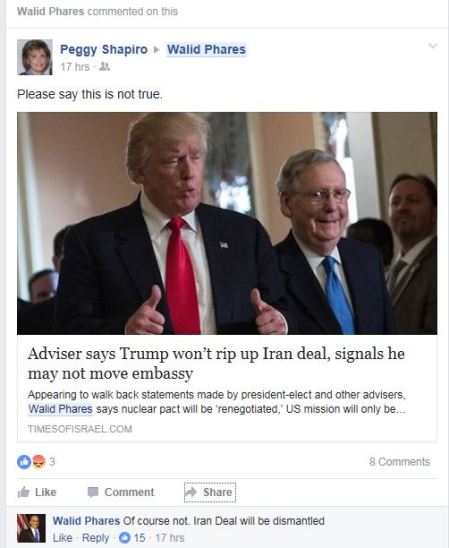
But Trump senior national-security adviser Walid Phares poured cold water on speculation that Trump plans to walk back his statements about the Iran deal, when he commented on Facebook over the weekend that the “Iran Deal will be dismantled.”

phares-iran-deal

This firm statement by Phares confirmed previous statements he and Mr. Trump have made that the deal is a dangerous agreement that needs to be either significantly renegotiated or abandoned. As an expert who has followed the Iran nuclear program for many years inside and outside of government, I would like to expand on their statements by offering three key points about the nature of the deal and ten guidelines for renegotiating it.

1. The Iran deal is a dangerous fraud.

Donald Trump was exactly right when he called the Iran deal a “horrible” and “disastrous” agreement. The U.S. agreed to huge concessions to get this agreement, from no restrictions on Iran’s sponsorship of terrorism to no inspections of military facilities. There were secret side deals withheld from Congress that permitted Iran to inspect itself for past nuclear-weapons work and receive secret planeloads of cash in exchange for freeing U.S. hostages. To get the $150 billion in sanctions relief Iran wanted, there was another secret side deal — also withheld from the U.S. Congress — which granted Tehran exemptions for failing to meet some of the agreement’s key requirements.

So what did the United States get for these concessions?

Not much. The Obama administration claims the deal keeps Iran a year away from a nuclear deal for ten to 15 years. But in fact, the time to an Iranian nuclear bomb will drop dramatically under the deal, since Iran will be able to enrich uranium, develop advanced centrifuges, and, with Chinese assistance, finish construction of a heavy-water nuclear reactor that will produce one-quarter of a weapon’s worth of plutonium per year.

It will be very hard to verify the agreement since military sites — where Iran is likely to conduct covert nuclear-weapons work — are off limits to inspectors. The deal dumbed down the IAEA’s quarterly Iran reports, making it difficult for the world to know the true extent of Iran’s compliance. Certainly, there already have been reports of significant Iranian cheating.

Further, the deal was supposed to improve Iran’s international behavior.

Instead, from ballistic-missile tests to increased support to Hezbollah, Bashar al-Assad, and the Houthi rebels in Yemen, Tehran’s behavior in the Middle East has significantly worsened. Just in the last year, Iran has captured and held at gunpoint ten U.S. sailors and fired anti-ship missiles at American and UAE ships. Is this what a new era of cooperation with Iran was supposed to look like?

2. The deal is not legally binding on us.

Knowing that a bipartisan majority of Congress opposed the nuclear deal and that the U.S. Senate would never ratify it as a treaty, the Obama administration arranged to go around the Senate by negotiating the deal as an executive agreement endorsed by the U.N. Security Council. Because Security Council resolutions are binding on all U.N. members, it could therefore be argued that the nuclear deal was binding on the United States even though it had not been ratified by the Senate.

But that is not how our constitutional order works. American presidents historically have decided which international agreements are to be treated as treaties, but the Iran deal specified that it be ratified by the Iranian parliament.

If President Obama wanted to make a long-term international agreement binding on the United States, he needs consent from Congress. Anything else is a serious affront to the Constitution, and no U.N. endorsement changes that.

(This is not the only example of President Obama’s lawless approach to international agreements: The Paris climate-change agreement was deliberately negotiated to make it binding on the United States without Senate ratification and difficult for a future U.S. president to cancel. The same principles apply, however, and I expect President Trump pull out of the climate agreement as soon as possible.)

3. It’s not a true multilateral agreement.

The Obama administration also attempted to entrench the Iran deal making it a multilateral agreement, but this was just window-dressing.

The deal is technically a multilateral pact agreed to by Iran, the United States, Russia, China, France, the United Kingdom, and Germany, but it is actually a bilateral agreement negotiated almost entirely between the United States and Iran. Iran has only looked to the United States for additional concessions since the deal was announced, and if we want to end the deal, we can.

So it is clear the deal must be either discarded or substantially renegotiated, and that we have every right to do so.

The first steps to renegotiation should be (1) assembling a new anti-Iran coalition of our European allies, Israel, and the Gulf states, and (2) imposing new sanctions on Iran in response to its nuclear program, ballistic-missile program, sponsorship of terrorism, and belligerent behavior. Russia and China could be allowed into the new coalition, but they should not be given a veto over any new agreement. This coalition also must be kept out of the United Nations.

Building the new coalition and renegotiating the agreement won’t be the easiest task, but given Iran’s belligerent behavior and the power new U.S. sanctions can have, a strong president and secretary of state can do it.

An agreement that truly addresses the threat from Iran’s nuclear program and the wider threats Iran poses will require reversing all of the irresponsible concessions made to Iran by the Obama administration.

Such negotiations must start from the following ten guidelines:

  1. Iran must cease all uranium enrichment and uranium-enrichment research.
  2. Iran cannot have a heavy-water reactor or a plant to produce heavy water.
  3. Iran agrees to robust verification, including “anytime, anywhere” inspections by IAEA inspectors of all declared and suspect nuclear sites.
  4. Iran must fully and truthfully answer all questions about its past nuclear-weapons-related work.
  5. Iran must agree to limitations on its ballistic-missile program.
  6. Sanctions will only be lifted in stages, in response to Iranian compliance with the agreement.
  7. Iran must agree to end its meddling in regional conflicts and its sponsorship of terror.
  8. Threats by Iran to ships in the Persian Gulf, U.S. naval vessels, and American troops must stop.
  9. Iran must cease its hostility toward Israel.
  10. Iran must release all U.S. prisoners.

Renegotiating or terminating the Iran deal will not just end the threat from a dangerous international agreement.

It will signify that this agreement was an aberration by an incompetent U.S. president who tried to subvert the U.S. Constitution, and it would send a powerful message to the world that the Obama administration’s policies of American weakness and appeasement are over.

Trump critics have argued that renegotiating or terminating the nuclear deal would isolate the United States and hurt America’s global stature. But in reality, President Obama’s foreign policy has already undermined America’s reputation around the world.

Fixing or killing the Iran nuclear deal will be President Trump’s first step toward restoring America’s global leadership.