Posted tagged ‘PKK’

Turkey warns US, Russia over arms supply to Syrian Kurds

October 14, 2015

Turkey warns US, Russia over arms supply to Syrian Kurds

Serkan Demirtaş – ANKARA

PM Davutoğlu is left apoplectic after the US gives weapons to the Kurdish PYD, an enemy of Ankara, amid additional ire for Moscow

Source: Turkey warns US, Russia over arms supply to Syrian Kurds – DIPLOMACY

In this Tuesday, Oct. 6, 2015, military reinforcements for Iraqi anti-terrorism forces arrive at the Ramadi Stadium after regaining control of the complex and the neighboring al-Bugleeb area. AP Photo

In this Tuesday, Oct. 6, 2015, military reinforcements for Iraqi anti-terrorism forces arrive at the Ramadi Stadium after regaining control of the complex and the neighboring al-Bugleeb area. AP Photo

Turkey’s prime minister has lashed out at both the United States and Russia for supplying weapons and support to the Democratic Union Party (PYD) of Syria in its bid to fight extremist jihadists, raising concerns that the arms could be used against Turkey by the outlawed Kurdistan Workers’ Party (PKK), an affiliate of the PYD.

Turkey summoned the United States’ ambassador to Turkey, John Bass, on Oct. 13 to the Foreign Ministry to convey Ankara’s strong reaction over the airdropping of ammunition to the PYD late Oct. 11. A similar message was scheduled to be conveyed to Russia later on Oct. 13.

“We have expressed this to the U.S. and Russia in the clearest way. This is an issue of national security for us. Everybody perfectly knows how we take action when it’s about our national security, just like we did on the night of July 23, when we attacked the PKK and Daesh,” Prime Minister Ahmet Davutoğlu told Ankara bureau chiefs of newspapers on Oct. 12. Davutoğlu used the Arabic acronym for the Islamic State of Iraq and the Levant (ISIL) as he recalled Turkey’s launch of a comprehensive military operation against ISIL and the PKK.

Davutoğlu’s reaction came as the U.S. Department of Defense confirmed that a U.S. cargo plane airdropped some logistical material to the PYD late Oct. 11 in line with Washington’s plans to reinforce the Syrian Kurds in their fight against ISIL in Syria.

“The aircraft delivery includes small arms ammunition to resupply the local forces” to enable them to continue operations against ISIL, Pentagon spokeswoman Elissa Smith told Anadolu Agency on Oct. 13. Smith said the “successful” airdrop was conducted by a “U.S. Air Force C-17 cargo aircraft flying from the U.S. Central Command area of responsibility” and added that all aircraft exited the drop area safely. Like the U.S., Russia is also in close contact with the PYD, but there are no confirmed reports about arms supplies from Moscow.

“I have instructed the foreign minister on this. Necessary diplomatic initiatives are being taken and our message is that ‘We don’t and never will approve of such a thing,’” he said.

‘These weapons will be destroyed’

Recalling that ISIL was now using the sophisticated weapons Washington had supplied to the Iraqi army a year ago, Davutoğlu indirectly addressed the U.S., saying: “When you provide weapons to a group, you should also be able to foresee whose hands these weapons could go to later. At the moment, nobody can assure us that these weapons delivered to the PYD will not go to the PKK. If we find out that these weapons are taken into the northern Iraq and used there, we will destroy them wherever they are. Nobody should expect understanding on this issue. These weapons will harm our soldiers, police and civilian citizens,” Davutoğlu said.

Turkish prime minister underlined that Turkey will take all necessary measures in the event of any infiltration from Syria into Turkey or the transportation of any ammunition “just like the Turkish army is doing in northern Iraq.” “I want to announce this with clarity.”

PKK, PYD indistinguishable from each other

Recalling that the situation in the region and in Turkey had changed as the PKK resumed its violent acts against the Turkish army, Davutoğlu said: “Five or six months ago when there were no PKK attacks against Turkey, allied countries’ intention to arm the PYD could be seen in a certain frame. It was not right but had a sort of a meaning. The crisis in Syria is a Syrian crisis until an attack targets Turkey. [If] the PYD or the al-Assad regime were to commit an act against Turkey, necessary actions would be taken. We have made clear that we will have no tolerance.”

October/14/2015

Putin’s “Endgame” in Syria

October 12, 2015

Putin’s “Endgame” in Syria

By Mike Whitney

Source: Putin’s “Endgame” in Syria

Russia doesn’t want to fight a war with Turkey, so Russian generals devised a simple, but effective plan to discourage Turkey from taking any action that could lead to a clash between the two nations.

Last week, Russian warplanes intruded into Turkish airspace twice. Both incidents caused consternation in Ankara and send Turkish leaders into a furor.  On both occasions, officials in Moscow politely apologized for the incursions claiming they were unintentional (“navigational errors”) and that they would try to avoid similar intrusions in the future.

Then there was a third incident, a more serious incident, that was not a mistake. It was clearly intended to send a message to Turkish President Recep Tayyip Erdogan.  Here’s a short summary of what happened from an article at the World Socialist Web Site:

“Turkish officials claimed a third incident on Monday, when an unidentified MiG-29 fighter jet locked its radar for four and a half minutes on eight Turkish F-16 jets that were on patrol on their side of the border, in apparent preparation to open fire.” (“US, NATO step up threats to Russia over Syria“, World Socialist Web Site)

This was no mistake. The only time a fighter pilot adopts these protocols is when he plans to take down an enemy plane. This was a message, and while it might have been over-the-heads of the politicians and the media but, I assure you, every general in the Turkish High-Command knows what’s it means. This is a wake-up call.  Moscow is indicating that there’s a new sheriff in town and that Turkey had better behave itself or there’s going to be trouble. There’s not going to be any US-Turkey no-fly zone over North Syria, there’s not going to be any aerial attacks on Syrian sites from the Turkish side of the border, and there certainly is not going to be any ground invasion of Turkish troops into Syria.  The Russian Aerospace Defence Forces now control the skies over Syria and they are determined to defend Syria’s sovereign borders. That’s the message. Period.

This is a good example of how “preemption” can actually prevent conflicts rather than starting them. By firing a shot over Turkey’s bow, Moscow has dampened Erdogan’s plan to annex part of N. Syria and declare it a “safe zone”. Turkey will have to scrap that plan now realizing that any attempt to seize-and-hold Syrian territory will trigger a swift and powerful Russian retaliation. Seen in this light,  Russia’s incursion looks like an extremely effective way to prevent a broader war by simply telegraphing to potential adversaries what they can and can’t do. Simply put: Putin has rewritten the rules of the game in Syria and Erdogan had better comply or else. Here’s more on Turkey from Patrick Cockburn in The Independent:

“A Turkish ground invasion into Syria, though still a possibility, would now be riskier with Russian aircraft operating in areas where Turkey would be most likely to launch an incursion.

The danger for the Turks is that they now have two Kurdish quasi-states, one in Syria and one in Iraq, immediately to the south. Worse, the Syrian-Kurdish one…is run by the Democratic Union Party (PYD) which is effectively the Syrian branch of the Kurdistan Workers Party (PKK) which has been fighting the Turkish state since 1984. Any insurgency by the PKK in Kurdish areas in south-east Turkey in future will be strengthened by the fact that the PKK has a de facto state of its own.

It appears that Turkey’s four-year attempt to overthrow President Bashar al-Assad has failed. It is unclear what Turkish President Recep Tayyip Erdogan can do about this since support from Nato is at this stage purely rhetorical. As for Turkey’s relations with Russia, Mr Erdogan says that any attack on Turkey is an attack on Nato and that “if Russia loses a friend like Turkey with whom it has co-operated on many issues, it will lose a lot.” But in Syria, at least, it appears that it is Turkey that is the loser.” (“Russia in Syria: Russian Radar Locks on to Turkish Fighter Jets“, The Unz Review)

Poor Erdogan. He rolled the dice and came up snake-eyes. He figured he could expand his would-be Ottoman Empire into Northern Syria, and now his dream is in a shambles. Should he deploy his warplanes to N Syria and openly challenge the Russian airforce?  No, he’s not that foolish. He’s going to stay on his side of the border, stomp his feet, and lash out at “evil Putin”, but at the end of the day, he’ll do nothing.

And Washington’s not going to do anything either. Yes, Hillary and McCain have been calling for a no-fly zone over Syria, but that’s not going to happen. Putin won’t allow it and neither will the Security Council. And, on what pretext anyway? Is Obama really going to request a no-fly zone on the basis that Putin is killing “moderate” terrorists along with the “extreme” terrorists? That’s not a very compelling argument, in fact, even the American people are having a hard time swallowing that one. If Obama wants something from Putin, he’s going to have sit-down at a bargaining table and hash out a deal. So far, he has refused to do that, because he still thinks regime change is within his grasp. There are signs of this everywhere like this article in Turkey’s Today’s Zaman titled “İncirlik base to increase capacity by 2,250 to accommodate new personnel”:

“A tent city within İncirlik has been undergoing reconstruction for modern prefabricated houses, which will host 2,250 US military personnel, the Doğan news agency reported on Friday. During the Gulf War of 1991, a tent city was established to accommodate military personnel serving with Operation Provide Comfort (OPC) and was shut down with the end of the OPC.

On Aug. 20, work began to transform the site of the tent city into a new area named “Patriot Town.” After construction is completed, the İncirlik base will have the largest capacity among the US bases in Europe…

The expansion of the İncirlik base’s capacity comes at a time when Russia has launched the biggest intervention in the Middle East in decades….Moscow’s intervention means the conflict in Syria has been transformed from a proxy war.. into an international conflict in which the world’s main military powers… are directly involved in fighting.” (“İncirlik base to increase capacity by 2,250 to accommodate new personnel“, Today’s Zaman)

This article smacks of US ambitions in the Middle East. As readers can plainly see,  Washington is gearing up for another war just like it did in 1991.  And the US air war is going to be launched from “Patriot Town” at Incirlik just like we’ve been predicting since July when the deal was finalized. Here’s more background from an article at Hurriyet:

“U.S. Air Force Central Command has started deploying search and rescue helicopters and airmen at Turkey’s southeastern Diyarbakır Air Base in order to help with recovery operations in neighboring Iraq and Syria, it has announced….

NATO’s Supreme Allied Commander in Europe and the commander of U.S. European Command, Gen. Phillip Breedlove, has said the mission will be temporary.

“We will be guests of the government of Turkey at Diyarbakir Air Base. There are no plans for a permanent U.S. presence at this location … This marks yet another successful cooperative effort between the Turkish and U.S. militaries,” Breedlove said.” (“US deploys recovery aircraft in Turkey’s southeast“, Hurriyet)


“US Search and rescue helicopters” just a couple miles from Turkey’s southeastern border?

Yep.  In other words,  if an F-16 is shot down somewhere over Syria while trying to impose an illegal no-fly zone, then– Presto– the search and rescue helicopters are just 20 minutes away.

How convenient.

So you can see that– even though Putin has thrown a wrench in the works–  the Obama team is still moving ahead with its “Topple Assad” plan.  Nothing has changed, the Russian intervention just makes the future much more uncertain which is why frustrated geopolitical strategists, like Zbigniew Brzezinski, have begun to pop-up in the op-ed pages of leading newspapers blasting Putin for sabotaging their plans for regional hegemony. It’s worth noting that Brzezinski is the spiritual godfather of Islamic extremism, the man who figured out how religious nutcases could be used to foment hysteria and advance US geopolitical objectives around the world. Thus, it’s only natural that Brzezinski would want to offer his advice now in a desperate effort to avoid a legacy of failure and disgrace. Check out this clip from Politico:

“The United States should threaten to retaliate if Russia does not stop attacking U.S. assets in Syria, former national security adviser Zbigniew Brzezinski wrote in a Financial Times op-ed published Sunday, urging “strategic boldness,” with American credibility in the Middle East and the region itself at stake….And if Russia continues to pursue non-ISIL targets, the U.S. should retaliate, he added.

“In these rapidly unfolding circumstances the U.S. has only one real option if it is to protect its wider stakes in the region: to convey to Moscow the demand that it cease and desist from military actions that directly affect American assets,” he said.” (“Brzezinski: Obama should retaliate if Russia doesn’t stop attacking U.S. assets“, Politico)

The people who Brzezinski breezily refers to as “American assets” in Syria are terrorists. It’s that simple. Putin doesn’t distinguish between the “moderate” terrorists and the “radical” terrorists, the good terrorists and the bad terrorists. It’s a joke. They’re all in the same pool and they’re all going to meet the same fate. They all have to be rooted out, apprehended or killed. End of story.

By tweaking the war on terror narrative in a way that supports some, but condemns others, the Obama administration has backed themselves into an ideological cul de sac from which there is no way out. What they are doing is wrong and they know it is wrong. And that’s why it’s going to be so difficult to make the case for war. In a recent “must see” interview, Putin called out Obama on this very point. Here’s what he said:

“President Obama frequently mentions the threat of ISIS. Well, who on earth armed them? And who created the political climate that facilitated the current situation?  Who delivered arms to the area? Do you really not know who is fighting in Syria? They’re mercenaries mostly. They are paid money. Mercenaries work for whatever side pays more. We even know how much they are paid. We know they fight for awhile and then see that someone else pays a little more, so they go there…..

The US says “We must support the civilized, democratic opposition in Syria”. So they support them, arm them, and then they join ISIS. Is it impossible for the US to think one step ahead?  We do not support this kind of policy at all. We think it’s wrong.” (Putin explains who started ISIS, you tube, 1:38 to 4:03)

See? Everyone knows what’s going on. Barack Obama is not going to initiate a confrontation with Russia to defend a fundamentally immoral CIA program that has gone south.  He will, however, do what the US always does when dealing with an adversary that can actually defend itself.  He’s going to hector, harass, threaten, demean, demonize, ridicule, and bully. He might launch another attack on the ruble, or fiddle with oil prices or impose more economic sanctions. But he’s not going to start a war with Russia,  that’s just not going to happen.

But don’t give up hope just yet, after all, there is a silver lining to this fiasco, and all of the main players know exactly what it is.

It’s called Geneva. Geneva is the endgame.

Geneva is the UN-backed road map for ending the war in Syria. Its provisions allow for the “establishment of a transitional governing body”, the  “participation of all groups… in a meaningful national dialogue,” and “free and fair multi-party elections.”

The treaty is straightforward and uncontroversial. The one sticking point, is whether Assad will be allowed to participate in the transitional government or not.

Putin says “Yes”.  Obama says “No”.

Putin is going to win this battle. Eventually, the administration will cave in and withdraw their demand that Assad step down. Their plans for regime change through the use of jihadi-proxies will have failed, and Putin will have moved the Middle East one step closer to a lasting peace and genuine security.

That’s the silver lining and that’s how the war in Syria will end.

Bravo, Putin.

Turkish Military Carry Out Airstrikes on PKK Targets in Iraq

October 11, 2015

Turkish Military Carry Out Airstrikes on PKK Targets in Iraq

13:07 11.10.2015

(updated 13:26 11.10.2015)

Source: Turkish Military Carry Out Airstrikes on PKK Targets in Iraq

The Turkish military bombed targets of the Kurdistan Workers Party (PKK) in southeastern Turkey and Iraq during airstrikes on Sunday.

PKK shelters and gun positions were destroyed during the airstrikes in areas of northern Iraq. At least 14 PKK fighters were killed in the Lice area of southeast Turkey, the military statement said.

The airstrikes were carried out a day after deadly twin bomb blasts in Ankara.Tensions in Turkey escalated in mid-summer when the country launched a military campaign against PKK in northern Iraq, after the militant group claimed responsibility for the murders of two Turkish police officers who they say had aligned themselves with Islamic State.

On Monday, Turkish Interior Minister Selami Altinok said that the Turkish security forces have killed more than 2,000 PKK militants since July.

PKK seeks to create a Kurdish state in parts of Turkey and Iraq. The organization is considered a terrorist group by Turkey, the European Union and NATO.


NATO Calls Emergency Meeting at Turkey’s Request Over ISIS, PKK

July 27, 2015

A full emergency meeting of NATO has been called for Tuesday in Brussels by Turkey over threats it faces from ISIS and the PKK.

By: Hana Levi Julian

Published: July 26th, 2015

via The Jewish Press » » NATO Calls Emergency Meeting at Turkey’s Request Over ISIS, PKK.

Ambassadors of all 28 member states of the North Atlantic Treaty Organization (NATO) have been called to an emergency meeting on Tuesday in Brussels at the request of Turkey.

The allies were summoned under Article 4 of NATO’s founding Washington Treaty, according to a statement released Sunday by NATO secretary-general Jens Stoltenberg.

The request came in the wake of last week’s attacks on two fronts, one by Da’esh (ISIS) and the other by the outlawed Kurdish separatist PKK terror organization, which has fought for autonomy since 1984.

“Turkey requested the meeting in view of the seriousness of the situation after the heinous terrorist attacks in recent days, and also to inform allies of the measures it is taking,” NATO said. “NATO allies follow developments very closely and stand in solidarity with Turkey.”

Under the treaty, Turkey has the right to request military assistance,, surveillance aircraft to monitor activity along the Syrian border, or even to call for establishment of a “safe zone” in northern Syria. The latter has been under discussion for several days.

Article 4 reads: “The parties will consult together whenever, in the opinion of any of them, the territorial integrity, political independence or security of any of the parties is threatened.”

Turkey has invoked Article 4 twice before, in 2003 and 2012.

A week ago Monday a Da’esh (ISIS) suicide bomber attacked a cultural center in the southeastern Turkish town of Suruc, killing 32 Kurdish youth activists who were engaged in sending aid across the border to the Syrian Kurdish city of Kobane, six miles away. Kurds blamed Turkey for not patrolling the porous 500-mile border with Syria.

And the outlawed Kurdish PKK separatist terror organization retaliated – not against Da’esh, but against Turkey — with a deadly car bombing. Two Turkish soldiers were killed in the predominantly Kurdish southeastern Turkish province of Diyarbakir on Saturday night. Four other soldiers were wounded in the attack. Turkey said PKK terrorists also attacked a police station in the province.

Late Sunday, Turkish F-16 fighter jets struck back, aiming at PKK terror targets in the northern Iraqi town of Hakurk, according to Turkish security sources.

Turkey’s military operations will continue as long as there is a threat, Prime Minister Ahmet Davutoglu told United Nations secretary-general Ban Ki-moon. The U.S. backed Ankara’s air strikes in Iraq, according to a report in the British newspaper The Telegraph.

Talks between the Kurdish terror group and Ankara that led to a cease-fire in 2013 have not resulted in a formal agreement. However, the pro-Kurdish Peoples’ Democratic Party (HDP) garnered 12 percent of the votes in this past parliamentary election, entering the governing body for the very first time.

Turkish jets ‘bomb PKK targets in southeast’

October 14, 2014

Turkish jets ‘bomb PKK targets in southeast’

Turkish media reports air strikes against Kurdistan Workers’ Party fighters in Hakkari in retaliation for shelling.

Last updated: 14 Oct 2014 10:36


Kurds accuse Turkey of standing idly by as Syrian Kurds come under ISIL attack [File: Reuters]

Media in Turkey has reported that Turkish warplanes have struck suspected Kurdish rebel positions in the southeast of the country, in the first major airstrikes against the rebel group since peace talks began two years ago to end a 30-year conflict.

The website of the Hurriyet newspaper said on Tuesday that the F-16 jets hit Kurdistan Workers’ Party (PKK) targets in in the village of Daglica in Hakkari province on Sunday.

The airstrikes were launched in response to the suspected PKK shelling of a military outpost there, it said.

A military statement said on Tuesday that armed forces had responded “in the strongest way” to shelling by the rebels, without saying whether airstrikes were launched.

The attack on the military post came amid accusations by Kurds that Turkey is standing idly by while Syrian Kurds are being slaughtered across the border in the besieged town of Kobani.

Al Jazeera’s Bernard Smith, reporting from Urfa, near the Turkish border with Syria, said that Abdullah Ocalan, the jailed leader of the PKK, was expected to issue a statement on Wednesday that should indicate how the group would react to the attack.

“The back story is that last week the acting leader of the PKK said that effectively the two-year peace process with Turkey was over because of the Turkish military build-up along the Iraq and Syria border,” said Smith.

“And it is over because the Turkish government has resorted to heavy-handed tactics in cracking down on Kurdish protesters.”

Smith was referring to the protesters who took to the streets in several cities in the southeast over the past week because of frustration as what has been seen as Turkey’s lack of action to stop the advance of the Islamic State of Iraq and the Levant group in northern Syria where Kurds are under threat.

Scores died during a police crackdown on the demonstrations.

Fight against IS helps PKK gain global legitimacy

September 17, 2014

Fight against IS helps PKK gain global legitimacy, Al MonitorAmberin Zaman, September 16, 2014

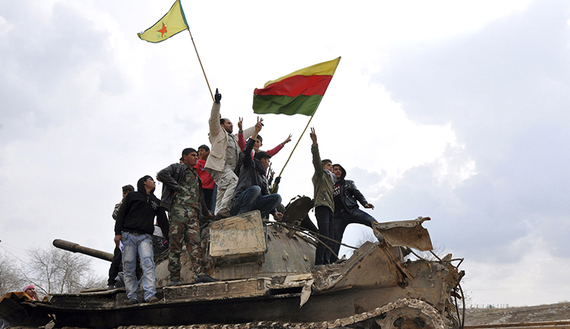
Civilians and members of the YPG gesture and raise flags atop a tank that belonged to fighters from the ISIL, in al-Manajeer village of Ras al-Ain countrysideCivilians and members of the Kurdish People’s Protection Units (YPG) gesture and raise flags atop a tank that belonged to fighters from the Islamic State of Iraq in al-Manajeer village of Ras al-Ain countryside, Jan. 28, 2014. (photo by REUTERS/Rodi Said)

Western officials say that given the Islamic State threat, it is only a matter of time before their governments initiate formal ties with the Kurdistan Workers Party and the Democratic Union Party, despite objections from Turkey.

****************

As the United States presses ahead with assembling an international coalition to “degrade and destroy” the Islamic State (IS), two potentially critical players are coming to the fore: the Kurdistan Workers Party (PKK) and its Syrian Kurdish franchise, the People’s Protection Units (YPG). Their ascent has been amply chronicled by Al-Monitor columnist Kadri Gursel and Al-Monitor contributor Mohamed A. Salih.

The PKK and YPG have proven to be the most effective forces in the battle against IS both in Iraq and in Syria, never so much as when they shepherded tens of thousands of Yazidi Kurds marooned on Mount Sinjar, in northwestern Iraq, to safety and helped Iraqi peshmerga retake the town of Makhmour.

The PKK and YPG are pro-secular, if quasi Marxist, in ideology. The latter has never targeted the West, and although the PKK has been fighting Turkey, a NATO member, on and off since 1984 for Kurdish self-rule, a cease-fire declared in March 2013 remains in effect. Moreover, both groups claim they are eager to cooperate with the West. So, what better local partners for the anti-jihadist alliance than them? This question is being pondered by European Union (EU) governments and US officials, senior Western officials speaking on condition of anonymity told Al-Monitor. All stressed, however, that for now the debate was, as one put it, “of a purely ‘what if’ nature.”

“The problem is Turkey,” explained one of the officials, echoing concerns of a likely backlash from the Turkish government. Turkey branded the PKK as “terrorists,” and the label was adopted by the EU and Washington. The PKK is on both their lists of officially designated terrorist groups and has been accused of money laundering and drug trafficking. IS’ dizzying gains, however, have dramatically altered the security landscape across Syria and Iraq. “You’ve got to pick your poison. It’s either [IS] or the PKK,” the same official stated.

Turkey has not helped matters by refusing to join the anti-IS front, saying its contribution would be limited to humanitarian missions. IS continues to hold 49 workers from the Turkish Consulate in Mosul hostage, which is the main stated reason for its reticence. After all, Turkey has been holding direct peace talks with the imprisoned PKK leader, Abdullah Ocalan, for at least five years. Thus, US and European policymakers who are pushing for a dialogue with the PKK/YPG argue that Turkey can hardly complain about Western engagement with them when it is talking to the rebels itself.

Ankara’s peace negotiations with the PKK were effectively formalized with legislation rammed through parliament by the ruling Justice and Development Party (AKP) earlier this year. In a further dramatic shift, AKP officials say they are finally ready to talk to PKK commanders in Iraqi Kurdistan. All of this ought to make it easier for Western governments to delist the PKK, but Turkey argues that until a lasting peace agreement is struck with the rebels, any Western moves to legitimize the group would weaken the government’s hand.

Engagement with the PKK and the YPG’s political arm, the Democratic Union Party (PYD), is already being advocated by some influential think tanks in Washington. Michael Werz, a senior fellow at the Center for American Progress, co-authored a recent report calling on the Obama administration “to deal with Kurdish organizations that are helping define the reality on the ground [in Syria], such as the militant Democratic Union Party, or PYD.” Unlike Turkish officials, Werz believes that dangling the carrot of delisting can help move the peace talks forward.

Another part of the problem is Turkey’s insistence that the rebels surrender their arms and disband as part of any final deal. This is utterly unrealistic given the spiraling IS threat. If anything, the PKK is looking to expand its forces and upgrade its weapons. Indeed, it is the PKK’s prowess on the battlefield, rather than its peace overtures to Turkey, that is propelling it to international legitimacy.

Marietje Schaake, an EU parliamentarian who closely follows Turkish affairs, argues against such expediency. “The Middle East has suffered enough from ‘your enemy’s enemy is your friend’ type of thinking, which has often had disastrous consequences. Instead, the IS threat should create a sense of urgency for a negotiated solution [to Turkey’s Kurdish] problem,” Schaake told Al-Monitor.

Another hurdle to Western dialogue with the PKK and the YPG is the Iraqi Kurds. Massoud Barzani, head of the Kurdistan Democratic Party (KDP), sees himself as the true leader of the world’s 40 million or so Kurds and resents any suggestions that Ocalan and the PKK might have a similar claim. His peshmerga, however, put up no resistance and fled when IS forces stormed Sinjar in August, casting them in an unfavorable light compared with the battle-hardened PKK/YPG.

PKK sources who asked not to be identified confirmed that they have already had informal contact with “junior level” US Army officials and CIA operatives on Mount Sinjar. “These interactions would be unthinkable absent the [IS] threat,” Werz told Al-Monitor. “That said, the US government is very risk averse and will proceed cautiously. Many officials are afraid of jeopardizing their careers by being seen to cooperate with anyone linked to the PKK,” he said. This and unremitting Turkish pressure may explain why the United States continues to deny a visa to Salih Muslim, the PYD co-chair, and shuns official contact with him.

Undaunted, the PKK and the PYD/YPG are continuing their battle for global acceptance. In a move apparently calculated to provide the Obama administration with a fig leaf for future cooperation, the YPG recently sealed an anti-IS alliance with various groups affiliated with the Free Syrian Army (FSA), founding what they call the Joint Action Center. Its purported goal is to liberate all territories held by IS in Syria. Barzan Iso, a Syrian Kurdish activist, explained to Al-Monitor, “We cannot fight IS alone. We need to join hands with the Arabs.”

It remains unclear how this sits with the YPG’s policy of nonconfrontation with the regime of Bashar al-Assad. YPG sources confirm that they have already begun training FSA-linked fighters from Liwa al-Tawhid, Shams Shamal and Liwa al-Siwar al-Raka, among others, in and around the town of Azaz, a logistical hub for weapons and other materiel flowing to so-called moderate rebels vetted by the CIA. The end goal for the YPG is to be part of the fresh batch of moderates the Obama administration says it is planning to arm and train to fight IS.

On June 5 and July 5, the PYD/YPG signed three “deeds of commitment” with Geneva Call, a nonpartisan Swiss-based nongovernmental organization dedicated to promoting respect by what it calls armed nonstate actors (ANSAs) for “international humanitarian norms in armed conflict.” Under the terms of the agreement, the YPG pledged to ban anti-personnel mines, work against gender discrimination and sexual violence and not use children under the age of 18 to fight in its ranks. By July, the group had demobilized 149 child soldiers. Geneva Call has wrested similar pledges from the PKK and its armed unit, the People’s Defense Force.

Though there have been alleged violations of the accords, Anki Sjoeberg, program director for Geneva Call, told Al-Monitor, “Geneva Call has found that both the PKK/HPG and the PYD/YPG have proven a willingness to implement them.” She further stated, “We have also worked with both organizations on the respect of international humanitarian law, and they did show a keen interest in learning more about international standards and practices.”

Human Rights Watch (HRW), the New York-based rights advocacy group, had a similarly favorable experience with the PYD/YPG. When HRW published a report cataloguing alleged rights abuses by the PYD/YPG, the Syrian Kurds’ reaction was unexpectedly measured. While they claimed there were “inaccuracies” in the report, YPG spokesman Redur Xelil acknowledged in a tweet that they had to do “a better job.” Emma Sinclair-Webb, HRW’s senior Turkey researcher, told Al-Monitor, “We were encouraged by their response.”

Western officials, meanwhile, predict that it is only a matter of time before their governments initiate formal ties if not with the PKK then certainly with the PYD and the YPG, because the latter two outfits are not on a terrorist list. Nihat Ali Ozcan, a Turkish security analyst who focuses on the Kurds, reckons that Turkey may well ditch its demand that the Syrian Kurds take up arms against the Assad regime as a condition for dialogue and join hands with them, albeit tacitly, against IS as well. “It’s an open secret that the PKK and the YPG are branches of the same tree, but under the circumstances, Turkey will likely resort to pragmatism and treat them differently, at least until the IS threat subsides,” Ozcan told Al-Monitor.