Posted tagged ‘Peace Process’

Palestinians: Abbas’s “Culture of Peace”

May 8, 2017

Palestinians: Abbas’s “Culture of Peace”, Gatestone InstituteBassam Tawil, May 8, 2017

(Please see also, Palestinian Daily ‘Al-Ayyam’ Reports On ‘Abbas’s White House Visit. — DM)

Thanks to Abbas’s falsehoods, his media continues to this day dishonestly to talk about “Jewish invaders and settlers storming” Islamic and Christian holy sites in Jerusalem. This and this alone is the source of the knife and car-ramming attacks against Israelis.

Perhaps by a “culture of peace” Abbas means calling — as he and his top officials regularly do — Israel an apartheid and racist state. Or maybe “culture of peace” means calling all Jews “occupiers” and “colonists” — or denouncing and threatening Palestinian children who play soccer with Israeli kids. Or naming schools and electoral lists after convicted murderers?

Under Abbas, anti-Israel incitement and indoctrination is a business that has expanded exponentially. It has, in fact, grown to the point that a new generation has been raised on the glorification of jihadists — a generation impatient to draw yet more Jewish blood. If this is Abbas’s “culture of peace,” one has to wonder what he would consider a culture of war?

Palestinian Authority (PA) President Mahmoud Abbas may soon be known for his sense of humor. Like many Palestinians, Abbas believes that Westerners will swallow his lies wholesale. Abbas, for instance, ended his May 3 meeting with US President Donald Trump with the following whopper: “We are raising our youth, our children, our grandchildren on a culture of peace.”

Abbas did not provide further details about the “culture of peace” upon which Palestinian children are being raised. Nor did anyone bother to ask Abbas or any member of his entourage to provide examples of the “culture of peace” in Palestinian society. Yet major Western media outlets were quick to publish Abbas’s unmistakable lie.
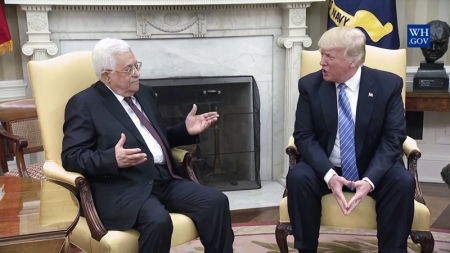
US President Donald Trump meets with Palestinian Authority President Mahmoud Abbas in the White House, on May 3, 2017. (Image source: White House video screenshot)

Apparently, like his predecessor, Yasser Arafat, Abbas is convinced that Palestinians can fool “all of the people, all of the time” about their true goals and intentions. Arafat lied to Presidents George W. Bush and Bill Clinton when he told them that he and the Palestinian Authority were promoting peace and coexistence with Israel. Under Arafat, anti-Israel incitement in the Palestinian media, schools and mosques intensified until Palestinians waged the Second Intifada in September 2000. This intifada was the result of seven years of vicious incitement and indoctrination that came after the inception of the PA. In a truly ironic turn of events, the Oslo Accords, signed between Israel and the PLO in 1993, gave the Palestinians media outlets, including television and radio stations, which were then used to amplify hatred against Israel and Jews on a daily basis.

Arafat used these media outlets to tell his people — when then Israeli Prime Minister Ariel Sharon visited the Temple Mount in September 2000 — that Israel was planning to destroy the al-Aqsa Mosque. It was precisely this incitement that triggered the Second Intifada, in which Palestinians wage a massive and ruthless campaign of suicide bombings and drive-by shootings that caused the death of hundreds of Israelis.

Under Arafat, it was anything but a “culture of peace.” His message to the Palestinians was: “We will march towards Jerusalem and we will sacrifice millions of martyrs on the way!”

Unlike many Israelis who were murdered by Palestinians at Arafat’s incitement, Arafat’s famous battle cry is still alive and well. Currently, it is being echoed by many Palestinians, including children, during rallies and demonstrations in the West Bank and Gaza Strip. This call-to-arms openly encourages Palestinian youths to “march towards Jerusalem” and become “martyrs.”

Only one week before the Abbas’s meeting with Trump, the PA president’s Fatah faction called on Palestinians to take to the streets and clash with Israeli soldiers and Jewish settlers. The call was made in “solidarity” with Palestinian prisoners who went on a “hunger strike” in Israeli prisons. The hunger strike was not about Israel’s prisons, well-known for being among the most comfortable in the world; the hunger strike was actually a political move to compete for which terrorist would be Abbas’s successor. The prisoners are terrorists, most of them with blood on their hands; the more blood, the higher the promotion.

In the fight for Palestinian leadership, being a “graduate” of an Israeli prison is far more important than being a graduate of the University of Texas at Austin. The Palestinians’ former prime minister, Salam Fayyad. Fayyad, an economist and reformer adored in the West, received only 2% of the Palestinian vote.

By calling for clashes with Israelis, Fatah is inciting Palestinian youths to carry out violent attacks against Israeli soldiers and settlers. This is the same Fatah led by Abbas — the same Abbas mouthing lies about a “culture of peace.” By voicing solidarity with convicted murderers and praising them as role models and heroes of Palestinians, Abbas’s Fatah pushes Palestinian youths to follow in their footsteps and engage in violence.

One day after the Abbas-Trump meeting, the current Palestinian Authority prime minister, Rami Hamdallah, participated in a rally in Ramallah, in solidarity with the hunger-striking terrorists. At the rally, Hamdallah affirmed the PA’s full support for the terrorists, by saying he was working to bring their case to the attention of the international community.

Like Arafat, Abbas continues to use alleged but non-existent threats the al-Aqsa Mosque to incite Palestinian youths against Israel. For the past 50 years, non-Muslims, including Jews, have been permitted to visit the Temple Mount as tourists. The visits were suspended when the Second Intifada began in 2000. But since the tourist visits resumed a few years ago, the Muslims have been trying to keep Jews away from the holy site. The Muslims claim that Jews are seeking to “destroy” and “desecrate” the al-Aqsa Mosque (on the Temple Mount) — a false claim that is added to the long list of lies and blood libels spread by Abbas and many Muslims. Abbas’s statement came in response not to any incidents at al-Aqsa Mosque, as Abbas and other Palestinians claimed: Tours of Jews to the Temple Mount are routine and peaceful.

In September 2015, Abbas stated that he “welcomed every drop of blood that is spilled in Jerusalem.”

Shortly after this statement, Palestinians began waging a campaign of knife and car-ramming attacks against Israelis, in a violent insurgency known as the “Knife Intifada”. “We will protect Jerusalem and we will not allow them [Jews] to defile al-Aqsa (Mosque) and the Church of the Holy Sepulcher with their filthy feet,” Abbas deceitfully announced.

It is still unclear why he decided to bring the church into the controversy surrounding Jewish visits to the Temple Mount. What is clear is that Abbas was lying: Jews had not entered either the church or al-Aqsa Mosque.

Ever since Abbas’s inciting statement, however, dozens of Palestinian youths have heeded his call by going out to stab or run over the first Jew they see. Their blood is on Abbas’s hands. He is the one who sent out the youths to “protect” al-Aqsa Mosque against the fictitious Jewish “invaders.” He is the one who continues falsely to talk about “herds of settlers storming al-Aqsa Mosque” — in reality, peaceful routine visits by Jews to the Temple Mount. Thanks, however, to Abbas’s falsehoods, his media continues to this day dishonestly to talk about “Jewish invaders and settlers storming” Islamic and Christian holy sites in Jerusalem. This and this alone is the source of the knife and car-ramming attacks against Israelis.

This, evidently, is the “culture of peace” to which Abbas is referring. How can he utter such a staggering lie when his media and top officials continue to delegitimize Israel and demonize Jews on a daily basis? How precisely is Abbas promoting peace when his Palestinian Authority names schools and public squares after Palestinian terrorists with Jewish blood on their hands? Earlier this year, for example, Abbas’s Fatah named a youth camp in Jericho after Dalal al-Mughrabi, a female terrorist who killed 38 civilians, 13 of them children, and wounded more than 70, in 1978.

By honoring the murderers of Jews, Abbas is, instead, solely promoting a culture of hate and violence. His message to Palestinian youths is, straightforwardly: the more Jews you kill, the more honor and respect you will receive from your people.

Abbas talks about a “culture of peace” at a time when he and his Palestinian Authority are even combating all forms of “normalization” with Israel. The anti-normalization campaign, in Ramallah and other Palestinian cities, targets any Palestinian who dares to meet with Jews (even “pro-Palestinian” Jews). It operates solely under the auspices of the PA government. This campaign also promotes boycotts, divestment and sanctions against Israel. Its goal is to intimidate Palestinians who work towards peace and coexistence with Israel and to ban any business with Jews. Can any Palestinian invite Jews to a meeting in Ramallah without being targeted by the “anti-normalization” thugs, many of whom are affiliated with Abbas’s Fatah?

Perhaps by a “culture of peace,” Abbas means calling — as he and his top officials regularly do — Israel an apartheid and racist state. Or maybe “culture of peace” means calling all Jews “occupiers” and “colonists” — or denouncing and threatening Palestinian children who play soccer with Israeli kids. Or naming schools and electoral lists after convicted murderers? Those seem like debatable ways to advance his “culture of peace.”

Under Abbas, anti-Israel incitement and indoctrination is a business that has expanded exponentially. It has, in fact, grown to the point that a new generation has been raised on the glorification of jihadists, a generation impatient to draw yet more Jewish blood. If this is Abbas’s “culture of peace,” what, one wonders, would he consider a culture of war?

Palestinian Daily ‘Al-Ayyam’ Reports On ‘Abbas’s White House Visit

May 8, 2017

Palestinian Daily ‘Al-Ayyam’ Reports On ‘Abbas’s White House Visit, MEMRI, May 8, 2017

(Consider the source. Abbas will get what he seeks when he teaches pigs to fly. Whoops. Pigs are haram. Please note the absence of any reference to Palestinian incitement of children and others to commit acts of terror and payment of Palestinian “heroes” in Israeli jails — both of which President Trump has insisted cease. Perhaps more important, were the Palestinian Authority to have elections, Hamas would likely win. The excerpts from the article do not mention Hamas– DM)

On May 7, 2017, the Palestinian daily Al-Ayyam published a detailed article on Palestinian Authority (PA) President Mahmoud ‘Abbas’s May 3 visit in Washington, titled “The Secrets and Details of President [‘Abbas’s] Visit and Talks in the U.S. Capital.” The article, by the daily’s U.S. correspondent ‘Abd Al-Rauf Arnaut, described ‘Abbas’s meetings with American officials as relaxed, and the hosts’ reception of ‘Abbas and his delegation as warm and respectful.

The article presented lengthy quotes from ‘Abbas himself about his meeting with Trump. According to ‘Abbas, he clarified to Trump that the Arabs oppose terrorism, no matter its type or its source, and that the Palestinians support a two-state solution rather than a two-state solution. He presented the Arab peace initiative as a basis for peace between Israel and the entire Arab world following an Israeli withdrawal from the Palestinian territories, and focused on the need to find a creative solution for the refugee problem based on UN Resolution 194,[1] stressing that otherwise it would not be possible to end the conflict. ‘Abbas also presented Trump with maps showing the history of Palestine from 1937, in order to demonstrate the steady contraction of the territories intended for the Palestinians and the vital need to halt construction in the settlements.

The following are excerpts from the article:[2]

“This wasn’t President ‘Abbas’s first visit to the White House, but it was different in its details from all the previous visits. After Donald Trump won the U.S. presidential election, Arab officials and analysts hurried to say that the Palestinians had become “irrelevant”, but within 100 days [of the election], the relations and the chemistry between the Palestinian and U.S. presidents developed to a point that [proved them to be] shamefully wrong.

“President Trump and his team were unfamiliar to the Palestinians, since, unlike previous [U.S.] presidents, such as George Bush Jr. and Barack Obama, they did not emerge from the American [political] establishment. In contrast to some leaders of Palestinian factions who criticized the new U.S. president based on Israeli statements, President ‘Abbas opted for a quiet diplomacy whose results became evident later, during his visit to the White House, which he has characterized as successful.

“After talking a great deal about the cold shoulder turned to ‘Abbas by the new inhabitant of the White House, and the implications [of this attitude], analysts found themselves faced with a sight that even many Palestinian officials had not imagined they would see. [Thanks to preparatory] measures and arrangements that preceded the meeting at the White House, a new bond was formed that is bound to become [even] clearer during Trump’s visit to Bethlehem on May 23, 2017.

“President ‘Abbas said: “The visit was preceded by several [preparatory measures]. About six weeks ago, after Trump entered the White House, the head of the Palestinian intelligence service, Maj. Gen. Majid Faraj, was invited to Washington for a meeting with his American counterpart, and he indeed came there and met with many U.S. political and military officials. [Gen. Faraj] returned with a lot of information, indicating that a new era had dawned in Washington and that we could expect new developments because there was a new [president] in that country who might present fresh ideas regarding the Palestinian issue. We were very pleased with this [preliminary] meeting.

“In a closed meeting with Arab ambassadors to Washington, [‘Abbas] said: “Immediately after that, shortly after the appointment of Mike Pompeo as Director of the CIA [on January 23, 2017], we were told he would come for a visit [in the PA] and he indeed came to Ramallah and we held lengthy meetings with him. He is an experienced man, for he was a member of Congress, so our cause was not unfamiliar to him, although we may have had to fill him in on some of the details. At the end of the meeting, he said: ‘I will now go [straight] to the airport and [fly to] Washington, for I want to present the minutes of this meeting to President Trump, who has a meeting scheduled tonight with Binyamin Netanyahu.’

“The CIA director was the first [U.S. official] to meet with the [Palestinian] president… and even though certain elements tried to claim that the contacts between the Palestinians and Americans were [confined to] the security level, these contacts continued on the diplomatic level [as well].

“President [‘Abbas] said: ‘The second step came one week later, when President Trump called me. This was the first time he called [me. He] greeted me and then invited me to the White House, saying, ‘I’ve heard all sorts of things about you, but I want to hear more from you, because I want to find a solution to the [Palestinian-Israeli] conflict. He repeated his invitation several times, and then told me that he had a great deal of confidence in several of his aides, including Jason Greenblatt,[3] and that he would soon send [Greenblatt] to us so we could talk with him.’

“The [next] step was [indeed] a meeting between United States Special Representative for International Negotiations Jason Greenblatt and President ‘Abbas in Ramallah. President ‘Abbas said: ‘Greenblatt arrived and I had a lengthy and comprehensive meeting with him, because I assumed he needed to learn the details. I [recounted all the developments] from Oslo until today, step by step, and described the entire Palestinian issue in full. Then I tried to answer all the questions I figured he might have, and when I was done he indeed said, “I have nothing left to ask, this was a useful meeting.”‘

“The [next] step was a meeting between Greenblatt and President [‘Abbas] on the Jordanian shore of the Dead Sea, at the periphery of the Arab League summit. President ‘Abbas said: ‘Greenblatt returned to Washington and then came back to [visit] us during the Arab League summit in Jordan, where he met with many Arab foreign ministers.’

“Concurrently, preparations for the [Trump-‘Abbas] summit were also made during the visit to Washington of a [Palestinian] delegation that included Dr. Saeb Erekat, the head of the Palestinian intelligence service and PLO Executive Committee secretary-general Maj. Gen. Majid Faraj, and Dr. Muhammad Mustafa, President [‘Abbas’s] economic advisor. Preparations were also made at the level of the leaders of Palestine, Jordan and Egypt, all three of whom had been invited to the White House. President ‘Abbas said: “We had been invited [to Washington] and we prepared for the visit, but [even] before this, at the Arab [League] summit which was [dedicated to the issue of] Palestine, Jordan’s King ‘Abdallah II initiated a three-way meeting with Egyptian President ‘Abd Al-Fattah Al-Sisi and myself so we would go to Washington with a single unified message. King [‘Abdallah] and President [Al-Sisi] had been invited [to Washington], but the date of my own visit had not yet been set. So the three of us met and discussed in detail the message we would present to Washington.’ He added: ‘King ‘Abdallah and President Al-Sisi [later] informed us about what had transpired [during their meetings] in Washington. They conveyed the same message, and that helped us a lot. Then it was decided that I would come here, to Washington, and I arrived, held some side meetings and then we went to the White House.'”

The Meeting With Jared Kushner

“Upon President ‘Abbas’s arrival in Washington, more meetings were held between the Palestinians and Americans. Far from the media, a first meeting took place between President ‘Abbas and Trump’s senior advisor and son-in-law, Jared Kushner. Kushner left a very positive impression on ‘Abbas, [who called him] ‘a polite man who wanted to gain a good understanding of the situation [and who] asked very polite questions about all the topics he wished to understand.’ This meeting was held on the eve of the president’s arrival at the White House.

“Up until the meeting at the White House, Palestinian officials differed in their assessments. Some expected a smooth and easy meeting while others were afraid of last-minute surprises.”

The Meeting With Trump

“The meeting went as Palestinian officials hoped it would, and was very positive, as was clearly evident from President [‘Abbas’s] reception at the White House.

“President [‘Abbas] naturally slept that night, after the long flight and because of the time-difference. The next morning he was cheerful as he prepared for his first visit to the White House during the Trump presidency. When he arrived, Trump met him at the door and accompanied him as he went to sign the guestbook. Then the two went into the Oval Office, and there, in the presence of the media, Trump greeted President ‘Abbas and shook his hand multiple times. Then they visited President Roosevelt’s historic office at the White House, where each delivered a statement, before shaking hands once again and turning to the Cabinet Room, where the U.S. cabinet holds its meetings.

“In the Cabinet Room, U.S. State Secretary Rex Tillerson sat to the left of the U.S. President and Vice President Mike Pence sat to his right. Also present at the meeting were U.S. National Security Advisor Gen. McMaster as well as Kushner, Greenblatt, the White House Chief of Staff, and U.S. Consul General [in Jerusalem] Donald Blome. Apart from ‘Abbas, the Palestinians present included Dr. Saeb Erekat, Gen. Majid Faraj, Dr. [Muhammad] Mustafa, Deputy Prime Minister Ziad Abu ‘Amr, ‘Abbas’s advisors Nabil Abu Rudeineh and Majdi Al-Khalidi, and Palestinian ambassador to Washington Husam Zomlot.”

‘Abbas: This Is What Happened At The White House

“As for the details of the visit, ‘Abbas said: ‘After signing the guestbook and delivering our statements to the press, [Trump and I] sat down together and I made every effort to present our wishes and our ideas [to him]. I told him explicitly: We, the united Arab nation, all oppose terror and combat terror, of every type and from every source. [Terror] is alien to us as a nation, alien to our culture, and that is why we stand up against it. Secondly, as for the political situation, we Palestinians believe in the solution of two states, namely Israel, which already exists, and a Palestinian state that we want to establish in the 1967 borders, whose capital is East Jerusalem. I told [Trump], if someone gets it into his head to speak about a one-state [solution, you should know that] we opt for the two-state [solution]. But if someone [nevertheless] mentions the one-state [solution, you should know that] there are two options. [The first option] is a racist discriminatory state, in which there are two regimes, [one for Palestinians and another for Jews], as is the case today in the Palestinian territories. Obviously, we will never agree to this and nobody in the world will agree to it. [The second option] is a binational state. I believe that they [the Israelis] reject this [option] out of hand, and I have [in fact] heard this from [them] on more than one occasion. So we are left with the solution of two states: a Palestinian state in the 1967 borders, and Israel. We want a state in those borders, with East Jerusalem as its capital’…

“‘Abbas then turned to explain the Arab peace initiative, using a one-page document prepared by the Palestinian president’s office, which included the details of the plan and the flags of the Arab countries that had approved it. President [‘Abbas] said: ‘I told Trump: We have the Arab initiative that was adopted at the 2002 Arab [League] summit in Beirut, which, in my opinion, is the most valuable initiative ever achieved for resolving the Palestinian problem. [The plan] is neither long nor complicated. It includes two main clauses.’ President [‘Abbas] explained to President [Trump] that the first clause says that if Israel withdraws from the Palestinian and Arab territories, all the Arab countries will be willing to form [diplomatic] ties with it, and that this initiative has been approved by more than one Arab capital and at many Arab and Muslim summits, for example in Istanbul, Iran and Pakistan…’ President ‘Abbas explained to the U.S. President that the flags on the document represented the countries that have approved the Arab peace initiative and have expressed willingness to recognize Israel if the latter withdraws from the occupied Arab and Palestinian territories.

“[‘Abbas also] explained to Trump that the [Arab] initiative proposed a just and agreed-upon solution to the refugee problem based on [UN Resolution] 194. The problem needs to be solved in a creative way based on the UN resolutions, [he said]. It must be resolved in order to resolve the conflict… We insist on this solution [to the refugee problem] because do not want only a peace treaty between ourselves and Israel, we want to end the conflict between ourselves and the Israelis. If the refugee problem remains unresolved, the conflict will remain as well.’

Historical Map Of Palestine

“President ‘Abbas then presented the U.S. President with a map showing Palestine from 1937 until today, to demonstrate how the Israeli occupation is eating away at the Palestinian territories. He said: ‘The maps explain the Palestinian problem… starting with the map of historical Palestine, through the first partition plan of 1937, the second [partition plan] of 1947, and then 1948. What [territory] is left to us? In the end [we have only] what the Israelis have left the Palestinians [after] building their settlements in the Palestinian territories.’ ‘Abbas said, ‘If construction in the settlements continues… how will we be able to establish a Palestinian state? That is why we oppose the settlements and regard them as illegitimate. This should be the basis for handling them at the [negotiation] table.’

“This explanation took up about 15-20 minutes of the face-to-face meeting between the two presidents. Then the two went to the Cabinet Room, where the American and Palestinian teams joined them. In the Cabinet Room, the Palestinian officials spoke, each about his area [of expertise], and explained the Palestinian position on each issue.

“President ‘Abbas said: ‘To sum up, we felt that the man [Trump] was serious and is eager to find a solution soon. Indeed, we hope that this is the case. I told him that we are prepared to send a delegation to the U.S. immediately in order to start negotiations, as they see fit.’ He added: These are our basic [principles], these are our positions, and we are demanding no more than the [implementation of the] U.N. resolutions. I felt that President Trump is very willing to proceed, and I am very pleased about that. I am not saying that he agreed with me, but at least he listened to me with great interest and in a positive manner. I hope he was convinced [by me], but this takes time, and I think that he should know further details.’

Outstanding Reception

“The observers were unanimous that President ‘Abbas received an unusually [warm] welcome in the White House. The Palestinian flag was prominently displayed in many places, especially in the historic Roosevelt Room, where it was stood behind the U.S. President as he gave his address. Several hours after the meeting, dozens of top U.S. officials and intellectuals in Washington, including the President’s harshest critics and representatives of organizations such as AIPAC, hurried to a large hall in the Mandarin Hotel in order to congratulate President ‘Abbas on the successful meeting. Many made sure to have their photo taken with him. The next day, there was another American surprise, when the White House announced that President Trump had accepted the invitation to visit the Palestinian territories. President ‘Abbas said that he was pleased about this visit and hoped that it would lead to something new.”

_______________________

[1] It should be noted that the Palestinians and the Arab states, unlike Israel, hold that this resolution recognizes the refugees’ right to return to their homes and also to receive compensation. It should be noted that the issue of the refugees’ return or compensation was not mentioned in the original Saudi peace initiative, but was added later under pressure from Syria and Lebanon in what became the “Arab peace initiative.” See “The Warped Saudi Initiative” by Itamar Rabinovich, Haaretz (Israel), April 4, 2002. For the article in English, see Haaretz.com, April 7, 2002.

[2] Al-Ayyam (PA), May 7, 2017.

[3] A Jewish-American lawyer who served as executive vice president and chief legal officer to Donald Trump and the Trump Organization, and as advisor on Israel during his presidential campaign. In January 2017 Trump appointed him United States Special Representative for International Negotiations.

Ever wonder what fake news is?

May 7, 2017

Ever wonder what fake news is? IsraeliPM via YouTube, May 7, 2017


Former Jordanian Culture Minister: No Problem With U.S. Moving Embassy To West Jerusalem

May 1, 2017

Former Jordanian Culture Minister: No Problem With U.S. Moving Embassy To West Jerusalem, MEMRI, May 1, 2017

In an April 30, 2017 article titled “Unpopular Statements,” Tareq Al-Masarwa, Jordan’s former culture minister and a senior columnist for the government daily Al-Rai, wrote that the U.S. can move its embassy to West Jerusalem[1] because the Palestinians and Arabs do not claim that part of the city. He called on the Arabs to face reality in light of the fundamental changes that have occurred in the Arab world in the last few years, and discard illusions of victory and fairytales about resistance.

The following are excerpts from his article:[2]

Tareq Al-Masarwa (image: Ahkelak.net)

“The Americans can move their embassy to the new [part of] Jerusalem [i.e. the western part] without sparking any serious rage among the Arabs. This is for the simple reason that the Palestinians and Arabs demand the Old City [of Jerusalem] – which they lost in the 1967 war, known as the Six Day War – as the capital of their state. I have not heard anyone demanding the 1948 part of Jerusalem [i.e., West Jerusalem], neither Hamas, the PLO nor anyone else.

“There is talk about U.S. President [Donald] Trump visiting the region [soon], including the hotspots of Israeli-Palestinian tension. Although the man is known for the promises he made before and after the elections, he can play the game of ‘Jerusalem the capital [of Israel]’ without causing awkwardness for [either] U.S. policy or his allies…

“I do not mean to seem like a spoil-sport. The U.S. president will meet Abu Mazen [Mahmoud ‘Abbas on May 3, 2017] and this meeting is meaningful, despite everything that is said about [Trump] constantly changing his mind according to his whim. The Palestinian president will demand a demilitarized state, to exit securely alongside Israel. The [late Palestinian] president Yasser Arafat also agreed at some point to the formula of ‘administrative autonomy’ in return for [permission to] return to Palestine. The Israeli occupation, [for its part,] has already come to terms with all the characteristics of the Palestinian state, except for the aspect of changing its basic designation [i.e., calling it a state rather than an authority or an autonomy].

“Today many things have changed, and much water has passed under the bridge, as the saying goes. It’s time to face the bitter reality. Who thought that the Syria disaster would enter its seventh year, that Iraq would [have to] borrow money to pay the salaries of its civil servants, that an Arab war would rage in Yemen, and that Libya would return to the state it was in before King Idris unified its three provinces?

“[King] ‘Abdallah II managed to revive the [Arab League] summit on the Dead Sea and to strike a pact of Arab cooperation in this region. It’s time to face reality as it is, without the illusion of victory and the fairytales about resistance, for we are not in the best of situations.”

________________________

[1] Senior journalist ‘Abd Al-Rahman Al-Rashed made similar statements in Al-Sharq Al-Awsat. See MEMRI Special Dispatch No. 6764, Prominent Saudi Journalist: West Jerusalem Is Part Of Israel; Moving The U.S. Embassy There As Part Of Overall Peace Agreement Could Herald The End Of The Israeli-Palestinian Conflict, January 31, 2017.

[2] Al-Rai (Jordan), April 30, 2017.

Congressional Caucus Seeks New Approach to Israeli-Palestinian Conflict

April 27, 2017

Congressional Caucus Seeks New Approach to Israeli-Palestinian Conflict, Investigative Project on Terrorism, April 27, 2017

(Please see also, The Agenda for the Trump-Abbas Meeting. — DM)

The Congressional Israel Victory Caucus (CIVC) was launched on Thursday in an effort to revitalize U.S. engagement with the Israeli-Palestinian conflict, building on perspectives espoused by the Middle East Forum (MEF).

The caucus calls for the need to put the onus of peace on the Palestinians, to give up their rejectionist claims about Israel’s right to exist as Jewish state. The initiative also calls for the U.S. to cease pressuring Israel to make major concessions that often lead to more Palestinian violence and terrorism.

Co-chairs, Reps. Ron DeSantis, R-Fla., and Bill Johnson, R-Ohio, expressed strong support for Israel and its right to defend itself at Thursday’s launch event, which featured several other Republican congressmen.

“Israel is not the problem in the Middle East; it is the solution to many of the problems that bedevil the region. American policy must ensure that Israel emerges victorious against those who deny or threaten her existence,” DeSantis said in a statement announcing the initiative.

The caucus wants the Palestinian Authority (PA) to stop its violent incitement against Jews and Israelis. It aims to help reverse one sided, anti-Israel United Nations resolutions and oppose efforts to delegitimize Israel through initiatives such as the Boycott, Divestment, and Sanctions (BDS) campaign.

Palestinian incitement prevents peace from materializing, Johnson said, specifically calling out the widespread practice of naming Palestinian institutions and schools after terrorists responsible for murdering innocent Israelis.

DeSantis also blasted the PA for continuing to pay terrorists’ families after they committed attacks against Israelis.

“Any financial assistance to the Palestinian Authority by American taxpayers cannot continue so long as the PA continues to pay pensions and salaries for families of terrorists. It’s a simply inappropriate use of taxpayer money and it’s not fair to the American taxpayer,” DeSantis said at Thursday’s event.

The Taylor Force Act, a bill named after a 28-year-old American tourist killed by a Palestinian terrorist in Israel last year, would prohibit U.S. assistance to the PA until terrorist salaries and payments cease.

“If you die as a terrorist, as a ‘martyr,’ your family will get an annual stipend greater than the average Palestinian earns. In this case, the terrorist who killed Taylor Force…was hailed as a hero, was basically given a state funeral, and his family was given money by the state,” says sponsor Sen. Lindsey Graham, R-S.C.

The Agenda for the Trump-Abbas Meeting

April 27, 2017

The Agenda for the Trump-Abbas Meeting, Front Page MagazineCaroline Glick, April 27, 2017

Originally published by the Jerusalem Post

The day after Israel celebrates its 69th Independence Day, US President Donald Trump will greet PLO chief Mahmoud Abbas at the White House. The date of their meeting, May 3, is notable not least for its timing.

The timing of the meeting presumes a linkage between the establishment of Israel and the establishment of a Palestinian state. This is not merely obnoxious, it is also blind to reality.

In reality, an independent state of Palestine has existed for the past 12 years in Gaza. Rather than build that up and declare independence, Abbas and his comrades surrendered Gaza to Hamas in 2007.

Hamas, in turn, transformed independent Palestine into a base for jihad.

Abbas’s failure to declare independence in 2005 – and the subsequent failure of his US-trained forces to defend their control over Gaza in June 2007 from Hamas terrorists – is generally overlooked. But it is critical that Trump understand the significance of his behavior before he meets with Abbas.

Since the inception of the peace process between Israel and the PLO in 1993, the professed goal of the PLO has been to establish an independent Palestinian state on any territory over which it was able to take control from Israel. Yet 12 years ago, when Israel withdrew its citizens and military from Gaza, the PLO refused to take responsibility for the area insisting ridiculously that Gaza was still controlled by Israel.

Then 10 years ago, US-trained PLO forces fled to Israel rather than defend their control of Gaza when Hamas took up arms against them.

There are, it seems, two main reasons for Abbas’s behavior. The first is directly related to how he understood Israel’s decision to withdraw.

In December 2003, then-prime minister Ariel Sharon stunned the country when he adopted the platform of the Labor Party – which he had just massively defeated in the general elections – and removed all Israeli communities and military installations from Gaza, including from the border with Egypt, by the end of 2005.

Israeli society was nearly torn apart in the one year and eight months between Sharon’s surprise announcement and the expulsion of Gaza’s Jews in August 2005. The media hemorrhaged with continuous propaganda that demonized the Israeli residents of Gaza and the religious Zionist community in general.

A reminder of that toxic period came earlier this month, when Haaretz published a column by veteran reporter Yossi Klein in which he alleged that religious Zionists posed a graver danger to the State of Israel than Hezbollah.

Abbas and his lieutenants viewed the domestic chaos that engulfed Israel at the time as proof of Israel being on its way off the stage of history.

If this was how Israelis reacted to the destruction of 21 communities in Gaza (and four in northern Samaria) and the dispossession of 10,000 Israelis, it was clear to Abbas and his comrades that Israeli society would collapse if Sharon carried out his plan to reenact the Gaza withdrawal tenfold in Judea and Samaria after the 2006 elections.

Why accept Gaza if all of Israel was about to be destroyed – by its own hand? The second reason that Abbas didn’t declare independence in Gaza, is because he had no interest in being held accountable for his behavior – as leaders of independent states are. If he accepted sovereign power, then the Palestinians as well as Israel and, presumably, the rest of the world would be able to hold him to account for what happened within the territory he controlled. His ability to blame Israel for his failures would be diminished, at least in theory.

Far better, Abbas concluded, to pretend that Israel’s withdrawal was meaningless and blame Israel for his failure to govern his own territory.

Both reasons for Abbas’s rejection of responsibility over Gaza are important because they also reflect the views of the Palestinians as a whole.

Dan Polisar, from Shalem College, summarized in a recent article in the online magazine Mosaic, his study of more than 400 public opinion surveys of the Palestinians in Judea, Samaria and Gaza taken by professional pollsters over the past 23 years.

Like Abbas in 2005, the overwhelming majority of Palestinians believe that Israel isn’t long for this world.

In one 2011 survey, for instance, a mere 23% of Palestinians said they were certain that Israel will continue to exist 25 years hence. 44% were certain it would not.

The fact that more than three quarters of Palestinians are uncertain if Israel will survive is not only a function of Israel’s own self-destructive behavior – it is premised as well on Palestinian ideology.

The vast majority of Palestinians reject Israel’s right to exist. Indeed, a mere 12% of Palestinians believe that Jews have ties to the land of Israel.

Polisar showed that, whereas a plurality to a bare majority of Palestinians accepts the premise of a twostate solution, the overwhelming majority reject any deal that would leave Israel intact as a viable state capable of defending itself. Equally importantly, 68% of Palestinians believe that even if a Palestinian state is established in Gaza, Judea and Samaria with Jerusalem as its capital, they should continue to aspire to Israel’s destruction.

In other words, even if the PLO signs a deal with Israel that says the conflict has been resolved, for 68% of Palestinians the conflict will continue. They oppose ending the education of their children to seek Israel’s destruction and accepting Israel as a peaceful neighbor.

This then, brings us to Trump’s visit with Abbas, the day after Israel’s 69th birthday.

What does he intend to discuss with Abbas? From media reports, it appears that Trump intends to discuss the Palestinian Authority’s subsidization of terrorism to the tune of $300 million each year, which it pays out as salaries to terrorists in Israeli prisons and as stipends to their families.

In an interview with Sean Hannity on Fox News earlier this week, Prime Minister Binyamin Netanyahu urged Trump to hold Abbas to account for his massive budgetary outlays to terrorists and their families. He asked that Trump demand as well that Abbas stop the PA ’s indoctrination of the Palestinians to seek the annihilation of Israel and the murder of its citizens.

This is well and good. But it seems a bit beside the point. The point is that 69 years ago, the Jews established our state. A Palestinian state was not established then or since, not because Israel was unwilling for such a state to come into being, but because the Palestinians refuse to accept Israel’s right to exist.

If any good is to come from Trump meeting with Abbas – on May 3 or at any other time – then he should send the following message to Abbas and to the rest of the world.

To date, the US has supported the goal of Palestinian statehood, because it convinced itself that the Palestinians were interested in a state that would live at peace with Israel. The US pressured Israel to make concessions to the Palestinians in order to encourage them to accept Israel. And the US funded the PA thinking that doing so would advance the cause of peace. It trained and armed PA security forces for the same reason.

To date, the Palestinians, the PLO and the PA have not lived up to their side of the bargain – on anything.

They have not come to terms with Israel’s existence; they have not abjured terrorism; and they have not accepted responsibility for the areas under their control, either in Gaza, or in Judea and Samaria.

Since his is a new administration, Trump is willing to give Abbas the benefit of the doubt for three months. In that time Abbas needs to stop all financial transfers to terrorists and their families – in and out of prison; he needs to change the names of all the public sites now named after terrorists; and he needs to purge all anti-Jewish content from his PA -controlled media and mosques.

If Abbas fails to do all of these things by August 3, then the Trump administration will abandon its support for Palestinian statehood and its recognition of the PLO .

The UNRWA book battle

April 20, 2017

The UNRWA book battle, Israel Hayom, Jonathan S. Tobin, April 20, 2017

(More on the UN Rocket Warehousing Agency and the Palestinian authority. Please see also, UNRWA Won’t Be Changing School Textbooks and Curriculum. — DM)

It is an article of faith for the international community and the Jewish Left that the ‎Palestinian Authority is a moderate force that wants to make peace with Israel. ‎That belief has been undermined by many of the PA’s actions and statements since ‎its creation after the signing of the Oslo Accords in 1993, yet somehow it survives and forms the basis for many of the assumptions critics make ‎about Israel’s government.

The latest proof that the PA is a principle obstacle to ‎peace rather than its best hope has not received any attention in the Western press. ‎But a discussion of the conflict that has arisen between it and the United Nations ‎Relief and Works Agency speaks volumes about everything that is wrong ‎with the PA.‎

UNRWA is the world body that is devoted solely to aiding Palestinian refugees. ‎Unlike the United Nations High Commissioner for Refugees, which is tasked with helping all other refugees around the world, UNRWA doesn’t try ‎to resettle refugees or resolve their problems. On the contrary, since its creation ‎after the Arab failure to destroy Israel in its War of Independence, UNRWA has ‎helped to perpetuate the clash between Israel and the Muslim and Arab worlds and ‎championed the “right of return” that would spell Israel’s end. Its schools and aid ‎projects have been hotbeds of radicalism aimed at erasing the existence of the ‎Jewish state and have even been used by Hamas. In particular, critics have noted ‎the way UNRWA schools in the West Bank and Gaza have curricula and textbooks ‎that teach up to 600,000 Palestinian youngsters to reject Israel’s legitimacy and ‎glorify the struggle to destroy it. ‎

But, like the rest of the U.N., UNRWA has been feeling some pressure to ‎reform. The Trump administration has shown a willingness to throw its weight ‎around that directly contrasts with former President Barack Obama’s support for the U.N. Under ‎new Secretary General Antonio Guterres, who previously headed the U.N.’s other ‎refugee agency, efforts to promote the libel that Israel is an apartheid state were ‎rejected. So when the Arab press reported leaks about a shift in UNRWA’s ‎education policy, this seemed to indicate that even that agency was feeling some ‎pressure to change its ways.‎

According to those reports, UNRWA was planning to alter the textbooks it uses ‎in its schools. Among the planned changes, cities inside Israel would stop being labeled as Palestinian, a practice that instills a sense in readers that the Jewish state is ‎merely a colonialist intrusion built entirely on “stolen” Arab land. Other changes ‎included an effort to tone down praise of Palestinians who commit terrorism ‎against Jews and Israelis. Its teaching about Jerusalem would treat it as a city that ‎is as holy to all three monotheistic religions, rather than just Islam. That’s significant because Palestinian efforts to claim that shrines such ‎as the Temple Mount and even the Western Wall are ‎exclusively Muslim were part of a campaign of incitement that led to the recent ‎‎”stabbing intifada.” Perhaps just as significant is that the new texts would also seek ‎to correct gender bias that was part of the old books.‎

But rather than welcome reform, the Palestinian Authority has reacted with fury. ‎Last week, the PA announced that it was suspending ties with UNRWA over the ‎proposed changes, which have yet to be formally announced. It said the revisions ‎to the curriculum were an “affront to the Palestinian people, its history and ‎struggles” and that the suspension would continue until the agency’s “positions are ‎corrected.”‎

The PA Education Ministry issued the following statement:‎ “Any distortion of the Palestinian curriculum is a flagrant violation of the laws of the ‎host country, and any change to any letter to appease any party is a betrayal of the ‎Palestinian narrative and the right of the Palestinian people under occupation to ‎preserve its identity and struggle.‎”

The implications of the PA position for the prospects for peace in this or future ‎generations cannot be overestimated.‎

For more than a century, Palestinian national identity has been inextricably tied to the war on Zionism. Throughout two decades of failed peace negotiations, the ‎supposedly moderate Palestinian Authority has consistently rejected Israeli offers ‎of independence that would obligate it to recognize the legitimacy of the Jewish ‎state within any borders. Any chance that this will change rests not so much on ‎more Israeli concessions but on a sea change in Palestinian political culture. ‎Leaving aside the role of Hamas, unless the PA’s future leaders are able to embrace ‎peace without fear that doing so will be seen as a betrayal, the failure of more talks ‎is foreordained. UNRWA’s proposed changes are a step in the right direction. The ‎PA’s opposition is more proof that it is an obstacle to any hope for a better life for ‎both Israeli and Palestinian children.‎

UNRWA Won’t Be Changing School Textbooks and Curriculum

April 18, 2017

UNRWA Won’t Be Changing School Textbooks and Curriculum, The Jewish Press, April 18, 2017

(The UN Rockets Warehousing Agency will continue to teach young Palestinians to hate Jews. — DM) 

Photo Credit: The Center for Near East Policy Research

The announcement came after threats by Hamas and the Palestinian Authority who said the planned changes were “unacceptable”.

**************************

Following all the exposure of incitement and anti-Semitism in the UNRWA schools, there was pressure on UNWRA to clean up the books and the curriculum they’re teaching from all the anti-Semitism.

Khaled Abu Toameh reports that it won’t be happening, “UNRWA says it has no intention to change textbooks and will continue to teach according to Palestinian Authority curriculum.”

UNRWA says it has no intention to change textbooks and will continue to teach according to Palestinian Authority curriculum.

INTO THE FRAY: Middle East meltdown

April 14, 2017

INTO THE FRAY: Middle East meltdown, Israel National News, Dr. Martin Sherman, April 14, 2017

But of course the most troubling of questions regarding the regional integration question is this: If the allegedly moderate regimes really desire Israel’s help in confronting formidable common threats (the menace of Jihadi cohorts and the specter of nuclear Iran), why would they predicate that help on precisely the same concessions from Israel that they demanded prior to those threats arising?  And were Israel to refuse those concessions would these “moderates” deny themselves the aid Israel could provide them—for the sake of the Palestinian-Arabs, for whom they have shown consistent disdain and contempt over decades?

Furthermore, if the “moderate” states see Israel’s strength as a determining factor in making it an attractive ally in combatting the common threat of radical Islamism, why would they insist on concessions that weaken it, and expose it to greater perils as a precondition to accepting its aid? Why would they press for concessions that are likely to fall—as they did in Gaza—to the very Jihadi elements that both they, and Israel, see as a common enemy?

****************************

Worst Chemical Attack in Years; US blames Assad  – New York  Times, April 4, 2017.

Death toll climbs in clashes at Palestinian camp in Lebanon – Reuters, April 9, 2017.

Deadly blasts hit Coptic churches in Tanta, Alexandria – Al Jazeera, April 10, 2017.

Five Sudanese soldiers killed in Yemen conflict – Reuters, April 12, 2017.

These four recent headlines, spanning barely a week, bear chilling testimony to the grim and grisly realities of the Arab world.

Barbaric business as usual   

After all, had the several score killed in the April 4th chemical attack in Northern Syria been beheaded, or lynched, or burnt alive or slaughtered by any one of the other gruesome methods by which hundreds of thousands of civilians have lost their lives in the Syrian Civil War over the last five years, it is more than likely that their deaths would have gone largely unnoticed and unreported.Indeed, it would have been nothing more than brutal, barbaric business as usual for the region.

Across virtually the entire Arab world , from the Atlantic Ocean in the West to the Persian Gulf in the East; from the Sahara desert in the South to the upper reaches  of the Euphrates in the North, naked violence engulfs entire countries – Syria, Iraq, Yemen, Libya.  Others – like Lebanon and Egypt—are perennially on the cusp of its eruption; and in others (like Bahrain and Saudi Arabia), it lurks, simmering just below the surface, constrained only by the iron grip of police-state tyranny.

With painfully few—and dubious—exceptions (such as Iraq, teetering on the brink of failed state status and Tunisia, once the poster-child of the “Arab Spring”, now   increasingly threatened by Jihadi Salafi insurgents—see here and here), the Arab regimes are a noxious brew of theocratic tyrannies, military dictatorships and/or nepotistic monarchies. The violent exchanges that rage throughout the region occur between a wide range of protagonists and across a myriad of schisms: Sunni vs Shia, radicals vs. monarchs, rebel insurgents vs incumbent rulers, Islamist extremists vs traditional regimes.

Death, depravity and despotism

It is against this doleful and daunting backdrop that the fatal follies of the past and of the emerging prescriptions for the future course of what has been perversely dubbed “the peace process”, must be assessed.

For as growing numbers of erstwhile advocates of the two-state paradigm are becoming increasingly skeptical—indeed, even despairing—of its viability within any foreseeable future, rather than admit the enormity of their error, they are now turning to a new false deity, no less ppreposterous or perilous than the tarnished chimera of two-statism.

This is the new cult of “regionalism”, which attempts to invert the twisted logic of two- statism—but leaves it just as twisted.

At the core, regionalism is the idea that, rather than strive for an agreement with the Palestinians as a necessary precursor to its acceptance by the states of the region, Israel can, and should, establish a pan-regional alliance with allegedly “moderate” states, driven by a recognition of common threats (the menace of Jihadi cohorts and the specter of nuclear Iran)—thereby paving its way to a resolution of the Palestinian issue.

Central to this new cult is the bizarre belief that Israel’s “integration” into region—which, as we have seen, is little more than a cesspool of death, depravity and despotism –is a goal both necessary and worthy—and one that the nation ought to strive to achieve.

Risible regionalism

Significantly, there are several glaring logical inconsistencies, non sequiturs and factual inaccuracies that plague the regional-integration doctrine.

First of all, as commonly presented, it almost inevitably entails circular reasoning – i.e. Israel should pursue relations with the moderate Arab states as a means of arriving at a resolution of the Palestinian problem; but the only way to arrive at such relations with the Arab world is to reach an agreement with the Palestinians.  So, resolving the Palestinian issue becomes both the objective of the regional-integration and the means to achieve it!

Thus, for instance in an article, Regional integration only way for Israel to achieve security, Atlantic Council senior fellow H.A. Hellyer writes: “…the only realistic way for Israelis to thrive in the long term is for them to be integrated into the wider region, beginning with a comprehensive and just peace settlement…”

This statement is not only of dubious veracity—since Israel seems to be thriving rather well without (thankfully) being “integrated into the wider region—but seems to collide with a later contention by Hellyer, who writes elsewhere: “A sustainable peace for Israelis is predicated on their eventual integration into the wider region.”

So there you have it: “Integration into the wider region” must be preceded by “peace”; but “peace” must be predicated on (i.e. preceded by) “integration into the region”.  Thus, resolving the Palestinian issue (a.k.a. “peace”) is presented both as the cause and effect of integration –having to precede it on the one hand, while being predicated on it, on the other.

Confusing, isn’t it??

Puzzling Pardo

But perhaps one of the most puzzling and perturbing endorsements of the regional-integration paradigm came in a speech delivered by Tamir Pardo the former Head of Israel’s Secret Intelligence Service, Mossad.

In it, Pardo identified the emergence of “a rare confluence of interests between Israel and the moderate Arab states.”

Pointing to the drawbacks of relations that are entirely covert, he remarked: “Secret relations that take place “under the radar” are by their nature transitory.” Accordingly, he advocated Israel’s overt integration into the region: “The key to regional integration is to build economic and social bridges between countries, facilitating trade and tourism…. The deeper, the more open and above board relations are, the better suited they will be to survive the inevitable shocks and disruptions that take place from time to time…. Israel’s regional integration is a key to its very survival.”

But he warned “None of this will happen without a resolution of the Palestinian problem.”

There are several disturbing defects—both conceptual and empirical–in this portrayal by Pardo, which seem to indicate that his undoubted ability in covert operations is not matched by a commensurate acumen for political analysis.

So, while Pardo may well be correct in his doubts as to the durability of secret relations, his faith in more overt one seems wildly at odds with Israel’s experience in past decades, causing one to puzzle over what could possibly be the basis  for his unfounded contention, and his reasons for making it.

Puzzling (cont) 

Indeed, the examples of Iran and Turkey clearly indicate that robust overt “economic and social bridges” as well as “trade and tourism” are of little value if the regime should change. After all, the relations with pre-revolutionary Iran and pre-Islamist Turkey could hardly have been closer or more cordial.

Yet, with the ascent to power of Khomeini in Iran and Erdogan in Turkey these ties proved, indeed, “transitory”.  Of course, the metamorphosis was particularly dramatic and rapid in Iran, where Israel was transformed from being a trusted ally to a hated enemy almost immediately. In Turkey, the process was more gradual and less drastic, but there can be little comparison between the tight strategic ties of yesteryear and the hostile attitude that prevails today.

This volatility in relations between nations is one of the most profound flaws in the regional-integration proposal—especially when it is predicated on a resolution of the Palestinian issue. For while it is true that countries like Jordan, under the Hashemite dynasty,  Egypt under Sisi, and the incumbent regimes in the Gulf may face common threats, it would be more than a stretch to characterize this as sharing long-term mutual interests with Israel.

Indeed, a yawning gulf separates between the seminal values that define the differing societies – with regard to individual liberties, gender equality, social diversity, religious pluralism—which clearly portends ample room for renewed adversarial relations once the common threat has been eliminated.

Palmerston…on perpetual allies

Israel would do well to heed the words of British Prime Minister, Lord Palmerston (1784-1865) on the fickleness of nations and their international ties “We have no eternal allies, and we have no perpetual enemies. Our interests are eternal and perpetual, and those interests it is our duty to follow”.This caveat is particularly pertinent in the case of the regional-integration paradigm. For in essence the deal to be struck is as follows: Israel is called upon to make perilous permanent concessions (to resolve the Palestinian issue) in exchange for a temporary alliance, based on the (ephemeral) word of rulers, who head not only some of the most decadent and despotic regimes on the planet, but also some of the most threatened.

Accordingly, there is little guarantee that the Arab entity that makes commitments toward Israel will be the entity called upon to honor them when need be. After all, what would be the value of any understanding on integration entered into in 2010 with say Syria, or Iraq or Libya…
Moreover, Israel was unable to prevent an Islamist takeover of Gaza.  It is, therefore, highly unlikely that it could prevent an Islamist takeover by a resurgent Muslim Brotherhood in Egypt, or an Islamist coup in Jordan.

Thus, given the fact that the concessions Israel is called upon to make to resolve the Palestinian issue, are largely irrevocable, while the pledges given it are largely retractable, any regime change in Cairo and even more so in Amman would have potentially disastrous ramifications.

With an Islamist state abutting the envisaged Palestinian state from the East, dispatching irredentist insurgents to destabilize any purportedly peaceable Palestinian regime in the territory evacuated by Israel; with a regime in Cairo no longer interested in, or capable of, countering the Jihadi warlords in Sinai, pressing against Israel’s 200 km frontier and the land route to Eilat, Israel is likely to rue any credence it placed in regional integration.

The most troubling of questions 

But of course the most troubling of questions regarding the regional integration question is this: If the allegedly moderate regimes really desire Israel’s help in confronting formidable common threats (the menace of Jihadi cohorts and the specter of nuclear Iran), why would they predicate that help on precisely the same concessions from Israel that they demanded prior to those threats arising?  And were Israel to refuse those concessions would these “moderates” deny themselves the aid Israel could provide them—for the sake of the Palestinian-Arabs, for whom they have shown consistent disdain and contempt over decades?

Furthermore, if the “moderate” states see Israel’s strength as a determining factor in making it an attractive ally in combatting the common threat of radical Islamism, why would they insist on concessions that weaken it, and expose it to greater perils as a precondition to accepting its aid? Why would they press for concessions that are likely to fall—as they did in Gaza—to the very Jihadi elements that both they, and Israel, see as a common enemy?

Indeed one might ask: Why should Israel have to make any concessions so that the Arab states would deign to accept its aid in their battle against a grave common menace?

As Lewis Carroll’s Alice in Wonderland once sighed “It would be so nice if something made sense for a change.”   It sure would! Regional integration: What Isaiah would say?

Of course one can only puzzle over what merit proponents of regional integration see in its implementation. Do they really want Israel to be absorbed into the morass of cruelty, corruption and cronyism that is the Middle East?  What values that pervade their Arab neighbors, would they urge it to adopt in order to “integrate”?Misogynistic gender bias? Homophobic persecution of gays? Intolerance of social diversity? Repression of minority religious faiths?  Suppression political dissidence? For were Israel to resist adopting these and other regional values, how on earth could it integrate into the region?

So, with the Mid-East on the cusp of melt-down, one can only imagine what Isaiah (5:20) would say of the proponents of regional integration:  Woe unto them that call evil good, and good evil; that put darkness for light, and light for darkness; that put bitter for sweet, and sweet for bitter.  

Martin Sherman is the founder and executive director of the Israel Institute for Strategic Studies.

President Trump and King Abdullah II Hold a Joint Press Conference

April 5, 2017

President Trump and King Abdullah II Hold a Joint Press Conference, White House via YouTube, April 5, 2017