Despite repeated requests by the U.S. administration to refrain from doing so, the PLO will go forward this month with its threatened introduction of a resolution into the UN Security Council. The resolution will demand the “end of Israeli occupation.”
A draft of the resolution obtained by AFP calls for the “full withdrawal of Israel, the occupying power, from all of the Palestinian territory occupied since 1967, including East Jerusalem, as rapidly as possible and to be fully completed within a specified timeframe, not to exceed November 2016.”
PLO Secretary General Yasser Abed Rabbo said that despite intense pressure, his organization decided Wednesday, Oct. 15, to push ahead with the UN initiative.
“The political council of the PLO decided during its meeting last night… to go to the UN Security Council with the aim of getting a resolution passed to end the Israeli occupation in the Palestinian territories… by the end of this month,” Abed Rabbo said at a news conference in Ramallah, according to the Maan Palestinian Arab news site.
The U.S. is fully expected to veto the resolution, but it is worth watching to see if the U.S. will follow through on its threats to cut U.S. aid to the Palestinian Arabs. The U.S. just announced an additional $212 million in aid for Gaza.
Acting leader of the PA Mahmoud “I’m no psychic” Abbas. Photo Credit: Issam Rimawi/Flash90
Despite humbly admitting to U.S. Secretary of State John Kerry that he is “not a psychic,” acting Palestinian Authority leader Mahmoud Abbas told the U.S. diplomat that “during this year and next year there won’t be any type of clashes.”
Abbas gave this astonishing reassurance to Kerry who, along with representatives of other donor nations, had expressed concerns about the ceasefire which ended this summer’s 50 day conflict between the Hamas-led Gaza Strip and Israel.
The concerns were raised in the context of donor aid pledged to rebuild areas of Gaza which suffered serious damage during the conflict.
The pledge made by Abbas was intended to assure the donors that their money would not simply go up in smoke during the next round of fighting triggered by Hamas rockets and terror tunnels into Israel.
“We told them we are responsible for the ceasefire,” Abbas told Arab businessmen at his headquarters in Ramallah, according to the Palestinian Arab Maan news site.
Really? The PA hasn’t even been capable of stopping Gazan violence against PA members, how will they stop Hamas from committing violence towards Israel?
Not only is Abbas promising to stop all violence towards Israel, he’s also promising his careful oversight regarding how and where the billions of dollars of aid money is spent.
“We informed the whole world that the government will take charge of the issue of aid and no one else,” Abbas added, “and it will send them to the correct addresses.”
Next we can expect Abbas to assure the donors that the money spent will be put in the ground and grow new money, which will be tended by tiny green men with radar antennas instead of ears. The donor nations, including the U.S., will dutifully report this back to their nations’ leaders in the hopes of persuading them to provide even more aid money.
Never mind that the Palestinian Authority is even less trustworthy than Hamas when it comes to honesty and financial integrity.
Iranian Supreme Leader Ayatollah Ali Khamenei promised increased support for Palestinian terrorists and urged them to stockpile arms in anticipation of a new war on Israel, according to public comments made Thursday following his meeting with members of the Palestinian Islamic Jihad (PIJ) terror group.
“Fighting the Zionist regime [Israel] is a war of destiny,” Khamenei said after a meeting with PIJ’s secretary general, according to Iran’s semi-official Fars News Agency.
Khamenei instructed Palestinians to “intensify their fight against the Israeli regime” and vowed that Iran would continue to arm Palestinian terrorists in both the Gaza Strip and West Bank, according to Fars.
All Palestinian terrorists groups—with Iran’s support—should rearm and prepare for another war with Israel, Khamenei said.
“The resistance movements in Palestine should boost their preparedness day by day and reinforce their power resources inside Gaza,” Khamenei was quoted as saying Thursday, less than two months after Israel launched an intense several week war against Hamas militants in the Gaza Strip.
Khamenei maintained that the most recent war with Israel, in which thousands of terror rockets were dropped on the Jewish people, marked the start of the “divine promise” of destroying the Jewish state.
The supreme leader also discussed the importance of arming terrorists in the West Bank, which is controlled by the more moderate Fatah Party.
Iran said in late August, days after the last war officially ended, that Tehran had stepped up arm shipments to the West Bank.
“The enemy should feel the same worries in the West Bank as it does in Gaza,” Khamenei said on Thursday, adding that Tehran will continue its support for the Palestinian “resistance.”
“The Islamic Republic and the Iranian people are proud of your victory and resistance, and hope that the back-to-back triumphs of resistance groups will continue until final victory,” he was quoted as saying.
PIJ Secretary General Ramazan Abdullah thanked Khamenei for Iran’s ongoing support for terrorism against Israel.
“Definitely, the victory was achieved with the assistance of the Islamic Republic,” Abdullah was quoted as saying by Fars following his meeting with Khamenei in Tehran. “Without Iran’s strategic and efficient help, resistance and victory in Gaza would have been impossible.”
Iran’s “arming” of the Palestinian factions in the West Bank has been “strategic and effective,” according to Abdullah, who also noted that Tehran’s support has “re-energized the Palestinian fighters and raised their spirit,” according to Fars.
Additionally, Iran on Thursday sent a plane of what it claimed is humanitarian aid and food to the Palestinians. The aid was said to be delivered via Egypt, according to Fars.
“The society has dispatched aid packages, including tents, blankets, food, and medical products worth $890,000 to Gaza,” the Iranian Red Crescent announced on Thursday.
As the Obama administration contemplates extending nuclear talks with Iran through the November deadline, sources on Capitol Hill are warning that there is no way to stem Iran’s support for terrorism.
The potential extension of talks through November, which already marked the second deadline for progress in the negotiations, has experts and lawmakers worried that the Obama administration will concede to Tehran’s demands that it be permitted to enrich uranium.
“With the Obama administration poised to extend nuclear talks with Tehran once again, it’s business as usual for the Iranian regime, which continues to brazenly fund and incite terrorism across the Middle East,” said one senior congressional aide who works on foreign policy issues. “Almost a year of negotiations has only served to boost Iran’s economy, embolden its leaders, and buy Iran more time to continue its quest for nuclear weapons.
Palestinian prime minister Rami Hamdallah, right, gestures towards UN Secretary-General Ban Ki-Moon during a press conference following his arrival in the West Bank city of Ramallah on October 13, 2014. (photo credit: AFP/ABBAS MOMANI)
RAMALLAH, West Bank — The Palestinians will submit a draft resolution to the UN Security Council by the end of October demanding the end of Israel’s occupation, a senior official said on Thursday.
The Palestinians have been under intense pressure not to push forward with the resolution — including with alleged threats of cuts in US aid — but Palestine Liberation Organization Secretary General Yasser Abed Rabbo said a decision was made late Wednesday to push ahead.
“The political council of the PLO decided during its meeting last night… to go to the UN Security Council with the aim of getting a resolution passed to end the Israeli occupation in the Palestinian territories… by the end of this month,” he said.
Voting could take place “two weeks or more after the request is presented,” Abed Rabbo told a news conference in the West Bank city of Ramallah. “There is no excuse for a delay.”
The meeting between Palestinian Authority President Mahmoud Abbas and senior PLO and Fatah officials was called Wednesday night in Ramallah to discuss a request by US Secretary of State John Kerry to put off any Security Council initiative until the beginning of next year, participants said.
Kerry made the request in a meeting with Abbas earlier this week, according to senior PLO members Wasel Abu-Youssef and Tayseer Khaled.
Since the collapse of US-led peace talks with Israel in April, the Palestinians have been pursuing a new diplomatic path to independence via the United Nations and by joining international organizations.
The Palestinians won the status of UN observer state in 2012.
A draft of the resolution obtained by AFP earlier this month calls for the “full withdrawal of Israel, the occupying power, from all of the Palestinian territory occupied since 1967, including East Jerusalem, as rapidly as possible and to be fully completed within a specified time frame, not to exceed November 2016.”
An initiative in the Security Council is sure to meet opposition from the United States, which has repeatedly vetoed resolutions seen as undermining Israel.
Abed Rabbo said he hoped the draft would at least survive long enough to be debated by the 15-member council, even if its chances of being carried were slim.
Palestinian officials said Thursday that their draft resolution still doesn’t have majority backing in the UN Security Council. It would likely be vetoed by the US, but Ramallah would still consider a nine-vote majority in favor of the resolution as a diplomatic victory.
Israeli Prime Minister Benjamin Netanyahu told visiting UN chief Ban Ki-moon on Monday that a Palestinian diplomatic offensive would “undermine” peace efforts.
President Abbas said earlier this month that the Palestinians are risking $700 million a year in US aid by pursuing the resolution.
He warned the Palestinians could also seek to join the International Criminal Court, where they could sue Israeli officials over allegations of war crimes.
Reports in Israel on Wednesday said the US is looking to get Israel to agree to renew peace talks with the Palestinians based on the 1967 lines, as a way of checking Ramallah’s UN bid for statehood.
Kerry recently asked Netanyahu if he would return to the negotiating table for discussions with the Palestinians on the basis on the 1967 ceasefire lines, with agreed-upon land swaps, the Haaretz daily reported, citing unnamed diplomatic officials.
On Thursday, Kerry said it was “imperative to get peace talks back on track,” saying the conflict was fueling the spread of Islamist terror in the Middle East.
“There wasn’t a leader I met with in the region who didn’t raise with me spontaneously the need to try to get peace between Israel and the Palestinians, because it was a cause of recruitment and of street anger and agitation,” added the secretary of state.
If Hamas were to transfer “what it has [in Gaza]
or just a small part of it to the West Bank,”
it would destroy Israel
“with a speed that no one can imagine”
“We will build an Islamic state in Palestine,
all of Palestine”
New Poll: Hamas leader Haniyeh
would defeat Abbas in elections
in both the West Bank and the Gaza Strip
Haniyeh – 55%, Abbas – 38%
by Itamar Marcus and Nan Jacques Zilberdik
Last week, Hamas Political Bureau member Mahmoud Al-Zahar stated that Hamas wants to build an Islamic state in all of Palestine, meaning it would replace Israel:
“[Some] have said Hamas wants to create an Islamic emirate in Gaza. We won’t do that, but we will build an Islamic state in Palestine, all of Palestine.” [Al-Ayyam, Oct. 1, 2014]
Al-Zahar further said that if Hamas had a military foothold in the West Bank as it does in the Gaza Strip, it would be able to destroy Israel. He alluded to a possible future war of destruction against Israel by citing a Sura from the Quran about “the final promise,” which speaks of destroying “the enemies” and “what they had taken over with [total] destruction” [Sura 17:7]:
“Al-Zahar said that if his movement [Hamas] were to ‘transfer what it has or just a small part of it to the West Bank, we would be able to settle the battle of the final promise with a speed that no one can imagine.'”
His expression “the final promise” is taken from Sura 17:7 of the Quran: “Then when the final promise came, [We sent your enemies]… to enter the temple in Jerusalem, as they entered it the first time, and to destroy what they had taken over with [total] destruction.'” (trans. Sahih International) By alluding to this passage in the context of Israel, Hamas is promising a future war of destruction against Israel.
A recent Palestinian poll shows that Hamas indeed has a strong base of support in the West Bank. Last week, the Palestinian Center for Policy and Research found that were elections to be held now between Hamas leader Ismail Haniyeh and PA Chairman Mahmoud Abbas, Haniyeh would win with 55% support compared to 38% for Abbas. Interestingly, Haniyeh would win with only 50% – 47% in Gaza but on the West Bank Hamas’ Haniyeh is even stronger winning 57% to 33% over Abbas:
“If new presidential elections are held today and only two were nominated, Ismail Haniyeh [of Hamas] and Mahmoud Abbas, the former [Haniyeh] would win a majority of 55% (compared to 61% a month ago) and the latter 38% (compared to 32% a month ago). Votes for Abbas and Haniyeh are close in the Gaza Strip with the former receiving 47% and the latter 50%. In the West Bank, Abbas receives 33% and Haniyeh 57%.” [http://www.pcpsr.org/en/node/496, Sept. 29, 2014]
The following is a longer excerpt of the report on Al-Zahar’s statements about using the Wset Bank to destroy Israel and establishing an Islamic state in place of Israel:
Headline: “Al-Zahar: The Hamas movement will build an Islamic state in all of Palestine”
“Hamas Political Bureau member Mahmoud Al-Zahar emphasized that Hamas would ‘build an Islamic State in all of Palestine.’ During a ceremony for the relatives of policemen killed by the Israeli army in Gaza, Al-Zahar said: ‘[Some] have said Hamas wants to create an Islamic emirate in Gaza. We won’t do that, but we will build an Islamic state in Palestine, all of Palestine.’ Al-Zahar said that if his movement were to ‘transfer what it has or just a small part of it to the West Bank, we would be able to settle the battle of the final promise (an allusion to Sura 17:7 of the Quran) with a speed that no one can imagine.’
He continued by saying: ‘We know exactly how to liberate the land of Palestine, and we know how to hit every inch of Palestine with our hands, brains, and money.’ Al-Zahar promised ‘to protect the resistance project, including all its military, police, security and civilian wings.’
On the [issue of the] PA and the transfer of control of the Gaza Strip to the unity government, he said: ‘They relinquished these positions, but we look out for our citizens and our homeland. In no way whatsoever will we allow anyone to harm the resistance project or the dignity of any citizen.'”
Hamas spokesperson Mushir Al-Masri said on Thursday night that his terrorist organization, despite returning to truce talks with Israel in Cairo in the last week of October, still remains fully committed to armed conflict.
“The ‘resistance’ is the basis for the clash with Israel. Only through the ‘resistance’ can victory and liberation (i.e. the occupation of Israel by Hamas – ed.) be accomplished,” Al-Masri told the Hamas journal Al-Risala in Gaza, reports Walla!.
The spokesperson continued by saying “there is no doubt that Gaza succeeded in achieving victory by the nation standing firm and the courage of the ‘resistance,’ which surprised the enemy on land, sea and air.”
Al-Masri concluded with a troubling pronouncement, saying “the enemy did not succeed in stopping the rocket fire, and also didn’t succeed in destroying the military tunnels.”
The latter reference to tunnels, if true, would seem to confirm concerns that while the IDF destroyed all of the terror tunnels leading into Israel that it found, which numbered over 30, others may remain hidden and unknown.
The statement also may refer to numerous reports indicating that Hamas’s “military wing,” the Al-Qassam Brigades, as well as the Islamic Jihad terror group, have already restarted construction on the terror tunnels. In fact, video evidence shows that the renewed digging of the tunnels started even minutes after the ceasefire on November 26.
Despite the pledge to continue armed conflict and the lingering threat of tunnel attacks targeting Israeli civilians, Israel confirmed it has allowed 500 residents of Gaza to pray on the Temple Mount – something Jews are forbidden from doing by the Jordanian Waqf (Islamic trust) – this Saturday for Eid al-Adha, which celebrates Abraham’s “sacrifice of Ishmael” in an appropriation of the original Torah story.
Al-Masri also hinted strongly several days ago that his group may be on the verge of sealing a terrorist swap deal with Israel, which would see hundreds of jailed terrorists released in exchange for the bodies of fallen soldiers Hadar Goldin and Oron Shaul hy”d.
If Israel did not exist it would have to be invented.– DM)
Many Europeans who would laugh at the idea of negotiating with ISIS or al-Qaeda say that Israel should negotiate with Hamas.
Almost nobody sees that the invention of the “Palestinian people” has transformed millions of Arabs into a genocidal weapon to be used against the Israelis, and even, as in Europe recently, the Jews. Transforming people into a genocidal weapon is a barbaric act.
Israel was urged to find ways to coexist peacefully with people who did not want to co-exist with it. Terrorism against Israel fast became acceptable: a “good” terrorism.
Hamas’s stated aim is the destruction of Israel. Its stated way to achieve this aim is terror attacks, called “armed struggle” by Hamas leaders. To this day the Palestinian Authority has not ceased praising and promoting terrorism.
If hatred of Israel is increasing in the U.S., it is largely confined to academics and other extreme radical circles, many of which are funding or receiving funding from Soviet-style agitprop organizations. Journalists are recruited to disseminate descriptions of “facts” as if they were real facts. Pseudo-historians rewrote the history of the Middle East. The falsified version of history replaced history.
Understanding radical Islam requires going back to its roots.
The Christian idea of rendering “unto Caesar that which is Caesar’s and unto God that which is God’s” never existed in Islam. Its absence has had consequences, including, possibly, the decline of the Muslim civilization and the feeling of humiliation that resulted.
During the late eighteenth and early nineteenth centuries, when Muslim clerics observed that that the Islamic world was not keeping pace with the West and was on the verge of collapse, they may have decided they needed answers.
Some of these clerics turned to the West, where they chose to study Western political ideas. They spoke of necessary reforms, and created secret societies and nationalist organizations.
Other clerics chose dogmatic, strict readings of the Quran. They found inspiration in the writings of Muhammad ibn Abd-al-Wahhab and in the established fundamentalist movements.
Several secret societies gained strength and came to power: the Young Ottomans staged a coup d’état in 1876; the Young Turks ruled the Ottoman Empire from 1908 to 1918.[1]
Nationalist revolts took place: Colonel Ahmed Urabi led a mutiny in Egypt in 1879. A secret society, calling Arabs to recover their “lost vitality,” was created in Beirut by Ibrahim al-Yaziji in the late 1870s.[2]
The House of Saud, led by Wahhabis, mounted military campaigns against other tribal rulers and the Ottomans in order to seize the Arabian Peninsula. From 1855-56 until his death in 1897, Sayyid Jamāl ad-Dīn al-Afghānī traveled throughout the Muslim world to call desperately for a return to the “original principles” of Islam.
But the decline did not stop and the collapse occurred. The First World War led to the dismantling of the Ottoman Empire, the emergence of modern Turkey, and the creation of kingdoms and Mandates in the Arab World.
In 1923, the Ankara-based Turkish regime, founded by Mustafa Kemal Pasha [Atatürk], became the officially secular Republic of Turkey. Arab nationalists, whom Britain had used as a weapon against the Ottoman Empire, felt betrayed when Britain and France settled on the division of Arab territories and did not satisfy Arab demands. The leader of the Arab revolt, Emir Faisal ibn Hussein, for example, asked during the 1919 Paris Peace Conference in Versailles that, “the Arabic-speaking peoples of Asia” be recognized as “independent sovereign peoples,” and that “no steps be taken inconsistent with the prospect of an eventual union” of Arab “areas under one sovereign government.”
As Arab nationalists grew bitter, pan-Arab nationalism emerged throughout the Arab world.
The House of Saud united the kingdoms of the Hejaz and Nejd, and created the Kingdom of Saudi Arabia in 1932.
Around the same time, radical Islam arose. The Muslim Brotherhood (al-Ikhwān al-Muslimūn), established in 1928, quickly became the main radical movement.[3]
Radical Islam soon took on a different color. Although it is sometimes described as a by-product of fundamentalism, it is really fundamentalism influenced by Western totalitarian dogmas: Marxism, Leninism, fascism, National-Socialism.
The borders between radical Islam, Islamic fundamentalism, and Arab Nationalism have always been porous. Fundamentalist Islam “must have power in this world. It is the true religion—the religion of God—and its truth is manifest in its power…. [I]f Muslims now return to the original Islam, they can preserve and even restore their power.”[4]
In the late 1950s, the political landscape of the Muslim world was relatively easy to describe. Saudi Arabia was fundamentalist. Some moderate kingdoms existed: Jordan, Morocco, Iran. Turkey was a secular republic. Lebanon was a “unitary confessionalist” Republic: a Republic resting on a power-sharing mechanism based on religious communities.[5] Arab nationalists had taken power in Egypt, Syria, Iraq, Tunisia, and were about to take power in Algeria.
The major Muslim countries in Asia — Pakistan and Indonesia — were not especially present in the news. Pakistan declared Islam as its state religion in 1949: most Pakistani Muslims belonged at the time to the Barelvi movement, much influenced by Sufism.[6] The Deobandi movement, inspired by Wahhabism, was not politically influential. And in Indonesia, the main Muslim groups — Nahdlatul Ulama and Muhammadiyah — advocated religious moderation.[7]
Meanwhile, radical Islam was growing in the shadows.
In the 1960s, Arab nationalism was still gaining ground: Libya and Algeria were added to the list of countries ruled by people calling themselves Nationalists.
In the 1970s, a civil war erupted in Lebanon. Palestinian militias were expelled from Jordan. They settled in South Lebanon and began fighting Christian militias. As central government authority quickly disintegrated, Shi’a militias that were beginning to form joined in the fighting.[8]
The great change occurred on April 1st 1979: Iran, with its version of radical Shi’a Islam, became an Islamic Republic.[9] From then on, radical Islam spread rapidly. In 1985, various violent Lebanese Shi’a extremist groups founded Hezbollah, apparently in the hope of establishing an Islamic State in Lebanon. Two years later, in 1987, Hamas, an offshoot of the Egyptian Muslim Brotherhood, was founded in Gaza City. Al-Qaeda, a radical Wahhabi movement calling for global jihad, was created in 1988-1989 by Osama bin Laden and Abdullah Yusuf Azzam. In Algeria, the Islamic Salvation Front started its bloody activities in 1989. Afghanistan became an Islamic State in 1992. The Taliban established the Islamic Emirate of Afghanistan in 1996. Countless more violent and deadly developments have taken place since.
Radical Islam is now present on every continent. It has many names, various appearances, and is now a global threat.
***
In the meantime, as nationalism was on the rise all over the world and the idea of national liberation filled the atmosphere, Zionism emerged as the national liberation movement of the Jewish people, urging Jews scattered all over the earth to come back to “the Land of Israel.”
The movement began during the collapse of the Muslim world. The First Aliyah [lit. “going up”] to Israel took place in 1881; the First Congress of the World Zionist organization took place in Basel, in 1897, and the Second Aliyah began in 1904.[10]
In the 1920s, as the Ottoman Empire was dismantled, and the secret societies, nationalist organizations and fundamentalist movements rose in the Muslim world, Zionism also gained strength.
In 1917, the Jewish Legion, a group of Zionist volunteers, assisted the British Army in Palestine (the name given to the land by Roman Emperor Hadrian in 135 A.D., to try to rid it of its Jewish roots). The same year, the Balfour Declaration confirmed support from the British government for “the establishment in Palestine of a national home for the Jewish people.” In 1922, the League of Nations granted Britain a mandate over Palestine to establish the “national home for the Jewish people.” The official document explicitly states that “a recognition has been given to the historical connection of the Jewish people with Palestine.”[11]
Zionism was compatible. It could coexist with moderate kingdoms, such as Morocco, with secular republics such as modern Turkey, and with republics such as Lebanon before its civil war.
Islamic fundamentalism and Arab Nationalism, however, are not compatible with Zionism. In the eyes of Islamic fundamentalists, Jews are ahl al-ḏimmah, people of the dimmah: inferiors who are allowed to survive in an Islamic-conquered land only if they accept being subjugated and deprived of any legal or human rights.
Further, in fundamentalist Islam, the entire world is divided into either the Dar al-Islam [The House of Islam] or the Dar al-Harb [The House of War], where Islam does not yet dominate. In the eyes of Islamic fundamentalists, therefore, every territory — whether Israel or Spain’s al-Andalus — that has ever been under the rule of Islam must remain irreversibly under the rule of Islam — a waqf, or religious endowment, held in trust for Allah as part of his dar al-Islam [the House of Islam].
Originally, Arab nationalists wanted to end the Ottoman domination of Arab lands; then, after the Ottoman Empire was dissolved in 1918, they wanted the end of all Western presence in the Arab world.
The Zionist project was first viewed as a continuation of this Western presence. Then the influence of Marxism and Leninism, fascism and National-Socialism led them to start describing Zionism as “imperialist” and “colonialist,” or as part of some alleged “world Jewish conspiracy” — still how they see it today.
Radical Islam is also not compatible with Zionism. Radical Muslims are outspoken about wanting to destroy all that is not radical Islam and kill all those who do not submit to it, as can be seen now in the “Islamic State” in Iraq and Syria, in the Hamas Charter and in groups such as Boko Haram.
In such conditions, Zionism would seem to have no chance of succeeding.
But succeed it did — despite unbelievable adversity and despite the cowardice and the opportunism of Western leaders. Although Britain was granted a Mandate over Palestine in 1922 with the clear objective of supporting the Jews, the British never respected the spirit and the letter of the Mandate. They gradually closed the doors to Jewish immigrants who were trying to flee Hitler’s Europe before, during and after World War II. The British government did not even try to save Jews at the time when the extermination was taking place in Auschwitz; and no member of the League of Nations issued any objection to the British behavior.[12]
In parallel, the British kept the doors wide open to Arab immigration. In 1939, the British government issued a policy paper (“White Paper of 1939“) providing for the creation of an “independent Palestine” to be governed by “Palestinian Arabs and Jews” in “proportion to their numbers in the population.” The result of the British immigration policy was that Jews were made a minority, and “Palestine” would be an Arab Muslim State.
Despite British complicity with Amin al Husseini, an Islamic nationalist, violent anti-Semite and friend of Adolf Hitler, Zionism succeeded. Husseini, thanks to the approval of the British authorities, was appointed Mufti of Jerusalem in 1921. But in order to be able to appoint him, the British High Commissioner, Sir Herbert Samuel, first had to pardon Husseini for having incited riots. The British also chose Husseini despite his having received, in the election for Mufti, the least number of votes.[13]
British authorities received the results that could be expected: Arab riots and a pogrom in Hebron in 1929; the 1936-1939 Arab revolt; hundreds of Jews killed, and a widespread atmosphere of anti-Semitic hatred in the Arab population. Ironically, in 1921 Herbert Samuel was regarded as a British Zionist leader.
Then came the abandonment of the European Jews by every Western country at the Evian conference in July 1938. Before the conference, Hitler had said that if other countries would agree to take the Jews, he would help them leave. But when the United States and Britain refused to accept Jewish refugees, other countries at the conference followed suit, and any mention of the British Mandate of “Palestine” as a possible destination for Jewish refugees was excluded from the agenda. The decision-making process which led to the “final solution to the Jewish problem” began immediately after the conference and was a direct result of it.
Despite the Holocaust, the murder of six million Jews trapped in Europe, and the complicity of Western powers with the enemies of Israel to destroy Israel the day it was established, November 29, 1947 — just a few months after the adoption of the United Nations Partition Plan for Palestine — Zionism succeeded. Although most Western countries had voted in favor of the Partition Plan, no Western country helped the newborn state. Only one country, and not a powerful one, provided weapons: Czechoslovakia.
The Arab armies that attacked Israel on the day of its birth were equipped and supplied by the British and the French. Most Western leaders did not think Israel would last long. All of them were sure that Arab armies would win and wipe out both Israel and its population.
In the 1950s, Israel had almost no allies. The British and the French temporarily signed alliances and cooperation agreements with Israel — for opportunistic reasons: as nationalists in the Arab world were choosing the side of the Soviet Union, the British and the French could only choose the other side: the United States. But the United States, apparently wanting to have good relations with Turkey and fundamentalist Saudi Arabia, were prone to appeasement. Eisenhower did not support the action of France, Britain and Israel against the nationalization of the Suez Canal in 1956; instead, he granted victory to Egypt’s President, Gamal Abdel Nasser.[14]
During the 1960s, the French — after the Algerian War of Independence from French colonization, which ended in March 1962 — switched sides again. That period was the beginning of the so called “Arab policy of France,” which later became the Arab and Muslim policy of Europe.
The British also switched sides again, strengthening their ties with Jordan and the Gulf countries. “Eurabia,” as the Egyptian writer, Bat Ye’or, has called it, took shape: “a geo-political reality envisaged in 1973 through a system of informal alliances between, on the one hand, the nine countries of the European Community (EC) which, enlarged, became the European Union (EU) in 1992, and on the other hand, the Mediterranean Arab countries.”[15]
All members of the European Community started to distance themselves from Israel and instead to align their interests with those of the Arab world.
At the same time, the United States saw that Israel could be a strategic asset in the Middle East. America started to help Israel seriously in 1967, and during the next decades, its help increased.
The alliance between Israel and the United States, however, often fluctuated; frequently Israel found itself under American pressure too heavy to resist.
When Egypt’s President, Anwar al-Sadat, for instance, decided to cut Egypt’s ties with the Soviet Union and align his country with the United States, the Carter Administration encouraged Israel in the direction of a peace treaty that could be acceptable to Sadat. In 1978, therefore, Israel’s Prime Minister, Menachem Begin, signed a text acknowledging the “legitimate rights of the Palestinian people.” Peace with Egypt is a strategic asset for Israel, but the recognition by Israel of the “legitimate rights of the Palestinian people” has had complicated consequences.
When George H.W. Bush (“Bush 41”) thought that he could establish a “new world order,” he tried to force the Israeli government to sign a peace agreement allowing the fulfillment of “Palestinian rights.” The result was the Madrid conference of 1991 from which, two years later, the Oslo Accords followed, under the presidency of William Jefferson Clinton.
The Oslo Accords, supposed to bring peace, brought anything but peace. Instead, they led to countless attacks on Israelis by Palestinians, and hundreds of injuries and deaths.
A separate peace treaty was signed with Jordan in 1994, but the price Israel had to pay was the de facto recognition of the PLO’s demand to create and take administrative control over an independent “Palestinian state” in Judea and Samaria, on the “West Bank” of the Jordan River. The Palestinian Authority [PA] was formed the same year, 1994 — the PLO acquired a “self-governing body” — but, in total contravention of the Oslo Accords, it did not renounce violence. Terrorist attacks from territories ruled by the PA stopped only a decade later when the Israelis finally built a security barrier to make it more difficult to blow up buses, hotels, cafés, and discotheques. To this day, the PA has not ceased praising and promoting terrorism.
President Clinton, although a friend of Israel, witnessed more Israelis killed by terrorist attacks under his watch than all U.S. presidents from Harry Truman to George H.W. Bush combined.
Ronald Reagan, also a friend of Israel, had as his main concern the danger posed by the Soviet Union. Even though he treated Israel as a reliable ally and fought to free Jews from the Soviet Union, in 1981 he decided temporarily to suspend the delivery of F-16 jet fighters to Israel, after an Israeli raid on a nuclear reactor in Osirak, Iraq, purchased from France by Saddam Hussein.
In 1982, Reagan announced a two-stage plan: to pull Israeli troops out of Lebanon, and to force Israel into withdrawing from the West Bank and Gaza. Israel eventually completed a full withdrawal from south Lebanon in 2000, but the second stage of the plan was killed by resistance from the Israeli government.
Under the presidency of George W. Bush (“Bush 43”), also a friend of Israel, the “peace process” that was to have emerged from the Oslo Accords had ground to a total halt.
After the attack on the World Trade Center and Pentagon on September 11, 2001, Bush understood that radical Islam was a global threat, that the mix of ideas roaming the Muslim world was dangerous, and that Arab nationalism, as well as Islamic fundamentalism and radical Islam, did not seem to be producing world peace. He tried to reshape the Middle East to prepare it for democracy and to break the backbone of radical Islam, but he was not successful.
Under his presidency, a majority of European leaders acted according to the unwritten rules of Eurabia. They placed themselves on the side of the most extreme form of Arab nationalism, such as the hellish dictatorship of Saddam Hussein, and did all they could to appease radical Islam. When they could see that Arab nationalism and Israel were not compatible, they chose Arab nationalism. When they could also see that radical Islam and Israel were not compatible, they chose radical Islam. When they could see the aims of George W. Bush, they chose to defeat him.
President Barack Obama, from the beginning of his term, adopted policies toward Israel and Islam that most Europeans were ready to love. As he seems to be basically “anti-imperialist,” he shares the fundamentals of Arab nationalism. As, according to his two books, he identifies with the history of “African Americans,” he seems to think he understands radical Islam’s vision of the world as an expression of a Muslim rage coming from the abuses committed by “American imperialism.”[16]
Obama appears to think that if the alleged abuses were corrected, and if radical Islam gained power, the world would be a more fair and friendly place. He may not have approved of Osama Bin Laden, but he very much approved of the Muslim Brotherhood in both Turkey and Egypt, and as it has infiltrated the U.S., according to U.S. “official sources.”
Obama apparently held up, as a “role model” of Muslim leadership, Turkey’s Islamist Prime Minister, Recep Tayyip Erdogan, who said, “Democracy is like a streetcar. You ride it until you arrive at your destination and then you step off,” and, quoting a poem, “Mosques are our barracks, the domes our helmets, the minarets our bayonets, the faithful our soldiers.”
In 2010, Obama issued a “Presidential Study Directive 11,” ordering an assessment of the Muslim Brotherhood and other “political Islamist” organizations; he concluded that the U.S. should shift from its policy of supporting stability in the Middle East to a policy of backing Islamic political movements. He encouraged the overthrow of Egypt’s President Hosni Mubarak in 2011 and, despite massive protests, supported President Mohamed Morsi and his government until the last moment. Obama also did his best to not support Morsi’s successor, President Abdel Fattah al-Sisi.
Obama also seems to think he understands the grievances of the Islamist regime in Tehran. If he regards Israel as an ally of “American imperialism”, he possibly considers it yet another reason for America to be embarrassed.
On June 4, 2009, in the address to the Muslim world Obama delivered in Cairo, he analogized Palestinian “daily humiliations that come with occupation” to the “humiliation of segregation” of black people in America. He has said several times that he supports a “solution” based on the Arab Peace Initiative promulgated at the 2002 Beirut Summit of the Arab League, and has called many times for Israel’s return to indefensible pre-1967 borders. He seems not to be a friend of Israel.
Meanwhile, despite the supine pro-Arab and Muslim policy of Europe; despite fluctuations in the alliance between Israel and the United States, despite Israel’s sometimes making costly concessions to yield to pressure, despite the circumstance that some American presidents were not friends of Israel, and despite the present U.S. president’s not being a friend of Israel, Zionism has continued to succeed.
It has persisted despite the pretext that Europeans have used to justify their anti-Israeli policies, and despite the so-called “Palestinian cause” which stands behind the pressure exerted by several U.S. administrations, the 1979 Camp David Accords, the Madrid Conference in 1991, the Oslo Accords in 1992, and all that followed the Oslo Accords until today.
In 1948-49, in 1967, and in 1973, the Arabs states used conventional armies to try to destroy Israel. They attacked Israel, mostly in the name of Arab nationalism, partly in the name of Islamic fundamentalism. In 1948-49, they had the implicit support of Western powers. In 1967 and in 1973, the U.S. was on the side of Israel. European powers were not, but could not come right out and say they supported the eventual destruction of Israel. In 1948-49, the “Palestinian cause” did not exist; and in 1967 and 1973, it was embryonic.
The Fatah movement, founded in 1959, remained marginal and unimportant until the creation of the Palestine Liberation Organization [PLO] in 1964 by a decision of Arab nationalist leaders in Egypt and Syria, in coordination with the Soviet Union. Its aim was to create a “national liberation struggle” and a “people” fighting for its liberation. It was only then that the “Palestinian people” and the “Palestinian cause” started their existence, but it took time for them to reach center stage.
The PLO, structured according to the codes of Arab nationalism, used the vocabulary of Arab nationalism with touches of the Soviet propaganda apparatus. Israel began to be described as a by-product of “colonialism,” and as a bridgehead of “American imperialism” in the region. A Middle Eastern, romanticized Che Guevara-type of terrorist was created: the leader of the Fatah movement, Yasser Arafat. The aim was apparently to seduce as many people as possible in the West, and many in the West were seduced.
Suddenly forgotten was that Israel had been born from a genuine national liberation movement of the Jewish people. It was now buried under the new “national liberation struggle,” presented as “more authentic”, emanating as it did from Arab Muslims, the ultimate victims of European “imperialism” and “colonialism.”
Little by little, Israel was no longer perceived as a small country threatened by 22 powerful and bloodthirsty armies, but as a “strong” power trying to “cruelly crush” a “small people” who “only” aspired to be free. European leaders found in this tale a good excuse to distance themselves from Israel and to accuse Israel of all types of crimes, whether it was guilty of them or not, such as in the non-stop accusations against Israel in the United Nations, as opposed to nations who are daily committing real violations of human rights.
Israel was pushed to sign peace treaties with leaders who were molded to make war, not to sign peace.
Israel was urged to find ways to coexist peacefully with people who did not want to coexist with it. The people Israel was asked to coexist with had been invented, literally, in order to be a weapon of war against Israel. Their entire reason for being was as a weapon of war against Israel.
Terrorism against Israel fast became acceptable: a “good” terrorism, a “resistance,” a sign of “despair.” Even attacks against children in a toy store or a restaurant were considered “comprehensible”. Every time Israel accepted a compromise and the “Palestinian leaders” said it was not enough, Israel was treated as the guilty party. The huge number of Israelis killed under Clinton’s presidency was treated as a detail.
When fewer Israelis were killed under the presidency of George W. Bush than in earlier years, he was accused of being “indifferent” to the “suffering” of the “Palestinians”.
The global rise of radical Islam in the 1980s saw the creation of Hamas. Hamas is not a nationalist Arab movement: it is an integral part of radical Islam.[17]
Hamas’s stated aim is the genocidal destruction of Israel. Its stated way to achieve this aim is terror attacks, called “armed struggle” by Hamas leaders.
For many years, European countries did not define Hamas as a terrorist organization. As Hamas was fighting for the “Palestinians,” it was considered by European leaders a “resistance movement.” Hamas only started to beconsidered a terrorist organization by the European Union in 2005. Many European leaders who would laugh at the idea of negotiating with ISIS or al-Qaeda, say that Israel should negotiate with Hamas. In other words, they are saying that Israel should negotiate with an organization dedicated to its genocidal destruction.
***
Although Zionism succeeded despite the “Palestinian cause” and its consequences, it did not lead to peaceful coexistence between Israel and the rest of the Middle East, or even the Western world. Each time Israel was attacked by Arab conventional armies, Western media generally spoke of the wars in a neutral tone. Some commentators had sympathy for Israel, but not many.
In 1948-49 and in 1967, those who had no sympathy for Israel did not explicitly say what they thought.
In 1973, those who did not like Israel and the Jews hoped that Israel would be defeated; when Israel won, most of them did not openly express their disappointment.
Then, Israel was seen as the underdog, a tiny state set upon by 22 Arab and Muslim countries trying to obliterate it. But in 1973, that perception began to change — the start of a process that has not stopped.
The first “Palestinian” terrorist attacks[18] against Israel occurred in 1968, four years after the creation of the PLO, and one year after the unexpected victory of Israel in the Six Day War.
Even though the Western media talked of “Palestinian terrorism,” the phrase did not last. From the moment that “Palestinian” terrorism was associated with the “Palestinian cause,” Palestinian terrorist acts were described as noble and brave. Terrorists were portrayed as “militants” or “activists.” Killing Israeli Jews came to be considered by more and more journalists as logical, making sense.
Terror attacks went hand in hand with diplomatic attacks and attacks of disinformation. Arab diplomats worked closely with “Palestinian” organizations. European diplomats who wished to establish economic strategic links with the Arab world worked with Arab diplomats, and warmly received leaders of “Palestinian” organizations. They adopted the Arab vision of the Middle East and the “Palestinian” vision of Israel. Most American diplomats followed suit.
Since the early 1970s, some U.S. administrations have been supportive of Israel, others not as much. All of them have said they support the rights of the “Palestinian people”.
The Soviet propaganda apparatus produced all the elements of disinformation necessary[19]: “Pro-Palestinian” movements were created, existing “pacifist” movements were mobilized and protests were organized. Journalists were recruited to disseminate elements of language and descriptions of “facts” that other journalists used as if they were real facts. Pseudo-historians rewrote the history of the Middle East. The falsified version of history replaced history.
After a few years, all Western media were using the elements of language and the descriptions of “facts” that had been disseminated, and no Western media outlet was free of bias.
Not all of them became fully hostile to Israel. But most did.
As a result, Western opinion on Israel, especially in Europe, evolved in a negative direction.
The Soviet propaganda apparatus disappeared when the Soviet Union collapsed, but what had been sown remains, and continues its momentum.
Today, Israel is wrongly described almost everywhere in the West as an “aggressor,” an “occupier,” a “colonizer” or as a country that treats its minorities badly. Few bother to compare how Israel treats Palestinians to how their own “brothers” in Arab and Muslim countries treat them. The “Palestinian people,” who officially organized in 1964, are presented as a people as old as the Jewish people, as if a country called “Palestine” had ever existed in the past and as if “Palestine” had been illegitimately and arbitrarily displaced by Israel seven decades ago. The Gaza Strip, Judea and Samaria are defined as “occupied Palestinian territories”, even though much of Judea and Samaria are ruled by the Palestinian Authority and Fatah, and every Jew was forcibly removed from the Gaza Strip by the Israelis themselves in 2005. The very existence of a Jewish people is questioned by bestselling authors[20] and the ties of the Jewish people to their historic homeland are challenged.
“Palestinian” terrorism is still almost never described as terrorism. Violence against Israel is almost never condemned. Israel’s responses in self-defense are almost always defined as “disproportionate,” “barbaric,” “criminal.”
“Zionism” has become a dirty word. Being an “anti-Zionist” and fighting to erase Israel off the map — and the Israeli Jews off the earth — has become a widely-accepted attitude. “Anti-Zionists” again spread old anti-Semitic stereotypes, in new clothes.
In every Western country today, except the United States, a majority of the people regards Israel as one of the most despicable countries in the world and has a positive view of the “Palestinians”.
In every Western country, even in the United States, almost nobody sees that the raw invention of the “Palestinian people” transformed millions of Arabs into a genocidal weapon to be used against Israelis and even, in Europe this year, the Jews. Almost nobody sees that transforming people into a genocidal weapon is essentially a barbaric act.
Terror attacks have not stopped and will not stop so long as Arab nationalism and radical Islam exist. Israel will continue to exist at the price of eternal and strict vigilance.
Diplomatic attacks have not stopped and will not stop so long as Western countries do not break with the Arab vision of the Middle East and the “Palestinian” vision of Israel.
Disinformation attacks also have not stopped and will almost certainly increase. They could stop if, and only if, Western media admitted they had lied or been lied to — not a high probability.
There is no sign that European countries will change course. No sign indicates that European media will change discourse. The Arab and Muslim policies of Europe exist.
Multiple economic ties connect European countries to Arab Muslim countries and to the Muslim world in general. The Islamic influence on Europe is growing, despite the horrors of Syria, Libya and especially the “Islamic State.” Hostility toward Jews has never really disappeared in Europe; it just adapted to new circumstances. The Jewish State now plays the role of the “collective Jew,” with European Jews treated as its “henchmen.”
There is no sign even that most American leaders, diplomats and journalists will change course and stop talking about the rights of the “Palestinian people”.
Some American leaders and journalists speak the truth: a majority of the American people do not see Israel as a despicable country, and have a deeply skeptical view of the “Palestinian cause”.
One hopes that the United States will remain an exception. Although the Soviet propaganda machine has infiltrated academia and is increasingly inciting Americans to become “anti-Zionist”, most Americans are still impressed by what Israel has accomplished despite the diplomatic, political and economic pressures on it, despite the Soviet-style propaganda cooked up against it and despite the wars inflicted on it.
The Obama Administration is the most hostile administration to Israel in history — the dismaying result of the old Soviet-style propaganda to demonize America and the values of economic freedom, decentralized government and the individual liberties it promotes.
The decline of the Muslim world started at least one century before Zionism emerged. Fundamentalism, Arab nationalism, and radical Islam were born decades before the birth of Israel. Historical and cultural trends show that a Middle East without Zionism and Israel would not have evolved very differently.
The Arab world has used — and is still using — Israel as a decoy to hide its multiple failures and to channel the frustration of Muslim populations. But these failures and frustrations are not the result of the existence of Israel. The success of Israel so nearby only highlighted the sense of failure and frustrations of authoritarian governance in the Middle East. It did not create those failures or the authoritarian governance.
Israel has no responsibility for what happened to the Muslim world or for what the Muslims have done to their own societies. Israel could not have done more to be tolerated and accepted by the Muslim world, apart from ceasing to exist altogether. Israel could not bring democracy and liberty to countries with no experience of, or appetite for, either. Israel could have created links and partnerships that allow for evolution in the Muslim world towards more democracy and liberty only if the Muslim world were not what it is. But the Muslim world is what it is.
Israel also has no responsibility for the choices that led to the policies of Europe toward Arabs and Muslim. The choices made in Europe are the result of the cynical and short-sighted political calculations of European leaders.
Israel had no oil to offer to Europe in the 1970s. Israel did not threaten to plant bombs in European cities. And as Jews are a tiny minority in every European country, their votes do not matter.
Israel also has no responsibility for the choices made by the administrations in the United States. America is a superpower and can dictate terms to smaller countries. The ability of small countries to resist has limits.
The Camp David Accords brought a peace with Egypt that is now strengthening. The Madrid Conference and the Oslo Accords were disasters that have led to many deaths, and are causing painful consequences to this day. Many Israeli politicians were naïve and enthusiastic when the agreements were signed. Others, who could see what a “Trojan Horse” Oslo was, were shouted down.
Israel has no responsibility for the emergence and the global spread of the “Palestinian cause;” the disinformation campaigns either against Israel or in support of the “Palestinians;” the demonization of Israel, or the return of anti-Semitism in Europe.
Maybe Israel could have done more to counter the disinformation campaigns or have found better ways to sound the alarm about the return of anti-Semitism in Europe. But there are limits to what a small country, beset by terrorism, constant rocketing and wars every few years can do against propaganda, especially when it is financed by petrodollars.
The main achievement is that Israel not only exists but is flourishing, open, free and independent — despite setbacks that might have crushed any of the comfortable nations now criticizing and pecking at it. Despite all the dangers, attacks, hatred, enemies and threats, Israel and the Jewish people are better than ever.
It is better than in 1921, when the Jewish Agency for Palestine was created. It is better than in 1948 when the Arab armies attacked the tiny, newborn State of Israel.
It is better than in 1956, 1967 or 1973, when Arab armies attacked Israel, and better than in the time of endless waves of suicide bombings, before the security barrier was built.
Hamas and Islamic Jihad have been trying create a small terrorist state in Gaza and use it as a base for launching missiles into Israeli territory, but Israel’s military can defend it without asking anyone from abroad to risk his life for it.
In the late eighteenth and early nineteenth centuries, the Muslim world feared collapse. Muslim clerics and scholars looked for answers. But the collapse occurred almost a century ago; we are still in the aftershocks.
Fundamentalism survives in Saudi Arabia, in Yemen, in the Gulf Emirates. Fundamentalists with their petrodollars try to buy themselves a future with investments in the West. Many of the fundamentalists help radical Islamists. But that still does not create development or growth.
Arab nationalism is dying; it survives only in countries where economies are crumbling. It has no future. Leaders such Egypt’s President al-Sisi seem to understand the immense scale of the problem.
Lebanon sits unofficially under the dictatorship of Hezbollah. The secular Republic of Turkey under Erdogan has been increasingly sliding toward radical Islamism. Moderate monarchies survive in Jordan and Morocco, but Jordan and Morocco are — and will remain — underdeveloped for years to come.
Radical Islam destroys and threatens. It is the most destructive force of the twenty first century. It brings only chaos and sterility; it is dangerous and has no future.
The only country in the Middle East that has a future is Israel. Militarily, economically, legally and technologically, Israel is strong. Even as birth-rates throughout the Muslim world, including the so called “Palestinian territories,” are going down, in Israel, they are going up.
If hatred of Israel is growing in Europe, then Israel never had any real friends in Europe to begin with. Ties connecting European countries to Arab and Muslim countries, and to the Muslim world in general, are ties connecting European countries to losing countries. Islam’s growing influence in Europe is not exactly improving the continent. Europe continues to deteriorate.
As more and more Jews leave Europe, they take with them their cultural and intellectual capital. Israeli technological innovations have been essential to the economic survival of Europe. European countries cannot cut their ties with Israel without committing suicide, but it is not sure if they will or not, either out of short-term political comfort, or even out of spite.
If hatred of Israel is increasing in the United States, it is largely confined to academics and other extreme radical circles, many of which are funding, or receiving funds from, agitprop organizations trying to increase this hatred. Israel still has many friends among Americans. Ties to Arab and Muslim countries exist but have much less of an influence on America’s economy, politics and culture than they have in Europe.
If Jews leave the United States, it is because they choose to, not because they are tormented there.
Many American companies work together with Israeli companies and have branches in Israel. Many Israeli start-ups are bought or financed by American companies. Virtually all American leaders know that Israeli technology is essential to the U.S. economy. Even in the Obama Administration, there are limits to what he can do: Congress will never pass any law that could threaten the economic and strategic ties between the U.S. and Israel. A new president will be elected in November 2016 and a new administration will be formed. It almost certainly will not choose to harm U.S.-Israel relations.
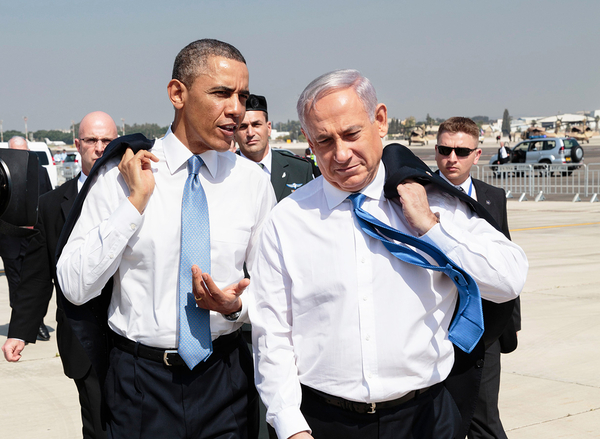
Although U.S. President Barack Obama is not one of them, Israel still has many friends among Americans. Virtually all American leaders know that Israeli technology is essential to the U.S. economy. (Image source: The White House)
Other leaders of major countries in the world — Russia, China, Brazil, India, Japan — see the economic, technological and military importance of Israel, and respect what it has brought to the world.
To too many countries, the rarity that is Israel — a democracy that constantly brings fruitful inventions to the world — is not recognized. Perhaps they are envious.
Millions of people dream of destroying Israel and killing the Jews. What Jews brought to the world — one of the earliest codes of humanitarian law, social justice and respect for education — is not acknowledged. Yet Israel is respected by most leaders of the world and feared by its enemies. Even leaders who despise Israel respect it.
As long as these views hold, and as long as Jews who are persecuted elsewhere can find refuge and be able to build full lives in Israel, those who created Israel will have achieved its goal.
[1] M. Sükrü Hanioglu, A Brief History of the Late Ottoman Empire, Princeton University Press, 2010.
[2] Kamal Salibi, A House of Many Mansions: The History of Lebanon Reconsidered, University of California Press, 1990.
[3] Cf. Carrie Rosefsky Wickham, The Muslim Brotherhood, Evolution of an Islamist Movement, Princeton University Press, 2013.
[4] Martin Kramer, “Fundamentalist Islam at Large: The Drive for Power”, Middle East Quarterly, June 1996. Also, on radical Islam, cf. Daniel Pipes, “The Western Mind of Radical Islam“, First Things, December 1995.
[6] Gregory C. Kozlowski, “Devotional Islam and Politics in British India: Ahmad Raza Khan Barelwi and His Movement”, Journal of the American Oriental Society, Oct-Dec 1999.
[7] Cf. M. C. Ricklefs, A History of Modern Indonesia, Indiana University Press, 1981.
[8] Itamar Rabinovitch, The War for Lebanon, 1970-1985, Cornell University Press, 1985.
[9] Amir Taheri, The Spirit of Allah: Khomeini and the Islamic Revolution, Adler & Adler, 1986.
[10] Cf. Walter Laqueur, A History of Zionism: From the French Revolution to the Establishment of the State of Israel, Fine Communications, 1997.
[11] Isaiah Friedman, The Question of Palestine: British-Jewish-Arab Relations 1914-1918, Transaction Publishers, 1991.
The political leadership reacted in rage to the harsh speech of the Chair of the Palestinian Authority, who accused Israel of genocide, on the stage of the UN General Assembly. “This is not the way a man of peace talks”, claimed the Prime Minister’s office. Foreign Minister Liberman: “Abbas is leading to the conflict continuing”
n light of the renewed cooperation between Hamas and Fatah, which was announced two days ago in Cairo, Palestinian President, Mahmoud Abbas, gave a harsh speech at the UN General Assembly yesterday (Friday), during which he accused Israel of war crimes during operation “Protective Edge”. According to him, “Israel is preparing for a new Nakba and the world must stop it”. The Israeli representative was absent during the speech.
Abbas began his speech with strong criticism of the deaths of Palestinian citizens during the operation in Gaza. “We will not forget and we will not forgive, and we will not allow war criminals to escape punishment”, emphasized the Palestinian President. “The Palestinian people hold steadfast to their legitimate right to defend themselves against the Israeli war machine and to their legitimate right to resist this colonial, racist Israeli occupation”.
Abbas, who very well understands the effectiveness of boycotts against Israel, supported those defending it. “Amidst a torrent of massacres and storms of massive destruction, we witnessed the peoples of the world gathering in huge demonstrations declaring their condemnation of Israel’s aggression”, said Abbas. “There was also an increase in boycotts meant to bring peace”.
The empty seat, Israel. Photo: AP / Channel 2 News
From the battles in Gaza, Abbas moved on to the diplomatic standstill, pointing a blaming finger towards Israel, claiming it is undermining the chance for peace. “Settlement construction, home demolitions, killing and forced displacement in the West Bank continued unabated, as well as the unjust blockade on the Gaza Strip”, he attacked.
According to him, “Israel reached an agreement with the Americans regarding the release of a group of Palestinian prisoners in the occupation’s jails – while we continue to insist on releasing all of them. Israel did not hesitate to reveal its true positions, it rejects the Palestinian state and refuses to find a just solution to the plight of the Palestine refugees”.
“Israel offers us isolated ghettos, without borders and without sovereignty, which will be under the subjugation of the racist settlers and army of occupation. At worst, Israel proposes Apartheid”, Abbas added and later claimed that “it reminds me of other scenes from history”.
Abbas also demanded that Israel and the international community set a deadline for any future solution. “There is no meaning nor benefit in negotiations not aimed to end the Israeli occupation and form a Palestinian State, with East Jerusalem as its capital, over the entire territory occupied in 1967. There is no value in negotiations without a specific time frame for the implementation of these objectives”.
Palestinians to demand UN set timeline for ‘end of occupation’
Palestinian President Abbas to lobby UN to set a timeframe for Israel’s withdrawal from the West Bank ahead of the establishment of a Palestinian state as part of UN General Assembly.
Palestinian President Mahmoud Abbas has said that he will launch a bid at the United Nations on Friday to set a timeline for the “end of the Israeli occupation,” Palestinian news agency Ma’an reported.
Abbas is set to address the UN at 7 pm (noon EST) amid growing anger within the Palestinian street that the Palestinian Authority which he leads has failed to make substantial gains regarding the Palestinian’s national ambitions; anger further exacerbated by Operation Protective Edge and ongoing security cooperation with Israel.
Is Abbas’s UN trip Israel’s last hope for peace? (Photo: EPA)
According to Ma’an, Saeb Erekat, the chief Palestinian peace negotiator, said that Palestinian leadership have lost faith in the US-led talks, the last round of which ended uneventfully in April, and despite US Secretary of State John Kerry’s disapproval have decided to go ahead with the UN bid.
According to Israel Radio, Abbas met with Kerry last week and told him about the plan. Kerry expressed his disapproval, to which Abbas responded that if the US uses its veto power in the Security Council to shoot down the initiative, then the Palestinians would move to join over 500 international bodies, including the International Criminal Court in The Hague.
The US has urged Abbas not to turn to the Security Council, but has not offered an alternative, a Palestinian official speaking on condition of anonymity because he was not allowed to discuss internal deliberations with the media said last week.
Erekat confirmed for Ma’an that the Palestinians – whom currently enjoy the status of observer non-member state in the UN – will propose the resolution on Friday to end the occupation and implement all previous international decisions regarding Israel and Palestine.
Erekat said that Riyadh Mansour, the Palestinian envoy to the UN, expects that the application would take 2-3 weeks until it reaches the “blueprint” stage..
Abbas adviser Nabil Abu Rdeneh has said in the past that the Palestinian leader would present a new strategy in his UN speech. In recent weeks, Abbas and his aides have hinted at the content of the proposal, according to which Abbas would ask the UN Security Council to issue a binding resolution, with a three-year deadline for ending Israel’s occupation.
‘End occupation, make peace’
“Prime Minister Netanyahu: End the occupation, make peace,” Palestinian President Mahmoud Abbas said on Monday ahead of the UN General Assembly, AFP reported.
Prime Minister Netanyahu is also set to travel to the UN as well, where he will deliver a speech in the general assembly, and then meet with US President Obama to discuss the Islamic State terror group. Israeli officials say the Palestinian issue will play a peripheral role in this year’s UN meet, in light of the chaos in Syria and Iraq.
Nonetheless, speaking at the Cooper Union hall, Abbas said: “The international community has the responsibility to protect our people, living under the terror of settlers, an occupying army,” AFP reported.
“We cannot understand how the Israeli government can be so misguided as to fail to understand that the indiscriminate bombing of Gaza that killed thousands of women and children only sowed more hate,” Abbas reportedly said, according to AFP.
“This week I will propose to the United Nations a new timetable for peace talks,” Abbas said, AFP reported.
In an interview with Palestinian TV last month, Abbas said it should only take “half an hour or an hour” to delineate the borders of a Palestinian state, since the United States agreed they should be based on the 1967 borders that existed before the war in which Israel captured the West Bank and East Jerusalem.
The UN Security Council unified behind the international attempt to fight the Islamic State group and demanded on Wednesday that all states make it a serious criminal offense for their citizens to travel abroad to fight with militant groups, or to recruit and fund others to do so.
UHHHHH, hamas , qatar and so on ??? who can believe this ? what about arming terrorist, sory freedom fighters, oposition forces so you want, by who ??
At a meeting chaired by US President Barack Obama, the 15-member council unanimously adopted a US-drafted resolution that compels countries to “prevent and suppress” the recruitment and travel of militant fighters to foreign conflicts.
The resolution will be penned by over 100 nations and de facto removed legal hurdles for US airstrikes in Syria, which unlike Iraq, did not invite the US’ intervention.
Not for Isareli aistrikes on the hamas terorist ??
“The United States of America will work with a broad coalition to dismantle this network of death,” Obama told the General Assembly of the United Nations. “Today I ask the world to join in this effort.”
So now can Israel dismantle hams ?
“We will use our military might in a campaign of airstrikes to roll back ISIL,” he declared, using an alternative acronym for the group.
UN Security Council (Photo: AFP)
After his address, Obama chaired a meeting of the UN Security Council which unanimously approved a binding resolution on stemming the flow of foreign jihadists to Iraq and Syria.
The resolution requires all countries to adopt laws that would make it a serious crime for their nationals to join jihadist groups such as ISIS and the Nusra Front, Al-Qaeda’s branch in Syria.
And what about hamas ?
Obama described the resolution as “historic” at the special session of the Council, only the sixth time in UN history that the council was convening at the level of heads of state.
US President Barack Obama (Photo: AFP)
The UN action reflects mounting international concern over rising numbers of foreign fighters joining the Islamic State militant group and the threat they pose when returning home. Some 12,000 fighters from more than 70 nations have joined extremist groups in Syria and Iraq, experts say.
British Prime Minister David Cameron told the Security Council that the beheadings of two American journalists and a British aid worker by a fighter with an apparent British accent “underlines the sinister, direct nature of this threat.”
The council resolution is under Chapter 7 of the UN Charter, which makes it legally binding for the 193 UN member states and gives the Security Council authority to enforce decisions with economic sanctions or force.
It targets fighters traveling to conflicts anywhere in the world, but does not mandate military force.
Obama is building a global coalition against Islamic State, which has captured swaths of Syria and Iraq and urged its followers to attack citizens of various countries. The United States has led air strikes against the group in Iraq and Syria.
“The words spoken here today must be matched and translated into action,” Obama told the Security Council after the adoption of the resolution. “For if there was ever a challenge in our interconnected world that cannot be met by one nation alone, it is this – terrorists crossing borders and threatening to unleash unspeakable violence.”
Obama chaired the Security Council because the United States is president of the body for September.
The UN resolution expresses concern that “foreign terrorist fighters increase the intensity, duration and intractability of conflicts, and also may pose a serious threat to their states of origin, the states they transit and the states to which they travel.”
Australian Prime Minister Tony Abbott told the council that the passports of more than 60 Australians had been suspended to stop them from joining extremist groups in the Middle East. Both Abbott and Cameron outlined their efforts to strengthen laws.
Terror target: Israel
The European Union’s counterterrorism coordinator, Gilles de Kerchove said al-Qaeda may try to show its relevance by carrying out attacks in Europe, the United States or Israel, the European Union’s counterterrorism coordinator said on Wednesday.
De Kerchove warned of the risk of competition between Islamic State and al-Qaeda, which has renounced its offshoot as too brutal.
“It is possible that Al-Qaida may want to mount attacks to show that the organization is still relevant, they are still in the game,” De Kerchove told a European Parliament committee.
He said some militants had moved from Afghanistan and Pakistan to Syria, where they formed part of the al-Qaeda-linked Khorasan Group.
He added that it appeared they planned to recruit Europeans who had travelled to Syria to fight and persuade them to use their passports to return and mount attacks in Europe, Israel and the United States.
While Islamic State was the main target of a US-led air assault in Syria this week, American officials said they also targeted the Khorasan Group, with the aim of disrupting a plot against US or European targets that the Pentagon said was “nearing the execution phase.”
De Kerchove estimated that more than 3,000 Europeans were in Syria, had been there or planned to go there to fight, and that there was a real risk some of them could return and bring violence back to Europe.
“We have seen that in Brussels with the killing of four persons at the Jewish Museum. It raises their level of tolerance of violence to such a level that there is a risk when they come back that killing is something normal,” he said.








 anneinpt
 artaxes
 danmillerinpanama
 davidking1530
 Peter Hofman
 Joseph Wouk
 Peter
Peter Louisiana Steve
 WarSclerotic
Recent Comments