These are Obama’s “peace partners” bragging about murdering Israelis. Fatah is under the control of the “moderate” Mahmud Abbas, the man to whom Obama wants Netanyahu to make concessions.
No amount of concessions will end the Palestinian jihad. Islamic Jew-hatred: it’s in the Quran.
Fatah brags it killed 11,000 Israelis”, by Itamar Marcus, Palestinian Media Watch, August 3, 2016:
Fatah yesterday posted a list of Fatah’s achievements on behalf of Palestinians. Significantly, Fatah did not cite even one peace-seeking or peace-promoting achievement, but only listed Fatah acts of violence and terror. Fatah even boasted that its attacks have killed 11,000 Israelis. While Fatah and the PLO have been killing Israelis since 1965, this number is a gross exaggeration.
One of the acts it bragged about was being the “first Palestinian faction to reach the [Israeli] nuclear reactor.” This is a reference to Fatah’s bus hijacking and murder of three Israeli civilians on their way to work at the Dimona nuclear plant in 1988.
Throughout the recent terror wave, Palestinian Media Watch has documented that the PA and Fatah have promoted violence and terror against Israelis, both in Israel and in the West Bank.
The following is yesterday’s Fatah post celebrating and bragging about Fatah’s murder of Israeli civilians:
“To those who argue [with Fatah], to the boors, and to those who do not know history:
Fatah has killed 11,000 Israelis
Fatah has sacrificed 170,000 Martyrs (Shahids)…
Fatah was the first to carry out operations (i.e., terror attacks) during the first Intifada (i.e., Palestinian violence and terror against Israel, 1988-1993), and it was the first Palestinian faction to reach the nuclear reactor in Dimona (i.e., 1988 murder of 3 working mothers on way to the Dimona plant)
Fatah was the first to fight in the second Intifada (i.e., PA terror campaign 2000-2005) (Baha Al-Sa’id, an officer in the Preventive Security Forces, infiltrated an Israeli settlement on the border with Gaza) [parenthesis in source]…
Fatah was the first to defeat the Zionist enemy (Battle of El-Karameh) [parenthesis in source]…
Fatah led the Palestinian attack on Israel in the UN.”
[Official Fatah Facebook, Aug. 2, 2016]
PMW reported that Fatah had posted a similar text on its official Facebook page in 2014…
Senior aid worker said to funnel ‘tens of millions’ to Hamas World Vision denies its Gaza chief diverted 60% of his budget to the terror group, which allegedly used the cash to finance weapons, tunnels
Over the course of several years, the Hamas terrorist organization siphoned off “tens of millions of dollars” from the US-based World Vision charity for its military wing, the Shin Bet security service said Thursday.
Muhammad Halabi, a Hamas member and manager of operations for World Vision in Gaza, was indicted in a Beersheba court on Thursday for his role in the alleged scheme. He was arrested in a joint Shin Bet-IDF-Israel Police operation at the Erez Crossing on June 15 as he tried to return to the Strip, the Shin Bet said.
Halabi, a member of Hamas from a young age, was handpicked to infiltrate the international charity in 2005 in order to steal money for the terrorist organization, according to the investigation.
“This was a meaningful and important investigation that showed — above all — the cynical and crude way in which Hamas takes advantage of funds and resources from international humanitarian aid organizations,” the Shin Bet said in a statement.
Muhammad Halabi, a member of Hamas and manager of the World Vision charity’s operations in the Gaza Strip, was indicted on August 4, 2016, for diverting the charity’s funds to the terrorist organization. (Shin Bet)
In a statement released following the indictment, World Vision defended Halabi and denied the allegations against him.
“Based on the information available to us at this time, we have no reason to believe that the allegations are true. We will carefully review any evidence presented to us and will take appropriate actions based on that evidence,” the group wrote.
After rising through the ranks of World Vision, Halabi became the manager of World Vision’s activities in the Gaza Strip. “In that capacity he controlled the budget, equipment and humanitarian aid packages worth tens of millions of dollars,” the Shin Bet said.
There he was able to funnel approximately “60 percent of World Vision’s annual budget for the Gaza Strip to Hamas,” according to his testimony, which amounted to approximately $7.2 million every year.
This was mostly commonly done by Halabi offering fake tenders for work. “The ‘winning’ company was aware that 60% of the project’s funds were bound for Hamas,” the Shin Bet said.
Approximately 40 percent of World Vision’s funds for civilian projects — $1.5 million a year — was also given to Hamas battalions in cash, according to the Shin Bet, along with approximately $4 million a year that was designated for helping the needy.
A Palestinian boy looks from his family’s destroyed house at workers rebuilding a house which was destroyed during last summer’s war between Israel and Hamas, as the long-awaited reconstruction began in the Shejaiya neighborhood of eastern Gaza City on Thursday, July 23, 2015. (AP Photo/Khalil Hamra)
According to investigators, some of those “fictitious” humanitarian projects included the construction of greenhouses, rejuvenation of agricultural fields, mental and physical health projects, an initiative to assist fishermen, a center for treating the mentally and physically handicapped, and the creation of agricultural organizations.
“These were all used as a pipeline to transfer money to Hamas,” the Shin Bet said.
In those fake programs, the terrorist organization was able to inflate the budgets, claim Hamas operatives as employees and launder money through World Vision, the security service added.
For instance, Halabi would list a parcel of land as costing $1,000 when it in fact cost $700 in order to pocket the extra funds and transfer them to the terrorist group, according to his testimony.
Still from an August 2015 Hamas video purporting to show a Gaza tunnel dug under the Israeli border. (Ynet screenshot)
According to Halabi’s testimony, the funds that were transferred to Hamas were “earmarked for building up the military wing [of Hamas],” including digging tunnels, purchasing weaponry and building defensive outposts.
Some of the stolen funds were also used to pay the salaries of Hamas operatives. In some cases large sums of money were taken by senior members of the terrorist organization for their “personal needs,” the Shin Bet said.
Through such initiatives, Hamas was also able to purchase otherwise forbidden gear and take advantage of the “logistical assistance” given to the organization.
A Border Crossing Authority inspector discovers a wet suit, believed to be en route to Hamas, hidden in a shipment of sporting goods to the Gaza Strip on June 20, 2016. (screen capture: Defense Ministry)
For instance, the greenhouse construction project allowed the group to scope out suitable digging sites for tunnels, while the nonexistent fishermen assistance program was used to purchase motorboats for smuggling and wetsuits that could be used by Hamas frogmen in attacks against Israel, the Shin Bet said.
In addition to funds and opportunities, Halabi also allegedly stole equipment that had been purchased by World Vision to assist farmers. Instead, the iron, digging tools, pipes and construction materials were used by Hamas for its own purposes.
Some 2,500 cartons of food and 3,300 cartons of cleaning supplies were also stolen from World Vision and given to Hamas fighters, according to the Shin Bet.
Money designated for children injured in conflicts with Israel was instead taken by families of Hamas members who falsely registered their children in the program, the security service said.
Palestinian workers rebuilding a house as reconstruction begins in the Shejaiya neighborhood of Gaza City, July 23, 2015. (AP/Khalil Hamra)
According to Halabi’s testimony, the humanitarian aid reserved by World Vision for residents of the Gaza Strip was given “almost entirely” to Hamas operatives and their families.
“This, it must be said, is against the official regulations of humanitarian aid organizations operating in the Gaza Strip,” the Shin Bet said in a statement.
Following the indictment, Israel’s Coordinator of the Government’s Activities in the Territories Maj. Gen. Yoav Mordechai released a statement in Arabic to the people of Gaza, telling them of Halabi’s actions.
“I’m speaking to you today about the Hamas terror organization, which is stealing your money to advance terror. Following a long investigation, we found that Hamas consistently uses funds that Western countries give to international organizations, like the World Vision organization in Gaza,” Mordechai said.
“Millions of dollars that were meant to build projects, support residents financially — even food packages for the needy — were given over to the military wing of Hamas for building bases, for salary bonuses and for digging death tunnels that will bring demolition and destruction upon you and the Gaza Strip,” he told residents of the coastal enclave.
While the general cast the blame on Hamas, Emmanuel Nahshon, a spokesperson for the Foreign Ministry, accused World Vision of being “negligent” in its indirect funding of terrorism.
“World vision int. financed ‘unwittingly’ Hamas terror tunnels. How negligent can you be?! Money for kids used for terror,” Nahshon tweeted after the case was revealed.
World vision int. financed “unwittingly ” Hamas terror tunnels . How negligent can you be?! Money for kids used for terror
Halabi supplied Israeli investigators with additional information about a large number of individuals in the Gaza Strip who take advantage of their work for aid organizations and the United Nations to assist Hamas, the Shin Bet said.
For example, Halabi’s father, Halil, served as head of the United Nation’s school system in the Gaza Strip for years. He too is a member of Hamas and, according to Halabi’s testimony, uses his position to help the terrorist organization.
Goods and medical supplies being transferred to the Gaza Strip through the Kerem Shalom Crossing, July 19, 2014. (IDF Spokesperson’s Unit)
World Vision is an Evangelical Christian charity created in 1950 that operates in nearly 100 countries worldwide. Today it is one of the largest relief organizations based in the United States, with a budget of approximately $2.6 billion and nearly 50,000 employees. It has operated in Israel, the West Bank and Gaza since the 1970s.
When Halabi was first arrested in June, before charges were brought against him, the charity defended him in a statement.
“[Halabi] is a widely respected and well regarded humanitarian, field manager and trusted colleague of over a decade. He has displayed compassionate leadership on behalf of the children and communities of Gaza through difficult and challenging times, and has always worked diligently and professionally in fulfilling his duties,” the organization said in June.
More than one hundred activists braved scorching Brooklyn heat to rally at the Barclay’s Center prior to marching through downtown Brooklyn to gather at Borough Hall. (Photo by Andy Katz/Pacific Press)
The newly released platform of a group claiming association with the Black Lives Matter movement declares that Israel is an “apartheid state” that “practices systematic discrimination,” including “genocide … against the Palestinian people.”
The platform makes the accusations against only the Jewish state.
The document, posted online Monday, includes an extensive foreign policy section titled “Invest-Divest.” Substantial parts of the section are devoted to Israel and to what the group believes is a joint U.S.-Israeli campaign of global terror, militarization, and war.
“The US justifies and advances the global war on terror via its alliance with Israel and is complicit in the genocide taking place against the Palestinians,” the document says. The United States, the group says, “is an empire that uses war to expand territory and power. American wars are unjust, destructive to Black communities globally and do not keep Black people safe locally.”
The platform document promotes the Boycott, Divest, and Sanction (BDS) movement, which seeks to cripple Israel economically. The document lists as “resources” for readers the names of several leading BDS groups and calls on its members to fight against anti-BDS bills under consideration in several state legislatures. As a policy recommendation, the platform calls for an end of U.S. aid to Israel.
Black Lives Matter is also opposed to a security fence that Israel built in the early 2000s to stop Palestinian suicide bombers. During that period—commonly called the Second Intifada—Palestinian terrorists murdered approximately a thousand Israeli civilians in attacks. After the fence was constructed, attacks dropped precipitously. The Black Lives Matter document denounces the security fence as an “apartheid wall.”
Another Black Lives Matter grievance is the 2006 creation of AFRICOM, a regional U.S. military command that promotes closer ties between African governments, the African Union, and the U.S. military. “In reality, this effort was designed to expand western colonial control over the region, its people and their resources. AFRICOM is a major example of U.S. empire and is a direct threat to global Black liberation,” the platform states.
The platform calls for redirecting 50 percent of the US defense budget to providing reparations both domestically and abroad. American military spending, the activists say, are “resources and funds needed for reparations and for building a just and equitable society domestically,” yet they “are instead used to wage war against a majority of the world’s communities.” Reparations, the group says, should be provided “to countries and communities devastated by American war-making, such as Somalia, Iraq, Libya and Honduras.”
The Palestinian lie
The following video is truly shocking and enraging!
An Arab father sends his three year old son to confront the Israeli border police, while shouting at the solders to “shoot the child”.
In addition, the Arab father urges his little son to throw rocks at the solders, but the youngster misunderstands and throws them sideways.
Now do you understand what we are dealing with?
The whole thing is being encouraged by radical left-wing protestors (you can hear them shouting through loudspeakers).
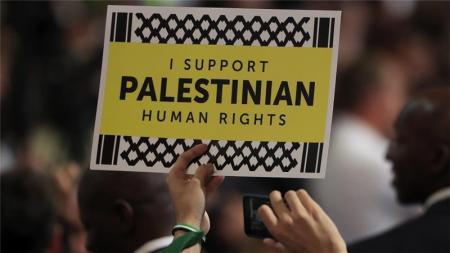
A delegate holds a sign reading ‘I support Palestinian Human Rights’ at the Democratic convention in Philadelphia [Tannen Maury/EPA]
An issue that was once sidelined even in progressive circles, Palestine was pushed to the forefront of the electoral campaign this year, with Vermont Senator Bernie Sanders showing that policy change on a seemingly intractable conflict is possible.
For the first time, the platform reflected the right of Palestinians to “independence, sovereignty, and dignity” in addition to Israel’s security. In a recent poll (PDF) of American attitudes on the conflict, 49 percent of Democrats said they recommended economic sanctions or other more serious action to counter settlement construction.
***************
Philadelphia, Pennsylvania – Eva Putzova held a banner with a simple message just outside the Democratic National Convention (DNC) floor on Tuesday: “I support Palestinian rights.”
“I think it’s time that Democratic candidates – Hillary, Bernie or anybody else – start taking the issue seriously and start a real national conversation and get behind all human rights, including Palestinian rights,” said Putzova, a city council member from Flagstaff, Arizona.
She was among many pro-Palestine activists at the DNC this week who came out in a show of force unprecedented at other political conventions. They marched and rallied, held talks and town halls, carried signs and, at one point, raised a Palestinian flag on the convention floor.
“The issue is getting more media exposure, more people are aware,” Putzova said. “I think we are on the brink of changing the policy stands of the US, but it will take all of us to push the political elite. I think [Palestinians are] a community that has been marginalised for so long.”
An issue that was once sidelined even in progressive circles, Palestine was pushed to the forefront of the electoral campaign this year, with Vermont Senator Bernie Sanders showing that policy change on a seemingly intractable conflict is possible.
In a debate last April, he pushed Democratic presidential nominee Hillary Clinton to call the 2014 Israeli war on Gaza “disproportionate”. He said the US and Israel need “to treat the Palestinian people with respect and dignity” and that the US “has to play an even-handed role”. Sanders, however, was also criticised for not denouncing Israel more forcefully, and for the ousting of his campaign’s Jewish outreach director, who slammed Israel’s prime minister in a Facebook post.
A month later, Sanders assigned James Zogby, an advocate for Palestinian rights, and four others, including one of two Muslim congressmen, to the platform-writing committee, signalling his attempt to revise the party’s long-standing policy that favoured Israel.
“It took the work of a mass movement and a courageous person like Bernie Sanders, because if Bernie hadn’t elevated it, it wouldn’t have happened,” said Zogby, also President of the Arab American Institute, in a talk attended by pro-Palestine supporters in Philadelphia. “He gave us a qualitative boost forward.”
What’s on the platform?
On the DNC sidelines, pro-Palestine supporters discussed how the conflict with the Israelis was playing out on the domestic policy platform.
But in stark contrast to public support and activism, the party’s platform, which now supports a $15 minimum wage and Wall Street reform, did not include references to the Israeli occupation and its settlements.
Zogby said Clinton supporters cut out these references, fearing retribution from billionaire mogul and Republican donor Sheldon Adelson. On an official level, Clinton’s backers said the call for negotiations for a two-state solution in the party’s platform was sufficient.
Going into the platform-writing committee, Zogby said he and other Sanders delegates were expecting to discuss removing a reference to Jerusalem being the “undivided capital” of Israel, and opposition to the Boycott, Divestment and Sanctions (BDS) movement.
“We wanted to strike the BDS line, we wanted to strike out a line on Jerusalem,” said Zogby, who is also on the DNC’s executive committee. “I thought that would be the fight. I had no idea the fight would end up being over occupation and settlements.”
They lost on all counts, and pro-Clinton supporters said they couldn’t change the language. “Here’s what they told me: ‘We can’t do it because Adelson will come out against us,'” Zogby said. “He will come after you no matter what you do. The people who like [Adelson] won’t vote for you.”
The platform committee discussions leading up to the DNC also spurred controversy, as civil rights activist and scholar Cornel West made an impassioned appeal to change the language to include “an end to occupation and illegal settlements”.
He called Palestine a “Vietnam War” issue for young Americans, and likened the party’s indifference to the conflict to the same apathy to “these Negroes” in the Jim Crow era.
Despite the fact that the resolution was voted down, some believe that the discourse on Palestine has shifted.
For the first time, the platform reflected the right of Palestinians to “independence, sovereignty, and dignity” in addition to Israel’s security. In a recent poll (PDF) of American attitudes on the conflict, 49 percent of Democrats said they recommended economic sanctions or other more serious action to counter settlement construction.
A changing conversation
“The conversation has improved a lot … it is broader and more inclusive,” said Congressman Keith Ellison of Minnesota, another Sanders pick on the DNC platform committee. “Over the past few years, members of Congress have gone to the Holy Land, not only to Israel, but also to Palestine. The perspective is changing, and it’s a good time to continue the work that you’re doing.”
Palestine supporters are banking on the presence of many activists and progressives in the city, in part because of Sanders’ candidacy, to expand and change the debate on the conflict.
They are also aware that the share of younger Americans sympathising with the Palestinian cause has risen significantly in recent years – from 9 percent in 2006 to 20 percent in July 2014, and finally to 27 percent today.
“We have seen some fairly remarkable changes in the landscape of how the issue of Palestine and Israel is being addressed – both in the news media and particularly within progressive circles,” said Mike Merryman Lotze, the American Friends Service Committee’s (also known as the Quakers) Palestine-Israel programme director.
“If we look back where the conversation was 15 years ago today, even really five years ago, we have to recognise that we are now in a fundamentally different place,” he said.
“That marks a shift … and that conversation has been pushed by the grassroots progressive movement.”
Hamas ready to pounce on weak Fatah in local elections, experts say Gaza-ruling terror group now says it will take part in vote set for October; after all, it has won the only two major elections in which it ever competed
The Hamas terror group in control of the Gaza Strip is poised to make a power play using one of its most potent weapons — the ballot box.
In 2012, the hardline Islamist group boycotted municipal elections over allegations of intimidation and corruption in the West Bank by its political rival Fatah, which dominates the Palestinian Authority. Since then, the two major Palestinian parties have remained in a state of cold war.
Despite these ongoing tensions, Hamas surprised many by agreeing recently to participate in municipal elections across the Palestinian territories slated for October 8.
Experts told The Times of Israel that Hamas likely ended its boycott of the vote because the group sees an opportunity to gain legitimacy by beating a weak opponent — the aging and unpopular Palestinian Authority President Mahmoud Abbas and his divided Fatah party.
Hamas is also in a state of political isolation after losing the support of its important Sunni state backers, Egypt, Jordan and Saudi Arabia, and to some extent Turkey after Ankara and Jerusalem recently mended relations. The ballot box, one Israeli expert argued, is a way the group can take control of its own destiny, while a well-known Palestinian scholar hypothesized secret and unprecedented coordination between the Islamists and Fatah.
Palestinian security officers wait to cast their early votes during local elections at a polling station in the West Bank town of Jenin on Thursday. Members of Palestinian security forces cast an early vote ahead of local elections, which are taking place Saturday, in the first such polls since 2006. (AP Photo/Mohammed Ballas)
Hamas has won the only two elections it ever ran in — the 2005 municipal elections and the 2006 legislative elections, which resulted in a war between Hamas and Fatah. But since Hamas’s last democratic victory, 10 years have passed.
“It’s almost obvious why Hamas decided to participate in the upcoming elections,” Prof. Shaul Mishal, head of the Middle East program at the Interdisciplinary Center in Herzliya (IDC), told The Times of Israel.
“If you look back at what happened during the election in 2006, Hamas believes that’s the best way to gain status and strength within the Palestinian population of the West Bank. They want to extend their influence to where the heart of the Palestinian issue is,” he said.
In 2006, Hamas won nearly all the electoral districts in the West Bank and in Gaza.
Mishal believes Hamas sees an opportunity to take advantage of Abbas’s current weakness. The PA leader is 81-years-old and is reportedly not in good health. Polls show a majority of Palestinians want him to resign.
Prof. Shaul Mishal (Courtesy)
“This is Hamas’s opportunity to ensure they will be part and parcel of any future political process,” Mishal said.
He added that Hamas has reached such a point of political isolation that “the only way to strengthen their position with the public is to run in this election.” He argues Hamas’s success in the past and its likely success in the upcoming election has much to do with its nature as an Islamist movement.
“Hamas is a party of the people, putting its efforts into working with the communities on the ground… first and foremost, they are an Islamist social group: they focus on social services, social welfare and working with the needy, especially in places where the central government might not reach,” Mishal said.
In an indication of Hamas’s likely victory in the upcoming elections, the Islamist movement has for the past two years won the contest considered the best barometer of Palestinian public opinion — student elections at Birzeit University. Birzeit is the oldest Palestinian university, considered a liberal outpost and a historic stronghold for Fatah and the PA.
“The young generation is more pro-Hamas. From experience, the student elections tend to be quite accurate,” Mishal said.
Palestinian students who support the Hamas movement take part in an election campaign rally for the student council at Birzeit University, near the West Bank city of Ramallah on April 26, 2016 (AFP/Abbas Momani)
With the odds stacked against it, the Israeli professor believes Fatah may try to wiggle out of having the elections.
“It all depends on one man: Abu Mazen (Abbas). He can find ways to bypass the declaration. He may substitute it with something more dramatic, such as negotiations over the Arab Peace Initiative,” he said, referring to the 2002 offer to the Jewish state for full diplomatic ties with 57 Arab and Muslim countries after cementing a peace accord with the Palestinians.
The Arab Peace Initiative has come to the forefront in the past few months, with both Arab and Israeli statesmen discussing the plan.
Khalil Shikaki, the Director of the Palestinian Center for Policy and Survey Research at his office in Ramallah, June 14, 2011 (Yossi Zamir/Flash90)
“My guess,” said Dr. Khalil Shikaki, a Palestinian political scientist and well-regarded pollster, “is that Hamas has agreed [to the elections] because Abbas, without publicly admitting it, has agreed that local elections in the Gaza Strip can take place fully under Hamas’s security and administrative control.”
Shikaki called the possible coordination “the most visible PA acknowledgment of the legitimacy of Hamas’s control in the Gaza Strip since Hamas’s takeover in June 2007.”
“At this stage,” Shikaki continued, “Hamas seems to care more about maintaining control over the Strip than extending its influence into the West Bank.”
The Palestinian political scientist did, however, offer a second theory similar to Mishal’s.
“Hamas might think that given Fatah’s fragmentation, particularly in the Gaza Strip, the outcome of elections will demonstrate the Islamist group’s ascendance and popularity despite the blockade and siege imposed by Israel and Egypt, thus strengthening further its legitimacy,” Shikaki said.
Israel imposed a land and sea blockade on the Strip, designed to prevent the terror group from importing weapons, after Hamas seized power there in a bloody 2007 coup, which saw Abbas’s Fatah movement ousted from Gaza.
The upcoming elections are slated to be held in 416 townships and village councils; 25 are located in Gaza and the other 391 in the West Bank. If the election does take place, it will be the largest municipal elections held by the Palestinians in their history.
Trump sees in Netanyahu “all the things that were lacking in Obama,” David Friedman says.
CLEVELAND – Israeli annexation of settlements in the West Bank could be viewed by a Trump administration as a legitimate way for Israel to move forward if the Palestinians continue to avoid a real and genuine peace deal, David Friedman, a senior advisor to Donald Trump, told The Jerusalem Post on Tuesday.
Speaking as the Republican Party convention entered its second day in Cleveland, Friedman, who advises Trump on matters related to Israel, said that in his view, settlements in the West Bank were not illegal and were not the real impediment to peace with the Palestinians.
“The impediment to peace is very clear in both of our minds and that is the failure of the Palestinians to renounce hatred and renounce violence,” Friedman said. “Everything else is barely important.”
Friedman, a Manhattan-based attorney for Donald Trump and president of the American Friends of Bet El Institutions who serves as an Israel advisor to Trump alongside Jason Greenblatt, told the Post that in his view annexation of the settlements would be a legitimate way for Israel to move forward.
“If there is no agreement with the Palestinians, Israel has to move forward and maybe there is another path and a better path that is not a two-state solution and obviously under those circumstances that [annexation D.Z.] is certainly an option,” he said “I don’t know when or if that would be implemented but it’s certainly not a third rail in terms of options. It is certainly a legitimate possibility.”
Friedman went on to say that a one-state solution was also a viable option for ending the decades-old conflict between Israel and the Palestinians.
What I’m saying is a two-state solution is not the only solution. It’s failed in the past and I think it’s reasonable to consider any other alternatives people of good faith may propose,” he said. “A two-state solution might be a solution. It could work, but it’s not the only solution.”
The one-state idea was a viable solution, he said, since Israel was recognized as a protector of minority rights.
“So I think they have a wonderful track record to import into Judea and Samaria,” he said. “Second of all, the demographics with regard to the entire region are trending in a way that – according to the most credible demographic report – a one state solution would not deprive Israel of its Jewish character.”
According to Friedman, the best solution for the conflict is for the Palestinians to stop killing Israelis.
“The question is: Are people going to kill each other? And let me be clear – the Palestinians have to stop killing the Jews, because that’s where all this violence is initiating,” he said. “Do people have to keep trying? If you have a stomach ache, and you went to 10 different doctors and they all gave you the same medicine and after that you still have a sick stomach, you probably will start thinking about a different medicine or doctor, no?”
Under Trump, Friedman said, the Israeli-American alliance would look 180 degrees different than it has been for the past eight years under President Barack Obama.
“The first and most basic is the presumption on the part of president Trump that Israel actually knows what it is doing, and that Israel wants peace and the people of Israel desperately want peace,” he said. “I think we presume that they want peace and will know the best way to achieve peace and therefore there is no need to pressure them or impose any conditions on them or against their wishes, begin any summits, initiatives, conference that they are not ready for. That is the first major philosophical difference – Israel knows what is best for Israel.”
He said he was also confident that Trump and Prime Minister Benjamin Netanyahu would develop a strong relationship.
“The relationship will be far different and better at the core because there’s going to be a high level of mutual respect,” he said.
“On our side of things – Trump has great respect for Bibi. He sees in Bibi all the things that were lacking in Obama…I think Bibi and Trump have a similar view of the world: The United States and – to a similar extent Israel – have to deal with their enemies from a position of strength. Obama deals from a position of weakness and apology, from a position of conceding whenever necessary. I think Trump recoils from that approach and I think Bibi is the same way. I think they would get along great. They have a very similar world view,” he added.
Israeli Prime Minister Benjamin Netanyahu posted a video message Friday laying out steps toward peace to Mahmoud Abbas, the President of the Palestinian Authority.
“Every Israeli and Palestinian child deserves a life of hope, of tranquility and opportunity. I will continue to work tirelessly for peace. It’s time that you join this effort,” Netanyahu said.
The Palestinian Authority pays roughly 10 percent of its budget annually to terrorists who attack Israelis and financially rewards the killers of Jews. Netanyahu called for Abbas to allocate funding toward co-existence education, rather than violence.
In addition, he laid out examples of Palestinian authorities such as advisor Sultan Abu al Einein advocating and praising the slaughter of Israelis. As Netanyahu noted, one Palestinian terrorist “turned these words into action” and stabbed to death 13-year-old Hallel Yaffa Ariel as she slept.
“Advocating genocide is not consistent with peace,” Netanyahu said.
The full statement was as follows:
“President Abbas, since over the past several years, you refused to meet with me and sit down and negotiate peace, I hope you’ll hear this message.
“First, your advisor, Sultan Abu al Einein recently called to slit the throat of every Israeli.
“Three days later, a Palestinian terrorist turned these words into action when he slit the throat of a 13-year-old beautiful girl, Hallel Yaffa Ariel, as she slept. She was a little, innocent girl. She didn’t deserve this. I ask that you fire this advisor because advocating genocide is not consistent with peace.
“Second, your party recently praised a terrorist on Facebook who murdered 24 civilians, innocent Israelis in cold blood. I ask that you to pick up the phone and instruct your party’s social media manager to stop praising mass murderers. Impressionable children read these posts. They should be taught harmony, not hate. Such words seriously harm the chances of peace.
“Third, next week the Palestinian Authority will dedicate a monument to Abu Sukar. Abu Sukar murdered 15 people by detonating a refrigerator filled with explosives on a busy Jerusalem street.
“Rather than dedicate a statue to a mass murderer, I ask that you consider honoring a champion of co-existence. This will help educate future generations to love peace over war, compassion over violence. It will also help convince Israelis that they have a true partner for peace.
“Fourth, the PLO currently pays a monthly salary to anyone who murders Jews. This money provides direct incentive to commit terror. I ask that you stop paying murderers and instead use this money to fund co-existence education. Teach tolerance, not terror.
“Every Israeli and Palestinian child deserves a life of hope, of tranquility and opportunity. I will continue to work tirelessly for peace. It’s time that you join this effort.”
Both houses of Congress are at work to modify funding bills for the United Nations Relief and Works Agency (UNRWA), as part of an effort to investigate the very legitimacy of the decades-old agency, Michael Wilner reported in the Jerusalem Post Friday. Both the House and the Senate want the State Department to, once and for all, define the term “Palestinian refugee,” and while they’re at it, reveal how many are receiving aid from UNRWA.
UNRWA was established in 1948 to assist the 750,000 Palestinians who had left Israel. Since then UNRWA has been a promoter of the Palestinian cause, funding as many as 5 million “refugees,” the majority of whom never left the homes where they were born in the Gaza Strip, the “West Bank,” eastern Jerusalem, or other Arab countries, to the tune of $1.23 billion annually, $250 million of which is donated by US taxpayers.
Many in Congress have been saying, since about 2012, that the majority of Palestinians are permanently settled, and should not be under the jurisdiction of a refugee agency.
Needless to say, Wilner points out, “such a finding would fundamentally change the narrative of the decades-old conflict.”
The first Palestinian census was completed 15 years ago, and the head of the Palestinian Central Bureau of Statistics (PCBS) admitted then that the census was, in effect, “a civil intifada” rather than a scientific survey. In 2011 the Bureau attempted to correct that blatant misrepresentation, claiming that 2.6 million Palestinian Arabs inhabit Judea and Samaria.
But Israeli demographer Yoram Ettinger challenged those numbers, claiming they overstated the real number of Arabs there by as much as 66%. He explained that the PCBS’s total counts 400,000 Palestinians living overseas, and double-counts 240,000 Jerusalem Arabs. It also undercounted Palestinian emigration.
In 2014, UNRWA came up with the figure of 5 million Palestinian refugees living in Gaza, Judea and Samaria, Jordan, Syria and Lebanon, and the US responded by providing hundreds of millions of dollars for UNRWA’s health, education, and social service programs.
“UNRWA is sort of becoming an entitlement program of the Middle East, and the desire is to increase transparency on who actually are refugees relevant to that conflict,” a senior Senate aide familiar with the language told Wilner, suggesting the new bill “goes to the heart of the debate over UNRWA funding.”
Republicans in both houses have launched parallel efforts to compel the State Department to go on the record with who qualifies as a “Palestinian refugee,” and the combined version of the law, once passed, will compel the secretary of state to provide “a justification of why it is in the national interest of the United States to provide funds to UNRWA.”
The bill’s language continues: “Such justification shall include an analysis of the current definition of Palestinian refugees that is used by UNRWA, how that definition corresponds with, or differs from, that used by UNHCR, other UN agencies, and the United States Government, and whether such definition furthers the prospects for lasting peace in the region.”
And, naturally, “the committee directs that such report be posted on the publicly available website of the Department of State.”
Finally, it should be noted that there are two distinct definitions of the term “refugee” in international law.
A refugee, according to the United Nations Convention relating to the Status of Refugees, is a person who is outside their country of citizenship because they have well-founded grounds for fear of persecution because of their race, religion, nationality, membership of a particular social group or political opinion, and is unable to obtain sanctuary from their home country or, owing to such fear, is unwilling to avail themselves of the protection of that country; or in the case of not having a nationality and being outside their country of former habitual residence as a result of such event, is unable or, owing to such fear, is unwilling to return to their country of former habitual residence.
It is rare for a refugee status to extend beyond the lifetime of the original refugee, because normally it is expected that their offspring will have settled someplace else.
Not so regarding Palestinian refugees, according to UNRWA’s definition of the term, which includes the patrilineal descendants of the original “Palestinian refugees,” limited to persons residing in UNRWA’s areas of operation in the Palestinian territories, Lebanon, Jordan and Syria.








 anneinpt
 artaxes
 danmillerinpanama
 davidking1530
 Peter Hofman
 Joseph Wouk
 Peter
Peter Louisiana Steve
 WarSclerotic
Recent Comments