The West Bank Army of the “State of Palestine,” Thanks to the United States, The Gatestone Institute, Shoshana Bryen, January 21, 2015
(????????????? — DM)
The U.S. Consulate’s determination to provide the trappings of Palestinian statehood to the Palestinian Authority outside the negotiating process should come under scrutiny.
What plan do we have if the Palestinian army attacks the IDF in the future — instead of its presumed enemy, Hamas?
It is revealing that the U.S. appears determined to provide the Palestinian Authority with an army while it is still at war with our ally, Israel.
Last week, officials from the U.S. Consulate in East Jerusalem attended a Palestinian protest over Israel’s removal of olive trees illegally planted in the West Bank. Coordinated with the Palestinian Authority [PA] but not Israel, the Consulate personnel ended up clashing with Israelis living nearby. It was, perhaps, the quietest international almost-incident you never heard of.
This week, with the focus off Paris, the Middle East Quartet (the U.S., EU, Russia & the UN) plans to meet. The U.S. Consulate’s determination to provide the trappings of Palestinian statehood to the PA outside the negotiating process should come under scrutiny.
The olive tree incident prompted an article in the Israeli press about the Consulate, including the use of Palestinian security, rather than IDF combat veterans as required by a 2011 agreement. Some IDF guards were fired, according to the article. Others resigned, blaming the appointment of a new consulate security officer, who they said, established a Palestinian armed militia. “He is training them with weapons, combat and tactical exercises. There is a lack of responsibility here – who ensures that such weapons, once given over to Palestinian guards, won’t make their way to terror groups?”
The change in personnel from IDF veterans to a Palestinian Security Force [PSF] is part of a long series of steps to transform the Palestinian body politic into a state. If the U.S. Consulate becomes the U.S. Embassy to Palestine — a function it already observes — it is understandable that the PA would not want “occupying Israeli soldiers” to guard the symbol of America from Palestinian citizens in “its capital, Jerusalem.” The Consulate, with its mission to the PA, would agree.
Palestinian security forces have been in existence since 1994 and have steadily changed mandates. They have gone from a “police force” under the Oslo formulation of “dismantling the terrorist infrastructure” so Israel could have confidence in security after withdrawing from territory, to a protection force for Mahmoud Abbas so he would continue negotiations under U.S. auspices — but now to an army for the nascent state.
The Clinton Administration signed on to the police phase, but asked how Arafat could be expected to defeat “terrorists” without weapons. Unmentioned were a) Arafat was the prime funder and organizer of the terrorist organizations in question, and b) the PLO had already proven perfectly capable of killing its enemies.
The first funds for equipment and training came in 1994 from international donors including the U.S. Arafat, having a reasonable sized arsenal of his own, wanted arms, but settled for nonlethal items.
In 1996, Western trained Palestinian “police” attacked IDF personnel with weapons, killing 15 soldiers and border guards, after the opening of an exit from an ancient Hasmonean tunnel in Jerusalem, near the Western Wall in the Old City.
Despite these attacks, according to Jeffrey Boutwell, Director of the Pugwash Conferences on Science and World Affairs, the 1997 Hebron Protocol “provided for a Palestinian police force of some 30,000 personnel, equipped with 15,000 automatic rifles and pistols, 240 heavy machine guns, 45 armored vehicles, lightly armed shore patrol vessels, and associated communications and transportation equipment.” An Israeli-Palestinian Joint Security Coordination and Cooperation Committee [JSC] was formed to oversee “arrangements for entry of the Palestinian Police and the introduction of police arms, ammunition, and equipment.”
Between the onset of Western arms deliveries and a thriving black market, the PA “police” had all the lethal equipment they could handle.
Training stopped during the 2001-2004 so-called “second intifada” with the (unsurprising) revelation that the PA “police” found their Western assets invaluable in attacking Israelis. In 2005, however, history began again and the U.S. decided that the Palestinians should have a new security service. LTG William Ward USA (Deputy Commanding General, U.S. Army Europe, and Chief of Staff, U.S. Seventh Army) was the point man. In the words of then-Secretary of State Condoleezza Rice, his mission was:
- “To make sure the parties understand each other and we understand what the parties are doing, so we can raise it at the appropriate level” if action is required.
- “To provide a focal point for training, equipping, helping the Palestinians to build their security forces and also for monitoring, and if necessary, to help the parties on security matters.”
The missions were incompatible and inappropriate. The first involved “translating for the parties” with an eye toward U.S. intervention, a political job that should not have been done by a military officer. Further, having part of the mission directed toward a Palestinian force gave the General a stake in the success of the Palestinians over the concerns of Israel.
And so it happened. The Ward mission, the sole conduit for U.S. aid to the new Palestinian Security Force, resulted only in better-trained terrorists.
LTG Keith Dayton (Director of Strategy, Plans and Policy, Office of the Deputy Chief of Staff, G-3, U.S. Army), well respected and liked by Israel and the IDF, succeeded LTG Ward. His job, however, was complicated by the deterioration relations Hamas-Fatah in Gaza. According to acontemporaneous Ha’aretz story, Dayton was to arm and train “the Presidential Guard of PA Chairman Mahmoud Abbas to prepare it for a potential violent confrontation with Hamas forces in Gaza. Palestinian sources say the training of 400 Force 17 troops… started [in November 2006] in Jericho under the guidance of an American military instructor.” Force 17 had been Arafat’s Praetorian Guard, attacking recalcitrant Palestinians as well as Israelis. Abbas had inherited it.
Throwing American support to one Palestinian faction over another was a political decision to side with what our government assumed was “better” or more “moderate” Palestinians, hoping it would use our help to put down Hamas rather than using it to kill ever more Israelis.
What it did was legitimize the creeping movement of the Palestinians toward a full-fledged army.
This new mission needed IDF participation — which Israel approved in part because of its relations with LTG Dayton, and because it allowed Israel to operate in West Bank territory with a relatively free hand to arrest both Hamas operatives and Fatah bad guys. It also made Abbas beholden to Israel for his personal security and that of his kleptocracy. That part worked, and even now, PA figures have admitted publicly that without IDF cooperation, the PA would fall.
Dayton’s successors, LTG Michael Moeller, USAF and ADM Paul Bushong, USN, have quietly continued and upgraded both training and weapons.
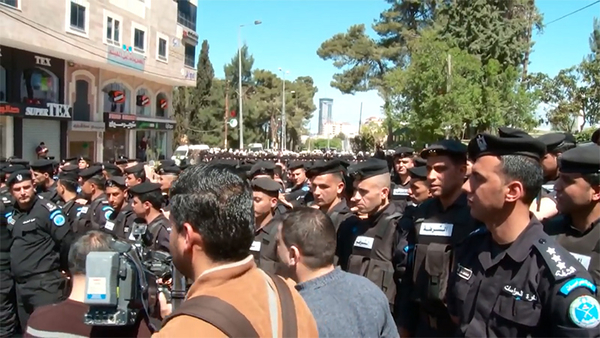 Hundreds of troops from the Palestinian Security Force line a street in Ramallah, in order to block anti-American protestors, during President Obama’s 2013 visit to the city.
The question always was twofold: What constitutes “appropriate” weapons for the PSF, and how does the U.S. justify training security forces the ultimate loyalty of whom will be a government that we cannot foresee and may become something — or already is something — we don’t like? The corollary is: What plan do we have if the Palestinian Army attacks IDF forces in the future — instead of its presumed enemy, Hamas?
To raise the questions is to understand that there are no sound answers from either the Consulate or the State Department. In their absence, concern over the choice of security guards by the U.S. Consulate in Jerusalem is appropriate, but insufficient. It is revealing that the U.S. appears determined to provide the PA with an army while it is still at war with our ally, Israel.





 anneinpt
 artaxes
 danmillerinpanama
 davidking1530
 Peter Hofman
 Joseph Wouk
 Peter
Peter Louisiana Steve
 WarSclerotic
Recent Comments