Posted tagged ‘Obama and U.S. military’

The Perilous Politicization of the Military

April 18, 2016

The Perilous Politicization of the Military, American ThinkerJonathan F. Keiler, April 18, 2016

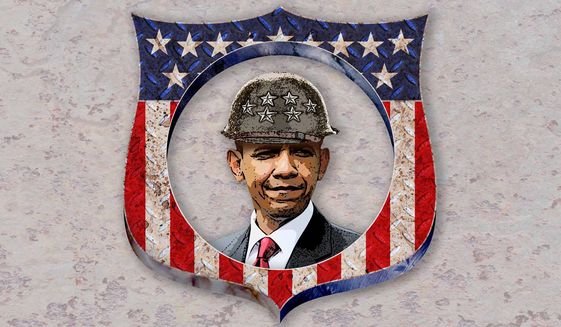
We are looking at a permanent structural change in the American armed forces that will not only weaken the nation’s ability to defend itself, but endanger constitutional principles. A year ago in an article titled “Obama’s Generals,” I described an American military increasingly politicized under the current administration.  The evidence at the time was already abundant:  the military’s refusal to identify the Fort Hood shootings as terrorism, the coddling of Bowe Bergdahl, the relief or prosecution of politically unreliable generals, and unrealistically rosy appreciations of the campaign against ISIS being the major points.  If anything, things have worsened since, most especially with the purely political decision to remove all restriction on women in combat, and as noted in a recent AT posts the mostly symbolic but still significant decisions by the Navy to issue “gender neutral” uniforms and to ignoreregulations regarding naming ships to honor Democrat politicians and leftwing social activists.  Add to this, ongoing and increasingly aggressive recruiting policies that mandate “diversity” and the situation becomes scary.

Arguably there has been some good news here and there, but even that must be taken with a large grain of salt.  Last year Congress passed legislation allowing for the soldiers wounded at Fort Hood to receive Purple Hearts, and the Army belatedly acknowledged former Major Nidal Hassan’s terrorist ties, though has yet (to my knowledge) formally remove the “workplace violence” moniker it attached to the shooting, despite the fact that Obama late last year reluctantly acknowledged the Fort Hood shooting as a terror attack.

Similarly, in the Bergdahl case, also after incredibly long delays, the Army decided to try the soldier at a General Courts Martial.  This is seen by some as the “old Army” reasserting itself in a case that reeks of liberal political influence.  Perhaps this is so.  However, the decision to try Bergdahl only came after he badly embarrassed the Army by going public with his account of his desertion and capture on NPR, practically forcing the hand of convening officer, General Robert B. Abrams.   Moreover, though the decision to try Bergdahl was made last December (four days after the first NPR appearance), the trial will not take place until August, scarcely demonstrating a hard charging prosecution in a relatively simple case.  Even assuming Bergdahl is convicted, his attorneys will argue that Bergdahl has successfully served on active duty for over two years since his release by the Taliban in May 2014, and thus deserving of leniency, undermining the contention he is a bad soldier.  This might sound ridiculous to some, but the jury will have to consider it, and it is part of the reason why military prosecutions are usually expeditious, though the Army has not demonstrated any sense of urgency in the case.

Meanwhile the low level war against ISIS goes on. The U.S. continues operate under ruinous rules of engagement which result in countless wasted strike sorties, wearing out men and equipment to no gain.  While ISIS is probably weakening under the bombardment, the campaign’s military logic is held hostage to politically correct dogmas.  The Pentagon goes along with this, hyping over-optimistic casualty reports with promises that ISIS is close to breaking.  While the Pentagon and some commentators trumpet the arrival of B-52 bombers in the region, those expecting carpet bombing will be disappointed.  The B-52s replace more capable B-1s which flew many hours but dropped only a small fraction of the munitions they are capable of throwing at the enemy.  The B-52s will do the same.  By contrast, Russia’s politically incorrect but effective Syrian intervention seems to have accomplished much more, in a much shorter time span, with inferior equipment, money and support.

I got to see some of the strain on Marine pilots, ground crew and aircraft when I visited the Beaufort Marine Air Station a few months ago.  While there I also learned a lot about recruiting, and especially political influences that are pervasive and potentially permanent. Beyond the already divisive, controversial and standard-destroying policy of allowing women in all combat billets is the military’s intensive drive to fill the ranks with as many women and other categories of “diverse” recruits as possible, at almost any cost.   Diversity is now effectively the primary goal of military recruiters, even beyond meeting basic quotas.  Recruiters that enlist too many qualified and ready applicants (read Caucasian males) that don’t meet the description of “diverse” can be sanctioned for going after easy pickings.  Recruiting goals are first defined by diversity rather than by quality, availability or cost.  In a situation in which the Marines say over 70% of young American adults are unqualified for service, and in an era in which officer quality is a serious concern, this program verges on folly.

Officers and senior enlisted who wish to progress must effectively buy into this program, and the folks they recruit and advance will too.  While diversity is not a bad thing (I live and work in very diverse environments) its empirical benefits are extremely debatable, and when adopted forcefully as a matter of policy, it is a completely political matter that reflects a strong leftist bent.  It may be desirable to have a military that reflects demographic reality in the country, but effectively favoring some categories of citizens willing to serve over others is a recipe for ineffectiveness, tension, conflict and potentially serious political turmoil.  That is not a price worth paying for a cherry-picked military selected to fit an idealized demographic template.

While to some extent the services have always been and will continue to be organizations affected by politics, among the many departments of government, the services are probably the most sensitive to political influence in terms of maintaining a free society.  The openly leftist orientation that the Obama administration continues to force on the armed forces not only damages morale and national security, but is potentially a serious long term (if not permanent) phenomenon.  Senior officers have to be sympathetic to the administration’s moves in order to advance, and junior officers are oriented politically both by selection and doctrine from the get-go.  On the other hand, mid-grade officers who do not buy in are forced out via the evaluation process or through their own disgruntlement.

While plenty of former senior officers (and Defense secretaries) have criticized the administration, and some were eventually maneuvered out, I’m not aware of any who explicitly resigned on principle, which at least might offer some encouragement for those disturbed by this process.  Whether senior officers continue to soldier on based on loyalty to the military-political system or just plain careerism is hard to say (and certainly in many cases both are true), but the practical effect of going along to get along allows this extremely dangerous politicization to snowball, a process which will only worsen if another Democrat is elected in November.

Dunford: U.S. Military Isn’t Ready Across the Board

March 22, 2016

Dunford: U.S. Military Isn’t Ready Across the Board, Washington Free Beacon, March 22, 2016

Gen. Joseph Dunford, chairman of the Joint Chiefs of Staff, told lawmakers Tuesday that the United States military currently is not prepared or capable across all the service branches of addressing the threats facing the country.

Dunford gave his assessment of the military’s readiness while testifying before the House Armed Services Committee alongside Defense Secretary Ash Carter on the fiscal year 2017 proposed defense budget.

Rep. Mac Thornberry (R., Texas), chair of the committee, first listed evidence he has heard from other senior military officers to illustrate how the military does not have sufficient readiness capabilities across the services.

“Let me just offer a handful of other quotes on the record,” Thornberry told Dunford. “[Marine Corps Commandant] Gen. [Robert] Neller said, ‘Our aviation units are currently unable to meet our training and mission requirements, primarily due to Ready Basic Aircraft shortfalls.’ [Army Chief of Staff] Gen. [Mark] Milley and Gen. [John] Allen have testified [that] less than one-third of Army forces are at acceptable forces of readiness. The readiness of the United States Army is not at a level that is appropriate for what the American people would expect to defend them.”

Thornberry then referenced Air Force Secretary Deborah Lee James’ testimony from last week in which she said that “less than half our combat forces are ready for a high-end fight… the Air Force is the smallest, oldest, and least ready force across the full spectrum of operations in our history.”

“Do you agree that we have a significant readiness problem across the services, especially for the wide variety of contingencies that we’ve got to face?” Thornberry asked.

“Chairman, I do, and I think those are accurate reflections of the force as a whole,” Dunford said. “From my perspective, there’s really three issues: There are the resources necessary to address the readiness issue, there’s time, and then there’s operational tempo.”

Dunford said that the readiness problem is the result of several years of an “unstable fiscal environment” combined with an “extraordinarily high operational tempo,” or rate of military actions.

The general warned it will take many years to dig out of this situation, but said he is satisfied that the FY 2017 budget meets the fiscal requirements of each service for readiness.

The U.S. cannot buy its way out of the readiness problem this year, Dunford said, because of time and the growing need to deploy resources quickly.

He added that the Army, Navy, and Marine Corps will not be sufficiently ready to counter the challenges they need to until around fiscal year 2020, and the Air Force likely will not reach that point until fiscal year 2028.

Beyond resources, time, and operational tempo, Dunford explained that depot-level maintenance has been back-logged in Marine aviation, and likely in other branches as well, contributing to the delay in reaching full readiness.

“I think it’s important for us and for y’all to continue to not only watch this issue but really understand down deeper what’s happening,” Thornberry said. “Statistics are one thing, but you talk to these folks eyeball to eyeball, and the sense of frustration and concern is very evident.”

The military has been steadily downsized over the course of the Obama administration, with the number of active-duty ships in the Navy reduced to pre-World War I levels and the Marine Corps the smallest it has been since the Korean War in the early 1950s. The size of the Army has been reduced as well.

The Un-Armed Forces Medley (Trump for Prez!)

October 24, 2015

The Un-Armed Forces Medley (Trump for Prez!) via You Tube, August 4, 2015


World view: Politics may force Obama to ‘over-react’ militarily in Syria

October 11, 2015

World view: Politics may force Obama to ‘over-react’ militarily in Syria, BreitbartJohn J. Xenakis, October 11, 2015

(Fine. But what advice will he take from whom before he does something? Perhaps his favorite military political adviser?

PJ boy and Obama

— DM)


obamaz-640x480

Palestinian-Israeli violence continues in Gaza and West Bank

g151009bPalestinian protesters in Gaza on Friday (AP)

Six Palestinians were killed and hundreds of Palestinians and Israeli were wounded on Friday as several weeks of violence continued. ( “9-Oct-15 World View — Israeli-Palestinian violence spreads across West Bank as anger grows”)

Ismail Haniyeh, the leader of Hamas, which governs Gaza, applauded the recent Palestinian knife attacks on Israelis, and called for a “third intifada.” By contrast, Israeli Prime Minister Benjamin Netanyahu “strongly condemned the harming of innocent Arabs.” Both Israeli and Palestinian security forces are on high alert, with more violence expected. Fox News/AP

Obama administration announces an abrupt change of policy in Syria

The Obama administration’s widely ridiculed $500 million program to train and equip Syrian rebels to fight the so-called Islamic State (IS or ISIS or ISIL or Daesh) was “paused” on Friday as a publicly admitted failure. The program was supposed to train thousands of rebels, but the public was shocked several weeks ago when the administration admitted that only “four or five” had been trained, despite the program’s huge price tag.

As Foreign Policy magazine put it: “On Capitol Hill, it’s been called “a joke,” a “total failure,” and “a bigger disaster than I could have ever imagined.” And now we have another name for it: dead.”

A new program has been announced. The new program will provide air support and basic equipment and training to vetted opposition group leaders who are already fighting ISIS and who are committed to fighting ONLY ISIS, and not the regime of Syria’s president Bashar al-Assad.

Brett McGurk, whose title is “White House deputy envoy to the Global Coalition to Counter Islamic State,” described the new program as follows:

“Is it best to take those guys out and put them through training programs for many weeks, or to keep them on the line fighting and to give them additional enablers and support? I think the latter is the right answer, and that’s what we’re going to be doing.”

According to Secretary of Defense Ash Carter: “I remain convinced that a lasting defeat of ISIL in Syria will depend in part on the success of local, motivated and capable ground forces. I believe the changes we are instituting today will, over time, increase the combat power of counter-ISIL forces in Syria and ultimately help our campaign achieve a lasting defeat of ISIL.”

The old policy was criticized and mocked from the day it was announced last year. The new policy is receiving similar treatment. A NY Times editorial titled “An Incoherent Syria War Strategy” points out that the strategy of finding and arming rebel groups that want to fight ISIS but who are going to be forbidden from fighting the al-Assad regime makes no sense:

“The initial plan was dubious. The new one is hallucinatory, and it is being rolled out as the war enters a more perilous phase now that Russia has significantly stepped up its military support of Mr. Assad’s forces.

There is no reason to believe that the United States will suddenly be successful in finding rebel groups that share its narrow goal of weakening the Islamic State, also known as ISIS or ISIL, but not joining the effort to topple Mr. Assad. Washington’s experience in Syria and other recent wars shows that proxy fighters are usually fickle and that weapons thrust into a war with no real oversight often end up having disastrous effects.”

This harsh criticism from a newspaper that regularly slobbers over President Obama symbolizes how much even the left-wing mainstream media, not to mention foreign media throughout the Mideast, now views the Obama administration as weak and rudderless, lurching from one policy to the next. (As another example, it had been widely expected that Secretary of State John Kerry would win this year’s Nobel Peace Prize for the Iran nuclear deal, but even the loony Norwegians have lost faith.) VOA and NY Times

Obama administration may be forced into greater military role

I’ve written many times about the Harry Truman’s Truman Doctrine of 1947, which made America policeman of the world. The justification is that it’s better to have a small military action to stop an ongoing crime than to let it slide and end up having an enormous conflict like World War II. Every president since WW II has followed the Truman Doctrine, up to and including George Bush. Barack Obama is the first president to repudiate the Truman Doctrine, essentially leaving the world without a policeman.

Call it Kismet or Karma or God’s Will (or call it an unstoppable generational trend), but America does have an exceptional role in the world, and repudiating that role does not end it. Obama’s policy of apologizing for America has held sway for over six years, but now powerful political pressures are growing to force a change. Those forces are being driven by massive shifts in public attitudes towards Obama, both in the US and abroad, as reflected in worldwide criticism of him in the media as a weak president.

According to the left-leaning Washington Post:

“Russia’s military moves in Syria are fundamentally changing the face of the country’s civil war, putting President Bashar al-Assad back on his feet, and may complicate the Obama administration’s plans to expand its air operations against the Islamic State. …

But others within the administration, and many outside experts, are increasingly worried that if President Obama does not take decisive action — such as quickly moving to claim the airspace over northwestern Syria and the Turkish border, where Russian jets are already operating — it is the United States that will suffer significant damage to both its reputation and its foreign policy and counterterrorism goals. …

The current internal administration debate is largely the same one that has kept the administration out of significant intervention in Syria’s civil war for the past four years. On one side, Russia’s involvement has strengthened the winning argument that the United States should avoid direct involvement in yet another Middle East conflict and should continue directing its resources toward countering forces such as the Islamic State that pose a direct threat to U.S. national security.

On the other side, the argument is that it makes no strategic sense for the United States to concede Russian dominance of the situation: If Russia succeeds in keeping Assad in power, the problems in the West caused by both the Syrian war and militant expansion will only get worse.”

The article describes two sides of the debate whether to intervene in Syria, but does not draw the obvious conclusion that the weight of political opinion is moving sharply towards the side of some kind of intervention — although those that say that “it makes no strategic sense … to concede Russian dominance” do not agree on what steps should be taken to avoid conceding.

The left-leaning Brookings Institution makes the claim that intervention in Syria is costing Russia enormously, and so “For the United States, avoiding the temptation to over-react is still the key guideline.”

But the article then goes on to describe problems with doing nothing, and even conclude:

“Finally, the United States and its allies could deliver a series of airstrikes on the Hezbollah bands around Damascus. That would be less confrontational vis-à-vis Russia than hitting Assad’s forces. Hezbollah has already suffered losses in the Syrian war and is not particularly motivated to stand with Assad to the bitter end, away from own home-ground in Lebanon. (Israel would appreciate such punishment, too.)”

I almost can’t believe my eyes reading this recommendation. American warplanes around Damascus would almost certainly come into contact with Russian warplanes, and even if they didn’t, bombing al-Assad’s close ally Hezbollah could be the trigger that sets off a wider war in this generational Crisis era.

Policy can sometimes act like a rubber band that be stretched in one direction so far that when it’s released, it snaps back in the other direction violently. After six years of constantly apologizing for America, the pressure is on President Obama to do something different. Brookings advises Obama about “avoiding the temptation to over-react,” but Obama may be politically forced to decide that with his previous policies so widely criticized and mocked, he has to take some step to prove to the world that he’s a tough leader after all, and he may have to over-react, because no half-measure will provide the proof he needs. Washington Post and Brookings Institution.

No moral outrage in the military

October 6, 2015

No moral outrage in the military, Washington Times, James A. Lyons, October 5, 2015

105_2015_b3-lyon-obama-shiel8201_c0-0-2933-1710_s561x327Obama Decimates the U.S. Military Illustration by Greg Groesch/The Washington Times

[T]he degradation of our military’s core principles must be viewed in a much broader perspective. Actually, it is a key element in President Obama’s declaration to fundamentally transform America. When you want to take down a country, the first thing you do is weaken its military.

***************************

Recent articles highlighting horrifying child abuse atrocities inflicted on defenseless children by our Afghan military and police partners are but the latest examples of how President Obama is destroying U.S. military forces.

Our military leadership’s response to these blatant acts of pedophilia by our so-called Afghan partners has been shocking. In short, the guidance provided to our Army and Marine Corps personnel was to just ignore these Muslim and Afghan seventh-century customs and traditions. They have been instructed to not interfere, even when such horrific acts are being committed on our own bases.

Those U.S. military personnel. whose moral outrage will not let them ignore these atrocities and instead act to stop these unconscionable acts against children, are either disciplined or forced to leave the service. In other words, even if you find a young boy chained to a bed so that a local police commander can sodomize him every night and you hear the screams, you are told to look the other way. This is not only un-American but an act against humanity.

Even the Taliban outlawed such practices and freed a number of children, thereby earning the gratitude of village elders. Does the Taliban with its seventh-century mentality have a higher moral code than the U.S. military leadership? It should be clear to any thinking person that when our honorable military personnel are forced to ignore these crimes against humanity, they are viewed as being complicit.

To those who have followed our involvement in Afghanistan, the current policy to ignore acts of pedophilia should come as no surprise. When “green on blue” attacks gained national attention, our military leadership tried to explain it away by claiming the friction that developed between the two forces was because our military personnel were not sensitive enough to Afghan culture and traditions. In other words, if our Afghan partners conduct violence or kill U.S. military personnel, it is our fault. What nonsense.

Other Afghan cultural idiosyncrasies our military personnel are forced to accept without reservation include wife-beating, rape, drug use, thievery, dog torture, desertion and collusion with the enemy, the Taliban. Furthermore, under no circumstances can our military discuss Islam in any form. The genesis for this goes back to the purging of all our training manuals and instructors who presented Islam in an unfavorable light or linked it to terrorism. It is totally against our core principles and everything we stand for as Americans. It clearly has an adverse impact on individual and unit morale, which affects the ultimate goal of the “will to win.” The bottom line is that we are forcing our great military to submit to Islam and its governing Shariah law, or possibly die.

This is exactly the choice offered to infidels who have been vanquished by Islamic jihad. Our military’s silence and acquiescence, particularly by the leadership, is the humiliating price for our coexistence with our Afghan partners. This is unacceptable.

However, the degradation of our military’s core principles must be viewed in a much broader perspective. Actually, it is a key element in President Obama’s declaration to fundamentally transform America. When you want to take down a country, the first thing you do is weaken its military. We cannot ignore the fact that with or without sequestration, the Obama administration has unilaterally disarmed our military forces and, consequently, our capabilities. Further, the social engineering imposed on our military forces — to include the acceptance of gay, lesbian and soon transgender personnel — further undermines the moral fiber of our military and constitutes a further degradation of our military effectiveness. Forcing women into combat roles only further degrades the situation. The restricted rules of engagement imposed on our forces has reduced our military’s effectiveness and caused unnecessary loss of life and debilitating injuries.

Likewise, the pin-prick attacks on the Islamic State cast a shadow over what a dedicated air campaign could accomplish. It projects an image of weakness and ineffectiveness of our true capabilities. It has taken the “awe” of our invincibility and overwhelming force capabilities out of the equation. The net result is that our enemies no longer fear us, and our allies can no longer trust us.

The imposed limit on the application and capability our military force is not limited to the Middle East. For example, in the Western Pacific, to challenge China’s illegal actions in the South China Sea, the Obama administration has restricted the U.S. Navy from enforcing its freedom of seas concept that has been a fundamental principle of the U.S. Navy for more than 238 years. Our Asian allies in the Western Pacific watch carefully how we respond to China’s aggressive actions. Our directed restraint clearly will not raise their confidence level.

Our national security is being deliberately jeopardized. President Obama’s bloviating to Vladimir Putin at the recent U.N. session that he leads the most powerful military in the world was only true on the day he took office. Since then, Obama has systematically degraded our capabilities. The chairmen of the House and Senate Armed Services Committee must take forceful action now to prevent further emasculation of our military capabilities.