Posted tagged ‘Obama and Iran’

Iran’s Threats Louder after Obama Appeasement

November 10, 2016

Iran’s Threats Louder after Obama Appeasement, Gatestone InstituteMajid Rafizadeh, November 10, 2016

Chants of “Death to America” and “Death to Israel” were heard across Iranian cities as thousands of Iranians marked the anniversary of the seizure of the U.S. Embassy in Tehran and the taking of 52 American hostages for 444 days by militant students.

The State Department’s reaction is classic: ignoring these developments and continuing with appeasement policies.<

These anti-American demonstrations are not rhetoric, but are the cornerstone of Iran’s revolutionary principles and foreign policies, which manifest themselves in Iran’s support for terrorist proxies, support for Assad’s regime, and the scuttling of US and Israeli foreign policies in the region.

Many other Iranian officials who were engaged in attacks against the US currently serve in high positions. Hossein Salami, who enjoys one of these high-level positions, is the deputy commander in chief of the Islamic Revolutionary Guards Corps. He stated at the rally: “America should know that if they do not honor their agreement in the nuclear deal, we will resume uranium enrichment…”


After eight years of President Barack Obama’s policies of appeasement, Iran’s threats, such as “Death to America,” and “Death to Israel,” have grown even louder.

This week, the Iranian government orchestrated one the largest anti-American and anti-Israeli demonstrations, since 1979, echoing Iran Supreme Leader, Ayatollah Ali Khamenei’s recent messages.

The government provided facilities for the protesters. Chants of “Death to America” and “Death to Israel” were heard across Iranian cities as thousands of Iranians marked the anniversary of the seizure of the U.S. Embassy in Tehran and the taking of 52 American hostages for 444 days by militant students.

According to the Tehran-based bureau of the Los Angeles Times,

“The demonstrators brought by buses to the former embassy complex included young and old, university students, military staff and employees of state-run companies who voiced opposition to the nuclear deal Iran signed with the United States and world powers… Many echoed Iran’s Supreme Leader, Ayatollah Ali Khamenei…. Almost 1 in every 10 demonstrators at the former embassy — now widely dubbed a “den of espionage” — carried placards with Khamenei’s words: ‘We do not trust America.'”
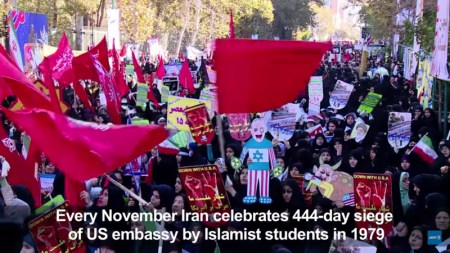
2034Iranians protest outside the former US embassy in Tehran, on the anniversary of its storming by student protesters in 1979. (Image source: AFP video screenshot)

The chants were accompanied by burning American and Israeli flags, and Stars of David. This all is occurring in a country that is presided over by the so-called “moderate” president of Iran, Hassan Rouhani and his foreign minister, Javad Zarif; both continue to argue that Iran is a constructive state actor, does not hold hostility against any country, and that Tehran is looking to improve ties with the West and the international community — so long as Iran’s objectives are met.

The State Department’s reaction is classic: ignoring these developments and continuing with appeasement policies. State Department spokesman Mark Toner stated that the White House is not going to change its policies towards Iran:

“Like any country, there’s heated political rhetoric that comes out, and I’m just not going to respond to every instance of that in this case. No one likes to see this kind of hyper-charged rhetoric on the part of any government anywhere, and anti-American sentiments expressed. But again, we’re not going to base our whole relationship going forward … on these kind of heated political remarks.”

However, these large-scale anti-American demonstrations are not rhetoric, but are the cornerstone of Iran’s revolutionary principles and foreign policies, which manifest themselves in Iran’s support for terrorist proxies, support for Assad’s regime, and the scuttling of US and Israeli foreign policies in the region.

In fact, alleging crimes against the US plays very well within the political establishment of Iran. For example, one of the hostage takers who occupied the US embassy, Masoumeh Ebtekar, has climbed the political ladder remarkably. She was first the editor-in-chief of Keyhan International, an Iranian state-owned newspaper, and close advisor to the Supreme Leader. Later she was appointed as the head of the Environment Protection Organization of Iran during the “reformist” administration of President Mohammad Khatami. Afterwards the “moderate” President Rouhani appointed her as the Vice President of Iran, the first woman to serve such position.

The Agence France-Presse (AFP) news agency scored an interview with her during the “Death to America” rally. She boasted about taking US hostages and US documents from the embassy: “Revealing these documents was very similar to what WikiLeaks is doing these days. It was the WikiLeaks of that time.” According to the AFP,

“She now regrets the diplomatic isolation that followed the embassy siege, but she is still proud of their work in releasing documents found in the CIA’s files — some painstakingly reassembled after embassy staff frantically shredded as many as possible when the students stormed the building.”

Many other Iranian officials who were engaged in attacks against the US currently serve in high positions.

Hossein Salami, who enjoys one of these high-level positions, is the deputy commander in chief of the Islamic Revolutionary Guards Corps (IRGC). He stated at the rally, in reference to the role of the IRGC in the bombing of the U.S. Marines barracks in Lebanon, “In 1983, the flames of Islamic revolution flared among Lebanese youth for the first time, and in a courageous act, a young Muslim buried 260 United States Marines under the rebels east of Mediterranean Sea.”

Last week, Ayatollah Ali Khamenei reasserted his stance against the US more firmly, saying, “The US system is far away from values of humanity, death to America means death to a system which has nothing to do with humanitarian values.” Khamenei also dismissed diplomacy with the United States, arguing that these negotiations “will not resolve our problems… We should resolve the problems ourselves and with reliance on our capabilities and the young forces inside the country.”

Iran’s anti-American policies are buttressed and supported by Iran’s powerful military institutions, domestic militia groups such as the Basij, Iran’s proxies such as Hezbollah, and the hundreds of thousands of people who join these kinds of “Death to America” demonstrations. Iranian leaders evidently enjoy powerful loyalist employees and supporters.

As a passionate protestor told the Euronews, “We are here to chant slogans, and our slogans are a strong punch in the face of America. America can never touch our country, and as our leader said, America can’t do a damn thing.”

In addition, Hossain Salami, the acting commander of the IRGC, pointed out at the rally that: “America should know that if they do not honor their agreement in the nuclear deal, we will resume uranium enrichment and send the agreement … to the museum.”

Accordingly, “crowds chanted support for the Syrian government and other Shiite Muslim-led regimes in the Middle East, saying, “We will never give it up.”

For eight years, Washington pursued total appeasement policies with Iran. The four rounds of crippling UN Security Council sanctions, which took decades to put in place, were lifted immediately. Iran’s ballistic missile ambitions and test firings of missiles, in violation of the UN resolutions, were ignored. The expanding militaristic role of the Revolutionary Guard was taken lightly.

None of these appeasement policies changed the political calculations of Iranian leaders towards the US and Israel. In fact, based on these developments, Iranian leaders became more emboldened and empowered, to the extent that they repeatedly harass naval ships of the world’s superpower without fearing any repercussions. Iran uses its proxies to attack US ships.

“Death to America” and Iran’s anti-American policies will not change if the US continues to appease Iranian leaders. For Iran, appeasement policies do not mean diplomatic initiatives; concessions mean only weakness.
Obama Gave Iran Money that Belonged to Iran’s Terror Victims

November 3, 2016

Obama Gave Iran Money that Belonged to Iran’s Terror Victims, Counter Jihad, November 2, 2016

iranmoney

Once again, it seems as if neither the law nor the American interest are of great concern to this administration.  When Iran is involved, at least, both the law and our national interests are always set aside.

****************

Here at CounterJihad, we have covered the transfer by the Obama administration of $1.7 billion in giant pallets of cash to the terrorist elements within Iran’s government.  None of the administration’s stories justifying this transfer of wealth to the main state sponsor of terrorism have made sense.  It was not necessary to transfer the money in cash, for example.  The transfer really was a hostage ransom payment, in spite of their denials, to take a second example.

Today, we learned that another aspect of their justification was flawed.  The Obama administration has claimed that the money transferred to Iran belonged to Iran anyway, as a kind of refund for weapons sales that did not happen.  This was always a highly questionable claim, as the government that paid us the money was not the same government that now rules over Iran.  It is unclear why the Iranian revolutionary government would be entitled to moneys advanced by the Shah of Iran.  This makes no more sense than if a homeowner had overpaid property taxes, and the government responded by sending the overpaid money not to him but to the squatters who had forcibly occupied his home over his protest.  Of course, the Shah was no longer in a position to receive a refund, so it wasn’t clear that the money should go to anyone.

What we have learned most recently, however, is that the money did have a proper owner:  victims of Iran’s support of terror.

Alisa Flatow, a twenty-year-old Brandeis University honors student spending her junior year abroad in Israel, boarded a bus in Jerusalem bound for a popular resort area in Gaza. It was the height of the “peace process,” celebrated the year before with Nobel Peace prizes. As the bus entered Gaza, a van filled with explosives slammed into it. Eight people, including Alisa, were killed, and more than 40 others were injured. The attack was carried out by a faction of Islamic Jihad controlled, financed, and directed by the highest levels of Iran’s government….  A federal district court issued a 35-page opinion, Flatow v. Islamic Republic of Iran (1998), awarding a total of $20 million in compensatory damages as well as punitive damages, with both types of damages specifically authorized by the U.S. Congress….

In all, sixteen cases were decided against Iran by courts in the United States between 1998 and 2004, with awards of compensatory damages totaling some $400 million and punitive damages totaling $3.5 billion.

Of course, the problem faced by each victorious plaintiff was collecting the judgment. Stephen Flatow, after unsuccessfully seeking to have the damages paid out of various Iranian assets held in the United States, learned of the $400 million in the FMS fund. The Clinton administration had supported the legislation that allowed suits such as Flatow’s, but then strenuously opposed any effort to have the judgments satisfied from that fund.

In other words, the money was spoken for before the Obama administration elected to transfer it to the IRGC.  It belonged, by the authorization of Congress and the decision of Federal courts, to victims of terrorism sponsored by the Iranian government.  Iran owes them all that money, and a great deal more.

The Obama administration has not rethought its position on sending Iran more and more money, whatever the law may say.  The State Department been busy recently trying to drum up investment for Iran instead.  Secretary of State John F. Kerry has been telling unlikely stories about the sanctions still in place on Iran in order to try to convince bankers to send Iran even more cash.  On this question, it should be noted by anyone thinking of investing, the State Department and the Treasury are very much at odds.

Once again, it seems as if neither the law nor the American interest are of great concern to this administration.  When Iran is involved, at least, both the law and our national interests are always set aside.

Column One: From Yemen to Turtle Bay

October 14, 2016

Column One: From Yemen to Turtle Bay, Jerusalem Post, Caroline Glick, October 13, 2016

sana-yemen


As far as Obama is concerned, Iran is a partner, not an adversary.

****************************

Off the coast of Yemen and at the UN Security Council we are seeing the strategic endgame of Barack Obama’s administration. And it isn’t pretty.

Since Sunday, Iran’s Houthi proxies in Yemen have attacked US naval craft three times in the Bab al-Mandab, the narrow straits at the mouth of the Red Sea. The Bab al-Mandab controls maritime traffic in the Red Sea, and ultimately controls the Suez Canal.

Whether the Iranians directed these assaults or simply green-lighted them is really beside the point. The point is that these are Iranian strikes on the US. The Houthis would never have exposed themselves to US military retaliation if they hadn’t been ordered to do so by their Iranian overlords.

The question is why has Iran chosen to open up an assault on the US? The simple answer is that Iran has challenged US power at the mouth of the Red Sea because it believes that doing so advances its strategic aims in the region.

Iran’s game is clear enough. It wishes to replace the US as the regional hegemon, at the US’s expense.

Since Obama entered office nearly eight years ago, Iran’s record in advancing its aims has been one of uninterrupted success.

Iran used the US withdrawal from Iraq as a means to exert its full control over the Iraqi government. It has used Obama’s strategic vertigo in Syria as a means to exert full control over the Assad regime and undertake the demographic transformation of Syria from a Sunni majority state to a Shi’ite plurality state.

In both cases, rather than oppose Iran’s power grabs, the Obama administration has welcomed them. As far as Obama is concerned, Iran is a partner, not an adversary.

Since like the US, Iran opposes al-Qaida and ISIS, Obama argues that the US has nothing to fear from the fact that Iranian-controlled Shiite militias are running the US-trained Iraqi military.

So, too, he has made clear that the US is content to stand by as the mullahs become the face of Syria.

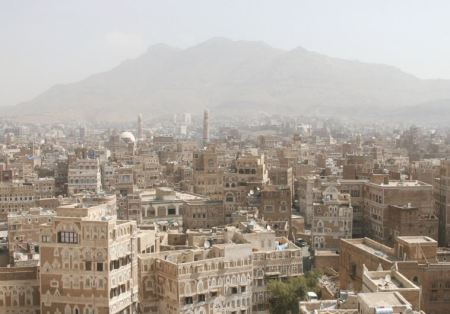
In Yemen, the US position has been more ambivalent. In late 2014, Houthi rebel forces took over the capital city of Sanaa. In March 2015, the Saudis led a Sunni campaign to overthrow the Houthi government. In a bid to secure Saudi support for the nuclear agreement it was negotiating with the Iranians, the Obama administration agreed to support the Saudi campaign. To this end, the US military has provided intelligence, command and control guidance, and armaments to the Saudis.

Iran’s decision to openly assault US targets then amounts to a gamble on Tehran’s part that in the twilight of the Obama administration, the time is ripe to move in for the kill in Yemen. The Iranians are betting that at this point, with just three months to go in the White House, Obama will abandon the Saudis, and so transfer control over Arab oil to Iran.

For with the Strait of Hormuz on the one hand, and the Bab al-Mandab on the other, Iran will exercise effective control over all maritime oil flows from the Arab world.

It’s not a bad bet for the Iranians, given Obama’s consistent strategy in the Middle East.

Obama has never discussed that strategy.

Indeed, he has deliberately concealed it. But to understand the game he has been playing all along, the only thing you need to do listen to his foreign policy soul mate.

According to a New York Times profile published in May, Obama’s deputy national security adviser Ben Rhodes is the president’s alter ego. The two men’s minds have “melded.”

Rhodes’s first foreign policy position came in the course of his work for former congressman Lee Hamilton.

In 2006, then-president George W. Bush appointed former secretary of state James Baker and Hamilton to lead the Iraq Study Group. Bush tasked the group with offering a new strategy for winning the war in Iraq. The group released its report in late 2006.

The Iraq Study Group’s report contained two basic recommendations. First, it called for the administration to abandon Iraq to the Iranians.

The group argued that due to Iran’s opposition to al-Qaida, the Iranians would fight al-Qaida for the US.

The report’s second recommendation related to Israel. Baker, Hamilton and their colleagues argued that after turning Iraq over to Iran, the US would have to appease its Sunni allies.

The US, the Iraq Study Group report argued, should simultaneously placate the Sunnis and convince the Iranians of its sincerity by sticking it to Israel. To this end, the US should pressure Israel to give the Golan Heights to Syria and give Judea and Samaria to the PLO.

Bush rejected the Iraq Study Group report. Instead he opted to win the war in Iraq by adopting the surge counterinsurgency strategy.

But once Bush was gone, and Rhodes’s intellectual twin replaced him, the Iraq Study Group recommendations became the unstated US strategy in the Middle East.

After taking office, Obama insisted that the US’s only enemy was al-Qaida. In 2014, Obama grudgingly expanded the list to include ISIS.

Obama has consistently justified empowering Iran in Iraq and Syria on the basis of this narrow definition of US enemies. Since Iran is also opposed to ISIS and al-Qaida, the US can leave the job of defeating them both to the Iranians, he has argued.

Obviously, Iran won’t do the US’s dirty work for free. So Obama has paid the mullahs off by giving them an open road to nuclear weapons through his nuclear deal, by abandoning sanctions against them, and by turning his back on their ballistic missile development.

Obama has also said nothing about the atrocities that Iranian-controlled militia have carried out against Sunnis in Iraq and has stopped operations against Hezbollah.

As for Israel, since his first days in office, Obama has been advancing the Iraq Study Group’s recommendations. His consistent, and ever escalating condemnations of Israel, his repeated moves to pick fights with Jerusalem are all of a piece with the group’s recommended course of action. And there is every reason to believe that Obama intends to make good on his threats to cause an open rupture in the US alliance with Israel in his final days in office.

Prime Minister Benjamin Netanyahu’s phone call with Secretary of State John Kerry on Saturday night made this clear enough. In the course of their conversation, Netanyahu reportedly asked Kerry if Obama intended to enable an anti-Israel resolution to pass in the UN Security Council after the presidential election next month. By refusing to rule out the possibility, Kerry all but admitted that this is in fact Obama’s intention.

And this brings us back to Iran’s assaults on US ships along the coast of Yemen.

Early on Sunday morning, the US responded to the Houthi/Iranian missile assaults by attacking three radar stations in Houthi-controlled territory. The nature of the US moves gives credence to the fear that the US will surrender Yemen to Iran.

This is so for three reasons. First, the administration did not allow the USS Mason destroyer to respond to the sources of the missile attack against it immediately. Instead, the response was delayed until Obama himself could determine how best to “send a message.”

That is, he denied US forces the right to defend themselves.

Second, it is far from clear that destroying the radar stations will inhibit the Houthis/Iranians.

It is not apparent that radar stations are necessary for them to continue to assault US naval craft operating in the area.

Finally, the State Department responded to the attack by reaching out to the Houthis. In other words, the administration is continuing to view the Iranian proxy is a legitimate actor rather than an enemy despite its unprovoked missile assaults on the US Navy.

Then there is the New York Times’ position on Yemen.

The Times has repeatedly allowed the administration to use it as an advocate of policies the administration itself wishes to adopt. Last week for instance, the Times called for the US to turn on Israel at the Security Council.

On Tuesday, the Times published an editorial calling for the administration to end its military support for the Saudi campaign against the Houthis/Iran in Yemen.

Whereas the Iranian strategy makes sense, Obama’s strategy is nothing less than disastrous.

Although the Iraq Study Group, like Obama, is right that Iran also opposes ISIS, and to a degree, al-Qaida, they both ignored the hard reality that Iran also views the US as its enemy. Indeed, the regime’s entire identity is tied up in its hatred for the US and its strategic aim of destroying America.

Obama is not the only US president who has sought to convince the Iranians to abandon their hatred for America. Every president since 1979 has tried to convince the mullahs to abandon their hostility. And just like all of his predecessors, Obama has failed to convince them.

What distinguishes Obama from his predecessors is that he has based US policy on a deliberate denial of the basic reality of Iranian hostility. Not surprisingly, the Iranians have returned his favor by escalating their aggression against America.

The worst part about Obama’s strategy is that it is far from clear that his successor will be able to improve the situation.

If Hillary Clinton succeeds him, his successor is unlikely to even try. Not only has Clinton embraced Obama’s policies toward Iran.

Her senior advisers are almost all Obama administration alumni. Wendy Sherman, the leading candidate to serve as her secretary of state, was Obama’s chief negotiator with the Iranians.

If Donald Trump triumphs next month, assuming he wishes to reassert US power in the region, he won’t have an easy time undoing the damage that Obama has caused.

Time has not stood still as the US has engaged in strategic dementia. Not only has Iran been massively empowered, Russia has entered the Middle East as a strategic spoiler.

Moreover, since 2001, the US has spent more than a trillion dollars on its failed wars in the Middle East. That investment came in lieu of spending on weapons development. Today Russia’s S-400 anti-aircraft missiles in Syria reportedly neutralize the US’s air force.

US naval craft in the Bab al-Mandab have little means to defend themselves against missile strikes.

The US’s trillion-dollar investment in the F-35 fighter jet has tethered its air wings to a plane that has yet to prove its capabilities, and may never live up to expectations.

Israel is justifiably worried about the implications of Obama’s intention to harm it at the UN.

But the harm Israel will absorb at the UN is nothing in comparison to the long-term damage that Obama’s embrace of the Iraq Study Group’s disastrous strategic framework has and will continue to cause Israel, the US and the entire Middle East.

Miami: Three Hizballah operatives busted for laundering $500,000 of cocaine money for Colombian cartel

October 13, 2016

Miami: Three Hizballah operatives busted for laundering $500,000 of cocaine money for Colombian cartel, Jihad Watch,

(Please see also, Venezuela, Iran, USA and Narco-Terrorism. — DM

Hizballah is a wholly owned and operated subsidiary of the Islamic Republic of Iran. Iran has repeatedly declared its intention to destroy the United States, as you can read about in detail in my book The Complete Infidel’s Guide to Iran (Regnery). Hizballah working with the drug cartel kills two birds with one stone: drugs weaken and destroy Americans, and sap American resources in largely futile anti-drug efforts, and the cash Hizballah earns in working with the drug cartel goes for more jihad against the U.S.

People watch Lebanon's Hezbollah leader Sayyed Hassan Nasrallah as he appears on a screen during a live broadcast to speak to his supporters at an event marking Resistance and Liberation Day, in Bekaa valley May 25, 2016. The event is to commemorate the 16th anniversary of Israel's withdrawal from southern Lebanon. REUTERS/Hassan Abdallah - RTSFWSN

People watch Lebanon’s Hezbollah leader Sayyed Hassan Nasrallah as he appears on a screen during a live broadcast to speak to his supporters at an event marking Resistance and Liberation Day, in Bekaa valley May 25, 2016. The event is to commemorate the 16th anniversary of Israel’s withdrawal from southern Lebanon. REUTERS/Hassan Abdallah – RTSFWSN

“State: Hezbollah-linked group laundered drug money through Miami banks,” by David Ovalle, Miami Herald, October 11, 2016:

Three men suspected of laundering cocaine money for the Colombian cartel have been busted after agents say they illegally moved $500,000 into Miami banks through a series of complicated financial transactions stretching from Australia to Europe.

That’s not uncommon in Miami, but the trio’s background is: They are suspected associates of the Middle Eastern terror group Hezbollah.

The main player is Mohammad Ahmad Ammar, 31, who was living in Medellín, Colombia. He was quietly booked into a Miami-Dade jail last week to face state felony money laundering charges in a case that underscores increased law-enforcement scrutiny on the role of Middle Eastern terror groups who use financial networks in Latin America to earn untold millions off drug profits.

Along with Ammar, two other Hezbollah associates are facing charges charges in the same case. One of them is in custody in Paris, while the other is on the lam, possibly in Lebanon or Nigeria.

The DEA investigated the case along with the the South Florida Money-Laundering Strike Force, a group of federal and state investigators that recently helped bust 22 people suspected in a large run connected to Mexican kingpin Joaquín “El Chapo” Guzmán.

“Drug dealers, potential terrorists and money launderers should all get the message that Miami-Dade County is not the place to do your dirty business,” Miami-Dade State Attorney Katherine Fernandez Rundle said in a statement.

The involvement of radical Islamic terrorist groups in Latin American is not new but has increased in recent years, according to federal law enforcement and security experts.

In November 2012, a congressional report on border security noted that Latin America has “become a money laundering and major fundraising center” for Hezbollah, the Shiite Muslim group classified as a terrorist organization by the U.S. government. The group, based in Lebanon, has been a key ally of Syrian dictator Bashar Assad in the bloody war that has decimated the country for the past five years.

“The notion of terrorist groups, especially Islamists using Latin America as place for money laundering, drug trafficking and other nefarious trades — it’s been known for some time now,” Jerry Haar, a Latin America expert at Florida International University, said in an interview.

In February, the U.S. Drug Enforcement Administration announced a “significant enforcement activity” against people connected with Hezbollah, The DEA’s efforts in “Operation Cassandra” came after the U.S. Department of Treasury announced sanctions against Hezbollah’s financiers, whom they the believe are capable of earning $400 million a year from drug trafficking and money laundering.

Exactly how much of money generated from laundering drug money is used directly to fund terror attacks is unknown. Many of those business associates such as Ammar “are more concerned with generating cash than religious or political doctrine” — though they readily send money back to their handlers in the Middle East, according to an arrest warrant.

Hezbollah-related arrests stemming from Latin American have popped up before in South Florida.

In 2008, a Lebanese man named Chekri Harb was arrested and convicted as part of a large-scale Colombian cocaine ring. U.S. authorities did not name Hezbollah in charging documents, but Colombian security officials described him as having links to the group.

Federal agents in 2010 arrested three South Florida businessmen accused of exporting video games and other electronic products to a shopping mall in Paraguay that allegedly served as a front to Hezbollah. They wound up being convicted of non-terrorism-related charges.

The lawless area at the borders of Paraguay, Brazil and Argentina has long been identified by the U.S. as a hotspot for money launderers who send their money back to the Middle East.

The latest Miami case was a spinoff from the DEA investigation into Colombian cocaine operations that netted dozens of trafficking and money-laundering arrests. In custody in Miami is Ammar, described in court documents as a Hezbollah associate whose job was to launder money for the Colombian cocaine operation known as La Oficina, or The Office, an off-shoot of the notorious Medellín cartel.

He was known to launder money through Holland, Spain, the United Kingdom, Australia and Africa, according to an arrest warrant. Ammar is charged with eight felonies, including money laundering and conspiracy to launder money; court records do not list a defense attorney.

According to court documents, his father is a well-connected Hezbollah associate living in Los Angeles, where the younger Ammar was arrested last month.

Also facing charges is Ghassan Diab, another purported Hezbollah associate based in Nigeria. According to court documents, Diab is related to a “high-ranking member of Hezbollah who has access to numerous international bank accounts.” He remains on the loose, possibly in Nigeria or Lebanon.

The third man facing charges is Hassan Mohsen Mansour, another Hezbollah associate with dual Lebanese and Canadian citizenship. He is in custody in Paris, and is facing a separate but similar federal money-laundering prosecution in South Florida.

The 42-page arrest warrant reads like a plot out of a international spy thriller, detailing a complicated web of encrypted communications between players in far-flung countries — some of them secretly working as informants — and murky financial transactions on six different continents.

A confidential source first tipped of Miami DEA agents to Ammar in early 2014, introducing him a second confidential informant who secretly recorded their meetings.

The second informant eventually asked Ammar to help him launder $250,000 worth of Australian dollars that was netted from cocaine sales. The task: Move the money to banks in Miami, where it could be moved later to Colombia or used by Colombian traffickers in South Florida.

Ammar was not aware, however, that the money was actually DEA cash and the Miami accounts were set up by the feds.

Using encrypted communications, Ammar enlisted the help of Mansour in Paris, who contacted a source in Australia (who by coincidence, happened to be an informant for the police there) to pick up the cash.

The money was deposited into an account in Dubai in the United Arab Emirates — where the anything-goes banking system remains out of reach of U.S. authorities. It was then then broken up and moved through a sham company called Al Haitham Exhibition and Conference Organizers, which purports to organize events but authorities believe is simply a front for money laundering.

From there, the money was cashed out and disappeared, according to an arrest warrant by DEA agent Kenneth Martin and state prosecutor Jared Nixon.

Back in Miami, the bank accounts set up by the DEA soon began receiving the money in chunks from obscure companies with names like “Tropical Trading” and “Khofo International.” To make them look like legitimate business, phony invoices were sent by Diab for nebulous goods or “payment for shipment.”

After the first deal went through successfully, Ammar soon admitted to the DEA informant that he was working with La Oficina, the chief cartel in Medellin, the warrant said.

In September 2014, another deal to launder $250,000 was struck. The Australian cash was sent to the events company in Dubai, with a note that it was for the purchase of a four-carat diamond ring head for Majorca, Spain. Through more bogus companies, some of the money was eventually transferred into the DEA’s Miami bank accounts; one transaction was disguised as payment for 50-kilogram bags of white rice.

Throughout the undercover operation, Ammar made admissions of interest to investigators, according to the warrant, including that he knew two brothers who worked for Avianca airlines who could smuggle in cocaine to Miami.

He also boasted that his family was well connected with Hezbollah, and inquired if the informant would be interested in helping smuggle 150 kilograms of cocaine from Costa Rica to the Netherlands.

Accused Hezbollah Operative Slated to Speak In Washington, D.C.

October 7, 2016

Accused Hezbollah Operative Slated to Speak In Washington, D.C., Washington Free Beacon, , October 6, 2016

Azmi Bishara, an Israeli Arab and former lawmaker, speaks with journalists as he arrives to attend the emergency Arab leaders summit on Gaza in Doha, Qatar, Friday, Jan. 16, 2009. (AP Photo/Hassan Ammar)

Azmi Bishara, an Israeli Arab and former lawmaker, speaks with journalists as he arrives to attend the emergency Arab leaders summit on Gaza in Doha, Qatar, Friday, Jan. 16, 2009. (AP Photo/Hassan Ammar)

“The Obama administration’s tilt toward Iran is so extreme that now a visa has been given to a Hezbollah terrorist so that he can visit Washington D.C.,” the source said. “The administration’s love affair with Iran is a disgrace to our country and a danger to our security.”

********************

A former Arab member of Israel’s parliament who was forced to flee the country after he was accused of working as a top Hezbollah operative is slated to speak next week in Washington, D.C., raising questions about how he obtained permission to enter U.S. soil.

Azmi Bishara, who is accused by Israel’s Shin Bet secret service of helping Hezbollah plot terrorist operations, is confirmed to speak next week at Washington’s downtown Marriott hotel as part of a conference organized by The Arab Center of Washington, D.C.

An official from the Arab Center confirmed to the Washington Free Beacon that Bishara will be attending the event, raising questions about how an individual linked to a U.S.-designated sponsor of terror obtained permission to enter America.

Bishara was initially slated to speak alongside former U.S. Ambassador to Russia Michael McFaul, who the Free Beacon has learned cancelled his appearance. The talk was to focus on the promotion of democracy in the Arab world, according to a current conference schedule.

McFaul’s image was removed from the conference’s webpage several hours after the Free Beacon made an inquiry into the event.

Bishara remains listed as a speaker.

Bishara, who has been living in Qatar since he fled Israel in 2007, is accused by Israel of helping Hezbollah select targets during its 2006 assault on the Jewish state. Israel is still seeking to detain Bishara and charge him for these terror offenses. Israeli authorities have said they will arrest Bishara if he returns to the country, where he could face the death penalty, according to the Israeli newspaper Haaretz.

The State Department declined to tell the Free Beacon if it granted a visa to Bishara. It remains unclear how he has gotten official permission to be in the United States, as Qatar, his current place of residence, is not part of the U.S. Visa Waiver Program.

A State Department official told the Free Beacon that visas are granted on a case-by-case basis, but remain confidential.

“We are unable to provide information on individual cases because visa records are confidential under U.S. law,” an official told the Free Beacon. “Visa applications are adjudicated on a case-by-case basis in accordance with U.S. law.”

Additionally, “Section 222 (f) of the Immigration and Nationality Act (INA) prohibits us from disclosing details from individual visa cases,” the official said.

One foreign policy insider familiar with the situation questioned how Bishara obtained entry to the United States.

“The Obama administration’s tilt toward Iran is so extreme that now a visa has been given to a Hezbollah terrorist so that he can visit Washington D.C.,” the source said. “The administration’s love affair with Iran is a disgrace to our country and a danger to our security.”

Bishara, a former chairman of Israel’s Balad political party, is accused by Israel of aiding Hezbollah agents during the 2006 war.

“Bishara allegedly provided ‘information, suggestions and recommendations,’ including censored material, to his contacts in Lebanon during the war,” according to Haaretz.

He currently serves as the general director at the Arab Center for Research and Policy Studies in Qatar.

Another Day, Another Secret Obama Side Deal with Iran

September 30, 2016

Another Day, Another Secret Obama Side Deal with Iran, Center for Security Policy, September 30, 2016

409742601

Source: National Review

According to a September 30 Wall Street Journal article, the Obama administration signed a secret agreement with Iran to lift U.N. sanctions from two Iranian banks — Bank Sepah and Bank Sepah International — that helped finance Iran’s ballistic-missile program. U.S. and Iranian officials signed this deal on January 17, 2016, the same day Iran released four U.S. prisoners.

U.S officials in January said the prisoners were swapped for the release of seven Iranian prisoners by the U.S. and the removal of 21 persons — mostly Iranian nationals — from an INTERPOL wanted list for violating U.S. laws barring transfers of WMD technology and weapons to Iran.

The American people and Congress did not learn until August that the U.S. prisoners were not allowed to leave Iran until a planeload of $400 million in cash sent by the United States had landed in Iran. This payment — and two more over the next month — has been strongly condemned by Republican congressmen as U.S. ransom payments to a state sponsor of terror.

Commenting on the $400 million cash payment to Iran, the prisoner swap and the lifting of sanctions from the Iranian banks, a senior U.S. official told the Journal, “The timing of all this isn’t coincidental. Everything was linked to some degree.”

The Journal also quoted unnamed Obama officials who justified lifting sanctions against the two Iranian banks to “harmonize the U.N. sanctions list with the U.S.’s” and because “Washington believed Iran had earned more sanctions relief because Tehran had been implementing the terms of the nuclear agreement.” The Obama administration lifted U.S. sanctions against Bank Sepah and Bank Sepah International in July 2015. The U.N. Security Council voted to lift these sanctions on January 17, 2016.

This suggests the removal of sanctions against the Iranian banks was part of a broad ransom agreement to free U.S. prisoners held by Iran.

The secret agreement to lift sanctions against the Iranian banks also violated U.N. Security Council Resolution 2231, passed in July 2015 which endorsed the JCPOA. This resolution stipulated that U.N. missile-related sanctions against Iran would remain in place for eight years. In addition, lifting sanctions against the two banks broke promises to Congress by Obama officials that the nuclear deal would only lift nuclear-related sanctions against Iran and that U.N. missile sanctions would remain in place for eight years.

The secret deal to lift missile sanctions against the Iranian banks joins a long list of secret JCPOA side deals that the Obama administration illegally withheld from the U.S. Congress and the American people. These include allowing Iran to inspect itself for nuclear weapons work; the dumbing down of IAEA Iran reports; exemptions granted to Iran on its JCPOA obligations so it would receive $150 billion in sanctions relief; sending Iran planeloads of $1.7 billion in cash to free four imprisoned Americans; and an agreement allowing Iran to construct advanced centrifuges in 2027. One has to wonder how many more secret side deals have yet to be disclosed.

I argue in my new book on the Obama administration’s nuclear diplomacy with Iran is national-security fraud. This latest secret side deal is more compelling evidence of this.

Khamenei on WWII: Iran Must Not Go the Way of Germany and Japan Khamenei on WWII: Iran Must Not Go the Way of Germany and Japan

September 29, 2016

Khamenei on WWII: Iran Must Not Go the Way of Germany and Japan  Khamenei on WWII: Iran Must Not Go the Way of Germany and Japan, Israel National News, Col (res.) Dr. Eran Lerman, September 29, 2016

Speaking on September 18, 2016 before commanders of Iran’s Revolutionary Guards Corps (IRGC), the Supreme Leader of Iran launched into a bitter polemic against Rafsanjani’s call to invest more in the economy and less in military build-up. (Ref. MEMRI translation and analytical observations.) The IRGC, Khameini declared, is the key to the success of the revolutionary project. Deterrence can only be achieved if fear of Iran’s raw power is instilled in the hearts of her enemies. Neither the JCPOA (the nuclear deal between Iran and the P5+1 powers) in itself, nor a shift in strategy to more civilian pursuits, can protect Iran. The revolution must be translated into military might.

At this point in the speech, Khameini offered a fascinating point of reference. Look, he suggested, at Germany and Japan at the end of World War II: forced into submission, humiliated, and required to disarm. He made no effort to hide his sympathy. As far as Khameini is concerned, the bad guys won and the good guys lost in 1945, and the time has come to overthrow the entire post-war dispensation.

Speaking on September 18, 2016 before commanders of Iran’s Revolutionary Guards Corps (IRGC), the Supreme Leader of Iran launched into a bitter polemic against Rafsanjani’s call to invest more in the economy and less in military build-up. (Ref. MEMRI translation and analytical observations.) The IRGC, Khameini declared, is the key to the success of the revolutionary project. Deterrence can only be achieved if fear of Iran’s raw power is instilled in the hearts of her enemies. Neither the JCPOA (the nuclear deal between Iran and the P5+1 powers) in itself, nor a shift in strategy to more civilian pursuits, can protect Iran. The revolution must be translated into military might.

At this point in the speech, Khameini offered a fascinating point of reference. Look, he suggested, at Germany and Japan at the end of World War II: forced into submission, humiliated, and required to disarm. He made no effort to hide his sympathy. As far as Khameini is concerned, the bad guys won and the good guys lost in 1945, and the time has come to overthrow the entire post-war dispensation.

This position is, after all, in line with Iran’s denial of the Holocaust (recall the caricature competition designed to denigrate and diminish it) and exterminatory stand towards Israel. It is not the personal quirk of Ahmadinejad, who was, in fact, just told by the Leader that he will not be allowed to run for president again this time. It is the position of Khamenei himself and of Khomeini before him: “Khatt al-Imam,” the line of the Imam, the ultimate imperative of the revolutionary regime.

According to this line, Iran has a religious (or, rather, ideological) imperative to reject all Western mores. For this to be possible, the Revolution, even more than the State as such, must position itself as a strong military power in regional and global affairs. The alternative is unthinkable. The “values” the West and the US seek to impose include utterly base and noxious notions like homosexuality (with which Iran’s present leaders are apparently obsessed). Military weakness would lead to moral weakness, a “cultural invasion,” and the loss of all that Khameini and Khomeini have sought to establish.

Khameini told his audience that there are misguided souls in Iran who seek to negotiate with the US even as the Americans themselves seek a dialog with Iran on regional affairs (e.g., on Syria, Lebanon, Iraq and Yemen). He rejects this quest not only as poisonous for Iran, but as evidence that America is now a spent force.

With that American weakness in mind, the Iranian leadership is now openly calling for the total destruction of Wahhabism (read: the Saudi state). It makes this call while complaining, as did Foreign Minister Zarif in an op-ed at The New York Times, that “big money is being used to whitewash terrorism.” This claim is, of course, extremely rich to anyone with even a smattering of knowledge about Iran’s behavior in recent years.

Iranian arrogance is thus on the rise in the post-deal era, and with it Iran’s hope of steadily undoing Israel and undermining regional and global stability until the true Imam or Mehdi appears on earth. Meanwhile, as Saudi Foreign Minister Adel Jubayr wrote in response to Zarif, it is Iran that remains at the top of the terror lists. It is Iran’s ally in Syria, with the help of Iran’s proxies in Lebanon, who is now engaging in unprecedented acts of carnage in Aleppo.

The Leader’s extolling of military might is thus frightening to all in the region, even as Tehran tries to present itself as the voice of reason in the struggle against the Islamic State (Iran was quick to denounce the assassination in Amman this week of a Christian journalist who “insulted” the IS radicals).

There could be an opportunity here. Neither candidate for the US presidency seems to have bought into the strange notion, implicit (and at times explicit) in the positions taken by Obama and his inner circle, that Iran can serve as a useful counterweight to other forces in the region. Nor have they bought (yet) into the delusion that Iran’s revolutionary impulse can be assumed to be benign. The US is thus still able to think of Iran as an enemy, which it is.

If so, the domestic tension and turmoil over the unfulfilled promise of economic relief, and over Khamenei’s demand for more and more sacrifices by the people (a “resistance economy,” as he calls it) can provide fertile ground for destabilization of the Iranian regime. Such an opportunity was lost in 2009. It need not be lost again.

Obama Turns Blind Eye to Iranian Offenses in UN Speech

September 27, 2016

Obama Turns Blind Eye to Iranian Offenses in UN Speech, Clarion Project, Jennifer Breedon, September 27, 2016

obama-un-address-2016-hpU.S. President Barack Obama addresses the UN General Assembly on Sept. 20, 2016. (Photo: video screenshot)

The Iranian leader rightfully fears a future administration that may not be willing to tolerate a total disregard for international law or human rights, given that even President Obama’s positive nod to Iran at the UN was met with the label of “continued animosity.” 

****************************

In 2015, President Obama stated that Iran’s “support for terrorism” and “its use of proxies to destabilize parts of the Middle East” was problematic, despite the Joint Comprehensive Plan of Action (the nuclear deal) that had been reached by that time that allowed Iran access to millions of previously frozen funds.

Yet, bafflingly, just five minutes after mentioning terror proxies in his 2016 UN address last week, President Obama seemed to turn a blind eye to Iran’s ongoing offenses by saying, “When Iran agrees to accept constraints on its nuclear program, that enhances global security and enhances Iran’s ability to work with other nations.”

Today, Iran is poised to move funds to its global terror proxies more easily due to the infusion of cash created by the unfreezing of their assets.  Even John Kerry admitted in 2015 that some of the money going back to Iran through sanctions relief would undoubtedly go to fund terrorism.

So, we all know it is happening and yet nothing is being done to stop them or to even state this obvious fact aloud before the very body that is designed to protect against such international violations.

The UN Convention that prohibits terrorism financing explicitly outlines the illegality of any government that commits such an offense when it

“directly or indirectly, unlawfully and willfully, provides or collects funds with the intention that they should be used or in the knowledge that they are to be used, in full or in part, in order to carry out . . . act(s) intended to cause death or serious bodily injury to a civilian, or to any other person not taking an active part in the hostilities in a situation of armed conflict, when the purpose of such act, by its nature or context, is to intimidate a population, or to compel a government or an international organization to do or to abstain from doing any act” (Article 2(1)).  

Iran is guilty in spades of all of this.

Additionally, the Iranian government remains the U.S. State Department’s top proxy war and terror sponsor. Previous reports from the U.S. State Department note that Iran remains “unwilling to bring to justice senior al-Qaeda (AQ) members [and has] previously allowed AQ facilitators to operate a core facilitation pipeline through Iran.”

The State Department has also highlighted Iran’s provision of “hundreds of millions of dollars in support of H[e]zballah in Lebanon and has trained thousands of its fighters . . . in direct support of the Assad regime in Syria” as well as terrorist groups in Palestine (Hamas), Yemen (Houthis) and “throughout the Middle East.”

President Obama’s appeals to the oppressive government of Iran have clearly fallen on deaf ears.  In a one-on-one with MSNBC’s Chuck Todd merely 24 hours after Obama’s UN speech, Iranian President Rouhani stated, “If the future administration of the United States wishes to continue animosity, it will receive the appropriate response.”

The Iranian leader rightfully fears a future administration that may not be willing to tolerate a total disregard for international law or human rights, given that even President Obama’s positive nod to Iran at the UN was met with the label of “continued animosity.”

No amount of vocal, material or financial appeasement can ease relations with the State Department’s leading state sponsor of terrorism.  Despite repeated efforts by President Obama, it will not get better until the Iranian regime abandons its practice of funding terrorism, inciting proxy wars throughout the Middle East, and oppressing their own people by using their resources to build and test weapons before providing the infrastructure needed to create a stable economy and free society for their people.

While Iranian civilians and citizens were in dire economic straits with very little government reprieve or resource allocation to ease their conditions prior to the Nuclear Deal sanctions relief, the Iranian regime was spending over $6 billion per year to support the Assad regime in Syria in its efforts to ensure a Shiite majority in the region.

The Iranian regime must be held accountable for its non-adherence to international law and its desire to finance terror globally in places like Yemen, Iraq, Lebanon, and Syria.

It must be held responsible for using funds to bankroll violence and oppression instead of providing basic necessities and freedoms for its own people.  As Obama said at the UN this year, Iran must “listen to voices of young people everywhere who call out for freedom, and dignity, and the opportunity to control their own lives.”

Rouhani made it clear that, despite all of the steps we’ve taken, including acknowledging them positively at the UN General Assembly, nothing the U.S. has done has thawed our relationship with Iran or helped to improve the security of people living in the areas ruled by Iran or its terror proxies.

Our leaders must continue to speak out against Iran’s human rights violations and the financing of terror if we ever hope to see change and remain a positive beacon of democracy and freedom.


Obama’s Syria Policy Explained

September 26, 2016

Obama’s Syria Policy Explained, Power Line, Paul Mirengoff, September 26, 2016

It seems likely that Obama welcomed Russia’s direct intervention since (1) it served Iran’s interests and (2) made it much easier for Obama to defend not taking military action. Indeed, Obama sees Russia as a partner in Syria.

*********************************

In writing about the pathetic efforts of John Kerry to arrange a cease fire in Syria, I’ve referred to the Secretary of State as the village idiot. But what about President Obama?

Though his intellect may be overrated, he’s anything but an idiot. Obama is, instead, a clever operator who often thinks several moves ahead of his domestic, though not his foreign, adversaries.

Why, then, has U.S. policy paved the way for Assad’s revival, Iranian and Russian success in Syria, and the massacre of up to half a million Syrians?

I’ve come to believe that the answer lies in the Iran nuclear deal. I base this view in part on the great reporting of Jay Solomon for the Wall Street Journal.

For example, Solomon revealed that in 2013, Iran told Obama that if he were to strike the regime of Bashar Assad following the latter’s chemical-weapons attack, the Iranians would end the talks over their nuclear program. Obama duly canceled the strike and later reassured Iran that the United States would not touch Assad.

In my view, Obama’s priority from Day One has been to negotiate a nuclear deal with the mullahs and use the deal as a springboard to a kind of alliance with the their regime under which Iran would “stabilize” the region and the U.S. would basically exit. This desire best explains why Obama’s Syria policy serves Iran’s interests.

My view finds powerful support in a piece in Tablet by Tony Badran of the Federation for Defense of Democracies. Having read Badrad’s piece, it seems to me that the pro-Iran tilt manifested in Obama’s Syria policy is even more pronounced than I had suspected.

Badran states his thesis this way:

America’s settled policy of standing by while half a million Syrians have been killed, millions have become refugees, and large swaths of their country have been reduced to rubble is not a simple “mistake,” as critics like Nicholas D. Kristof and Roger Cohen have lately claimed. Nor is it the product of any deeper-seated American impotence or of Vladimir Putin’s more recent aggressions.

Rather, it is a byproduct of America’s overriding desire to clinch a nuclear deal with Iran, which was meant to allow America to permanently remove itself from a war footing with that country and to shed its old allies and entanglements in the Middle East, which might also draw us into war. By allowing Iran and its allies to kill Syrians with impunity, America could demonstrate the corresponding firmness of its resolve to let Iran protect what President Barack Obama called its “equities” in Syria, which are every bit as important to Iran as pallets of cash.

Obama’s intentions should have been evident from the beginning. After all, as Badran points out, “if Obama purposefully took the Iranian regime’s side during the 2009 protests so as not to upset the prospect of rapprochement, he similarly wasn’t about to commit the United States against Iran’s longest-standing strategic ally, Assad.”

But Obama did a great job of masking his pro-Assad tilt and confusing none-too-bright media. Badran writes:

[B]y 2012, criticism of the administration’s policy had grown more vocal, and calls rose to give military support to the Syrian opposition, a proposition the president was always opposed to. As this was a fixed position for Obama, the task before the White House was, therefore, one of public relations—to quiet the calls for supporting the opposition, outside and also within the administration, without doing anything that would actually upset Assad and his patrons in Iran.

Messaging, as always, was of paramount importance to the White House. As the Wall Street Journal reported in early 2013, “White House national security meetings on Syria [in 2012] focused on what participants called ‘strategic messaging,’ how administration policy should be presented to the public.” To that end, the administration started putting out targeted talking points. The administration laid down its now-infamous mantra: There is no military solution in Syria.

Unfortunately, Assad, Iran, and Russia did not share this view — as Obama knew. Thanks to U.S. policy, Assad, Iran, and Russia appear to be right.

Not content with the “no military solution” mantra, Obama added argument that he wanted to avoid “further militarization” of the situation in Syria. Thus Jay Carney stated:

We do not believe that militarization, further militarization of the situation in Syria at this point is the right course of action. We believe that it would lead to greater chaos, greater carnage.

In light of subsequent developments, this statement is obscene, but it was always ridiculous. A no-fly zone would have prevented much of the carnage — and presumably virtually all of carnage rained down from the air — that has occurred since Carney spoke this rubbish several years ago.

But a no-fly zone would have thwarted Iran’s ambitions. Thus, argues Bedran, it was always a non-starter for Obama.

Russia’s presence in the air over Syria provided Obama with an excuse for rejecting a no-fly zone. But, as Bedran says, the administration had firmly rejected such action for years before the Russians were anywhere near Syria.

It seems likely that Obama welcomed Russia’s direct intervention since (1) it served Iran’s interests and (2) made it much easier for Obama to defend not taking military action. Indeed, Obama sees Russia as a partner in Syria. According to Bedran, “partnership with Russia is what the White House has sought after since late 2015 and throughout 2016 —with [Robert] Malley as the point man, negotiating directly with the Kremlin’s special envoy. Malley, by the way, is virulently anti-Israel.

The cynicism of Obama’s pronouncements on Syria — his “strip tease” as Bedran calls it — is encapsulated by what he and his team have said about Russian intervention in Syria. Initially, the administration’s line was that Russia had made a tragic mistake by becoming involved in a quagmire (never mind that, as we pointed out at the time, its military involvement was limited almost entirely to air strikes). Now, Team Obama argues that Russia holds all the cards in Syria and that our only option is to work with the Kremlim.

Russia and Iran hold all the cards because Obama allowed them to. Bedran makes a strong case that Obama allowed them to because because he wants Iran to prevail.

One might admire the elegance of Obama’s “strip tease,” if not for the demise of hundreds of thousands of Syrians and the triumph of our arch-enemy in Tehran.

China to Obama: America Forced Norks to get Nukes and Must Negotiate a Deal

September 20, 2016

China to Obama: America Forced Norks to get Nukes and Must Negotiate a Deal, Dan Miller’s Blog, September 20, 2016

(The views expressed in this article are mine and do not necessarily reflect those of Warsclerotic or its other editors. — DM)

In an article titled North Korean Nukes, South Korea, Japan, China and Obama, posted the day after North Korea’s most recent nuke test, September 9th, I contended that China would not honor Obama’s request to make North Korea stop developing and testing nukes. China has remained a faithful ally of North Korea since the end stage of the Korean Conflict and “sees Obama, not as the representative of the world’s greatest power, but as a joke. He has no clout internationally and is a national embarrassment.”  NB: I had hoped to publish this article more than a week ago, but my internet was down or at best intermittent from September 13th until September 19th.)

I was right, but it’s a bit worse than I had thought.

On September 12th, an article was published by Xinhua titled China urges U.S. to take responsibility on Korean Peninsula nuclear issueXinhua is

the official press agency of the People’s Republic of China. Xinhua is the biggest and most influential media organization in China. Xinhua is a ministry-level institution subordinate to the Chinese central government. Its president is a member of theCentral Committee of China’s Communist Party.

According to Xinhua,

U.S. Defence Secretary Ashton Carter reportedly called for further pressure on the DPRK last Friday after the country carried out a new nuclear test and said China bears “responsibility” for tackling the problem. [Emphasis added.]

The essence of the Korean Peninsula nuclear issue is the conflict between the DPRK and the United States, spokesperson Hua Chunying said at a press conference. [Emphasis added.]

As a permanent member of the UN Security Council and a close neighbor of the DPRK, China has made unremitting efforts to maintain peace and stability on the Korean Peninsula and safeguard the international nuclear non-proliferation regime, Hua said.

A statement released by the Foreign Ministry of the DPRK Sunday said the United States compelled the DPRK to develop nuclear warheads, and the nuclear threat it has constantly posed to the DPRK for decades is the engine that has pushed the DPRK to this point. [Emphasis added.]

Blindly increasing the pressure and the resulting bounce-back will only make the nuclear issue on the Korean Peninsula “a firm knot,” Hua said, calling for responsibility from all relevant parties.

Hua reiterated that China will remain committed to resolving issues concerning the Peninsula through dialogue to realize long-term peace and stability.

China strongly urges all parties to speak and act cautiously with the larger picture in mind, avoid provoking each other and make genuine efforts to achieve denuclearization, peace and stability on the Korean Peninsula, Hua said.

. . . .

“We have seen the twists and turns in the situation on the Korean Peninsula since the six-party talks have stalled,” Hua said, noting that it proves that simple sanctions cannot solve the issue. [Emphasis added.]

Hua said the security concerns of parties on the Korean Peninsula must and can only be resolved in a way that serves the interests of all parties.

Any unilateral action based on one’s self-interest will lead to a dead end, and it will not help resolve one’s security concerns but will only aggravate the tension, complicate the issue, and make it more difficult to achieve relevant goals, Hua said. [Emphasis added.]

The six-party talks, involving China, the DPRK, the United States, the Republic of Korea (ROK), Russia and Japan, were a multilateral mechanism aimed at solving the Korean Peninusla nuclear issue. The talks began in 2003 and stalled in December 2008. The DPRK quit the talks in April 2009.

“Resuming the six-party talks is difficult, but we cannot give up easily ,” Hua said.

China will continue to keep close communication with relevant parties and call on them to return to the right track of solving issues related to the Korean Peninsula through dialogue and negotiation, the spokesperson said.

China clearly appears to be following the line of Kim Jong-un on why North Korea needs nukes:

https://www.youtube.com/watch?v=iJBJtohbLT0

The Obama administration cannot engage in successful negotiations with North Korea, for several reasons. They are, in no particular order: Obama will be gone in about four months; Kerry is Obama’s Secretary of State; The Obama-Clinton-Kerry Iran Scam gave the Islamic Republic everything it sought and, at best, left Iran on the highway to nukes. North Korea and Iran are different in at least one major respect: Iran claimed that it did not have nukes and had not tried to develop them; Supreme Leader Khamenei was claimed to have issued a fatwa against the acquisition, development and use of nukes — despite propaganda videos showing how Iran will use nukes against the “great and little Satan.” North Korea has and has tested five nukes. Kim brags about them and threatens to use them.

The nuke threat

38 North is a think tank largely devoted to obtaining and publishing reliable information about North Korea’s nuke and missile programs. An article there by , published on September 12th, concludes:

What are the greatest threats from the rapidly expanding North Korean nuclear program? Left unchecked, Pyongyang will likely develop the capability to reach the continental United States with a nuclear tipped missile in a decade or so. Much more troubling for now is that its recent nuclear and missile successes may give Pyongyang a false sense of confidence and dramatically change regional security dynamics. The likely ability of the DPRK to put nuclear weapons on target anywhere in South Korea and Japan and even on some US assets in the Pacific greatly complicates the regional military picture. That situation would be exacerbated if Pyongyang decides to field tactical nuclear weapons as its arsenal expands and its confidence in its nuclear arsenal grows.

More bombs and better bombs also increase the potential of accidents and miscalculations with greater consequences as the number and sophistication of bombs increase. Rendering the nuclear enterprise safe and secure in case of internal turmoil or a chaotic transition in the North becomes more difficult. We also cannot rule out that a financially desperate leadership may risk the sale of fissile materials or other nuclear assets, perhaps to non-state actors. [Emphasis added.]

So, what to do? The latest nuclear test demonstrates conclusively that attempting to sanction the DPRK into submission and waiting for China to exert leverage over Pyongyang’s nuclear program do not work. Increasing sanctions and adding missile defenses in South Korea to that mix will also not suffice and make China even less likely to cooperate. What’s missing is diplomacy as much as Washington may find it repugnant to deal with the Kim regime.

On September 20th, North Korea announced that it had tested a new long-range rocket engine, suggesting that it “can be used for an intercontinental ballistic missile (ICBM), which is capable, in theory, of hitting targets on the U.S. mainland.” The September 9th nuke test is claimed to have involved “a miniaturized nuclear warhead that could be mounted on a ballistic missile.” How close in North Korea to being able to nuke the U.S. mainland? I don’t know and don’t want to find out by having it happen.

Can diplomacy, even if undertaken by a new administration after Obama leaves office, be successful? Continued sanctions got Iran to engage in negotiations; both Iran and Obama’s America very much wanted the sanctions lifted so that Iran would become an honorable member of the community of nations. There are few if any significant sanctions to lift on North Korea and China will not impose or enforce any; China’s role has been to help North Korea evade sanctions.

In China Won’t Stop Kim Jong-un. The U.S. Must Stand Up to Both of Them, published by Slate Magazine on September 13,  had some perhaps useful suggestions:

[T]he United States should rally the same sort of campaign that revved up the pressure against Iran before those nuclear talks got underway. In other words, the international community should apply sanctions not only against North Korea but also against all institutions that do business with North Korea—an action that would affect some major Chinese banks, which provide it with energy supplies, other goods, and hard currency. [Emphasis added.]

Yes, this would stir tensions in U.S.-China relations; but so do a lot of other actions, many of them instigated by China (for instance, the dodgy territorial claims in the South China Sea), and in this case, any perceptions of American aggression would be offset, to some degree, by a realization—at least by some Chinese officials—that it’s time for Beijing to face up to its problem and reassess its strategic priorities accordingly. (Longtime China-watchers say that some of Xi’s senior comrades have been advocating tougher action against Kim.)

He also suggests that if an end is put to North Korea’s nuclear ambitions and work, America should agree to terminate its no longer necessary THAAD deployments in South Korea and Japan. Further, the next president

should take steps, especially with China, to prevent Pyongyang from deploying a nuclear missile; but if that proves fruitless, he or she should make very clear that North Korea’s use of nuclear weapons—or even a conventional invasion of South Korea (which might be accompanied by a brandishing of nukes to deter anyone from coming to Seoul’s aid)—will be regarded as an attack on the United States and will be dealt with accordingly. There should be no ambiguity about this. Kim Jong-un may be crazy, but his eccentricities have always been in the service of his survival—and he should understand that he’s putting his survival on the line. Daniel Sneider, associate director of Stanford University’s Shorenstein Asia-Pacific Research Center, thinks we should deploy more nuclear-capable aircraft on U.S. bases in Asia to drive this point home fiercely.

It seems worth noting that among the reasons to expect that a Russian-assisted attack on South Korea would be successful, which Kim Il-sung suggested to Stalin in 1950, was that Secretary of State Dean Atcheson had delivered an important address in which he listed the nations to the defense of which America would come if attacked. South Korea was not on the list. As I observed here in November of 2010,

When Kim il-Sung secretly visited Moscow between March 30 and April 25, he assured Stalin that his attack would succeed in three days: there would be an uprising by some two hundred thousand party members and he was convinced that the United States would not intervene. Secretary of State Dean Acheson’s January 12, 1950 speech was persuasive evidence. There, Secretary Acheson had omitted South Korea from a list of nations which the United States would defend if attacked. Stalin gave the go-ahead.

Conclusions

China has encouraged North Korean nuclearization and wants America and her allies, principally South Korea, to cease their “provocations” against the Kim regime. Yet Kim thrives on, and encourages his supporters by, engaging in provocations far more serious and dramatic than anything thus far done by America and South Korea. It seems likely that the North Korean nuke – missile problem will continue until Kim is (a) taken out and (b) replaced with someone less narcissistic and more interested in feeding his people than his ego. Whether such a replacement will emerge is unknown. However, if a Kim clone emerges instead, he seems likely to be more concerned than Kim about his prospects for a long and happy life, even with protection from China.