Posted tagged ‘Obama and Iran’

UNSC resolution promotes Mid East war

December 24, 2016

UNSC resolution promotes Mid East war, DEBKAfile, December 24, 2016

obama_bibi2480-1

The United States did not abandon Israel by its abstention from vetoing the UN Security Council resolution condemning settlements that was passed Friday, Dec. 23, 2016.

The one who abandoned Israel was US President Barack Obama – and not for the first time. During his eight years in office, Obama let Israel down at least three times on issues that jeopardized its security:

One of the first consequences of his 2011 “Arab Spring” initiative was the overthrow of Hosni Mubarak as Egyptian president and his direct promotion of the Muslim Brotherhood’s takeover of power in Cairo.

Four years later, Obama turned his back on Israel to award Iran favored status. Iran was allowed to retain the infrastructure of its military nuclear program as well as continuing to develop ballistic missiles, with the help of an infusion of $250 billion in US and European sanctions relief.

The horror of the carnage in Syria overshadowed the fact that President Obama allowed Tehran to pump Revolutionary Guards forces into the country through Iraq in order to fight for the brutal Assad regime. The president made no effort to halt the influx of pro-Iranian Shiite groups, including the Lebanese Hizballah, into Syria, as though it was perfectly natural and his policies had nothing to do with bringing Israel’s arch-foes to its back door.

In 2015, too, when Obama tried to wash his hands of the Middle East at large, he opened the war for the Islamic State and its leader Abu Bakr Al-Baghdadi to walk in and commandeer large swathes of Iraq and Syria virtually unopposed.

From those vantage points, the jihadists sent out a tentacle to Egyptian Sinai – close to another Israeli border.

Of late, the Obama has claimed he was not aware of ISIS’ potential for expansion, implying that US intelligence was at fault.

All the same, Obama never tired of emphasizing that he had done more than any US president before him to support Israel’s security, mainly in the form of advanced US weapons systems supplied for its defense. Because of the close military and intelligence ties between the two countries, no voice was raised to contradict him.

It is now time to point to the hypocrisy of the incumbent president’s posture: Had he invested less in granting benefits and free rein to the Jewish state’s closest enemies, Israel would perhaps have been less dependent on American hardware.

In the latest UN Security Council resolution, Israel is reprimanded on the score that “all Israeli settlement activities in the Occupied Palestinian Territory, including east Jerusalem, are illegal under international law and constitute a major obstacle to the achievement of peace on the basis of the two-state solution.”

Before anyone else, Barack Obama and his Secretary of State John Kerry are in a position to attest to the falseness of this equation.

On Nov. 25, 2009, Prime Minister Binyamin Netanyahu announced that Israel would impose a 10-month freeze on construction in the West Bank and east Jerusalem as a concession to ease the US peace initiative. Israel gave way further on its demand for direct negotiations, when Palestinian leader Mahmoud Abbas dug his heels in against meeting Israeli officials face to face. John Kerry was forced to engage in shuttle diplomacy.
Even after those concessions for peace, the Obama initiative fell flat when it came up against Palestinian resistance.

The departing US president seems determined to use his last weeks in office to teach the Israeli prime minister a painful lesson he won’t forget in a hurry after his White House exit on Jan. 20.

But he is getting it wrong one more time. The UN SC resolution will soon be reduced to a piece of paper. The Palestinians will wave it gladly in the face of the international community, but Israel won’t remove a single settlement or stop building new housing estates in Jerusalem. The Prime Minister’s Office made it clear that Israel is not bound by the resolution and rejects it.
The only concrete result will be to make peace more elusive than ever

The notion that Donald Trump will come riding to Israel’s rescue as soon as he moves into the Oval Office is foolish. He was elected to rebuild America as a global power. That would necessarily include restoring US influence in the Middle East, but how he proposes to accomplish this is not generally known.

If he decides to call on Israel for support and assistance, it stands to reason that he will introduce radical changes in Obama’s steps – especially the nuclear deal with Iran and the peace process with the Palestinians.

Not all those changes can be achieved peacefully. They may well entail the use of military force by the United States and Israel. In this sense, Security Council Resolution 2334 may turn out to be the real obstacle to peace, tending rather to promote belligerence in the Middle East, because the Palestinians and other hardliners and rejectionists will use the resolution as their justification for bashing Israel and more acts of terror.

The sorrow and the pity in Syria

December 21, 2016

The sorrow and the pity in Syria, Washington Times

(Please see also, Lies and Hypocrisy over Aleppo. — DM)

iraninsyriaIllustration on Iran’s future role in Syria by Linas Garsys/The Washington Times

ANALYSIS/OPINION:

Over the last five years, Syria has been descending into a hell on Earth. Over the last four months, the lowest depths of the inferno have been on display in Aleppo, an ancient city, once among the most diverse and dynamic in the Middle East. On Friday, in the final press conference of his presidency, Barack Obama addressed this still-unfolding humanitarian and strategic catastrophe.

“So with respect to Syria,” he said, “what I have consistently done is taken the best course that I can to try to end the civil war while having also to take into account the long-term national security interests of the United States.”

An estimated 500,000 dead, 11 million displaced, millions more living in fear, sorrow and pitiful poverty, Iranian forces backed by Russian forces occupying the heart of the Arab world — yet no-drama Mr. Obama remains so casual, so confident that the decisions he’s made were “the best” and, what’s more, that he made them “consistently.” Is refusing to change one’s mind as conditions worsen and policies fail really a virtue?

To bolster his case, the president emphasized that he has spent lots of time — “if you tallied it up, days and weeks” — attending meetings on Syria. “We went through every option in painful detail with maps,” he said, “and we had our military and we had our aid agencies and we had our diplomatic teams, and sometimes, we’d bring in outsiders who were critics of ours.” Imagine that: painful detail, maps, aid agencies, even critical outsiders.

Count me among those not convinced. In 2011, during that hopeful moment known as the Arab Spring, peaceful protesters took to the streets of Damascus. The dynastic dictator Bashar Assad responded brutally. Before long, a civil war was ignited.

Mr. Obama’s top advisers recommended assisting non-Islamist and nationalist rebels — not with the proverbial boots on the proverbial ground but with secure communications devices, money, weapons and training. Mr. Obama rejected that advice. He had done the math: Mr. Assad, a member of the Alawite minority, hadn’t enough loyal troops to prevail against Syria’s insurgent Sunni majority. So the fall of the Assad regime had to be both inevitable and imminent.

What that failed to take into account: Iran’s theocrats would send in foreign Shia fighters, including those of Hezbollah, their Lebanese proxy, all under the leadership of their Islamic Revolutionary Guard Corps. Vladimir Putin also would deploy forces in support of the Assad regime. We can surmise his reasons: to have a Mediterranean port for his navy; to re-establish Russia’s influence in the Middle East; to show the world that, unlike Mr. Obama, he does not abandon his friends; to diminish American credibility and prestige.

Mr. Obama’s response was, as it so often is, mainly rhetorical. He warned Mr. Putin that he was stepping into a quagmire. He proclaimed, as so he often does, that there can be “no military solution.”

The Russian president, a product of the KGB rather than the faculty lounge, knew that was nonsense. In the Middle East, the law of the jungle trumps international law every time.

Having accused President George W. Bush of overreach, Mr. Obama adopted a policy that might be called underreach. He decided not to enforce the “red line” he had declared against Mr. Assad’s use of chemical weapons. He decided not to eliminate Mr. Assad’s air power, which would have ended the barrel-bombing of civilians. He wasn’t even willing to help establish “safe zones” where innocent Syrians might stand a chance to defend themselves.

I know: Mr. Obama saw his mission as ending wars and certainly not risking additional American entanglements. And he is among those who believe that the projection of American power generally does more harm than good.

Not mutually exclusive is the theory that he had a specific goal in mind: to bring Iran’s rulers into a strategic partnership with the United States. To achieve that, he had to demonstrate that he respected what he has called their “equities” in Syria. Were he to take action against Mr. Assad, the Islamic republic’s envoys might walk away from the table where they were negotiating the nuclear weapons deal Mr. Obama envisioned as his great foreign policy legacy.

The president has been nothing if not “consistent” in his pursuit of detente with Iran’s Islamic revolutionaries. In all likelihood, that is what explains his decision, just after taking office, to turn a blind eye to the clerical regime’s ruthless repression of the Green Movement that took to the streets of Iranian cities following a rigged presidential election in 2009.

History will record that these efforts failed. Nixon went to China. Mr. Obama will not be going to Iran — or to Syria, which Iran intends to incorporate into its version of a caliphate (which Shia call an “imamate”).

Aleppo,” U.S. Ambassador Samantha Power said last week at the U.N., “will join the ranks of those events in world history that define modern evil, that stain our conscience decades later. Halabja, Rwanda, Srebrenica, and, now, Aleppo. To the Assad regime, Russia, and Iran, your forces and proxies are carrying out these crimes.”

She went on to ask: “Are you truly incapable of shame? Is there literally nothing that can shame you? Is there no act of barbarism against civilians, no execution of a child that gets under your skin?”

Would it be unfair to suggest that the answers to these questions should have been apparent to her and the president years ago? Had that been the case, perhaps they would have formulated different policies and implemented a different course of action. Or perhaps not.

Iranian Commander Who Killed Americans Tours Syria, Violating International Travel Ban

December 19, 2016

Iranian Commander Who Killed Americans Tours Syria, Violating International Travel Ban, Washington Free Beacon, , December 19, 2016

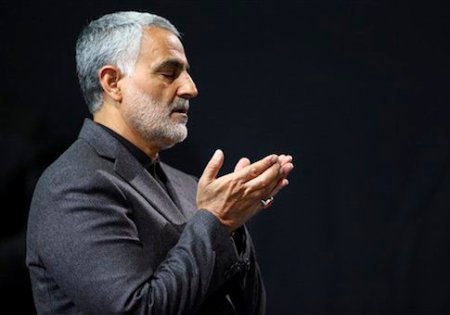
CORRECTS SPELLING OF NAME TO SOLEIMANI - In this photo released by an official website of the office of the Iranian supreme leader, commander of Iran's Quds Force, Qassem Soleimani, prays in a religious ceremony at a mosque in the residence of Supreme Leader Ayatollah Ali Khamenei, in Tehran, Iran, Friday, March 27, 2015. Iran's Foreign Minister Mohammad Javad Zarif sought Friday to reassure the six world powers conducting nuclear power talks in Switzerland, saying the negotiations remained focused on sealing a deal. (AP Photo/Office of the Iranian Supreme Leader)

Qassem Soleimani,  (AP Photo/Office of the Iranian Supreme Leader)

Multiple sources who spoke with the Washington Free Beacon about the matter disclosed that the Obama administration is taking a soft approach with Iran, including not enforcing sanctions, in order to preserve the nuclear deal and diplomacy with Tehran, which has threatened repercussions for any new sanctions.

Soleimani’s visit to Syria is viewed as a sign that Iran is not worried about facing repercussions for its continued military presence in Syria in support of embattled leader Bashar al-Assad.

Iran has breached international laws for some time without facing consequences. The Obama administration repeatedly assured Congress it would enforce sanctions on Iran when lawmakers expressed doubt about the viability of the Iran nuclear deal.

********************************

A top Iranian commander responsible for the deaths of Americans was photographed touring the war-torn city of Aleppo in Syria over the weekend, in violation of a United Nations travel ban that the Obama administration swore to enforce while selling the landmark nuclear deal with Iran to Congress, according to multiple sources and photographs.

Iranian Quds Force Commander Qasem Soleimani—a top general who leads Iranian militants across the globe and is directly responsible for the death of Americans—was recently photographed touring Aleppo in a demonstration of Iran’s waxing influence in Syria and disregard for international resolutions barring such behavior. Soleimani’s presence in Syria is a direct violation of the United Nations resolution governing the nuclear deal.

Soleimani’s visit coincided with moves by the terror group Hezbollah, which is controlled by Iran, to establish its own claim in Syria, according to regional reports and footage.

Iran’s public presence in Syria has not been met with action by the Obama administration, which has come under increasing pressure in recent weeks to explain why it is not enforcing current sanctions against Iran. Soleimani continues to direct Iranian forces in both Iraq and Syria and has long been sanctioned for the murder of U.S. citizens.

Mutliple sources who spoke with the Washington Free Beacon about the matter disclosed that the Obama administration is taking a soft approach with Iran, including not enforcing sanctions, in order to preserve the nuclear deal and diplomacy with Tehran, which has threatened repercussions for any new sanctions.

Soleimani’s visit to Syria is viewed as a sign that Iran is not worried about facing repercussions for its continued military presence in Syria in support of embattled leader Bashar al-Assad.

Iran has breached international laws for some time without facing consequences. The Obama administration repeatedly assured Congress it would enforce sanctions on Iran when lawmakers expressed doubt about the viability of the Iran nuclear deal.

The absence of consequences for Iran’s behavior has paved the way for Hezbollah to stake it own claim in Syria, according to congressional and foreign policy insiders who told the Free Beacon that the Obama administration is working behind the scenes to prevent any new sanctions against Iran.

“The Obama administration has been working overtime to prevent any U.S. official from doing anything new to punish the butchers of Syria, because they know that would force them to take action against Iran, and then Iran would walk away from the deal,” said one veteran insider who consults with Congress on the issue. “Now they’re ignoring even old sanctions against the Iranians. They’ll do anything to keep the Iranians in the deal for just a couple more weeks, so they can blame the inevitable collapse on Trump.”

A senior congressional aide apprised of the situation said the administration would continue to turn a blind eye to blatant violations in order to preserve diplomacy with Iran.

“This administration’s refusal to enforce sanctions explicitly allowed under the nuclear deal is not only cowardice—it’s dangerous,” said the aide. “What does it say about U.S. leadership when a terrorist like General Soleimani—someone with American blood on his hands—can freely travel to the ground zero of genocide in Syria without penalty? President Obama knows his nuclear deal is on thin ice, so he’s willing overlook blatant sanctions violations like this one even if it means more carnage in Aleppo.”

A second senior congressional source warned that refusal to enforce sanctions was empowering Iran’s radical regime, which has increasingly taken hold in Iraq as well, where the U.S. military has been accused of training Iranian-backed militias.

“The outgoing Obama administration struck a Faustian bargain with Iran, the world’s biggest state sponsor of terrorism, and Soleimani, head of the IRGC terrorist organization that’s responsible for the death of many hundreds of Americans, continues to do victory laps throughout the Middle East” the source said. “Unless the Trump administration changes course, this short-sighted Iran policy cannot and will not end well.”

Troops in Aleppo, as well as an Iranian reporter, have been spotted raising Hezbollah’s flag in recent days, calling into question the Obama administration’s claim that it has been working to constrain the terror group.

Michael Rubin, a former Pentagon adviser and expert on radical regimes, told the Free Beacon that Iran sees the nuclear deal as a vehicle to advance its regional aspirations.

“For Obama, diplomacy’s goal was to affirm his brilliance,” Rubin said. “For Iran’s leadership, it was an asymmetric warfare tactic meant to distract from a continuous geopolitical goal.”

“Red lines matter. Over 25 years, both Republicans and Democrats signaled to Iran about what they were,” Rubin explained. “Obama, however, believed himself wiser than Reagan, Clinton, and Bush—at least that’s what the man in the mirror told him every morning. Once Iran realized there were no real red lines, it concluded it could bust sanctions with impunity. Soleimani is the personification of that conclusion.”

The State Department conceded on Monday that Soleimani’s visit to Syria violated United Security Council resolutions government the nuclear deal, but would not lay out steps meant to address the behavior.

“We do intend to consult with our partners on the security council about how to address our concerns with this,” State Department Spokesman John Kirby said during a press briefing. “We’ve long said that Iran needs to choose whether it’s going to play a positive role in helping peacefully resolve conflicts, such as in Syria, or whether it will choose to prolong them. And you’re absolutely right, his travel was a violation.”

Update 3:05 P.M.: This post has been updated to reflect comment from the State Department.

Flashback: A love song to Obama with thanks

December 16, 2016

A love song to Obama with thanks, LATMA-TV via YouTube, October 26, 2012

The Obama doctrine’s crushing denouement in Syria

December 16, 2016

The Obama doctrine’s crushing denouement in Syria, Washington Examiner, December 16, 2016

(Please see also, Russian role in Aleppo’s fall impacts US politics. — DM)

syriaandobamaPresident Obama’s fecklessness emboldened not just Russia, but also Iran, whose combat troops continue to bolster Assad’s forces across Syria, as well as jihadists around the world. (AP Photo/Carolyn Kaster)

President Obama said this week that the civil war in Syria “is one of those things that has kept me up at night a lot.” On a previous occasion he said that the situation there “haunts me constantly.”

But for all the worry and consternation it supposedly evokes in him, Obama still insists he wouldn’t do things differently if he could.

If in the story of Obama’s Middle East policy, the war in Syria represents the dramatic climax, then the imminent fall of rebel-held eastern Aleppo and the humanitarian crisis unfolding there is its crushing denouement.

The Obama administration’s determination to prevent the U.S. from being drawn into more wars — and to “lead from behind” when it felt it was forced to engage, as in Libya — allowed terrorist groups such as the Islamic State and geopolitical rivals such as Russia to fill the vacuum.

Obama’s first mistake in Syria was his 2012 failure to follow through on enforcing a “red line” over dictator Bashar Assad’s use of chemical weapons. Obama’s inaction taught Assad that there would be no repercussions for his regime’s crimes.

Obama’s decision in 2013 not to back moderate groups in the armed opposition only reinforced that lesson. When Russia moved in last year to help Assad, Obama again did nothing.

Obama’s fecklessness emboldened not just Russia, but also Iran, whose combat troops continue to bolster Assad’s forces across Syria, as well as jihadists around the world. All of them quickly learned that they had little to fear in Obama.

Obama repeatedly rejected recommendations from his generals for tougher military response against Assad. Obama seems to be willing to pay almost any cost to find a diplomatic solution to Syria. He believes peace talks will somehow lead to a transition in which Assad gives up power. Obama has focused instead on the Islamic State, but even there the U.S. response has been confined to bombing and the deployment of a few U.S. Special Forces.

Secretary of State John Kerry has been working for months to negotiate a ceasefire between the Assad regime and opposition forces. But Assad has refused to comply with previous agreements, continuing to bomb rebel-held areas of Aleppo.

Obama isn’t the only one who’s in denial about how the war can be resolved. The State Department on Wednesday refused to acknowledge that U.S. policy and strategy failed to bring peace to Syria. Russia, Iran and the Assad regime were to blame, a State Department spokesman told reporters, for trying to find a military solution instead of a political one.

The war in Syria has taken the lives of 400,000 people and left another 11 million homeless. As many as 100,000 civilians remain trapped in Aleppo, potential victims of the regime’s revenge.

Obama’s failure to act decisively has left Syria devastated, much of the greater Middle East in chaos and Europe teeming with refugees. It has also left America less trusted and respected throughout the world. Obama’s dithering in Syria will be a black mark on his legacy.

Watch What Iran Does, But Also Listen to What They Say

December 8, 2016

Watch What Iran Does, But Also Listen to What They Say, Front Page MagazineKenneth R. Timmerman, December 8, 2016

4_142015_mideast-iran-nuclear-118201

We ignore the ideology of the Tehran regime and its long-term goals at our peril. President-Elect Trump needs strategists who think outside the box, one reason I am thrilled by the appointments of Lt. General Mike Flynn as National Security advisor and General James T. Mattis as Secretary of Defense.

****************************

President-Elect Trump will be tested by the Islamic state of Iran soon after taking office on January 20. It could come the very day of his inauguration with an enormous (if superficial) head-fake, as they gave President Reagan by releasing our U.S. diplomat-hostages the very minute he swore the oath of office. Or it could come later, in a less benign form.

But this much is certain: that test will come, and the foreign policy establishment in Washington will fail to see it coming and mistakenly interpret it once it occurs. Again.

Establishment analysts focus on Iran’s actions. In itself, that is not a bad thing, but it’s kind of like buying a peach at an American supermarket because of its wonderful good looks, only to cut it open at home to find it wooden and tasteless.

In addition to examining Iran’s actions, we need to pay close attention to what the Islamic regime’s leaders say. We need to understand their ideology, and their goals. Above all, we must not assume – as most analysts do – that they think using the same cost-benefit calculus we do.

This is a regime driven by ideology, fueled on a vision of the end times just as our sun is fueled by its magma. Only rarely does the fuel erupt and become a measurable “event,” although when that happens, it can be deadly. Scientists have warned for years that our electric power grid is vulnerable not only to man-made Electromagnetic Pulse (EMP), but to a massive coronal ejection from the sun.

In the same way, the United States remains vulnerable to a massive event, potentially devastating, caused by the confluence of the Iranian regime’s ideology and its military capabilities. Like EMP or a massive coronal ejection, such an occurrence will be a low probability-high impact event. Will we detect that confluence before it happens? If the past record of our intelligence community and our political leaders is any guage, the answer is a resounding no.

Here’s why.

Even the best analysts of the foreign policy establishment limit their analysis to the actions and capabilities of the regime. They note, for example, that when the United States Navy retaliated by sinking Iranian warships after the regime’s unpredicted and confusing decision to lay mines in the Strait of Hormuz, the regime leadership backed off.  Operation Praying Mantis is still viewed as a resounding success.

They mistakenly took this to mean that the ruling clerics and the fanatical Islamic Revolutionary Guards Corps (IRGC) who serve them respected American power; specifically, that they can be deterred.

They discount the chants of “Death to America” the regime leaders have instilled in the generations of the revolution as so much hot air. It’s just bombast. Nothing to see here. Move along, the analysts say.

As proof there is nothing to this relentless inculcation of the regime’s ultimate goal they point to similar claims involving the military. For decades, military leaders have claimed they were building indigenous fighter jets, helicopters and tanks; none have ever moved beyond a few prototypes.

Iranians are prone to exaggeration, they say. How can you tell an Iranian is lying? Because his lips are moving. I have heard respected U.S. intelligence analysts make such a silly – and dangerous – claim.

And of course, Iranians are prone to exaggeration. That much is true. But even in those exaggerations, they reveal their goals and aspirations, and we simply dismiss them as hot air.

For nearly thirty-five years, IRGC leaders and their clerical puppet-masters have boasted they would drive the United States from the Middle East.

“I can remember my father telling me after the Beirut attack on the U.S. Marines that Iran had won,” the son of former IRGC commander Maj. Gen. Mohsen Rezai told me after he defected to the United States. “He said, with a single bomb, we have forced the Americans to pull out of Lebanon. With a few more bombs, we will force them out of the region entirely.”

Such was their goal at that time, and it remains their goal today—except that they are a lot closer to fulfilling it. What once was a long-term aspiration, which nobody in the Washington policy establishment believed, has become a tactical goal whose accomplishment Iran’s leadership can see on the near horizon.

Ever since October 1983 when the regime ordered its proxies to murder 242 U.S. Marines, they have been probing our weaknesses. That is the only way you can explain the outrageous violation of international law in January 2016 when IRGC gunboats captured U.S. sailors gone adrift at sea and humiliated them in front of cameras.

That’s the only way you can understand the installation of Chinese made C-802 ship-killing missiles on the Red Sea coast of Yemen, where IRGC crews actually fired on a U.S. warship in October.

They are testing us, probing our defenses and our willingness to accept pain. They are constantly evaluating our political resolve to resist their goal of driving us from the region.

Under Obama, of course, they found us sorely lacking. From his first days in office, President Obama told the Iranians openly he would end the long-standing U.S. “hostility” toward the Islamic regime. He wanted to “open a channel” for talks, and did.

Iran’s ruling mullahs quickly decided to test Mr. Obama. When three million Iranians took to the streets of Tehran and other cities to protest the stolen “re-selection” of President Mahmoud Ahmedinejad as President, they held up signs in English for the CNN cameras. “Obama are you with us?” they said.

When Obama failed to respond or provide even lip-service to the yearning for freedom of the Iranian people, the regime responded on cue. Regime officials went on state television, pointing to photos of the U.S. president.“Obam’ast,” they said, turning his name into a play on words. “He’s with us.”

And Obama showed by his actions that he was with them. As Congress imposed an ever-rigorous set of sanctions aimed to reducing Iran’s oil exports and access to international financing, Obama initially waived their application. Only a relentless bi-partisan push-back caused him to allow the sanctions go into force – with devastating impact on Iran’s economy.

By 2014, the regime was scrambling, fearful that income from reduced oil exports would not be enough to cover subsidies on basic foodstuffs to the poor, leading their most faithful supporters to revolt.

That is when Obama carried out the most astonishing, unnecessary, unilateral capitulation since Chamberlin went to Munich in 1938, offering to remove the sanctions for a temporary reduction in Iran’s nuclear programs.

The traditional foreign policy establishment and its ally, the pro-Tehran lobby, is holding seminars and writing opeds and whispering into whatever ears they can find that President-Elect Trump must hold on to the nuclear deal.

Why? It’s all about actions, and can be measured. They do not want the President-Elect or his advisors focusing on the intentions and goals of Iran’s clerical leaders and their IRGC enforcers. Because to do so would reveal not just the folly, but the tremendous danger inherent in the nuclear deal, which legitimizes the Islamic state of Iran as a nuclear power ten years down the road.

What’s ten years, when you are staring at all eternity? That’s how Ayatollah Khamenei and the IRGC generals think. That’s how their successors will think, if the current regime remains in power.

Their goal was and remains to erase Israel from the map (or “from the pages of history,” if you want to get literal), and to bring about Death to America. And yet, if there’s any effort underway to measure their progress toward those goals in our intelligence and policy establishment, none of our political leaders have taken it seriously.

We ignore the ideology of the Tehran regime and its long-term goals at our peril. President-Elect Trump needs strategists who think outside the box, one reason I am thrilled by the appointments of Lt. General Mike Flynn as National Security advisor and General James T. Mattis as Secretary of Defense.

The Iranians know there’s not a moment to lose. Do we?

Intel: Iran Using Commercial Planes to Smuggle Weapons to Terrorists

November 24, 2016

Intel: Iran Using Commercial Planes to Smuggle Weapons to Terrorists, Washington Free Beacon, November 24, 2016

(Please see also, Israel: Iran is smuggling weapons to Hezbollah on commercial flights  — DM)

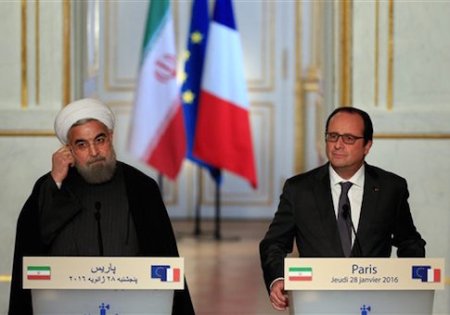
France's President Francois Hollande, right, and Iranian President Hassan Rouhani give a press conference, at the Elysee Palace, in Paris, Thursday, Jan. 28, 2016. Iran Air has signed a deal to buy 118 aircraft from Airbus in the first of an expected host of commercial deals expected to be announced during the visit of Iranian President Hassan Rouhani to Paris. (AP Photo/Thibault Camus)

France’s President Francois Hollande, right, and Iranian President Hassan Rouhani give a press conference, at the Elysee Palace, in Paris, Thursday, Jan. 28, 2016. Iran Air has signed a deal to buy 118 aircraft from Airbus in the first of an expected host of commercial deals expected to be announced during the visit of Iranian President Hassan Rouhani to Paris. (AP Photo/Thibault Camus)

The Obama administration has given clearance to Western airline manufacturers to sell planes to Iran at the same time the Islamic Republic is using commercial airliners to smuggle weapons and other illicit arms to Hezbollah terrorists in Lebanon, according to new intelligence and congressional communications obtained by the Washington Free Beacon.

The disclosure of this new intelligence, which shows that Iran has been using its commercial airline company to smuggle advanced weaponry to Hezbollah and terrorists operating in Syria, has placed renewed focus on a congressional inquiry that has been stymied by Obama administration officials since early October.

Senators, led by Sen. David Perdue (R., Ga.), have been pushing Obama administration officials to explain why they are helping airline manufacturers Boeing and AirBus sell planes to Iran, despite clear evidence that Tehran is using its commercial airline as cover for its continued terrorist operations across the region.

As with multiple other congressional investigations into the Obama administration’s efforts to roll back economic sanctions and conduct secret dealings with Iran, officials have stonewalled Perdue, refusing to answer key questions about the motivation for aiding Tehran’s pursuit of planes that could be used to further its terrorist enterprise.

This new intelligence comes just days after the Obama administration approved a second license for AirBus, a French company, to pursue even more sales with Iran.

The Free Beacon recently disclosed that several American-made planes are currently being flown by Iran’s Air Force, while other jets are being used in its commercial sector to smuggle arms.

Perdue on Wednesday accused the Obama administration of facilitating Iran’s terrorist operations by signing off on the multi-billion dollar deals to sell Iran planes, according to a letter sent to the Treasury Department, which oversees such sales, and obtained by the Free Beacon.

The senator chided the department for ignoring his initial Oct. 6 request for information, describing this lack of response as “troubling.”

“While I find your lack of a response to our last letter troubling, I would not that the issue surrounding commercial aircraft usage for illicit purposes by the Iranian regime has now expanded, given new intelligence information alleging that Iran has indeed been using Mahan Air — a commercial airline that is currently subject to U.S. and UN sanctions — to smuggle weapons and ammunition to Hezbollah in Lebanon,” Perdue writes.

New intelligence unearthed by the Israelis and disseminated to United Nations Security Council members in an “urgent letter” shows that Iran has been using Mahan Air to smuggle a large quantity of arms into Lebanon, where they are then transferred to Hezbollah, which remains committed to destroying the Jewish state.

“These planes fly directly to the airport in Lebanon or Damascus and from there the weapons are transferred on the ground to Hezbollah,” according to the letter sent by Israeli officials to U.N. Security Council members.

This includes weapons, ammunition, and missile technology to Hezbollah, which is placed inside suitcases and placed on Mahan’s commercial flights.

The intelligence further shows that Hezbollah now has about 12,000 missiles hidden underground in Lebanon, or “more than 17 times the number of missiles it possessed 10 years ago, and more than the European NATO allies have above the ground,” according to Perdue’s letter.

The intelligence appears to confirm fears by many in Congress that the easing of airline sales to Iran by the Obama administration will directly fuel Tehran’s global terrorist operation, according to the senator.

“This report confirms precisely the fear we expressed in our October 6 letter: that Iran continues to use commercial aircraft to smuggle weapons and ammunition in violation of UN Security Council Resolution 2231 to support its terrorist proxies,” Perdue wrote, referring to the UN resolution currently governing last year’s comprehensive nuclear deal with Iran.

“We are rightly concerned that Iran may continue to do so with the new commercial aircraft it purchases from Boeing and Airbus, as permitted by the U.S. Treasury Department,” the letter stated.

Despite this intelligence, the Obama administration continues to sign off on and endorse these sales to Iran.

“I was also disturbed to see that Airbus, one of the companies seeking licenses for the sale of commercial aircraft to the government of Iran, was just awarded a second license from U.S. Office of Foreign Asset Control (OFAC) to sell up to 118 jets to Iran,” Perdue wrote. “To echo the concerns of our last letter, what, if any, end-use monitoring controls can you guarantee will follow this license to ensure that these aircraft are not used to further support Iran’s terrorist proxies or support for the Assad regime in Syria?”

One senior congressional aide familiar with the matter told the Free Beacon that the Obama administration’s permissive attitude towards Tehran has only emboldened its bad behavior.

“The sanctions relief President Obama agreed to has allowed Iran to ramp up support for its destructive ambitions,” the source said. “Given this recent discovery by [Israeli U.N.] Ambassador Danon, President Obama and Congress shouldn’t wait to see what this rogue nation has planned for this massive increase in commercial aircraft.”

“It’s been nearly a year since the implementation of President Obama’s nuclear deal and we’ve seen Iran become increasingly aggressive in its support of terrorism,” the source noted. “In fact, Iran is still the number one state sponsor of terrorism. If this isn’t a symptom of a failed deal, what is?”

Iran, Hamas and the Dance of Death

November 23, 2016

Iran, Hamas and the Dance of Death, Gatestone InstituteKhaled Abu Toameh, November 23, 2016

It now appears that the Obama Administration’s failed policies in the Middle East have increased the Iranians’ appetite, such that they are convinced that they can expand their influence to the Palestinians as well.

Iran has one goal only: to eliminate the “Zionist entity” and undermine moderate and progressive Arabs and Muslims.

“Relations between Iran and Hamas are currently undergoing revitalization, and are moving in the right direction,” announced Osama Hamdan, a senior Hamas official. He went on to explain that “moving in the right direction” means that Iran would “continue to support the resistance” against Israel.

Hamas and Iran have no meaningful ideological or strategic differences. Both share a common desire to destroy Israel and replace it with an Islamic empire. Iran expects results: Hamas is to use the financial and military support to resume attacks on Israel and “liberate all of Palestine, from the Jordan River to the Mediterranean Sea.”

As far as Iran is concerned, there is nothing better than having two proxy terror organizations on Israel’s borders — Hezbollah in the north and Hamas in the south.

The biggest losers, once again, will be President Mahmoud Abbas and his Palestinian Authority in the West Bank.

Israel’s presence in the West Bank has thus far thwarted Iran’s repeated attempts to establish bases of power there.

The Iranians and Hamas are exploiting the final days of the Obama Administration to restore their relations and pave the way for Tehran to step up its meddling in the internal affairs of the Palestinians in particular and the Israeli-Palestinian conflict in general.

Emboldened by the nuclear deal framework with the world powers, Iran has already taken the liberty of interfering in the internal affairs of other Arabs, particularly the Iraqis, Lebanese, Syrians, Yemenites and some Gulf countries.

It now appears that the Obama Administration’s failed policies in the Middle East have increased the Iranians’ appetite, such that they are convinced that they can expand their influence to the Palestinians as well.

Thanks to the civil war in Syria, relations between Hamas and Iran have been strained over the past few years. Hamas’s refusal to support the regime of Bashar Assad — Iran’s chief ally in the region — has led the Iranians to suspend financial and military aid to the Islamist movement in the Gaza Strip. However, recent signs indicate that Iran and Hamas are en route to a kind of Danse Macabre — a move that will undoubtedly allow Tehran to become a major player in the Israeli-Palestinian conflict.

1162-2Iran used to funnel money to Hamas because the terrorist group shares Iran’s desire to destroy Israel and replace it with an Islamic empire. Relations between Iran and Hamas foundered a few years back, when Hamas leaders refused to support the Iranian-backed Syrian dictator, Bashar Assad. Pictured above: Hamas leader Khaled Mashaal (left) confers with Iranian “Supreme Leader” Ali Khamenei, in 2010. (Image source: Office of the Supreme Leader)

This, of course, bodes badly for any future peace process between Israel and the Palestinians. Iran has one goal only: to eliminate the “Zionist entity” and undermine moderate and progressive Arabs and Muslims.

The new US administration would do well to take very seriously Iran’s comeback to the Israeli-Palestinian conflict, because of its implications not only concerning prospects for peace, but also because it means that this will lead to an upsurge in violence and terror attacks against Israel.

Proof of Iran’s renewed effort to infiltrate the Palestinian arena was provided this week by statements made by a senior Hamas official, Osama Hamdan, who is in charge of the Islamist movement’s “external affairs.” Asked about Hamas’s relations with Iran, Hamdan was quoted as saying that he had good reason to be optimistic.

“Relations between Iran and Hamas are currently undergoing revitalization, and are moving in the right direction,” Hamdan announced. He went on to explain that “moving in the right direction” means that Iran would “continue to support the resistance” against Israel:

“Relations between Iran and Hamas extend over a period of 25 years. Undoubtedly, any flaw in this relationship has a negative impact. But this relationship is capable of renewing itself. This is a relationship that is based on supporting the resistance and the Palestinian cause.”

In reality, Hamas and Iran have no meaningful ideological or strategic differences. Both share a common desire to destroy Israel and replace it with an Islamic empire. The two entities are also committed to an “armed struggle” against Israel, and are vehemently opposed to any compromise with it.

The crisis between the two sides over the civil war in Syria is no more than a minor, tactical dispute. When it comes to the real agenda, such as destroying Israel and launching terror attacks, Iran and Hamas continue to be in total alignment.

Another sign of the apparent rapprochement between Iran and Hamas came in the form of reports that the Islamist movement has appointed a new leader in the Gaza Strip with close ties to Tehran. According to the reports, Emad El Alami, who previously served as Hamas’s first emissary to Tehran, has been entrusted with temporarily replacing Ismail Haniyeh as the ruler of the Gaza Strip. Haniyeh has in recent months relocated from the Gaza Strip to Qatar. At this stage, it remains unclear when and if Haniyeh will return to the Gaza Strip. Some Palestinians have surmised that Haniyeh may replace the Doha-based Khaled Mashaal as head of the Hamas “Political Bureau.” If this happens, then El Alami, who is regarded by many Palestinians as Iran’s agent, will become the permanent de facto ruler of the Gaza Strip.

El Alami’s rise to power will undoubtedly further facilitate Iran’s ambition to become a significant player in the Israeli-Palestinian conflict through the gates of the Gaza Strip. This means that Hamas can expect more cash and weapons to enter Gaza in the coming weeks and months. Such an influx would significantly increase the likelihood of another war between Hamas and Israel. Iran’s millions will not be used by Hamas for building schools and hospitals, or providing desperately needed jobs for Palestinians in the Gaza Strip. Nor will the Iranian-supplied weapons be stored in Hamas warehouses and tunnels, or used in military parades.

Iran expects results: Hamas is to use the financial and military support to resume attacks on Israel and “liberate all of Palestine, from the Jordan River to the Mediterranean Sea.”

When Hamas leaders talk about Iranian support for the Palestinian “resistance,” they mean suicide bombings, rocket attacks and other forms of terrorism. They are saying with unmistakable clarity that they seek a resumption of Iranian support for the “resistance” — not for the tens of thousands of unemployed and impoverished Palestinians living under the Hamas regime in the Gaza Strip. The well-being of the Palestinians living under its rule is the last thing on Hamas’s mind.

The Iranians, for their part, appear to be extremely eager to resume their role as enablers and funders of any group that vows to eliminate Israel. As far as Iran is concerned, there is nothing better than having two proxy terror organizations on Israel’s borders — Hezbollah in the north and Hamas in the south.

Iran is already backing other terror groups in the Gaza Strip, such as the Palestinian Islamic Jihad and Al-Sabireen. But these are tiny groups compared to Hamas, which has tens of thousands of gunmen and a strong military group, Ezaddin Al Kassam. And there is nothing to prevent Iran from extending its control to the Gaza Strip through Hamas, especially in the wake of the Obama Administration’s policy of appeasing not only the Iranians, but also the Muslim Brotherhood.

In the coming months, Hamas is scheduled to hold secret elections to elect a replacement for Khaled Mashaal. Mashaal’s departure from the scene is also set to facilitate Iran’s effort to infiltrate the Gaza Strip. The three candidates who are seen as potential successors to Mashaal — Ismail Haniyeh, Musa Abu Marzouk and Yehya Al Sinwar — have all pledged to improve their movement’s ties with Iran.

The biggest losers, once again, will be President Mahmoud Abbas and his Palestinian Authority (PA) in the West Bank.

PA officials continue to express deep concern over Iran’s meddling in Palestinian affairs, especially its financial and military support for terror groups in the Gaza Strip and even some parts of the West Bank. Yet Israel’s presence in the West Bank has thus far thwarted Iran’s repeated attempts to establish bases of power there. Abbas has no choice but to work with Israel if he wishes to prevent Iran and its supporters from overthrowing his regime, and perhaps dragging him to the center of Ramallah and hanging him as a traitor.

Abbas and his senior aides are nonetheless plenty worried about Iran’s increased efforts to infiltrate the Palestinian arena. At a lecture in Bahrain last week, PLO Secretary-General Saeb Erekat sounded an alarm bell when he said:

“Iran has no right to interfere in the internal affairs of the Palestinians. Iran must respect the particularity of our country. We hope that Iran will focus on placing Palestine back on the map and not intervene through this or that group.”

But this warning is likely to fall on deaf ears in the waning Obama Administration, which obviously no longer shares the widespread concern among Arabs and Palestinians that Iran remains a major threat to stability and security in the region, including Israel. Perhaps the new US administration will see Iran and its machinations a bit more clearly. The alternative is allowing Iran and its proxy terror groups further to drench the region in blood.

Hassan Rouhani: Iran’s Executioner

November 23, 2016

Hassan Rouhani: Iran’s Executioner, American ThinkerHeshmat Alavi, November 23, 2016

As we begin to wind down to the end of Hassan Rouhani’s term as president of the regime in Iran, it is time to take a look back at the past four years. We all remember how the West joyfully welcomed his election — read selection — as a change of gear in Iran aimed at moderation. However, what the world witnessed ever since has been anything but. An atrocious rise in executions, continued public punishments and an escalating trend of oppression has been Rouhani’s report card during his tenure. With a new administration coming into town, Washington must make it crystal clear to Tehran that human rights violations will no longer be tolerated.

Unprecedented executions

Despite pledging to hold the “key” to Iran’s problems, Rouhani has failed to provide even an iota of the freedoms the Iranian people crave and deserve. His record has revealed an unrelenting loyalty to the regime establishment in regards to social oppression and continued crackdowns. Iran sent 18 to the gallows last week alone, according to official reports.

As the international community continued its policy of appeasement, Rouhani and the entire regime used this opportunity to launch an execution rampage. Over 2,500 people have been sent to the gallows ever since Rouhani came to power, shattering all records held by this regime itself in over two decades.

In 2015 alone, Iran was executing an individual every eight hours, as reported by Dr. Ahmed Shaheed, former United Nations special rapporteur on human rights in Iran.

Vast social crackdown

Rouhani’s commitment to regime supreme leader Ali Khamenei and the ruling elite has rendered a wide-ranging, escalating crackdown. In addition to the executions mentioned above, state-sponsored social oppression has resulted in horrific scenes of public hangings, floggings, and even limb amputations.

The prisons are overwhelmed with inmates, leading to intolerable and inhumane conditions. Political prisoners, specifically, are subject to horrendous treatment by the authorities. Renowned human rights organization Amnesty International has recently issued an Urgent Action call expressing major concerns over the case of Maryam Akbari Monfared, a Green Movement organizer still in prison two years after her family put up her bail.

And this is merely a single example of the dreadful results of Rouhani’s domestic policies. The regime, with the West unfortunately falling in line, had claimed that the Iranian nation welcomed Rouhani’s presidency with open arms. While such assertions were politically motivated from the very beginning, the ordinary Iranian has been the first to pay the price of such a failed engagement policy.

A call for justice

The Iranian population is extremely fond of the Internet and millions are actively using social media. Despite its vast censorship efforts, the regime has failed to completely firewall the entire globe from the clever and highly motivated Iranian netizen. Various clips, images, and stories from inside Iran are leaking to the outside world as we speak, revealing ever more the regime’s atrocities.

rouhanifinger

One significant case involves the exposure of a controversial sound file shedding light on a private meeting between the late Ayatollah Hossein-Ali Montazeri and the main officials involved in the horrendous 1988 summer massacre of over 30,000 political prisoners across Iran. Montazeri was the successor to Iranian regime founder, mullah Ruhollah Khomeini, set aside by Khomeini himself considering his opposing perspectives.

This disclosure sent shockwaves amongst the Iranian people from all walks of life, and throughout the globe. As a result a global movement is demanding accountability from those responsible for the horrific massacre of thousands of innocent political prisoners. The victims of this carnage included members and supporters of the main Iranian opposition entity, People’s Mojahedin Organization of Iran, and other dissident groups and minorities. The PMOI, more commonly known as the MEK in the West, has also been the focus of a lobbying campaign launched by Iran. Tehran’s mullahs are terrified of MEK supporters such as former New York City mayor and ambassador John Bolton being considered for senior cabinet posts in a Donald Trump White House.

Conclusion

The entire regime in Iran, including the so-called “hardliners” and “moderates,” are shifting gear for the upcoming presidential elections in June 2017. Members of the Rouhani faction have described U.S. President Barack Obama’s tenure as a “golden era.” This signals how Tehran took full advantage of Obama’s rapprochement as a green light to escalate executions and further implement social crackdown.

With a new administration set to take the reins in Washington, the opportunity has arrived for America to raise the issue of Iran’s human rights violations. Such outrageous crimes have no place in the 21st century, and all eyes are on U.S. president-elect Donald Trump. Supporting the call to hold all senior Iranian regime officials involved in the 1988 massacre accountable for their crimes is a good start.

Will Team Trump Air Obama’s Iran Secrets?

November 21, 2016

Will Team Trump Air Obama’s Iran Secrets? Power Line, Paul Mirengoff, November 21, 2016

For years, Republicans and conservatives have charged that President Obama has shielded embarrassing intelligence and other information regarding Iran in order to limit opposition to the Iran nuclear deal and Obama’s conciliatory approach to Tehran. The charge seems well-founded. After all, it took Sens. Tom Cotton and Rep. Mike Pompeo to discover secret side agreements attached to the nuclear deal.

Eli Lake suggests that the Trump administration may well stop covering for the mullahs. Certainly, as Lake argues, Trump’s early high level personnel picks suggest so.

Trump’s nominee for CIA Director is none other than Mike Pompeo. Not only did he and Sen. Cotton uncover side deals to the nuclear agreement, he also pressed hard for answers about the cash payments the U.S. delivered to the mullahs in exchange for the release of hostages.

Pompeo wrote to Attorney General Lynch asking for answers as to how the cash payments were approved by the Justice Department. Lynch stonewalled him. Perhaps Jeff Sessions will be more cooperative.

Mike Flynn is the other key appointment for purposes of airing Obama’s Iran secrets. Lake points out that in 2011 General Flynn ran a team at the Office of the Director of National Intelligence that reviewed the troves of material captured in the 2011 Osama bin Laden raid.

Under Obama, only a small fraction of these documents have been declassified and released. After he retired from the military, Flynn charged that the disclosures were selective.

Flynn noted, for example, that some documents captured in the bin Laden raid show a much tighter relationship between Iran and al-Qaeda than previously disclosed. In The Field of Fight: How We Can Win the Global War Against Radical Islam and Its Allies (written with Micheal Ledeen), Flynn states: “One letter to bin Laden reveals that al-Qaeda was working on chemical and biological weapons in Iran.”

Given Obama’s desire to deal with Iran and, indeed, for a rapprochement, you can see why the administration shielded such intelligence. Given the well-deserved contempt by Pompeo and Flynn for Obama’s Iran policy, you can see why they might want relevant facts to come to light. As a general matter, these are facts the public has a right to know.

If such facts are made public, Obama won’t have much standing to complain. Lake reminds us:

Obama himself in 2008 campaigned against the sitting president’s policies on waterboarding and enhanced interrogation. One of the first things his government did when he took office was to declassify and release the legal memos that justified and revoked these practices.

It looks like the Republicans are about to return the favor.