Posted tagged ‘Obama and Iran scam’

New Report Shows Iran’s Revolutionary Guards Profiting from Iran Deal

October 5, 2016

New Report Shows Iran’s Revolutionary Guards Profiting from Iran Deal, Counter Jihad, October 5, 2016

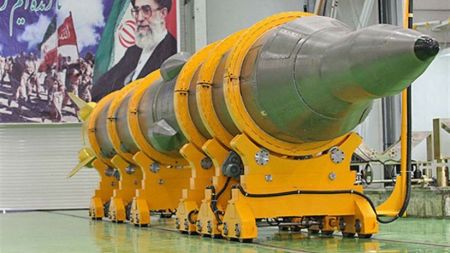
iranian-nuclear-weapon

A new report from the Foundation for the Defense of Democracies showcases the ways in which Iran’s Revolutionary Guards Corps (IRGC) has benefited from the so-called nuclear deal.  This deal, which Congress never voted to approve nor reject, and which the Iranian government fundamentally altered rather than accepting, has nevertheless led to a vast transfer of wealth to Iran.  Much of that wealth has fallen right in the hands of the IRGC, which oversees Iran’s terrorist and military nuclear programs.

Here at CounterJihad, we have covered the problems withIran’s nuclear deal somewhat extensively.  The Foundation for Defense of Democracies report’s conclusions will thus be of little surprise to our regular readers.  However, it does include additional detail on the degree to which Iran’s corporate and business ventures are secretly dominated by IRGC elites.  As the report says:

[IRGC abuses] did not stop France’s mobile phone giant, Orange, from beginning talks with Iran’s largest mobile phone operator, Mobile Telecommunication Company of Iran (MCI), over acquiring a stake in the Iranian company. The IRGC controls MCI through a 50-percent-plus-one stake in its parent company, the Telecommunication Company of Iran (TCI).  In short, whether its internal security, foreign adventures, or large corporate ventures, the IRGC plays an outsized role in Iran’s internal power structure. Established in 1979 to consolidate the Islamic revolution and fight its enemies, the IRGC has evolved over the years into a full-fledged conventional army, conducting and directing terrorist activity abroad. The Guard has also become a political power broker, an economic conglomerate, and an agency in charge of nuclear and ballistic-missile proliferation….  IRGC revenues from economic activities yield the necessary resources and political leverage to place its members in positions of power. Conversely, the Guard’s political power serves the economic enterprises it owns, and both its political and economic weight in turn advance its military projects.

The IRGC’s corporate activity offers revenue to the organization in the same way that its control of narcotics within Iran does.  However, whereas the narcotics are often passed on to Hezbollah to be turned into heroin, corporate profits can be rolled over into apparently legitimate enterprises that have useful military applications.  That allows Iran a backdoor to internationally-developed advanced weaponry and so-called “dual use” technologies.  These are technologies that have both a legitimate purpose, but also an application to Iran’s nuclear program.

Their space program is an excellent example of the way in which a legitimate purpose can mask development of nuclear weapons:  the same technologies involved in building space rockets that can deploy satellites in particular orbits can also be used to develop ballistic missiles that will deliver nuclear warheads to particular cities.  The New York Times reported in September that the biggest engine in North Korea’s nuclear missile program seems to have been developed in partnership with Iran.  Iran’s version is “nuclear-capable,” but the North Korean version makes no pretense about its intentions.

The potential links to Iran complicate the issue. Iran has ignored a United Nations Security Council resolution, passed in conjunction with last year’s agreement freezing its nuclear program, to refrain from tests of nuclear-capable missiles for eight years.  The Obama administration has not sought sanctions, knowing they would be vetoed by Russia and China, nor has it said much in public about the details of the cooperation on the new rocket engine.

Nor are they likely to do so, given how much of the administration’s prestige is tied up with the so-called nuclear deal.  It is worth noting, however, that the effect of the deal has been to embolden Iran — and North Korea, and Russia, and America’s enemies in general.

Obama Admin Secretly Facilitated Iranian Ballistic Missile Program

October 4, 2016

Obama Admin Secretly Facilitated Iranian Ballistic Missile Program, Washington Free Beacon, , October 4, 2016

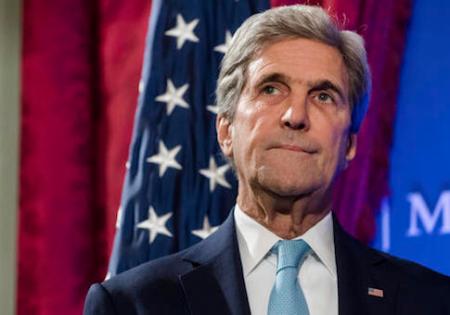
U.S. Secretary of State John Kerry smiles during a speech on the future of "Transatlantic Relations" during an event hosted by The German Marshall Fund (GMF) and the U.S. Mission to the EU at Concert Noble in Brussels, Tuesday, Oct. 4, 2016. Kerry is in Brussels for a two-day conference, hosted by the EU, with the participation of over 70 countries to discuss the current situation in Afghanistan. (AP Photo/Geert Vanden Wijngaert)

U.S. Secretary of State John Kerry smiles during a speech on the future of “Transatlantic Relations” during an event hosted by The German Marshall Fund (GMF) and the U.S. Mission to the EU at Concert Noble in Brussels, Tuesday, Oct. 4, 2016. AP Photo/Geert Vanden Wijngaert

The Obama administration misled journalists and lawmakers for more than nine months about a secret agreement to lift international sanctions on a critical funding node of Iran’s ballistic missile program, as part of a broader “ransom” package earlier this year that involved Iran freeing several U.S. hostages, according to U.S. officials and congressional sources apprised of the situation.

The administration agreed to immediately lift global restrictions on Iran’s Bank Sepah—a bank the Treasury Department described in 2007 as the “linchpin of Iran’s missile procurement”–eight years before they were to be lifted under last summer’s comprehensive nuclear agreement. U.S. officials initially described the move as a “goodwill gesture” to Iran.

The United States also agreed to provide Iran $1.7 billion in cash to release or drop charges against 21 Iranians indicted for illegally assisting Tehran. Full details of this secret agreement were kept hidden from Congress and journalists for more than nine months, multiple sources told theWashington Free Beacon.

State Department officials who spoke to the Free Beacon now say the United States “already made” the decision to drop U.S. sanctions, but declined to address multiple questions aimed at clarifying the discrepancy between past and current explanations for dropping international sanctions.

The Free Beacon first reported on these terms in January, including the dropping of international sanctions on Bank Sepah.

State Department officials told the Free Beacon at the time that the settlement with Iran, including the $1.7 billion cash award, was “not related” to “the release of the U.S. citizens from Iran.”

U.S. officials last week confirmed to the Wall Street Journal that in fact the dropping of sanctions on Bank Sepah “was part of a package of tightly scripted agreements” surrounding the release of the U.S. citizens from Iran.

When asked about the discrepancies between these statements, a State Department official would not elaborate, instead telling the Free Beacon, “The U.S. government had already made the determination that it would remove Bank Sepah from our domestic Specially Designated Nationals and Blocked Persons List on Implementation Day, which was outlined clearly in the JCPOA [nuclear deal] itself in July 2015.”

“We made this determination after a careful review of the activity of all individuals and entities—including Bank Sepah—that would be removed from the SDN list,” the official explained. “Although we removed Bank Sepah from the U.S. SDN list, Bank Sepah will continue to be cut off from the U.S. financial system and its funds under U.S. jurisdiction will remain blocked. Furthermore, we have the ability to quickly reimpose additional U.S. sanctions if Bank Sepah or any other entity engages in activities that remain sanctionable.”

The Free Beacon was not the only publication that was provided with misleading information by the Obama administration.

U.S. officials told Al Monitor in late January that the move to cancel international sanctions on Bank Sepah at the United Nations was undertaken by Venezuela without U.S. action.

“We already made the decision to delist this bank as part of U.S. secondary sanctions as part of the nuclear deal,” the official added, claiming the United States only agreed “not to oppose the delisting at the U.N., which Iran very much wanted.”

Senior Iranian officials said in January that the $1.7 billion payment and delisting of Bank Sepah were part of the agreement to free U.S. hostages, a charge the Obama administration denied at the time.

“The annulment of sanctions against Iran’s Bank Sepah and reclaiming of $1.7mln of Iran’s frozen assets after 36 years showed that the U.S. doesn’t understand anything but the language of force,” Mohammad Reza Naqdi, commander of Iran’s Basij Volunteer Force, told Iran’s state-controlled press in early February.

Senior congressional sources apprised of the matter told the Free Beacon that these latest revelations provide further proof of the administration’s intentional bid to deceive the public about its dealings with Iran.

“Facts are facts, no matter how much the administration tries to hide them,” said one senior congressional aide involved in investigating the matter. “Journalists and Members of Congress are on the trail and have already uncovered so much, including the cash payment of almost $2 billion to the world’s largest state sponsor of terrorism as a ransom for four American hostages. The truth, no matter how disturbing it is, will continue to come out.”

“This should eliminate any remaining doubt that the administration paid a ransom to Iran,” said another source familiar with the issue. “Why else would they keep Congress and the American people in the dark about this unprecedented concession? President Obama’s continued capitulation to the Iranian regime is a hazard to our national security.”

Another source who serves as a senior adviser to Congress and is familiar with the administration’s thinking told the Free Beacon that the Obama administration misled the public to avoid sparking outrage over its decision to drop sanctions on the top funder of Iran’s ballistic missile program.

“The Obama administration couldn’t tell the American public that it had just unleashed Iran’s ballistic missile program as one part of an enormous ransom extracted by Iran,” the source said. “So instead they ran to friendly reporters to misleadingly boast about how successful their diplomacy was, while they were bribing Iran with billions of dollars and military concessions to stay at the table.”

The Foundation for Defense of Democracies, a Washington, D.C.-based think tank, described the administration’s move as putting Iran’s ballistic missile program “back in business.”

“It represents a unilateral dismantling of the international ballistic missile embargo against the Islamic Republic,” FDD wrote in a recent policy analysis. “Iran’s preferred missile-financing bank is back in business.”

Iran has test fired multiple ballistic missiles since the nuclear deal was implemented, despite international restrictions on this type of activity.

Another Day, Another Secret Obama Side Deal with Iran

September 30, 2016

Another Day, Another Secret Obama Side Deal with Iran, Center for Security Policy, September 30, 2016

409742601

Source: National Review

According to a September 30 Wall Street Journal article, the Obama administration signed a secret agreement with Iran to lift U.N. sanctions from two Iranian banks — Bank Sepah and Bank Sepah International — that helped finance Iran’s ballistic-missile program. U.S. and Iranian officials signed this deal on January 17, 2016, the same day Iran released four U.S. prisoners.

U.S officials in January said the prisoners were swapped for the release of seven Iranian prisoners by the U.S. and the removal of 21 persons — mostly Iranian nationals — from an INTERPOL wanted list for violating U.S. laws barring transfers of WMD technology and weapons to Iran.

The American people and Congress did not learn until August that the U.S. prisoners were not allowed to leave Iran until a planeload of $400 million in cash sent by the United States had landed in Iran. This payment — and two more over the next month — has been strongly condemned by Republican congressmen as U.S. ransom payments to a state sponsor of terror.

Commenting on the $400 million cash payment to Iran, the prisoner swap and the lifting of sanctions from the Iranian banks, a senior U.S. official told the Journal, “The timing of all this isn’t coincidental. Everything was linked to some degree.”

The Journal also quoted unnamed Obama officials who justified lifting sanctions against the two Iranian banks to “harmonize the U.N. sanctions list with the U.S.’s” and because “Washington believed Iran had earned more sanctions relief because Tehran had been implementing the terms of the nuclear agreement.” The Obama administration lifted U.S. sanctions against Bank Sepah and Bank Sepah International in July 2015. The U.N. Security Council voted to lift these sanctions on January 17, 2016.

This suggests the removal of sanctions against the Iranian banks was part of a broad ransom agreement to free U.S. prisoners held by Iran.

The secret agreement to lift sanctions against the Iranian banks also violated U.N. Security Council Resolution 2231, passed in July 2015 which endorsed the JCPOA. This resolution stipulated that U.N. missile-related sanctions against Iran would remain in place for eight years. In addition, lifting sanctions against the two banks broke promises to Congress by Obama officials that the nuclear deal would only lift nuclear-related sanctions against Iran and that U.N. missile sanctions would remain in place for eight years.

The secret deal to lift missile sanctions against the Iranian banks joins a long list of secret JCPOA side deals that the Obama administration illegally withheld from the U.S. Congress and the American people. These include allowing Iran to inspect itself for nuclear weapons work; the dumbing down of IAEA Iran reports; exemptions granted to Iran on its JCPOA obligations so it would receive $150 billion in sanctions relief; sending Iran planeloads of $1.7 billion in cash to free four imprisoned Americans; and an agreement allowing Iran to construct advanced centrifuges in 2027. One has to wonder how many more secret side deals have yet to be disclosed.

I argue in my new book on the Obama administration’s nuclear diplomacy with Iran is national-security fraud. This latest secret side deal is more compelling evidence of this.

Khamenei on WWII: Iran Must Not Go the Way of Germany and Japan Khamenei on WWII: Iran Must Not Go the Way of Germany and Japan

September 29, 2016

Khamenei on WWII: Iran Must Not Go the Way of Germany and Japan  Khamenei on WWII: Iran Must Not Go the Way of Germany and Japan, Israel National News, Col (res.) Dr. Eran Lerman, September 29, 2016

Speaking on September 18, 2016 before commanders of Iran’s Revolutionary Guards Corps (IRGC), the Supreme Leader of Iran launched into a bitter polemic against Rafsanjani’s call to invest more in the economy and less in military build-up. (Ref. MEMRI translation and analytical observations.) The IRGC, Khameini declared, is the key to the success of the revolutionary project. Deterrence can only be achieved if fear of Iran’s raw power is instilled in the hearts of her enemies. Neither the JCPOA (the nuclear deal between Iran and the P5+1 powers) in itself, nor a shift in strategy to more civilian pursuits, can protect Iran. The revolution must be translated into military might.

At this point in the speech, Khameini offered a fascinating point of reference. Look, he suggested, at Germany and Japan at the end of World War II: forced into submission, humiliated, and required to disarm. He made no effort to hide his sympathy. As far as Khameini is concerned, the bad guys won and the good guys lost in 1945, and the time has come to overthrow the entire post-war dispensation.

Speaking on September 18, 2016 before commanders of Iran’s Revolutionary Guards Corps (IRGC), the Supreme Leader of Iran launched into a bitter polemic against Rafsanjani’s call to invest more in the economy and less in military build-up. (Ref. MEMRI translation and analytical observations.) The IRGC, Khameini declared, is the key to the success of the revolutionary project. Deterrence can only be achieved if fear of Iran’s raw power is instilled in the hearts of her enemies. Neither the JCPOA (the nuclear deal between Iran and the P5+1 powers) in itself, nor a shift in strategy to more civilian pursuits, can protect Iran. The revolution must be translated into military might.

At this point in the speech, Khameini offered a fascinating point of reference. Look, he suggested, at Germany and Japan at the end of World War II: forced into submission, humiliated, and required to disarm. He made no effort to hide his sympathy. As far as Khameini is concerned, the bad guys won and the good guys lost in 1945, and the time has come to overthrow the entire post-war dispensation.

This position is, after all, in line with Iran’s denial of the Holocaust (recall the caricature competition designed to denigrate and diminish it) and exterminatory stand towards Israel. It is not the personal quirk of Ahmadinejad, who was, in fact, just told by the Leader that he will not be allowed to run for president again this time. It is the position of Khamenei himself and of Khomeini before him: “Khatt al-Imam,” the line of the Imam, the ultimate imperative of the revolutionary regime.

According to this line, Iran has a religious (or, rather, ideological) imperative to reject all Western mores. For this to be possible, the Revolution, even more than the State as such, must position itself as a strong military power in regional and global affairs. The alternative is unthinkable. The “values” the West and the US seek to impose include utterly base and noxious notions like homosexuality (with which Iran’s present leaders are apparently obsessed). Military weakness would lead to moral weakness, a “cultural invasion,” and the loss of all that Khameini and Khomeini have sought to establish.

Khameini told his audience that there are misguided souls in Iran who seek to negotiate with the US even as the Americans themselves seek a dialog with Iran on regional affairs (e.g., on Syria, Lebanon, Iraq and Yemen). He rejects this quest not only as poisonous for Iran, but as evidence that America is now a spent force.

With that American weakness in mind, the Iranian leadership is now openly calling for the total destruction of Wahhabism (read: the Saudi state). It makes this call while complaining, as did Foreign Minister Zarif in an op-ed at The New York Times, that “big money is being used to whitewash terrorism.” This claim is, of course, extremely rich to anyone with even a smattering of knowledge about Iran’s behavior in recent years.

Iranian arrogance is thus on the rise in the post-deal era, and with it Iran’s hope of steadily undoing Israel and undermining regional and global stability until the true Imam or Mehdi appears on earth. Meanwhile, as Saudi Foreign Minister Adel Jubayr wrote in response to Zarif, it is Iran that remains at the top of the terror lists. It is Iran’s ally in Syria, with the help of Iran’s proxies in Lebanon, who is now engaging in unprecedented acts of carnage in Aleppo.

The Leader’s extolling of military might is thus frightening to all in the region, even as Tehran tries to present itself as the voice of reason in the struggle against the Islamic State (Iran was quick to denounce the assassination in Amman this week of a Christian journalist who “insulted” the IS radicals).

There could be an opportunity here. Neither candidate for the US presidency seems to have bought into the strange notion, implicit (and at times explicit) in the positions taken by Obama and his inner circle, that Iran can serve as a useful counterweight to other forces in the region. Nor have they bought (yet) into the delusion that Iran’s revolutionary impulse can be assumed to be benign. The US is thus still able to think of Iran as an enemy, which it is.

If so, the domestic tension and turmoil over the unfulfilled promise of economic relief, and over Khamenei’s demand for more and more sacrifices by the people (a “resistance economy,” as he calls it) can provide fertile ground for destabilization of the Iranian regime. Such an opportunity was lost in 2009. It need not be lost again.

Obama Admin Seeks Pathway for Future ‘Ransom Payments’ to Iran

September 22, 2016

Obama Admin Seeks Pathway for Future ‘Ransom Payments’ to Iran, Washington Free Beacon, September 21, 2016

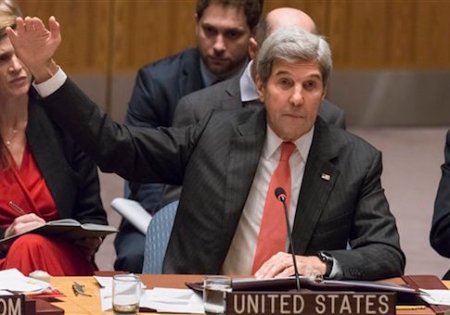
US Secretary of State John Kerry addresses the United Nations Security Council during an open, high-level debate regarding the ongoing Syrian crisis, at UN Headquarters in New York, NY, USA on September 21, 2016. The meeting, presided over by New Zealand's Prime Minister John Key, comes amid growing hostility between the United States and Russia over allegations of military operations conducted in the region. (Photo by Albin Lohr-Jones) *** Please Use Credit from Credit Field ***

US Secretary of State John Kerry addresses the United Nations Security Council during an open, high-level debate regarding the ongoing Syrian crisis, at UN Headquarters in New York, NY, USA on September 21, 2016. (Credit Field)

The Obama administration is pushing a pathway to ensure it can continue sending Iran cash payments amid mounting accusations it laundered some $1.7 billion to the Islamic Republic as part of a “ransom payment” to free U.S. hostages earlier this year, according to statements by the White House and sources familiar with the matter.

The White House late Wednesday promised to veto new legislation—first disclosed by theWashington Free Beacon—that would bar the administration from making “future ransom payments to Iran,” prompting outrage from key members of Congress who have been investigating how U.S. officials delivered nearly $2 billion in cash to Iranian officials.

The administration’s veto threat comes as top lawmakers on a range of investigatory committees launch efforts to uncover details about the cash exchange still being hidden by the Obama administration.

Congressional sources who spoke to the Free Beacon raised questions as to why the Obama administration would threaten to veto the bill, given its insistence that the cash payments to Iran were not part of a ransom.

“President Obama’s veto threat on our ransom legislation puts the lives of U.S. citizens around the world at risk,” Rep. Mike Pompeo (R., Kan.), a member of the House Intelligence Committee who helped spearhead the ransom legislation, told the Free Beacon.

“Instead of admitting wrongdoing, this administration is sticking to talking points. But selective noun use cannot explain away criminality, nor does it excuse eight months of lying to the American people,” Pompeo said. “It is unprecedented and reckless for the U.S. to be doling out billions to the Islamic Republic of Iran—under wraps and in cash—which is why our bill is necessary.”

Sen. Marco Rubio (R., Fla.), a lead sponsor of the legislation to ban future payments to Iran, told theFree Beacon that he would continue to push the legislation, despite threats by the administration.

“This effort by the President to defend his ransom payments to Iran at all costs amounts to doubling down on ‎a policy that has made Americans less safe,” Rubio told the Free Beacon. “Democrats may be swayed by this threat, but I will continue to fight to prevent the U.S. government from sending taxpayer dollars to the world’s foremost state sponsor of terrorism.”

Sen. Mark Kirk (R., Ill.) told the Free Beacon Wednesday evening that the Obama administration is betraying U.S. victims of Iranian terrorism, who are owed billions under federal court rulings.

“Under U.S. court judgments, Iran owes $55.6 billion to American victims of Iranian terrorism,” Kirk told the Free Beacon. “The Administration should stop finding ways to send more cash to Iran, and start working to bring a measure of justice to American families whose loved ones were killed or injured due to Iran-backed terrorists.”

One source familiar with the matter said Iran prefers cash because it can more easily be used to fund terrorism.

“There is no credible reason for the administration to oppose this bill. We already know, contrary to what the president initially said, that the administration can in fact wire money to Iran,” the source said. “So why do we need the option to pay in cash? Simple. This money can fund terrorism, and there’s nothing we can do to know of stop it.”

The Obama administration maintains the legislation is “ill-advised” and would “undermine U.S. obligations” to Iran.

The bill is “an ill-advised attempt to respond to a problem—so-called ‘ransom’ payments to Iran—that does not exist, in a way that would undermine U.S. obligations and ultimately benefit Iran at the expense of the United States,” the White House said in a statement.

The administration said it plans to award Iran further payments, which would not be possible under the ransom legislation.

“This bill, while styled as prohibiting future purported ‘ransom payments,’ instead bars virtually any payment from the U.S. government to Iran, including those permitted or even required by law,” the administration said.

The $1.7 billion cash payment was given to Iran as part of an effort to resolve decades-old legal disputes, many of which are still outstanding. The administration said further payments could be made to Iran in order to settle these disputes.

“Specifically, this bill would effectively prevent the United States from paying out awards rendered by the Tribunal and, thus, risk putting the United States in violation of our obligations under the Algiers Accords—an agreement concluded by President Carter, endorsed by President Reagan and honored by every President since that time,” according to the White House.

Questions remain about why the administration chose to pay Iran in cash installments routed through the New York Federal Reserve and several European banks.

Lawmakers such as Pompeo and Sen. Ted Cruz (R., Texas) have described the administration’s process as tantamount to a money laundering scheme.

UPDATE 8:40 P.M.: This piece was updated to include comments from Sens. Marco Rubio (R., Fla.) and Mark Kirk (R., Ill.).

Obama Admin: Iran Was Only Paid $1.7 Billion in Cash After Hostages Released

September 8, 2016

Obama Admin: Iran Was Only Paid $1.7 Billion in Cash After Hostages Released, Washington Free Beacon, Adam Kredo, September 8, 2016

Assan Rouhani, The President of Iran during the United Nations General Assembly at the United Nations General Assembly Hall on September 25, 2015 in New York City. Photo by Dennis Van Tine/Sipa USA

Hassan Rouhani. Photo by Dennis Van Tine/Sipa USA

Senior Obama administration officials, under the threat of a subpoena, were forced to appear on Capitol Hill on Thursday to explain why lawmakers and the American public were kept in the dark about a $1.7 billion cash payment to Iran that has been widely viewed as a ransom to free imprisoned U.S. hostages.

Four senior administration officials declined to provide in-depth explanations of how U.S. funds were transferred to Iran, but said that at least $1.3 billion was withdrawn from a U.S. taxpayer fund and sent to Iran only after it released the hostages.

The payments to Iran were made in hard currency after the United States delivered the funds to European banks. The money was converted into hard currency and bank notes before being transferred to an official from the Central Bank of Iran for transport to Tehran, according to the officials.

Administration officials confirmed that the $1.7 billion payment only went through once the United States was able to secure the release of several U.S. hostages being held in Iran—though the officials would not say this amounted to a ransom.

The Obama administration also could not guarantee lawmakers that the money would not be spent by Iran to fund terror operations.

These disclosures appear to confirm key details about the payment that the administration had either denied or declined to elaborate on for months.

Details are only becoming public now following several news reports and leaks from Congress about the source of the payment, which has been shrouded in mystery since January, when it was first announced.

“This committee requested records … more than a month ago and to date the self-proclaimed most transparent administration in our history has failed to provide any, not one document to this committee,” said Rep. Sean Duffy (R., Wis.), a member of the House Financial Services Committee, during the hearing.

“The witnesses today only agreed under threat of subpoena” to appear before Congress, Duffy said.

The testimony by these administration officials is likely to fuel claims that the payment amounted to a ransom, following the admission that the administration only went through with the cash delivery after it was able to confirm that the U.S. hostages had left Iran.

“You can’t tell me that you guaranteed our prisoners would have been released had your money not been sent,” Duffy said to Christopher Backemeyer, a deputy assistant secretary for Iranian affairs at the State Department.

Backemeyer also could not provide a guarantee that the money would not be spent by Iran on terrorist operations.

“I can’t speak to every dollar that’s going to go in or out of Iran,” he said.

“There is a risk you have taken in providing $1.7 billion to the leading state sponsor of terrorism in the world,” Duffy said.

European officials handed off the first payment of $400 million in cash to Iran on Jan. 17, only after Iran agreed to release the U.S. hostages following an evening of negotiations that included Secretary of State John Kerry, officials said.

After converting the U.S. funds to European bank notes and cash, the money was given to an “official from the Central Bank of Iran for transfer to Tehran,” according to Paul Ahern, assistant general counsel for enforcement and intelligence at the Treasury Department. “The funds were under U.S. government control until their disbursement.”

The remaining $1.3 billion was withdrawn from a U.S. taxpayer fund operated by the Treasury Department and sent to Europe. Once there, the money was converted into foreign currency and transferred to a representative of Iran’s central bank on Jan. 22 and Feb. 5.

Information about the payment and the circumstances surrounding it remains a mystery.

The administration officials  made the decision to pay Iran in cash, even though other options existed.

“Iran had to have it in cash,” Ahren said. “Iran was very aware of the difficulties it would face in accessing and using the funds if they were in any other form than cash, even after the lifting of sanctions.”

A cash delivery “was the most reliable way that they received the funds in a timely manner and it was the manner preferred by the relative foreign banks,” Ahren said.

“For them,” Backemeyer added, “the critical need was they [Iran] got immediate access.”

The administration officials would not provide in-depth details, citing diplomatic sensitivities.

“My guess is, if any private citizen had done what this administration did, they’d be indicted on money laundering and the administration calls in diplomacy,” said Rep. Jeb Hensarling (R., Texas), who questioned why the deal was hidden from the public

“Why did the administration go to such great lengths to hide it from the American people?” Hensarling asked. “Why did I have to threaten subpoenas to get the administration to show up in the first place?”

The State Department’s Backemeyer explained that some details could only be divulged in a classified setting.

“There will be limitations to what I and my colleagues can say in an open setting,” he explained. “There are a number of litigations and diplomatic sensitivities that could jeopardize U.S. interests if we were to go into too much detail.”

When asked why the United states agreed to pay $1.3 billion in interest to Iran from a taxpayer fund, a State Department official bristled.

“The details of why we settled for this amount are litigation sensitive,” said Lisa Grosh, a legal adviser in the State Department’s office of international claims and investment disputes. “Iran’s lawyers would try to use my words or maybe even your words against us to help their position at the [claims] tribunal. I believe this settlement was the best thing for the United States.”

Ralph Peters: Cash payments to Iran were a bribe to save Obama’s nuclear deal

September 7, 2016

Ralph Peters: Cash payments to Iran were a bribe to save Obama’s nuclear deal, Washington Free Beacon via YouTube, September 7, 2016

Column One: Obama’s greatest achievement

September 1, 2016

Column One: Obama’s greatest achievement, Jerusalem PostCaroline B. Glick, September 1, 2016

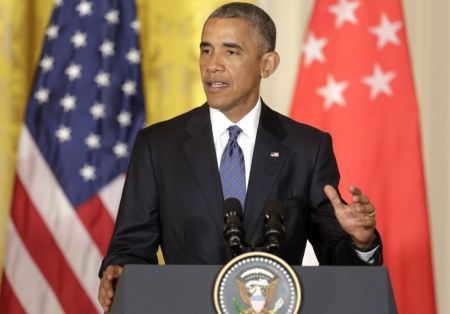
Obama lies on Iran scamU.S. President Barack Obama and Singapore Prime Minister Lee Hsien Loong (not pictured) speak during a press conference at the White House in Washington, U.S., August 2, 2016.  (photo credit:REUTERS)

The time for complaining about President Barack Obama’s nuclear deal with Iran has passed. The time has come to overcome the damage enormous damage his signature foreign policy accomplishment has caused.

To understand why this is the case, it is important to understand the breadth and depth of Obama’s failure.

On August 4, during the course of a press conference, Obama gave his interim assessment of his nuclear agreement with Iran.

“It worked,” he insisted.

A year after the deal was signed, Obama argued, events have proven that he was right and the deal’s critics were wrong.

“You’ll recall that there were all these horror stories about how Iran was going to cheat and this wasn’t going to work and Iran was going to get $150 billion to finance terrorism and all these kinds of scenarios, and none of them have come to pass,” he proclaimed.

Obama then snidely swiped at the deal’s opponents saying that it would be “impressive” if the people who criticized the deal would own up to their mistakes and admit that it worked.

As it works out, everything that Obama said about the deal with Iran during his press conference was a lie.

Some of his lies became apparent within hours.

For instance, Obama falsely claimed that Israel now “acknowledges this has been a game changer and Iran has abided by the deal and they no longer have the sort of short-term breakout capacity that would allow them to develop nuclear weapons.”

Hours later, the Defense Ministry issued a stinging rebuke of Obama’s claim, parroted more diplomatically by the Prime Minister’s Office.

Obama’s press conference took place the day after The Wall Street Journal reported that in January 2016, the US sent an unmarked plane to the Tehran airport filled with $400 million in cash, on the same day Iran released four US hostages.

Obama angrily rejected allegations that the cash payment was a ransom payment for the hostages’ release. He insisted that the US had made the payment as the first installment of a $1.7b. payment the administration made to settle an Iranian government lawsuit against America.

Obama claimed that the administration agreed to the settlement at the urging of the Justice Department.

He said his administration was able to settle the dispute only due to the nuclear deal which placed US officials in direct contact with their Iranian counterparts for the first time in decades.

Within a day, Obama’s claims were exposed as lies. It turns out that Justice Department lawyers opposed the cash payout to Iran.

One of the hostages released in January told the media that the Iranians refused to allow the hostages to leave Iran until the airplane with the cash landed in the airport.

The Iranians, for their part, contemptuously mocked Obama, and stated openly that the $400m.

was a ransom payment for the hostages.

Two weeks later, Obama’s State Department admitted that the $400m. was a payment for the hostages.

Obama’s principle claim is that due to his deal, Iran no longer has a short-term nuclear breakout capacity. He also says that in accordance with the deal, Iran has shipped its nuclear materials out of the country. These claims are both untrue and misleading.

On Thursday Reuters reported that Iran did not ship the quantities of low-enriched uranium out of the country in the quantities the deal required.

Last January, when the deadline arrived for Iran to comply with the deal’s clauses calling for it to move its uranium enriched to 3.5 percent and 20 percent out of the country and so enable the US and its European colleagues to cancel UN sanctions against it, it worked out that Iran had failed to comply.

Rather than acknowledge Iran’s failure and maintain the sanctions in accordance with their deal, the Americans and Europeans decided to move the goalpost closer to Iran.

They secretly decreased the amount of uranium the Iranians were required to part with. They then announced triumphantly that they were canceling UN sanctions because Iran had complied with the agreement.

Reuters reported that much of the low-enriched uranium Iran did remove from its territory wasn’t actually removed from its possession. Instead it was transferred to neighboring Oman, where it is held under Iranian guard and control.

Obama of course knows all of this. So his claims that the agreement “worked” are nothing more than a card trick meant to trick the American public.

Obama’s assertion that Iran’s breakout time to a nuclear arsenal has been slowed as a result of his deal is similarly a stretch of the imagination. The Iranians have suspended much of their prior centrifuge spinning. But that is only because they are now directing their efforts to developing and deploying more advanced centrifuges that will be able to enrich uranium to bomb grade material far more rapidly than the centrifuges they were required to retire.

Experts have already placed Iran’s post-deal nuclear breakout time at a mere six months. And Iran can leave the agreement – which it never actually signed or officially agreed to – anytime it wants.

While developing their next generation centrifuges, the Iranians are expanding the range and precision of their ballistic missiles, deploying them and increasing the size of their arsenals. Despite the fact that these actions are prohibited under US law and breach what was initially claimed about the ever-changing nuclear deal, the Obama administration has refused to impose sanctions against Iran, insisting that its actions merely breach the spirit, rather than substance, of the deal.

The administration has had a similar response to Iran’s recent deployment of Russia’s S-300 missile defense battery around its military nuclear site at Fordo. On Sunday Iranian television showed footage of the missiles being set up around the formerly secret site.

As Omri Ceren of the Israel Project noted this week, Iran’s deployment of the S-300 system places it in breach of three US sanctions laws. Despite this, the White House announced on Wednesday that it has no intention of enforcing US law and applying sanctions on Iran. The S-300 missiles can be used both as a defensive system and as an offensive one.

On Tuesday, Tehran announced that it will be launching three satellites in the coming months.

Satellite launches are widely viewed as a means through which Iran is covertly developing a longrange ballistic missile capability. Rather than censure Iran for its actions, the Obama administration insists that such actions, as well as Iran’s recent longrange rocket tests, do not violate the nuclear deal or warrant US action.

Taken separately and together, Iran’s actions since the nuclear deal was officially concluded make clear that it continues to pursue its nuclear program, and indeed, has become more brazen in its nuclear operations than it was before the agreement was announced last year.

In other words, not only has the deal not worked, contrary to Obama’s claims, it has been a colossal failure on every level. The deal’s opponents were entirely right about the dangers it posed and Obama was entirely wrong.

This is true as well in relation to the administration’s qualified promises that the deal would lead to better relations between the US and Iran. As Shoshana and Stephen Bryen noted last week following the Iranian naval assault on the USS Nitze in the Strait of Hormuz, with its repeated harassment of US naval ships traversing the Strait of Hormuz, Iran is clearly practicing its tactic of swarming US naval craft as a preparation for a real strike against them.

The main reason that Iran’s nuclear program is such a grave concern for Israel and for other Middle Eastern states is that the Iranian regime has hegemonic ambitions. It seeks to destroy Israel and dominate the entire region.

Since it concluded the deal with Washington, Iran has surged its forces and massively expanded its power projection throughout the region.

On Thursday the Daily Mail reported that the commonly held belief that Iran commands 16,000 troops in Syria is wrong. According to the National Council of Resistance in Iran, the regime actually commands 60,000 forces in Syria, deployed throughout the country. The entire Syrian army today numbers a mere 50,000 men.

On August 4, Obama mocked claims that Iran would spend its windfall profits of $100b.-$150b.

from the sanctions relief the nuclear deal offered to fund terrorism. Yet, according to the Daily Mail report, to date Iran has spent $100b. on the war in Syria.

The implications of the report are blood curdling.

They mean that despite Obama’s denials, the funds Iran has received as a result of the sanctions relief he brought about through his nuclear deal have paid for Iran’s war in Syria. That war has caused the death of nearly half a million people and forced more than 11 million people to flee their homes.

Obviously, it is important for Americans to know the truth about the Iran deal and its consequences as they consider their votes for Obama’s replacement.

One of Democratic nominee Hillary Clinton’s top candidates for secretary of state is Wendy Sherman.

Sherman was the chief negotiator of Obama’s nuclear deal with Iran.

For Israel, the question of what to do about Iran now is far more urgent than it is for Americans.

Today more and more commentators are voicing concern over the prospect that Obama will support an anti-Israel resolution at the UN Security Council as a parting shot at Israel.

But any such resolution will be small potatoes in comparison to the strategic devastation his nuclear deal, which is his main foreign policy legacy, has caused.

The rapidity of Iran’s advance makes clear that there is no justification for waiting to act until Obama has left office. If it doesn’t act soon, Israel is on the fast track to waking up one morning and discovering it has no means of thwarting the threat.

Indeed, with each passing month, its options for action become more and more limited.

After Israel’s security leadership undermined Prime Minister Benjamin Netanyahu’s plan to attack Iran’s nuclear installations in 2010 and 2012, Netanyahu settled on a strategy of blocking Obama’s moves to appease Tehran.

That strategy of course failed last summer. Since then, Netanyahu has worked to build an anti-Iranian alliance with the Sunni Arab states. His efforts in this area have clearly met with some measure of success, as witnessed by public statements from prominent Saudis and others.

Whatever that success may be, and whatever the status of that burgeoning alliance of spurned US allies, the fact is that it’s time Israel and its new allies do something more than send signals. Time is a-wasting.

Last spring Brig.-Gen. Hossein Salami, the deputy commander of Iran’s Revolutionary Guard Corps, said, “Today the grounds for the annihilation and collapse of the Zionist regime are more present than ever before.”

Thanks to Obama, he may be right.

It is time for Israel to make him eat his words.