Posted tagged ‘Obama Administration’

Iran and Israel, compare and contrast

November 8, 2014

Iran and Israel, compare and contrast, Power LineJohn Hinderaker, November 7, 2014

As Scott noted earlier today, the Obama administration’s warm attitude toward Iran’s mullahs has been in the news. Its view of Israel, on the other hand, is much chillier.

Last night, General Martin Dempsey, Chairman of the Joint Chiefs of Staff, gave a talk in which he lauded Israel’s avoidance of civilian casualties during the recent Gaza conflict, and stated that the U.S. military has sent a team of experts to Israel to study best practices in that regard. Via Yid With Lid:

I actually do think that Israel went to extraordinary lengths to limit collateral damage and civilian casualties. In fact, about 3 months ago we sent, we asked [IDF Chief of Staff] Benny [Gantz] if we could send a lessons learned team – one of the things we do better than anybody I think is learn – and we sent a team of senior officers and non-commissioned officers over to work with the IDF to get the lessons from that particular operation in Gaza. To include the measures they took to prevent civilian casualties and what they did with tunneling….

But they did some extraordinary things to try to limit civilian casualties to include calling out, making it known that they were going to destroy a particular structure. Even developed some techniques, they call it roof knocking, to have something knock on the roof, they would display leaflets to warn citizens and population to move away from where these tunnels. But look, in this kind of conflict, where you are held to a standard that your enemy is not held to, you’re going to be criticized for civilian casualties. So I think if Benny were sitting here right now he would say to you we did everything we could and now we’ve learned from that mission and we think there are some other things we could do in the future and we will do those. The IDF is not interested in creating civilian casualties, they’re interested in stopping the shooting of rockets and missiles, out of the Gaza Strip and in to Israel, and its an incredibly difficult environment, and I can say to you with confidence that I think that they acted responsibly.

So today a reporter asked State Department spokeswoman Jen Psaki whether the Department agrees with General Dempsey’s assessment. Psaki parroted the Obama administration line: Israel should have done more. Here she is:

What that “more” might be is, of course, unspecified; nor is there any suggestion that Hamas and Fatah should have done more to stop the firing of rockets at Israeli civilians. But of course, civilian casualties are a greater or lesser issue, depending on which administration is under discussion. Just yesterday, a reporter asked Ms. Psaki about reports that civilians had been killed in a U.S. drone strike. Her answer, in essence: Hey, we’re doing the best we can:

QUESTION: Do you have any confirmation of reports that any civilians were killed in these – this latest round of strikes?

MS. PSAKI: Well, as you know, this is – any reports of civilian casualties we take very seriously. The Department of Defense looks into that. We understand that there have been reports from activists alleging that civilian casualties occurred. I’ll just reiterate that no other military in the world works as hard as we do to be precise and avoid civilian casualties. But while we strive to avoid them, when any allegation is presented we investigate it fully and strive to learn from it as to avoid it in the future. So that would, of course, be under the Department of Defense.

QUESTION: Yes.

MS. PSAKI: Asia?

QUESTION: Yes.

QUESTION: Wait. No other military in the world –

QUESTION [SIC]: Other than Israel.

QUESTION: Yeah, exactly. I seem to recall the Israelis saying this – the same thing. You think you’re better at it than the Israelis are?

MS. PSAKI: We think we hold ourselves to a high standard, and we continue – encourage all countries to do the same.

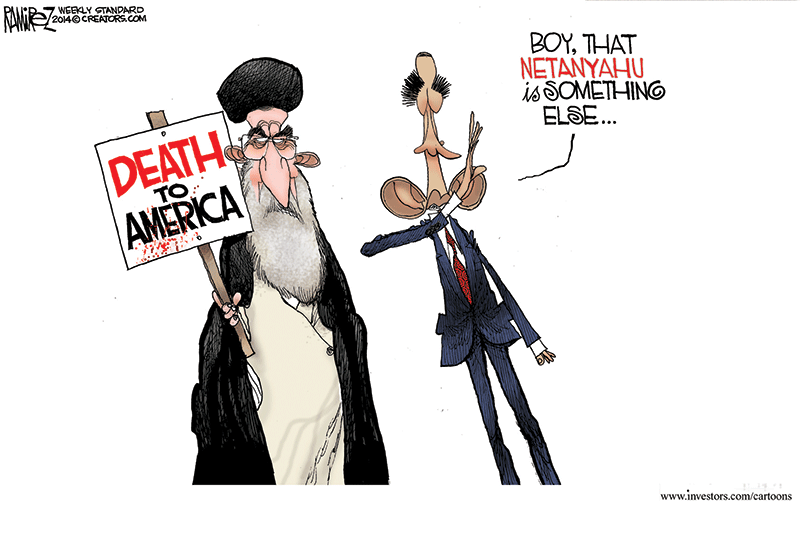
Michael Ramirez gets the last word. Click to enlarge:

RAMclr-110514-netanyahu-WS-wide.gif.cms_

U.S. strategy against Islamic State hits major hurdles

October 31, 2014

U.S. strategy against Islamic State hits major hurdles, LA Times, 

(Happy Halloween from the Obama Administration. — DM)

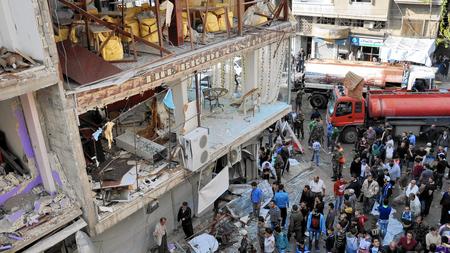
la-epa-epaselect-syria-homs-car-bomb-jpg-20141030Syrian police and residents inspect the site of a car bombing in Homs on Oct. 29. The U.S. plan to raise a rebel army in Syria to fight Islamic State has run into steep political and military obstacles. (European Pressphoto Agency)

The Obama administration’s plan to raise a 15,000-strong rebel army in Syria has run into steep political and military obstacles, raising doubts about a key element of the White House strategy for defeating Islamic State militants in the midst of a civil war.

Pentagon concerns have grown so sharp that Defense Secretary Chuck Hagel sent a two-page memo to the White House last week warning that the overall plan could collapse because U.S. intentions toward Syrian President Bashar Assad are unclear, according to a senior defense official who read the memo but was not authorized to speak publicly.

President Obama has called on Assad to step down, but he has not authorized using military force, including the proposed proxy army, to remove the Syrian leader.

At a news conference Thursday, Hagel declined to discuss his memo to national security advisor Susan Rice, but he acknowledged that Assad has inadvertently benefited from more than five weeks of U.S.-led airstrikes against the Islamic State, one of the most powerful antigovernment forces in Syria’s bitter conflict.

Secretary of State John F. Kerry sought to paper over the problem Thursday, telling a forum in Washington that the proposed proxy army “can have an impact on Assad’s decision-making so we can get back to a table where we could negotiate a political outcome, because we all know there is no military resolution of Syria.”

Rebel leaders in Syria say they would reject joining a U.S.-backed force that is not aimed at defeating Assad, their main enemy.

Senior U.S. military officers also privately warn that the so-called Syrian moderates that U.S. planners hope to recruit — opposition fighters without ties to the Islamic radicals — have been degraded by other factions and forces, including Assad’s army, during the war.

It will take years to train and field a new force capable of launching an offensive against the heavily armed and well-funded Islamic State fighters, who appear well-entrenched in northern Syria, the officers say.

“We’re not going to be able to build that kind of credible force in enough time to make a difference,” said a senior U.S. officer who is involved in military operations against the militants and who asked for anonymity because he was not authorized to speak publicly. “We’ve watched the moderate opposition dwindle and dwindle and now there’s very little left.”

The Pentagon plan calls for putting 5,000 rebel fighters into Syria in a year, and 15,000 over the next three years.

It is the least developed and most controversial part of the multi-pronged U.S. strategy, which also includes near-daily airstrikes in Iraq and Syria, deployment of U.S. military advisors and other support to assist Iraqi government and Kurdish forces, along with attempts to choke off the militants’ financing from oil sales and foreign donors.

When officers involved in high-level Pentagon deliberations in the summer raised concerns about building a rebel army from scratch, they were overruled by senior commanders, who warned that airstrikes alone would not defeat the militants, one of the officers said.

But Pentagon unease has intensified in recent weeks as Jordan and Turkey, two allies that the Obama administration is counting on to help train the proposed proxy force, made it clear that they are lukewarm to the plan, two U.S. officials said.

Washington and its allies are chiefly split over whether the proposed force should focus on reclaiming Syrian territory now held by the Islamic State militants, which is the U.S. priority, or should also battle troops loyal to Assad, the allies’ main concern.

Turkey said this month that it would train a portion of the Syrian force, joining Saudi Arabia in training on its territory. U.S. officials don’t expect to assemble the first group of “moderate” rebels, drawing them from inside Syria or from crowded refugee camps in nearby countries, until early next year at the earliest.

But Turkish officials have signaled that the rebels it trains would concentrate on battling Assad’s forces, not Islamic State, once they return to Syria.

Jordan has not joined the training effort, although it hosts a separate, smaller, CIA-run operation for Syrian insurgents.

U.S. officials say greater involvement by Turkey and Jordan would allow them to increase the number who can be trained, and provide easier conduits for support and resupply when they return to Syria.

The dispute reflects the complex calibrations now in play as the Islamic State militants shake long-established political and military fault lines in the Middle East.

Most dramatically, perhaps, U.S. forces are now in at least tacit alignment with traditional enemies such as Iran and Hezbollah, the Lebanon-based militant and political group, against a common threat.

Syrian rebel leaders and Arab allies complain that the U.S.-led airstrikes have helped Assad by weakening one of his most powerful foes and enabling his army to step up attacks on other rebel factions.

A spokesman for the Free Syrian Army, an umbrella organization claiming to represent largely autonomous rebels in Syria, said fighters were incensed by the U.S. insistence on focusing entirely on Islamic State.

“They have forgotten that tens of thousands of civilians are suffering because of the regime,” said the spokesman, who did not want his name published because it could endanger his family. “Our main cause is the regime, and that will remain our main cause.”

A rebel commander, a defector from the Syrian army who also asked for anonymity, agreed. The U.S. plan “doesn’t work for us,” he said.

“They are concerned with ISIS … but we are concerned with the regime more than ISIS,” he said, using one of several acronyms for Islamic State.

U.S. Central Command, which is overseeing the effort to build a Syrian force, says questions about its direction will be resolved once the fledgling program is underway.

“We are early on in this and there’s much to be figured out,” said Maj. Curtis J. Kellogg, a spokesman for Central Command.

Frederic C. Hof, a former special advisor to President Obama for Syria, said the U.S. plan “is going to be a tough sell” in Syria.

“You can always get people by providing weapons, ammo and pay, but your appeal to a large number of Syrians will increase dramatically if it is a force whose goal is eventually to govern all of Syria,” not just beat one faction, he added.

The caution reflects, in part, a U.S. desire to reassure Iran, one of Assad’s closest backers, that it is not seeking to oust him by force. If the U.S. backtracked on that promise, Iran might step up military support for Assad.

Tehran also could respond by using local Shiite militias to attack U.S. personnel or facilities in Iraq. The Iranian-backed Shiite militias in Iraq have coordinated their attacks on Islamic State with the U.S.-backed government in Baghdad.

“If we really focus on Assad, the Iranian piece of this coalition [against Islamic State] will fracture, and we will have Shia militants trying to target us,” said the senior U.S. military officer.

The U.S. experience with proxy military forces is laced with disappointment.

The Kennedy administration backed a failed invasion of the Bay of Pigs in Cuba in 1961 after training a counterrevolutionary brigade. In the 1980s, the Reagan administration bankrolled the Contras in Nicaragua, who were unsuccessful against the Sandinistas’ socialist revolution.

“We’ve helped arm insurgencies before,” Bruce Riedel, a former CIA analyst who now is a senior fellow at the Brookings Institution. “Nearly all of them have been complete failures or marginal to the final outcome. But there was one spectacular success.”

The CIA, working with Pakistan and Saudi Arabia, covertly poured $4 billion into arming a rebel force in Afghanistan from 1979 to 1989, helping them drive out Soviet forces. Riedel, who wrote a book about the undertaking, said the CIA operation hastened the fall of the Soviet Union and the end of the Cold War.

The Syrian rebel forces, with their fractured leadership and rival sponsors, bear similarities to the competing Afghan mujahedin factions during that war, Riedel said. If the U.S. can secure tight-knit partnerships with neighboring countries on training the rebels, it could also see success against Islamic State.

“There’s no reason we can’t do it again,” he said. “But it doesn’t happen overnight.”

The Consequences of a “Chickensh*t” Policy

October 29, 2014

The Consequences of a “Chickensh*t” Policy, Commentary, , October 29, 2014

There is no doubt that Obama’s lame duck years will be stressful for Israel and its friends. As Seth noted earlier today, the administration’s full court press for détente with Iran is setting the table for a strategic blunder on their nuclear quest that will severely harm the balance of power in the Middle East as well as lay the groundwork for challenges to American national security for decades to come.

*****************

No doubt the gang in the Obama administration have been congratulating themselves for planting some juicy insults aimed at Israeli Prime Minister Benjamin Netanyahu in Jeffrey Goldberg’s latest column in The Atlantic. But now that the wiseacres in the West Wing and/or the State Department have done their dirty work the question remains what will be the consequences of the decision to widen as well as to embitter the breach between the two countries. While most of those writing on this subject, including Goldberg, have emphasized the real possibility that the U.S. will sandbag Israel at the United Nations and otherwise undermine the Jewish state’s diplomatic position in the last years of Obama’s term in office, that won’t be the only blowback from the administration’s “chickenshit” diplomacy. Rather than harm Netanyahu, this ploy, like previous attacks on the prime minister, will strengthen him while making mischief for the president’s party in both this year’s midterms and in 2016.

There is no doubt that Obama’s lame duck years will be stressful for Israel and its friends. As Seth noted earlier today, the administration’s full court press for détente with Iran is setting the table for a strategic blunder on their nuclear quest that will severely harm the balance of power in the Middle East as well as lay the groundwork for challenges to American national security for decades to come.

Nor should anyone discount the potential for severe damage to Israel’s diplomatic standing in the world should Obama decide to collude with the Palestinian Authority and to allow them to get a United Nations Security Council resolution on Palestinian statehood, borders, and Jerusalem. The Palestinians’ drive to annul Jewish rights and to bypass the peace process could, with Obama’s support, further isolate Israel and strengthen the efforts of those forces working to promote BDS—boycott, divest, sanction—campaigns that amount to an economic war on the Jewish people.

This is a dire prospect for a small, besieged country that still relieves heavily on U.S. security cooperation and defense aid. But for all the huffing and puffing on the part of Obama’s minions, the administration’s real objectives in all this plotting are not likely to be achieved. That’s because nothing published in a Goldberg column or leaked anywhere else will weaken Netanyahu’s hold on office or prompt the Palestinians to make peace or Iran to be more reasonable in the nuclear talks. The only people who will be hurt by the attacks on Israel are Obama’s fellow Democrats.

As I pointed out yesterday, Obama’s barbs aimed at Israel haven’t enticed the Palestinians to negotiate seriously in the past and won’t do so in the future. If the Palestinian Authority really wanted a state they would have accepted the one offered them in 2000, 2001, or 2008 or actually negotiated with Netanyahu in the last year after he indicated readiness to sign off on a two-state solution.

The boasts about having maneuvered Netanyahu into a position where he may not have a viable military option against Iran (actually, Israel may never have had much of an option since it can be argued that only U.S. possesses the forces required to conclusively knock out Iran’s nuclear facilities) is also nothing for the U.S. to be happy about since it will only strengthen the Iranians’ conviction that they have nothing to fear from Israel or a U.S. president that they think is too weak to stand up to them.

But Obama should have also already learned that challenging Netanyahu and insulting the Jewish state in this manner has one definite side effect: strengthening the prime minister’s political position at home. The same thing happened after Obama’s attacks on the status of Jerusalem in his first term. The administration thought it could topple Netanyahu soon after his election in February 2009 and failed, but even after his election to another term in 2013 as well as the absence of any viable alternative to him, they are still clinging to the delusion that the Israeli people will reject his policies. But that isn’t likely to happen for one reason. The overwhelming majority of Israelis may not love the prime minister but they share his belief that there is no Palestinian peace partner and that turning the West Bank into a sovereign state that could be controlled by Hamas and other terrorists just like Gaza would be madness. They also oppose efforts to divide their capital or to prohibit Jews from the right to live in some parts of the city.

Netanyahu won’t back down. In the wake of the summer war with Hamas that further undermined an Israeli left that was already in ruins after 20 years of failed peace processing, Netanyahu was clearly heading to early elections that would further strengthen the Likud. Obama’s attacks will only make that strategy more attractive to the prime minister. But whether he is reelected in 2015, 2016, or 2017, few believe Netanyahu won’t be returned to office by the voters for his third consecutive and fourth overall term as Israel’s leader. Though a lot of damage can be done to Israel in the next two years, that means Netanyahu is almost certain to be able to outlast Obama in office and to enjoy what will almost certainly be better relations with his successor whether it is a Democrat or a Republican. Waiting out Obama isn’t a good strategy for Israel but it may be the only one it has available to it and will likely be rewarded with a honeymoon with the next president.

But Netanyahu isn’t the only person who will profit politically from this astonishingly crude assault on the Jewish state’s democratically elected leader.

Foreign policy is rarely a decisive factor in U.S. elections but at a time when Democrats are suffering the ill effects of Obama’s inept response to the threat from ISIS, it won’t do the president’s party any good for the administration to pick a fight with it’s sole democratic ally in the Middle East. Americans have a right to ask why an administration that was slow to react to ISIS and is intent on appeasing a murderous Islamist regime in Iran is so intent on fighting with Israel. That won’t help embattled Democrats seeking reelection in red states where evangelicals regard backing for Israel as a key issue.

Nor will it help Democrats as they head toward 2016. Though Hillary Clinton will likely run away from Obama on his attacks on Netanyahu as she has done on other foreign-policy issues, running for what will in effect be Obama’s third term will still burden her with the need to either actively oppose the president’s anti-Israel actions in the UN or détente with Iran or accept the negative political fallout of silence. Any Republican, with the exception of an isolationist like Rand Paul, will be able to exploit this issue to their advantage.

Those who worry about the damage to Israel from a lame-duck Obama administration that is seething with hatred for Netanyahu and thinks it has nothing to lose are not wrong. But Democrats will be hurt politically by a crisis that was created by Obama, not Netanyahu. They won’t be grateful to the president for having put them in this fix while Netanyahu will probably emerge from this trial strengthened at home and in a good position to repair relations with Obama’s successor.

The Islamization of Jerusalem

October 29, 2014

The Islamization of Jerusalem, Front Page Magazine, Daniel Greenfield, October 29, 2014

pl

The murder of little girls like Chaya Zissel Braun does not take place in a vacuum. The Islamizers of Jerusalem gain confidence when they see that the international community stands behind their demands. In 1920, racist Muslim settler mobs in Jerusalem had chanted “Mohammed’s religion was born with the sword”, “Death to the Jews” and “the government is with us” as Muslim policemen under British colonial rule had joined with them in the rape and murder of the indigenous Jewish population.

***************

Chaya Zissel Braun was murdered on her first trip back from the Western Wall where the indigenous Jewish population of Israel continues to pray in the shadow of the shrine established there by the Muslim conquerors from which the racist Muslim settlers rain down rocks on the Jewish worshipers.

The three-month old baby girl died when a Muslim terrorist rammed a car into a crowd hurtling her into the air and headfirst onto the pavement. Her death did not take place in isolation. It was not caused by a tiny minority of extremists. Her blood was spilled on the street for the Islamization of Jerusalem.

The Islamization of Jerusalem is an international cause. It does not just come out of Gaza City or even Ramallah. Nor Doha or Istanbul. The politicians and diplomats of every major country demand the Islamization of Jerusalem. When they talk about a Palestinian State with its capital in Jerusalem what they are really demanding is the restoration of the Muslim ethnic cleansing of Jerusalem in 1948.

They demand it with words and boycotts, but the Muslim settlers on whose behalf they cry for the Apartheidization of Jerusalem are writing their murderous demands with the blood of little girls.

The baby girl was murdered to Islamize a city. She died as the Israeli soldiers had died reunifying Jerusalem after the Arab Legion had ethnically cleansed the Jewish population and as ordinary Jerusalemites had died at the hands of Jordanian snipers searching the city for Jewish and Christian targets. The victims of those years of Muslim occupation included Yaffa Binyamin, a 14-year-old girl sitting on the balcony of her own house, and a Christian carpenter working on the Notre Dame Convent.

Like Chaya, I was born in Jerusalem. Like Yaffa, I lived in a building targeted by Muslim snipers. But the Six Day War had ended the reign of Muslim snipers over the city. The building where my parents made their home had been cheap once because living there could mean instant death for anyone looking out of a window at the wrong time. The liberation and reunification of Jerusalem had made it a place where Jewish children could play on balconies and Christians could repair churches without being murdered.

Under Muslim occupation, while Jordanian snipers were cold-bloodedly murdering their children, the Jewish residents living under fire couldn’t so much as put up an outhouse without being reported to the UN for illegal construction. In one case a UN observer organization held four meetings to discuss an outhouse for local Jewish residents before condemning Israel for illegal construction.

It did not however condemn Jordan when one of its soldiers opened fire on a train wounding a Jewish teenage girl.

Muslim outrage over Jewish outhouses mattered more than the Muslim murder of Jewish children. It still does. Today the State Department calls the murder of that little girl a traffic incident while warning that Jews living in Jerusalem will end any possibility of peace.

Hillary Clinton spent 45 minutes shrieking at Netanyahu over the phone after a planning committee allowed new housing in Jerusalem to advance to the public comment stage, and told the media that the proposal that Jews live in a part of Jerusalem that she believes should belong to Muslims is “insulting” to the United States.

The latest firestorm exploded over seven Jewish families moving into homes that they had bought legally in an area from which Jews had been ethnically cleansed by racist Muslim violence in the twenties and thirties. Earlier the State Department and White House had warned that Israel was alienating “even its closest allies” by proposing to build houses on Airplane Hill, a place mainly known for having an Israeli plane crash there during the Six Day War that had formerly hosted temporary housing for Russian and Ethiopian immigrants.

Meanwhile when Chaya was murdered, the State Department urged “all sides to maintain calm and avoid escalating tensions in the wake of this incident.” It wasn’t as if anything important had happened. Just an Israeli-American baby murdered in pursuit of their shared goal of Islamizing Jerusalem.

Secretary of State John Kerry did not call President Abbas, the unelected president of the PLO’s Palestinian Authority, to berate him when one of his advisers called the murderer of that child a “heroic martyr”. Hillary Clinton did not come out of retirement to shriek at him over the phone when his party suggested that the killer would be receiving his 72 virgins in paradise.

If only something more important had happened than a presidential advisor to an Obama-backed terror state calling the murderer of an American child a hero; like planning for new housing “advancing”.

No one objects when Muslim settlers build houses in Jerusalem or anywhere else. But the objections pour in when the indigenous Jewish population builds so much as a house or an outhouse.

What we are talking about here is not peace, but ethnic cleansing. In 1948, the Jews were ethnically cleansed from Jerusalem to Islamize the city. Their synagogues were blown up by the Muslim occupiers. Their tombstones were used to line the roads traveled by the racist Muslim settlers.

“For the first time in 1,000 years not a single Jew remains in the Jewish Quarter,” Abdullah el-Talal, a commander of the Muslim invaders, had boasted. “Not a single building remains intact. This makes the Jews’ return here impossible.”

In his memoirs he wrote, “I knew that the Jewish Quarter was densely populated with Jews who caused their fighters a good deal of interference and difficulty…. Only four days after our entry into Jerusalem the Jewish Quarter had become their graveyard. Death and destruction reigned over it.”

Life magazine published photos of the atrocity writing that, “Muslim censors, not only in Palestine but in   neighboring Arab countries which have major communication outlets, tried for a fortnight to keep the news from leaking out.”

The Life photographer who took the photos was sentenced to death by the Arab High Committee.

This ethnic cleansing is what Hillary Clinton and John Kerry have been defending. The Islamization of Jerusalem is the thrust of all the peace plans put forward.

The entire phony “Palestinian” narrative in which the regional Sunni Arab Muslim majority that is busy slaughtering Christians, Kurds, Shiites acts as if it’s the victim because its racist ethnic cleansing plans were frustrated when its Jewish victims fought back and won.

The Muslim occupiers have added insult to injury by pretending to be the indigenous population to aid in their attempts at displacing the indigenous Jewish population through terror and lies.

Abdullah el-Talal said, “I have seen in this defeat of the Jews the heaviest blow rendered upon them, especially in terms of morale, since they were evicted   from the Western Wall and from the Jewish Quarter, for the first time in fifteen generations.”

Every politician denouncing Jews for building houses in Jerusalem, but not Muslims doing the same thing is endorsing Abdullah’s genocidal vision and all the terrorism that goes with it.

The murder of little girls like Chaya Zissel Braun does not take place in a vacuum. The Islamizers of Jerusalem gain confidence when they see that the international community stands behind their demands. In 1920, racist Muslim settler mobs in Jerusalem had chanted “Mohammed’s religion was born with the sword”, “Death to the Jews” and “the government is with us” as Muslim policemen under British colonial rule had joined with them in the rape and murder of the indigenous Jewish population.

Too many governments still stand with those who wave the sword of Mohammed and cry death to the Jews. They encourage them, defend their agenda and issue weak rebukes when blood is spilled in the name of Islamizing Jerusalem.

Those politicians who endorse the Islamization of Jerusalem cannot escape responsibility for the crimes of the Islamizers.

Obama Admin: Palestinians Who Throw Molotov Cocktails at Israelis Are Not Terrorists

October 28, 2014

Obama Admin: Palestinians Who Throw Molotov Cocktails at Israelis Are Not Terrorists, Washington Free Beacon, October 27, 2014

(The dear lad was Islamic, so how could he possibly have been involved in terrorism? Islam is the “religion of peace.” Or something.– DM)

The Obama administration insisted Monday that a Palestinian who was killed by the IDF while attempting to throw a Molotov cocktail at Israeli civilians is not a terrorist.

The Palestinian, a teenager with U.S. citizenship, was shot on Friday and buried this weekend wearing a green Hamas headband. The Obama administration said in a statement on Friday that it “expresses its deepest condolences to the family.”

At a State Department briefing today, Associated Press reporter Matt Lee asked spokesman Jen Psaki whether it is appropriate to offer deepest condolences to the family of someone killed while attempting to carry out an attack on civilians.

“There are reports … that [the Palestinian teenager] was throwing Molotov cocktails at cars on a highway, and I’m wondering, if that is the case, would you still have been so speedy in putting out a statement and offering your condolences to the family?” asked Lee. “The argument that is being made by some in Israel is that this kid was essentially a terrorist, and you don’t agree with that, I assume,” Lee continued.

“Correct, we don’t,” replied Psaki. Lee then asked whether the fact that the teenager was buried wearing a Hamas headband was “of concern at all.” Psaki replied, “I just don’t have any more on this particular case.”

Surrender in the War of Ideas

October 7, 2014

Surrender in the War of Ideas, Washington Free Beacon, October 7, 2014

(The U.S. Constitution, ignored by the Obama Administration whenever convenient, has very little to do with the matter. In any event, Obama has repeatedly claimed that the Islamic State is not Islamic, thus erroneously interpreting and supporting what he apparently considers to be Islamic religious doctrine. — DM)

Constitutional religious clause prevents Obama administration from countering Islamic State ideology.
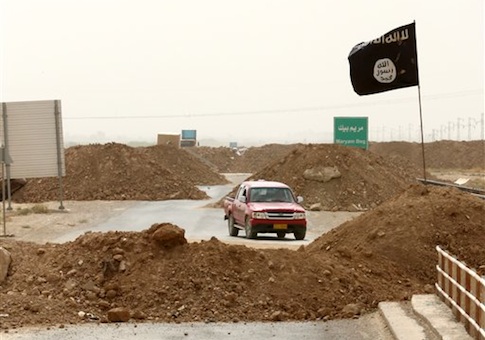
Mideast IraqIslamic State militants pass a checkpoint bearing the group’s trademark black flag in the village of Maryam Begg in Kirkuk, 290 kilometers (180 miles) north of Baghdad, Iraq / AP

Obama stated in a speech on Sept. 10 that ISIL is “not Islamic” despite the group’s use of a fundamental Islamic precept of jihad, or holy war, in expanding its reach and imposing anti-democratic, hardline Islamic sharia law in areas it now controls.

Analysts and statements by the president and other administration spokesmen also indicate the administration may not clearly understand ISIL ideology, a required first step in developing a counter to it.

The Obama administration, under pressure from domestic Muslim advocacy organizations, has adopted a politically correct approach toward Islam and terrorism that has resulted in removing mentions of Islam from its current policies and programs. Instead, counterterrorism programs and policies are carried out under the less-specific rubric of “countering violent extremism” (CVE).

******************

The Obama administration is failing to wage ideological war against Islamic State of Iraq and the Levant (ISIL or ISIS) terrorists over fears that attacking its religious philosophy will violate the constitutional divide between church and state, according to an in-depth inquiry by the Washington Free Beacon.

Instead, the task of countering what President Obama called the “warped ideology” of ISIL is being farmed out to foreign states and Muslim communities that often share some of the same goals as the groups the administration calls violent extremists. This approach allows the administration to avoid identifying links between terrorism and Islam.

“While the government has tried to counter terrorist propaganda, it cannot directly address the warped religious interpretations of groups like ISIL because of the constitutional separation of church and state,” said Quintan Wiktorowicz, a former White House counterterrorism strategist for the Obama administration.

“U.S. officials are prohibited from engaging in debates about Islam, and as a result will need to rely on partners in the Muslim world for this part of the ideological struggle,” he said in an email interview.

Is ISIL Islamic?

Obama announced last month for the first time that his new counterterrorism strategy includes programs aimed at countering ISIL’s ideology. But a review of administration efforts shows very little—if anything—is being done to defeat or destroy the terrorist group’s religious ideology in a war of ideas.

At the United Nations on Sept. 24, the president asked the world body to come up with a plan over the next year designed to counter ISIL and al Qaeda’s ideology. He said ending religious wars through an ideological campaign in the Middle East will be “generational” and led by those who live in the region. No external power, the president insisted, can change “hearts and minds,” and as a result the United States would support others in the unspecified program of “counter extremist ideology.”

The administration’s so-called soft power approach to countering Islamist terrorism also appeared to have difficulty with clearly defining the religious doctrine behind the ideology of the resurgent al Qaeda offshoot now rampaging its way across Iraq and Syria.

Obama stated in a speech on Sept. 10 that ISIL is “not Islamic” despite the group’s use of a fundamental Islamic precept of jihad, or holy war, in expanding its reach and imposing anti-democratic, hardline Islamic sharia law in areas it now controls.

Analysts and statements by the president and other administration spokesmen also indicate the administration may not clearly understand ISIL ideology, a required first step in developing a counter to it.

Sebastian Gorka, a counterterrorism specialist, said the major problem for the administration in countering ISIL ideology is that most senior officials hold “post-modern” and “secular” views.

“As a result, they have almost no ability to understand the drivers of violent terrorists which are religious,” said Gorka, the Horner chairman of military theory at the Marine Corps University.

“When you don’t take religion seriously, it’s almost impossible for you to comprehend the philosophy of a suicide bomber, or someone who cuts off the heads of people in the name of jihad,” Gorka said.

Senior State Department officials have expressed the view that ideology plays no role in Islamist terror and is spawned instead by “local grievances” such as poverty or other economic and social privation, Gorka said. “That is utterly fallacious. If that were true, half of India would be terrorists,” he said.

The latest issue of the ISIL English-language magazine Dabiq reveals some of the group’s ideology, using references to Islamic practices of jihad and sharia law. “The Islamic State has long maintained an initiative that sees it waging jihad alongside a dawah [proselytizing campaign] that actively tends to the needs of its people,” the magazine said, adding that the group “fights to defend the Muslims, liberate their lands, and bring an end to tawaghit[the evil corrupt system].”

The magazine also sought to legitimize its mass executions, beheadings, and other atrocities as religiously justified responses to all opponents who refuse to submit to its ideology.

The president stated in his Sept. 10 speech announcing the anti-ISIL strategy that the group is “not Islamic” because it kills Muslims and innocents, something he asserted no religion condones, and a claim disputed by many experts on Islam.

“I’ve studied Islam and I did not find a very peaceful religion,” said a current senior U.S. counterterrorism specialist who disagrees with the administration’s approach of not directly addressing the Islamic nature of terrorism in counter-ideology efforts.

Wictorowicz, the former counterterrorism strategist, defended the State Department approach. “Having spoken to them at length about this, their position is that Islam, as a religion, is not the issue,” he said. “It is particular interpretations of Islam that are, in part, driving support for violence.”

Not fighting a war of ideas

The Obama administration, under pressure from domestic Muslim advocacy organizations, has adopted a politically correct approach toward Islam and terrorism that has resulted in removing mentions of Islam from its current policies and programs. Instead, counterterrorism programs and policies are carried out under the less-specific rubric of “countering violent extremism” (CVE).

Discussing Islam also has been placed off limits in many government and intelligence community counterterrorism programs as a result of pressure groups and Muslim advisers who insist such topics would violate constitutional separation of church and state issues.

That pressure has inhibited the U.S. government from addressing Islamist ideology in a significant way, critics say. Instead, the government has been forced to indirectly counter claims by terrorists, such as the false notion that the United States and the West are at war with Islam. It used public diplomacy programs and global “messaging” campaigns whose effectiveness has been questionable, to try and counter such claims.

James Glassman, former undersecretary of state for public diplomacy, said “absolutely,” that the administration is hampered by concerns over First Amendment constitutional religious issues from conducting aggressive counter-ideology efforts against groups such as al Qaeda and ISIL.

“There is reticence, especially at State, to criticize a noxious political ideology based on a religion,” said Glassman, now with the American Enterprise Institute.

Glassman said from the start, Obama has played down the war of ideas in the struggle against terrorism.

During the transition from the Bush to Obama administration, “I was told by the Obama operatives assigned to State that the term ‘war of ideas’ was not to be used,” Glassman said.

“The war of ideas had been my focus at State, but the administration had no interest in continuing the work we were doing,” he said. “Ideology provides the environment and the justification for the activities of al Qaeda and ISIL. It must be dealt with—just as we dealt with communism from 1945 to 1990. It’s a long battle.”

“The way around the problem is leadership,” Glassman said. “The president needs to make clear—as President Bush did immediately after 9/11—that the terrorists have constructed a phony ideology and that they are trying to take over an entire religion.”

Obama appears to be in the early stages of doing that “but it is very late in the game and he needs to devote resources, not just words, to the war of ideas,” Glassman said.

Looking for allies

Obama told the United Nations in a speech to the General Assembly Sept. 24 that “extremist ideology” has spread despite more than a decade of military and intelligence efforts to kill al Qaeda leaders. Groups such as ISIL and al Qaeda have “perverted one of the world’s great religions,” he said.

The world, and specifically “Muslim communities,” the president said, must now take steps to “explicitly, forcefully, and consistently reject the ideology of al Qaeda and ISIL.”

However, most of the Islamic countries, such as Saudi Arabia and Turkey, so far have not denounced the ISIL ideology and do not appear to be engaged in counter-ideological campaigns designed to discredit the motivating force behind the group.

The president elaborated in the U.N. speech on his administration’s approach to countering ISIL’s message, but not its Islamist ideology. He called for a “new compact” among civilized peoples to stop the “corruption of young minds by violent ideology.”

He called for cutting off funding and contesting terrorists’ use of social media to recruit and propagandize. Additionally, he called upon religious leaders of all faiths to join together and propagate the Christian concept of “do unto thy neighbor as you would have done unto you.”

“The ideology of ISIL or al Qaeda or Boko Haram will wilt and die if it is consistently exposed, confronted, and refuted in the light of day,” Obama said.

Wiktorowicz said he agrees more needs to be done. “Not enough resources are being devoted to the counter-ideology component of the administration’s strategy,” he said. “The long war is the war against violent ideologies and there hasn’t been the resource investment since 9/11. As a result of this and other factors, we’re seeing the reincarnation of al Qaeda as ISIL in Iraq and Syria.”

Wiktorowicz also said the administration is working with partners in the Muslim world “who can push back against the ideology.”

“The Salafi jihadists, however, have assassinated and intimidated Islamic scholars and others who have spoken out against violence, increasing the danger for the brave individuals involved in the counter-ideological struggle,” he said.

A hashtag campaign

To date, the allied campaign against ISIL is limited to U.S.-led missile, drone, and air strikes against vehicles and command posts of the group in territories it controls in Iraq and Syria. The bombing has slowed but not reversed territorial gains by the group.

The Obama strategy as outlined last month will involve four elements: Air strikes; support for local forces on the ground; counterterrorism efforts to prevent ISIL attacks; and humanitarian assistance to deal with the mass of refugees fleeing ISIL control.

Under the counterterrorism program, the president declared: “Working with our partners, we will redouble our efforts to cut off its funding; improve our intelligence; strengthen our defenses; counter its warped ideology; and stem the flow of foreign fighters into and out of the Middle East.”

Asked for specifics on what the White House is doing to counter ISIL ideology, White House and National Security Council spokesmen declined to discuss the matter. Ned Price, an NSC spokesman, provided a recent White House “fact sheet” that contains no reference to counter-ideology efforts.

Price said White House counterterrorism coordinator Lisa Monaco was “too busy” to discuss the counter-ideology campaign.

The fact sheet mentions various steps being taken, including the adoption of a “whole-of-government-approach,” cutting off funds to ISIL, and preventing foreigners from joining the group. An international group called the Global Counterterrorism Forum and other, non-government organizations also are said to be focusing on unspecified efforts to prevent foreign fighters from joining ISIL.

At the State Department, a State-led interagency Center for Strategic Counterterrorism Communications is engaged in “messaging” on social media and elsewhere. But those efforts appear limited to a counter-terror Twitter feed with few followers and limited reach.

A glimpse into the center’s activity was disclosed in February by a Saudi national who said he was paid to use Twitter in an online campaign to discredit Syrian jihadists.

The Saudi said he was unemployed when he was approached with an offer of money to attend a U.S. workshop with instructors who schooled him on the covert campaign against both al Qaeda and rival ISIL in Syria. The goal was to use Twitter to link both groups to Iran and its Lebanese surrogate, Hezbollah, he said.

The training included the use of hashtags designed to expand the reach of tweets to the largest number of people, particularly women. Instructions were relayed to the Saudi from a special iPhone application downloaded from the State Department web site.

State Department spokesmen ignored repeated emails seeking comment on the counter-ideology campaign, and the department’s public affairs office blocked the Free Beacon from speaking to officials in the center, without explanation.

Ideology as the center of gravity

At the Pentagon, spokesman Adm. John Kirby told reporters two days after the president’s speech that a “purely military solution” would not be enough to destroy ISIL.

“It also is going to take the ultimate destruction of their ideology,” Kirby said.

Ideological destruction, Kirby said, will be done through “good governance” in Iraq and in Syria. “And in a responsive political process so that the people that are falling sway to this radical ideology are no longer drawn to it,” he said. “That’s really the long-term answer.”

Because ISIL is not a formal military organization but a terrorist group, its center of gravity, in military terms, is the group’s ideology, Kirby said, adding that one non-military goal is delegitimizing ISIL while using U.S. and allied forces to destroy its ability to conduct attacks and control territory in the region.

Kirby did not elaborate and referred questions to the Central Command, the military command in charge of military operations against ISIL.

Lt. Col. Steven Wollman, a Central Command spokesman, said the command’s counter ideology efforts against ISIL are focused on exposing al Qaeda and ISIL “fallacies, particularly their incongruity with Islam and their penchant for violence, crime, and terror.”

“We demonstrate that despite their claims of creating a Caliphate for the good of the Muslim world their sole method is violence and only violence which has no positive short term or long term impact on the population,” Wollman said in a statement to the Free Beacon.

“To do so we highlight their total disregard for basic human needs and desires such as education, medical care, a free press, use of tobacco, and an expectation of freedom of choice.”

Additionally, the command said ISIL’s use of extreme violence such as beheadings, mass executions, and rape are “totally out of line of any Islamic teachings,” an aspect highlighted to local and regional audiences.

Terrorist groups also are using all forms of communication, including social media to recruit, fundraise, and spread violent ideology, Wollman said.

“It would be inappropriate to disclose all the specifics of what we are currently doing to counter the al Qaeda and ISIL fallacies campaign, but I can tell you that this command’s information operations activities are focused on foreign audiences across the region,” Wollman said, adding that message dissemination includes website, social media, print media, radio, and television in local languages.

“We align our efforts with other U.S. government agencies, and often are in direct support of U.S. ambassadors and with the knowledge of our partnered nations,” he said.

Additionally, “all of this is conducted by, with, and through our partner nations, often with our partner’s face on the message,” Wollman said.

“We also conduct training on how to combat extremist ideologies with our regional partner nations, as part of Foreign Internal Defense, Security Force Assistance, Building Partner Capacity, and other State Department-led activities.”

‘We won that battle already’

The administration’s point man for propaganda and so-called “soft power,” Rick Stengel, a former Time magazine reporter who is now undersecretary for public diplomacy, said in a recent speech that the administration is not trying to wage a war of ideas against ISIL.

“I would say that there is no battle of ideas with ISIL,” Stengel said. “ISIL is bereft of ideas, they’re bankrupt of ideas. It’s not an organization that is animated by ideas. It’s a criminal, savage, barbaric organization—I feel like we won that battle already.”

However, ISIL and its supporters are using social media effectively both to promote their Islamic-centered ideology and to recruit both foreign and regional fighters to their cause.

Twitter and Facebook have cracked down on ISIL supporters since the new counterterrorism campaign began last month. But the group has found ways to circumvent the crackdown, through innovative ways of creating new social media accounts.

In fact, the group has been so successful online that U.S. and foreign intelligence agencies have been able to use information publicly available on the Internet to track and identify ISIL targets for bombing. In response, ISIL supporters on Twitter and Facebook have launched a campaign to limit the information about the group online to undermine the bombing strikes.

ISIL also uses social media to link to recruitment videos and publications that, according to U.S. officials, have gained wide circulation.

All the videos and publications highlight the group’s adherence to Islamic principles.