Posted tagged ‘North Korean nukes’

U.S. and Guam Shielded From North Korean Missiles by High-Tech Defenses

August 10, 2017

U.S. and Guam Shielded From North Korean Missiles by High-Tech Defenses, Washington Free Beacon, August 10, 2017
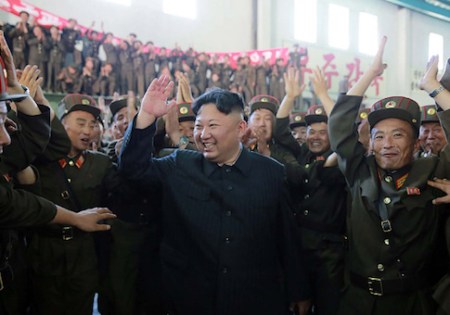
Kim Jong Un / Getty Images

Amid growing missile threats from North Korea, American missile defenses based in Alaska, California, and Guam, as well as on Navy ships, are capable of knocking out North Korean nuclear missiles, according to military leaders and experts.

Missile Defense Agency Director Air Force Lt. General Samuel Greaves said Wednesday he is confident current defenses would be effective against Pyongyang’s missiles.

“Yes, we believe that the currently deployed ballistic missile defense system can meet today’s threat, and we’ve demonstrated that capability through testing,” Greaves told a conference in Alabama.

Contrary to critics who say ground-based interceptors and naval anti-missile systems are unreliable, retired Air Force Lt. Gen. Trey Obering, a former MDA director, says the Ground-based Midcourse Defense (GMD) provides the best protection from a long-range North Korean strike.

Yet other shorter-range defenses such as the land-based Terminal High Altitude Area Defense, or THAAD, and the Navy’s ship-based Aegis SM-3 missiles can knock out medium and intermediate-range North Korean missiles, and if given enough satellite warning could attack North Korea’s ICBM warheads, he said.

“Any interceptor can intercept any missile, given the right parameters,” Obering said in an interview.

“I have high confidence that if we were attacked by North Korea we would be able to defend ourselves.”

President Trump has declared North Korea will not be allowed to develop a nuclear missile capable of striking the United States. On Tuesday he warned that continued North Korean threats against the United States would result in “fire and fury like the world has never seen.”

North Korea responded by announcing that an attack on the American Pacific island of Guam is being considered.

On Wednesday, the official KCNA news agency dismissed Trump’s warning as a “load of nonsense.”

“Sound dialogue is not possible with such a guy bereft of reason and only absolute force can work on him,” the state media organ said.

The heated rhetoric prompted Defense Secretary Jim Mattis to reiterate U.S. military capabilities, including missile defenses, in a statement Wednesday.

“The United States and our allies have the demonstrated capabilities and unquestionable commitment to defend ourselves from an attack,” Mattis said.

Noting the unified vote condemning North Korea at the United Nations on Saturday, Mattis said “Kim Jong Un should take heed” of those who agree North Korea poses a threat to global security and stability.

North Korea “must choose to stop isolating itself and stand down its pursuit of nuclear weapons,” he said, adding that Pyongyang “should cease any consideration of actions that would lead to the end of its regime and the destruction of its people.”

Mattis said Trump was notified of the growing missile threat and his first orders were to emphasize the readiness of both missile defenses and nuclear deterrent forces.

The defense secretary added that the “combined allied militaries now possess the most precise, rehearsed and robust defensive and offensive capabilities on earth,” and noted that the Kim Jong Un regime’s actions “will continue to be grossly overmatched by ours and would lose any arms race or conflict it initiates.”

Air Force Gen. John Hyten, commander of U.S. Strategic Command, said recently that he is concerned about growing missile threats from both North Korea and Iran and wants better sensors and interceptors for missile defenses.

“I’m concerned about any missile threat that is growing and can either range our allies or the United States,” he said in Omaha last month.

“But when I look at where we need to invest in future missile defenses, I see the most important thing that we have to invest in right now would be increased sensor capabilities because we need to be able to characterize the threat wherever it is on the globe in order to be able to effectively respond to it with defenses.”

Hyten also favors adding sensors in space “because you can’t have access to enough land points in the world to have a full sensor capability, so we need to go to space.”

Next is the need for improved interceptors.

“We have interceptors right now that are good enough to deal with the basic North Korean threat that is out there right now,” Hyten said. “But the threat is maturing fast and we have to improve our interceptor capability fast enough to stay with them.”

The Pentagon is developing an advanced kill vehicle that will be added current interceptors in Alaska and California. New technology is also available to deal with maneuvering warheads.

Hyten said he would favor building space sensors and better interceptors before setting up a third based on the East Coast for the Ground-based Midcourse Defense.

The Pentagon is currently conducting a major review of ballistic missile defense policy that will set the course of current and future defenses.

“There’s a ballistic missile defense review underway right now that will say where we have to go in terms of capacity, whether it’s more in the West, more in the East,” Hyten said.

“But I continue to advocate to make sure we don’t in the discussion on capacity miss the need for improved sensors and improved interceptors that will really enable decisions we have coming out of the review.”

The ground based missile defenses that would be used against a North Korean ICBM include 36 interceptors mainly based at Fort Greely, Alaska with a smaller number located at Vandenberg Air Force Base in southern California.

The interceptors are equipped with kinetic kill vehicles that travel at very high speeds and ram into enemy warheads in space.

Command centers are located in Colorado Springs and Fort Greely.

Obering said the command and control for missile defense is highly automated because of the need to respond very quickly to a missile launch by North Korea that would be spotted by special military satellites focused on North Korea.

Once detected the system predicts an “impact fan” of potential target areas and if the track indicates it is going to hit the continental United States, Alaska or Hawaii.

“If that fan touches any of the defended area that is programed into the Ground Based Midcourse system, the system automatically alerts,” Obering said.

The alert notifies commanders that a missile is inbound heading for a specific area. Then electronic sensors around the world, including radar, begin searching for the missile.

The sensor information is then fed into the fire control system that assesses which data is more reliable and selects an interceptor to attack the warhead.

“The system then determines what would be the most optimum shot, either from Vandenberg or Alaska,” Obering said. “The human has to enable it. It has to say, ‘Ok, you’re authorized to launch.’ But everything else is done automatically.”

For Guam, currently a THAAD battery is deployed to the island and Aegis missile defenses ships also are likely being deployed near the island in the event North Korea would attempt to strike the island.

North Korea has three ICBMs, the Taepodong-2, Hwasong-13, and Hwasong-14. Those would not be used for strikes on Guam. Other medium-range or intermediate range missiles such as the Musudan or Hwasong-12 could be used.

Those missiles can be countered by THAAD and Aegis ships.

Obering said current defenses are capable against North Korean missiles today but need to be upgraded. “We certainly need to add more interceptors, we need to add more sensors and we need to do much more in terms of fielding advanced capabilities to stay ahead of the North Korean threat and the Iranian threat as well,” he said.

The MDA budget should be increased to $10 billion to $12 billion annually, he said.

For example, in addition to using space satellites for warning, satellites should be used for tracking in order to provide more precision for missile defenses.

“When you do that, you get dramatically improved sensor coverage,” Obering said. Space based sensors would bolster the three most effective missile defenses: GMD, THAAD and Aegis.

Another step to increase the lethality of missile defenses would be to use what is called cooperative engagement capabilities—the ability to use multiple tracking and guidance sensors on various missile defense systems.

For example, the Navy’s SM-3 missile has a range greater than the Aegis radar and thus could be extended by using data from other longer-range radar.

“That’s what we mean by an integrated system—the ability to take any sensor and marry it with any interceptor,” Obering said.

Cooperative engagement has been tested several times and more are scheduled.

Obering said missile defenses are proving opponents wrong. Many arm control advocates for decades opposed all missile defenses by arguing the defenses undermined arms control agreements.

“Just imagine where we would have been in the late 1990s and early 2000s if we would have listened to the critics and listened to those who said we don’t need to field missile defenses,” he said.

Without missile defenses, there would be only two options for military commanders: preemptive attacks or retaliation after being attacked.

“And now we have another option and that’s very critical,” Obering said.

Mattis warns NKorea to stop before it is destroyed

August 10, 2017

Mattis warns NKorea to stop before it is destroyed, DEBKAfile, August 9, 2017

US Defense Secretary Jim Mattis warned North Korea in the strongest terms Wednesday, Aug. 9 to stop any action that would lead to the “end of its regime” and the destruction of its people.

He said in a statement: “The DPRK must choose to stop isolating itself and stand down its pursuit of nuclear weapons. The DPRK should cease any consideration of actions that would lead to the end of its regime and the destruction of its people.”

Mattis pointed out that the DPRK regime’s actions “will continue to be grossly overmatched by ours and would lose any arms race or conflict it initiates.”Mattis added that while the State Department was making diplomatic efforts, the United States and its allies have the most “precise, rehearsed and robust defensive and offensive capabilities on Earth.”

Tuesday, President Donald Trump warned:  “North Korea best not make any more threats to the United States. They will be met with fire and fury like the world has never seen.”

For Reporters, the Enemy is Trump, Not North Korea

August 10, 2017

For Reporters, the Enemy is Trump, Not North Korea, Power LineJohn Hinderaker, August 9, 2017

Last night I wrote about the fact that the Associated Press has done little or no actual reporting on the North Korea crisis, but rather has used the episode as another excuse to bash President Trump–foolishly, in this case. Earlier this evening I was on the Seth and Chris show in Phoenix, talking about the AP’s absurd coverage of Trump and Kim Jong Un.

Michael Ramirez’s most recent cartoon picks up on the theme of my post with Ramirez’s usual flair. Click to enlarge:

Most of the liberal press has little interest in Kim Jong Un or the prospect of nuclear bombs landing in Japan, South Korea, Hawaii, America’s West Coast or Guam. They are crazed. Their only enemy is President Trump. We have never seen anything like it before.

Trump, Putin, Xi: Talking fades to shows of force

July 31, 2017

Trump, Putin, Xi: Talking fades to shows of force, DEBKAfile, July 31, 2017

(Please see also, Haley Says ‘No Value’ in Another UN Resolution Against North Korea: ‘The Time for Talk Is Over’. — DM)

The message from Beijing was clear: The threat to Chicago and Los Angeles would have to be dealt with by the White House in Washington, not Beijing.

********************************

Over the weekend, three world leaders, US president Donald Trump, Russia’s Vladimir Putin and China’s leader Xi Jinping stepped off the diplomatic path over their differences on world issues and switched to displays of military might.

In a show of force after North Korea’s two ICBM tests, two US B-1B bombers capable of delivering nuclear weapons, escorted by South Korean and Japanese fighters, took off from Guam Saturday, July 29 and cut across the Korean peninsula. There was no word on whether they entered North Korean skies.

Further west, US Vice President Mike Pence toured East European capitals. Speaking in Tallinn, Estonia, he assured “our Baltic allies” – as well as Georgia and Montenegro, his next destinations: “We are with you and will stand with you on behalf of freedom.”  He said that the president would soon sign the latest round of sanctions voted on by Congress, since “Russia’s destabilizing activities and support for rogue regimes and its activities in Ukraine are unacceptable.”

Shortly after President Donald Trump criticized China over failing to deal with North Korea, President Xi Jinping in a general’s uniform viewed a huge military parade Sunday marking the People’s Liberation Army’s 90th anniversary. Xi is the PLA’s commander in chief. Whereas the annual parade usually takes place in Beijing, this one was staged at the remote Zhurihe military base in Inner Mongolia., with the participation of 12,000 soldiers, 100 bombers and fighters and a display of 600 weapons systems, 40 percent of them new products of China’s arms industries.
“The world isn’t safe at the moment,” the Chinese president told his people. “A strong army is needed more than ever.”

The Russian president meanwhile showcased his naval might in a huge parade of vessels stretching from the Dnieper River in Moscow to Saint Petersburg, through the Baltic port of Kaliningrad, to Crimea on the Black Sea and up to Russia’s Syrian base at Tartus.  Taking part were 50 warships and submarines.

Standing on the deck of the presidential warship as it sailed past the Kremlin’s walls, Putin congratulated the Russian navy on its great advances.

He then disembarked, headed to his office and ordered 755 U.S. diplomats to leave the country by Sept. 1, in retaliation for the new round of sanctions against Russia ordered by the US Congress. More than 1,000 people are currently employed at the Moscow embassy and three US consulates in Russia.

“We waited for quite some time that maybe something will change for the better, had much hope that the situation will somehow change, but, judging by everything, if it changes, it will not be soon,” Putin said. “It is time for us to show that we will not leave anything unanswered.” He added menacingly that there are many areas of Russian-American cooperation whose discontinuation would be harmful to the US. “I hope we don’t have to go there,” he said.

These muscle-flexing steps by the three world powers add up to an ominous shift from their brink-of-cold war diplomatic interaction to a new level with the potential for tipping over into limited military clashes.

The penny has finally dropped for Trump that President Xi has no intention of cracking down on North Korea’s Kim Jong-un, even though he declared after a successful second test of an intercontinental ballistic missile that “the US mainland is without our striking range.”

The message from Beijing was clear: The threat to Chicago and Los Angeles would have to be dealt with by the White House in Washington, not Beijing.

Xi may accept that the US president may eventually be forced to take some military action against North Korea’s missile and nuclear facilities. But he may also be counting on such action being a one-off, like the 59-US Tomahawk missile barrage that hit the Syrian air base of Shayrat on April 7.  Because that dramatic strike was not the start of an organized campaign against the regime in Damascus, it failed to unseat Bashar Assad and in fact made him stronger. Once America has vented its anger, the Chinese president hopes its military offensive against Kim will be over and done with.

For six months, Putin waited to see whether Trump was able to beat down the media-boosted war waged against his presidency by political and intelligence enemies at home, much of it focused on the Russian dimension. His patience with the US president and his troubles at home is clearly at an end.

On Sunday, July 30, Russian Deputy Foreign Minister Sergei Ryabkov called the new sanctions “completely weird and unacceptable,” adding “If the US side decides to move further towards further deterioration we will answer, we will respond in kind. We will mirror this. We will retaliate,” he stressed.

The gloves have clearly come off for the ramping up of friction among the three powers in the various world flashpoint arenas, whether in Europe, the Far East, or other places.

What Iran Replacing China as North Korea’s Global Best Friend Means to Us

July 29, 2017

What Iran Replacing China as North Korea’s Global Best Friend Means to Us, BreitbartJames Zumwalt, July 28, 2017

(Collaboration on Nukes and missiles between Iran and North Korea is clear and well documented. But why would Kim let Iran take the “glory” of nuking America? He can escape death by going to Iran for “consultation” shortly before one of his nukes hits America.– DM)

Office of the Iranian Supreme Leader via AP / AP Photo/Wong Maye-E

What we must recognize, however, is that a North Korea capable of striking the US with nuclear weapons will result in nuclear conflict. Interestingly, this will not happen as a result of an attack initiated by Pyongyang. Kim is smart enough to understand the concept of Mutual Assured Destruction (MAD) by which any nuclear attack he launched against the US would lead to his own annihilation—obviously an outcome no narcissistic despot desires.

It will lead to a nuclear conflict in which Kim intends not to be a party, but a spectator.

*************************************

The only thing more difficult than attempting to stop one rogue nation from acquiring nuclear weapons is attempting to stop two rogue nations collaborating to do so.

As we explore our options in shutting down North Korea’s nuclear weapons and missile programs, we must recognize we are also dealing with Iran’s programs, which have piggybacked upon Pyongyang’s. Ever since Iran’s war with Iraq (1980-1988), during which North Korea began providing Tehran with SCUD missiles, both countries nurtured a relationship that would allow them eventually to gain membership into the nuclear arms club.

In recent years, the evolution of this relationship has allowed Iran to step into the shoes of North Korea’s former and longtime best friend, China. It is also why China has been unresponsive to U.S. calls to reel Pyongyang in.

North Korea’s leadership behaves as if it has determined that it no longer needs China as its “big brother,” as Iran is committed to seeing Kim acquire a nuclear arsenal and delivery system for it. Tehran’s mullahs have not hesitated to use Pyongyang over the past several years as a test case for American resolve. As such resolve has been non-existent, Iran came to recognize it could move forward simultaneously and in coordination with Pyongyang.

Having developed this close working relationship, Iranian observers began showing up at North Korean military tests. It was also this relationship that led to North Korean technicians working secretly to build a nuclear facility in Syria. Its development was closely monitored by Israel which, after the U.S. refused to take action to stop construction, destroyed it in an air attack in September 2007.

Undoubtedly, this nuclear facility was yet another effort by Iran – this time using its Syrian proxy, President Bashir Assad – to test our resolve. While Tehran found ours lacking, Israel’s was not. One can only imagine, had Israel not destroyed it then, ISIS seeking to capture it later.

As we weigh what option to take with North Korea, we must recognize, first of all, decades of diplomacy and sanctions have never worked. Kim will only use any future diplomatic efforts to extract concessions, as has been done in the past, lulling us to believe the crisis is over when it is not. Kim will relentlessly continue his missile and nuclear program. His motivation for doing so is twofold: to achieve a nuclear deterrent and to add to his prestige as a world leader. He has vowed never to give up his nuclear program and, as such, would lose face in the eyes of his people if he does now.

What we must recognize, however, is that a North Korea capable of striking the US with nuclear weapons will result in nuclear conflict. Interestingly, this will not happen as a result of an attack initiated by Pyongyang. Kim is smart enough to understand the concept of Mutual Assured Destruction (MAD) by which any nuclear attack he launched against the US would lead to his own annihilation—obviously an outcome no narcissistic despot desires.

It will lead to a nuclear conflict in which Kim intends not to be a party, but a spectator.

The North Korean strongman has received millions of dollars from the Iranians to continue his programs to develop nuclear weapons and a delivery system. Undoubtedly, much of this funding has come from the billions of dollars Obama sent the mullahs while negotiating the nuclear deal. Such weapons will then be acquired by Tehran as well. And, as firm believers in the eschatological Mahdi prophecy, the mullahs view MAD not as a threat to their existence but as a means of attaining their afterlife in Paradise.

For Kim, it is all about money and prestige. But if we fail to take military action to deny him his nuclear goal, we do need to forewarn him that any nuclear attack by Iran against the US or an ally will be deemed an attack by North Korea as well.

Unfortunately, at least nine U.S. presidents have believed reason ultimately would trump North Korea’s behavior. It has not. In fact, dozens of acts of aggression by its leadership against the U.S. and our allies have been documented in a 2007 report to Congress—from attacking and capturing a US Navy ship to shooting down a US military plane to assassinating South Koreans to kidnapping Japanese to sinking an ROK frigate—all failing to generate a military response. It has only emboldened additional bad behavior, leading today to a situation in which the Pyongyang/Tehran nexus has stacked the deck against us as our viable options can only be described as “lousy.” It now leaves us more threatened than ever before by a nuclear attack.

Sadly, threatening Kim’s personal survival in the event such an attack by Iran occurs may be the only card we have left to play.

How to neutralize the North Korea threat

July 11, 2017

How to neutralize the North Korea threat, Washington Times,  Ronald Kessler, July 10, 2017

(Here’s a May 16th video about the capabilities of the technology:

The new technology is similar to EMP but more selective and therefore more accurate. It seems excellent. — DM)

Illustration on way to neutralize the North Korean threat by Alexander Hunter/The Washington Times

They may sound like science fiction, but no doubt Mr. Trump has both HPM and robotic weapons in mind when he says he is contemplating “pretty severe things” to counter the North Korean threat.

**********************************

ANALYSIS/OPINION:

Whenever we hear about viable options for stopping North Korea’s nuclear ambitions, the answer is always the same: There are none. Any military strike against that country would result in retaliation against South Korea, we are told.

But what has gone largely unnoticed in the media is that there are viable alternatives to waiting passively until North Korea has the capability of wiping out millions of Americans with nuclear weapons. The first is the U.S. Air Force’s development of missiles that zap electronics with high-power microwaves (HPM).

That capability, which is entirely different from cyberwarfare designed to confuse computers, has been advancing secretly ever since the Air Force successfully tested use of a missile equipped with HPM in 2012.

Called the Counter-Electronics High Power Microwave Advanced Missile Project (CHAMP), the missile was built by Boeing’s Phantom Works for the U.S. Air Force Research Laboratory at a cost of $38 million. The Boeing missile emits high power microwaves that fry computer chips so that no electronic devices targeted by the missile can operate.

On Oct. 16, 2012, the CHAMP missile flew over a two-story building on the Utah Test and Firing Range. The building in the west Utah desert was crammed with computers and security and surveillance systems. The microwaves took down the compound’s entire spectrum of electronic systems, including video cameras set up to film the test, without damaging anything else.

“We hit every target we wanted to,” Boeing’s CHAMP Program Manager Keith Colman said in a company press release. “Today we made science fiction into science fact.”

Until the announcement of the successful test, the project had been top secret. When it was announced, only a few trade publications ran the story, and since then, beyond a few mentions, the media have ignored the story. Instead, they have focused on how impossible it is to deal with the North Korea threat.

The beauty of the HPM missile is that its microwave beam can penetrate bunkers where facilities are hidden without harming humans inside. Even if a bunker is buried inside a mountain, HPM penetrates the facilities through its connections to power cables, communication lines and antennas. Thus, HPM can penetrate any underground military facility and fry its electronics.

While North Korea may attempt to shield its equipment, U.S. officials doubt that would be effective against CHAMP.

Most amazing of all, the missile renders inoperable any radar that might detect it as it flies to and from a target. Thus, a country cannot take out CHAMP before it strikes and has no way of knowing why its facilities have suddenly gone dead.

Besides underground bunkers, HPM can quickly disable fighter planes, tanks, ships and missile systems. And it can wipe out facilities for developing and testing nuclear weapons.

Unlike an electromagnetic pulse (EMP) created by detonating a nuclear weapon in the atmosphere, because it is targeted, HPM leaves intact civilian facilities needed to sustain life. Unlike any other existing system like cyber-attacks, CHAMP permanently destroys electronic equipment.

America’s national laboratories operated by the Department of Energy have been working on these capabilities for decades. Equally impressive, one of those laboratories, Sandia National Laboratories, has been developing robots the size of insects that could assassinate the North Korean leader with deadly toxins.

These robotic weapons using nanotechnology employed in surgical operations in hospitals are being developed secretly with funding by the Defense Advanced Research Projects Agency.

While President Ford banned assassinations with an executive order, that order was based on the assumption that other world leaders are rational and would refrain from trying to assassinate our president unless we tried to assassinate them. But we are dealing today with terrorist organizations and world leaders who are not rational and do not care if they are killed.

President Trump could reverse Ford’s obsolete executive order with the stroke of a pen. With robotlike weapons using nanotechnology, the CIA could wipe out Kim Jong-un without risking American lives.

They may sound like science fiction, but no doubt Mr. Trump has both HPM and robotic weapons in mind when he says he is contemplating “pretty severe things” to counter the North Korean threat.

While President Obama preached “strategic patience” in dealing with North Korea, Mr. Trump has made it clear he will not stand by while the North Korean leader threatens our survival.

Top Armed Services Dem: Russia, China ‘Spectacularly Disingenuous’ on North Korea

July 5, 2017

Top Armed Services Dem: Russia, China ‘Spectacularly Disingenuous’ on North Korea, PJ MediaBridget Johnson, July 5, 2017

(Please see also, North Korean Missiles Reaching USA. President Trump seems to have decided that joint action with China and Russia won’t work and that unilateral action by America will be needed. — DM)

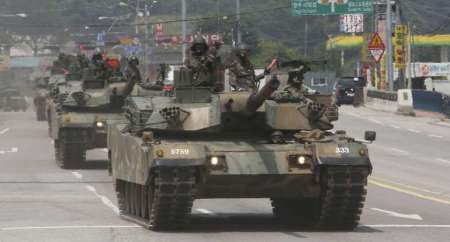
South Korean army K-1 tanks move during the annual exercise in Paju, South Korea, near the border with North Korea, on July 5, 2017. (AP Photo/Ahn Young-joon)

China and Russia issued a joint statement calling Pyongyang’s ICBM test “unacceptable.”

“The two sides propose that the DPRK (North Korea) as a voluntary political decision declares a moratorium on testing nuclear explosive devices and ballistic rocket launches, and the US and South Korea refrain from carrying out large-scale joint exercises,” the statement said. “Parallel to this, the opposing sides should start negotiations and affirm general principles of their relations including the non-use of force, rejection of aggression and peaceful co-existence.”

“Neither one of them is doing a darn thing to stop North Korea. And they want to use it as an excuse to push us out of the region,” he added. “What we have to make clear to them is it’s going to have the exact opposite effect. Once North Korea is able to threaten us and even now, as they threaten our allies, we have to be in there to protect our own interests. 

******************************

The top Democrat on the House Armed Services Committee declared this morning that the “threat from North Korea, regrettably, is not going to be removed” by the “global action” proposed by the Trump administration to curb Kim Jong-un’s behavior.

Pyongyang said Tuesday that it successfully test-fired Hwasong-14, a long-range intercontinental ballistic missile. According to Chosun Ilbo in South Korea, state TV in the North declared the regime “a full-fledged nuclear power… possessed of the most powerful intercontinental-ballistic rocket capable of hitting any part of the world.”

Kim reportedly watched the launch at the scene. The missile, said to be capable of reaching Alaska or Hawaii, flew for 39 minutes before hitting open waters.

Secretary of State Rex Tillerson issued a statement Tuesday evening condemning the July Fourth launch. “Testing an ICBM represents a new escalation of the threat to the United States, our allies and partners, the region, and the world,” he said. “Global action is required to stop a global threat.”

“Any country that hosts North Korean guest workers, provides any economic or military benefits, or fails to fully implement UN Security Council resolutions is aiding and abetting a dangerous regime. All nations should publicly demonstrate to North Korea that there are consequences to their pursuit of nuclear weapons. We intend to bring North Korea’s provocative action before the UN Security Council and enact stronger measures to hold the DPRK accountable,” Tillerson continued.

“The United States seeks only the peaceful denuclearization of the Korean Peninsula and the end of threatening actions by North Korea. As we, along with others, have made clear, we will never accept a nuclear-armed North Korea.”

President Trump and his national security team “are continuing to assess the situation in close coordination with our allies and partners,” he added.

Armed Services Committee Ranking Member Adam Smith (D-Wash.) doubted that Tillerson’s vow would put pressure on North Korea.

“If there is an idea floating around out there for how we can remove that threat, I’m open to it. But we have been circling around this discussion of what we want China to do and what we want sanctions to do and all these other different pieces,” Smith said. “The bottom line is, what we need against North Korea, we need to put the best economic sanctions we can. I think it’s perfectly appropriate for the secretary of state to try to put pressure on other nations to do the same. But the most important thing we need is a credible military deterrent, so that whatever North Korea does in terms of building a missile, they know that if they act against South Korea or against Japan or against us, we will obliterate them.”

“That’s why THAAD [missile defense system] is important. That is why our alliance with South Korea and Japan is important, to have that credible military force, because what’s been proven — and all of the options have been discussed with your previous guests — is that North Korea is going to do it. They want to build nuclear weapons. They want to develop an intercontinental ballistic missile. And short of an all-out war on the Korean Peninsula, we don’t really have an option for stopping them.”

China and Russia issued a joint statement calling Pyongyang’s ICBM test “unacceptable.”

“The two sides propose that the DPRK (North Korea) as a voluntary political decision declares a moratorium on testing nuclear explosive devices and ballistic rocket launches, and the US and South Korea refrain from carrying out large-scale joint exercises,” the statement said. “Parallel to this, the opposing sides should start negotiations and affirm general principles of their relations including the non-use of force, rejection of aggression and peaceful co-existence.”

Smith slammed the statement as “spectacularly disingenuous.”

“Neither one of them is doing a darn thing to stop North Korea. And they want to use it as an excuse to push us out of the region,” he added. “What we have to make clear to them is it’s going to have the exact opposite effect. Once North Korea is able to threaten us and even now, as they threaten our allies, we have to be in there to protect our own interests. China’s not acting against North Korea. And the reason they’re not acting against North Korea is, they don’t want to cut off North Korea’s economic aid. They don’t want North Korea to collapse because they don’t want millions of North Korean refugees pouring across their border. They’re not happy that North Korea is causing such instability in the region, but the alternative of them trying to crush the regime somehow is something they’re not willing to do, and they haven’t been willing to do it through four administrations. So, we need a credible military deterrent, and that is our only option.”

Smith noted that Kim’s actions have been “all about ensuring regime survival,” as he’s “looked at Iraq and Afghanistan and Libya, and they feel that unless they have a nuclear weapon and a credible deterrent of their own, that their regime is in jeopardy.”

“So, all the economic sanctions, all that needs to be done. But understand what I’m saying here. As you have discussed, there is not a good military option,” he said. “Thinking that we can preemptively go in there and somehow take out their capabilities, whatever we do leads to a massive war in the Korean Peninsula… we need our THAAD system in the region. We need a system to give us a shot at shooting down that missile if they decide to launch it. And then we also need a clear diplomatic policy that we will destroy them.”

After the THAAD system was installed in South Korea, Trump said Seoul should fork over a billion dollars for the missile defense. New South Korean President Moon Jae-in recently suspended further THAAD deployment pending a review of the program.

Smith stressed that Russia and China must “stop screwing around.”

“If you guys really want us to be less involved in the region, then you have got to figure out a way to control North Korea,” he said. “Now, I don’t think they’re going to do that. But that means that we have to stay active in the region.”

North Korean Missiles Reaching USA

July 5, 2017

North Korean Missiles Reaching USA, Front Page MagazineMatthew Vadum, July 5, 2017

(Peace talks have failed and the leftist view seems to be “if at first you don’t succeed try the same thing again.” President Trump does not agree and is no longer willing to rely on China. He recently tweeted, “Trade between China and North Korea grew almost 40% in the first quarter. So much for China working with us – but we had to give it a try!” Please see also, Trump Hits China Over Trade Relationship With North Korea. If, as is now apparent, China wants more fruitless negotiations, it’s time to employ our military resources to eliminate North Korea’s nuclear and missile capabilities. An EMP attack could be effective.– DM)

But Americans are finally being disabused of left-wing arms control fantasies, and fortunately, after eight years of dithering and appeasement, we now have a president who actually wants to defend the country from external threats.

And alongside President Trump there are serious adults in the White House and Foggy Bottom willing to respond with an appropriate show of force to the latest provocation from Pyongyang and take other necessary action.

Pentagon spokesman Dana White said “we remain prepared to defend ourselves and our allies and to use the full range of capabilities at our disposal against the growing threat from North Korea.”

*************************************

Less than six months into Donald Trump’s presidency America has awakened to the nightmare of a North Korea armed with intercontinental ballistic missiles that the Trump administration says are capable of reaching Alaska.

U.S., South Korean, and Japanese officials say the North Korean Hwasong-14 ICBM flew approximately 580 miles in 40 minutes and achieved an altitude of 1,500 miles, besting previously reported North Korean test results. North Korea’s successful but unexpected test is a sobering reminder of how urgently the United States needs to ramp up its antiballistic missile program after years of reckless military downsizing by the Obama administration.

The North Korean launch was “the big story we have all been waiting for,” Professor Bruce Bechtol of Angelo State University in Texas told Fox News on Tuesday. “All of the paradigms have changed. It is now time to see what action the USA will take.”

The missile was apparently launched from a mobile launcher, which “nearly destroys our warning time and also means that the North Koreans have a real shot at launching this system at us without us being able to destroy it on the ground.”

North Korea also carried out a successful ballistic missile test on May 14, and the U.S. Missile Defense Agency conducted its first successful interception of an ICBM on May 30. A long-range ground-based interceptor missile launched from Vandenberg Air Force Base in California hit and destroyed the ICBM launched from the U.S. Army’s Reagan Test Site on Kwajalein Atoll in the Marshall Islands.

This idea of missile defense, oft-compared to trying to shoot a bullet with another bullet, grew out of President Reagan’s Strategic Defensive Initiative (SDI), derided by left-wingers at the time and for years after as “Star Wars.” Unsurprisingly, Barack Obama used to scoff at the idea that a missile could take out another missile.

Meanwhile, Monday evening after news of the successful Hwasong-14 ICBM test broke, President Trump took to Twitter.

North Korea has just launched another missile. Does this guy have anything better to do with his life? Hard to believe that South Korea and Japan will put up with this much longer. Perhaps China will put a heavy move on North Korea and end this nonsense once and for all!

Apparently, “this guy” refers to dictator Kim Jong-un. Communist China has been propping up Kim’s dictatorship for years. The Trump administration wants China to push its North Korean ally harder to scrap its nuclear weapons program.

During Independence Day remarks at a picnic for military families on the South Lawn of the White House Trump did not refer to North Korea’s activities but said, “we do have challenges, but we will handle those challenges. Believe me.”

How did we get to this dangerous juncture in world affairs?

Blame the Left. After all, it’s not rocket science.

While left-wingers in Washington were busy reaching out to Islamofascists and projecting American weakness on the international scene over the eight long years of Barack Obama’s presidency, Kim Jong-il and his heir Kim Jong-un were busy transforming their Stalinist hellhole of a country into a nuclear power. They were aided not just by the permissive Obama administration, which did more or less nothing to curb Pyongyang’s nuclear ambitions, but also years earlier by the enabling Clinton administration.

In 1994 Bill Clinton unveiled an agreement between the U.S. and North Korea that he claimed would achieve “an end to the threat of nuclear proliferation on the Korean Peninsula.” Under the deal, North Korea “agreed to freeze its existing nuclear program and to accept international inspection of all existing facilities,” Clinton said at the time. The pact “is good for the United States, good for our allies, and good for the safety of the entire world.”

But Americans are finally being disabused of left-wing arms control fantasies, and fortunately, after eight years of dithering and appeasement, we now have a president who actually wants to defend the country from external threats.

And alongside President Trump there are serious adults in the White House and Foggy Bottom willing to respond with an appropriate show of force to the latest provocation from Pyongyang and take other necessary action.

While American and South Korean forces conducted joint ballistic missile drills following the North’s ICBM test, Secretary of State Rex Tillerson said yesterday that the U.S. government would “never accept a nuclear-armed North Korea.” He urged countries around the world to fully enforce UN sanctions against the rogue nation, saying “global action is required to stop a global threat.”

Pentagon spokesman Dana White said “we remain prepared to defend ourselves and our allies and to use the full range of capabilities at our disposal against the growing threat from North Korea.”

The UN Security Council may convene an emergency meeting as soon as today. On Twitter, U.S. Ambassador to the UN Nikki Haley demonstrated her exasperation at having to devote her Independence Day holiday to emergency consultations by using the hashtag “#ThanksNorthKorea.”

Haley doesn’t have it quite right. If she wants to sarcastically “thank” anybody for the North Korean ICBM test, she should be “thanking” Barack Obama and Bill Clinton, whose suspect policies helped a pariah nation join the nuclear club.

North Korea claims it tested first intercontinental missile

July 4, 2017

North Korea claims it tested first intercontinental missile, Washington Times, , July 4, 2017

This image made from video of a news bulletin aired by North Korea’s KRT on Tuesday, July 4, 2017, shows what was said to be North Korea leader Kim Jung Un, center, applauding after the launch of a Hwasong-14 intercontinental ballistic missile, ICBM, in North Korea’s northwest.

SEOUL — North Korea claimed to have tested its first intercontinental ballistic missile in a launch Tuesday, a potential game-changing development in its push to militarily challenge Washington — but a declaration that conflicts with earlier South Korean and U.S. assessments that it had an intermediate range.

The North has previously conducted satellite launches that critics say were disguised tests of its long-range missile technology. But a test-launch of an intercontinental ballistic missile, if confirmed, would be a major step forward in developing a nuclear-armed missile that can reach anywhere in the United States.

Still, the launch appeared to be the North’s most successful missile test yet, a weapon analyst said could be powerful enough to reach Alaska.

The launch seems designed to send a political warning to Washington and its chief Asian allies, Seoul and Tokyo, even as it allows North Korean scientists a chance to perfect their still-incomplete nuclear missile program. It came on the eve of the U.S. Independence Day holiday, days after the first face-to-face meeting of the leaders of South Korea and the United States, and ahead of a global summit of the world’s richest economies.

U.S., South Korean and Japanese officials say the missile fired from North Phyongan province, in the North’s western region, flew for about 40 minutes and reached an altitude of 2,500 kilometers (1,500 miles), which would be longer and higher than any other similar tests previously reported. It also covered a distance of about 930 kilometers (580 miles). South Korean analysts said it was likely that it was a retest of one of two intermediate-range missiles launched earlier this year.

Once U.S. missile scientist, David Wright, estimated that the missile, if the reported time and distance are correct, would have been on a very highly lofted trajectory and could have a possible maximum range of 6,700 kilometers (4,160 miles), which could put Alaska in its range, if fired at a normal trajectory.

North Korea has a reliable arsenal of shorter-range missiles, but is still trying to perfect its longer-range missiles. Some analysts believe North Korea has the technology to arm its short-range missiles with nuclear warheads, but it’s unclear if it has mastered the technology needed to build an atomic bomb that can fit on a long-range missile.

Soon after the morning launch, President Donald Trump responded on Twitter: “North Korea has just launched another missile. Does this guy have anything better to do with his life? Hard to believe that South Korea and Japan will put up with this much longer. Perhaps China will put a heavy move on North Korea and end this nonsense once and for all!”

“This guy” presumably refers to North Korean leader Kim Jong Un. China is North Korea’s economic lifeline and only major ally, and the Trump administration is pushing Beijing to do more to push the North toward disarmament.

Japanese Chief Cabinet Secretary Yoshihide Suga suggested the altitude of this missile might have been higher than earlier tests. He did not give further details, including the distance of the flight and where in Japan’s exclusive economic zone in the Sea of Japan the missile landed.

Just last week South Korean President Moon Jae-in and Trump met for the first time and vowed to oppose North Korea’s development of atomic weapons.

Japan’s Prime Minister Shinzo Abe sharply criticized North Korea for the launch. “The latest launch clearly showed that the threat is growing,” Abe said.

Abe, who talked by phone with Trump on Monday, said the two leaders plan to seek cooperation from world leaders when they attend a G20 summit in Germany.

Lee Illwoo, a Seoul-based military commentator, said the missile traveled for a far longer period of time than if it would have been fired at a normal angle. A North Korean scud-type missile, with a range of 800-900 kilometers, would land in its target site within 10 minutes if fired at a standard angle of 45 degrees. Lee said it’s likely that North Koreafired either Hwasong-12 missile or a solid-fuel Pukguksong-2, both of which were tested in May.

On May 14, North Korea launched the Hwasong-12 missile, which its state media later said flew as high as 2,111 kilometers (1,310 miles) and landed in a targeted area in the ocean about 787 kilometers (490 miles) from the launch site. On May 21, North Korea also tested the Pukguksong-2, which traveled about 500 kilometers (310 miles).

China’s U.N. ambassador, Liu Jieyi, warned Monday that further escalation of already high tensions with North Korea risks getting out of control, “and the consequences would be disastrous.”

The Korean Peninsula has been divided since before the 1950-53 Korean War. Almost 30,000 U.S. troops are stationed in South Korea.

Tuesday’s launch is the first by the North since a June 8 test of a new type of cruise missile that Pyongyang says is capable of striking U.S. and South Korean warships “at will.”

Since taking office on May 10, Moon has tried to improve strained ties with North Korea, but the North has continued its missile tests. Pyongyang says it needs nuclear weapons and powerful missiles to cope with what it calls rising U.S. military threats.

A nuclear trip wire for North Korea

June 29, 2017

A nuclear trip wire for North Korea, Washington TimesDaniel Gallington, June 28, 2017

(Don’t pussyfoot around. — DM)

Illustration on locking down North Korea’s nuclear weapons threat by Linas Garsys/The Washington Times

ANALYSIS/OPINION:

Now that North Korea has a bunch of nukes and is testing ways to deliver them by ballistic missile, we need to address the stark realities of what this new threat really means for us.

And just as important — what it should mean for them.

However, before we begin, it should now be a reality for us that negotiations with fat boy Kim Jong-un’s regime are a total waste of our time, energy and money, just as they were with his stroked-out father’s crew.

Politically, of course, this result was the collective failure of our State Department, the Clinton, Bush and Obama administrations, together with the defective concept of the “Six Party Talks.” The only “accomplishment” was to provide the time and diplomatic cover for the Democratic People’s Republic of Korea’s nuke program, plus give the regime lots of oil and money in the process. In short, the Six Party Talks enabled North Korea’s nuke weapons program. If this sounds familiar, Barack Obama and John Kerry made the same mistakes with Iran.

So, North Korea is now a dangerous nuclear rookie and we must develop — and articulate — policies that reflect, in the words of Defense Secretary James Mattis, the “clear and present danger” they represent.

What should our new policies look like? What should be the “red lines,” and what North Korean behaviors should cause virtually automatic responses from us? As this is a whole new ball game, what should be the thresholds for our responses and what should we be telling the Russians and Chinese about it?

This because nothing we do in response to North Korean aggressive behaviors should come as a surprise to anyone.

It also seems clear we need both short- and longer-term strategies. Along with this approach, we should rule out a number of troublesome scenarios for possible armed conflicts with North Korea — in other words, let’s also define those situations in which we simply will not “play.”

Shorter-term strategies: The short term is, for a number of reasons, the most dangerous. This is because it’s the nuclear muscle-flexing stage for the fat boy and also the period he is most likely to make a mistake or do something dumb. For this same reason, it’s also the period when our responses should be in the virtually “automatic” mode, including pre-emptive strikes.

While there are a number of scenarios that should be addressed, there are a few that deserve special attention. In this category should be a pre-planned nuclear response option for each North Korean action:

• Preparations for a massive artillery attack on Seoul.

• Massing troops at the border.

• Interception of ocean or coastal traffic.

• Interception of aviation.

• Launch of any ballistic missile with an aggressive trajectory.

Longer-term strategies: These should be developed with urgency, but on a different track from the shorter-term ones. In this category should be:

• Discussions with the Japanese for a cooperative nuclear relationship.

• Re-positioning nuclear assets — and nuclear-capable assets — to and around the Korean peninsula.

• Excluding North Korea from any relevant diplomatic discussions; maximizing all types of sanctions — in the U.N. and domestically; terminating any remaining Six Party benefits.

• Working trade embargoes; interceptions of suspicious commerce; very aggressive information operations.

Defining when we won’t “play”: This category is as important as the other two — maybe more so, because it is the essence of deterring the fat boy from doing something stupid. Here are some things we won’t do in context of any conflict or confrontation with the North:

• A land war on the Korean peninsula — been there, done that.

• A build-up of our conventional forces in the region in response to North Korean aggressive behaviors — gradualism does not work.

• Any kind of negotiations with the North — they have given up this option.

Combined, these strategies are intended to have a simple “message” for the North Korean regime: We have defined the limits of your behavior. If you cross the lines, our response will be quick — and pre-emptive if we decide you are about to do something dumb. The response will be nuclear if that is appropriate for the risk you present to us — and in that event, you will cease to exist as a political entity.

Perhaps as important as promulgating these strategies is that they be articulated publicly and fully briefed to our allies and enemies alike.

A useful analogy: During the Cold War, we had a SIOP — a Single Integrated Operational Plan — that included a targeting doctrine (promulgated during the Carter administration) that focused on the top Soviet leadership. My personal experience during the ‘80s was that the leadership-targeting aspect of the SIOP got the attention of the Soviets, along with President Reagan’s Strategic Defense Initiative.

Will the fat boy behave differently if we promulgate the strategies described above? That’s his choice, of course, but if he doesn’t, he should realize that the slightest miscalculation on his part, let alone a dangerous overt act, could cause the end of him and his regime. In short, he has no margin for error — nor do we — and it should surprise no one.

• Daniel Gallington served through 11 rounds of bilateral negotiations in Geneva as a member of the U.S. Delegation to the Nuclear and Space Talks with the former Soviet Union.