Posted tagged ‘North Korean nukes’

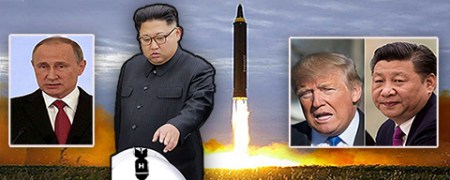
Kim Jong Un’s Thermonuclear Joyride

September 4, 2017

Kim Jong Un’s Thermonuclear Joyride, PJ MediaClaudia Rosett, September 3, 2017

(According to CBS

South Korea’s Defense Ministry said on Monday that North Korea appeared to be planning another missile launch, possibly of an intercontinental ballistic missile (ICBM) to show off its claimed ability to target the United States with nuclear weapons.

Will it be a sufficient “threat” to precipitate a military response? — DM)
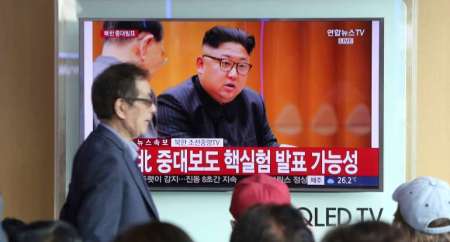
People watch a TV news program showing North Korean leader Kim Jong Un at the Seoul Railway Station in Seoul, Sunday, Sept. 3, 2017. North Korea said it set off a hydrogen bomb Sunday in its sixth nuclear test, which judging by the earthquake it set off appeared to be its most powerful explosion yet. The signs read “North Korea, important announcement.” (AP Photo/Ahn Young-joon

What ought to be clear by now is that North Korea’s Kim regime is not going to be stopped by any niceties at the diplomatic bargaining table — even if Kim agrees at some stage to parley. For North Korea, deals in the past have amounted to nothing more than pitstops, a chance to refresh and refuel. There is no reason to expect anything better of Kim Jong Un, who clearly has a liking for the nuclear accelerator. Nor is it wise to expect that China or Russia will stop this pioneering tyrant who in the 21st century is doing such a standout job of humiliating and threatening the mighty United States.

For Kim Jong Un, what a joyride.

For President Trump, for Mattis, for South Korea, for Japan, for the entire free world, what a horrifying conundrum to inherit.

And the longer it goes on, quite likely the worse, for all of us, the crash.

****************************

Following North Korea’s sixth nuclear test, advertised by Pyongyang as an ICBM-ready hydrogen bomb, it was good to hear Defense Secretary James Mattis talking tough. But that won’t stop North Korea from building nuclear missiles. It won’t stop North Korea’s threats against the U.S. and our allies. I’d wager it won’t even interfere with Kim Jong Un’s enjoyment of his apparently ample meals.

Mattis stressed Kim’s peril in his remarks on Sunday, when he said: “Any threat to the United States or its territories, including Guam or our allies will be met with a massive military response.” Mattis added the backhanded threat that “we are not looking to the total annihilation of a country, namely, North Korea, but as I said, we have many options to do so.”

But does Kim have any reason to think the U.S. would exercise those options?

North Korea has long been a geyser of threats, including its threat last month to use the U.S. territory of Guam for missile practice, its launch last month of a ballistic missile over Japan, and its threat accompanying Sunday’s nuclear test that it could use thermonuclear weapons for a “super-powerful EMP attack.”

The U.S., Japan and South Korea have responded with shows of force, but like a multitude of displays done before, the de facto message is one of great muscle but no will to fight. None of that force has been used to strike North Korea. Kim holds Seoul hostage, and America, while groping for a solution to North Korea’s rapidly compounding threats, has no appetite to risk a replay of the carnage of the 1950-1953 Korean War, potentially amplified by nuclear weapons in the hands of Pyongyang.

With the caveat that I have no inside information, it’s intriguing to imagine what’s going on right now in Kim Jong Un’s head. He’s a young tyrant, now in his mid-thirties, who inherited power upon the death of his father, Kim Jong Il, in December 2011. Some young men inherit a family fortune. Kim inherited supremacy over a totalitarian ruling party, fully accessorized with a nation state, a gulag, a nuclear weapons program and one of the world’s largest standing armies — with artillery already dug in to threaten the fat prize of capitalist Seoul, with its population of 10 million South Koreans just the other side of the Demilitarized Zone.

Since inheriting the keys to this grotesque family estate, Kim has presided over four of North Korea’s six nuclear tests to date (one in 2013, two in 2016 and the latest this Sunday). Under his rule, North Korea has amassed a nuclear arsenal estimated by various experts to be in the double digits, perhaps now including thermonuclear weapons. On Kim Jong Un’s watch, North Korea has advertised its pursuit of the ability to launch nuclear missiles from submarines, and acquired the ability to miniaturize nuclear warheads and mount them on missiles. In July, North Korea succesfully tested two ICBMs. And, as mentioned, in August North Korea threatened the U.S. territory of Guam and launched a missile over Japan. And of course there was the test on Sunday of what North Korea celebrated as a hydrogen bomb.

From international obscurity half a dozen years ago, Kim has vaulted to erstwhile godhood on his totalitarian home turf, and become a celebrity tyrant who makes headlines around the globe. With tactics worthy of Stalin, or Caligula, he has consolidated power — recall the execution in 2013 of his uncle, Jang Song Thaek, and the assassination earlier this year, with VX nerve agent, of his half-brother, Kim Jong Nam. Under his rule, North Korea has become a global player in cyber warfare. In the tradition of his enterprising forebears, he continues to cultivate strategic alliances and illicit weapons networks that funnel North Korea’s military wares to the likes of Syria, Iran and their terrorist mascots.

All this has provoked repeated rounds of sound and fury from U.S. superpower, and inspired multiple rounds of emergency meetings at the United Nations. Serious high-level officials of the world’s great powers have spent plenty of time debating and discussing and pronouncing on North Korea — evidently all of them either unable or unwilling to stop Kim’s trajectory.

What ought to be clear by now is that North Korea’s Kim regime is not going to be stopped by any niceties at the diplomatic bargaining table — even if Kim agrees at some stage to parley. For North Korea, deals in the past have amounted to nothing more than pitstops, a chance to refresh and refuel. There is no reason to expect anything better of Kim Jong Un, who clearly has a liking for the nuclear accelerator. Nor is it wise to expect that China or Russia will stop this pioneering tyrant who in the 21st century is doing such a standout job of humiliating and threatening the mighty United States.

For Kim Jong Un, what a joyride.

For President Trump, for Mattis, for South Korea, for Japan, for the entire free world, what a horrifying conundrum to inherit.

And the longer it goes on, quite likely the worse, for all of us, the crash.

Iran a Far Greater Threat Than North Korea, Warns Scholar

September 4, 2017

Iran a Far Greater Threat Than North Korea, Warns Scholar, PJ MediaKarl Herchenroeder, September 2, 2017

(This article may have been written before North Korea’s successful H Bomb test. We know what North Korea is doing because the Kim regime brags about it. We don’t know what Iran is doing because of the limitations placed on inspections of its military and other nuke facilities. It is quite likely that Iran has, or soon will have, whatever nuclear capabilities North Korea has. Nevertheless, North Korea presently is a more immediate and probably more dangers problem than Iran. — DM)

President Hassan Rouhani attends an interview with the state-run TV at the presidency office in Tehran on Aug. 29, 2017. (Iranian Presidency Office via AP)

WASHINGTON – If the U.S. stays on its present path, Iran will emerge in the coming years as a far more ominous nuclear threat than North Korea, a Heritage Foundation scholar said Wednesday.

“If you like what North Korea is doing today, you’re going to love what Iran is going to be doing a few years down the road,” said James Phillips, a senior research fellow.

The Obama administration, a handful of international partners, Russia and Iran agreed to the Joint Comprehensive Plan of Action in 2015, which dictated that Iran significantly curb nuclear operations in return for the lifting of international economic sanctions. The agreement dealt an estimated $100 billion in sanctions relief and unfrozen assets to Iran.

But international consensus is that Tehran has not upheld its end of the bargain, ramping up its ballistic missile program and expanding subversive forces throughout Iraq, Syria and Yemen. Iran’s list of proxies includes Hezbollah, Hamas and Houthis. The last administration acknowledged that such bad behavior was not meant to be covered by the P5+1 nuclear deal.

In Syria, Iran has cooperated closely with Russia, deploying some 5,000 revolutionary guards. According to Phillips, since the agreement, Tehran has boosted its defense budget by about $300 million for a ballistic missile program and the Quds Force, elite special forces of Iran’s Revolutionary Guard Corps charged with protecting and advancing the Islamic Republic. Phillips said the 2015 deal handed Iran an “economic bonanza.”

“The nuclear deal has not moderated Iran. In fact, it has strengthened and emboldened hardliners within Iran, and Washington must impose clear and increasing costs on Iran, on the regime, in order to dissuade it from continuing on its present path,” he said.

Iran differs from North Korea, he continued, in that Tehran leads a much stronger economy, has more allies around the world, and it has a far more aggressive track record of violent regional intervention.

Jim Hanson, president of the Security Studies Group who served in the U.S. Army Special Forces, said that America stood by for the past eight years watching President Obama empower Tehran. He was “stunned” that the Obama administration treated Iran as a potential peace partner, given that there is no historical basis for such an approach. Iran, he said, has been killing Americans since its revolution in the late 1970s. In the Iraq War, Iran was one of the major producers and distributors of weapons used by al-Qaeda and Shia militias, he said, which killed somewhere between 500 and 1,000 American troops.

“Yet somehow (Obama) decided that they were ones that we should back,” Hanson said. “2016 – (Iran was) the State Department’s leading sponsor of terrorism worldwide. Now, that might not get you much in the Trump administration. In the Obama administration, it got you pallets full of cash flown in the middle of the night.”

Mark Dubowitz, CEO of Foundation for Defense of Democracies, said that Iran’s regime took advantage of the “policy paralysis” of the past eight years.

“We were so afraid of the Iranian shadow,” he said. “We were so afraid that the Iranians would reach a nuclear deal, and then we were so afraid the Iranians would walk away from that nuclear deal that we were unwilling actually to counter Iranian aggression.”

In 10 years, he continued, Iran will have an industrial-sized nuclear weapons program.

“All they have to do is wait until the key restrictions on the program sunset, and they will emerge with a legal, internationally recognized, NPT-compliant, industrial-sized nuclear program,” he said.

He noted that Iran’s economy in 2013 was growing at a negative 6.5 percent GDP rate and was on the verge of collapse. The economy is now growing between 4 percent and 5 percent. Dubowitz recommended that the Trump administration not allow nuclear provisions in the agreement to sunset, comparing the situation to President Reagan’s showdown with the Soviet Union. Six years after Reagan issued National Security Decision Directive 75 in 1983, the Soviet Union collapsed.

“We have a huge project ahead of us, but what Reagan did to the communists, Donald Trump has to do to the mullahs,” he said.

Obama’s chief negotiator Wendy Sherman, who served as undersecretary of State for political affairs from 2011 to 2015, defended the Iran deal in May. Trump in August signed a veto-proof sanctions bill targeting Russia, Iran and North Korea, but complained that Congress had hamstrung his business-dealmaking skills with the “seriously flawed” legislation.

North Korea’s latest test: More diplomacy will only make matters worse, says Amb. Bolton

September 3, 2017

North Korea’s latest test: More diplomacy will only make matters worse, says Amb. Bolton, Fox Business, September 3, 2017

(Please see also, Powers may end up with Iranian model for NKorea. — DM)

Bolton said the U.S. has “fooled around” with North Korea for 25 years, and if that continues, the current situation will only worsen.

“It would be a lesson to every nuclear state in the world that if you just have patience enough you can wear the United States down. The notion that we can accept North Korea or Iran with any kind of nuclear capability just means that we will forever be at their mercy,” he said.

*****************************

Following North Korea’s announcement that it successfully tested a thermonuclear device on Sunday, former U.S. Ambassador to the United Nations John Bolton said more diplomacy will only make matters worse regarding the Hermit Kingdom’s nuclear threat to surrounding countries and America.

“I think the only diplomatic option left is to end the regime in North Korea by effectively having the South take it over,” Bolton told “Sunday Morning Futures.” “Anybody who thinks that more diplomacy with North Korea or sanctions, whether against North Korea or an effort to apply sanctions against China, is just giving North Korea more time to increase its nuclear arsenal, increase its ballistic missile capability, increase the accuracy of its guidance systems and put us, South Korea and Japan in more jeopardy.”

The artificial earthquake caused by the test was “five to six times stronger” than tremors created by previous tests; South Korean officials put the magnitude at 5.7 and the U.S. Geological Survey said it was a magnitude 6.3 Opens a New Window., according to The Associated Press.

In addition to the threat of the country launching a thermonuclear weapon, Bolton explained that the willingness of Kim Jong Un to sell anything for money is also quite worrisome.

“They could sell these weapons, ballistic missiles and the nuclear devices themselves to Iran in a heartbeat. North Korea can sell these devices to terrorist groups around the world; they could be used as electromagnetic pulse weapons (EMPs), not necessarily hitting targets, but destroying our electric grid’s capabilities,” the former ambassador said, adding that they could also be used for nuclear blackmail.

President Trump reacted to the news of the alleged test on Twitter saying, “North Korea is a rogue nation which has become a great threat and embarrassment to China, which is trying to help but with little success.”

..North Korea is a rogue nation which has become a great threat and embarrassment to China, which is trying to help but with little success.

He also criticized South Korea for not taking a tougher stand against the communist country.

South Korea is finding, as I have told them, that their talk of appeasement with North Korea will not work, they only understand one thing!


Bolton said the U.S. has “fooled around” with North Korea for 25 years, and if that continues, the current situation will only worsen.

“It would be a lesson to every nuclear state in the world that if you just have patience enough you can wear the United States down. The notion that we can accept North Korea or Iran with any kind of nuclear capability just means that we will forever be at their mercy,” he said.

Powers may end up with Iranian model for NKorea

September 3, 2017

Powers may end up with Iranian model for NKorea, DEBKAfile, September 3, 2017

(Obama’s “deal” with Iran (also known as the Iran scam) worked perfectly — for Iran. An even better deal for North Korea? Great idea. Not. Perhaps the “Israeli option” is the only realistic option available. Please see also, Germany’s Merkel: Iran deal a model for solving North Korea problem. — DM)

The only time military action was applied against a North Korean nuclear facility was on Sept. 6, 2007 when the Israeli Air Force and special forces blew up the plutonium reactor under construction by North Korea in the eastern Syrian province of Deir ez-Zour, in Operation Orchard. This plant was intended to be Iran’s main supplier of plutonium and had it been finished, would have accelerated Tehran’s advance towards a hydrogen bomb.

The North Korean leader will want much more than the deal won by Tehran, for a 10-year moratorium against a $150 billion pledge and many other rewards. Kim, whose arsenal is far more advanced, will certainly go a lot higher. His leverage for extortion is unassailable. He can either bargain for a mountain of cash or carry on looming over his Pacific neighbors and the United States, armed with advanced ballistic missiles and a nuclear bomb. He would then be faithful to the legacy of his father Kim Jong-Il, who declared in 1995 that a nuclear program was the only guarantee of his dynasty’s survival.

For now, both Iran and North Korea, long in cahoots on their weapons programs, are riding high.

*********************************

Even North Korea’s 150-kiloton hydrogen bomb and avowed ability to fit it onto an intercontinental ballistic missile, as Kim Jong-un demonstrated Sunday, Sept. 3, have so far drawn nothing more decisive from the world’s powers that words of condemnation and threats of stronger sanctions..

President Donald Trump called North Korea a rogue state whose words and actions were “hostile and dangerous to the United States” and convened a meeting with his national security team. Yet stronger sanctions are on the table, including stopping trade with countries doing business with North Korea.

Japan’s Shinzo Abe, already rattled by the North Korean missile that flew over his country, said the latest nuclear test, the most powerful thus far, “is completely unacceptable and we must lodge a strong protest.

South Korea said that its northern neighbor’s defiant sixth nuclear test should be met with the “strongest possible” response, including new UN Security Council sanctions to “completely isolate” the country.

Chinese President Xi Jinping and Russian President Vladimir Putin agreed Sunday to “appropriately deal with” the latest nuclear test by North Korea. The state news agency Xinhua said, “The two leaders agreed to stick to the goal of denuclearization on the Korean Peninsula and keep close communication and coordination to deal with the new situation.”

But still, there is no sign of all these powers getting together for tangible, effective concerted action.

Since the Kim regime’s the first underground nuclear test on Oct. 9, 2006, almost every conceivable penalty and deterrent has been tried to rein in the rogue nation’s gallop towards a nuclear weapon, barring full-blown military aggression.

None worked, mainly because they were imposed piecemeal and never fully followed through. But most of all, this was because the big powers never lined up as one and pooled all their resources at the same time for concerted action. Sanctions were never comprehensive and so were never a solution.

The only time military action was applied against a North Korean nuclear facility was on Sept. 6, 2007 when the Israeli Air Force and special forces blew up the plutonium reactor under construction by North Korea in the eastern Syrian province of Deir ez-Zour, in Operation Orchard. This plant was intended to be Iran’s main supplier of plutonium and had it been finished, would have accelerated Tehran’s advance towards a hydrogen bomb.

The Israeli example has long been set aside, mainly since it was overtaken by Obama’s pro-Iran policy. Successive governments led by Binyamin Netanyahu also set this precedent aside over heavy resistance among Israel’s politicians and some of its generals to an attack on Iran’s nuclear program before it matured.

North Korea’s latest nuclear test was estimated by experts to be five times more powerful than the WWII bomb which destroyed Nagasaki. The Vienna-based Comprehensive Nuclear-Test-Ban Treaty said it was evidence that Pyongyang’s nuclear program is “advancing rapidly.”

The leading world powers’ only real weapon against this advance is unity. But because this is so elusive, their governments – and because a military attack is seen as the worst option – those governments are apparently moving towards getting reconciled to living with a nuclear-armed Kim regime.

Against Iran, six world powers (the US, Russia, China, Britain, France and Germany), did team up and so were able to negotiate the 2015 nuclear accord with Iran, which left its weapons and missile programs intact although relatively free of effective oversight.

If a similar lineup confronted Kim front-un with a collective seven-day ultimatum to dismantle those programs or else face their destruction, he might decided to sit down and talk.. As things stand today, he is free to shoot ballistic missiles over Japan and detonate a hydrogen bomb like a child’s firecrackers, while the world begs him on bended knee to come and discuss freezing his belligerent programs on the Iranian model.

The North Korean leader will want much more than the deal won by Tehran, for a 10-year moratorium against a $150 billion pledge and many other rewards. Kim, whose arsenal is far more advanced, will certainly go a lot higher. His leverage for extortion is unassailable. He can either bargain for a mountain of cash or carry on looming over his Pacific neighbors and the United States, armed with advanced ballistic missiles and a nuclear bomb. He would then be faithful to the legacy of his father Kim Jong-Il, who declared in 1995 that a nuclear program was the only guarantee of his dynasty’s survival.

Attempts to starve his country and force the regime into submission have fallen short. Even South Korea does not dare stop sending aid to allay its compatriots’ endemic famine. For now, both Iran and North Korea, long in cahoots on their weapons programs, are riding high.

Trump says ‘appeasement’ will not work after N.Korea nuke test

September 3, 2017

Trump says ‘appeasement’ will not work after N.Korea nuke test, Breitbart, September 3, 2017

(Please see also, Getting Tough on North Korea: Iran and Other Mirages. The thrust of the linked article is that sanctions won’t work and that some form of “a broader political-military effort to stabilize the situation” is necessary.  As asked in my parenthetical comment on the article,

Do we need merely “to stabilize the situation,” or do we need to do something more drastic to change it so that North Korea will (a) cease to be a nuclear threat now and (b) be disabled from becoming one again? “

I think we need to disable North Korea from ever becoming a nuclear power again. While China urges patience, sanctions and appeasement of North Korea, China is threatening to “reunite” Taiwan with military force rather than through appeasement or sanctions. Please see also, Chinese Official Says China Might Invade Taiwan If “Peaceful Reunification Takes Too Long”. Getting rid of North Korea’s nuclear threat has already taken too long. — DM)

AFP

Washington (AFP) – US President Donald Trump declared Sunday that “appeasement with North Korea” will not work, after Pyongyang claimed it had successfully tested a missile-ready hydrogen bomb.

“North Korea has conducted a major Nuclear Test,” Trump said. “Their words and actions continue to be very hostile and dangerous to the United States.”

His comments came hours after the US Geological Survey picked up a 6.3 magnitude “explosion” in North Korea, which Pyongyang confirmed was a nuclear test, its sixth.

The isolated regime said this one was of a hydrogen bomb that could be fitted atop a ballistic missile, sharply raising the stakes in a US-North Korea confrontation.

Trump last month threatened North Korea with “fire and fury” if it continued to threaten the United States, but he refrained from direct threats in his latest tweets.

“South Korea is finding, as I have told them, that their talk of appeasement with North Korea will not work, they only understand one thing!” he said.

“North Korea is a rogue nation which has become a great threat and embarrassment to China, which is trying to help but with little success.”

Getting Tough on North Korea: Iran and Other Mirages

September 1, 2017

Getting Tough on North Korea: Iran and Other Mirages, 38 North, September 1, 2017

The thrust of the article is that sanctions will not deter the Kim regime from pursuing its thus far successful efforts to become a nuclear power. They have not worked well in other nations, despite some similarities with North Korea, and will not work there either.

I look forward to reading the subsequent column discussing “how tough sanctions might be merged with a broader political-military effort to stabilize the situation.” Do we need merely “to stabilize the situation,” or do we need to do something more drastic to change it so that North Korea will (a) cease to be a nuclear threat now and (b) be disabled from becoming one again?  — DM)

A subsequent column will discuss how tough sanctions might be merged with a broader political-military effort to stabilize the situation.

***************************

As North Korea moves closer to its goal of being able to target key parts of the United States with nuclear weapons, it has produced a near universal consensus in Washington that it is “time to get tough” with Pyongyang. By and large this consensus still centers on the same policy tools it has for the past dozen years: economic sanctions capable of coercing Pyongyang into capitulating to US and UN demands that it end its nuclear and ballistic missile programs. Sanctions are clearly preferable to war, but they do not offer a viable strategy for untying the Gordian Knot that is North Korea.

Those advocating the “get tough with sanctions” approach to the North Korean nuclear and missile problem in turn base their approach on two dubious assumptions.[1] First, they believe that there is a great deal of additional economic pressure that can be put on North Korea. Some who share this assumption believe the US has a number of unilateral tools that could achieve US objectives. Others—like President Trump—believe that China holds the key by threatening economic pressure on Pyongyang and that China can be persuaded or coerced into using its leverage on Kim Jong Un. Second, advocates of this approach believe that this additional pressure will likely produce a positive result: North Korean capitulation to US demands or—failing that—a change of regime in the DPRK.

Those who believe sanctions are the answer to the North Korean problem point in particular to the sanctions regime developed against Iran’s nuclear program. They assert that sanctions on Iran were more severe than they are today on North Korea. They add that when the international community got serious about sanctions on Iranian oil and Iranian oil revenue, the regime became serious at the P5+1 negotiations. Thus, if only the US and China would get as serious about sanctions on North Korea, Pyongyang would be faced with the choice of collapse or agreement to end its nuclear and missile adventure.

Can Additional Economic Pressure Succeed?

Some parts of the economic pressure argument are borne out by the facts. From about 2005 until late 2011, the Iran and North Korean sanctions regimes were quite similar. Both were primarily targeted on the two countries’ nuclear and missile programs and their purposes were to deny those programs material, technology or financial support. But, from about 2010 onward—prompted in no small part by actions of the US Congress—Iranian sanctions increasingly targeted broader economic activities. This included the sale of gasoline, investment in Iranian oil infrastructure, shipping and airlines.

Most important, with the passage of the National Defense Authorization Act in the United States and the promulgation of an EU action almost at the same time, Iranian oil exports and the repatriation to Iran of proceeds from such exports were targeted. The US legislation, in particular, included secondary sanctions of global reach requiring all foreign consumers of Iranian oil to significantly reduce their purchases of Iranian oil or face draconian US financial sanctions. This was backed by a robust sanctions outreach effort by the Departments of Treasury, State and Energy and—unnoticed by many—significant contributions by a network of non-government entities that tracked the behavior of Iranian shipping, oil exporting and sanctions evasion entities. It is, therefore, accurate to state that Iranian sanctions were tougher in nature and in implementation than the sanctions record against North Korea. [2]

There are several problems, however, with using Iran as the model for the resolution of the North Korean nuclear and missile issue:

  • First, Iran had a great deal more to damage than North Korea has. The Kim dynasty’s bizarre economic policies have inflicted far more damage on the North Korean economy than anything the outside world will ever do.
  • Second, Iran had much more robust foreign trade throughout the period of sanctions application than North Korea has ever had. Iran was far more dependent on foreign trade and access to foreign currency than North Korea, thus its economy could be more easily hurt.
  • Third, Iran’s most important external economic link—the EU—was enthusiastic about the oil and related sanctions. The same can’t be said about the DPRK’s economic lifeline—China.
  • Fourth, the Iranian government’s extensive dependence on revenue from foreign oil sales for its government budget—including its comprehensive program of consumer subsidies and social expenditures—made the government politically vulnerable.
  • Fifth, despite its many anti-democratic and repressive aspects, the Iranian government is far more sensitive to public opinion than the Kim Regime. Iran changed its negotiating stance not because its Supreme Leader felt too much pain to go on, but rather because voters in the 2013 Iranian presidential election made it clear they wanted a negotiated end to the nuclear issue and an escape from sanctions.
  • Sixth, sanctions against Iran were implemented in conjunction with a robust active multilateral negotiating effort and—as we learned only later—a back channel for US bilateral engagement. This is not the case currently for North Korea.
  • Finally, Iran did not have nuclear weapons. It was not being asked to trade away a fundamental component of its security strategy. According to the unclassified version of the US intelligence community’s National Intelligence Estimate, Iran had already made the decision not to continue its nuclear weapons production and design program.[3]

Thus, in terms of vulnerability to sanctions, political structure, diplomatic context and strategic orientation, Iran posed a very different sanctions problem than the challenge the international community faces with North Korea. In the case of North Korea, these countries are seeking to coerce a personalist dictator with a narrow governing elite and little remaining political competition, with enormous coercive power at home, and extensive control of his country’s resource allocation to give up a fundamental component of what he believes to be crucial to his national (and personal) survival. To put it clearly, the last dollar available in North Korea will go to Kim; the next-to-the last will go to his bodyguards; and the third-to-the last to the nuclear and missile program—no matter who starves or what else collapses.

Will Kim Capitulate?

The other key assumption of a “get tough” approach is that crippling sanctions might persuade the Kim regime to capitulate rather than collapse. But there is another possibility: the North Korean regime would conclude that capitulation to the sanctions would have no better result for it than it did for Libyan strong man Gaddafi. They might consider it better to gamble on an “Assad gambit”: a final horrible fight hoping the US and South Korea would recoil at the carnage or that Beijing or Moscow might step in to preserve them. In this respect, there is a cautionary tale to consider from another US confrontation with an East Asian dictatorship.

In July 1941, in response to the Japanese invasion of Indochina, President Roosevelt took a series of steps that look very much like the sanctions advocated by those who want to get tough on the DPRK. He froze Japanese assets and required that Japan obtain specific export licenses to obtain any US goods—including oil upon which the Japanese economy and military was dependent. Subsequently, the US government denied Japan the right to use the US dollar to purchase goods, thus making it impossible to obtain oil even if licenses were granted. Those who made the decision to take this step were confident Japan would not go to war over the sanctions, since both US and Japanese leaders knew it would be a suicidal act for Japan to do so. The Japanese military chose to gamble on an attack on the US fleet and a simultaneous invasion of South East Asian oil fields. Four years of total war in the Pacific ensued. The Japanese decision was indeed suicidal, but it cost a great deal in American blood and treasure to confirm it.

Lessons Learned from Iraqi Sanctions

Iraq presents a much closer analogue to the North Korea situation when considering a “get tough” sanctions campaign. Very shortly after the 1990 Iraqi invasion of Kuwait, the UN Security Council passed UNSCR 661.[4] This resolution in simple and in unequivocal terms placed a full-scale arms, trade and financial embargo on Iraq and Iraqi-occupied Kuwait.[5]Within three weeks, the UNSC backed up the embargo with an authorization for member states to enforce the trade embargo with a maritime interdiction force—essentially a legal blockade.[6] Thus, from the very outset the Iraqi sanctions regime was nearly total in scope and backed by the threat of military enforcement. It would soon also add an additional coercive element: a time limit connected with a threat to move on to the use of force to implement the Council’s demands on the Iraqi withdrawal from Kuwait in UNSCR 678.

The combination of extensive economy-killing sanctions with the threat of force would carry over into the post-conflict era in connection primarily with unresolved questions about Saddam Hussein’s WMD and missile programs. The cease-fire resolution[7] explicitly links the cessation of hostilities following Hussein’s crushing military defeat with resolution of these questions. Moreover, the United States and its coalition partners reserved and exercised the right to use force in order to implement that resolution. This is what the extreme case of “getting tough” with sanctions really looks like. Yet, despite the vast impact of sanctions and the overwhelming military and political coalition lined up against him, Hussein refused to withdraw from Kuwait (believing that it was and had always been Iraqi territory) and even after defeat refused to take the steps necessary to get sanctions lifted.

The problems policymakers faced in Iraq and the nature and motivations of the opponent are very similar to those presented by the Kim regime. The Iraq sanctions regime was tougher than anything Iran, North Korea or almost any other country has faced. This underscores how difficult it is even with the most coercive sanctions available to force a regime based on one-man control and vicious coercive capabilities to yield, especially when the dictator can simply reallocate pain away from his henchmen to the general population. There are, no doubt, a number of reasons unique to Saddam Hussein that contributed to the failure of Iraqi sanctions to achieve their objectives, but there are also factors that will play in a “get tough” effort against Pyongyang. These include the following:

  • Highly coercive regimes are not cowed by public pain;
  • Regimes with extensive central control of the economy can shift resources internally to protect regime elites and the military, thus, at least for some time, holding them harmless from sanctions at the expense of the general population;
  • High impact sanctions also raise the risk premium sanctions busters can earn; border nations are particularly subject to large temptations either at the official or black market level. (The Turkish border during the Iraq sanctions regime showed a disheartening example of this. One can only imagine what the Chinese border would look like in the case of expanded North Korean sanctions.)
  • In the face of determined resistance by a coercive regime, even the most thorough sanctions will take years to take sufficient effect.

Conclusion

Tough sanctions on North Korea are going to be a component of any effort to deal with the North Korean nuclear and missile issue. They at least delay and perhaps can prevent the slide towards miscalculation and war that we see today. But we need to be very careful about adopting models from the (historically rare) instances when sanctions succeeded. We also need to be wary of the assumptions behind the current suggestions for getting tough on Pyongyang through sanctions. The record shows even the most draconian sanctions may not move a repressive one-man regime in the right direction and that, in some circumstances, they can ignite the very conflict they were designed to prevent. A subsequent column will discuss how tough sanctions might be merged with a broader political-military effort to stabilize the situation.


  1. [1]

    There are a number of excellent pieces to cite in the “get tough” school. These include Joshua Stanton, Sung-Yoon Lee and Bruce Klingner, “Getting Tough on North Korea,” Foreign Affairs, May/June 2017, pp. 63-75; David Thompson, “Risky Business,” C4ADS, July 2017; and Anthony Ruggiero, “Restricting North Korea’s Access to Finance,” Testimony before the House Committee on Financial Services Subcommittee on Monetary and Trade Policy, July 19, 2017.

  2. [2]

    For a recent analysis of the Iran sanctions regime and how it might be applied to North Korea see, Edward Fishman, Peter Harrell and Elizabeth Rosenberg, “A Blueprint for New Sanctions on North Korea,” Center for New American Security, July 2017.

  3. [3]

    Director of National Intelligence, “Iran Nuclear Intentions and Capabilities,” National Intelligence Council, November 2007.

  4. [4]

    United Nations Security Council Resolution 661, August 6, 1990.

  5. [5]

    There were exceptions for humanitarian goods, but these were subject to oversight by the UN Sanctions Committee. This was a cumbersome process and it would be some time before Saddam Hussein was able to corrupt it.

  6. [6]

    United Nations Security Council Resolution 665, August 25, 1990.

  7. [7]

    United Nations Security Council Resolution 687, April 3, 1991, Section C.

How Trump should respond to North Korea’s missile over Japan

August 29, 2017

How Trump should respond to North Korea’s missile over Japan, Washington ExaminerTom Rogan, August 29,2017

Ultimately, Kim has changed the dimensions of the crisis by this missile launch. While a diplomatic solution is both possible and preferable, Trump must ensure everyone knows that time for a peaceful solution is running out.

********************************

Early Tuesday morning Japan time, North Korea fired a missile over Japan’s northern Hokkaido island. The missile launch represents a major North Korean escalation in its ongoing standoff with the United States, South Korea, and Japan.

This is the first time in 8 years that North Korea has fired a missile over Japanese territory, and in doing so Kim Jong Un has seized back the strategic initiative.

Kim’s success in that regard is reflected by Japan’s apparent failure to try and shoot down the missile. In recent weeks, the Trump administration had suggested any launch against Japanese territory would be dealt with aggressively and immediately; implying the use of anti-ballistic missile weapons or retaliation. True, Japan might say that it didn’t act here because the missile’s trajectory was indicative of a Western Pacific impact, but Kim will feel his roll of the dice has been vindicated.

That puts the Trump administration in a difficult position. As I noted last week, while Trump’s tough-rhetoric on North Korea has been largely successful, there was a growing likelihood that Kim would launch a missile test against South Korea or Japan. That option, now rendered, allows Kim to preach defiance while avoiding Guam or another U.S. territory.

Still, the specter of a ballistic missile passing over one of America’s closest allies cannot be ignored. After all, it cuts to the heart of any realistic deterrent policy.

So what should Trump do?

I think four things. First, he should work to establish a consensus with Prime Minister Shinzo Abe of Japan on what to do if another launch takes place. Here, both leaders should state any further missiles on course to transit Japan will be shot down. North Korea must know that this activity cannot become the new norm. Absent that understanding, Kim will be emboldened to further acts of aggression.

Second, the president should direct Nikki Haley to work with the U.N. security council to pass new sanctions legislation on North Korea. This should include the sanctioning of North Korean government accounts used to support its diplomats around the world, and the North’s importation of machinery, electronics, and refined petroleum from China and Russia. While China and Russia might well veto such legislation, it would force China and Russia to take a stand against the international community. With export reliant economies, both nations would worry about the impacts of that vote. An able negotiator, Nikki Haley should call on allies like Britain and France to lobby on America’s behalf.

Third, Trump should order the deployment of additional forces to the U.S. Military’s Pacific Command. As I’ve explained, these deployments should be focused on air and naval striking capabilities. The intent here would not simply serve the prudent preparation for military action against North Korea’s ballistic missile program, but to remind China that the U.S. sees the end game on the horizon. North Korean nuclear-ballistic capabilities are growing in many areas, and China continues to take only mild action. Put simply, either that must change or the U.S. must strike.

Fourth, as soon as is feasibly possible (following his visit to Texas), Trump should visit Tokyo and make a speech in solidarity with U.S. allies in the region. Doing so wouldn’t simply calm our friends in the Asia-Pacific, it would personally stake Trump’s reputation on resolving this crisis. Knowing his ego is considerable, Trump’s arrival might deter those like China and North Korea who would accept the North’s conduct as the new norm.

Ultimately, Kim has changed the dimensions of the crisis by this missile launch. While a diplomatic solution is both possible and preferable, Trump must ensure everyone knows that time for a peaceful solution is running out.

The Fire And Fury Of Presidents

August 25, 2017

The Fire And Fury Of Presidents, Hoover InstitutionVictor Davis Hanson, August 24, 2017

Image credit: Barbara Kelley

In regard to North Korea, measured diplomacy and mellifluous talk over the last three decades have done little but bring us to the point where nuclear-tipped missiles may soon be able to incinerate a U.S. city. Taking the position of “strategic patience” may have met Foggy Bottom’s standards for acceptable diplomacy. But surely the North Koreans saw it as a reckless form of appeasement to be leveraged rather than as magnanimity to be reciprocated.

There are many ways that presidents and their subordinates talk—or keep mum—in times of crisis. Most of them are far more dangerous than promising “fire and fury” when a nut points nuclear missiles at the American homeland.

********************************

We could, obviously, destroy North Korea with our arsenals.” —Barack Obama, April 2016

The media recently went ballistic over President Trump’s impromptu promises of “fire and fury” in reply to the latest North Korean threats—and even more so when he later doubled down under criticism and claimed he had not been tough enough. But American leaders have always resorted to such blunt talk in exacerbating circumstances such as the current one.

Recall Bill Clinton’s now widely quoted remark that it would be “pointless” for North Korea to develop nuclear weapons because using them would mean “the end of their country.” Likewise, President Harry Truman once promised Japan a “rain of ruin from the air, the like of which has never been seen on this earth” after dropping the bomb on Hiroshima. Japan apparently got the message that there was no way out but unconditional surrender. President John F. Kennedy referred publicly to an “abyss of destruction” during the Cuban crisis.

And President Ronald Reagan was the master of the apocalyptic allusion. Remember his hot mic quip: “My fellow Americans, I’m pleased to tell you today that I’ve signed legislation that will outlaw Russia forever. We begin bombing in five minutes”? Or his “evil empire” reference to the Soviet Union, delivered to a group of Florida evangelicals? George W. Bush was channeling Reagan when he dubbed Iran, Iraq, and North Korea an “axis of evil”—“axis” was a World War II allusion that left no ambiguity, especially when married to the Reaganesque use of “evil.”

The media seems to have also forgotten the (now prescient) 2006 Washington Post joint op-ed by former Defense Secretary William Perry and future Defense Secretary Ash Carter. The two former Clinton administration officials called for a preemptory U.S. strike on a North Korea missile site. They mostly discounted the threat that North Korea would hit Seoul in response: “Should the United States allow a country openly hostile to it and armed with nuclear weapons to perfect an intercontinental ballistic missile capable of delivering nuclear weapons to U.S. soil? We believe not. . . .But diplomacy has failed, and we cannot sit by and let this deadly threat mature.”

Later, Perry and Carter backtracked somewhat from such calls for nuclear brinksmanship. But in retrospect, given North Korea’s new nuclear capabilities, their idea of limited preemption might have been right. Regardless, publishing their preemptive call for war did not enrage North Korea to the point of no return.

By using such strong rhetoric, Trump was likely trying to remind North Korea and China that the United States is not necessarily the predictable rational actor they had assumed it was, but is now subject to episodes of fury and anger, especially when its West coast citizens are routinely threatened with extinction.

Of course, there are various ways for a president to sound dangerous—which should be distinguished from the various ways he actually becomes recklessly dangerous by sounding too accommodating or keeping silent.

The most inflammatory thing a recent president has said might have been President Barack Obama’s hot mic, quid pro quo quip. Obama got caught stealthily offering Russia a deal affecting our national security: “On all these issues, but particularly missile defense, this, this can be solved but it’s important for him [Putin] to give me space. . . This is my last election. After my election I have more flexibility.” Given our current uncertainty about the effectiveness of our missile defense systems, Obama’s offer to back off now seems particularly chilling.

Trump’s bombast was at least invoked for the sake of collective U.S. defense. Obama, in contrast, was making concessions for his own gain: “give me space… my election… I have more flexibility.” And talk about electoral collusion! Putin, remember, was especially aggressive only after the 2012 election, as Obama had hoped, when he ceased giving Obama “space” and dropped the pretenses of reset by invading Crimea and eastern Ukraine in 2014, and upped his interference into Western elections.

Trump was also vague in his “fire and fury” warning. If off the cuff, it at least was not foolishly specific, as Obama had been with deadlines to Iran on nuclear proliferation, “step-over lines” to Putin, and “red lines” to Assad. All these threats went unenforced and contributed to an insidious loss of U.S. deterrence capability.

Trump was also likely playing good cop/bad cop. Later, Defense Secretary James Mattis also emphasized the existential consequences facing North Korea. Yet, Secretary of State Rex Tillerson and National Security Advisor H. R. McMaster were focusing on the international community and diplomacy, as a means to emphasize carrots as well as sticks.

The carrot/stick routine was reminiscent of Nixon’s “mad bomber” or “madman theory” of collusion with his supposedly more sober subordinates. Nixon’s Chief of Staff H. R. Halderman later wrote that Nixon insisted on acting the madman and quoted Nixon once as bragging: “I want the North Vietnamese to believe I’ve reached the point where I might do anything to stop the war. We’ll just slip the word to them that, ‘for God’s sake, you know Nixon is obsessed about communism. We can’t restrain him when he’s angry—and he has his hand on the nuclear button,’ and Ho Chi Minh himself will be in Paris in two days begging for peace.”

There are also many ways to be reckless in calm and measured tones. In July 1990, Ambassador to Iraq April Glaspie reportedly assured Saddam Hussein, in careful diplomatese, that the Bush administration had no interest in adjudicating “Arab-Arab” border disputes between Iraq and Kuwait. A relieved Saddam invaded Kuwait a few weeks later. We might have wished that she had hinted about the coming fire and fury had he dared try. Then, at the conclusion of the 1991 Gulf War, George H. W. Bush urged “the Iraqi military and the Iraqi people to take matters into their own hands and force Saddam Hussein, the dictator, to step aside.” They did just that both immediately following Bush’s call and later in the 1990s on the assumption that the United States would help—and were slaughtered by Saddam Hussein as we largely sat by and watched.

No diplomat was more judicious than Secretary of State Dean Acheson. When he carefully offered a review of U.S. defense obligations at the National Press Club in January 1950, he either inadvertently or by design left out mention of South Korea. A few months later, North Korean communists invaded the south in a war that would eventually kill millions.

Susan Rice, former National Security Advisor, has sharply criticized the tough-guy rhetoric of President Trump. She has urged Americans to accommodate themselves to the idea of a nuclear North Korea with missiles pointed at the U.S. mainland, just as Americans had grown accustomed to the threat of nuclear war against the Soviet Union. Her admission seems to be a confession that the Obama administration’s laxity (“strategic patience”) accelerated North Korean missile development—and that the administration always assumed (but never stated publicly) that nuclear missiles pointed at the West coast were acceptable risks.

Much of Rice’s tenure in the Obama administration was characterized by public statements that sounded as calm and careful as they were either unhinged or abjectly untrue: the five public assertions that the Benghazi catastrophe was due to a video; the denial that the Iran agreement contained hidden side deals; the initial denial that she had any responsibility for unmasking and leaking the names of Americans caught up in government intercepts; the assurance that Assad had given up all his chemical weapons; and the false pledge to honor UN resolutions about Libya that limited American action to enforcing no-fly-zones and humanitarian aid—even as it bombed Muammar Gaddafi out of power .

All these declarations were delivered in professional tones and all were rank deceits that did the United States incalculable damage. Indeed, destroying the Gaddafi regime—after it had pledged reform and had given into U.S. pressure to give up its advanced nuclear weapons program—was a disastrous decision that may have convinced Kim Jong-un to resist efforts to de-nuclearize. Why would North Korea now surrender its nuclear weapons, when the last time a dictator did just that, his regime was bombed to smithereens by the U.S. military?

In regard to North Korea, measured diplomacy and mellifluous talk over the last three decades have done little but bring us to the point where nuclear-tipped missiles may soon be able to incinerate a U.S. city. Taking the position of “strategic patience” may have met Foggy Bottom’s standards for acceptable diplomacy. But surely the North Koreans saw it as a reckless form of appeasement to be leveraged rather than as magnanimity to be reciprocated.

There are many ways that presidents and their subordinates talk—or keep mum—in times of crisis. Most of them are far more dangerous than promising “fire and fury” when a nut points nuclear missiles at the American homeland.

North Korea and Iran: The nuclear result of strategic patience

August 23, 2017

North Korea and Iran: The nuclear result of strategic patience, Israel National News, Barry Shaw, August 23, 2017

(Please see also, US Says to Ask IAEA Questions about Inspecting Iran’s Military Sites and Discussion Of Iranian Violations Of JCPOA Is Futile; The Inspection Procedure Designed By The Obama Administration Precludes Actual Inspection And Proof Of Violations. “Strategic patience” —  stupidity or worse? — DM)

While American politics in melt down mode over the Democrats almost yearlong obsession in trying to find a scintilla of evidence with which they can hang Trump on charges of colluding with the Russians, both North Korea and Iran have been busy getting on with developing their nuclear missile programs.

North Korean President Kim Jong-Un has blatantly carried out a series of missile tests that show their capability of launching a nuclear missile strike that will put the west coast of the United States within range. 

When President Trump warned North Korea of the “fire and fury, never seen before” should they test America’s patience, some Democrats and Obama hang-overs, such as Ben Rhodes, the White House Deputy National Security Secretary under President Obama, accused Trump on MSNBC of “extreme and false statements about all manner of things. It’s more concerning,” he said, “when they are about nuclear weapons.”

So who gets it? Ben Rhodes, or President Trump?  Rhodes introduced a security policy of “strategic patience.” Rhodes, it should be remembered, was an ardent promoter of Obama’s nuclear deal with Iran which rewarded the Islamic Republic to the tune of $150 Billion while allowing them to continue their intercontinental ballistic missile development program.

Compare Rhodes criticism to Trump’s statement to Donald Trump’s comments about making nuclear deals with regimes like North Korea on an NBC’s ‘Meet the Press’ TV interview in October 1999. That was a decade and a half before Donald Trump entered politics. Here is what he said about the Administration’s refusal, or inability, to adequately close down North Korea’s nuclear program, “Do you want to do it in five years when they have warheads all over the place, each one of them pointing at New York and Washington, is that when you want to do it, or do you want to do it now?”

In that interview, Trump talking about the US negotiators, and using his familiar verbal style, added that the North Korean leaders “are laughing at us. They think we’re a bunch of dummies.”

Who can say, faced with today’s crisis, that Trump was wrong?

The most recent North Korean testing has seen them use their missile launch capability for carrying miniaturized nuclear weapons which they announced would be placed on their warships to aim at Guam. This is not new technology or intelligence. Revelations show that the US Military Intelligence reported this technology to the Obama Administration back on April 2013, but, operating on Ben Rhodes’s “strategic patience” paradigm, President Obama decided to deny the contents of this intelligence assessment, and do nothing about it. In other words, they covered up the intelligence as being politically inconvenient. Strategic patience bathed in denial has resulted in North Korea arriving at this dangerous moment for the United States and the Trump Administration.

It is worth reminding ourselves that Wendy Sherman was one of the architects of both the North Korean and the Iranian nuclear deals. The North Korean deal was used as the US template for the negotiations with Tehran over their advanced nuclear program.  Both were based on the fallacy of a strategic patience policy of “let’s go easy on them and see what happened in ten years’ time.”

How did the US Intelligence and the Obama Administration allow this dramatic national security failure to occur? This should be required study for leading Strategic and National Security think tanks.

The strategic patience policy is a frightening failure. It is nothing more than politically kicking the can down the road to be picked up by a future Administration when it is about to explode in a mushroom cloud.

America is in crisis mode right now. They are scrambling to come up with a solution to the North Korean nuclear threat, but there appears to be no good solution in sight, particularly when you are dealing with unpredictable rogue regimes. Conflict seems inevitable.

This is the consequence of kicking that can down the road.  Tomorrow, they will wake up to the same crisis when Iran takes the wraps off their project and are ready for a nuclear breakout.

Barry Shaw is the Senior Associate for Public Diplomacy at the Israel Institute for Strategic Studies. 

Susan Rice Urges Donald Trump to ‘Tolerate Nuclear Weapons in North Korea’

August 10, 2017

Susan Rice Urges Donald Trump to ‘Tolerate Nuclear Weapons in North Korea’, BreitbartCharlie Spiering, August 10, 2017

Associated Press

Former President Barack Obama’s National Security adviser, Susan Rice, wants President Donald Trump to accept North Korea as a nuclear power.

“History shows that we can, if we must, tolerate nuclear weapons in North Korea — the same way we tolerated the far greater threat of thousands of Soviet nuclear weapons during the Cold War,” she wrote in a New York Times op-ed, criticizing the president’s “fire and fury” rhetoric in response to the escalating tensions between the two countries.

Rice urged Gen. John Kelly, White House chief of staff, to stop Trump, and she pointedly attacked Dr. Sebastian Gorka, the deputy assistant to the president.

“John Kelly, Mr. Trump’s chief of staff, must assert control over the White House, including his boss, and curb the Trump surrogates whipping up Cuban missile crisis fears,” she wrote.

Rice complained that Trump’s rhetoric was “unprecedented and especially dangerous” and that America would have to be cautious about its response to Pyongyang.

She defended Obama’s actions in response to North Korea, insisting that his administration put them “on edge” by conducting joint military exercises with South Korea and introducing more economic sanctions.

She urged Trump to continue the Obama doctrine on North Korea despite growing hostility from the country.

“Rational, steady American leadership can avoid a crisis and counter a growing North Korean threat,” Rice wrote. “It’s past time that the United States started exercising its power responsibly.”