Posted tagged ‘North Korean nukes’

U.S. Threatens to Cutoff China, Russia for Undermining Sanctions Against North Korea

September 12, 2017

U.S. Threatens to Cutoff China, Russia for Undermining Sanctions Against North Korea, Washington Free Beacon, September 12, 2017

(Please see also, UN Passes Mega-Ultra Toughest-Ever North Korea Sanctions, Again.– DM)

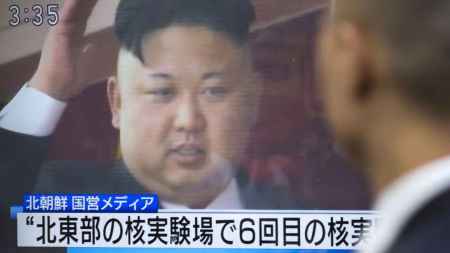
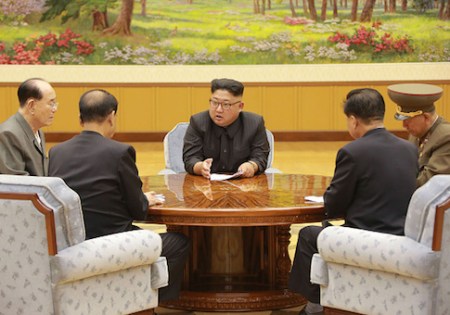
North Korean leader Kim Jong-Un attends a meeting with a committee of the Workers’ Party of Korea about the test of a hydrogen bomb / Getty Images

“Unfortunately, I cannot tell the committee today that we’ve seen sufficient evidence of China’s willingness to truly shut down North Korea’s revenue flows, to expunge North Korean illicit actors from its banking system, or to expel the various North Korean middlemen and brokers who are continuing to establish webs of front companies,” he said.

*****************************

The Trump administration on Tuesday threatened to cut off from the U.S. financial system Chinese and Russian companies helping North Korea smuggle coal overseas to circumvent international sanctions on Pyongyang’s nuclear activities.

Marshall Billingslea, the Treasury Department’s assistant secretary for terrorist financing, provided Congress with intelligence images mapping North Korea’s illicit shipping networks used to mask the origin of exported coal to China and Russia.

The images appear to expose China and Russia’s covert hand in undermining international pressure on the Kim Jong Un regime to give up its nuclear ambitions, despite the two nations voting publicly on several occasions at the United Nations Security Council to strengthen sanctions.

“North Korea has been living under United Nations sanctions for over a decade and it has nevertheless made significant strides toward its goal of building a nuclear tipped ICBM,” Billingslea testified before the House Foreign Affairs Committee, referring to the regime’s pursuit of an intercontinental ballistic missile capable of reaching the United States mainland.

“I urge anyone in the financial services industry who might be implicated in the establishment of shell or front companies for [North Korea], and anyone who is aware of such entities, to come forward with that information now, before they find themselves swept up in our net,” he said.

The Treasury Department estimates North Korean coal shipments bring in more than $1 billion in annual revenue for the regime, in part enabling Kim Jong Un to generate income used to fund ballistic missile and nuclear programs. Though the UN Security Council over the past month has passed two separate sanctions packages targeting North Korea’s coal industry, illicit coal-smuggling networks through China and Russia have watered down the impact, according to the Trump administration.

Citing the intelligence images provided to Congress on Tuesday, Billingslea said North Korean shipping vessels routinely shut off their transponders in violation of international maritime law to avoid detection as they move from North Korea into Chinese or Russian ports to offload sanctioned coal.

The Treasury Department is also tracking North Korea’s effort to penetrate the international financial system through shell companies based in China and Russia to help conceal the regime’s overseas footprint. Billingslea warned the Trump administration will punish any company in violation of UN sanctions by choking it off from the U.S. financial market.

Though he lauded China for supporting a recent round of UN sanctions, he said Beijing has not yet shown it is serious about cutting off North Korean funding.

“Unfortunately, I cannot tell the committee today that we’ve seen sufficient evidence of China’s willingness to truly shut down North Korea’s revenue flows, to expunge North Korean illicit actors from its banking system, or to expel the various North Korean middlemen and brokers who are continuing to establish webs of front companies,” he said.

UN Security Council passes new sanctions against North Korea

September 12, 2017

UN Security Council passes new sanctions against North Korea, Fox Business News via YouTube, September 11, 2017

As noted in the blurb beneath the video,

Lt. Col. Michael Waltz (Ret.) and Center for Security Policy President Frank Gaffney on the U.N. implementing new sanctions against North Korea.

FULL MEASURE: September 10, 2017 – Korean Conflict

September 11, 2017

FULL MEASURE: September 10, 2017 – Korean Conflict via YouTube, September 10, 2017


16 Years Later: Lessons Put into Practice?

September 11, 2017

16 Years Later: Lessons Put into Practice? Gatestone Institute, John R. Bolton, September 11, 2017

Sept. 11 should be more than just a few moments of silence to remember the Twin Towers falling, the burning Pentagon and the inspiring heroism of regular Americans in bringing down United Flight 93 in Shanksville, Pa. We should also seriously consider today’s global threats. Those who made America an exceptional country did so by confronting reality and overcoming it, not by ignoring it.

********************************

Today marks the 16th anniversary of al-Qaida’s 9/11 attacks. We learned much that tragic day, at enormous human and material cost. Perilously, however, America has already forgotten many of Sept. 11’s lessons.

The radical Islamicist ideology manifested that day has neither receded nor “moderated” as many naive Westerners predicted. Neither has the ideology’s hatred for America or its inclination to conduct terrorist attacks. Iran’s 1979 Islamic Revolution brought radical Islam to the contemporary world’s attention, and it is no less malevolent today than when it seized our Tehran embassy, holding U.S. diplomats hostage for 444 days.

The Taliban, which provided al-Qaida sanctuary to prepare the 9/11 attacks, threaten to retake control in Afghanistan. Al-Qaida persists and may even be growing worldwide.

While ISIS’s caliphate in Syria and Iraq will not survive much longer, countries across North Africa and the Middle East (“MENA”) have destabilized or fractured entirely. Syria and Iraq have ceased to exist functionally, and Libya, Somalia and Yemen have descended into chaos. Pakistan, an unstable nuclear-weapons state, could fall to radicals under many easily predictable scenarios.

The terrorist threat is compounded by nuclear proliferation. Pakistan has scores of nuclear weapons, and Iran’s program continues unhindered. North Korea has now conducted its sixth, and likely thermonuclear, nuclear test, and its ballistic missiles are near to being able to hit targets across the continental United States. Pyongyang leads the rogue’s gallery of would-be nuclear powers, and is perfectly capable of selling its technologies and weapons to anyone with hard currency.

During Barack Obama’s presidency, he ignored these growing threats and disparaged those who warned against them. His legacy is terrorist attacks throughout Europe and America, and a blindness to the threat that encouraged Europe to accept a huge influx of economic migrants from the MENA region, whose numbers included potentially thousands of already-committed terrorists.

IGNORING NORTH KOREA

Obama also ignored North Korea, affording it one of an aspiring proliferator’s most precious assets: time. Time is what a would-be nuclear state needs to master the complex scientific and technological problems it must overcome to create nuclear weapons.

And, in a dangerous unforced error that could be considered perfidious if it weren’t so foolish, Obama entered the 2015 Vienna nuclear and missile deal that has legitimized Tehran’s terrorist government, released well over a hundred billion dollars of frozen assets, and dissolved international economic sanctions. Iran has responded by extending its presence in the Middle East as ISIS had receded, to the point where it now has tens of thousands of troops in Syria and is building missile factories there and in Lebanon.

Before 2009, publishers would have immediately dismissed novelists who brought them such a plainly unrealistic plot. Today, however, it qualifies as history, not fantasy. This is the agonizing legacy the Trump administration inherited, compounded by widespread feelings among the American people that we have once again sacrificed American lives and treasure overseas for precious little in return.

These feelings are understandable, but it would be dangerous to succumb to them. We didn’t ask for the responsibility of stopping nuclear proliferation or terrorism, but we are nonetheless ultimately the most at risk from both these threats.

And as we knew during the Cold War, but seem to have forgotten since it ended, our surrounding oceans do not insulate us from the risk of long-distance nuclear attacks. We face the choice of fighting the terrorists on our borders or inside America itself, or fighting them where they seek to plot our demise, in the barren mountains of Afghanistan, in the MENA deserts, and elsewhere.

Nor can we shelter behind a robust national missile-defense capability, hoping simply to shoot down missiles from the likes of North Korea and Iran before they hit their targets. We do not have a robust national missile defense capability, thanks yet again to Barack Obama’s drastic budget cuts.

President Trump appreciates that nuclear proliferation and radical Islamic terrorism are existential threats for the United States and its allies. During the 2016 campaign, he repeatedly stressed his view that others should play a larger role in defeating these dangerous forces, bearing their fair share of the burden. But candidate Trump also unambiguously (and entirely correctly) called for restoring our depleted military capabilities because he saw that American safety depended fundamentally on American strength.

Sept. 11 should be more than just a few moments of silence to remember the Twin Towers falling, the burning Pentagon and the inspiring heroism of regular Americans in bringing down United Flight 93 in Shanksville, Pa. We should also seriously consider today’s global threats. Those who made America an exceptional country did so by confronting reality and overcoming it, not by ignoring it.

The names of passengers and crew of United Airlines Flight 93, who lost their lives in the September 11 attacks, as displayed at the National 9/11 Memorial in New York. (Image source: Luigi Novi/Wikimedia Commons)

____________________________

John R. Bolton, former U.S. Ambassador to the United Nations, is Chairman of Gatestone Institute, a senior fellow at the American Enterprise Institute, and author of “Surrender Is Not an Option: Defending America at the United Nations and Abroad”.

This article first appeared in The Pittsburgh Tribune Review and is reprinted here with the kind permission of the author.

FDR’s ‘Rattlesnake’ Rule and the North Korean Threat

September 6, 2017

FDR’s ‘Rattlesnake’ Rule and the North Korean Threat, Gatestone Institute, John R. Bolton, September 6, 2017

(FDR may have honored his “Rattlesnake Rule” vis a vis Germany. He did not do so vis a vis Japan. We should honor it vis a vis North Korea and its enablers. –DM)

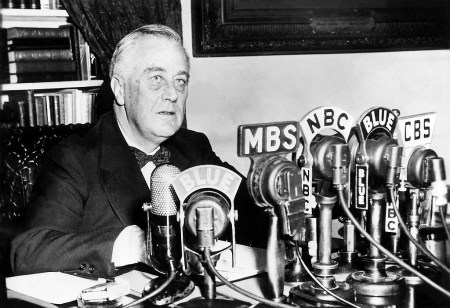
“When you see a rattlesnake poised to strike, you do not wait until he has struck before you crush him.” By these words in a Sept. 11, 1941, fireside chat, Franklin Roosevelt authorized US warships to fire first against Nazi naval vessels, which he called “the rattlesnakes of the Atlantic.”

Roosevelt’s order applied whenever German or Italian ships entered “waters of self-defense” necessary to protect the US, including those surrounding US outposts on Greenland and Iceland.

Franklin D. Roosevelt. (Image source: National Archives and Records Administration/Wikimedia Commons)

Uttered 60 years to the day before 9/11, and less than three months before Pearl Harbor, Roosevelt’s words still resonate. North Korea’s sixth nuclear test last weekend, along with its significantly increased ballistic-missile testing, establishes that Pyongyang is perilously close to being able to hit targets across the continental United States with nuclear warheads, perhaps thermonuclear ones.

The Nazi threat to US shipping, both normal commercial traffic and war supplies destined for Great Britain, was undeniably significant, and the Axis powers’ broader totalitarian threat was existential. Nonetheless, right up to Dec. 7, 1941, many American leaders urged caution to avoid provoking the Axis and thereby risking broader conflict. Pearl Harbor followed.

In his chat, Roosevelt observed that others had “refused to look the Nazi danger squarely in the eye until it actually had them by the throat.” We shouldn’t commit that mistake today. North Korea’s behavior, and its lasting desire to conquer the South, have created the present crisis.

Letting Kim Jong-un’s bizarre regime “have America by the throat,” subjecting us and our allies to perpetual nuclear extortion, is not an acceptable outcome.

We have endured 25 years of US diplomatic failure, with endless rounds of negotiations, presenting North Korea with the choice between economic incentives or sanctions. During this time, which certainly constitutes “not looking the danger squarely in the eye,” North Korea has repeatedly breached commitments to abandon its nuclear-weapons program, often made in return for handsome compensation.

Nonetheless, we hear echoes from Roosevelt’s day that “there is no acceptable military option” when it comes to Pyongyang. This means, as Susan Rice said recently, “we can, if we must, tolerate nuclear weapons in North Korea,” as we did with the Soviets in Cold War days. The US should not accept such counsels of despair, based on dangerously facile and wildly inaccurate historical analogies.

Why accept a future of unending nuclear blackmail by Pyongyang, whose governing logic is hardly that of Cold War Moscow, and which would entail not that era’s essentially bipolar standoff, but a far-more-dangerous world of nuclear multipolarity?

If Washington lets Kim retain his nuclear weapons and ballistic missiles, his regime will happily sell these materials and technologies to Iran, other rogue states or terrorist groups for the right price. This is another key difference from the Cold War; Moscow was substantially more worried about nuclear proliferation than Pyongyang now is.

It would be, as Roosevelt understood, “inexcusable folly” to ignore North Korea’s pattern of behavior over the last quarter century: “We Americans are now face to face not with abstract theories but with cruel, relentless facts.” For America in 1941, hope of sheltering behind the oceans was fast disappearing, forcing Roosevelt to extend our maritime defense perimeter effectively across the Atlantic to Europe.

In the age of ICBMs, there’s no “perimeter”; we are at risk in agonizingly short time frames of a missile’s flight launched anywhere, whether from North Korea or Iran. It is completely unacceptable to say we must await a first strike by Pyongyang before we will resort to military force. Roosevelt dismissed such arguments peremptorily: “Let us not say: ‘We will only defend ourselves if the torpedo succeeds in getting home, or if the crew and passengers are drowned.’ ”

The remaining diplomatic options are few, and the time to exercise them dwindling fast. Convincing China that its national interests would be enhanced by reunifying the two Koreas, thus ending what Beijing itself believes is a threat to peace and security in northeast Asia, remains possible. Unfortunately, this is increasingly hard to accomplish before North Korea becomes a fully mature nuclear-weapons state.

We’re moving rapidly to the point where Roosevelt said squarely, “It is the time for prevention of attack.” George W. Bush spoke equally directly in 2002: “Our security will require all Americans to be . . . ready for preemptive action when necessary to defend our liberty and to defend our lives.” The alternative is potentially global proliferation of nuclear weapons, with the attendant risks lasting beyond our power to calculate.

John R. Bolton, former U.S. Ambassador to the United Nations, is Chairman of Gatestone Institute, a senior fellow at the American Enterprise Institute, and author of “Surrender Is Not an Option: Defending America at the United Nations and Abroad”.

This article first appeared in The New York Post and is reprinted here with the kind permission of the author.

SKorea to deploy more THAAD launchers Thursday

September 6, 2017

SKorea to deploy more THAAD launchers Thursday, DEBKAfile, September 6, 2017

South Korea will add four more launchers to its advanced missile defense system on Thursday amid heightening tensions with North Korea, the South’s Defense Ministry said. The step came after Pyongyang conducted its sixth and most powerful nuclear test on Sunday. Two launchers from the US-made Terminal High-Altitude Area Defense (THAAD) system were deployed in April to counter rising threats from the North.

Meanwhile, South Korean President Moon Jae-in met with Russian President Vladimir Putin on Wednesday in Vladivostok to discuss the North Korea nuclear issue.

North Korea’s Ultimatum to America

September 5, 2017

North Korea’s Ultimatum to America, Front Page MagazineCaroline Glick, September 5, 2017

(We should strike North Korea and eliminate it as a nuclear threat. We have first-strike capability which, if used can eliminate the danger to South Korea and Japan as well as to America. Perhaps we should wait — but not long — until North Korea “tests” a missile directed toward Guam. Then we should act immediately and without warning. We can even do it successfully without using our own nukes. On the other hand, we have a new option. Please see also, How to neutralize the North Korea threat. It might, or might not, work. If it works as advertised, great. If it fails, we will have lost very little. –DM)

Originally published by the Jerusalem Post

If the US strikes North Korea in a credible manner and successfully diminishes its capacity to physically threaten the US, America will have taken the first step towards rebuilding its alliances in Asia.

On the other hand, if the current round of hostilities does not end with a significant reduction of North Korea’s offensive capabilities, either against the US or its allies, then the US will be hard pressed to maintain its posture as a Pacific power. So long as Pyongyang has the ability to directly threaten the US and its allies, US strategic credibility in East Asia will be shattered.

***********************************

The nuclear confrontation between the US and North Korea entered a critical phase Sunday with North Korea’s conduct of an underground test of a thermonuclear bomb.

If the previous round of this confrontation earlier this summer revolved around Pyongyang’s threat to attack the US territory of Guam, Sunday’s test, together with North Korea’s recent tests of intercontinental ballistic missiles capable of reaching the continental US, was a direct threat to US cities.

In other words, the current confrontation isn’t about US superpower status in Asia, and the credibility of US deterrence or the capabilities of US military forces in the Pacific. The confrontation is now about the US’s ability to protect the lives of its citizens.

The distinction tells us a number of important things. All of them are alarming.

First, because this is about the lives of Americans, rather than allied populations like Japan and South Korea, the US cannot be diffident in its response to North Korea’s provocation. While attenuated during the Obama administration, the US’s position has always been that US military forces alone are responsible for guaranteeing the collective security of the American people.

Pyongyang is now directly threatening that security with hydrogen bombs. So if the Trump administration punts North Korea’s direct threat to attack US population centers with nuclear weapons to the UN Security Council, it will communicate profound weakness to its allies and adversaries alike.

Obviously, this limits the options that the Trump administration has. But it also clarifies the challenge it faces.

The second implication of North Korea’s test of their plutonium-based bomb is that the US’s security guarantees, which form the basis of its global power and its alliance system are on the verge of becoming completely discredited.

In an interview Sunday with Fox News’s Trish Regan, former US ambassador to the UN John Bolton was asked about the possible repercussions of a US military assault against North Korea for the security of South Korea.

Regan asked, “What are we risking though if we say we’re going to go in with strategic military strength?… Are we going to end up with so many people’s lives gone in South Korea, in Seoul because we make that move?” Bolton responded with brutal honesty.

“Let me ask you this: how do you feel about dead Americans?” In other words, Bolton said that under prevailing conditions, the US faces the painful choice between imperiling its own citizens and imperiling the citizens of an allied nation. And things will only get worse. Bolton warned that if North Korea’s nuclear threat is left unaddressed, US options will only become more problematic and limited in the years to come.

This then brings us to the third lesson of the current round of confrontation between the US and North Korea.

If you appease an enemy on behalf of an ally then you aren’t an ally.

And eventually your alliance become empty of all meaning.

For 25 years, three successive US administrations opted to turn a blind eye to North Korea’s nuclear program in large part out of concern for South Korea.

Presidents Bill Clinton, George W. Bush and Barack Obama all sought to appease North Korea’s aggressive nuclear adventurism because they didn’t believe they had a credible military option to deal with it.

In the 1980s, North Korea developed and deployed a conventional arsenal of bombs and artillery along the demilitarized zone capable of vaporizing Seoul.

Any US military strike against North Korea’s nuclear installation it was and continues to be argued, would cause the destruction of Seoul and the murder of millions of South Koreans.

So US efforts to appease Pyongyang on behalf of Seoul emptied the US-South Korean alliance of meaning. The US can only serve as the protector of its allies, and so assert its great power status in the Pacific and worldwide, if it prevents its allies from being held hostage by its enemies.

And now, not only does the US lack a clear means of defending South Korea, and Japan, America itself is threatened by the criminal regime it demurred from effectively confronting.

Regardless of the means US President Donald Trump decides to use to respond to North Korea’s provocative actions and threats to America’s national security, given the nature of the situation, it is clear that the balance of forces on the ground cannot and will not remain as they have been.

If the US strikes North Korea in a credible manner and successfully diminishes its capacity to physically threaten the US, America will have taken the first step towards rebuilding its alliances in Asia.

On the other hand, if the current round of hostilities does not end with a significant reduction of North Korea’s offensive capabilities, either against the US or its allies, then the US will be hard pressed to maintain its posture as a Pacific power. So long as Pyongyang has the ability to directly threaten the US and its allies, US strategic credibility in East Asia will be shattered.

This then brings us to China.

China has been the main beneficiary of North Korea’s conventional and nuclear aggression and brinksmanship.

This state of affairs was laid bare in a critical way last month.

In mid-August, Trump’s then chief strategist Steve Bannon was preparing a speech Trump was set to deliver that would have effectively declared a trade war against China in retaliation for its predatory trade practices against US companies and technology. The speech was placed in the deep freeze – and Bannon was forced to resign his position – when North Korea threatened to attack the US territory of Guam with nuclear weapons. The US, Trump’s other senior advisers argued, couldn’t declare a trade war against China when it needed China’s help to restrain North Korea.

So by enabling North Korea’s aggression against the US and its allies, China has created a situation where the US has become neutralized as a strategic competitor.

Rather than advance its bilateral interests – like curbing China’s naval aggression in the South China Sea – in its contacts with China, the US is forced into the position of supplicant, begging China to restrain North Korea in order to avert war.

If the US does not act to significantly downgrade North Korea’s offensive capabilities now, when its own territory is being threatened, it is difficult to see how the US will be able to develop an effective strategy for coping with China’s rise as an economic and strategic rival in Asia and beyond. That is, the US’s actions now in response to North Korea’s threat to its national security will determine whether or not the US will be in a position to develop and implement a wider strategy for maintaining its capacity to project its economic and military power in the Pacific in the near and long term.

Finally, part of the considerations that need to inform US action now involve what North Korea’s success in developing a nuclear arsenal under the noses of successive US administrations means for the future of nuclear proliferation.

In all likelihood, unless the North Korean nuclear arsenal is obliterated, Pyongyang’s nuclear triumphalism will precipitate a spasm of nuclear proliferation in Asia and in the Middle East. The implications of this for the US and its allies will be far reaching.

Not only can Japan and South Korea be reasonably expected to develop nuclear arsenals. Saudi Arabia, Egypt, Jordan and other inherently unstable Arab states can be expected to develop or purchase nuclear arsenals in response to concerns over North Korea and its ally Iran with its nuclear weapons program linked to Pyongyang’s.

In other words, if the US does not respond in a strategically profound way to Pyongyang now, it will not only lose its alliance system in Asia, it will see the rapid collapse of its alliance system and superpower status in the Middle East.

Israel, for one, will be imperiled by the sudden diffusion of nuclear power.

Monday morning, North Korea followed up its thermonuclear bomb test with a spate of threats to destroy the United States. These threats are deadly even if North Korea doesn’t attack the US with its nuclear weapons. If the US does not directly defeat North Korea in a clear-cut way now, its position as a superpower in Asia and worldwide will be destroyed and its ability to defend its own citizens will be called into question with increasing frequency and lethality.

North Korea Nuclear Progress Puts Iran on Renewed Pathway to Bomb

September 4, 2017

North Korea Nuclear Progress Puts Iran on Renewed Pathway to Bomb, Washington Free Beacon, September 4, 2017

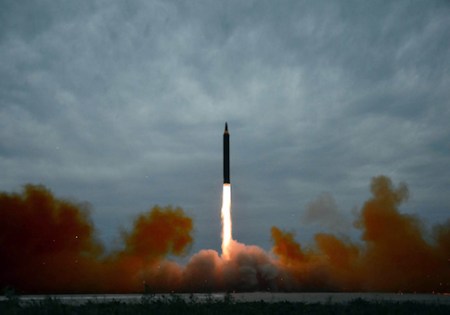
North Korea’s intermediate-range strategic ballistic rocket Hwasong-12 lifts off / Getty Images

Iran and North Korea have been sharing nuclear materials and know-how for well over a decade, according to sensitive intelligence community communications published by WikiLeaks and dating as far back as 2009.

The Obama administration took little action during its time in office to thwart this growing alliance, leading to increased nuclear ties between Iran and North Korea, multiple sources said.

In order to comply with the nuclear agreement, Iran outsourced much of its nuclear technology to North Korea, according to multiple sources, who pointed to evidence of a key 2015 meeting between the two countries surrounding the nuclear portfolio.

“Thanks to the Obama-Khamenei nuclear deal, Iran is flush with cash and has the capacity to be a willing buyer for nuclear material,” DeSantis said. “This represents a major threat to the United States and should be taken seriously.”

**************************

U.S. officials are closely monitoring an ongoing meeting between senior North Korean and Iranian officials that comes on the heels of a nuclear test by Pyongyang, according to senior Trump administration officials and other sources who expressed concern that North Korea is helping to put the Islamic Republic back on the pathway to a functional nuclear weapon.

Sources told the Washington Free Beacon that Pyongyang continues to stockpile illicit nuclear material on Iran’s behalf in order to help the Islamic Republic skirt restrictions implemented under the landmark nuclear deal.

North Korea’s latest nuclear test of a hydrogen bomb has roiled Trump administration officials and led President Donald Trump to consider multiple options for war. However, it also has renewed fears among U.S. officials and foreign policy insiders about Pyongyang’s long-standing relationship with Iran, which centers on providing the Islamic Republic with nuclear technology and know-how.

The head of North Korea’s parliament arrived this weekend in Iran for a 10-day visit aimed at boosting ties between the two countries amid an international crackdown on Pyongyang’s nuclear weapons program, a situation U.S. officials tell the Free Beacon is being closely monitored.

As North Korea makes progress in its nuclear pursuits, it is likely this information is being shared with senior Iranian officials who continue to maintain and build upon the country’s weapons program, despite the nuclear agreement, which only limits a portion of Iran’s nuclear enrichment and research abilities.

One senior U.S. official currently handling the Iranian and North Korean nuclear portfolios told the Free Beacon that the collaboration between these two countries is being closely monitored by the Trump administration, which will not hesitate to take action to disrupt this relationship.

“The history of collaboration between North Korea and Iran has been an ongoing concern and needs to be watched closely,” the official told the Free Beacon. “We’ve been laboring under the false assumption that these oppressive regimes are rational and that we can persuade them to act for the greater good. President Trump has made it clear those days are at an end, and that the United States will do what is necessary to prevent Iran from turning into another North Korea.”

Iran and North Korea have long collaborated on their missile programs and nuclear technology, and the U.S. intelligence community continues to monitor ongoing efforts by the two countries to boost cooperation.

Kim Yong Nam, the head of North Korea’s parliament, reportedly arrived in Iran on Thursday for a high-profile meeting with Iranian President Hassan Rouhani that is likely to center around Tehran’s quest for technology and North Korea’s need for hard currency and financial assets.

Iran has been flush with cash and other financial assets since the nuclear agreement lifted international sanctions and opened the Islamic Republic to new business ties.

Rep. Ron DeSantis (R., Fla.), a member of the House Foreign Affairs Committee and the National Security Subcommittee, told the Free Beacon that the increased ties are cause for concern, particularly in light of Iran’s renewed economic success.

“Given that Kim Jong Un is a plump, immature kid who only rules because of accident of birth, it is not clear that he can, through traditional means, be deterred from commencing an attack against the United States using his nuclear arsenal,” DeSantis told the Free Beacon. “What is completely clear is that Kim is willing to transfer nuclear technology to, and assist with nuclear development for, rogue regimes such as Iran.”

“Thanks to the Obama-Khamenei nuclear deal, Iran is flush with cash and has the capacity to be a willing buyer for nuclear material,” DeSantis said. “This represents a major threat to the United States and should be taken seriously.”

North Korea’s latest nuclear test has sparked a fierce war of words with the Trump administration, which announced on Monday that it is considering a range of military options.

United Nation’s Ambassador Nikki Halley said that North Korean leader Kim Jong Un is “begging for war” and urged the U.N.’s Security Council to consider a strong response.

“Enough is enough,” Haley was quoted as saying. “War is never something the United States wants. We don’t want it now. But our country’s patience is not unlimited.”

Israeli officials also have warned that North Korea’s latest test is a boon to Iran’s own nuclear program.

“The international response, led by the U.S., to the North Korean regime’s provocations, sheds light on how it will behave toward the Iranian regime on their nuclear efforts in the near future,” Moshe Ya’alon, a former Israeli defense minister, tweeted. “Although the nuclear test is not our issue, the tension should concern us.”

Iran and North Korea have been sharing nuclear materials and know-how for well over a decade, according to sensitive intelligence community communications published by WikiLeaks and dating as far back as 2009.

The Obama administration took little action during its time in office to thwart this growing alliance, leading to increased nuclear ties between Iran and North Korea, multiple sources said.

In order to comply with the nuclear agreement, Iran outsourced much of its nuclear technology to North Korea, according to multiple sources, who pointed to evidence of a key 2015 meeting between the two countries surrounding the nuclear portfolio.

Iran also has opened ballistic missile factories in Syria with the help of Russia and North Korea, according to regional reports.

“North Korea and Iran’s military and political ties are long-standing, and can be traced back to the 1980-1988 Iran-Iraq War, the same time that Tehran developed an interest in nuclear and missile technology,” said Behnam Ben Taleblu, an Iran analyst at the Foundation for Defense of Democracies.

“North Korea’s provision of the Nodong-A liquid fueled medium-range ballistic missile to Iran in the 1990s enabled the mullahs to make significant strides in the missile program and eventually even their satellite launch-vehicle technology,” Ben Taleblu explained.

“While some may see the long-standing missile relationship as merely evidence of the two countries’ interest in conventional munitions, these missiles are capable of carrying nuclear payloads, and offer both rogues the ultimate deterrent weapon with which to ensure regime survival,” he said.

Iranian officials and scientists have been spotted at several of North Korea’s key nuclear test, fueling speculation that the two countries are in close contact on the issue.

“What is almost certain, however, is the following: both in the post- and pre-JCPOA [or Joint Comprehensive Plan of Action, the formal name for the Iran deal] era, the two closely watched how each one negotiated with the international community, what deals it struck, the lies that worked and didn’t work, and where and how it could supplement resolve for material capability,” Ben Taleblu said.

Michael Rubin, a former Pentagon adviser and expert on rogue regimes, further told the Free Beaconthat it is suspected North Korean officials played a role in helping Iran recently test fire a series of ballistic missiles, which sparked international outrage and accusations the Islamic Republic is violating legally binding bans on such behavior.

“For those who want to deny the links between Pyongyang and Tehran, it’s easy so long as they ignore their military, diplomatic, and economic ties,” Rubin said. “It’s doubtful there has been a single Iranian missile test where North Korean scientists weren’t present, nor a North Korean test where Iranian scientists didn’t have a front row seat.”

One veteran congressional foreign policy adviser who works on the Iran portfolio told the Free Beacon that efforts to promote a new North Korean nuclear deal in the same vein as the Iran agreement are fruitless, and would only strengthen Pyongyang’s appetite to publicly test its nuclear weaponry.

“The same people who sold the Iran deal are now trying to sell what they call an ‘Iran deal for North Korea,'” the source said. “It’s the same groups, the same people, and the same playbook. Up until this weekend’s nuclear test, they were telling journalists that diplomacy has time to work, that North Korea is still years away from an H-Bomb, and—of course—that additional pressure would lead to war.”

“Now, all at once, their narratives about Iran and North Korea are both colliding with reality,” the source added. “The cost for American national security is staggering.”

Rubin went on to describe the North Korean stand-off as a glimpse into future situations with Iran.

“North Korea is a crystal ball into the future of the Iranian nuclear agreement, and the current diplomatic behavior in which there will be no support for inspections, which risk finding Iran in violation and imperiling the agreement, fits the pattern to a ‘T,'” Rubin said. “In addition, one of the biggest holes to which the Obama administration agreed was not recognizing that Iranian nuclear work doesn’t necessarily take place in Iran.”
USA vs North Korea: This is the US military arsenal poised to WIPE OUT Kim’s threat

September 4, 2017

USA vs North Korea: This is the US military arsenal poised to WIPE OUT Kim’s threat, Express [UK]Will Kirby, September 4, 2017

[French] Foreign minister Jean-Yves Le Drian warned a nuclear strike on Europe was possible and said a world war could erupt in months.

He said: “The situation is extremely serious… we see North Korea setting itself as an objective to have, tomorrow or the day after, missiles that can transport nuclear weapons.

“In a few months that will be a reality.”

***********************

After ’s UN envoy said the country would never bow down to international pressure and give up its nuclear weapons program, diplomatic means of addressing the hostilities appear to have been sidelined in favour of military action.

’s UN ambassador Nikki Haley and the President himself have said “the time for talk is over”, despite China, Russia, and other members of the US administration claiming dialogue remains the main aim.

The US military has a huge presence in the area around North Korea, particularly in Japan and increasingly close allies South Korea.

There are almost 40,000 US troops serving in Japan, more than in any other country, and earlier this year the US Air Force lined up a huge array of helicopters, tactical fighter jets and surveillance aircraft in a show of force aimed to intimidate Kim Jong-un.

Among the aircraft were HH-60 Pave Hawks, a twin-turboshaft helicopter primarily used for the insertion and rescue of special operation personnel.

The aircraft’s versatility makes it incredibly useful in other operations too, including civilian rescue and disaster relief.

The F-15 Eagles, America’s twin-engine, all-weather tactile fighter jets, are also stationed in the region and are among the most successful modern fighters, with over 100 victories and no losses in aerial combat.

Also headquartered in Japan is the Seventh Fleet, the largest of the US navy’s deployed sea forces.

The flagship carrier is the USS Ronald Reagan, a nuclear-powered aircraft supercarrier that forms part of “the most effective and agile fighting force in the world”.

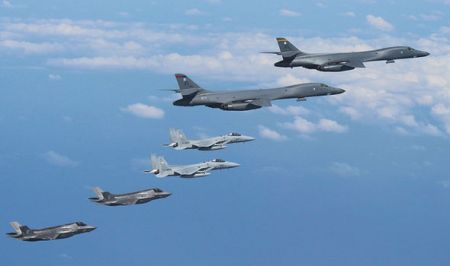
Two US Air Force B-1B Lancer bombers fly from Guam escorted by a pair of Japanese F-15 fighter jets. REUTERS

Also in the fleet are up to 14 destroyers and cruisers at any given time, some armed with ballistic missile interceptors.

A collection of long-range Tomahawk land missiles, which made headlines earlier this year when President Trump fired 59 of them at an airbase in Syria, joins the arsenal.

As if that wasn’t enough, there are also 12 nuclear-powered submarines available should war break out.

South of the demilitarised zone (DMZ), the US has 23,468 troops at 83 different sites as well as hundreds of tanks and armoured vehicles, meaning there is always a heavy military presence should North Korea decide to launch a land attack.

There is also the Terminal High-Altitude Area Defence (THAAD) system, which, despite criticism from Beijing and Pyongyang, is ready and waiting to intercept missiles and destroy the incoming projectiles while in mid-flight.

Guam, the US territory that Kim Jong-un has threatened to fire four ballistic missiles towards, is also host to a huge military presence.

Much of the island is controlled by the armed forces and the Andersen air base hosts a range of bombers, resulting in Guam being dubbed a “permanent aircraft carrier”.

Among the aircraft at the base are B-1B bombers, B-52 bombers and F-35B stealth fighters, some of the US Air Force’s most impressive jets.

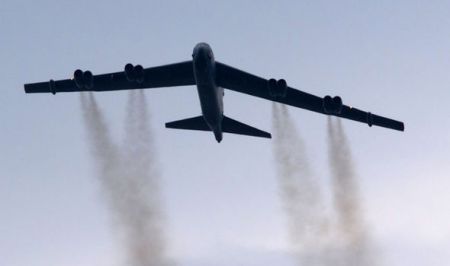
The revered B-52 bomber is capable of carrying more than 30 tonnes of weapons. GETTY

The B-1B bomber is heralded for its survivability and although initially designed to carry nuclear arms, it was converted to carry more conventional weaponry after the Cold War.

The US is believed to have at least six B-1B bombers stationed in Guam and is best suited to a ‘medium threat environment’, rather than a heavily defended airspace.

Speaking about plans for a possible preemptive strike on North Korea earlier this month, retired Admiral James Stavridis told NBC News: “The B-1b has also been selected because it has the added benefit of not being able to carry nuclear weapons.

“Military planners think that will signal China, Russia, and Pyongyang that the US is not trying to escalate an already bad situation any further.”

The B-52 was first introduced in 1955 and was originally designed to carry nuclear weapons during the Cold War. It remains one of the most superior aircraft in the US Air Force.

The long-range, subsonic, jet-powered strategic bomber is capable of carrying more than 30 tons of weapons. The aircraft’s fearsome appearance and reputation has resulted in the nickname BUFF, which stands for Big Ugly Fat F*****.

The US also maintains a smaller presence in other countries in the region, including Thailand, Singapore and the Philippines. US military aircraft use Thai runways while the US Navy will operate four warships out of Singapore by next year.

Tensions have been stepped across the region over recent days following North Korea firing a test missile over Japan.

The provocative action saw South Korea and US forces drop bombs on the border of the hermit state.

Earlier today France warned the situation was “extremely serious”.

Foreign minister Jean-Yves Le Drian warned a nuclear strike on Europe was possible and said a world war could erupt in months.

He said: “The situation is extremely serious… we see North Korea setting itself as an objective to have, tomorrow or the day after, missiles that can transport nuclear weapons.

“In a few months that will be a reality.”

Part II: Tough Is Not Enough

September 4, 2017

Part II: Tough Is Not Enough, 38 North, September 4, 2017

(In what fantasy world does the author live? He states,

What sort of deployments (strategic systems, missile defense, precision strike conventional weapons, conventional land, sea, special and air forces) would be a function of both military and diplomatic would need to be hammered out in the National Security Council and with regional allies.

It is inconceivable that the UN Security Council, where each permanent member has a veto, would approve any “deployment of significant and visible assets [which] would make it clear to the DPRK that it cannot compete with the US in the nuclear field regardless of the size, scope, pace and duration of that effort.”  Even were it to happen, North Korea would be told, in advance, how to prepare for whatever America and perhaps our allies will do when North Korea again tests or uses a nuke or missile. 

Please see also, North Korea Nuclear Test Puts Pressure on China and Undercuts Xi. — DM)

North Korea Nuclear Test Puts Pressure on China and Undercuts Xi

In Part I of this seriesI argued that advocates for “getting tough on North Korea” were prone to adopt inappropriate models for a harsher sanctions regime and to ignore the risk of counterproductive North Korean reactions to such sanctions. This is not an argument for no more sanctions. Given North Korean progress on its ICBM and nuclear weapons capabilities, we remain in an ongoing cycle of actions and reactions that may lead to a major war. A very vigorous political/military effort to contain and eventually eliminate the DPRK nuclear threat is essential now before the tensions and ill-considered rhetoric once again create the risk of the US and North Korea bellowing and stumbling their way into a catastrophic conflict. But sanctions should be only one element of the effort. The final push for a stabilization[1] of the North Korean nuclear and missile issue has to include the following components.

Military Deterrence and Defense

The additional deployment of significant and visible assets would make it clear to the DPRK that it cannot compete with the US in the nuclear field regardless of the size, scope, pace and duration of that effort. What sort of deployments (strategic systems, missile defense, precision strike conventional weapons, conventional land, sea, special and air forces) would be a function of both military and diplomatic would need to be hammered out in the National Security Council and with regional allies. The purpose of these forces would be both to provide diplomatic leverage and to prevent Kim from believing a military gamble would pay off.

Sanctions and Targeted Secondary Sanctions

The sanctions campaign should begin with the enforcement of UNSCRs 2270 and 2371. The initial goal would be to get full compliance with some of the difficult-to-enforce provisions, notably the caps on joint ventures and on North Korean labor exports. To this end, the US should target secondary sanctions on Chinese and other third country entities that are violating the UN resolutions. Rather than seeking to squash every sanctions-evading gnat, it should inflict significant pain on one large and vulnerable entity to have a bracing effect on many more. And, it might well create massive ripple effects if it is a key node in North Korea’s sanctions evasion network—for example, Chinese companies outlined in the recent C4ADS report—that are clearly violating UN sanctions and making extensive use of the US banking system. The US may also wish to find a similar target outside the Chinese network of businesses—perhaps one in a friendly Middle Eastern or African country that has chosen to ignore past US efforts to cut connections to Pyongyang. The US should for now avoid steps to coerce others to accept its own definition of sanctions that go beyond the resolutions. It appears that the most recent sanctions by the US Treasury against Chinese, Russian and one Namibian entity, as well as a recent freeze on some aid to Egypt, may fit the model described above.

However, it is unlikely the UN sanctions as currently written will suffice. The US should be building the case now for significant sanctions tightening if North Korea does not shift its current direction. This should best be done in steps, perhaps starting with the change of the labor and investment caps and moving to a full ban as a first iteration with the dusted off version of UNSCR 661 as the final alternative to military conflict. As the risk of conflict moves closer, the US will have to consider when secondary sanctions as a coercive mechanism for third countries needs to be deployed more widely. This is a high-risk enterprise in an already risky situation, but when stacked up against nuclear war in Asia, surely secondary sanctions are preferable.

Many Tracks of Diplomacy

These tough military and sanctions components will do nothing but open the door to miscalculation and war if other “softer” components are ignored or—more likely—mishandled. A stabilization of the Korean nuclear and missile issue is going to require multilateral diplomacy—and only the US has the ability to be at the center of this effort. It cannot subcontract the effort primarily to China. The PRC does not have the entre with some of the players, nor could it speak for the US to the most difficult audience of all: Pyongyang. These rings of diplomatic activity have existed in one form or another for many years, but they will need to be greatly invigorated and placed in the service of a clear set of policy objectives. These rings include:

  • US-ROK and US-Japan: This ring will need to create a solid front on possible military deterrence force deployments and on a sanctions strategy in the United Nations. The Trump administration appears to be in the middle of such an effort.
  • US-PRC: This ring is key. It needs to be removed from undisciplined and uncoordinated public commentary and shifted to sustained bilateral dialogue. Washington will need to enlist Chinese assistance both to create sanctions pressure on Pyongyang and to generate multilateral negotiations and a viable US-DPRK diplomatic channel. The US cannot expect pressure without political dialogue and Beijing cannot expect dialogue without real pressure on Pyongyang. The less we hear about the content of this channel (not to mention the US-DPRK channel) in public the better.
  • UN Security Council: Iraq sanctions failed when P-5 unity in the UNSC failed. The Trump Administration deserves credit for maintaining P-5 unity with the passage of UNSCR 2371, but this will have to be the first of many efforts in the Council.
  • Six Party (US, ROK, China, Russia, Japan and DPRK): At some point this channel will have to generate the political agreements and the framework for a settlement. There is nothing sacred about this particular forum or format, but something like it will have to be active and available for the formal public structure of a diplomatic settlement.
  • A direct US-DPRK channel: With one exception in the second term of the George W. Bush administration, the most rapid and extensive progress I have seen in over 28 years of interchange with North Korea over the nuclear issue has always taken place in a US-DPRK bilateral channel. The potential causes of war lie between Washington and Pyongyang. The US would be well advised to put together a small, tight, empowered negotiating team to create a channel for bilateral discussions. If the leak-prone and undisciplined Trump administration could manage to do so without us all hearing about it, so much the better.

Orchestrating this diplomacy will be one of the most complex challenges of the past 50 years. It is unclear whether the US State Department—suffering from several levels of missing leadership, low morale and persistent and unhelpful interference from the White House—is up to the task. But a way will have to be found to perform it if there is to be success on this issue.

Clarity, Discipline and Accountability in Public Commentary

US diplomacy during the recent dust-up with North Korea over its July ICBM tests was clumsy and amateurish: the incendiary rhetoric coming out of the White House needlessly escalated tensions and the uncoordinated and incoherent public messaging sowed confusion among our allies over US goals and intentions. That said, it did signal that the United States was approaching the limit of its patience over North Korean missile developments. Nevertheless, a policy vacuum continues to exist.

The United States has not made clear to Pyongyang, the American public, or its allies how it would respond to North Korean nuclear intimidation or aggression. There may be a place for strategic ambiguity in deterrence policy under some circumstances but not strategic incoherence. As a result of the loose and imprecise US rhetoric and mixed messaging, all parties are groping for an understanding of what might trigger nuclear conflict in Korea and beyond. To end this confusion and uncertainty, an authoritative figure such as the Secretary of State or Defense should give a policy speech which lays out for the American public, our allies, the Chinese and the North Koreans what American nuclear deterrence policy is vis-a-vis North Korea—and then the White House needs to discipline itself and other agencies to hew scrupulously to this script in all their public messaging on the policy.

The speech or the press backgrounding around it should also designate a single, high level official who would be accountable for the North Korean issue; this is simply not an issue that can survive current White House tong wars, presidential pique or bureaucratic backstabbing. This speech will also be the best place to signal that toughness will be accompanied by dialogue. It needs to open the door to real negotiations with a concrete proposal. This could be done through a proposal to reopen Six Party Talks or through a prearranged signal to Pyongyang that certain words in the speech are an invitation to a private authoritative back-channel discussion.

Goals and Trade Bait

The Obama administration’s efforts on North Korea foundered on a couple of rocks. The first was its inability or unwillingness to commit political capital to an issue that was highly controversial, with a very small (or nonexistent) solution set and a timeline that was less pressing than the Iran nuclear issue. The second was that the only goal for resolving or even trying to resolve the crisis that could garner consensus support was complete DPRK denuclearization. However, given the Obama administration’s unwillingness to invest fully in the issue, the White House’s highly constrained room for political maneuvering and Pyongyang’s commitment to its nuclear strategy, the goal of denuclearization became an obstacle to even starting a process for dealing with Pyongyang’s nuclear and missile progress.

Denuclearization remains a worthy goal and it is the only one that preserves the global nonproliferation regime and the long-term security of the US and its allies. But the first goal of renewed diplomatic engagement needs to be more focused and urgent: to stabilize peace in Northeast Asia and to prevent a stumble into a nuclearized second Korean War. Achieving this goal, by definition, will require North Korea to put limits on its ICBM program, which is the essential immediate need for American security policy. There are interim steps that would be of value in preserving peace and security. The parties might wish to develop mechanisms to prevent accidental war. It might also be a worthy tactical goal to create geographic limits on North Korean missile testing targets, thus putting US territories like Guam and Japanese waters off limits. The US might, at some point, trade off a particular sanction in return for a firm ICBM testing ban or moratorium or a halt to nuclear tests.

At no point should the US take ultimate denuclearization off the table, but it is necessary first to identify immediate steps to stabilize what is a dangerous dynamic. The two great dangers to pursuing more modest, immediate goals will be the accusation the US has “accepted” a nuclear DPRK and the concessions the DPRK may want. Sanctions should be considered legitimate items to trade. Our alliances should not. Our political relationship with the DPRK—including at some point a peace treaty ending the Korean War—should be legitimate points of discussion. Tangible payments to the DPRK should not, given the unfortunate experiences the ROK and US had with such payments in past agreements.

Conclusion

In a policy with any hope of resolving US and global concerns about North Korea’s nuclear and missile threat, sanctions play an important but supporting role. The key to a successful effort to deal with the North Korean threat without war is a combination of military deterrence, sanctions, a complex diplomatic offensive with clear and realistic short-term goals, and perhaps most importantly, a disciplined, clear public elucidation of US deterrence and diplomatic policy for Korea. The “tough” part of this approach (military deterrence and sanctions) is well within the reach of the Trump administration. Whether it has the personnel, structure and capacity for discipline for the diplomatic and public components of the effort is yet unproven.


  1. [1]

    Stabilization is chosen deliberately in this sentence. Denuclearization should be the long term stated goal of the effort but that goal should be placed in the same context as “general and complete disarmament” as used in Article VI of the Nuclear Nonproliferation Treaty. It is a legitimate goal, but one that is far over the horizon. The key goal at this moment is to halt momentum towards having North Korean nuclear weapons capable of reaching the US homeland.