Posted tagged ‘North Korean nukes’

North Korean Nukes, South Korea, Japan, China and Obama

September 10, 2016

North Korean Nukes, South Korea, Japan, China and Obama, Dan Miller’s Blog, September 10, 2016

(The views expressed in this article are mine and do not necessarily reflect those of Warsclerotic or its other editors. — DM)

On September 9th, North Korea conducted its fifth nuke test, of its most powerful nuke thus far. Can Obama get China to help make North Korea stop developing and testing nukes? Nope. China sees Obama, not as the representative of the world’s greatest power, but as a joke. He has no clout internationally and is a national embarrassment.

China and North Korea – a very short history

Here’s a link to an article I posted on June 25, 2013 about the Korean conflict. To summarize, China and the Democratic People’s Republic of Korea (North Korea) have a long history of acting together. China views the Republic of Korea (South Korea), which borders North Korea to the south and is an American ally, as a threat. She does not want reunification of the Korean peninsula under a government favorable to America.

When, on June 25, 1950, North Korea invaded South Korea with Russian aircraft, weaponry, training and other substantial support, China did not assist North Korea. North Korean forces pushed the South Korean government, as well as the few American military advisers (then under the command of the Department of State), south to the Pusan perimeter. Following General MacArthur’s unexpected and successful Inchon invasion which began on September 15th, American and other United Nations forces pushed the North Korean forces back north: MacArthur sent his by then greatly augmented forces east to Wonson and eventually managed to push North Korean forces to the northern side of the Yalu River. However, Chinese forces struck back en masse and MacArthur’s forces were driven back to Seoul.

Ever since bringing to an end MacArthur’s successes in the Korean Conflict, China has supported North Korea. She has opposed, and has then declined to enforce, significant sanctions responsive to North Korean nuclear and missile development and testing. While China may acquiesce in weak UN resolutions condemning North Korean provocations, she rarely goes beyond that.

China, Japan and the two Koreas

China has a long memory and still resents, bitterly, the lengthy period prior to and during World War II when Japan occupied significant parts of China. Ditto South Korea, all of which was under Japanese occupation for a lengthy period prior to and during World War II. Although China has substantial trade with both South Korea and Japan, she is more hostile to Japan than is South Korea; the latter two have substantial mutual interests transcending trade.

Perhaps the most important current dispute between China on the one hand, and Japan-South Korea-America on the other, involves the plans of Japan and South Korea to defend against North Korean missiles by the installation of THAAD anti-missile weapons provided by America. China’s stated reason for opposition to the THAAD system is that it could be used against Chinese, as well as North Korean, missiles. Why does China assert this objection unless she hopes to fire missiles at one or both of them? If China fires missiles at Japan and/or South Korea, they have every right to destroy her missiles and to respond in kind with U.S. assistance if requested.

President Obama

condemned Pyongyang’s fifth nuclear test today in the “strongest possible terms as a grave threat to regional security and to international peace and stability” as outraged lawmakers from both parties called for tougher action to stop North Korea’s nuclear program. [Emphasis added.]

That may well be all that Obama does — despite the warnings of Rep. Adam Smith (D-Wash.), the top Democrat on the House Armed Services Committee, that

we have to make it absolutely clear that if they engage in any military activity, they will be destroyed. We have to have a credible deterrent. That seems to be the only thing that will stop North Korea from engaging in military action… We have sanctioned them, and we should keep sanctioning them, but it’s not going to stop them from developing the nuclear weapons.” [Emphasis added.]

Obama won’t do that:

In a statement Friday, President Obama vowed to “take additional significant steps, including new sanctions, to demonstrate to North Korea that there are consequences to its unlawful and dangerous actions.”

Obama did not suggest what He might have in mind, beyond historically ineffective sanctions and condemnations “in the strongest possible terms,” to let North Korea know that there will be “consequences.”

A September 9th article at the New York Times provides an unpleasant analysis of the options Obama now has, and which His successor will have, in dealing with North Korea.

A hard embargo, in which Washington and its allies block all shipping into and out of North Korea and seek to paralyze its finances, risks confrontations that allies in Asia fear could quickly escalate into war. But restarting talks on the North’s terms would reward the defiance of its young leader, Kim Jong-un, with no guarantee that he will dismantle the nuclear program irrevocably.

For more than seven years, President Obama has sought to find a middle ground, adopting a policy of gradually escalating sanctions that the White House once called “strategic patience.” But the test on Friday — the North’s fifth and most powerful blast yet, perhaps with nearly twice the strength of its last one — eliminates any doubt that that approach has failed and that the North has mastered the basics of detonating a nuclear weapon.

Despite sanctions and technological backwardness, North Korea appears to have enjoyed a burst of progress in its missile program over the last decade, with experts warning that it is speeding toward a day when it will be able to threaten the West Coast of the United States and perhaps the entire country. [Emphasis added.]

. . . .

Mr. Obama has refused to negotiate with the North unless it agrees first that the ultimate objective of any talks would be a Korean Peninsula without nuclear arms. But Mr. Kim has demonstrated, at least for now, that time is on his side. And as he gets closer to an ability to threaten the United States with a nuclear attack, and stakes the credibility of his government on it, it may be even more difficult to persuade him to give up the program.

 In a statement Friday, Mr. Obama condemned the North’s test and said it “follows an unprecedented campaign of ballistic missile launches, which North Korea claims are intended to serve as delivery vehicles intended to target the United States and our allies.”

“To be clear, the United States does not, and never will, accept North Korea as a nuclear state,” he said.

Many experts who have dealt with North Korea say the United States may have no choice but to do so. [Emphasis added.]

“It’s too late on the nuclear weapons program — that is not going to be reversed,” William Perry, the defense secretary under President Bill Clinton during the 1994 nuclear crisis with North Korea, said in August at a presentation in Kent, Conn. The only choice now, he argued, is to focus on limiting the missile program. [Emphasis added.]

Obama has taken no significant steps to limit Iran’s continuing missile development and testing program. How can He limit that of North Korea without Chinese cooperation?

Yet the latest effort to do that, an agreement between the United States and South Korea to deploy an advanced missile defense system in the South, has inflamed China, which argues the system is also aimed at its weapons. While American officials deny that, the issue has divided Washington and Beijing so sharply that it will be even more difficult now for them to come up with a joint strategy for dealing with the North. [Emphasis added.]

China has been so vocal with its displeasure over the deployment of the American system that Mr. Kim may have concluded he could afford to upset Beijing by conducting Friday’s test. [Emphasis added.]

Fueling that perception were reports that a North Korean envoy visited Beijing earlier this week.

North Korea almost certainly sees this as an opportunity to take steps to enhance its nuclear and missile capabilities with little risk that China will do anything in response,” Evans J.R. Revere, a former State Department official and North Korea specialist, said in a speech in Seoul on Friday. [Emphasis added.]

The breach between China and the United States was evident during Mr. Obama’s meeting with President Xi Jinping last week. “I indicated to him that if the Thaad bothered him, particularly since it has no purpose other than defensive and does not change the strategic balance between the United States and China, that they need to work with us more effectively to change Pyongyang’s behavior,” Mr. Obama said, referring to the Terminal High Altitude Area Defense system, as the advanced missile defense project is known. [Emphasis added.]

North Korea and Iran

Iran and North Korea have a long history of cooperation in developing nukes and missiles with which to deliver them. In the past, Iranian scientists have been present at North Korean nuke tests, and vice versa. They have also assisted each other in the development of nukes and missiles.

Iran and North Korea have substantial reasons to cooperate: by virtue of the Iran scam, Iran now has lots of money but is at least minimally restricted in its nuke development. North Korea has little usable currency, needs whatever it can get, and no attempts to halt or even to limit its nuke development have worked.

A missile fired recently by North Korea bore a striking resemblance to an Iranian missile.

Photos released by North Korea of its launch of long-range ballistic missiles are the latest proof of the close military cooperation between Pyongyang and Tehran, an Israeli expert in the field told the news site IsraelDefense on Tuesday.

According to Tal Inbar — head of Space and UAV Research Centre at the Fisher Institute for Air & Space Strategic Studies — what was new in the photos was the shape of the warheads attached to the Nodong missiles, known in Iran as the Shahab-3.

Until now, such warheads — first detected by Inbar in Iran in 2010 — have not been seen in North Korea. At the time, Inbar dubbed them NRVs (or, “new entry vehicles”), which became their nickname among missile experts around the world. [Emphasis added.]

Inbar told IsraelDefense: “The configuration that we saw [on Tuesday] is identical to what we saw in Iran six years ago. In principle, its penetrating body (warhead) is identical to that of Scud missiles, but is mounted on the Shahab-3, and creates a more stable entity than other Shahab/Nodong warheads.”

Inbar said this was the third time that something of this nature had appeared in Iran before it did in North Korea. “But we must remember that the two countries engage in close cooperation where military and space-directed missiles are concerned,” he said. “It is thus possible that both plans and technology are being transferred regularly from one to the other.” [Emphasis added.]

Are North Korea and Iran rational? According to this New York Times analysis, North Korea is.

North Korea’s actions abroad and at home, while abhorrent, appear well within its rational self-interest, according to a 2003 study by David C. Kang, a political scientist now at the University of Southern California. At home and abroad, he found, North Korean leaders shrewdly determined their interests and acted on them. (In an email, he said his conclusions still applied.) [Emphasis added.]

“All the evidence points to their ability to make sophisticated decisions and to manage palace, domestic and international politics with extreme precision,” Mr. Kang wrote. “It is not possible to argue these were irrational leaders, unable to make means-ends calculations.” [Emphasis added.]

Victor Cha, a Georgetown University professor who served as the Asian affairs director on George W. Bush’s National Security Council, has repeatedly argued that North Korea’s leadership is rational.

I submit that the same analysis, applied to Iran, produces the same result. Iran’s leaders know what they want, and are sufficiently rational to achieve it; they did. Obama, not the leader of a dictatorial theocracy, is sufficiently irrational to believe that what he wants for the Islamic Republic of Iran is what America needs it to have. It is not.

Obama and Iran

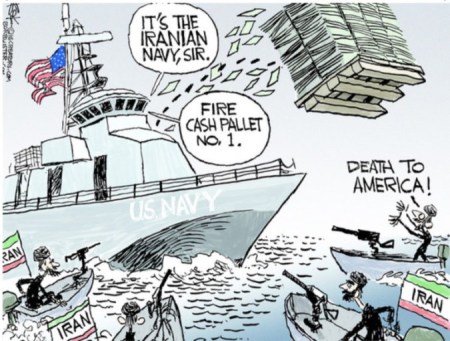
Obama’s Iran scam would be farcical were it not potentially deadly. He did not do what would have been best for America and the free world in general — increase sanctions until Iran complied fully with UN resolutions on missile testing, ceased Uranium enrichment and disposed of the means to do it, ceased all nuke research as well as all nuke cooperation with North Korea and ceased supporting all terrorist groups, including Hezbollah and Hamas. Instead, perhaps considering Himself above such trivia, Obama sought little more than what He considered His greatest achievement — His legacy:
iranian-navy-copy-1

Conclusions

If Obama were viewed internationally as the powerful leader of the world’s most powerful nation, He might be able to get China to clamp down, severely and successfully, on North Korea’s nuke and missile development. Were China to reject His overtures, He could arrange for it to wish that it had acceded. That’s not who Obama is, as demonstrated by, among His other actions, entering into the Iran Scam deal with Iran.

Perhaps Kim Jong-un needs to dress like an Iranian mullah to convince Obama to give him a “deal” similar to the one He gave to Iran. He had better hurry: that won’t work with President Trump.

North Korea Nuke Test – Amb John Bolton – Stuart Varney

September 9, 2016

North Korea Nuke Test – Amb John Bolton – Stuart V, Fox News via YouTube, September 9, 2016

https://www.youtube.com/watch?v=oai0DHTUbZ4

A Big Blast in North Korea, and Big Questions on U.S. Policy

September 9, 2016

A Big Blast in North Korea, and Big Questions on U.S. Policy, New York Times

GENEVA — North Korea’s latest test of an atomic weapon leaves the United States with an uncomfortable choice: stick with a policy of incremental sanctions that has clearly failed to stop the country’s nuclear advances, or pick among alternatives that range from the highly risky to the repugnant.

A hard embargo, in which Washington and its allies block all shipping into and out of North Korea and seek to paralyze its finances, risks confrontations that allies in Asia fear could quickly escalate into war. But restarting talks on the North’s terms would reward the defiance of its young leader, Kim Jong-un, with no guarantee that he will dismantle the nuclear program irrevocably.

For more than seven years, President Obama has sought to find a middle ground, adopting a policy of gradually escalating sanctions that the White House once called “strategic patience.” But the test on Friday — the North’s fifth and most powerful blast yet, perhaps with nearly twice the strength of its last one — eliminates any doubt that that approach has failed and that the North has mastered the basics of detonating a nuclear weapon.

Despite sanctions and technological backwardness, North Korea appears to have enjoyed a burst of progress in its missile program over the last decade, with experts warning that it is speeding toward a day when it will be able to threaten the West Coast of the United States and perhaps the entire country.

“This is not a cry for negotiations,” said Victor Cha, who served in the administration of President George W. Bush and now is a North Korea expert at the Center for Strategic and International Studies in Washington. “This is very clearly a serious effort at amassing real nuclear capabilities that they can use to deter the U.S. and others.”

Mr. Cha said the usual response from Washington, Seoul and Tokyo — for another round of sanctions — was not likely to be any more successful at changing the North’s behavior than previous rounds. That means Mr. Obama’s successor will confront a nuclear and missile program far more advanced than the one Mr. Obama began grappling with in 2009.

Mr. Obama has refused to negotiate with the North unless it agrees first that the ultimate objective of any talks would be a Korean Peninsula without nuclear arms. But Mr. Kim has demonstrated, at least for now, that time is on his side. And as he gets closer to an ability to threaten the United States with a nuclear attack, and stakes the credibility of his government on it, it may be even more difficult to persuade him to give up the program.

 In a statement Friday, Mr. Obama condemned the North’s test and said it “follows an unprecedented campaign of ballistic missile launches, which North Korea claims are intended to serve as delivery vehicles intended to target the United States and our allies.”

“To be clear, the United States does not, and never will, accept North Korea as a nuclear state,” he said.

Many experts who have dealt with North Korea say the United States may have no choice but to do so.

“It’s too late on the nuclear weapons program — that is not going to be reversed,” William Perry, the defense secretary under President Bill Clinton during the 1994 nuclear crisis with North Korea, said in August at a presentation in Kent, Conn. The only choice now, he argued, is to focus on limiting the missile program.

Yet the latest effort to do that, an agreement between the United States and South Korea to deploy an advanced missile defense system in the South, has inflamed China, which argues the system is also aimed at its weapons. While American officials deny that, the issue has divided Washington and Beijing so sharply that it will be even more difficult now for them to come up with a joint strategy for dealing with the North.

China has been so vocal with its displeasure over the deployment of the American system that Mr. Kim may have concluded he could afford to upset Beijing by conducting Friday’s test.

Fueling that perception were reports that a North Korean envoy visited Beijing earlier this week.

“North Korea almost certainly sees this as an opportunity to take steps to enhance its nuclear and missile capabilities with little risk that China will do anything in response,” Evans J.R. Revere, a former State Department official and North Korea specialist, said in a speech in Seoul on Friday.

The breach between China and the United States was evident during Mr. Obama’s meeting with President Xi Jinping last week. “I indicated to him that if the Thaad bothered him, particularly since it has no purpose other than defensive and does not change the strategic balance between the United States and China, that they need to work with us more effectively to change Pyongyang’s behavior,” Mr. Obama said, referring to the Terminal High Altitude Area Defense system, as the advanced missile defense project is known.

But Mr. Obama noted that sanctions had failed at having much effect. That is largely because the Chinese have left open large loopholes that have kept the North Korean economy alive and, by some measures, enjoying more trade than anytime in years.

In a recent paper, two researchers concluded that sanctions so far “have had the net effect of actually improving” North Korea’s procurement capabilities for its weapons program. To evade sanctions, the North’s state-run trading companies opened offices in China, hired more capable Chinese middlemen and paid higher fees to employ more sophisticated brokers, according to Jim Walsh and John Park, scholars at M.I.T. and Harvard respectively.

The sanctions, Mr. Cha noted, “are supposed to inflict enough pain so the regime comes back to the negotiation table, and that’s clearly not working; or it’s supposed to collapse the regime until it starves, and that’s not working either.”

“Unless China is willing to cut off everything, which they don’t appear willing to do, the sanctions may be politically the right thing to do and a requisite response, but they are not the answer to the problem,” he said.

That means the choices facing Mr. Obama’s successor will be stark. One option is to choke off all trade, in part by telling banks that conduct transactions with North Korea that they will be shut out of dealing in dollars around the world — an effective tactic against Iran before last year’s nuclear deal. But that would enrage the Chinese, and probably cut into cooperation on other issues.

At the same time, an attempt to intercept all shipping could quickly escalate into a full-blown conflict, something neither Mr. Obama nor the South Koreans and Japanese have been willing to risk.

On the other hand, reopening negotiations, which Donald J. Trump has indicated he is willing to consider, could mean paying North Korea again to freeze nuclear activities that the Bush administration and the Clinton administration had already rewarded them for stopping years ago.

The nuclear program dates back to Mr. Kim’s grandfather, Kim Il-sung, the country’s founder, who emerged from the Korean War more than 60 years ago mindful that the United States had considered using nuclear weapons in that conflict and determined to get his own arsenal.

The missile program also has a long history, mostly to deliver conventional arms. But now the two are converging, as the North races to develop a weapon small, light and durable enough to be launched into space and survive re-entry into the atmosphere.

The explosive energy unleashed during the test on Friday, estimated at 10 to 12 kilotons of TNT, was nearly twice that of the North’s last test, conducted in January, said Yoo Yong-gyu, a senior seismologist at South Korea’s National Meteorological Administration.

And the fact that North Korea’s fifth test came only eight months after its fourth is another indication that it is making fast progress toward fitting its ballistic missiles with nuclear warheads, said Choi Kang, a senior analyst at the Asan Institute. The North had waited about three years between each of its previous tests.

North Korea’s advances have unnerved its neighbors in South Korea and Japan, and Mr. Trump’s suggestion that the two nations should pay more for the United States to defend them has not helped.

In both South Korea and Japan, a small but increasingly vocal minority hasbegun to advocate developing nuclear weapons to counter the North instead of relying on the United States.

Cheong Seong-chang, a senior analyst at the Sejong Institute in Seongnam, south of Seoul, argued that a South Korean nuclear program might distract the North from its efforts to build a long-range missile capable of delivering a nuclear warhead to the mainland United States.

“If South Korea arms itself with nuclear weapons, North Korea will regard the South Korean nuclear weapons, not the distant American nukes, as the most direct threat to its security,” Mr. Cheong said.

North Korea Fires Submarine-Launched Ballistic Missile Towards Japan

August 24, 2016

North Korea Fires Submarine-Launched Ballistic Missile Towards Japan, Washington Free Beacon, August 24, 2016

dprk-missile-540x360Underwater test-fire of strategic submarine ballistic missile released by North Korea’s Korean Central News Agency on April 24, 2016 / REUTERS

SEOUL (Reuters)–North Korea fired a submarine-launched missile on Wednesday that flew about 500 km (311 miles) towards Japan, a show of improving technological capability for the isolated country that has conducted a series of launches in defiance of U.N. sanctions.

Having the ability to fire a missile from a submarine could help North Korea evade a new anti-missile system planned for South Korea and pose a threat even if nuclear-armed North Korea’s land-based arsenal was destroyed, experts said.

The ballistic missile was fired at around 5:30 a.m. (2030 GMT) from near the coastal city of Sinpo, where a submarine base is located, officials at South Korea’s Joint Chiefs of Staff and the Defense Ministry told Reuters.

The projectile reached Japan’s air defense identification zone (ADIZ) for the first time, Chief Cabinet Secretary Yoshihide Suga told a briefing, referring to an area of control designated by countries to help maintain air security.

The missile was fired at a high angle, South Korea’s Yonhap News Agency reported, an indication that its full range would be 1,000 km (620 miles) at an ordinary trajectory. The distance indicated the North’s push to develop a submarine-launched missile system was paying off, officials and experts said.

North Korea’s “SLBM (submarine-launched ballistic missile) technology appears to have progressed,” a South Korean military official told Reuters.

Jeffrey Lewis of the California-based Middlebury Institute of International Studies said the test appeared to be a success.

“We don’t know the full range, but 500 km is either full range or a full range on a lofted trajectory. Either way, that missile works.”

The launch came two days after rival South Korea and the United States began annual military exercises in the South that North Korea condemns as a preparation for invasion, and has threatened retaliation.

Beijing is Pyongyang’s main ally but has joined past U.N. Security Council resolutions against the North. It has been angered by what it views as provocative moves by the United States and South Korea, including their July decision to base the THAAD (Terminal High Altitude Area Defense) anti-missile system in South Korea.

China opposes North Korea’s nuclear and missile program as well as any words or deeds that cause tension on theKorean peninsula, its foreign minister, Wang Yi, said on Wednesday at a previously scheduled meeting with his Japanese and South Korean counterparts in Tokyo.

South Korea’s Foreign Ministry condemned the launch and warned of more sanctions and isolation for its rival that “will only speed up its self-destruction.”

“This poses a grave threat to Japan’s security, and is an unforgivable act that damages regional peace and stability markedly,” Japanese Prime Minister Shinzo Abe told reporters, adding that Japan had lodged a stern protest.

GROWING ISOLATION

North Korea has become further isolated after a January nuclear test, its fourth, and the launch of a long-range rocket in February which brought tightened UN sanctions.

It has launched numerous missiles of various types this year, including one this month that landed in or near Japanese-controlled waters.

Joshua Pollack, editor of the U.S.-based Nonproliferation Review, said claiming to have mastered SLBM technology is as much about prestige as a military breakthrough, a status enjoyed only by six countries including the United States, Russia, and China.

“I think it’s meant foremost as a demonstration of sheer technical capability and a demand for status and respect,” Pollack said.

South Korea believes the North has a fleet of more than 70 ageing, limited-range submarines–a mix of Chinese, Russian, and locally made boats. Acquiring a fleet of submarines large and quiet enough and with a longer range would be a next step for the North, experts said.

“They keep conducting nuclear tests and SLBMs together which means they are showing they can arm SLBMs with miniaturised nuclear warheads,” said Moon Keun-sik, a retired South Korean navy officer and an expert in submarine warfare.

North Korea said this year it had miniaturized a nuclear warhead to fit on a ballistic missile, but outside experts have said there is yet to be firm evidence to back up the claim.

Tensions on the Korean peninsula were exacerbated by the recent defection of North Korea’s deputy ambassador in London to South Korea, an embarrassing setback to the regime of North Korean leader Kim Jong Un.

Joe Biden to China: Curb North Korea or Japan Can Go Nuclear ‘Virtually Overnight’

June 26, 2016

Joe Biden to China: Curb North Korea or Japan Can Go Nuclear ‘Virtually Overnight’, Breitbart, Frances Martel, June 24, 2016

Joe Biden

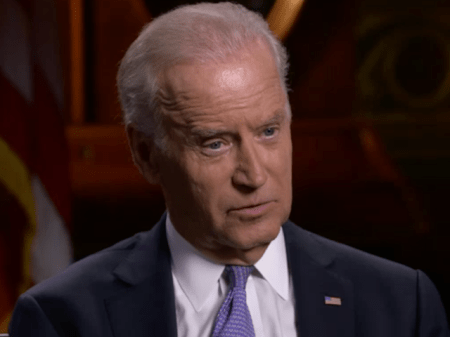
Vice President Joe Biden warned China that the Japanese government may acquire nuclear weapons “virtually overnight” if the threat from North Korea becomes too grave, urging Beijing to do more to curb Pyongyang’s belligerence.

The Vice President’s comments echo those of presumptive Republican presidential nominee Donald Trump, who warned that Japan and South Korea acquiring nuclear weapons “is going to happen anyway” in controversial remarks issued in March. Japanese government officials and media responded to Trump’s comments much more severely than they have to Biden’s.

“What happens if Japan, who could tomorrow, could go nuclear tomorrow? They have the capacity to do it virtually overnight,” Biden told PBS host Charlie Rose in an interview broadcast Monday. He explained that he made this warning to Chinese President Xi Jinping personally while discussing the deployment of a Terminal High Altitude Area Defense (THAAD) system in South Korea to protect from a North Korean attack, a move that China has condemned vocally.

“When I tell President Xi, you have to understand we got a guy up there in North Korea who is talking about building weapons that can strike, nuclear weapons strike the United States and not only Hawaii and Alaska, but… the mainland of the United States,” he told Rose. “And I say, so we’re going to move up our defense system, and he says no, no, no, wait a minute, my military thinks you’re going to try to circle us.”

Biden suggested that China, a fellow communist country, “has the single greatest ability to influence North Korea.”

Japan has issued a tepid response to the remarks, with Japanese Deputy Chief Cabinet Secretary Hiroshige Seko telling reporters Friday that Japan simply “can never possess nuclear weapons.” Japan remains the only nation in the world to experience a nuclear weapon attack.

In March, Trump stated that both Japan and South Korea were likely to develop nuclear capabilities due to their access to advanced technology. “It’s going to happen, anyway. It’s only a question of time. They’re going to start having them, or we have to get rid of them entirely,” he said, suggesting that, should the move be inevitable, the United States should do more to curb its defense expenses in Asia protecting wealthy nations.

In response, Foreign Minister Fumio Kishida stated that Japan having nuclear capabilities was “impossible,” and national newspaper Asahi Shimbun described national leaders as responding with “bewilderment and unease.

The government of North Korea has behaved with extreme belligerence in 2016, beginning the year with the detonation of what they claimed was a hydrogen bomb and repeatedly launching missiles towards Japan (all have failed to reach their targets). Most recently, North Korea tested what are believed to be two Musudan ballistic missiles, with one reaching the greatest height the nation has yet to achieve on a test.

China responded to the new test by calling for North Korea to “act with caution and refrain from taking actions that may elevate tension on the Korean peninsula.” China recently backed expanded UN sanctions on North Korea, but has condemned U.S. and South Korean defense buildups in response to Pyongyang, claiming that the also put Beijing in the line of fire.

While China has kept its criticism of North Korea tepid and remained its largest trade partner, the volume of that trade has declined significantly. Imports from North Korea dropped 12.6 percent between May 2015 and May 2016, while exports to North Korea fell 5.9 percent in the same time period.

North Korean Nuke Program Built With Earnings From Slave Labor

May 30, 2016

North Korean Nuke Program Built With Earnings From Slave Labor, Washington Free Beacon, May 30, 2016

North Korean leader Kim Jong Un waves during a parade at Kim Il Sung Square in the country's capital Pyongyang on May 10, 2016, to celebrate the end of the seventh Workers' Party of Korea congress. Kim appeared at the parade, in which hundreds of thousands of people took part. (Kyodo) ==Kyodo

North Korean leader Kim Jong Un waves during a parade at Kim Il Sung Square in the country’s capital Pyongyang on May 10, 2016, to celebrate the end of the seventh Workers’ Party of Korea congress. Kim appeared at the parade, in which hundreds of thousands of people took part. (Kyodo)

North Korea uses “forced and slave laborers” in order to fund state priorities, including the development of nuclear weapons and missiles, according to a new report on the labor practices in the isolated dictatorship.

The report, entitled Gulag, Inc., was unveiled by the Committee for Human Rights in North Korea (HRNK) at an event at the National Press Club in Washington, D.C., last week. It offers a glimpse into the way Kim Jong Un’s regime exploits North Korean citizens in the lowest tiers of its social system for economic gain.

“Most of us cannot imagine a place where your life is pre-determined from the time you are born: what you eat, where you attend school, travel, and work—all forced onto you, regardless of your desires, dreams, talents, or merits,” the report says.

“If you are born into the lowest rung of the loyalty-based social discrimination system (songbun), you will likely live a brutish, dangerous, and often short life, shrouded in the darkness of the country’s state-run mines. This has been the reality of North Korea under three generations of the Kim regime.”

The report was written by Kim Kwang-Jin, a defector from North Korea and an expert on the regime’s secret and illegal international financial operations who is a fellow at HRNK.

Forced labor serves as the backbone of North Korea’s mining industry, which yields coal, copper, and other commodities that “earn hard foreign currency for the state,” Kwang-Jin explains in the report.

The mining industry continues to play a central role in North Korea’s exports despite reductions in the price of commodities. In 2013, for example, coal and mineral resources accounted for half of the regime’s total exports. The chief buyer of North Korean mineral exports is China.

“In 2013, China accounted for 97% of North Korea’s exports of mining products in terms of revenue. Exports of coal and iron ore to China in the same year totaled $1.68 billion, or 44% of North Korea’s overall exports to all countries for that year,” the report notes.

All facets of the mining industry are run by state entities.

The North Korean social system is comprised of three classes: the basic class, the complex class, and the hostile class. Members of the two lower rungs “are forcibly assigned to the most difficult and avoided occupations in North Korea, which include mines and farms.” The occupations of those in the hostile class, the lowest class, are pre-determined by the occupations of the individual’s parents or grandparents.

North Korea’s political prison camps are also linked to mining activities, according to evidence presented in the report.

“These individuals, systematically marginalized and discriminated against, cannot enter the institutions of power, including the Party, government, or the military. They are placed at an extreme disadvantage in all walks of life, and their labor is exploited to maintain production and export the state’s underground resources,” the report says. “The dark reality of this industry reveals a vast system of unlawful imprisonment, forced labor, and human rights violations.”

The wealth generated from the mining industry is used by Kim Jong Un’s regime to “strengthen its own power,” meaning that the state’s interests are funded by slave labor.

“The underground resources exported from North Korea are produced by forced labor and human rights violations committed by the state,” the report explains. “The wealth that is generated from these exports is spent on state priorities: the privileged lifestyle of the Kim dynasty and the elite classes, the development of nuclear weapons and missiles, songun (‘Military First’) politics, giftpolitik, and the maintenance of the songbun system of social classification.”

A resolution passed by the United Nations Security Council in March cracked down on North Korean exports by prohibiting Pyongyang from exporting coal, iron, iron ore, gold, and other minerals, with some exceptions. The new sanctions came in response the regime’s January nuclear test. Still, the resolution is not likely to be enough to curb exports to China, the report notes.

“Although the sanctions imposed by UN Security Council resolution 2270 were widely regarded to be unprecedented in strength, they do not yet appear to have had a significant impact on North Korea’s exports of underground resources to China, which continue under the guise of ‘livelihood purposes,’” the report states.

“There is an urgent need to strengthen controls on North Korea’s mining exports, not only to improve the effectiveness of sanctions aimed at altering Pyongyang’s stance on denuclearization, but also to protect the human rights of countless North Koreans who endure forced labor in mines across the country.”

Kwang-Jin headlined the launch event for Gulag, Inc. on Thursday along with David Asher, who was a State Department official during the Bush administration; William Newcomb, a former U.S. government economist; and Roberta Cohen, an expert on human rights and humanitarian issues at the Brookings Institution.

Asher, who served as a senior adviser for East Asian and Pacific Affairs and coordinator of the North Korea Working Group at the State Department, emphasized the need to crack down on North Korea’s forced labor in order to minimize threats posed by Pyongyang to the homeland.

“These workers are being used as slaves or serfs in a way that is absolutely at the center of the North Korean regime’s finances and weapons of mass destruction program,” stated Asher.

“North Korea’s ‘Gulag, inc.’ is supporting a system that at the end of the day is involved in threatening the entire stability of the world economy and civil society,” Asher later said. “North Korea’s exploitation of its human people like cattle at the end of the day results in a very sophisticated ability to build nuclear weapons and proliferate them as well as missiles.”

Trump’s approach to North Korea bucks foreign policy elite

May 23, 2016

Trump’s approach to North Korea bucks foreign policy elite, The Hill, Ivan Eland, May 23, 2016

[A]lthough Trump is still putting together his foreign policy, he already has the pieces to create a more coherent and possibly more successful policy toward North Korea than the stodgy U.S. elite, who have sniffed at him.

************************

Donald Trump, the presumptive Republican presidential nominee, is at it again, horrifying the U.S. foreign policy elite by saying that he would speak to Kim Jong Un, the erratic North Korean leader, to discuss North Korea’s nuclear program. For example, the standard bearer for this elite, and Trump’s likely Democratic opponent for president, former Secretary of State Hillary Clinton, sneered at Trump’s “bizarre fascination with foreign strongmen.”

Imagine actually talking to difficult countries, as Ronald Reagan successfully did with the Soviet Union! Trump knows that it takes a tough and effective leader to use negotiation and diplomacy instead of the reflexive use of military force, which has marked the weak and insecure presidencies of George W. Bush and Barack Obama.

Trump’s high-level negotiation likely would be more successful in limiting or getting rid of North Korea’s nuclear program than past, unsuccessful lower-level U.S. bargaining with the regime over the same issue.

With U.S. forces stationed in South Korea, Kim Jong Un is paranoid of a combined, U.S.-South Korean attack on his country. The main reason that he has likely developed nuclear weapons is to deter such an attack. A President Trump speaking to him personally might ease these fears significantly.

Also dismissed by the foreign policy elite is Trump’s strategy of putting pressure on China, North Korea’s only ally, to prod Kim to negotiate away his nuclear program. Trump said in a recent media interview: “I would put a lot of pressure on China because economically we have tremendous power over China.”

The foreign policy elite notes that despite recent Chinese annoyance with North Korean nuclear and missile tests, and China’s agreement to impose some economic sanctions on the regime, it still props up the always rickety North Korean autocracy with supplies of energy and other vital goods over their common border. Thus, the elite doubts that China will change this behavior.

Yet Trump, a businessman, may be more savvy than politicians and bureaucrats by focusing on negotiating parties’ incentives to do things—that is, Trump likely knows that for a sustainable arrangement on the North Korean nuclear program to be reached and honored, it has to be advantageous for both China and the U.S. Trump is correct that China is the key to moving North Korea on the issue and when pressure on China is combined with other elements of Trump’s foreign policy program, it just might work.

The main reason that China supports the dangerously unpredictable North Korea is that it feels it has no choice: If the North Korean regime collapses, China fears Korea will be unified under a pro-U.S. South Korean government—U.S. military and even U.S. nuclear forces could be right on China’s border.

In other words, China would then have a hostile alliance dominated by a military superpower, the U.S., on its border. Given the collapse of communist governments in Europe at the end of the Cold War and the expansion of a U.S.-led NATO alliance hostile to Russia right on Russian borders, the Chinese believe that their fears are well grounded.

Trump’s solution to this friction is to allow wealthy allies in the region like Japan and South Korea to defend themselves. China would no longer need to fear the U.S. superpower, with its massive arsenal of nuclear weapons, on its border if North Korea collapsed.

Therefore, if Trump implemented this change in U.S. policy, China might have a greater incentive to pressure North Korea to limit or eliminate its nuclear program than it currently does. China has no intrinsic incentive to want an unstable state possessing nuclear weapons as its immediate neighbor.

In sum, although Trump is still putting together his foreign policy, he already has the pieces to create a more coherent and possibly more successful policy toward North Korea than the stodgy U.S. elite, who have sniffed at him.

Could North Korea Secretly Build an Iranian Bomb?

May 11, 2016

Could North Korea Secretly Build an Iranian Bomb? The National InterestPeter Brookes, May 10,2016

(Please see also, The Iran-North Korea Axis of Atomic Weapons? — DM)

Khamanei-300x271

Editor’s Note: The National Interest and the Heritage Foundation have partnered for a multi-part occasional series examining various aspects of the Iran nuclear agreement. The below is part four of the series. You can read previous parts here: one, two and three.

Last summer’s Iran nuclear deal has been roundly criticized for a number of solid reasons, ranging from Tehran’s ability under the deal to continue advanced centrifuge research to lingering questions about the possible military dimensions of its nuclear program.

That’s all well established.

One issue that has been largely ignored—wittingly or unwittingly—is this: What if Iran were able to find a suitable partner to collude with on an ‘‘underground” nuclear weapons program, all while seemingly staying within the restrictions of the July 2015 nuclear deal?

In other words, Tehran could by all public accounts adhere to the P5+1’s (China, France, Germany/European Union, Russia, the United Kingdom and the United States) Joint Comprehensive Plan of Action (JCPOA). But concurrently, Iran could work clandestinely with another country to advance its nuclear weapons program, essentially circumventing the International Atomic Energy Agency’s inspections and monitoring of the nuclear program inside Iran.

What better candidate for covert cooperation than cagey North Korea?

First, there’s no doubt that North Korea has a nuclear weapons capability. It has conducted four—maybe soon five—tests (2006, 2009, 2013 and 2016), possibly using both plutonium and uranium as fissile material.

Next, some analysts believe Pyongyang may have already “miniaturized” or “weaponized” the underground testing device into a nuclear warhead, capable of being mated to a ballistic missile. Even if North Korea hasn’t achieved it yet, it’s working on it.

Pyongyang has also expanded its missile testing beyond land-based launches. It now has conducted at least two subsurface ballistic missile tests that may also be related eventually to its nuclear weapons program. Clearly, these North Korean capabilities—though not all proven—would benefit an Iranian nuclear weapons program.

Also important is that Pyongyang seems willing to share its nuclear know-how with others, as evidenced by its building of a nuclear facility for Damascus that was destroyed in an Israeli air strike in 2007. Though public evidence is scarce and, if available, gauzy, it’s quite reasonable to conclude with some confidence that Pyongyang and Tehran already have some sort of established security or defense relationship. For instance, in 2012, Iran and North Korea reportedly signed a science and technology (S&T) agreement. It’s fair to assume that any cooperation is defense-related.

Indeed, considering the sorry state of their respective economies, research and industrial bases, it’s hard to conceive of what sort of civilian S&T Pyongyang might offer Tehran—and vice versa, of course.

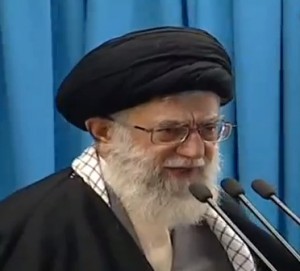
Lending credence to this idea is the report that, at the time of the S&T agreement’s signing, Iran’s Supreme Leader, Ayatollah Ali Khamenei, spoke of how Tehran and Pyongyang had “common enemies.” The United States quickly—and clearly—comes to mind.

The idea of collaboration should come as no real surprise, as it’s seemingly well-known that the Iran and North Korea are reported to have been cooperating at some level on ballistic missiles going back to at least the late 1990s. For instance, it’s long been asserted that some Iranian ballistic missiles (e.g., the Shahab) are based on North Korean ballistic-missile technology (e.g., the Nodong) or transfers (e.g., the Scud).

Equally alarming is the New York Times report suggesting that the 2013 North Korean nuclear test may have been conducted “for two countries.” That notion was raised by unattributed U.S. government sources and gives support to concerns that Pyongyang and Tehran may be cooperating on more than ballistic missiles. This wouldn’t be the first time such an allegation has been leveled at Tehran and Pyongyang informally, but perhaps the first time it’s been acknowledged by Washington, taking into account a source not willing to be identified.

Of course, the situation has changed dramatically with the JCPOA now in force. Iran now has more than a passing interest in moving forward with its nuclear weapons program—especially considering the evolving regional security situation—without losing the benefits that the agreement provides, such as the removing of crippling economic sanctions. From Iran’s perspective, the need for “nuclear networking” with North Korea is greater than ever.

Of course, it’s not just Tehran that is in need. Pyongyang is also needy for its own reasons, such as its self-imposed, collectivist economic woes and the increasing international economic sanctions it faces over nuclear and missile tests.

In addition, North Korea could use some technical assistance with its space launch program, where Iran is arguably more advanced, but which is integral—and critical—to Pyongyang’s intercontinental ballistic missile (ICBM) program.

Lastly, both countries despise the United States and some of its allies (e.g., South Korea and Israel). Accordingly, Iran and North Korea would benefit from the existence of another state that threatens America with nuclear-tipped ICBMs.

 In other words, there’s plenty of political and military motivation for these two rogue states to get together on nuclear and/or missile matters, arguably even more so today than last summer, before the JCPOA came into effect.

State Dept: North Korea Should Be ‘Inspired by’ Iran Nuclear Deal

April 20, 2016

State Dept: North Korea Should Be ‘Inspired by’ Iran Nuclear Deal, BreitbartJohn Hayward, April 19, 2016

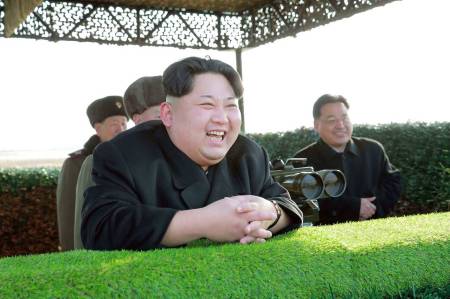
(Kim must either take the deal and stop testing nukes or Obama will “respond strongly” by announcing his condemnation. What might Kim be laughing at in the photo below? — DM)

Kim Chi-un laughing at Obama

During a visit to Seoul, South Korea, Deputy Secretary of State Antony Blinken said the North Koreans should be “inspired” to give up their nuclear weapons by the deal that was struck with Iran.

“Iran made a fundamental choice. It decided to freeze and roll back its nuclear program and allow inspectors to come in and create the time and space to see if we could agree a comprehensive agreement,” said Blinken, as reported by Reuters. About North Korea, he stated: “It’s our hope that the DPRK will be inspired by that example.”

He went on to cite “recent diplomatic progress” with Cuba and Myanmar as evidence the United States is “willing to engage with countries like North Korea.”

“If a country, even one with which we’ve had the most profound differences, is prepared to engage seriously and credibly in answering the demands of the international community, we are also prepared to engage,” Blinken declared.

However, he insisted the U.S. would “respond strongly” if there is another North Korean nuclear test, as international observers widely suspect.

South Korean president Park Geun-hye said on Monday that activity near the North’s nuclear test site indicates another detonation may be imminent. The South Korean Defense Ministry suggested it might be an underground test of a miniaturized warhead, bringing them perilously close to mounting nukes on a ballistic missile.

“We are in a situation in which we cannot predict what provocations North Korea might conduct to break away from isolation and to consolidate the regime,” Park warned.

Army General Vincent Brooks testified to a Senate panel on Tuesday that North Korea is “struggling” with its intercontinental ballistic missile program, but he warned that “over time, I believe, we are going to see them acquire these capabilities if they are not stopped.”

North Korea’s Sanctions Loophole

February 29, 2016

North Korea’s Sanctions Loophole, Wall Street Journal, February 28, 2016

Happy KimThis undated picture released from North Korea’s official Korean Central News Agency on February 27, 2016 shows North Korean leader Kim Jong-Un smiling during the inspection of the test-fire of a newly developed anti-tank guided weapon at an undisclosed location. PHOTO: KCNA VIA KNS/AFP/GETTY IMAGES

The Obama Administration is touting the latest United Nations sanctions as a milestone against North Korea’s nuclear and missile programs. We’d like to believe it too, but a close look at the draft Security Council resolution offers many reasons to doubt.

The resolution would double the number of blacklisted North Korean individuals and state entities, adding Pyongyang’s atomic-energy and space agencies. Luxury goods banned from export to North Korea would grow to include watches, yachts and snowmobiles. A ban on sales of aviation fuel targets state-owned airline Air Koryo, while a ban on sales of rocket fuel targets Kim Jong Un’s missile program.

More significant are efforts to cut Pyongyang’s access to hard currency and smuggled weapons technology. The sanctions expand the list of banned arms and dual-use goods, and they require states to inspect all cargo transiting their territory to or from North Korea by sea, air or land. They would also squeeze North Korean mineral exports, including coal and iron ore, which in 2014 accounted for 53% of Pyongyang’s $2.8 billion in exports to China, per South Korean state figures.

Overall the blacklist of North Korean proliferators is growing by only 12 individuals and 20 entities to a total of 64; the U.N.’s former blacklist on Iran was far larger at 121. In any case, none of these matter if China won’t rigorously enforce them—which it has never done.

There are other loopholes and oversights. The nominal ban on North Korean mineral exports applies only to purchases that demonstrably fund illicit activities, rather than “livelihood purposes.” Yet money is fungible, so Chinese coal purchases excused on livelihood or humanitarian grounds will still channel hundreds of millions of dollars to the regime.

The sanctions also do nothing about the Chinese oil transfers that keep the Kim regime alive. Or Chinese purchases of textiles from mostly state-run North Korean factories that have quadrupled to $741 million a year since 2010 and recently ensnared Australian surf brand Rip Curl in a supply-chain controversy. Or the 50,000-plus North Korean laborers overseas, largely in China and Russia, earning some $230 million a year for their masters in Pyongyang.

U.S. officials say China has new incentive to back sanctions because it wants to block South Korea’s recent moves to deploy the U.S.-built Thaad missile-defense system. That may be why China wants to look cooperative, but the new sanctions aren’t enough to justify walking back on Thaad. China still views the North as a political buffer against South Korea, a thorn in the side of Japan and the U.S., and a diplomatic card to play at the U.N. So China has long played a double game of rhetorically deploring North Korea’s nuclear program while propping it up in practice.

The better way to squeeze the North is closer cooperation among Washington, Seoul and Tokyo to sanction Chinese banks that facilitate trade with Pyongyang. This worked a decade ago until the Bush Administration fell for more of China’s diplomatic promises. China won’t get serious about stopping North Korea until it sees that the U.S. and its allies are serious.