Posted tagged ‘North Korean missiles’

Further Evidence of Iran-North Korea Military Connection

May 6, 2017

Further Evidence of Iran-North Korea Military Connection, Iran Focus, May 5, 2017

London, 5 May – Pentagon officials saw more evidence of North Korea’s assistance when Iran tried to launch a cruise missile from a midget submarine earlier this week. Intelligence reports claim the submarine was the same type that sank a South Korean warship in 2010, which was Pyongyang designed.

This was the first time Iran attempted to launch a Jask-2 cruise missile underwater, but the launch failed, according to U.S. defense officials. That North Korea and Iran are sharing expertise when it comes to their rogue missile programs has been long suspected by nonproliferation experts.

Perhaps most worrisome for the United States is that this occurred in the narrow and crowded Strait of Hormuz, where much of the world’s oil passes each day.

Jeffrey Lewis, a missile proliferation expert at the Middlebury Institute of International Studies at Monterey said, “The very first missiles we saw in Iran were simply copies of North Korean missiles, over the years, we’ve seen photographs of North Korean and Iranian officials in each other’s countries, and we’ve seen all kinds of common hardware.”

“In the past, we would see things in North Korea and they would show up in Iran. In some recent years, we’ve seen some small things appear in Iran first and then show up in North Korea and so that raises the question of whether trade — which started off as North Korea to Iran — has started to reverse,” Lewis added.

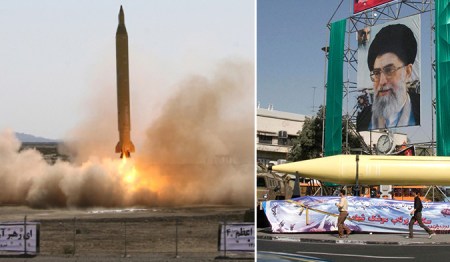
The ballistic missile Iran tested in late January was based on a North Korean design, the Pentagon said. Another missile launch conducted by Iran last summer, was similar to the most advanced missile Pyongyang has successfully tested to date, a North Korean Musudan.

North Korea’s Taepodong missile looks almost identical to Iran’s Shahab, according to defense analysts.

North Korea successfully launched a missile from a submarine for the first time in 2015, and officials believe Tehran is not far behind.

North Korea and Iran are the only countries in the world who deploy the Yono-class submarine. Midget subs are used in shallow waters, where they can hide. The 290-foot South Korean warship that sank in 2010 and killed more than 40 sailors, was ambushed in shallow water by a midget sub. However, North Korea denies involvement in the attack.

A U.S. defense official who declined to be identified stated, “When those midget subs are operating underwater, they are running on battery power—making themselves very quiet and hard to detect.”

During testimony at the House Armed Services Committee late last month, Admiral Harry Harris, the head of American forces in the Pacific said, “We are being taken to the cleaners by countries that are not signatories to the INF.” Harris warned that because the U.S. is a signatory to the Intermediate Range Nuclear Forces, or INF, treaty signed in 1987 between Russia and the United States, the United States has no land-based short range or medium range missiles. Iran and North Korea are under no such constraints.

The BM-25 Musudan ballistic missile has a maximum range of nearly 2,500 miles, and potentially puts U.S. forces in the Middle East and Israel within reach, if its problems are fixed.

It’s unclear to what extent North Korea is involved in the failed launch, apart from sharing their technology, according to officials.

Rex Tillerson, Secretary of State, tried to garner support for more United Nations sanctions against North Korea by hosting leaders from Southeast Asia in Washington on Thursday.

The White House put Iran “on notice” just days after Iran’s first ballistic missile test during the Trump administration.

North Korea: China ‘Dancing to the Tune of the U.S.’ with ‘Absurd’ Opposition to Nuclear Program

May 5, 2017

North Korea: China ‘Dancing to the Tune of the U.S.’ with ‘Absurd’ Opposition to Nuclear Program, BreitbartJohn Hayward, May 4, 2017

AFP PHOTO / KCNA via KNS REPUBLIC OF KOREA

North Korea is a bottomless fountain of apocalyptic threats against the U.S. and its allies, but on Wednesday, its state-run media lashed out against China with unprecedented fury, accusing the Chinese of “dancing to the tune of the U.S.” with “absurd and reckless remarks” about Pyongyang’s nuclear weapons program.

The North Korean outburst was prompted by a string of editorials in China’s similarly state-controlled media which “criticized the North’s nuclear weapons program and called for Beijing to cut off oil supplies if the North conducted another nuclear test,” as the New York Times summarizes them.

“One must clearly understand that the DPRK’s line of access to nukes for the existence and development of the country can neither be changed nor shaken, and that the DPRK will never beg for the maintenance of friendship with China, risking its nuclear program which is as precious as its own life, no matter how valuable the friendship is,” snarled the unusually harsh response from North Korea’s Rodong Sinmun newspaper. (“DPRK” is North Korea’s name for itself, the Democratic People’s Republic of Korea.)

“China should no longer try to test the limits of the DPRK’s patience. China had better ponder over the grave consequences to be entailed by its reckless act of chopping down the pillar of the DPRK-China relations,” the op-ed continued.

North Korea accused China of providing “lame excuses for the base acts of dancing to the tune of the U.S.” and betraying Pyongyang’s friendship “in order to avert a war which would bring danger to China.” It railed against “absurd and reckless remarks” from “ignorant politicians and media persons” in China.

“We didn’t cross the ‘red line’ of the (North Korea)-China relationship. China is violently stomping on and crossing it without hesitation,” declared another passage spotlighted by CNN.

The editorial specifically complained about “rubbish” in Chinese publications accusing North Korea of creating tensions in northeast Asia and giving the United States “excuses for deploying more strategic assets.”

On the contrary, China should “acknowledge in an honest manner that the DPRK has just contributed to protecting peace and security of China, foiling the U.S. scheme for aggression by waging a hard fight in the front line of the showdown with the U.S. for more than seven decades, and thank the DPRK for it,” according to the North Korean paper.

The New York Times notes that this broadside was not an unsigned editorial from the editors at large but was attributed to a specific author named Kim Chol.

Of course, no one would imagine such a provocative article could be published by any North Korean outfit without the blessing of dictator Kim Jong-un, but putting a single name on the piece gives North Korea a little wiggle room to disavow its harsh words if China objects too strongly or does whatever is needed to calm the Kim regime down. In either of those eventualities, it is a safe bet that someone in Pyongyang named “Kim Chol” will have a very bad day.

Another cushion for the blow noted by the NYT is that Kim Chol’s op-ed did not castigate the government of China or the Communist Party per se; the fiery criticism was directed at Chinese media – which, of course, is only slightly more independent of the government and ruling party than North Korean media.

North Korean editorialists have grumbled about Chinese policy before, but it usually takes the important precaution of leaving China’s name out of the editorials, referring vaguely to a “neighboring country.”

Indications that China might decide to handle North Korea’s outburst with kid gloves quickly appeared. The Chinese Foreign Ministry stressed both Beijing’s “consistent and clear” position on denuclearizing the Korean peninsula and “good-neighborly and friendly relations with the DPRK.”

China’s Communist Party organ, the Global Times, at first responded with some soothing noises about the marvelous friendship between Beijing and Pyongyang, slipping in a few barbs about the importance of denuclearization, China’s unwillingness to “allow its northeastern region to be contaminated by North Korea’s nuclear activities,” and a little reminder that North Korea would have been defeated by South Korea and the United States in the 1950s without Chinese intervention.

On Thursday, the Global Times directly addressed the Kim Chol editorial, very pointedly observing it was the first time China was specifically named in such a tirade.

“Overall, the editorial is nothing more than a hyper-aggressive piece completely filled with nationalistic passion,” sniffed the Global Times. “Pyongyang obviously is grappling with some form of irrational logic over its nuclear program.”

The editorial goes on to tell North Korean media to pipe down while officials in Beijing and Pyongyang hammer out their policy differences through “higher levels of dialogue with one another.” A half-dozen passages in the Global Times response boil down to condescending advice that North Korean is making its situation worse by publicly criticizing China.

“The direction of China-North Korea relations remains in the hands of China. Whether KCNA editorials mention China or Chinese media by name or not, those missions will not change the inherent logic and trend of a relationship that has been in place for over six decades. The more editorials KCNA publishes, the better Chinese society will be able to understand how Pyongyang thinks, and how hard it is to solve this nuclear issue,” the concluding paragraph reads.

Another commentary published by Rodong Sinmun on Wednesday warns Japan that it would be “blanketed with radioactive clouds if a nuclear war occurs on the Korean peninsula.”

“Not only those who try to harm us but their supporters will not be safe if any war breaks out,” this op-ed stated, adding that it would be a “piece of cake” for North Korea’s military to devastate Japan.

Congress to Pass Fresh Sanctions on North Korea as Nuke Threat Hits Critical Stage

May 3, 2017

Congress to Pass Fresh Sanctions on North Korea as Nuke Threat Hits Critical Stage, Washington Free Beacon, , May 3, 2017

This April 15, 2017 picture released from North Korea’s official Korean Central News Agency (KCNA) on April 16, 2017 shows Korean People’s Army (KPA) soldiers marching through Kim Il-Sung square during a military parade in Pyongyang marking the 105th anniversary of the birth of late North Korean leader Kim Il-Sung.THIS PICTURE WAS MADE AVAILABLE BY A THIRD PARTY. AFP CAN NOT INDEPENDENTLY VERIFY THE AUTHENTICITY, LOCATION, DATE AND CONTENT OF THIS IMAGE. THIS PHOTO IS DISTRIBUTED EXACTLY AS RECEIVED BY AFP. / (Photo credit should read STR/AFP/Getty Images)

Congress is expected to level fresh economic sanctions on North Korea this week as the threat of the hermit nation’s capability to strike the U.S. with a nuclear missile continues to escalate, according to conversations with members of the congressional leadership who told the Washington Free Beacon that the Kim Jong Un regime could have a nuclear weapon capable of striking the United States in “only a few years.”

House Majority Leader Kevin McCarthy (R., Calif.) confirmed that he has scheduled a vote in the House on new sanctions that will target North Korea’s slave labor trade and its shipping industry, which plays a central role in ferrying illicit arms and technology to and from the country. North Korea is a major supplier of nuclear technology on the black market, particularly to Iran, which has mimicked Pyongyang’s nuclear playbook.

The new sanctions come as congressional leaders debate how to handle North Korea’s growing nuclear threat, which went largely unaddressed by the former Obama administration.

North Korea is expected to perfect a nuclear missile capable of striking the U.S. homeland in about four years time, according to congressional sources.

“The North Korean threat is escalating—in about four years, experts estimate that North Korea will have the capability to reliably hit the continental United States with a nuclear weapon,” McCarthy told the Free Beacon. “America must use every tool at our disposal to keep our nation safe and preserve peace.”

McCarthy said that new sanctions are long overdue and can more easily win approval now that former President Barack Obama is out of office.

“This week, we will vote to increase sanctions on North Korea, targeting its shipping industry as well as those who employ North Korean slave labor abroad,” the lawmaker said. “The last administration’s long-practiced policy of strategic patience has made us less safe. We must increase the pressure on the Kim regime.”

In just the past year, North Korea has conducted two nuclear weapons tests and at least 26 ballistic missile flight tests.

The new sanctions, codified under the Korean Interdiction and Modernization of Sanctions Act, has already garnered approval from the House Foreign Affairs Committee and is expected to easily pass when it comes before the full House for a vote. The bill will then be taken up for action by the Senate, which has an appetite for such a bill.

Lawmakers are moving forward with two other resolutions aimed at highlighting North Korea’s escalating nuclear progress.

One resolution formally condemns Pyongyang’s development of several intercontinental ballistic missiles, which violated multiple international laws on such behavior.

A second resolution requires the State Department to determine whether North Korea is a state sponsor of terrorism. Such a designation still has not been made, despite the country’s threatening behavior and multiple nuclear missile launches.

“It is not a matter of if, but when Kim Jong-Un will be brazen enough to attack one of our allies, or even the United States,” McCarthy said in a statement on the two resolutions. “We must be honest and forthright abroad, making clear that North Korea’s ballistic missile testing is unacceptable and that the Kim regime is worthy of sanctions as it is undoubtedly a state sponsor of terrorism.”

One senior congressional source who spoke to the Free Beacon about the issue said that the Obama administration’s policy of trying to wait out the threat has proven ineffective.

“The policy of strategic patience has allowed North Korea to charge full steam ahead in developing its nuclear program,” said the source, who requested anonymity to discuss congressional deliberations on the issue. “Doing nothing has only allowed North Korean provocations to increase. I think everyone recognizes that.”

“Now, North Korea is only a few years away from being able to hit the United States with a nuclear bomb,” the source said. “The best response is to increase pressure on the Kim regime, including with new sanctions, leaving all options on the table to preserve peace and end the threat of a nuclear North Korea.”

How to Defuse the Crisis with North Korea

May 2, 2017

How to Defuse the Crisis with North Korea, American ThinkerHerbert E. Meyer, May 2, 2017

(There is no excellent solution and the concept behind the suggestion needs to be expanded. However, something along its lines may be the best we can do. North Korean peasants would be better off as East German clones and China would prefer the arrangement to a reunification of North and South Korea. Please see also, Krauthammer: U.S. does have cards to play against North Korea and my parenthetical comment there. — DM)

North Koreans would have far more confidence that a guarantee of sovereignty by the U.S. and South Korea would hold if China’s leaders backed it publicly, as well as privately. And if the Chinese would promise to provide the level of economic support that North Korea needs to keep it at least stable, and perhaps more prosperous than it is now, that would help encourage the generals to act. Let’s hope that President Trump at least talked about all this when he met at Mar-a-Lago last month with his new best-buddy, Chinese president Xi.

*********************

The looming crisis with North Korea provides a perfect illustration of what’s gone wrong with the way Washington works. Everyone is so eager to propose a policy, no one can be bothered to articulate an objective. So policymakers start arguing about what to do, before deciding what they want to accomplish. That’s like arguing over what route to take, before deciding where you want to go. (Which, to point out the obvious, is why we keep ending up in the middle of nowhere, or upside down in a ditch.)

Here’s one possible objective that would defuse this crisis and perhaps even bring a few decades of stability: to turn North Korea into a modern version of East Germany.

For those of you too young to remember the Cold War, during those decades after World War II Germany was divided. West Germany was free, prosperous, and an American ally. East Germany was a miserable dictatorship, not very prosperous, and a Soviet satellite. (To get a feel for what life was like in East Germany, watch the great movie The Lives of Others, and the German television seriesWeissensee.) But during all these decades, East Germany was never a threat to West Germany, or to the U.S. Its communist regime wanted only to be left alone. And in return, the West Germans and the Americans made it absolutely clear they had no intention of unifying Germany by attacking or otherwise bringing down the East.

When the Korean war ended with an armistice in 1953, that country was divided. South Korea became free, prosperous, and an American ally. North Korea became a miserable dictatorship, not very prosperous, and a sort-of satellite of China. The difference between Germany and Korea is that while East Germany wanted only to be left alone, North Korea keeps threatening to conquer South Korea and reunify the country under its control, and to fire nuclear-armed missiles at the U.S. itself.

President Trump’s Got Their Attention

But now, for the first time in its history — and thanks entirely to President Trump — North Korea faces the real possibility of a massive military attack, certainly to destroy its nuclear facilities and perhaps even to obliterate the regime itself. And there’s nothing like the looming prospect of an attack by the United States to get a government’s attention.

Simply put, it may be possible to defuse the current crisis without a war by cutting a deal along these lines: If North Korea will give up its nuclear weapons and cease threatening South Korea and the U.S., the U.S. and South Korea will guarantee North Korea’s sovereignty.

Once again, there’s an historic parallel between Korea and Germany: Adolf Hitler was crazy; a foaming-at-the-mouth, chewing-the-carpet raving lunatic. He was also a brilliant, cunning politician who not only held onto power, but who kept within his grip the total loyalty of Germany’s military leaders. These generals weren’t crazy; they were hard, practical, highly intelligent men who had fought and lost World War I and then rebuilt Germany’s war machine. They knew in their bones that another world war would devastate their country. They understood that invading Russia would end in catastrophe.

Yet the generals didn’t get rid of Hitler. While a small number were prepared to overthrow Hitler, most were caught up in appalling, fawning loyalty to him that had more to do with twisted psychology than with military strategy. The minority willing to act received no encouragement from the Western Allies. The others plunged ahead, caught in Hitler’s hypnotic spell. There’s no way to know this for sure, but it’s widely accepted among historians that if the generals had gotten rid of Hitler in 1937 or 1938, there would not have been a Second World War. (Plots to overthrow Hitler by some brave German continued after the war started, but by that time it was too late; all their efforts failed.)

We can argue all day whether Kim Jong-un is crazy, but it’s obvious he isn’t, um, normal. He’s held onto power, and he’s kept within his grip the loyalty of North Korea’s generals. These generals aren’t crazy. Crazy people cannot build weapons, organize complex programs to develop nuclear bombs — or build roads, operate electric power systems, keep the trains and buses running, assure that at least some food gets produced and distributed, operate schools and hospitals. They must be hard, practical, and highly intelligent. And while they may not be charming and fun to hang out with, they aren’t suicidal.

How to Organize a Coup d’Etat

Today, just like the German generals in the Spring of 1939, North Korea’s generals are careening toward war. But the point of studying history is to learn from it. Back in 1939 there was no serious effort in London, Paris, and Washington to try and break Hitler’s grip on his generals and to help them organize a coup d’etat. So the world plunged into war. Might it be possible to do this now? Is there some way to break Kim Jong-un’s grip on his generals — to snap them out of their hypnotic spell and help them to organize a coup before it’s too late?

For an effort like this to have even a chance of success, we’ll need answers to these questions:

Who are these guys? Presumably our intelligence service knows at least something about the two or three dozen officials who actually run North Korea. Well, which ones are most likely to abandon Kim and work with us? Who are the ones we would like to see take power?

How do we reach them? Of course, we can communicate with these generals over the airwaves, so to speak. That would involve official statements by President Trump and his national security team threatening war, and clearly offering a guarantee of regime survival in exchange for disarmament. But there must also be ways of reaching these officials individually — and very privately.

What precisely do we want them to do? We want the generals to replace Kim and his closest advisors with officials who will work with the U.S. to dismantle North Korea’s nuclear weapons program, then work with South Korea to establish the kind of sullen but stable peace that existed for decades between West and East Germany.

What help do they need? It’s possible that a serious threat to attack by President Trump, combined with the offer of regime survival in return for disarmament, will be sufficient to push at least some of the generals into taking action. But they may need more help, for instance a massive propaganda campaign to generate support for them before they act by telling the North Korean population how their lives will become immeasurably better once Kim is replaced. The generals also may need the kind of help that only a powerful intelligence service like ours can provide, for instance a covert communications system so they can be in touch with us, and with one another, without being overheard by Pyongyang’s security officials. They may even need the kind of help only the Pentagon can provide, for instance SEAL Team Six.

China’s help would vastly increase the chances of success. Beijing’s diplomatic and intelligence services probably have a better grasp of what’s actually going on in Pyongyang than ours. And they can probably provide detailed information about which generals to work with, and which to avoid — or remove. Most of all, the North Koreans would have far more confidence that a guarantee of sovereignty by the U.S. and South Korea would hold if China’s leaders backed it publicly, as well as privately. And if the Chinese would promise to provide the level of economic support that North Korea needs to keep it at least stable, and perhaps more prosperous than it is now, that would help encourage the generals to act. Let’s hope that President Trump at least talked about all this when he met at Mar-a-Lago last month with his new best-buddy, Chinese president Xi.

Don’t bother asking the usual Washington policymakers whether turning North Korea into a modern version of East Germany might actually be possible. They will reply — in unison, within two-billionths of a second — No, this is impossible! Kim Jong-un is crazy, and the North Koreans will never give up their nukes or agree to stop threatening South Korea and the U.S. Well, they may be right. On the other hand, these are mostly the same geniuses who told us, also with 100 percent confidence, that it was impossible to win the Cold War, and impossible for Donald Trump to get elected president. Impossible things sometimes do happen, even in politics — especially in politics. Given the risk we face of nuclear war, this is worth a shot.
CNN: Trump’s North Korea Policy Might Just Be Working

April 19, 2017

CNN: Trump’s North Korea Policy Might Just Be Working, BreitbartJoel B. Pollak, April 19, 2017

AP Photo/Alex Brandon

Former British ambassador to North Korea John Everard writes at CNN.com on Wednesday that President Donald Trump’s assertive strategy towards the rogue nuclear power may have actually worked, despite domestic criticism.

Everard writes:

In my opinion, the most plausible explanation for this is that North Korea blinked. Although it is possible the extensive preparations around its nuclear test site were intended only to wind up the international community, it seems more likely that the North Koreans did indeed plan a nuclear test Saturday but desisted, probably because they assessed the risks of serious retaliation were too great.

The US carrier group it thought was near Korea and China’s threat on April 12 to support UN sanctions, including cutting off North Korea’s oil supply — which would have quickly brought its fragile economy to a halt — probably weighed heavily on Pyongyang as well.

Though domestic critics attacked Trump for stating that the USS Carl Vinson and an “armada” were sailing toward the Korean peninsula, when in fact the ships were far away, Everard says that Trump’s statement was a successful bluff.

The North Korean dictator thought the carrier group really was off the Korean coast, Everard writes. “Very few people outside the US administration knew the carrier group was in fact some 3,500 miles away from the Korean Peninsula.”

He concludes:

Perhaps the North Koreans calculated (rightly, it seems) that either a nuclear test or a test of an intercontinental ballistic missile — a long-range missile of the kind they would need to carry a nuclear warhead to the continental United States — was too dangerous. Instead, launching a medium-range missile would allow them to deny they were buckling under foreign pressure while not triggering a vigorous international reaction. The fact it failed doubtless also softened responses.

If this analysis is right, then the United States has, for now at least, succeeded in its long-term goal of halting the development of North Korea’s nuclear weapons and missiles.

One observer who predicted Trump’s success in the confrontation was Dilbert illustrator and author Scott Adams, who had been stating for weeks that Trump’s unpredictable military moves might scare China into reining in its client state.

CNN is rarely positive in its coverage of the 45th president, making Everard’s article particularly noteworthy.

What North Korea Should Teach Us about Iran

April 18, 2017

What North Korea Should Teach Us about Iran, Gatestone InstituteAlan M. Dershowitz, April 18, 2017

(The proposed legislation should explicitly authorise military action whenever Iran develops nukes; not merely after the Iran Scam permits their development. — DM

If we are not to make the same mistake with Iran that we made with North Korea, we must do something now – before Iran secures a weapon – to deter the mullahs from becoming a nuclear power, over which we would have little or no leverage.

Congress should now enact legislation declaring that Iran’s reaffirmation that it will never “develop or acquire nuclear weapons” is an integral part of the agreement and represents the policy of the United States. It is too late to change the words of the deal, but it is not too late for Congress to insist that Iran comply fully with all of its provisions, even those in the preamble.

Congress should authorize the President “to take military action against Iran’s nuclear weapon’s program if it were to cross the red lines….”

*****************************

We failed to prevent North Korea from developing nuclear weapons. As a result, our options to stop them from developing a delivery system capable of reaching our shores are severely limited.

The hard lesson from our failure to stop North Korea before they became a nuclear power is that we MUST stop Iran from ever developing or acquiring a nuclear arsenal. A nuclear Iran would be far more dangerous to American interests than a nuclear North Korea. Iran already has missiles capable of reaching numerous American allies. They are in the process of upgrading them and making them capable of delivering a nuclear payload to our shores. Its fundamentalist religious leaders would be willing to sacrifice millions of Iranians to destroy the “Big Satan” (United States) or the “Little Satan” (Israel). The late “moderate” leader Hashemi Rafsanjani once told an American journalist that if Iran attacked Israel with nuclear weapons, they “would kill as many as five million Jews,” and that if Israel retaliated, they would kill fifteen million Iranians, which would be “a small sacrifice from among the billion Muslims in the world.” He concluded that “it is not irrational to contemplate such an eventuality.” Recall that the Iranian mullahs were willing to sacrifice thousands of “child-soldiers” in their futile war with Iraq. There is nothing more dangerous than a “suicide regime” armed with nuclear weapons.

The deal signed by Iran in 2015 postpones Iran’s quest for a nuclear arsenal, but it doesn’t prevent it, despite Iran’s unequivocal statement in the preamble to the agreement that “Iran reaffirms that under no circumstances will Iran ever seek, develop or acquire nuclear weapons.” (Emphasis added). Recall that North Korea provided similar assurances to the Clinton Administration back in 1994, only to break them several years later — with no real consequences. The Iranian mullahs apparently regard their reaffirmation as merely hortatory and not legally binding. The body of the agreement itself — the portion Iran believes is legally binding — does not preclude Iran from developing nuclear weapons after a certain time, variously estimated as between 10 to 15 years from the signing of the agreement. Nor does it prevent Iran from perfecting its delivery systems, including nuclear tipped inter-continental ballistic missiles capable of reaching the United States.


If we are not to make the same mistake with Iran that we made with North Korea, we must do something now – before Iran secures a weapon – to deter the mullahs from becoming a nuclear power, over which we would have little or no leverage.

Congress should now enact legislation declaring that Iran’s reaffirmation that it will never “develop or acquire nuclear weapons” is an integral part of the agreement and represents the policy of the United States. It is too late to change the words of the deal, but it is not too late for Congress to insist that Iran comply fully with all of its provisions, even those in the preamble.

In order to ensure that the entirety of the agreement is carried out, including that reaffirmation, Congress should adopt the proposal made by Thomas L. Friedman on 22 July 2015 and by myself on 5 September 2013. To quite Friedman:

“Congress should pass a resolution authorizing this and future presidents to use force to prevent Iran from ever becoming a nuclear weapons state … Iran must know now that the U.S. president is authorized to destroy – without warning or negotiation – any attempt by Tehran to build a bomb.”

I put it similarly: Congress should authorize the President “to take military action against Iran’s nuclear weapon’s program if it were to cross the red lines….”

The benefits of enacting such legislation are clear: the law would underline the centrality to the deal of Iran’s reaffirmation never to acquire nuclear weapons, and would provide both a deterrent against Iran violating its reaffirmation and an enforcement authorization in the event it does.

A law based on these two elements — adopting Iran’s reaffirmation as the official American policy and authorizing a preventive military strike if Iran tried to obtain nuclear weapons — may be an alternative we can live with. But without such an alternative, the deal as currently interpreted by Iran will not prevent Iran from obtaining nuclear weapons. In all probability, it would merely postpone that catastrophe for about a decade while legitimating its occurrence. This is not an outcome we can live with, as evidenced by the crisis we are now confronting with North Korea. So let us learn from our mistake and not repeat it with Iran.

Trump Sends a Message to China Through Syria

April 10, 2017

Trump Sends a Message to China Through Syria, Front Page Magazine, Daniel Greenfield, April 10, 2017

On Thursday evening, President Trump met with China’s President Xi and bombed Syria. The decision came as Trump traveled on Air Force One to meet with Xi at Mar-a-Lago. An hour into their dinner, 59 Tomahawk cruise missiles launched and pounded an airbase in Syria. The message wasn’t just for Assad and Putin. It was for Xi and his North Korean client state. The era of a weak America was over.

Xi had come to America expecting an easy photo op visit. President Trump would urge action on North Korea and Xi would smile coldly and shoot him down. Talk of fairer trade would be similarly dismissed.

And then Xi would go home and laugh that the bold new American leader was another paper tiger.

Except that President Trump had a different plan. Instead of Xi showing how tough he could be, Trump gave him a front row seat to a display of American power. The message was both obvious and subtle.

And President Xi, along with Russia’s Vladimir Putin, North Korea’s Kim Jong-un and Iran’s Supreme Leader Khamenei, aren’t laughing.

The obvious part was as blatant as a 1,000 pound explosive warhead slamming into concrete and steel, and as obvious as upstaging Xi’s efforts to stonewall Trump while warning that North Korea could be next if the Chinese leader continues to be obstinate.

Trump had warned throughout the campaign that he would not be laying his military plans on the table. “You’re telling the enemy everything you want to do!” he had mocked Clinton.

His address to the nation came an hour after the missiles had struck. The element of surprise had held.

And Xi came away with a very different message. The Obama era was over. The new guy was bold, dangerous and unpredictable. Like many of Trump’s American opponents, Xi understood now that the jovial man sitting next to him could and would violate the rules of the game without prior warning.

China would have to be careful. There was a cowboy in the White House again.

And that was the subtle part. Trump does not care very much about Assad. What he truly cares about is American power. Left-wing critics quickly pounced on Trump’s past opposition to strikes on Syria and his criticisms of Obama for not enforcing his own “red line”.

There is no contradiction.

Trump didn’t believe that strikes on Syria were a good idea. But once we had committed to a red line, then we had to follow through if we were going to be taken seriously.

And so Trump enforced Obama’s red line. Not because of Obama or Syria. But because of America.

“When he didn’t cross that line after making the threat, I think that set us back a long ways, not only in Syria, but in many other parts of the world because it was a blank threat,” President Trump said.

President Trump intends to get things done. And he knows it won’t happen with “blank” threats.

Asked about whether the strikes represented a message to Xi and North Korea, Secretary of State Tillerson replied, “It does demonstrate that President Trump is willing to act when governments and actors cross the line and cross the line on violating commitments they have made.”

“President Trump has made that statement to the world tonight,” he added.

The message is more subtle than a 1,000 pound warhead. But not by that much.

President Trump’s move bewildered leftist critics who had to shift from accusing him of having a secret relationship with Russia to accusing him of ruining our relationship with Russia. It also enraged some supporters who maintained a dogmatic non-interventionist position. But Trump doesn’t make decisions based on ideology. He measures policies against real world objectives, not abstract philosophies.

What he has always wanted to do is solve real problems.

The problem he was solving on Thursday wasn’t Assad. President Trump recognizes that Syria is an unsolvable problem and that little good can come of extended engagement with it. There are no good guys in Syria. Only Sunni and Shiite Jihadis and their victims. Syria is and will always be a dead end.

The problem is that Obama thoroughly wrecked American prestige and power over eight years. And that makes it painfully difficult to get anything done when no one in the world will take us seriously.

President Trump sees North Korea’s nuclear weapons as a major threat. But he also sees the crisis as a way to leverage our military might to achieve better trade deals with both partners and rivals. He is not wedded to a globalist or anti-globalist ideology. Instead he sees every problem as an opportunity.

He is not committed to any international coalition, globalist or anti-globalist, except where it temporarily serves American purposes. That is what being a true nationalist actually means.

That is what makes him so unpredictable and so dangerous.

President Trump made a point in Syria. He timed that point for maximum effect. The point isn’t that Assad is a bad man. Though he is. It’s not that he isn’t a Russian puppet, though only the lunatic left could have believed that. The point is that he is determined that America will be taken seriously.

Cruise missile diplomacy isn’t new. Bill Clinton fired over 500 cruise missiles into Iraq. Not to mention Sudan. Bush fired cruise missiles into Somalia. Obama signed off on firing cruise missiles into Yemen and Syria at terrorist targets. The difference is that Trump isn’t just saving face with cruise missile diplomacy.

President Trump’s real objective isn’t the Middle East. It’s Asia. He doesn’t see Russia as our leading geopolitical foe, but China. Syria was the opening shot in a staring contest with the People’s Republic. The moves in this chess game will sometimes be obvious and sometimes subtle. And Trump is usually at his most subtle when he’s being obvious. That’s what his enemies usually miss.

President Trump’s first step in Syria was to reestablish physical and moral authority on the international stage while the President of China had to sit there and watch. He humiliated Democrats and their media operation at the peak of their Russia frenzy. And he sent the message that America is back.

It’s not a bad return on a $60 million investment. We’ve spent much more in the field with less to show for it.

The Obama era in international affairs ended with whimper and a hollow Nobel Peace Prize as a trophy. The Trump era in international affairs began with 59 cruise missiles and a big bang.

Did the Syria strike push China toward action on North Korea?

April 8, 2017

Did the Syria strike push China toward action on North Korea? Hot Air, Jazz Shaw, April 8, 2017

(Kim Jong-un has been deemed “crazy” because he is unpredictable. Trump is far from crazy, but can be unpredictable when he wants to be. China does not know what Trump might do about North Korean nukes and missiles, and that is a good thing. — DM)

So the fireworks in Syria have produced all sorts of interesting results on the international diplomacy front. World leaders in western nations who have seemed at least somewhat skeptical of President Trump (to put it mildly in some cases) were suddenly praising him. The Russians, who Democrats regularly assure us are pulling Trump’s strings, are getting nervous. But perhaps the biggest potential sea change came in an unexpected area. China’s position on North Korea and their diminutive dictator may be shifting quickly. This is probably a result of leaked information about the options Trump is being presented with and considering in terms of the Korean Peninsula. NBC News is reporting that the possible moves include not only assassinating Kim Jong-un, but moving nukes back into South Korea for the first time since the end of the cold war.

The National Security Council has presented President Trump with options to respond to North Korea’s nuclear program — including putting American nukes in South Korea or killing dictator Kim Jong-un, multiple top-ranking intelligence and military officials told NBC News.

Both scenarios are part of an accelerated review of North Korea policy prepared in advance of President Donald Trump’s meeting with Chinese President Xi Jinping this week.

The White House hopes the Chinese will do more to influence Pyongyang through diplomacy and enhanced sanctions. But if that fails, and North Korea continues its development of nuclear weapons, there are other options on the table that would significantly alter U.S. policy.

Excuse me… did you say nukes? And assassinations? That got China’s attention, at least according to the Secretary of State. (Washington Examiner)

Chinese President Xi Jinping has agreed to boost cooperation with the U.S. on trying to persuade North Korea to abandon its pursuit of long-range nuclear weapons, Secretary of State Rex Tillerson said Friday.

In an off-camera briefing with reporters on the second and final day of President Trump’s summit with his Chinese counterpart, Tillerson said the two leaders recognized the imminent threat North Korea poses and agreed to respond accordingly.

Clearly, the Chinese aren’t any more worried about Kim Jong-un today than they were a few weeks ago. The guy is just as crazy as ever and his missile program remains in the same state of clunky, but still worrisome progress that it has been. But the fact that all of this Syria business was rolling out just as Trump was having dinner with Xi Jinping probably has China’s leader more worried about… Trump. After eight years of Obama foreign policy which basically boiled down to speak softly and never even pick up the stick, the rest of the world is now keenly aware that the new administration isn’t all peace, love and unicorns.

In terms of China’s attitude, fold the two stories above together. That leak reported by NBC never should have happened, obviously, but now that it has the Chinese have clearly noticed. The options under discussion, even if they are nothing more than worst case scenarios, are the stuff of nightmares for Xi Jinping. Having the United States move some nukes into South Korea would be far more than a threat to Kim in the North. It would be incredibly provocative towards both China and Russia. Keep in mind that you could basically ride a bicycle from Seoul to the Chinese border in a single day (assuming you could find a road) and Vladivostok isn’t much further up the coast. An attempt to move nukes into the area could actually provoke a showdown similar to the Cuban missile crisis and nobody really wants that.

And assassinating Kim Jong-un? While appealing in a hypothetical sense it would no doubt provoke a response which may well include a very different sort of “nuclear option.” The Chinese have got to be wondering just what sort of tiger they have by the tail in the White House right now. Obama was reliable in terms of not doing anything seriously provocative, but now Xi Jinping has had a chance to see Trump fire off nearly five dozen cruise missiles right while they were bringing out the Crème brûlée in Mar-a-Lago. He’s got to be wondering if Trump isn’t the sort of guy who’s going to wake up in a bad mood one day next week and decide to go punch Kim Jong-un in the face just to see what happens.

So now the Chinese are looking like they’re going to take Kim out behind the woodshed for a chat. Was this part of Trump’s strategy all along or just a happy bit of collateral diplomatic debris? His most ardent supporters can use this as evidence to argue that he’s playing three dimensional chess on the international front after eight years of Obama playing checkers. His detractors will call it dumb luck. Personally, I’m guessing that he was already briefed on and anticipating some benefits from the missile strike in areas which are almost totally unrelated to Syria, but it’s not the sort of thing he wanted to predict publicly because China can be fairly tough to anticipate at times.

North Korea is Crazy

April 6, 2017

North Korea is Crazy, Bill Whittle Channel via YouTube, April 6, 2017


A crazy fat kid and his nuclear toys

April 4, 2017

A crazy fat kid and his nuclear toys, Washington TimesWesley Pruden, April 3, 2017

(Kim Chi-un, I mean Kim Jong-un, is fat and his claimed craziness lets us laugh at him; at least until he unleashes an EMP attack on America. However, he is probably saner than some members of the U.S. Congress. Inscrutable? Unpredictable? Sure. Acting crazy has worked for him and his predecessors for years; he would be “crazy” to appear to be sane. Rationality would make him predictable and unpredictability is an asset in war. — DM)

Kim Jong-un may be “a crazy fat kid” with a goofy haircut, but he is doing what his father and his grandfather never could. With nuclear weapons to play with, he frightens the West enough to make it start thinking about doing something about the most dangerous crazy fat kid on earth.

By some reliable intelligence estimates North Korea now has eight nuclear weapons, but no way to deliver them farther than the Sea of Japan, but they’re working on it. They have to get the size of the bomb down to manageable weight and girth before an intercontinental missile could reach the California coast with it.

What seemed absurd only a few years ago is thought to be soon in the crazy fat kid’s box of toys. The failure of the early missiles was easy to mock, like the purple prose of the propaganda artists in Pyongyang. But Kim and his scientists, believed to be working with the help of Iran and the nuclear-weapons program saved by Barack Obama, are moving steadily to full membership in the club of nations with “the bomb.”

Kim has the family DNA and the brutal Marxist ambitions of his father and grandfather, but little of their appreciation of the rational. A recent defector from North Korea, Thae Young Ho, the deputy North Korean ambassador to London, says “Kim Jong-un is a man who will do anything beyond the normal imagination.” He ordered an uncle and his half-brother “terminated with extreme prejudice” — as in, dead — because he reckoned them threats to his own life. He knows that when the regime goes, he goes with it. That’s the way it works in a satrap like North Korea. Terror is the constant companion to the dictator who lives by the whip and the gun.

Kim lives a life of sumptuous ease in Pyongyang, surrounded by sycophants and the pleasures of the table, adding to his girth with a rich diet of imported groceries while millions of his countrymen live close to starvation. He is particularly vain for a fat man, and Sen. John McCain’s recent description of him as “a crazy fat kid” stirred him to rage.

Mr. McCain had told an interviewer at MSNBC, the cable-TV channel, that “the crazy fat kid running North Korea is far worse than some of history’s worst dictators. He’s not rational. We’re not dealing with someone like Joseph Stalin, who had a certain rationality to his barbarity.”

The Korean Central News Agency, the mouthpiece of the Kim regime, accused Mr. McCain of “hurting the dignity of the country and the supreme leadership of the Democratic People’s Republic of Korea,” i.e., North Korea. When Sen. Ted Cruz joined other conservatives to file legislation to put North Korea on the list of state sponsors of terrorism again, he was denounced as a dignity-damager, too, and promised all manner of punishment.

The senators, said the news agency, “will have to bitterly experience the disastrous consequences to be entailed by their reckless tongue-lashing and then any regret for it will come too late. The revolutionary forces of [North Korea] with its nuclear force as its pivot will fulfill its sacred mission of devotedly defending its supreme leadership representing the destiny and life of its people by dealing with merciless sledgehammer blows at those daring to hurt the dignity of the supreme leadership.”

All that merciless work with a sledgehammer seems a little wasteful of resources to punish two mere senators, worthy as those gents may be (but the example of sledgehammer rhetoric might be instructive to the pundits in the West who have done their darnedest to take down Donald Trump and still haven’t managed to put their rhetoric in the killer shade of purple).

Nevertheless, a genuine threat lies beneath the entertaining bluster and braggadocio. Adm. Scott Swift, the commander of the U.S. Pacific Fleet, tells NBC News that American officials are particularly wary of Kim Jong-un’s latest threats to hit an American city with a nuclear bomb.

“They have the nuclear capability,” the admiral says. “They’ve demonstrated that. Where they’re going with the miniaturization of that, whether they can actually weaponize a missile, that’s what’s driving the current concern.”

President Trump told London’s Financial Times on Monday that “something has to be done about North Korea.” Secretary of Defense James Mattis, once called “Mad Dog Mattis,” says North Korea “has got to be stopped.” Secretary of State Rex Tillerson says a military response is “on the table.”

President Trump entertains Chinese President Xi Jinping this week at Mar-A-Lago, and he’ll have a lot to tell him. But if President Xi can’t make Kim behave, somebody else will have to do it, and soon. Scary to think about. It’s even scarier to think about not doing anything.