Posted tagged ‘North Korean missiles’

U.N. council bans key North Korea exports over missile tests

August 5, 2017

U.N. council bans key North Korea exports over missile tests, ReutersMichelle Nichols, August 5, 2017

(How quickly will China find ways to evade the sanctions, to which it agreed?)

UNITED NATIONS (Reuters) – The United Nations Security Council unanimously imposed new sanctions on North Korea on Saturday that could slash by a third the Asian state’s $3 billion annual export revenue over Pyongyang’s two July intercontinental ballistic missile tests.

The U.S.-drafted resolution bans North Korean exports of coal, iron, iron ore, lead, lead ore and seafood. It also prohibits countries from increasing the current numbers of North Korean laborers working abroad, bans new joint ventures with North Korea and any new investment in current joint ventures.

“We should not fool ourselves into thinking we have solved the problem. Not even close. The North Korean threat has not left us, it is rapidly growing more dangerous,” U.S. Ambassador to the United Nations Nikki Haley told the council.

“Further action is required. The United States is taking and will continue to take prudent defensive measures to protect ourselves and our allies,” she said, adding that Washington would continue annual joint military exercises with South Korea.

North Korea has accused the United States and South Korea of escalating tensions by conducting military drills.

North Korean ally China and Russia both slammed the U.S. deployment of the THAAD anti-missile defense system in South Korea. China called for a halt to the deployment and for any equipment already in place to be dismantled.

“The deployment of the THAAD system will not bring a solution to the issue of (North Korea’s) nuclear testing and missile launches,” China’s U.N. Ambassador Liu Jieyi told the Security Council after the vote.


Haley Says ‘No Value’ in Another UN Resolution Against North Korea: ‘The Time for Talk Is Over’

July 31, 2017

Haley Says ‘No Value’ in Another UN Resolution Against North Korea: ‘The Time for Talk Is Over’ Washington Free Beacon , July 31, 2017

( Sounds like serious shit… – JW )

Nikki Haley / Getty Images

U.S. Ambassador to the United Nations Nikki Haley said Sunday that she is ready to take action and not just hold more talks following North Korea’s latest intercontinental ballistic missile (ICBM) launch.

Haley released a statement denying that the U.S. was seeking to form an emergency session at the U.N. She said that it would be useless and even counterproductive to further sanction the regime of North Korean leader Kim Jong-un without action.

“There is no point in having an emergency session if it produces nothing of consequence,” she said. “North Korea is already subject to numerous Security Council resolutions that they violate with impunity and that are not complied with by all U.N. Member States.”

“An additional security council resolution that does not significantly increase the international pressure on North Korea is of no value,” Haley said. “In fact, it is worse than nothing, because it sends the message to the North Korean dictator that the international community is unwilling to seriously challenge him.”

She directly addressed China, the regime’s closest ally, and said that Beijing must intervene. China has insisted that it is not responsible for North Korea, even as the U.S. has accused the Chinese leadership of propping up Pyongyang.

“China must decide whether it is finally willing to take this vital step. The time for talk is over,” Haley said. “The danger the North Korean regime poses to international peace is now clear to all.”

President Donald Trump also focused his Twitter fire on China. He said on Saturday that China does nothing on North Korea despite having “easy” options to “solve this problem.”

I am very disappointed in China. Our foolish past leaders have allowed them to make hundreds of billions of dollars a year in trade, yet…

…they do NOTHING for us with North Korea, just talk. We will no longer allow this to continue. China could easily solve this problem!

China hit back on Monday after Trump’s tweets. The Chinese Foreign Ministry, in a statement sent to Reuters, said the international community needs to work together to address the North Korean nuclear issue and that China is not responsible for Pyongyang’s aggression.

South Korea announced Saturday that it will begin talking with the Trump administration about expanding the country’s nuclear capabilities. The Chinese have opposed any actions that would put Seoul in control of nuclear weapons.

Japanese Prime Minister Shinzo Abe also told reporters that the Trump administration promised to “take all necessary measures to protect” Japan.

North Korea launched its latest test missile into Japanese waters on Friday.

Trump under NKorean and Iranian missile siege

July 29, 2017

Trump under NKorean and Iranian missile siege, DEBKAfile, July 29, 2017

But the fact is that Iran was not trying this time to put a satellite in orbit. Its objective, for which a big step was taken forward, was to perfect the technology for building missiles able to carry small nuclear warheads, as well as carriers for boosting military and spy satellites into space.

President Barack Obama, hell bent on a deal, gave in to Tehran’s demand to leave its missile program out of the accord. Iran was left free to pursue its ballistic missile program unchecked by international law up until now.

Therefore, when on Thursday, the US Senate slapped sanctions on Iran as punishment for its missile tests, the Foreign Ministry in Tehran was formally within its rights Saturday in affirming “Iran’s inalienable right” to develop missiles “in compliance with its international obligations.”

******************************

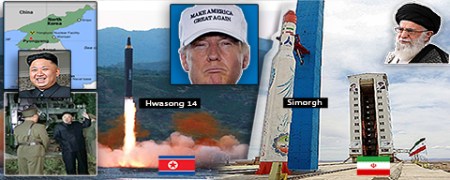
In the same 48-hour time frame, North Korea and Iran both managed to rattle the West by successfully testing advanced missiles. Thursday, July 27, Tehran launched a “Simorgh” rocket, which is capable of carrying a 250-kg satellite into space. The next day, Pyongyang test-fired its second intercontinental ballistic missile, an improved version of the Hwasong 14, first tested three weeks earlier.

President Donald Trump was discovering that sanctions are no deterrent.

The depth of the dismay in the West may explain why none of the experts dared mention the even more troubling fact which has been known for some time: Iran and North Korea are longstanding partners in their long-range missile programs. Each maintains experts at the other’s development facilities.

On July 28, the Hwasong 14 flew 47 minutes over a distance of 3,724km before dropping into the Sea of Japan. Kim Jong-un boasted: “The test confirmed that all the US mainland is within striking range,” confirming the new estimate that North Korea’s latest ICBMs can now reach major American cities like Chicago and Los Angeles.

That was his delighted response to the latest round of US sanctions.

Iran was less forthcoming about its latest test, without however neglecting to underline its success. DEBKAfile’s military and intelligence sources confirm that Iran’s success was no less impressive than North Korea’s – and just as dangerous. The Simorgh, aka Safir-3, is the fruit of years of Iranian development and many failed tests on the way to achieving a satellite-carrying rocket as the basis for nuclear-armed ballistic missiles.

US military sources tried to present the Iranian test as another flop, only admitting at length that “the only thing we know for sure is that no satellite was put into orbit.” Like the Americans with regard to Iran, Russian military sources tried play down the North Korean success by tossing it off as an ordinary, medium-range ballistic missile.

But the fact is that Iran was not trying this time to put a satellite in orbit. Its objective, for which a big step was taken forward, was to perfect the technology for building missiles able to carry small nuclear warheads, as well as carriers for boosting military and spy satellites into space.

Tehran was extremely cagey with details about its success. The Safir-2, built around components of the North Korean BM-25 ballistic missile, which too derived from the Soviet R-27 fired from submarines, was able to attain an estimated range of 3,000-4,000km. The Simorgh or Safir-3 tested this week was an advanced version of its predecessor. The two-stage version, powered by solid fuel, is believed to have an improved range of 7,500km.

Two years ago, when Iran placed an imaging rocket into orbit during February 2015, Israeli rocket experts established that these rockets were also capable of striking any point that Iran may chose. Tehran was therefore well ahead of Pyongyang in its ability to stage a missile attack on the United States mainland – except that this discovery was eclipsed at the time by the Iranian nuclear negotiations nearing conclusion with six world powers, led by the United States.

President Barack Obama, hell bent on a deal, gave in to Tehran’s demand to leave its missile program out of the accord. Iran was left free to pursue its ballistic missile program unchecked by international law up until now.

Therefore, when on Thursday, the US Senate slapped sanctions on Iran as punishment for its missile tests, the Foreign Ministry in Tehran was formally within its rights Saturday in affirming “Iran’s inalienable right” to develop missiles “in compliance with its international obligations.”

In another event tied to Iran’s missiles, Saudi Arabia Thursday, July 26, announced the interception of “a ballistic missile launched by Yemen’s Iran-backed Houthi insurgents against the holy city of Mecca.” The defense ministry in Riyadh said the missile had been shot down some 69km away from Mecca, causing no damage or casualties.

The Saudis have for some months accused Iran of supplying the Yemeni insurgents with Fatteh-110 missiles for targeting Saudi cities, including the capital, Riyadh. They had expected President Donald Trump to hit back at Iran. However, other than reprimanding Tehran for hostile action against the “US partner Saudi Arabia,” no tangible US action was forthcoming – only fresh sanctions, which don’t cut much ice in Tehran or Pyongyang.

Donald Trump’s six-month presidency is clearly under siege. On top of the bucketfuls of trouble landing on his head at home, he is being pushed against a wall by America’s enemies in two world regions – the Far East and the Middle East.

Early Observations of North Korea’s Latest Missile Tests

July 28, 2017

Early Observations of North Korea’s Latest Missile Tests, 38 North, July 28, 2017

On July 4, 2017, North Korea conducted its first test of a two-stage Hwasong-14 ballistic missile, which reached an apogee of about 2,800 km. If flown on a standard trajectory, this means the Hwasong-14 would have a maximum range in excess of 7,500 km—intercontinental ballistic missile (ICBM) range—and may be able to reach the US west coast if armed with a warhead weighing 650 kg or less. However, the Hwasong-14 tested on July 4 was not optimally designed to achieve maximum range. Instead, it appears to have been a prototype designed to maximize the probability of a successful maiden flight by relying on flight-proven stages.

The Hwasong-14 tested on July 4 employed a first stage based on the Hwasong-12, but with a slightly larger diameter to carry more propellant. The second stage was similar to the third stage of North Korea’s satellite launch vehicle, the Unha. For an ICBM, however, the second stage was under-sized and under-powered, making it ill-suited for use on a ballistic missile. One would assume that future tests of the Hwasong-14 would require North Korea to reconfigure the second stage for better performance.

On July 28, North Korea launched a ballistic missile that reportedly flew for 45 minutes, reaching a peak altitude of 3,000 km, and a slightly longer range than the previous test. While the type of missile tested is yet unconfirmed, these data, if accurate, are fully consistent with a Hwasong-14 tested with a larger second stage that is powered by a high-thrust engine. If flown on a flatter trajectory, this missile could reach as far as 9,000 to 10,000 km. More information, including videos and photographs, will help identify the new second stage engine, and pinpoint its performance capacity.

However, if the above assessment is correct, North Korea seems to have made a logical step forward, as it tries to perfect the technologies to build and field an operationally-viable ICBM that can threaten the mainland United States. More tests are needed to assess and validate the reliability of the Hwasong-14, so North Korea is sure to follow this launch with many more.

Iran poised to launch rocket into space, as North Korea readies another missile test, US officials say

July 26, 2017

Iran poised to launch rocket into space, as North Korea readies another missile test, US officials say, Fox NewsLucas Tomlinson, July 26, 2017

While Iran insists its space program is for peaceful purposes, officials have long said any components used to put a satellite into orbit can also be used for building an intercontinental ballistic missile capable of hitting the United States.

*********************************

Two American foes are poised for upcoming rocket launches, two senior U.S. officials told Fox News, with another North Korean intercontinental ballistic missile launch expected as soon as Wednesday night and Iran on the verge of sending its own vehicle into space.

Iran’s Simorgh space-launch vehicle is believed to be carrying a satellite, marking the second time in over a year that Tehran has attempted to put an operational satellite into orbit — something the Islamic Republic has never done successfully, according to one of the officials who has not authorized to discuss a confidential assessment.

Iran’s last space launch in April 2016 failed to place a satellite into orbit, the official said.

The intelligence community is currently monitoring Iran’s Semnan launch center, located about 140 miles east of Tehran, where officials say the “first and second stage airframes” have been assembled on a launch pad and a space launch is expected “at any time,” according to the official.

Just days after President Trump took office, Iran conducted its first ballistic missile test under the new administration, prompting the White House to put Tehran “on notice.” Since then there have been other ballistic missile and cruise missile tests, including one from a midget submarine in early May — a type of submarine used by both Iran and North Korea.

North Korea and Iran have long been accused of sharing missile technology.

“The very first missiles we saw in Iran were simply copies of North Korean missiles,” said Jeffrey Lewis, a missile proliferation expert at the Middlebury Institute of International Studies at Monterey. “Over the years, we’ve seen photographs of North Korean and Iranian officials in each other’s countries, and we’ve seen all kinds of common hardware.”

U.S. officials are skeptical, however, that North Korea and Iran are coordinating their rocket and missile launches.

While Iran insists its space program is for peaceful purposes, officials have long said any components used to put a satellite into orbit can also be used for building an intercontinental ballistic missile capable of hitting the United States.

U.N. resolution 2231 says Iran is “called upon not to undertake any activity related to ballistic missiles designed to be capable of delivering nuclear weapons, including launches using such ballistic missile technology,” according to the text of the agreement which went into effect days after the landmark Iran nuclear agreement that was engineered by the Obama administration.

Critics have said that language was purposefully watered down to “called upon” instead of a more restrictive phrase because Russia intervened.

In a sign Congress is losing patience with both Iran and North Korea, the House of Representatives on Tuesday overwhelmingly passed (419-3) new sanctions targeting Iran, North Korea and Russia, due in part to Iran and North Korea’s missile programs.

News of Iran’s pending rocket launch coincides with more evidence North Korea is also preparing to test another ICBM, perhaps as early as Wednesday night — a date that would coincide with the 1953 Korean Armistice Agreement, which ended the fighting in the Korean War, but technically not the war itself.

U.S. officials say North Korea has recently moved fueling equipment and trucks to a launch pad near the town of Kusong, near North Korea’s border with China and about 100 miles north of the capital city of Pyongyang.

North Korea has a history of conducting missile tests on historic dates.

North Korea’s first successful launch of a long-range missile capable of reaching Alaska — a rocket the Pentagon now calls the KN-20 — occurred on July 4th, while the U.S. celebrated Independence Day.

That North Korean ICBM traveled some 1,700 miles into space, seven times higher than the orbit of NASA’s International Space Station. It is not clear, however, if the rocket’s “reentry” vehicle successfully returned to earth in one piece after it splashed down in the Sea of Japan hundreds of miles off the Korean peninsula.

Officials believe a new test of North Korea’s KN-20 is for the purpose of testing the reentry vehicle.

Intelligence Report Warns of Growing Missile Threats

July 13, 2017

Intelligence Report Warns of Growing Missile Threats, Washington Free Beacon, July 13, 2017

China’s CSS-5 Mod 5 MRBMsdf

The United States faces a growing threat of ballistic and cruise missiles from China, Russia, Iran, and North Korea, according to a military intelligence report.

“Ballistic and cruise missiles present a significant threat to U.S. and allied forces overseas, and to the United States and its territories,” states the latest report by the National Air and Space Intelligence Center in Ohio.

The report warns that both China and Russia are expanding their force of strategic nuclear missiles with new multi-warhead weapons.

North Korea now has three intercontinental-range missiles and is moving ahead with a submarine-launched ballistic missile.

The report was published days before North Korea on July 4 conducted the first flight test of the new Hwasong-14 missile, described in the report as a new road-mobile ICBM first unveiled in October 2015.

In addition to that missile, North Korea also has another road-mobile ICBM called Hwasong-13, also known as the KN-08, and the Taepo Dong-2.

“Any of these systems could be exported to other countries in the future,” the report said.

Iran appears to be on a path to developing long-range missiles as part of what the report said was “Tehran’s desire to have a strategic counter to the United States.”

Multiple test firings of Iran’s Simorgh space launch vehicle are viewed as a test bed for developing long-range missiles.

“In 2015, Iran publicized the launch of the Emad-1, which officials claim is Iran’s first long-range missile that is guided throughout flight and capable of hitting its targets with high-precision,” the report said.

“Iranian officials have also announced plans for an Emad-2 with greater precision as well as a new Sejjil which can also be guided all the way to the target.”

The proliferation of missile systems and technology has resulted in over 20 nations having ballistic missiles that the report said “likely will be a threat in future conflicts involving U.S. forces.”

In the past 30 years, missiles were used in several wars, including the Iran-Iraq war, the Afghan civil war, the war in Yemen, the 1991 and 2003 Persian Gulf conflicts, Russian military actions in Chechnya and Georgia, and most recently in the conflicts in Syria and Ukraine.

The NASIC missile threat report is published periodically and is the first report since 2013.

For the first time, the center reveals new details about China’s force of “close-range” missiles that could be used in an attack on Taiwan.

The report also warns that new “hypersonic” missiles are being developed that have characteristics of both ballistic and cruise missiles. Ballistic missiles travel in space on a trajectory to their targets while cruise missiles often fly close to land or sea.
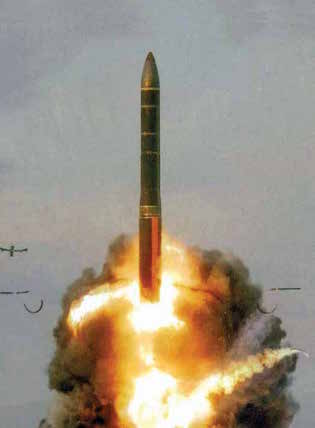
Russia’s SS-27 ICBM

Hypersonic missiles are maneuvering weapons launched atop ballistic missiles that glide to their targets. They are being developed by China and Russia as both strategic nuclear and conventional weapons capable of passing through U.S. missile defenses, often at speeds of up to 7,500 miles per hour.

“Overall, the threats posed by ballistic missile delivery systems are likely to continue to increase and grow more complex,” the report said.

“Adversary ballistic missile systems are becoming more mobile, survivable, reliable, and accurate while also achieving longer ranges. Hypersonic glide vehicles delivered by ballistic missile boosters are an emerging threat that will pose new challenges to missile defense systems.”

China’s missile forces are expanding in both numbers and types.

“China continues to have the most active and diverse ballistic missile development program in the world,” the report said. “It is developing and testing offensive missiles, forming additional missile units, qualitatively upgrading missile systems, and developing methods to counter ballistic missile defenses.”

Beijing’s nuclear missile forces are expanding with multiple-warhead systems that will expand China’s warhead stockpile in the coming years.

On China’s close-range missiles, which can be used in artillery salvos during a conflict with Taiwan or against ships in the South China Sea from newly militarized islands, the report identified 19 different missiles with ranges of between 24 miles to 173 miles.

Russia, North Korea, Iran, Pakistan, and India also have close-range missiles some of which are precision guided.

To defeat increasingly effective missile defenses, short-range missile manufacturers are working on countermeasures, such as maneuverable reentry vehicles called MaRVs.

New missiles with ranges of between 620 miles and 3,400 miles are in development by China, North Korea, Iran, India, and Pakistan, and many will be armed with nuclear or other unconventional warheads.

“All of these countries except Iran have tested nuclear weapons,” the report said.

Iran has promised to give up developing nuclear weapons for the next 10 years under the deal reached in 2016. Critics note that the continued development of Iran’s long-range missiles is an indication Tehran plans to break out of the treaty in the future.

The report for the first time mentions Russia’s new hypersonic missile called the “object 4202” that will be used to penetrate missile defenses. Several other new long-range missiles, including a heavy ICBM called the Sarmat, are being deployed or are in development.

China also is building a new DF-41 road-mobile ICBM that will carry multiple warheads.

“The number of warheads on Chinese ICBMs capable of threatening the United States is expected to grow to well over 100 in the next five years,” the report said.

For submarine-launched missiles, the report identified Russia’s submarine forces as “substantial” and undergoing modernization. New long-range submarine nuclear missiles include the SS-N-32 Bulava, along with upgraded SS-N-23s.

The intelligence report for the first time confirms that China’s new CSS-N-14 submarine-launched missile is deployed on four missile submarines.

“This missile will, for the first time, allow Chinese SSBNs to target portions of the United States from operating areas located near the Chinese coast,” the report said.

Cruise missile threats, those that are guided by satellite navigation, also are increasing.

“The cruise missile threat to U.S. forces is increasing in the number of countries possessing [land attack cruise missiles], the number of LACMs, and the number of LACMs possessing advanced capabilities,” the report said.

China has a new DH-10 long-range cruise missile and Iran has developed a Soumar cruise missile, based on Russia’s AS-15 air launched cruise missile.

Russia’s Club-K cruise missile is dubbed the “container launcher” weapon that is fired from what appears as a standard shipping container, making it easy to hide and fire from cargo ships, trains, or commercial trucks.

“The majority of LACMs will still be subsonic, but supersonic and hypersonic missile will be deployed in the future,” the report said.

Missile weapons are sought by many nations because they can be used effectively against adversaries with formidable air defenses that make using aircraft impractical or too costly, the report concludes.

“In addition, missiles can be used as a deterrent or an instrument of coercion…. Even limited use of these weapons could have devastating consequences if armed with chemical, biological, or nuclear warheads.”

Rick Fisher, a military affairs analyst with the International Assessment and Strategy Center, said the report for the first time details China’s growing arsenal of very accurate close-range missiles.

Fisher said China is a world leader in developing new, longer range and precision guided artillery rockets like the 124-mile-range CSS-X-16, and the new 174-mile range CSS-14 Mod-X-2. A third is the 161-miles range CSS-9 Mod-X-2.

“NASIC, however, does not mention that these new systems have the potential to carry five to eight missiles per launcher, so they could rapidly increase the number of missile targeting Taiwan into the multiple thousands, when considering potential reloads,” he said.

As a result of the close-range missile threat from China, the United States should speed up development of energy weapon defenses, like rail-guns and lasers that can defeat large numbers of the close-range missiles, he said.

Fisher also notes that the report understates China’s potential warhead expansion.

“If China modifies all of its DF-5 to the 10 warhead DF-5C standard, as it has started to modify the older single-warhead DF-5A with the three-to-five warhead DF-5B warhead bus, this type of ICBM alone could account for over 200 warheads,” he said.

“Then to this you add the road and rail mobile 10 warhead DF-41, with at least two units of six missiles accounting for 120 warheads. Many times 100 Chinese warheads is much more than ‘well over.'”

U.S. warhead cuts under the Obama administration should be reconsidered, he said.

“China’s potential to approach at least 1,000 warheads over the next decade, plus Russia’s missiles, means the United States must prepare to exceed existing limitations on deployed weapons or face the possibility of coordinated nuclear blackmail from China and Russia,” Fisher said.

Mark Schneider, a former Pentagon nuclear missile expert with the National Institute for Public Policy, said the report reveals that Russia’s 3M-14 Kalibr cruise missile, capable of being fired from the ground, ships, or submarines, has a range of 1,553 miles.

“This is obviously the INF Treaty violation,” he said of the 1987 U.S.-Russian accord banning all ground launched cruise missiles with range of between 620 and 3,420 miles.

The U.S. government has accused Russia of violating the INF treaty but has not provided details of the cruise missile Moscow has deployed in violation of the accord.

Haley on North Korean Missile Test: ‘Action is Required. The World is on Notice.’

July 5, 2017

Haley on North Korean Missile Test: ‘Action is Required. The World is on Notice’, Washington Free Beacon via YouTube, July 5, 2017


Top Armed Services Dem: Russia, China ‘Spectacularly Disingenuous’ on North Korea

July 5, 2017

Top Armed Services Dem: Russia, China ‘Spectacularly Disingenuous’ on North Korea, PJ MediaBridget Johnson, July 5, 2017

(Please see also, North Korean Missiles Reaching USA. President Trump seems to have decided that joint action with China and Russia won’t work and that unilateral action by America will be needed. — DM)

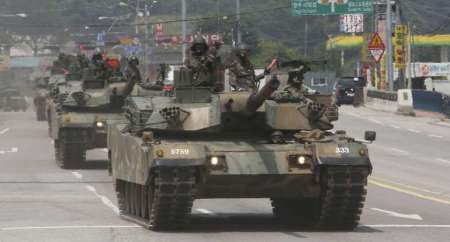
South Korean army K-1 tanks move during the annual exercise in Paju, South Korea, near the border with North Korea, on July 5, 2017. (AP Photo/Ahn Young-joon)

China and Russia issued a joint statement calling Pyongyang’s ICBM test “unacceptable.”

“The two sides propose that the DPRK (North Korea) as a voluntary political decision declares a moratorium on testing nuclear explosive devices and ballistic rocket launches, and the US and South Korea refrain from carrying out large-scale joint exercises,” the statement said. “Parallel to this, the opposing sides should start negotiations and affirm general principles of their relations including the non-use of force, rejection of aggression and peaceful co-existence.”

“Neither one of them is doing a darn thing to stop North Korea. And they want to use it as an excuse to push us out of the region,” he added. “What we have to make clear to them is it’s going to have the exact opposite effect. Once North Korea is able to threaten us and even now, as they threaten our allies, we have to be in there to protect our own interests. 

******************************

The top Democrat on the House Armed Services Committee declared this morning that the “threat from North Korea, regrettably, is not going to be removed” by the “global action” proposed by the Trump administration to curb Kim Jong-un’s behavior.

Pyongyang said Tuesday that it successfully test-fired Hwasong-14, a long-range intercontinental ballistic missile. According to Chosun Ilbo in South Korea, state TV in the North declared the regime “a full-fledged nuclear power… possessed of the most powerful intercontinental-ballistic rocket capable of hitting any part of the world.”

Kim reportedly watched the launch at the scene. The missile, said to be capable of reaching Alaska or Hawaii, flew for 39 minutes before hitting open waters.

Secretary of State Rex Tillerson issued a statement Tuesday evening condemning the July Fourth launch. “Testing an ICBM represents a new escalation of the threat to the United States, our allies and partners, the region, and the world,” he said. “Global action is required to stop a global threat.”

“Any country that hosts North Korean guest workers, provides any economic or military benefits, or fails to fully implement UN Security Council resolutions is aiding and abetting a dangerous regime. All nations should publicly demonstrate to North Korea that there are consequences to their pursuit of nuclear weapons. We intend to bring North Korea’s provocative action before the UN Security Council and enact stronger measures to hold the DPRK accountable,” Tillerson continued.

“The United States seeks only the peaceful denuclearization of the Korean Peninsula and the end of threatening actions by North Korea. As we, along with others, have made clear, we will never accept a nuclear-armed North Korea.”

President Trump and his national security team “are continuing to assess the situation in close coordination with our allies and partners,” he added.

Armed Services Committee Ranking Member Adam Smith (D-Wash.) doubted that Tillerson’s vow would put pressure on North Korea.

“If there is an idea floating around out there for how we can remove that threat, I’m open to it. But we have been circling around this discussion of what we want China to do and what we want sanctions to do and all these other different pieces,” Smith said. “The bottom line is, what we need against North Korea, we need to put the best economic sanctions we can. I think it’s perfectly appropriate for the secretary of state to try to put pressure on other nations to do the same. But the most important thing we need is a credible military deterrent, so that whatever North Korea does in terms of building a missile, they know that if they act against South Korea or against Japan or against us, we will obliterate them.”

“That’s why THAAD [missile defense system] is important. That is why our alliance with South Korea and Japan is important, to have that credible military force, because what’s been proven — and all of the options have been discussed with your previous guests — is that North Korea is going to do it. They want to build nuclear weapons. They want to develop an intercontinental ballistic missile. And short of an all-out war on the Korean Peninsula, we don’t really have an option for stopping them.”

China and Russia issued a joint statement calling Pyongyang’s ICBM test “unacceptable.”

“The two sides propose that the DPRK (North Korea) as a voluntary political decision declares a moratorium on testing nuclear explosive devices and ballistic rocket launches, and the US and South Korea refrain from carrying out large-scale joint exercises,” the statement said. “Parallel to this, the opposing sides should start negotiations and affirm general principles of their relations including the non-use of force, rejection of aggression and peaceful co-existence.”

Smith slammed the statement as “spectacularly disingenuous.”

“Neither one of them is doing a darn thing to stop North Korea. And they want to use it as an excuse to push us out of the region,” he added. “What we have to make clear to them is it’s going to have the exact opposite effect. Once North Korea is able to threaten us and even now, as they threaten our allies, we have to be in there to protect our own interests. China’s not acting against North Korea. And the reason they’re not acting against North Korea is, they don’t want to cut off North Korea’s economic aid. They don’t want North Korea to collapse because they don’t want millions of North Korean refugees pouring across their border. They’re not happy that North Korea is causing such instability in the region, but the alternative of them trying to crush the regime somehow is something they’re not willing to do, and they haven’t been willing to do it through four administrations. So, we need a credible military deterrent, and that is our only option.”

Smith noted that Kim’s actions have been “all about ensuring regime survival,” as he’s “looked at Iraq and Afghanistan and Libya, and they feel that unless they have a nuclear weapon and a credible deterrent of their own, that their regime is in jeopardy.”

“So, all the economic sanctions, all that needs to be done. But understand what I’m saying here. As you have discussed, there is not a good military option,” he said. “Thinking that we can preemptively go in there and somehow take out their capabilities, whatever we do leads to a massive war in the Korean Peninsula… we need our THAAD system in the region. We need a system to give us a shot at shooting down that missile if they decide to launch it. And then we also need a clear diplomatic policy that we will destroy them.”

After the THAAD system was installed in South Korea, Trump said Seoul should fork over a billion dollars for the missile defense. New South Korean President Moon Jae-in recently suspended further THAAD deployment pending a review of the program.

Smith stressed that Russia and China must “stop screwing around.”

“If you guys really want us to be less involved in the region, then you have got to figure out a way to control North Korea,” he said. “Now, I don’t think they’re going to do that. But that means that we have to stay active in the region.”

North Korean Missiles Reaching USA

July 5, 2017

North Korean Missiles Reaching USA, Front Page MagazineMatthew Vadum, July 5, 2017

(Peace talks have failed and the leftist view seems to be “if at first you don’t succeed try the same thing again.” President Trump does not agree and is no longer willing to rely on China. He recently tweeted, “Trade between China and North Korea grew almost 40% in the first quarter. So much for China working with us – but we had to give it a try!” Please see also, Trump Hits China Over Trade Relationship With North Korea. If, as is now apparent, China wants more fruitless negotiations, it’s time to employ our military resources to eliminate North Korea’s nuclear and missile capabilities. An EMP attack could be effective.– DM)

But Americans are finally being disabused of left-wing arms control fantasies, and fortunately, after eight years of dithering and appeasement, we now have a president who actually wants to defend the country from external threats.

And alongside President Trump there are serious adults in the White House and Foggy Bottom willing to respond with an appropriate show of force to the latest provocation from Pyongyang and take other necessary action.

Pentagon spokesman Dana White said “we remain prepared to defend ourselves and our allies and to use the full range of capabilities at our disposal against the growing threat from North Korea.”

*************************************

Less than six months into Donald Trump’s presidency America has awakened to the nightmare of a North Korea armed with intercontinental ballistic missiles that the Trump administration says are capable of reaching Alaska.

U.S., South Korean, and Japanese officials say the North Korean Hwasong-14 ICBM flew approximately 580 miles in 40 minutes and achieved an altitude of 1,500 miles, besting previously reported North Korean test results. North Korea’s successful but unexpected test is a sobering reminder of how urgently the United States needs to ramp up its antiballistic missile program after years of reckless military downsizing by the Obama administration.

The North Korean launch was “the big story we have all been waiting for,” Professor Bruce Bechtol of Angelo State University in Texas told Fox News on Tuesday. “All of the paradigms have changed. It is now time to see what action the USA will take.”

The missile was apparently launched from a mobile launcher, which “nearly destroys our warning time and also means that the North Koreans have a real shot at launching this system at us without us being able to destroy it on the ground.”

North Korea also carried out a successful ballistic missile test on May 14, and the U.S. Missile Defense Agency conducted its first successful interception of an ICBM on May 30. A long-range ground-based interceptor missile launched from Vandenberg Air Force Base in California hit and destroyed the ICBM launched from the U.S. Army’s Reagan Test Site on Kwajalein Atoll in the Marshall Islands.

This idea of missile defense, oft-compared to trying to shoot a bullet with another bullet, grew out of President Reagan’s Strategic Defensive Initiative (SDI), derided by left-wingers at the time and for years after as “Star Wars.” Unsurprisingly, Barack Obama used to scoff at the idea that a missile could take out another missile.

Meanwhile, Monday evening after news of the successful Hwasong-14 ICBM test broke, President Trump took to Twitter.

North Korea has just launched another missile. Does this guy have anything better to do with his life? Hard to believe that South Korea and Japan will put up with this much longer. Perhaps China will put a heavy move on North Korea and end this nonsense once and for all!

Apparently, “this guy” refers to dictator Kim Jong-un. Communist China has been propping up Kim’s dictatorship for years. The Trump administration wants China to push its North Korean ally harder to scrap its nuclear weapons program.

During Independence Day remarks at a picnic for military families on the South Lawn of the White House Trump did not refer to North Korea’s activities but said, “we do have challenges, but we will handle those challenges. Believe me.”

How did we get to this dangerous juncture in world affairs?

Blame the Left. After all, it’s not rocket science.

While left-wingers in Washington were busy reaching out to Islamofascists and projecting American weakness on the international scene over the eight long years of Barack Obama’s presidency, Kim Jong-il and his heir Kim Jong-un were busy transforming their Stalinist hellhole of a country into a nuclear power. They were aided not just by the permissive Obama administration, which did more or less nothing to curb Pyongyang’s nuclear ambitions, but also years earlier by the enabling Clinton administration.

In 1994 Bill Clinton unveiled an agreement between the U.S. and North Korea that he claimed would achieve “an end to the threat of nuclear proliferation on the Korean Peninsula.” Under the deal, North Korea “agreed to freeze its existing nuclear program and to accept international inspection of all existing facilities,” Clinton said at the time. The pact “is good for the United States, good for our allies, and good for the safety of the entire world.”

But Americans are finally being disabused of left-wing arms control fantasies, and fortunately, after eight years of dithering and appeasement, we now have a president who actually wants to defend the country from external threats.

And alongside President Trump there are serious adults in the White House and Foggy Bottom willing to respond with an appropriate show of force to the latest provocation from Pyongyang and take other necessary action.

While American and South Korean forces conducted joint ballistic missile drills following the North’s ICBM test, Secretary of State Rex Tillerson said yesterday that the U.S. government would “never accept a nuclear-armed North Korea.” He urged countries around the world to fully enforce UN sanctions against the rogue nation, saying “global action is required to stop a global threat.”

Pentagon spokesman Dana White said “we remain prepared to defend ourselves and our allies and to use the full range of capabilities at our disposal against the growing threat from North Korea.”

The UN Security Council may convene an emergency meeting as soon as today. On Twitter, U.S. Ambassador to the UN Nikki Haley demonstrated her exasperation at having to devote her Independence Day holiday to emergency consultations by using the hashtag “#ThanksNorthKorea.”

Haley doesn’t have it quite right. If she wants to sarcastically “thank” anybody for the North Korean ICBM test, she should be “thanking” Barack Obama and Bill Clinton, whose suspect policies helped a pariah nation join the nuclear club.

A nuclear trip wire for North Korea

June 29, 2017

A nuclear trip wire for North Korea, Washington TimesDaniel Gallington, June 28, 2017

(Don’t pussyfoot around. — DM)

Illustration on locking down North Korea’s nuclear weapons threat by Linas Garsys/The Washington Times

ANALYSIS/OPINION:

Now that North Korea has a bunch of nukes and is testing ways to deliver them by ballistic missile, we need to address the stark realities of what this new threat really means for us.

And just as important — what it should mean for them.

However, before we begin, it should now be a reality for us that negotiations with fat boy Kim Jong-un’s regime are a total waste of our time, energy and money, just as they were with his stroked-out father’s crew.

Politically, of course, this result was the collective failure of our State Department, the Clinton, Bush and Obama administrations, together with the defective concept of the “Six Party Talks.” The only “accomplishment” was to provide the time and diplomatic cover for the Democratic People’s Republic of Korea’s nuke program, plus give the regime lots of oil and money in the process. In short, the Six Party Talks enabled North Korea’s nuke weapons program. If this sounds familiar, Barack Obama and John Kerry made the same mistakes with Iran.

So, North Korea is now a dangerous nuclear rookie and we must develop — and articulate — policies that reflect, in the words of Defense Secretary James Mattis, the “clear and present danger” they represent.

What should our new policies look like? What should be the “red lines,” and what North Korean behaviors should cause virtually automatic responses from us? As this is a whole new ball game, what should be the thresholds for our responses and what should we be telling the Russians and Chinese about it?

This because nothing we do in response to North Korean aggressive behaviors should come as a surprise to anyone.

It also seems clear we need both short- and longer-term strategies. Along with this approach, we should rule out a number of troublesome scenarios for possible armed conflicts with North Korea — in other words, let’s also define those situations in which we simply will not “play.”

Shorter-term strategies: The short term is, for a number of reasons, the most dangerous. This is because it’s the nuclear muscle-flexing stage for the fat boy and also the period he is most likely to make a mistake or do something dumb. For this same reason, it’s also the period when our responses should be in the virtually “automatic” mode, including pre-emptive strikes.

While there are a number of scenarios that should be addressed, there are a few that deserve special attention. In this category should be a pre-planned nuclear response option for each North Korean action:

• Preparations for a massive artillery attack on Seoul.

• Massing troops at the border.

• Interception of ocean or coastal traffic.

• Interception of aviation.

• Launch of any ballistic missile with an aggressive trajectory.

Longer-term strategies: These should be developed with urgency, but on a different track from the shorter-term ones. In this category should be:

• Discussions with the Japanese for a cooperative nuclear relationship.

• Re-positioning nuclear assets — and nuclear-capable assets — to and around the Korean peninsula.

• Excluding North Korea from any relevant diplomatic discussions; maximizing all types of sanctions — in the U.N. and domestically; terminating any remaining Six Party benefits.

• Working trade embargoes; interceptions of suspicious commerce; very aggressive information operations.

Defining when we won’t “play”: This category is as important as the other two — maybe more so, because it is the essence of deterring the fat boy from doing something stupid. Here are some things we won’t do in context of any conflict or confrontation with the North:

• A land war on the Korean peninsula — been there, done that.

• A build-up of our conventional forces in the region in response to North Korean aggressive behaviors — gradualism does not work.

• Any kind of negotiations with the North — they have given up this option.

Combined, these strategies are intended to have a simple “message” for the North Korean regime: We have defined the limits of your behavior. If you cross the lines, our response will be quick — and pre-emptive if we decide you are about to do something dumb. The response will be nuclear if that is appropriate for the risk you present to us — and in that event, you will cease to exist as a political entity.

Perhaps as important as promulgating these strategies is that they be articulated publicly and fully briefed to our allies and enemies alike.

A useful analogy: During the Cold War, we had a SIOP — a Single Integrated Operational Plan — that included a targeting doctrine (promulgated during the Carter administration) that focused on the top Soviet leadership. My personal experience during the ‘80s was that the leadership-targeting aspect of the SIOP got the attention of the Soviets, along with President Reagan’s Strategic Defense Initiative.

Will the fat boy behave differently if we promulgate the strategies described above? That’s his choice, of course, but if he doesn’t, he should realize that the slightest miscalculation on his part, let alone a dangerous overt act, could cause the end of him and his regime. In short, he has no margin for error — nor do we — and it should surprise no one.

• Daniel Gallington served through 11 rounds of bilateral negotiations in Geneva as a member of the U.S. Delegation to the Nuclear and Space Talks with the former Soviet Union.