Posted tagged ‘North Korean missiles’

China Sold Trucks Used With North Korean Missiles

September 14, 2017

China Sold Trucks Used With North Korean Missiles, Washington Free Beacon, September 14, 2017

(Please see also, What if South Korea acted like North Korea? — DM)
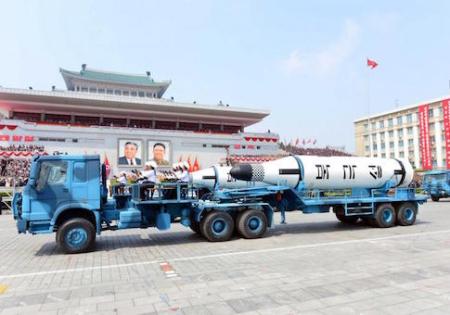
KN-11 launcher

The UN panel included a vague warning to China to stop its the missile-related transfers.

“The panel recalls and reaffirms its recommendation to member states on enhanced vigilance over the export of commercial vehicles that could be converted for military use,” the report said.

********************************

Chinese military support to North Korea’s missile programs included transfers of rocket transporters, according to a new report by a United Nations panel of experts.

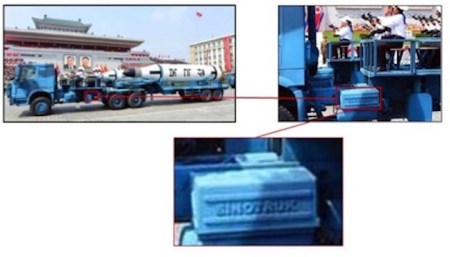
The report by the expert panel of the UN Security Council identified Chinese-origin trucks shown in a military parade last April carrying China’s new KN-11 submarine-launched ballistic missile.

“The trucks carried the ‘Sinotruk’ logo on the fuel tank and shared some identical features with the Sinotruk Howo 6×6 series trucks shown at the 10 October 2015 military parade,” the report said.

It is the second significant transfer of strategic missile technology from China identified by the panel.

In June 2013 the panel revealed the sale by China in 2011 of six to eight transporter erector launchers, known as TELs, that are now part of North Korea’s first road-mobile intercontinental ballistic missile system, the KN-08.

China claimed the KN-08 TEL vehicles were sold as lumber haulers. However, analysts said the 16-wheel launchers are too wide for logging roads. The launchers are made by the Sanjiang Special Truck Co. of the China Aerospace Science and Industry Corporation (CASIC).

An earlier UN report in April said Chinese electronic components were found in debris of a North Korean missile test that landed in the Sea of Japan in 2016.

The latest disclosure on Chinese military assistance to North Korea comes amid reports the regime of Kim Jong Un is rapidly developing long-range nuclear missiles while stepping up threats to fire them at American cities and territory.

Rep. Robert Pittenger (R., N.C.) said the report on Chinese support shows that China has not been a good faith partner to the United States on North Korea.

“We must continue to pressure the Chinese, via any means necessary, to ensure they correct their actions related to North Korea, human rights, illegal maritime claims, and a variety of other related national security concerns,” Pittenger said.

Rick Fisher, a military affairs analyst, said the Chinese assistance increased the threat to the United States.

“Let’s be clear, North Korea’s is able to wage surprise offensive nuclear strikes against the United States only because China has supplied the means for North Korea’s missiles to be mobile, to reach launch positions before the United States can strike them,” Fisher said.

“This is really is no less an outrage than Nikita Khrushchev’s supplying nuclear missiles to Fidel Castro’s Cuba,” he said. “Yet for over four years President Obama did not once publicly mention this Chinese outrage, and so far, neither has President Trump.”

Fisher, a senior fellow at the International Assessment and Strategy Center, said the report on Sinotruk vehicles carrying KN-11s provides new evidence of China’s covert role in assisting Pyongyang’s missile launch systems.
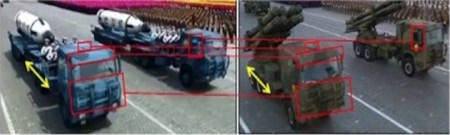
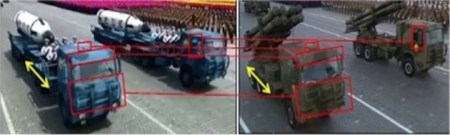
Other Chinese vehicles spotted with missiles in the April parade include what appeared to be a Sinotruk A7 tractor-trailer cab, seen carrying a new, unidentified North Korean medium-range missile. Mobile 300-millimeter precision-guided artillery rockets also were seen on the same Sinotruk vehicle as the KN-11. The artillery rockets were first paraded in 2015 and the Sinotruk carriers appeared upgraded in the April procession with a hardened grille.

The Chinese trucks were shown in videos and photos published by North Korean state media.

“Via Sinotruk, China is enabling North Korea to build larger tractor-trailer style TELs that in the future could perhaps transport multiple-warhead variants of its large, solid fuel ICBM,” said Fisher.

“Mobility will be crucial to the missions of North Korea’s new, large, solid-fuel ICBMs.”

Neither Sinotruk nor CASIC were included in recent sanctions announced by the Treasury Department imposed on 10 Chinese and Russian companies involved in illicit North Korean trade.

The UN report outlined some of the advances made by the North Koreans, including the first flight tests in February and July of new long-range missiles and new rocket engines, as well as the flight test of a Scud variant with a maneuvering warhead.

Maneuvering warheads are more difficult to track and shoot down with anti-missile interceptors.

The recent missile developments represent “a significant expansion and diversification of [North Korea] programs.”

“These new systems will allow the country to achieve greater range, responsiveness, reliability, and penetrating capabilities,” the report said.

The report said the second long-range Hwasong-14 ICBM tested on July 28 was “an improved version” of the missile tested on July 4.

The UN panel included a vague warning to China to stop its the missile-related transfers.

“The panel recalls and reaffirms its recommendation to member states on enhanced vigilance over the export of commercial vehicles that could be converted for military use,” the report said.

The UN also was urged to add the purchaser of the trucks, the Korea Daesong General Trading Corp., also known as the Korea Daesong Trading Co. No. 11, to be added to the list of sanctioned companies. A second company, Korea Kumsan Trading Corp., also was recommended for sanctions.

The report says the Chinese stated in response to UN inquiries that the missile carriers appeared similar to those made by the China National Heavy Duty Truck Group Co. (CNHTC) Ltd., also known as Sinotruk, that were exported to North Korea between 2010 and 2014.

According to the report, the Chinese defended the transfers as not prohibited under the Security Council embargo.

“Furthermore, in the sales contract, CHNTC explicitly requested the buyer to ensure the civilian use of the trucks,” the Chinese said.

China then claimed it could not confirm that the trucks seen in the parade, bearing the mark “Sinotruk” on the fuel tank, were produced by the Chinese companies because Beijing was not provided the vehicle identification numbers.

The report was published on Sept. 5, two days after Pyongyang detonated a large underground nuclear explosion. The report does not mention the nuclear test, North Korea’s sixth test blast.

The Security Council on Saturday voted to impose additional sanctions on North Korea, including a ban on Pyongyang’s largest export, coal.

However, the experts’ report said North Korea has easily evaded China’s restriction of coal purchases from North Korea.

North Korea “continued to violate sectoral sanctions through the export of almost all of the commodities prohibited in the [UN] resolutions, generating at least $270 million in revenue during the reporting period,” the report said.

After China suspended coal import in February, North Korea “has been rerouting coal to other member states including Malaysia and Vietnam, and has shipped coal through third countries,” the report said.

“The panel’s investigations reveal that the country is deliberately using indirect channels to export prohibited commodities, evading sanctions.”

To evade financial sanctions, Pyongyang stationed agents abroad that were able to conduct financial transactions for North Korean entities.

“Financial institutions in numerous member states wittingly and unwittingly have provided correspondent banking services to front companies and individuals of the Democratic People’s Republic of Korea engaged in prohibited activities,” the report said.

China was not named as the member state guilty of facilitating banking services for the North Koreans.

The report notes that North Korea “has made significant technological progress” in advancing its weapons of mass of destruction despite sanctions.

“The country also continues to flout the arms embargo and robust financial and sectoral sanctions, showing that as the sanctions regime expands, so does the scope of evasion,” the report said.

“For the first time in the history of the sanctions regime against the country, the use of a chemical warfare agent was reported by Malaysia, which accused [North Korea] of using VX [nerve agent] in the February 2017 assassination of Kim Jong Nam, reported to be Kim Jong Un’s half-brother, in Kuala Lumpur.”

What if South Korea acted like North Korea?

September 14, 2017

What if South Korea acted like North Korea? Washinton Times, Victor Davis Hanson, September 13, 2017

(One of VDH’s best articles, a thought experiment. — DM)

ANALYSIS/OPINION:

Visitors watch the North side from the unification observatory in Paju, South Korea, Wednesday, Sept. 13, 2017. South Korea said Wednesday it conducted its first live-fire drill for an advanced air-launched cruise missile it says will strengthen its pre-emptive strike.

[I]f China were in America’s position, we would have likely witnessed a tragically destructive war a long time ago.

China should make the necessary corrections now, before things get even worse.

*********************************

Think of the Korean Peninsula turned upside down.

Imagine if there were a South Korean dictatorship that had been in power, as a client of the United States since 1953.

Imagine also that contemporary South Korea was not the rich, democratic home of Kia and Samsung. Instead, envision it as an unfree, pre-industrialized and impoverished failed state, much like North Korea.

Further envision that the U.S. had delivered financial aid and military assistance to this outlaw regime, which led to Seoul possessing several nuclear weapons and a fleet of long-range missiles.

Next, picture this rogue South Korean dictatorship serially threatening to incinerate its neighbor, North Korea — and imagine that North Korea was ruled not by the Kim dynasty, but by a benign government without nuclear weapons.

Also assume that the South Korean dictatorship would periodically promise to wipe out Chinese cities such as Shanghai and Beijing. The implicit message to the Chinese would be that the impoverished South Koreans were so crazy that they didn’t care whether they, too, went up in smoke — as long a dozen of their nuclear-tipped missiles could blow up Chinese cities and paralyze the second-largest economy in the world. Assume that these South Korean threats had been going on without consequences for over a decade.

Finally, in such a fantasy scenario, what if the United States falsely claimed ignorance of much of its South Korean client’s nuclear capability and threats. America instead would plead that it regretted the growing tension and the reckless reactions of China to the nuclear threats against it. Washington would lecture China that the crisis was due in part to its support for its North Korean ally.

For effect, the United States would occasionally issue declarations of regret and concern over the situation — even as it warned China not to do anything to provoke America’s provocateur ally.

In such a fantasy, American security experts and military planners would gleefully factor a roguish nuclear South Korea into U.S. deterrent strategy. The Pentagon would privately collude with the South Korean dictatorship to keep the Chinese occupied and rattled, while the U.S. upped shipments of military weaponry to Seoul and overlooked its thermonuclear upgrades.

The American military would be delighted that China would be tied down by having an unhinged nuclear dictatorship on its borders, one that periodically threatened to kill millions of Chinese. South Korea would up the ante of its bluster by occasionally test-launching missiles in the direction of its neighbor.

Question: How long would China tolerate having weapons of mass destruction pointed at its major cities by an unbalanced tyrannical regime?

In response, would Beijing threaten a nuclear Seoul with a preemptory military strike, even though the Chinese would know that Seoul could first do a lot of nuclear damage?

Would China conclude that the United States was the real guilty party because it tacitly sanctioned South Korea’s possession of nuclear weapons?

Would China then warn the U.S. to pressure Seoul to disarm?

Would Beijing cease all trade with America?

Would China boycott, embargo or blockade South Korea?

Would China be furious that after ensuring that its own client, North Korea, remained non-nuclear and played by the rules, America had deliberately done exactly the opposite: empowering its dictatorial client, South Korea, to become a nuclear power in order to threaten China?

In other words, if China and North Korea found themselves in the same respective positions of current America and South Korea, the world may well have already seen a preemptive Chinese attack on Seoul to remove its nuclear capability.

The international community would already have seen China expel the conniving Americans from Chinese embassies, cut trade with the U.S., disrupt American banks and threaten the use of force against the U.S. mainland.

The truth of the North Korea missile crisis is not the boilerplate assumption that China is the key to the solution, but rather that China is by design the root of the problem.

China did not fail to realize that North Korea was developing a nuclear arsenal. Rather, it calculated that North Koreawould do exactly what it is now doing, and that such nuclear roguery would serve China’s strategic interests both on the Korean peninsula and in its rivalries with the United States and with America’s allies in Asia.

In other words, if China were in America’s position, we would have likely witnessed a tragically destructive war a long time ago.

China should make the necessary corrections now, before things get even worse.

• Victor Davis Hanson is a classicist and historian with the Hoover Institution at Stanford University.

U.S. Threatens to Cutoff China, Russia for Undermining Sanctions Against North Korea

September 12, 2017

U.S. Threatens to Cutoff China, Russia for Undermining Sanctions Against North Korea, Washington Free Beacon, September 12, 2017

(Please see also, UN Passes Mega-Ultra Toughest-Ever North Korea Sanctions, Again.– DM)

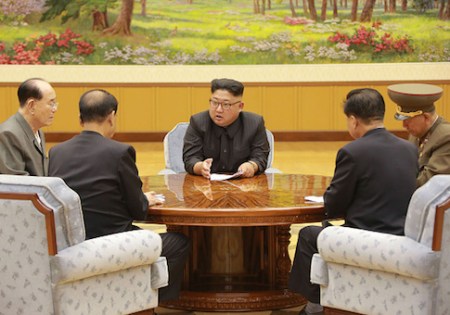
North Korean leader Kim Jong-Un attends a meeting with a committee of the Workers’ Party of Korea about the test of a hydrogen bomb / Getty Images

“Unfortunately, I cannot tell the committee today that we’ve seen sufficient evidence of China’s willingness to truly shut down North Korea’s revenue flows, to expunge North Korean illicit actors from its banking system, or to expel the various North Korean middlemen and brokers who are continuing to establish webs of front companies,” he said.

*****************************

The Trump administration on Tuesday threatened to cut off from the U.S. financial system Chinese and Russian companies helping North Korea smuggle coal overseas to circumvent international sanctions on Pyongyang’s nuclear activities.

Marshall Billingslea, the Treasury Department’s assistant secretary for terrorist financing, provided Congress with intelligence images mapping North Korea’s illicit shipping networks used to mask the origin of exported coal to China and Russia.

The images appear to expose China and Russia’s covert hand in undermining international pressure on the Kim Jong Un regime to give up its nuclear ambitions, despite the two nations voting publicly on several occasions at the United Nations Security Council to strengthen sanctions.

“North Korea has been living under United Nations sanctions for over a decade and it has nevertheless made significant strides toward its goal of building a nuclear tipped ICBM,” Billingslea testified before the House Foreign Affairs Committee, referring to the regime’s pursuit of an intercontinental ballistic missile capable of reaching the United States mainland.

“I urge anyone in the financial services industry who might be implicated in the establishment of shell or front companies for [North Korea], and anyone who is aware of such entities, to come forward with that information now, before they find themselves swept up in our net,” he said.

The Treasury Department estimates North Korean coal shipments bring in more than $1 billion in annual revenue for the regime, in part enabling Kim Jong Un to generate income used to fund ballistic missile and nuclear programs. Though the UN Security Council over the past month has passed two separate sanctions packages targeting North Korea’s coal industry, illicit coal-smuggling networks through China and Russia have watered down the impact, according to the Trump administration.

Citing the intelligence images provided to Congress on Tuesday, Billingslea said North Korean shipping vessels routinely shut off their transponders in violation of international maritime law to avoid detection as they move from North Korea into Chinese or Russian ports to offload sanctioned coal.

The Treasury Department is also tracking North Korea’s effort to penetrate the international financial system through shell companies based in China and Russia to help conceal the regime’s overseas footprint. Billingslea warned the Trump administration will punish any company in violation of UN sanctions by choking it off from the U.S. financial market.

Though he lauded China for supporting a recent round of UN sanctions, he said Beijing has not yet shown it is serious about cutting off North Korean funding.

“Unfortunately, I cannot tell the committee today that we’ve seen sufficient evidence of China’s willingness to truly shut down North Korea’s revenue flows, to expunge North Korean illicit actors from its banking system, or to expel the various North Korean middlemen and brokers who are continuing to establish webs of front companies,” he said.

UN Security Council passes new sanctions against North Korea

September 12, 2017

UN Security Council passes new sanctions against North Korea, Fox Business News via YouTube, September 11, 2017

As noted in the blurb beneath the video,

Lt. Col. Michael Waltz (Ret.) and Center for Security Policy President Frank Gaffney on the U.N. implementing new sanctions against North Korea.

FULL MEASURE: September 10, 2017 – Korean Conflict

September 11, 2017

FULL MEASURE: September 10, 2017 – Korean Conflict via YouTube, September 10, 2017


16 Years Later: Lessons Put into Practice?

September 11, 2017

16 Years Later: Lessons Put into Practice? Gatestone Institute, John R. Bolton, September 11, 2017

Sept. 11 should be more than just a few moments of silence to remember the Twin Towers falling, the burning Pentagon and the inspiring heroism of regular Americans in bringing down United Flight 93 in Shanksville, Pa. We should also seriously consider today’s global threats. Those who made America an exceptional country did so by confronting reality and overcoming it, not by ignoring it.

********************************

Today marks the 16th anniversary of al-Qaida’s 9/11 attacks. We learned much that tragic day, at enormous human and material cost. Perilously, however, America has already forgotten many of Sept. 11’s lessons.

The radical Islamicist ideology manifested that day has neither receded nor “moderated” as many naive Westerners predicted. Neither has the ideology’s hatred for America or its inclination to conduct terrorist attacks. Iran’s 1979 Islamic Revolution brought radical Islam to the contemporary world’s attention, and it is no less malevolent today than when it seized our Tehran embassy, holding U.S. diplomats hostage for 444 days.

The Taliban, which provided al-Qaida sanctuary to prepare the 9/11 attacks, threaten to retake control in Afghanistan. Al-Qaida persists and may even be growing worldwide.

While ISIS’s caliphate in Syria and Iraq will not survive much longer, countries across North Africa and the Middle East (“MENA”) have destabilized or fractured entirely. Syria and Iraq have ceased to exist functionally, and Libya, Somalia and Yemen have descended into chaos. Pakistan, an unstable nuclear-weapons state, could fall to radicals under many easily predictable scenarios.

The terrorist threat is compounded by nuclear proliferation. Pakistan has scores of nuclear weapons, and Iran’s program continues unhindered. North Korea has now conducted its sixth, and likely thermonuclear, nuclear test, and its ballistic missiles are near to being able to hit targets across the continental United States. Pyongyang leads the rogue’s gallery of would-be nuclear powers, and is perfectly capable of selling its technologies and weapons to anyone with hard currency.

During Barack Obama’s presidency, he ignored these growing threats and disparaged those who warned against them. His legacy is terrorist attacks throughout Europe and America, and a blindness to the threat that encouraged Europe to accept a huge influx of economic migrants from the MENA region, whose numbers included potentially thousands of already-committed terrorists.

IGNORING NORTH KOREA

Obama also ignored North Korea, affording it one of an aspiring proliferator’s most precious assets: time. Time is what a would-be nuclear state needs to master the complex scientific and technological problems it must overcome to create nuclear weapons.

And, in a dangerous unforced error that could be considered perfidious if it weren’t so foolish, Obama entered the 2015 Vienna nuclear and missile deal that has legitimized Tehran’s terrorist government, released well over a hundred billion dollars of frozen assets, and dissolved international economic sanctions. Iran has responded by extending its presence in the Middle East as ISIS had receded, to the point where it now has tens of thousands of troops in Syria and is building missile factories there and in Lebanon.

Before 2009, publishers would have immediately dismissed novelists who brought them such a plainly unrealistic plot. Today, however, it qualifies as history, not fantasy. This is the agonizing legacy the Trump administration inherited, compounded by widespread feelings among the American people that we have once again sacrificed American lives and treasure overseas for precious little in return.

These feelings are understandable, but it would be dangerous to succumb to them. We didn’t ask for the responsibility of stopping nuclear proliferation or terrorism, but we are nonetheless ultimately the most at risk from both these threats.

And as we knew during the Cold War, but seem to have forgotten since it ended, our surrounding oceans do not insulate us from the risk of long-distance nuclear attacks. We face the choice of fighting the terrorists on our borders or inside America itself, or fighting them where they seek to plot our demise, in the barren mountains of Afghanistan, in the MENA deserts, and elsewhere.

Nor can we shelter behind a robust national missile-defense capability, hoping simply to shoot down missiles from the likes of North Korea and Iran before they hit their targets. We do not have a robust national missile defense capability, thanks yet again to Barack Obama’s drastic budget cuts.

President Trump appreciates that nuclear proliferation and radical Islamic terrorism are existential threats for the United States and its allies. During the 2016 campaign, he repeatedly stressed his view that others should play a larger role in defeating these dangerous forces, bearing their fair share of the burden. But candidate Trump also unambiguously (and entirely correctly) called for restoring our depleted military capabilities because he saw that American safety depended fundamentally on American strength.

Sept. 11 should be more than just a few moments of silence to remember the Twin Towers falling, the burning Pentagon and the inspiring heroism of regular Americans in bringing down United Flight 93 in Shanksville, Pa. We should also seriously consider today’s global threats. Those who made America an exceptional country did so by confronting reality and overcoming it, not by ignoring it.

The names of passengers and crew of United Airlines Flight 93, who lost their lives in the September 11 attacks, as displayed at the National 9/11 Memorial in New York. (Image source: Luigi Novi/Wikimedia Commons)

____________________________

John R. Bolton, former U.S. Ambassador to the United Nations, is Chairman of Gatestone Institute, a senior fellow at the American Enterprise Institute, and author of “Surrender Is Not an Option: Defending America at the United Nations and Abroad”.

This article first appeared in The Pittsburgh Tribune Review and is reprinted here with the kind permission of the author.

Trump Orders Military to Shoot Down North Korean Missiles

September 8, 2017

Trump Orders Military to Shoot Down North Korean Missiles, NewsMaxJohn Gizzi, September 7, 2017

AP

President Donald Trump has given military orders for U.S. forces to shoot down and destroy any missile launched from North Korea and moving toward the continental United States, Hawaii, and Guam.

Sources close to the president’s national security team tell Newsmax the order was given to Pentagon brass in the wake of last month’s threat by North Korea to fire a ballistic missile aimed at Guam, a U.S. territory.

“The threat provoked the president,” one source familiar with the decision told Newsmax.

Last Sunday, North Korea detonated a thermonuclear weapon. The communist regime claims they can fit the new device on advanced intercontinental ballistic missiles, known as ICBMs.

This week, South Korean intelligence sources said the North was moving an ICBM in an apparent preparation for another test launch over the northern Pacific and possibly Japan.

The president also is said to be considering a new “shoot down” order for any North Korean missile launched and moving toward Japan or South Korea, another national security source told Newsmax.

“This is a clear exercise of self-defense, and there’s no question we should do it,” former U.S. ambassador to the United Nations John Bolton told Newsmax.

Bolton said U.S. allies South Korea and Japan “are in jeopardy” and said the United States must take steps to protect them under treaty obligations.

The presidential order came after a flurry of recent provocations from Pyongyang.

In August, President Trump ominously warned the North Koreans that continued threats “will be met with fire and fury like the world has never seen.”

Soon after, North Korea answered Trump’s warning by threatening a ballistic missile strike off the territory of Guam.

The president quickly responded, saying any attack against the U.S. would be met with a fierce response.

“Things will happen to them like they never thought possible,” the president said, adding U.S. forces were “locked and loaded.”

The situation appeared to be de-escalating when North Korean strongman Kim Jong Un announced he had met with his military commanders and they would not fire the missile at Guam.

In a threatening move Aug. 29, North Korea launched from their capital Pyongyang what they said was an “ultramodern rocket system” — an intermediate range missile. The missile flew over Japanese territory and landed in the Pacific.

“There is general consensus in the White House and the Pentagon that North Korea is quite close to the ‘red zone’ and that the U.S. must act soon or lose the upper hand,” one official told Newsmax.

Bolton, who has advised the president informally on security matters, said the U.S. is being “driven in the direction of a preemptive strike because North Korea won’t back down.”

“We are close to the finish line,” Bolton said, referring to Pyongyang’s recent missile and nuclear developments. “It highlights how little time we have here.”

Just days after North Korea’s nuclear test detonation, Han Tae Song, the North Korean ambassador to the United Nations in Geneva, told a disarmament conference the U.S. could expect more “more gift packages.”

If the U.S. military does act on President Trump’s orders to shoot down a missile, this would be achieved through different U.S. anti-ballistic programs under the aegis of the Missile Defense Agency.

Among these programs are the 26-year-old Terminal High Altitude Area Defense system, (THAAD), whose “hit to kill” interceptors are designed to shoot down an incoming missile through kinetic energy that explodes the missile on impact.

“It’s called stopping a bullet with a bullet,” one veteran intelligence expert told Newsmax.

The technology appears to be working.

In late August, a day after the North Korea missile flew over Japan, the U.S. Missile Agency conducted a test that successfully struck down a ballistic missile off the coast of Hawaii.

The White House press office and the Pentagon declined to comment on this report.

At Thursday’s White House press conference held with the Emir of Kuwait, the president said while “military action would certainly be an option” in dealing with North Korea, he added “nothing’s inevitable.”

“I would prefer not going the route of the military,” he said.

FDR’s ‘Rattlesnake’ Rule and the North Korean Threat

September 6, 2017

FDR’s ‘Rattlesnake’ Rule and the North Korean Threat, Gatestone Institute, John R. Bolton, September 6, 2017

(FDR may have honored his “Rattlesnake Rule” vis a vis Germany. He did not do so vis a vis Japan. We should honor it vis a vis North Korea and its enablers. –DM)

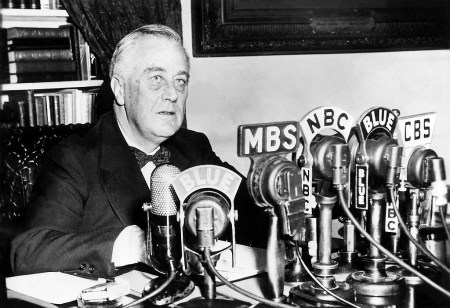
“When you see a rattlesnake poised to strike, you do not wait until he has struck before you crush him.” By these words in a Sept. 11, 1941, fireside chat, Franklin Roosevelt authorized US warships to fire first against Nazi naval vessels, which he called “the rattlesnakes of the Atlantic.”

Roosevelt’s order applied whenever German or Italian ships entered “waters of self-defense” necessary to protect the US, including those surrounding US outposts on Greenland and Iceland.

Franklin D. Roosevelt. (Image source: National Archives and Records Administration/Wikimedia Commons)

Uttered 60 years to the day before 9/11, and less than three months before Pearl Harbor, Roosevelt’s words still resonate. North Korea’s sixth nuclear test last weekend, along with its significantly increased ballistic-missile testing, establishes that Pyongyang is perilously close to being able to hit targets across the continental United States with nuclear warheads, perhaps thermonuclear ones.

The Nazi threat to US shipping, both normal commercial traffic and war supplies destined for Great Britain, was undeniably significant, and the Axis powers’ broader totalitarian threat was existential. Nonetheless, right up to Dec. 7, 1941, many American leaders urged caution to avoid provoking the Axis and thereby risking broader conflict. Pearl Harbor followed.

In his chat, Roosevelt observed that others had “refused to look the Nazi danger squarely in the eye until it actually had them by the throat.” We shouldn’t commit that mistake today. North Korea’s behavior, and its lasting desire to conquer the South, have created the present crisis.

Letting Kim Jong-un’s bizarre regime “have America by the throat,” subjecting us and our allies to perpetual nuclear extortion, is not an acceptable outcome.

We have endured 25 years of US diplomatic failure, with endless rounds of negotiations, presenting North Korea with the choice between economic incentives or sanctions. During this time, which certainly constitutes “not looking the danger squarely in the eye,” North Korea has repeatedly breached commitments to abandon its nuclear-weapons program, often made in return for handsome compensation.

Nonetheless, we hear echoes from Roosevelt’s day that “there is no acceptable military option” when it comes to Pyongyang. This means, as Susan Rice said recently, “we can, if we must, tolerate nuclear weapons in North Korea,” as we did with the Soviets in Cold War days. The US should not accept such counsels of despair, based on dangerously facile and wildly inaccurate historical analogies.

Why accept a future of unending nuclear blackmail by Pyongyang, whose governing logic is hardly that of Cold War Moscow, and which would entail not that era’s essentially bipolar standoff, but a far-more-dangerous world of nuclear multipolarity?

If Washington lets Kim retain his nuclear weapons and ballistic missiles, his regime will happily sell these materials and technologies to Iran, other rogue states or terrorist groups for the right price. This is another key difference from the Cold War; Moscow was substantially more worried about nuclear proliferation than Pyongyang now is.

It would be, as Roosevelt understood, “inexcusable folly” to ignore North Korea’s pattern of behavior over the last quarter century: “We Americans are now face to face not with abstract theories but with cruel, relentless facts.” For America in 1941, hope of sheltering behind the oceans was fast disappearing, forcing Roosevelt to extend our maritime defense perimeter effectively across the Atlantic to Europe.

In the age of ICBMs, there’s no “perimeter”; we are at risk in agonizingly short time frames of a missile’s flight launched anywhere, whether from North Korea or Iran. It is completely unacceptable to say we must await a first strike by Pyongyang before we will resort to military force. Roosevelt dismissed such arguments peremptorily: “Let us not say: ‘We will only defend ourselves if the torpedo succeeds in getting home, or if the crew and passengers are drowned.’ ”

The remaining diplomatic options are few, and the time to exercise them dwindling fast. Convincing China that its national interests would be enhanced by reunifying the two Koreas, thus ending what Beijing itself believes is a threat to peace and security in northeast Asia, remains possible. Unfortunately, this is increasingly hard to accomplish before North Korea becomes a fully mature nuclear-weapons state.

We’re moving rapidly to the point where Roosevelt said squarely, “It is the time for prevention of attack.” George W. Bush spoke equally directly in 2002: “Our security will require all Americans to be . . . ready for preemptive action when necessary to defend our liberty and to defend our lives.” The alternative is potentially global proliferation of nuclear weapons, with the attendant risks lasting beyond our power to calculate.

John R. Bolton, former U.S. Ambassador to the United Nations, is Chairman of Gatestone Institute, a senior fellow at the American Enterprise Institute, and author of “Surrender Is Not an Option: Defending America at the United Nations and Abroad”.

This article first appeared in The New York Post and is reprinted here with the kind permission of the author.

SKorea to deploy more THAAD launchers Thursday

September 6, 2017

SKorea to deploy more THAAD launchers Thursday, DEBKAfile, September 6, 2017

South Korea will add four more launchers to its advanced missile defense system on Thursday amid heightening tensions with North Korea, the South’s Defense Ministry said. The step came after Pyongyang conducted its sixth and most powerful nuclear test on Sunday. Two launchers from the US-made Terminal High-Altitude Area Defense (THAAD) system were deployed in April to counter rising threats from the North.

Meanwhile, South Korean President Moon Jae-in met with Russian President Vladimir Putin on Wednesday in Vladivostok to discuss the North Korea nuclear issue.

When nothing deters the clever brutal tyrant

September 5, 2017

When nothing deters the clever brutal tyrant, Washinton TimesWesley Pruden, September 4, 2017

(Words, words, I’m so sick of words.

Yep. But not in the same context — DM)

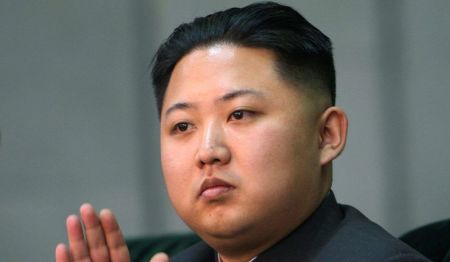
Kim Jong-Un

ANALYSIS/OPINION:

If words were bullets, the crazy fat kid in Pyongyang would have been dead a long time ago, with his ample carcass on display now within a shrine of marble, plaster and tears. But under that goofy haircut there’s a brain that is not so crazy at all.

Words, words, words. Nikki Haley, the U.S. ambassador to the United Nations, says North Korea is “begging for war,” which suggests that North Korea will get it if the begging continues. “Enough is enough. War is never something the United States wants. We don’t want it now. But our country’s patience is not unlimited.”

President Trump telephoned President Moon Jae-in in Seoul and they agreed that the fat kid’s explosion of a hydrogen bomb, underground or not, is not only a grave provocation, but “unprecedented,” too.

One after another, diplomats of America’s more or less reliable European allies, Britain, France and Italy, renewed demands for Kim Jong-un to behave himself, or else be sent to his room without supper. They demand that he halt his nuclear weapons program and ballistic missile scheme, or else — “else” being more of the sanctions that so far haven’t worked.

Francois Delattre, the French ambassador to the U.N., proposes “new” sanctions by the U.N., implementing the sanctions already in place, and new and separate sanctions that also might not work by the European Union. Words, words, words.

Sebastiano Cardi, the Italian ambassador, repeats the chorus as if he were singing the grace notes in an aria from Verdi: “Pyongyang poses a clear threat challenging the global nonproliferation regime.” Mr. Cardi is chairman of the U.N. North Korean compliance committee, and observes that North Korea is the only country to have tested a nuclear device in the 21st century. Mr. Cardi imagines this might shame the fat kid, but Kim takes it as a compliment. He has the toys that the other kids can only envy.

Japan and South Korea have unique critical concerns, sharing a neighborhood with the villains in the North. “We cannot waste any more time,” says the Japanese ambassador, Koro Bessho. “We need North Korea to feel the pressure, that if they go down this road there will be consequences.”

All true, all to the point, but Kim can count it all as just more yada, yada, yada from those he torments. He has his neighbors, and the lord protector the United States, backed into a corner, and he has never had so much fun. He doesn’t mind being the international pariah. He knows the United States dare not put the American boot with its hobnails on his neck, where it could squash him like a bug on the sidewalk, for fear of inviting massive retaliation on Seoul, killing upwards of a million innocents.

Nikki Haley suggests spreading the pain of sanctions, punishing nations that do business with Pyongyang, whether in contraband food and oil, or textiles, the profitable North Korean export so far untouched by the sanctions in place. Tighter limits on exporting North Korean laborers to other nations have been suggested, too. Much of the money these laborers earn is confiscated by the Pyongyang government, and important to the North Korean economy.

Russia and China, always eager to be helpful, suggest bartering Kim’s nuclear threat against the American guarantee of South Korean national security. Eliminate both and every conflict would be resolved, every rough place made smooth and plain. Both Russia and China know this is unacceptable to both Washington and Seoul, and it’s not a solution offered in good faith, anyway.

Some diplomats, pundits and other speculators argue that since nothing else works, returning to “diplomacy,” that vague and formless cure-all that usually cures nothing and invites only more yada, yada, yada, is the way to go. “Jaw, jaw beats war, war,” as Mr. Churchill said, but jaw, jaw has its limits, too.

Doing nothing is what brought the United States — and its allies — to the present moment. Bill Clinton, distracted by staining Monica Lewinsky’s little blue dress and spending the rest of his attention on the hot pursuit of other passing skirts, imagined that sending groceries to North Korea would transform the Kim family into small-d democrats, eager to make the world a happy place. They took the groceries and continued work on splitting the atom. Barack Obama, itching to reduce America’s size in the world, was always ready to make another speech, but not much else.

No one disputes that the way forward is hard, but the threat of an out-of-control regime armed with nuclear bombs and the missiles to deliver them to faraway places, is real and the hour is late. The strategy of three presidential administrations seems fashioned by Mr. Micawber, the Dickens character who could never quite succeed at anything but was always sure that “something will turn up.” Something must, and soon.

• Wesley Pruden is editor in chief emeritus of The Times.