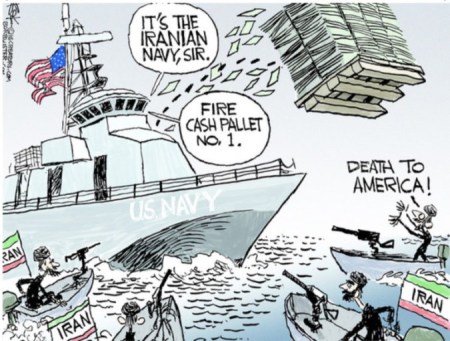
(Might Secretary Tillerson also have intended to give a “hint” to The Islamic Republic of Iran? — DM)
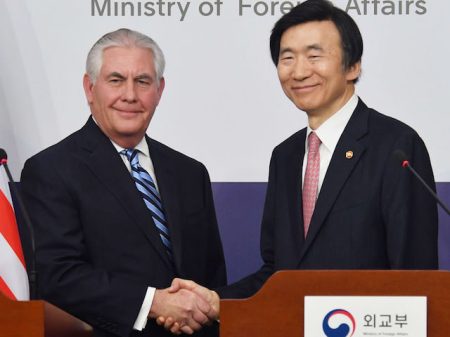
SEOUL, SOUTH KOREA – MARCH 17: (L to R) U.S. Secretary of State Rex Tillerson shakes hands with South Korean Foreign Minister Yun Byung-se during a press conference on March 17, 2017 in Seoul, South Korea. (Photo by Song Kyung-Seok-Pool/Getty Images)
U.S. Secretary of State Rex Tillerson told reporters in Seoul on Friday that the Trump administration is open to military action against North Korea as a last resort, and that the Obama-era policy of “strategic patience has ended.”
“The policy of strategic patience has ended. We are exploring a new range of diplomatic, security and economic measures. All options are on the table,” Tillerson told reporters at a press conference with South Korean Foreign Minister Yun Byung-se. “If North Korea takes actions that threaten South Korean forces or our own forces, that will be met with an appropriate response.”
“If they elevate the threats of their weapons program to the level that we believe requires action, that option is on the table,” Tillerson added. He emphasized that the United States would attempt to avoid to the extent possible any military actions against North Korea, particularly those that may put North Korean civilian lives in danger. “We hope that that will persuade North Korea to take a different course of action. That’s our desire,” Tillerson concluded.
Tillerson also took the opportunity to once again call for China to take on a larger role in containing North Korea’s escalating belligerence and objected to China cutting economic ties with South Korea over the deployment of the America Terminal High Altitude Area Defense (THAAD) missile defense system. “While we acknowledge Chinese opposition, its economic retaliation against South Korea is inappropriate and troubling. We ask China to refrain from such actions. Instead, we urge China to address the threat that makes that necessary,” Tillerson said.
Tillerson is currently in the middle of a three-nation trip to Asia, having left Japan on Thursday and scheduled to meet with leaders in China on Saturday.
The Secretary of State’s remarks regarding potential military action against North Korea follow remarks in Japan that emphasized a “different approach” to the rogue government in Pyongyang. “Part of the purpose of my visit to the region is to exchange views on a new approach,” Tillerson noted on Friday in a press conference with his Japanese counterpart, Foreign Minister Fumio Kishida.
The Trump administration has hinted at a change in America’s approach towards Pyongyang in other venues, as well. Earlier this month, UN Ambassador Nikki Haley told reporters in New York that the White House is “not ruling anything out” to keep North Korea from developing and using nuclear weapons. Haley described the THAAD system as a necessary response to Pyongyang’s insistence on violating UN sanctions with missile launches that could threaten Japan and South Korea. “We are not going to leave South Korea standing there with the threat of North Korea facing them and not help. The reason for THAAD is because of the actions of North Korea,” she said in response to Chinese and Russian opposition.
Following Tillerson’s remarks Friday, President Trump himself issued a warning to North Korea on Twitter:
North Korea is behaving very badly. They have been “playing” the United States for years. China has done little to help!
Tillerson’s message towards China was also similar in Japan: as its largest trading partner, take a more prominent role in containing North Korea. “We look to China to fulfill its obligations and fully implement the sanctions called for,” he said. Anticipating Tillerson’s visit, Chinese Premier Li Keqiang told reporters Wednesday he was “optimistic about the future of China-US relations” and anticipated a positive outcome from Tillerson’s visit. President Donald Trump is reportedly working with Chinese officials to plan a U.S. visit by President Xi Jinping next month.
These statements represent a nearly complete shift away from what former Secretary of State and twice-failed presidential candidate Hillary Clinton described as “strategic patience“: a policy of waiting for the North Korean economy to implode and Pyongyang finding itself no longer able to afford to ignore UN sanctions and the rejection of the international community. This policy largely failed because China continued to trade with North Korea, providing the fellow communist regime a vital lifeline.
The response in Seoul to the new, robust U.S. policy is largely divided along partisan lines, according to the South Korean news agency Yonhap. Conservative leaders have expressed gratitude for Tillerson’s strong support for their country. “We highly appreciate his comments as he expressed a strong willingness to respond to North Korea’s reckless behavior,” Liberty Korea Party spokesman Rep. Choung Tae-ok told Yonhap.
One left-wing leader, in contrast, told Yonhap: “We are supporting the U.S.’s move to strengthen the effectiveness of sanctions against the North through cooperation with relevant countries, but we cannot help expressing concerns about the U.S. stance that there will be no dialogue until North Korea gives up (nuclear weapons).”
North Korea appears to have responded to Tillerson’s presence in the region with the publication of a “human rights white paper” condemning the United States as a serial violator of human rights, condemning the presidential election itself as a human rights violation against the American people and labeling the nation a “human rights desert.”
Haley deserves applause for deflecting the pressures to start bargaining with Kim. Deals with North Korea do not work, and will not work while Kim remains in power. The long record of U.S. talks, deals and attempted talks with North Korea is one of humiliation and failure for the U.S., as North Korea’s dynastic Kim regime has repeatedly pocketed any gains, milked every concession, cheated on every agreement, and carried on with its atrocities and its nuclear missile projects.
Schofer’s words did not quite mesh with Haley’s polite dismissal of pressure for “talks and negotiations.” Rather, Schofer repeated what was for years the refrain of the Obama administration — and of former Secretary of State John Kerry, in particular — offering Pyongyang, under conditions North Korea had previously agreed to, and then violated, the option of returning to the bargaining table:
We have consistently communicated to Pyongyang that we remain open to meaningful negotiations based on the understandings reached by all members of the Six-Party Talks in the 2005 Joint Statement.
As the Trump administration now toils to reduce the threats and clean up the mess bequeathed by Obama’s “global approaches” — including Obama’s gross failure to block North Korea’s prolific nuclear-weapons advances of recent years — perhaps it’s not too much to ask that America’s Mission to the UN in Vienna get entirely on board with the new administration, even if that entails updating its web site to reflect in full that Trump, not Obama, is now the president.
*****************************
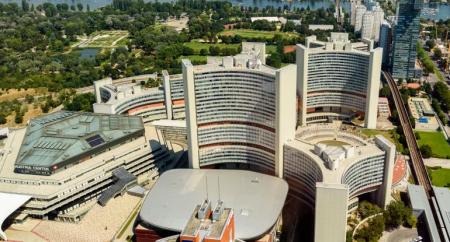
Quite likely you don’t spend a lot of time following the doings of Andrew J. Schofer, a career State Department officer who is currently the Charge d’Affaires at the U.S. Mission to International Organizations in Vienna (UNVIE). Nor was Schofer anywhere high on my radar until this week, when he delivered a statement on North Korea that seemed to me slightly at odds with what Ambassador Nikki Haley was saying at the United Nations in New York. Which sent me to the web site for his legation in Vienna … but before I get ahead of myself on that, here’s a bit more background.
Haley, at a UN press stakeout in New York, following a Security Council meeting this Wednesday on North Korea, said that while the U.S. reevaluates how to handle North Korea, “all options are on the table.” But Haley also went out of her way to imply that the Trump administration is far from eager to accede to pressures, such as those from China, to default to talks or deals with North Korea. Referring to North Korea’s tyrant, Kim Jong Un, Haley told reporters:
I appreciate all of my counterparts wanting to talk about talks and negotiations. We are not dealing with a rational person.
To my mind, Haley may be wrong in her assessment of Kim Jong Un as irrational. We can debate whether Kim is actually a madman incapable of rational calculation, or a wily thug, who in the interest of maintaining his hereditary totalitarian throne has been proving adept, like his forebears, at calibrating what he can get away with in the way of threats, hostage-taking, assassinations, executions, extortion rackets, and nuclear missile projects — all in the interest of consolidating his grip on power and expanding his reach.
But wherever one comes down on the crazy-Kim question, Haley deserves applause for deflecting the pressures to start bargaining with Kim. Deals with North Korea do not work, and will not work while Kim remains in power. The long record of U.S. talks, deals and attempted talks with North Korea is one of humiliation and failure for the U.S., as North Korea’s dynastic Kim regime has repeatedly pocketed any gains, milked every concession, cheated on every agreement, and carried on with its atrocities and its nuclear missile projects.
Which brings me to the statement delivered this Wednesday in Vienna by U.S. Charge D’Affaires Schofer, at a meeting of the board of governors of the International Atomic Energy Agency in Vienna. Schofer’s words did not quite mesh with Haley’s polite dismissal of pressure for “talks and negotiations.” Rather, Schofer repeated what was for years the refrain of the Obama administration — and of former Secretary of State John Kerry, in particular — offering Pyongyang, under conditions North Korea had previously agreed to, and then violated, the option of returning to the bargaining table:
We have consistently communicated to Pyongyang that we remain open to meaningful negotiations based on the understandings reached by all members of the Six-Party Talks in the 2005 Joint Statement.
Whether Schofer on matters involving North Korea is genuinely out of sync with Haley, or with the Trump administration generally, I don’t know. But I do know this: Schofer’s statement was different enough from Haley’s, and similar enough to those of the Obama administration, that after reading it I went looking for more information on the web site of the U.S. Mission currently run by Schofer in Vienna — an important legation, not least, because it represents the U.S. at the IAEA.
It is also, as it turns out, a legation that is in some respects almost two months out of date on a major change at the White House — meaning the inauguration on Jan. 20 of a new president. Perhaps someone at the State Department should remind Schofer that Obama has left office? Here’s an excerpt from the web site of the U.S. Mission in Vienna (boldface is mine):
UNVIE’s mission is to conduct effective multilateral diplomacy with International Organizations in Vienna to advance President Obama’s commitment to design and implement global approaches to reduce global threats and seize global opportunities.
Yes, this is small stuff, in its way — that seven weeks after Trump’s inauguration, the U.S. Mission to International Organizations in Vienna has not gotten around to fully updating its web site. (Surely the problem here is one of carelessness, not political bias among career foreign service officers.) But details matter, especially in the symbolically freighted realms of diplomacy.
As the Trump administration now toils to reduce the threats and clean up the mess bequeathed by Obama’s “global approaches” — including Obama’s gross failure to block North Korea’s prolific nuclear-weapons advances of recent years — perhaps it’s not to much to ask that America’s Mission to the UN in Vienna get entirely on board with the new administration, even if that entails updating its web site to reflect in full that Trump, not Obama, is now the president.
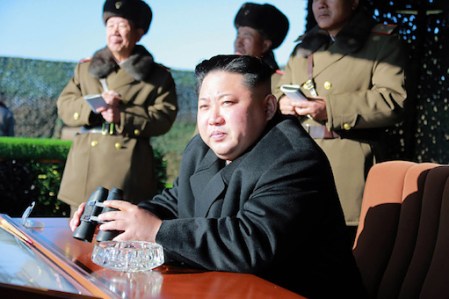
This undated photo released by North Korea’s official Korean Central News Agency (KCNA) on December 11, 2016 shows North Korean leader Kim Jong-Un (C) during a combat drill of the service personnel of the special operation battalion of the Korean People’s Army Unit 525. (Photo credit KNS/AFP/Getty Images)
North Korea could soon have the capacity to launch an attack on Hawaii that would devastate America’s Pacific military bases, accelerating the need for the United States to upgrade missile defenses in the area.
The United States today relies on ground-based ballistic missile interceptors deployed in California and Alaska to protect Hawaii, but these defenses would do little to guard U.S. territory in the Pacific against a North Korean intercontinental ballistic missile (ICBM), which officials believe is nearing completion.
The U.S. Missile Defense Agency in February test fired a new SM-3 Block IIA missile from Hawaii that successfully intercepted an incoming ballistic missile, but the Pentagon does not maintain a permanent missile defense installation or detection capabilities on the Hawaiian Islands.
The Pacific Missile Range Facility in Hawaii hosts an experimental, land-based ballistic missile defense system called Aegis Ashore. The facility served as a prototype for the U.S. missile defense facility in Romania, which was declared operational last year, and another in Poland that will be completed in 2018.
Ariel Cohen, director of the Center for Energy, Natural Resources, and Geopolitics at the Institute for the Analysis of Global Security, told the Washington Free Beacon on Tuesday that the Defense Department needs to immediately upgrade the Aegis Ashore facility in Hawaii from experimental to operational to guard against North Korean aggression.
“Senior national security leaders have stated that the U.S. needs to work off the assumption that North Korea will have ICBM capabilities soon, and in this business ‘soon’ could mean five to 10 years, or earlier,” Cohen said.
“This question is, do we need to wait until North Korea successfully launches a test ICBM to know that they have that capacity? The answer is no … The [Aegis Ashore] is a proven system. Why would we protect our European allies before we protect the homeland?”
Aegis, developed by Lockheed Martin Corp to be used on U.S. Navy destroyers, is one of the most advanced missile defense systems in the world. Deploying the land version of that technology to Hawaii, coupled with Aegis-equipped Navy destroyers, would establish a permanent missile defense installation in the U.S. Pacific that could protect the Hawaiian Islands and the West Coast from a North Korean missile launch.
Converting the Aegis Ashore site from an experimental facility to a combat-ready platform would cost an estimated $41 million, which Cohen described as “inexpensive” compared to typical Defense Department expenditures.
The proposal to improve Hawaii’s missile defense capabilities gained support among defense officials on Monday after North Korea launched four missiles that coincided with joint U.S.-South Korean military exercises in the region.
The U.S. joint chiefs initially believed that at least one of the projectiles launched by North Korea was an intercontinental ballistic missile capable of striking America’s West Coast, but ultimately concluded the projectiles did not have the range of an ICBM.
Defense officials have warned that North Korea is on the brink of producing an ICBM that could target the United States. North Korean leader Kim Jong Un announced in January during his New Year’s address that Pyongyang had “entered the final stage of preparations to test-launch” an ICBM that could reach parts of the United States.
President Donald Trump rejected Kim’s assessment, tweeting after the statement: “It won’t happen!” The administration has not yet established a missile defense plan that would protect the United States from a North Korean ICBM, though it is in the process of reviewing U.S. policy toward North Korea.
Bruce Klingner, a senior research fellow for Northeast Asia at the Heritage Foundation, told the Washington Free Beacon that the administration will likely look at defense and deterrence tactics to use against Pyongyang, rather than diplomatic engagement.
“Our intelligence has been surprised again and again by technology developments by adversaries or attacks the U.S. didn’t foresee,” Cohen said. “Hawaii has a particularly symbolic history of this given the attacks on Pearl Harbor. Let’s not be surprised this time, let’s be prepared.”
Pyongyang has worked for years to improve its missile capabilities, launching an unprecedented number of ballistic missiles in 2016 while conducting its fifth nuclear test in September 2016.
(Kim Jong-un may be insane. Or, like his predecessors, he may pretend to be insane to make predictions about his behavior very difficult and often impossible. China’s leaders are not insane, they are merely devious. Dealing with them has been, and will continue to be, very difficult. — DM)
China waving flag on bad day
At the beginning of the Trump administration, the situation on the Korean peninsula is highly uncertain and potentially volatile. During a late January research trip to Beijing, “uncertainty” and “concerns” were the keywords that best characterized how Chinese scholars and officials are feeling about Trump and the two Koreas. During his presidential campaign, Trump suggested that he would be willing to negotiate with North Korea directly. However, that scenario has become more uncertain in recent months, especially given the hawkish instincts of President Trump and his national security team. Chinese analysts nonetheless expect the US to enlist Beijing’s support on the North Korea issue and are anxiously waiting for Washington to engage so that China can bargain for its preferred outcomes. The prolonged silence from the administration is making Beijing increasingly uncertain and uncomfortable, and complicating its plans to reduce the threat that the United States and its network of alliances in Northeast Asia poses to Chinese security and strategic influence.
Between 2013 and 2016, China tested an alternative alignment strategy on the Korean peninsula. Frustrated with North Korea’s brinkmanship continuously damaging Chinese security interests, President Xi Jinping placed his hope on South Korean President Park Geun-hye to improve China’s strategic position. At the heart of this scheme was an effort to turn South Korea into China’s “pivotal” state in Northeast Asia, thereby undermining the US alliance system in the region and diminishing its threat to China. As a result of Sino-ROK rapprochement, senior-level visits soared, bilateral economic ties strengthened and many South Koreans questioned the utility and future of the US-ROK alliance. In an ideal scenario, China’s new realignment strategy would defeat the US-orchestrated “Northeast Asia NATO” based on America’s alliances with Japan and Korea, and counter the US-Japan alliance with an alignment between China and both Koreas. From the Chinese point of view, this would not only reduce China’s vulnerability vis-à-vis the US, but also lay a firm foundation for Chinese regional predominance.
However, events after the fourth North Korean nuclear test in January 2016 entirely derailed China’s scheme. Overestimating its presumed influence over Seoul, Beijing refused to adequately address South Korea’s legitimate security concerns, which eventually led to Seoul’s decision to deploy the Terminal High Altitude Area Defense (THAAD) system. China sees the THAAD deployment as a threat to strategic stability with the United States and an obstacle to its desired regional blueprint. As such, Chinese policy toward the Korean peninsula has evolved significantly in the last year, reflecting the realization that undermining the US-ROK alliance and turning South Korea into a Chinese strategic asset were both improbable in the near future and raising the prospect that Beijing might not have a choice between the two Koreas after all.
Nonetheless, while China’s ambitious efforts to transform geopolitical alignments on the Korean peninsula did not come to fruition, it still has two other key priorities. First, Beijing has not completely given up its efforts to defeat the THAAD deployment. At a minimum, it hopes that a victory for progressive forces in the upcoming South Korean presidential election, such as the Minjoo Party, could alter Seoul’s deployment plans for the system. While acknowledging that a complete reversal of the deployment decision is unlikely, Beijing hopes that a new South Korean government might delay the initial deployment or reduce the number of deployed units. China sees the propensity of the progressives to engage North Korea, to improve relations with China and to limit the scope of the US-ROK alliance as aligned with its overall strategic agenda. Although China’s ability to sway a South Korean domestic election is limited—for example, by maintaining the implicit sanctions China has imposed on South Korean companies, products and industries for the THAAD deployment—its preference and influence are expected to have an impact.
Second, China hopes to mitigate the impact that any future North Korean intercontinental ballistic missile (ICBM) test might have on its strategic position and influence on the peninsula. The conventional wisdom is that North Korea will not want to conduct the test immediately after Trump’s inauguration, as it will almost certainly block the chance for dialogue with the new US administration and boost the popularity of the conservatives in the South Korean election. However, based on North Korea’s previous pattern of behavior, Chinese experts expect to see provocations in the coming months if Trump chooses to follow Obama’s policy of strategic patience. At the same time, Chinese analysts are inclined to downplay the significance of such an ICBM test, citing the immaturity of North Korea’s long-range missile technology and its likely failure. Still, Beijing will oppose any preemptive strike by the US on the launch site, although it does not fully believe that the US would take such a risky move and jeopardize South Korean security—a fundamental assumption embedded in China’s assessment of the prospects for conflict on the Korean peninsula.
Beijing has always insisted that North Korea’s nuclear development is motivated by Pyongyang’s vulnerability and insecurity, and argued that only the US and North Korea can resolve the stalemate through a peace negotiation. Selfless as it may sound, there is a certain level of hypocrisy in that position. As it has become clear to American officials and experts that strategic patience failed to address the North Korean nuclear threat, there have been more vocal calls to resume US-DPRK dialogue in return for a decision by Pyongyang to suspend its nuclear and missile tests. For China, the danger lies in the unpredictable consequences of such a bilateral negotiation. If the United States and North Korea decide to move ahead with a deal, the improvement of relations between them and the shifting balance of power on the Korean peninsula will diminish what China perceives as its leverage and strategic influence. Therefore, if the Trump administration unilaterally initiates bilateral talks with North Korea, it will be met with suspicion rather than enthusiasm from Beijing.
China’s potential reaction to a North Korean ICBM test all comes down to one question: What does Beijing want? One thing is clear: China wishes to see denuclearization and peace dialogues, but also wants to be an indispensable party in these dialogues to monitor and influence their direction. Beijing believes that the “dual-track” approach (parallel negotiations on denuclearization and a peace treaty) it proposed in 2016 offers the best hopes for achieving its strategic and security goals. Although the Obama administration largely rejected this approach, Beijing sees a new opportunity to try it again with the Trump administration. Trump should understand, however, that China’s position on the Korean peninsula is neither objective nor neutral and that it will view all solutions primarily through the lens of its strategic competition with the United States. As a result, it is important for all the concerned parties to have realistic expectations about a grand bargain with China over North Korea and treat it with extreme caution.
The US-China relationship under Trump is undoubtedly the largest uncertainty in China’s relations with both North and South Korea. If the Trump administration, as appears to be the case, chooses a more confrontational approach towards China, soliciting Beijing’s support and assistance in pressuring North Korea will be exceedingly difficult. A more hawkish stance from the United States will make Beijing instinctively seek more policy leverage, and provocative North Korea behavior that goes unpunished militarily by the United States offers tremendous opportunities for Beijing to be wooed by Americans to rein in Pyongyang. Past experience, including the Cheonan incident, the shelling of Yeonpyeong Island and South Korea’s THAAD deployment, have demonstrated the high level of leniency Beijing will afford Pyongyang when the United States applies greater pressure on China in response to such provocations.
The application of US secondary sanctions on China, which some American officials and experts have discussed, is likely to make China less rather than more cooperative on North Korea. It is unlikely that effective sanctions could be imposed on these entities without poisoning bilateral relations and adversely affecting China’s willingness to cooperate with the US on North Korea. China opposes unilateral sanctions as a general principle, and in particular condemns those that affect Chinese companies or interests. Beijing’s cooperation on the Iran nuclear deal was not incentivized by US sanctions on the Chinese Bank of Kunlun and Zhuhai Zhenrong, but by the opportunities offered for expanding Chinese influence in the Middle East and leveraging its cooperation in overall relations with Washington. In the Chinese view, the North Korea nuclear program, unlike the Iranian case, is much more complicated and sensitive because it directly affects China’s national security, and therefore requires more comprehensive and political solutions.
If the Trump administration’s primary goal is to confront China and thwart Beijing’s regional ambitions, the most effective policy (and the worst nightmare for China) would be a unilateral improvement of relations with North Korea. Whether that is politically possible depends on how far the administration is willing to pursue diplomacy and negotiations to defuse the North Korean threat. On the contrary, pressuring China is unlikely to make it cooperate. Beijing wants a grand bargain over the future of the Korean peninsula conducive to China’s interests. Without a proper endgame to incentivize the Chinese and a policy of dialogue that allows Beijing a key seat at the table, neither pressure nor solicitation will succeed.
Ultimately, the nuclear issue is just one challenge the incoming Trump administration faces in foreign policy. The U.S. needs a new strategy of realist resolution. After years of Obama’s fraying credibility with allies and foes alike, the United States must resume leading. Kim Jong-un and Iranian supreme leader Khamenei are arrogant. If given an inch, they will walk the nuclear mile. And history tells us that great power and totalitarian zealots rarely blend positively.
***********************************
How President Trump should strengthen America’s ICBM-deterrence posture. Like Big Brother in George Orwell’s Nineteen Eighty-Four, North Korean dictator Kim Jong-un holds absolute power. And Kim, the same as his father and grandfather, wants to forcibly unify the Korean peninsula under a xenophobic ideology of self-sufficiency.
Since the end of the Korean War, the Kims’ wacky “Juche” ideology has sparked Western laughter as much as fear. We have rightly assumed the Kims are deterred by their understanding that a conventional-arms conflict with America would destroy them. While the U.S. has had to occasionally reinforce this conventional deterrence, it has been sustained for 60 years.
Over the weekend, Kim Jong-un announced that the North’s development of an intercontinental ballistic missile (ICBM) is advancing rapidly. Unless America appeases him, Kim warned, he will build a “preemptive striking capacity with a main emphasis on nuclear force.” Recently successful rocket tests suggest we should take Kim at his word.
Still, it’s not just North Korea the West should be concerned about here.
Today, alongside other malevolent activities, the Islamic Revolutionary Republic’s ballistic-missile research is advancing unabated. In his wisdom, President Obama decided to exclude a ban on such research from his legacy Iran deal. He lacked the threat-of-force credibility to compel the Iranians to cease their missile development. Unfortunately, when Iran perfects ballistic-missile technology, it will break the nuclear deal. By then, sanctions relief will have made Iran tens of billions of dollars richer.
Collectively, these developments threaten not just the stability of international peace, but the civilian population of the United States. They demand a robust response in U.S. nuclear-deterrent posture. President Trump should deliver it.
First, Trump should reform the Iran nuclear deal to include prohibitions on Iranian ballistic-missile development. This is the realist compromise between scrapping the nuclear deal entirely and attempting to make it work better.
Second, Trump should enforce a new, proactive strategy to deal with North Korea’s increasingly advanced ICBM program. Whereas, in the past, the U.S. has simply monitored North Korean missile tests, stronger action is now required. North Korean ICBMs demand it. After all, the base-minimum range of an ICBM is 3,400 miles. But seeing as 1960s-era Soviet and U.S. ICBMs easily exceeded 6,200-mile ranges, we must assume North Korean ICBMs will exceed the minimum range. And with just 125 miles more than the minimum, North Korea could strike Darwin, Australia. An extra 270 miles would put Anchorage, Alaska, in range. Hawaii, a little over 4,300 miles from North Korea, would also be vulnerable.
Countering this threat, Trump should supplement the U.S military’s multi-phase missile-defense programs. He should publicly announce that if the North tests an ICBM, he will establish three North Korea focused missile-test defense sectors. Trump should be clear that any North Korean ICBM that enters or passes these sectors will be shot down. U.S. military planners would, of course, fine-tune such proposals, but here’s one example of what the defense zones might look like.
Trump could establish a northern sector — focused on protecting Alaska — off the Japanese coast in the Sea of Okhotsk. Second, a western sector — focused on protecting Hawaii and the U.S. west coast — could be set up approximately 1,000 miles west of Midway Island, at the southern tip of the Emperor seamounts. Third, a southern sector — to protect Australia — could be established south of Palau Island between Papua and Papua New Guinea. These sectors should be maintained by U.S. Navy destroyers and cruisers (and hopefully allied assets), equipped with the Aegis missile-defense system.
Next, Trump should clarify his willingness, where facing imminent nuclear attack, to use nuclear weapons in a “first strike” role. That demand is urgent because President Obama has equivocated on this fundamental precept of U.S. nuclear-deterrent posture. Namely, the understanding that U.S. nuclear weapons serve both deterrence (preventing an attack) and capability (destroying an enemy). A retained first-strike capability is necessary to prevent the loss of millions — or tens of millions . . . or hundreds of millions — of American lives in a nuclear showdown. Yes, ideally, the U.S. would be able to use conventional non-nuclear capabilities to achieve that objective. But idealism is a dangerous master. For one, U.S. military pilots might not be able to penetrate enemy air defenses in time to prevent a ballistic-missile attack. Similarly, conventional bunker-busting bombs might not destroy enemy nuclear platforms.
Fourth, Trump should aggressively confront illicit ICBM research-and-development networks. Specifically, Trump should push Pakistan, Russia, and the former Soviet states to take action against smugglers in their nations. In the case of Pakistan and the former Soviet states, such action should be tied to U.S. aid payments. A philosophical evolution of U.S. tactics is equally important here. Put simply, instead of treating nuclear smuggling as a law-enforcement matter, the U.S. must be prepared to coerce or kill those who support the illicit nuclear industry. Fear is always the best guarantor against a nuclear holocaust.
Ultimately, the nuclear issue is just one challenge the incoming Trump administration faces in foreign policy. The U.S. needs a new strategy of realist resolution. After years of Obama’s fraying credibility with allies and foes alike, the United States must resume leading. Kim Jong-un and Iranian supreme leader Khamenei are arrogant. If given an inch, they will walk the nuclear mile. And history tells us that great power and totalitarian zealots rarely blend positively.
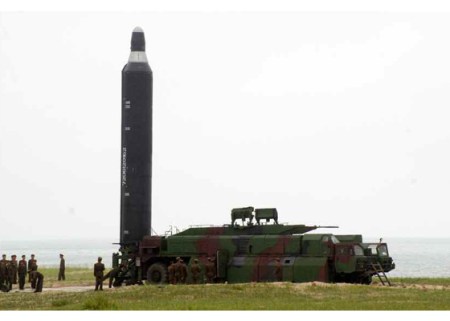
North Korea seems to have tested its Musudan missile seven times this year, with only a single clear success to show for it. But the North Koreans aren’t simply repeating old failures. And they aren’t taking the slow path to developing a reliable system, with a year or so between each test to analyze the data and make improvements. That has been their practice in the past, and it is what we expected this time once they had one successful flight for the cameras. Instead, they are continuing with an aggressive test schedule that involves, at least this time, demonstrating new operational capabilities. That increases the probability of individual tests failing, but it means they will learn more with each test even if it does result in failure. If they continue at this rate, the Musudan intermediate-range ballistic missile could enter operational service sometime next year–much sooner than had previously been expected.
The Musudan (also called Hwasong-10) pictured during a test on June 23, 2016. (Photo: Rodong Sinmun)
There are still many unanswered questions about Friday’s test. The US Strategic Command (STRATCOM) reported that the launch had occurred near the city of Kusong and “exploded immediately after launch.” The North Koreans have not broadcast the sort of propaganda imagery that follows their successful tests, so a failed test of some sort is likely. But STRATCOM has been wrong before about exactly what sort of missile is being tested–misidentifying last month’s Scud-ER test as a trio of Nodong missiles. The Musudan is distinctive enough that it’s unlikely anyone with STRATCOM’s capabilities would mistake it for anything else, but we should still treat this report as unconfirmed.
Assuming it is a Musudan, the noteworthy difference for this test is the location. North Korea’s previous Musudan launches have been from sites associated with their Musudan-ri test facility – that’s not a coincidence; “Musudan” is our name for the missile, not theirs, given because we first saw it at Musudan-ri and didn’t have anything better to call it (the DPRK has referred to this missile as “Hwasong-10″). Musudan-ri is where North Korea keeps the engineers and technicians who built these missiles, with all of their laboratories and workshops. These are the people who figured out how to put grid fins on the Musudan when the first four tests tumbled out of control. People you want looking over your shoulder when you are launching an experimental rocket, but can’t count on being available in wartime.
Moving to a roadside near Kusong is like taking the training wheels off the bicycle, seeing if you really have mastered something new. But Kusong is on North Korea’s west coast, near Pyongyang–why such a long move? One possibility is that a west coast launch allows the North Koreans to achieve a longer range without overflying other countries. Previous tests from Musudan-ri were limited to 400 kilometers or so to avoid Japanese airspace; the North Koreans were able to partially compensate for this by using a lofted trajectory, but probably did not demonstrate the missile’s full performance in an operationally realistic manner. From the west coast, launching south, a North Korean missile could fly 3000 kilometers or more before splashing down in the Philippine Sea.
Another possibility is security. Kusong is home to several secure military sites in the province of Pyongyang, the most heavily guarded territory and airspace in North Korea. It is as close to the Musudan’s likely targets as North Korea can get while still remaining safely north of the DMZ, and so well suited to serve as the Musudan’s operational basing area. If the North Koreans were hoping to hide this test from prying eyes, moving from the east coast to the west clearly didn’t do the job for them–STRATCOM watches the whole country by satellite. But we may have just been given a clue as to where North Korea intends to base its operational Musudan force, once the field crews demonstrate that they can launch the things without factory tech support close at hand.
There is a saying in our military that amateurs practice until they get it right, but professionals practice until they can’t get it wrong. The North Koreans have just shown that they can still get it wrong, but they are still practicing. Let’s review the scorecard. Four tests of the original Musudan configuration, all failed. Two tests of a new configuration with stabilizing grid fins, conducted with full engineering support from Musudan-ri, with one success and one partial success. And now one test in the field, a complete failure. Seven launches in seven months–a rate greater than most US strategic missile programs. After a decade of keeping it on the back burner, the North Koreans are clearly committed to the Musudan. Another seven months of training and practice could bring them to a real initial operational capability. We, and STRATCOM, will be watching closely to see when and where the next tests occur.
(The views expressed in this article are mine and do not necessarily reflect those of Warsclerotic or its other editors. — DM)
In an article titled North Korean Nukes, South Korea, Japan, China and Obama, posted the day after North Korea’s most recent nuke test, September 9th, I contended that China would not honor Obama’s request to make North Korea stop developing and testing nukes. China has remained a faithful ally of North Korea since the end stage of the Korean Conflict and “sees Obama, not as the representative of the world’s greatest power, but as a joke. He has no clout internationally and is a national embarrassment.” NB: I had hoped to publish this article more than a week ago, but my internet was down or at best intermittent from September 13th until September 19th.)
I was right, but it’s a bit worse than I had thought.
U.S. Defence Secretary Ashton Carter reportedly called for further pressure on the DPRK last Friday after the country carried out a new nuclear test and said China bears “responsibility” for tackling the problem. [Emphasis added.]
The essence of the Korean Peninsula nuclear issue is the conflict between the DPRK and the United States, spokesperson Hua Chunying said at a press conference. [Emphasis added.]
As a permanent member of the UN Security Council and a close neighbor of the DPRK, China has made unremitting efforts to maintain peace and stability on the Korean Peninsula and safeguard the international nuclear non-proliferation regime, Hua said.
A statement released by the Foreign Ministry of the DPRK Sunday said the United States compelled the DPRK to develop nuclear warheads, and the nuclear threat it has constantly posed to the DPRK for decades is the engine that has pushed the DPRK to this point. [Emphasis added.]
Blindly increasing the pressure and the resulting bounce-back will only make the nuclear issue on the Korean Peninsula “a firm knot,” Hua said, calling for responsibility from all relevant parties.
Hua reiterated that China will remain committed to resolving issues concerning the Peninsula through dialogue to realize long-term peace and stability.
China strongly urges all parties to speak and act cautiously with the larger picture in mind, avoid provoking each other and make genuine efforts to achieve denuclearization, peace and stability on the Korean Peninsula, Hua said.
. . . .
“We have seen the twists and turns in the situation on the Korean Peninsula since the six-party talks have stalled,” Hua said, noting that it proves that simple sanctions cannot solve the issue. [Emphasis added.]
Hua said the security concerns of parties on the Korean Peninsula must and can only be resolved in a way that serves the interests of all parties.
Any unilateral action based on one’s self-interest will lead to a dead end, and it will not help resolve one’s security concerns but will only aggravate the tension, complicate the issue, and make it more difficult to achieve relevant goals, Hua said. [Emphasis added.]
The six-party talks, involving China, the DPRK, the United States, the Republic of Korea (ROK), Russia and Japan, were a multilateral mechanism aimed at solving the Korean Peninusla nuclear issue. The talks began in 2003 and stalled in December 2008. The DPRK quit the talks in April 2009.
“Resuming the six-party talks is difficult, but we cannot give up easily ,” Hua said.
China will continue to keep close communication with relevant parties and call on them to return to the right track of solving issues related to the Korean Peninsula through dialogue and negotiation, the spokesperson said.
China clearly appears to be following the line of Kim Jong-un on why North Korea needs nukes:
The Obama administration cannot engage in successful negotiations with North Korea, for several reasons. They are, in no particular order: Obama will be gone in about four months; Kerry is Obama’s Secretary of State; The Obama-Clinton-Kerry Iran Scam gave the Islamic Republic everything it sought and, at best, left Iran on the highway to nukes. North Korea and Iran are different in at least one major respect: Iran claimed that it did not have nukes and had not tried to develop them; Supreme Leader Khamenei was claimed to have issued a fatwa against the acquisition, development and use of nukes — despite propaganda videos showing how Iran will use nukes against the “great and little Satan.” North Korea has and has tested five nukes. Kim brags about them and threatens to use them.
The nuke threat
38 North is a think tank largely devoted to obtaining and publishing reliable information about North Korea’s nuke and missile programs. An article there by Siegfried S. Hecker, published on September 12th, concludes:
What are the greatest threats from the rapidly expanding North Korean nuclear program? Left unchecked, Pyongyang will likely develop the capability to reach the continental United States with a nuclear tipped missile in a decade or so. Much more troubling for now is that its recent nuclear and missile successes may give Pyongyang a false sense of confidence and dramatically change regional security dynamics. The likely ability of the DPRK to put nuclear weapons on target anywhere in South Korea and Japan and even on some US assets in the Pacific greatly complicates the regional military picture. That situation would be exacerbated if Pyongyang decides to field tactical nuclear weapons as its arsenal expands and its confidence in its nuclear arsenal grows.
More bombs and better bombs also increase the potential of accidents and miscalculations with greater consequences as the number and sophistication of bombs increase. Rendering the nuclear enterprise safe and secure in case of internal turmoil or a chaotic transition in the North becomes more difficult. We also cannot rule out that a financially desperate leadership may risk the sale of fissile materials or other nuclear assets, perhaps to non-state actors. [Emphasis added.]
So, what to do? The latest nuclear test demonstrates conclusively that attempting to sanction the DPRK into submission and waiting for China to exert leverage over Pyongyang’s nuclear program do not work. Increasing sanctions and adding missile defenses in South Korea to that mix will also not suffice and make China even less likely to cooperate. What’s missing is diplomacy as much as Washington may find it repugnant to deal with the Kim regime.
On September 20th, North Korea announced that it had tested a new long-range rocket engine, suggesting that it “can be used for an intercontinental ballistic missile (ICBM), which is capable, in theory, of hitting targets on the U.S. mainland.” The September 9th nuke test is claimed to have involved “a miniaturized nuclear warhead that could be mounted on a ballistic missile.” How close in North Korea to being able to nuke the U.S. mainland? I don’t know and don’t want to find out by having it happen.
Can diplomacy, even if undertaken by a new administration after Obama leaves office, be successful? Continued sanctions got Iran to engage in negotiations; both Iran and Obama’s America very much wanted the sanctions lifted so that Iran would become an honorable member of the community of nations. There are few if any significant sanctions to lift on North Korea and China will not impose or enforce any; China’s role has been to help North Korea evade sanctions.
[T]he United States should rally the same sort of campaign that revved up the pressure against Iran before those nuclear talks got underway. In other words, the international community should apply sanctions not only against North Korea but also against all institutions that do business with North Korea—an action that would affect some major Chinese banks, which provide it with energy supplies, other goods, and hard currency. [Emphasis added.]
Yes, this would stir tensions in U.S.-China relations; but so do a lot of other actions, many of them instigated by China (for instance, the dodgy territorial claims in the South China Sea), and in this case, any perceptions of American aggression would be offset, to some degree, by a realization—at least by some Chinese officials—that it’s time for Beijing to face up to its problem and reassess its strategic priorities accordingly. (Longtime China-watchers say that some of Xi’s senior comrades have been advocating tougher action against Kim.)
He also suggests that if an end is put to North Korea’s nuclear ambitions and work, America should agree to terminate its no longer necessary THAAD deployments in South Korea and Japan. Further, the next president
should take steps, especially with China, to prevent Pyongyang from deploying a nuclear missile; but if that proves fruitless, he or she should make very clear that North Korea’s use of nuclear weapons—or even a conventional invasion of South Korea (which might be accompanied by a brandishing of nukes to deter anyone from coming to Seoul’s aid)—will be regarded as an attack on the United States and will be dealt with accordingly. There should be no ambiguity about this. Kim Jong-un may be crazy, but his eccentricities have always been in the service of his survival—and he should understand that he’s putting his survival on the line. Daniel Sneider, associate director of Stanford University’s Shorenstein Asia-Pacific Research Center, thinks we should deploy more nuclear-capable aircraft on U.S. bases in Asia to drive this point home fiercely.
It seems worth noting that among the reasons to expect that a Russian-assisted attack on South Korea would be successful, which Kim Il-sung suggested to Stalin in 1950, was that Secretary of State Dean Atcheson had delivered an important address in which he listed the nations to the defense of which America would come if attacked. South Korea was not on the list. As I observed here in November of 2010,
When Kim il-Sung secretly visited Moscow between March 30 and April 25, he assured Stalin that his attack would succeed in three days: there would be an uprising by some two hundred thousand party members and he was convinced that the United States would not intervene. Secretary of State Dean Acheson’s January 12, 1950 speech was persuasive evidence. There, Secretary Acheson had omitted South Korea from a list of nations which the United States would defend if attacked. Stalin gave the go-ahead.
Conclusions
China has encouraged North Korean nuclearization and wants America and her allies, principally South Korea, to cease their “provocations” against the Kim regime. Yet Kim thrives on, and encourages his supporters by, engaging in provocations far more serious and dramatic than anything thus far done by America and South Korea. It seems likely that the North Korean nuke – missile problem will continue until Kim is (a) taken out and (b) replaced with someone less narcissistic and more interested in feeding his people than his ego. Whether such a replacement will emerge is unknown. However, if a Kim clone emerges instead, he seems likely to be more concerned than Kim about his prospects for a long and happy life, even with protection from China.
(The views expressed in this article are mine and do not necessarily reflect those of Warsclerotic or its other editors. — DM)
On September 9th, North Korea conducted its fifth nuke test, of its most powerful nuke thus far. Can Obama get China to help make North Korea stop developing and testing nukes? Nope. China sees Obama, not as the representative of the world’s greatest power, but as a joke. He has no clout internationally and is a national embarrassment.
China and North Korea – a very short history
Here’s a link to an article I posted on June 25, 2013 about the Korean conflict. To summarize, China and the Democratic People’s Republic of Korea (North Korea) have a long history of acting together. China views the Republic of Korea (South Korea), which borders North Korea to the south and is an American ally, as a threat. She does not want reunification of the Korean peninsula under a government favorable to America.
When, on June 25, 1950, North Korea invaded South Korea with Russian aircraft, weaponry, training and other substantial support, China did not assist North Korea. North Korean forces pushed the South Korean government, as well as the few American military advisers (then under the command of the Department of State), south to the Pusan perimeter. Following General MacArthur’s unexpected and successful Inchon invasion which began on September 15th, American and other United Nations forces pushed the North Korean forces back north: MacArthur sent his by then greatly augmented forces east to Wonson and eventually managed to push North Korean forces to the northern side of the Yalu River. However, Chinese forces struck back en masse and MacArthur’s forces were driven back to Seoul.
Ever since bringing to an end MacArthur’s successes in the Korean Conflict, China has supported North Korea. She has opposed, and has then declined to enforce, significant sanctions responsive to North Korean nuclear and missile development and testing. While China may acquiesce in weak UN resolutions condemning North Korean provocations, she rarely goes beyond that.
China, Japan and the two Koreas
China has a long memory and still resents, bitterly, the lengthy period prior to and during World War II when Japan occupied significant parts of China. Ditto South Korea, all of which was under Japanese occupation for a lengthy period prior to and during World War II. Although China has substantial trade with both South Korea and Japan, she is more hostile to Japan than is South Korea; the latter two have substantial mutual interests transcending trade.
Perhaps the most important current dispute between China on the one hand, and Japan-South Korea-America on the other, involves the plans of Japan and South Korea to defend against North Korean missiles by the installation of THAAD anti-missile weapons provided by America. China’s stated reason for opposition to the THAAD system is that it could be used against Chinese, as well as North Korean, missiles. Why does China assert this objection unless she hopes to fire missiles at one or both of them? If China fires missiles at Japan and/or South Korea, they have every right to destroy her missiles and to respond in kind with U.S. assistance if requested.
condemned Pyongyang’s fifth nuclear test today in the “strongest possible terms as a grave threat to regional security and to international peace and stability” as outraged lawmakers from both parties called for tougher action to stop North Korea’s nuclear program. [Emphasis added.]
That may well be all that Obama does — despite the warnings of Rep. Adam Smith (D-Wash.), the top Democrat on the House Armed Services Committee, that
we have to make it absolutely clear that if they engage in any military activity, they will be destroyed. We have to have a credible deterrent. That seems to be the only thing that will stop North Korea from engaging in military action… We have sanctioned them, and we should keep sanctioning them, but it’s not going to stop them from developing the nuclear weapons.” [Emphasis added.]
Obama won’t do that:
In a statement Friday, President Obama vowed to “take additional significant steps, including new sanctions, to demonstrate to North Korea that there are consequences to its unlawful and dangerous actions.”
Obama did not suggest what He might have in mind, beyond historically ineffective sanctions and condemnations “in the strongest possible terms,” to let North Korea know that there will be “consequences.”
A September 9th article at the New York Times provides an unpleasant analysis of the options Obama now has, and which His successor will have, in dealing with North Korea.
A hard embargo, in which Washington and its allies block all shipping into and out of North Korea and seek to paralyze its finances, risks confrontations that allies in Asia fear could quickly escalate into war. But restarting talks on the North’s terms would reward the defiance of its young leader, Kim Jong-un, with no guarantee that he will dismantle the nuclear program irrevocably.
For more than seven years, President Obama has sought to find a middle ground, adopting a policy of gradually escalating sanctions that the White House once called “strategic patience.” But the test on Friday — the North’s fifth and most powerful blast yet, perhaps with nearly twice the strength of its last one — eliminates any doubt that that approach has failed and that the North has mastered the basics of detonating a nuclear weapon.
Despite sanctions and technological backwardness, North Korea appears to have enjoyed a burst of progress in its missile program over the last decade, with experts warning that it is speeding toward a day when it will be able to threaten the West Coast of the United States and perhaps the entire country. [Emphasis added.]
. . . .
Mr. Obama has refused to negotiate with the North unless it agrees first that the ultimate objective of any talks would be a Korean Peninsula without nuclear arms. But Mr. Kim has demonstrated, at least for now, that time is on his side. And as he gets closer to an ability to threaten the United States with a nuclear attack, and stakes the credibility of his government on it, it may be even more difficult to persuade him to give up the program.
In a statement Friday, Mr. Obama condemned the North’s test and said it “follows an unprecedented campaign of ballistic missile launches, which North Korea claims are intended to serve as delivery vehicles intended to target the United States and our allies.”
“To be clear, the United States does not, and never will, accept North Korea as a nuclear state,” he said.
Many experts who have dealt with North Korea say the United States may have no choice but to do so. [Emphasis added.]
“It’s too late on the nuclear weapons program — that is not going to be reversed,” William Perry, the defense secretary under President Bill Clinton during the 1994 nuclear crisis with North Korea, said in August at a presentation in Kent, Conn. The only choice now, he argued, is to focus on limiting the missile program. [Emphasis added.]
Obama has taken no significant steps to limit Iran’s continuing missile development and testing program. How can He limit that of North Korea without Chinese cooperation?
Yet the latest effort to do that, an agreement between the United States and South Korea to deploy an advanced missile defense system in the South, has inflamed China, which argues the system is also aimed at its weapons. While American officials deny that, the issue has divided Washington and Beijing so sharply that it will be even more difficult now for them to come up with a joint strategy for dealing with the North. [Emphasis added.]
China has been so vocal with its displeasure over the deployment of the American system that Mr. Kim may have concluded he could afford to upset Beijing by conducting Friday’s test. [Emphasis added.]
Fueling that perception were reports that a North Korean envoy visited Beijing earlier this week.
“North Korea almost certainly sees this as an opportunity to take steps to enhance its nuclear and missile capabilities with little risk that China will do anything in response,” Evans J.R. Revere, a former State Department official and North Korea specialist, said in a speech in Seoul on Friday. [Emphasis added.]
The breach between China and the United States was evident during Mr. Obama’s meeting with President Xi Jinping last week. “I indicated to him that if the Thaad bothered him, particularly since it has no purpose other than defensive and does not change the strategic balance between the United States and China, that they need to work with us more effectively to change Pyongyang’s behavior,” Mr. Obama said, referring to the Terminal High Altitude Area Defense system, as the advanced missile defense project is known. [Emphasis added.]
North Korea and Iran
Iran and North Korea have a long history of cooperation in developing nukes and missiles with which to deliver them. In the past, Iranian scientists have been present at North Korean nuke tests, and vice versa. They have also assisted each other in the development of nukes and missiles.
Iran and North Korea have substantial reasons to cooperate: by virtue of the Iran scam, Iran now has lots of money but is at least minimally restricted in its nuke development. North Korea has little usable currency, needs whatever it can get, and no attempts to halt or even to limit its nuke development have worked.
Photos released by North Korea of its launch of long-range ballistic missiles are the latest proof of the close military cooperation between Pyongyang and Tehran, an Israeli expert in the field told the news site IsraelDefense on Tuesday.
According to Tal Inbar — head of Space and UAV Research Centre at the Fisher Institute for Air & Space Strategic Studies — what was new in the photos was the shape of the warheads attached to the Nodong missiles, known in Iran as the Shahab-3.
Until now, such warheads — first detected by Inbar in Iran in 2010 — have not been seen in North Korea. At the time, Inbar dubbed them NRVs (or, “new entry vehicles”), which became their nickname among missile experts around the world. [Emphasis added.]
Inbar told IsraelDefense: “The configuration that we saw [on Tuesday] is identical to what we saw in Iran six years ago. In principle, its penetrating body (warhead) is identical to that of Scud missiles, but is mounted on the Shahab-3, and creates a more stable entity than other Shahab/Nodong warheads.”
Inbar said this was the third time that something of this nature had appeared in Iran before it did in North Korea. “But we must remember that the two countries engage in close cooperation where military and space-directed missiles are concerned,” he said. “It is thus possible that both plans and technology are being transferred regularly from one to the other.” [Emphasis added.]
Are North Korea and Iran rational? According to this New York Times analysis, North Korea is.
North Korea’s actions abroad and at home, while abhorrent, appear well within its rational self-interest, according to a 2003 study by David C. Kang, a political scientist now at the University of Southern California. At home and abroad, he found, North Korean leaders shrewdly determined their interests and acted on them. (In an email, he said his conclusions still applied.) [Emphasis added.]
“All the evidence points to their ability to make sophisticated decisions and to manage palace, domestic and international politics with extreme precision,” Mr. Kang wrote. “It is not possible to argue these were irrational leaders, unable to make means-ends calculations.” [Emphasis added.]
Victor Cha, a Georgetown University professor who served as the Asian affairs director on George W. Bush’s National Security Council, has repeatedlyargued that North Korea’s leadership is rational.
I submit that the same analysis, applied to Iran, produces the same result. Iran’s leaders know what they want, and are sufficiently rational to achieve it; they did. Obama, not the leader of a dictatorial theocracy, is sufficiently irrational to believe that what he wants for the Islamic Republic of Iran is what America needs it to have. It is not.
Obama and Iran
Obama’s Iran scam would be farcical were it not potentially deadly. He did not do what would have been best for America and the free world in general — increase sanctions until Iran complied fully with UN resolutions on missile testing, ceased Uranium enrichment and disposed of the means to do it, ceased all nuke research as well as all nuke cooperation with North Korea and ceased supporting all terrorist groups, including Hezbollah and Hamas. Instead, perhaps considering Himself above such trivia, Obama sought little more than what He considered His greatest achievement — His legacy:
Conclusions
If Obama were viewed internationally as the powerful leader of the world’s most powerful nation, He might be able to get China to clamp down, severely and successfully, on North Korea’s nuke and missile development. Were China to reject His overtures, He could arrange for it to wish that it had acceded. That’s not who Obama is, as demonstrated by, among His other actions, entering into the Iran Scam deal with Iran.
Perhaps Kim Jong-un needs to dress like an Iranian mullah to convince Obama to give him a “deal” similar to the one He gave to Iran. He had better hurry: that won’t work with President Trump.
GENEVA — North Korea’s latest test of an atomic weapon leaves the United States with an uncomfortable choice: stick with a policy of incremental sanctions that has clearly failed to stop the country’s nuclear advances, or pick among alternatives that range from the highly risky to the repugnant.
A hard embargo, in which Washington and its allies block all shipping into and out of North Korea and seek to paralyze its finances, risks confrontations that allies in Asia fear could quickly escalate into war. But restarting talks on the North’s terms would reward the defiance of its young leader, Kim Jong-un, with no guarantee that he will dismantle the nuclear program irrevocably.
For more than seven years, President Obama has sought to find a middle ground, adopting a policy of gradually escalating sanctions that the White House once called “strategic patience.” But the test on Friday — the North’s fifth and most powerful blast yet, perhaps with nearly twice the strength of its last one — eliminates any doubt that that approach has failed and that the North has mastered the basics of detonating a nuclear weapon.
Despite sanctions and technological backwardness, North Korea appears to have enjoyed a burst of progress in its missile program over the last decade, with experts warning that it is speeding toward a day when it will be able to threaten the West Coast of the United States and perhaps the entire country.
“This is not a cry for negotiations,” said Victor Cha, who served in the administration of President George W. Bush and now is a North Korea expert at the Center for Strategic and International Studies in Washington. “This is very clearly a serious effort at amassing real nuclear capabilities that they can use to deter the U.S. and others.”
Mr. Cha said the usual response from Washington, Seoul and Tokyo — for another round of sanctions — was not likely to be any more successful at changing the North’s behavior than previous rounds. That means Mr. Obama’s successor will confront a nuclear and missile program far more advanced than the one Mr. Obama began grappling with in 2009.
Mr. Obama has refused to negotiate with the North unless it agrees first that the ultimate objective of any talks would be a Korean Peninsula without nuclear arms. But Mr. Kim has demonstrated, at least for now, that time is on his side. And as he gets closer to an ability to threaten the United States with a nuclear attack, and stakes the credibility of his government on it, it may be even more difficult to persuade him to give up the program.
In a statement Friday, Mr. Obama condemned the North’s test and said it “follows an unprecedented campaign of ballistic missile launches, which North Korea claims are intended to serve as delivery vehicles intended to target the United States and our allies.”
“To be clear, the United States does not, and never will, accept North Korea as a nuclear state,” he said.
Many experts who have dealt with North Korea say the United States may have no choice but to do so.
“It’s too late on the nuclear weapons program — that is not going to be reversed,” William Perry, the defense secretary under President Bill Clinton during the 1994 nuclear crisis with North Korea, said in August at a presentation in Kent, Conn. The only choice now, he argued, is to focus on limiting the missile program.
Yet the latest effort to do that, an agreement between the United States and South Korea to deploy an advanced missile defense system in the South, has inflamed China, which argues the system is also aimed at its weapons. While American officials deny that, the issue has divided Washington and Beijing so sharply that it will be even more difficult now for them to come up with a joint strategy for dealing with the North.
China has been so vocal with its displeasure over the deployment of the American system that Mr. Kim may have concluded he could afford to upset Beijing by conducting Friday’s test.
Fueling that perception were reports that a North Korean envoy visited Beijing earlier this week.
“North Korea almost certainly sees this as an opportunity to take steps to enhance its nuclear and missile capabilities with little risk that China will do anything in response,” Evans J.R. Revere, a former State Department official and North Korea specialist, said in a speech in Seoul on Friday.
The breach between China and the United States was evident during Mr. Obama’s meeting with President Xi Jinping last week. “I indicated to him that if the Thaad bothered him, particularly since it has no purpose other than defensive and does not change the strategic balance between the United States and China, that they need to work with us more effectively to change Pyongyang’s behavior,” Mr. Obama said, referring to the Terminal High Altitude Area Defense system, as the advanced missile defense project is known.
But Mr. Obama noted that sanctions had failed at having much effect. That is largely because the Chinese have left open large loopholes that have kept the North Korean economy alive and, by some measures, enjoying more trade than anytime in years.
In a recent paper, two researchers concluded that sanctions so far “have had the net effect of actually improving” North Korea’s procurement capabilities for its weapons program. To evade sanctions, the North’s state-run trading companies opened offices in China, hired more capable Chinese middlemen and paid higher fees to employ more sophisticated brokers, according to Jim Walsh and John Park, scholars at M.I.T. and Harvard respectively.
The sanctions, Mr. Cha noted, “are supposed to inflict enough pain so the regime comes back to the negotiation table, and that’s clearly not working; or it’s supposed to collapse the regime until it starves, and that’s not working either.”
“Unless China is willing to cut off everything, which they don’t appear willing to do, the sanctions may be politically the right thing to do and a requisite response, but they are not the answer to the problem,” he said.
That means the choices facing Mr. Obama’s successor will be stark. One option is to choke off all trade, in part by telling banks that conduct transactions with North Korea that they will be shut out of dealing in dollars around the world — an effective tactic against Iran before last year’s nuclear deal. But that would enrage the Chinese, and probably cut into cooperation on other issues.
At the same time, an attempt to intercept all shipping could quickly escalate into a full-blown conflict, something neither Mr. Obama nor the South Koreans and Japanese have been willing to risk.
On the other hand, reopening negotiations, which Donald J. Trump has indicated he is willing to consider, could mean paying North Korea again to freeze nuclear activities that the Bush administration and the Clinton administration had already rewarded them for stopping years ago.
The nuclear program dates back to Mr. Kim’s grandfather, Kim Il-sung, the country’s founder, who emerged from the Korean War more than 60 years ago mindful that the United States had considered using nuclear weapons in that conflict and determined to get his own arsenal.
The missile program also has a long history, mostly to deliver conventional arms. But now the two are converging, as the North races to develop a weapon small, light and durable enough to be launched into space and survive re-entry into the atmosphere.
The explosive energy unleashed during the test on Friday, estimated at 10 to 12 kilotons of TNT, was nearly twice that of the North’s last test, conducted in January, said Yoo Yong-gyu, a senior seismologist at South Korea’s National Meteorological Administration.
And the fact that North Korea’s fifth test came only eight months after its fourth is another indication that it is making fast progress toward fitting its ballistic missiles with nuclear warheads, said Choi Kang, a senior analyst at the Asan Institute. The North had waited about three years between each of its previous tests.
North Korea’s advances have unnerved its neighbors in South Korea and Japan, and Mr. Trump’s suggestion that the two nations should pay more for the United States to defend them has not helped.
In both South Korea and Japan, a small but increasingly vocal minority hasbegun to advocate developing nuclear weapons to counter the North instead of relying on the United States.
Cheong Seong-chang, a senior analyst at the Sejong Institute in Seongnam, south of Seoul, argued that a South Korean nuclear program might distract the North from its efforts to build a long-range missile capable of delivering a nuclear warhead to the mainland United States.
“If South Korea arms itself with nuclear weapons, North Korea will regard the South Korean nuclear weapons, not the distant American nukes, as the most direct threat to its security,” Mr. Cheong said.
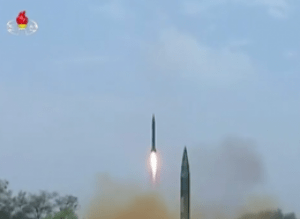
The North Korean launch of the Nodong missiles with Iranian warheads. Photo: Screenshot.
Photos released by North Korea of its launch of long-range ballistic missiles are the latest proof of the close military cooperation between Pyongyang and Tehran, an Israeli expert in the field told the news site IsraelDefense on Tuesday.
According to Tal Inbar — head of Space and UAV Research Centre at the Fisher Institute for Air & Space Strategic Studies — what was new in the photos was the shape of the warheads attached to the Nodong missiles, known in Iran as the Shahab-3.
Until now, such warheads — first detected by Inbar in Iran in 2010 — have not been seen in North Korea. At the time, Inbar dubbed them NRVs (or, “new entry vehicles”), which became their nickname among missile experts around the world.
Inbar told IsraelDefense: “The configuration that we saw [on Tuesday] is identical to what we saw in Iran six years ago. In principle, its penetrating body (warhead) is identical to that of Scud missiles, but is mounted on the Shahab-3, and creates a more stable entity than other Shahab/Nodong warheads.”
Inbar said this was the third time that something of this nature had appeared in Iran before it did in North Korea. “But we must remember that the two countries engage in close cooperation where military and space-directed missiles are concerned,” he said. “It is thus possible that both plans and technology are being transferred regularly from one to the other.”
As was reported in The Algemeiner in July, American intelligence officials said that Iran attempted to launch a new type of ballistic missile based on North Korean technology. The test reportedly ended in failure when the North Korean BM-25 Musudan ballistic missile exploded shortly after lift-off.
In April, as The Algemeiner reported, former US Vice President Dick Cheney’s national security adviser John Hannah used the story of Israel’s 2007 bombing of the North Korean-built nuclear reactor in Syria to warn against Pyongyang’s behavior today. “The greatest threat we face from [Supreme Leader] Kim Jong Un is probably not a suicidal attack against the United States or our allies in Northeast Asia with nuclear missiles. Rather, the more likely danger is that North Korea’s tyrant sells part of his ever-expanding nuclear arsenal to other rogue actors that mean us harm,” Hannah wrote, going on to identify Iran and its Lebanese Shiite proxy Hezbollah as particularly worthy of monitoring.





 anneinpt
 artaxes
 danmillerinpanama
 davidking1530
 Peter Hofman
 Joseph Wouk
 Peter
Peter Louisiana Steve
 WarSclerotic
Recent Comments